



Abstract
This study used multiple-group confirmatory factor analysis procedure to examine the measurement and structural invariance across Malaysian Malay (n = 724), Chinese (n = 372), and Indian (n = 259) parent ratings of their children on the short version of the Parent–Parental Acceptance–Rejection Questionnaire (Parent-PARQ/S). The Parent-PARQ/S measures parents’ perceptions of their rejection of their children and has scales for coldness/lack of affection, hostility/aggression, indifference/neglect, and undifferentiated rejection. Results provided strong support for the measurement and structural invariance of the Parent-PARQ/S. In addition, the three ethnic groups did not differ for all four latent mean scores.
Keywords
The Parental Acceptance–Rejection Questionnaire (PARQ; Rohner, 2005) comprises a group of self-rating questionnaires that measure parental rejection. Among these measures is the short version of the Parent-PARQ (Parent-PARQ/S). The Parent-PARQ/S asks parents to assess the way they now treat their children in terms of rejection. Like all the PARQ measures, this questionnaire is assumed to be valid for cross-cultural studies of parental rejection (Rohner, 2005). If so, this questionnaire needs to demonstrate measurement invariance across different cultural groups in the first instance. To date, this has not been examined. The primary aim of the current study was to use multiple-group confirmatory factor analysis (CFA) procedure to examine measurement invariance of the Parent-PARQ/S across Malaysian Malay, Chinese, and Indian parents’ ratings of their children.
Based on several cross-cultural studies, Rohner and coworkers developed their parent acceptance–rejection (PAR) theory that suggests the children and adults organize their perceptions of their parental acceptance–rejection around the same four groups of behavior or constructs: coldness/lack of affection, hostility/aggression, indifference/neglect, and undifferentiated rejection (Khaleque & Rohner, 2002a; Rohner, Khaleque, & Cournoyer, 2005). Coldness/lack of affection relates to perceptions of very low levels of parental warmth, affection, and love. Hostility/aggression relates to perceptions of parental behaviors associated with anger, bitterness, resentfulness, and physical and/or verbal harm. Indifference/neglect relates to perceptions of parental behaviors reflecting being unconcerned and uninterested. Undifferentiated rejection relates to perceptions of parental behaviors reflecting rejection, but where the expression of rejection is not clearly unaffectionate, aggressive, or neglecting. To measure these constructs, Rohner (2005) developed a number of questionnaires that are collectively referred to as the PARQ.
Currently, there are three versions of the PARQ: Adult-PARQ, Child-PARQ, and Parent-PARQ. The Adult-PARQ assesses adults’ perceptions of their mothers’ or fathers’ treatment of them when they were about 7 through 12 years old. The Child-PARQ asks youths to respond about the way they feel that their parents (mothers or fathers) now treat them; and the Parent-PARQ asks parents to assess the way they now treat their children. All three versions have a long form (60 items) and a short form (24 items). The short forms were developed from items from the long counterparts. In line with the PAR theory, the theoretical model of all PARQ measures is a four-factor oblique model, with scales for coldness/lack of affection, hostility/aggression, indifference/neglect, and undifferentiated rejection.
To date, most of the psychometric data for the PARQ come from the Adult-PARQ. The Adult-PARQ assesses adults’ perceptions of their mothers’ or fathers’ treatment of them when they were about 7 through 12 years old. Meta-analysis of this measure for its internal consistency across many countries has shown homogeneity in the effect size (Khaleque & Rohner, 2002a, 2002b), and factor analytic studies have yielded the same factor structure across many countries (e.g., Comunian & Gielen, 2001; Rohner & Cournoyer, 1994). These findings raise the possibility of, but do not guarantee, measurement equivalency or measurement invariance of the PARQ across different cultural groups. For a rating scale, measurement invariance deals with whether the items in the rating scale have the same scale properties when completed by individuals from different groups, such as boys and girls (Brown, 2006). If there is weak or no support for invariance, then it follows that the individuals from the different groups examined cannot be justifiably compared on the raw scores as the raw scores are confounded by differences in measurement and scaling properties that are group specific. The opposite is the case when there is support for measurement invariance.
A powerful method for testing invariance is multiple-group CFA. This procedure can test invariance for the measurement and structural components of a model. For the measurement model, it can test for configural invariance (equality for form across groups), metric invariance (equality for factor loadings across groups), thresholds invariance (equality for responses to response categories across groups), and error variances invariance (equality for uniqueness across groups). For the structural model, it can test for invariance for factor variances and covariances across groups, and compare the groups for latent mean scores. To date, only one study has examined invariance across national groups for the PARQ (Gomez & Rohner, 2011). The study found support for all types of measurement and structural invariance across ratings of the Adult-PARQ provided by Australian and U.S. adults. Despite this and in view of the limited cross-cultural data for the PARQ, it seems prudent to conduct more studies in this area, involving other versions of the PARQ and for other cultures.
Among the group of PARQ measures is the short version of the Parent-PARQ or Parent-PARQ/S (Rohner, 2005). As noted previously, this measure asks parents to assess the way they now treat their children, and it provides scales for measuring coldness/lack of affection, hostility/aggression, indifference/neglect, and undifferentiated rejection. A recent study examined the factor structure, reliability, and validity of this measure (Gomez & Suhaimi, 2014). It also examined its measurement invariance for parent ratings of boys and girls, and mothers’ and fathers’ ratings of their children. Findings based on CFA indicated only marginal fit for the original four-factor model. There was excellent fit for an alternate four-factor model in which Item 13, which loads in the original model on the indifference/neglect factor, was loaded on the coldness/lack of affection factor instead. Figure 1 shows the path diagram of the revised model (henceforth referred to as the adjusted four-factor model). The adjusted model showed acceptable internal consistencies (Cronbach’s α coefficients) for all factors (ranging from .77 to .65), with all factors correlating significantly and positively with childhood emotional and behavioral problems. Also, the study found measurement and structural invariance across parent ratings of boys and girls; mothers’ and fathers’ ratings of their children. Taken together, these findings indicate good support for the psychometric properties of the Parent-PARQ/S. It is to be noted that apart from the study just described, no other study has reported on the psychometric properties of the Parent-PARQ/S. This means that unlike the Adult-PARQ, we do have any information on the measurement equivalency of the PARQ/S across different cultural groups.
Culture has been defined by Hofstede (1980) in terms of the collective programming of the mind that distinguishes the members of one group of people from another group. Central to this distinction are values, attitudes, beliefs, and practices. Such a view recognizes cultural homogeneity of different groups within the same nation, as well as cultural heterogeneity of different groups within the same nation. As pointed out by Hofstede, nations can have many cultures, and cultures can bridge more than one nation. Malaysia is a good example of a nation with multiple cultures. The Malaysian population includes 50.5% Malays, 24.2% Chinese, and 7.1% Indians (Department of Statistics Malaysia, 2010). The Malaysian Government recognizes these groups as distinct ethnic–cultural groups (emic).
Although there are similarities in these groups, such as being collectivistic, there are also differences. The value system of the Malays is embedded in the budi complex, which is central to Malay values, attitudes, and behaviors toward the self and others. According to Dahlan (1991), these include being polite, generous, respectful, sincere, righteous, discrete, feeling shame at the individual level, and knowing that stresses intuitive feelings. Together, they interact to provide norms of individual and social behaviors that lead to approval from others (Dahlan, 1991). The value system of Malaysian Chinese is primarily Confucianism fused with Buddhism and Taoism. According to Tu (1979), the core values of Confucianism are derived from the concept of ren (goodness, humanity) that relates to the highest human achievement reached through moral self-cultivation. In terms of Hofstede’s (1980) cultural dimensions, Idris (2011) found that Malaysian Malays were more individualistic and more uncertainty avoiding than Malaysian Chinese. They did not differ for masculinity, power distance, and time orientation. Based on liberal interpretations of studies involving other related attitudes and practices, Lrong (1998) concluded that relative to Malaysian Chinese, Malaysian Malays have lower masculinity and higher uncertainty avoidance and power. Zawawi (2008) examined the similarities and differences of cultural values among Malaysian Malays, Chinese, and Indians. Findings showed that all three groups were similar in terms of politeness. The Malays and the Chinese were similar for ambition, filial piety, honesty, knowledge, and trustworthiness, whereas the Malays and Indians were similar for piousness. The Chinese and Indians were similar for rituals and traditions. Overall, therefore, based on Hofstede’s definition of culture, Malaysian Malays, Chinese, and Indians can be viewed as culturally distinct groups.
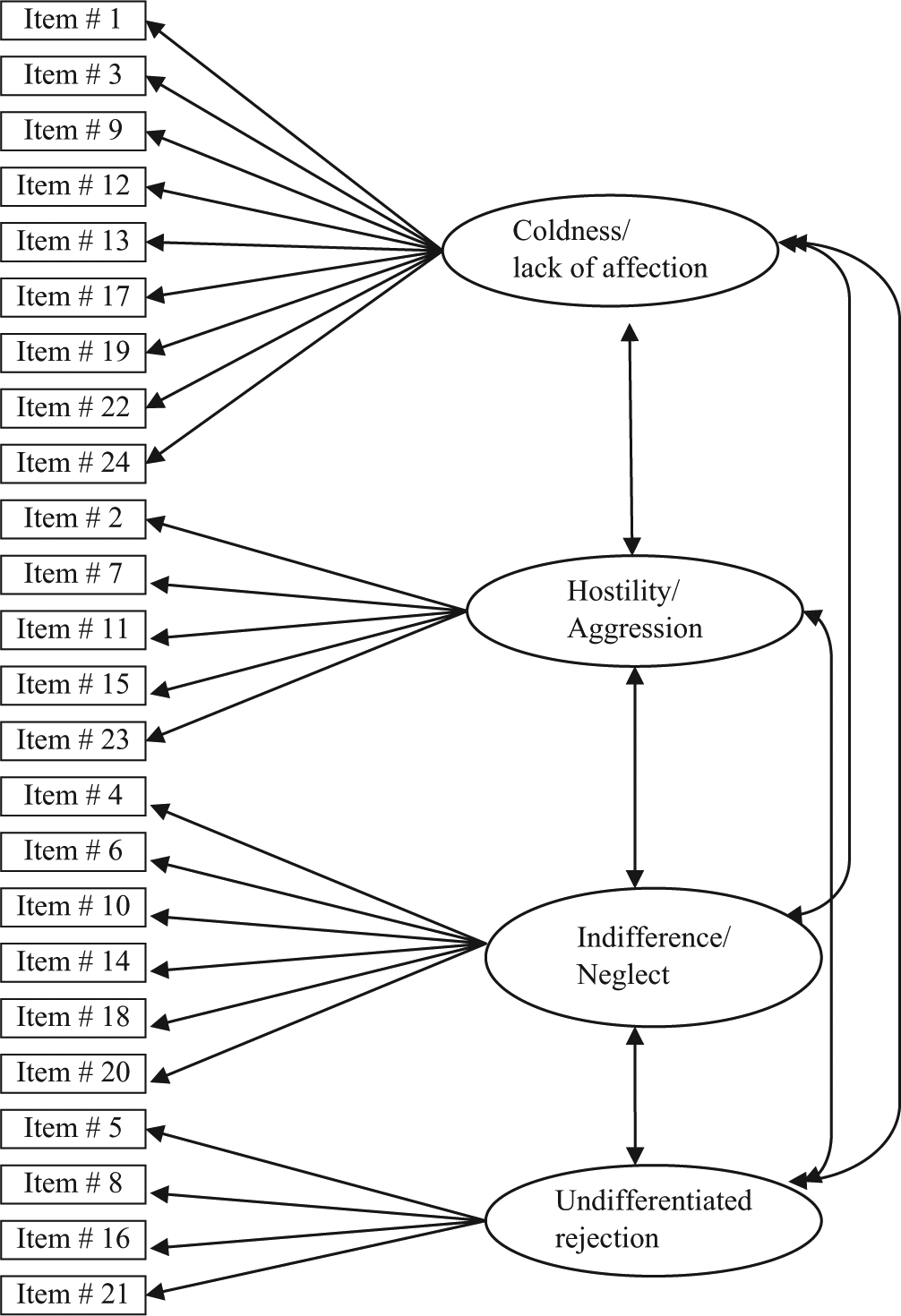
Path diagram of the adjusted four-factor PARQ model used in the multiple-group CFA analyses.
The different cultural values of Malays, Chinese, and Indians can be expected to influence their attitudes and behaviors differently, including parenting style and interactions with their children (Keshavarz & Baharudin, 2009). Consistent with this, Ang (2006) found different effects for parenting styles on Malay and Chinese adolescents’ personal and social behaviors. Bao and Xu (2006) found that Malaysian Malay adolescents were more attached to their parents and peers, compared with Malaysian Chinese adolescents. Quah (2004) examined differences in parenting styles and expectations across Malay, Chinese, and Indian parents in Singapore (Malaysia’s neighbor). She found that in comparison with Indian and Malay parents, Chinese parents were more likely to consider physical punishment (in contrast to reasoning and rules) as being effective for disciplining children and were less likely to demonstrate their affection by hugging, kissing, and holding their children. Between Indian and Malay parents, Indian parents were less indulgent, stricter, and had higher expectation of behavior discipline and standards from their children. Consistent with the findings for Chinese parents, Chi, Baharudin, & Hossain, 2012) showed that Malaysian Chinese parents use relatively more authoritative parenting styles (characterized by high control over children and emphasizing conformity, discipline, and obedience from children) than authoritarian (parenting that display democratic and negotiated interactions and warmth, and encouragement of independence in children) and permissive (non-demanding, non-controlling) parenting styles. Indeed, Confucianism, which is central to Chinese values, requires Chinese children to be obedient, self-disciplined, hard-working, and achievement-oriented, and for Chinese parents to train (guan) their children directly through high levels of control and very close monitoring. Given such cultural differences (including ethnic and parenting differences), it is conceivable that they would differentially affect parental perceptions and acceptability of their children’s behaviors. In brief, Chinese parents can be expected to require better child behavior standards and are likely to be less tolerant of their children’s “misbehaviors” than Indian and Malay parents. Also, Indian parents can be expected to require better child behavior standards and are likely to be less tolerant of their children’s “misbehaviors” than Malay parents. Given these differences, it is conceivable that Chinese, Malay, and Indian parents could have different interpretations of comparable parenting behaviors that could differentially influence their responses on the Parent-PARQ. This could, in turn, contribute to lack of measurement invariance across their ratings.
The aim of this study was to use multiple-group CFA to test measurement and structural invariance across Malaysian Malay, Chinese, and Indian parent ratings of their children for the Parent-PARQ/S. As our previous study involving the same sample as in this study showed strong support for the adjusted four-factor model, we used this model in all our analyses. It was speculated that as there is evidence of parenting differences across Malay, Chinese, and Indian parents, there will be some degree of non-invariance across their ratings.
Method
Participants
The participants were 1,382 caregivers (primarily parents, and henceforth referred to as parents) of primary schoolchildren from 12 schools in Klang Valley of the State of Selangor in Malaysia. This state was selected as it is highly representative of the ethnic distribution of West Malaysia. The respondents provided ratings for 603 (43.6%) boys and 779 (56.4%) girls, aged between 5 and 13 years. The mean age (SD) for boys was 9.79 years (1.78), and it was 9.92 years (1.81) for girls. There was no significant difference for age between boys and girls, t(1,380) = 1.25, ns. In terms of ethnicity, 729 (52.4%) were Malays, 372 (26.9%) were Chinese, 259 (18.7%) were Indians, and 27 (2.0%) belonged to the other categories. For Malaysia as a whole, the figures are 61.5% Malays, 26.4% Chinese, and 10.5% Indian (Department of Statistics Malaysia, 2010). The distribution of the ethnic groups in the study sample did not differ significantly from the Malaysian population, χ2(2) = 3.03, ns. In terms of educational attainment, most parents completed primary and secondary education, and the majority of fathers were in skilled/semi-skilled (e.g., technicians and associated technicians, 25%) and service-related (e.g., service workers in shops and markets; 40%) occupations. Professionals (e.g., teachers, nurses, doctors, etc.) constituted around 10%. Mothers completed 1,101 (79.7%) of all the parental ratings. Father completed 222 (16.1%) ratings.
Measure
The measure of relevance in this article is the Parent-PARQ/S. The Parent-PARQ/S, completed by parents, has 24 items that measure parental acceptance and rejection of their children and adolescents. It has four scales: coldness/lack of affection (eight items), hostility/aggression (six items), indifference/neglect (six items), and undifferentiated rejection (four items). All items in the coldness/lack of affection scale are worded to measure warmth/affection. When they are reversed scored, they indicate coldness/lack of affection. Sample items in the Parent-PARQ/S include the following: “I say nice things about my child” (original warmth/affection); “I hit my child even when she/he may not deserve it” (hostility/aggression); “I pay no attention to my child” (indifference/neglect); and, “I see my child as a big nuisance” (undifferentiated rejection). Each item is rated on a 4-point Likert-type scale, from 4 (“almost always true”) to 1 (“almost never true”). For scoring, all the eight items in the coldness/lack of affection scale, and one of the items (Item 13, “I pay a lot of attention to my child”) on the indifference/neglect scale, which is positively worded, are reverse-scored. For the current sample, the Cronbach’s α coefficient was .73 for all the full scales. The Cronbach’s α coefficients were .74, .69, .72, and .65 for the coldness/lack of affection, hostility/aggression, indifference/neglect, and undifferentiated rejection scales, respectively.
Parents were provided both English and Malay versions of the Parent-PARQ, with instructions to select any one version. The Parent-PARQ was translated to Malay for this study via forward and backward translation by experts in both languages. A bilingual university professor made the forward translation from English to the Malay language, whereas a graduate professional officer made the backward translation for the translated Malay version to English. Following this, the differences between the backward translated English version and the original English version as they related to the translated Malay version were resolved by discussion involving both the individuals involved in the translation process and a trainee clinical psychologist competent in both Malay and English. This resulted in the final Malay version that was used in the study. In all, 831 parents completed the Malay version and 577 parents completed the English version. Our previous study has shown equivalency across the Malay and English language versions (Gomez & Suhaimi, 2014).
Procedure
Prior to data collection, ethical approval for the study was obtained from the University of Tasmania Social Sciences Human Research Ethics Committee. Following this, approvals were sought from the relevant authorities for distributing the relevant documents, including the dissemination of the Parent-PARQ/S to parents through schools. Initially, approval was obtained from the Research Promotion and Coordination Committee, Economic Planning Unit (EPU), Prime Minister’s Department, Malaysia, to conduct the research through the primary schools in Klang Valley in the State of Selangor in Malaysia. Following this approval, additional approvals were obtained from State Department of Education for both Federal Territory of Kuala Lumpur and Selangor.
According to the Department of Statistics Malaysia (2010), the 2010 midyear population census showed the Klang Valley population had 26% of the total Malaysian population of 28.5 million. Schools in this region were selected for participations using the multi-stage random sampling technique (Calmorin & Calmorin, 2007). Accordingly, the schools were divided into a hierarchy of units and random sampling, with probability proportional to size, applied to select schools. Briefly, the districts and zones located in the Klang Valley region were divided into two first stage units: the State of Selangor and the Federal Territory of Kuala Lumpur. Two out of the four Selangor districts and one of the four Federal Territory zones were randomly chosen to be included in the study. The units were the Petaling districts, Hulu Langat districts, and Bangsar zone. There were a total of 269 schools in these units (50% from Petaling district; 32% from Hulu Langat district; 18% from Bangsar Zone). Based on the list of the school postcodes, nine schools from Petaling district, six schools from Hulu Langat district, and three schools from Bangsar zone were selected using a random number generator. Eighteen primary schools in the Klang Valley region made up the ultimate units. Principals of the selected schools were contacted to further determine their interest in participating in the study. Out of the 18 schools contacted, 14 agreed to receive information regarding the study. Finally, 12 schools agreed to participate.
Following approvals from the school principals of the 12 schools, classroom teachers were issued with the appropriate number of large sealed envelopes to be forwarded to parents, through their students. Each envelope included a plain language statement providing the background of the study and the Parent-PARQ/S. To minimize bias in ratings, the letter to parents indicated that the study was examining aspects of childhood behavior. Parents were requested to participate in the study by completing the Parent-PARQ/S. They were also asked to provide the child’s age, gender, and ethnic background. Parents were requested to return the completed questionnaires to the teachers through their children. The researcher then collected the completed envelopes from the schools.
About 2,500 parents of primary schoolchildren were invited to take part in the study. In all, 1,407 parents responded, giving a response rate of 56.3%. Of these, 1,382 parents provided usable Parent-PARQ/S ratings. Mothers completed 1,101 (79.7%) of all parental ratings. Father completed 222 (16.1%) ratings. Of the 1,382 ratings, 59 (4.3%) did not provide this information. In terms of language versions, 561 parents completed the original English version of the Parent-PARQ/S, and 811 parents completed the translated Malay version of the Parent-PARQ/S.
Statistical Procedures
All the CFA analyses in the study were conducted using Mplus (Version 6.1) software (Muthen & Muthen, 2010), and they used the mean and variance–adjusted weighted least squares (WLSMV). This is a robust estimator for ordered-categorical scores. According to Brown (2006), the WLSMV estimator provides the best option for modeling categorical data.
Multiple-group CFA measurement invariance was tested using the procedure proposed by Millsap and Yun-Tein (2004) for the WLSMV estimator with theta parameterization. In brief, this procedure involves comparing progressively more constrained models that test for measurement invariance: configural invariance (equality for form), metric invariance (equality for factor loadings), thresholds invariance (equality for responses to response categories), and error variances invariance (equality for uniqueness). According to Millsap and Yun-Tein, for baseline model identification, the following restrictions are necessary: (a) The factor loadings of the scaling indicators must be set to 1 for all group; (b) the thresholds of these scaling indicators must be constrained to be equal across all groups; (c) for all other indicators, their first threshold and additional thresholds (if needed) need to be constrained equal across groups; and (d) residual variances need to be constrained to 1 in the first group and to be freely estimated in the other groups. When there is some support for measurement invariance (full or partial), structural invariance (equivalency for factor variances and covariances) can be examined. Also, when there is some support for measurement invariance, the groups can be compared for latent mean scores, taking into account the non-invariance in the measurement model.
The goodness-of-fit of the CFA models was examined using WLSMVχ2. Like all other χ2 values, WLSMVχ2 values are also inflated by large sample sizes. In addition to the WLSMVχ2, Mplus also provides approximate (or practical) fit indices. These are the root mean squared error of approximation (RMSEA), the comparative fit index (CFI), and the Tucker–Lewis Index (TLI). These approximate fit indices were also used in this study to evaluate the goodness-of-fit of models. The guidelines suggested by Hu and Bentler (1998) are that RMSEA values close to 0.06 or below be taken as good fit, 0.07 to <0.08 as moderate fit, 0.08 to 0.10 as marginal fit, and >0.10 as poor fit. For the CFI and TLI, values of 0.95 or above are taken as indicating good model-data fit, and values of 0.90 and <0.95 are taken as marginally acceptable fit. The various CFA invariance models were compared using the WLSMVχ2 difference test that was computed using the option available in Mplus. An α value of .01 was used to allow for more stringent Type 2 error control in models compared.
Results
Single Group CFA of the Adjusted Four-Factor Model for the Different Ethnic Groups
Initially, the fit values of the adjusted four-factor model were examined separately for ratings provided by Malay (n = 724), Chinese (n = 372), and Indian (n = 259) parents. The fit indices of Malay ratings were χ2(df = 246) = 536.24, p < .001, RMSEA = 0.040, CFI = 0.969, TLI = 0.965. The fit indices of Chinese ratings were χ2(df = 246) = 395.63, p < .001, RMSEA = 0.040, CFI = 0.971, TLI = 0.967; and the fit indices of Indian ratings were χ2(df = 246) = 392.76, p < .001, RMSEA = 0.048, CFI = 0.959, TLI = 0.954. The RMSEA, CFI, and TLI values for all three cultural groups indicated good fit, thereby supporting the construct validity of the adjusted four-factor model of the Parent-PARQ/S for all three ethnic groups.
Multiple-Group CFA for Invariance Across the Different Ethnic Groups
Table 1 shows the results of the analyses for invariance testing across Malay, Chinese, and Indian parent ratings. In these analyses, the Malay group served as the reference group. As shown, the goodness-of-fit values for the configural model (M1) were WLSMVχ2(df = 788) = 1363.87, p < .001; RMSEA = 0.040; CFI = 0.967; and TLI = 0.965. Thus, the RMSEA, CFI, and TLI values indicated good fit for the configural model. These values provide sufficient support for configural invariance. Table 1 shows that there was no difference between (a) the configural model (M1 in Table 1) and the metric invariance model (M2 in Table 1), ΔWLSMVχ2(df = 40) = 48.57, ns; and (b) the thresholds invariance model (M3 in Table 1) and the metric invariance model (M2 in Table 1), ΔWLSMVχ2(df = 38) = 37.42, ns. These findings indicate support for equivalence for all factor loadings and thresholds across the three groups. The error variances invariance model (M4 in Table 1) differed from the metric invariance model (M2), ΔWLSMVχ2(df = 86) = 135.84, p < .001. This finding indicates lack of support for equivalence for one or more error variances across the groups. Additional analysis indicated non-invariance for error variances of only one item, and this being for Item 16 (“I make my child feel unloved if he/she misbehaves”), which is part of the undifferentiated rejection factor. For this item, Indians had lower error variance than the Malay and Chinese groups (completely standardized values: Malay = .720, Chinese = .705, Indian = .587). Taken together, however, these results provide quite good support for the measurement invariance of the PARQ across the ratings provided by Malay, Chinese, and Indian parents.
Results of Tests for Invariance Across PARQ Ratings of Malay, Chinese, and Indian Parents.
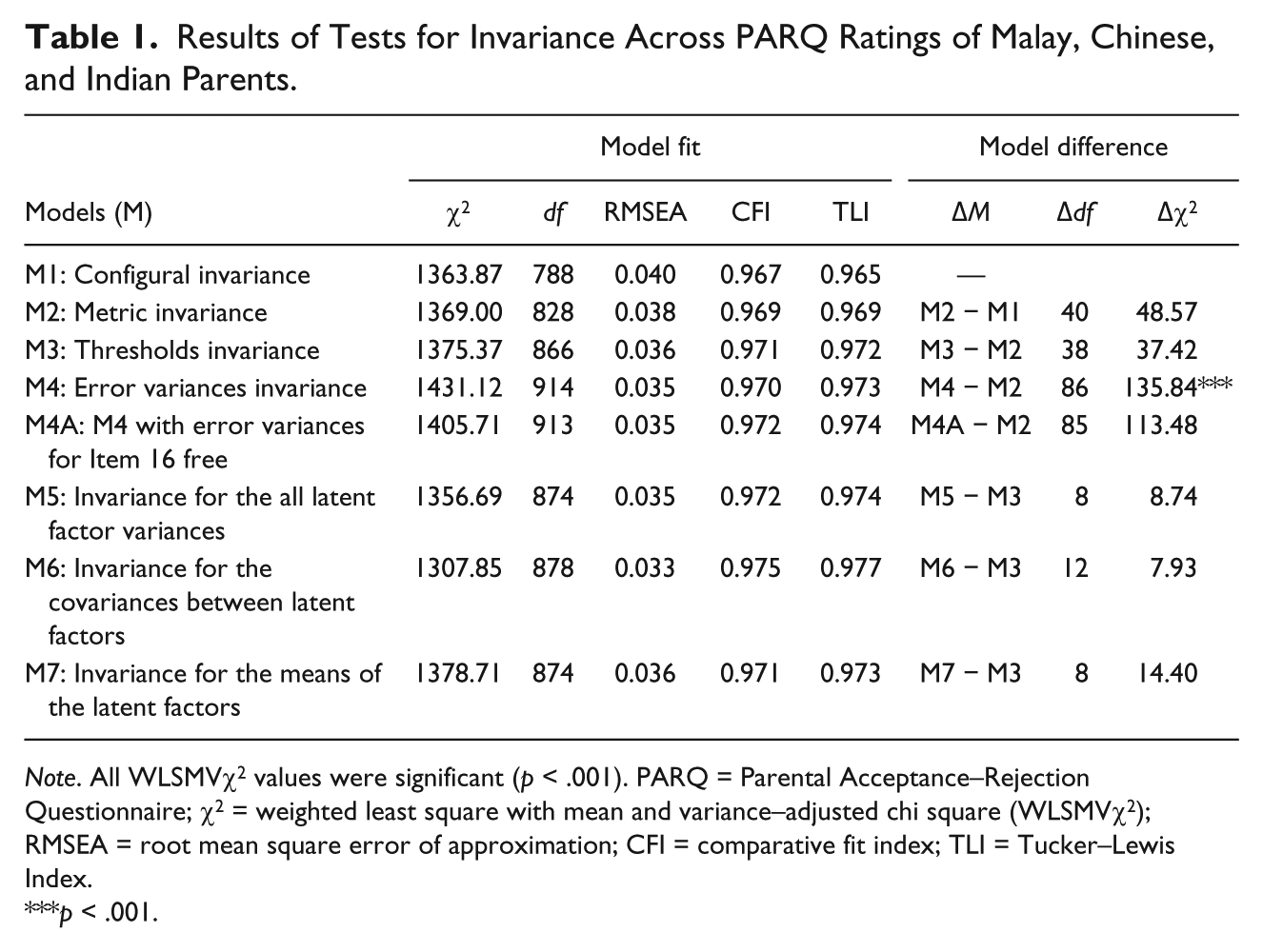
Note. All WLSMVχ2 values were significant (p < .001). PARQ = Parental Acceptance–Rejection Questionnaire; χ2 = weighted least square with mean and variance–adjusted chi square (WLSMVχ2); RMSEA = root mean square error of approximation; CFI = comparative fit index; TLI = Tucker–Lewis Index.
p < .001.
As also shown in Table 1, for the structural model, there was support for invariance for all factor variances and covariances (M5 and M6, respectively, in Table 1) as these models did not differ significantly from the thresholds invariance model (M3 in Table 1), ΔWLSMVχ2(df = 8) = 8.74, ns; and ΔWLSMVχ2(df = 12) = 7.93, ns, respectively. As shown in Table 1, the analysis showed support for invariance for the factor mean scores model (M7 in Table 1), as this model did not differ from the thresholds invariance model (M3 in Table 1), ΔWLSMVχ2(df = 8) = 14.40, ns.
Discussion
The aim of the current study was to use multiple-group CFA analyses to examine measurement and structural invariance for Malaysian Malay, Chinese, and Indian parent ratings of their children on Parent-PARQ/S. For the measurement model, the findings showed support for the configural model (same pattern of factor structure), and for full measurement invariance for the metric (same factor loadings), and thresholds (same response categories) models. Of the 24 items in this questionnaire, 23 items showed invariance for error variances (same unique variances). The item that did not show invariance was Item 16 (“I make my child feel unloved if he/she misbehaves”), which is part of the undifferentiated rejection factor. For this item, Indians had lower error variance than the Malay and Chinese groups. Although the test for error variances is often included during invariance testing, most methodologists consider this test as overly stringent and unnecessary (Brown, 2006). Taken together, therefore, the results can be taken as providing very good support for the measurement invariance of the Parent-PARQ/S across the ratings provided by Malaysian Malay, Chinese, and Indian parents. This means that the ratings provided by these groups of parents have the same measurement and scaling properties, and therefore, their observed scores can be compared directly.
For the structural model, the findings showed invariance for all factor variances and covariances. This means that the scores for the four latent factors (hostility/aggression, indifference/neglect, and indifference/neglect) in the adjusted four-factor model do not differ for ratings provided by Malaysian Malay, Chinese, and Indian parents in terms of their variability and intercorrelations, respectively. The findings for the structural model also showed no difference between Malay, Chinese, and Indian parent ratings for the latent scores for coldness/lack of affection, hostility/aggression, indifference/neglect, and indifference/neglect. All the invariance findings suggest that the cultural differences of Malays, Chinese, and Indians that influence the way parents treat and interact with their children (Ang, 2006; Bao & Xu, 2006; Quah, 2004) appear not to differentially influence the way they rate their children on the Parent-PARQ/S. However, this does not imply that cultural factors are irrelevant for understanding parenting behaviors and attitudes. It may be that such factors are relevant for understanding other issues, such as the processes in play that lead to similar parenting behaviors and attitudes across different cultural groups.
At a general level, the findings support the use of the Parent-PARQ/S for cross-cultural studies of parental rejection (Rohner, 2005). However, because this study only involved three cultural groups in one nation, more studies are needed to establish whether this can be generalized to cultures in other countries. Furthermore, although the findings in this study have been interpreted in terms of cross-cultural invariance for the Parent-PARQ/S, this interpretation is based on the assumption that the Malay, Chinese, and Indian communities in Malaysia are culturally distinct. However, if this assumption is incorrect to start with, then it is inappropriate to interpret the findings as clear evidence of equivalence across the cultural groups. Culturally, Malay, Chinese, and Indian communities are all collectivist groups. In addition, as proposed by Tu (2003), as traditional non-Western communities modernize, their traditional values undergo a transformation that represents a mixture of both the traditional and modern Western values. Because Malaysia is an industrialized modern society, influenced by Western values and institutions, it can be expected that both modern Western and culture-specific values exist in Malaysia, with Chinese, Malays, and Indians sharing a common set of the core modern Western values. It is possible that these common core Western values as they relate to parenting practices (rather than their specific culture values) play the dominant role in influencing their parenting practices and attitudes. This means that in reality, the different cultural groups compared in the current study may not be as distinct as suspected in terms of parenting practices. However, it is unlikely that this is the case as there is evidence of different cultural values among Malays, Chinese, and Indians (Zawawi, 2008), and also different parenting styles among these groups (Chi et al., 2012; Keshavarz & Baharudin, 2009; Quah, 2004)
In concluding, the findings and interpretations made in this study have limitations. First, it is possible that factors such as age, gender, and other characteristics such as parental psychopathology could influence findings. The failure to control for these effects in this study could have confounded the results. Second, because the Malaysian culture is embedded in collectivist values, the findings here could be unique to countries with these values and may not be to more individualist cultures. It would be useful if future studies examine invariance of the Parent-PARQ/S across more diverse cultural and national groups. Third, we only examined one version of the PARQ measures. Thus, it is not certain whether other versions of the PARQ would demonstrate findings similar to that reported here. Despite these limitations, we believe that the findings in the current study and previous study (Gomez & Suhaimi, 2014) do provide adequate psychometric basis for the use of the Parent-PARQ/S in applied and research settings.
Footnotes
Declaration of Conflicting Interests
The author(s) declared no potential conflicts of interest with respect to the research, authorship, and/or publication of this article.
Funding
The author(s) received no financial support for the research, authorship, and/or publication of this article.