




Abstract
Cross-national research links decline in religiosity with improved living conditions due to economic development. These associations were examined in data from Gallup polls conducted in 50 U.S. states. Correlational analysis found that state religiosity (or importance attributed to religion) declined with economic development (state Human Development Index [HDI]). Positive correlates of religiosity included state hypertension levels (used as an index of psychological stress), Southern location, and the proportion of the population that was African American. Regression analysis found that the largest predictors of religiosity were HDI and African American population. The greater religiosity of states with more African American population was statistically explained in terms of stress (hypertension) and racism (Southern location). This is the first systematic study of state or ethnic variation in U.S. religiosity. Results provide further support for the existential security hypothesis of religious belief and support adaptive environmental explanations of societal variation in religiosity.
Keywords
Religion may be adaptive in the sense of favoring health, survival, and reproductive success (Koenig, 2008; Sanderson, 2008, but see Sloan & Bagiella, 2002). One plausible benefit of participation in religious rituals is that this facilitates emotional coping as indicated by reduced blood pressure (Paul-Labrador et al., 2006) helping deal with sources of uncertainty and anxiety such as food insecurity, sickness, and violence (Barber, 2012). This functional approach to religion was developed by Malinowski (1954), who noted that Trobriand Islander fishermen used protective rituals prior to fishing in dangerous waters but never before fishing in a calm lagoon, and explored by others (e.g., Kluckhohn, 1942; Spiro, 1987). This article tested the hypothesis that religion helps people deal with painful and unpredictable events in their lives and it used U.S. state-level data on the importance attributed to religion (Gallup, 2011) based on the assumption that state differences would respond to similar factors of the social environment as country differences (Barber, 2011, 2012, 2013).
There has been very little systematic research on U.S. state differences in religiosity, possibly because social scientists think of religion more as a cause of state differences rather than as a consequence of them. A new theoretical perspective, known as evolutionary social science (Barber, 2008), predicts adaptive patterning in religion and other social behavior in response to ecological conditions such that adaptive variation (Barber, 2015) across states would mirror international differences.
In selecting possible factors affecting religiosity, it may be instructive to think of differences between states at the extremes of the distribution. New Hampshire is the least religious state in the union and Mississippi is the most religious according to Gallup (2011) data. A minority of New Hampshire residents see religion as being important in their daily lives (46%) in contrast to a large majority of Mississippians (85%). How can such large differences be explained? Does the fact that Mississippi is a less developed Southern state with a substantial African American population affect living conditions so as to boost the importance attributed to religion there?
Assuming that religion is primarily an adaptation to cope with psychological stress and uncertainty (the uncertainty hypothesis, Barber, 2011, 2012; Norris & Inglehart, 2004; Paul, 2009; Rees, 2009), religious belief would be expected to decline in states that enjoy greater material prosperity and existential security (i.e., expectation of leading a long healthy life). Economic development increases our ability to prevail over the hostile forces of nature (e.g., predators, hunger, inclement weather, diseases), thereby increasing existential security and weakening religion (Zuckerman, 2007, 2008).
The conclusion that religion declines in importance with economic development (i.e., the secularization thesis) has engendered controversy (Stark, 1999) but is supported by a great deal of comparative evidence (Barber, 2011, 2012, 2013; Bruce, 2002; Norris & Inglehart, 2004; Zuckerman, 2007, 2008). This article tested the prediction that states in which there is greater material security (including economic and social development) would have a lower level of religiosity, that is, stated importance of religion in their daily lives (Gallup, 20102). If religion functions partly as an emotional coping mechanism, then it would be more important in states experiencing elevated psychological distress as measured by the incidence of hypertension (Marvar & Harrison, 2012).
Although there is a large cross-national literature testing the prediction that religiosity declines as the quality of life improves due to economic development or other factors (Barber, 2012), there has been little or no relevant comparative research analyzing state-level data in the United States. This is unfortunate because states are more similar than countries and comparing them reduces the confounding effects that bedevil cross-national research where different countries vary widely in level of development, health, education, and so forth, thereby introducing the prospect of multiple confounding variables.
Specific Predictions
The following predictions were tested based on cross-national findings:
More religious states will be less developed (mirroring the cross-national patterns of association between poverty and religiosity).
Given that African Americans are a discriminated-against minority, and that discrimination is stressful (Din-Dzietham, Nambhard, Collins, & Davis, 2004), states with larger African American populations will be more religious.
Hypertension is both the product of stressful living conditions and a stressor of itself (Marvar & Harrison, 2012). It was therefore predicted that more religious states would have a higher incidence of hypertension. Although hypertension is affected by many other factors (including genetics and diet), social psychologists have long been aware that discriminated-against racial and ethnic groups suffer from elevated blood pressure and this mirrors primatological research establishing that low-status females manifest elevated blood pressure and related pathologies (Kaplan, Chen, & Manuck, 2009; Shively, Register, & Clarkson, 2009). Blood pressure is elevated in adolescents who experience discrimination based on their physical appearance (Matthews, Salomon, Kenyon, & Zhou, 2005) possibly because being perceived as unattractive is particularly stressful at this age. People of African descent have higher blood pressure than Europeans in North and South America, and, within populations of African descent, those with darker skin have higher blood pressure (Dressler, Balieiro, & Dos Santos, 1999). The relationship between skin color and blood pressure is mediated by psychological factors rather than genetic influences (Graylee, Dressler, & Bernard, 2005). African Americans who reported stressful experiences of racial discrimination were more than twice as likely to be hypertensive (Davis, Liu, Quarells, & Din-Dzietharn, 2005). Similar effects of racial discrimination on blood pressure were observed among various ethnic minorities in England (Karlsen & Nazroo, 2002). These differing lines of research imply that the level of hypertension is a rather sensitive index of social stress.
Given that Southern states have larger African American populations, a history of greater racial intolerance, and more contemporary racial intolerance (Burns & Gimpel, 2000), it was predicted that these states would be higher on religiosity.
Method
Sample of States
Date were available for all 50 U.S. states.
Dependent Variable
The dependent variable (DV) measured religiosity as the percentage of people in each state who rated religion as either important or very important in their daily lives (the other option being not important) in telephone surveys conducted in 2008, the most recent data publicly available when the study was conducted (Gallup, 2012). These surveys are conducted as part of the Gallup daily tracking survey and involve random sampling of cell phone and landline numbers. Approximately 1,000 surveys are conducted per day nationally. The 95% margin of sampling error per state was ±4%. Samples were weighted by gender, age, race, Hispanic ethnicity, education, region, adults in the household, and type of phone connection. Religiosity was validated against other measures of religious belief strength and religious practice by Halman and Draulans (2006). This means that people who state that religion is important to them are also more likely to pray regularly, attend church, and participate in religious activities phenomena that connote religiosity in everyday usage.
Predictor Variables
State development was measured in terms of the Human Development Index (HDI) for 2008 (Lewis & Burd-Sharps, 2008). This is a composite measure that ranges from 0 to 10. It includes standard of living (median personal earnings), health (life expectancy), and access to knowledge (educational attainment in terms of high school diplomas, bachelor’s degrees, and higher education; and school enrollment). The state HDI was specifically designed to allow unbiased comparison among states and is not strictly comparable with the country-level HDI published by the United Nations.
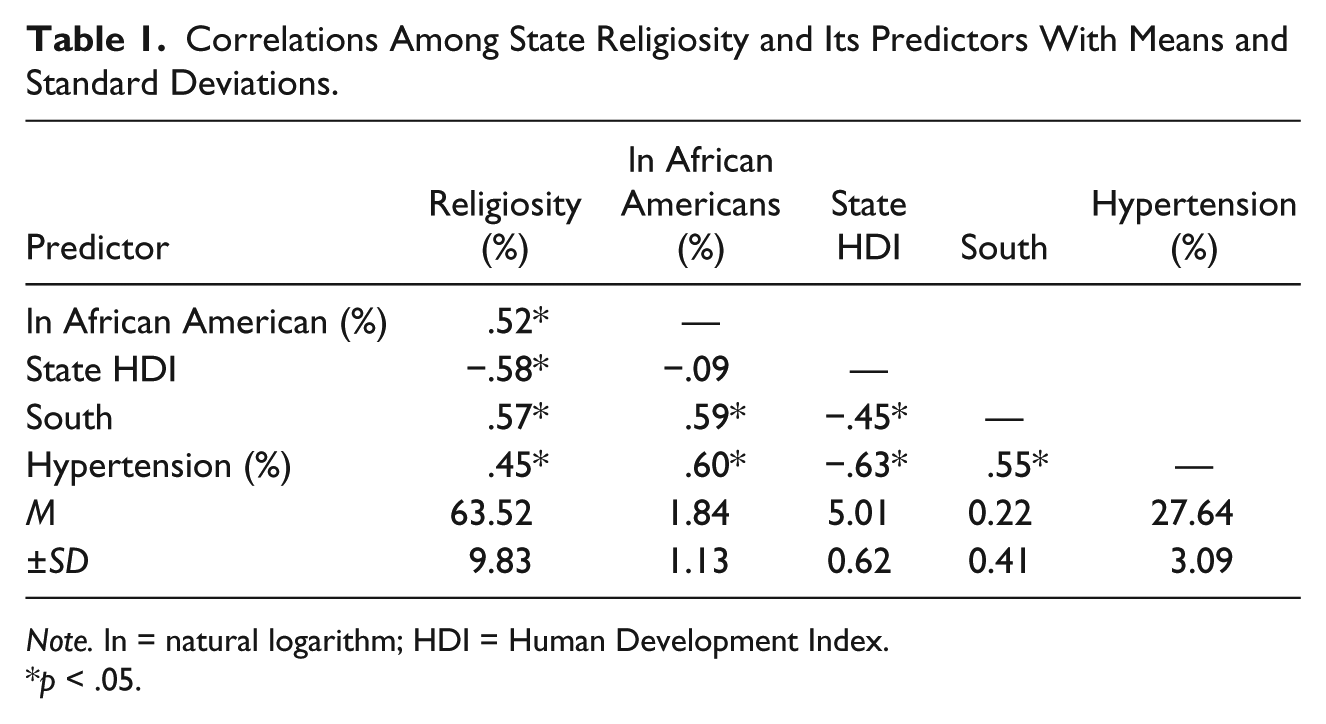
The South variable contrasted the 13 states of the former Confederacy with other states of the Union. Given the history of slavery and racism in these states, it was assumed that African Americans living in these states would experience more intense racial prejudice and discrimination that might increase social anxiety across all ethnic groups. This assumption is supported by the fact that Southern states have higher levels of hypertension (see Table 1). African American population was the percentage of each state’s residents self-classified as African American in the census (U.S. Census Bureau, 2011).
Correlations Among State Religiosity and Its Predictors With Means and Standard Deviations.
Note. ln = natural logarithm; HDI = Human Development Index.
p < .05.
Hypertension was the proportion of each state’s population suffering from high blood pressure (behavioral risk factor surveillance system [BRFSS] data; Healthy Americans, 2012). Data are medians based on 3-year averages (2005, 2007, 2009) and are the percentage of the population suffering from hypertension. As percentages, these are continuous variables (rather than dichotomous) and therefore appropriate for regression analysis.
Statistical Procedure
Data were analyzed using Pearson correlations and ordinary least squares (OLS) regression. In the first regression analysis, all four predictors were entered by the method of forced entry. This analysis was designed to answer the following question: Which factors account for state differences in religiosity?—a question that breaks new ground and therefore cannot be guided by previous results. Subsequent analyses were designed to answer the following question: Why do these factors affect religiosity? These analyses tested a mediational model (Baron & Kenny, 1986). This analysis begins with a significant predictor of the DV (in terms of a simple correlation). This predictor is regressed on the DV along with candidate mediator variables. So the greater religiosity of States having a larger African American population might be mediated by stress (as measured by hypertension) and racism (as indexed by location in the South). If the mediation model were correct, then the African American variable would be insignificant when regressed along with hypertension and Southern location but these mediators would be significant (see Baron & Kenny, 1986, for details on the possibility of partial mediation where the effect is reduced but not removed). Analyses were screened for multicollinearity by computing variance inflation factors (VIFs) using a cutoff of 2.00 (Fox, 1991). Because directional predictions were made, one-tailed tests were used in the regression analysis.
Results
Correlations are presented in Table 1 along with descriptive statistics. Mean religiosity was 63.52%, as shown. The mean African American population was 10.50 ± 9.47 but the natural-log-transformed data are shown in the table. Religiosity was negatively correlated with HDI, and positively correlated with the other predictor variables (African American population, Southern state, hypertension) and all of these effects were statistically significant.
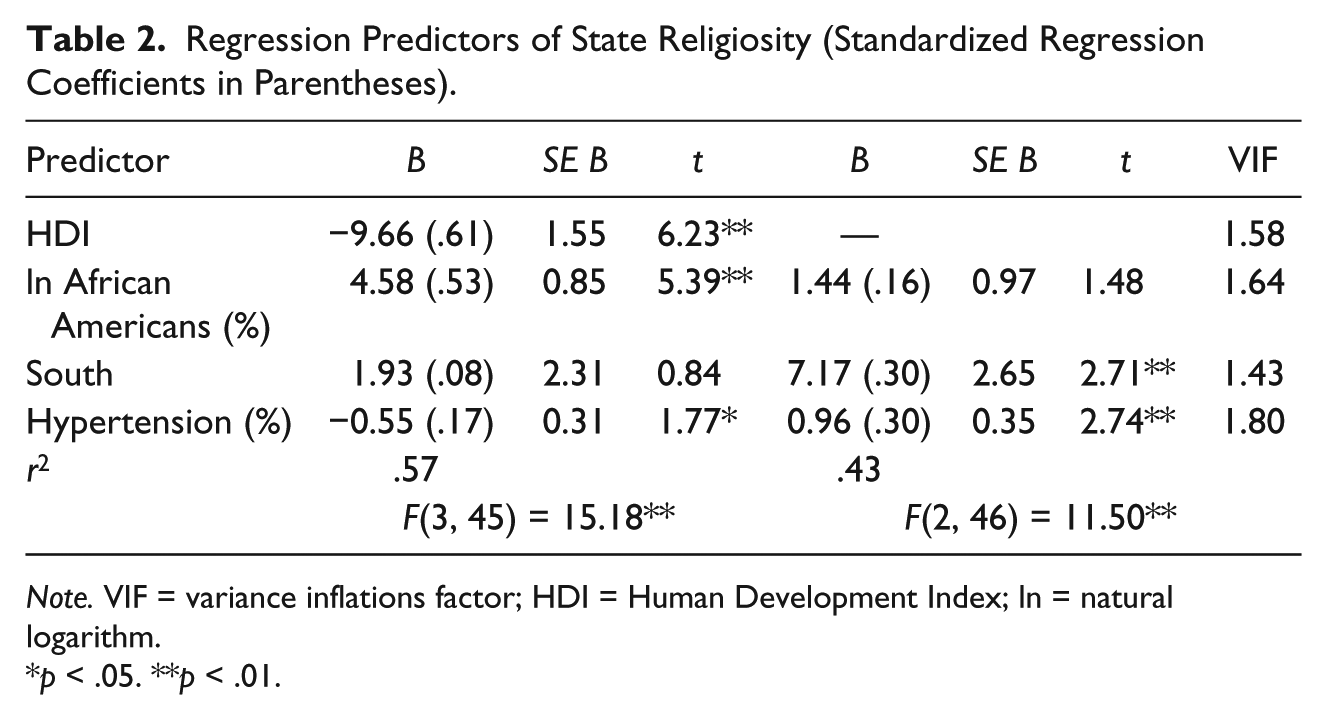
Regression analysis results are presented in Table 2 that includes VIFs for the full model all of which are well below the 2.00 cutoff indicating that multicollinearity was not a problem. In the first analysis that included all four predictors, state development and African American population emerged as strong predictors while hypertension reached significance and Southern location did not (Table 2, left panel). Religiosity declined as development increased, and it increased with African American population and hypertension (the latter effect barely reaching significance for a directional test). In the second analysis, Southern location and hypertension both emerged as significant positive predictors of religiosity whereas African American population failed to reach significance (Table 2, right panel) consistent with a mediational role of the significant variables.
Regression Predictors of State Religiosity (Standardized Regression Coefficients in Parentheses).
Note. VIF = variance inflations factor; HDI = Human Development Index; ln = natural logarithm.
p < .05. **p < .01.
Discussion
All four predictions were supported in correlational analyses (Table 1). Less developed states were substantially more religious (Prediction 1). States with larger African American populations were significantly more religious (Prediction 2). More religious states had a higher incidence of hypertension (Prediction 3). Given that hypertension is a reasonable index of stress, this supports the view that religion serves as one mechanism for coping with stressful living conditions. Southern states were significantly more religious (Prediction 4).
All four predictions also received some support from the regression analysis (Table 2). HDI and African American population emerged as strong predictors of state religiosity (Predictions 1 and 2, respectively; Table 2, left panel). The effect of Southern states was rendered insignificant by regressing it along with African American population and HDI (analysis not shown), suggesting that higher religiosity of the South was mediated by lower level of development (HDI) and higher African American population. (A reviewer of this article suggested that religion may have been more important for African Americans historically because the church was the only viable form of community organization but that is no longer true.)
The strength of the effect of African American population is surprising considering that this ethnic group comprises an average of just 10.50% of the state populations. A supplementary analysis investigated whether this effect might be explainable in terms of plausible indices of racism (Southern states) and stress (hypertension). When this analysis was carried out, hypertension and Southern location emerged as significant positive predictors (supporting Predictions 3 and 4, respectively) whereas African American population was no longer significant (Table 2, right panel). This suggests that the higher religiosity of states with a high proportion of African Americans was mediated by the combination of high stress levels and Southern location of these states (Baron & Kenny, 1986).
Of course, some readers would dispute the claim that Southern states are more racist today even if these states were historically slower to grant civil rights to African Americans. Yet, it seems reasonable to assume that getting rid of the apartheid system of Jim Crow laws and their consequences may be a multigenerational process, and the empirical evidence indicates that Southern residents are indeed more racist in their attitudes and behavior (Burns & Gimpel, 2000).
The use of hypertension as an index of stress is not only defensible but also disputable. In particular, hypertension levels are affected by multiple factors, such as overweight and a high-fat, high-calorie diet (Marvar & Harrison, 2012). Although this is certainly true, overweight and unhealthy diet are so closely linked to psychological stress that public health experts now view stress as a causal factor in obesity and unhealthy dietary practices (Wilkinson & Pickett, 2010). A reviewer of this article suggested replacing hypertension with a more generalized measure of health but this was not done for two reasons: one theoretical, the other empirical. The theoretical rationale is that hypertension is more theoretically relevant to the security hypothesis. The empirical rationale is that health is already included in the development measure (state HDI) so little would be added.
Some researchers might prefer to measure the quality of life in terms of state poverty but including poverty levels in the analysis did not add to the variance explained. State HDI was preferred as a more comprehensive measure of the quality of life that taps earnings, health, and education. Some researchers might also like to see income inequality included but adding this variable did not increase the variance explained either. A more fine-grained analysis of ethnic-group differences in religiosity may also reward further research.
In conclusion, the evidence presented in this article is consistent with earlier evidence from cross-national research showing that religiosity declines as the quality of life improves. Specifically, state religiosity declines with an improved quality of life due to economic development (i.e., affluence, education, health) and increases with psychological stress (i.e., hypertension, African American population). Both state differences and country differences in religiosity are thus explainable in terms of the quality of life, and the same conclusion applies to ethnic-group differences in religiosity.
Religion may thus function as an adaptive emotional coping response to difficult living conditions. This adaptational approach to societal differences (evolutionary social science) diverges from mainstream cultural determinism by aiming to avoid circular explanation and promises new understanding in comparative research on religion and other topics in personality and social psychology, including group differences in IQ scores, crime, drug addiction, and sexual behavior (Barber, 2008, 2015).
Footnotes
Declaration of Conflicting Interests
The author(s) declared no potential conflicts of interest with respect to the research, authorship, and/or publication of this article.
Funding
The author(s) received no financial support for the research, authorship, and/or publication of this article.
Author Biography
 ).
).