



Abstract
This study discusses methodological considerations and cultural sensitivity issues in cross-cultural research. A multi-method approach was adopted—consisting of a seminar, an expert’s opinion, and a focus-group discussion with Western-Balkan professionals—to assess the content validity of the Best Interest of the Child Model (BIC Model) and Questionnaire (BIC-Q) in the cultural context of the Western Balkans. The cultural sensitivity of the assessment was evaluated during a field study with local interviewers, who assessed the quality of the child-rearing environment of returned migrant children (N = 66) in Kosovo and Albania. The findings indicate that specific cultural aspects influence the meaning and interpretation of child-rearing conditions, such as the importance of the extended family in child-rearing, authoritarian child-rearing practices, the within-society heterogeneity, and the stability of the state. Regarding assessment, factors affecting outcomes were identified as they related to the questionnaire as well as to the cultural perspectives of the interviewers and the regional population characteristics. The study resulted in an understanding of the child-rearing situation of returned migrant children from a local cultural perspective and avoided the imposition of Western-European standards on the assessment of “good-enough” child-rearing.
Keywords
Introduction
The United Nations Convention on the Rights of the Child (CRC; 1989) contains a pedagogical message and considers the rights enshrined in the Convention as essential for the development of children. It functions as a sociopolitical instrument by calling on states to respect the rights found in the Convention and to implement policies to ensure them (Meuwese, Blaak, & Kaandorp, 2005). One of its key principles is laid down in Article 3 CRC, which states that, in every decision affecting a child, the child’s best interests should be a primary consideration.
In 2006, Kalverboer and Zijlstra developed a theoretical model that operationalizes the best interest of the child principle from a pedagogical perspective in terms of child development: the Best Interest of the Child Model (BIC Model; Kalverboer & Zijlstra, 2006). An international literature review into pedagogical environmental conditions for children’s development resulted in 14 child-rearing conditions in the child’s family and societal context, which determine the child’s opportunities for development. The Best Interest of the Child Questionnaire (BIC-Q; Kalverboer et al., 2012; Zijlstra, Kalverboer, Post, Knorth, & Ten Brummelaar, 2012; Zijlstra, Kalverboer, Post, Ten Brummelaar, & Knorth, 2013), derived from this, came about due to the absence of an instrument that provided an overall picture of the quality of a child-rearing environment compared with alternative upbringing settings.
In the Netherlands, the BIC-Q has been validated for asylum-seeking children and informs judicial decisions for children involved in migration procedures. The purpose of the current study is twofold: First, we aimed to explore the face and content validity of the BIC Model in asylum seekers’ countries of origin to study how migrant children are faring after their return; second, we wished to explore the factors influencing the assessment with the BIC-Q in countries of origin according to a local perspective on “good-enough” practices of child-rearing.
In accordance with the CRC (2013), decision-makers deciding on the asylum-seeking child’s right to stay . . . should not only assess the physical, emotional, educational, and other needs at the specific moment of the decision, but should also consider the possible scenarios of the child’s development, and analyse them in the short and long term. (para. 84)
Regarding repatriation of the child, this implies that immigration authorities in host countries should consider the scenarios for development, if the child is forced to return to the country of origin.
The development of returned children is not monitored by the host countries, nor has it been studied academically as yet (Fazel, Reed, Panter-Brick, & Stein, 2012; Kalverboer, Zijlstra, & Knorth, 2009); reports by NGOs show, however, that repatriated children suffer severe socioemotional and adaptation problems after return (Gladwell & Elwyn, 2012; Knaus et al., 2012). To weigh the child’s best interests and consider the possible scenarios for development in the short and the long term, insight is required as to the opportunities for the child’s development in the country of origin. Using the BIC-Q, the situation in the country of origin can be compared with that in the host country, and, subsequently, the upbringing situation that serves the child’s interest best can be identified.
In a European study aimed at developing a monitor for returned migrant children, 1 the BIC Model (Kalverboer & Zijlstra, 2006; Zijlstra, 2012) and the BIC-Q (Kalverboer et al., 2012; Zijlstra et al., 2012; Zijlstra et al., 2013) were introduced for assessing the quality of the living situation and opportunities for development of returned children. At the moment of conducting the study, the largest proportion of the asylum caseload in the European Union was of Western-Balkan origin (Kosovo, Serbia, Albania, the former Yugoslav Republic of Macedonia, Bosnia-Herzegovina, Montenegro; European Asylum Support Office [EASO], 2013, 2015). Therefore, the Western-Balkan region was selected for a first exploratory study of the use of the BIC Model and BIC-Q in an international context.
Keeping in mind that most research on child development is conducted in Western countries (Arnett, 2008; Kağitçibaşi, 2006; LeVine & New, 2008), the assumption that all the child-rearing conditions in the BIC Model are valid a priori in all cultural contexts would result in an “imposed etic approach” (Berry, 1969, 1989), imposing “ . . . a uniform (Euro-American) mold on all of humanity” (Berry & Poortinga, 2006, p. 55). Instead, the reliability and validity of the instrument’s use in a different cultural context have to be empirically demonstrated (Van de Vijver & Poortinga, 1997).
Berry (1989) proposed a three-step process for cross-cultural research, starting with research in one’s own culture. To make comparisons about children’s development opportunities in another cultural context, the cultural perspective on child-rearing needs to be discovered using a qualitative “emic” approach: This approach seeks to avoid imposition (and ethnocentrism) by trying to understand people “in their own terms.” Explanations of human diversity are sought in the cultural context in which people have developed. Assessments are typically carried out employing the values and meanings that a cultural group gives to a phenomenon. (Berry & Poortinga, 2006, p. 55)
Valid cross-cultural comparisons can only be made when the same child-rearing conditions appear in both cultures—the so-called “derived etic” (Berry, 1989).
Central questions in this study were, first of all, whether the BIC-Model child-rearing conditions are recognized as being relevant for measuring the quality of the child-rearing environment in the Western Balkans, according to laypersons and professionals. The second question focuses on whether the BIC-Model conditions have the same meaning and can be interpreted in the same manner in the cultural context of the Western Balkans as in the Western-European context. Finally, we explored in a field study how to assess the quality of the child-rearing environment of returned migrant youth with the BIC-Q from a local cultural perspective—without the availability of a Western-Balkan baseline on child-rearing—which had to be transparent and understandable for the Western-European researchers.
The empirical exploration process we followed provides an example for other studies using Western instruments in an international context and provides input on methodological considerations regarding cultural perspectives, both in international social research and in research on asylum-seeking children. First, we will provide a deeper theoretical understanding of the BIC Model and cross-cultural child-rearing practices.
The BIC Model
The BIC Model is grounded on theoretical frameworks in which the child’s development is determined by mutual interaction between the child and environmental factors in the family and society (Belsky & Vondra, 1989; Bronfenbrenner, 1979; Van der Ploeg, 2007; Zijlstra, 2012). The BIC Model adopts a holistic and ecological approach to child development by analyzing seven conditions in a child’s family context and seven conditions in the context of the society (see Figure 1).

BIC Model: Pedagogical environmental conditions (Kalverboer & Zijlstra, 2006; Zijlstra, 2012).
Together, these 14 conditions determine the quality of a child’s upbringing environment and contribute to the child’s prosperous development. A stable and continuous presence of these conditions is important for a child’s healthy development. If environmental conditions are of insufficient quality over a longer period of time, this may lead to disturbed development and problem behavior in children. The degree to which a child’s development is affected by a lower quality of the rearing environment depends on the child’s vulnerability or resiliency (Zijlstra, 2012).
Child-Rearing in a Cross-Cultural Perspective
All the conditions in the BIC Model are related to provisions in the CRC. The worldwide ratification of the CRC—except by the United States, Somalia, and South Sudan—implies that ideas on child development have been universally accepted. As pointed out by Weisner (2014, p. 99), certain upbringing situations are indeed detrimental for children’s development everywhere, such as situations involving the lack of physical protection against danger and violence inside or outside the home, unresponsive and chaotic caregivers, and unpredictable disruptions on a continuing basis.
Although these risk factors for children’s well-being seem to be universal, child-rearing practices and ideas on what is good for a child differ across cultures (LeVine & New, 2008; Whiting & Edwards, 1988; Whiting & Whiting, 1975). This affects the assessment of child well-being in a different cultural context; rearing situations that may appear unacceptable according to Euro-American standards may be considered appropriate for children’s development in another cultural context (Weisner, 2014). 2
The material and ecological setting, in which the child grows up, as well as the shared cultural values in a society, influences the ideas about the nature of children and their development, resulting in diverse care practices and beliefs considered important for children across countries and continents (Harkness & Super, 1996). A common distinction with regard to child-rearing practices is made between “cultures of separateness” in individualistic societies and “cultures of relatedness” in collectivistic societies (Kağitçibaşi, 2006).
Although both collectivistic and individualistic aspects can be present in a society, Western societies are mainly characterized by cultures of separateness, in which autonomy and self-reliance are fostered in child-rearing. Social welfare and wealth make family interdependency unnecessary. In cultures of relatedness—often societies in the non-Western world—children are educated with values focused on interdependency, social cohesion, and loyalty to the family and the group. Children often have a utilitarian and economic role, about which they are made aware from a young age. The child-rearing is characterized by an authoritarian child-rearing style in which dependency, obedience, and respect are central. This dependency is reversed when parents need to rely on their grown-up children for “old age security” (Eldering, 2014; Kağitçibaşi, 2006).
In Kağitçibaşi’s conceptualization, traditional Western-Balkan societies could be characterized as “cultures of relatedness,” in which extended families play an important role in people’s daily lives, and family life is characterized by patriarchal traditions and clear gender-based role definitions. Women fulfill mostly nurturing responsibilities, whereas men mostly occupy instrumental roles in the family and engage with their children using authoritarian methods (Goodman, 2004; Simić, 1999; Snyder, May, Zulcic, & Gabbard, 2005).
Western-Balkan countries have been considered together in several studies (i.e., EASO, 2013, 2015; Goodman, 2004; Ramet, 1999), among other reasons because of their common past as socialist societies and as part of Yugoslavia (except for Albania); their common European Union (EU) perspective; and their similar economic and social conditions, as the poorest region in Europe.
Whereas armed conflicts were the main reason for fleeing the Western Balkans in the 1990s, current push factors for asylum seekers involve a high unemployment rate, societal problems of minorities such as discrimination and racial violence, blood feud issues (especially in Albania), and a lack of social or health infrastructure (EASO, 2013, 2015). Because asylum claims solely on the grounds of economic and social marginalization are not successful, the recognition rate of asylum claims from Western-Balkan applicants is one of the lowest of all asylum claims in the EU. As a result, many asylum seekers, including children in families or unaccompanied children, are forced to return to their countries of origin.
Method
Most Western-Balkan asylum seekers are of ethnic-Albanian and Roma descent (EASO, 2015). The largest number of asylum applicants are from Kosovo, followed by Serbia and Albania (Eurostat, 2015). In this study, Kosovo will be used as an exemplary case, in which we validated the BIC Model from a local cultural perspective on child-rearing. Because the returnees had to be reachable by the local interviewers without reviving ethnic tensions, ethnic Serbians in Kosovo and returnees in Serbia in general were excluded from the study. Instead, returnees in Albania were included.
Our study consists of two phases with different methods (see Figure 2): (a) research on the recognizability, meaning, and interpretation of the BIC-Model conditions in the cultural context of the Western Balkans, and (b) BIC-Q assessment on the quality of the child-rearing environment of 66 returned children in Kosovo and Albania. The study took place between November 2012 and June 2013.
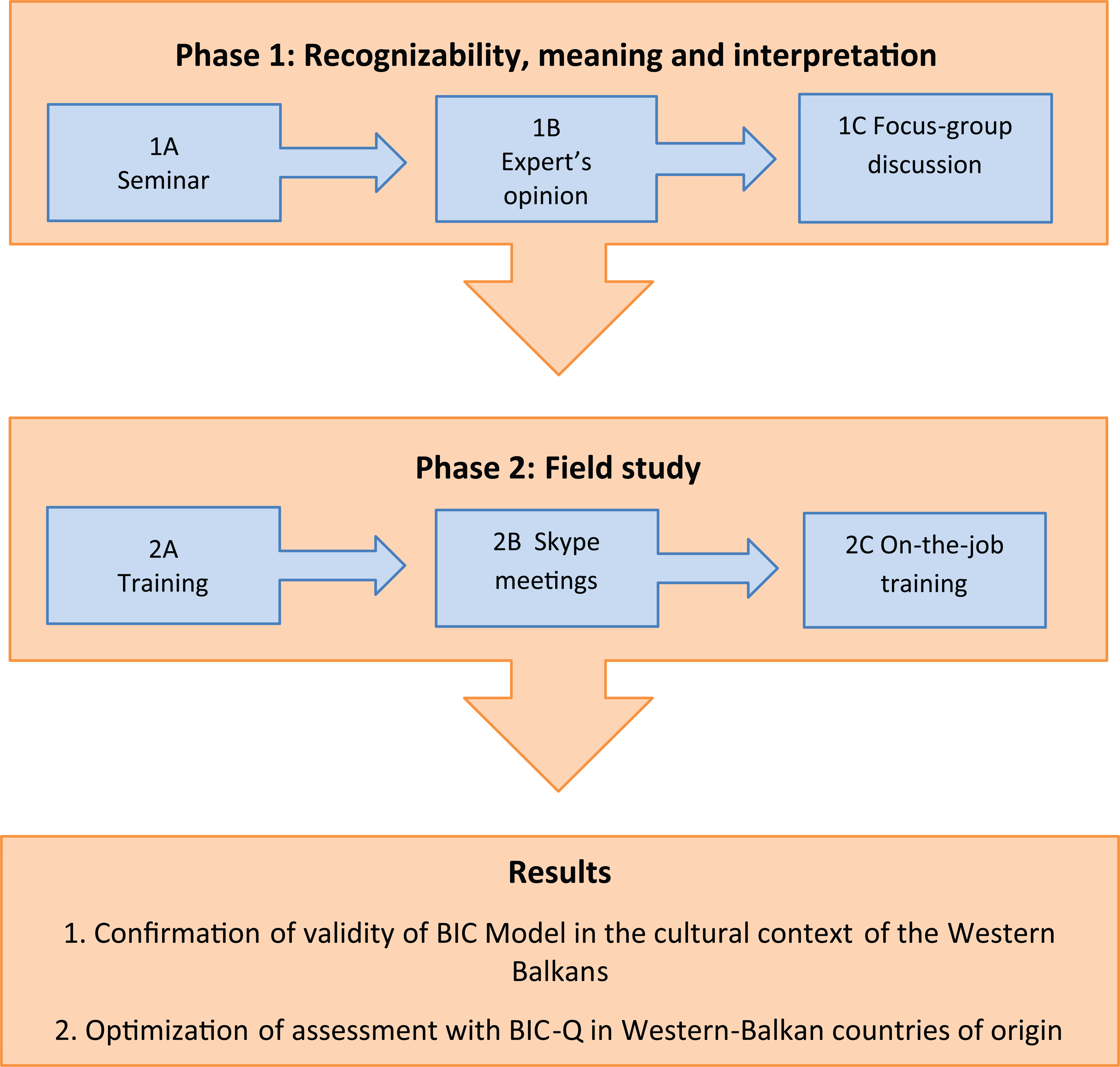
Phases of (1) exploration regarding validity of the BIC Model and (2) assessment of children’s child-rearing situation in Kosovo and Albania using the BIC-Q (November 2012 until June 2013).
BIC-Q Instrument
After a semi-structured interview with the parents and the child, professionals qualify the child-rearing environment in terms of the BIC-Q. In the BIC-Q, each child-rearing condition can be qualified as “unsatisfactory,” “moderate,” “satisfactory,” or “good” for different living situations: the past situation in the host country, the situation after return to the country of origin, and the expected future situation in the country of origin. In this way, the professional can identify environmental risk and protective factors for the child’s well-being over a longer period of time, and give a professional opinion as to the quality of the child-rearing environment.
For asylum-seeking children, the inter-rater and intra-rater reliability of the BIC-Q are good (kappas .65 and .74, respectively). Research into the criterion-related validity shows an 81% correct classifications rate using the BIC-Q for predicting internalizing behavioral problems in asylum-seeking children (Zijlstra et al., 2013). According to Mokken’s analysis, the BIC-Q constitutes a strong scale measuring the construct “quality of the child-rearing environment” (H = .55; Rho = .94; Zijlstra et al., 2012). The BIC-Q, applied in secure treatment of adolescents, covers four well-known pedagogical dimensions found in the literature (i.e., affective-relational; cognitive-behavioral; physical-nurturant; social environment; Kalverboer et al., 2012).
Design
Phase 1: Recognizability, meaning, and interpretation of the BIC Model
The aim of the first phase of this study was to determine the face and content validity of the BIC Model in the Western Balkans, that is, to explore whether the BIC-Model child-rearing conditions are recognized in Western-Balkan child-rearing practices, and to assess the interpretation and meaning of the conditions in the local context. This phase consisted of a seminar, an expert’s opinion, and a focus-group discussion, which were held in Pristina between November 2012 and January 2013 (see Figure 2).
Participants Phase 1
In total, 13 professionals of Western-Balkan and Western-European origin participated in the first phase of the study. The seven Western-European professionals work with migrants in EU host countries, and in the field of return and reintegration. The six Western-Balkan professionals work in Kosovo in the field of mental health care, socioeconomic reintegration support for returnees, psychological support for refugees and war victims, and organizational psychology. For each sub-phase—seminar, expert’s opinion, and focus-group discussion—the participants will be described.
1A Seminar
Ten professionals of both Western-European and Western-Balkan origin participated in the seminar, which was held in Pristina in November 2012. The seminar focused on the recognizability of the BIC-Model conditions in the Western Balkans. First, the co-author (M.E.K.) gave a presentation about the theoretical and legal background of the BIC Model (Kalverboer & Zijlstra, 2006; Zijlstra, 2012). During the presentation, the co-author proposed how the BIC Model and BIC-Q (Kalverboer et al., 2012; Zijlstra et al., 2012; Zijlstra et al., 2013) could be applied to assess the returned children’s child-rearing environment after return to their countries of origin. After the presentation, the participants and authors (D.Z.; M.E.K.) split up into two groups and discussed the applicability of the BIC Model in local child-rearing practices. In particular, the local professionals were asked whether they recognized the BIC-Model conditions in local child-rearing practices, whether these conditions were applicable in their society, and whether they found certain child-rearing conditions absent, which were important in the local cultural context. The authors took minutes during the seminar.
1B Expert’s opinion
An expatriate, who also participated in the seminar (Phase 1A), and who had been working for 12 years in Kosovo on the subject of mother and child health, and mental health, was approached for an expert’s opinion on the meaning of the 14 BIC-Model child-rearing conditions in local family life. As an example, the expert received a description of BIC-Model child-rearing conditions in a case of an asylum-seeking family in Western Europe. The expert’s opinion was provided in writing and provided an initial insight into the meaning of the child-rearing conditions in the local cultural context, which was further assessed during the focus-group discussion.
1C Focus-group discussion
In total, five local professionals participated in a focus-group discussion on the 14 BIC-Model conditions. Two of the local professionals also participated during the seminar (Phase 1A). They recommended inviting two additional professionals who were knowledgeable about child-rearing in the Western Balkans, and the situation of returnees. The expatriate, who wrote the expert’s opinion (Phase 1B), recommended inviting one other local professional. The participants worked in the field of psychology, mental health care, and socioeconomic support for returnees. In addition, two Western-European professionals, who also participated in the seminar, were present during the focus-group discussion.
The discussion centered on the meaning and interpretation of the 14 BIC-Model child-rearing conditions in the cultural context of the Western Balkans. In preparation, the local professionals received the descriptions of the BIC-Model child-rearing conditions, as developed through a Western literature review (Kalverboer & Zijlstra, 2006; Zijlstra, 2012). For every BIC-Model condition, the professionals were asked whether the conditions were relevant with regard to child-rearing in their region and under which circumstances the professionals considered the child-rearing condition to be of “good,” “satisfactory,” “moderate,” or “unsatisfactory” quality. These questions were also posed during the focus-group discussion, which lasted 3 hr and was recorded.
Phase 2: Field study
The aim of the second phase was to explore the factors that influence the assessment using the BIC-Q in Kosovo and Albania according to local standards for practices of child-rearing. This research phase took place from January until June, 2013. The field study, in which 66 returned children in Kosovo and Albania were involved, consisted of training four local interviewers in the assessment with the BIC-Q, Skype meetings between researchers and interviewers, and on-the-job training (see Figure 2).
Participants Phase 2
The four local interviewers were Kosovar professionals working for NGOs in the fields of mental health care or reintegration support for returnees. One of them had also participated in both the seminar (Phase 1A) and focus-group discussion (Phase 1C), and one of them in the focus-group discussion only. Two of their colleagues were also involved as interviewers in the research from this phase on. The local interviewers had a background in psychiatry, medical science, education, or management and economics. The interviewers worked in pairs, and conducted 32 and 34 interviews, respectively.
Interviews were conducted with 66 returned migrant adolescents and their parents, who had returned to Kosovo and Albania from an EU host country between 2009 and 2013. The adolescents were between 11 and 21 years old (M = 13.95; SD = 1.98; median = 14) during the interview. In total, 29 girls and 37 boys were involved. In Kosovo, 17 children belonged to the Roma and 39 children to the Kosovar–Albanian ethnic groups. In Albania, 10 children were included, who all belonged to the Albanian ethnic group. The families had returned from the EU host countries either voluntarily or had been forced to return, with 38 children returning to urban areas and 28 children to rural areas. The family’s length of stay in the host country varied between 8 months and 30 years, with 20 children being born in the EU host countries.
The interviewers approached participants in all seven regional districts of Kosovo and in the north of Albania. Regions where the majority ethnic group consisted of Serbian residents were excluded from the research. As no central registration mechanism existed to register returnees, municipalities and regional officers in all districts were approached for the contact information of returnees who had returned between 2010 and 2013, from host countries in the EU. The quality of information in the lists varied per municipality; some lists contained detailed information including birth dates of the returnees, whereas other lists only provided names and telephone numbers. The registered returnees had contacted the municipality themselves on return to obtain assistance or were otherwise known to the municipality employee. In Albania and in one municipality in Kosovo, returned children were recruited through schools as well.
The local interviewers contacted the people on the lists of the municipalities or schools, and aimed to include children according to an equal distribution of age groups (11-14 years old and 15-18 years old), gender, and living area. Within each family, a maximum of two children were included. All parents and children signed informed consent forms and, after the interview, the family received EUR 10 per child who participated in the study.
2A Training of local interviewers
The authors (D.Z., A.E.Z.) trained the local interviewers during 2 days in January 2013.
The interviewers were trained in conducting a semi-structured interview with parents and children regarding the 14 BIC-Model conditions. In the absence of a local baseline on child-rearing in the Western Balkan, the local interviewers qualified the child-rearing environment of the returned migrant children according to their own cultural perspectives on child-rearing. To gain insight into the child-rearing situation of the returned migrant children and the interviewers’ value systems regarding child-rearing, the local interviewers were encouraged to explain in the clarifications section of the BIC-Q why they qualified a child-rearing situation in a certain way. This provided insight into the local interviewers’ perspectives on a “good,” “satisfactory,” “moderate,” or “unsatisfactory” child-rearing environment.
During the training session, the interviewers completed a BIC-Q based on an anonymous story of an asylum-seeking family in Western Europe. On the second day, the interview pairs held two test interviews with returned migrant families and completed the BIC-Q. Afterward, the researchers and interviewers had a plenary discussion about the completed BIC-Qs.
2B Skype meetings
After the training session, the local interviewers completed 10 BIC-Qs after their interviews with returned migrant families. During four Skype meetings, the authors (D.Z., A.E.Z.) and the local interview teams discussed the first 10 cases of returned migrant families. The researchers were especially interested in how and why the local interviewers qualified the child-rearing conditions in a certain way. The local interviewers were further trained in providing precise clarifications of the child-rearing conditions they encountered. The author (D.Z.) took minutes during the Skype meetings and summarized points of attention in e-mails.
2C On-the-job training
After the Skype meetings, the local interviewers continued interviewing returned migrant families, while the authors (D.Z.; A.E.Z.; M.E.K.) monitored whether the clarifications in the completed BIC-Qs were clear enough. The aim of on-the-job training was to make the BIC-Q assessments and the local interviewers’ perspectives on child-rearing more transparent and understandable for the Western-European researchers.
Together with three professionals working with migrants in a Western-European host country and in the field of reintegration after return, the author (D.Z.) participated in four interviews in April and June, 2013. The local interviewers conducted the interviews, while the researcher observed and had informal conversations with the parents and child. After the interviews, the meaning and interpretation of the BIC-Model conditions, in the context of those specific cases, were discussed during group discussions with the local interview pairs and the Western-European professionals. The author took minutes during the home visits and discussions, and recorded one of the group discussions on the BIC-Model conditions, which lasted 3 hr.
Data Analysis
The recorded focus-group discussion during Phase 1 and the group discussion during Phase 2 were transcribed. Together with the expert’s opinion, these were analyzed in Atlas.ti, Version 7, using a deductive analysis approach (DeCuir-Gunby, Marshall, & McCulloch, 2011).
Results
Recognizability, Meaning, and Interpretation of BIC-Model Conditions
During the seminar, the preconditions were explored for assessment of the living situations of returned migrant adolescents in their Western-Balkan countries of origin, using the BIC Model and BIC-Q. In general, the local professionals recognized all the BIC-Model child-rearing conditions in the cultural context of the Western Balkans and did not identify any missing conditions.
The expert’s opinion provided an initial insight into the meaning of the BIC-Model conditions in the local context, and in the historical and cultural contexts influencing the child-rearing environment. During the focus-group discussion, four topics were identified that permeated the meaning and interpretation of various BIC-Model conditions in the cultural context of the Western Balkans (see Table 1).
Themes in Western-Balkan Child-Rearing That Permeate the BIC-Model Conditions’ Meaning and Interpretation in the Local Cultural Context.

Note. BIC Model = Best Interest of the Child Model.
Extended family
The extended family—such as grandparents, aunts, and uncles—plays an important role in the daily upbringing of the child in the Western Balkans. Some children live with their parents, grandparents, and/or uncles and aunts in the same house, or in the same village. According to a professional, Most of our families are very attached with grandparents, like for example I have to see my parents every day, and they have to see my child, and my uncle . . . And so, so like a society we have this norm that we are very attached and basically everybody’s problems in the family in a way are our problems too, we care about each other. (Local Professional 1, verbatim, focus group, January 2013; regarding “adequate examples by parents”)
As a result, not just the parents but the entire family takes on the responsibility for the daily care and upbringing of the child, affecting all the family conditions in the BIC Model (Conditions 1-7).
[Especially] affection and to shape the behavior, grandparents generally speaking play a very important role . . . Automatically when a son or a daughter is born they will take a kind of responsibility: “Okay, we will also support in order to raise the child.” In order to co-share this responsibility. (Local Professional 2, verbatim, focus group, January 2013; regarding “affective atmosphere” and “supportive, flexible child-rearing structure”)
Whenever the parents are not available for their children, the continuity in upbringing conditions is ensured by the extended family: In terms of feeling safe and being fed, or left on the street: that cannot happen here actually. Usually the larger family would get [a] solution in order to take care of the children, whenever the parent might die, or the poor conditions, or whatever. Always somebody is there. (Local Professional 3, verbatim, focus group, January 2013; regarding “continuity in upbringing conditions, a future perspective”)
When state involvement in child well-being is low, “ . . . the families are there to take care and to feel safe,” according to the focus-group participants. Not only the extended family but also the wider social network is important for obtaining support when a family is in need.
Authoritarian child-rearing with affection
According to the focus-group participants, the local child-rearing practices are related to an authoritarian child-rearing style, which becomes clear through various topics, such as the obedience and respect vis-à-vis the elderly, the general acceptance of disciplinary measures such as slapping, and the collective versus the individual wishes of the child. Although living in extended family units has been a historical way of surviving, and ensuring food and safety, nowadays, more and more families prefer to live in nuclear family households. This transformation has consequences for traditional norms and values in child-rearing practices: In traditional extended families emotional support and understanding were not common. Children were raised with strictly divided gender roles and tasks and responsibilities. . . . The nowadays more common smaller family units in the urban, and some rural areas, are in a transformation process. Gender roles are changing, the still existing boy preference is gradually becoming less important. (Expert’s opinion, January 2013; regarding “affective atmosphere”)
Whereas in previous generations the elderly men in the family had the authority, nowadays, the middle generation often provides the family’s income. This may lead to inter-generational tensions regarding transmitting traditional values to children: For example, I live with my parents, my wife and my children. There is an intent from my father, for example, and my mother, to give more inputs on tradition and culture to my children, which I sometimes don’t like. I don’t like that my children grow up with nationalism and big ideals for a “big Albania,” or something else; I don’t want them to grow up with that, or with some traditional or cultural things . . . So if you live in this kind of families, it is quite difficult to skip away from your traditional and cultural habits. (Local Professional 4, verbatim, focus group, January 2013; regarding “adequate examples by parents”)
Apart from the changing family situations and authority within the family, the transformation in society may also have consequences for the use of disciplinary measures. Although slapping as a disciplinary measure is still generally accepted in Western-Balkan societies, there is a difference from the experience of children who had grown up in the previous generation: If we compare it with 13 years ago, I have experienced both systems before the war and after the war at school. It was different, teachers would apply violence at school, also at home it was like a normal thing, more common. But after the war things changed. . . . Laws came, things were written and more forbidden. And at school I didn’t experience any more violence. But there were other things that were furthered, like bullying and eh . . . you know, not accepting children at school, these kind of things that they are more common now. (Local Professional 5, verbatim, focus group, January 2013; regarding “affective atmosphere”)
Obedience to and respect for the elderly are still important values transmitted in child-rearing.
[Children] don’t talk back . . . fight back. You know, like, you have to sit and listen because he is the elderly and, first of all, you have to respect because he knows more than you. And then you can give your arguments but not like becoming nervous and saying “no-no”; like this, no. (Local Professional 1, verbatim, focus group, January 2013; regarding “adequate examples by parents”)
Regarding interest in the child’s wishes, the focus may be less on the individual wishes of children and more on the collective interests of the family. This also relates to the situation of high unemployment in Western-Balkan countries, in which parents may not encourage the child to pursue a certain profession, in line with the child’s interests, due to bad employment perspectives. Although “the importance of understanding the perception of the world through the eyes of the child is rising,” according to the expert’s opinion, a professional during the focus-group discussion explains, I think this topic is really related . . . to the dynamics of the family: we cannot dream, we cannot plan, we cannot have talents which are disconnected or independent to the interests of the family. . . . For example in the Netherlands, you have . . . places where the older generation would be taken care of; now, we created a kind of system that the younger generation are taking care about the oldest one, so always deciding about the opportunities, about the dreams, about the talents, about the occupation. (Local Professional 3, verbatim, focus group, January 2013; regarding “interest”)
Within-society heterogeneity
According to a professional in the focus group, the class differences in society are increasing; in Kosovo, for example—being the poorest country in the Western Balkans—15% to 20% of the people belong to “ . . . the lowest category of the poor people” (Local Professional 3, verbatim, focus group January 2013; re “adequate physical care”). In particular, children growing up in rural areas, or children belonging to minority groups such as the Roma, grow up in poor circumstances. Therefore, the meaning of “adequate physical care” (BIC-Model Condition 1) may differ for a child living in a rural area or a child of Roma origin; Roma children, for instance, often live in camps. Growing up in a poor household may also affect the other child-rearing conditions in the family situation of the child.
Rural versus urban areas
In rural areas, the amount of time spent with the child and the availability of the parents for “quality time” with the child, for example, may differ from urban areas: When you talk about urban life; that is different because people are working from 8 [a.m.] to 5 [p.m.] . . . and they have enough time to take care of their children, discuss about school and so on. But in cases where people do more this kind of field work and so on . . . there’s a lack of discussion between children and parents, they don’t discuss even about more emotional things for their children. (Local Professional 4, verbatim, focus group, January 2013; regarding “affective atmosphere”)
In rural areas, the daily routine, expectations, and responsibilities for children might be different, for example, because they need to assist parents in the family livelihood, such as farming: For a child in a town in Kosovo [it] is also not a good [situation] to raise a cow, I mean they have never seen a cow in this situation as well. So no matter the country is so small, we have these two different perspectives. . . . And a child who is grown up in a village; there is not so much of other activities to take care, in order to develop other skills. (Local Professional 2, verbatim, focus group, January 2013; regarding “Supportive, flexible child-rearing structure”)
Nevertheless, no differences exist regarding how education is valued. For instance, in Kosovo, education is highly valued, both in rural and urban areas, according to the professionals: Most or all . . . families are in favor of being educated, whatever the education or background, so everybody understands and is in favor of being educated. . . . They would prefer the education instead of [child labor]. Ok, there are cases where they have to beg or they have to work, but the worst situation is that the education has to be stopped because of that. (Local Professional 3, verbatim, focus group, January 2013; regarding “education”)
The Roma population
This high value given to education contrasts with the value that the Roma community affords it. School attendance is not encouraged in all Roma families, and traditional values can be more dominant, for example, for female pupils who marry before reaching maturity or for children who need to provide for family income, for instance, through collecting metals, singing in restaurants, and selling cigarettes. Therefore, “ . . . dropouts [from school] are rising in the highest levels of the grades” (Local Professional 3, verbatim, focus group January 2013; regarding “education”).
Even when Roma families want their children to attend school, the availability of Roma schools poses a problem. For returned Roma children, this may have a large impact, as one of the professionals explains about the situation in Kosovo: The most difficult problems in education is that in the Roma community—because they speak Roma and for example they speak German, but they can’t speak Albanian—it means they can’t go to school in the Albanian language school, and there are no Roma schools; . . . maybe one or two in whole Kosovo. . . . [Then] it’s very difficult for a Roma child returning after seven years, for example from Germany, and he was totally integrated there because he was born in . . . in an environment of a very normal society. Then when he returned . . . [he lives] in camps, or in some place where they live together, and he faces these terrible conditions, with no basic needs. (Local Professional 4, verbatim, focus group, January 2013; regarding “education”)
Stability of the state
Although the communist regimes and the wars in the former Yugoslavia came to an end in the 1990s, various Western-Balkan states are still involved in an economic and social transition. According to the expert’s opinion, this results in an . . . unsecure future, high unemployment, failing juridical system and public services, leading to tax evasion, corruption, drugs, prostitution, and weapons trade, liquidations, complete neglect of public space, et cetera. (Expert’s opinion, January 2013; regarding “safe wider physical environment”)
Because there is no involvement on the part of the state in child-welfare and social-security issues, the extended family and the social network function as a “safety net” to take care of each other and ensure survival: Everything [depends] on who you know, basically. . . . In any certain situation the group will know that the group support will come from the family and the friends. . . . When somebody loses his job, he will be part of the unemployment offices, but . . . however, the assistance you will not be provided; even when financial assistance will be provided, it’s not sufficient. So basically for us as a community, we have to depend on the social network because we don’t have from the state a certain security. . . . You don’t have anywhere to go, you can live for years [on the street]; nobody will provide a home for you. (Local Professional 2, verbatim, focus group, January 2013; regarding “social network”)
As a result, families without a social network live excluded from society. This is especially the case for blood feud cases, where a family has problems with another family, which is a problem especially in Northern Albania.
The instability and insecurity resulting from the state are a reason for many citizens to migrate, which affects children whose family members, such as the father, migrate to Western countries: We perceive the society as not secure and not sustainable. . . . We perceive that it is possible that the society turns within a year, within two years, all another way. It is possible because we experienced it once, and then it comes to a situation that people do not see a perspective in here. A perspective is somewhere far away abroad. (Local Professional 2, verbatim, focus group, January 2013; regarding “stability in life circumstances, future perspective”) I think we have to be realistic: . . . most of the youths’ dream is to get abroad. So no perspective here, no possibility, no education, no employment possibilities . . . So moving abroad would be the best possible chance or solution, the “dreams” actually. This is the actual situation. (Local Professional 3, verbatim, focus group, January 2013; regarding “stability in life circumstances, future perspective”)
For children who had stayed for a long period of time in a high-income host country and were repatriated by force to the Western Balkans, the functioning of the state had a particular impact according to the professionals: Most of the children returned by EU countries, they had better economic conditions than they have now [in the Western Balkans], all of them they had. Because it means . . . it was a more developed country than this. . . . And in most cases the children, before they return, they are not prepared for the return . . . they were not prepared, in the meaning to get informed “mentally” how is the state organized here. (Local Professional 4, verbatim, focus group, January 2013; regarding “stability in life circumstances, future perspective”)
Adjustments BIC-Q Manual Phase 1
After the focus-group discussion, the researchers extended the BIC-Q Manual, which was based on a pedagogical Western literature review (see Kalverboer & Zijlstra, 2006; Zijlstra, 2012). In the adjusted BIC-Q Manual, descriptions were added that were applicable to the child-rearing situation in the cultural context of the Western Balkans.
The role of the extended family in child-rearing had a notable impact on the assessment using the BIC-Q in the cultural context of the Western Balkans. Therefore, regarding all seven BIC-Model family conditions, a footnote was inserted explaining that the conditions referred to all extended family members, with whom the child is in touch on a daily basis and who play a role in the upbringing of the child. Furthermore, Condition 5 was modified into “adequate examples by parents and care providers.”
The other three themes related to Western-Balkan societies and child-rearing practices—the authoritarian child-rearing, within-society heterogeneity, and stability of the state—had consequences for the interpretation of the BIC-Model conditions, resulting in the need for detailed clarifications during the field study.
Furthermore, during the focus-group discussion, an initial basis was laid for the standards of the BIC-Model conditions in the local child-rearing context. Before Phase 1, the BIC-Q Manual contained descriptions of the criterion “good” quality for each child-rearing condition according to Western standards. Descriptions of the criterion “unsatisfactory” quality were added, as discussed during the focus-group discussion. The adjusted BIC-Q Manual was used during the field study in Phase 2.
Assessment During the Field Study
Optimizing the assessment: Cultural and external factors
The field study in Kosovo and Albania revealed some cultural factors that influenced the assessment: (a) sensitivity to values of the families, (b) the within-society heterogeneity and the assessment according to local standards, and (c) the special situation of returned migrant children and the impact of local standards on this group of children.
Sensitivity to values of the families
The interviewers had to be sensitive to the specific cultural values of the families, when assessing the child-rearing environment. For instance, the interviewers were instructed during the training session to interview both the child and the child’s caregivers. Still, in one case, only the father and the child were interviewed, while the mother stayed in the kitchen and was not invited to participate in the conversation. Discussing the case afterward, the researcher asked why the mother was not interviewed as well—the worry being not having a complete picture of the child-rearing environment. The interviewers explained it would have been inappropriate according to cultural standards to ask the mother to join in, as it involved a very authoritarian family with traditional values.
Within-society heterogeneity and “local” standards
The absence of a local baseline on child-rearing made it necessary for the two interview teams to assess the child-rearing environment from their own cultural perspectives on child-rearing. The two interview teams, however, had dissimilar opinions vis-à-vis the state of affairs in their society. This became clear in discussions about the local standards with regard to “education” (BIC-Model Rearing Condition 11). One of the interview teams found the public education system to be of “moderate” quality, because no attention was paid to the development of children’s talents or because of disciplinary measures, such as slapping, as found in some schools. This team more often qualified the condition of education as “moderate” or “unsatisfactory” (in 81% of their cases in Kosovo). The other interview team, however, found the public education system in general to be of “satisfactory” quality. This team qualified the condition of education in 42% of their cases as being of “moderate” or “unsatisfactory” quality. In a group discussion, consensus was reached that the public education system, in general, was of satisfactory quality. However, the education was considered as being of moderate or unsatisfactory quality when it was not suitable for the child, for example, due to difficulties in the Albanian language and the absence of language support, or when teachers slapped pupils.
In addition, the within-society heterogeneity influenced the local standards in terms of the qualification of the child-rearing conditions. For instance, the content of the condition “safety in the direct physical environment” (BIC-Model Condition 2) differed in rural and urban areas: In rural areas, “ . . . you have snakes, because it is mountain, and the child said there is danger for wolves. So you have other factors which are different from the town” (Local Interviewer 1, verbatim, group discussion, June 2013). The interviewers questioned which perspective they should use to complete the BIC-Q: the cultural perspective of the family or the interviewers’ own cultural perspectives. One of the interviewers recalls, Last time we visited in a very remote part of [X] . . . between hills and mountains we found [it] difficult to go there by car. . . . It was muddy, and there was only one house in the place. So first, you know, the first impressions you know, when you go in that place you just feel sorry about the families you say “Oh how can these people live alone in this?” (Local Interviewer 1, verbatim, group discussion, June 2013)
After talking with the family living in that remote rural area and asking them how they experienced living in that area, the interviewer acknowledged that “ . . . for the standard of that region it is okay; for us it’s not, it’s strange.”
This also occurred in cases of Roma children who had to provide for family income. In the first instance, the interviewers disapproved of Roma parents stopping the education of their children so that they could engage in child labor, for example, singing in restaurants. However, after speaking with the parents and listening to the parents’ motives, the interviewers also acknowledged that these were their own cultural viewpoints in terms of disapproving of child labor, whereas the child might actually be gaining from it in terms of future possibilities: “In the future perspective [the child] might become a very well-known singer and might gain a lot of money. So now, who are we to judge?” (Local Interviewer 2, verbatim, group discussion, June 2013).
Impact of local standards on migrant children
The interviewers noted the specific impact that the quality of child-rearing conditions had on migrant children who had returned from a high-income host country. In one of the cases, the parent recalled that the daughter once came home crying from school, because the teacher had hit one of her classmates until he bled. Although she had not been beaten herself by the teacher, the daughter, who had returned from the EU host country a year before, was upset and in shock. According to the local interviewers, the returned migrant children are in a special situation: “They see how far the world went and how well the children [live in the host country], it’s a typical impact and they feel different here, they feel ignored.” . . . “They had a taste of what really good is.” . . . “I mean they miss the school, they miss the traveling abroad, all activities they had in the educational system, outside the educational system, all of the routine over there; it was different life actually, and it has an impact because they look somehow strangers here. They are missing these old activities and efforts they made there.” (Local Interviewers 2 and 3, verbatim, group discussion, June 2013)
Not only may the societal norms be different for the migrant child after returning but also some parents may have changed after their return to their country of origin. A father told one of the interview teams that after returning, he had changed his child-rearing style and now slaps his child more often than he used to in the host country: “If we did this in the host country, the social services would take our children,” the father admitted to the interviewers. According to the interviewer, several parents had behaved differently in the host country, “ . . . because they faced the rule of law and the hand of the state” (Local Interviewer 3, verbatim, group discussion, June 2013). For other families, however, the parents’ emotional availability to their children had decreased, because the parents had returned to a situation in which their main focus was on survival.
Optimizing the assessment: Factors relating to the BIC-Questionnaire
The field study further revealed issues that were related to assessment with the BIC-Q instrument, namely, (a) the necessity of detailed clarifications describing the local perspectives on child-rearing, (b) acknowledgment of the interrelatedness of some BIC-Model conditions, and (c) a miscomprehension of semantics in the BIC-Q.
Detailed clarifications
During Skype meetings about the first 10 interview cases, it became clear that certain clarifications in the BIC-Q did not fit the particular BIC-Model conditions. For the Western-European researchers to understand the assessment in terms of the local standards on child-rearing, the researchers felt they needed more thorough clarifications on how and why the local interviewers had reached certain conclusions.
Interrelatedness BIC-Model conditions
After the first 30 cases, the researchers noted that, in some cases, the clarifications of certain child-rearing conditions were still more applicable to another child-rearing condition in the BIC-Q. Participating in interviews and discussing the case with the local interviewers revealed the cause: Because the conditions in the BIC Model are interrelated, the circumstances belonging under one particular child-rearing condition, for example, an “inadequate example by caregivers” (Condition 5), could at the same time affect other child-rearing conditions in the BIC-Q.
Miscomprehension due to semantics
The third issue encountered during the on-the-job training was the miscomprehension of the semantics used in the BIC-Q instrument. This became apparent, first of all, in some conditions being misinterpreted due to certain questions in the BIC-Q. For example, one of the questions, related to BIC-Model Condition 6 on “interest,” is focused on whether the child is given opportunities for activities of his or her liking. With the economic situation of returned families often being poor and many families not being able to enroll their children in any after-school activity, the condition “interest” was in many cases qualified as “moderate” or “unsatisfactory.”
For other conditions, miscomprehensions were caused by the terminology in the BIC-Q questions (i.e., “the personal integrity of the child” within the condition “respect”) or the scope of certain conditions (i.e., the physical closeness within the condition “social network”).
Adjustments to BIC-Q assessment Phase 2
To optimize the assessment with the BIC-Q, the researchers provided additional instructions during the field study. First, the subjective aspect inherent in the BIC-Q necessitated personal reflection on the part of the local interviewers regarding their objectivity and their own personal backgrounds—being highly educated Kosovar–Albanians from mostly urban areas in Kosovo. The interviewers had to be empathetic, trying to understand the family’s cultural viewpoints, while assessing the child-rearing environment through their own perspective on child-rearing. The interview pairs were encouraged to share thoughts and ideas among themselves when completing the BIC-Q.
In addition, the interviewers were further trained during the Skype meetings and right after the home visits so as to provide detailed clarifications for their scores and to focus on each separate BIC-Model condition when completing the BIC-Q. Because the BIC-Q is validated on the presumption that all conditions are scored objectively and independently from each other (Zijlstra et al., 2012), the researcher emphasized that, although it is possible that conditions may affect one another, it should not be the case that all related child-rearing conditions are automatically scored in the same way. Instead, the interrelatedness of the BIC-Model conditions necessitates focusing on each BIC-Model condition separately, weighing the particular elements belonging to the condition and comparing the obtained information between the two interviewers.
Finally, the researchers (D.Z., M.E.K.) further explicated the meaning and scope of conditions in the BIC-Q Manual, which had been miscomprehended due to semantics; this way, the assessment of the child-rearing situations was enhanced.
Discussion
Main Findings
In this study, we explored the validity of the BIC Model in the Western Balkans as well as the factors influencing the cross-cultural assessment using the BIC-Q in asylum seekers’ countries of origin. The notion of “good-enough” parenting and child-rearing is often based on a Western understanding of family life and children, which may oppose the (collectivistic) values that asylum seekers are enculturated with in their countries of origin. By using an emic approach, we aimed to avoid imposition of such Western conceptualizations and to understand the child-rearing context from the local interviewers’ own perspectives. Knowledge of the cultural context can contribute to culturally sensitive decision making in legal procedures regarding asylum seekers’ right to stay in the host country.
The results underline the content validity of the BIC Model in the cultural context of the Western Balkans, and the cultural sensitivity of assessment using the BIC-Q in Kosovo and Albania. The local professionals recognized all of the BIC-Model conditions as being relevant in Western-Balkan child-rearing and as measuring the quality of the child-rearing environment. Western-Balkan societies can be characterized as “cultures of relatedness” (Kağitçibaşi, 2006) and, therefore, certain cultural aspects differ from the Western-European child-rearing context. These collectivistic aspects in the society permeate the BIC-Model rearing conditions. The extended family plays a more important role in the daily care of children, compared with a Western-European society, thereby influencing the assessment of the BIC-Model family conditions. Other themes related to the society and child-rearing—the authoritarian child-rearing, the within-society heterogeneity, and variable stability of the state—compelled precise clarifications for the interpretation of the child-rearing conditions in the local cultural context.
The findings during the field study revealed that the cultural values of families, the within-society heterogeneity, and the special situation of returned children influenced the assessment in terms of local norms, resulting in the need for continuous reflection on the part of the interviewers. In addition, factors relating to the questionnaire resulted in additional on-the-job training.
Strengths and Limitations
Asylum-seeking children’s well-being after (forced) return to their country of origin has not yet been thoroughly studied. This study provides an initial insight into the applicability of the BIC-Q in term of assessing how migrant children are faring after return to their country of origin. One strength of this study is the participatory process with local professionals, which provided insight into the cultural aspects of the child-rearing that differed from the Western context in which the BIC-Q was developed. In addition, the cultural sensitivity of the assessment could be analyzed through this participatory process, as factors that are important when assessing the child-rearing environment in international context came to the fore.
Because most asylum seekers from the Western Balkans are of ethnic-Albanian and Roma origin—with the majority coming from Kosovo—the returned children’s rearing environment was assessed from a Kosovar cultural perspective. Although the ethnic Albanians in Kosovo and Albania share a common identity, and have strong historical and contemporary links (Judah, 2008; Vathi, 2015), differences may be discerned among ethnic Albanians across the Western Balkans. Likewise, within countries, the differences between ethnic groups can also be just as big as the cross-country differences (Simkus, 2007a, 2007b). Hence, although the broad patterns of family life and kinship relationships do not imply a different meaning and interpretation of the child-rearing conditions across the Western Balkans, the qualification of the child-rearing conditions could differ across cultural groups and countries in the Western Balkans. Therefore, whether assessment from a Macedonian, Serbian, or Bosnian perspective vis-à-vis child-rearing practices would be qualified in the same manner as it was in this study is a subject of further study.
Some limitations also may be discerned. Regarding the participatory process with local research assistants, Jacobsen and Landau (2003) warned that “there are some ethical and methodological problems worth considering”: The first, and potentially most significant from an academic standpoint, is the risk of biased response resulting from the use of translators or local research assistants. . . . Second, using research assistants from the same country or area as the respondent risks transgressing political, social, or economic fault lines of which the researcher may not be aware. (p. 9)
We were aware of the risk of transgressing such political, social, and economic fault lines. Given the ongoing ethnic distrust in Kosovo (Jones, Rrustemi, Shahini, & Uka, 2003; Kellezi, Reicher, & Cassidy, 2009) and the ethnic-Albanian background of the interviewers, this resulted in the exclusion of Serbian returnees from our research group. Furthermore, our findings on the within-society heterogeneity showed that assessment according to “local standards” could differ across ethnic groups as well as in rural and urban areas. Therefore, it should be borne in mind that the assessment in this study shows how the returned children are faring according to an “urban” perspective of the majority population group in Kosovo.
Previous research in the field of child and youth care shows that, among other things, personal attitudes, backgrounds, and the ethnicity of the professionals influence the child-welfare decisions they make regarding child maltreatment (see, for example, Ashton, 2004; Finnilä-Tuohimaa, Santtila, Sainio, Niemi, & Sandnabba, 2005; Ibanez, Borrego, Pemberton, & Terao, 2006). Thus, the risk of biased response relates to various fields of social research with leeway for subjectivity. We tried to overcome this possible bias by providing additional instructions during the field study, so as to ensure objective assessment of the child-rearing situation, and by stimulating the sharing of thoughts and observations among the interviewers when completing the BIC-Q. In addition, interviewers were further trained in providing detailed clarifications regarding their considerations when qualifying the child-rearing situation in a certain way.
In addition, the possibility of obtaining biased responses not only relates to the use of local research assistants but also pertains to the specific research group of refugees. Refugees’ responses could be, consciously or unconsciously, part of a “survival strategy,” and they may refuse to “ . . . tell researchers anything that might jeopardize their position” (Jacobsen & Landau, 2003, p. 8). Therefore, the interviewers had to explain the purpose of the research extensively, and only started the interview when it was clear to the family that there was no future benefit for them by participating in the research.
Implications for Research and Practice
This study has been a first step in validating the BIC Model in the cultural context of the Western Balkans. A future study will analyze the construct and criterion validity of the BIC-Q instrument in the cultural context of the Western Balkans, and compare findings on the quality of the child-rearing environment from two cultural perspectives: a Western-Balkan and a Western-European perspective on child-rearing. This will give further insight into the differences and similarities between cultural perspectives on child-rearing.
The strengths and limitations of this research have certain methodological implications for similar studies conducted in asylum seekers’ countries of origin. To avoid the risk of transgressing social fault lines, a multi-method approach is to be recommended. More focus-group discussions with participants from varying cultural and socioeconomic backgrounds could meet the within-society heterogeneity in the countries of origin.
Furthermore, we have not studied the influence of ethnicity on the assessment in those cases where the ethnicities of the interviewer and interviewee were dissimilar. Therefore, in future studies, the interview teams could reflect the population more faithfully by including interviewers from all the ethnic groups participating in the study.
In addition to this, other studies show that forced returnees in various countries are not accepted and are stigmatized by the population from the home community (Davids & Van Houte, 2008; Drotbohm, 2015; Schuster & Majidi, 2015) and may be “ . . . welcomed with a mix of distrust and misunderstanding” (Davids & Van Houte, 2008, p. 185). Hence, future studies could consider taking the home communities’ perceptions regarding the returnees into account before local research assistants are selected.
The findings in this study show that the interviewers experienced a special impact on the part of local standards on returned migrant children. It would be interesting for future studies to include a control group of local children who have always lived in the country of origin, and to compare their situation with that of the returned children.
The use of “local standards” raises an important ethical implication for research on (returned) migrant children and legal decision making in host countries. On one hand, when deciding on the right to stay in the host country, decision-makers can compare the local standards of child-rearing in the countries of origin with their own (Western) standards, and consider the best possible scenarios for the child’s development in the short and long term—in line with the best interest of the child determination as laid down in Article 3 CRC. On the other hand, before assessing the child’s interests through one particular cultural perspective, it should first be investigated which cultural perspective assigns the most value to the returned children’s situation: that of the country of origin and the norms and values in the society, to which the child is repatriated, or that of the host country and the norms and values, to which the child may have adapted during the stay abroad. Especially for well-integrated asylum-seeking children, and those who do not have vivid memories and experiences of living in the country of origin (or that of their parents), the forced transition to the country of origin may have a great impact in their lives and on their feelings of belonging to the society after returning (Cornish, Peltzer, & Mac Lachlan, 1999; Knaus et al., 2012).
In a Belgian documentary, a 12-year-old girl—who had returned to Kosovo after a stay of 6 years in Belgium—expressed her perception of living in Kosovo aptly: “Here you get this kind of virus: a ‘virus of Kosovars.’ These people are strange. They yell at you, they throw stuff on the ground. I do not want that virus” (Canvas, 2014). 3 Hence, no matter how a living situation is qualified from the home community’s perspective or from that of the host country, an essential perspective that should not be disregarded in research on the situation of children is the child’s own perspective.
Footnotes
Declaration of Conflicting Interests
The author(s) declared no potential conflicts of interest with respect to the research, authorship, and/or publication of this article.
Funding
The author(s) disclosed receipt of the following financial support for the research, authorship, and/or publication of this article: The research was supported by the Dutch foundation “Stichting Steunfonds Pro Juventute Nederland”.