




Abstract
This study examines the connection of love styles with relationship satisfaction on the basis of cross-cultural research, including Bosnia, Germany, Romania, Russia, and German immigrants from Russia and Turkey. Love styles include romantic love, friendship love, game-playing love, possessive love, altruistic love, and pragmatic love. The validation of the measurement model across cultural groups was successful because partial measurement invariance was secured, which allows for the application of correlation, regression, and path analysis. Results indicate that the effects of love styles on relationship satisfaction were consistent across cultures with the exception of game-playing love that negatively predicted relationship satisfaction for Germans, Romanians, and Turkish migrants but not for Bosnians, Russians, and Russian migrants. In addition, cultural variation occurred with respect to the strength of the associations. The implications of these findings are discussed in relation to universality and cultural relativity. In general, the effect of love styles on well-being turned out to be manifold.
Keywords
Culture is defined as “the shared way of life of a group of people” (Berry, Poortinga, Breugelmans, Chasiotis, & Sam, 2011, p. 4). It provides cultural standards for members of cultural groups and influences their perception, thinking, judgment, and action (Thomas, 2003). Cultural standards include attitudes, values, and social norms. They are learned during childhood and adolescence and provide orientation for individuals to act accordingly.
Triandis (1993) emphasized the importance of the cultural syndromes of collectivism and individualism among persons who share a common language and geographic location. In a collectivistic society, it is important to fit into the extended family and to promote the goals of others. The interdependence of members is emphasized. In contrast, in an individualistic society, partners focus on the nuclear family, consisting of parents and their children only, and their ties to the extended family are formed more loosely. In addition, the independence and autonomy of individual members is emphasized.
According to Markus and Kitayama (1991), the construal of the self and others, as well as the amount of interdependence between them, differs between cultures. In collectivistic societies, the self is primarily defined through relationships with others. Children are taught to think about themselves “as part of a ‘we’-group or in-group” (Hofstede, 2006, p. 225). Individuals in collectivistic cultures are “integrated into strong cohesive in-groups which throughout people’s lifetime continue to protect them in exchange for unquestioning loyalty” (Hofstede, 2006, p. 225). Therefore, a member of a collectivistic culture routinely takes consequences of own decisions for other people into account. A classic example for a collectivistic society is Hong Kong, which scored 25 on Hofstede’s individualism index that ranges from 0 (indicating high collectivism) to 100 (indicating high individualism). In contrast, in individualistic societies, with the United States as a prototype of individualism with a score of 91 on the individualism index, the self is viewed as unique, people advance their own goals, feel primarily independent, and are less concerned about others (Hui & Triandis, 1986; Markus & Kitayama, 1991). Note that the classification of Hofstede (2006) is criticized because it is based exclusively on samples of IBM employees. But the alternative classification of collectivism in the multi-national Global Leadership and Organizational Behavior Effectiveness (GLOBE) study, which is based on managers from 951 organizations, corresponds closely with the individualism index by Hofstede (House, Hanges, Javidan, Dorfman, & Gupta, 2004) and therefore confirms it.
Goode (1959) posited that strong love attachments are found in all cultures but that love is of different importance depending on culture (cf. Landis & O’Shea, 2000). In correspondence with this viewpoint, this study investigates whether the link between love and relationship satisfaction varies across cultural groups. In the following, we first outline the concepts of love and relationship satisfaction. We then derive three research questions on the association between love and relationship satisfaction and on the universality of these associations across cultures.
Love is a multi-dimensional construct (Berscheid, 2010; Graham, 2011). Accordingly, Lee (1973, 1977) developed a taxonomy of love styles that he called the colors of love. He drew on the basic principles of color theory as a useful analogy to differentiate among six love styles, which are therefore also known as “colors of love”: romantic love (Eros), friendship love (Storge), possessive love (Mania), altruistic love (Agape), game-playing love (Ludus), and pragmatic love (Pragma).
More specifically, romantic love is characterized by immediate attraction to the loved person. The presence of the partner elicits physiological arousal as well as sexual desire. Lovers pursue a close and intimate relationship (Davis & Latty-Mann, 1987). Friendship love occurs when love is built on affection and companionship. The love relationship develops slowly. The partners share interests and acquire trust and acceptance over longer periods of time, so love can grow and develop from an ongoing friendship (Berscheid, 2010; C. Hendrick & Hendrick, 1986). Game-playing love is closely linked to infidelity and cheating in relationships, respectively. Lovers who prefer this love style emphasize sexual freedom and look for sexual adventures. Possessive love represents the love style that is obsessive and emotionally intense. Jealousy is strong. Therefore, possessive lovers need the reassurance of being loved by their partner while they fear losing him or her. Altruistic love represents the obligation to support the partner without expecting reciprocity. It is selfless, gentle, caring, and giving (Berscheid, 2010; Lee, 1977). Finally, pragmatic love represents the desire to find someone as a partner who fits in reference to background or profession, shares one’s interests, and seems likely to be a good life partner and parent.
It is an empirical question whether love styles are based on six dimensions or less. Graham (2011) performed a meta-analysis of love measures including Lee’s six colors of love. The results of his principal component analysis indicate that three dimensions underlie the love-style typology: love, romantic obsession, and practical friendship. Specifically, romantic love, game-playing love, and altruistic love are represented by the love dimension, possessive love solely constitutes the romantic-obsession dimension, and pragmatic love and friendship love, respectively, are summarized on the practical-friendship dimension.
The loadings of romantic love and altruistic love on the one side and game-playing love on the other side on the love dimension are opposite in direction. In different samples, romantic love and altruistic love correlated positively with each other, whereas game-playing love correlated negatively with both love styles.
Two further dimensions, romantic obsession and practical friendship, were identified by Graham (2011). Possessive love constitutes the romantic-obsessive love dimension, which is related to insecure attachment (Neumann & Bierhoff, 2004). For both women and men, pragmatic love and friendship love correlate positively with each other (Bierhoff, Grau, & Ludwig, 1993) and constitute the practical-friendship dimension, which stands for a less emotional and more cognitive relationship orientation and was also identified by Jankowiak, Shen, Yao, Wang, and Volsche (2015) on the basis of a factor analysis of love items in a Chinese sample.
Cross-cultural differences in love styles between Russia, Japan, and the United States have been examined in a study by Sprecher et al. (1994). Neto et al. (2000) compared participants from Angola, Brazil, Cape Verde, France, Macao, Mozambique, Portugal, and Switzerland, whereas Neto (2007) compared love styles of British, Portuguese, and Indian participants. Because in these studies the emphasis is on the analysis of differences in mean levels of love styles between cultures, the meaningfulness of their results depends heavily on the establishment of measurement equivalence across cultural groups. Because measurement equivalence is not demonstrated in these studies, comparisons of cultural means are not warranted and the findings on cultural mean differences in love styles are questionable.
Relationship satisfaction is an important variable in relationship research because it captures relationship quality and because it is positively related to stability and longevity of close relationships (Sternberg & Hojjat, 1997). Karney and Bradbury (1995) reviewed results of 115 longitudinal studies of the maintenance of marriages over time. Relationship satisfaction turned out to be an important predictor of relationship stability both in women and men. In addition, relationship satisfaction is positively related to happiness, life satisfaction, and subjective well-being (Diener, Suh, Lucas, & Smith, 1999).
Romantic love has been consistently related to enhanced relationship satisfaction (Bookwala, Frieze, & Grote, 1994; Meeks, Hendrick, & Hendrick, 1998; Montgomery & Sorell, 1997). In the same vein, altruistic love has been shown to relate positively to relationship satisfaction (Bookwala et al., 1994; Davis & Latty-Mann, 1987; Meeks et al., 1998; Montgomery & Sorell, 1997).
Game-playing love indicates a weak personal involvement and low emotionality (Neto et al., 2000). Lovers tend to avoid close relationships and are more likely to engage in sexual relationships outside their primary dyadic relationship. Infidelity is related to lower relationship quality (Atkins, Baucom, & Jacobsen, 2001). Game-playing love has consistently been linked negatively to relationship satisfaction (e.g., Bookwala et al., 1994; Davis & Latty-Mann, 1987; Meeks et al., 1998).
Possessive lovers tend to be obsessed with their partner, anxious to lose him or her, and therefore their relationships are characterized by jealousy, which is associated with higher potential for conflicts and lower relationship quality (Barelds & Barelds-Dijkstra, 2007; Shackelford & Buss, 2000). Another implication is that possessive love is accompanied by a preoccupied or anxious attachment style, which also has been linked to less satisfaction (Hazan & Shaver, 1987; Levy & Davis, 1988; Schmitt et al., 2004). But meta-analytic reviews reveal a zero relationship between possessive love and relationship satisfaction (Acevedo & Aron, 2009; Graham, 2011). In contrast, Meeks et al. (1998) reported a positive correlation.
Both friendship love and pragmatic love are love styles that do not include much emotional feelings. Friendship love evolves from long-term relationships, where mutual trust and respect has had time to grow. Pragmatic lovers are more likely to choose a partner by “cool calculation.” Apparently, neither friendship love nor pragmatic love can predict relationship satisfaction (Davis & Latty-Mann, 1987; Frazier & Esterly, 1990; Fricker & Moore, 2002; Graham, 2011).
Recently, the importance of love for understanding the bases of a satisfying couple relationship has been emphasized (Berscheid, 2010). Only few studies, if any, to our knowledge have considered cultural similarities and differences in the prediction of relationship satisfaction by love styles. This is remarkable because relationship satisfaction is probably the most important success criterion of the viability of close relationships. Therefore, the accumulation of knowledge about cross-cultural variation of the determinants of relationship satisfaction is highly desirable. To close this gap, the present research focuses on cross-cultural similarities and differences in the link between love and relationship satisfaction.
Which love styles predict relationship satisfaction? In accordance with previous theory and research, we assume that the love dimension of Graham’s typology is decisive, whereas his additional dimensions, romantic obsession and practical friendship, are not. More specifically, romantic love and altruistic love are assumed to be positive predictors of relationships satisfaction across samples, whereas game-playing love is assumed to be a negative predictor. The expectations for possessive love, friendship love, and pragmatic love as predictors of relationships satisfaction are less clear. Given the inconclusive (possessive love, friendship love) or consistent zero results (pragmatic love), the best guess might be that the additional dimensions, romantic obsession and practical friendship, are not at all related to relationship satisfaction.
Which links between love styles and relationship satisfaction are universal across cultural groups and which are distinct? Given the lack of evidence mentioned before, it is difficult to answer this question. But it seems likely that romantic love is a cross-culturally valid predictor of relationship satisfaction. Hatfield and Rapson (1987) emphasized cultural universality of romantic love (see also Hatfield, Rapson, & Martel, 2007). Furthermore, Jankowiak and Fischer (1992) found evidence of romantic love in 147 of 166 cultures on the basis of ethnographic documentation. They concluded that romantic love is “near universal” but that “our understanding of the cross-cultural variation in the styles of romantic expression is lacking” (p. 154). Finally, de Munck, Korotayev, de Munck, and Khaltourina (2011) described on an empirical basis a common core of features of romantic love, including sexual interest, happiness, intrusive thinking, altruism, and emotional fulfillment. Jankowiak et al. (2015) replicated these cultural universals in a Chinese sample of college students from Shanghai.
In contrast, the results for game-playing love might be more distinct with some cultures exhibiting a negative association and other cultures exhibiting a zero correlation. In Western culture, results consistently point to a negative association between game-playing love and relationship satisfaction. In contrast, in cultures in which lovers are used to the occurrence of infidelity, the response might turn out to be less negative. Previous research shows that in Russia infidelity is quite common and occurs frequently (Haenselmann, 2008). Therefore, Russians might respond with less disappointment to the manifestation of game-playing behavior and might even ignore its occurrence more or less. In correspondence with this suggestion, Widmer, Treas, and Newcomb (1998) found that attitudes toward extramarital sex were most lenient in the Russian sample compared with 23 other nations.
We chose to investigate participants from several European cultural groups because of the continuing development toward a more integrated Europe. Specifically, we included both people who lived in their country of origin and migrants who lived in Germany and who represent bicultural groups. Because data from Russians and Russian migrants were obtained, for the Russian culture a direct comparison of both groups is possible. Germany receives immigrants from several other nations. In 2010, according to the German Federal Statistical Office (2012) 15,746,000 people with migration background lived in Germany, representing 19.3% of almost 82 million people living in Germany. More specifically, 2,985,000 people migrated from Turkey, 1,496,000 from the former Yugoslavia, 1,212,000 from Russia, and 468,000 from Romania.
This study includes samples from Bosnia, Germany, Romania, and Russia. Whereas Germany is considered an individualistic culture, Bosnia, Romania, and Russia represent, according to Hofstede (2006), collectivistic cultures. The same conclusion with respect to Germany and Russia is derived from the GLOBE measure of “In-Group Collectivism Practices” by House et al. (2004). Only Germany and Russia are available on their list, with Germany classified as individualistic society and Russia as collectivistic society. We compared the German respondents with each of the respondents from the collectivistic cultures. Collectivism, which represents a focus on the interdependence of the extended family, seems to be quite independent from love styles, which focus on partners’ attitudes toward each other. Therefore, we expected that the comparisons of the collectivistic cultures with the individualistic reference group lead only to scattered evidence for differences in the function of love styles for relationship satisfaction.
Our study is rather exploratory than confirming hypothesized assumptions. We provide some kind of map describing links between love styles and relationship satisfaction across cultures. The goal is to improve our understanding of the framework of relationship satisfaction and to explore its cultural relativity. We have outlined three research questions:
Method
Participants and Procedure
The study is based on a cross-sectional multi-sample design with quantitative data. The measures include the Relational Assessment Scale, which is frequently used as a multi-item measure of relationship satisfaction, and the Marburg Inventory of Attitudes Toward Love (MEIL), which measures six love styles (e.g., romantic love, altruistic love). More specifically, 804 participants from Bosnia, Germany, Romania, and Russia lived in their culture of origin. In addition, 183 migrants participated who lived in Germany and whose culture of origin was Russia and Turkey, respectively. Total N is 987. On average, participants were 28.4 years old (SD = 8.12) with a range from 18 to 55 years. All participants lived in a close relationship. The average length of relationship was 66.8 months (SD = 80.4 months). For a more detailed description of the sample characteristics, see Table 1. Note that the largest sample with nearly 500 participants is the Germans. All other samples include approximately 100 participants. 1 Average age and relationship length vary somewhat between samples. Note that all samples include males and females with the exception of the sample of Russian migrants, which consists only of women. Therefore, comparisons with Russian migrants should be made with some caution.
Sample Characteristics.

In contrast to all other nations investigated, Germany is the only nation that is considered to be individualistic. According to Hofstede (2006), Germany’s score is 67 on the dimension of individualism and stands for a society that stresses independence of its members. In addition, Russia scores 39 on the individualism dimension and, therefore, can be considered as a more collectivistic society. The Russian culture has been investigated in cross-cultural contexts a lot in the past (cf. Lynch, La Guardia, & Ryan, 2009; Realo & Allik, 1999; Sprecher et al., 1994). Countries like Romania or Bosnia have been investigated less frequently. Romania’s individualism score is 30 and for Bosnia, a country that gained independence as a nation not long ago, no information on level of individualism is available yet. Given the fact that Bosnia was formerly part of Yugoslavia, it is justifiable to infer relevant information from Croatia and Serbia, which were also part of former Yugoslavia. These countries scored 33 and 25, respectively, on the individualism dimension. Therefore, because of correspondence in recent history and regional setting with Croatia and Serbia, we consider the Bosnian culture as collectivistic, too.
In addition, it seems very instructive to investigate migrants’ attitudes toward love and relationships as well. On one hand, cultural values of the country of origin might be quite vivid in migrants of first or second generation, but on the other hand it is likely that experiences with the receiving culture as well as integration into it might modify earlier cultural socialization. Thus, it is likely that immigrants develop some kind of hybrid culture of their own.
To study this phenomenon, we included Russian and Turkish migrants in the investigation who constitute large groups of migrants in Germany. Russian migrants arrived in large number in Germany in recent decades. As mentioned before, their country of origin is characterized by dominance of collectivistic over individualistic tendencies. Turkey represents a collectivistic culture (the individualism score on Hofstede’s, 2006, scale is 37 and the collectivism score given by House et al., 2004, is accordingly high). Turkish people migrated to Germany for five decades. Therefore, in both groups of migrants, a tension between collectivistic tendencies, which are associated with their culture of origin, and individualistic tendencies, which are predominant in their receiving culture, might be present.
Because people from Russia and Russian immigrants were included, the design of the study allows an analysis of the viewpoints of immigrants relative to the viewpoints of people who stayed in their culture of origin. Although this comparison is limited to Russian people, it broadens the perspective of this study.
With respect to the recruitment of participants, the Bosnian sample consisted of persons who had been born and had grown up in Bosnia and was recruited online via the Internet. The Romanian sample was recruited in three cities in Romania (Bukarest, Timisoara, and Targo Mures). Data for the Russian sample were collected in the town of Ivanovo, approximately 200 miles northeast of Moscow. All other data were collected in Germany, either by paper-and-pencil questionnaire administration or online via Internet. Empirical comparisons indicate that for the two administrative formats of questionnaires (i.e., paper-and-pencil and web-based) mostly equivalent psychometric qualities are to be expected (Carlbring et al., 2007) although small differences are also reported (Van de Looij-Jansen & de Wilde, 2008). The assumption of equivalence is supported by our own research experience with German paper-and-pencil and web-based questionnaires of love styles and relationship satisfaction.
All participants completed the questionnaire in their mother language with the exception of migrants who were offered the choice between German or Turkish and Russian, respectively. In translating the different versions, the guidelines of cross-cultural methodology were taken into account (Berry, 1980; Brislin, 1980). Specifically, the translation—back-translation—modification procedure (Berry, 1980) was applied. Starting point of the translation was the German MEIL (Bierhoff et al., 1993) or the German translation of the English Relationship Assessment Scale (RAS; S. S. Hendrick, 1988). Bilingual translators established the Bosnian, Romanian, Russian, and Turkish versions of the MEIL and RAS. The translators were born in the target countries and came to Germany as children with their parents. Each of them speaks the target language fluently. Specifically, Adriana Daniela Müller, Tatjana Hänselmann, Niyal Cetin, and Maid Dedic were the translators for the Romanian, Russian, Turkish, and Bosnian versions, respectively. The questionnaires were retranslated, and discrepancies between the original version and the back-translation were resolved among the translators (the one who originally translated the items and the one who back translated them) and one of the authors (E.R.).
Measures
MEIL
Participants completed the short version of the MEIL (Bierhoff & Klein, 1991), which is similar but not identical to the Love Attitudes Scale (C. Hendrick & Hendrick, 1986). Each of the six subscales (romantic love, game-playing love, possessive love, friendship love, pragmatic love, and altruistic love) consists of five items. To achieve higher comparability, we used only those three items per scale that showed the highest factor loadings across most samples.
A sample item of romantic love is “Our sexual life is very intensive and satisfying.” Respondents were asked to rate on a 1 to 9 continuum the degree to which each statement applies to them (1 = absolutely wrong to 9 = absolutely right). Internal consistencies were sufficient to good for the respective groups. For romantic love, Cronbach’s alpha varied from .82 to .92, for game-playing love from .54 to .93, and for possessive love from .78 to .84. Cronbach’s alpha for friendship love differed within the subsamples from .44 to .75, for pragmatic love from .62 to .75, and for altruistic love from .82 to .87. Scale means, standard deviations, and internal consistencies for each sample are included in Table 2.
Means, Standard Deviations, and Internal Consistencies of Love Styles and Relationship Satisfaction.

Note. ZIP = German version of the Relationship Assessment Scale.
RAS
To measure relationship satisfaction, we used the Satisfaction in Relationship Scale by Hassebrauck (ZIP; 1991), which is based on the RAS (S. S. Hendrick, 1988). The ZIP includes seven items rated on a continuum from 1 to 7. Verbal anchoring depends on the specific question. A sample item is “How good is your relationship compared to most?” This item is rated from 1 (very good) to 7 (very bad). The internal consistency of the scale was good. Cronbach’s alpha varied from .86 to .94. Table 2 shows scale means, standard deviations, and internal consistencies for each sample separately.
Results
The first part of the results section consists of the validation of the measurement model across cultural groups, which is essential given the differences in sample characteristics mentioned in the method section. Quantitative cross-cultural research suffers from pitfalls and biases, which result from the neglect of the cross-cultural equivalence of measurement. Therefore, the validation of the measurement model is a crucial precondition for performing meaningful cross-cultural comparisons with quantitative data as has been repeatedly emphasized by Ype Poortinga and Fons van de Vijver (e.g., Poortinga & van de Vijver, 2013) and others (Steenkamp & Baumgartner, 1998). The second part, which focuses on answering the research questions, includes the prediction of relationship satisfaction by love styles. It offers new insights into the building blocks of a happy relationship from a cross-cultural perspective. In the final part, the results for Germans are compared with every other sample in the study.
Validation of the Measurement Model Across Cultural Groups
We first assessed the measurement model for the MEIL scales across all cultural groups simultaneously. Therefore, we conducted a multi-group confirmatory factor analysis to examine if the measurement model applies for each cultural group equally, which is important in comparing differences in cross-cultural research (Milfont & Fischer, 2010) and common practice as recent reports illustrate (cf. Kang, Shaver, Sue, Min, & Jing, 2003; Kööts-Ausmees, Realo, & Allik, 2013; Milfont, Duckitt, & Cameron, 2006). Multi-group analyses were conducted using AMOS 21. Specifically, three steps were conducted.
We first established configural invariance, which—according to Vandenberg and Lance (2000)—is essential for subsequent testing for measurement equivalence. The first indicator for each latent variable was fixed to 1 to serve as a reference and provide identifiability of the model. In a second step, we examined whether factor loadings (“slopes”) are equivalent across groups to achieve metric invariance. Third, equivalence of intercepts was tested to establish scalar invariance to compare latent means. We employed the multi-group structural equation modeling procedure recommended by Byrne (2004). Model fit was assessed by three statistics, including the chi-square test statistic, the comparative fit index (CFI), and the root mean square error of approximation (RMSEA). Following Hu and Bentler (1999), we used the recommended cutoff value close to .95 for the CFI and close to .06 for the RMSEA as indicative for good model fit.
To evaluate relationships between love styles within the different cultural groups, correlations were examined (see Table 3). Relationships between love styles differ across samples. Between game-playing love and romantic love, for instance, there is a significantly negative correlation for Germans (r = −.13, p < .05), Bosnians (r = −.23, p < .05), Romanians (r = −.29, p < .05), and Russian migrants (r = −.37, p < .05) but not for Russians (r = −.18, ns) and Turkish migrants (r = −.08, ns). Although all correlations are negative, the magnitude of the association varies considerably.
Correlations Between Love Styles in the Six Cultural Groups.
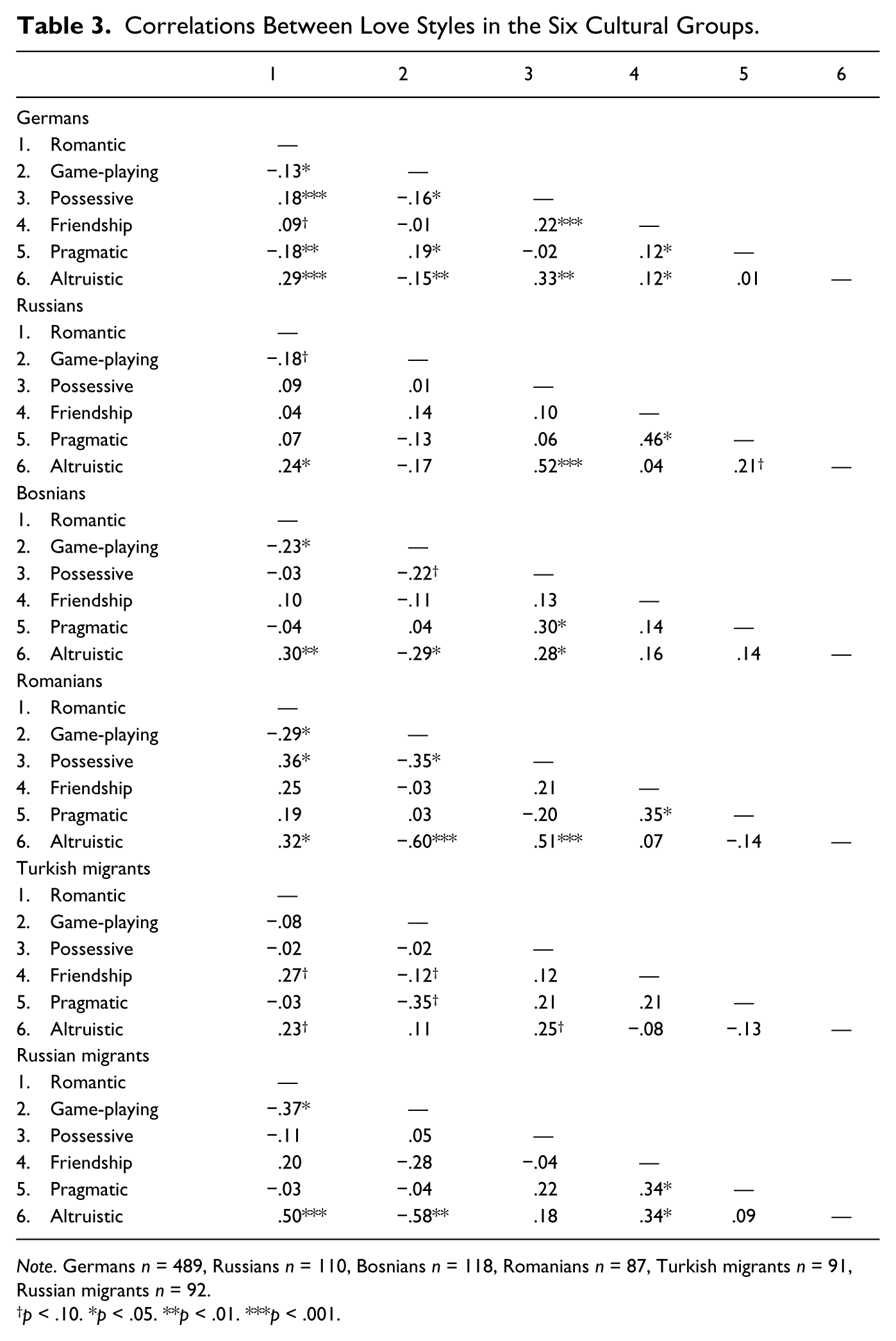
Note. Germans n = 489, Russians n = 110, Bosnians n = 118, Romanians n = 87, Turkish migrants n = 91, Russian migrants n = 92.
p < .10. *p < .05. **p < .01. ***p < .001.
Configural invariance
When testing the measurement model for configural invariance and assessing model fit, a negative error variance (Heywood case) occurred in the sample of Russian migrants. According to Dillon, Kumar, and Mulani (1987), Heywood cases may be caused by lack of fit, misspecification, or sample fluctuations. Sample fluctuations might be the reason for a negative error variance if the model provides reasonable fit, the confidence interval for the offending estimate covers zero, and the corresponding standard error roughly matches the standard errors of the corresponding estimates. Because all conditions were met, we considered the negative error variance as the result of sample fluctuations and—following Dillon et al. (1987)—constrained it to zero.
The resulting model (Model 1) provided a good fit (see Table 4) and served as a baseline model for the following comparison. 2 All factor loadings were significant, p < .01, indicating that the underlying factor explains substantial variance in the corresponding item.
Model Fit Indices for MEIL.
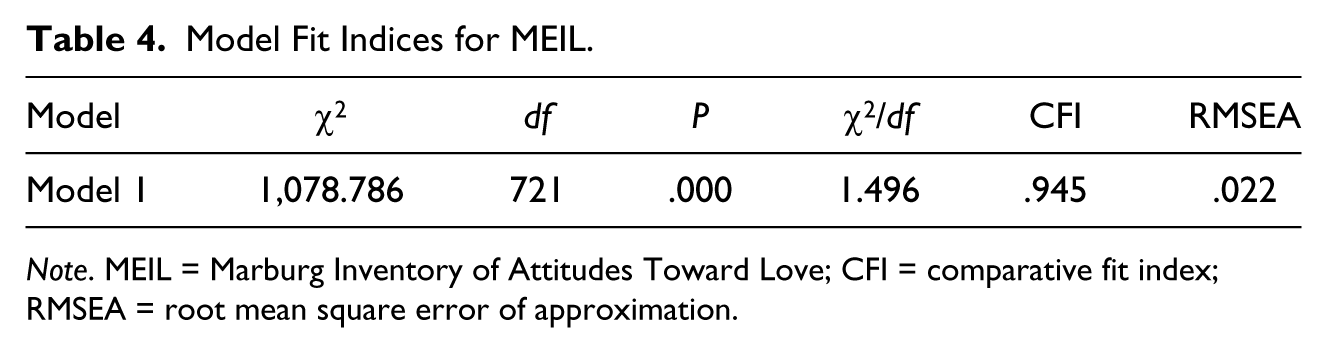
Note. MEIL = Marburg Inventory of Attitudes Toward Love; CFI = comparative fit index; RMSEA = root mean square error of approximation.
Testing the ZIP for configural invariance also showed good model fit (see Table 5) with every factor loading significant at p < .001.
Model Fit Indices for ZIP.

Note. ZIP = German version of the Relationship Assessment Scale; CFI = comparative fit index; RMSEA = root mean square error of approximation.
Metric invariance
Next, we tested for metric invariance by constraining factor loadings to be equal and allowing intercepts to be estimated freely. If metric invariance is established, it is possible to compare obtained ratings across groups. The model evaluation was guided by the following considerations:
The null hypothesis of equality should be rejected, if the chi-square difference test is significant. The chi-square test is sensitive to large sample sizes. As a result, trivial differences could become significant when evaluating change in model fit by constraining parameters. Cheung and Rensvold (2002) explored change in several global fit indices and concluded that change in CFI provides a robust statistic in testing for invariance between groups in multi-group confirmatory factor analysis. According to their recommendation, the null hypothesis of invariance should not be rejected if the decrease in CFI is not greater than −0.01. Hence, we took chi-square test statistics into account as well as change in CFI.
Tables 6 and 7 show model fit indices and change in model fit due to successive parameter constraints. As can be seen in the second row of both tables, constraining the factor loading to be equal causes a significant difference in chi-square values but also a change in CFI value less than .01 (Model 2). Thus, we considered factor loadings to be invariant across cultural groups. This inference applies both to the MEIL and to the ZIP.
Model Fit Indices and Changes in Model Fit for Constrained Models MEIL.
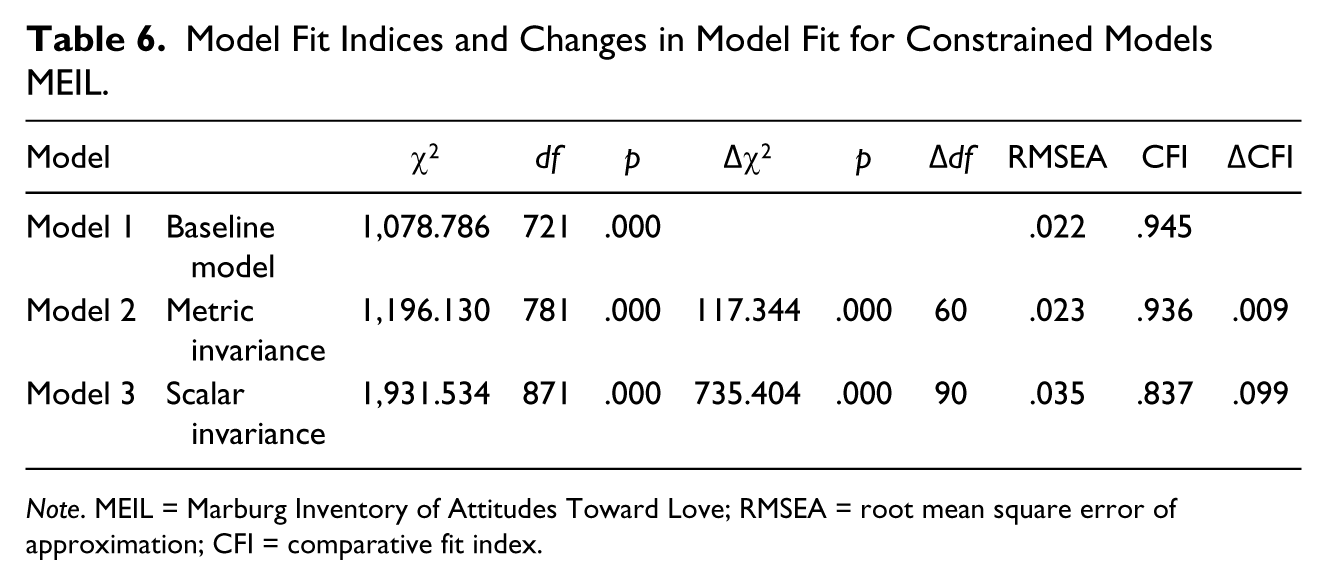
Note. MEIL = Marburg Inventory of Attitudes Toward Love; RMSEA = root mean square error of approximation; CFI = comparative fit index.
Model Fit Indices and Changes in Model Fit for Constrained Models ZIP.
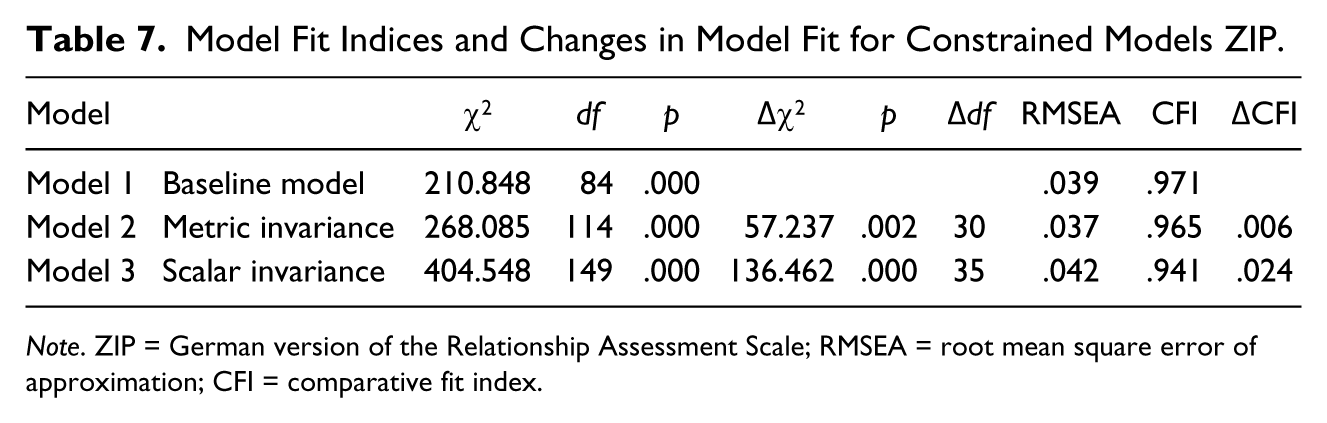
Note. ZIP = German version of the Relationship Assessment Scale; RMSEA = root mean square error of approximation; CFI = comparative fit index.
Scalar invariance
In addition, constraining the intercepts to equality (see Table 6, Model 3) resulted in a significant chi-square difference test as well as a change in CFI greater than .01. This change in model fit indicates non-invariance for the intercepts across samples. Therefore, latent means across cultural groups cannot be considered equivalent and thus are not comparable.
Likewise, constraining the intercepts to equality for ZIP resulted in a significant chi-square difference test as well as a change in CFI greater than .01 so that the assumption of scalar invariance for measurement of relationship satisfaction had to be rejected (see Table 7, Model 3).
Establishment of full configural and metric but not scalar invariance means that the comparison of latent means between cultural groups is inappropriate because it requires scalar invariance. Nevertheless, if configural and metric invariance hold, the analysis of relationships between constructs is viable. Given configural and metric invariance, the use of correlation, regression, and path analysis is permitted. Steenkamp and Baumgartner (1998) explained in their highly regarded analysis of measurement invariance and its implication for cross-cultural research with respect to construct-to-construct relationships: “Scalar invariance is not required because no absolute comparisons are conducted.” (p. 82). But configural and (partial) metric invariance are required. Indeed, we established full configural and metric invariance by examining measurement invariance of the MEIL and the RAS.
Gender differences
Measurement equivalence was tested for the largest sample. Therefore, the comparability of responses of males and females was examined for the German sample, which included 301 women and 188 men. The same statistical procedure that was used for validation of the measurement model across cultural groups was employed. Full configural and metric invariance as well as partial scalar invariance were confirmed for both the MEIL and the ZIP, rendering the results of males and females at least partially equivalent.
Prediction of Relationship Satisfaction
To examine the extent to which each love style predicts relationship satisfaction, a path analysis was conducted with love styles as predictors and relationship satisfaction as criterion (see Figure 1). 3 The structural model including all participants as one group revealed an acceptable fit, χ2 = 873.526, CFI = .945, and RMSEA = .050. When groups were estimated separately within the structural model, the fit still was acceptable, χ2 = 2,568.682, CFI = .911, and RMSEA = .026.

Culture-specific love styles and relationship satisfaction.
Constraining the coefficients for romantic love to be equal across cultural groups yielded a significant chi-square difference test (Δχ2 = 11.550, Δdf = 5, p = .041), but CFI did not change at all, so we considered romantic love to equally, positively predict relationship satisfaction across cultural groups.
Imposing the equality constraint on possessive love’s path coefficients revealed that possessive love’s ability to negatively predict relationship satisfaction appears to be similar across all cultural groups (Δχ2 = 2.716, Δdf = 5, p = .744).
Although friendship love positively predicted relationship satisfaction in the main analysis, this result was not confirmed in the supplementary analysis (see Note 3). Constraining the path coefficient to be equal showed no significant differences across cultures in the main analysis (Δχ2 = 5.037, Δdf = 5, p = .411) and in the supplementary analysis (Δχ2 = 4.750, Δdf = 5, p = .447), respectively.
Pragmatic love was not related to relationship satisfaction and constraining path coefficients for pragmatic love to be equal revealed no substantial differences between cultural groups, Δχ2 = 7.251, Δdf = 5, p = .203.
Next, for altruistic love we set path coefficients to be equal. This yielded an overall Δχ2 = 5.210, Δdf = 5, p = .391, which suggests that positively predicting relationship satisfaction through altruistic love is consistent across the cultural groups.
Finally, we constrained the path coefficients to be equivalent for game-playing love. The result showed that game-playing love differs across cultural groups (Δχ2 = 27.532, Δdf = 5, p < .001). Game-playing love predicts significantly lower relationship satisfaction for Germans, Romanians, and Turkish migrants, but not for Bosnians, Russians, and Russian migrants. This result was confirmed in the supplementary analysis (Δχ2 = 25.450, Δdf = 5, p < .001).
Germans as Comparison Standard for Every Other Cultural Group
Finally, we examined which samples differ from the German sample in particular. This was accomplished by computing a regression analysis with love style, sample, and their interaction as predictors of relationship satisfaction. Besides Bosnians, Romanians, and Russians we also included both groups of migrants in this comparison. The analysis was conducted with MODPROBE (Hayes & Matthes, 2009). Sample was coded in six different categorical dummy variables with German = 0 and every other sample = 1. We statistically controlled each love style for all other love styles. In addition, we controlled for age and gender.
These analyses yielded only scattered evidence for cultural differences. Specifically, the comparison between Germans and Russians revealed that sample moderated the prediction of relationship satisfaction through romantic love. The complete model regression explained 43.53% of the variance, F(10, 563) = 43.391, p < .001. Change in R2 was .005, F(10, 563) = 4.844, p = .028. Figure 2 illustrates the interaction. For Germans, romantic love predicted relationship satisfaction, b = .330, SE = .028, t(572) = 11.800, p < .001, as well as for Russians, b = .449, SE = 048, t(572) = 9.302, p < .001. While German and Russian high scorers on romantic love (defined as 1 standard deviation above the mean) were similarly satisfied with their relationship, Russian low scorers on romantic love (defined as 1 standard deviation below the mean) were less satisfied than German low scorers (defined as 1 standard deviation below the mean; see Figure 2). No other interaction effects were found in comparing Russians with Germans.
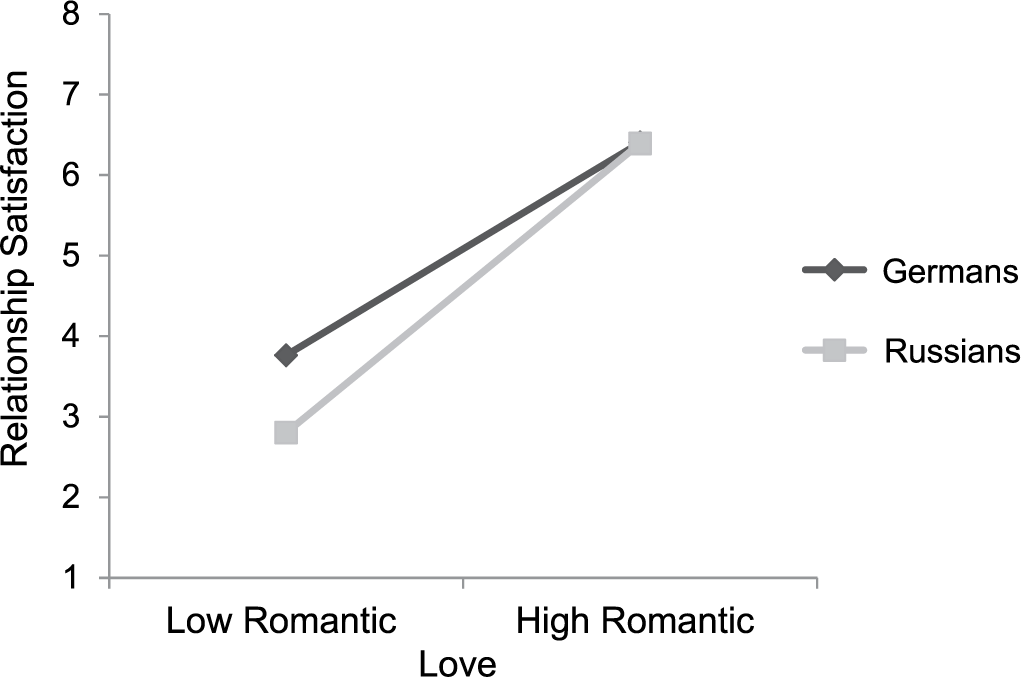
Sample (German vs. Russian) moderating the association between romantic love and relationship satisfaction.
For the group of Russian migrants, we found an interaction effect for romantic love (see Figure 3) as well as for pragmatic love (see Figure 4). For romantic love, 39% of the variance was explained by the regression model, R2 = .393, F(10, 545) = 35.236, p = .001. The interaction effect caused a change in R2 of .005, F(10, 545) = 4.001, p = .046. Russian migrants who were low scorers on romantic love were less satisfied with their relationship than Germans scoring low on romantic love (see Figure 3). Romantic love predicted relationship satisfaction for German participants, b = .325, SE = .029, t(554) = 11.380, p < .001 as well as for Russian migrants, b = .4561, SE = .061, t(554) = 7.458, p < .001.
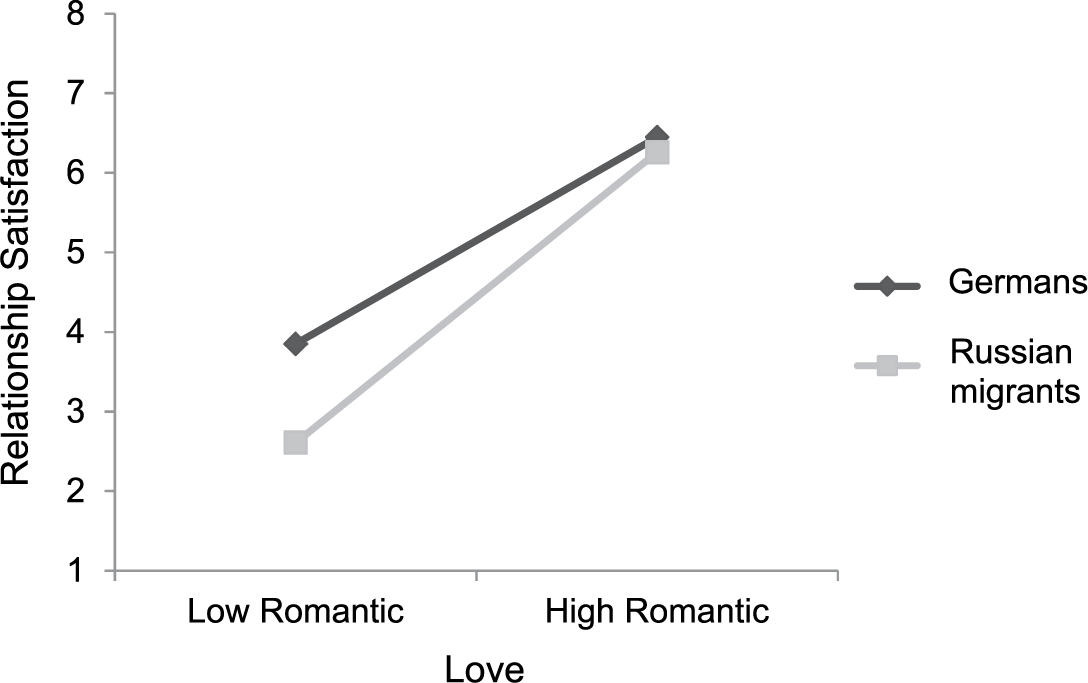
Sample (German vs. Russian migrants) moderating the association between romantic love and relationship satisfaction.

Sample (German vs. Russian migrants) moderating the association between pragmatic love and relationship satisfaction.
For pragmatic love, the analysis resulted in R2 = .394, F(10, 545) = 35.452, p < .001, for the complete model regression. Furthermore, we found high-scoring Germans to be more satisfied than high-scoring Russian migrants with ΔR2 = .006, F(10, 545) = 5.324, p = .022, due to interaction (see Figure 4). Pragmatic love did not predict relationship satisfaction for Germans, b = −.001, SE = .025, t(554) = −.036, p = .97, but it negatively predicted satisfaction for Russian migrants, b = −.132, SE = .051, t(554) = −2.585, p < .05.
Furthermore, the factor sample moderated the effect of possessive love on relationship satisfaction in comparing Germans with Turkish migrants (illustrated in Figure 5). The complete regression model explained 39% of the variance, R2 = .390, F(10, 544) = 34.796, p < .001. Change in R2 caused by interaction was ΔR2 = .005, F(10, 544) = 4.489, p = .035. Germans scoring high on possessive love are more satisfied with their relationship than Turkish migrants scoring high on possessive love (see Figure 5). For Germans b was −.069, SE = .028, t(553) = −2.433, p < .05, whereas for Turkish migrants, b = −.183, SE = .048, t(553) = −3.833, p < .01. Again, this was the sole significant interaction that emerged from the comparison between Germans and Turkish migrants.
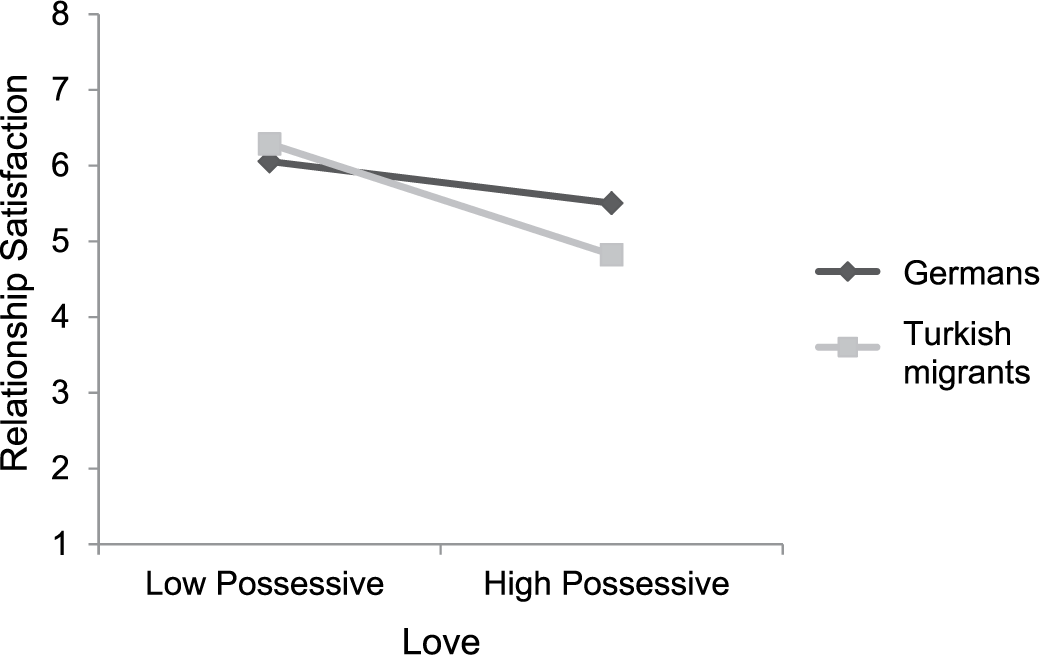
Sample (German vs. Turkish migrants) moderating the association between possessive love and relationship satisfaction.
For Bosnians and Romanians compared with Germans, no significant interactions were found at all.
Discussion
This cross-cultural study examined the extent to which love, measured in terms of love styles, is associated with relationship satisfaction. Data analysis including six samples was based on structural equation modeling, estimating all samples at once within a single model. To reveal both cultural similarities and differences, regression paths were successively constrained to be equal across cultural groups. The measurement model ascertained partial invariance permitting the cross-cultural analysis of meaningful relationships among constructs. Specifically, love styles and relationship satisfaction were in the focus of our research.
Are love styles associated with relationship satisfaction? We assumed that romantic love, altruistic love, and game-playing love are systematically associated with relationship satisfaction across cultures, whereas possessive love, pragmatic love, and friendship love are not. In addition, the expectation was that romantic love and altruistic love predict relationship satisfaction positively and consistently across cultural groups, whereas the negative effect of game-playing love is culture-specific.
Results indicate that romantic love predicted relationship satisfaction positively across all samples. The explained variance varied between 8.9% (for Romanians) and 53.0% (for Russians). This significant result is in accordance with previous research (cf. Bookwala et al., 1994; Davis & Latty-Mann, 1987; Meeks et al., 1998). The especially strong connection of relationship satisfaction with romantic love in the Russian sample indicates that in Russian culture romantic love is closely linked to relationship satisfaction. This result was replicated—although attenuated—for the Russian migrants.
Direct comparison of Russians with Germans as reference group revealed a significant moderation effect that was based on Russian low scorers on romantic love who turned out to be less satisfied with their relationship than German low scorers on romantic love.
In addition, the comparison between Germans and Russian migrants revealed a similar moderation effect because Russian migrants who scored low on romantic love expressed less relationship satisfaction than German low scorers. The consistency of these results across Russians and Russian migrants indicates that the especially negative response to low romantic love characterizes Russian culture in general.
High altruistic love compared with low altruistic love consistently enhanced relationship satisfaction across samples. The Romanians represented the only exception to this rule. Altruistic love in general may function as a positive relationship resource in most cultures by facilitating the social exchange between relationship partners and therefore fostering relationship satisfaction.
Game-playing love was the love style that, in its consequences, was strongly dependent on culture because it negatively predicted relationship satisfaction for Germans, Romanians, and Turkish migrants but not for Bosnians, Russians, and Russian migrants. In general, a negative association between game-playing love and relationship satisfaction might be expected on the basis of two arguments. First, game-playing love is positively related to infidelity, which is a relationship-threatening behavior and which therefore has the potential to undermine relationship satisfaction. Second, game-playing love might be partially motivated by low relationship satisfaction. Therefore, the occurrence of game-playing love is likely to damage relationship satisfaction and, in addition, low relationship satisfaction might inspire game-playing tendencies.
These explanations obviously do not apply to the Bosnian and Russian samples. These exceptions were in part expected. Sexual infidelity seems to be quite common in Russia and to be accepted even by women. Russian males tend to express their masculinity and status in going out, drinking, and engaging in sexual encounters (Kon, 1997, cited in Haenselmann, 2008). In an empirical study by Haenselmann (2008), results indicated a very clear difference between Germans and Russians. Whereas Russians stated they had on average 2.19 (SD = 4.95) extrarelational sexual encounters, Germans indicated that they had engaged in 0.12 (SD = 0.55) extrarelational sexual encounters on average. As Julia Ioffe (2010; www.slate.com) stated, it has become accepted and even expected in Russia to deal with infidelity in romantic relationships. The same statement seems to hold for the sample of the Russian migrants and possibly also for the Bosnians (Ziga & Dzozic, 2006, cited in Dedic, 2010).
But Jankowiak, Nell, and Buckmaster (2002) collected convincing anthropological evidence, which indicates that extramarital affairs elicit mate-guarding tactics in all cultures investigated. Infidelity of one partner routinely elicits countermeasures by the other partner. This evidence is not dependent on gender or level of male dominance in society because women and men engage equally in the defense against sexual competitors. But cultural variation was observed in style of response to infidelity. For example, women more than men distanced their self from partner as a response to his or her extramarital affair (Jankowiak et al., 2002). It is likely that members of all cultural groups tend to protect their relationship against partner’s infidelity. Russians, Russian migrants, and Bosnians more than Germans, Romanians, and Turkish migrants might prefer to employ the tactic “distance self from other.” Such a tactic of distancing would be compatible with the finding that game-playing love does not correlate with relationship satisfaction in the Russian and Bosnian samples. Further research is needed to examine the merits of this explanation, which assumes that negative partner responses to infidelity are universal but that styles of response and their consequences on relationship satisfaction may differ between cultures.
Possessive love consistently turned out to be a negative predictor of relationship satisfaction across cultures. We didn’t predict this effect because the results of earlier studies were inconsistent. But Graham (2011) who performed a meta-analysis found, as well, possessive love to be negatively related to relationship satisfaction. Note that the possessive love effect on relationship satisfaction was consistent across cultural groups but quite small in terms of explained variance.
Although in the main analysis friendship love showed a small, but significant positive link with relationship satisfaction across cultural groups, this result did not stand up to the supplementary analysis. We conclude from these results that friendship love is not a reliable predictor of relationship satisfaction. This conclusion corresponds with Graham (2011) who reported a non-significant positive correlation between friendship love and relationship satisfaction in his meta-analysis.
Finally, relationship satisfaction was as expected statistically independent from pragmatic love across countries. This pattern of results corresponds with the findings of previous studies.
Limitations
This study has a number of limitations. First, sample sizes differed considerably between cultural groups. The stability of the results depends in part on the sample size with larger samples producing more reliable results. We tackled this problem by performing the supplementary analysis with equalized sample sizes. In addition, the percentage of males and females differed between samples and the sample of Russian migrants was completely female. Finally, age and relationship length varied somewhat across samples. We tackled these problems by introducing age and gender as covariates in the regression analyses. Further studies should match participants from different nations on the basis of age and gender to reduce these problems.
In addition, validation of the measurement model between women and men was only performed for the largest sample included (i.e., for the German sample). The structural equation model for predicting relationship satisfaction by love styles for males and females separately revealed a sufficient model fit, χ2 = 847.906, df = 508, CFI = .939, RMSEA = .037. Imposing constraints on all regression weights simultaneously revealed no substantial gender differences in the prediction of relationship satisfaction, Δχ2 = 2.315, Δdf = 6, p = .889. Although these results for the Germans are promising with regard to gender comparability, the same information is not available for the other cultural groups because of sample restrictions.
Like in most studies on cross-cultural effects, a methodological problem was present because it was not feasible to establish scalar invariance across cultural groups. Thus, means could not be compared meaningfully because it was not possible to rule out that differences in scale usage caused mean differences between cultural groups. But the partial validation of the measurement model allowed for construct-to-construct analyses based on covariances. Therefore, our results are validated by cross-cultural comparability.
In any case, the replication of the links between love and relationship satisfaction across six cross-cultural samples bolsters our confidence in the dependability of the results. Whereas cultural universality dominated the results, the strongest case of cultural relativity emerged with respect to game-playing love.
Conclusion
The present results offer new insights into the cross-cultural link between love and relationship satisfaction. Which general conclusions can be drawn from the cross-cultural comparisons? We have mentioned three research questions in the introduction. The first asked which love styles predict relationship satisfaction. Whereas romantic love and altruistic love overall showed positive associations with relationship satisfaction, the association with possessive love was negative. In addition, the link between game-playing love and relationship satisfaction turned out to vary between cultural groups.
These results confirmed our expectations only partially. The predictions for the love styles, which are represented on the love dimension derived by Graham (2011), were confirmed by the empirical results, which are summarized in Figure 1. But the cross-culturally consistent results for possessive love as a negative predictor of relationship satisfaction are surprising. This additional effect indicates that the romantic-obsessive dimension is also associated with relationships satisfaction. Therefore, the association of love styles with well-being turned out to be more manifold than originally thought.
The second research question referred to the universality of the results. The overall pattern of results corresponds with the notion of cultural universality, although cultural relativity plays a secondary role. A similar conclusion was drawn by de Munck et al. (2011) in their cross-cultural research on the basis of questionnaires, interviews, and free list responses comparing United States, Russia, and Lithuania. They contrasted cultural universals of love with cross-cultural variation. In the same vein, we distinguish between a common core of love features and love features that represent adaptations to different cultures.
Romantic love and altruistic love were positively related to relationship satisfaction in different cultural contexts. Therefore, these associations with relationship satisfaction are universal. But in accordance with cultural variability, the strength of the positive links varied cross-culturally. Possessive love was negatively correlated with relationship satisfaction. This negative correlation was consistent across cultures although it varied in strength with Turkish migrants showing the strongest correlation and Bosnians and Romanians showing very weak correlations. In addition, the negative effect of game-playing love on relationship satisfaction was completely dependent on culture because it disappeared in the Russian and Bosnian samples. Finally, neither pragmatic love nor friendship love turned out to be reliable predictors of relationships satisfaction and these zero results were replicated cross-culturally.
In terms of the framework of Graham (2011), love styles, which are located on two dimensions of the three-dimensional framework, facilitated or inhibited relationship satisfaction. Their significant connection with relationship satisfaction was observed in Western European and Eastern European cultures likewise and was also confirmed in the sample of Turkish migrants. Therefore, the connection of love styles with relationship satisfaction seems to be independent of the individualism-collectivism dimension. In the introduction, we speculated that this dimension on which cultures vary substantially and love are independent of each other. Such a speculation is confirmed by our results, which indicate that the links between love styles and relationship satisfaction primarily represent a pattern of cultural universality.
In addition, cultural relativity dominated the link between game-playing love and relationship satisfaction. Game-playing love, which loads on the love dimension with a negative sign, does not only constitute a controversial love style because of its relationship-threatening potential, but it is also controversial as a cultural phenomenon with some cultures responding negatively in terms of relationship satisfaction and others responding neutrally in this respect. Therefore, the effect of game-playing love on relationship satisfaction revealed substantial cross-cultural variation.
These results are especially intriguing. Does it mean that people in cultures like Russia and Bosnia are less vulnerable to the relationship-threatening effects of game-playing love because they have become accustomed to it? If such a cultural phenomenon of habituation exists, does it encompass other negative relationship experiences, such as anger and frustration? Or is the use of countermeasures against extrarelational affairs a universal phenomenon in different cultures and the cultural variation occurs only in style of response as was suggested by Jankowiak et al. (2002)? If such a cultural relativity of response style exists, how is it translated into emotional responses that correlate with relationship satisfaction?
A further question is whether the occurrence of infidelity depends in part on educational level. The results of earlier studies are inconclusive (Blow & Hartnett, 2005). In general, the influence of educational level seems to be quite small and dependent on additional factors like gender and perceived equity.
The level of pragmatic love was neutral in terms of relationship satisfaction. This result supports the assumption that pragmatic love is different from love (Sternberg, 1987). The results summarized in Figure 1 and the contrast with Germans in Figure 4 show that Russian migrants constitute an exception to this rule. Interestingly enough, events such as immigration may trigger processes that contribute to a negative association between pragmatic love and relationship satisfaction. In the introduction, we speculated that migrants might develop some kind of hybrid culture of their own. For example, migrants from a collectivistic culture who encounter an individualistic culture like Germany may favor positions midway between the receiving culture and their culture of origin. The result of Russian migrants who displayed a negative link between pragmatic love and relationship satisfaction exemplifies a possible feature of such a hybrid culture. But the negative link between pragmatic love and relationship satisfaction was not replicated for Turkish migrants. Instead, Turkish migrants who scored high on possessive love expressed less relationship satisfaction than Germans (see Figure 5). Therefore, it is likely that each group of migrants develops its own hybrid culture. The hybrid culture may comprise positions midway between receiving culture and culture of origin. Or it may be characterized by the acceptance of new positions, which are neither held in the receiving culture nor in the culture of origin. Further research is needed on this interesting issue.
Unfortunately, no comparison of Turkish migrants with their culture of origin is possible. But in the case of Russian migrants, a comparison with their Russian home culture is feasible. In general, the comparison reveals both similarities and differences. Whereas both cultural groups are similar with respect to game-playing love, they differ with respect to pragmatic love. This pattern of results indicates that the Russian migrants have developed their own hybrid culture, which includes both components from the culture of origin and components that reflect the encounter with the receiving culture.
Finally, friendship love—the other love style, which is located on the practical-friendship dimension of Graham (2011)—did not systematically co-occur with relationship satisfaction. Although in Figure 1 a small positive link emerged for the main analysis, it was not supported in the supplementary analysis. Therefore, the conclusion is warranted that the practical-friendship dimension does not predict relationship satisfaction. This conclusion is in correspondence with our assumptions, which were outlined in the introduction.
The third research question referred to contrasts between Germany as a representative of individualistic cultures and Bosnia, Romania, and Russia as representatives of collectivistic cultures (cf. Hofstede, 2006). Whereas no significant contrasts were found with Bosnians and Romanians, differences emerged in the comparison with Russians, Russian migrants, and Turkish migrants. Specifically, Russians and Russian migrants deviated from Germans with respect to the link between romantic love and relationship satisfaction. In addition, Russian migrants deviated from Germans with respect to the link between pragmatic love and well-being, and Turkish migrants deviated from Germans with respect to the link between possessive love and relationship satisfaction. These significant contrasts neither follow the individualistic/collectivistic dichotomy nor the dichotomy between migrants and non-migrants. Nevertheless, they reveal cultural variability, which is embedded in the overall pattern of cultural universality with respect to the link between love styles and relationship satisfaction.
Footnotes
Acknowledgements
The authors would like to thank Niyal Cetin, Maid Dedic, Stephanie Hanke, Tatjana Hänselmann, Ines Maisch, Adriana Daniela Müller, and Nathalie Simahin for help in collecting the data.
Declaration of Conflicting Interests
The author(s) declared no potential conflicts of interest with respect to the research, authorship, and/or publication of this article.
Funding
The author(s) received no financial support for the research, authorship, and/or publication of this article.