



Abstract
The current study focuses on the human value of forgiveness and explores its correlates using a country-level meta-analytical approach. We investigated the importance of forgiveness using the Rokeach Value Survey with 41,975 participants from 30 countries to address the following research questions: How important is forgiveness across different countries? What contextual variables correlate with the ranked importance of forgiveness? This study provides important insights on country-level correlates of forgiveness in regard to conditions that may favor prioritizing the value forgiveness and its possible implications for societies. The results show that the value forgiveness is related to a highly developed socioeconomic and sociopolitical environment as well as to subjective well-being at the country level.
How far that little candle throws his beams! So shines a good deed in a weary world.
In times of unrest through a globalizing world, it is timely to investigate processes that may facilitate reconciliation and sustainable peace. One of the processes that captured the attention of scholars across a range of disciplines is forgiveness between peoples and nations (e.g., Oliner, 2005). Forgiveness has intuitive meaning across cultures, especially in the form of interpersonal forgiveness. Rokeach (1973) thought of forgiveness as a human value with universal meaning. There are also other ways to think of forgiveness as well: as a symbolic process involving apology and its acceptance or as an intrapersonal release from holding onto grievance (Langsley, 2005; McCullough, Bono, & Root, 2007; Worthington, 2005). The first assumption and its causal link have been debated, and the positive impact of apologies in the public sphere on the willingness to forgive has been questioned (Hornsey & Wohl, 2013). Furthermore, recent research showed that forgiveness has to be regarded as a contextualized dynamic process (Hanke et al., 2013).
This article presents a meta-analytic approach that examines forgiveness as a human value at the country level, and details its relationship with contextual variables such as human development and sociopolitical variables in a society. Such contextual variables, rooted in a society’s socioeconomic and political milieu, may well have an impact on the value accorded to forgiveness by a people. This may in turn facilitate reconciliation processes involving entire countries or groups within a society. In the following sections, we review briefly and differentiate various conceptualizations of forgiveness.
Interpersonal Conceptions of Forgiveness
Everyone has suffered painful periods at some point when they were unjustly harmed by someone. Forgiving the perpetrator or cause of such hurtful experiences may allow a person to let go of anger, restore a damaged relationship, or stop the desire for revenge. The dynamics of interpersonal forgiveness began receiving attention in the literature in the late 1980s (see McCullough, Pargament, & Thoresen, 2000, for a review). Studies have addressed questions such as how forgiveness as a process is able to heal the hurt caused by the harm done and bring people together again (Fincham, Jackson, & Beach, 2005). This literature generally incorporates an analysis of the benefits and drawbacks of forgiveness in interpersonal settings (for an overview, see McCullough, 2000). The majority of research has been embedded within the fields of developmental psychology (Enright & the Human Development Study Group, 1991; Enright & North, 1998) and counseling/clinical psychology (e.g., McCarthy, 2005; McCullough & Worthington, 1994, 1995; Murray, 2002). For example, forgiveness has been proposed as an intervention method and has been applied in therapeutic settings; an important finding is that studies have shown that forgiveness is positively related to psychological outcome variables such as overall well-being (Karremans, Van Lange, Ouwerkerk, & Kluwer, 2003, McCullough, 2000; Rye, Folck, Heim, Olszewski, & Traina, 2004) and happiness (Maltby, Day, & Barber, 2005) of an individual.
Intergroup Forgiveness
When looking at conflicts at a broader scale, such as atrocities committed by nations toward other nations, forgiveness has more recently been identified as a subject for research in the realm of conflict resolution and peace (for an overview, see Roe, 2007). Most of the research addressed how forgiveness may function to facilitate peace and reconciliation. Scholars have also explored forgiveness as a process at the societal level after conflicts (Staub, 2005; Staub & Bar-Tal, 2003; Staub & Pearlman, 2001; Wohl & Branscombe, 2005) and in intractable conflicts using a social identity approach (Hewstone, Cairns, Voci, Hamberger, & Niens, 2006; McLernon, Cairns, Hewstone, & Smith, 2004). Such research has proceeded cautiously in extending concepts that are already complex in their operation at the interpersonal level to the macrolevel (e.g., Staub, 2004).
Nonetheless, there is an overall agreement among scholars in the fields of sociology (e.g., Tavuchis, 1991), philosophy (e.g., Govier, 2002), political science (e.g., Amstutz, 2005; Minow, 1998), and quasi-legal institutions like Truth Commissions (e.g., in South Africa, see Tutu, 1999) that forgiveness seems to be a critical element in breaking cycles of counterviolence in postconflict societies. Furthermore, forgiveness at the societal level may foster the process of healing between nations and work toward genuine reconciliation. Hamber (2007) noted that there is a motivation among scholars to research the dynamics of forgiveness in postconflict societies because such work may provide critical insight in developing sustainable peace. This motivation is particularly acute in light of contemporary peace-building processes that have been unable to escape cycles of violence and counterviolence, consistently failing to develop long-term stability. Overall, important areas might include the positive relationship between forgiveness and subjective well-being. Furthermore, contextual correlates such as the stability of a society in form of the development of a country may shed some light on the complexity of forgiveness.
The Human Value “Forgiveness”
A useful element in this endeavor is the neglected research on the human value “forgiveness”. McCullough (2000) was surprised that not much research has been done with forgiveness as a value, although it could possibly reveal some crucial aspects about forgiveness. According to Rokeach (1973),
a value is an enduring belief that a specific mode of conduct or end-state of existence is personally or socially preferable to an opposite or converse mode of conduct or end-state of existence. A value system is an enduring organization of beliefs concerning preferable modes of conduct or end-states of existing along a continuum of relative importance. (p. 5)
Rokeach’s pioneering work on human values inspired very influential subsequent research on values at the individual (e.g., Schwartz, 1992, 1994; Schwartz et al., 2012) and at the cultural level (e.g., Hofstede, 2001; Inglehart, 1997). Recently, Vauclair, Hanke, Fischer, and Fontaine (2011) conducted a meta-analysis on the Rokeach Value Survey (RVS) to replicate Schwartz’s (2006) country-level value structure, yet they did not examine the value forgiveness as such and its associations with other contextual variables. In sum, to the best of our knowledge, there is no research attempting to better understand forgiveness as a value priority across countries since McCullough (2000) expressed his surprise. Consequently, this study has a rather exploratory character to gain an understanding about associations and their possible implications.
Engrained values, either at the personal or at the societal level, can guide peoples’ lives, as they represent beliefs about the desirable and not desirable (Rokeach, 1973; Schwartz, 1992). Given that values are “conceptions . . . of the desirable which influences the selection from available modes, means and ends of action” (Kluckhohn, 1954, p. 395), they can be seen as the underlying psychological foundations that motivate the expression of behaviors and attitudes at the societal level. According to Schwartz (1994) and Schwartz and Boehnke (2004), the importance and behavioral or attitudinal expression of values are influenced by contextual variables (Feather, 1975; Inglehart, 1997; Rokeach, 1973), including the social and political context.
Therefore, we derived the following research questions for the study:
Method
The common procedure was employed for a meta-analysis. A literature search was conducted covering studies that use the RVS (Rokeach, 1973), as this is one of the most widely used instruments to measure human values across a large period of time and with many different samples around the world (e.g., Allen, Ng, & Wilson, 2002; Feather, 1975). Commonly, the RVS consists of 18 terminal (desirable end states of existence) and 18 instrumental (preferable modes of conduct) values. The value of “forgiving” is included in the set of instrumental values and is briefly described as “forgiving—willing to pardon others.” Usually, the values are listed alphabetically, and the participants are instructed to rank the importance from 1 = most important to 18 = least important in each set, and a low number indicates high importance.
We used the data on forgiveness from a previous study in which we conducted a meta-analysis on all Rokeach values and examined the structure of Rokeach values at the country level. The detailed procedure for compiling the data can be found in Vauclair and colleagues (2011). For the current article, we briefly summarize the main steps. We used the database PsycINFO and searched for articles that covered the period 1967 (year of the publication of the RVS) to March 2006. We used the keywords Rokeach and values in our search. It resulted in 558 references. We included studies in which participants were at least 16 years old, not delinquent, and not mentally or physically disabled. Only studies that reported sufficient statistical information (such as the mean, median, or rank orders for values) were included. If relevant statistics were not reported in the original article, we contacted the authors and requested the information. Original articles that were not published in English language (22 out of 130) were translated by the authors or native speakers.
Three hundred thirty-four independent samples were used for the meta-analysis, originating from 168 independent studies. The meta-analysis contains data from 41,975 participants coming from 30 different countries. There was considerable variation regarding the samples sizes ranging from 25 participants (Sweden: number of independent samples = 2) to 5,589 participants (Australia: number of independent samples = 68) excluding the United States. However, there were only four countries with less than a hundred participants (M = 61). The complete list of articles included in the meta-analysis and further statistics on the countries and samples can be obtained from the second author.
We coded the mean or median ranks that were reported in the studies. General rank orders were used if no mean or median rank orders were reported. If the rating procedure was used (10.5% of all samples) instead of the original ranking procedure, we coded the mean rating. Successively, all coded information was ranked within each sample, ensuring maximal comparability of the data. After that, sample size–weighted rank orders were aggregated to the country level. Hence, our analysis is based on 30 countries. Last, each coded number was then again rank ordered across groups at the country level.
Subjective Well-Being
Country-level data on subjective well-being were obtained from Diener and colleagues (for reliability of these measures and further information, see Diener, Diener, & Diener, 1995). The aim was to replicate findings from previous research at the interpersonal level (Karremans et al., 2003; Maltby et al., 2005; Rye et al., 2004).
Contextual Variables
The Polity IV Project (Marshall, Gurr, & Jaggers, 2014) issues several indices, and we used the Polity index, institutionalized autocracy, and institutionalized democracy from 1967 to 2006, and created a sociopolitical indicator out of these three indices. We performed a factor analysis with the Polity index, institutionalized autocracy, and institutionalized democracy scores using varimax rotation, showing a strong single factor solution (eigenvalue = 2.91) that explained 96.92% of the total variance. We then calculated a regression-based factor score that represents democracy in a wider sense in the given time frame.
Moreover, we used the Human Development Index (HDI) as provided by the United Nations (United Nations Development Programme [UNDP], 2006) from 1975 to 2004 as potential socioeconomic correlate. We calculated a factor analysis with varimax rotation to be used as a single indicator for human development across this given time frame. We received a strong single factor solution (eigenvalue = 6.90) explaining 98.57% of the total variance. The HDI provides a single statistical indicator of a country’s level of development that serves as a frame of reference for both social and economic development. The HDI sets a minimum and maximum for life expectancy at birth, educational attainment, and gross national income per capita. Each of the three indicators then shows where each country stands in relation to these standards (Human Development Report, 2009).
We used these two indicators to correspond to the socioeconomic and sociopolitical context at the country level.
Results
The Ranked Importance of the Human Value “Forgiving” Across Countries
Out of the 18 instrumental values, forgiveness was ranked as the eighth most important value across the 30 countries. Therefore, the value has moderate importance in relation to all other instrumental values. Descriptive statistics are shown in Tables 1 and 2.
Mean Rank and Rank Order for Forgiveness Across All Countries and Across All Instrumental Values.

Note. 1 = most important; 18 = least important.
List of Countries and the Ranks for the Human Value “Forgiveness” Within and Across the Countries.
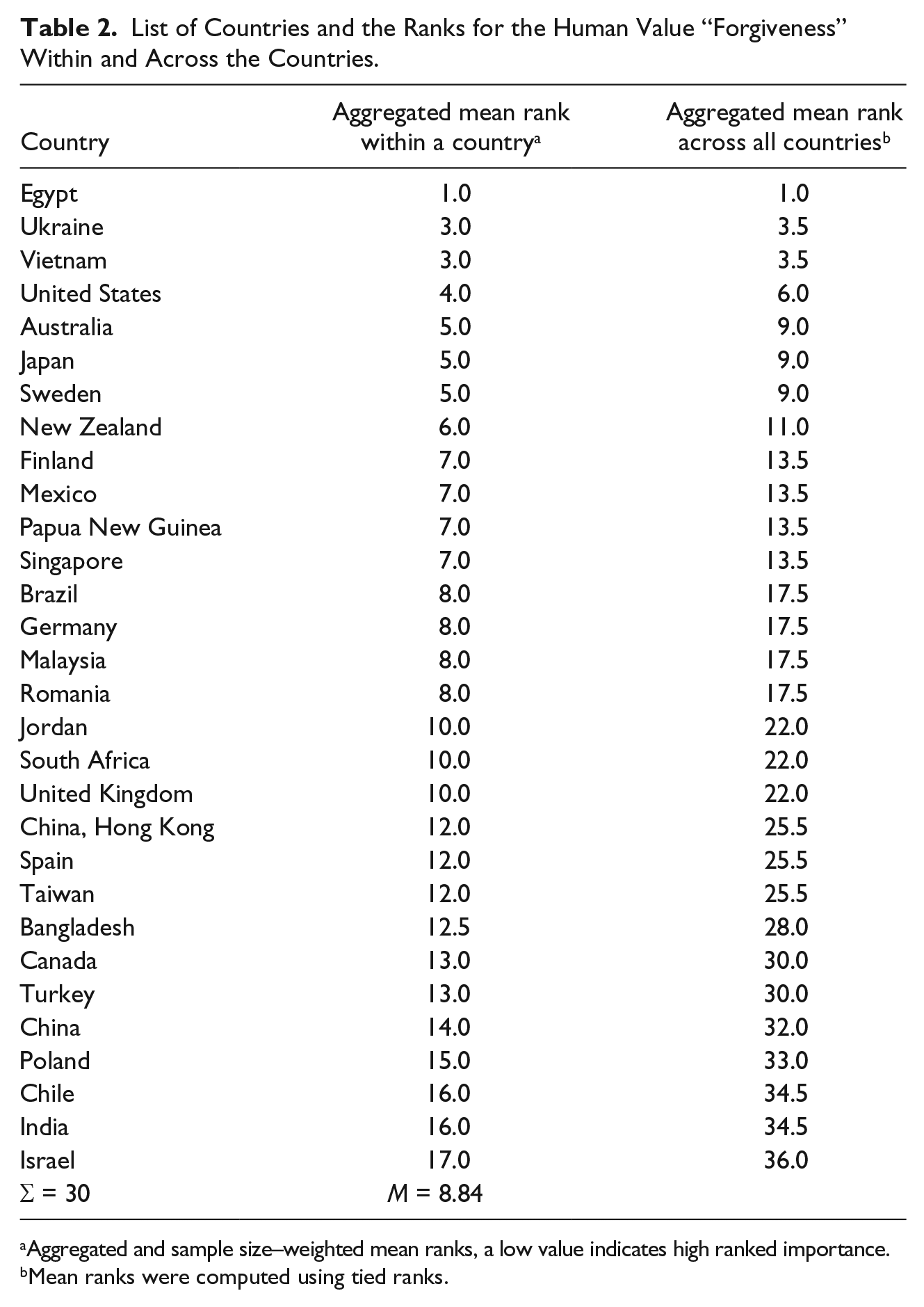
Aggregated and sample size–weighted mean ranks, a low value indicates high ranked importance.
Mean ranks were computed using tied ranks.
Correlations at the Country Level
For all analyses, we used the country scores and the ranks of forgiveness across all countries. The country scores of the indices are listed in Table 3.
Country Scores for SWB, SPI, and HDI.
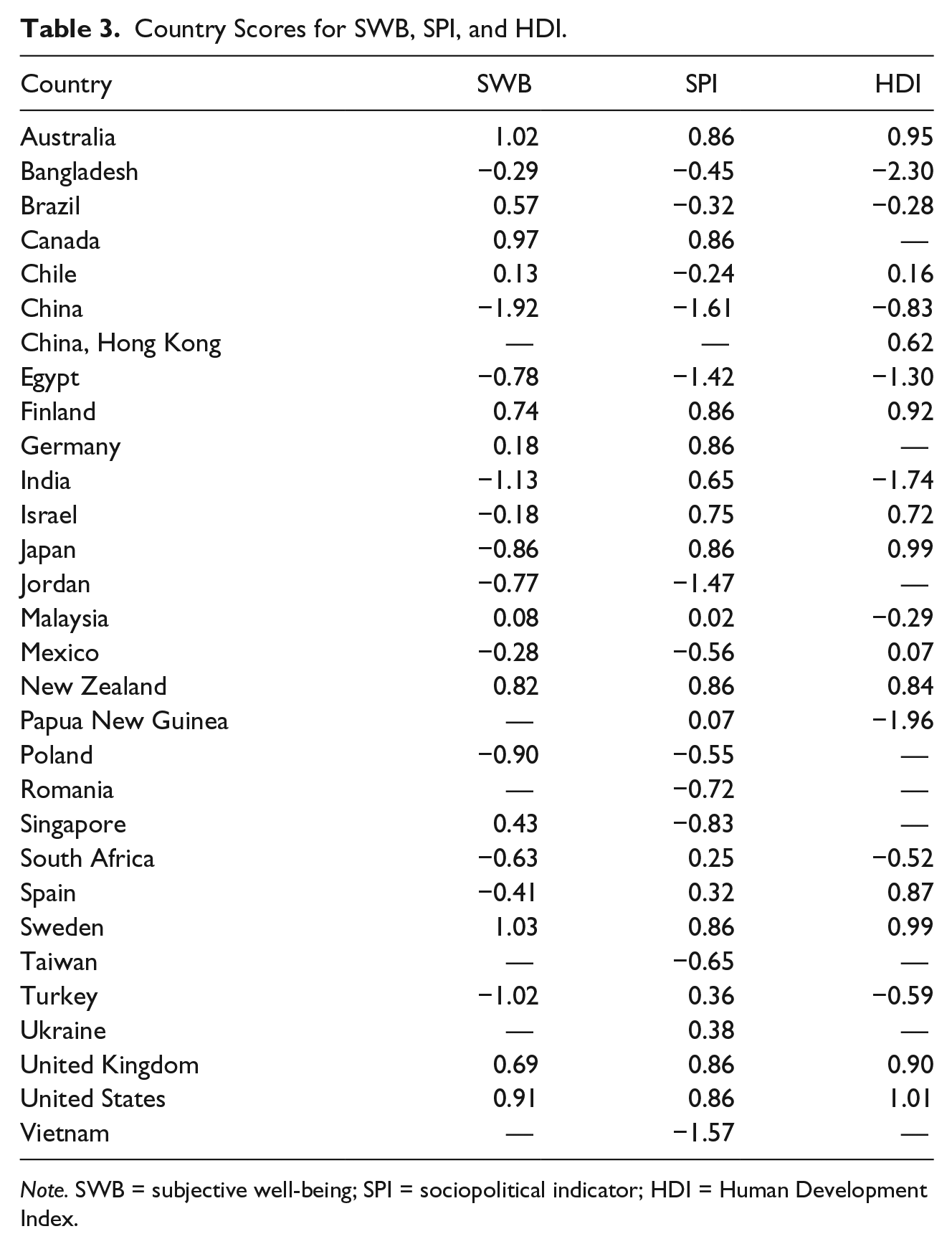
Note. SWB = subjective well-being; SPI = sociopolitical indicator; HDI = Human Development Index.
An alpha level of 5% was used for all statistical tests in this study. As we had a small sample size (sample size is the number of countries here), we employed Kendall’s tau. Hence, we calculated several rank-order correlations (Kendall’s tau) across all countries between the countries’ ranks of forgiveness and subjective well-being (Diener et al., 1995), the overall sociopolitical indicator, and the HDI. The reported correlations are all negative because of the ranking procedure used in the RVS where a low value indicates high importance (see Table 4), but in fact, it shows a positive relationship.
Intercorrelation Matrix Between “Forgiving” and SWB, SPI (Polity, Autocracy, Democracy), and HDI.
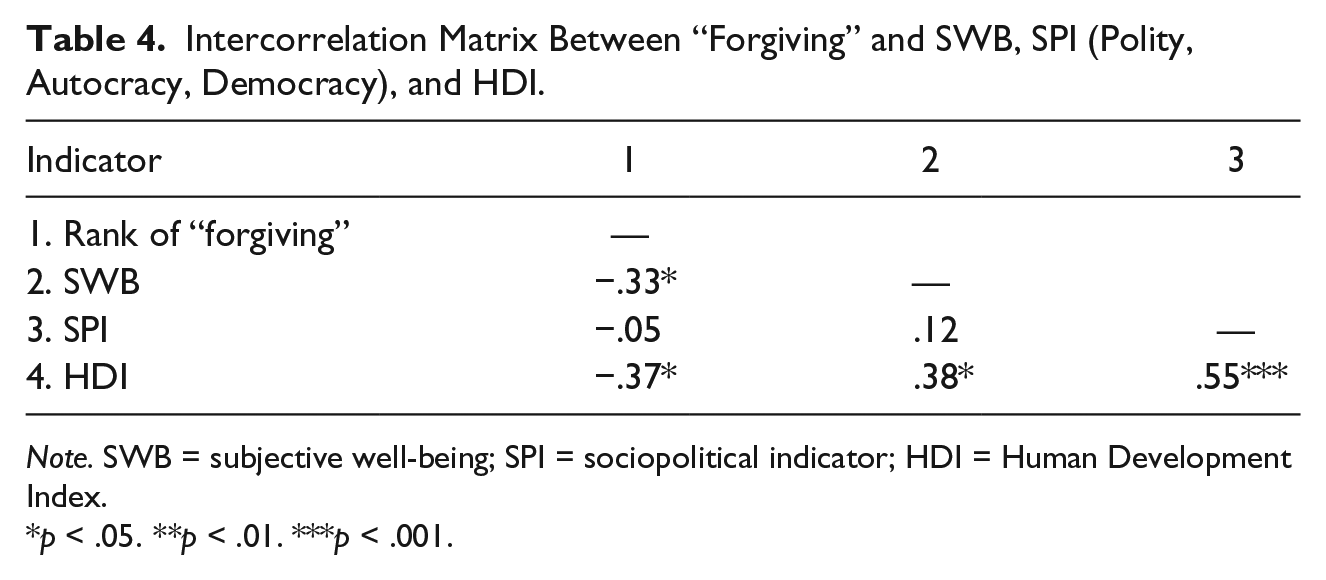
Note. SWB = subjective well-being; SPI = sociopolitical indicator; HDI = Human Development Index.
p < .05. **p < .01. ***p < .001.
We found a moderate but significant correlation between the ranked importance of forgiveness and subjective well-being—τ(30) = −.33, p < .05—at the country level. It shows that the more importance was placed on forgiveness across countries, the higher the scores for subjective well-being were and vice versa. This replicates earlier findings at the individual level (Karremans et al., 2003; Maltby et al., 2005; McCullough, 2000; Rye et al., 2004).
Surprisingly, there was no significant relationship with the sociopolitical indicator, τ(29) = −.05, p = .72. Furthermore, we found a significant relationship between the human development indicator and the ranked importance of forgiveness, τ(21) = −.37, p < .05. The more important forgiveness was ranked, the higher the human development in a country and vice versa.
Overall, well-being as well as HDI was positively associated with the importance of the value of forgiveness. However, after controlling for the socioeconomic context via HDI, the correlation between well-being and forgiveness became insignificant. This means that the level of development is driving the correlation between well-being and forgiveness, which is an interesting discovery.
Discussion
The aim of this study was to explore the relationship between the ranked importance of the value forgiveness across countries and contextual variables at the country level, such as country-level subjective well-being as well as socioeconomic and sociopolitical context variables.
Our findings demonstrated that forgiveness is positively associated with subjective well-being at the country level. This result was somewhat anticipated, as it is a replication of results found at the individual level (Karremans et al., 2003; Maltby et al., 2005; McCullough, 2000; Rye et al., 2004). This finding is highly encouraging, as it shows the potential benefits of forgiveness at the country level. Whereas previous research only examined the positive benefits of forgiveness at the individual level, our analysis showed that forgiveness is associated with positive effects across cultural contexts. Of course, the direction of causality in these effects cannot be ascertained using correlational methods, but it shows that the more forgiveness is valued, the higher well-being is at the country level. Previous research (Hanke & Fischer, 2013) in another multilevel meta-analysis has examined country-level indicators as predictors of interpersonal forgiveness. In this previous research the one predictor that stood out was postmaterialism (Inglehart, 1997). Postmaterialism predicted interpersonal forgiveness over and above socioeconomic and other contextual variables pointing to the explanation that “Forgiveness can thrive within a society if political and economic needs are met, and the values of citizens shift toward postmaterialistic . . .” (Hanke & Fischer, 2013, p. 523). Hence, it could be argued that an underlying shift to postmaterialistic values driven by the basic fulfillment of needs as assessed by the HDI may have an actual impact on the importance of forgiveness in a society, which then in turn may lead to higher well-being, but it seems also plausible that the underlying value shift leads to higher well-being that then in turn may lead to higher importance of forgiveness. Thus, we are talking about a possible mechanism that we, unfortunately, cannot test with our data, but based on previous research, this avenue may be a possibility that socioeconomic development is a driving force.
Along these lines, we can further think about the possibility that to develop a sense of forgiveness and to value forgiveness as important, there needs to be some stability in society (in the form of economic stability) and a certain level of development. In postconflict societies, there is a heightened need for safety (Staub, 2004), which then reduces the likelihood of endorsing and developing a sense of forgiveness. Forgiveness as a central value (being a part of more postmaterialistic values) within a country could well foster cooperation, and increase the economic and developmental vitality across societies, which would suggest forgiveness as a possible engine of the social stability in a society. Therefore, this meta-analytical approach complements the findings from previous individual-level research.
One limitation of the current analysis is that we had to derive our country-level indicators across multiple time points and diverse samples. We therefore used contextual variables that also captured a larger time period. However, by doing this, we might have missed particular temporal patterns. This goes beyond this study, but future research could look more deeply into temporal patterns, if there are enough data that allow such an analysis. The nature of the data (ranked data) and the level of the data (country level) restrict the ways we can employ statistical techniques. Consequently, we were not able to go beyond correlations, as the country-level sample size was simply too small. Future research should employ a multilevel approach in which it is possible to predict individual-level variation with country-level indicators. Nevertheless, the complementary nature of the findings indicates validity of this approach. Moreover, we need to further investigate the causality of relations found between forgiveness and socioeconomic variables, and possible time pattern. Future research might find stronger effects when employing more accurate and sensitive indicators of forgiveness.
To our surprise, forgiveness was not meaningfully associated with our sociopolitical indicator of “democracy.” This suggests that other factors, such as the economic vitality, which provides a safe environment free from survival fears, as well as the level of human development, which goes further than sole economic development, have an impact on the importance of the value forgiveness. It is possible that the HDI actually taps into basic needs fulfillment, such as health, education, and financial security. Furthermore, our results suggest that forgiveness might have needed a certain level of stability within a society to grow. As already pointed out, this overlaps with a recent meta-analysis looking at the Enright Forgiveness Inventory (EFI; Hanke & Fischer, 2013), assessing forgiveness at individual level and testing prediction using contextual predictor variables in which it was shown that postmodernism was a strong positive predictor of forgiveness at the individual level.
Conclusion
Individuals do not exist in a vacuum. The social context and the culture individuals are embedded in have an impact on them (Power, 2004). We have to carefully consider the contextual background that can stimulate the prioritization of forgiveness. To facilitate forgiveness, we have to know how different cultures perceive and value forgiveness. This article sheds some light on how the value forgiveness is related to complex contextual variables and how it is perceived across 30 countries. Forgiveness is of moderate importance in comparison with the other values that were ranked. The more important forgiveness was ranked, the greater the subjective well-being in society. However, this relationship disappeared after controlling for human development. Furthermore, we provide some evidence that economic and human development representing stability within a country is associated with the ranked importance of forgiveness. Previous research was more focused on psychological variables such as empathy, perspective taking, or contact in a social psychological framework when examining processes of forgiveness at the intergroup level (e.g., Hewstone et al., 2006). However, contextual variables at the macrolevel need more consideration. This study addresses questions about contextual variables and their associations with the importance of forgiveness across different countries. To value forgiveness as important, it may be necessary to live in a societal context that fulfills basic needs. For forgiveness to thrive, probably a secure and stable environment is needed as a foundation.
Footnotes
Declaration of Conflicting Interests
The author(s) declared no potential conflicts of interest with respect to the research, authorship, and/or publication of this article.
Funding
The author(s) received no financial support for the research, authorship, and/or publication of this article.
Author Biographies
 ).
).