




Abstract
Given the importance of interethnic intimate relationships for the integration of minority groups, the present study examined attitudes toward marriages and sexual relationships with in-group and out-group members among young second-generation immigrants in the Netherlands compared with the Dutch. A sample of 95 ethnically Dutch, 68 Moroccan, and 68 Turkish individuals aged between 15 and 25, living in the Netherlands filled out an online questionnaire. Overall, individuals showed a preference for a marital partner from the same ethnic group as themselves, but a less pronounced preference for a sexual partner from their own ethnic group. Turkish and Moroccan, but not Dutch, men would rather engage in a sexual relationship than in a marriage with a Dutch woman, and rather in a marriage than in a sexual relationship with a woman from their own ethnic group. In contrast, women, especially Moroccan women would rather engage in a marriage than in a sexual relationship, preferably with someone of their own ethnic group. Finally, the more religious they were, the more Turkish and Moroccan women preferred a marital partner from their own ethnic group. Findings are discussed in the light of the integration of different ethnic groups in society.
Introduction
In Western industrialized societies, the reactions to ethnic intermarriage have been, for long and often still are, rather negative. For example, it was not until 1967 that the U.S. Supreme Court eradicated all laws prohibiting marriages between individuals of different “races” (Miller, Olson, & Fazio, 2004). Still today, even in the “melting pot” of the United States, especially marriages between European Americans and African Americans often evoke negative emotional responses (Jacobson & Johnson, 2006). Indeed, in the United States, African Americans marry still predominantly endogamously, whereas European Americans marry often with members from other ethnic groups, except with African Americans (Qian & Lichter, 2007). Nevertheless, recently, Djamba and Kimuna (2014) found that more than half (54%) of African Americans were in favor of a close relative marrying a European American, and nearly one in four (26%) of European Americans were in favor of a close relative marrying an African American. Also in other parts of the world, marriage between different ethnic groups has become more common and accepted. For instance, since the beginning of the Jewish state, interethnic marriage between Ashkenazi Jews originating in Central and Eastern Europe, Sephardic Jews coming from Southern Europe (Spain, Portugal, Greece, Turkey, and the Balkans), and Mizrahi Jews of North African or Middle Eastern origin gradually rose from 9% in the early 1950s to 25% in the late 1980s (Remennick, 2009).
From the beginning of the previous century, social scientists have generally considered the degree of intermarriage as the most basic indicator of mutual acceptance between ethnic groups (cf. Allport, 1958; Bogardus, 1928). Interethnic marriages are viewed to reflect as well as facilitate the integration of ethnic groups in the larger society, and to reduce the prejudice between groups (Kalmijn, 1998). As suggested by Kalmijn and Van Tubergen (2010), intermarriage is “. . . an indicator of the degree to which different groups in society accept each other as equals” (p. 459). In support of this notion, Van Zandvliet and Kalmijn (2013) found that having ethnically diverse friendship networks and attending schools with pupils from other ethnic identities positively affected the likelihood of entering in dating, cohabitation, and marriage with members of other ethnic groups. In a particularly illustrative longitudinal study, Levin, Taylor, and Caudle (2007) found that intergroup dating resulted in more positive attitudes at the end of college, underlining the importance of interethnic dating for the integration of minority groups. Given the quite heavy societal debate about the integration of immigrant groups from Muslim countries in Western Europe, the present research examined to what extent young people of Dutch descent are open to marital and sexual relationships with young second-generation immigrants of Turkish and Moroccan descent in the Netherlands, and vice versa. In line with Arends-Tóth and Van den Vijver (2008), the groups examined here are referred to as Turks, Moroccans, and Dutch.
Ethnicity and Interest in Interethnic Marriage
The Turks and Moroccans are by far the largest immigrant groups in the Netherlands: 2.3% of the Dutch population has Turkish origins, and 2.1% have Moroccan origins. The immigration of Turkish and Moroccan workers began when in the late 1960s men from Turkey and Moroccan were hired as “guest workers” in various industrial sectors. However, currently, most immigrants from these countries arrived later, not as guest workers, but under a regulation of family reunification, or in the expectation of finding a better life. Nevertheless, both Turkish and Moroccan immigrants occupy still a relatively low status position in society and are generally socio-economically worse-off than the native Dutch (e.g., Hindriks, Verkuyten, & Coenders, 2014). It must be emphasized however, that, despite their common religion, the Islam, Turks and Moroccans have distinct cultures, with more cohesion and ethnic solidarity and transmission of collective values among the Turkish than among Moroccan immigrants (Phalet & Schönpflug, 2001). Given the still relatively low status of both immigrant groups, and considering the dominance of the Islam in these groups, we would expect that the Dutch would in general be less open to marrying a Turkish or Moroccan than a Dutch partner. A field experiment in Sweden using an Internet dating site showed that males with a Swedish or Greek family name received more responses than those with an Arab family name (Jakobsson & Lindholm, 2014). However, as already noted by Allport (1958), American minorities may even display greater ethnocentrism than native European Americans, in that they not only insist upon choosing their friends and colleagues but also their “dates” from their own group. We assumed that this will be particularly true for young Turks and Moroccans for a number of reasons. A first reason is that virtually all Turks and Moroccans are Muslims, and a majority can even be considered as fundamentalist in that they think that there is only one true interpretation of the Koran and that religious rules are more important than secular laws, which stands in sharp contrast with the secular attitudes and liberal views on religion that are dominant among the Dutch and other West Europeans (Koopmans, 2013). In a recent survey among Christians and Muslims in six Western European countries including the Netherlands, Koopmans (2015) found that indeed religious fundamentalist attitudes are much more widespread among Muslims than among Christians. Considering the importance of religion in mate choice, especially in Turkish and Moroccan culture (e.g., Hortaçsu, 2003), we would therefore expect Moroccans and Turks to be not very open to marrying a Dutch and to prefer to marry within their own ethnic groups.
A second reason why Moroccans and Turks would be primarily oriented toward marrying members of their own group is that both immigrant groups come predominantly from rural areas in countries where arranged marriages still occur, mainly with members of the same ethnic group, clan or tribe. It is estimated that in present day Turkey still about 50% of the marriages are arranged by the families (Hortaçsu, 2003), and in Morocco, many young people currently still believe that their parents should select a marriage partner for them (D. A. Davis & Davis, 1995). In this type of cultures, marriages are more an issue for the family and the community,cementing family and kin liaisons, building new economic ties (Goodwin & Pillay, 2006), and maintaining the homogeneity and cohesion of the in-group (Buunk, Park, & Duncan, 2010; Buunk, Pollet, & Dubbs, 2012). Such attitudes seem to continue for a couple of generations among immigrants. For instance, in a study of second-generation South Asian immigrants living in North America, 25% of the participants indicated that their parents would likely arrange their marriage (Talbani & Hasanali, 2000). Thus, even when not directly arranging the marriages of their offspring, the parents of young Turks and Moroccans probably still have a considerable influence on the mate choice of their offspring, emphasizing the importance of marrying within one’s own ethnic group.
The tendency to marry in one’s own group among minority groups may, however, be counteracted by the motivation to enhance one’s individual social status by marrying someone from the dominant majority group that, due its dominance, has a higher cultural status. In general, one’s individual social status is determined both by the status of the cultural group one belongs to, with the majority group usually having highest cultural status, as well as by their individual socio-economic status in terms of occupation and education (Fu & Heaton, 1999). Overall, members of minority groups tend to be more open to dating members of the majority group than these are interested in dating them (e.g., Feliciano, Lee, & Robnett, 2011; Mendelsohn, Shaw Taylor, Fiore, & Cheshire, 2014). According to social exchange theory, partners in interethnic marriages may exchange cultural status for socio-economic status and vice versa. As a consequence, it will be especially minority men with a relatively high socio-economic status who will marry majority women with a relatively low socio-economic status (but a high cultural status; for example, K. Davis, 1941; Fu & Heaton, 1999; Merton, 1941). The higher cultural status of their wife may further increase the social status of high socio-economic status minority men, by providing them access to the majority group of high cultural status. Vice versa, the higher socio-economic status of their husband from a minority may increase the social status of low socio-economic status majority women. In line with this theorizing, research in Hawaii showed, for instance, that, in general, ethnic Hawaiians with a higher occupational and educational status are relatively more likely to marry into high status cultural groups, especially individuals of European descent, thus establishing a higher social status (Fu & Heaton, 1999). Likewise, Hou and Myles (2013) found that in the United States, European American women married to African American men are more likely to marry up on education than European American women in ethnically homogeneous groups. However, because in many countries, among which the Netherlands, most minority men have both low cultural status and low socio-economic status, for most women from the majority group, a marriage with a member of a minority group will not enhance their social status. As a result, interethnic marriage may especially pose an opportunity to increase social status for minority men. For example, in a review of empirical research on endogamy, Kalmijn (1998) showed that African American men more often marry European Americans than African American women do. More in general, men are more inclined to marry someone from a different ethnic group (regardless of whether this group consists of a majority or minority group). For instance, in a nationally representative sample of African Americans, Jacobson and Johnson (2006) found that males were more accepting of interethnic marriage than females (although more than 80% of both sexes accepted such marriages). Likewise, among Turks and Moroccans living in the Netherlands, Huschek, De Valk, and Liefbroer (2011) found that men more often had a non-co-ethnic partner than women, suggesting that minority men have more positive attitudes toward interethnic marriage than minority women have. On the basis of the foregoing, it might thus be expected that overall, minority men, that is Turkish and Moroccan men, would be more interested in marrying a native Dutch woman than Turkish and Moroccan women would be in marrying a Dutch man.
Ethnicity and Interest in Interethnic Sexual Relationships
While virtually all research on interethnic intimate relationships has focused on dating and marriage, the present research examined explicitly the willingness to engage in sexual relationships. From an evolutionary point of view, it is precisely the sexual contact that counts, as this could in ancestral times—and still today—have resulted in reproductive success, particularly among men. For males, more than for females, reproductive success can be enhanced by increasing the sexual access to members of the opposite sex (Buss, 2005; Trivers, 1972). As noted by Klavina and Buunk (2013), particularly for men, even when opposite sex individuals from other groups may not qualify as candidates for a marital relationship, they may qualify as potential sexual partners for whom the criteria are loosened (Regan, 1998). For instance, compared with a marriage partner, for a short-term partner, men are willing to accept a partner who is less kind and of a lower social level (Li & Kenrick, 2006). Indeed, there is evidence that overall, men tend to be more open to dating members of other ethnic groups than women (e.g., Hwang, 2013). A study by Tucker and Mitchell-Kernan (1995) in California showed that among African Americans, European Americans, and Latinos, men had considerably more often than women engaged in interethnic dating. Vice versa, a study among Internet daters showed that more than twice as many women (48%) than men (20%) preferred a partner of the same ethnicity (Mendelsohn et al., 2014).
Whereas interethnic marriage may be a sign of ongoing integration and attenuation of mutual prejudice, this may not be the case with regard to sexual contact between members of different ethnic groups. Much more than in the native Dutch culture, in Turkish and Moroccan communities, especially those communities that have adopted strict Islam rules concerning premarital sex and virginity, women are pressured to behave chastely and discretely. For uncommitted sexual relationships, men from these communities may therefore have to look for women outside of their own group. In addition, as noted above, in general, men set much lower standards for uncommitted sexual relationships than for marriage (e.g., Zeigler-Hill, Campe, & Myers, 2009) and especially Muslim men—in our sample, Turkish and Moroccan men—may view Western women as oversexed and promiscuous and to be “an easy catch” (Diab, 2015), in other words, of being from a lower standard. Usually in contrast to the dressing code of Turkish and Moroccan women, many young native Dutch women and girls dress “porno-chic,” by, for instance, wearing visible G-strings, belly shirts, or FCUK T-shirts, that may give off unintended sexual signals (Duits & Van Zoonen, 2006) and that may confirm Muslim men’s stereotype that native Dutch women are eager to have sex. As a consequence, young men from the immigrant groups may exhibit somewhat of a double standard by making a distinction between “bad” and “pure” women and by having sexual relationships with sexually unrestricted Dutch women, but marrying eventually a sexually more restricted woman of their own ethnic group. In contrast, among the Dutch, the differences between men and women and between the preferences for a marital versus a sexual partner will be less pronounced.
Remarkably, the sexual aspect of interethnic relationships has received little attention in research and may even be considered somewhat of a taboo. As already noted by Allport (1958), European Americans are often fascinated by and jealous of the—alleged—sexual open and direct sex life of African American people, and this fascination is so strong that the most rigid taboos are frequently broken, especially by men of European descent. As noted above, currently in Western Europe, including the Netherlands, rather than the native European majority populations, it seem to be immigrant people from Muslim countries who often tend to feel at the same time abhorred and fascinated by the sexual freedom and libertarianism that they consider common among native West European women and that they do not find in women from their own ethnic group. Thus, we expected that men will be overall more interested in sexual relationships, will be more interested in such relationships with out-group members, and that this will be especially true for Turkish and Moroccan men.
The participants in the present research were young people in the age range from 15 to 25. This age range was chosen for a couple of reasons. The average age of marriage in the Netherlands is 31.7 and 29.2 years for men and women, respectively (Eurostat, 2008), however, the frequency of cohabitation is high, and a high percentage of women, 71.3%, have a steady partner by the age of 24 (Kalmijn, 2007). By the age of 15, most girls have had their first period, and many children begin to think about relationships with the opposite sex. The mean age of first sexual intercourse is 16.6 years, and by the age of 24, 90% of the women and 94% of the men have had sexual intercourse. The issue whether or not to engage in romantic relationships with people from other ethnic groups has probably by many young people in this age range been considered or discussed with peers. Thus, the period between 15 and 25 years seems like a reasonable age range to use for the present study.
Method
Sample and Procedure
The questionnaire was conducted in Dutch and was administered by Flycatcher, an independent research agency that conducts online survey collection in representative samples. Participants were rewarded for completing a questionnaire, by receiving a credit for an online store. Flycatcher has a database of potential participants, and we specified that we wanted a sample as representative as possible of Dutch, Turkish, and Moroccan young people living in the Netherlands between the ages of 15 and 25 in terms of educational level, relationship status, and religious affiliation. It was more difficult to obtain the collaboration of Moroccan and Turkish young people than of the Dutch. The original sample consisted of 245 participants aged between 15 and 25, including 107 ethnically Dutch, 69 Moroccan, and 69 Turkish young people living in the Netherlands. A total of 14 participants (6%; 12 Dutch participants, one Moroccan, and one Turkish participant) indicated they had a homosexual or bisexual preference. These individuals were not included in the present analyses. Therefore, the final sample consisted of 95 Dutch (45 men and 50 women), 68 Moroccan (19 men and 49 women), and 68 Turkish participants (25 men and 43 women). The mean age was M = 20.84, SD = 2.92, with a minimum of 15 and a maximum of 25 years. Of the respondents, nearly half (49%) did not have a steady relationship, 11% was married, 7% was living together, and 32% had a steady relationship, with 2% indicating another type of relation. Of the Moroccans, 90% indicated Islam as their religion, 9% no religion, and 1% another religion. Of the Turks, 71% indicated Islam as their religion, 26% no religion, and 3% another religion. Of the Dutch, 16% indicated Protestantism as their religion, 10% Catholicism, 65% no religion, and 9% another religion. The highest obtained educational level was as follows: 10% primary school, 15% lower level of high school, 26% high school, 24% lower professional education, 17% higher professional education, and 10% university. More than half (52%) had a part-time job, 15% a full-time job, and the other participants (33%) did not have a job. As intended, a large majority of the respondents (91%) was born in the Netherlands, with 5% born in Morocco, and 4% in Turkey. In addition, as intended, of the Moroccans, all fathers and 82% of the mothers were born in Morocco, and of the Turks, 91% of the fathers and 83% of the mothers were born in Turkey. The present samples of Moroccans and Turks can therefore be reasonably viewed as constituting of second-generation immigrants. Other results based on this sample can be found in Buunk (2015). The research was approved by the Ethical Committee of Psychology, code ppo-013-129.
Questionnaire
All participants were asked the following pair of two questions for each ethnic group, in a randomized order: “Would you eventually want a sexual relationship with a Moroccan/Dutch/Turkish boy/girl?” and “Would you eventually want to marry a Moroccan/Dutch/Turkish boy/girl?.” The five possible answers were for all questions: definitely not, quite certainly not, maybe, maybe not, quite certainly, and definitely. In addition to the questions on demographic characteristics, participants were asked questions about their degree of religiosity, that is, “How religious do you consider yourself?” with answers, including not at all, hardly, a bit, quite, and very much.
Results
Sexual Relationship
To examine differences between the three ethnic groups and between men and women in their preferences for a sexual relationship with members from the three groups, a generalized linear model (GLM) analysis was done with, as between-subjects factors, gender and ethnic group, and as within-subjects factor, the target ethnic group, that is, interest in a sexual relationship with individuals from the three ethnic groups. First, we included as covariates age and educational level. Neither of these had a significant effect on any of the three dependent variables, with for educational level ps > .37 and for age ps > .09. Therefore, we report only the main analyses without including these covariates. There was a significant within-subjects effect of target ethnic group, F(2, 450) = 48.29, p < .001, η2 = .18. Overall, there was more interest in a sexual relationship with a Dutch (M = 3.35, SD = 1.59) than with a Turkish (M = 2.35, SD = 1.35) or a Moroccan individual (M = 2.37, SD = 1.36). As this might be due to the somewhat higher number of Dutch respondents that could affect within-subjects effects, it was checked whether by taking twice a random sample of 69 the effect remained. That proved to be the case. Therefore, it was considered justified to also interpret the other effects that may be affected by the size of the subsamples.
The between-subjects tests showed a significant effect of respondent ethnic group, F(2, 225) = 5.06, p < .01, η2 = .04, the predicted main effect of gender, F(1, 225) = 31.33, p < .001, η2 = .12, but no significant interaction between gender and respondent ethnic group, F(2, 225) = 2.12, p = .12, η2 = .02. Overall, men (M = 3.16, SD = 0.91) showed a stronger interest in a sexual relationship than women (M = 2.39, SD = 1.04), and Dutch respondents showed the highest interest in a sexual relationship (M = 2.97, SD = 0.75) but were rather close to the Turkish respondents (M = 2.75, SD = 1.16), with the Moroccan respondents clearly showing the lowest interest in a sexual relationship (M = 2.25, SD = 1.15).
There were no interactions between target ethnic group and gender, F(2, 450) = 0.34, p = .72, η2 = .00, nor between target ethnic group, gender, and respondent ethnic group, F(4, 450) = 0.82, p = .51, η2 = .01. However, there was a significant and strong interaction between target ethnic group and respondent ethnic group, F(4, 450) = 50.57, p < .001, η2 = .31. As shown in Table 1 and Figure 1, the Dutch clearly had the strongest preference for a sexual relationship with someone of their own ethnic group, as compared with both other groups, between which they hardly made any difference. The Moroccans also had the strongest preference for a sexual relationship with someone of their own ethnic group, but the differences with preferences for sexual relationships with members of both other groups were not very large. The Turks preferred someone of their own ethnic group to a similar extent as a Dutch partner for a sexual relationship, and these preferences were somewhat stronger than for a Moroccan partner.
Preferences for a Sexual Relationship and a Marriage With Members of One’s Own and Other Ethnic Groups.

Note. Presented are the means and between parentheses the standard deviations.
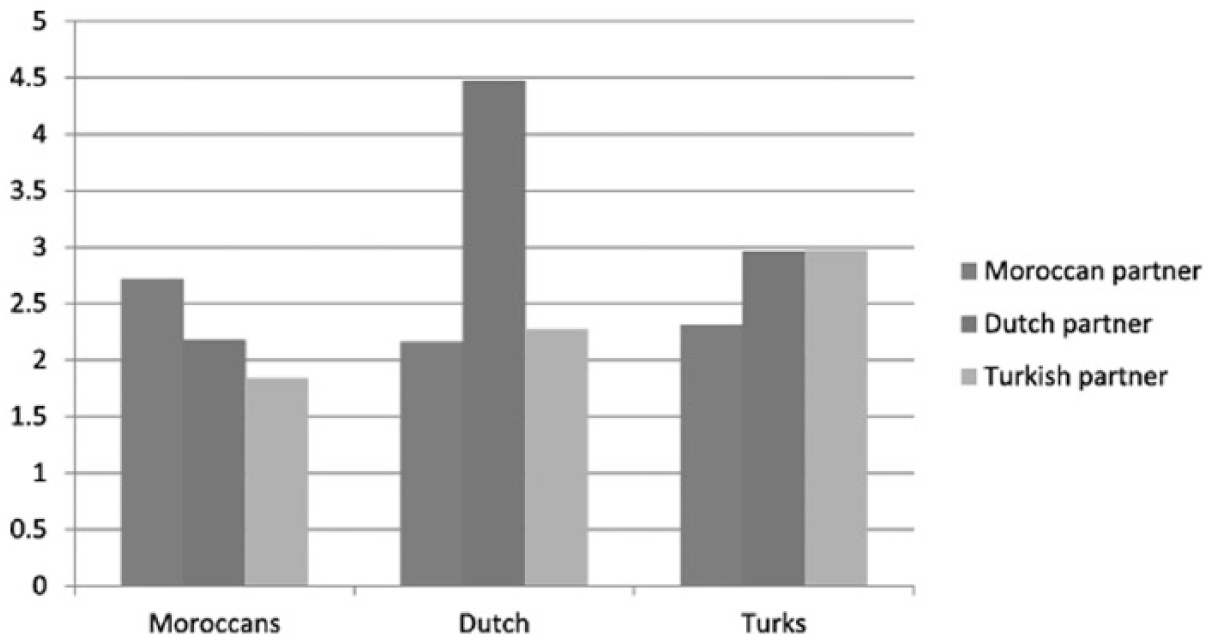
Willingness to engage in a sexual relationship with partners of different ethnic groups.
Among men, there were no correlations between educational level and religiosity, on one hand, and willingness to engage in a sexual relationship, on the other hand. However, as they were more religious, Moroccan (r = −.52, p < .001) as well as Turkish women (r = −.38, p < .05), but not Dutch women (r = −.20, ns), were less willing to have a sexual relationship with a Dutch man. Dutch women were more willing to have a sexual relationship with a Turkish (r = .30, p < .05) or with a Dutch man (r = .32, p < .05), the higher their educational level. None of other correlations with educational level were significant.
Marriage
To examine differences between the three ethnic groups and between men and women in their preferences for a marriage with members from the three groups, a GLM analysis was done with as between-subjects factors gender and ethnic group, and as a within-subjects factor, the target ethnic group, that is, interest in marrying an individual from the three ethnic groups. Again, we first included as covariates age and educational level. Neither of these had a significant effect on any of the three dependent variables, with ps > .45. Therefore, we report only the main analyses without including these covariates. There was a significant within-subjects effect of target ethnic group, F(2, 450) = 21.01, p < .001, η2 = .09. Overall, there was more interest in marrying a Dutch (M = 3.57, SD = 1.43) than a Turkish (M = 2.67, SD = 1.37) or a Moroccan (M = 2.75, SD = 1.44) individual. Again, by taking twice a random sample of 69, the effect remained. Therefore, it was considered justified to interpret the other effects, and to assume that these were unaffected by the size of the subsamples.
Unlike what was the case for the willingness to engage in a sexual relationship, the between-subjects effects showed no significant effect of respondent ethnic group, F(2, 225) = 1.59, p = .21, η2 = .01. However, similar to our results on sexual relationships, while there was no significant interaction between gender and respondent ethnic group, F(2, 225) = .82, p = .44, η2 = .01, there was again a main effect of gender, F(2, 225) = 4.88, p < .05, η2 = .02. Overall, men (M = 3.11, SD = 0.67) showed a somewhat stronger interest in marrying than women did (M = 2.92, SD = 0.74).
There were, as with respect to sexual relationships, no interactions between target ethnic group and gender, F(2, 450) = 1.61, p = .20, η2 = .01, or between target ethnic group, gender, and respondent ethnic group, F(4, 450) = 0.70, p = .59, η2 = .01. However, there was again a significant and strong interaction between target ethnic group and respondent ethnic group, F(4, 450) = 90.78, p < .001, η2 = .45. This interaction showed largely the expected pattern with some interesting exceptions. As shown in Table 1 and Figure 2, while all three ethnic groups preferred to marry someone of their own ethnic group, this was especially true for the Dutch, and to a somewhat lesser extent, for the Moroccans. In this respect, both groups did not really make a difference between the two other ethnic groups. The Turks also showed the strongest preference for marrying someone of their own ethnic group, but were less negative than both other groups about the idea of marrying someone of a different ethnic group.
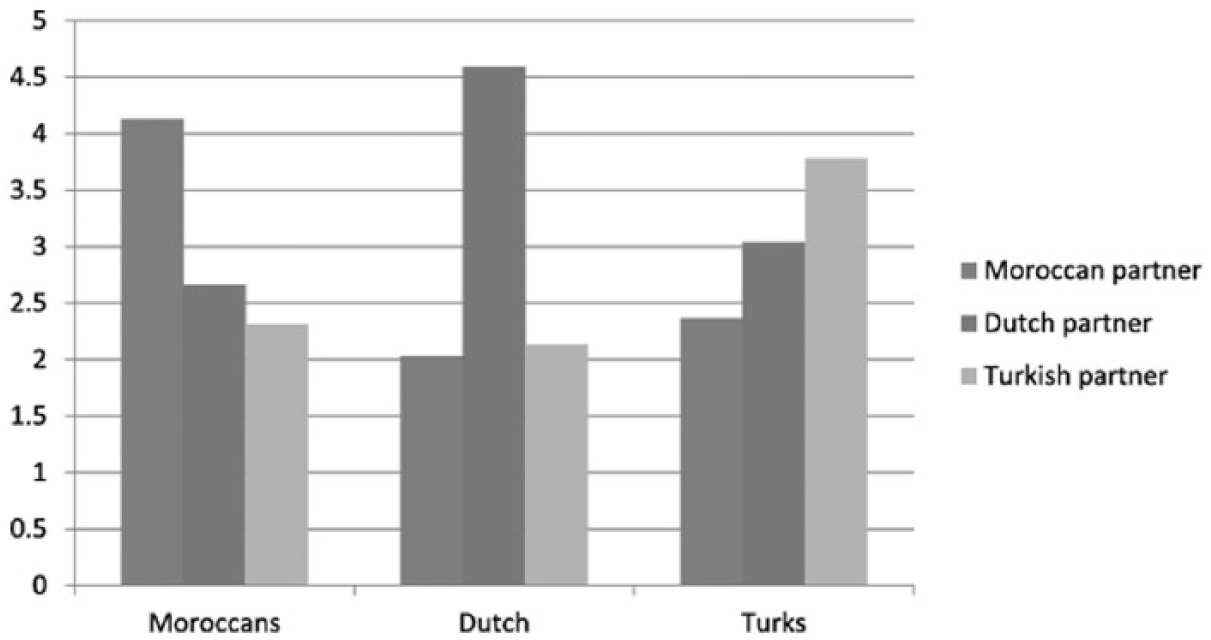
Willingness to engage in a marriage with partners of different ethnic groups.
Among men, there were no correlations of educational level and religiosity with willingness to engage in a marriage with any of the groups. However, as they were more religious, both Moroccan (r = −.30, p < .05) and Turkish women (r = −.33, p < .05), but not Dutch women (r = −.20, ns), were less willing to engage in a marriage with a Dutch man. Note that these effects are identical to those with respect to willingness to engage in a sexual relationship. In addition, as they were more religious, both Moroccan (r = .55, p < .001) and Turkish women (r = .40, p < .01) were more willing to engage in a marriage with a man of their own ethnic group. None of the correlations with educational level was significant.
Sexual Relationship Versus Marriage
Next, we examined differences between the three ethnic groups and between men and women in their preferences for a sexual relationship over a marriage and vice versa with members from the three groups. A GLM analysis was done with as between-subjects factors gender and ethnic group, and as a within-subjects factor the difference between a preference for a sexual relationship minus the interest in a marriage with an individual from each of the three ethnic groups. Of the multivariate tests, the Pillai’s trace indices were used. There was a significant within-subjects effect of target ethnic group, F(2, 224) = 5.51, p < .001, η2 = .05. This main effect was, however, qualified by a series of interactions. All interactions of the target ethnic group were significant, or marginally significant. There was a marginally significant interaction between target ethnic group and gender, F(2, 224) = 2.83, p = .06, η2 = .03, and a significant interaction between target ethnic group and respondent ethnic group, F(4, 450) = 19.31, p < .001, η2 = .15. The between-subjects effects showed a significant main effect of respondent ethnic group, F(2, 225) = 10.52, p < .001, η2 = .09, a main effect of gender, F(2, 225) = 20.04, p < .001, η2 = .08, and a marginally significant interaction between gender and respondent ethnic group, F(2, 225) = 2.97, p = .05, η2 = .03. All these main effects and interactions were qualified by a significant three-way interaction between target ethnic group, gender, and respondent ethnic group, F(4, 450) = 2.47, p < .05, η2 = .02.
The nature of the main effects and interactions is presented in Figures 3 and 4. As Figure 3 shows, among both Turkish and Moroccan men, the effect of target ethnic group was significant, with substantial effect sizes, F(2, 48) = 5.22, p < .01, η2 = .18 and F(2, 36) = 4.20, p < .05, η2 = .19. Put simply, and as predicted, Turkish and Moroccan men would rather engage in sexual relationship than in a marriage with a Dutch woman, and rather in a marriage than in a sexual relationship with a woman from their own ethnic group, and to a lesser extent, with a woman from the other immigrant group. Dutch men, although, in general, somewhat more open to a sexual relationship than to a marriage, showed no evidence of a double standard as the effect of target ethnic group was not significant, F(2, 88) = 1.17, p = .32, η2 = .03.
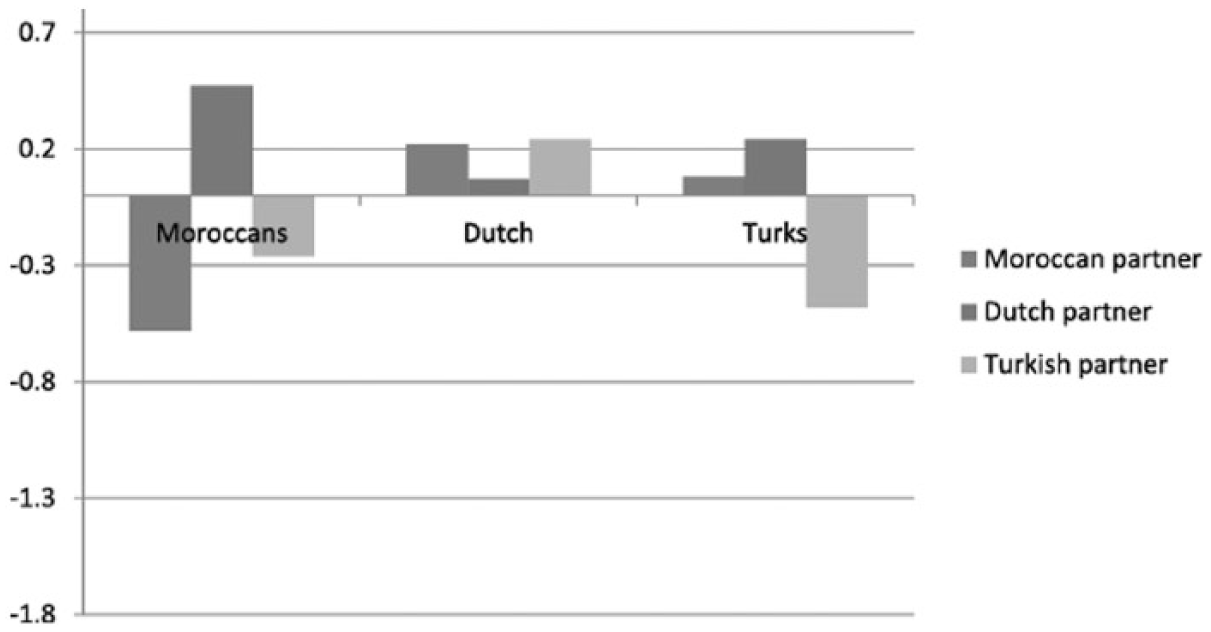
Interest of men in having a sexual relationship versus a marriage with partners of different ethnic groups.

Interest of women in having a sexual relationship versus a marriage with partners of different ethnic groups.
As Figure 4 shows, women tended to adhere more to what one could refer to as a reverse double standard, by being especially more open to a marriage than to a sexual relationship with men from their own ethnic group. This applied to all three groups, but most to Moroccan women. In all three groups, the effect of target ethnic group was significant, with substantial effect sizes, for the Turkish, F(2, 84) = 9.17, p < .001, η2 = .19, for the Moroccan women, F(2, 96) = 19.80, p < .001, η2 = .29, and for the Dutch women, F (2, 98) = 10.08, p < .001, η2 = .17. Note that, as can be seen in Figure 4, the effect size was considerably higher among Moroccan than among both Turkish and Dutch women. Put simply, women, and, most of all, Moroccan women, would rather engage in a marriage than in a sexual relationship, preferably with someone of their own ethnic group.
We also tested sex differences in the ethnic groups separately. We report the results for tests with equal variances assumed, that produced virtually the same results as tests with equal variances did. Among the Moroccans, men favored significantly more than women a sexual relationship rather than a marriage particularly with a Dutch, t(66) = 3.53, p < .001, and also with a Moroccan partner, t(66) = 3.47, p < .05, but not with a Turkish partner, t(66) = 0.84, p = .40. Among the Turks, men only favored significantly more than women a sexual relationship rather than a marriage with a Dutch partner, t(66) = 2.49, p < .05, but not with a Moroccan partner, t(66) = 1.32, p = .19, or a Turkish partner, t(66) = 1.34, p = .19. Among the Dutch, men favored significantly more than women a sexual relationship rather than a marriage particularly with a Dutch partner, t(93) = 2.38, p < .05, but not with a Moroccan partner, t(93) = 1.52, p = .13, or a Turkish partner, t(93) = 1.73, p = .09, although this last difference approached significance. Thus, overall, men were more than women interested in having a sexual relationship than a marriage with a Dutch individual. To conclude, Dutch men preferred a sexual relationship over marriage with an in-group member, whereas Turkish and Moroccan men preferred a sexual relationship over marriage, not with an in-group member, but with an out-group member of the Dutch majority.
Discussion
Discussion of Main Findings
In general, positive attitudes toward sexual relationships and especially marriage with individuals from another ethnic group indicate increased levels of integration of ethnic groups in the larger society. As a consequence, in a society in which groups are highly integrated, one would find only small or no differences in attitudes toward having sexual, respectively, marital relationships with someone of a different ethnic group. The present study suggests that, in the Netherlands, there is according to these standards, not a high level of integration. That is, both men and women differed in their attitudes toward different ethnic groups with regard to both sexual as well as marital relationships. More specifically, individuals showed overall a preference for a marital partner from their own ethnic group. With regard to sexual relationships, this preference was less pronounced. That is, although the Dutch preferred sexual relationships with other Dutch, and Moroccans with other Moroccans, the Turks were about equally positive about having a Turkish and Dutch partner for a sexual relationship.
The finding that people prefer a marital partner of the same ethnic group is in line with numerous studies showing that people tend to marry individuals with traits similar to their own (Kalmijn, 1991). Having a partner who is similar in terms of, for instance, socio-economic background, ethnicity, and religious attitudes validates one’s beliefs about the world and themselves and reduces the risk of conflicts and disagreements (e.g., Barelds & Barelds-Dijkstra, 2007). It is nevertheless noteworthy that the preference for a partner of the same group was more pronounced with regard to a marriage than with regard to a sexual relationship. This can be explained from the fact that with regard to marriage, especially individuals from a collectivistic culture, such as the Turkish and Moroccan communities in the Netherlands, may feel pressured to gain parental approval for their marital partner (Buunk, 2015; MacDonald, Marshall, Gere, Shimotomai, & Lies, 2012), with approval being more easily achieved in the case of a partner from the same ethnic background. Differences in ethnic background or a lack of parental approval may cause relationship problems when partners from different ethnic backgrounds do decide to marry. In a study in the Netherlands, Smith, Maas, and van Tubergen (2012) found that interethnic marriages had a higher divorce rate than mono-ethnic marriages. The highest divorce rate was found of marriages between an ethnic Moroccan and a Dutch. After 13 years, no less than 42.4% of these couples were divorced, in contrast to 27.6% for Turkish–Dutch marriages, whereas the figures for mono-ethnic marriages of Turkish, Moroccan, and Dutch people were 21%, 15.7%, and 12.2%, respectively. In contrast, uncommitted sexual relationships are usually free from familial interference and are less hindered by differences in ethnic background as parents are often oblivious of their children’s casual sexual contacts. Although few young minority women, especially religious ones, may engage in premarital sex and most of them are monitored closely by their parents, when they do engage in premarital sex, they will probably make sure to keep this a secret to prevent potential social exclusion from their family or ethnic community. In the case of sexual relationships, other motivations may therefore steer partner choice than familial approval and “fitting in” in one’s own ethnic group, such as a partner’s physical attractiveness and a partner’s willingness to have uncommitted sex.
Attitudes toward a marriage partner from one’s own ethnic group were more positive as Turkish and Moroccan women, but not men, were more religious. As women from these groups were more religious, they were also less willing to engage in a sexual relationship with a Dutch man. This finding is in line with a recent study by Carol and Teney (2015) among more than three thousand 18-year-olds from 11 ethnic groups in Brussels, that showed a negative relationship between religiosity and favoring intergroup dating for girls, but not for boys. For both sexual relations as well as marriage, it therefore seems that religious Muslim women seek a partner who shares their religious beliefs, with men from their own ethnic group being most likely and Dutch men being least likely to have similar religious beliefs. Although, in general, a potential partner’s religious beliefs are valued about equally by men and women (e.g., Buss, 1985; Buss, Shackelford, Kirkpatrick, & Larsen, 2001), Islamic religious rules allow men much more freedom than women, for instance, with regard to activities outside of the home and sexual relationships (e.g., Sechzer, 2004). The fact that Islamic communities often have more strict rules for women than for men, may cause relatively religious Turkish and Moroccan women to be more conservative in their partner choice than religious men from the same communities and to show a relatively strong preference for a partner from their own ethnic background. Although also among the native Dutch, religion may play a role in the selection of marriage partners, it can be safely assumed that among them the role of religion in the choice of marriage partner is much smaller than among Turks and Moroccans. During the last century, membership of religious church groups among the native Dutch has decreased dramatically, indicating a reduced value of traditional Dutch religion in general (Central Bureau of Statistics, 2009). In contrast, in migrant communities in the Netherlands, most Muslims still report high overall levels of religious identification and practices, and religion is still seen as an important aspect of life (Fleischmann & Phalet, 2012). The low willingness of Muslim women to out-marry may also be explained from the perspective that out-marriage of Muslim women, as they are the primary transmitters of religion, poses a threat to the stability of the religious community.
When comparing the findings on attitudes toward marriage and sexual relationships, Turkish and Moroccan men showed a double standard: they would rather engage in sexual relationship than in a marriage with a Dutch woman, and rather in a marriage than in a sexual relationship with a woman from their own ethnic group. In contrast, women, especially Moroccan women, would rather engage in a marriage than in a sexual relationship, preferably with someone of their own ethnic group. These findings may be well explained by the double standard with regard to premarital sex that still is prevalent in today’s Islamic communities in the Netherlands. Although, according to the Qu’ran sex before marriage is haram (a sin) for both men and women, research among Muslims in the Netherlands shows that in contrast to female Muslims, male Muslims generally do not comply with this rule even though they consider sex before marriage indeed haram (Smerecnik, Schaalma, Kok, Meijer, & Poelman, 2010). Likewise, De Graaf, Meijer, Poelman, and Vanwesenbeeck (2005) found that in the Netherlands, Muslim girls and women up to the age of 25 have little experience with sexuality compared with their native Dutch counterparts. Muslim males, however, are relatively experienced with sexuality compared with their Dutch peers. Moreover, male Muslims are not called to account for transgressing this norm, whereas female Muslims are, indicating a clear double standard for Muslim men and women regarding premarital sex (Smerecnik et al., 2010). Because of this double standard, Muslim women can be expected to prefer a marriage over a sexual relationship. The finding that Turkish and Moroccan men, when looking for a sexual relationship, prefer a Dutch sex partner over one from their own or from the other ethnic group, may be explained from the fact that Dutch women are the most willing to have uncommitted sexual relationships. Dutch women are not restricted by the Islamic rules concerning premarital sex, and dress and behave more provocatively than women from Islamic culture (Duits & Van Zoonen, 2006), and their behavior may easily be interpreted as signaling a high willingness to have sex. In addition, Muslim men may turn to native Dutch women for casual sex because they respect Muslim women’s sexually restrained attitudes. When Muslim men marry, they find it important that their wife, who they prefer to select from their own ethnic group, is still a virgin.
Strengths, Limitations, and Conclusion
The present study does not only contribute to our knowledge on attitudes toward interethnic relationships, but indirectly, also sheds light on the degree of integration of ethnic groups in Dutch society. In addition, whereas most research on interethnic relationships is restricted to the study of interethnic marriages, the present study also examined attitudes toward sexual relationships with individuals from other ethnic groups, showing that these attitudes are different. For instance, male members of minority groups were found to hold more positive attitudes toward sexual relationships with members of the majority group, in this case Dutch women, than toward marrying a member of the majority group. In addition, the present study showed that among minority women, religiosity may be of importance to better understand minority women’s attitudes toward marriage and sexual relationships with members of their own and other ethnic groups. Finally, a strength of the present study is that its sample is quite representative of the population of young people living in the Netherlands, making our results relatively generalizable to other young people in the Netherlands.
Our study also had a number of limitations. First, we assessed individuals’ attitudes toward, respectively, marriage and a sexual relationship with only one item for each of these attitudes. In general, including multiple items to assess a variable contributes to the reliability of the measurement. Second, our research restricted itself to two minority groups in the Netherlands, that is, Turks and Moroccans. However, there are more ethnic minority groups in the Netherlands that might have been included in the present study, such as Asians and Surinams. In the Netherlands, these ethnic groups are about equally large as the Turkish and Moroccan communities, and therefore, worth studying as well. Third, our samples of men and women from different ethnic groups were quite small, which may have affected our findings on the attitudes toward sexual relationships because interest in sexual relationships is age-dependent (e.g., Tozdan & Briken, 2015). However, when controlling for age, the results remained the same, and age did not have any effect on the attitudes toward sexual relationships. Finally, we did not ask participants about their degree of integration in Dutch society. As a consequence, we did not test our assumption that attitudes toward interethnic relations reflect or are related to the degree of integration of minority groups in Dutch society.
The present study suggests several avenues for future research. It would, for instance, be interesting to examine the attitudes toward sexual relationships and marriage in a representative sample of older Turks, Moroccans, and native Dutch individuals in the Netherlands, comparing their attitudes with those found in the present study. Comparing different cohorts on these attitudes may help show not only how different age groups differ in their attitudes toward interethnic sexual relationships and marriage but may also shed light on the extent to which different minority groups have become more or perhaps less integrated in Dutch society. Likewise, for the same purpose, 10 years from now, it may be interesting to study a similar sample as the one in the present study, examining to what extent young individuals’ attitudes have changed. Future studies may also clarify why exactly minority men want to engage in sexual relationships with women from the majority group but are less eager to marry them. In this way, a more nuanced perspective on the meaning of intimate relationships between individuals from different ethnic groups may be developed.
Footnotes
Declaration of Conflicting Interests
The author(s) declared no potential conflicts of interest with respect to the research, authorship, and/or publication of this article.
Funding
The author(s) disclosed receipt of the following financial support for the research, authorship, and/or publication of this article: This research was supported by the Royal Netherlands Academy of Arts and Sciences.