



Abstract
Theorists in autobiographical memory (AM) studies generally agree that AMs serve three kinds of broad functions: self-related, social, and directive functions. Although these kinds of functions are probably universal, gender and country variations are expected. The study investigates perceived use of AMs in everyday life. Male and female Danish and Spanish college students were asked to carry a diary and report a sample of naturally occurring instances of AMs. Participants were asked to assess their memories in terms of perceived functions. Results showed some country differences that were consistent with the characterization of Danish and Spanish samples in terms of individualism–collectivism. Some gender differences were also found. These differences, in contrast to our expectations, were limited to the Danes. To interpret it, two main lines of reasoning were proposed. The first was concerned with changes in gender ideology in Spain in the last decades. According to the second, these analyses may lead us to expand the number of broad categories as well as the variety of specific uses of AMs in everyday activities.
Autobiographical memories (AMs) are memories of “significant personal experiences from an individual’s life” (Wang, 2008, p. 744). But not all memories of personal past qualify as autobiographical, as that would require them to be meaningful, and especially self-relevant (Conway, 1990, 2005; Rubin, 1986). In a general view, AM is related to the self, and to the experience of personhood, that is, to the experience of enduring as an individual, in a culture, over time. In this sense, self and autobiographical construct each other, as, on one hand, personal memories are cognitively organized around the self and, on the other hand, the self cannot exist as a continuous entity across time without the existence of personal memories organized in subjective time. Self and AMs have been understood as two closely interrelated phenomena. In fact, an important function of AM is to provide a sense of continuity of the self across time from the past to the future. However, the term function may have two interrelated meanings: adaptive significance or real-world usefulness (Bluck & Alea, 2011; Pillemer, 2009). In our study, we analyze what people say about the use of AMs in daily life.
During the past 30 years, one of the focuses of research in AMs is the study of how these memories occur in everyday life. In this vein, Neisser (1978) addressed the need for understanding and studying memory from an ecological approach. From this perspective, researchers are concerned not only with understanding how AM works but why humans remember personal experiences.
Theoretical perspectives across a range of traditions have suggested that we use our AMs to develop a coherent sense of ourselves, our emotions, our future plans, and our relationships with other people. As self and AMs are so highly interrelated, it is then no surprise that cross-national and gender variations in personal memories have been found as a function of variations in self-construals (Nelson & Fivush, 2004). For many authors, however, this is not the only, not even the main function of AMs. Over the last years, a considerable amount of theoretical and empirical work in AMs literature has been concerned with analyzing memory performance in everyday life (Baddeley, 2009; Bluck, 2003, 2009; Pillemer, 2009; Rasmussen & Habermas, 2011). This approach signifies that people retrieve their memories in particular contexts at particular times for particular purposes. Within this research paradigm, the main objects of recall are ongoing life events (births, first dates, school experiences, etc.), rather than carefully constructed experimental materials. This approach attempts to understand how the memory system works in everyday experiences, by understanding why individuals remember things in the way they do (Bluck, 2009; Harris, Rasmussen, & Berntsen, 2014; Pillemer, 2009). The primary concern is not with how people remember their personal past, but with why people remember mundane or significant events often over long periods of time.
The aim of this article is to contribute to the existing literature by studying why and how people remember life events. In other words, what functions do personal memories which arise in the course of everyday significant life events serve? Why do people remember the experiences of their lives? Specifically, our research examined perceived use of AMs in everyday life of male and female college students from two countries (Denmark and Spain).
Functions of AMs
Conceptual analysis and empirical studies of AM have uncovered a diverse set of possible functions. Theorists in this area generally agree that AMs serve three kinds of broad functions: self-related, social, and directive functions (Bluck, 2003; Pillemer, 2009). The self-function involves retrieving memories that contribute to maintaining a sense of being the same person over time—self-defining (Neisser, 1978), self-relevant (Pillemer, 2009), or self-concept (Fivush, 1998). The social function involves using AM to create and maintain intimacy through sharing personal memories, as well as creating a stable representation of a shared history between individuals (Kulkofsky, Wang, & Kim, 2009). Several researchers have suggested that social bonding is the primary function of AM (Bluck, 2003). The directive function guides present and future thinking and behavior, retrieving past experiences to guide present problem solving, to direct future thoughts and behavior (Wang, Hou, Tang, & Wiprovnick, 2011), and also to inform and motivate (Pillemer, 2009).
However, although these three broad functions have been classified into discrete categories, research shows that they usually overlap in everyday memory experiences (Bluck, 2003), and that memories of personal specific episodes might serve more than one function at a given time (Bluck, Alea, Habermas, & Rubin, 2005; Pillemer, 2003). The presence of each function could be a matter of degree rather than a binary decision (Rasmussen & Berntsen, 2009) or, as other authors have suggested, different types of memories may serve particular functions more than others (Bluck, 2009; Hyman & Faries, 1992). In this article, we agree with the idea that functions of AMs are multiply determined and inextricably linked. In everyday activities, different AM functions do not only co-occur and overlap (Pillemer, 2009), but they are also composed of various specific uses (Webster, 1993). For that reason, taxonomies of AM broad functions include more specific uses (i.e., emotion regulation, establishing and maintaining identity, intimacy, mood regulation, bitterness revival, establishing and maintaining social relations, guide problem solving, goal setting, etc.).
Another problem of the previously used methodologies is that they ask participants to report their general impression of what they typically use memories for. This is unlikely to produce a faithful account of use pattern, as general assessments are biased by effects of recency, salience, importance, rehearsal, and so on (cf. survey methodology literature such as Tourangeau, 2000). In other areas of memory research, the diary method has been used to deal with this issue (e.g., Berntsen, 1999). For the question of functions of AMs, there is an additional challenge. To answer what memories are used for, participants need to remember previous instances of remembering, which can be a transient process that is not easily accessible for later recall (Arnold & Lindsay, 2002). The diary method may still be a solution but some method development is required. We shall return to this below.
The stage is now set for a more detailed examination of the functions that AMs serve, and how those functions may relate with cultural factors. Although these three broad functions are considered to be universal, some authors such as Pasupathi (2003) or Kulkofsky, Wang, and Hou (2010) have reported individual gender, age, personality, and so on, variations in the use of AMs to serve these functions. Beyond individual differences, focusing on social, contextual, and cultural dimensions will be crucial to understanding the influences on how AMs serve its functions. For that, gender and cultural variations in the perceived functions of AMs in daily life should be expected.
Effects of Culture and Gender on AMs: Some General Issues
AMs research has demonstrated cultural and gender differences in personal memories. With regard to cultural variations, research in the last decades has evidenced that these variations are consistent with differences in self-construals across cultures (Santamaría, de la Mata, Hansen, & Ruiz, 2010) and concern different aspects (age at the earliest memory, specificity, emotionality, elaboration, and self-focusing). Previous work has associated these cultural differences with differences in AM style, structure, and content (de la Mata, Santamaría, Hansen, & Ruiz, 2015; Nelson & Fivush, 2004; Wang, 2003).
With regard to gender variations, women’s first memories are usually earlier (Davis, 1999), more detailed (Pillemer, Wink, DiDonato, & Sanborn, 2003), more vivid (Davis, 1999), and more emotional than males’ (Ross & Holmberg, 1992). Research has also shown a greater proportion of themes related to communion or affiliation in females and of themes related to agency and autonomy in males (Fivush, 2011; Niedzwienska, 2003). Finally, there is emerging evidence suggesting that men and women tend to remember life events differently: When asked about how they use AMs in daily life, women tend to assign a greater value to purposeful reminiscing than men (Pillemer et al., 2003). However, not all studies have found gender differences. For instance, some researchers have not reported gender differences in the age at the earliest memory in different cultures (Wang, 2003), or in relation to agency and communion. Thus, although not all studies find gender differences in these previous AM characteristics, if any gender differences appear, they would be in the direction outlined above.
We think that the analysis of gender differences must be situated in cultural context. It is necessary to examine the complex interactions between gender and culture and how they influence the functions of AMs (Cala & de la Mata, 2010).
For us, an important aspect of gender and cultural differences in AMs is concerned with how women and men from different countries perceive the functions of everyday memories. Although the three broad AM functions should be present in every country and be used by men and women alike, they can be observed with different levels of frequency across countries and genders (e.g., the social bonding function might be observed in some countries more than others). However, studies about the three broad functions in relation to specific gender and cultural effects are relatively scarce. Notwithstanding that, some of these few studies show very interesting data. In the following, we refer to them.
Webster (1993, 2003) and Webster and McCall (1999) developed a general method for assessing people’s beliefs about how frequently they use memory to fulfill different functions. The Reminiscence Functions Scale (RFS) is not tied to particular remembered episodes; instead, respondents rated on a 6-point scale: “how often they reminiscence with a particular function in mind.” The scale tapped eight different factors. Three of the most interesting factors for us were referred to the broad functions commonly associated with AM (self, social, and directive). These factors were identity (using the past to discover, clarify, and crystallize important dimensions of our sense of who we are, pp. 76-77), conversation (using the past as a means of connecting or reconnecting with others in an informal way, p. 77), and problem solving (using the past so that past problem-solving strategies may be used again in the present, p. 77). Webster and colleagues did not compare these factors with respect to rated frequency of use, so that their results did not bear directly with the question we are interested in, the relative prominence or importance of the functions. Notwithstanding that, we think that these three factors could be easily related with the three broad functions: identity with the self, conversation with the social, and problem solving with the directive broad function.
Kulkofsky et al. (2010) asked young adults to report reasons for reminiscing and social sharing, and found that European American participants reported more functional reasons, whereas Chinese participants reported more nonfunctional reasons. These findings seem to fit well with the Western tendency to value people’s unique personal past and with the lack of such focus in East Asian cultures.
Pillemer et al. (2003) observed gender differences in relation to the specific uses of AMs. These authors administered the RFS to their participants as a part of a study of gender differences in AM styles in older adults. The scale includes 43 items for which respondents indicated how often, on a 6-point scale, they reminisce for a particular purpose. Women scored higher than men did in several factors on the scale: identity, intimacy maintenance, death preparation, and problem solving. The author identified gender differences in memory specificity and in RFS scores: Women’s narratives contained a greater number of specific memories than did men’s narratives, and women also scored higher than men on the identity and problem-solving RFS factors.
Treebak et al. (2005) found that both genders tended to see memories as multifunctional, but there was still a slight gender difference in the distribution of use of the categories. More specifically, men used their memories more often for boredom reduction and mood regulation, whereas women did so with respect to bitterness revival.
In a subsequent study, Hansen, Lundhus, and Treebak (2006) reported evidence about the perceived use of personal memories in everyday contexts that partially reflected cultural beliefs about gender differences in AM. The authors observed significant differences in the use of personal memories by men and women. Whereas men predominantly used their memories for mood regulation and goal setting and maintenance, women tended to use their memories for entertainment more often than men. These data confirm the existence of gender differences in the perceived use of AMs. In men, more uses related to the self broad function were found. Women, in turn, showed a greater use of their memories in interpersonal relations. Notwithstanding the differences, the authors are cautious about assuming different capacities for autonomy and sociability in women and men. Other studies showed no gender differences in American and Danish samples (Grysman & Hudson, 2013; Harris et al., 2014).
The Study: Analyzing Gender and Cultural Differences in the Perceived Functions of Everyday AMs
In the current study, we focused on Danish and Spanish cultural contexts, because these cultures differ with respect to prevalent self-construals, and in terms of gender roles. These data also converge with characterizations of Danish contexts as individualist and Spanish contexts as collectivist (Hofstede, 1980).
Our study expands Hansen et al.’s (2006) argument to explore whether the gender differences found in the Danes could be replicated in a Spanish sample. According to Hofstede (1980) and other studies, Denmark is considered to be one of the most egalitarian countries in terms of gender roles and traits, with one of the lowest scores (10) on Hofstede’s Dimension of Masculinity (which assesses values about gender differentiation). In this sense, Denmark—and other Nordic countries—top the world ranks on most measures of gender equality. In many ways, both genders face similar cultural expectations, and gender stereotypes seem to be much weaker than in other European countries (Wängnerud, 2009). This does not mean that gender equality is complete in Denmark, however. Gender-biased roles still persist in Danish society. In this sense, although Danish men contribute more to the household chores than men in most other countries, Danish women still contribute twice as much as Danish men (Melby, Ravn, & Wetterberg, 2008). Moreover, a frequently mentioned paradox of the Danish labor market is that while it has one of the highest levels of female participation in the world, it is also one of the most gender-segregated labor markets in the world. Men tend to work in the private sector’s business jobs, whereas women tend to work in the public sector’s caregiving jobs (Skjeie & Siim, 2000). Thus, the overall pattern of gender ideology in Denmark is that boys and girls grow up with rather similar cultural expectations, but women tend to take on more caregiving-oriented work (paid as well as unpaid), that is, women may still be more tuned toward social-interactive issues.
Spain, in contrast, as a culture characterized by more traditional gender ideology (López-Sáez, Morales, & Lisbona, 2008), owns a relatively medium score (42) in masculinity (Hofstede, 1980). Traditionally, public power is here associated with men and the private sphere with women. At the same time, recent sociological data show that 55.6% of Spanish people believe in traditional female roles, whereas in Denmark only 24% of the people agree with that model (Moreno, 2010). Thereby, the classical typology which attributes more expressive and communion traits to women and more instrumental and agentive characteristics to men is still predominant. Besides such traditional gender ideology, many authors point to the significant changes in Spanish society’s beliefs about gender roles and traits in the last decades (López-Zafra & García-Retamero, 2011). Authors like Moreno (2010) claimed that the transition toward a postpatriarchal family model in Spain is more closely linked to education than to age. In this sense, there is a clear difference between people with lower and higher educational levels with regard to their adoption of a traditional female model. In Spain, educational level thus seems to be an important variable in explaining differences in preferences toward family models and gender roles.
In the present study, we examined gender differences in perceived AM specific uses and broad functions in two cultural contexts, a Danish and Spanish one. We employed the diary method developed in Treebak et al. (2005). Here, participants take a few immediate notes when a memory occurs, and later they use these notes for self-prompted elaboration about the situation where they recalled the memory, in particular, what they used it for in that situation. The immediate notes ensure a sampling that is less biased than retrospective recalls. This is the benefit of the diary method. However, unlike in traditional diary studies, we delayed any elaboration until the sampling was closed. This way, participants stayed ignorant—and thus uninfluenced—of the questions while sampling. The benefit of this choice is reduced bias. The cost of the choice is that only a short retention interval and few memories per person are possible, to avoid forgetting of the sampled memories and associated recall episodes.
Our hypotheses with regard to broad functions were as follows: With regard to country, we expected more social use of the memories in the Spaniards than in the Danes. In contrast, we expected the Danes to use their memories for self-related and directive functions than the Spaniards did. With regard to gender, we expected more social use of the memories in females than in males. In addition, due to the different degree of gender differentiation in the two countries, we expected to observe vaster gender differences in the Spanish than in the Danish sample.
The current study contributes a cultural and situated approach to the research on AM functions. It also offers insights concerned with the definition of certain specific uses of AM broad functions. Finally, we contribute to cross-cultural research generally by including two countries not typically studied.
Method
Participants
The participants were 110 Danish undergraduate students from Aalborg University (55 women and 55 men) and 91 Spanish undergraduate students from the University of Seville (45 women and 46 men). They were all born in the country of their university (Denmark and Spain). Their ages ranged from 18 to 43 (M = 25, SD = 2.1) in the Danish sample, and from 18 to 30 (M = 22, SD = 3.8) in the Spanish one. None of the participants reported any sensory handicap that could have affected their performance of the tasks. The students were recruited in psychology classes. Their participation was entirely voluntary, unpaid, and based on informed consent.
Design
The independent variables of our study were country (Denmark and Spain) and gender (males and females). The dependent measures were concerned with AM functions. They were broad functions (self-oriented, social, and directive) and specific uses (goal, identity, entertain, transfer, mood, attachment, bitterness, argument, and other).
Materials
Participants were given two envelopes, one open and one sealed. The open envelope contained an introduction to the study, our definition of a memory, an informed consent sheet, a diary, and instructions on how to use the diary, and a sealed envelope marked “open after the final diary entry.” The sealed envelope contained nine questionnaires (one for each memory), instructions on how to fill them out, and a sheet for demographic information. The definition of a memory given was: when you remember a specific episode that happened in your life more than 24 hours ago. The instructions also noted that memories may arise spontaneously as well as deliberately; be good, bad, or neutral; be important or not; and arise when alone or in company of others (cf. Treebak et al., 2005).
The diary prompted for brief notes about memory content and current context when remembering for up to three memories a day for 3 days. The questionnaires (one for each memory noted in the diary) contained eight brief descriptions of what memories may do or be used for, and a request to choose the best match for the case of remembering noted in the diary (see the appendix). There was an optional column for additional uses and also an opt-out category “Other.”
The list of memory uses was informed by literature on AM functions (e.g., Bluck & Alea, 2002; Hyman & Faries, 1992; Pillemer, 1992) and reminiscence (e.g., Webster, 1993, 2003; Webster & McCall, 1999), as well as a series of pilot studies (e.g., Treebak et al., 2005). It was the following:
Identity: When the participants answered that their memory helped them understand who they were as a person. Mood: When the participants answered that their memory helped them retain or change their mood. Bitterness: When the participants answered that their memory helped them justify negative feelings toward a person who had treated them unjustly.
Attachment: When the participants answered that their memory helped them have an intimate conversation, or it helped them feel close to someone in their life who was not physically present. Argument: When the participants answered that their memory helped them convince themselves or others that they were right about some point or reason (argument). Entertainment: When the participants answered that their memory helped them with nothing better to think or talk about, their memory helped them keep occupied or start/continue a conversation.
Goal: When the participants answered that their memory helped them remember a goal they were trying to achieve. Transfer: When the participants answered that their memory helped them act in a new situation, or inform or teach others.
The actual questionnaire can be seen in the appendix.
Subsequent pages contained questions about the context of remembering (was the memory involuntary, were others present; was the memory shared; initial mood valence and whether this changed), the phenomenology of remembering (details, vividness, point of view), and the remembered event (age, others present, emotion valence and intensity, uniqueness, importance). Except age, all answer formats were either lists of categories to choose from or 7-point rating scales with anchored end points. In this article, we will show data only about perceived functions of AMs.
Procedure
Participants were informed that the study was about everyday memories and had two parts. In Phase 1, they carried a small diary for 3 days and take immediate brief notes of three memories per day whenever a memory occurred, and in Phase 2 they answered a three-page questionnaire on each. A memory was defined as a recall of a specific episode from the participant’s life that occurred more than 1 day ago. It was noted that memories can be about positive, negative, or neutral events; can be recalled spontaneously or deliberately; and can occur whether alone or not.
Participants were also informed that diary notes were for their own support in the second phase and would only be seen by themselves. To avoid influencing the memory sample, the focus on memory functions and the content of the questionnaires were not mentioned until the 3-day sampling period was completed and the second phase started. After noting the final memory for the third day, participants opened a sealed envelope that contained a questionnaire for each remembering noted in the diary, a demographic information sheet, and an additional sheet for optional description of the content of one of the memories (this last description will not be analyzed in this article). Participants could pick more than one specific use for each memory but chose one as its main use in that particular instance of remembering. This use is the one analyzed in the present article.
Results
A total of 1,809 memories were collected. All except one included a choice of primary function. The data were fed into the SPSS (Version 23) software package, and chi-square tests were performed to analyze gender and country differences in perceived use of AMs in everyday life. We first describe country differences and then gender differences.
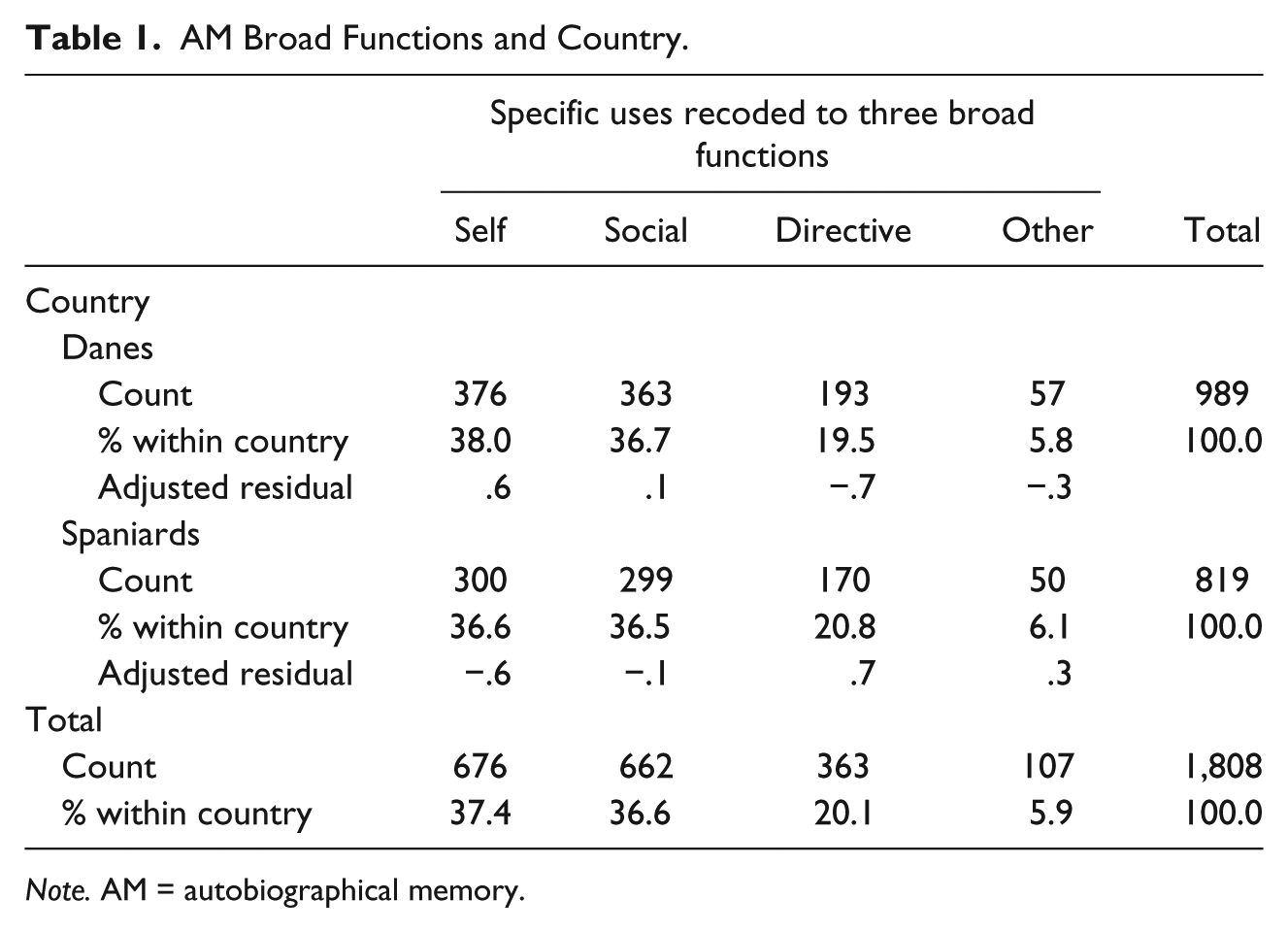
Results did not reveal significant differences between Spanish and Danish samples in the three overall AM functions (self, social, and directive; χ2 = 0.668, df = 3, p = .881; Table 1).
AM Broad Functions and Country.
Note. AM = autobiographical memory.
With regard to specific AM uses, results revealed significant differences between country (χ2 = 31.512, df = 8, p < .001, rϕ = .131; Table 2) . Danes were more likely to select as main uses of their memories, transfer (8.1%) and argument (5.9%), than Spaniards did (5.3% and 2.7%); whereas Spaniards selected as main uses, goal (15.5%) and attachment (12.3%), more than Danes (11.4% and 8.1%).
AM Specific Uses and Country.

Note. AM = autobiographical memory.
The second variable studied was gender. With regard to this variable, there were significant differences in the three broad functions (χ2 = 16,537, df = 3, p = .001, rϕ = .095; Table 3). Memories were more likely to serve social functions for women than for males (40.7% and 32.6%, respectively). In contrast, memories were more likely to serve self and directive functions for males than for females (39.9% vs. 34.9%, and 22.2% vs. 17.9%, respectively).
AM Broad Functions and Gender.

Note. AM = autobiographical memory.
With regard to specific uses, the significant difference between males and females (χ2 = 22,703, df = 8, p = .004, rϕ = .111) is seen in Table 4. Males were more likely to select as primary use of their memories, goal (15.0%) and mood (20.8%), than females were (11.6% and 16.1%, respectively); whereas females selected entertainment more often (24.2%) and attachment (11.9%) as main use.
AM Specific Uses and Gender.

Note. AM = autobiographical memory.
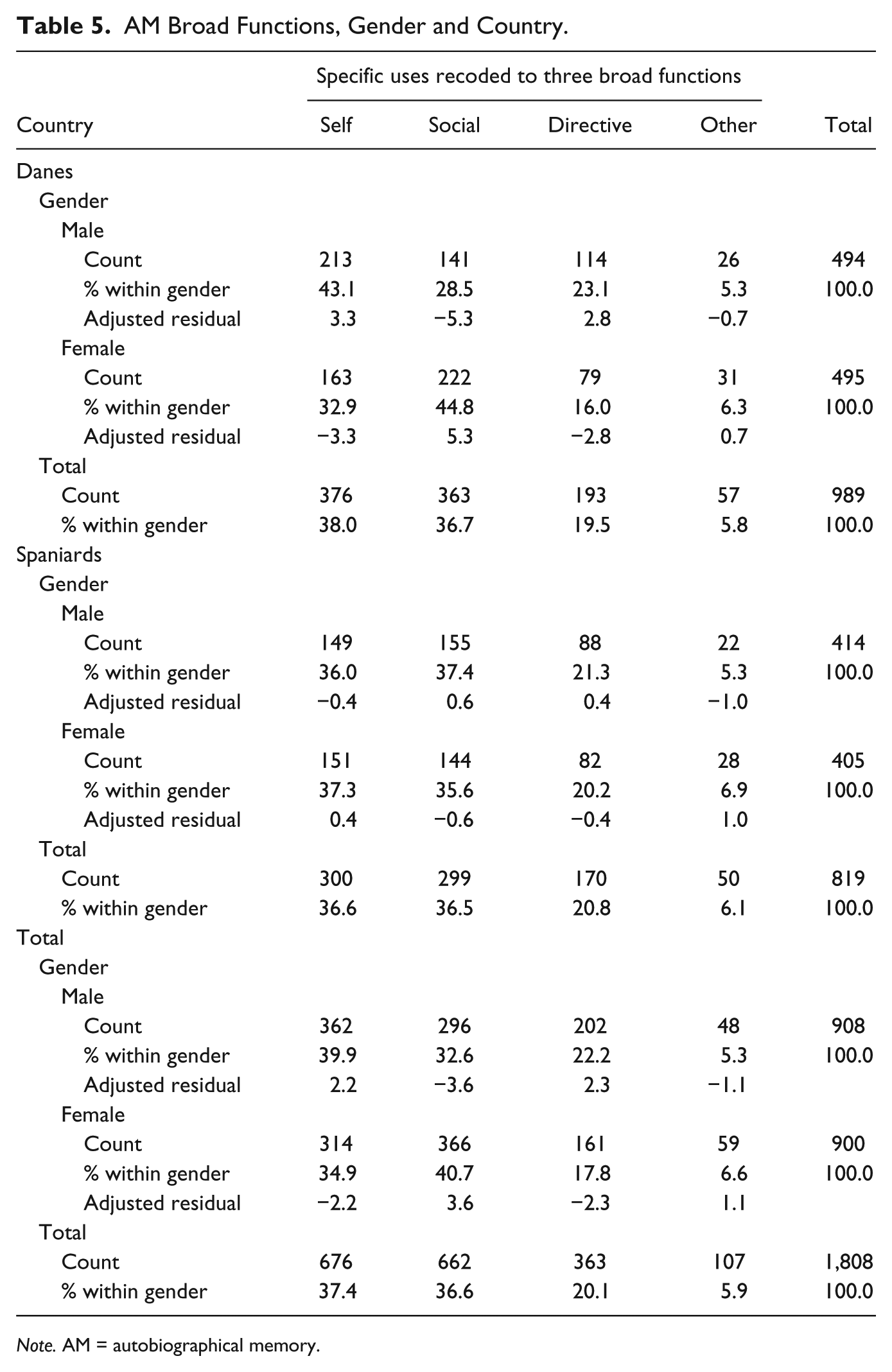
A more detailed analysis of these differences revealed that gender differences were only found in the Danish sample. For broad functions, there was a significant gender difference in Danes (χ2 = 31.508, df = 3, p < .001, rϕ = .176) but not in Spaniards (χ2 = 1.251, df = 3, p < .741). In Danish women, more social functions were found than in Danish men, whereas more self and directive functions were found in Danish men than Danish women. For frequencies, see Table 5.
AM Broad Functions, Gender and Country.
Note. AM = autobiographical memory.
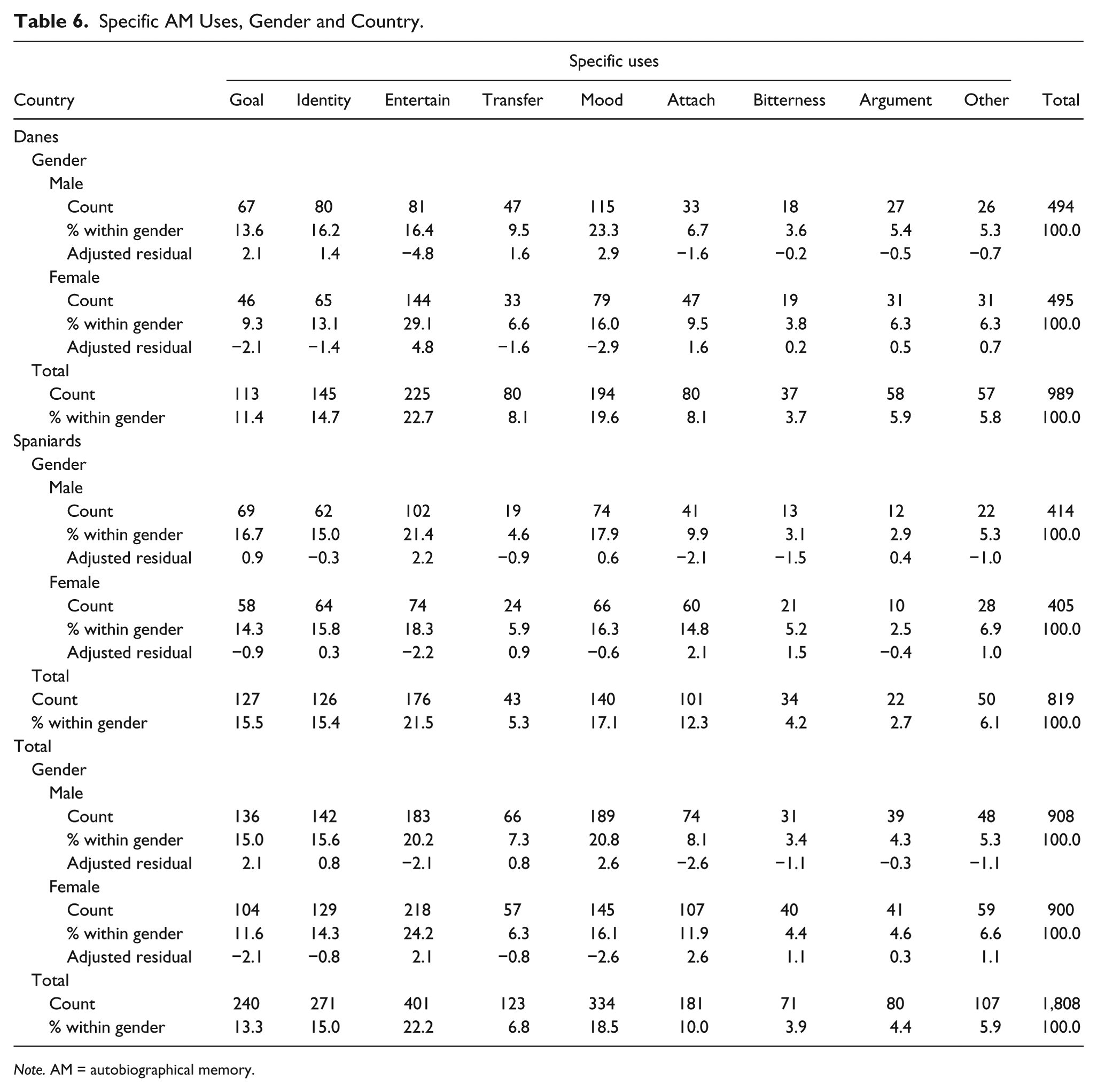
With regard to specific uses, the gender difference in Danes (χ2 = 35.415, df = 3, p < .001, rϕ = .186), but not Spaniards (χ2 = 12.739, df = 8, p = .121), was in terms of entertainment (more mentioned by women), mood regulation, and goal (both more mentioned by men). For frequencies, see Table 6.
Specific AM Uses, Gender and Country.
Note. AM = autobiographical memory.
This means that it was only the Danish females who were more likely to reveal social functions of their memories than their male counterparts. Danish males, in turn, were more likely to have self and directive functions of their memories than females. We found no similar differences in the Spanish sample.
Discussion
The current study was aimed at exploring country and gender differences in the perceived use of AMs in everyday life. The results did not show the expected differences between Danish and Spanish participants in the overall functions (self, directive, and social) of their memories. In general, the results of the reported overall functions of the memories did not fit the expectations about country differences. To deepen the analysis of the country differences in AM functions, our study has examined the specific uses of the memories. In this case, chi-square tests showed some country differences in AM uses. Specifically, compared with Spanish participants, the memories of Danish participants served significantly more transfer and argument uses. Conversely, the memories of Spanish participants were significantly more often used for goal setting and attachment than those of the Danes.
However, the results did show some significant gender differences in the three overall functions, as we expected. A more detailed analysis of the data indicates that the differences were limited to the Danish sample only. Danish women’s memories served social functions significantly more than men’s did. Men’s memories, in turn, served self and directive functions more than women’s did. In contrast, no gender differences in the reported functions of the memories were found between Spanish males and females.
First, we must say that these results contradict some of our hypotheses, as we expected more gender differences in the Spanish than in the Danish sample. In this sense, the observation of gender differences in the Danish sample is consistent with the literature about gender ideology and roles in Denmark. Despite the fact that Denmark is considered to have one of the highest levels in gender equality in the world (Melby et al., 2008; Wängnerud, 2009), we must not forget that gender differences are still present in Danish society. These differences involve the traditional orientation of women to caregiving, thereby explaining a higher social orientation of Danish females (Skjeie & Siim, 2000). This predominant orientation of females to caregiving is consistent with a higher proportion of socially oriented memories in Danish women. As previous research on AM and gender has demonstrated, females’ AMs tend to be more emotionally laden and more oriented to relations than males’ memories are (Cala & de la Mata, 2010; Davis, 1999; Fivush, 2011; Fivush & Buckner, 2003; Niedzwienska, 2003; Pohl, Bender, & Lachmann, 2005). They are also consistent with self-concept and gender identity theories that propose gender differences in identity, with women’s identity being more emotionally and relationally oriented (Cala & de la Mata, 2010; Fivush, 2011). Notwithstanding the previous considerations, the lack of gender differences in Spanish males’ and females’ memory functions is not consistent with our expectations. We need to discuss this issue further.
To deepen the analysis of the gender differences in AM functions, our study has examined the specific uses of the memories. With regard to gender, males’ memories were significantly more used for goal setting and mood regulation than females’ were. In contrast, females’ memories were significantly more used for entertainment and attachment than males’ did. These gender differences, however, were limited to the Danish sample.
With regard to the characteristics of the sample, we assume that the limited amount of gender difference can be attributed to it, and especially, the age of the participants and their high level of education. In this vein, Grysman, Fivush, and Merrill (Grysman & Fivush, 2016; Grysman, Merrill, & Fivush, 2016) have argued that rather than categorical gender, it is gender identity, to what extent do people (and, especially, women) identify with stereotypical gender norms, that predicts both the content and the phenomenological characteristics. This is in our view a very promising avenue for future research that may help us understand the complex relation between gender and AM.
Notwithstanding the above considerations, the fact that most gender differences in our study were found within the Danish sample seems to contradict the hypotheses. According to Hofstede’s (1980) classification, Denmark is considered to be a country with less gender differentiation in terms of roles and traits than Spain. To interpret these results, it is necessary to consider two types of arguments.
First, we must say that, while Hofstede’s Dimension of Masculinity reflects a higher gender typification in Spain than in Denmark (42 and 10 in Spain and Denmark, respectively), recent studies show changes in gender ideology in Spain, toward a decrease in gender stereotypes (López-Zafra & García-Retamero, 2011). These changes in the direction of a more equitable model are considered to be stronger in Spain than in other Western countries. In this sense, Moreno (2010) claimed that the adoption of traditional gender beliefs and models is more related to the level of education in Spain than in other European countries. In countries such as Finland or Denmark, not education but age is the variable that explains differences in lifestyles and gender roles.
The second line of argumentation is more theoretically oriented and points to the conceptualization of AM functions. To develop this argumentation, we must consider the results of the specific uses of the memories. While the higher proportion of memories that were used for attachment in the Spaniards than in the Danes seems to be consistent with the consideration of Spanish culture as more collectively oriented than the Danish one, the higher proportion of argument (classified into the main social function) and transfer (directive) in the Danes and of goal setting in the Spaniards is more difficult to interpret. To do so, we need to consider theoretical arguments that question the inclusion of the supposed specific uses into the broad categories, in particular, and the very definition of these three functions, in general.
In our study, we have considered the specific uses of identity, mood, and bitterness within the overall self-related function and the specific uses labeled attachment, argument, and entertainment as social functions. Finally, goal setting and transfer are considered specific instances of directive functions. However, it seems necessary to reconsider the inclusion of some of the specific uses within the three broad functions. This is the case, for example, of mood regulation and bitterness (which could be also considered as directive functions, as they are related to emotional regulation). In case of social functions, it seems that the specific use of attachment is clearly an example of this general category. In the case of argument, however, although arguing is something that usually takes place in social context, the way this category is defined in the questionnaire (to convince oneself or others about some point or reason) may put the emphasis on the instrumental side of argumentation, instead of on that of connection with others. In the case of entertainment, the definition of this category includes not only conversation but also keeping occupied. In addition, the source of entertainment does not have to be exclusively social. In sum, a theoretical and empirical refinement of the definition of the specific AM uses and of their inclusion into the overall categories is necessary. At the same time, follow-up studies with refined scales would be necessary too.
From a more general theoretical perspective, our results may point to the need of revising the tripartite model of AM functions (Bluck, 2003; Bluck et al., 2005; Pillemer, 2009). In this sense, Pillemer, for instance, has criticized the model, and advocated for the need to reconsider if these three overall categories may encompass all the variability and functional richness of everyday memories. In a related vein, Pasupathi (2003) proposed the inclusion of a fourth function, emotional regulation, considered to be at the same level of generality as the self-related, social, and directive functions. In our case, the specific AM uses of mood and bitterness could be included within emotional regulation. Further studies should include this new function and examine cultural and gender differences in it.
Concluding Remarks
To sum up, we have expanded the study by Hansen et al. (2006), based on the use of diaries, to investigate gender and country differences in the functions of AMs in everyday contexts. Our results show some significant country and gender differences in a number of these functions, which are only partially consistent with previous studies and with our hypotheses. How can we interpret these findings?
The fact that all participants were college students may explain the relatively small size of the differences observed. As many theorists claim, formal education seems to be a fundamental factor in the cultural changes associated to the process of individualization in the European context, especially in countries like Spain (Moreno, 2010). To explain the lack of gender differences in most variables within the Spanish sample, we think it is necessary to appeal to changes in Spanish society in the last decades. There is evidence pointing to rapid changes in gender ideology in Spain in the last decades (López-Sáez et al., 2008) . These changes point to a reduction of differences between Spanish males and females in terms of beliefs about gender roles and traits. López-Zafra and García-Retamero (2011), for instance, considered that there has been an increase of stereotypically feminine traits (such as communality) in men and of stereotypically masculine traits (such as agency) in women in Spain in the last years. Sociodemographic and institutional changes linked to a general process of modernization (Greenfield, 2014) and individualization (Moreno, 2010) in Western countries, as well as specific institutional initiatives (e.g., the implementation of plans for gender equity), may explain current changes in gender ideology in the Spanish society.
Notwithstanding the arguments above, the existence of less gender differences among Spaniards than among Danes requires further explanation. These arguments could explain the lack of gender differences in the two countries, but not in the Spanish and the presence of the differences in the Danish group. As no data support an increase of gender differences in Danish society, we must think of a combination of country and gender influences to explain our results. From our view, the analysis of gender differences must be situated in cultural context. In our case, it is necessary to examine the complex interactions between gender and culture, and how they influence the functions of AMs (Cala & de la Mata, 2010).
The other important issue that needs further revision is concerned with the conceptualization of AM functions. As we have said above, the definition of some specific uses of the memories as well as their relationship with the broad functions need further elaboration and review. That is the case, for instance, of mood (regulation) and bitterness, included within self-related, or argument and entertainment, included within social functions. We also think of the need to review the tripartite model of AM functions. Do social, self, and directive categories capture the richness of everyday memory functions? Alternatively, would it be necessary to define a larger set of more specific functional categories? On one hand, we must recognize that the three functional categories provide a conceptual framework for theoretical and empirical analyses, and, more specifically, a guiding structure to evaluate the importance and uniqueness of other potential functions or specific uses, such as emotional regulation. Nevertheless, on the other hand, some authors have advocated for the inclusion of new categories, concerned with both broad function and specific uses. So, conceptual and empirical effort should be devoted to identifying and evaluating other possible categories. These analyses may lead us to expand the number of broad categories as to well as the variety of specific uses of AMs in everyday activities.
To conclude, more studies from a variety of countries, with different degrees of individualism–collectivism and different models of self-construal, as well as different gender ideologies, are required. At the same time, it is also necessary to reexamine the definition of AM functions and uses, overcoming some of the limitations of our study, such as the definition of certain specific uses. Memory researchers should conduct further cross-cultural work to explore other possible functions and to develop a more global model of the functionality of recalling one’s personal past.
Footnotes
Appendix
Declaration of Conflicting Interests
The author(s) declared no potential conflicts of interest with respect to the research, authorship, and/or publication of this article.
Funding
The author(s) received no financial support for the research, authorship, and/or publication of this article.