



Abstract
Omaha kinship terminologies are distributed globally to the north and south of the belt of ancient “high cultures” which stretches from the Mediterranean Sea to East and Southeast Asia in the Old World and includes parts of Mesoamerica and the Andes in the New World. This article offers an explanation for this curious distribution of Omaha terminologies. In so doing, it reviews examples of Omaha terminologies in Central Asia and on the Horn of Africa, noting their defining characteristics and those other aspects of social organization with which they are associated. In conclusion, it is suggested that a continuum of lineage-based systems, including systems with Omaha terminologies, was split into two areas of concentration, one to the north and the other to the south, as ancient “high cultures,” based on intensive agricultural production, arose among them, reverting, in the process, to terminological systems with a cognatic bias like those of the Eskimo type that are associated with urbanization and statehood.
Jack Goody (1970), citing earlier work by Lowie (1934) and Murdock (1949, 1957, 1967), has shown the strong statistical correlation between Omaha and Crow type kinship terminologies and unilineal descent groups (patrilineal and matrilineal, respectively). 1 These terminologies are found in Eurasia, Africa, and North and South America, that is, across several continents. Nevertheless, they are not scattered at random across the globe but show a characteristic spatial distribution. There is one belt around the world, both the New and the Old, where they are not found, namely, the belt of ancient civilizations, the Hochkulturgürtel of German cultural history (Figure 1). 2 Systems of “bifurcate merging,” including Iroquois, Crow, and Omaha, are frequently encountered to the north and south of the “high cultures” 3 which form a ring around the globe along ecological zones in which intensive agricultural production arose.
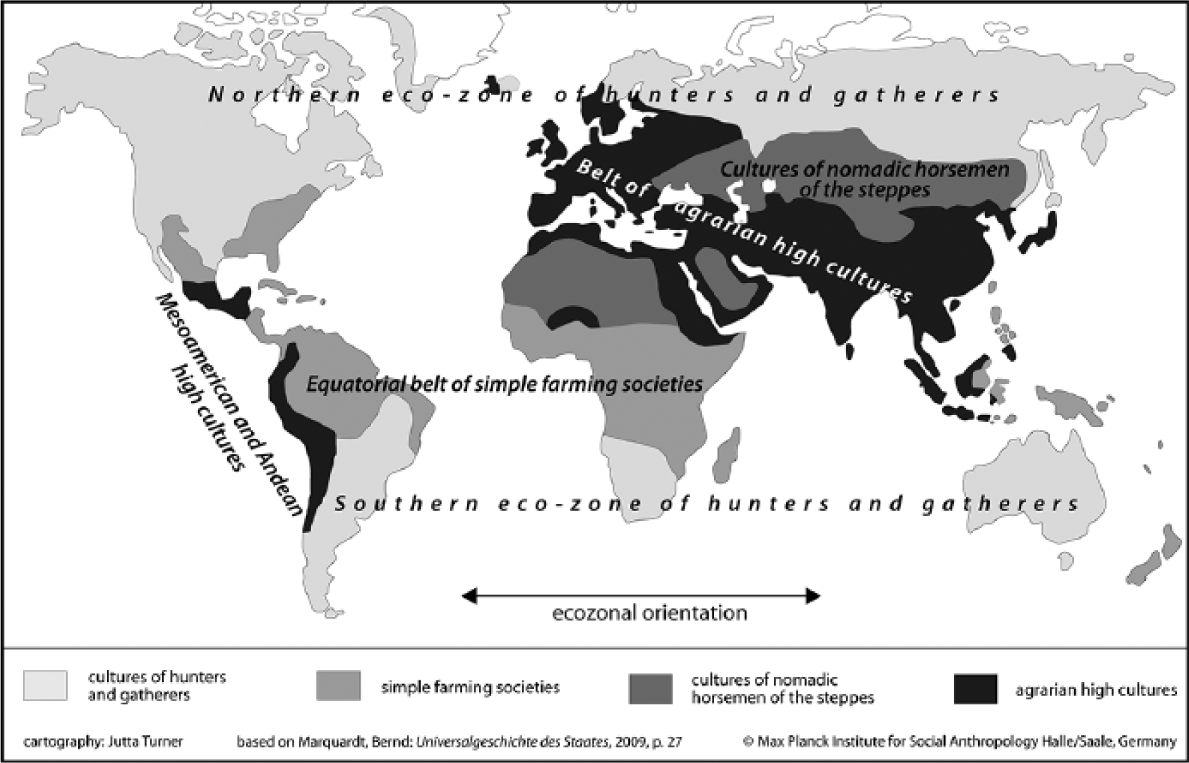
Hochkulturgürtel.
The term Hochkulturgürtel (e.g., Frobenius, 1923) includes the archaic “high cultures” along the Nile, Euphrates, Tigris, Indus, Ganges, and Huang Ho (Wittfogel’s hydraulic societies [Wittfogel, 1958]), the Greek and Roman civilizations of antiquity and their European successors, and the New World civilizations of Mesoamerica and the Andes, all of which were marked by monumental sacral architecture, statehood, cities, and associated features.
The Omaha terminologies clustering to the north and south of the belt of agrarian civilizations show a clear statistical correlation with patrilineal organization, in particular with exogamous patrilineal clans. 4 Another association is with mobile wealth: Omaha systems combine well with pastoralism (Abbink, 2006). As the High Culture Belt was the first region on Earth where states arose, first in the form of city-states, we can also see whether Omaha systems correlate with the absence of statehood. This is confirmed by the Ethnographic Atlas (Gray, 1999).
Table 1(overleaf) shows that all three systems of bifurcate merging are rarely found in large states. Zero percent of all Crow systems, 6.4% of all Iroquois systems, and 5.7% of all Omaha systems are found there. The vast majority of systems of bifurcate merging are found in “nonstate” societies and “chiefdoms.” Large states typically are populated by speakers of languages with descriptive and Eskimo terminologies. Of all large states, 30.3% have Eskimo terminologies, and of all Eskimo terminologies, 32.5% are found in large states. An even higher proportion of Eskimo systems (49.4%) is found at the other extreme of “statehood,” in the “no state” societies, which confirms that the Eskimo systems of English, French, or German can be regarded as examples of secondary primitivism, that is, the reversion to a very old pattern. This finding is also compatible with the idea that bifurcate merging systems combine well with lineage-based societies, whereas societies with both smaller forms of aggregation (“hordes”) and larger ones (states) have other cousin terminologies.
Ethnographic Atlas: Cross-Table “Kin Terms for Cousins” (Variable 27) by “Jurisdictional Hierarchy Beyond Local Community” (Variable 33).
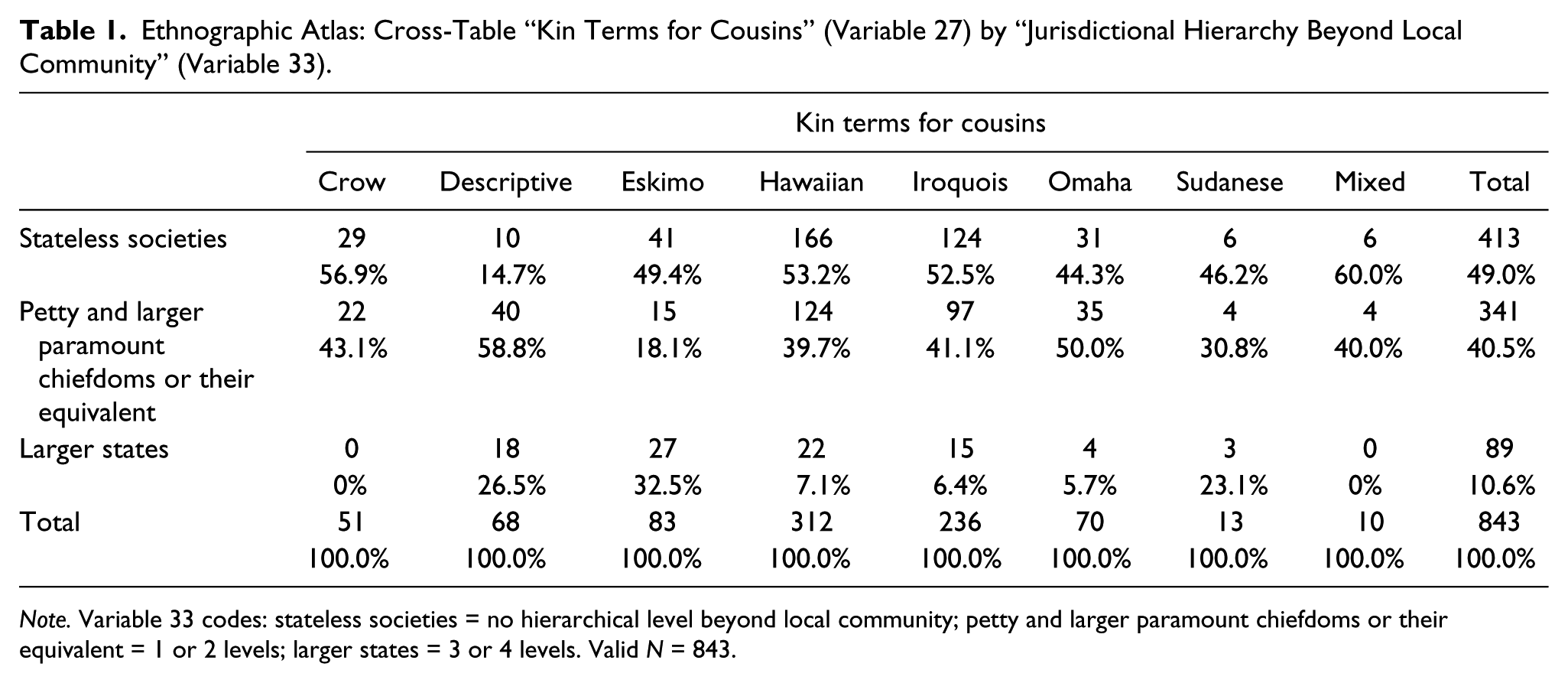
Note. Variable 33 codes: stateless societies = no hierarchical level beyond local community; petty and larger paramount chiefdoms or their equivalent = 1 or 2 levels; larger states = 3 or 4 levels. Valid N = 843.
To show that there is a statistically positive correlation of Omaha systems with patrilineages and a negative one with statehood does not explain why this is so. To explain this, we have to proceed empirically, and in some detail, delving into the ethnographic context of particular groups with Omaha systems, north and south of the High Culture Belt. How do people address their relatives or refer to them? What are the literal meanings of the terms they use, and what are the values and attitudes attached to them? What do they imply about the social relations they stand for? We shall start with the Kyrgyz system and then discuss some Central Asian variations in the Turco-Mongolian world. From that cluster of cases north of the High Culture Belt, we then proceed to the south of it to take a closer look at the Rendille, camel keeping pastoralists of northern Kenya.
According to Aksana Ismailbekova (2012, in press; Ismailbekova & Schlee, in press), Kyrgyz kinship terminology distinguishes between those who are related by descent (by “blood,” also referred to as “my kind of people”), those who are affinal (by marriage or “other kind of people”), and those who have quasi-kin or kin-like relationships. Patrilineal or agnatic kin have one set of terms, and those related through women have another set of terms. This implies that kin are sorted according to their descent.
To illustrate this, we start with ego’s own descent group. Here, we find several instances of kin being grouped together under a single term that expresses a shared position in a patrilineal descent system at the expense of neglecting possible distinctions between them on the basis of other criteria. A father’s elder brother and a father are classified under one kinship term—“father” (FB = F). Father’s brother’s children are classified as father’s children, that is, as brother or sister (FBS = B; FBD = Z). 5 A man treats the children of his brothers in the same manner in which he treats his own children and addresses them with the same terms he uses for his son and daughter. Distinct terms are used to distinguish younger brother (baike) and elder brother (ini), younger sister (singdi), and elder sister (eje), and the usage of these terms is quite strict. This means that, for “brothers” and “sisters” (in the wider Kyrgyz sense which includes patrilateral parallel cousins, that is, FB children or the equivalent thereof), it is more important to state whether they are senior or junior to ego than to state whether they are siblings or cousins. Also, the gender of the speaker may be taken into account and leads to different forms of address, whereas the distinction between siblings and parallel cousins plays no role.
The specific features of Omaha systems are found in the terms used for cross-cousins (children of MB and FZ). One of their defining features is that matrilateral cross-cousins (MBS) are terminologically equated with relatives of an ascending generation (MB). The Kyrgyz system fulfills this criterion: Both the MBS and the MB are “taike.” The logic underlying this classification is quite similar to that underlying the lumping together of potentially distinct types of patrilateral kin: Just as ego’s patrilineal relatives share a categorical affiliation, so do the members of the mother’s patrilineage. As we move from ego’s patriline to that of his mother, only the point of reference changes (patrilineally related to whom?): It is no longer ego but ego’s mother. A number of relatives belonging to one’s mother’s patrilineage are grouped together, ignoring generational differences, so that a single term is used for both MB and MBS. What is more is that both the elder MZ, the younger MZ, and MBD are designated by a single term (taieje) as well. In accordance with Lévi-Strauss’s and Leach’s idea of wife-givers being accorded a high status by wife-takers, the generational differences among members of this group are ignored by putting them all into the same category as senior relatives. After all, ego’s lineage is indebted to them for having received ego’s mother from them.
In harmony with the patrilineal logic of the Kyrgyz kinship terminology, matrilateral parallel cousins (MZC) are not equated with ego and his siblings, in contrast to patrilateral parallel cousins (FBC). Nor can MZC be equated with their MBC (who are also ego’s MBC). The reason for this is that their father, due to the requirement of exogamy, cannot be of the same shallow patriline as their mother and ego’s mother. MZC are called bölö. This term only applies to the children of the actual MZ, not to classificatory MZ, or MZ in the wider sense of female members of the same patrilineage and generation. MFBDC, for example, are called taekenin baldary (MFC, or children of mother’s father), 6 a term which makes the (double) male link between the two women and the equivalence of brothers (MF = MFB) explicit, rather than leaving all this implicit in a broader concept of sisterhood.
Among the Kyrgyz, patrilateral cross-cousins (FZC) fulfill the criteria of the Omaha system as well. Here, we find that these types of cousins are equated with relatives of the descending generation. Both ego’s FZC and his ZC are referred to as jeen. What these relatives share with each other is that their mothers are from the same patriline. Therefore, they have precisely the same relationship to ego’s patriline as ego has to the patriline of his or her mother. Jeen are metaphorically compared with wolf cubs. Even if raised in his mother’s patrilineage, a young man whom the members of that group call jeen, once grown up, would nevertheless return to the wild, meaning to his own patrilineage. Below, we shall come across the Rendille equivalent of the term jeen—eysim, which is not only based on quite a different metaphor but also expresses a strong patrilineal bias.
The spirit of the Kyrgyz kinship terminology resonates with the wider Central Asian context. There are parallels between Kyrgyz kin terminologies and Altai kinship terminologies (Broz, 2005), and also with Kazakh terminologies (Werner, 1997). Looking for other features shared by these groups, one cannot fail to notice that they typically have been pastoral nomads and warriors. According to Todd (2011), the pastoralists and many former pastoralists of the central Eurasian steppe all have patrilineal descent reckoning and lineage organization. It is therefore not surprising to find very neat examples of Omaha terminologies among these pastoralists and their sedentarized descendants.
Another such example is the Yomut Turkmen (Irons, 1975). Here the term dai stands for both MB and MBS, as does its Kyrgyz cognate taike. The other criterion for classifying this system as Omaha, namely, the terminological equation of FZC with ZC, is also fulfilled. From Iron’s (1975) diagram, it becomes clear that the term dai (MB) is also used for MFB and MFBS, that is, for other patrilineal relatives of ego’s mother. The exceptions are the lineal ancestors: MF, MFF, MFFF, and so on are kinds of grandfather, not MB. The Turkmen also use dai for the same kind of relatives of ego’s father; that is, FMB and FMBS are addressed as if they were the speaker’s own MB or MBS. This resembles Lévi-Strauss’s category of wife-givers; that is, those from whom ego’s lineage has received wives. In addition, MMB and MMBS are called dai as well. So, this is a broad category for different kinds of relationships through women, setting apart neatly those to whom one is related through one or more females from one’s own patrilineage. Although the Yomut terminology is pervaded by the idea of patriliny, they do not, however, have exogamous clans. We shall come back to their marriage rules below.
Crossing the linguistic divide between Turkic and Mongolian, we find further evidence of Omaha systems. According to Krader, the Ordos Mongols kinship terminology, which he equates typologically with Ancient Turkic and Classic Mongol, clearly shows some Omaha features (Krader, 1963). In the parental generation, all kin types (F, FB, FZ, M, MB, MZ) are differentiated from each other, and there are different terms for both kinds of parallel cousins (FBC and MZC); however, the MBS is referred to by the same term as the MB. As for the FZC, the Mongols go further than the Kyrgyz in playing down their importance: They do not even have any term for them. According to Krader (1963), “they are not considered to be kin at all” (p. 44).
Terminology types, and how they have been derived from each other and spread, are also the theme of Dole (1965). Not limited to a particular region, her comparisons take us immediately, along typological lines, across continental divides. She classifies Chahar and Khalkha Mongol, Kazakh, and—moving on to East Africa in the same breath—Maasai terminologies as being of the “lineage” type (her term for Murdock’s “descriptive”) with Omaha vestiges (Dole, 1965, p. 52; see also p. 51). 7 This brings us to Africa, where we are now going to have a closer look at one particular Omaha system, that of the Rendille. 8
The Rendille are a Cushitic speaking group of camel nomads (undergoing an advanced stage of sedentarization) in northern Kenya. The diagram (Figure 2) is minimalistic. It shows only the features indicating that their kinship terminology belongs to the Omaha type. As can be seen, patrilateral and matrilateral cross-cousins (FZC and MBC, respectively) are called by distinct terms. Patrilateral parallel cousins are equated with siblings, just as elder FB (and father’s senior male parallel cousins) is equated with F, as among the Kyrgyz. The patrilineal principle is also reflected in the terms used for members of other lineages—in which lineage identity can take precedence over generational distinctions. Thus, MB is equated with MBS, both being members of a lineage that has provided ego’s own lineage with a wife, namely, ego’s mother. Similarly, the children of women whom ego’s lineage has given away as wives to men of other clans are referred to by a common term eysim, regardless of whether they are ZC or FZC. The distribution of the term eysim is the same as that of jeen in Kyrgyz, but the underlying metaphor is different. Its etymology makes the closeness of this relationship between the kinship terminology and the social organization of the Rendille particularly clear. Eysim also means the residual milk in a nearly empty vessel or, more generally, any left-over food. Those to whom this term is applied are what is left of the descent relationship once it is traced through a female link, and thus (because of the requirements of clan exogamy) across a clan boundary.
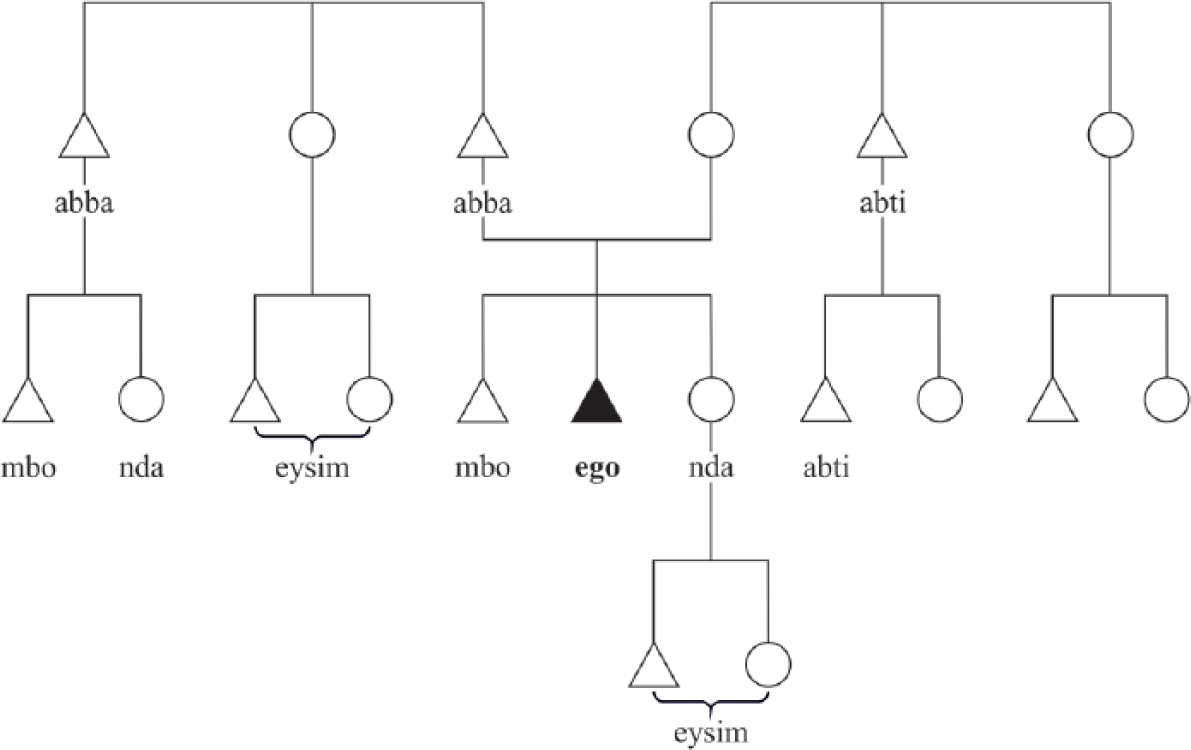
Some Rendille kinship terms—Terms used by men.
Consideration of both Kyrgyz and Rendille kinship terminologies makes it clear that the distinction between kinds of cross-cousins (MBC and FZC) is closely connected to the marriage system. In fact, it is a distinction between those who have given women in marriage to ego’s patrilineage, and those to whom ego’s lineage have given women. In Omaha and also in Crow systems, as in kinship systems with prescriptive matrilateral cross-cousin marriage, generally, these two categories must be kept distinct. However, in Omaha and Crow systems, unlike in systems with matrilateral cross-cousin marriage, the designation of wife-givers and wife-takers rotates among several allied clans or lineages from one generation to the next.
To appreciate this fully, we must leave the ego-centered-kindred perspective expressed by genealogical diagrams and regard the matter in terms of groups. Ego is not allowed to marry a bride from in his own clan, nor one from the clan of his mother or the one of his father’s mother. Marriage with a girl who originates from ego’s FFM’s clan or lineage, a classificatory FFMBSSD (Figure 3), is, however, not only allowed but also preferred, especially in the case of first-born sons, who are those who matter ritually. 9

The Rendille marriage ideal.
Our diagram (Figure 4 overleaf) depicts the overlapping loops that result if this rule is put into practice. It depicts the marriages of members of one patriline, namely, A (ego’s clan). Of course, recurring marriages between men from A and their classificatory FFMBSSD does not require a brother–sister link in the third ascending generation, as the rule is not about marrying a FFMBSSD in the strict sense but, simply, a girl from the FFM’s patrilineage. A FFMFFBSSSSD or a FFMFFFBSSSSSD, to cite only two of many possible examples, would do just as well. Also the number of generations up to the “sibling” link does not need to be the same as that down again. A FFMFFBSSSD would also do, if of approximately the right age. The rule is simply to marry a girl from the FFM’s people.

Cyclical marriages of the Patriline A with the Patrilines B, C, and D.
Even allowing for these variations, however, this diagram is still an oversimplification of what actually happens. If we were to include the marriages of all male members of B, C, and D, we would get many more such overlapping loops, and, if we drew them all, the resulting image would look like spaghetti. Furthermore, among the Rendille, a given patriline can intermarry with more than three other clans, and the different patrilines of a clan, with their different histories of intermarriage, have such relationships with almost all other Rendille clans. One of the best attempts at capturing this complexity on paper can be found in Adam Kuper’s (1982) representation of the nearly identical Tsonga system.
For Lévi-Strauss, marriage rules like these were a problem. They differed from his model characterized by prescriptive matrilateral cross-cousin marriage, in which men marry their MBD (in lineage terms). For this model to work, you need at least three lineages, which intermarry as follows: A’s mother stems from B, so he marries a girl from B; B’s mother stems from C, so he marries from C; and C’s mother stems from A, so he marries from A. Of course, these chains can be much longer, and there are also open systems, or linear, noncyclical ones, which require brides coming in from one direction and out the other. But we always have a regular transfer of brides, from D to C to B to A. In the Rendille system, as in other Omaha systems, the marriage rule is not formulated in a positive way but in a negative way. The Rendille forbid the marriage in one’s own clan, and with the clans of the mother and father’s mother. 10 Beyond that, there are no hard rules, and, usually, after prohibitions have been respected, more than one clan remains with which marriage is possible. As there are nine clans among the Rendille, three of which are forbidden, there are six left from which one may choose, and so, for different Rendille, there are millions of possible combinations of intermarriage over the generations. This characteristic, shared by the Omaha systems known to him, disturbed Lévi-Strauss’s sense of order. However, well-behaved Rendille who want to please Lévi-Strauss have the option of following their preferential rule, namely, that it is best to marry a girl of the clan of your FFM. Then, you get a predictable succession of clans with whom a particular patriline intermarries, which is much more in line with the spirit of a Lévi-Straussian prescriptive alliance (Lévi-Strauss, 1949/1969; Trautmann & Whiteley, 2012).
The Rendille share ideas of exogamy with the Kyrgyz and Kazakh of Central Asia, but they implement them in a quite different way. Although Kazakh and Kyrgyz compare the patrilines of the prospective bride and groom and avoid marriage between persons whose patrilines converged less than seven generations ago, the Rendille forbid marriage in one’s own clan forever, and with a member of one’s mother’s and father’s mother’s clan irrespective of how far back the actual genealogical link with the prospective marriage partner is, and whether it is known at all. Clan membership suffices to establish an insurmountable obstacle to marriage. 11 The Kazakh and Kyrgyz marriage rules can be visualized as a system of continuously segmenting lineages: It is forbidden to marry if the shared patrilineal ancestor is less than seven generations away, but which ancestor is in the seventh and which in the eighth changes with every generation. The Rendille system is better visualized as being composed of fixed boxes. One is not allowed to marry into a given number of containers—the clans of ego, mother, and father’s mother—no matter how closely or distantly one is related to the people within these containers.
We can now look at some of the ways in which Rendille kinship terminologies and marriage rules correspond to social behavior. The Rendille have nine clans, not counting the newcomers, Odoola, who may have arrived in the seventeenth century. The Rendille still say that they have nine clans and that, with Odoola, they are 10. For historical reasons beyond the scope of this article, processes of ethnogenesis in this region have repeatedly cut across clan boundaries, so that, today, we find the same clans among peoples of quite different linguistic and political affiliations (Schlee, 1989; Schlee & Shongolo, 2012). The Rendille share clans with the Gabra, Sakuye, Garre, and others.
Similar interethnic clan relationships have been recorded in the American Southwest (Shetler, 1996) and in Assam, where Inner Asia meets South Asia and Southeast Asia (Ramirez, 2011a, 2011b, 2014). In post-Soviet Central Asia, Azim Malikov (2013) has studied the khoja groups in their different ethnic representations. Globally, however, despite the existence of some important works, the phenomenon of interethnic clan identities still seems to be understudied.
Even across ethnic boundaries, clan brothers are clan brothers, whether you have ever seen them or not. They may speak a language you do not understand, and they may even be at war with you. Nevertheless, the sisters of your brothers are your sisters, so you cannot marry them. If your mother’s or father’s mother’s clan has an equivalent in another ethnic group, the male members of those clans are your maternal uncles, and the females are forbidden to you as marriage partners.
All of these marriage constraints exist equally for young girls and women and can be seen from their perspective. If a mother’s or father’s mother’s clan corresponds to an equivalent clan in another ethnic group, all the male members of those clans are forbidden as marriage partners. Prohibitions on marriage stretch far and wide over the social landscape of the larger region.
Interethnic clan relationships have implications not only for marriage exchange among clans represented in different ethnic groups but also for politics. Imagine a Rendille nationalism, demanding independent statehood. There are no such demands, so this is a mere thought experiment. Lines of identity and solidarity would continuously cross the borders of such a unit, not only on the Cushitic side (e.g., Gabra and Sakuye) but also on the Nilotic side. The Ariaal, described by Spencer (1973), are clans with Samburu names, but the majority of their members have Rendille clan origins and adhere to Rendille exogamy rules. Thus, important elements of identification among Rendille and their offshoots in other ethnolinguistic communities have nothing to do with ethnicity and language, and important aspects of being a nation and, thus, also a potential nation-state are missing. Until recently, there was also a total lack of concern among Rendille about the receding number of Rendille speakers, as the Rendille language was and continues to lose speakers to Samburu (Schlee & Schlee, 2014).
Among the Rendille, inheritance of livestock is strictly male and patrilineal. They represent pretty much the opposite of what Goody (1976) describes for societies that have undergone agricultural intensification and developed more complex institutions marked by diverging devolution (female inheritance), class, and caste—that is, they are the opposite of what Goody would expect in what we call here the High Culture Belt. In the absence of a son, a brother’s son inherits, and if there is no brother’s son, a father’s brother’s son or a father’s brother’s son’s son is next in line. If an entire lineage were to die out, the senior male in the next lineage one up in the seniority order encompassing the entire Rendille society would inherit, whether he wanted to or not. He might not want to: There are strains of camels that are thought to bring bad luck, for example, because they might originally have been acquired illegitimately. No one wants to inherit these camels, which are said to bring about the death of one lineage after the other.
The Rendille example shows that the Omaha terminology corresponds to local kinship practices which express the overall political structure of Rendille society and have detailed implications for domestic arrangements such as marriage choices and inheritance. As we have seen, other Omaha systems, such as the Kyrgyz and Kazakh, organize exogamy by principles other than those of clan membership. The Yomut Turkmen even allow first cousin marriage. In this, they resemble Arabs or Somali, both of whom have descriptive rather than Omaha terminologies. There is a great deal of variation within patrilineal systems. An exploration of this range of variation shows that endogamy does not automatically lead to the exclusivity of small groups. Boddy (2009) has shown for Sudanese Arabs that endogamy can even be a fast way of incorporating strangers. If your immigrant father has married locally and you marry into the group of your mother, this repeated intermarriage will give you the status of a local person irrespective of your patrilineal descent. However, systems which require rigid exogamy often imply intermarriage with strangers who remain strangers or even potential enemies.
Above, we have shown some of the global patterns of the spatial distribution of Omaha kinship terminologies, especially. The High Culture Belt separates northern and southern belts of Omaha terminologies which fit nicely with unilineal descent groups. Assuming a diffusionist model, we may then ask how kinship systems of this type have come to be present north and south of the High Culture Belt.
Since Dyen (1956), we know that the most economical and the most likely explanation of such a distribution is the one requiring the minimal number of migrations. Dyen was interested in languages and language families, but the same holds true for varieties of wild maize and many other kinds of distribution. If we assume that in an earlier phase of cultural history, bifurcate merging terminologies crossed the High Culture Belt, that would require at least one migration. Populations bearing one such terminological system (which might then change into another, for example, an Iroquois system might change into an Omaha one, etc.) would have to have crossed the High Culture Belt from north to south or from south to north. But there is also an explanation which requires zero migrations: Bifurcate merging systems might have had a broad, long-term distribution over the surface of the globe, including but not restricted to those localities where we now find them, and the High Culture Belt might have emerged in the middle of this broad distribution, separating northern and southern belts of lineage-based systems. Such an explanation would require us to assume that the terminologies that we now find in the High Culture Belt replaced earlier terminologies with a stronger bias toward unilineal descent groups, including Crow and Omaha systems. This assumption would be in line with what we know about the recession of unilinearity in the cases of the Romans, Slavs, and Celts (Korotayev & Kazankov, 2000).
In this belt in the middle, in which “high cultures” developed, lineage-based kinship systems appear to have changed—a process which may have gone through different stages culminating in the spread of modern, isolating (Dole, 1968) kinds of terminology, among them our own (e.g., German, English, French) terminology, which is of the Eskimo type. Because these modern terminologies were not originally Eskimo but have reverted to this type by losing distinctions they once contained, they have been dubbed “secondary isolating” (Winter, 1986, p. 440), which is synonymous with “modern isolating.”
The process of replacing lineage-based kin terms with cognatic ones continues today with the global spread of the Anglo sphere. Urban Africans use the term “auntie” for MZ and FZ alike (and also for other categories of kin, such as MB’s wife), because the distinction between patri- and matrilateral kin, that is, the distinction between lineages (their own vs. their mother’s patriline) seems to have lost relevance for them. McConvell (2016) has shown for some Australian languages that the same process is going on right now. History, ancient as it may be, extends into the present.
One may assume that, with globalization, electronic media, urbanization, and the like, these processes are now universal, adversely affecting the remaining Omaha and Crow systems, at least when people switch from their own language to English or other languages shaped by the developments of the High Culture Belt. One can therefore expect the comparative and historical study of kinship organization (a field whose revival we hope for) to be replete with examples of Omaha and Crow systems developing into something else. But this should not make us blind to the possibility that, well after the High Culture Belt emerged, just centuries ago (to give a rough order of magnitude), in an environment characterized by Omaha-type terminologies and the ideology of clanship, new Omaha terminologies might have developed out of other systems. There is evidence that even the Rendille, one of our paradigmatic cases of an Omaha system in this article, did not always have an Omaha terminology (Schlee, 1994, 2009). The language most closely related to Rendille, Somali, has a descriptive kin terminology, as does Arabic. Like bifurcate merging terminologies, those of the descriptive type can be found in association with patrilineal descent reckoning and segmentary lineages, but they do not seem to imply, logically, the formation of exogamous groups that can serve as building blocks, as is the case with Omaha terminologies. Under the influence of their Maa-speaking neighbours 12 (comprising the Samburu and, possibly, other Maasai groups preceding them in the region), Rendille kin terms may have developed the Omaha characteristics discussed in this article over time. 13 By the twenty-first century, the circumstances in which such a development could take place may have become rare. The global trend is toward having “cousins” and “aunties.” The idea of having “uncles” with the same range of meaning as in English, however, does not seem to diffuse as easily as that of an “aunt.” In Kenyan English, “uncle” often stands for the mother’s brother, whereas the father’s brother is a kind of father (e.g., a “small father”). Even in the modern urbanized world, the idea of patrilineal groups shows a degree of tenacity and resilience.
Conclusion
What kind of anthropology have I applied in this article and to which results has that led? Modern anthropology stresses individual agency. Much of my own work on identification and alliances, together with colleagues (e.g., Eidson et al., in press; Schlee, 2008), focuses on agency and choice. People adopt, foreground, or deny one or the other collective identity in response to incentives. This kind of reasoning extends far into the way I think about kinship. A boy might address a relative with the English loanword “auntie” (reflecting a modern cognatic logic) or with a distinctive term for FZ, MZ, or FB’s wife, depending on what he wants from her and how he can influence her. Is she a modernist who responds more favorably to “auntie”? Is she attached to local custom, insisting on a “proper” form of address? Getting or not getting a meal or a contribution to one’s school fees may depend on such considerations. Historical change may be the result of a myriad of such individual decisions. 14
Looking at the global map and a time scale of millennia, however, we do not see individuals and their decisions. We only see large aggregates such as language families, forms of production, patterns of residence, levels of technology, and the like, and if we want to speculate about how these things came to be distributed on the globe as they are today, we are thrown back on time-honoured concepts such as evolution and diffusion.
What, now, is “evolutionist” and what is “diffusionist” in the attempt made above to explain the global distribution of Omaha systems? Dyen’s theory, quoted above, aims at explaining distributions and can be subsumed under the heading, “diffusionism,” although it has led us to prefer a hypothesis which requires zero migrations. We have chosen an explanation of a present day distribution which is the most elegant, insofar as it makes the fewest assumptions about migration (thus corresponding to the metatheoretical principle known as Ockham’s razor or the principle of parsimony).
The article does not dwell on how systems of bifurcate merging originally developed. We know—and the article illustrates this with examples—that they have an affinity with unilineal social organization, and that Omaha in particular is correlated with patrilinearity. We also know that hunter and gatherer societies, forming lose bands, tend to have other systems of kinship terminology, for example, the Eskimo system, to which many modern societies have reverted. The article focuses, however, not on how Omaha systems have come about but on how they have disappeared in the High Culture Belt and under the influence of the various forms of globalization and modernity directly or indirectly derived from different segments of the High Culture Belt. Omaha systems seem to be incompatible with modes of social organization in which patrilineages play no role or only a minor one. “Statehood” is a concept which springs to mind when looking for a name for the form of social organization that appears to be omnipresent in the High Culture System but only on the distant social horizon of those areas where we still find functioning Omaha systems. That bands, lineages, and states reflect different, successive stages, is a classical evolutionist idea. It is this idea that allows me to hypothesize that, if we find Omaha systems associated with lineage organization to the north and south of the High Culture Belt, we might assume that, previously, they existed in the areas where the “high cultures” emerged, for there is no reason to assume that, prior to that, lineage organization was less prominent there than in the surrounding areas. I have been asked whether the Omaha systems may not have come into existence after the emergence of the High Culture Belt, independently, to the north and the south of it. Independent invention, of course, is an idea dear to evolutionists. I have no proof that this did not happen. Instead, I can only adduce Ockham’s razor once more. Such a course of events would require hypothesizing an unnecessarily complicated history. The history I propose is shorter and achieves its purpose perfectly. It explains the present global distribution of bifurcate merging systems and requires only one invention and not two. Two separate inventions would be necessary if we had a reason to assume that, prior to the emergence of high cultures in the belt affected by it, lineage organization did not prevail there. Such an assumption would necessitate a second assumption that lineages only developed later and separately to the north and the south of it (or in one of those places and then jumped across the belt). I am not aware of anyone advocating such a complicated theory and find the one presented here to be more plausible.
A factor loosely related to statehood is urbanism. 15 In some parts of what was to become the High Culture Belt, people lived in cities before the protostates, or states that developed there started their imperial expansion across rural territories. Urban life strengthens local identifications at the expense of descent-based ones. The two may at some stage be congruent, if settlement is organized in ethnic neighborhoods, but eventually, the neighborhood aspect comes to the fore. I was struck by the importance of local identification in the case of Sudan, of all places. Sudan is a country in which “tribes” (qabaa’il, sing. qabiila) exist officially as administrative entities, and sometimes have to be declared when one fills out a form, for example, when applying for a public service position. So, I noted with surprise that urban Sudanese identify strongly not only with their residential quarter in Khartoum but also with the provincial towns from which they or their parents migrated to the capital city. Collecting genealogies in towns and cities, I was surprised by the number of “tribes” turning up in the same genealogies. These genealogies often comprised even people from both of the major ideology-laden categories “Arab” and “African.” Tribal affiliations were only stated in the cases I asked for them. In contrast, in rural and, particularly, in pastoral settings, tribes and descent-based units in general are much more in the foreground of social perception.
If we look at the different Omaha systems we have dealt with in this article, we find that they differ in their exogamy rules. The Rendille system (like that of the Samo and Tsonga) forbids marriage with women of certain clans. In contrast, there are those who have Omaha terminologies but who do not organize exogamy in terms of clanship. The Kyrgyz and Kazakh permit marriage within the clan, if the shared ancestor is more than seven generations ago, and the Yomut Turkmen permit marriages within the clan even if the shared ancestor is just two generations ago, the FF of the spouses. It is the second type, not the first, which we find in empires, either among nomadic rulers over oasis populations or on the nomadic fringe of empires which have their centers elsewhere and which alternate between co-opting and fighting against Turkic tribesmen. So, the incompatibility with statehood seems to be stronger among those with clan-based exogamy rules than those with individualizing exogamy rules (counting actual ancestors). The same can probably be said about urbanism. I am not aware of any townsmen or city-dwellers who maintain large clans as units defining the limits of exogamy. This may have to do with degrees of patrilinearity. Omaha systems with exogamous patrilineal clans may represent a purer and more extreme form of a patrilineal ideology, one which is stronger than that of systems in which exogamy is not tied to clanship. These latter appear to be more compatible with statehood and loyalty based on urban coresidence. Perhaps, however, practical considerations are decisive: In a given local settings, potential marriage partners just might not be available for people who follow Rendille type rules.
For the Rendille, the requirement that each line of descent pass through a rotation of intermarriage with other clans is what reproduces the social order, very much in line with the Lévi-Straussian emphasis on marriage alliance as the structural principle constituting society. Every Rendille has a kin term for every other Rendille. If there is no relation through women, because there has not been intermarriage in recent generations, the patrilineal terminology (generalized fatherhood, brotherhood, and so on, according to purely generational criteria) is applied. The Rendille consult and cooperate with one another at the tribal level, but they have no specialized state institutions. All this would change with a form of incorporation into the state going beyond their marginal incorporation in the postcolonial state to date. Territorial residential units, bureaucracy, and a government with an executive branch and its own ways of classifying people and ascribing roles to them would take over from the system based on descent and alliance.
The centrality of intermarriage for societal cohesion and cooperation (for reproducing the “corporate group,” as the older terminology has it) is illustrated by what happens to intermarriage when processes of political fission start. The Rendille have named moieties, in the sense of a binary grouping of clans, which have ritual implications and which are reflected in the settlement order when Rendille gather for collective rituals. In other ethnographic contexts, the term “moiety” refers to exogamous units, but the Rendille moieties, called “Western” and “Eastern,” respectively, are not exogamous. On one occasion, they even temporarily became endogamous. The collective ritual preparations for the marriage of the age-set Ilkichili in 1976 were accompanied by bitter disagreement about the ascription of ritual roles and even by suicide and murder. In that age-set, there were practically no intermarriages across the moiety line. To compensate for the lack of brides that this caused, the largest clan of the Eastern moiety, which is divided into subclans, changed its marriage rules. Its members continued to abstain from marrying each other, but they introduced the rule that, henceforth, they could marry each other’s eysim, daughter’s children; that is, women whose mothers were from another subclan of their own clan. (Schlee, 1979; Schlee, Schlee & Hambule, 2012). Without marriage, no cohesion, and without cohesion, no marriage—as far as Rendille are concerned. Marriage with non-Rendille is possible and, sometimes, even desirable, as they are beyond the range of ritual rivalry and politically motivated marriage boycotts.
From this perspective, the Central Asian Omaha systems have lost (or never had?) what from Lévi-Strauss’s perspective they should be all about: defining a system of marriage alliances both distinguishes and links a finite number of clans. Once the clans, which Central Asians still have, are no longer part of a system of marriage alliances, they have become free to acquire other functions: Clans may have become regiments, and regiments may become clans, as in the ups and downs of Mongol rule over the centuries, or they may have shifted from the domain of alliance to that of descent, and becoming part of a real or fictive national genealogy, as among the Kazakhs. At any rate, Central Asians have preserved their emphasis on lineal descent (which in itself has a problematic relationship to statehood and its administrative units, as it poses the question of primary loyalty), but they have acquired a higher tolerance of statehood in comparison with the African Omaha systems.
This article has covered a wide range. Trying to discern a global pattern and to explain it, it has gone into some detail, but only in some selected cases. I am sure there is more to be said and would be glad if this theme was taken up by others.
Footnotes
Declaration of Conflicting Interests
The author(s) declared no potential conflicts of interest with respect to the research, authorship, and/or publication of this article.
Funding
The author(s) received no financial support for the research, authorship, and/or publication of this article.