



Abstract
The main goal of this article is to explore the role of individual sociodemographic characteristics and national social backgrounds in forming people’s decisions to engage in voluntary work. We have drawn data from the European Value Survey (1990, 1999, and 2008). We analyze voluntary work as an aggregate measure and also through four different categories. We have performed multilevel regression models taking into account a hierarchical structure of two levels: individual and country. There are no relevant gender and age differences, and, in fact, the most important differences lie in the impact of social factors rather than individual characteristics. We also highlight that geographical effects are diluted after controlling for social factors, but a certain level of geographical variance remains unclarified by the explanatory variables. This conclusion has important policy implications because it opens the door to implementing social policies that could be effective for all European countries.
Keywords
Introduction
Increasing interest in voluntary work goes together with an increasing interest in the third sector. The third sector is different from traditional government and capitalist sectors because it favors the access of all citizens to markets of basic goods and services, such as housing, food, health, and education, thus contributing to sustainable growth (Amendola, Garofalo, & Nese, 2011; Ronel, 2006; Sabatini, 2008; Salamon, 2010; Taylor, 2004). Although some research papers have questioned the intensity of these effects, they also confirm that social initiatives reinforce particular aspects of economic development, such as income distribution and labor market stability (Casey & Christ, 2005; Van Ingen & Kalmijn, 2010). Voluntary organizations have been recognized as complementary suppliers of goods and services, and, as a consequence, social initiatives are increasingly being encouraged due to the global crisis framework (Never, 2011).
The main goal of this article is to analyze the role of individual sociodemographic characteristics and national social backgrounds in forming people’s decisions to engage in voluntary work. Given that different nonprofit organizations require different volunteer profiles, we consider voluntary work as an aggregate measure and also through four different categories (Social Justice, Social Awareness, Education and Leisure, and Professional and Political activities).
Apart from obtaining external help, such as public grants, voluntary organizations depend on their members’ efforts. Understanding the determinants of volunteering work will help the design of policies that help voluntary organizations to function properly. Although voluntary work is not a new research topic, many questions still remain open. Consistent with the theory of human capital, income and education are significant predictors of volunteering. However, the real situation might be more complex, because there may be people with lower incomes and fewer social networks who feel more compelled to volunteer, as volunteering is a means of strengthening these capitals (Bryant, Jeon-Slaughter, Kang, & Tax, 2003). At an individual level, it is difficult to comprehensively test the underlying motives behind volunteering decisions.
At an aggregate level, globalization and economic development have accelerated the homogenization process in consumption patterns and in general lifestyles for men and women around the world. This homogenization process is even more evident among geographically close countries. However, important regional differences persist for many activities, such as voluntary work. The economic analysis of volunteering motives might also help to understand why volunteering participation rates vary so strongly across European countries. Sweden and Slovakia exhibit the highest volunteering participation rates, with shares of 59% and 55% of all employed people, whereas Turkey, Russia, Ukraine, Hungary, Poland, and Lithuania have the lowest participation rates, with shares between 10% and 20% (Hackl, Halla & Pruckner, 2007).
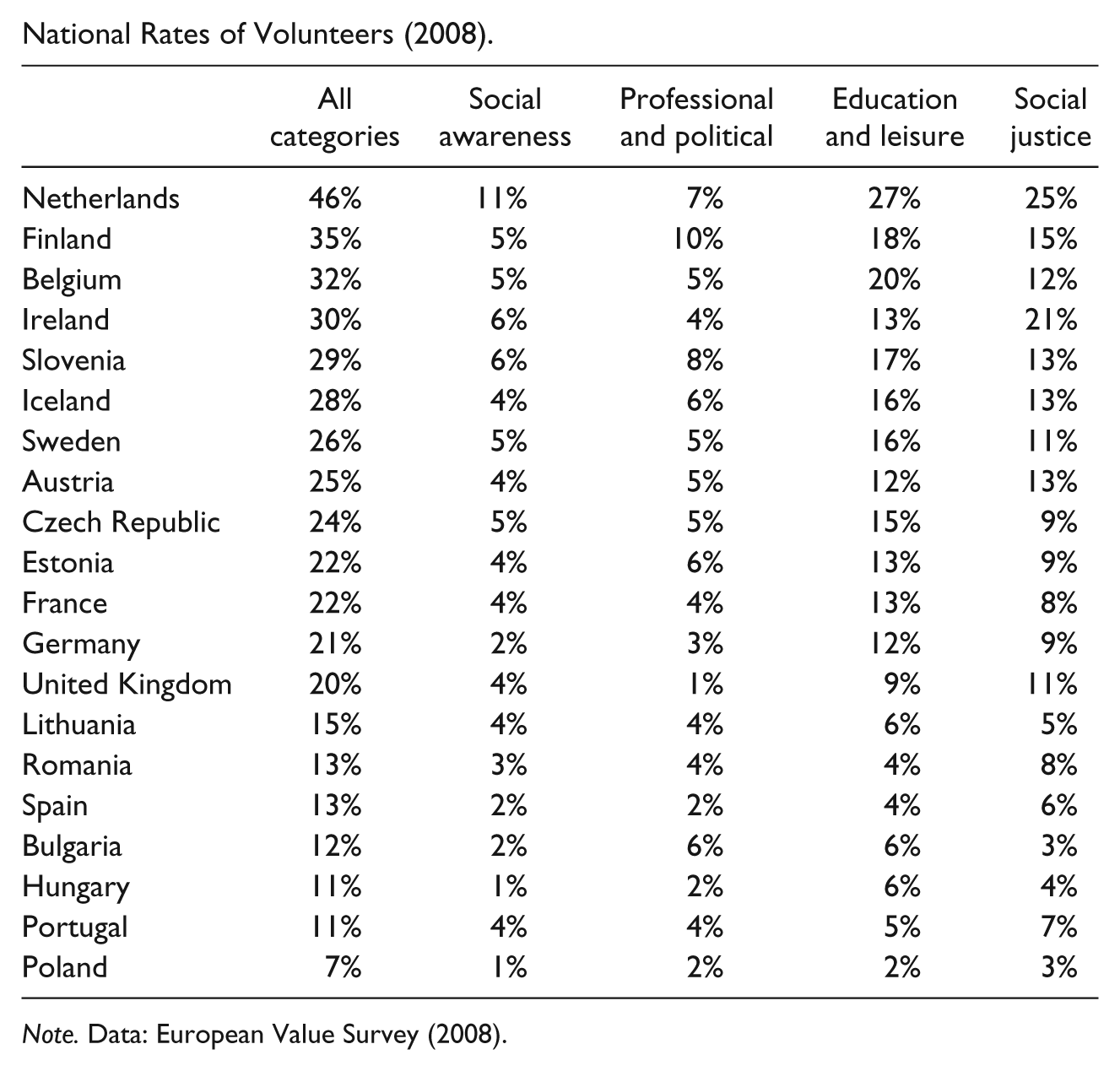
Not only do volunteering percentages vary internationally, even more significant international differences become apparent in the types of activities people volunteer for. Volunteering is high in Sweden and Finland, and most of that volunteer activity concentrates on cultural and recreational activities. In Mediterranean countries, where volunteering is low, it is equally distributed into the endowments of goods and services, such as educational goods and welfare services for vulnerable people (Salamon & Anheier, 1998). The highest volunteering rates are in the Netherlands, as 45% of the interviewed population is volunteers, followed by Finland (35%) and Belgium (32%). In contrast, Poland has the lowest volunteer participation rate of 7%. The rates for Slovenia, Iceland, Sweden, Austria, Czech Republic, Estonia, France, and Germany range from 21% to 30%. The rates for the United Kingdom, Lithuania, Romania, Spain, Bulgaria, Hungary, and Portugal range from 11% to 20%. The highest participation rates are for activities related to education, leisure, and social justice. However, there are major national differences in these activities. The lowest national differences are found in social awareness activities and professional and political activities (see Appendix).
The main contribution of this article is the study of sociodemographic characteristics taking into account geographical differences. First, we explore the explanatory power of individual and national data. Second, we attempt to understand whether geographical differences are consequences of the population’s characteristics, such as educational levels or working status, or national characteristics, such as rates of affiliates in nonprofit associations or attitudes to other people’s problems, or to a greater extent, whether geographical differences are consequences of unobserved contextual data, such as political background.
As particular voluntary jobs require specific volunteer profiles, the strength of this article lies in introducing voluntary work measures based on interest fields. Social norms restrain individual decisions; therefore, social factors will refine estimations of sociodemographic characteristics. Lastly, international comparisons will help us understand how different political and economic settings determine the decisions of population groups. We focus on European countries for two main reasons. First, the aging population is generalized in European countries thus the future of welfare is under debate. Meanwhile government expenditures are increasing, public revenues are decreasing. The third sector might provide new solutions for social, economic, and environmental issues, among others. Second, although there is a homogenization process through the building of the European Union, there are still many differences. For example, countries characterized by a late economic development (such as Poland or Portugal) have, in general, lower volunteering participation rates than countries with earlier economic development (such as Netherlands or Finland). Similar, but not equal national scenarios, and variability in values of volunteer percentages are good technical conditions to carry out international comparisons at different country levels.
Theoretical Framework
The volunteers cannot be treated as a homogenous group. Depending on their prosocial motivations and contextual settings, they will react quite differently to changes in sociodemographic characteristics. For policy purposes, it is particularly relevant to understand if there is a unique pattern in volunteering or if national differences cause this pattern to differ.
Sociodemographic Characteristics
In research articles using cross-sectional data sets, there is a general consensus that voluntary work is positively correlated with education and income (Curtis, Baer, & Grabb, 2001; García-Mainar, Marcuello, & Saz, 2010; McPherson & Rotolo, 1996; Mesch, Rooney, Steinberg, & Denton, 2006; Prouteau & Wolff, 2006; Taniguchi, 2006, 2010; Wilson, 2012; Wilson & Musick, 1997). Empirical gender studies highlight significant differences between volunteering intensity (Mesch et al., 2006; Rosenthal, Feiring, & Lewis, 1998; Wymer & Samu, 2002), motivations (Trudeau & Devlin, 1996), and preferences for the type of organization (Schlozman, Burns, & Verba, 1994). Hardly any research has yet been conducted on the reasons for these differences in gender studies (Einolf, 2011; Fyall & Gazley, 2015). Some show that women are more likely to volunteer in countries such as Australia, the United Kingdom, Japan (Musick & Wilson, 2008), the Netherlands, and Italy (Dekker & van den Broek, 1998); others demonstrate that men are more likely to volunteer in countries such as Sweden (Musick & Wilson, 2008) and Spain (García-Mainar et al., 2010), and there is no gender difference in Canada (Musick & Wilson, 2008).
Men and women have to decide how to allocate their time between formal employment and informal economic activities (including “unpaid domestic work” and “unpaid community and voluntary work”). There are important gender differences on how men and women allocate their time in these activities, not only on how much time they allocate, but also on which activities (Williams & Nadin, 2012). Even after evaluating the gender divisions of unpaid domestic labor in countries with strong work–family policies to enhance fathers’ family role, full-time employment for the mother does not increase the father’s contribution in any type of family work (Kitterød & Pettersen, 2006; Matz-Costa, Besen, Boone-James, & Pitt-Catsouphes, 2014). Thus, gender differences in working decisions are usually similar to gender differences in volunteering by time allocated and type of activity (Principi et al., 2013).
Regarding age differences, the relationship between volunteering and age shows an inverted U that can be modified depending on the type of voluntary participation (Knapp, Koutsogeorgopoulou, & Smith, 1996; Pancer & Pratt, 1999), and it is associated with different life-cycle stages (Selbee & Reed, 2001). Using time series rather than cross-sections offers a broader picture. Van Ingen and Dekker (2011) examined whether societal developments, such as educational expansion, secularization, and changes in the job market, affected volunteering levels in the Netherlands from 1975 to 2005. The authors reveal that volunteering has become more common among the economically inactive, especially among pensioners and homemakers. The role of education has also changed; volunteering differences between the lower and higher educated in their participation in volunteer work have virtually disappeared. The relationship between church attendance and volunteering has become stronger; although volunteering has dropped in general, churchgoers have, on average, increased their volunteering activities for religious organizations.
The explanation of determinants becomes even more complicated when variables interact and more than two sociodemographic characteristics are considered simultaneously. To a certain extent, it might be extrapolated that gender gap drop-offs in education, income, and working conditions might lead to gender gap drop-offs in volunteering participation. Single women are more willing to offer voluntary work than single men to improve their social network, although as a population group, they have a lower acquisition capacity (Gee, 2011). Taking into account that both male and female high school students are hardly exposed to working conditions and that they represent a homogenous group in terms of education, gender differences may be strongly linked to gender roles rather than socioeconomic characteristics (Einolf, 2011; Trudeau & Devlin, 1996).
Prosocial Motivations
The theories on why people offer themselves for voluntary work are diverse. People might become volunteers for reasons of altruism, investment, or even egoism (Ziemek, 2006). We can find intrinsic and extrinsic motivations (Frey, 1992; Meier & Stutzer, 2004) and egoistic and altruistic motivations for volunteering (Shye, 2010). Volunteers might pursue benefits, they might just want to be involved in what is going on, or volunteering decisions might be based solely on people’s self-identity for prosocial reasons (Prouteau & Wolff, 2004). The rewards for volunteering depend on volunteers’ motives, which might basically be classified as intrinsic motivation and extrinsic motivation (Meier & Stutzer, 2004).
Volunteers with intrinsic motivation receive internal rewards as direct results from their activity and/or from the outcome of the volunteer work they do. This group includes activities that generate enjoyment per se, such as work gratification or the act of helping others (Andreoni, 1990; Frey, 1992). Volunteers with extrinsic motivation might also feel useful when helping others. In this case, people volunteer because they view it as an investment and expect external benefits or payoffs in human capital (Menchik & Weisbrod, 1987), social network (Prouteau & Wolff, 2004), or even the signaling effect (Spence, 1973), among other consequences (Day & Devlin, 1998; Hackl, Halla, & Pruckner, 2007).
Economics literature usually describes two types of models that have been used to explain the volunteer decision and which are related to the two types of motivation: (a) consumption models that are more related to intrinsic motivation (Andreoni, 1990) and the (b) investment model that is related to extrinsic motivation (Menchik & Weisbrod, 1987). Traditional economics theories highlight how individuals make decisions about their time and money, but these theories need to coexist with the fact that social factors are the strongest predictors of many individual decisions, including volunteering.
The functional approach inquires into personal and social processes that initiate, direct, and sustain actions (Katz, 1960). The functional approach for the particular case of voluntary activities catalogued six functions of voluntarism through (a) Values that refer to a concern for the welfare of others, and society in general; (b) Understanding, thus voluntary activities give volunteers the opportunity to learn, understand, practice, and apply skills and abilities; (c) Enhancement of one’s self-esteem; (d) Career, thus voluntary activities may serve to increase one’s job prospects; (e) Social pressure or strong normative; and (f) Protection, so volunteers show feelings of social responsibility. This approach has been empirically validated, but its implementation requires a specific questionnaire: The Volunteer Function Inventory (VFI; Clary et al., 1998; Houle, Sagarin, & Kaplan, 2005). The VFI is a 30-item measure designed to examine how important or accurate are these six functional motives for individuals to volunteer. Although the VFI is not exempt of critics (Shye, 2010), it continues to prove its usefulness in volunteer research (Wilson, 2012).
To overcome this difficulty, we look at similar theories that can make use of more general data sets. Bekkers (2007) offers a panoramic view of the social determinants of voluntarism in which the author includes motivations, attitudes, values, and beliefs. Einolf (2011) distinguishes three categories of variables to study the gender differences of volunteering.
Contextual Settings
People differ substantially in their social preferences, but even the same person might display different patterns of behavior depending on the situation. Given that it is easier to control the contextual background than individual attitudes, less emphasis should be placed on the quest for the ultimate prosocial motivation and more emphasis on conditions that trigger volunteering decisions (Goldschmidt & Remmele, 2005; Meier, 2006).
People are generally more likely to join nonprofit organizations in more prosperous societies (Parboteeah, Cullen, & Lim, 2004; Ruiter & De Graaf, 2006). In general, country differences in volunteering may be due to differences in economic background, religious tradition, democratic political systems, and/or democratic stability (Curtis et al., 2001; Curtis, Grabb, & Baer, 1992). For example, economic development reinforces altruism and reduces investment motivation (Ziemek, 2006). Both structural factors and cultural determinants might influence volunteering decisions (Gronlünd et al., 2011). Culture has been addressed in several ways, but probably the most widely used proposal by the scientific literature is Hofstede’s (2001). Collectivism and individualism are terms used to contrast cultural dimensions (Hsu, 1981); both are among the most representative dimensions of culture (Schimmack, Oishi, & Diener, 2005) and are considered key elements in describing changes in behaviors, attitudes, norms, values, goals, and family structures (Triandis, 1996). Consequently, the process of volunteering might be explored under perspectives of collectivism and individualism (Finkelstein, 2010). Religious organizations provide valuable resources to communities especially in issues related to poverty and vulnerable population (Kinney & Combs, 2016; Polson, 2016). Organizers of volunteering activities may target regular churchgoers before reaching out to nonchurchgoers, because churchgoers could be easier to recruit (Lim & MacGregor, 2012). Religious volunteering has a strong spillover effect, implying that religious citizens also volunteer more for secular organizations (Ruiter & De Graaf, 2006).
The relationship between education and social resources is also modulated by the welfare state regime. The more a country spends on social security, the stronger the relationship between education and voluntary organization membership (Gesthuizen, van der Meer, & Scheepers, 2008). Combining individual-level data from the European Value Survey (EVS) and macroeconomic and political variables from OECD countries, Hackl, Halla, and Pruckner (2012) identify three channels through which governmental activities influence voluntary labor: size of the state (amount of public social expenditure), political consensus between voters and the government, and government support for democratization. These findings are particularly interesting because governments do not necessarily want to cut social spending, to reduce democratization, or to decrease their acceptance level from the public, even when these factors are correlated with increasing rates of volunteerism (Toran, 2014). In addition, these analyses contradict previous contributions (Salamon & Sokolowski, 2001; Stadelmann-Steffen & Freitag, 2010).
Meanwhile for some authors, volunteer labor and donations are complements (Brown & Lankford, 1992; Menchik & Weisbrod, 1987; Schiff, 1990), for others they are substitutable (Duncan, 1999; Feldman, 2010; Lilley & Slonim, 2014). However, empirical evidence shows that donating money and offering volunteering work behave as substitutes (Toran, 2014). Straub (2005) highlights the difficulty in establishing a model that could be applied to the general population and prove decisive if donations and volunteerism are substitutes or complements. Taking into account the nature of the link between donations and volunteering, crowding out estimates are incomplete if they fail to account for volunteering. “Crowding out” is more likely in the fields of health and social services (Stadelmann-Steffen, 2011); however, the degree of displacement is generally small (Brooks, 2000).
Furthermore, Salamon and Sokolowski (2001) identified cross-national variation in the amount and distribution of the volunteer input and in how the volunteer input is recruited and maintained by social and organizational networks. Consequently, the welfare state is able to create new interests through social programs around which a wide network of stakeholders can be organized (Pierson, 1996). Likewise, institutional theory suggests that volunteering is generalized when you have a support infrastructure to implement it (Wilson, 2012).
Empirical Strategy
As an empirical strategy, we consider multilevel models because we have data at individual and country levels: the dependent variables related to unpaid work measured at the individual level and a set of explanatory variables on each of the levels (individual sociodemographic characteristics and national social backgrounds). We have repeated results by age and gender subsamples to check for relevant age and gender differences.
For our empirical analysis, we have drawn data from the EVS. The EVS is a cross-national longitudinal study that explores people’s values and beliefs, how they change over time, and the social and political impact they have. The EVS measures and analyses support for democracy, support for equality, work, family, politics, national identity, culture, diversity, and subjective well-being, among other topics. The EVS is an instrument rich in information for analyzing individual voluntary work participation decisions based on sociodemographic characteristics or individual attitudes and social values. Other surveys, such as the Eurobarometer, can be used in research on volunteer work. The Standard Eurobarometer survey series is also a cross-national longitudinal study designed to compare and gauge trends within European Union member states. The reason why we work with the EVS is because the EVS has a specific stable set of questions about volunteering in all waves.
Data
We drew data from the EVSs (1990, 1999, and 2008) because the questionnaire includes items on memberships of associations, voluntary work, attitudes, and beliefs, along with sociodemographic characteristics. This survey has the structure of a cross-section. Samples are drawn from the entire population aged 18 and older. We have a total number of 87,707 observations from 20 European countries for 1990, 1999, and 2008.
Large fields of volunteering comprise a wide range of activities, such as social and health services, education and youth work, cultural and recreational activities, politics, and environmental and religious services. The dependent variables are volunteer work as an aggregate measure and types of organizations. The EVS considers 14 different types of volunteer work. For the purposes of simplicity, we aggregated voluntary work into different groups (Social Justice, Social Awareness, Education and Leisure, and Professional and Political activities). The main advantage of reducing the number of volunteering categories into four groups is that we can repeat estimations for an aggregated category to four main volunteering groups, instead of 14. Because Prouteau and Sardinha (2015) use the EVS, we have followed their argumentation line to aggregate the volunteer work types.
To classify volunteering work into four categories, these authors carried out the Bartlett’s test of sphericity (to test if the independent variables are unrelated) and the Kaiser-Meyer-Olkin measure (to calculate the proportion of the variance in the independent variables that might be explained by underlying factors). Unpaid work related to welfare services for vulnerable people, church organizations, women’s groups, and health centers were aggregated under the social justice volunteering category. Unpaid work in local political action groups, human rights, the peace movement, the environment, conservation, and animal rights were considered under the social awareness volunteering group. Voluntary work in labor unions, political parties, and professional associations were included in the professional and political volunteering group. Lastly, the education and leisure volunteering category included activities in education, arts, music or culture, youth work, sports, or recreation. People who volunteer in social justice and social awareness activities have intrinsic motivation (consumption model). Volunteers for educational and leisure activities, and, to a greater extent, volunteers for professional and political volunteering activities have extrinsic motivation (investment model). Nevertheless, the individual level of motivation combines intrinsic motivations and extrinsic incentives, such as intrinsic motivation is less important to performance when incentives are directly tied to performance, and intrinsic motivation is more important when incentives are indirectly tied to performance. Concerning the performance, incentives and intrinsic motivation are not necessarily antagonistic and they are best considered simultaneously, for example on topics related to well-being or satisfaction (Cerasoli, Nicklin, & Ford, 2014).
Explanatory Variables
Regarding the explanatory variables, we aggregated them into three main groups. We included individual characteristics, national social factors, and time-dummy variables. Individual variables include information about gender, age, civil status, household composition, educational level, working status, and income level of the interviewees. We included the following variables as social factors valued as the national mean of individual observations: the size of the residential area (group size); perception of other people’ problems—bad luck, injustice, inequality, and lack of motivation (attitudes); importance of family, friends, leisure time, politics, work, and religion (values); confidence in the public institutions—the Church, Education System, Healthcare System, and Social Security (social capital); and the mean of people belonging to the different types of associations (reciprocity). Deciding to be a member of a specific organization will largely depend on the same observed and unobserved determinants of offering volunteer work. Individuals decide to join an association, but they do not decide other people’s memberships. Direct reciprocity is measured by the percentage of people working in the same kind of volunteering activities as the one we are estimating. Consequently, if we are estimating the probability of volunteering in social awareness activities, we consider the national percentage of volunteers in social awareness activities as a proxy of direct reciprocity. Indirect reciprocity is measured by the percentage of people working in other types of activities to the one we are estimating; for example, if we are estimating the probability of volunteering in social awareness activities, we consider the national percentage of volunteers in educational activities as a proxy of indirect reciprocity. Importance given to family, friends, work, leisure, politics, and religion captures the exposure to volunteer work.
Multilevel Modeling
We consider multilevel models (STATA: xtmelogit) as an empirical strategy. The multilevel analysis helps us to understand individual and national determinants of volunteering decisions and whether national differences remain after controlling for micro- and macro-variables. Multilevel regression models are indicated when there is a hierarchical structure in levels of data, with a single dependent variable measured at the lowest level and a set of explanatory variables on each of the levels. The advantage of these models lies in their capacity to define and explore variations at each level of the hierarchy after controlling for relevant explanatory variables (Hox, 2002).
In our case, our data are structured with j countries, in each of which nj persons have been interviewed. Our dependent variable, UnpaidWorkij, summarizes whether individual i in country j offers unpaid work to nonprofit organizations. Thus, we represent this variable as follows:

where β j represents the mean of the dependent variable of all the individuals in country j and ϵ ij the deviation of the value of this variable for individual i from the mean of that variable for other interviewees living in the same j.
Deviating the β
j
from its mean

The model formulated in this equation coincides with the components of variances with fixed and random effects. Parameter
As a second step, we introduce information on K − 1 individual characteristics. These characteristics could be included in a vector

in which X includes K regressors and eij ≈ N(0,
In the third and last step, we parameterize the coefficients β j of equation (3) by adding L national explanatory variables:

in which the fixed effects are now dependent on L national variables, K − 1 individual variables, and a constant.
These models represent general specifications of multilevel models in which the responses to a continuous variable are related in a linear function to a set of explanatory variables and to a simple hierarchical structure. As our dependent variable (UnpaidWorkij) is binary, taking values 1 if the individual offers unpaid work in nonprofit organizations and 0 otherwise, we applied multilevel analysis with a logistic function. In fact, we repeated the estimations five times. First, we ran the model for a dependent variable summarizing voluntary work independently of the activity (All Categories), and then for the four voluntary activity categories (Social Awareness, Professional and Political, Education and Leisure, and Social Justice).
In addition, we estimated the following sequence of three models: Model 1, including individual characteristics and time-dummy variables as explanatory arguments; Model 2, including national explanatory variables; Model 3, repeating Model 2 by subsamples of gender and age (men and women; age 18-30, age 31-45, age 46-65, and age 66-81). If we had introduced gender and age as explanatory variables, we would have observed how gender and age determine volunteering decisions. The reason why we have repeated estimation by gender and age groups is because we want to analyze how the different determinants figure out volunteering decisions in terms of meaning (positive or negative influence) and importance (weak or strong influence) in each population group.
Results
This section follows the structure described in the methodology. Tables 1 and 2 focus on the results obtained for the whole sample for Models 1 and 2, respectively, while in Table 3, we repeat estimations of Model 2 for subsamples of gender and age.
Logistic Multilevel Regression Results: UnpaidWork.
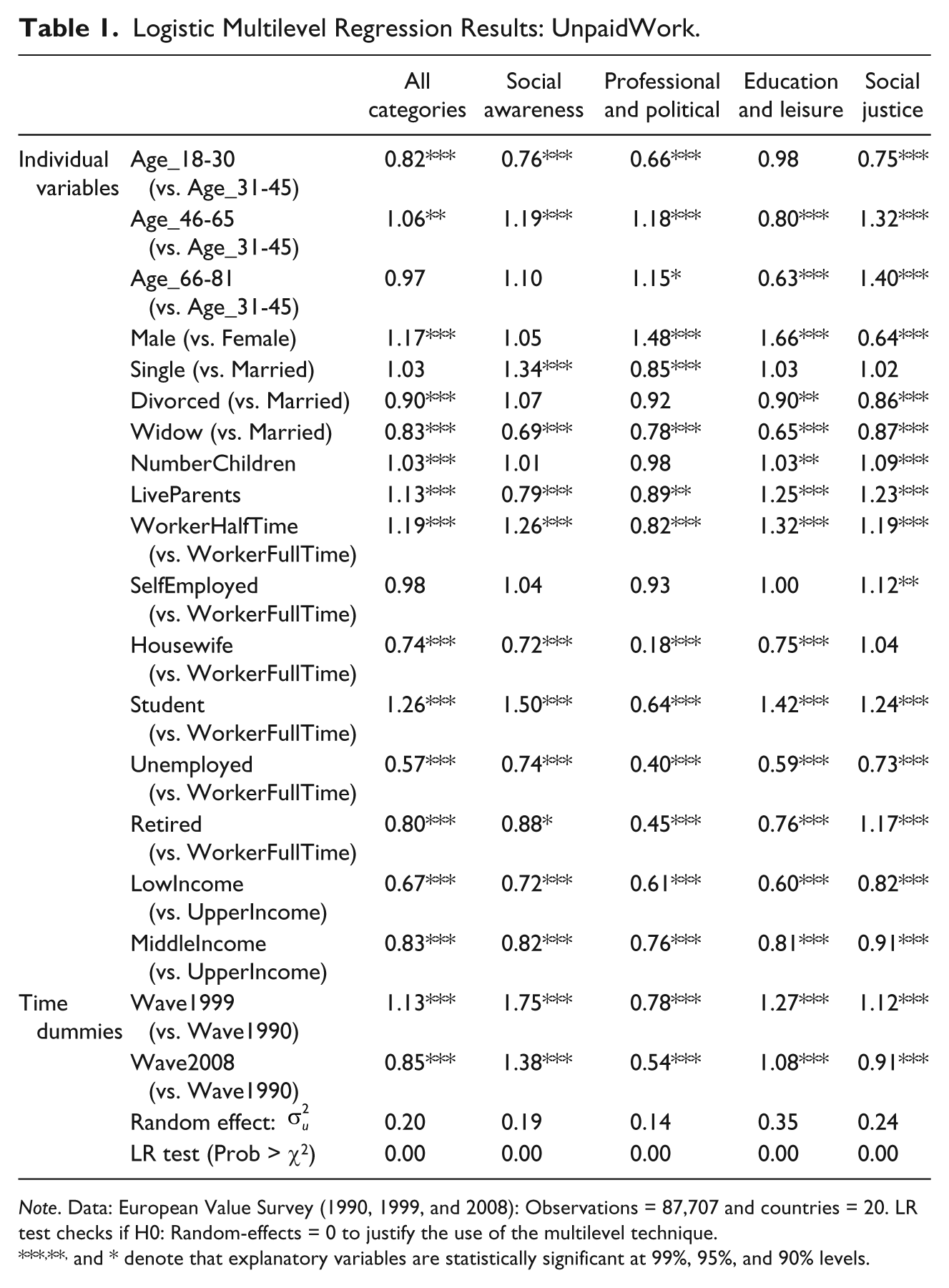
Note. Data: European Value Survey (1990, 1999, and 2008): Observations = 87,707 and countries = 20. LR test checks if H0: Random-effects = 0 to justify the use of the multilevel technique.
**, and * denote that explanatory variables are statistically significant at 99%, 95%, and 90% levels.
Logistic Multilevel Regression Results: UnpaidWork.
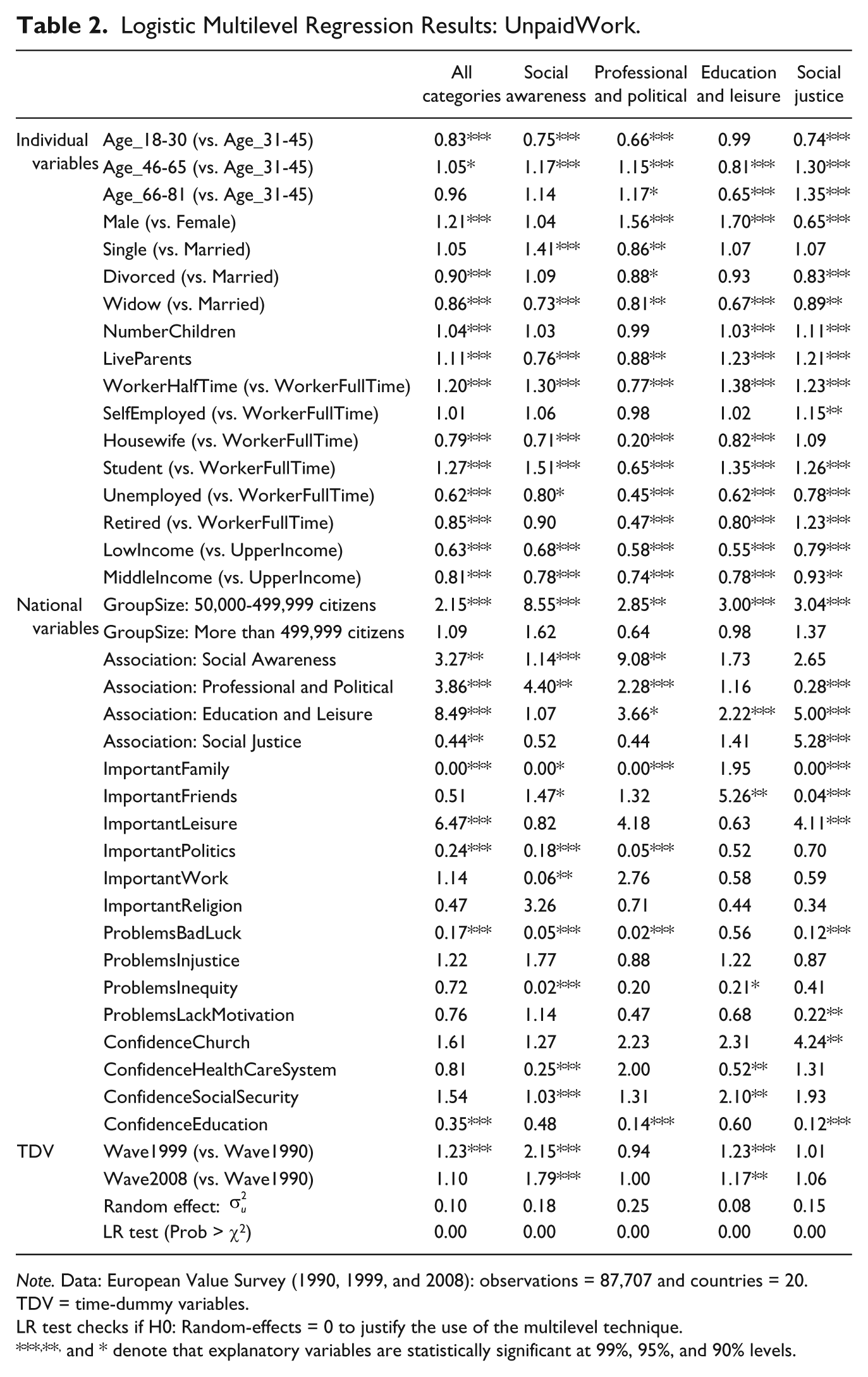
Note. Data: European Value Survey (1990, 1999, and 2008): observations = 87,707 and countries = 20. TDV = time-dummy variables.
LR test checks if H0: Random-effects = 0 to justify the use of the multilevel technique.
**, and * denote that explanatory variables are statistically significant at 99%, 95%, and 90% levels.
Logistic Multilevel Regression Results: UnpaidWork: All Categories.
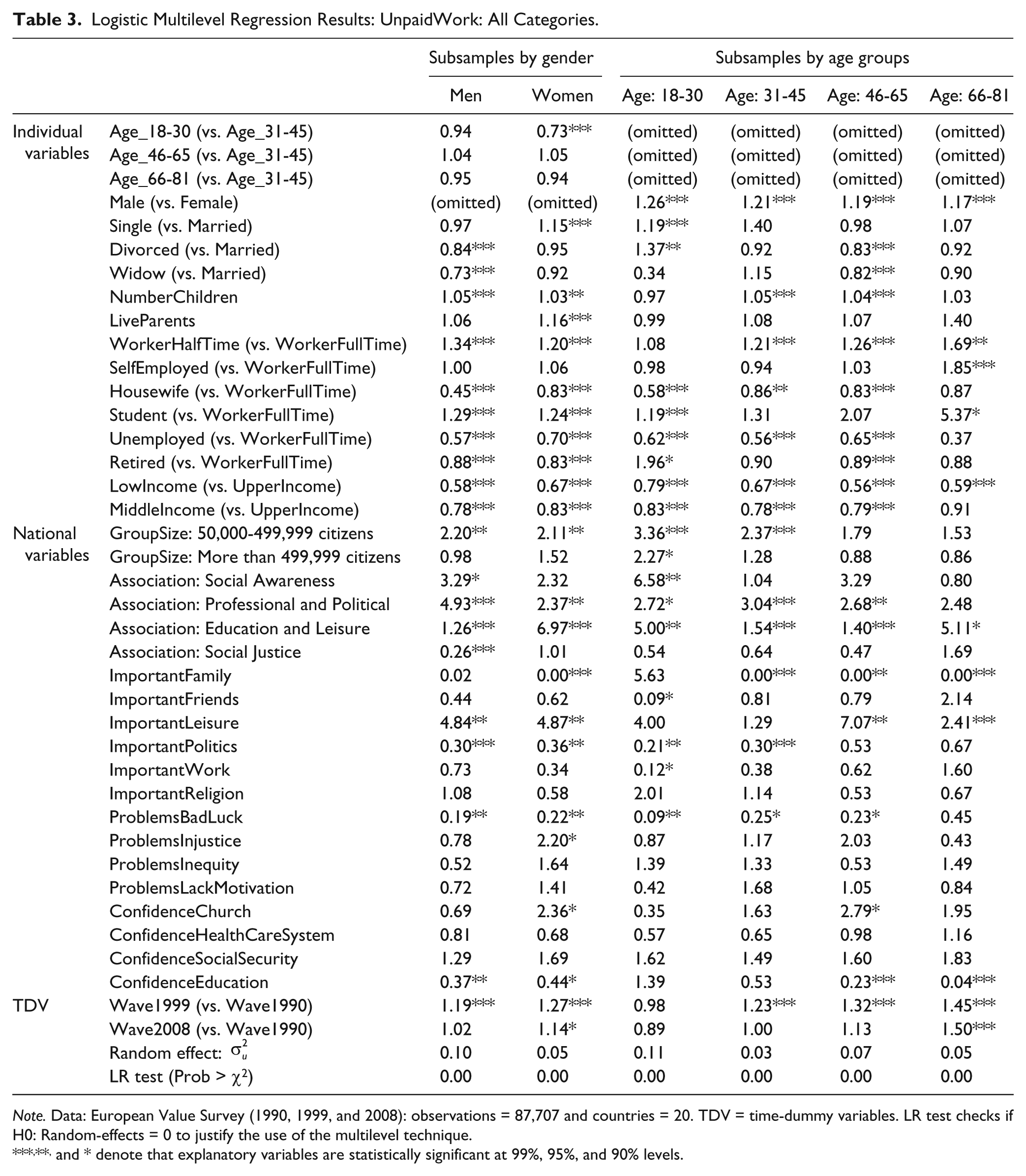
Note. Data: European Value Survey (1990, 1999, and 2008): observations = 87,707 and countries = 20. TDV = time-dummy variables. LR test checks if H0: Random-effects = 0 to justify the use of the multilevel technique.
**, and * denote that explanatory variables are statistically significant at 99%, 95%, and 90% levels.
Our results show that particular categories of voluntary work are more prevalent at different stages of the life cycle. Basic descriptive statistics showed that volunteer distribution by age often has the shape of an inverted U. This result is specially confirmed for social awareness and professional activities. In the case of education and leisure activities, the maximum peak is reached for people aged between 31 and 45, whereas in social awareness and professional activities the maximum peak is reached for people aged between 46 and 65. The empirical evidence of the inverted U is not clear for social justice activities, thus the maximum rate is reached for senior citizens.
Regarding gender differences, men are more likely to volunteer in professional and political activities as well as in education and leisure activities. In contrast, women are more likely to volunteer in social justice activities. Having children or living with parents increases the probability of volunteering in education and leisure activities, as well as social justice activities. Regarding civil status, there are heterogeneous results for different activities, but being single (vs. being married) is negatively correlated with volunteering in professional and political activities and positively correlated with volunteering in social awareness activities. Being divorced (vs. being married) is negatively correlated with social justice and education and leisure activities. Being widowed (vs. being married) is negatively correlated with all kinds of volunteering activities.
Accepting the results with care, due to potential problems of endogeneity and/or unobserved heterogeneity, we emphasize that relative income levels are positively correlated with all kinds of activities, but especially with professional and political activities, as well as with education and leisure activities. Students versus full-time workers are more likely to volunteer in all kinds of activities except for professional and political activities. Retired versus full-time workers are less likely to volunteer in all kinds of activities except for social justice activities. Unemployed versus full-time workers are less likely to volunteer in all kinds of activities.
Time-dummy variables reveal that volunteering rates for all kinds of activities increased from 1990 to 1999 but declined from 1999 to 2008, except for professional and political activities that have a decreasing tendency over time.
According to Table 1, the country-level variance,
The analysis of Table 2 confirms most previous results for individual characteristics. In addition, it provides information on national social backgrounds. The size of communities is an important determinant for individual decisions, thus there is a greater probability of volunteering for all kinds of activities in countries with higher fractions of communities with more than 50,000 citizens but less than 500,000. There are no concluding results for the impact of larger cities. Regarding direct reciprocity, the higher the membership of a nonprofit organization related to each specific activity, the likelier the individual will be to decide to volunteer. Regarding indirect reciprocity, membership of nonprofit organizations related to social awareness reinforces decisions about volunteering in professional and political activities. Membership of nonprofit organizations related to professional and political activities reinforces decisions about volunteering in professional and political activities but discourages decisions about volunteering in social justice activities. Membership of nonprofit organizations related to education and leisure activities reinforces decisions about volunteering in social justice and professional and political activities.
Concerning values, in countries where individuals positively value contact with their friends, their citizens are more likely to volunteer in social awareness and education and leisure activities but less likely to volunteer in social justice activities than in countries where friendship is not as important. Concerning attitudes, individuals are less likely to volunteer in social awareness activities in countries where the majority believe that people are in need due to their lack of motivation.
Regarding the random effect, the variance for the differences between countries remains significant after including social factors, but the intensity of international differences drops. In fact, for the general category, the coefficient reduces to half, and for education and leisure activities it is five times less.
In Table 3 we repeat previous estimations by subsamples of gender and age for the general category of unpaid work. In general, there are no remarkable gender differences. The impact of individual characteristics is pretty similar, in sense and intensity, among men and women. Regarding national social factors their impact is similar in sense, but there might be slight differences in the intensity of the impact. Men are more sensitive to membership rates in social awareness and professional and political activities, whereas women are more sensitive to membership rates in education and leisure activities. In addition, women are more sensitive to the general perception of people in need due to issues of injustice and also to their general confidence in the Church.
Most differences in estimations by age groups concern intensity, but there are also some concerning sense. For example, being divorced is positively correlated with volunteering for people aged between 18 and 30 but negatively correlated for people aged between 46 and 65. In addition, younger generations are more sensitive to reciprocity variables than older generations. People aged between 46 and 65 are more sensitive to the importance allocated to leisure activities and confidence in the Church than other population groups.
Regarding the random effect, the variance for the differences between countries reduces considerably for certain subsample groups (women; age: 31-45 and age: 66-81), but remains steady for the rest.
Discussion
Among our main results we highlight that the volunteer distribution by age often has the shape of an inverted U for volunteering activities on social awareness and professional activities. Regarding gender differences, men are more likely to volunteer in professional and political activities as well as in education and leisure activities. In contrast, women are more likely to volunteer in social justice activities. Relative income levels are positively correlated with all kinds of activities, but especially with professional and political activities, as well as with education and leisure activities. Once included social factors in the estimations, the intensity of international differences drops.
The profile of volunteers for different activities might have little in common because volunteering in political activities is not the same as volunteering in religious groups. In fact, policymakers may care about the development of a volunteering activity for a particular population group. For example, if policymakers seek to encourage volunteering among senior citizens as a strategy to promote active aging, it is important to know that, in principle, senior citizens are more likely to participate in social justice activities than in education and leisure activities. To support volunteering in education and leisure, it might be desirable to encourage the membership of senior citizens in nonprofit organizations related to education and leisure activities, or to emphasize the importance of healthy leisure at these ages.
As our main conclusions, we stress that it is easier to recruit volunteers for education and leisure activities among men aged between 31 and 45, and for social justice activities among women aged 66 or older. People aged between 46 and 65 years old are the most likely to volunteer in social awareness and professional activities. Except for social awareness activities, controlling for socioeconomic conditions does not smooth gender differences. This result suggests that gender roles and attitudes play a more important role in gender differences than socioeconomic characteristics, which explains why gender drop-offs in socioeconomic conditions have associated lower gender drop-offs in volunteering participation rates. In fact, when repeating estimations by gender, we observe that the impact of individual characteristics on the volunteering decision is significantly similar among men and women; only the impact of national social factors shows differences in intensity. For example, men are more sensitive to membership rates for social awareness and professional and political activities, whereas women are more sensitive to membership rates for education and leisure activities.
Volunteering decisions are complex in nature, so a multidimensional and multidisciplinary analysis is necessary to address this topic. The economic approach, based on how individuals make decisions under the paradigms of rationality, must be complemented by the sociological approach, based on how social factors shape individual decisions. For instance, once we introduce social factors, the role of education as a predictor of volunteering work remains meaningful but decreases in intensity.
Previous research has shown that national differences in volunteering participation rates cannot be fully explained by differences in the social, psychological or cultural factors associated with volunteering; therefore, contextual factors, such as a country’s historical and political background, have been used to explain these international gaps (Plagnol & Huppert, 2010). The observed national differences in volunteering rates may stem from differences in the institutional and cultural context (Fiorillo & Nappo, 2014; Wilson, 2012).
Complementarity and substitutability between volunteerism and money donation must be taken into account, as the implications of tax policies in volunteering decisions might be different to the implications in money donation. However, given the diversity of the nonprofit sector, tax policy effects may even vary among different types of organizations (Segal & Weisbrod, 2002). Moreover, tax implications depend on each country’s laws and they establish mechanisms to subsidize and support nonprofit organizations (Toran, 2014). Thus, further research is needed on the interaction of tax policies and volunteerism.
Even if culture is supposed to be an extremely stable construct over time, in a highly dynamic world, cultural patterns can accelerate their evolution (Inglehart & Baker, 2000). Moreover, culture includes several levels ranging from the macro- to the individual dimension (Erez & Gati, 2004). Across cultures, sustained volunteering was associated with self-reported prosocial motivation to volunteer as an antecedent of volunteering (Aydinli et al., 2016). Future analysis should explore the role of culture at an individual level, such as in Chum et al. (2015).
In this article, once we control for national contextual settings, geographical effects are diluted to half, but as in previous literature review, there are still important national differences that are not explained by either individual characteristics or social factors (Gronlünd et al., 2011; Hofstede, 2001). This conclusion opens the door to implementing social policies that could be effective for all countries. For example, the European Union encourages volunteering opportunities for young people across Europe by providing information of the projects and by recognizing their participation and learning with a Youthpass Certificate.
Designing civic education campaigns for children, making the benefits of voluntary work for communities visible, and recognizing voluntary activities by young people could encourage citizens to feel committed to their own and other people’s welfare. For example, volunteer activities might represent a useful instrument for building social networks and enabling students and the unemployed to gain professional experience.
The main goal of this article is to describe socioeconomic factors as possible determinants of volunteering decisions. We have taken into account different countries with different levels of development for the time period 1990-2008, thus the coefficient estimations might keep robust for precedent years. For future research, it might be interesting to include data after 2008 to study national trends in the percentages of volunteers.
Footnotes
Appendix
National Rates of Volunteers (2008).
| All categories | Social awareness | Professional and political | Education and leisure | Social justice | |
|---|---|---|---|---|---|
| Netherlands | 46% | 11% | 7% | 27% | 25% |
| Finland | 35% | 5% | 10% | 18% | 15% |
| Belgium | 32% | 5% | 5% | 20% | 12% |
| Ireland | 30% | 6% | 4% | 13% | 21% |
| Slovenia | 29% | 6% | 8% | 17% | 13% |
| Iceland | 28% | 4% | 6% | 16% | 13% |
| Sweden | 26% | 5% | 5% | 16% | 11% |
| Austria | 25% | 4% | 5% | 12% | 13% |
| Czech Republic | 24% | 5% | 5% | 15% | 9% |
| Estonia | 22% | 4% | 6% | 13% | 9% |
| France | 22% | 4% | 4% | 13% | 8% |
| Germany | 21% | 2% | 3% | 12% | 9% |
| United Kingdom | 20% | 4% | 1% | 9% | 11% |
| Lithuania | 15% | 4% | 4% | 6% | 5% |
| Romania | 13% | 3% | 4% | 4% | 8% |
| Spain | 13% | 2% | 2% | 4% | 6% |
| Bulgaria | 12% | 2% | 6% | 6% | 3% |
| Hungary | 11% | 1% | 2% | 6% | 4% |
| Portugal | 11% | 4% | 4% | 5% | 7% |
| Poland | 7% | 1% | 2% | 2% | 3% |
Note. Data: European Value Survey (2008).
Declaration of Conflicting Interests
The author(s) declared the following potential conflicts of interest with respect to the research, authorship, and/or publication of this article.
Funding
The author(s) disclosed receipt of the following financial support for the research, authorship, and/or publication of this article: The authors are grateful for the financial support by the European Social Fund and Aragonese Regional Government for this research.