



Abstract
How do modernizing social changes affect suicide risks for youths in small economically developing societies? Since Durkheim, social researchers have hypothesized that processes of social disintegration and processes of normative cultural disequilibrium can increase suicide rates. A lifestyle incongruity hypothesis has also been proposed. This article tests these competing hypotheses for the epidemic of suicide that occurred on culturally diverse communities of the Pacific Islands of Micronesia. The sample includes 74 municipalities of the Federated States of Micronesia. Multiple regression analyses suggest that the best analytic model includes the degree of urbanization, the levels of social integration, and the incongruity between modern economic resources and achieved modern material lifestyle. These results suggest that researchers should attend more to the way communities aspire to and participate in global markets as opposed to shifting adult role structures and occupations as a site for understanding the relationship between rapid social change and suicide.
The effects of modernizing social change on the well-being of indigenous people have been of enduring concern in the social sciences (Durkheim, 1951; Kohrt, Mendenhall, & Patel, 2015). How psychosocial well-being is harmed by social change that creates uneven social inclusion of older youths and young adults has been a major focus of this research. These include increased risk of peer-violence and victimization, social exclusion and delinquency, drug and alcohol abuse, and suicide (Desjarlais, Eisenberg, Good, & Kleinman, 1996).
Youth suicide on Fiji, Samoa, and several island groups of Micronesia in Pacific Islands regions have been recognized as particularly worrisome (Booth, 1999a; Bowles, 1985, 1995; Haynes, 1984; Hezel, 1987; Lowe, 2003; Macpherson & Macpherson, 1987; Rubinstein, 1983, 2002). Of these, the well-documented Micronesian suicide epidemic warrants attention. Suicide rates in Micronesia skyrocketed in near lockstep with a focused economic modernization program initiated by the United States beginning in the early 1960s in preparation for nominal political independence from its United Nations Trusteeship—finally realized in the late 1980s (Booth, 1999a; Hezel, 1987; Lowe, 2016; Rubinstein, 1983). Suicide rates were particularly high among young men (Booth, 1999a; Rubinstein, 1983). Although the overall suicide rates across the Micronesian region peaked in the early 1980s, they remained elevated well above global averages well into the 2000s (Lowe, 2016).
There are several competing theoretical explanations for these high rates of youth suicide (Booth, 1999a; Hezel, 1987; Macpherson & Macpherson, 1987; McDade & Worthman, 2004; Rubinstein, 1992). Many of these reflect those developed to explain the relationship between modernizing social change and worsened mental health in 19th century European societies, particularly as they are organized and articulated in Durkheim’s (1951) seminal work on the topic, Le Suicide. Following Durkheim (1951), these theories claim that either some form of social disintegration or normative social-cultural disequilibrium explains why rapid social change might lead to increased suicide rates. Social disintegration involves the reduction of the importance of extended kin-groups in the organization of everyday life as the activities once organized by kin-groups are displaced by involvement in modern, formal institutions such as the school, the state, and the market, leading to lower levels of social support and increased egoism in society. Egoism here is not a psychological state of “ego-centeredness,” but is defined by Durkheim (1951) as a social condition reflecting low levels of a society’s members’ integration into larger collective institutions such as the kin-group or religious organizations. Social-cultural disequilibrium occurs when a society’s cultural norms, values, and aspirations no longer adequately regulate individuals’ expectations for the level of reward they can reasonably expect through locally available opportunities for meaningful social and economic participation, producing a state of increased anomie among a society’s members. Lower levels of social inclusion and social capital and increased anomie because of sudden social and economic disruptions are regularly found to raise the suicide rates in affected communities (e.g., DeFina & Hannon, 2015).
What is left underappreciated in these classical Durkheimian views is the way movement, travel, and intercommunity interaction and exchange have always been a part of the social life of human communities leading to features of social life in human communities that come to be crosscut in complex ways (Abu-Lughod, 1991; Appadurai, 1988, 1996). Given these critiques, many contemporary explanations of the impacts of social change on psychosocial well-being focus on globalization and how it can produce sites of social-cultural disequilibria that can also worsen mental health vulnerabilities (e.g., Arnett, 2002; Booth, 1999b; McDade & Worthman, 2004; Schlegel, 1995). These globalization-oriented theories emphasize the importance of the flow of new ideas and new aspirations for valued adult identities and careers, particularly as these are articulated through modern schooling and the media. These may come into conflict with local expectations for adult identity pursuits that parents and local community leaders prefer, which are the emphasis of socialization experiences in the household or the village. When these two sites of youth socialization are discordant (i.e., the global and the local), increased psychosocial stress, intergenerational conflict, and declining mental health may be the result (Arnett, 2002; McDade & Worthman, 2004).
Globalization is also about the movement of goods and of ideas about how the possession and consumption of those goods symbolize the achievement of modern lifestyles. These explanations suggest that in rapidly modernizing non-Western societies, it is often the discrepancy between globalizing forms of modern social and economic achievements and the realization of a material lifestyle that is the source of increased rates of psychosocial stress and associated mental health problems like suicide (McDade, 2001). As a formal theory, William Dressler and colleagues have proposed the “lifestyle incongruity” hypothesis, where psychosocial stress is an expected outcome of the incongruity between an achieved material lifestyle and one’s social and economic achievements such as levels of education, occupational prestige, and income (Bindon, Knight, Dressler, & Crews, 1997; Dressler, 1995).
Several studies have described the epidemiological patterns for suicide in Micronesia (Booth, 1999b, 2010; Hezel, 1987; Rubinstein, 1983, 2002). These have also included several speculative explanations along the lines of the general theories summarized above for how modernizing social change contributes to the increased rates of suicide across the region. However, there has not been an empirical test of how well these competing theories explain variations in suicide rates in Micronesia. Given the differences among them, particularly with regard to the social-cultural disequilibria hypotheses, and their implications for how people think about the potential risk associated with modernizing social change and policies and programs that might effectively address them in small-scale societies like those of Micronesia, it is important to have greater clarity as to which of these theories might sufficiently account for variation of suicide rates in rapidly changing regions like Micronesia. A test of these competing theories of social and cultural change is particularly warranted given that the suicide epidemic in Micronesia is not related to differential access to new lethal means of attempting suicide such as has been reported regarding the importation of the herbicide Paraquat in the case of a suicide epidemic in Samoa in the 1970s and 1980s (Bowles, 1995). In the Micronesian case, suicides are overwhelmingly the result of death by anoxia, a result of leaning into a rope tied around the neck, suggesting that the means are widely available in the region (Rubinstein, 1983).
Conceptual Framework and Hypotheses
Given the preceding, this research report presents the results of an empirical study of three competing hypothetical explanations for suicide risk for 74 municipalities of the Federated States of Micronesia (FSM). All analytical models tested below include a measure for the social disintegration hypothesis, but differ regarding different disequilibrium hypotheses. These disequilibrium hypotheses include (a) the traditional anomie hypothesis, (b) the socialization ambiguity hypothesis, and (c) the lifestyle incongruity hypothesis. I will now briefly describe each of these hypotheses.
The Social Disintegration Hypothesis
The social disintegration hypothesis claims that the suicide epidemics in Micronesia reflect a decline of kin-based and community institutions since the 1960s (Booth, 2010; Hezel, 1987; Marsella, Austin, & Grant, 2005; Rubinstein, 1983, 2002). Economic modernization, particularly the shift from a subsistence-based to a wage-based economy, has led to the reduction of the role kin-based lineages once played in community life and youths socialization (Booth, 2010; Hezel, 1987; Rubinstein, 1983, 2002). As the extended kin-group declined, the authority of household heads increased, leading to increased intergenerational tensions that so often precede suicide attempts. It is both the loss of important socialization supports in the extended family lineages and increased intergenerational stress and conflict within youths’ natal families that is believed to have contributed to the suicide epidemic in Micronesia and elsewhere in the Pacific.
Normative Social-Cultural Disequilibria Hypotheses
Although social disintegration has been the favored explanation in the Micronesian scholarship, studies of suicide epidemics elsewhere in Oceania have favored social-cultural disequilibrium hypotheses (Macpherson & Macpherson, 1987; Rubinstein, 1992). There are three hypotheses for social-cultural disequilibrium that one can derive from the literature.
Traditional anomie hypothesis
The traditional anomie hypothesis claims that young people’s increasing exposure to modern values and career aspirations through Western schooling, international travel and migration, and global media is at odds with the slow pace of economic development and rapid population growth that limits youths’ opportunities for the realization of these values and aspirations (Booth, 1999b, 2010; Macpherson & Macpherson, 1987; O’Meara, 1990; Schlegel, 1995). Increased suicide risk in the traditional anomie hypothesis is often explained with reference to youths’ rising aspirations for obtaining formal employment in any number of globally valued modern occupations. These aspirations are fostered through youths’ increasing participation in formal schooling, consumption of global media, and/or travel to regional metropolitan centers. But, low levels of economic development in their home communities and limited opportunities to migrate to find work severely limit their opportunities to realize their modern career aspirations, leading to frustration with their life chances. As these youths remain largely dependent on their families for support as opposed to establishing their own financial independence and autonomous adult identity, these frustrations can feed into increased levels of family conflict, which often precipitate suicide attempts (Macpherson & Macpherson, 1987). These pressures are expected to be particularly difficult for male youths whose valued modern identity formations are tied to formal employment and the achievement of local political status that an expanding economy and less demographically competitive environment would otherwise afford (Booth, 1999b; Macpherson & Macpherson, 1987; Schlegel, 1995). Some argue that young women are less vulnerable because status achievement through marriage and childbearing remains available (Schlegel, 1995).
Socialization ambiguity hypothesis
The second disequilibrium hypothesis is discussed by McDade and Worthman (2004; also Arnett, 2002; Arnett-Jensen, 2011; Hollan, 1990) who claim that societies undergoing modernizing social change expose youths to two cultural worlds: one where traditional families—often in subsistence-oriented households—emphasize enduring, local norms, values, and career aspirations and another where modern schools, travel, and media emphasize modern global norms, values, and aspirations. Youths caught between these worlds might suffer increased psychosocial distress placing them at risk for suicidal behavior. This increased risk occurs because these youths may struggle with ambiguities and confusion between the different values emphasized in these divergent contexts of socialization (Arnett-Jensen, 2011). Young women might be particularly vulnerable to socialization ambiguity in certain contexts. For example, Booth (1999b) argued that young women are more vulnerable in contexts where their participation in global institutions and flows (e.g., school and media) influence their aspirations to achieve a modern identity through education and formal employment, but local attachment to more traditional practices among older adults insist on these more traditional pathways into adulthood like marriage and child-rearing. This form of socialization ambiguity has been suggested as an explanation for the relatively higher rates of suicide among young women in Samoa and Fijian Indians.
Communities where such socialization ambiguity might be particularly prominent could be in near-urban communities (e.g., rural communities with relatively easy access to the local port towns) where families may be more dependent on traditional subsistence gardening and fishing while also placing greater value on schooling and access to nearby urban markets. In one comparative study of Micronesian suicide rates, near-urban communities had slightly higher suicide rates than urban centers or outlying rural atolls (Rubinstein, 1983). In Samoa, McDade and Worthman (2004) found that adolescents who lived in semirural villages near the urban center of Apia and in households high in ratings of socialization ambiguity had the highest levels of embodied psychosocial stress. The connection between subsistence gardening and fishing and adherence to enduring local values may seem tenuous to some readers, as one reviewer noted. However, ample ethnographic research in Micronesia and Samoa documents that traditional forms of kinship, political authority, and the values that are associated with these are strongly tied to the ownership and control over land and reef resources upon which subsistence gardening and fishing depends (Alkire, 1989; Flinn, 1992; O’Meara, 1990; Petersen, 2009). These studies in Micronesia show that higher levels of reliance on subsistence gardening and fishing for everyday household production is associated with greater emphasis on maintaining local traditions and values, including in the domain of child and adolescent socialization practices (Flinn, 1992).
Lifestyle incongruity hypothesis
The third disequilibrium hypothesis is the modern lifestyle incongruity hypothesis (Bindon et al., 1997). Both the traditional anomic hypothesis and the socialization ambiguity hypothesis emphasize the importance of adult identity formation and the ability of members of a community to find rewarding pathways to valued adult roles in their largely hybridized, global-local island societies. An alternative to these functionalist approaches draws inspiration from the economic sociology of Thorstein Veblen (1994) and Max Weber (1946), who emphasized how patterns of conspicuous consumption of fashionable commodities and finished products become an important indicator of achieved social-economic status in modern and modernizing societies, where achieved social-economic status is indicated by economic resources such as the levels of formal education, the type of occupation, and the level of cash income. The material style of life is defined as the capacity to participate in material consumption practices that indicate a collectively shared understanding of what a status-enhancing modern style of life looks like within the global economic system.
Dressler and Bindon (2000) have proposed in the lifestyle incongruity hypothesis that increased psychophysiological distress and psychosocial conflict result from the moderating role that the acquisition of a valued, status-conferring material lifestyle has on the benefits conferred from the achieved level of economic resources (Dressler & Bindon, 2000; Bindon et al., 1997). In other words, psychophysiological distress and psychosocial conflict increases when a realized material style of life is incongruous with achieved levels of economic resources. Such incongruity can work both ways. It does not matter, theoretically, whether level of material style of life greatly exceeds the levels of the achievement of economic resources, or the level of economic resources greatly exceeds the level of material style of life. Both situations are potentially stress inducing. The lifestyle incongruity hypothesis broadens the notion of culture beyond the symbolic contents of other disequilibria hypotheses, as it includes norms, values, and aspirations and adds realized capacities, such as educational achievement, occupational prestige, and income together with the acquisition of modern forms of material culture and their associated lifestyles (Bindon et al., 1997).
This approach resonates strongly with ethnographic observations of social change in Micronesia that document how the sudden influx of United States dollars starting in the late 1960s led to a conspicuous display and exchange of both imported foods and finished products at important lineage and interlineage-level feasting events, competitive house building, church building, and the construction of lineage and village meeting houses (Carucci, 1997; Flinn, 2010; Lowe, 2003; Marshall, 1979). These are in addition to increased acquisition of highly valued finished products such as televisions (TVs), radios and music players, gasoline generators, fiberglass motorboats, and automobiles. These observations suggest that changing material lifestyles and the competitive interfamily and interlineage display and exchange of these goods might have played some role in increasing psychosocial stress, family, conflict, and suicide risk in the region (Lowe, 2003; Weisner & Lowe, 2004). But, according to the lifestyle incongruity hypothesis, these deleterious outcomes are only likely in the context of levels of material acquisition that are incongruous with the levels of economic resources achievements in the community. In communities where the levels between material lifestyle and economic resources are in balance, these problems would be less likely.
In a study of Samoan adults, Bindon et al. (1997) examined the effect of the incongruity between a modern lifestyle (e.g., Western house size and building materials, possession of household appliances, a car, modern electronic devices, and foreign travel and Western media consumption) and the achievement of modern economic resources (e.g., education, occupation, and income) on levels of psychophysiological stress. They found that members of households where lifestyle incongruity was high tended to have higher levels of stress, particularly for men. McDade (2001) studied the effect of lifestyle incongruity on a measure of psychosocial stress for Samoan adolescents and found that lifestyle incongruity was associated with increased psychosocial stress, particularly for adolescents with a high degree of integration into their families and kin-groups.
Study Aims
Again, several alternative hypotheses exist to explain suicide epidemics that have occurred in association with rapid modernizing social change in Micronesia and elsewhere in Oceania. Although the epidemiological patterns for these suicide epidemics have been well-documented, there have been no rigorous empirical tests of which of these alternative approaches might best explain the variation in suicide rates in any of the affected regions. Therefore, this study seeks to assess the additive effect of measures of social disintegration and measures for each of the three hypotheses for social disequilibrium (i.e., traditional anomie, socialization ambiguity, and lifestyle incongruity) on the variation in suicide rates among the municipalities of the FSM. These three analytical models are graphically represented by Figure 1 for added clarity.
Given the findings of previous studies and theoretical explanations reviewed above, there are several hypotheses that this research will test:
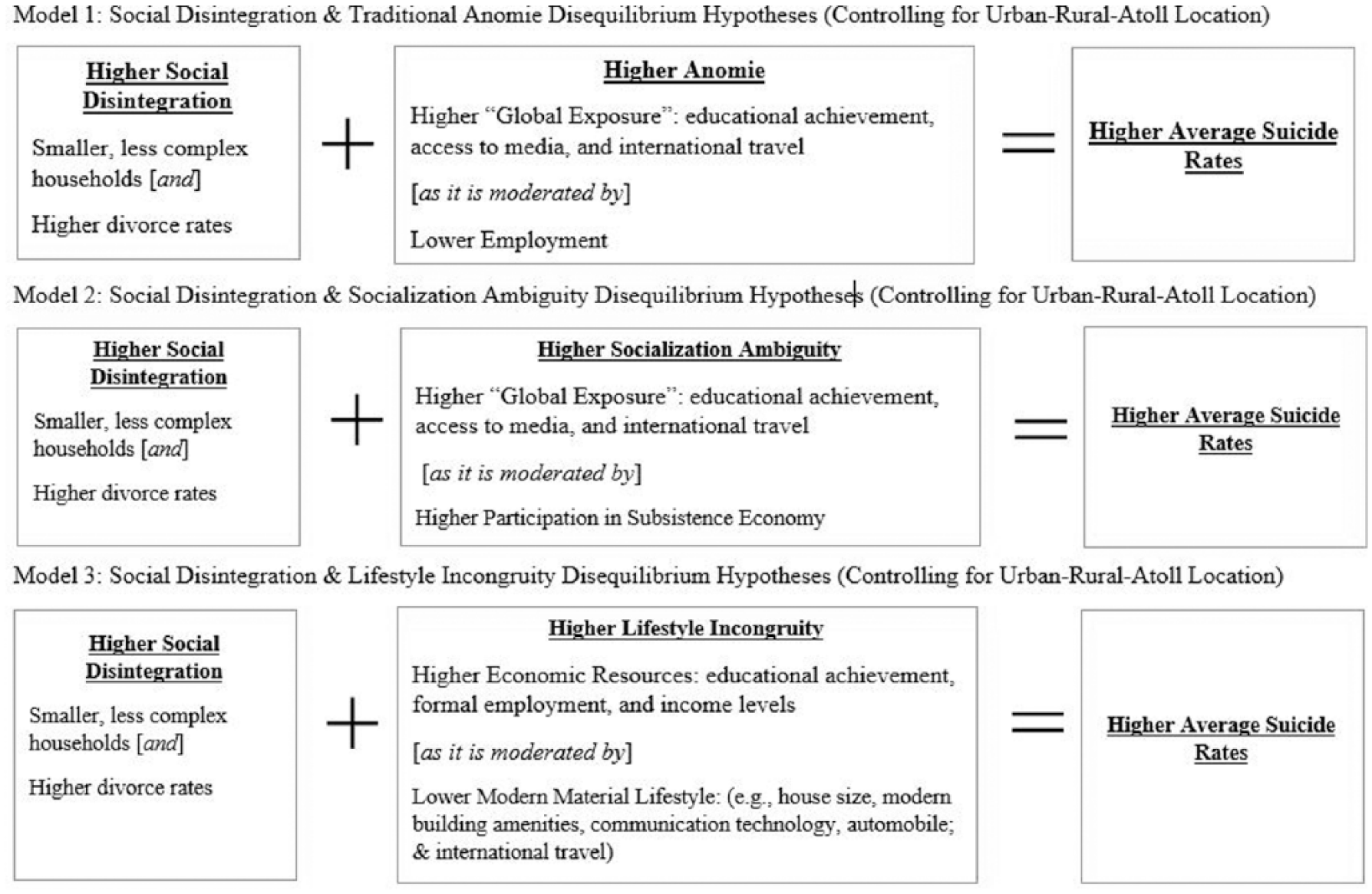
Graphic representation of the three analytical models and the variables for each construct.
Method
Regional Background and Data Sources
The FSM consists of 607 islands that vary between small- and medium-sized high volcanic islands, continental shelf islands to the west, and low-lying atolls. The FSM consists of four states organized around the high, mountainous islands where the commercial and administrative centers have been located since the era of United States direct administration of the islands as a United Nations mandated Trust Territory (1947-1986) and the nearby inhabited atolls. These states are Yap State, Chuuk State, Pohnpei State, and Kosrae State (FSM Division of Statistics, 2002). These four states are further organized into 75 island or island subdivision municipalities. In 2000, 107,800 individuals and in 2010 about 102,600 lived in the FSM (FSM Division of Statistics, 2002, 2012).
The FSM presents an appropriate test case for the different hypotheses for modernizing social change and suicide risk for many reasons. First, the rapid increase in suicide rates from the late 1960s—before leveling off through the 1980s—is well-documented and the association between the suicide epidemic and a program of rapid modernization of the region by the United States is well-known. On the contrary, there is considerable variation in suicide rates and the various indicators of modernizing social change across the 75 widely dispersed island municipalities of the FSM. This variation among so many geographically and culturally distinct entities provides a unique opportunity to use robust statistical procedures to test some of the explanations for suicide in the region.
The Micronesian Seminar provided access suicide case data for the entire FSM. These data have been collected by periodic cultural-epidemiological surveys in the municipalities of the FSM, the Marshall Islands, and the Republic of Palau since the late 1970s (see Rubinstein, 1983, for a description of an early wave of data collection), and were most recently updated by a community survey in late 2007 (Francis X. Hezel, personal communication, July 2008). These data are based on reports of completed suicides in each village or municipality, regardless of whether there is a death certificate in the state hospitals for the case. Although it is impossible to know whether some cases have been missed in the periodic community surveys, these data are believed to be valid and have been used in several published reports over the years (Booth, 1999b; Hezel, 1987, 1989; Rubinstein, 1983).
Data concerning several relevant demographic, economic, housing, and social variables for the 75 island municipalities in the FSM are available through the published reports of the federal and state periodic censuses. The most recent year for which municipal-level data are available is from the 2000 FSM Census, which was collaboratively undertaken by the FSM and the U.S. Bureau of the Census (FSM Division of Statistics, 2002). To assess the reliability of these data, the indicators used in this analysis from the 2000 FSM census were compared with those that were available from an earlier census of Chuuk State. The two data sources were found to be strongly intercorrelated.
Measures
Suicide Risk
As the incidence of suicide can be quite sporadic in small communities, a 10-year average suicide risk score was used as a measure of the 10-year average suicide rate for a municipality. The averaging process levels out these sharp interannual differences for a single municipality. As the overall average rate of suicide during this period was relatively flat across the decade, the 10-year average suicide rate for each municipality was calculated first by summing the number of suicides reported in the Micronesian Seminar data for each year between 1990 and 1999. Then dividing this number by the estimate for the population in the municipality for that year, based on the municipal population in the 2000 report, and adjusting for the rate of population change since the last published census of the municipality that was conducted in 1994. These were multiplied by 100,000 to get a standardized annual suicide rate per 100,000. Finally, an average was calculated of these 10 suicide rates as a final measure.
Geographic Controls
Three dummy variables were created indicating whether the municipality was part of an urban port town on Yap, Chuuk Lagoon, Pohnpei, or Kosrae, a rural municipality near the port town, or on an outlying atoll municipality, often hundreds of miles from the port towns. These outlying atolls are not economically isolated from global trade flows, but they are remote. Large trade ships visit the atolls every month or so, and there is regular movement of residents from these atolls to the port towns and then to wider destinations outside of the FSM (Marshall, 2004). Nevertheless, they still rely heavily on a mix of subsistence and cash-based economic activities.
Measures of Social Integration
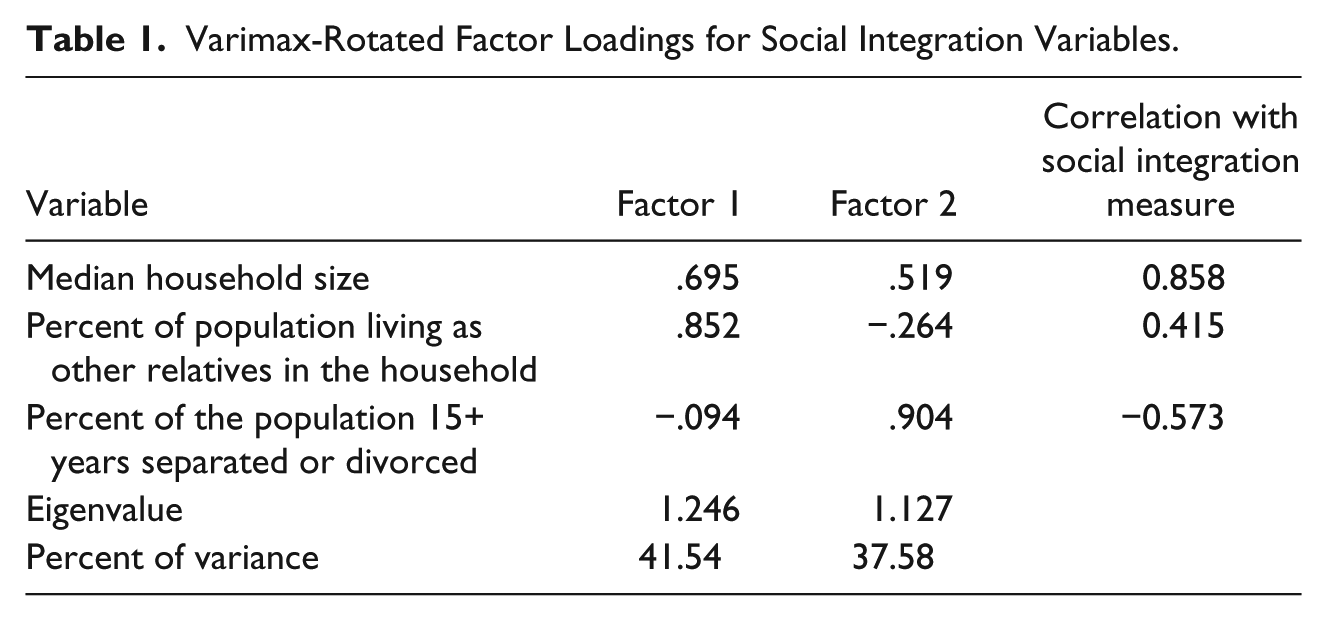
As the literature on social integration cited above emphasizes the growing primacy of the nuclear family and increased family conflict as consequences of recent modernizing economic changes in Micronesia, a measure of kin-based social integration of the kin-group within a municipality was calculated by first conducting a principal components analysis of three separate indicators: (a) the median household size for each municipality, (b) the percent of the population living as “other relatives” in these households, and (c) the percent of the population 15 years or older who were not divorced or separated at the time of the census. Other relatives in households included individuals who were relatives but not spouses, children, parents, or nonrelatives of the householder. Rotated factor scores for each municipality were calculated using the regression method. The final social integration of the kin-group variable was created by summing the scores for each factor (see Bindon et al., 1997). Table 1 shows the results of the principal components analysis and the correlation of the original three variables with the final, created variable. The correlations indicate that a high value on this measure would indicate larger households, with a greater percent of other relatives living in households, and lower rates of divorce or separation in the adult population, in other words, higher levels of social integration of the extended kin-group.
Varimax-Rotated Factor Loadings for Social Integration Variables.
Measures of Social Disequilibrium
For the traditional anomie hypothesis, the predictors involve a measure of exposure to global values, norms, and aspirations, labeled “global exposure” (McDade & Worthman, 2004) and a measure of unemployment. For the socialization ambiguity hypothesis, predictors include global exposure and the level of subsistence employment in the municipality, if a high reliance on the subsistence economy is an indicator of the level of adherence to local, more enduring norms, values, and aspirations among a municipality’s residents. Finally, for the material lifestyle incongruity hypothesis, measures of the level of economic resources for a municipality’s residents and a measure of the level of a modern material lifestyle were developed.
Global exposure
The level of global exposure for municipal residents was calculated using a principal components analysis of three items: (a) the percent of adults 25 years and older that graduated from high school, (b) the percent of households with a TV and/or a VCR, and (c) the percent of residents who had previously lived outside of the FSM. All three variables load highly on the first factor solution (range .82 and .875) and 75% of the variance is accounted for in the first factor. Factor scores for each municipality were calculated using the regression method. A higher score represents greater levels of global exposure.
Unemployment
The level of unemployment was taken from the FSM 2000 census for each municipality (FSM Division of Statistics, 2002). The unemployment measure represents the percent of municipal residents aged 15 years and older who were part of the labor force but did not work either full- or part-time at a job or a business, agricultural, or fishing occupation or as a subsistence worker at any time in the week prior to the census.
Subsistence economy
The measure of the level of reliance on the subsistence economy in each municipality consisted of the percent of the municipal labor force 15 years and older who were engaged in agricultural or fishing labor for subsistence purposes only.
Economic resources
The economic resources measure for each municipality was constructed using a principal components analysis of three indicators (first factor eigenvalue = 1.88, 62.5% of the variance). These indicators (and their first factor loadings) are the percent of resident adults 25 years and older that graduated from high school (.76), the percent of adults 15 years and older working in formal employment (.71), and the median household income (.89). Regression scores for each municipality were saved. A higher score on this measure indicates a higher level of modern economic resources.
Modern material lifestyle
Following Bindon et al. (1997), the modern style of life for each municipality was measured by constructing a nine-item scale using principal components analysis (first factor eigenvalue = 6.14, 68.0% of variance). The indicators used (with first factor loadings) include the percent of households that had updated housing with more than one room (.59), indoor cooking facilities (.88), piped water (.89), flush toilets (.70), and a bath/shower (.76); owned modern technological commodities such as a telephone/CB radio (.91), TV/VCR (.92), an automobile (.93); and the percent of residents who had lived outside of the FSM (.79). Regression scores for each municipality were saved. A higher score indicates a higher level of a modern material lifestyle for the households of the municipality.
Analytic Approach
Three stepwise moderated multiple regressions were used to assess which of the three analytic models offers a better empirical explanation for the variation in average suicide rates across the FSM municipalities. The first regression tested the combined effects of the social disintegration and the traditional anomie hypotheses, the second tested the combined effects of the social disintegration and the socialization ambiguity hypotheses, and the third tested the combined effects of the social disintegration and the lifestyle incongruity hypotheses. In the first step of each regression model, separate binary dummy variables for near-urban or outlying municipalities were entered with urban as the comparison group. Second, the kin-group integration variable was entered. Finally, two main-effects measures for the social disequilibrium hypotheses were entered in addition to an interaction variable. All the social disequilibria hypotheses suggest that it is the interaction of two predictors that determine suicide risk for Pacific Islander communities, with the first variable in the regression model being moderated by the second. Therefore, the key test of each of these hypotheses is not whether there are main effects for each social disequilibrium predictor, but whether the interaction terms significantly predict the average suicide rates and whether the interaction effect meets the standard for tests of moderation (Baron & Kenny, 1986).
To test the traditional anomie hypothesis, the predictors used were the measure of global exposure and the z-standardized scores for unemployment. The interaction term was the product of global exposure and the inverse of the z-standardized unemployment measure, with global exposure assumed to be the focal predictor and unemployment the moderator. To test the socialization ambiguity hypothesis, the predictors used were the level of global exposure and the z score for subsistence employment. The interaction term was the product of the measure of global exposure and the z-standardized subsistence employment measure, with the global exposure being the focal variable and subsistence employment the moderator. To test the lifestyle incongruity hypothesis, the predictors used were the economic resources measure and the modern material lifestyle measure. The interaction term was the product of economic resources and the inverse of the modern material lifestyle measure.
The final analysis is based on a sample of 74 of the 75 municipalities of the FSM (99%). Residual analysis identified one case, Elato Atoll in Yap State, as an outlier in all three multiple regression models (i.e., having a standardized residual value greater than 3). This case was removed, and the final analyses of 74 cases are reported here. Assuming an anticipated effect size of f2 = .22 (f2 = .23 is observed in the full regression models), a statistical power level of 0.8, five predictors plus the interaction term, and a probability level of .05, a sample size of 69 is minimally adequate for these multiple regression models.
To assess which of these analytic models were better explanations of the variation in the average rates of suicide, two main empirical criteria were used. The first criterion is whether the overall amount of variance explained by the overall model, as indicated by R2, is significant. The second is whether the interaction term is significantly associated with the dependent variable. If the second criterion is met, a test of moderation (Baron & Kenny, 1986; Kenny, Kashy, & Bolger, 1998) is indicated as a final check. In the test for moderation, a four-step multiple regression is used, where the interaction term is entered as the fourth-step. The change in the R2 is examined from the third-step to the fourth-step to see if the interaction term captures a sizable portion of the variance, as indicated by a significant increase in the value of the R2 between the third- and fourth-step of the regression. In addition, the change in the value of the correlation of the main-effect variable (e.g., the Beta for economic resources in the status incongruity measure) to the dependent variable is examined. If that correlation is reduced to zero when the interaction term is entered into the regression, then the effect of the main-effect variable is said to be entirely moderated by its interaction with the moderating variable (e.g., the moderation of the modern material lifestyle measure on the effect of economic resources on average suicide rates in the status incongruity measure).
Results
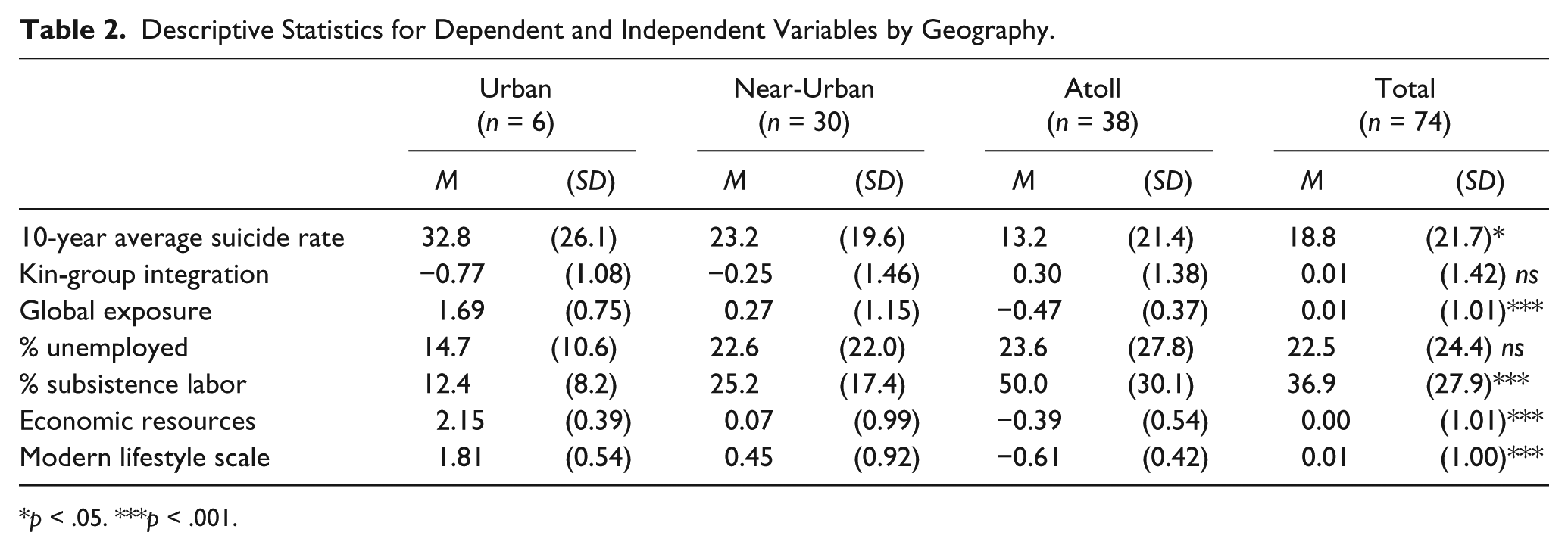
Table 2 reports the bivariate associations between the three geographic municipality types (urban, near-urban, and outlying atolls) and both the dependent variable (10-year average suicide rates) and the independent variables. Average suicide rates statistically differ between these geographic types, with the highest rates, on average, in the urban municipalities (M = 32.8, SD = 26.1) followed by the near-urban municipalities (M = 23.2, SD = 19.6). The lowest 10-year average rate, on average, is in the outlying rural atolls (M = 18.8, SD = 21.7). These differences are significant, F(2, 71) = 3.34, p = .04.
Descriptive Statistics for Dependent and Independent Variables by Geography.
p < .05. ***p < .001.
Although the mean differences in the levels of kin-group integration do differ in an expected direction, with the lowest mean level in the urban municipalities and the highest in the atoll municipalities, the overall distributions do not differ significantly between these three geographic types.
Among the remaining independent variables, global exposure, percent engaged in subsistence labor, level of economic resources, and modern lifestyle scale all vary significantly (p < .001) in terms of their distribution among the urban, near-urban, and outlying atolls. All except for the percent of subsistence labor are highest in the urban municipalities, followed by the near-urban, and the lowest in the outlying atolls. The pattern for subsistence labor runs in the opposite direction. Taken together, these show that the level of economic modernization of the local economies, the labor force, and the patterns of material lifestyle consumption run in an expected direction from the urban municipalities, to the near-urban, and on to the outlying atolls. As those who only engage in subsistence labor are considered employed, the percent unemployed is not significantly different from the urban, the near-urban, and the atoll municipalities.
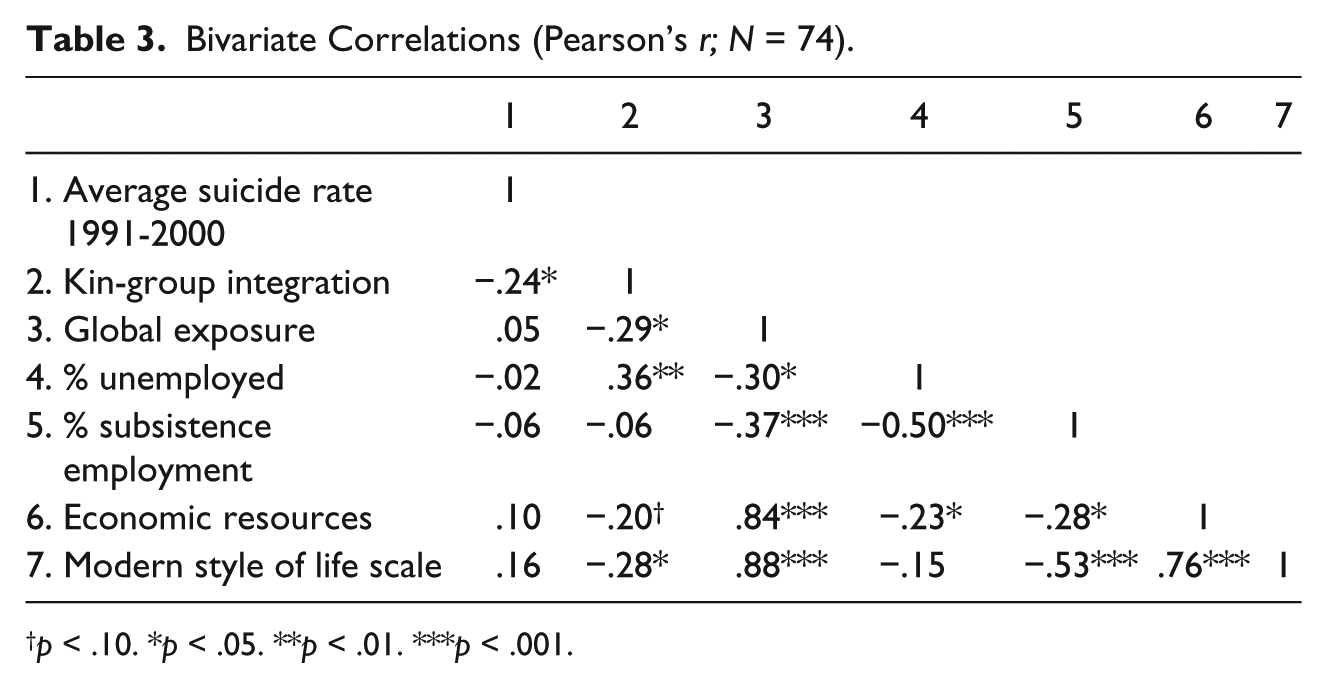
Table 3 reports the bivariate Pearson’s r correlations for the continuous measures. As is predicted by the social disintegration hypothesis, there is a modest negative zero-order correlation between the level of kin-group integration and average suicide rates, r(74) = −.24, p = .04. There are no significant correlations between the other independent variables and average suicide rates. This is theoretically expected, as the moderating effect of one independent variable on the other is understood to be significantly associated with suicide in the three social disequilibria hypotheses discussed above.
Bivariate Correlations (Pearson’s r; N = 74).
p < .10. *p < .05. **p < .01. ***p < .001.
The measures of economic modernization (global exposure, economic resources, and modern material lifestyle) are all strongly and significantly correlated, p < .001. The measure of kin-group integration is moderately negatively correlated with global exposure, r(74) = −.29, p < .05; unemployment, r(74) = −.35, p < .01; and the modern material lifestyle, r(74) = −.28, p < .05. Finally, the measure of subsistence employment is moderately negatively associated with global exposure, r(74) = −.35, p < .01; unemployment, r(74) = −.50, p < .001; economic resources r(74) = −.23, p < .05; and the modern material lifestyle r(74) = −.53, p < .001. Subsistence employment and kin-group integration are not correlated.
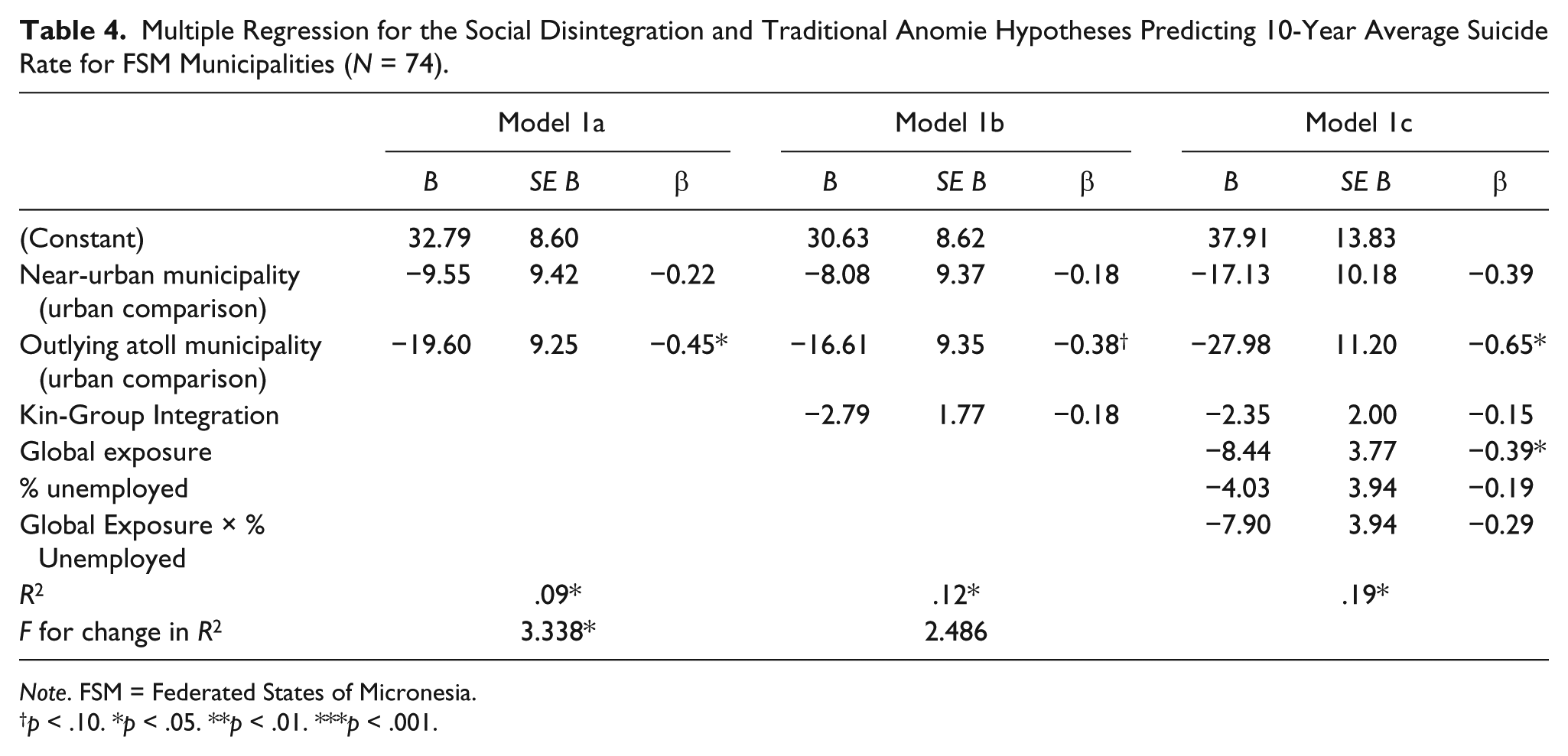
Table 4 summarizes the results for analytic Model 1 from Figure 1: The three-step multiple regression model that includes a test of the combined effects of the social disintegration hypothesis and the traditional anomie hypothesis. The final regression (Model 1c in Table 4) with all of the independent variables included (i.e., municipal geographic location, kin-group integration, and the tests for the moderation effect of unemployment on global exposure) is significant overall, R2 = .19, F(6, 67) = 2.56, p = .027. Only one of the main-effects predictors for the moderation model is significant, global exposure, Beta = −8.44, SE = 3.77, p < .05. The outlying atoll-urban municipality comparison is also significant, Beta = −27.75, SE = 11.90, p = .02.
Multiple Regression for the Social Disintegration and Traditional Anomie Hypotheses Predicting 10-Year Average Suicide Rate for FSM Municipalities (N = 74).
Note. FSM = Federated States of Micronesia.
p < .10. *p < .05. **p < .01. ***p < .001.
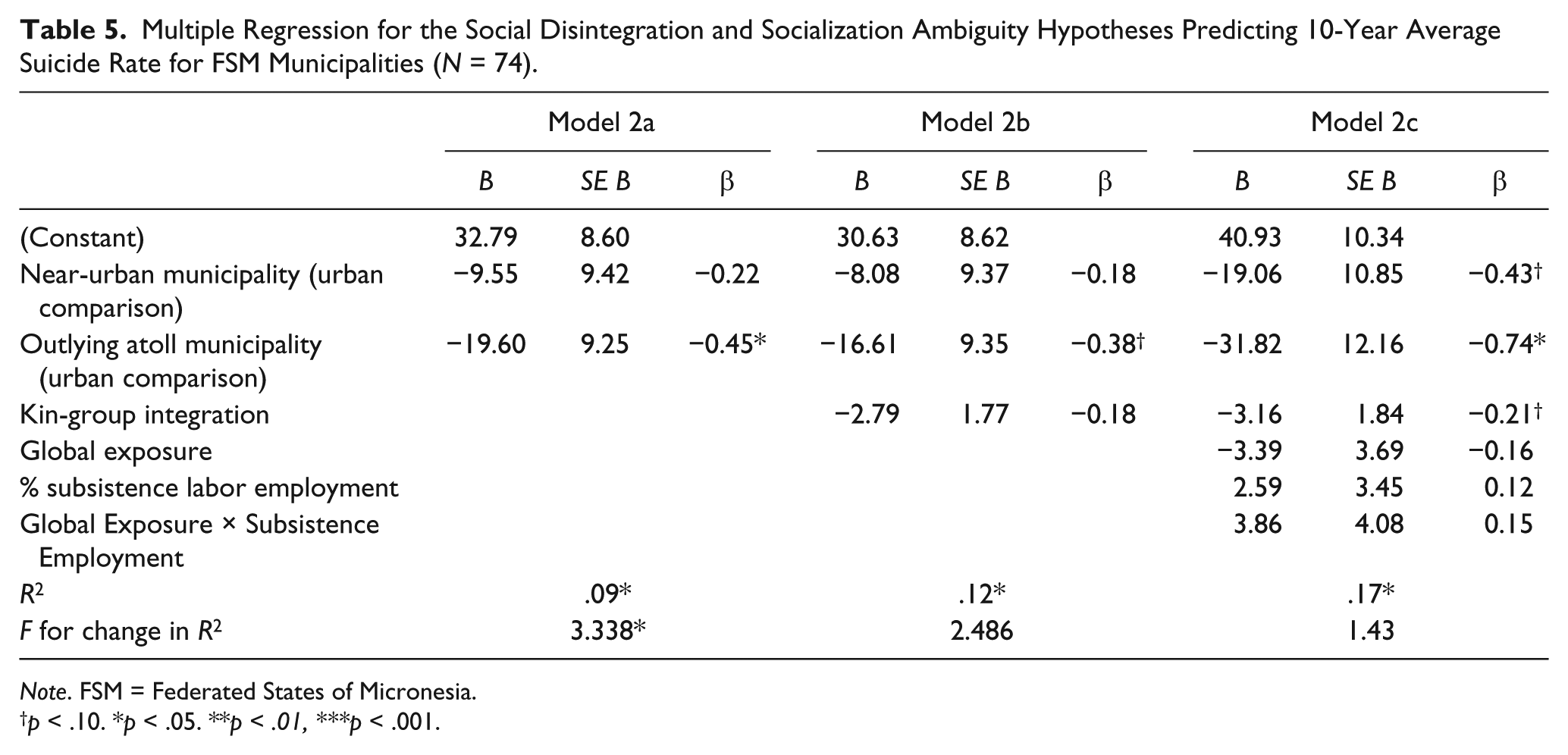
Table 5 reports the multiple regression results for analytic Model 2 from Figure 1: the three-step multiple regression model that includes a test of the combined effects of the social disintegration hypothesis and the socialization ambiguity hypothesis. The final model (Model 2c in Table 5) with all of the independent variables included (i.e., municipal geographic location, kin-group integration, and the tests for the moderation effect of subsistence employment on global exposure) is significant overall, R2 = .17, F(6, 67) = 2.25, p = .049. Only one of the individual predictors, the outlying atoll-urban municipality comparison, is significantly associated with the 10-year average suicide rates, Beta = −31.82, SE = 12.16, p = .01.
Multiple Regression for the Social Disintegration and Socialization Ambiguity Hypotheses Predicting 10-Year Average Suicide Rate for FSM Municipalities (N = 74).
Note. FSM = Federated States of Micronesia.
p < .10. *p < .05. **p < .01, ***p < .001.
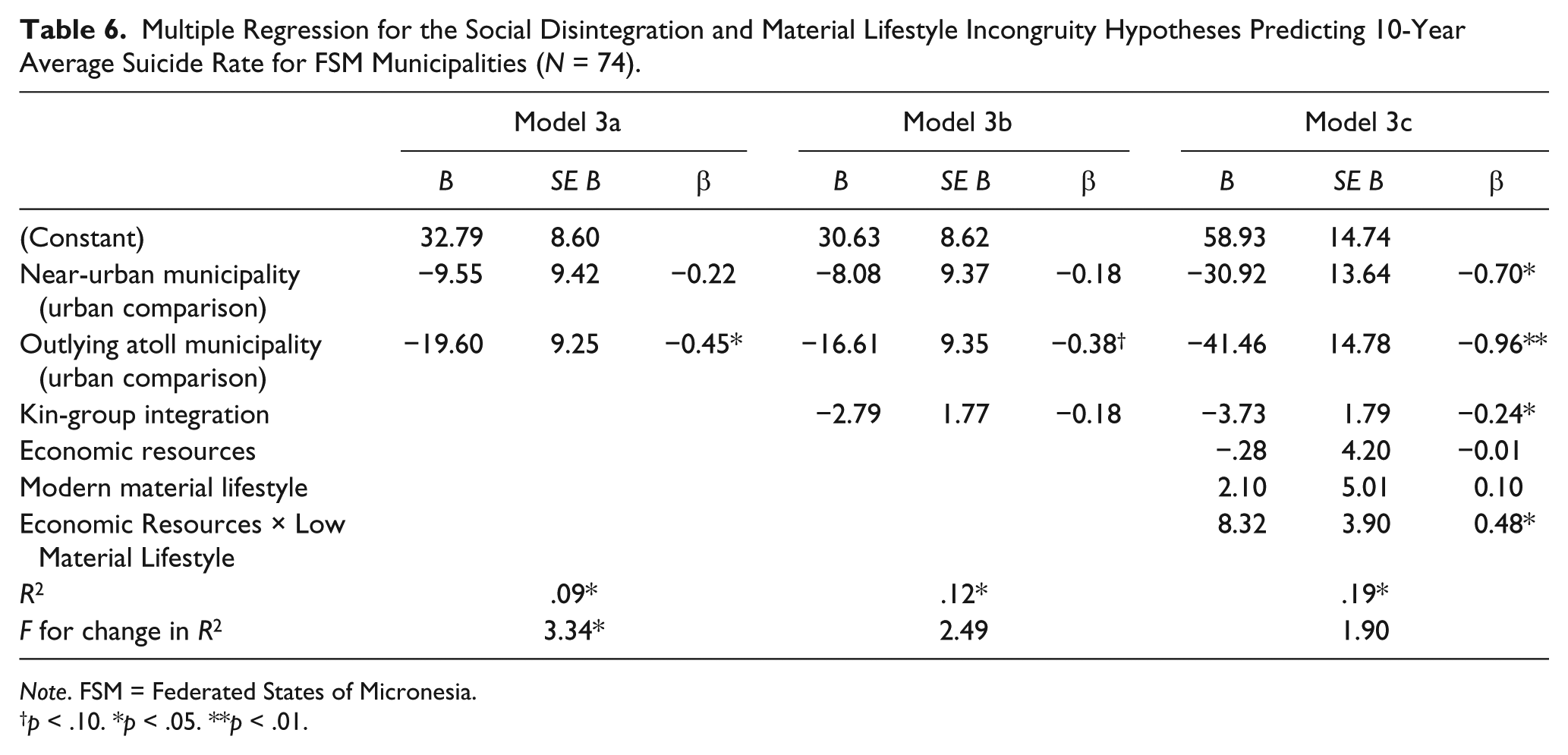
Table 6 reports the results for Model 3 from Figure 1: this includes a test of the combined effects of the social disintegration hypothesis and material lifestyle incongruity hypothesis. The final model (Model 3c in Table 6) with all of the independent variables included (i.e., municipal geographic location, kin-group integration, and the tests for the moderation effect of modern material lifestyle on economic resources) is significant overall, R2 = .19, F(6, 67) = 2.56, p = .027. Moreover, each of the main predictors, aside from the main effects of economic resources and modern material lifestyle, is now significantly associated with the average suicide rates: near-urban to urban comparison, Beta = −30.92, SE = 13.64, p = .03; outlying atoll to urban comparison, Beta = −41.46, SE = 14.78, p = .007; and kin-group integration, Beta = −3.73, SE = 1.79, p = .04. The interaction term for modern material lifestyle and economic resources is significantly related to the average suicide rates, Beta = 8.32, SE = 3.90, p = .04.
Multiple Regression for the Social Disintegration and Material Lifestyle Incongruity Hypotheses Predicting 10-Year Average Suicide Rate for FSM Municipalities (N = 74).
Note. FSM = Federated States of Micronesia.
p < .10. *p < .05. **p < .01.
In addition, the lifestyle incongruity interaction may be acting as a suppressor variable for the relationship between near-urban and outlying atoll municipalities and average suicide rates, as the effects of the near-urban to urban and outlying atoll to urban comparisons strengthened considerably with the inclusion of the measures for lifestyle incongruity. The Beta coefficients for the near-urban comparison changed from Beta = −8.08 to Beta = −30.92 and Beta = −16.61 and Beta = −41.46 for the outlying atoll comparison. A one-way ANOVA comparing the mean levels of the economic resources and material lifestyle interaction term, in terms of the three geographic types, showed a significant and negative association with urban municipalities scoring the lowest (M = −3.87, SD = 1.32), followed by near-urban municipalities (M = −0.79, SD = 1.03), and outlying atolls the highest (M = −0.24, SD = 0.35), F(2, 71) = 54.93, p < .001. This association suggests that the incongruity between economic resources and achieved material lifestyle is much higher in the near-urban and atoll municipalities than in the urban municipalities.
Finally, as this final regression model yielded a significant interaction effect for moderation of the modern material lifestyle level on economic resources, a four-step multiple regression (not shown) allowed a complete test of moderation (Baron & Kenny, 1986; Kenny et al., 1998). When just the main effects of economic resources and modern material lifestyle are entered, R2 = .13, and when the interaction term is added R2 = .19. Moreover, the standardized Beta for economic resources changes from Beta = −.09 to Beta = −.01 once the interaction term is entered. This change suggests that nearly all the effect of economic resource level on average suicide rates is moderated by the inverse of the level of modern material lifestyle.
Figure 2 shows the modeled interaction of the inverse of the modern material lifestyle and the economic resources measures for predicted average suicide rates. This graph represents the interaction assuming an urban municipality and for average levels of kin-group integration. For the low modern lifestyle condition (1 SD below the M), an increase in economic resources raises the predicted average suicide rate. In the average lifestyle condition (modern material lifestyle = 0), there is little to no effect of economic resources on the predicted suicide rates. Finally, in the high lifestyle condition (1 SD above the M), an increase in economic resources lowers suicide rates.
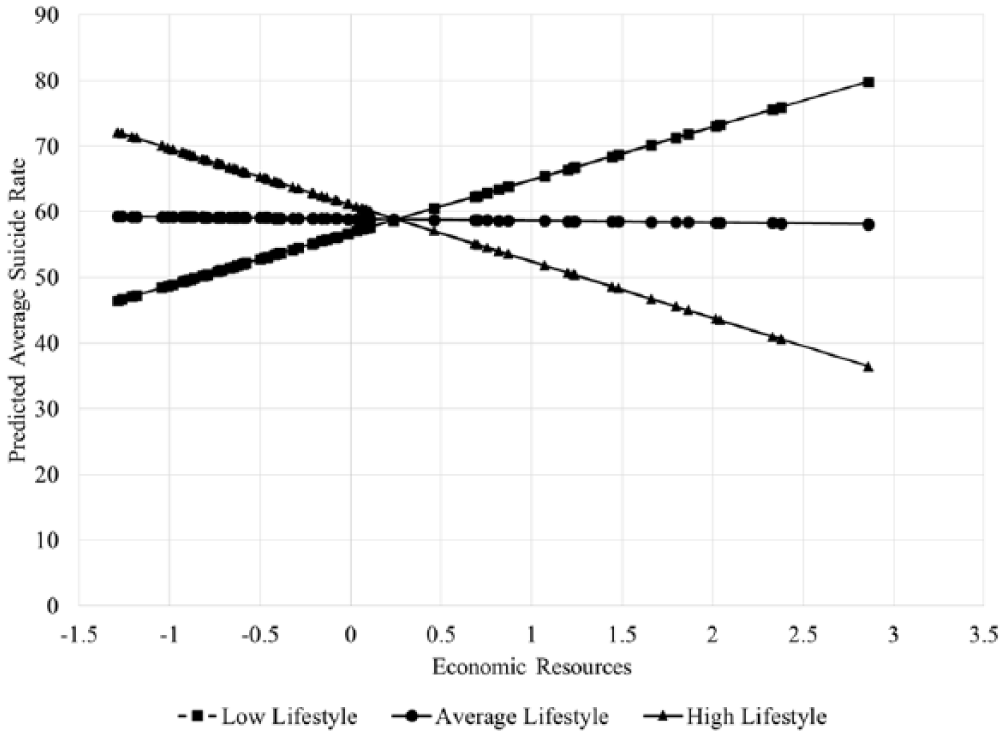
Predicted average suicide rates based on the interaction effect in Table 6.
Discussion
The main goal of this article is to test how well three alternative theoretical hypotheses account for variation in 10-year suicide rates across the municipalities of the FSM. Each analytic model included a measure of social disintegration and a test for disequilibrium between two measures of economic modernization. Again, there are two main empirical criteria for assessing the overall fit of each analytic model. The first is the overall amount of variance explained by the model, as indicated by R2. The second is whether the interaction term is significantly associated with the dependent variable. If the second criterion is met, then a test of moderation (Baron & Kenny, 1986; Kenny et al., 1998) is indicated as a final check.
Only the multiple regressions that include indicators for social disintegration and the material lifestyle incongruity hypotheses met these criteria (Table 6). Therefore, the analysis of these data supports the predictions for the social disintegration hypotheses and the lifestyle incongruity hypothesis, but there is no empirical support for the traditional anomie hypotheses or the socialization ambiguity hypothesis. This suggests that a combination of kin-group integration and an incongruity between a community’s achieved level of economic resources and modern material lifestyle, after controlling for island geographic proximity to the urban center, best accounts for variation in 10-year average suicide rates among the municipalities of the FSM. As the modeled interaction shows in Figure 2, suicide rates are higher in cases where the levels of economic resources in a community are incongruous with the achieved level of modern material lifestyle for a municipality, relative to levels of these indicators that are found in other municipalities.
Although their research focuses on individual-level variables, it is compelling that these findings for measures of community-level variation are consistent with the theoretical expectations and empirical findings of Dressler et al. across a wide range of contexts (Bindon et al., 1997; Dressler & Bindon, 2000; Dressler, Balieiro, & Dos Santos, 1997). These results also support to the contention that kin-group disintegration plays a role in the increased rates of suicide in Micronesian communities (Hezel, 1987; Rubinstein, 1983, 2002). In this study, social factors are shown to significantly predict suicide rates. These include the levels of kin-group integration and the degree of congruity between achieved material style of life and achieved economic resources for members of a municipality. Once the distance to the urban center is controlled, suicide risk in these Micronesian communities is higher when kin-groups are less integrated, and levels of lifestyle incongruity are also high.
The results of this study do not lend empirical support to claims found in the traditional anomie hypothesis that predicts increased suicide risk as a result of the disequilibrium between the availability of employment in modern adult occupations and youths’ levels of educational achievement and exposure to modern norms and values through access to global media and travel. This study also does not support the hypothesis that the increased potential for socialization ambiguity in a community—at least as it is indirectly measured in this case—explains the variation in suicide rates for these FSM municipalities.
In interpreting these results, it is important to note that vulnerability to suicide throughout Micronesia is sharply biased in terms of both gender and age. For example, for the 716 known cases of suicide that were recorded by the Micronesian seminar for the FSM between 1960 and 2005, only 70 (9.8%) were females, 90.2% were males. Both male and female youths between the ages of 15 and 29 years were most vulnerable as individuals in this age range makeup 70% of all known cases in this 45-year span.
These patterns of differential vulnerability to suicide raise the question of why youths between the ages of 15 and 29 years in general, particularly older adolescent boys and young men, are the most vulnerable to the three significant predictors of suicide in the final model of Table 6. Judging from the sizes of the standardized Betas (β), the difference in predicted suicide rates between the urban municipalities and atoll municipalities is the largest effect (β = −0.96), followed by lifestyle incongruity (β = 0.48), and, finally, the levels of kin-group integration (β = −0.24). One possible suggestion for why rates of suicide are estimated to be so much higher for urban municipalities is that these have a higher proportion of vulnerable young men who have moved to these urban centers to seek work or schooling. But, an examination of the census data for the FSM does not support this contention. The percent of residents between the ages of 15 and 29 years are 27.6% in the urban municipalities, 28.5% in the rural municipalities, and 26.9% on the atolls.
An alternative possibility involves conflict between households’ and youths’ own status pursuits, particularly those involving older boys and young men. As Lowe (2003; Weisner & Lowe, 2004) has argued, social changes in Micronesia in the second half of the 20th century have allowed for youths’ dramatically increased participation in activities among their peers that are beyond the immediate control and supervision of their families. These peer-related activities take young people away from the family and make it difficult for them to regularly contribute to the family’s needs. Throughout Micronesia, older boys and young men are particularly keen to engage in socially risky activities that enhance their status among their peers. These activities include substance use (tobacco and betel nut), excessive binge drinking of alcohol, occasional peer-to-peer violence, and the drunken disruption of community events that are greatly disapproved of by their families and among members of the wider community. The troubles caused by male youths’ “drunken comportment” can be a source of intense family embarrassment, as they can lower a family’s standing in the wider community (Marshall, 1979).
In addition, given these societies’ very limited levels of economic growth, youths remain dependent on their families for basic material and advisory needs. Conversely, their families need their unmarried young men and women to assist them with subsistence activities and other occasional activities that enhance or maintain the family’s good standing in the community. Because of these two conditions, family encounters of tension and conflict are common, particularly for older boys and young men and occasionally for older girls and young women. These conflicts are often implicated as precipitating factors in cases of suicide (Hezel, 1987; Lowe, 2003; Rubinstein, 1983). Young men’s problematic peer-group activities are most commonly found in the urban centers, but also occur in the rural municipalities, and remote atolls to a much lesser degree (Flinn, 1992; Marshall, 1979). Thus, the troubles of youth associated with these socially risky status pursuits might be greatest in the urban centers, followed by peri-urban rural municipalities, and least common in the remote atolls, offering some explanation for why the largest effect in Table 6 is the Urban–Rural–Atoll distinction. It is also possible that family conflicts that can precipitate suicide attempts are particularly likely in those municipalities whose households are already more likely to be insecure over the incongruity between their achieved levels of economic resources and their realized levels of a modern material style of life, and where the disintegration of the kin-group limits the availability of social supports that might buffer these conflicts.
There are several important limitations in this study to keep in mind. First, although the results of this study are suggestive for other contexts, they are limited by the case selection and sample to the FSM. Second, the indicators that are available in the FSM census materials limit the operationalization of the variables in this study. This may introduce some measurement bias that could affect the estimation of the effects of the independent variables on the municipal suicide rates. Measurement bias is particularly likely given the indirect way socialization ambiguity is operationalized in this study, suggesting the need for additional research to test this hypothesis specifically. Third, although a meaningful proportion of the variance in the suicide risk for these communities is accounted for in the regression model with the best theoretical fit, most of the variance is not explained. As this study used the average rate of suicide for the population in general, and not age-adjusted rates, it is likely that some bias in the final estimates exists. Given the small available sample of municipalities and the available social indicators from the FSM census data, several other possible predictors could not be included in the models presented in this article. One important additional variable to consider would be the distribution of mental health status and important coping resources and strategies. A second is the possible contagion effects that have been described previously in Micronesia (Booth, 2010; Rubinstein, 1983). A third is the effort by families, community and church leaders, and mental health workers to implement programs that address the well-known suicide epidemic in Micronesia and reduce its severity (Hezel, 2001; Phillips, Liu, & Zhang, 1999). Future research is needed to examine how these additional variables might add additional insight to the understanding of social change and suicide in the contexts of rapid social change in places like Micronesia.
Conclusion
Since Durkheim social researchers have recognized that levels of social disintegration and social-cultural disequilibrium are two important variables that help explain variation in suicide rates for societies undergoing rapid modernizing social change. These constructs have been used to explain the epidemic of suicide that occurred on Pacific Island communities across a broad swath of Micronesia from the 1970s to the 2000s. But, several ways of theorizing social-cultural disequilibrium had been advanced in the case of recent suicide epidemics in the Pacific Islands without an adequate test of which of these theoretical hypotheses might best account for suicide mortality in the Micronesian case. The results of this study find that the best explanatory model for variation in suicide rates includes the degree of urbanization, the levels of social integration, and the incongruity between modern economic resources and achieved modern material lifestyle. Models that include measures of imbalances between exposure to global norms and ideals and either levels of formal employment or levels of traditional subsistence practices do not account for the variation in suicide rates. These results suggest that researchers should give greater attention to the way communities aspire to and participate in global markets as opposed to shifting adult role structures and occupations as a site for understanding the relationship between rapid social change and youths’ mental health in indigenous societies.
Footnotes
Acknowledgements
I am deeply grateful for the invaluable assistance of Alexis Houghton, Aileen Mokuria, Carol Ember, and three anonymous reviewers for their comments and editorial advice on this manuscript. I also want to thank Francis X. Hezel and the Micronesian Seminar for providing access to the Micronesian suicide database. Fran was also a welcoming host and very helpful interlocutor as this project developed in its early stages.
Declaration of Conflicting Interests
The author(s) declared no potential conflicts of interest with respect to the research, authorship, and/or publication of this article.
Funding
The author(s) disclosed receipt of the following financial support for the research, authorship, and/or publication of this article: This research was funded by Soka University of America. Ms. Houghton’s work was supported by the President’s Research Assistant Program at Soka University of America.