



Abstract
Cultural studies on sacrifices made by emerging adults have given limited attention to the cost involved. We addressed this issue in studies among U.S. and Chinese emerging adults. Assessing real-life instances of sacrifice, Study 1 (N = 130) showed that Chinese sacrifice for their parents in a higher cost way than do European Americans. In a vignette-based experiment, Study 2 (N = 254) demonstrated that family obligation motivates high-cost sacrifice among Chinese emerging adults but not among European American emerging adults. The findings underscore the importance in cultural research of recognizing the distinctive impact of cultural and immigration effects, while highlighting methodological limitations associated with the use of scale measures.
Emerging adulthood is a developmental period from the late teens to the mid- to late 20s during which time youth move toward but have not yet fully entered adulthood. During this period, which theorists view as becoming more common internationally under the influence of globalization, youth postpone taking on various adult commitments, such as marriage and parenting, and do not subjectively identify themselves as fully adult (Arnett, 2000). As part of this process of becoming an adult, youth not only gain independence but also develop a greater sense of responsibility to care for their parents. However, filial obligation that involves contributions of time, money, and energy may conflict with the emerging adult’s personal goals and require self-sacrifice. How likely is it for emerging adults to sacrifice for their parents? What are emerging adults ready to give up for their parents?
Sacrifice for Parents
Cross-cultural studies on sacrifice have yielded mixed findings, with some studies indicating that greater sacrifice for parents occurs among Asian American emerging adults as compared with European American emerging adults (Son, 2010; Suzuki & Greenfield, 2002; Yeh, 2004) and other studies indicating that cross-cultural differences in sacrifice occur among adolescents but are no longer present by emerging adulthood (Fuligni, 1998; Fuligni & Pedersen, 2002; Fuligni, Tseng, & Lam, 1999; Juang & Cookston, 2009).
Based on evidence that family obligation is given greater emphasis in Asian than in European American cultural contexts (Nelson & Chen, 2007; Qi, 2015; Wu & Chao, 2017), Suzuki and Greenfield (2002) assessed whether this cultural variation would be evident in sacrifice. Asian American and European American college students were asked to appraise hypothetical dilemmas that involved choosing between fulfilling a personal goal and making a relatively minor sacrifice to one’s parents (e.g., giving up a New Year’s Eve party invitation from a date vs. spending time with one’s parents) 1 . Asian Americans endorsed sacrificing for parents in these types of cases more than did European Americans. However, contrary to the authors’ hypothesis, no cultural differences occurred in guilt associated with declining to sacrifice.
Other investigators (Fuligni, 1998, 2007; Fuligni & Pedersen, 2002; Fuligni et al., 1999) found that whereas cultural differences in sacrificing exist during adolescence, they no longer occur during emerging adulthood. Fuligni and his colleagues (1999) developed the widely used Attitudes Toward Family Obligation Scale that includes items about children spending time with family, respecting family, making sacrifices to family, and so forth. Using this measure, Fuligni and Pedersen (2002) observed that Chinese Americans maintain a stronger sense of family obligation than do European Americans only during adolescence and not also during emerging adulthood. Fuligni (2007) explained the absence of cultural differences during emerging adulthood as resulting from Asian Americans being too busy studying to spend time with their parents. This claim was further supported in a 3-year longitudinal investigation conducted by Juang and Cookston (2009) who found that family obligation scores decreased from adolescence to young adulthood among Chinese Americans.
Other studies, however, indicate that immigration rather than culture explains the observed differences in the greater readiness of Asian Americans than of European Americans to sacrifice for their parents. Kang and Larson (2014) found that Korean American young adults share “a sense of indebtedness towards parents” because of their awareness of the sacrifice their parents made during immigration (p. 11). The Korean American emerging adults described the obligation they felt as a debt owed to their parents for the parents’ sacrifice rather than as an unconditional cultural mandate. This claim was further supported in research showing that Chinese immigrant adolescents cited paying back the sacrifice their parents made during migration as a reason for their willingness to sacrifice (Wu & Chao, 2017). In helping their parents with immigration-related difficulties, immigrant Israel adolescents from the former Soviet Union placed greater emphasis on familial relatedness and responsibilities than did nonimmigrant Israeli adolescents (Walsh, Shulman, Bar-On, & Tsur, 2006). Likewise, Titzmann (2012) showed that German immigrant adolescents became more responsible for family than did adolescents from nonimmigrant families.
In work in this tradition, researchers have also highlighted the emotional challenges that Asian Americans face in sacrificing. It has been claimed that, as Asian American children transition from adolescence to emerging adulthood, they experience conflict between traditional family values and self-development (Badger, Nelson, & Barry, 2006; Fuligni, 2007). This leads to a feeling of “being torn” as they are dealing with their “in-between” position between self-desire and family-desire (Nelson & Chen, 2007, p. 87).
Unanswered Questions
Regarding unanswered questions, past developmental research has given limited attention to cultural influences on the nature and extent of everyday sacrifice for parents. For example, on the Attitudes Toward Family Obligation Scale (Fuligni et al., 1999), sacrifice is assessed using the single item “make sacrifices to your family.” This scale item, however, does not specify the type of sacrifice being referenced, leaving open the possibility that individuals from different cultural backgrounds may respond in terms of different types and magnitude of sacrifice. For example, the absence of cultural differences in family obligation found in research using this scale item may have resulted from Asian Americans making the same responses to this scale item as do European Americans, even while thinking of objectively higher cost instances of sacrifice. Thus, even when giving identical ratings as do European Americans to this item, Asian Americans may have been making objectively greater sacrifices to their parents. In other research, the skewed sampling of instances of sacrifice provides limited insight into the extent of everyday sacrifice. For example, in assessing responses to hypothetical vignettes that portrayed relatively minor instances of everyday sacrifice, Suzuki and Greenfield (2002) did not assess the extensiveness of everyday sacrifice to parents. Although emerging adults rated the scenarios used in their research as highly believable, minor sacrifices do not encompass the scope of sacrifices among emerging adults. There are no known studies that have assessed real-life examples of sacrifices made by emerging adults to their parents that could provide insight into this issue.
As most research on family obligation and sacrifice has sampled immigrant populations, it is also difficult to disentangle influences stemming from culture as compared with from immigration. In Suzuki and Greenfield’s (2002) study, for example, a majority of their Asian American respondents were first- or second-generation immigrants with the European American respondents mostly third or more generation immigrants. The authors compared emerging adults not only from different cultural backgrounds but also from recent immigrant families to families who had not recently experienced immigration. It is possible that the tendency for Asian American emerging adults to be more willing to sacrifice for their parents than are European Americans resulted from effects related to their parent’s immigration and not from cultural background per se, that is, emerging adults from immigrant families may have been reciprocating their parents’ sacrifice during immigration. To rule out this possibility, it is valuable to assess young adults whose families have not experienced recent immigration.
Finally, an additional limitation of past research is a tendency to link sacrifice solely with negative emotions, which does not provide necessarily a complete picture of the psychological experiences involved. Suzuki and Greenfield (2002), for example, only assessed guilt feelings about sacrificing and did not examine any positive emotions. However, family obligation, which involves issues of sacrifice, better predicts psychological well-being among Chinese American than among European American emerging adults (Fuligni, Yip, & Tseng, 2002). This raises the likelihood that Chinese American emerging adults may associate more positive feelings with sacrificing to parents than do European American emerging adults.
Current Study
The goal of the present two-study investigation was to examine the everyday sacrifices that nonimmigrant European American and Chinese emerging adults make to their parents. We focus on the nature and cost of sacrifices made and feelings associated with it.
Study 1
We undertook Study 1 to examine the nature of sacrifice to parents among samples of emerging adults in both the United States and China. We asked respondents to describe a situation in which they had made a sacrifice for their parents in the past 3 years. As an index of motivation, we asked respondents who generated an instance of sacrifice to explain the reasons why they made this sacrifice. To assess spontaneous feelings and reactions to sacrifice, we also asked respondents to describe their own reactions to making the sacrifice. To tap the subjective cost of sacrifice, we asked respondents to rate the level of hardship involved in making the sacrifice. Finally, to assess overall appraisals of sacrifice, we had respondents rate how important they considered it to be for adult children to sacrifice for their parents, with this question answered by all respondents regardless of whether they had reported a sacrifice.
Based on previous findings (Suzuki & Greenfield, 2002) indicating that Asian American emerging adults report more willingness to make even minor sacrifices to parents than do European Americans, we predicted that Chinese emerging adults would provide examples of sacrifice that involved objectively higher cost in comparison to the examples provided by European American emerging adults. However, we predicted that no cultural differences would occur in the reported levels of hardship involved in making the sacrifices narrated, given that the question about level of sacrifice tapped subjective rather than objective cost. Our expectation was that, with their cultural emphasis on autonomy, European Americans would be more sensitive to the material cost involved in sacrificing than would Chinese (Fuligni et al., 1999). Based on the stronger emphasis on family values in Chinese relative to American culture (Qi, 2015; Wu & Chao, 2017) and the relationship between sacrifice and family obligation identified in the existing literature (Fuligni & Pedersen, 2002; Fuligni et al., 1999), we predicted that sacrificing to parents would be considered as more important among Chinese emerging adults than among European American emerging adults. In terms of feelings, we predicted that Chinese emerging adults would feel more positively about sacrificing for their parents than would European American emerging adults.
Method
Respondents
European American respondents were recruited from The New School University in New York City, whereas Chinese respondents were recruited from Tianjin Foreign Studies University in Tianjin. We adopted a methodology recommended in cultural research of tapping relatively homogeneous cultural subgroups (Miller, 2004). To make sure that our European American and Chinese samples were nonimmigrant culturally homogeneous populations, our U.S. sample included native English speakers with European American backgrounds, who were born in the United States and whose parents were also born in the United States, and the Chinese sample included native Chinese speakers, who were born in China and whose parents were also born in China. We recruited respondents by sending out emails to the undergraduate student mailing list at The New School. In China, we advertised through the smartphone App WeChat, which Chinese college students use to form class chatting groups as a main tool for academic-related communication. We monetarily compensated respondents for their participation in ways that are normative in each cultural community.
The minimum number of respondents required was determined by an a priori power analysis (G*Power: Faul, Erdfelder, Lang, & Buchner, 2007). A total minimum sample size of 126 was detected (80% chance) as significant at the 5% level with a small effect size for the between-respondent comparisons. We collected a total of 60 European American and 70 Chinese college students aged 18 to 25 years. The sample consisted of 64% females, with the European American sample including 57% females and the Chinese sample including 70% females. The respondents did not differ significantly in age (European Americans: M = 22.5 years, Chinese: M = 22.3 years) or educational level (Mode = bachelor’s degree).
Materials and procedures
We developed a questionnaire in which respondents were asked to recall a real-life situation in which they sacrificed for their parents, and to complete a series of questions assessing their personal experiences in doing this. The questionnaire was developed in the English language. A bilingual research assistant translated the questionnaire into Chinese, with back-translation techniques utilized to ensure the quality of translation.
Qualitative coding
Two independent coders (one from China, the other from the United States) developed coding schemes to score the nature of sacrifice, reasons for sacrifice, and reactions to sacrifice, as conveyed in respondents’ open-ended answers. We obtained high interrater reliability for nature of sacrifice (k = .839, p < .001), for reason for sacrifice (k = .773, p < .001), and for each of the categories of reaction to sacrifice (positive feelings, k = 1.000, p < .001; negative feelings, k = .898, p <.001; need/obligation-related reactions, k = .773, p < .001).
Nature of sacrifice was coded into five categories: (a) Change of daily plans involved giving up a short-term everyday plan to spend time with or assist family (e.g., spending time with one’s mother rather than attending a social gathering); (b) Change of life plans involved giving up a long-term life plan to fulfill the parents’ wishes (e.g., giving up attending a graduate school outside the hometown to remain near to one’s family); (c) Tolerance involved putting up with what the emerging adult considered to be unfair treatment by their parents (e.g., delaying moving out on one’s own to help parents around the house); (d) Assistance without conflict of interest involved tangible help in which no schedule conflict or change of plans was mentioned (e.g., helping parents with moving). Self-growth involved making the effort to become self-sufficient (e.g., working to become financially independent).
Reasons for sacrifice were coded into four categories: (a) Family harmony and functionality concerned the importance of prioritizing family interest over self-interest (e.g., giving priority to the family business over the emerging adult’s individual preferences); (b) Pressing needs referred to an immediate situational need (e.g., taking someone to the hospital who was hurt); (c) Emotional consequences referred to promoting an anticipated positive emotional outcome for the parents (e.g., his parents would appreciate it); (d) Social pressure referenced social pressure for making the sacrifice (e.g., the disapproval of the parents).
Reactions to sacrifice were coded into three categories: (a) positive feelings (e.g., happy); (b) negative feelings (e.g., annoyed); and (c) need/obligation-related reactions and feelings (e.g., it was the right thing to do). In contrast to the nature and reasons for sacrifice that we coded dichotomously, we scored reactions to sacrifice multiply, meaning that if more than one of the three reactions were mentioned, we gave the answer credit for each of the types of reactions mentioned. For example, in the case of a respondent who described feeling “a little angry but satisfied,” their answer would be scored as including both a positive and a negative feeling.
Results
We utilized nonparametric statistics (Mann–Whitney U tests and chi-square tests) to analyze the categorical variables and one-way analysis of variance (ANOVA) with Bonferroni corrections to analyze the continuous variables.
Nature of sacrifice
The chi-square tests revealed no cultural differences in the proportion of respondents who reported a sacrifice, χ2(1, 130) = 0.357, p = .550. In both cultural groups, approximately half of the emerging adults reported sacrifices to their parents (European Americans: 56.7%, Chinese: 51.4%). Chinese respondents (55.6%) more frequently reported examples of sacrifice that involved change of life plans than did European American respondents (8.8%), χ2(1, 70) = 17.309, p < .001. European American respondents more frequently than Chinese respondents reported sacrifices that involved change of daily plans, χ2(1, 70) = 8.545, p = .003 (European Americans: 52.9%, Chinese: 19.4%) and sacrifices that involved tolerance, χ2(1, 70) = 5.701, p = .017 (European Americans: 14.7%, Chinese: 0%).
Reasons for sacrifice
We found that Chinese referred to family functionality and harmony as the reason to sacrifice for their parents more frequently than did European Americans, χ2(1, 70) = 18.529, p < .001 (Chinese: 75%, European Americans: 23.5%). In comparison with Chinese, European Americans cited pressing needs more frequently as the reason for sacrifice, χ2(1, 70) = 22.250, p < .001 (European Americans: 52.9%, Chinese: 2.8%). No significant cultural difference occurred in mention of the other reasons.
To illustrate the sacrifices that emerging adults made to their parents, we provide below representative examples from each culture, with the Chinese example reflecting change of life plans and the European American example reflecting change of daily plans:
As can be seen above, the Chinese respondent refused a job offer in another city to preserve family harmony, which represented a long-term plan, in comparison to the European American respondent, who gave up one day’s time to help his dad because there was an immediate need for assistance. In explaining the reasons for his or her sacrifice, the Chinese respondent referenced filial obligations to his parents, whereas the European American respondent referenced the pressing need of no one else being available to provide assistance.
Reactions
In assessing reactions associated with making sacrifices, Mann–Whitney U tests revealed a significant cultural difference in negative feelings (U = 437, p = .018), with European American respondents (64.7%) more frequently reporting negative feelings about sacrificing than did Chinese respondents (36.1%). However, no significant cultural differences occurred in mention of positive feelings (p = .099) or of need/obligation-related feelings (p = .344).
Importance and hardship
As hypothesized, Chinese respondents (M = 3.37) considered making sacrifices to their parents as more important than did European American respondents, M = 2.95, F(1, 129) = 8.234, p = .005, η2 = 0.06. Also congruent with our predictions, no cultural difference occurred in reported hardship associated with sacrificing, F(1, 69) = 0.629, p = . 430, European Americans: M = 5.06, Chinese: M = 4.56.
Discussion
By having respondents generate real-life examples, we were able to identify emerging adults’ understandings of sacrifice for their parents. In both cultures, sacrifice for parents was understood as a situation that involved a conflict between a child’s goal and their parents’ goal, in which the child made a sacrifice by giving up, in full or in part, obtaining their own goal to meet the goal of the parents. In the Chinese sample response given earlier, the emerging adult’s goal was to accept a very good job offer, whereas the parents’ goal was to have the child not be too far away from home. In turn, in the European American sample response, the emerging adult’s goal was to go out for New Year’s Eve, whereas the mother’s goal was to have the child spend New Year’s Eve with her. In both cases, the emerging adult chose to give up his or her own goals.
On the basis of this shared understanding of sacrifice, we observed cultural variation in the objective cost of the goal to be given up—that is, the cost of the sacrifice. Chinese emerging adults tended to report sacrificial situations in which they gave up their long-term life plans (such as academic choices, job opportunities, or preferred relationship partners) to meet their parents’ wishes. In contrast, European American emerging adults more frequently reported lower cost sacrificial situations in which they gave up short-term daily plans (such as social gatherings, weekend recreational plans, or trips) to assist their parents. Because these examples were spontaneously generated by respondents in responding to the question about sacrifice to parents, they were congruent with the study hypotheses regarding the predicted tendencies for Chinese emerging adults to understand sacrifice to parents in an objectively higher cost sense than did European American emerging adults.
Regardless of European American and Chinese emerging adults generating examples of sacrifice involving different objective cost levels, the two cultural groups did not differ in their ratings of the level of hardship involved in making the sacrifices they had narrated. In other words, although European American emerging adults reported objectively lower cost sacrifice to their parents, they did not perceive such sacrifice as less costly than did Chinese emerging adults who reported objectively higher cost sacrifice. This pattern of results is congruent with the claim that, as compared with Chinese emerging adults, European American emerging adults are more sensitive to perceived infringements on their autonomy in relation to their parents and thus more prone to view sacrificial behavior as entailing personal cost to themselves.
Moreover, even though Chinese emerging adults reported making objectively higher cost sacrifice to their parents, they less frequently associated negative feelings with sacrificing than did European American emerging adults. This finding challenges the assumption that sacrifice is associated only with negative emotions. Furthermore, if Chinese emerging adults report feeling more positively than do European American emerging adults even when they are making higher cost sacrifices, then it is possible that Chinese will report more positive feelings than European Americans in relation to instances of sacrifice that involved objectively lower cost.
We also found evidence to support our prediction that differences in cultural values, rather than migration experience, contributed to Chinese emerging adults displaying greater willingness than did European American emerging adults to make sacrifices to their parents. In our data collected from a sample of Chinese emerging adults who had not experienced immigration, Chinese more frequently reported higher cost sacrifice to their parents and viewed making sacrifice to their parents as more important than did European Americans, with family harmony and functionality the most frequently cited reasons for sacrifice among Chinese. The emphasis placed on family harmony and functionality among the Chinese emerging adults is congruent with previous claims that family obligation is given greater emphasis in Asian than in European American cultural contexts (Qi, 2015; Wu & Chao, 2017).
However, several limitations may be noted in Study 1. First, as the examples of sacrifice provided by respondents involved objectively different cost levels, we were not able to compare respondent’s reactions to sacrifice involving identical levels of cost. The fact that the European American emerging adults spontaneously generated examples of sacrifice involving lower cost than did the Chinese emerging adults does not establish that the Chinese would be more willing to sacrifice for their parents in relation to the types of scenarios salient to European Americans. Whereas spontaneously generated examples of sacrifice have ecological validity, it is essential also to compare responses to scenarios in which the cost involved is objectively the same. Second, because we used an open-ended probe to allow respondents to describe their own reactions to making a sacrifice, we did not directly assess the degree to which respondents experienced particular feelings and did not assess the relationship of particular feelings to the cost of the sacrifice. Third, the relationship between family obligation and sacrifice in the two cultures was not fully established. Although a connection between family obligation and sacrifice was observed among Chinese in that family harmony and functionality was the main motive cited by Chinese for why they sacrificed to their parents, it is unclear whether this relationship is affected by the cost of the sacrifice involved. Study 2 was designed to address these questions.
Study 2
We designed this study to address these unanswered questions regarding perceptions of the cost of sacrifice to parents, the feelings associated with sacrifice, as well as the relationship between family obligation and sacrifice. We created vignettes by sampling from the real-life examples of sacrifice that had been narrated by respondents in Study 1. This made it possible for us to compare emerging adults’ appraisals of the same sacrificial situations. Three of the vignettes sampled involved change of life plans, which had been found in Study 1 to be the most common type of sacrifice among Chinese emerging adults, and three involved change of daily plans, which had been found to be the most common type of sacrifice among European American emerging adults. Given the higher objective cost portrayed in the vignettes involving change of life plans, we treated these scenarios as stimuli in a high-cost condition, and treated the vignettes involving change of daily plans as stimuli in a low-cost condition, with respondents assigned, in a between-respondent manipulation, either to the high-cost or low-cost condition.
In the first part of Study 2, we asked respondents to read each vignette and indicate how they would respond if they were in each situation described. In turn, in the second part of Study 2, we portrayed the adult child in the vignette as undertaking a sacrificial behavior for their parents, with dependent measures assessing respondents’ views of the extent to which they considered the sacrificial behavior to represent a family obligation and a sacrifice and the level of satisfaction/dissatisfaction and hardship they associated with the behavior. We also assessed the levels of satisfaction/dissatisfaction and guilt associated with declining to sacrifice.
Given that no cultural differences occurred in perceived hardship in sacrificing in Study 1, with European Americans evaluating objectively lower cost examples of sacrifice than did Chinese, we expected that European Americans would be more prone to view sacrifice for parents as a hardship than were Chinese in both the high- and low-cost cases. We anticipated no cultural differences in levels of family obligation, given existing evidence that U.S. emerging adults with Chinese cultural backgrounds report similar levels of family obligation as do European American adults (Fuligni & Pedersen, 2002). However, based on the observed tendency in Study 1 for Chinese more frequently than European Americans to cite family-value-related concerns as the reason for sacrifice, we hypothesized that level of family obligation would predict willingness to sacrifice among Chinese but not among European Americans. In terms of affective reactions, we hypothesized that Chinese would associate greater satisfaction with sacrificing to parents and greater guilt with declining to sacrifice than did European Americans.
Method
Respondents
European American respondents were recruited online at The New School and City University of New York. Chinese respondents were also recruited online through the WeChat method from Beijing University, Tianjin Foreign Studies University, and Xinyang Agricultural College. We used the same recruitment and compensation methods as in Study 1.
The minimum number of respondents required was determined by an a priori power analysis (G*Power: Faul et al., 2007). A total minimum sample size of 250 was detected (80% chance) as significant at the 5% level with a small effect size for the between-group comparisons. The final sample included 128 European American and 126 Chinese college students aged 18 to 25 years, with the U.S. sample 72.4% female and the Chinese sample 72.2% female. No cultural differences occurred either in age (European Americans: M = 20.8 years, Chinese: M = 20.8 years) or educational level (Mode = bachelor’s degree), with all respondents having at least a bachelor’s degree.
Materials and procedures
The original vignette material in the high-cost condition was developed in Chinese and the original vignette material in the low-cost condition was developed in English. A bilingual research assistant translated the material into Chinese and back translation was undertaken by another bilingual research assistant. We identified the characters in the vignettes by American names in the English version, and by Chinese names in the Chinese version. Respondents from each culture were assigned to either the high- or low-cost condition. Shown below are examples of vignettes from each condition. 2
In the first part of the procedure, respondents were instructed to read each vignette and then indicate whether, if they were in the same situation, they would choose to follow the child’s goal or the goal of the parents. In the second part of the procedure, respondents were shown the vignettes again with characters in the stories now portrayed as choosing the goal of the parents. For example, for the sample high-cost story shown above, respondents were now notified that “Although Annie really wanted to continue dating the guy, she ended the relationship with him and started to date someone from a closer place.” Using 7-point Likert-type scales (“0” not at all, to “6” extreme), respondents were asked to indicate to what extent, if at all, they consider what the character in the story did to be a sacrifice; and to what extent they judged it to be an obligation and the hardship involved, if any, for the character to act in this way. Furthermore, respondents were asked to rate on a 7-point bipolar Likert-type scale how satisfied/unsatisfied the character would feel acting in this way, with the endpoints “-3” extremely unsatisfied to “3” extremely satisfied scale and “0” a neutral midpoint). We then asked respondents to indicate how satisfied/dissatisfied they thought the character would feel in declining to sacrifice, with responses given on the same type of 7-point bipolar scale described earlier, as well as to rate how guilty, if at all, the character would feel (“0” not at all guilty to “5” extremely guilty).
Results
We created an index of emerging adults’ willingness to sacrifice for parents in each story by dummy coding respondents’ choice of goals of the parents as 1 and choice of personal goals as 0, and transforming these variables into z scores. To provide an index of any story effects, we undertook reliability assessments across the three vignettes on all of the continuous variables (i.e., willingness to sacrifice index, sacrifice, obligation, hardship, satisfaction/dissatisfaction associated with sacrificing, satisfaction/dissatisfaction and guilt associated with declining to sacrifice) and obtained Cronbach’s alphas ranging from .600 to .831. Given these results indicating consistency in responses across the three vignettes, we combined the responses across the vignettes by calculating the averages of the ratings given on each of the dependent variables. We utilized multivariate analysis of variance (MANOVA) in cases where the variables were conceptually related to each other and ANOVA with Bonferroni corrections to unpack any main effects and interactions.
General attitude toward sacrifice
To assess general attitude toward sacrifice, we undertook a 2 (culture) × 2 (cost) MANOVA for willingness to sacrifice, extent of sacrifice, and obligation to sacrifice. We obtained main effects of culture, Λ = .583, F(3, 251) = 59.081, p < .001, η2 = .417 and cost, Λ = .564, F(3, 251) = 230.591, p < .001, η2 = .736, with the Culture × Cost interaction not significant, F(3, 251) = 1.420, p = .238. Further 2 × 2 ANOVAs revealed main effects of culture on willingness to sacrifice, F(1, 253) = 51.081, p < .001, η2 = .170, and extent of sacrifice, F(1, 253) = 148.349, p < .001, η2 = .372, but not on the degree sacrificing was considered obligatory, p = .903. Regardless of the cost, European Americans (M = −0.18) were less willing to sacrifice than were Chinese emerging adults (M = 0.22). European Americans (M = 3.71) also considered the adult child’s behavior in the vignettes to involve greater sacrifice than did Chinese (M = 2.07). However, no cultural differences occurred in the degree sacrificing was considered obligatory, F(1, 253) = 0.015, p = .903. Significant univariate main effects of cost occurred on willingness to sacrifice F(1, 253) = 51.081, p < .001, η2 = .170, extent of sacrifice, F(1, 253) = 148.349, p < .001, η2 = .372, and obligation to sacrifice, p = .903. Cross-culturally, emerging adults were less willing to make sacrifice in the high-cost (M = −0.67) than low-cost (M = 0.71) condition. They also considered behavior in the high-cost (M = 3.54) condition to involve greater sacrifice than in the low-cost condition (M = 2.24). Furthermore, overall emerging adults considered sacrifice to be less obligatory in the high-cost condition (M = 2.33) than in the low-cost condition (M = 4.07) (see Table 1).
Descriptive Statistics for Reactions to Sacrificial Behavior in Study 2.

Relationship between family obligation and willingness to sacrifice
We undertook a moderated moderation analysis to examine whether the relationship between obligation and willingness to sacrifice can be explained by culture and cost. Utilizing the Hayes (2013) method (PROCESS MODEL 3), we observed a significant Obligation × Culture × Cost interaction, b = −0.249, t(254) = −2.646, p = .009. Partially congruent with our prediction, when the cost of sacrifice was high, sense of family obligation was a significant predictor of the willingness to make sacrifice for parents among Chinese, b = 0.169, t(254) = 2.420, p = .017, but not among European Americans, b = −0.130, t(254) = −0.480, p = .632. No such relationship occurred in the low-cost condition, b = −0.067, t(254) = −1.176, p = .241 (see Figure 1).
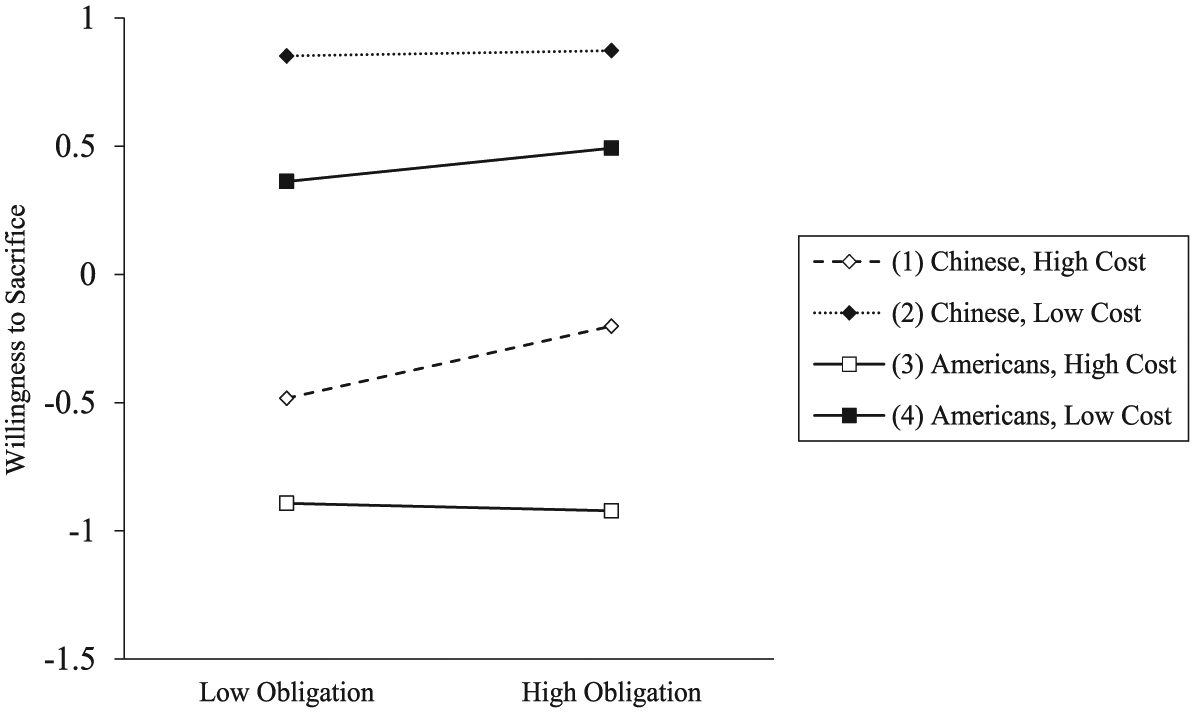
Culture and cost moderates the effect of family obligation on willingness to sacrifice.
Hardship
In terms of hardship, a 2 (culture) × 2 (cost) ANOVA revealed significant main effects of culture F(1, 253) = 73.562, p < .001, η2 = .910, and cost F(1, 253) = 148.696, p < .001, η2 = .373, with the Culture × Cost interaction not significant, F(1, 253) = 2.764, p = .098. As compared with Chinese (M = 2.70), European Americans (M = 3.81) associated greater hardship with sacrifice regardless of the cost. Cross-culturally, emerging adults associated greater hardship with high-cost (M = 4.04) than low-cost (M = 2.46) sacrifice.
Satisfaction
The 2 × 2 MANOVA that we undertook on satisfaction associated with making a sacrifice and satisfaction associated with declining to sacrifice revealed main effects of culture Λ = .732, F(2, 249) = 47.633, p < .001, η2 = .277 and cost, Λ = .404, F(2, 249) = 183.921, p < .001, η2 = .596, with the Culture × Cost interaction not significant, F(2, 252) = 0.008, p = .992. Regardless of cost, Chinese (M = 0.14) associated making sacrifices with greater satisfaction than did European Americans (M = −0.90). In contrast, European Americans (M = 0.49) associated declining to sacrifice with greater satisfaction compared with Chinese (M = −0.45). Overall, emerging adults from both cultures associated making high-cost sacrifice (M = −1.15) with less satisfaction than making low-cost sacrifice (M = 0.39), and associated declining to make high-cost sacrifice (M = 1.14) with greater satisfaction than declining to make low-cost sacrifice (M = −1.09). Interestingly, whereas emerging adults from both cultures associated satisfaction with declining to make high-cost sacrifices and dissatisfaction with declining to make low-cost sacrifices, Chinese emerging adults associated satisfaction with making sacrifices and dissatisfaction with declining to sacrifice, while European American emerging adults associated dissatisfaction with making sacrifices and satisfaction with declining to sacrifice.
Relationship between satisfaction and willingness to sacrifice
To examine whether culture and cost moderated the relationship between willingness to sacrifice and satisfaction in sacrificing, we undertook a moderated moderation analysis. Utilizing the Hayes (2013) PROCESS procedure (MODEL 3), we observed a significant willingness to Sacrifice × Culture × Cost interaction, b = 1.289, t(254) = 2.093, p = .037. When the cost of sacrifice was low, willingness to sacrifice predicted satisfaction with making sacrifices among Chinese, b = 1.404, t(254) = 3.345, p = .001, but not among European Americans, b = 0.014, t(254) = 0.049, p = .961. No such relationship occurred in the high-cost condition, b = 0.101, t(254) = 0.287, p = .774 (see Figure 2).
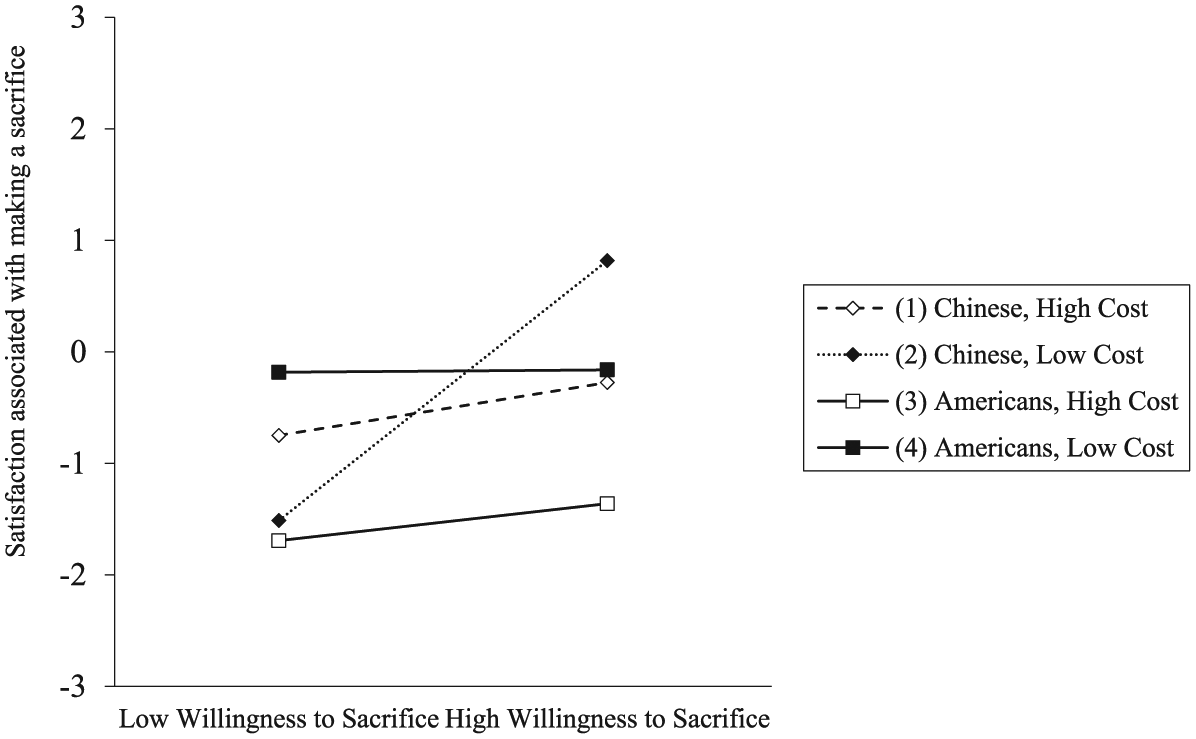
Culture and cost moderate the effect of willingness to sacrifice on the satisfaction in making sacrifices.
Guilt
In terms of guilt, we obtained a significant main effect of cost, F(1, 253) = 135.492, p < .001, η2 = .351, and a significant Culture × Cost interaction, F(1, 253) = 4.361, p = .038, η2 = .017, with the main effect of culture not significant, F(1, 253) = 2.897, p = .090. We decomposed this interaction by assessing simple effects separately for the low- and high-cost conditions. In the low-cost condition, Chinese emerging adults associated more guilt with declining to sacrifice than did European Americans, F(1, 122) = 8.522, p = .004, η2 = .066. However, contrary to our prediction, no significant effect of culture on guilt occurred in the high-cost condition, p = .798, F(1,130) = 0.066.
Discussion
Supporting our expectation that European Americans would be more sensitive to the cost of sacrificing to parents compared with Chinese, European Americans perceived the cost of sacrifice as higher and associated greater hardship with sacrifice than did Chinese. Extending previous findings indicating that Asian American emerging adults show greater willingness to make low-cost sacrifices than do European American emerging adults (Suzuki & Greenfield, 2002), our study provided evidence that cultural differences between Chinese and European American emerging adults extend to high-cost sacrifices.
Our study also provided insight into the relationship between sacrifice and family obligation (Fuligni et al., 1999). Congruent with Fuligni and Pedersen’s (2002) finding that Chinese and European American emerging adults endorse similar levels of family obligation, we found no difference between European Americans and Chinese in judgments of how obligatory it was to sacrifice for parents. However, among Chinese, their sense of family obligation predicted willingness to make high-cost sacrifices for parents, with this effect not observed among European Americans. This suggests that family obligation may be more consequential among Chinese than among European American emerging adults in motivating Chinese emerging adults to make high-cost sacrifices for their parents.
Documenting cultural variability in the emotional outcomes of sacrifice, we found that Chinese emerging adults associated more positive feelings with making sacrifices than did European American emerging adults. Moreover, culture moderated the relationship between willingness to sacrifice and satisfaction in the low-cost condition among Chinese but not among European Americans. We also observed no relationship between satisfaction and willingness to sacrifice in either culture in the high-cost condition. This suggests that cost qualifies when willingness to sacrifice brings satisfaction.
In contrast to previous findings (Suzuki & Greenfield, 2002) of no cultural difference in guilt associated with declining to make low-cost sacrifices, our data showed that Chinese associated more guilt than did European Americans with declining to make low-cost sacrifices. The variation in the results observed between the prior research by Suzuki and Greenfield (2002) and the present investigation may relate to the cultural background of the respondents. Suzuki and Greenfield’s research sampled Asian American college students whose outlooks may have been influenced both by their present bicultural experiences and by their parents’ experiences during migration. In our study, in contrast, the Chinese college students were born and living in their home country and thus were more exclusively influenced by Chinese cultural outlooks. Our results also imply that there are limits in the type of cost situation in which emerging adults associate guilt with declining to sacrifice. In particular, when the cost of sacrifice was high, Chinese did not associate more guilt with failing to sacrifice than did European Americans. This finding suggests that both culture and the cost of the sacrifice are important factors that should be taken into account in understanding emerging adults’ sacrificial behavior to parents.
General Discussion
The results support the hypotheses regarding the predicted tendencies for nonimmigrant Chinese emerging adults to be more willing to make high-cost sacrifices to their parents than European American emerging adults. Study 1 provided evidence for these predictions in the context of real-life sacrifice. Native Chinese emerging adults reported engaging in higher cost sacrifice for their parents than did European Americans, even as they did not differ from European Americans in the hardship they associated with sacrifice. Study 2 provided evidence that these cultural differences occurred when emerging adults appraised common vignette situations that included both low- and high-cost sacrifices. Study 2 also established a culturally variable relationship between family obligation and sacrifice, with family obligation functional in motivating emerging adults to make low-cost sacrifice for parents among Chinese but not among European Americans. Furthermore, the results highlighted boundary conditions, with Chinese and European Americans not differing in the guilt and satisfaction they associated with high-cost sacrifice.
Family Obligation and Sacrifice
In documenting culturally variable meanings associated with sacrifice, our results underscore the need to reconceptualize the relationship between sacrifice and family obligation. Previous studies have treated sacrifice as a component of family obligation, in including sacrifice as an individual item on the Attitudes Toward Family Obligation Scale (Fuligni, 1998). Our results, however, imply that family obligation plays a more central role in motivating sacrifice to parents among Chinese as compared with among European Americans. In particular, in Study 2 we observed that willingness to make high-cost sacrifice to parents was more closely linked to family obligation in the high-cost case among Chinese than among European Americans. Our results also provided evidence that, regardless of culture, sacrifice is less central to everyday family obligation than previously assumed. In Study 1, only about half of the European American and Chinese emerging adults reported having made sacrifices to their parents in the past 3 years. This low incidence of reported everyday sacrifice suggests that emerging adults may not consider sacrifice to parents to be a central part of everyday family obligation. The present findings highlight the need to consider the relationship of sacrifice to family obligation as an open question. In future research, it would be valuable to assess sacrifice and family obligation separately rather than to assume that sacrifice can necessarily be understood as a component of family obligation.
Distinguishing Between Cultural and Immigration Effects
Our results underscore the importance of distinguishing cultural from immigration effects. Although attention has been given to outlooks that are specific to the immigrant experience (e.g., Kang & Larson, 2014; Titzmann, 2012; Walsh et al., 2006; Wu & Chao, 2017), the dominant tendency in cross-cultural research has been to assume that the perspectives observed among Asian Americans reflect their maintaining a bicultural identity intermediate between their parent’s Asian cultural background and the U.S. cultural background they are experiencing. In adopting this assumption, however, researchers neglect to consider that immigration may not only reduce cultural differences but also influence outlooks in ways that are specific to immigration. Although our finding that Chinese sacrificed more than European Americans is congruent with the cultural differences in readiness to sacrifice observed in past research between Asian Americans and European Americans (Suzuki & Greenfield, 2002), our results involving guilt differ, with our findings and not those of Suzuki and Greenfield showing that Asians associate greater guilt with declining to sacrifice than do European Americans. The immigrant cultural groups in Suzuki and Greenfield’s research may have regarded sacrifice as a way of repaying their parents for the sacrifice associated with immigration and thus have felt less guilt about declining to sacrifice than did the present Chinese emerging adults who may have regarded sacrifice as an obligation reflective of long-standing Chinese cultural values. It is important in future research not to assume that the outlooks observed among recent immigrant populations necessarily resemble those observed among native cultural groups, but to explore more fully the motives that may be shared as well as those that may differ qualitatively among recent immigrant as compared with native cultural groups.
Methodological Implications
Our results have methodological implications for the assessment of sacrifice. A precondition for scale measurement is for respondents to understand the concepts assessed in the same ways. Our results, however, provided evidence that Chinese and European American emerging adults interpret sacrifice in ways that differ both qualitatively and quantitatively. In terms of qualitative differences, in Study 1 we showed that when asked to generate real-life examples of sacrifice, Chinese and European American emerging adults recalled distinct types of sacrifice, with Chinese mentioning issues involving change of life plans and American mentioning issues involving change of daily plans. In terms of quantitative differences, our study showed that European Americans rated the cost associated with sacrifice as higher than did Chinese. Thus, even though the instances of sacrifice generated by European Americans in Study 1 involved objectively lower cost than did those narrated by Chinese, European Americans appraised the sacrifice as involving the same levels of hardship as did Chinese. Likewise, in Study 2, European Americans rated the hardship portrayed in the common vignette situations as involving greater hardship than did Chinese.
The present findings suggest that some of the conclusions drawn in past research may be inconclusive. For example, Chinese American emerging adults have been found not to differ from European American emerging adults in their sense of family obligation as assessed by the widely used Attitudes Toward Family Obligation Scale (Fuligni & Pedersen, 2002; Juang & Cookston, 2009), with this finding explained as resulting from Chinese American emerging adults spending so much time studying that they are not available to engage in time-consuming family activities. Our results, however, imply that the scale may underestimate the extent of sacrifice found among Chinese populations. The family activities included on the scale under “Current Assistance” assess solely low-cost forms of help, and fail to include the types of sacrifice that involve change of life plans observed among the present Chinese sample. Also, whereas the scale includes the single item “make sacrifices for your family,” this item does not specify the type of sacrifice. Thus, even if Chinese and American cultural groups give similar responses to this scale item tapping how often they sacrifice for family, it is likely that the specific scenarios that Chinese, as compared with Americans, have in mind reflect sacrifice that is objectively higher in cost.
In sum, past findings of no cultural difference in family obligation during emerging adulthood may not only have occurred because Chinese Americans devote greater time to study but also because their contribution to family in the form of high-cost sacrifice was not fully assessed in the scale measurement. It is important to take both objective and subjective cost more fully into account when conducting studies involving between culture comparisons. This can involve explicitly sampling of specific high-cost instances of assistance, as well as avoiding the use of global statements, such as “make sacrifices for your family,” that are likely to be interpreted in distinctive ways in different cultural communities.
Footnotes
Declaration of Conflicting Interests
The author(s) declared no potential conflicts of interest with respect to the research, authorship, and/or publication of this article.
Funding
The author(s) received no financial support for the research, authorship, and/or publication of this article.