



Abstract
While ethnologists have long noted that females lack access to social capital across cultures, the magnitude of this effect is rarely examined. Here, we investigate the nature of gender bias in one dimension of social capital, reputation. We extract data on reputations from the electronic Human Relations Area Files (eHRAF) database, specifically the societies in the Standard Cross-Cultural Sample, and analyze whether there are fewer instances of feminine reputation relative to masculine reputation. In addition, we assess whether aspects of social structure or institutional biases in the production of ethnography affect the rate at which feminine reputations occur. We find that (a) most reputations are gendered male; (b) patrilocality and matriliny increase the rate at which feminine reputations occur, while patriliny decreases their occurrence; and (c) as female authorship increases over time, inclusion of feminine subject matter increases, which resulted in a greater incidence of feminine reputations. Ultimately, our analyses highlight the need for increased focus on feminine subject matters and gendered social capital in the discipline of anthropology.
Introduction
Scholars have noted for generations that women have less access to social capital than men (Lin, 2000; Marx, 1867/1976; Schultz, 1961). Social capital is generally defined as the ability to invest in relationships with some expectation of acquiring knowledge or skills, exerting influence, or gaining prestige and recognition within a social group (Lin, 2017). One well-studied dimension of social capital is reputation (Barclay & Willer, 2006; Macfarlan et al., 2013; Milinski et al., 2002; von Rueden et al., 2015). A reputation is a set of beliefs, perceptions, and evaluations members of a social group form about others based on identifiable behavioral tendencies (Macfarlan & Lyle, 2015). Reputations function by reducing transaction costs associated with social interaction; instead of investing considerable amounts of time and energy engaging in multiple face-to-face encounters, a reputation allows an individual’s abilities and intentions to be assessed solely from information given by others (Barclay, 2004; Macfarlan & Remiker, 2018). Consequently, the social capital (or lack thereof) a certain reputation provides can significantly dictate the quality and quantity of cooperative partnerships an individual has access to, as well as promoting the flow of other forms of wealth within communities (Barclay & Willer, 2006; Macfarlan et al., 2012; Macfarlan & Remiker, 2018).
Although reputations emerge in many spheres of social life (Macfarlan & Lyle, 2015), most quantitative ethnographic research has focused on male-biased samples (Macfarlan et al., 2012; von Rueden et al., 2015; von Rueden & Jaeggi, 2016; however, see Hess, 2017; Low, 2005; Power & Ready, 2018; Rucas, 2017). This raises questions pertaining to why discussion of reputation acquisition in women is so limited. If societies fail to recognize inter-individual differences in particular aspects of social life, a reputation cannot be formed. Therefore, if an individual or an entire class of individuals (e.g., women) has fewer opportunities to form a reputation, this will translate into fewer opportunities to mobilize resources through social connections and accrue benefits from communal recognition (Lin, 2017; Macfarlan & Lyle, 2015; Power & Ready, 2018). If women have less access to social capital generally, then there should be a cross-cultural pattern in the ethnographic record in which women have fewer opportunities relative to men to acquire social capital in the form of reputations. As such, we seek to understand the gendered nature of reputations in the ethnographic record.
Two bodies of research have emerged that attempt to explain why women are limited from achieving reputations. Cultural anthropological frameworks suggest that social structures dictating how the sexes are differentially evaluated will result in unequal opportunities to gain a reputation (Rosaldo et al., 1974). From this perspective, patricentric social systems that allocate power and resources primarily to men (e.g., patrilineal and/or patrilocal societies) should restrict women’s ability to form reputations by design (Rosaldo et al., 1974; Sargent & Brettel, 1993; Smuts, 1995). Conversely, matricentric social systems (Macfarlan et al., 2019; Mattison et al., 2019) that are matrilineal and/or matrilocal may open pathways for women to attain social capital in the form of reputations.
Alternatively, feminist theorists have suggested that limited understanding of feminine reputation is due to a history of institutional biases that discounted feminine social experiences generally (Lutz, 1990). These critiques can be partitioned into two arguments. One suggests that the discipline trained ethnographers to overlook “feminine” subject areas under the premise that men’s experience was more culturally normative (Ardener, 1975; Bell et al., 2013; Lutz, 1990). The second argues that the discipline of anthropology was mostly represented by male authors, who failed to capture the full diversity of women’s experiences (Begler, 1978; Bell et al., 2013).
While scholars have remarked that women’s social capital (and by association, women’s reputation) in the anthropological literature is relatively understudied (Power, 2018), we are aware of no study that quantitatively assesses the nature of this bias (although see Divale, 1976, on status). Most of anthropology’s current understanding of cultural variation in reputation comes from ethnographic descriptions of single cultural groups and their social customs. In this article, we examine the extent to which gender bias in reputations exist and the factors that might explain variability both across societies and ethnographic texts through an analysis of the electronic Human Relations Area Files World Cultures database (hereafter eHRAF)—see “Method” section. Our expectation is that masculine reputations will be mentioned more frequently in ethnographic reports than feminine reputations, and a greater number of reputation domains will be associated with masculinity rather than femininity.
As stated above, we attempt to adjudicate between two potential explanations for gender bias in reputations. If this pattern is driven by structural components of societies that limit women’s opportunities for acquiring social capital relative to men, then patrilineal and patrilocal societies should have fewer instances of feminine reputations relative to non-patrilineal and non-patrilocal societies, while matrilineal and matrilocal societies should have a higher incidence of feminine reputations relative to non-matrilineal and non-matrilocal societies. If gender bias in reputations is driven by a history of androcentric bias in anthropology, we should see that ethnographies authored by men will have fewer content dedicated to feminine subject matters related to ethnographies authored by women, and as more women-authored ethnographies have been introduced to the ethnographic record over time, the incident rate for feminine reputations should increase as well.
Method
eHRAF is an online database of ethnographies that report on aspects of cultural and social life for over 320 distinct societies and groups. The database can be analyzed at the document level by author, ethnographic text, and culture, and at the paragraph level for individual words and subject areas. Analyses were conducted using cultures in eHRAF that were also in the Standard Cross-Cultural Sample, a worldwide sample of 186 primarily preindustrial societies (Murdock & White, 1969). Due to the fact that several reputations can be mentioned in one cultural group, and that one cultural group can be covered in multiple documents, three distinct datasets were compiled organizing results by reputation, cultural group, and ethnographic text.
Reputation Dataset
To address the cross-cultural distribution of reputations in eHRAF, a primary dataset was created consisting of all individual mentions of reputation. The primary dataset was compiled using a combination of eHRAF’s Word Search Function and its Outline of Cultural Materials (OCM) indexing system, which catalogs paragraphs by relevant subject areas. Specific reputations were found using the Advanced Search tool to analyze the eHRAF documents collection, with the stipulations that search results would only produce paragraphs containing the keyword “reputation” and OCM Identifier 156 (“social personality”), 157 (“personality traits”), or 554 (“status, role, and prestige”). The particular keyword “reputation” was used to ignore conflation between conceptually distinct forms of social capital, such as an achieved status an individual has given himself or herself or an ascribed status assumed involuntarily (Linton, 1936). OCM Identifiers 156, 157, and 554 were selected based off of their relevance to topics pertaining to social capital in terms of evaluations made by a social group and associated with identifiable behavioral traits, ensuring that the result under discussion met the previously mentioned definition to classify as a reputation. After narrowing results to include only the cultures in the Standard Cross-Cultural Sample that appeared in the eHRAF database, search queries with the above specifications produced a total of 564 paragraphs from 274 specific ethnographic texts and 111 distinct cultural groups.
Paragraphs were analyzed for context to determine which behavior, character trait, or personal quality was associated with each particular mention of the keyword “reputation.” Results that identified a reputation as belonging to entire groups (e.g., lineages, tribes, religious followings) or non-human entities (e.g., animals, deities, locations) were eliminated from the sample to focus on individual differences in specifically human social capital. Using these methods, a final sample of 302 distinct reputations was compiled.
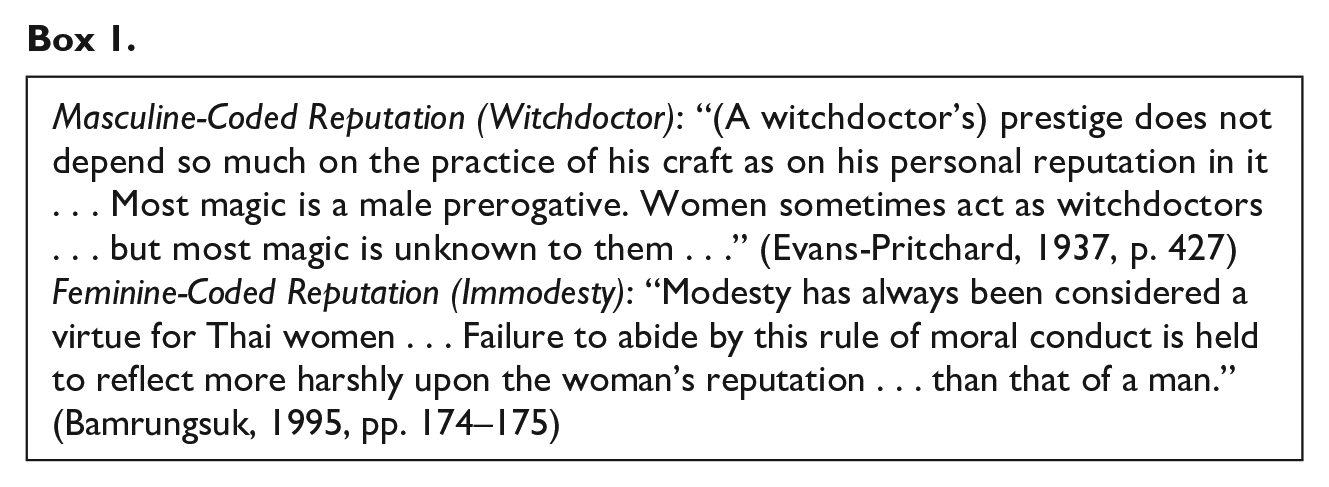
Reputations were then analyzed to determine gender affiliation. Reputations were designated as either “masculine” or “feminine” if the text explicitly assigned the reputation to a gender, only one gender’s pronouns (he/him/his vs. she/her/hers) were used when referencing subjects assigned with the reputation, and/or the text identified a reputation as customarily assigned to one gender with opposite-gender exceptions (Box 1). Reputations were designated as gender neutral only if the text did not clearly assign it to any gender and if there was no agreement of pronoun usage in reputation holders, or if the text explicitly assigned the reputation to “anyone” or both genders. Reputations that could not be identified by gender assignment were eliminated from this sample. Reputations were then classified into domains according to shared behaviors, group evaluations, and character traits that often arose concurrently in the text and across various cultures in similar contexts of social behavior. Twenty-one distinct reputation domains were identified in this sample (Table 1).
Descriptive Statistics Associated With Ethnographic Descriptions of Reputations Arranged by Reputation Domain.

Cultural Group Dataset
To analyze the effect of a culture’s social systems on the number of gendered reputations, a second dataset was created. We transformed the initial reputation dataset mentioned above so that each row represented a single cultural group (n = 94 cultures), and each cultural group contained information on the total number of feminine and masculine reputation domains (Table 2). Because a single cultural group may be the subject of multiple ethnographies, a variable was included to account for the number of texts mentioned per culture. In addition, we constructed four separate dummy-coded, binary variables for each culture regarding the predominance of (a) patrilineal descent, (b) patrilocal/virilocal residency, (c) matrilineal descent, and (d) matrilocal/uxorilocal residency. These dummy-coded variables were constructed from information contained within each group’s “Culture Summary” page in the eHRAF database.
Descriptive Statistics Associated With Cultural Group Dataset.

Ethnographic Text Dataset
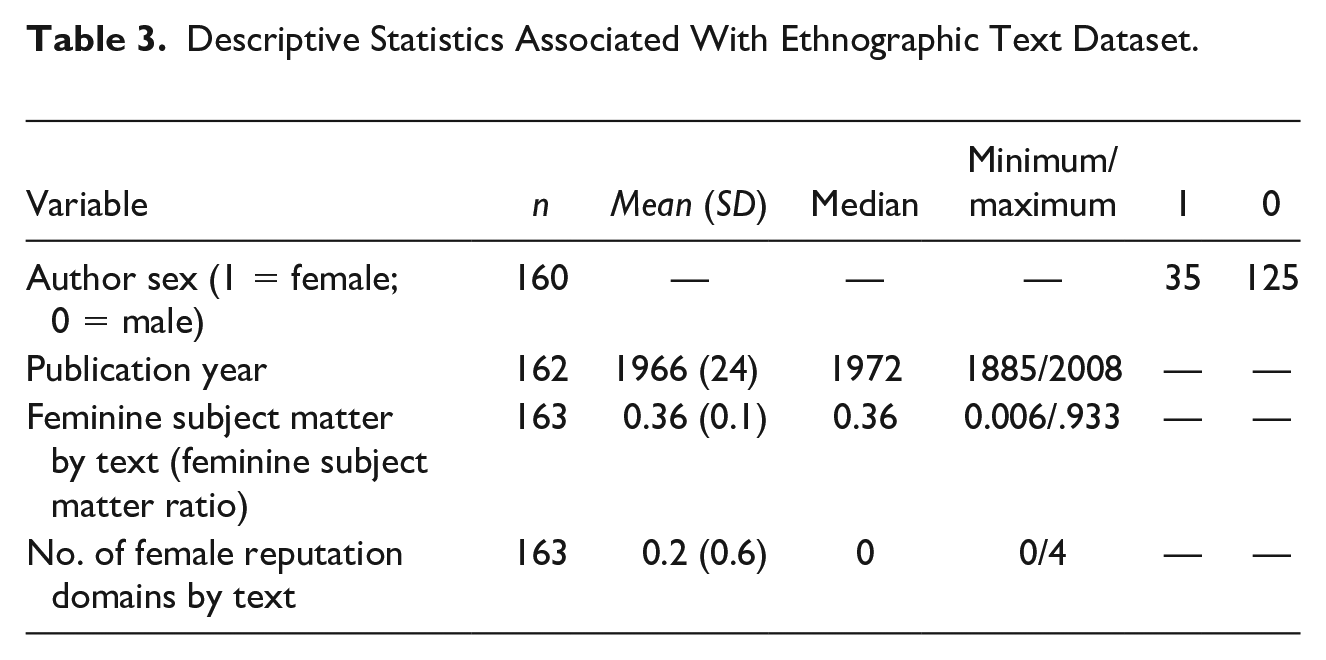
To analyze how document specific traits, such as an author’s sex, affected the inclusion of feminine content and the incidence rate for feminine reputations, a third dataset was created whereby each row represented a single ethnographic text (Table 3). The 94 cultures included in the cultural group dataset above represented 163 distinct ethnographic texts written by 147 authors (due to the fact that some authors had written multiple ethnographies about the same culture). For each ethnographic text, we included variables that identified the total number of masculine and feminine reputation domains contained within, as well as the sex of the text’s first author and the year of publication. The latter two variables were constructed using information contained in the “Publication Information” page that accompanied each text in the eHRAF database. The sex of the primary author was further assessed by examining how masculine or feminine pronouns were used by the primary author within the text and by researching information on authors’ biographies. The sex of the primary author could not be determined for three ethnographic texts. Furthermore, we constructed a variable that indexes the amount of content dedicated to feminine subject matter for each text that contained a paragraph that met the search criteria described in the “Method” section. The variable “Feminine Subject Matter Ratio” was created to assess how often masculine and/or feminine perspectives were recorded generally within the text, defined as the ratio of the number of feminine (she/her/hers) to total gendered pronouns (he/him/his and she/her/hers) present in each ethnographic text. Larger feminine subject matter ratios indicate greater use of feminine pronouns, and therefore more subject matter dedicated to women.
Descriptive Statistics Associated With Ethnographic Text Dataset.
Results
Are There More Masculine Reputations Than Feminine Reputations Cross-Culturally?
A primary aim of this study is to quantitatively assess the presence and magnitude of gender bias in reputations across human societies. If women are prevented from accessing equivalent amounts of social capital as men, then there should be fewer opportunities for women to acquire a reputation. Of the 302 reputations recorded, 174 were identified as masculine, 93 were gender neutral, and 35 were categorized as feminine (Table 1). A chi-square test for independence suggests that the overrepresentation of masculine reputations in this sample is more than what would be expected by chance alone (χ2 = 52.06, p < .00001).
To further investigate the nature of gender bias in reputations, we examine specific reputation domains. The 302 individual reputations mentioned above represent 21 distinct reputation domains (Table 1). The most frequently mentioned reputation domains include skill (n = 69), authority (n = 39), and supernatural roles (n = 35). Two reputation domains, “fidelity” and “virtue,” are exclusively feminine. Primarily masculine reputation domains include “ferocity,” “bravery,” “generosity,” and “provider.” A two-sample t test demonstrates that reputation domains are more likely to be associated with masculinity compared with femininity (masculine, M (SD) = 8.3 (11.8); feminine, M (SD): 1.7 (2.7); t = 2.5; df = 40; p < .008). Taken together, these findings indicate masculine gender bias in reputations across cultures.
Can Gender Bias in Reputation Be Explained by Structural Aspects of the Social Environment?
Frameworks from cultural anthropology suggest that aspects of societal organization structure how social capital is made available to each sex (Rosaldo et al., 1974). In societies where power and control are concentrated in men at the expense of women (i.e., patricentric societies), then women should have fewer opportunities to be recognized. As such, we expect to find that patrilineal and patrilocal societies will have fewer feminine reputations compared with non-patrilineal and non-patrilocal societies. Conversely, we expect societies with a matricentric bias (i.e., matrilineal and/or matrilocal societies) will have more feminine reputations compared with non-matrilineal, non-matrilocal societies.
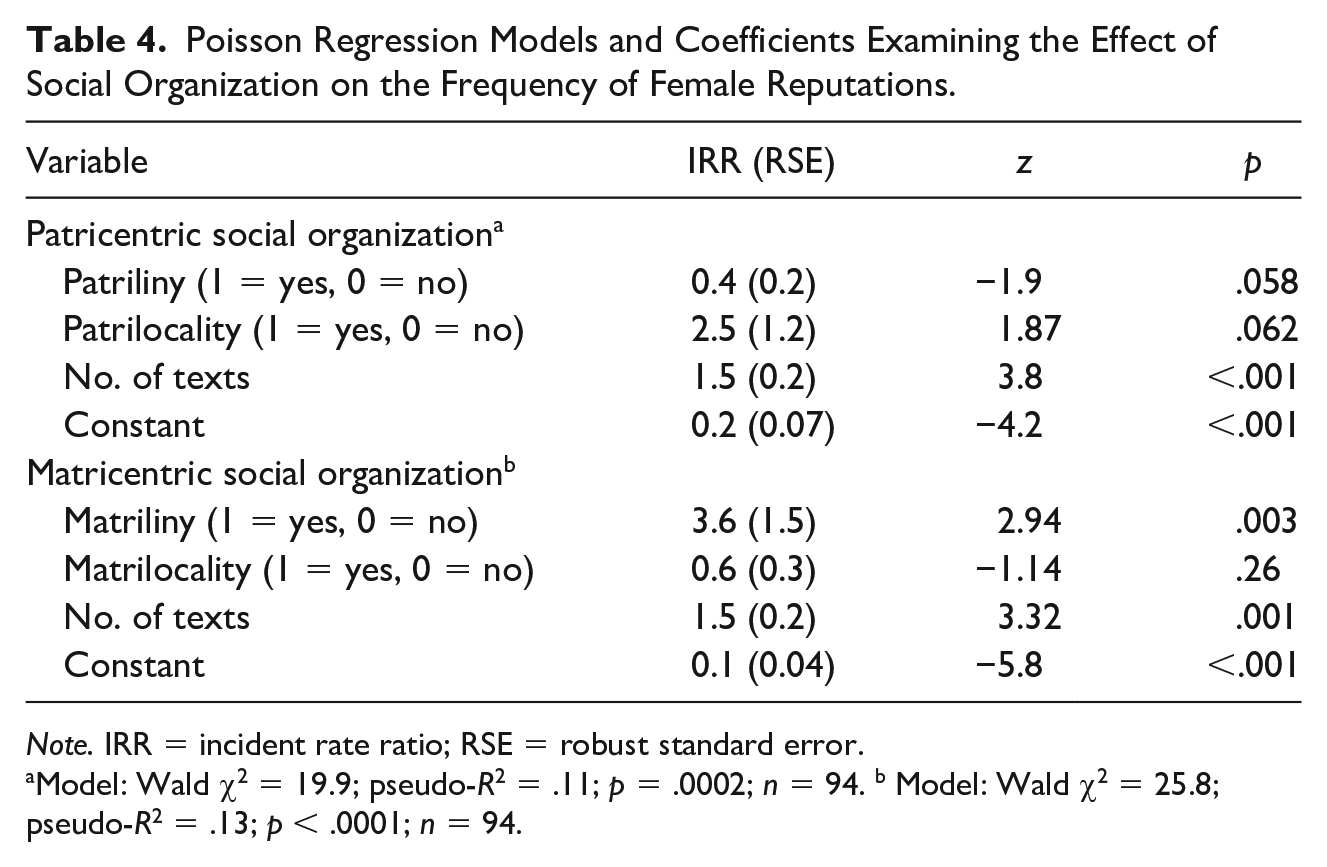
To assess these claims, we analyze the cultural group dataset using two Poisson regression analyses in STATA IC/15 (Rabe-Hesketh & Skrondal, 2012). The first model examines the effect of patriliny and patrilocality on the incidence rate of feminine reputations. The second analysis employs matriliny and matrilocality as independent variables. Furthermore, we account for the fact that some cultural groups have greater information than others using a control variable, “number of ethnographic texts.” The outcome variable for both models is the number of feminine reputations found within each culture. We find that patrilineal societies are associated with a 60% decrease in the expected number of feminine reputations which is marginally significant (p = .058), while counter to expectation, patrilocality was associated with a 2.5-fold increase in the incidence rate of feminine reputations (p = .062, marginally significant) (Table 4). Not surprisingly, as the number of texts written about a culture increased, the incidence of feminine reputations also increased (incident rate ratio [IRR] = 1.4, p < .001). Next, we find that matriliny is associated with a 3.5-fold increase in the incident rate of feminine reputation (p = .003), while matrilocality has no effect (IRR = 0.6, p = .26) (Table 4). Again, a greater number of texts written about a culture increased the incident rate at which feminine reputations occurred (IRR = 1.4, p = .001).
Poisson Regression Models and Coefficients Examining the Effect of Social Organization on the Frequency of Female Reputations.
Note. IRR = incident rate ratio; RSE = robust standard error.
Model: Wald χ2 = 19.9; pseudo-R2 = .11; p = .0002; n = 94. b Model: Wald χ2 = 25.8; pseudo-R2 = .13; p < .0001; n = 94.
Can Gender Bias in Reputation Be Explained by a History of Institutional Gender Bias in Anthropology?
Feminist critiques of anthropology suggest that institutional biases can decrease the likelihood that women’s social experiences will appear in the ethnographic record (Bell et al., 2013). This outcome can occur either because ethnographers were unable to capture the diversity of women’s experiences or because ethnographers were trained to ignore feminine topics under the presumption that men’s social experience was culturally normative and therefore more salient for ethnographic description (Ardener, 1975; Lutz, 1990). To assess these propositions, we use the “ethnographic text dataset” and employ a series of statistical analyses examining the relationships between primary author sex, year of publication, the proportion of text material dedicated to feminine subject matter, and the number of feminine gendered reputations per text. We employ Generalized Estimating Equations (GEEs) in STATA IC/15 (Rabe-Hesketh & Skrondal, 2012), which allow us to estimate population-averaged effects while taking into account the nested structure of our data (multiple ethnographies written about a single culture). All models reported herein use exchangeable correlation structures and robust standard errors (RSEs).
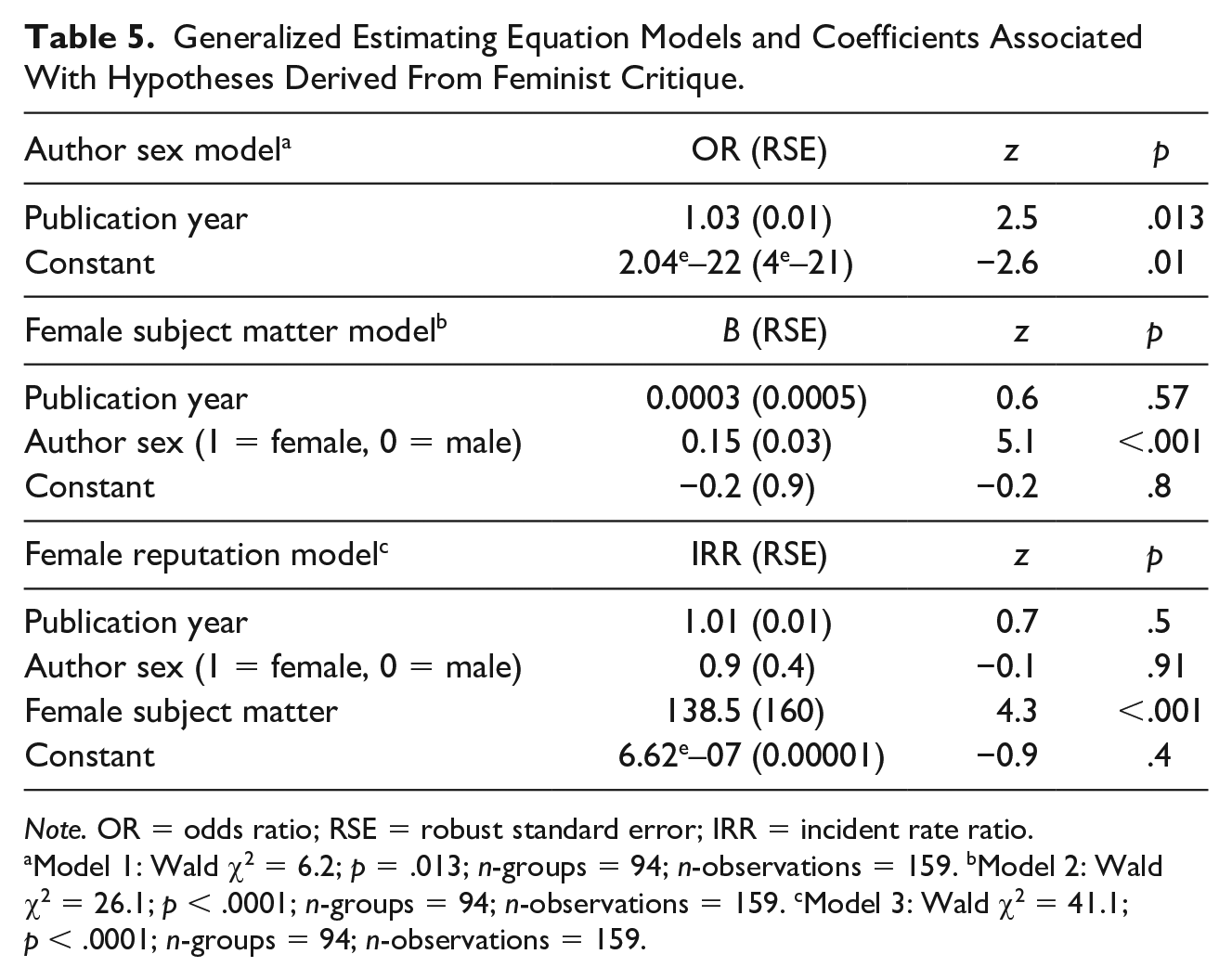
Our first model examines how publication year influences the primary author sex. As a binary outcome variable (primary author sex: 1= female, 0 = male), we employ a GEE logistic regression with a logit-link function. In this sample, the earliest text with a male first author appeared in the year 1885, while the earliest text with a female first author appeared over 40 years later in 1928. Consistent with feminist critiques, we find that the odds of female authorship increases significantly over time (odds ratio = 1.03, p = .013; Table 5, Model 1). Next, we examine how primary author sex and publication year affect the inclusion of feminine subject matter in ethnographic texts. For this analysis, we employ a GEE with a Gaussian distribution and an identity-link function to model the data. We find that female authorship significantly increases the amount of text dedicated to feminine subject matter (B = 0.14, p < .001); however, publication year had no effect (B = 0.0003, p = .57) (Table 5, Model 2). Last, we examine how publication year, author sex, and feminine subject matter affect the incident rate for feminine reputations within texts. Because the outcome variable (number of feminine reputation domains reported by text) represents a count process, we employ a Poisson distribution and a log-link function. Our model suggests that with greater inclusion of feminine subject matter in ethnographic texts, the incident rate for feminine reputations increases (Table 5, Model 3). Taken together, these findings support the contention that institutional biases in anthropology explain some variability in the cross-cultural patterning of gender bias in reputations.
Generalized Estimating Equation Models and Coefficients Associated With Hypotheses Derived From Feminist Critique.
Note. OR = odds ratio; RSE = robust standard error; IRR = incident rate ratio.
Model 1: Wald χ2 = 6.2; p = .013; n-groups = 94; n-observations = 159. bModel 2: Wald χ2 = 26.1; p < .0001; n-groups = 94; n-observations = 159. cModel 3: Wald χ2 = 41.1; p < .0001; n-groups = 94; n-observations = 159.
Discussion and Conclusion
The central aim of this study was to assess the nature of gender bias in reputations cross-culturally and elucidate the mechanisms that explain variability both across societies and ethnographic texts. Our results suggest that reputations are largely biased in favor of men and that this bias is partially due to aspects of social structure, as well as institutional biases in the production of ethnographic texts.
Our findings suggest that both descent and residence rules appear to affect how social capital is produced and structured within societies. Specifically, we show the incidence rate for feminine reputations increases in patrilocal and matrilineal societies, while patrilineal societies have lower incidence rates of feminine reputations. To be sure, a couple of the findings were contrary to expectation—patrilocality is a marginally significant predictor of more female reputations and matrilocality is not a significant predictor. The findings on lineality are generally consistent with expectations. Although many matrilineal societies still concentrate power in the hands of men, they also allow increased recognition of women’s roles and provide opportunities for women to compete among lineage members for social capital (Menon, 1996; Weiner, 1976). In contrast, patrilineal societies (which primarily focus attention on men who are expected to carry on the family line) are often associated with assigning women inferior status (Stone & King, 2018). Contrary to our initial predictions, patrilocality was positively related to the number of feminine reputations. This finding is consistent with previous studies that have called attention to the heightened importance of evaluating marriageable or recently married women in patrilocal societies (Stone & James, 1995; Stone & King, 2018). Potentially, residence systems facilitate greater opportunities for community members to assign a reputation to the sex arriving as a marriage partner, as opposed to the sex for whom residence rules prescribe natality. Such an explanation would be consistent with why we failed to detect a relationship between matrilocal residence and feminine reputations. Furthermore, this explanation predicts that matrilocality should have a positive effect on the presence of masculine reputations.
In addition, our findings suggest that institutional biases in the production of ethnographic texts have affected how women’s social capital is understood in the cross-cultural record. Consistent with historical trends in anthropology, our sample is dominated by male authors (Lewin, 2006). As our sample suggests, this bias is due in part to the fact that male authors began contributing to the ethnographic literature at much earlier dates than female authors. Fortunately, the overrepresentation of males in the production of ethnographic texts has improved, as a greater number of female authored documents has increased over time. This follows suggestions from feminist anthropology that increased inclusion of female ethnographers would correct for this bias (Bell et al., 2013). The increase of female authors over time has had a tangible impact on the amount of text dedicated to feminine subject matter, as measured through the use of feminine pronouns within a text. Subsequently, as the amount of subject matter dedicated to women increased over time, we see a proportional increase in feminine reputations in the cross-cultural record. Altogether, this study finds support for observations that androcentric bias in anthropology can explain gender bias in reputations.
While it is difficult to determine the exact mechanism influencing authors to bias their accounts toward primarily masculine forms of reputation, a variety of explanations can be put forth. Feminist anthropologists have long explained authors’ tendency to overlook female informants or feminine subject areas in ethnography as the result of ingrained sexism, either at the individual or discipline level (Begler, 1978; Lutz, 1990). Alternative explanations for why there are fewer mentions of feminine reputation include accounting for aspects of a culture’s gendered worlds. In many small-scale societies, cultural norms prevent men from interacting with women in equivalent social spheres (Sargent & Brettel, 1993). Male ethnographers’ access to female informants often are constrained due to their “stranger male” status, whereas female ethnographers are often admitted into women’s social life by virtue of their sex and subsequently provided more opportunities to comment on women’s reputation.
In addition, fewer mentions of feminine reputation could stem from evolved sex differences that favor conspicuous social capital acquisition and status competition in men. Men’s competition tends to take place in public settings and often involves large coalitions engaging in direct conflict (Hawkes et al., 2001; Lee & DeVore, 2017), while women are more likely to engage in indirect relational forms of competition (Bowser & Patton, 2010; Hess, 2017; Low, 2005; Rucas, 2017). Because reputation seeking in men is often more readily visible to both local observers and visiting ethnographers, masculine forms of reputation would be more likely to be mentioned in ethnographic texts. Furthermore, evolved sex differences in behavior also can play a part in influencing the emergence of gendered division of labor, which becomes encoded into cultural norms that dictate which activities men and women are expected to do (e.g., business leader, warrior, hunter; von Rueden et al., 2018). While previous research has acknowledged that gender differences in ethnographer reporting on women’s social status can occur, this can easily be confounded by the amount of time the ethnographer has conducted fieldwork, their cultural competency of the area, and the construction of study variables (Divale, 1976; Naroll, 1962; Whyte, 1978).
We hope our analyses catalyze future research into the full range of reputation domains that occur cross-culturally, as well as the nature of how reputations are differentially assigned value between the sexes (e.g., men are positively evaluated for promiscuity, whereas women are evaluated negatively). In this sample, the majority of reputation domains identified were associated with masculinity. The only reputation domains in this sample that were feminine biased were “fidelity” and “virtue.” While women clearly have more opportunities to acquire reputations in these domains, this does not necessarily mean that they were positively evaluated. Common themes that emerged cross-culturally in these domains were regulation of women’s sexual behavior through gossip or chaperoning, avoidance of adultery and sexual activity, and the negative consequences that occurred if cultural expectations were not met (Bamrungsuk, 1995; Chapelle, 1982; O’Meara, 1990). Social scientists have long recognized “double standards” between the sexes in expectations of sexual behavior and marriage fidelity where equivalent behaviors that would be coded as neutral or positive in men would be evaluated as negative in women, potentially explaining the lack of reputations available to men in these domains (Broude & Greene, 1976; Crawford & Popp, 2003).
A notable limitation of this study was the decision to use the single keyword “reputation” in this analysis, inviting the possibility that forms of reputation that could only be captured by using adjacent language would be overlooked. The authors acknowledge that these methodological errors are not accounted for in this sample. Future research could expand searches to use additional keywords that could capture a broader variation of reputation domains. In addition, this dataset assumes that a recorded reputation is fixed in time and space, while a reputation’s meaning and implications may vary widely between locations, time periods, distinct social groups, and even between ethnographers and ethnographies. Further analyses are required to determine the effects of these changes and to determine the robustness of current reputation domain categorization across cultures.
Overall, this study highlights issues previous researchers have articulated that anthropology has an insufficient understanding of how women acquire and utilize social capital cross-culturally. These findings suggest the possibility that multiple domains of feminine reputation may have been overlooked in the ethnographic literature or simply require more detailed reporting. This also suggests that when ethnographers generalize about reputation, they most likely are making conclusions more applicable to men, and in the discipline’s current state, there is inconclusive evidence to assume that acquisition of this form of social capital occurs identically in both sexes. In addressing the limited amount of feminine reputations found in eHRAF, we hope to underline the importance of focusing attention on women’s ability to acquire and maintain social capital throughout the discipline of anthropology. Based on our findings, we propose that the continued support of rigorous, evidence-based investigations into women’s social life and conducting ethnographic reports with mixed-gender teams will assist in correcting gender biases in the ethnographic literature in years to come.
Supplemental Material
SupplementaryCodebook-CCR_Revision_MinorChanges – Supplemental material for Tracking Cross-Cultural Gender Bias in Reputations
Supplemental material, SupplementaryCodebook-CCR_Revision_MinorChanges for Tracking Cross-Cultural Gender Bias in Reputations by Emily R. Post and Shane J. Macfarlan in Cross-Cultural Research
Footnotes
Acknowledgements
We would like to extend our thanks to Kristen Hawkes and Elizabeth Cashdan for their intellectual contributions to this manuscript, as well as three anonymous reviewers who provided valuable insights and commentary. We also wish to acknowledge the intellectual and financial support provided by the Global Change and Sustainability Center at the University of Utah.
Declaration of Conflicting Interests
The author(s) declared no potential conflicts of interest with respect to the research, authorship, and/or publication of this article.
Funding
The author(s) disclosed receipt of the following financial support for the research, authorship, and/or publication of this article: This study was supported by the Global Change and Sustainability Center at the University of Utah.
Supplemental Material
Supplemental material for this article is available online.
Author Biographies
References
Supplementary Material
Please find the following supplemental material available below.
For Open Access articles published under a Creative Commons License, all supplemental material carries the same license as the article it is associated with.
For non-Open Access articles published, all supplemental material carries a non-exclusive license, and permission requests for re-use of supplemental material or any part of supplemental material shall be sent directly to the copyright owner as specified in the copyright notice associated with the article.
