



Abstract
This article proposes a culturally implicit perspective of emotional intelligence and introduces the notion of culture-specific emotional intelligence (CSEI). Emotional intelligence (EI) as a construct has predominantly been associated with the individual. Given that emotions are also implicit beliefs and that their experience, expression, and management are known to be driven by cultural values, we suggest EI to be culturally embedded. We therefore suggest that EI is culture-specific. Culture-specific EI serves as an important social resource affecting behaviors. We provide a brief review of literature that elucidates the multi-level nature of EI and highlights the role of culture as both antecedent and moderator of CSEI. Implications for theory and cross-cultural phenomena are discussed.
Keywords
Introduction
Given the globalization of business activities, the role of emotional intelligence (EI) in examining cross-cultural phenomena is highly relevant (Crowne et al., 2009). While some scholars argue that culture may not influence EI (Mayer et al., 2002), others suggest cultural differences in EI (Ilangovan et al., 2007). Understanding the effect of culture on EI is important because an individual working with others who are outside his or her culture may not realize how the influence of culture on EI may affect their interactions (Crowne et al., 2009). Despite the above, research examining the relationship between culture and EI is limited (Crowne, 2013), and the cultural relevancy of EI needs to be understood. Without a detailed understanding of these differences across cultures, it is a challenge to evaluate consequential phenomena with a cross-cultural bearing.
Inquiry in this area of EI has been found predominantly at the individual level as EI models have been hypothesized as a form of emotion-related individual differences (Petrides et al., 2007a). Scholars have, however, suggested the implications of EI as a team or a group-level construct in predicting performance of the group (i.e., team or group EI was found to influence team or group characteristics). Team or group EI was found to be strongly related to the key dimensions of team or group interpersonal processes, including task orientation and maintenance function (Frye et al., 2006) and creative team efforts (Barczak et al., 2010). Group EI was found to increase group performance (Bell, 2007; Crombie et al., 2009; Jordan & Troth, 2004) as well as individual-level performance (Troth et al., 2012). EI at the group level was found to contribute to trust, cooperation, and reduced conflict, which ultimately enhanced group performance (Curşeu et al., 2015; Moore & Mamiseishvili, 2012; Peterson, 2012). The above discussions suggest that EI can be highly contextualized.
The contextual nature of EI is driven by the key principles of psychological processes, such as the idea that context influences the way individuals think, feel, and behave (Ybarra et al., 2014). Contexts could therefore lead to shared EI among individuals (Wagstaff et al., 2012). Extending this line of thinking, some scholars have recommended viewing EI as the output of the function, structure, and energy of the context rather than just an individual trait (Gantt & Agazarian, 2004). In summary, existing models allude to the fact that EI must be studied in relation to an individual’s context, hinting at the multi-level nature of EI (individual and the context). However, there is still a lack of common understanding among models surrounding the dynamics between EI and context or cultural relevancy. Our article addresses the above gap by suggesting a societal-level understanding of EI.
In particular, we seek to establish a culturally implicit perspective of emotional intelligence. Specifically, scholars have suggested that cultural dimensions interact with an individual’s ability to understand, regulate, and address emotions, which leads us to believe that EI traits can be culture-specific (Fernández-Berrocal et al., 2005; Ryan et al., 2012). Based on this perspective, we develop the notion of culture-specific emotional intelligence (CSEI) that could explain observed and reported cultural differences in EI. Addressing the cultural specificity of EI (Emmerling & Boyatzis, 2012; Sharma, 2012; Shipper et al., 2003) helps provide answers to the following questions that represent gaps in EI scholarship (Gohm, 2004). Is there a cross-cultural consistency of EI? Does EI have the same structure across cultures? Do culturally specific structures lead to the consideration of the specificity of cultures as contexts in defining EI, thereby necessitating its definition, operationalization, and understanding as a societal-level construct?
Our article is structured as follows. First, we present a brief literature review on the commonly used models of EI. Second, we present arguments to establish EI as highly contextualized and that it is culturally sensitive. Third, we introduce the notion of CSEI. Finally, we discuss implications of our study for theory, practice, and empirical research.
Commonly Used Models of Emotional Intelligence
The term “EI” was first used in scientific literature approximately three decades ago. Scholars have examined EI in a number of contexts such as education, social adjustment, health, personal, and work (Mayer et al., 2008). Over the years, although conflicting definitions and models have been developed, there seems to be considerable agreement on what EI is (Cherniss, 2010). Review of literature by Cherniss (2010) suggests that most researchers have accepted a basic definition proposed by Mayer et al. (2000, p. 396) that EI is “the ability to perceive and express emotion, assimilate emotion in thought, understand and reason with emotion, and regulate emotion in the self and others.”
Since the introduction of EI, several models have been developed (Fernández-Berrocal & Extremera, 2006), of which four models currently dominate the field (Cherniss et al., 2006). The first is Bar-On’s (1988) model where he was interested in identifying traits and skills, or in other words, non-cognitive factors that individuals need to adapt to social and emotional demands of life. In this model, EI is considered as a set of interrelated emotional and social competencies, skills, and facilitators that determine how effectively one understands and expresses oneself and/or understands and relates with others (Bar-On, 2006). The key components in this model are intrapersonal skills, interpersonal skills, adaptability, stress management, and general mood (Bar-On, 1997, 2006).
The second model (also referred to as the ability model) is based on research by Mayer, Salovey, and Caruso (Mayer & Salovey, 1997). They consider their model to represent a “mental ability” approach, and measures based on it tend to relate more with cognitive ability tests than with personality tests (Mayer et al., 2008; Van Rooy & Viswesvaran, 2004). As per this model, EI has the following four dimensions: (1) perceiving and expressing emotions—the ability to identify and process emotional information in self or others; (2) using emotions—the ability to harness emotions to guide cognitive activities and solve problems; (3) understanding emotions—the ability to analyze the cause and effect between events and emotions; and (4) regulating emotions—the ability to select emotion regulation strategies (or emotion regulation knowledge).
The third model of EI, based on research by Boyatzis and Goleman (Boyatzis & Sala, 2004), was designed to cover the social and emotional competencies that are linked to good performance in the workplace (Cherniss, 2010). This model comprises the specific competencies of: (1) self-awareness—the ability to know one’s emotions, strengths, weaknesses, drives, values, and goals; (2) self-management or self-regulation—controlling or redirecting one’s disruptive emotions and impulses to adapt to changing circumstances; (3) social awareness—considering other people’s feelings; and (4) relationship management—managing relationships to move people in a desired direction. The above form the bases to develop competencies that result in outstanding work performance (Goleman, 2001).
The most recent model (also called the trait model) was designed to include many of the personal qualities in the earlier models and it included all “personality facets that are specifically related to affect” (Petrides et al., 2007c, p. 274). This model, which focuses on noncognitive factors, defines four self-perceptions encompassing an individual’s behavioral dispositions (Petrides & Furnham, 2001). These behavioral dispositions are: (1) well-being (which includes self-confidence, happiness, and optimism)—generalized sense of positivity, happiness, and fulfillment extending from past achievements to future expectations; (2) sociability (which includes social competence, assertiveness, and emotion management of others)—the degree to which individuals establish social interactions, social relationships, and social influence; (3) self-control (which includes stress management, emotion regulation, and low impulsiveness)—the degree to which individuals have control over urges and desires; and (4) emotionality (which includes emotional perception of self and others, emotion expression, and empathy)—the degree to which individuals believe that they have a wide range of emotion-related skills.
The above four models are associated with different measurement strategies (Cherniss, 2010); the Bar-On’s model and trait model have been operationalized primarily through self-report measures; the Mayer et al. (2002) model has used ability tests; and the Boyatzis and Goleman model has used a multi-rater instrument. Most commonly used models in scholarly inquiry are the ability and the trait models as both the models are considered complementary (Zampetakis et al., 2009). While the ability approach refers to one’s actual ability to identify and use emotion-related information, the trait approach refers to self-perceptions concerning one’s ability to identify and use emotion-related information. The trait model (or trait EI) is contextualized within the personality framework and is evaluated through self-reported measures of behavior (e.g., Bar-On, 1997; Salovey et al., 1995). Ability EI measures attempt to capture the latent ability to perceive, use, understand, and regulate emotions (La Palme et al., 2016). Since trait EI is conceptualized as “a constellation of emotion-related self-perceptions and dispositions at the lower levels of personality hierarchies” (Petrides et al., 2007b, p. 26), it is considered as the shared affective variance within the personality domain that is sampled by lower order facets (Siegling et al., 2015) such as adaptability and empathy.
We now extend the understanding of EI, which has typically been at the individual level, to the societal level.
Establishing Emotional Intelligence as Highly Contextualized
Scholars have suggested that context plays an important role in cultural differences in emotions (Matsumoto et al., 2012). It can therefore be inferred that the emotional system is activated by factors or events outside of the physical bodies of individuals. These events or factors are often connected to social interactions and relationships (McCarthy, 1989). The stronger the interdependence among members of a society, the more probable they are to invoke or trigger emotions in one another. Therefore, their emotions will be more strongly linked (Clark et al., 2004). Such inextricable linkages lead to shared emotions among members of society (Kelly & Barsade, 2001). Collective emotions are shared by members of society because of their membership to that society (Smith, 1993; Stephan & Stephan, 2000). Individuals are socialized to feel and express emotions in a manner that is acceptable and/or endorsed by society (Averill, 1990). In other words, individuals are conditioned to emotional orientation specific to their culture. These observations lead us to believe that EI is shared among members of a society and it is culturally embedded.
Cultural Sensitivity of EI
Studies have recognized the observed influence of cultural values on EI. Our review of these studies has indicated the cultural relevancy of EI through two ways. First, cultural values directly influence EI or its dimensions. Second, the influence of EI on attitudes and behavior is culturally dependent. We discuss the findings of each of the above strands as follows.
Culture is defined by values and norms that, to a large extent, form the basis of what is valued by individuals in a society. Cultural sensitivity of EI was recognized at the initial conceptualizations of EI. As suggested by Mayer and Salovey (1997), examining EI entails going beyond emotions to understand the individual’s cultural context. The norms or implicit standards that exist in societies determine the meaning of emotions, their expressions, and their control (Eid & Diener, 2001). Evidence from meta-analysis further suggests that cultural values and beliefs influence the individual’s perceptions, emotions, and cognitive schema (Taras et al., 2010). Expressing emotions and reacting to emotions may therefore differ across cultures.
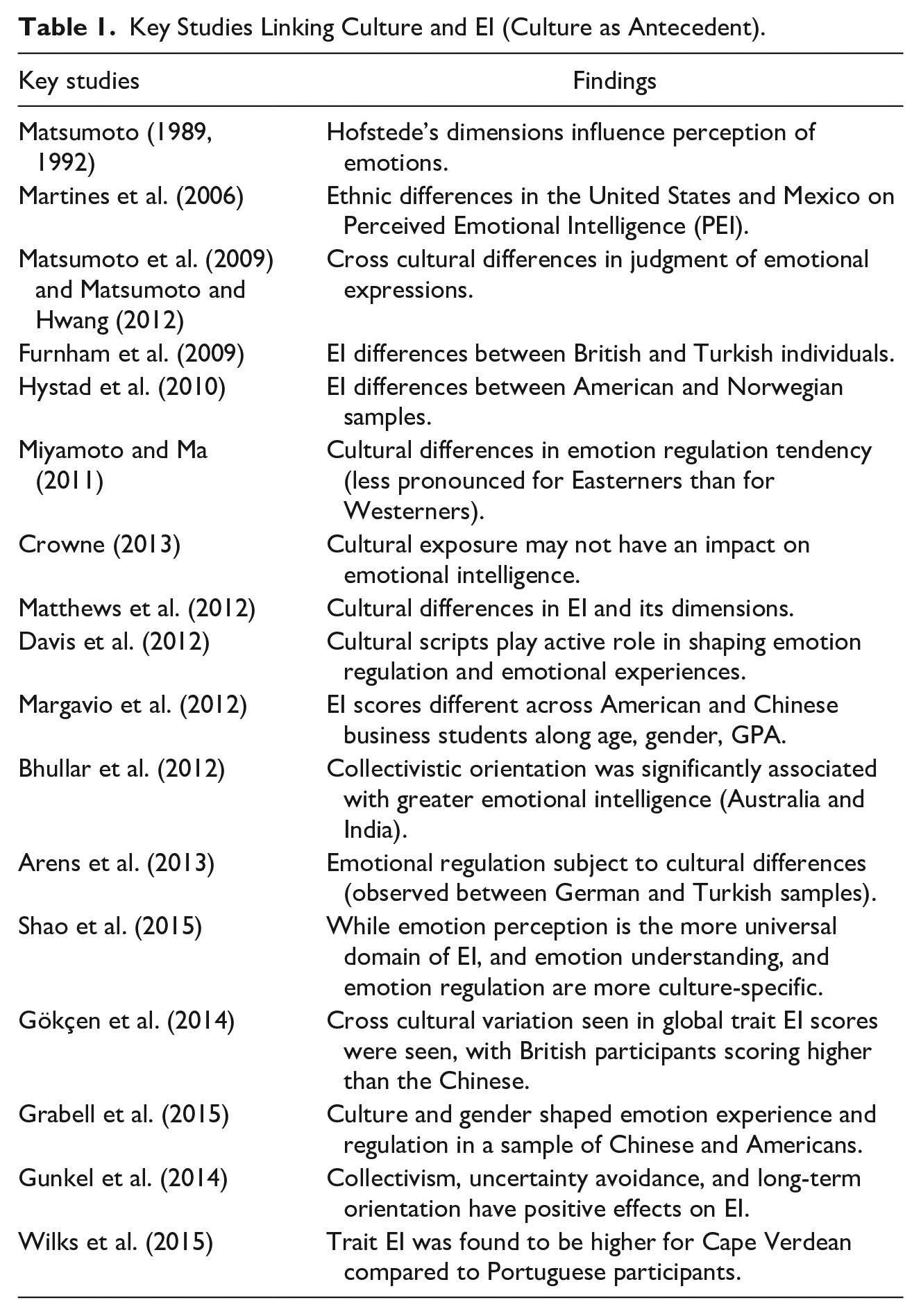
Different cultural predictors were found to influence EI differently. Cultural values of collectivism, uncertainty avoidance, and long-term orientation have been observed to positively influence various dimensions of EI (e.g., Fernández-Berrocal et al., 2005; Gunkel et al., 2014; Matsumoto, 1989). Extant literature on cross-cultural research suggests that individualistic-collectivistic orientations of society tend to shape and influence psychological processes. In comparing Australian societies with Indian societies, it was found that a collectivistic orientation was significantly associated with greater EI (Bhullar et al., 2012). EI as a characteristic of business students has been a line of inquiry among scholars. In comparing Chinese and American business students, it was found that EI scores were significantly different between these two groups when factors like age and gender were considered (Margavio et al., 2012). EI has also been compared across different ethnicities. Perceived EI was found to be different across ethnic groups such as African Americans, Latino Americans, Caucasians, and Mexicans (Martines et al., 2006). Specifically, cross-cultural differences in trait EI have been reported by scholars (Gökçen et al., 2014; Wilks et al., 2015).
While EI scores were found to vary across cultures (Furnham et al., 2009; Hystad et al., 2010; Margavio et al., 2012; Matthews et al., 2012), variations were also observed in the key dimensions of EI. For example, culture-specific aspects of the emotion perception branch of EI were observed (Matsumoto, 1989, 1992; Matsumoto et al., 2009). Shao et al. (2015), however, suggest that while emotion perception could be more universal, emotion understanding, and emotion regulation are more culture-specific.
Significant cross-cultural variance in the experience and regulation of emotions, as well as the value placed on emotions and the manner of their expression, were observed. In comparing Western and East Asian cultures, scholars suggest that emotion regulation strategies may contribute to differences in emotional experiences between cultures (Davis et al., 2012). Further, in line with the model suggested by Matsumoto and Hwang’s (2012) model of culture and emotion, emotion understanding and emotion regulation branches of EI were found to be more culture-specific (Arens et al., 2013; Shao et al., 2015). Emotion-regulation tendency, mediated by different beliefs surrounding emotions, was found to be less pronounced for Easterners than for Westerners. This suggests the influence of culture in shaping emotional experiences and regulation of emotions (Grabell et al., 2015; Miyamoto & Ma, 2011).
Cultural context defines the standards to which emotions and reactions to emotions of individuals can be assessed. The individual’s shared values and norms drive attitudes and behaviors, influencing the way in which emotions are recognized, evaluated, and acted upon. An individual who displays certain EI behaviors in one culture may not be perceived as displaying the same in another (Ang et al., 2007). Although EI can be shared among members of a society, extant studies that have linked EI to performance outcomes and behaviors have largely assumed that it is the same across cultures (Brackett et al., 2006; Côté & Miners, 2006; Lopes et al., 2004). For example, García-Sancho et al. (2014) suggest that individuals with high EI consistently show less aggression across all cultures. Studies on leadership, management effectiveness, and life satisfaction studies have, however, shown differences.
Comparing Indian students with German students, it was found that Indian students reported less subjective well-being and EI than German students, and EI was associated with life satisfaction to a higher degree in Germany than in India (Koydemir et al., 2013). Differences in power distance between countries (U.S., U.K., and Malaysia) were also found to influence the effect of EI on managerial effectiveness (Shipper et al., 2003). Americans and Chinese individuals were observed to react differently in response to success and failure. This suggests that culturally framed emotional reactions to success and failure, as well as subsequent expressions, result in different patterns of anticipated self-regulation (Zhang & Cross, 2011). The Americans tend to continue with the task after success; the Chinese continue after failure. Such differences in behaviors were accounted for by cultural differences in emotional reactions. Scholarship in the area of conflict management have clearly shown the moderating influence of culture in the EI-conflict management relationship. Culture was also found to moderate the link between trait EI and emotion regulation strategies adopted in European-American and East Asian Japanese populations (Nozaki, 2018). Similarly, the link between EI and creativity was also found to be influenced by culture when comparing East Asian populations with American and European ones (Xu et al., 2019). At the firm level, organizational cultural dimensions of collectivism and power distance measured by Global Leadership and Organizational Behavior Effectiveness (GLOBE) was found to moderate the relationship between EI and communication satisfaction among managers of Serbian organizations (Nikolić et al., 2014). Cross-cultural differences were also found in conflict management studies. The influences of EI dimensions (i.e., self-awareness, self-regulation, motivation, empathy, and social skills) on conflict management strategies were observed to vary across countries, including the United States, Greece, China, Bangladesh, Hong Kong, Macau, South Africa, and Portugal (Rahim et al., 2002). Gunkel et al. (2016) specifically suggest that uncertainty avoidance and long-term orientation influence preferences for conflict handling styles of compromising, obliging, and integrating through EI.
Another area where the moderating effect of culture was observed in the cultural relevancy of EI is in leadership studies. Differences were observed in the effects of EI on transformational leadership practices as a function of culture when comparing the contexts of Taiwan with that of the USA (Tang et al., 2010). Scholarship on leader-subordinate links suggest that culture moderates the relationship between leaders’ EI and subordinates’ task performance and satisfaction (Miao et al., 2016, 2018a). Similarly, the positive relationship between EI and leaders’ entrepreneurial intentions was found to be moderated by the long-term orientation of the culture (Miao et al., 2018b).
Finally, the cultural relevancy of EI makes understanding its measurement equivalence across cultures an important issue. Previous research has reported measurement equivalence to a large extent of the various scales used in the measurement of EI across various cultures (Karim & Weisz, 2010; Libbrecht et al., 2014; Wang et al., 2012). While the above research examining measurement equivalence of self-reported EI may not detect cultural differences (La Palme et al., 2016; Matthews et al., 2012), demonstrating measurement equivalence is a prerequisite to comparing (a) mean levels of EI and (b) relationships of EI with other constructs across cultures.
In summarizing the theme of EI at the cultural level, our findings clearly suggest the importance of the influence of culture on EI and the role of cultural context in understanding EI and consequent behavior (Lopez-Zafra et al., 2012; Soto et al., 2011). The findings from the key studies linking culture and EI (i.e., culture as antecedent and culture as a moderator) are listed in Tables 1 and 2. Cultural impact on EI has been recognized as valid and is therefore a concern to be addressed before using EI to understand cross-cultural phenomena (Antonakis, 2003, 2004). While the above research examines EI primarily at the individual level, we suggest the notion of a cultural-level EI or CSEI.
Key Studies Linking Culture and EI (Culture as Antecedent).
Key Studies Linking Culture and EI (Culture as Moderator).

The Notion of Culture-Specific Emotional Intelligence
Psychology research prioritizes the role of the individual and renders the role of social context on emotion regulation as negligible (Haga et al., 2009). Yet researchers recognize that emotions are embedded in social contexts (Campos et al., 2004; Keltner & Haidt, 2001) and certain aspects of emotion are more culture-specific (Matsumoto & Hwang, 2012). As discussed in our earlier sections, cultures can play an important role in the manner in which emotions can be regulated (Campos et al., 2004). We draw on insights from the knowledge structure approach and implicit theory of emotions to suggest that EI could be culture-specific. The knowledge structures approach involves conceptualizing culture in terms of implicit beliefs about the world (Nisbett et al., 2001; Peng & Nisbett, 1999). Judgment and actions on emotions are culturally driven implicit beliefs that differ across cultures (Nisbett et al., 2001).
The contextual influence on EI is further supported by implicit theories of emotions, which suggests that implicit theories of emotion, distinct from intelligence, are related to both the emotional and social adjustment with context (Tamir et al., 2007). Beliefs imply certain expectations that guide behavior (Olson et al., 1996). Specifically, beliefs about controllability guide the way individuals construe their reality and influence their motivation to indulge in self-regulation (Bandura, 1986). Based on the above assumptions, Dweck and her colleagues (Dweck, 1996; Dweck et al., 1995a, 1995b) have studied beliefs about the malleability of personal attributes (Tamir et al., 2007). These beliefs tend to be implied rather than explicitly held and hence have been referred to as implicit theories (Tamir et al., 2007). Therefore, the understanding of implicitly held theories that individuals of different cultures hold about the nature of the world may explain the precise mechanisms through which the culture basis of EI can be argued (Peng & Knowles, 2003). Specifically, this approach may explain judgments regarding emotions to be culturally driven beliefs that are implicit.
In summary, EI, which cannot be considered universal across cultures (Earley & Ang, 2003; Earley & Peterson, 2004), is reflected through commonly shared norms about emotions, their expressions, and their use in a society. This feeds into the notion of culture-specific EI or CSEI. The above understanding of culture-specific EI leads us to propose a culturally implicit perspective of EI.
Culturally Implicit Perspective of Emotional Intelligence
Culture, as mentioned earlier, can be defined as patterns of values, attitudes, and beliefs that influence the behaviors of individuals (Hofstede, 1980, 2001; Schwartz, 1994). Cultures have been found to vary on a variety of basic values and attitudes (e.g., Hofstede, 2001; House & Javidan, 2001). Extant research suggests, and as presented in the earlier sections, EI is likely to vary across cultures. We can also infer that the macro-level nature of EI can be argued using social construction models. When most individuals in a collective have similar or comparable levels of EI, then that EI becomes the dominant EI for the collective. This understanding can be extended to key dimensions of EI that constitute the commonly used ability and trait models of EI.
Ability EI models characterize EI as an individual’s capacity to solve problems using emotions (Mayer & Salovey, 1993). Trait EI models focus on personality attributes (Bar-On, 2002) as traits refer to behavioral tendencies (Leung et al., 2014). Expressing emotions is a key dimension of the ability EI model. Given that there are unique local languages and local moral orders, cultures can use the same emotion and express it in very different ways (Harré, 1986). Thus, emotional expressions are culturally prescribed performances rather than internal mental events. Further, knowing a social script for a certain emotion allows one to enact the emotional behaviors that are appropriate for the cultural context (Gross & Barrett, 2011). This makes the display of such emotional behaviors implicit to the context. This argument on the cultural embeddedness of emotional expressions (a dimension of EI) is also true for other dimensions of the ability EI model, including perceiving, using, understanding, and regulating emotions (Gross et al., 2006; Tsai & Chentsova-Dutton, 2003). One of the greatest assets as natives of a culture is their ability to quickly “read” (perceive) another person’s emotions. One would use, understand, and regulate one’s emotions by drawing cues from what is culturally acceptable and in line with implicitly held norms, including gestures or values.
Within the purview of the trait EI model, its four broad EI dimensions are also subject to the specificity of cultures. For example, members from different cultures will differ in their perceived subjective well-being (SWB), which is a function of life satisfaction, optimism, happiness, and self-esteem. Some cultures have higher levels of SWB based on both economic progress and cultural norms regarding what is seen as a happy state of affairs. In a cross-country comparative study, the constituent dimensions of trait EI have been reported to vary significantly across cultures (Gökçen et al., 2014).
Although several other models of EI exist in the literature, common dimensions among them are the abilities to manage and understand one’s own emotions, as well as the emotions of others (Bar-On & Parker, 2000). Emotional recognition, recognized as the core facet of EI, appears in Mayer and Salovey’s (1997) model as the ability to perceive emotions in oneself and others. While earlier studies provided evidence of universality in emotional recognition (e.g., Ekman, 1972; Ekman & Friesen, 1971; Izard, 1971), more recent studies have evidenced cultural differences in the same (e.g., Elfbein & Ambady, 2002; Huang et al., 2001; Matsumoto & Ekman Leu, 1988; Mesquita & Frijda, 1992; Russell, 1994). Therefore, we suggest that the key dimensions of emotional recognition and management are culturally implicit and are applicable regardless of the EI model discussed, the reason being that emotions are embedded in larger social and cultural contexts and many aspects of an individual’s emotional experiences are shaped by culturally implicit values (Cross & Madson, 1997; Mesquita & Frijda, 1992). These arguments are in line with the growing body of research that has highlighted the impact of culture on psychological processes through implicit beliefs (Gökçen et al., 2014). These beliefs are the mechanisms, which are more proximal to behavior, thereby making culture a more distal influencer of behavior. Therefore, emotional recognition and its management, we argue, are endorsed and reinforced by culture.
Our above argument draws support from extant scholarship on the implicit theory of emotions referring to an individual’s emotional and social adjustment in a cultural context. The adjustment of individuals in cultural contexts leads to implications for socioemotional functioning as displayed by behaviors (Tamir et al., 2007). Although implicit theories have been developed keeping individual beliefs in mind, empirical evidence in a leadership context suggests that it can be extended to organizational and societal levels of analyses (Dorfman et al., 2012). We extend EI at the individual level to the national or societal level of analysis. This notion of macro-level beliefs being abstracted from individual beliefs finds support in cross-cultural research (Muralidharan & Pathak, 2017; Pathak & Muralidharan, 2020; Stephan & Uhlaner, 2010).
In summary, cultures differ in their views on emotional experiences and emotional management, which supports the contextualized view of EI. We view these cultural differences in the way emotions are experienced and managed as a culturally implicit perspective of EI. We now present some of the implications of CSEI.
Implications of Culture-Specific Emotional Intelligence for Theory
The notion of CSEI potentially provides a holistic understanding of cultural-level EI. It can be invoked to further understand the role that cultural differences in EI play in cross-cultural phenomena and behavioral outcomes. For example, EI is known to shape work-related behaviors in employees—for example, career choice (Emmerling & Cherniss, 2003), career commitment, and entailing decision-making processes (Brown et al., 2003), career adaptability (Coetzee & Harry, 2014), career success (Goleman, 1995, 1998), etc. Our proposed perspective can inform theory on how these work-related aspects vary across cultures.
Our proposed perspective has the potential to contribute to the discussions on the fit between culture and entrepreneurship. Observed variance in entrepreneurial behaviors have been accounted for based on cultures (Autio et al., 2013; Muralidharan & Pathak, 2018; Pathak & Muralidharan, 2016). The central tenet in this line of research is that cultures shape entrepreneurial behaviors. An individual’s EI has been known to shape entrepreneurial behaviors such as risk-taking (Salovey & Mayer, 1990; Yip & Côté, 2013), resilience (Tugade & Fredrickson, 2004), tenacity, etc. Given that cultures shape EI, and EI shapes entrepreneurial behaviors, therefore by extension, the understanding of culture-specific EI has an important place in the culture-entrepreneurship fit perspective. EI is also known to shape pro-social behaviors (Côté, 2011), such that our proposed perspective can also inform theory on cross-cultural comparative social entrepreneurship (Muralidharan & Pathak, 2018, 2019). Further, a recent study has found that the effects of culture on behavioral dispositions are distal—mediated by cultural leadership styles (e.g., Stephan & Pathak, 2016)—rendering cultural leadership styles as more proximal influencers of entrepreneurial behaviors. EI shapes leadership styles and their effectiveness (Deng & Gibson, 2009; Kerr et al., 2006). Given EI varies by culture, so will cultural leadership styles. The notion of CSEI therefore has the potential to be a proximal predictor of behavioral dispositions. In other words, it has the potential to mediate the relation between culture and entrepreneurial behavior (Tung et al., 2007). Identifying the precise position of the notion of CSEI in the culture-entrepreneurship fit perspective and possible mechanisms through which CSEI shapes entrepreneurial behaviors offers scope for further research.
The notion of CSEI can also have implications for cultural leadership theories (CLT). Cultural values shape the cultural expectations and views of ideal leadership, and leaders behave in line with these expectations. These expectations are stereotypical ideas about the attributes and behaviors of effective leaders (House et al., 2004; Javidan et al., 2006). As such, CLTs are culturally embedded (Muralidharan & Pathak, 2018; Pathak & Muralidharan, 2018). Given EI shapes an individual’s leadership style, and cultures shape EI, then by extension CSEI will profoundly shape CLTs. As such, the notion of CSEI will have implications for understanding cross-cultural leadership styles that tend to be effective in their respective contexts.
Further, the notion of CSEI can also be used in tandem with other theories. The theory of positive emotions (Fredrickson, 2004), or psychological theory of resilience, etc., that have largely been used to explain behaviors at the individual level, can now be used alongside the notion of CSEI to understand cultural differences in such behaviors. Cultures are known to vary in terms of their perceived subjective well-being. The well-being branch of trait EI could be used in light of the broaden-and-build theory of positive emotions (Fredrickson, 2004). This theory suggests that positive emotions (i.e., happiness/enjoyment/fulfilment/joy/life satisfaction) broaden one’s awareness and encourage novel, varied, and exploratory thoughts and actions. Therefore, individuals with a higher perceived well-being are likely to pursue entrepreneurship. Furthermore, happier individuals are likely to engage in positive situational assessments (Spector, 1998), resulting in a different risk-benefit calculus (Miller et al., 2012). Instead of viewing challenges as obstacles, individuals with high perceived well-being develop and provide solutions to address unmet needs and unresolved problems (Dutton, 1992). Their ability to consider challenging contexts as manageable translates into their higher willingness to take risks. Well-being provides an increased sense of clarity in overcoming ambiguous situations. The notion of CSEI may translate these individual-level observations to higher levels and provide valuable insights into how societies perceive and express positive emotions of well-being, making it a form of social resource as opposed to it being human capital at the individual level alone.
Similarly, the understanding of the other three branches of trait EI—self-control, emotionality, and sociability—could be extended to the societal level using the notion of CSEI to explain: (1) the extent to which some societies fend off impulses, control urges and desires, and regulate external pressures and stress better than others; (2) manners and mechanisms through which members of societies develop and sustain relationships; and (3) evolution of social interactions and social influence.
The influence of culture-specific EI on behavioral dispositions may be contingent upon other institutional factors as well. For example, the manner in which formal institutions shape EI differently across countries could be theorized using the notion of CSEI—societies that display depression, anxiety, etc., may in part be an outcome of the state of formal institutions in a country, such as corruption, weakly enforced rule of law, poor governance, and an unhealthy political environment. This will have implications on how governments can formulate policies that improve the state of affairs to then influence emotions. In summary, understanding of the notion of CSEI and CSEI scores can benefit future research in the following manner. The proposed notion of CSEI can be invoked while theorizing and developing conceptual models that examine the effects of EI in a cross-cultural setting on important country-level phenomena.
Implications of Culture-Specific Emotional Intelligence for Empirical Research
Having country-level scores of the dimensions of EI under one roof will greatly serve the research community. To compile country-level EI scores, we first draw on our earlier discussions on the differences between the ability model and the trait model of EI. While the ability model is based on cognitive premises or mental abilities, the trait model is more characteristic of noncognitive influences or personality traits. The conceptualization of the ability model relates to a set of mental abilities of people to reason about emotions, process them, and regulate them (Mayer & Salovey, 1997). The trait model, on the other hand, relates to emotion-related behavioral dispositions located at the lower levels of personality hierarchies (Petrides & Furnham, 2003). Trait EI, therefore, is a construct that reflects personal characteristics and how they interact with and affect situations to influence behavior (Shipper et al., 2003). Petrides and Furnham (2001) specifically differentiate trait EI from ability by defining the former as behavioral dispositions and self-perceived abilities as opposed to the latter being more actual or mental abilities.
We suggest using the trait EI model to compile country-level EI scores for the following reasons. First, the key difference between trait and ability models lies in the measurement used while applying these models. Self-reporting is used to measure trait EI, or emotional self-efficacy (Petrides & Furnham, 2001), whereas maximum-performance tests (Petrides et al., 2007c) are used to measure ability EI. Trait EI would therefore be more culture-specific. Second, the model covers a broad range of 15 behavioral sub-dimensions that can be related to the four broad trait EI dimensions of well-being, self-control, emotionality, and sociability. Third, the internal validity of the 15 sub-dimensions and the four dimensions of trait EI have been established to be robust in cross-cultural studies (Gökçen et al., 2014). Fourth, some of the elements of trait EI also bear conceptual similarity to key dimensions of ability EI. For example, emotionality dimensions of trait EI (emotion perception of self and others, and emotion expression) are conceptually similar to perceiving emotion and expressing emotion respectively of ability EI. Similarly, emotional management of trait EI is conceptually similar to regulating the emotion component of ability EI. Finally, the temporal stability of the trait EI model makes it an appropriate conceptualization of personality trait. National aggregate measures of the dimensions of trait EI, similar to that of cultural values, can therefore be argued to be temporally stable.
One way of compiling aggregate measures is by using the scores of relevant measures provided by secondary sources of data such as the World Values Survey (WVS). Alternately, we also suggest to meta-analytically integrate the various existing empirical studies on trait EI into a dataset and develop scores that would relate to our construct of CSEI better (Taras et al., 2012). Scores generated through meta-analysis of EI studies will also help to address additional concerns of generalizability, relevancy, and also offer a longitudinal perspective (Taras et al., 2012).
At this stage, it is important that the composition model of CSEI (at the societal level) be specified to define the functional relationship between EI at the individual level (which is what is being presently examined by extant research) and CSEI (which is at the societal level); both levels reference basically the same content but may be qualitatively different at different levels (Rousseau, 1985). The composition model is important when data from a lower level are used to establish the higher-level construct, especially when the researcher conceptualized EI at the societal level (CSEI) and then moves down to the individual level to collect data that is perceptual for subsequent aggregation (Chan, 1998). This is more so because we do not have global indices for EI at the societal level (CSEI) and hence have to rely on aggregated data from individuals (lower level) to represent societal-level values (Ostroff, 1993). The study by Chan (1998) presents different composition models for construct validation: additive, direct consensus, referent-shift consensus, dispersion, and process models. Each of these models is defined by a specific form of functional relationship between constructs at different levels and corresponds to a typical operational process by which the lower-level construct is combined to form a higher-level construct (Chan, 1998). Since the dimensions of EI at the societal level are shared dimensions of EI at the individual level, we recommend the direct consensus model, which uses within-society agreement of the individual level dimensions of EI and justifies aggregation at the societal level (Chan, 1998).
Our suggested CSEI perspective could also be used in multi-level studies. Individual-level responses on, for example, entrepreneurial behaviors obtained, from the Global Entrepreneurship Monitor (GEM) survey could be clustered by country. The country-level CSEI scores could predict those entrepreneurial behaviors using random-effects regression techniques. This would not only account for the observed variance in entrepreneurial behaviors across countries but would also have implications for cross-cultural comparative research in entrepreneurship. From an empirical standpoint, of immediate importance would be to assimilate CSEI scores that can be used in cross-cultural comparative research and for testing mediation and moderation effects of CSEI on other country-level phenomena.
Implications of Culture-Specific Emotional Intelligence for Cross-Cultural Practices
With increased globalization, organizational environments are becoming culturally diverse and therefore very complex. Firms are expanding beyond their national borders and treading into contexts culturally different from their own. As multinational firms expand, many of them find that emotional behavioral dispositions of markets at home are frequently at conflict with those of their foreign subsidiaries (Geringer & Frayne, 1993; Hassett et al., 2018; Lillis & Tian, 2009; Sinkovics et al., 2011). CSEI plays an important role in understanding workplace practices across different geographical locations (Zeidner et al., 2004). Some of the practices in which CSEI may have implications are as follows.
First, the notion of CSEI will have implications for cross-border conflict management, for example, in international mergers (Barmeyer & Mayrhofer, 2008). Cross-cultural differences in EI of managers could lead to conflict. Such intercultural conflicts may occur due to a lack of emotional awareness regarding the differences in behavioral expectations (Ang et al., 2006; Black & Gregersen, 1991; Brislin et al., 2006; Kumar et al., 2008; Triandis, 2006). Second, the notion of CSEI will have implications for human resource management. Managers of multinational enterprises need to recognize the likelihood of experiencing different EI profiles across employees with different cultural backgrounds (Ilangovan et al., 2007). CSEI would shape perceived subjective well-being (Austin et al., 2005), career adaptability and career choices of individuals across cultures (Brown et al., 2003; Coetzee & Harry, 2014; Emmerling & Cherniss, 2003), as well as the extent of optimism, mood, and self-esteem (Schutte et al., 1998), all of which could affect behavior. Third, the notion of CSEI will have implications for hiring of managers of multinational enterprises. Due to differences in EI, Western managers were found to clash with the Chinese (Leung, 2005). Previous research has emphasized the importance of evaluating EI when recruiting and selecting expatriate managers (Evelina Ascalon et al., 2008; Jassawalla et al., 2004; Tan et al., 2005). Fourth, the notion of CSEI may have implications for the effectiveness of cross-border leadership. EI can be critical to the effectiveness of cross-border emotionally intensive areas of human activity, including leadership and leadership styles (Deng & Gibson, 2009; Goleman et al., 2002; Humphrey et al., 2008). Finally, the notion of CSEI may have implications for cross-cultural negotiations. EI has been known to induce favorable negotiation outcomes by enabling negotiators through information acquisitions, sound decision making, adapting to complexity, and tactical manipulation of own and/or other’s emotions (Adler & Graham, 1987; Fulmer & Barry, 2004). In summary, we imply that having knowledge and comprehension of CSEI could be cultural competencies for effective management of cross-cultural operations (Wang et al., 2014).
Limitations and Future Research
While we have proposed a culturally implicit perspective of EI and established that EI operates at multiple levels, we have not extended this perspective in detail to the constituent dimensions of EI of the various models of EI (ability, trait, and mixed models). A closer look at these constituent dimensions would suggest that significant variance in each of them would exist across cultures—making them individual subjects for further development of the notion of CSEI and as applicable to each one of them. For example, happiness, optimism, and self-esteem (constituent dimensions of the well-being factor) are emotions that would be expressed (or perceived) differently across cultures. The knowledge on CSEI could be drawn upon to propose the notion of societal-level perceived SWB, making SWB a social resource as opposed to considering it as an individual-level phenomenon. Similarly, the notion of CSEI could be used to develop perspectives relevant to the other dimensions of EI. Another limitation is that despite suggesting the multi-level nature of EI, we have not developed implicit perspectives of EI corresponding to other higher levels—for example, organizational level or team or group level. Perspectives such as the notion of CSEI (that establishes EI at the cultural level) could be developed for each of these other higher levels. Our above limitations can form the basis for future studies. Our suggested perspective needs to be empirically tested, by first developing country-wise CSEI scores. Resolving cultural differences and functioning effectively across cultures requires intercultural competence (Ang et al., 2020; Leung et al., 2014). Future research can theorize and empirically test the role of CSEI in studies that contribute to literature on intercultural competence.
Conclusion
Like any other perspective development, the notion of CSEI must be tried and tested rigorously before establishing its proposed merits. We believe that the proposed notion of CSEI is novel and justifies observed differences in EI across cultures. Recognizing cultural differences in EI is significantly important when examining phenomena across cultural borders. While still in its infancy, our suggestion to develop country-level dimensions of EI (CSEI) could be a valuable starting point for studies on cross-county comparative research on EI.
Footnotes
Declaration of Conflicting Interests
The author(s) declared no potential conflicts of interest with respect to the research, authorship, and/or publication of this article.
Funding
The author(s) received no financial support for the research, authorship, and/or publication of this article.