




Abstract
Various models of subjective culture (measures of self-reports) have been proposed since Hofstede’s original work but none of them have been validated by showing that they have analogs in objective culture (measures of societal practices). Inspired by Bardi and Schwartz’s discovery that Schwartz’s individual-level circumplex values model has an exact equivalent in a model of behaviors, we develop a test for the purpose of validating models of culture. We apply this test to Minkov’s revised two-dimensional variant of Hofstede’s subjective-culture model, consisting of individualism-collectivism (IDV-COLL) and flexibility-monumentalism (FLX-MON) (formerly “long-term orientation”), as Fog recently found that an analog to this model incorporates and summarizes all major validated models and dimensions of national culture. We analyze national measures of important social practices associated empirically and theoretically with IDV-COLL and FLX-MON: transparency-corruption, gender equality, political freedom, road death tolls, homicide rates, family structures, innovation rates, and educational effort and achievement. These yielded close analogs to IDV-COLL and FLX-MON, with similar factor structures across nations and across the 50 US states, explicable in terms of IDV-COLL, FLX-MON, and life-history strategy (LHS) theories. Thus, subjective culture structures have mirror images in objective culture structures. This provides validation for our test, for the Minkov-Hofstede two-dimensional model of culture, for the use of nations and some sub-national political entities as units of cultural analysis, as well as for IDV-COLL, FLX-MON, and LHS theories.
Introduction
Bardi and Schwartz (2003) showed that individuals’ behaviors that are conceptually and statistically related to values yield exactly the same circumplex structure as the one produced by Schwartz’s individual-level value analysis. Their findings resemble a mathematical theorem: for every set of values {a, b, c} there is at least one set of corresponding behaviors {α, β, γ}, and the structures of the two sets are similar. This symmetry between the structures of values and the structures of associated behaviors represents an elegant validation of Schwartz’s individual-level values model. It is surprising that despite the proliferation of models of national culture, all of which have generated controversies, a similar validation method has never been developed for, and tested on, any of those models.
The study of culture through dimensional models was launched by Hofstede (1980, 2001). His method relies on measures of “subjective culture” (Triandis, 1972), such as self-reported values, beliefs, ideologies, and self-construals, analyzed at the national level and sorted out into dimensions of culture. Hofstede’s method has been applied by many researchers (Beugelsdijk & Welzel, 2018; Bond et al., 2004; Chinese Culture Connection, 1987; House et al., 2004; Inglehart & Baker, 2000; Minkov, 2018; Schwartz, 1994, 2008a; Welzel, 2013, etc.). However, this method is characterized by various limitations. In addition to all potential pitfalls that self-reports generate in principle (described by Veenhoven, 2002), this method for cultural comparisons creates a number of other concerns.
Limitations of Measures of Subjective Culture
Different cultures exhibit different types of uniform response style (Harzing, 2006; He et al., 2014; Kemmelmeier, 2016; Smith, 2004, 2011), use different standards when assessing a particular trait (Heine et al., 2002), have different mean education levels which may result in differences in item comprehensibility (Minkov et al., 2019b), and may not understand the same term (such as “happy” or “religious”) in the same way. Differences in patterning of social desirability (Johnson & van de Vijver, 2003) may also be an issue. Each of these limitations could compromise the comparability of self-reported data from diverse cultures.
Limitations of the Use of Nations as Units of Analysis
It has been pointed out that national borders may not be an adequate way to delineate cultural boundaries because many countries have large subcultures (House & Javidan, 2004; Lenartowicz & Roth, 2001). According to Tung (2008), intra-national variations can often be as significant as cross-national differences.
Limitations of Data-Reduction Techniques
Research design and data reduction involve substantial subjectivism. We note Hofstede’s (2002) argument that “dimensions do not really exist.” Schwartz (2011) even goes a step further, admitting that “in order to work with values, we arbitrarily partition the [value] continuum into broad value domains” (p. 308). Thus, dimensions and models of culture are human constructs: partly subjective creations designed to explain an objective reality.
To address these concerns, researchers try to validate their dimensions of subjective culture by showing that they are closely correlated with various national statistics, usually reflecting practices, that can be viewed as measures of objective culture. This is illustrated in Figure 1. A subjective-culture factor, such as collectivism, conformism, or conservatism, is defined by its close associations with a number of subjective-culture variables and is validated through its associations with another set of objective-culture measures, theoretically related to it, such as rates of church or mosque attendance, gender income gap, etc.
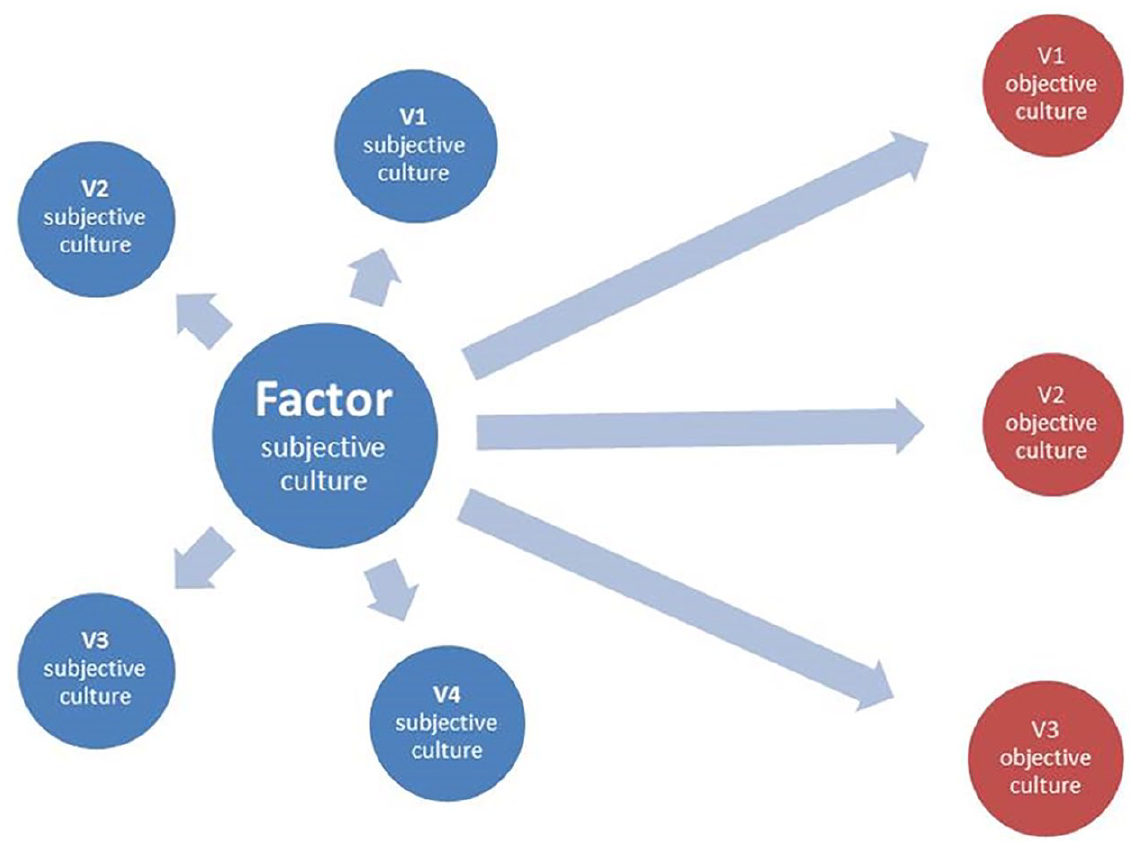
Validation of a factor (dimension) of culture.
This method has traditionally been considered appropriate for the validation of a single dimension. However, it is not fully convincing because it does not show that the main nomological network of a subjective-culture dimension (i.e., its objective-culture correlates v1, v2, and v3 on the right-hand side of Figure 1), yields a single objective-culture dimension, which, in addition to that, is interpretable in terms of the same theory as the corresponding subjective-culture dimension. In other words, a subjective-culture dimension may or may not have a single mirror image in objective culture. Further, even if objective-culture v1, v2, and v3 in Figure 1 yielded a single and coherent dimension of objective culture, we would still not know how this dimension relates to other dimensions of subjective or objective culture.
Thus, the dimensions of a model of culture need to be validated simultaneously, like in Bardi and Schwartz (2003). Inspired by their study, we propose a more sophisticated and more convincing test for validating whole models of culture than the simplistic tests used so far. The development of such a test is long overdue. Baskerville (2003) noted that Hofstede’s model (and, we can add, all models that follow his methodology) was popular in psychology and management but not in “mainstream social sciences” (p. 3), such as sociology and anthropology. Recent studies that failed to replicate some of Hofstede’s dimensions (Beugelsdijk & Welzel, 2018; Minkov, 2018; Minkov & Kaasa, 2021) may further shake academics’ faith not only in Hofstede’s model but also in his method. Ultimately, one might arrive at the erroneous generalization that aggregates of psychological measures are inappropriate for cultural comparisons, and anthropology (as well as sociology, to the extent that it is interested in culture) has nothing to learn from psychology.
Goal, Hypotheses, and Concept of the Present Study
Goal
Our goal is to propose a test for validating models of subjective culture by showing that they have mirror images in objective culture. We apply this test to a specific model of culture and show that it works in accordance with our hypotheses.
Hypotheses
Our test is based on the hypothesis that measures of practices (objective culture) should be patterned like measures of self-reports (subjective culture). We also hypothesize a symmetry between the structures of self-reports and those of practices. If a particular society has a high percentage of people who report that they value religion and tradition, as well as a high percentage of people (not necessarily the same individuals as the previous group) who do not believe in gender equality, it is logical to expect that the same pattern will manifest itself in objective measures: this society will also have high church or mosque attendance and a high gender income gap. If measures of values and beliefs (subjective culture) are correlated and yield a single factor, so should the corresponding measures of practices (objective culture). And the two factors should be closely associated. This hypothesized symmetry is illustrated in Figure 2.
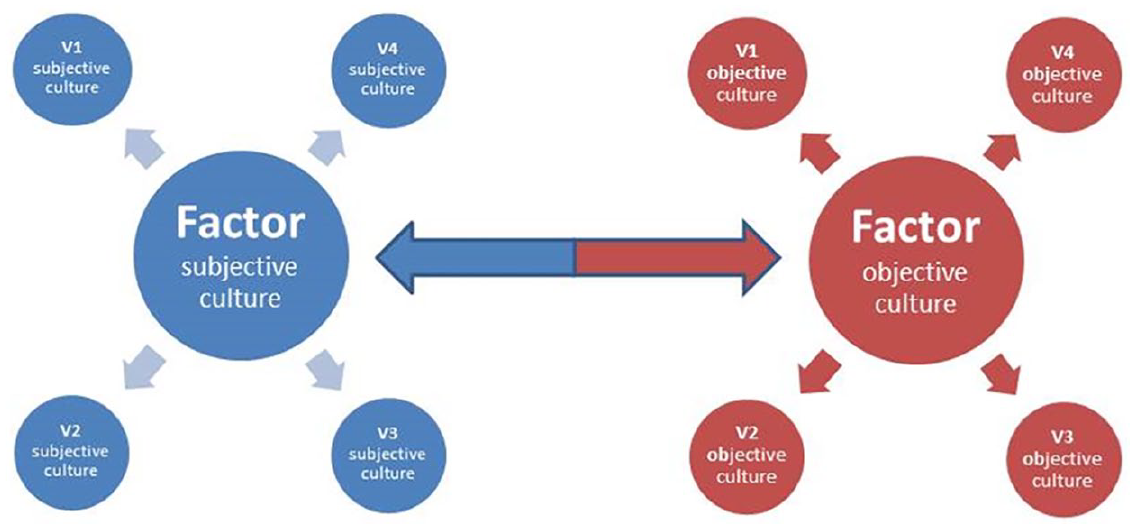
An illustration of a hypothesized association between a factor of subjective culture (values, beliefs, ideologies, self-construals) and a factor of objective culture (practices).
In an analogy with astronomy, one can hypothesize that the members of each pair of subjective and objective culture factors form something like a so-called binary star: a system of two stars that hold each other together and revolving around a common barycenter. Thus, we arrive at a hypothetical model of culture, consisting of binary factors, depicted in Figure 3. The model is based on the hypothesis that for each subjective-culture factor (from self-reports), there exists a corresponding objective-culture factor (from measures of practices). The internal structure of each of the two members of a binary factor should be explicable by one common cultural theory or at least by two compatible theories. There should also be a theoretical explanation of the association between the two members of a binary factor.

A hypothesized model of culture consisting of binary factors.
We also hypothesize that the model shown in Figure 3 is not limited to national culture. It should manifest itself also across other (although not necessarily all) ecological units of analysis, such as sub-national administrative units, as long as these belong to a country with very significant cultural diversity along more than one dimension of culture. Binary factors extracted from national data should be extractable in a similar form from sub-national data. The United States provides good material for a test of this hypothesis as that country has rich and reliable state-level statistics and its states have different legal systems, political and economic histories, climates, and ethnic/racial compositions. This suggests that the US states may possess enough cultural diversity to replicate national patterns. This was confirmed in a study by Sng et al. (2017) who compared some national patterns and some US patterns, and found similarity. However, the subnational administrative units of other nations that do not possess such diversity may not be good units of cross-cultural analysis.
Choice of a Cultural Model
We test this hypothesized binary-factor model of culture using Minkov’s (2018) revision of Hofstede’s model of culture, consisting of new measures of Hofstede’s best-validated dimensions: individualism-collectivism (IDV-COLL) and long-term versus short-term orientation (LTO-STO), now known as flexibility-monumentalism (FLX-MON) (Minkov et al., 2018a). In addition to the many studies that have replicated IDV-COLL under the same name or other names (Beugelsdijk & Welzel, 2018; House et al., 2004; Minkov et al., 2013, 2017; Schwartz, 2008a, 2008b; Welzel, 2013), equivalents of IDV-COLL and FLX-MON have been extracted by Minkov and Hofstede (2012), Vignoles et al. (2016), and Minkov and Kaasa (2021) from very diverse databases. Thus, Minkov’s revision of Hofstede’s model consists of two strongly validated and easily replicable dimensions.
Alternative Models of National Culture
We note that many cross-cultural studies have also yielded two-dimensional models (Bond & Lun, 2014; Leung et al., 2002; Inglehart & Baker, 2000; Stankov et al., 2014, etc.), whereas Schwartz’s (2008a) value domains are also situated in a two-dimensional circumplex. Recently, Muthukrishna et al. (2020) proposed a two-dimensional model of cultural distances: from the US and from China.
What all two-dimensional models of culture have in common is that at least one of the two dimensions in them is closely correlated with IDV-COLL as measured by Minkov et al. (2017). Analogs to FLX-MON as measured by Minkov et al. (2018a) have also been reported. The Inglehart-Welzel cultural map of the world (https://www.worldvaluessurvey.org/WVSContents.jsp) is of particular interest. The 2017 to 2020 scores on the vertical dimension (secular-traditional) correlate with FLX-MON at 0.78 and with IDV-COLL at .71, whereas the horizontal dimension (self-expression—survival) correlates with IDV-COLL at .79 (n = 0.44, p < .001 in both cases). The horizontal dimension is unrelated to FLX-MON. In view of the radically different methodologies and datasets used in the extraction of FLX-MON, IDV-COLL, and the Inglehart-Welzel dimensions, these close associations are remarkable, yet unsurprising. One of the key facets of MON is a focus on strong and immutable values and an invariant self, which, logically, has a strong appeal in societies that the Inglehart-Welzel model describes as “traditional.” On the other hand, traditionalism is associated with religious conformism, hence the closeness between traditional values and COLL. The horizontal dimension of Inglehart-Welzel’s map (self-expression vs. survival values) captures differences in other types of conformism versus individual freedom, hence its closeness to IDV-COLL.
In Schwartz’s model, all dimensions except mastery and harmony, are closely related to IDV-COLL and address the same societal differences: in individual autonomy or freedom versus conformism and importance of achieving high social status. Schwartz’s model does not have an analog to FLX-MON.
Project GLOBE (House et al., 2004) proposed another popular cultural model consisting of 18 dimensions. Many of these are closely correlated with IDV-COLL and address in-group versus out-group relationships as well as aspects of management modernization. Gelfand et al.’s (2011) study is also noteworthy although it proposed only a single dimension—tightness versus looseness—referring to the degree of strictness of social norms across societies. It is moderately associated with IDV-COLL.
Recently, Fog (2021) analyzed these and other, less well-known, models and dimensions of culture and showed that those that replicate well do indeed converge into a two-dimensional model, consisting of variants of IDV-COLL and FLX-MON. In other words, IDV-COLL and FLX-MON summarize most previously reported and valid dimensions of national culture.
Although Muthukrishna et al.’s (2020) cultural distances from the US and China are not actually dimensions of culture but products of such dimensions, the first is moderately correlated with IDV-COLL, whereas the latter is moderately correlated with FLX-MON. This is not surprising as IDV-COLL reflects the most salient cultural differences between the Western world and the least economically developed countries, whereas FLX-MON captures the most important cultural differences between East Asia and the countries farthest away from it: those in Latin America and Africa.
We stress the fact that all these cultural models, as well as Ronen and Shenkar’s (2013) tree of cultural clusters, replicate geo-economic patterns across the globe: nations that are close geographically and economically tend to be close culturally as well. Therefore, a valid model of culture should be expected to yield clearly recognizable geo-economic patterns.
Concept of This Study
We analyze the main nomological networks of IDV-COLL and FLX-MON, reflecting societal practices. Analyses of nomological networks for validating dimensions of culture were pioneered by Hofstede (1980, 2001), and were subsequently done by many authors, including the vast international network of scholars who contributed to Project GLOBE (House et al., 2004). Authors who use this method do not provide detailed and clear inclusion criteria for the variables that they analyze. They usually simply provide correlations, often only moderate, and a very sketchy explanation of the conceptual association between the correlated variables. We propose a stricter approach for this purpose, and we have indeed adhered to it.
First, to meet our criterion for inclusion in our analysis, each variable in the nomological network of a given dimension of culture should be correlated with it at no less than plus or minus 0.60. This means that the two variables share no less than one third of variance. A higher percentage, for instance 50% of shared variance, may seem preferable, yet this would require a correlation of more than .70. This is a high threshold and the few variables that might meet this criterion would most likely be so closely correlated with each other that they would necessarily yield a single factor, rendering any test of how they relate to each other pointless.
Second, each member of the nomological work of a particular dimension should be associated with that dimension theoretically. For this purpose, we have relied on previous publications, briefly summarizing in this article the relevant theoretical points that they make.
On a few occasions, we make a partial exception to these rules. A few variables of significant interest have not been reported so far as correlates of IDV-COLL or MON-FLX, yet they do meet the correlation criterion and their conceptual association with either of these two dimensions is quite clear. Ultimately, it is our final empirical test that will determine if their selection for our analysis was correct.
Research Questions
We ask the following research questions:
Do the main nomological networks of IDV-COLL and FLX-MON, consisting of practices, yield objective-culture factors that are interpretable in terms of IDV-COLL and FLX-MON theory or other compatible theories?
If the answer to the previous question is positive, do these objective-culture factors correlate strongly with IDV-COLL and FLX-MON respectively?
Do we observe the same factor patterns across nations and across the 50 US states?
Do we observe clear geo-economic patterns in the cultural maps yielded by the objective-culture factors?
If the answers to all these questions are positive, our hypotheses concerning the essence and structure of culture will be confirmed: culture does account for the existence of binary factors manifested in self-reports and in practices, and these structures are not a peculiarity of nation-level analyses as they can also exist at a sub-national level. A positive outcome of our analysis would also validate the validation test of cultural models that we have developed. It would also strengthen the revised two-dimensional Minkov-Hofstede model of culture. Besides, we would have assurance that culture can be studied equally well by using self-reports and measures of practices, as the symmetry between the two would suggest that neither method produces too much noise (meaningless variation).
The Revised Minkov-Hofstede Model of National Culture
This model of culture consists of conceptually enriched and recently measured versions of IDV-COLL and FLX-MON. Minkov (2018) showed that these dimensions replicate well, have internal reliability, and have strong predictive properties with respect to important national indicators of practices. The dimensions yield a cultural map of the world that reflects the real geographic map remarkably well, with an expected exception: the English-speaking countries are not scattered across the map but are close to each other and to the Northwest European countries.
The fact that IDV-COLL is strongly associated with latitude was noted by Van de Vliert (2019). The association between FLX-MON and longitude is obvious from Minkov’s (2018) cultural map although it has not been discussed in any publication. Thus, the dimensionality of Minkov’s cultural map has an interesting parallel in the real map of the world. This observation can be used in a future search of the geo-economic factors that explain country positions on the cultural map. Using data from Minkov et al. (2017) and Minkov et al. (2018a), we recreate that map in Figure 4.

The Minkov-Hofstede cultural map of the world.
Minkov (2018) and Minkov and Kaasa (2021) showed that Hofstede’s masculinity-femininity and uncertainty avoidance dimensions are not internally consistent and do not replicate, whereas Beugelsdijk and Welzel (2018) failed to find analogs to these dimensions despite their search across all waves of the World Values Survey. Minkov (2018) and Minkov and Kaasa (2021) recommended that they be dropped from the Hofstede model. He and Beugelsdijk and Welzel (2018) are in agreement that Hofstede’s power distance and IDV-COLL are one single dimension, not two.
Below, we explain what the axes of the map in Figure 4 stand for.
Individualism-Collectivism
Smith et al. (1996) described this dimension as “the most important yield of cross-cultural psychology to date” (p. 237), whereas Beugelsdijk and Welzel (2018), after analyzing all waves of the World Values Survey, called it “the most significant cultural marker of historically divergent country trajectories” (p. 28).
The IDV-COLL syndrome has been analyzed from many different perspectives and under diverse names. Here, we summarize briefly the analyses in the most recent large-scale nation-level studies of IDV-COLL: Minkov et al. (2017), and Minkov et al. (2018b). They are based on a single database of nearly 53,000 respondents selected probabilistically from the general populations of 56 countries for a study of Hofstede’s dimensions. Among other self-reports, the respondents provided self-construals and selected responses describing the values and behaviors that they try to instill in their children. We also take into consideration Beugelsdijk and Welzel (2018) who also extracted an IDV-COLL dimension, using World Values Survey data. More light on national IDV-COLL is shed by the work of Schwartz (2008a, 2008b) and Welzel (2013), as well as Minkov et al. (2013), Schwartz (2007), and Van de Vliert (2019), although some of these studies replaced the term IDV-COLL with other designations. Collectively, all these studies depict IDV-COLL as a multifaceted dimension that warrants a large book. For the purpose of this study, we can only focus briefly on three prominent facets, particularly relevant in this study. We summarize them in Table 1.
Three Prominent Facets of the Nation-Level Individualism-Collectivism Dimension.

It is noteworthy that all national indices of IDV-COLL or related dimensions are strongly inter-correlated and strongly correlated with wealth differences between nations. This characteristic of national IDV-COLL can be used as a test of the validity of any new operationalization of IDV-COLL, for instance one across US states 1 .
Measures of IDV-COLL also share some predictive properties. Although the nomological network of IDV-COLL is immense, measures of culture-related practices that are strongly associated with IDV-COLL (r = ±0.60 across more than 40 countries) are not particularly numerous. The main measures satisfying these conditions, reported in the literature, are rule of law (including transparency vs. corruption), political freedom, social (in)equality, especially gender (in)equality, and fatal accident rates in transportation and industrial settings. All these are strongly correlated with several published IDV-COLL indices (Minkov et al., 2017).
According to IDV-COLL theory, economic development creates a transition from exclusionism and conformism to universalism and individual freedom (Minkov et al., 2017). Originally, economic scarcity forces people to seek privileges for their in-groups, as there are not enough resources for all members of society. For instance, Ember et al. (2018) find that when resource stress is high, food sharing is more likely to be exclusive to relatives. Hruschka and Henrich (2013a, 2013b) note that in societies characterized by persistent economic shocks and without effective government services in-groups may be the only reliable social insurance, whereas modern public services and social safety nets (typical of wealthy countries) render investment in a network of kith and kin less necessary. Hruschka and Henrich (2013a) also point out that a vast body of research shows that mortality and disease (which are more common in economically stressful environments) induce people to favor in-groups.
In complex hierarchical yet economically underdeveloped societies, more powerful groups and individuals are more likely to obtain privileges, and limit the access of out-groups to scarce resources. When such access is allowed at all, it is exchanged for loyalty and obedience, the core of conformism. As economic resources become abundant, in-group-based privileges are rendered unnecessary and the rights and interests of all members of society are easier to protect by a system known as rule of law, involving transparency. Without rule of law, individual interests are neglected and safety regulations are not enforced; hence the high road death tolls in developing countries (Minkov, 2016). Similar conclusions were reached by Solmazer et al. (2016) who explicitly indicate that IDV-COLL or Schwartz’s related dimensions of culture affect road death tolls through differences in law enforcement: COLL societies have laxer enforcement. The strong negative association between IDV-COLL and road death tolls has been confirmed by a number of other studies using diverse databases, such as Gaygisiz (2009), Van den Berghe et al. (2020), etc.
An explanation of the relationship between IDV-related values on the one hand, and democracy, political freedom, rule of law, and gender equality on the other, is provided by Welzel (2013) and Welzel and Inglehart (2006). According to those authors, a country’s strongest democratic foundation is its cultural values. Welzel’s (2013) emancipation theory explains how economic development shifts a society’s cultural values from a focus on collective conformism, religiousness, obedience, submissiveness, and restrictive sexual morality (typical of COLL), to a focus on individual freedom (typical of IDV).
Our literature search yielded another social indicator that is strongly associated with IDV-COLL and warrants inclusion in our analysis: left-handedness. Medland et al. (2004) found that countries with higher scores on Hofstede’s IDV-COLL (called “informal cultures” by those authors) have higher percentages left-handers. This may be so because COLL cultures emphasize conformism, whereas IDV societies allow expression of one’s individuality. Indeed, using national data from McManus (2009) and supplements from other authors (Ardilla & Rosselli, 2001; Payne, 1981), we find a correlation between percentage left-handers and IDV-COLL (Minkov et al., 2017) of .73 (p < .001). Strong as this correlation is, it is calculated only across 31 available countries. Therefore, left-handedness can be used for validation purposes but not for extracting objective-culture factors.
We hypothesize that the aggregate measures of practices, each strongly associated with self-reported IDV-COLL, form a distinct and coherent single factor, strongly correlated with IDV-COLL, yet unrelated, or weakly related, to whatever dimensions may be yielded by the practices associated with FLX-MON. Our study will test this hypothesis across nations and across US states.
Flexibility-Monumentalism
Just like IDV-COLL, this dimension has a long history. Originally discovered by the Chinese Culture Connection (1987), it was replicated and developed theoretically on the basis of World Values Survey data by Minkov and Hofstede (2012). A closely correlated and conceptually similar dimension, called “consistency-variability,” was reported by Vignoles et al. (2016). The most recent replication of this dimension is by Minkov and Kaasa (2021) based on nationally representative samples.
In the studies that focus on this dimension (Minkov et al., 2018a, 2018b), “flexibility” refers to a modest and adaptable self, whereas “monumentalism” figuratively refers to a self, resembling a proud, and solid monument that changes little over time. Just like IDV-COLL, FLX-MON is a multifaceted dimension. Three of those facets are especially relevant in this study, explained in Table 2.
Three Prominent Facets of the Nation-Level Flexibility-Monumentalism Dimension.
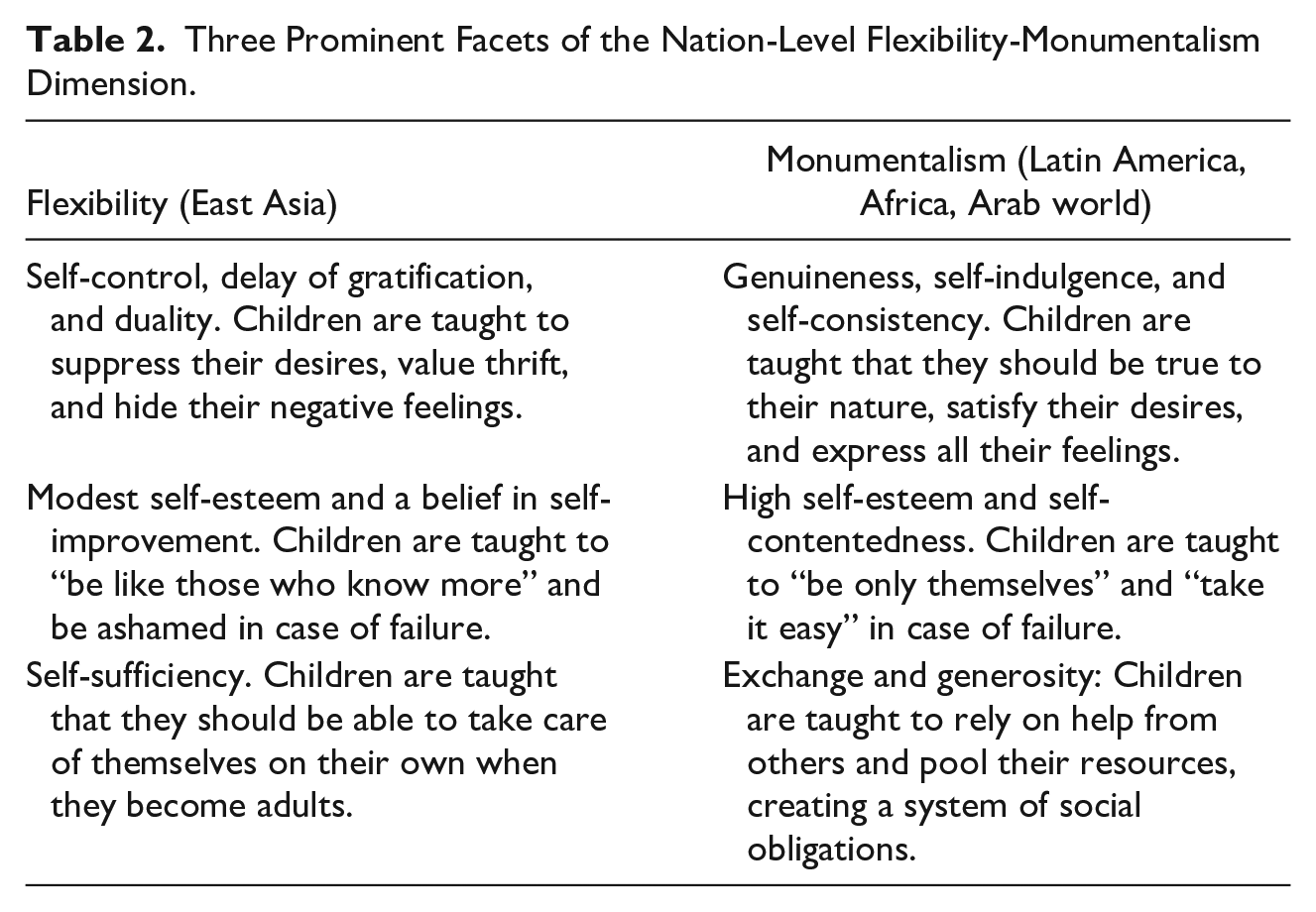
FLX-MON theory finds confirmation in the fact that all existent measures of this dimension are strong predictors of mean national educational achievement on standardized tests, such as those of Trends in Mathematics and Science Study (TIMSS) and the Program for International Student Assessment (PISA), even after controlling for the effect of other predictors, such as national wealth (Hofstede, 2001; Minkov & Hofstede, 2012; Minkov et al., 2018a). The original explanation of this phenomenon (Hofstede, 2001) was that LTO (corresponding to FLX) promotes a focus on long-terms goals, such as investment of personal effort in education that will pay off in the distant future, whereas STO (corresponding to MON) deflects society’s and individuals’ attention from such goals, allowing immediate gratification of desire for pleasurable activities. Minkov et al. (2018a) proposed an additional explanation: FLX (LTO) societies are characterized by a low self-esteem coupled with a belief in a malleable self. This accounts for a conviction that a positive self-transformation is both necessary and possible, resulting in high educational standards and strong effort in education. For the opposite reason, MON (STO) societies have lower educational standards and promote weaker effort.
Sng et al. (2018) propose a similar explanation: to “build oneself (i.e., ‘to accumulate knowledge and skills’) one needs to believe that the self can be built,” rather than adopt an “incremental theory of the self: believing that intelligence is unchangeable” (p. 718). Also, success in modern education requires considerable self-control (Normandeau & Guay, 1998; Sodian & Frith, 2008; Zhu et al., 2016) and a parental belief in their children’s self-sufficiency as adults. Both are stronger in FLX societies.
Minkov (2018) notes that FLX-MON differences also seem to be consistent and correlate with national homicide rates and adolescent fertility rates. Violent crime, teenage sexual activity and adolescent fertility, as well as paternal absenteeism, have all been interpreted as fast life-history strategies (LHS) in a large body of literature (Belsky et al., 2012; Brumbach et al., 2009; Bulled & Sosis, 2010; Copping et al., 2013; Dunkel et al., 2013; Hackman & Hruschka, 2013; Minkov & Beaver, 2016; Sng et al., 2017, 2018, etc.). Frankenhuis and Nettle (2020) note that while some of these perspectives in LHS research have a long history (for instance the focus on age at first reproduction), others have been integrated more recently (such as aggression, risk-taking, and impulsivity).
The term LHS may have somewhat different meanings in biology, from where it originated, and in psychology or the social sciences (Frankenhuis & Nettle, 2020; Sear, 2020). We use it in accordance with the latter tradition. Some branches of evolutionary science also use the term “pace of life” to denote some traits associated with LHS. For instance, Dammhahn et al. (2018) indicate that aggressive and bold individuals should have a fast pace of life, which among other things includes early reproduction. However, we will deliberately avoid the term “pace of life,” since a landmark study in the cross-cultural literature (Levine & Norenzayan, 1999) popularized the use of that term in a very different sense.
One of the most concise and clearest explanations of LHS theory, as used in psychology and the social sciences, is provided by Csatho and Birkas (2018): “Slow LH strategies can be characterized by future-oriented attitudes, a relatively long-term focus in behavioral strategies; for example, an ability to delay gratification. These strategies also involve higher parental investment (i.e., investment of time and effort in caring for offspring) in a relatively small number of offspring. In contrast, fast LH strategies are characterized by a relatively short-term focus and present-orientated attitude of taking risks or being aggressive in order to maximize immediate rewards and prioritize mating efforts” (p. 2).
Hackman and Hruschka (2013) provide a similar description, indicating that a fast LHS is associated with early sexual activity and pregnancy, less parental care, and more aggression, including homicide.
LHS theory is an evolutionary theory. Incorrect application of that theory, for instance ignoring the possibility that humans calibrate their LHS to environmental conditions (Hackman & Hruschka, 2013) may confuse genetic causes with social-class causes (Stearns & Rodrigues, 2020). In this study, we do not make any assumptions about the role of genes. On the contrary, we note that some elements of LHS theory are compatible with FLX-MON theory, which is a cultural theory. Both theories focus on the prioritization of short-term goals and benefits that can be pursued by following natural impulses versus long-term rewards that require delay of gratification and strong self-control. The mechanisms that lead to this differentiation, including the nature-nurture interplay, are outside the scope of the present article.
Some studies provide specific examples of social phenomena that are explicable by both LHS and FLX-MON theory at the same time. Rendon (2014) explains how violence (consistent with a fast LHS) promotes a network of social obligations (consistent with MON), which in turn depress educational achievement (consistent with MON). To avoid victimization, boys living in violent neighborhoods need protection from peers. This creates “expectations and obligations” (article abstract), which include collective truancy and participation in fights on the side of one’s associates, resulting in expulsion from school. Other individual-level cause-and-effect relationships, for instance from poor education (and hence poor employability) to street crime, or from poor education to adolescent fertility (as well as vice-versa), are common knowledge.
As FLX values emphasize self-control and suppression of desire for immediate gratification (Minkov et al., 2018b), they promote a slow LHS. FLX (and a slow LHS) are preconditions for investment in long-term goals, such as obtaining a good education (Minkov et al., 2018a). Sng et al. (2018) discuss another aspect of LHS compatible with FLX-MON theory: a slow LHS involves accumulation of knowledge and skills, which requires a belief in a changeable self. We also know from individual-level studies that educational achievement is negatively correlated with adolescent fertility (Klepinger et al., 1995). Therefore, we can hypothesize that measures of LHS practices, such as homicide rates, adolescent fertility, paternal absenteeism, and educational achievement, form a single factor across nations and across US states, closely correlated with FLX-MON, and independent of, or weakly related to, IDV-COLL and its mirror image in practices.
After an extensive search of the literature, we discovered another social indicator that is strongly associated with FLX-MON: myopia rates. Although myopia is partly heritable (Hornbeak & Young, 2009), national differences in myopia apparently reflect mostly cultural differences. The highest prevalence of myopia is found in East Asia, attributable to “increasing educational pressures, combined with life-style changes, which have reduced the time children spend outside” (Morgan et al., 2012, p. 1739). Myopia rates have been rising throughout the world and this trend is expected to continue drastically in the next decades, although regional and national myopia rankings are expected to remain fairly stable (Holden et al., 2016). The rapidly increasing myopia rates, as well as the fact that urban populations have higher myopia rates than rural populations of the same country (Holden et al., 2016), are indications that societal effects on myopia rates are strong. Also, the higher myopia rates among people with higher education (Holden et al., 2016) indicate that reading for educational purposes has a significant effect on myopia.
Thus, differences in myopia rates are a good proxy for differences in a particular type of educational effort: time spent reading. The data in Holden et al. (2016) —highest myopia rates in East Asia, lowest in Africa—suggest a positive association with FLX-MON, as well as with national educational achievement differences, consistent with FLX-MON theory: stronger investment in self-improvement through education in FLX societies, with myopia as a negative side-effect. We hypothesize that myopia rates will be associated with the previously hypothesized single LHS-related factor.
We hypothesize that aggregate measures of each of the discussed LHS-related practices, as well as myopia rates and educational achievement, each of which is strongly associated with FLX-MON, will form a distinct and coherent single factor, strongly correlated with FLX-MON, yet unrelated, or weakly related, to whatever dimensions may be yielded by the practices associated with IDV-COLL. Our study will test this hypothesis across nations and across US states
Finally, we found a national indicator that is closely associated with both IDV-COLL and FLX-MON. Bukowski and Rudnicki (2019) reported that measures of national innovation and innovativeness are predicted by both of these dimensions. This may be so because IDV deemphasizes conformism and encourages out-of-the-box thinking. Complex innovation also requires good modern education, which is stronger in FLX societies. Based on Bukowski and Rudnicki’s (2019) study, we hypothesize that innovation will be related to both factors yielded by our measures of practices.
Summary
In sum, IDV-COLL reflects differences in the degree to which the human self is restrained by, and submitted to, group interests, which may include privileges for the powerful and neglect of, or discrimination against, the powerless. FLX-MON reflects differences in the degree to which the self restrains its natural impulses in an attempt to achieve positive change through the acquisition of complex modern knowledge and skills.
Method
We emphasize the fact that our selection of objective-culture variables is neither random, nor biased. We have identified all practice-related national indicators that satisfy two conditions at the same time: a strong correlation of at least ±.60 with either IDV-COLL or FLX-MON (thus sharing at least one third of variance with either dimension) and data availability for at least 40 nations. More relaxed correlation criteria would yield unconvincing results whereas stricter criteria would reduce the number of variables and countries so much that our analysis would become unrepresentative.
Analysis across Nations
Our nation-level IDV-COLL and FLX-MON indices are from Minkov et al. (2017) and Minkov et al. (2018a) respectively. Both indices are based on self-construals, such as “I am a very religious person” (a COLL statement) and “I have strong values and beliefs that guide my behavior” (a MON statement). Both indices have been shown to have excellent predictive properties with respect to relevant national behavioral indicators. For validation purposes, we also use the latest available national IDV measure (Beugelsdijk & Welzel, 2018), and two closely related dimensions: Schwartz’s (2008a) embeddedness and Welzel’s (2013) emancipative values.
As Minkov’s IDV-COLL and FLX-MON data were collected in 2015 to 2016, we attempted to collect measures of practices from the same period or from years close to 2015 to 2016. We used the following sources (details are provided in the Appendix, at the end of this article):
For political freedom in 2016: Freedom House (2016). For transparency versus corruption in 2015: Transparency International (2019). For road death tolls in 2013: World Health Organization (2013). For gender (in)equality in 2014: Jahan and Jespersen’s (2015) Human Development Report 2015. For mean educational achievement in 2011 to 2015: Mullis et al. (2012, 2016); PISA (2014, 2016).
For myopia prevalence rates: Holden et al. (2016). For homicide rates in 2010 to 2012: United Nations Office on Drugs and Crime (2014). For adolescent fertility in 2010: UN Statistics Division (2012). For paternal absenteeism around 2014: PISA (2014) and Child Trends’ (2013) World Family Map 2014. For innovation in 2017: Dutta et al. (2017) Global Innovation Index 2017.
We factor-analyzed all behavioral indicators and compared the structures of the factors, and their associations with subjective-culture IDV-COLL and FLX-MON, as well as national wealth, to ascertain if they yield factors that conform to our theoretical expectations.
Analysis across US States
We used the most recent data available. This approach resulted in data from practically the same period as our national data.
As there are probably no significant differences in political freedom within the US, measures do not exist. Corruption is measured in terms of court convictions or other methodologies that are very different from Transparency International’s approach across nations. Thus, we do not have US state measures for these variables. Vice-versa, we have included a variable—church attendance by state—for which there do not exist reliable equivalent measures across a large number of countries. This variable reflects religiousness, a core element of recent IDV-COLL measures (Beugelsdijk & Welzel, 2018; Minkov et al., 2017).
We used the following sources: For self-reported religiousness in 2016: Lipka and Wormald (2016). For views on same-sex marriages, on abortion, and on immigrants in 2014: Public Religion Research Institute (2018). For church attendance in 2014: Newport (2015). For gender equality in 2011–2014: Institute for Women’s Policy Research (2020). For road death tolls in 2015: Sivak and Schoettle (2018). For eighth grade achievement in math in 2019: The Nation’s Report Card (2020). For percentage births to unmarried women and teenage birth rates in 2018, as well as homicide rates in 2017: Center for Disease Control and Prevention (2020). For teenage pregnancy rates in 2013: Kost et al. (2017). For myopia prevalence: Prevent Blindness America (2012). For innovation in 2017: National Science Foundation (2019).
As validation variables, we used median household income in 2018 (United States Census Bureau, 2019), gross domestic product per person (Statista, 2020), and percentage voters who chose Trump in 2016 (New York Times, 2017) and in 2020 (Politico, 2020). Inglehart (2018) argues that Trump-like politicians are on the rise in the West because older voters feel threatened by the cultural shift that they observe. If this is so, Trump must have appealed to culturally conservative voters with COLL values, and we can hypothesize a negative correlation between percentages voting for Trump and measures of IDV-COLL or a corresponding dimension across states. Another validation variable that we used is percentage left-handers (McManus, 2009).
As a first step, we constructed a subjective-culture IDV-COLL index, imitating IDV-COLL operationalizations in terms of religiousness (Beugelsdijk & Welzel, 2018; Minkov, 2018) and views on sexual and reproductive freedom (Minkov et al., 2013). We did this by factor-analyzing percentage very religious, percentage opposing abortion, and percentage opposing same-sex marriage.
Then, we factor-analyzed the measures of practices associated with IDV-COLL and FLX-MON, and compared the factor structures across US states with those from the nation-level analysis.
Results
Analysis across Nations
A factor analysis of the selected social indicators with varimax rotation yielded two factors (principal components) with eigenvalues over 1.00. The first one had an eigenvalue of 5.76 and explained 56.6% of the variance. The second had an eigenvalue of 1.64, explaining 16.4% of variance. The rotated factor solution is provided in Table 3.
Objective Culture Factor Solution Across Nations.
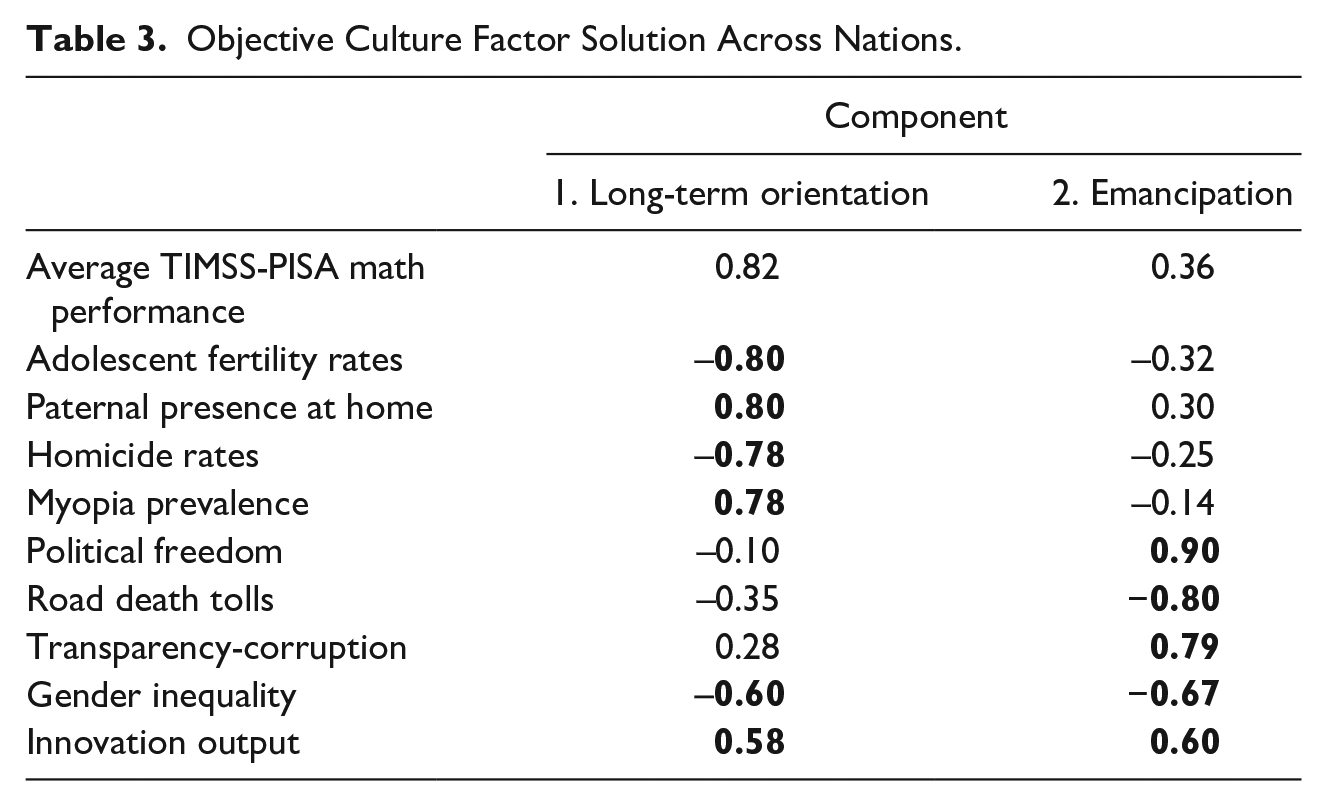
Component 1 is an equivalent of FLX-MON, interpretable in terms of LHS theory. In keeping with Hofstede’s (1991) terminology, which is consistent with LHS theory, and to avoid confusion with subjective-culture FLX-MON, we will call this objective-culture factor “long-term orientation” (LTO). The only unexpected finding is the negative association between gender inequality and this factor. The most likely explanations is that educational achievement, which is the key variable underpinning our LTO measure in this study, enables female emancipation.
Component 2 is an equivalent of IDV-COLL, as it groups together the correlates of IDV-COLL. In keeping with Welzel’s (2013) terminology and theory, and to avoid confusion with subjective-culture IDV-COLL, we will call this objective-culture factor “emancipation.”
Interestingly, the results confirm the association of innovation output with both dimensions, as in the study by Bukowski and Rudnicki (2019).
To increase the number of countries for which factor scores are available, we predicted scores for some countries by means of linear regression, provided we did not have missing values for a particular country for more than one variable associated with the relevant dimension. R2 values exceeded 0.90 in all regression models, attesting to the reliability of the estimates.
Table 4 shows correlations between the two components from this study, FLX-MON, and IDV-COLL or similar subjective-culture dimensions from various recent studies. The symmetry between the subjective-culture measures and our emancipation and LTO measures is obvious. Table 4 evidences another parallel: just like subjective-culture IDV-COLL, our objective-culture emancipation index is strongly correlated with national wealth, whereas our objective-culture LTO, just like subjective-culture FLX-MON, is moderately correlated with national wealth.
Correlations Between the Objective-Culture Dimensions from the Analysis Across Nations, Corresponding Dimensions of Subjective Culture, and National Wealth.
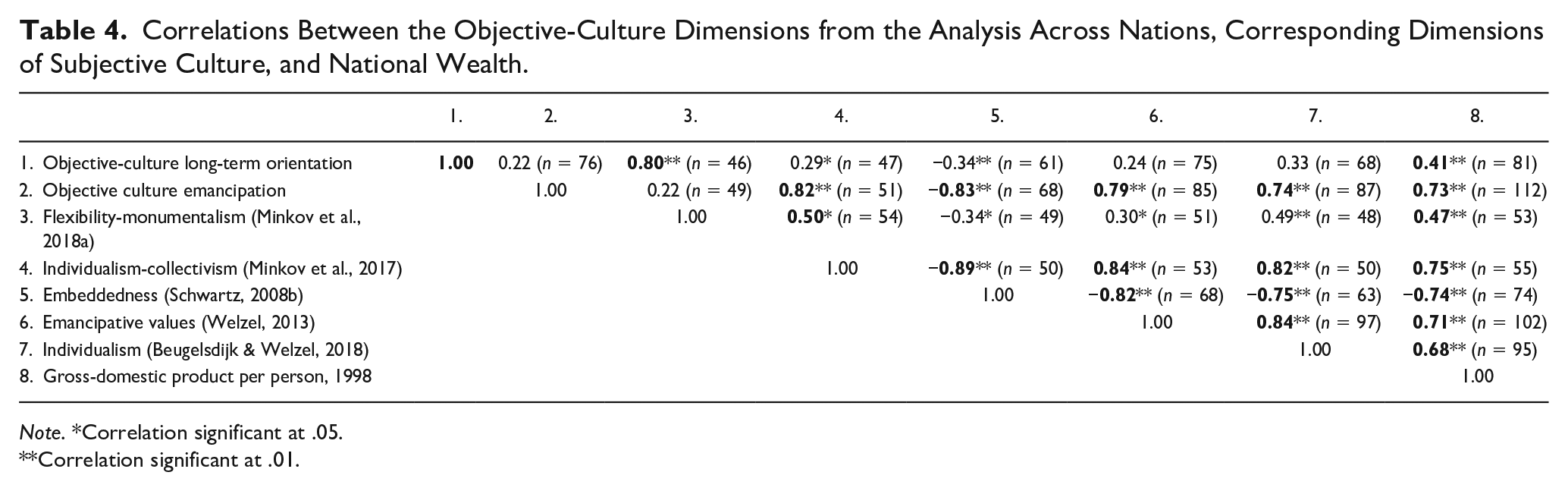
Note. *Correlation significant at .05.
Correlation significant at .01.
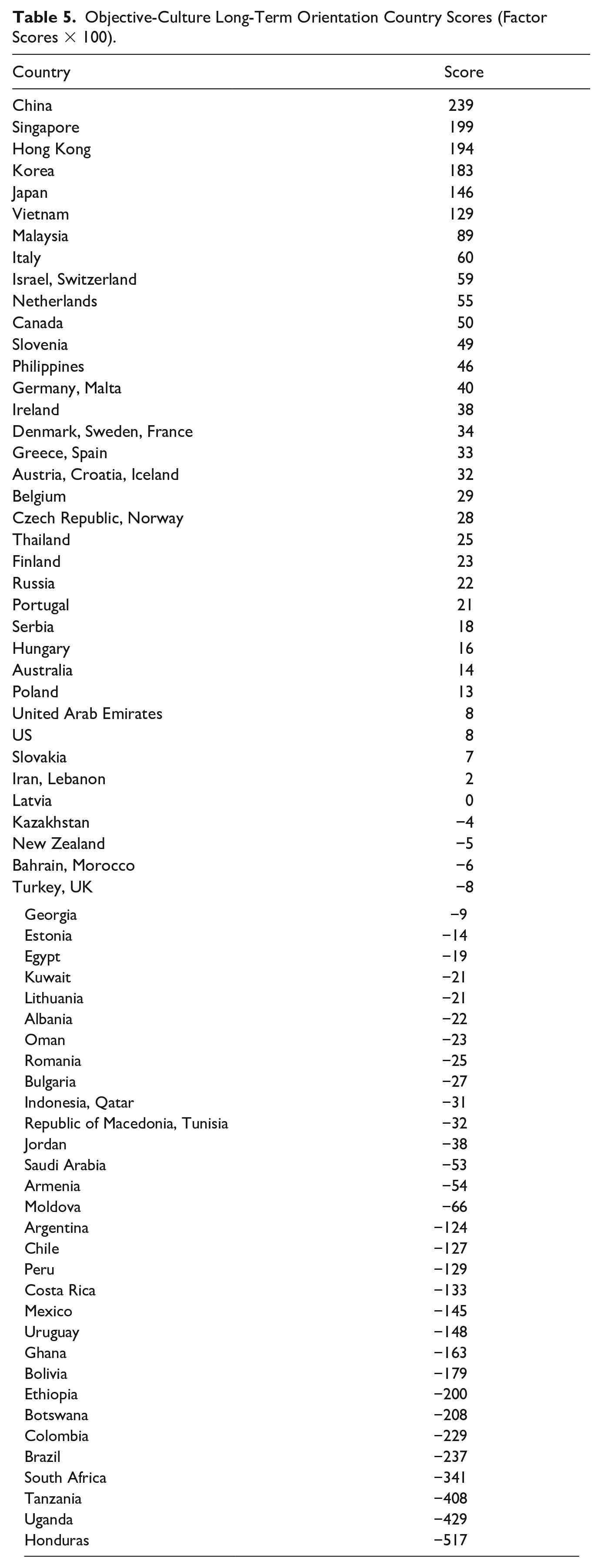
Tables 5 and 6 provide country scores for our objective culture LTO and IDV-COLL. These are factor scores multiplied by 100 so as to avoid decimals.
Objective-Culture Long-Term Orientation Country Scores (Factor Scores × 100).
Objective-Culture Emancipation Country Scores (Factor Scores × 100).

Figure 5 is a cultural map of the world, using objective-culture LTO and emancipation as axes. This map is fairly similar to the one in Figure 4 but has more countries. Both maps show that, with a few logical exceptions, such as the case of the English-speaking countries, geographic proximity correlates with cultural proximity.
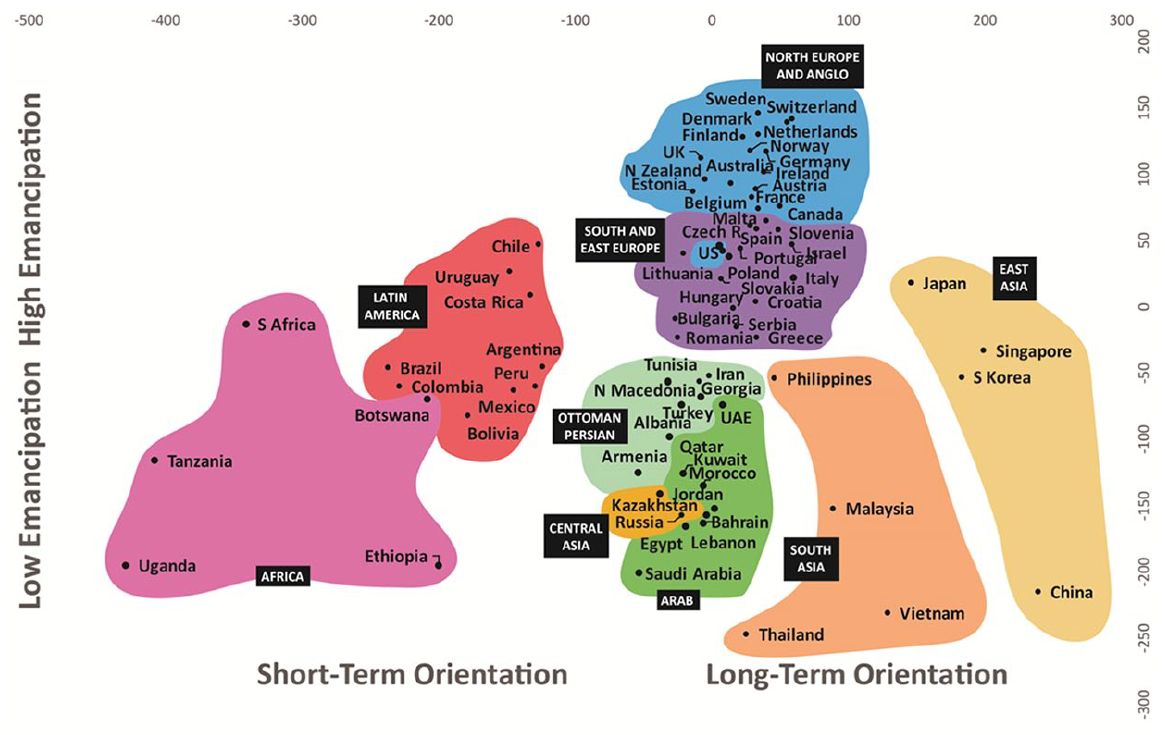
A cultural map of the world with long-term orientation and emancipation as axes.
Figure 6 visualizes the association between subjective-culture IDV-COLL and objective-culture emancipation across the available countries. Figure 7 does the same for subjective-culture FLX-MON and objective-culture LTO.

A plot visualizing the association between subjective-culture individualism-collectivism and objective-culture emancipation across countries.
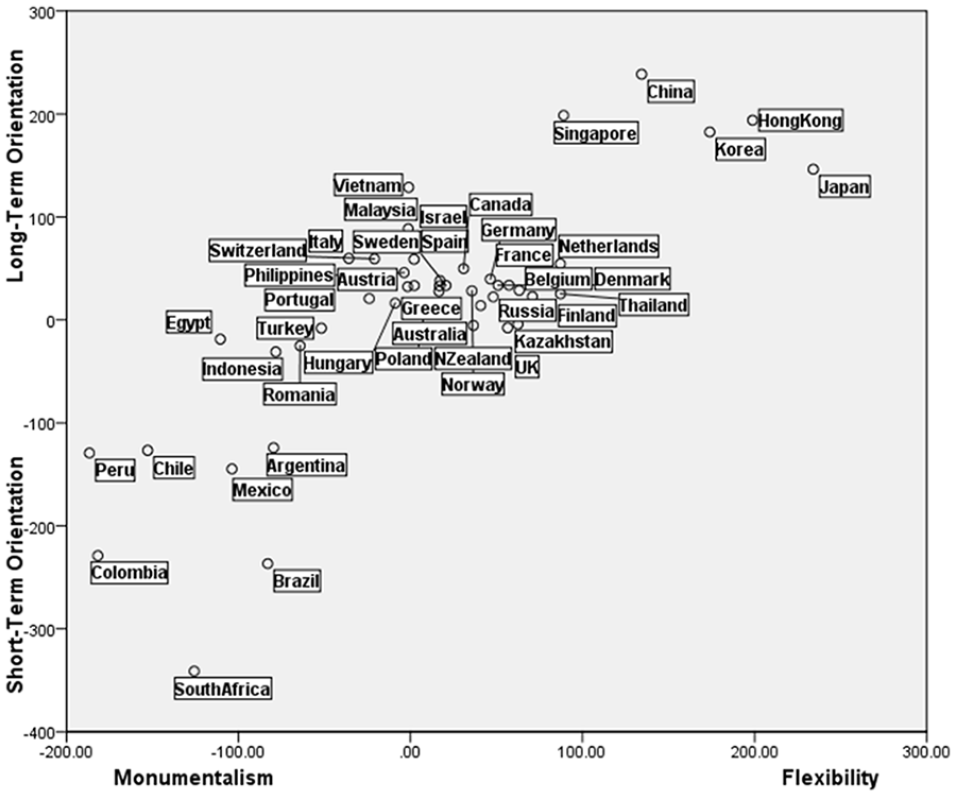
A plot visualizing the association between subjective-culture flexibility-monumentalism and objective-culture long-term orientation across countries.
Analysis across US States
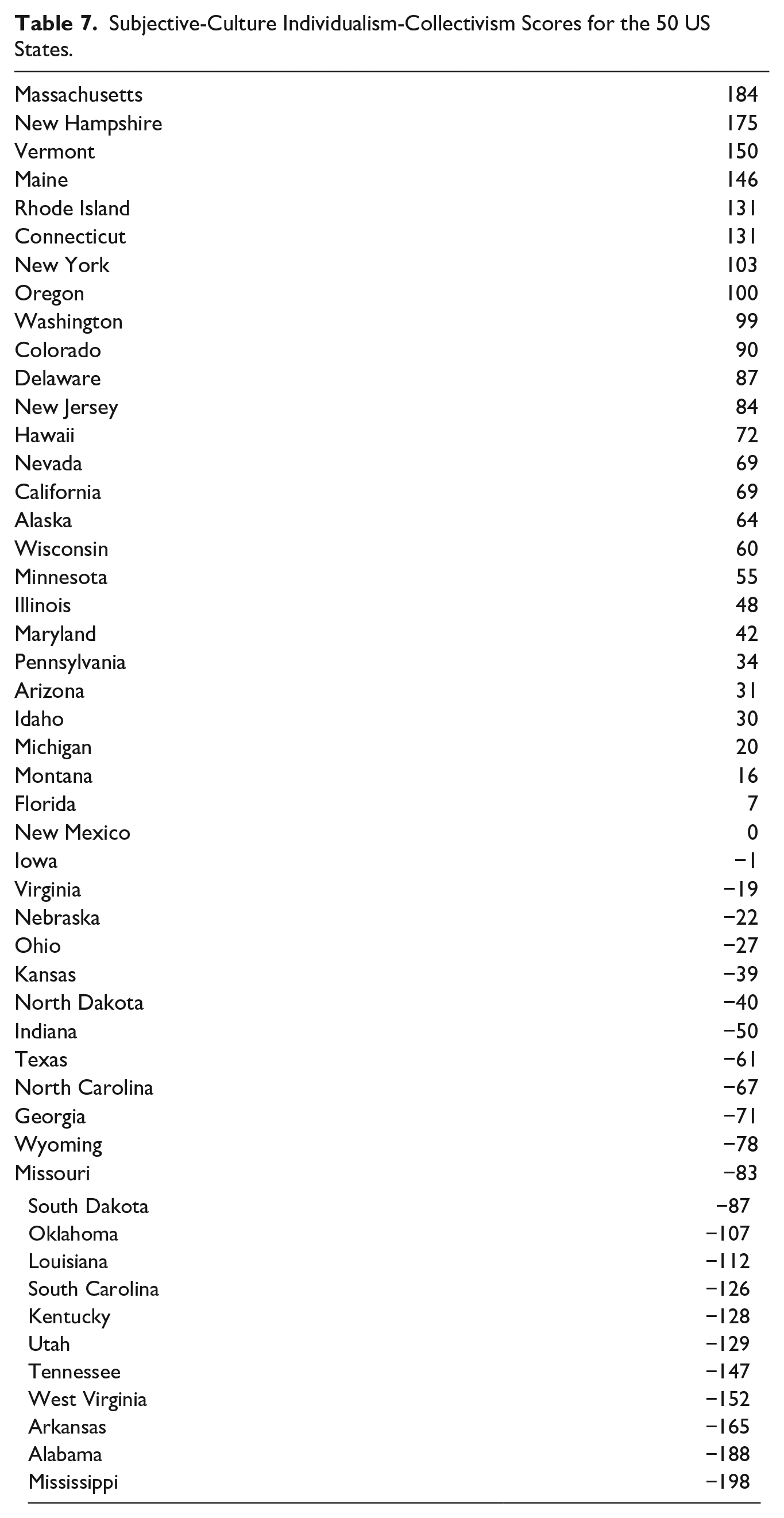
First, we obtained a subjective-culture measure of IDV-COLL by factor-analyzing three variables: percentage highly religious, percentage opposing abortion, and percentage opposing same-sex marriage. We obtained a single factor with an eigenvalue of 2.65, explaining 88.3% of variance. The three items loaded 0.94, 0.96, and 0.93. We multiplied the factor scores by −100 to avoid decimals and to align them with national IDV-COLL where high scores stand for IDV. Table 7 provides subjective-culture IDV-COLL scores for the 50 states.
Subjective-Culture Individualism-Collectivism Scores for the 50 US States.
Next, we factor-analyzed our selection of practices measured across 50 states. We obtained two principal components, with eigenvalues of 5.71 and 1.44, explaining 57.1% and 14.4% of variance respectively. The varimax-rotated solution is shown in Table 8.
Objective Culture Factor Solution Across the 50 US States.

The structure of component 1 is quite similar to that of component 2 (emancipation) in the analysis across nations, whereas component 2 in this analysis is similar to component 1 (LTO) in the analysis across nations 2 .
Table 9 shows correlations between our US state indices and our validation variables. Evidently, the nomological network of objective-culture emancipation across US states is similar to the corresponding network of emancipation across nations. Both measures of emancipation are highly associated with wealth and with subjective-culture measures of conformism/conservatism: IDV-COLL across nations and across the US states. The exceptionally high negative correlation between emancipation and percentages voting for Trump is striking, yet logical.
Correlations between the Objective-Culture Measures in the Analysis across 50 US States and Validation Variables.

Note. p values are not shown as the correlations are across the whole statistical population (50 states); therefore the concept of statistical significance is meaningless. For handedness only, n = 48.
Vandello and Cohen’s (1999) COLL measure is not highly correlated with any variables related to IDV-COLL, although it is correlated with LTO for reasons that we cannot explain. Evidently, their measure reflects something real, interesting, and potentially useful, but it does not correspond to national IDV-COLL. Interestingly, Harrington and Gelfand’s (2014) tightness-looseness measure is so strongly correlated with IDV-COLL that it is indistinguishable from it.
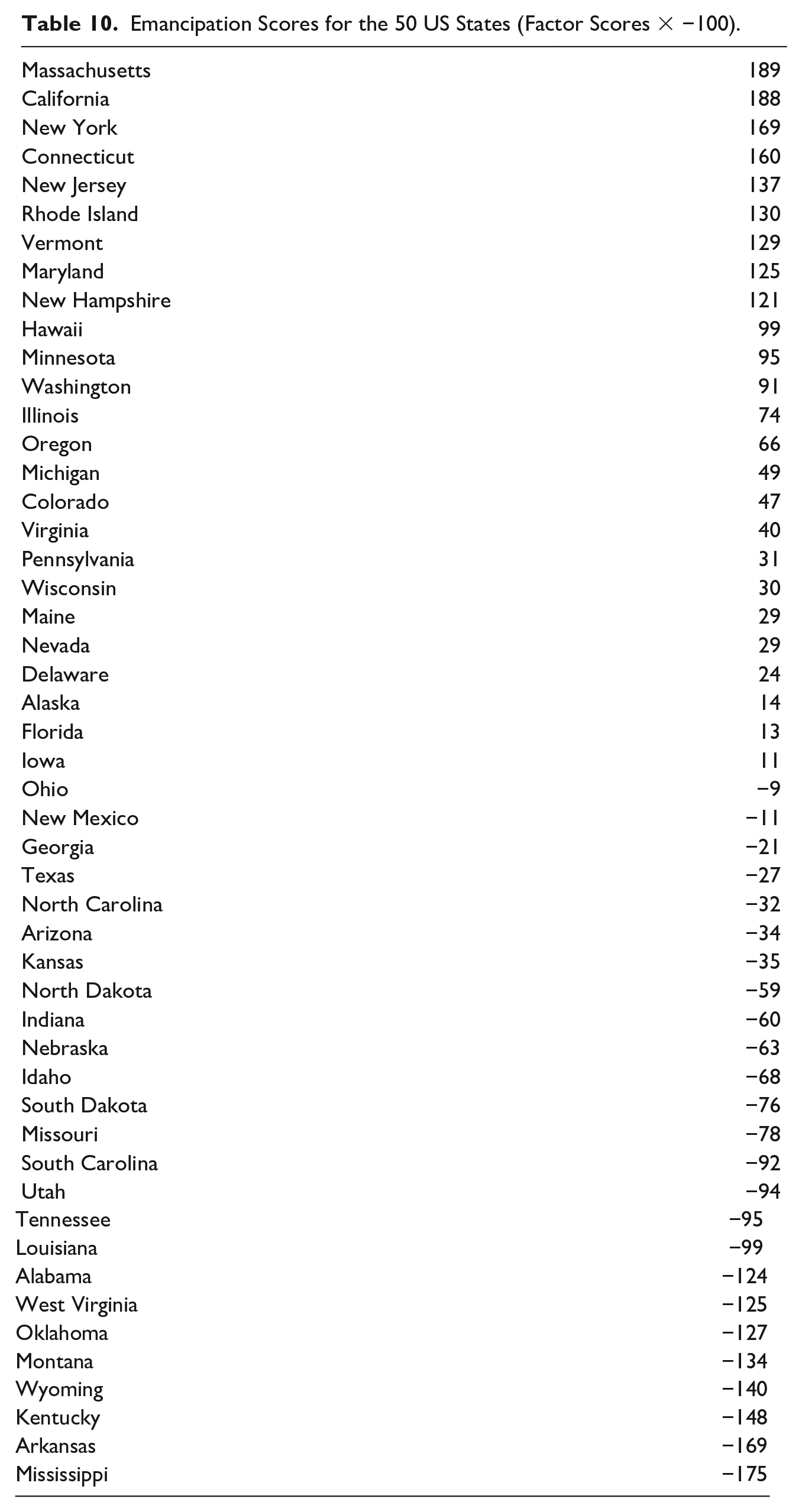
Table 10 provides emancipation scores for the 50 US states, whereas Table 11 provides LTO scores for the 50 US states.
Emancipation Scores for the 50 US States (Factor Scores × −100).
Long-term Orientation Scores for the 50 US States (Factor Scores × −100).

Figure 8 shows a cultural map of the United States, using objective-culture emancipation and long-term orientation as axes. Just as in the case of nations, we see that geographic proximity correlates with cultural proximity. Again, we see exceptions to this rule, such as the position of California.

A cultural map of the United States with objective-culture long-term orientation and emancipation as axes.
Figure 9 visualizes the association between subjective-culture individualism-collectivism and objective culture emancipation across US states.
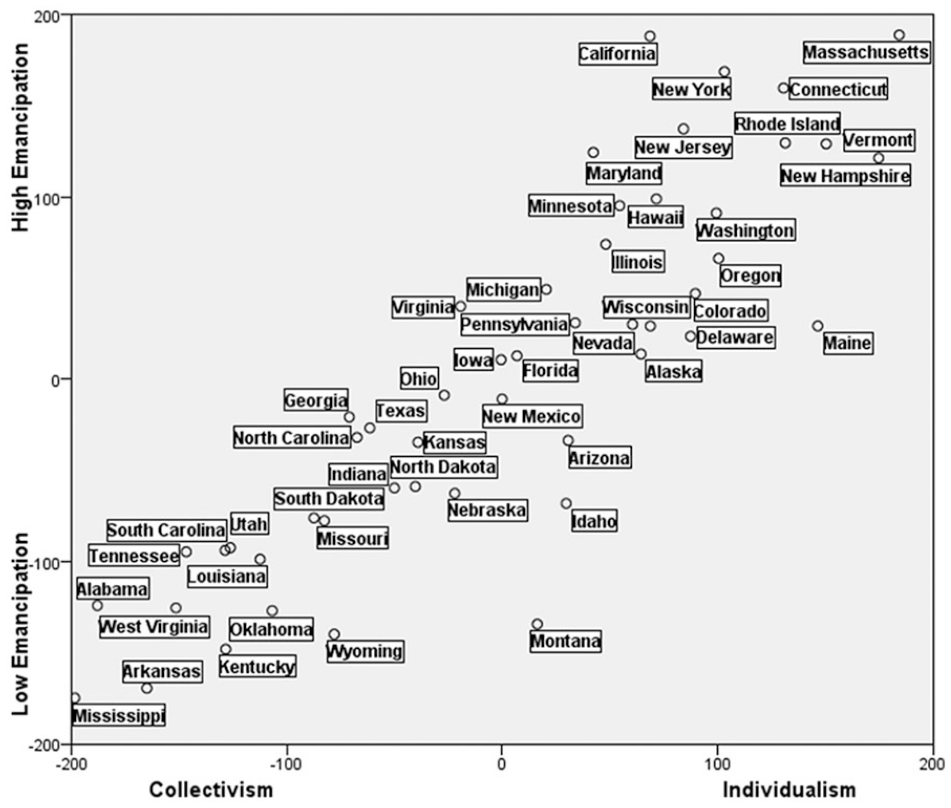
A plot visualizing the association between subjective-culture individualism-collectivism and objective-culture emancipation across US states.
Figure 10 summarizes the structure of culture as reflected in the revised Minkov-Hofstede model that we have validated in this analysis.
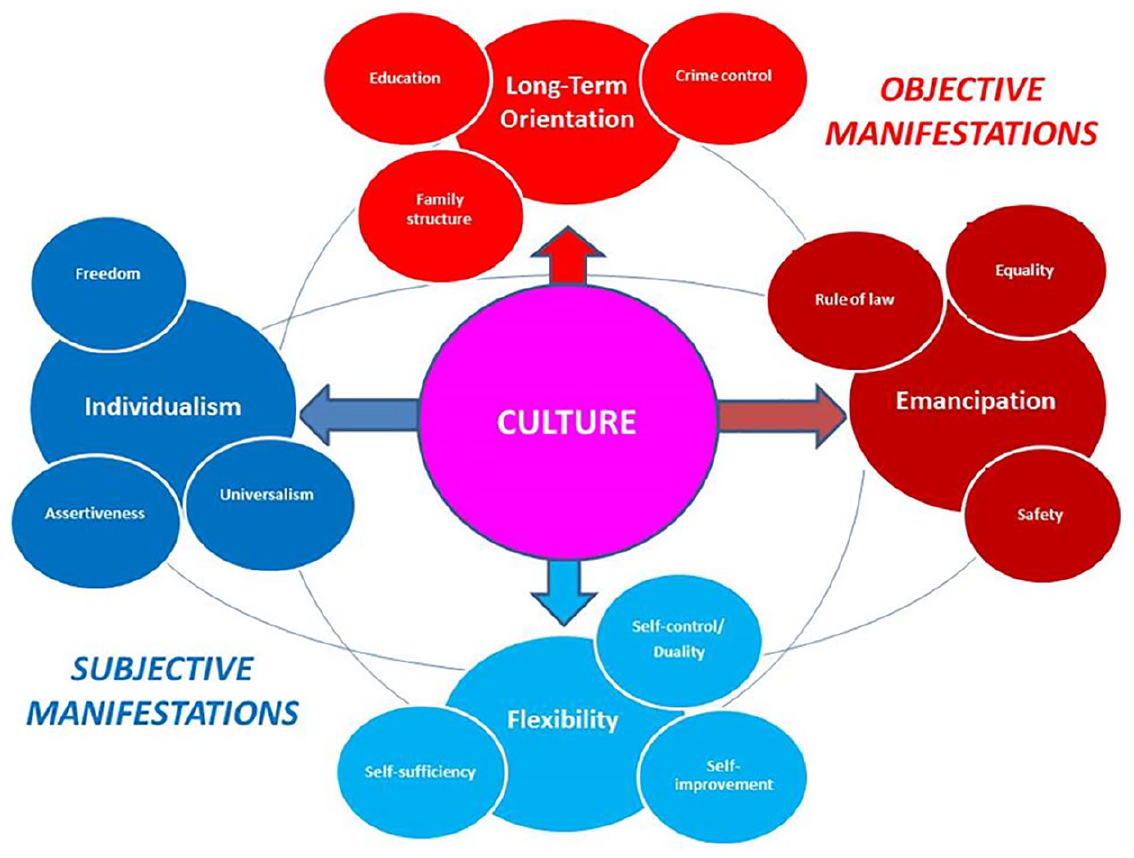
The structure of culture in the revised Minkov-Hofstede model.
Other Analyses
A reviewer suggested that we should study cultural structures also across the nations within the world’s main regions. Although we do not have enough countries for reliable analyses within most regions, a few observations seem obvious. First, Figures 4 and 5 suggest that within most of the main cultural regions of the world, the countries are located approximately on a single axis, suggesting a single dimension of culture, apparently associated with national wealth. We were able to test the correctness of this observation only across the European countries. Indeed, a single factor across 30 European countries merges objective-culture emancipation and LTO. It correlates with IDV-COLL at .79 and with FLX-MON at .62 (p = .001 in both cases), as well as with different measures of national wealth (GDP or GNI per person, raw or at purchasing power parity) at .81 to .88 (p < .001). A two-factor solution is possible, yet LTO and emancipation do not emerge as distinctly as across all nations or across the US states. This is partly due to an anomaly across the countries of the former Soviet Union, especially Russia and the Baltics, which combine high educational achievement with high homicide rates.
This brings up two interesting questions for future research that we address briefly in the discussion part: If wealth differences account for country positions within world regions, what accounts for between-region differences? Second, if objective-culture LTO and emancipation are not clearly distinct across the European countries, why do they reproduce distinctly across the US states? We compared US and European score ranges, standard deviations, and variances on some comparable variables, measured on the same scales, such as homicide rates, road death tolls, and adolescent fertility. We found that the US is considerably more heterogeneous than Europe in terms of the first two and more homogeneous in terms of the third variable. Although these results are inconclusive, they allow us to hypothesize that the US has more heterogeneity than Europe in terms of objective culture, which may partly account for the clearer distinction between LTO and emancipation across the US states.
Discussion
Inspired by Bardi and Schwartz’s (2003) work, we constructed and tested a new validation test of cultural models. Our findings confirmed all our hypotheses related to the model and the test. We summarize our main findings and their implications:
Culture manifests itself in similar ways in measures of subjective self-reports and in objective measures of social practices. It produces binary (mirror-image) factors of subjective and objective dimensions that can be explained in terms of similar theories.
Culture has a universal patterning effect. This is confirmed by the fact that, just like nations, US states yield the same culture factors, bound in the same two-dimensional model (except that we do not have a measure of subjective-culture FLX-MON across US states). These factors account for similar clear geographic patterns across nations and across US states.
We found that Minkov’s revised two-dimensional variant of Hofstede’s subjective-culture model passes our test. The model works equally well for nations and for US states. However, it may not work equally well for countries or world regions with less cultural variation than the US, or with anomalous associations between key variables. Europe may be one such example.
Models of national culture contain different numbers of dimensions, ranging from 1 (Welzel, 2013) to 18 (House et al., 2004). We believe that it is pointless to debate the optimal number of dimensions in an abstract sense. It appears however that the two-dimensional revised Minkov-Hofstede model that we tested in this article is a sufficiently efficient (parsimonious) and effective (predictive) tool to describe and explain what seem to be the most important cultural differences across modern nations and, in some cases, across sub-national political units. Thus, our findings confirm and supplement those of Fog (2021). Of the other popular models of culture, only the Inglehart-Welzel model reflects the variance on the horizontal axis on our cultural maps in Figures 4 and 5. No other model highlights the crucially important cultural contrast between East Asia at one extreme and Africa/Latin America at the other. Schwartz’s model places East Asia next to Africa, whereas many of GLOBE’s dimensions produce scrambled world maps, without a clear geographic pattern (Dobson & Gelade, 2012). Gelfand’s tightness-looseness does yield a recognizable geographic pattern, but it is not closely associated with either of the axes of our cultural maps, and therefore cannot explain convincingly the variables associated with them.
The Minkov-Hofstede model discussed here is not a master key that can open all doors. There are a number of important national indicators, such as suicide rates, cigarette and alcohol consumption, obesity rates, prevalence of diabetes, etc. that are related to either of the two dimensions in the model, or both, but the explained variance is less than one-third. This suggests two hypotheses: that the cultural element in these variables is weak, or that we need new, hitherto unreported, dimensions of culture to capture that element more convincingly
Our study clarifies further the IDV-COLL dimension and the analogous emancipation dimension, both of which can be best understood through Welzel’s (2013) theory of cultural emancipation. IDV/emancipated societies have a greater concern for individual rights, freedoms, equality, and welfare than those that are COLL and less emancipated.
Our study provides evidence that LHS theory finds empirical confirmation at the national and sub-national (US state) level. It is compatible with FLX-MON theory.
Our findings confirm that, with a few exceptions, geographic proximity is associated with cultural proximity. The fact that geography is closely associated with culture could be used as a starting point in a search of the factors that generate cultural differences. Cultural similarities have been ascribed to climatic and geomorphic similarities (Van de Vliert, 2009, 2019; Welzel, 2013) but this line of research has not yet received all the interest that it deserves. Geo-economic patterns of the past, such as Whittlesey’s (1936) agricultural map of the world, may also correlate with, and explain, part of the variance in modern cultural differences, especially those across the world’s main regions. Table 12 summarizes Whittlesey’s map. It provides clues concerning between-region cultural differences, suggesting that both axes on our cultural maps of the world reflect a contrast between simple and sophisticated agricultural methods. MON-FLX and short versus long-term orientation are consistent with a contrast between shifting cultivation and intensive rice cultivation. The former involves a low-scale temporary investment whereas the latter requires a very significant long-term investment of labor in land amelioration and complex irrigation systems. As Latin America and South East Asia combined these two types of agriculture with other types, they are adjacent to Africa and East Asia respectively. Europe and the Middle East, which never practiced either type of agriculture to a significant extent, are situated in the middle.
A Summary of Whittlesey’s (1936) Agricultural Map of the World Indicating Dominant Traditional Activities by World Region.
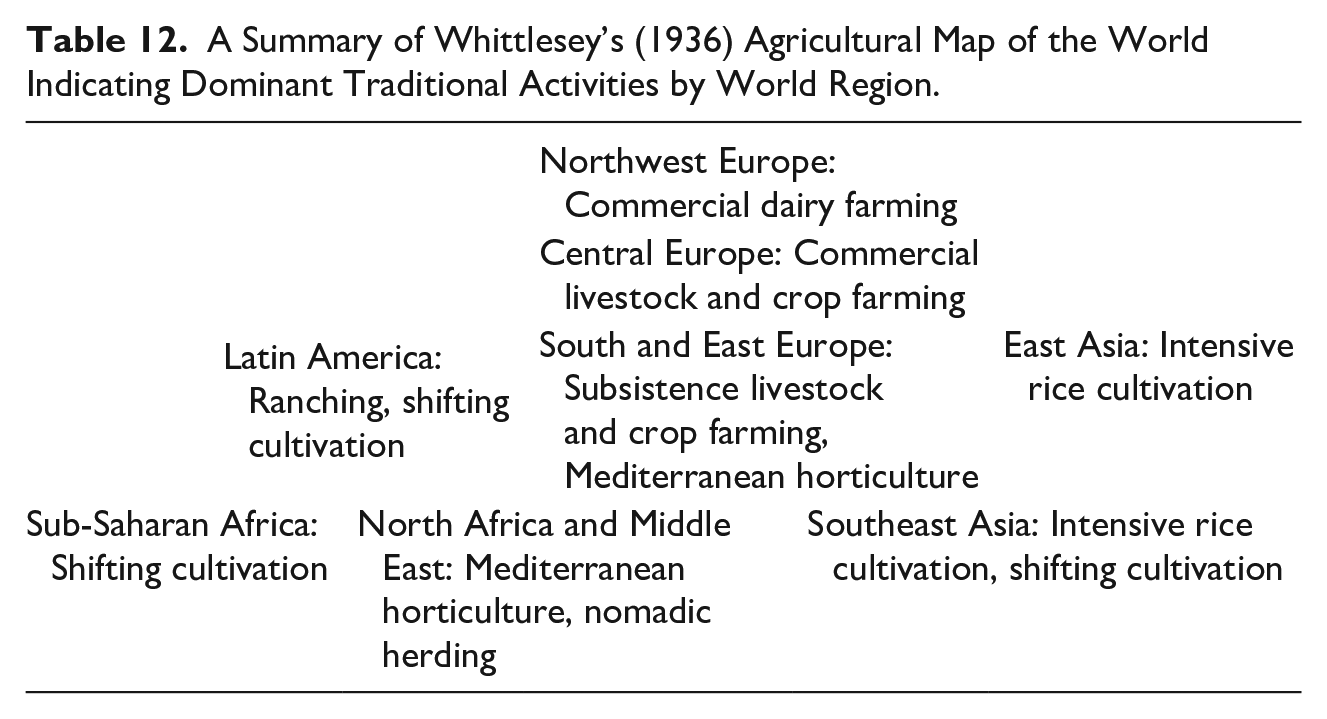
Positions on the vertical axes of our cultural maps of the world are consistent with a contrast between commercial agriculture, indicative of national wealth, and non-intensive, low-yield types of subsistence, such as shifting cultivation and nomadic herding. We also note Hruschka and Henrich’s (2013b) observation that “market integration” (that is commercialization) blurs the boundaries between in-groups and out-groups and results in more fair treatment of strangers. This is an essential trait of IDV. Regions where neither commercial agriculture nor shifting cultivation and nomadic herding were widespread by 1930, such as South and East Europe, occupy an intermediate position on the IDV-COLL and emancipation scale. Interestingly, in the most IDV countries and in the most IDV US states, the dominant traditional economy was dairy farming, an activity that traditionally allowed considerable female participation, and hence relatively higher female status and freedom than in other cultural regions.
9. Whittlesey’s agricultural map suggests that the US had greater agricultural diversity than Europe, which lacked plantations and ranching. Sng et al. (2018) provide other potentially useful clues concerning ecological and genetic factors that may account for cultural differences. Europe seems to replicate our objective-culture dimensions less clearly than the US because Europe has less climatic diversity than the US (there are no tropics and deserts, and climatic disasters are rare), less ethno-racial diversity, and less economic inequality and social polarization.
10. As both myopia and left-handedness are not only cultural but also partly biological products, the high correlation between IDV-COLL and left-handedness, and between FLX-MON and myopia, across nations and across US states, warrants further studies of the relationship between culture and biology.
11. It is not surprising that, across US states, Gelfand’s tightness-looseness dimension is the same as COLL-IDV as both measures incorporates religiousness. It is surprising however that at the national level, tightness-looseness was operationalized in a different way and is not closely associated with IDV-COLL. This raises an interesting question: what really is national tightness-looseness and why is it something quite different from tightness-looseness across the 50 US states?
Finally, we need to address a potential limitation. Any choice of variables contains a degree of subjectivity, even if it is based on a strong theory or strict empirical criteria. This raises an important question: how does the subjectivity of our variable selection affect our results?
Many of the variables in our analysis have very high factor loadings. This suggests that the factors that we obtained would emerge in very similar versions even if we added more variables to the matrix, and even if we obtained some additional factors. The high correlations between subjective-culture IDV-COLL and FLX-MON on one hand and objective-culture emancipation and LTO across both nations and US states on the other hand, suggest that the strong association between subjective and objective-culture constructs would remain even if we added more variables to our analysis.
Research Data
sj-sav-1-ccr-10.1177_10693971211014468 – Research Data for A Test of the Revised Minkov-Hofstede Model of Culture: Mirror Images of Subjective and Objective Culture across Nations and the 50 US States
Research Data, sj-sav-1-ccr-10.1177_10693971211014468 for A Test of the Revised Minkov-Hofstede Model of Culture: Mirror Images of Subjective and Objective Culture across Nations and the 50 US States by Michael Minkov and Anneli Kaasa in Cross-Cultural Research
Research Data
sj-sav-2-ccr-10.1177_10693971211014468 – Research Data for A Test of the Revised Minkov-Hofstede Model of Culture: Mirror Images of Subjective and Objective Culture across Nations and the 50 US States
Research Data, sj-sav-2-ccr-10.1177_10693971211014468 for A Test of the Revised Minkov-Hofstede Model of Culture: Mirror Images of Subjective and Objective Culture across Nations and the 50 US States by Michael Minkov and Anneli Kaasa in Cross-Cultural Research
Footnotes
Appendix
Declaration of Conflicting Interests
The author(s) declared no potential conflicts of interest with respect to the research, authorship, and/or publication of this article.
Funding
The author(s) disclosed receipt of the following financial support for the research, authorship, and/or publication of this article: The first and second author were supported by the Estonian Research Council grant PRG380. The first author was also supported by the National Research University Higher School of Economics, Russian Federation.
Notes
Author Biographies
References
Supplementary Material
Please find the following supplemental material available below.
For Open Access articles published under a Creative Commons License, all supplemental material carries the same license as the article it is associated with.
For non-Open Access articles published, all supplemental material carries a non-exclusive license, and permission requests for re-use of supplemental material or any part of supplemental material shall be sent directly to the copyright owner as specified in the copyright notice associated with the article.
