



Abstract
Rapport is a fundamental psychological construct and understanding it conceptually, including how it is perceived in social interactions, may have a crucial impact on human relations. Culture may be a key that can disentangle and elucidate dynamic characteristics about the nature of rapport as culture provides different and unique meaning systems. We examined cultural similarities and differences in social perceptions of rapport in a context in which interactants had different cultural/ethnic backgrounds. Observers from three very different culture/language groups rated their perceptions about the quality of rapport along 11 conceptually theorized rapport dimensions in video clips presenting one-on-one interviews that differed in their rapport levels. The observer ratings reduced to the same two dimensions across all observer groups, Positivity and Negativity, and there were considerable cultural similarities, along with some differences, in perceptions of rapport across videos. We discussed these findings concerning future theory and research on rapport in various contexts.
The topic of rapport has long attracted research attention as an important mechanism to improve social relations in various contexts such as businesses, classrooms, therapeutic settings, intervention programs, and investigations (Abbe & Brandon, 2013, 2014; Alison et al., 2013; Holmberg & Madsen, 2014; Spencer-Oatey, 2005; Spencer-Oatey & Xing, 2003; Walsh & Bull, 2010, 2012). Interviewers have deemed a stable maintenance of rapport beneficial for successful interview results (Vallano & Schreiber Compo, 2015; Walsh & Bull, 2012). As a crucial factor affecting the quality of social interactions, rapport has been defined in different ways, such as positivity between interactants (Bernieri & Gillis, 2001); togetherness or harmony (Vicaria, Bernieri, & Isaacowitz, 2015); operational accord (Abbe & Brandon, 2013, 2014); an open, interested and warm relationship (Harrigan et al., 1985); interviewers’ positive attitudes toward interviewees and conveyance of genuine respect (Hartwig et al., 2005); and a positive relationship composed of trust and communication (Vallano et al., 2015). All factors that have been studied vis-à-vis rapport indicate that rapport consists of various elements, and that pinpointing a single definition that is agreeable to all and applicable in research is difficult. Given this understanding of rapport, diverse approaches to measuring rapport have been considered in various social contexts for decades (Abbe & Brandon, 2013; Bernieri et al., 1996; Cooksey, 1996; Spencer-Oatey & Xing, 2003). Within this fruitful and dynamic literature, here we examined perceptions of rapport across cultures, aiming to contribute to the field’s understanding of rapport and how it may be conceptualized differently across cultures.
Classic Research on the Nature and Function of Rapport
Seminal studies on the nature and function of rapport were conducted by Bernieri and colleagues beginning in the late 1980s (Bernieri et al., 1994; Bernieri & Gillis, 1995; Bernieri et al., 1988; Grahe & Bernieri, 1999, 2002). For example, Bernieri et al. (1988) documented important findings that emphasized the role of synchrony in rapport. In their study, coordination and synchrony-related behaviors were observed in mother-infant genuine and pseudointeractions; findings indicated that dissynchrony was significant in unfamiliar mother-child pairs and confirmed a positive association between movement synchrony and genuine rapport. In other words, conceptually, synchrony might be a meaningful indicator in establishing relationships and rapport.
Bernieri and colleagues suggested the importance of identifying extended components of rapport as well as the need for different approaches in assessing rapport, such as third parties’ and self-ratings. Starting with initial accomplishments on rapport using self-report ratings and third-parties’ judgments, Grahe and Bernieri (2002) suggested assessing rapport in two cue domains – subjective (i.e., agreeableness, dominance, expressivity, mutual involvement, nervous behaviors, positivity, synchrony) and objective (i.e., back channel responses, eye contact, forward lean, silence, frequency of posture shifts, proximity, and nonverbal synchrony). These domains emphasized the importance of assessing rapport from multiple perspectives and consisted of more specific and extended elements of rapport than their previous studies. The researchers concluded that coordination and synchrony were terms used essentially to refer to rapport, but they operationalized rapport as “positivity” according to interactants’ self-reports and correlated judgments (or codes, depending on the study) of coordination or synchrony with the rapport ratings.
Rapport Conceptualizations
Bernieri and colleagues (Bernieri et al., 1988, 1994; Bernieri & Gillis, 1995; Grahe & Bernieri, 1999, 2002) and others (Dutton & Heaphy, 2003; Spencer-Oatey, 2005; Spencer-Oatey & Xing, 2003; Trout & Rosenfeld, 1980; Vacharkulksemsuk & Fredrickson, 2012) have made substantial efforts to identify different components of rapport theoretically and methodologically. One major contribution was Tickle-Degnen and Rosenthal’s (1987, 1990) review, which built upon previous literature (Bernieri et al., 1988; Bernieri & Gillis, 1995) and presented links between coordinated movements and rapport. They suggested that positive affect or attitude would be associated with rapport and highlighted three core components of rapport: mutual attentiveness (interest, focus), positivity (positive behaviors, friendliness, warmth), and coordination (balance, harmony); smiling, directed gaze, head nodding, body postures and so on were discussed as meaningful behaviors associated with rapport. They also suggested that coordination was relatively more important for rapport later in an interaction than at the beginning. In general, rapport quality may be expected to be in accord with the level of coordination, and coordination may matter in the unfolding of interactions.
In the therapeutic literature, the quality of the relationship between therapist and client that leads to change has been characterized in ways that can be likened to rapport. Bordin (1979, 1983), for example, described the notion of “working alliance,” which was described as an integrated relationship defined by three components (tasks, bonds, and goals). Horvath and Greenberg (1989) later extended Bordin’s (1979, 1983) theoretical work by developing and validating a measure of working alliance and its components. The concept of working alliance evolved in the therapeutic literature to be known also as the therapeutic alliance (Gaston et al., 1995).
Later work in investigative contexts offered different rapport conceptualizations. Kleinman (2006) argued that rapport – expressed as operational accord – was necessary to gain information in such contexts; operational accord was defined as the meaning of shared understanding about the goals of an interaction. Based on the PEACE model (Preparation and planning, Engage and explain, Account, Closure, and Evaluation), Abbe and Brandon (2013, 2014) further expanded on the ideas of both operational accord and working alliance (from the therapeutic literature) as ways of understanding rapport in investigative contexts. They emphasized the importance of rapport strategies across groups, especially across cultural boundaries, proposed specific sources or elements of rapport that possibly initiate and develop levels of rapport – active listening, linguistic and nonverbal mimicry, immediacy, common ground – and reiterated the essential role of coordination as a component of rapport. (Relatedly, Chartrand & Lakin, 2013, reviewed work on mimicry and its potential effects on rapport.) The rapport components and conceptualizations suggested by various researchers facilitated understandings of how to think about rapport more dynamically, in particular in investigative contexts, as well as confirming reliably acknowledged elements over decades of research.
Recent Empirical Studies in Investigative Contexts
Studies of the past decade have expanded approaches to operationalizing rapport in investigative interviews and have contributed to understanding the impetus of various methodological approaches to assessing rapport (e.g., Driskell et al., 2013). For example, Duke (2013) used two rapport rating sources (interviewees’ and observers’ ratings) and examined new components: attentiveness, trust/respect, expertise, connected flow, and cultural similarity. Duke et al. (2018) confirmed that those rapport components were associated with interviewees’ self-reported ratings but not with ratings from other sources. Their results justified why different assessments of rapport pertinent to roles in social interactions might provide different estimates of rapport.
Vallano and colleagues (2015) reported that 123 American interviewers (law enforcement officers) defined rapport with adult interviewees as a positive relationship based on trust and communication, and mentioned that interviewees’ and interviewers’ perceptions of rapport might not be correlated with each other in investigative interview contexts. This was also supported in two other studies (Hwang & Matsumoto, 2020; Matsumoto & Hwang, 2019) that reported no significant correlations between rapport rated by interviewers and interviewees.
Considering the ultimate meaning and goal of establishing rapport emphasizing a mutual relationship, variations in rapport perceptions by different interactants would be vital to identify optimal ways of predicting constructive and mutual rapport, resulting in effective interactional outcomes. Therefore, across three experimental investigative interview contexts, Matsumoto and Hwang (2021) assessed rapport by multiple entities – interviewers, interviewees, and third party coders – and demonstrated that third party codes of rapport were associated with interviewers’ ratings, but both were not associated with interviewees’ ratings. Better rapport, as coded by third party observers and rated by interviewers, was associated with greater information gains during the interview. Also, working alliance was positively correlated with obtaining relevant information in the interviews; interestingly, this positive association was consistent across three cultural/ethnic groups of interviewees but was not obtained using interviewee self-reported ratings. These findings reinforced some of the previous literature emphasizing the critical importance of assessing rapport from different perspectives as doing so might provide diverse information in understanding the nature and characteristics of rapport.
Culture and Rapport
Recognizing the imperative role of culture in social interactions in human societies, culture must have meaningful associations with initiating and building rapport. Yet, despite that decades of research have identified specific behaviors and components of rapport (described above), with few exceptions (Bernieri & Gillis, 1995; Chan et al., 2004; Spencer-Oatey, 2000, 2005), there is a surprising dearth of cross-cultural comparative research in this area, and none in investigative contexts. Cultural differences in conceptualizing rapport are likely, for several reasons. Cultures differ in facilitating different social behaviors and social norms (Matsumoto & Juang, 2016; Rosenthal et al., 1979; Smith & Bond, 1999). Bernieri (1988) mentioned the possible role of friendliness in accuracies of perceptions of rapport and that the meaning and application of friendliness may vary across cultures. Also as mentioned above, Abbe and Brandon (2014) stated that rapport strategies may differ across groups and cultural boundaries.
In one of the few cross-cultural studies available, Bernieri and Gillis (1995) obtained ratings of rapport by Greek and U.S. observers of 50 video clips of dyadic interactions concerning controversial issues. Interactants’ self-reported rapport and 17 behaviors in the videos were coded separately. Observers made two ratings – do the interactants like each other, and do they enjoy what they are doing? – that were merged into a single composite judgment. To examine within group consensus in ratings, Bernieri and Gillis (1995) computed intraclass correlations and demonstrated that the Americans and Greeks had similar within group consensus in their rapport ratings. Cue dependencies were computed by correlating observer ratings with each of the 17 coded behaviors across videos; American and Greek ratings were, for the most part, correlated with the same behaviors.
Spencer-Oatey and colleagues (Spencer-Oatey, 2005; Spencer-Oatey & Xing, 2003) also conducted some of the few landmark studies that have made inroads into understanding possible associations between culture and rapport, showing a unique role of culture. These authors have reported consistent findings regarding the effects of positive rapport, which may extend beyond being polite in social relations in real life across cultures, as well as the importance of contextual factors in understanding the nature and outcomes of rapport. Their work has identified concepts such as behavioral expectations, face sensitivities, politeness, and interpersonal wants as important features of rapport in everyday contexts across cultures.
Thus, cross-cultural comparisons may be able to elucidate some unknown aspects of rapport and their associations with other elements of interactions. Yet formal studies of the association between culture and rapport are still at the beginning of their journey, especially in investigative contexts.
Overview of the Current Study and Hypotheses
The current study extends the literature in several ways. We obtained judgments of rapport by observers from three cultural/language groups with considerable cultural distance in order to examine if perceptions of rapport were similar or different across cultures. While Bernieri and Gillis (1995) obtained only two ratings that were merged into one (which essentially assessed pleasantness), here we assessed 11 rapport elements that operationalized not only pleasantness but other components or dimensions previously theorized; greater diversity in ratings allowed us to examine cultural differences in the structure of rapport ratings (i.e., whether rapport perceptions involve more than pleasantness). We also tested whether observer judgments were associated with a different criterion – third-party coding of rapport – and whether these associations were moderated by observers’ cultures/languages. Finally, we obtained ratings on investigative interviews that included interviewees of three cultural/ethnic groups in two veracity conditions (truth and deception) and two video rapport levels (high and low rapport previously coded by third party coders). We hypothesized that culture would moderate the structure of the rapport ratings and the association of rapport ratings with coded rapport levels of the videos.
Methods
Design
The study was a mixed factorial design including observers from three cultural/language groups (U.S Americans/English, Hispanic/Spanish, and Egyptian/Arabic) rating 12 video clips of interviewees from three culture/ethnicities (European Americans, Chinese and Hispanic individuals), two veracity conditions (truth vs. lie), and two video rapport levels (high vs. low). Thus, the study involved a three (culture/language groups of observers) by three (culture/ethnicities of the interviewees) × two (veracity conditions) × two (video rapport level) mixed factorial design. The dependent variables were 11 ratings made on each video clip. 1 The rights of all observer participants were protected, all procedures were approved by an Institutional Review Board, and applicable human research participant guidelines were followed.
Observers
A total N = 739 observers from three culture/language groups participated; hereafter these participant observers will be referred to as “observers” in order to avoid confusions with the interviewees in the videos and coders who coded the videos in a previous study (described below). We strategically sampled three culture/language groups that represented three of the largest language groups around the world, reckoning that language was a proxy for culture (Matsumoto & Juang, 2016) and that this selection method would provide a broad sampling of potential cultural differences in observer perceptions. U.S./English speaking observers (n = 107, 42 males, 62 females, three declined to respond; mean age = 40.85) were a community sample recruited from the U.S. West Coast. Hispanic/Spanish speaking observers (n = 269, 175 males, 88 females, remainder declined; mean age = 34.57) were community samples recruited at two sites (Bolivia and Spain). Egyptian/Arabic speaking observers (n = 363, 48 males, 304 females, 11 declined; mean age = 21.37) were recruited in Egypt and were university student volunteers participating in partial fulfillment of course requirements. All self-reported as being born and raised in the country in which they were recruited, spoke the target language as their first language, and rated themselves as proficient in speaking, reading, and writing their target language (all means > 6.0 on a 1–7 scale for all culture/language groups).
Measures
Self-Reported Emotions
This scale asked observers to report the degree to which they were currently feeling 15 emotion words (guilt, fear, anger, embarrassment, worry, contempt, excitement, disgust, amusement, nervousness, surprise, interest, sadness, pride, and shame). Ratings were made on a nine-point scaled anchored 0, None; 4, Moderate Amount; and 8, Extremely Strong Amount. This scale and the post-session measures described below were part of a different effort and no further mention of them will be made here.
Demographics and Post-Session Measures
The demographics assessment included questions on sex, age, ethnicity, student status, education, religion, places of birth and upbringing and language proficiency. Observers also completed the Interpersonal Awareness Subscale (Boyce & Parker, 1989), the Intercultural Adjustment Potential Scale Emotion Regulation Subscale (Matsumoto et al., 2001; Matsumoto et al., 2003; Matsumoto et al., 2004), and the Social Dominance Orientation scale (Pratto et al., 2000; Pratto et al., 1994).
Stimuli
The stimuli were video clips that came from a previous study utilizing a mock theft paradigm examining investigative interviews (more details about the methodology can be found in Matsumoto & Hwang, 2018). That study involved a community sample of interviewees of three ethnic/cultural groups – European Americans, Hispanic individuals, and Chinese individuals – who participated in an investigative interview in which they had to tell the truth or lie about a theft. All interviews were conducted in English and manipulation checks confirmed that interviewees were emotionally aroused differentially by veracity condition and perceived moderate-high stakes associated with their performances. In that previous study, an introductory segment of the interviews was coded on four theoretically and empirically derived components of rapport between the interactants (mutual attentiveness, coordination, cooperation/operational accord, and overall rapport). 2 These introductory segments were chosen for coding because they did not involve questions that required interviewees to lie; thus, coding was not confounded by responses or perceptions concerning veracity or deception of the interviewees.
For the current study, video clips of these same introductory segments, approx. 2 m length, and that were associated with the highest and lowest averaged rapport codes (after reducing the four codes to an overall score) for each interviewee ethnicity and veracity condition were selected. Final selection criteria were such that the stimuli used in the current study included an equal number of clips of European American, Chinese, and Hispanic interviewees, with equal numbers in the two veracity conditions and highest and lowest averaged video rapport codes, resulting in 12 video clips (three interviewee ethnicities × two veracity conditions × two levels of coded rapport). Video clips were selected for this current study with the condition that the standardized difference in highest versus lowest coded rapport scores were equivalent across interviewee ethnicities and veracity conditions (average standardized difference between high vs. low rapport codes across the interviewee ethnicities and veracity conditions was z = 3.45; i.e., on average the high and low rapport videos were different by 3.45 standard deviations). Thus, the stimuli were equivalently different in high versus low rapport codes across interviewee ethnicities and veracity conditions. These differences in rapport previously coded in the interviews served as a basis to compare whether observers’ ratings of rapport in the current study would match the previous rapport codes; this was done in the current study by testing whether observers’ ratings obtained in the current study differentiated the high versus low rapport coded videos from the previous study. 3
Observer Judgment Tasks
Observers rated each video clip on 11 items using an 11-point scale anchored 0, No Evidence, 5, Moderate Evidence, and 10, Maximum Evidence (the same anchors used for rapport coding in the previous study). The items were derived from various components and elements of rapport reported in previous research and theory (see reviews by Abbe & Brandon, 2013; Abbe & Brandon, 2014; Bernieri, 1988; Bernieri et al., 1994; Bernieri & Gillis, 1995; Kleinman, 2006) operationalizing the concepts of mutual attentiveness, coordination and synchrony, working alliance and operational accord, and overall rapport (the same components on which the videos were originally coded). Specifically, observers made ratings on the following 11 descriptive prompts: The interactants were (1) attentive to each other, (2) showed mutual respect, (3) coordinated, (4) contributed to the interview goals, (5) expressive, (6) positive, (7) had overall good rapport; (8) the interviewee was hesitant, (9) serious, (10) disengaged, and (11) nervous. Additionally, observers were provided an open-ended question to share any explanations of their judgments as an option.
Procedures
The entire survey was embedded online. After consenting, participants completed demographic questions, followed by the video judgment tasks and then post-session measures. The judgment task consisted of rating the 12 video clips (approx. 2 min-long/videos) described above, which were presented in a random order. After presentation of each clip, observers completed the ratings (items were randomly presented for each video). After rating all 12 video clips, observers completed the self-report emotion ratings a second time, then responded to four open-ended questions related to how observers could recognize “good” and “bad” rapport in interactions, and then the post-session measures, after which they were debriefed.
Results
Cross-Cultural Similarities and Differences in Structure of Rapport Judgments
Means and SDs for the 11 Ratings Computed Across All Videos.

Results From Two Exploratory Factor Analyses for Each of the Three Observer Groups and Total Group.

aTop value for EFA on averaged ratings from original data; bottom value for transformed data.
bitem loadings <.20 omitted.
To examine further the factor structure, we also computed forced three-factor solutions in each group but none provided reasonably interpretable solutions. For example, in the U.S./English group, the highest loading items on the third factor were Seriousness (.61), which also loaded on the first factor (.68); Disengagement (−.39), which also loaded on the second factor (.80); and Contribution to Goals (.30), which also loaded on the first factor (.86). In the Hispanic/Spanish group, Overall Rapport loaded highest on the third factor (.86) but also loaded on the first factor (.37); and four other items that loaded highest on the first factor also loaded on the third factor with loadings .36–.44. In the Egyptian/Arabic group, Hesitation loaded highest on the third factor (.93) but also on the second (.26); Disengagement also loaded on the third factor (.30) as did Seriousness (−.35) but their highest loadings were on the second factor. These differential findings suggested potential interesting cultural differences in the underlying factor structure of the ratings.
We also computed parallel analyses (Franklin et al., 1995; Hayton et al., 2004; Lim & Jahng, 2019; Patil et al., 2008; Wood et al., 2015) to compare our results from what would be expected using random correlation matrices (Patil et al., 2017). None of the results provided a reasonable comparison as the eigenvalues for all 11 initially extracted factors in the EFAs (prior to application of Kaiser criterion) above were greater than the eigenvalues produced by the parallel analyses, which would not represent any data reduction.
We also computed a secondary EFA using only items loading on the Positivity factor, separately in each culture/language group. The analyses produced a single factor using Kaiser criterion in all groups, accounting for 77.86, 64.41, and 77.80% of the variance in the U.S./English, Hispanic/Spanish and Egyptian/Arabic groups, respectively. Thus, Positivity appeared to be a single concept across the three culture/language groups.
Because averaging ratings across the videos eliminated variability among ratings within videos, we also recomputed the EFAs after restructuring the data set as an observer x video (739 × 12 = 8868 cases) matrix, which represented how the 11 ratings varied across videos (but also introduced non-independence of cases). EFAs were computed for the total data set and separately for each observer culture using Direct Oblimin rotation (instead of the Varimax rotation in the original analyses above). Pattern matrices indicated the same two factor structure as that reported above (Table 2, right). We also computed EFAs with Direct Oblimin rotations separately for each video and observer culture on the raw data, all of which pointed to a two-factor solution (Table S1 in Supplemental Materials). Thus, in the remainder of the paper we adopted the two-factor solution, which we believed was the most conservative option to understand the data and allow for equivalent cross-cultural analyses. 4
Cultural Similarities and Differences in Absolute Levels of Rapport Judgments
Based on the analyses above, we computed Positivity and Negativity scale scores by averaging the eight and three items, respectively, separately for each video (.89 < ICCs <.99 for both scores across all three observer culture/language groups). To test for cultural differences in perceived rapport levels in the videos, we computed overall Observer Culture/language (3) by Sex (2) x Interviewee Ethnicity (3) x Veracity condition (2) x Video Rapport Level (2) mixed ANOVAs on the Positivity and Negativity scale scores. (Although observer sex was not a focus of the study, we included it as a factor for statistical and conceptual reasons. Statistically, its inclusion allowed for a partitioning of variance across all known factors existing in the experiment, which would result in better estimates of all sources of variance in the data. Conceptually, sex is often an important source of cultural differences and its inclusion allowed for post-hoc examinations of such differences below.)
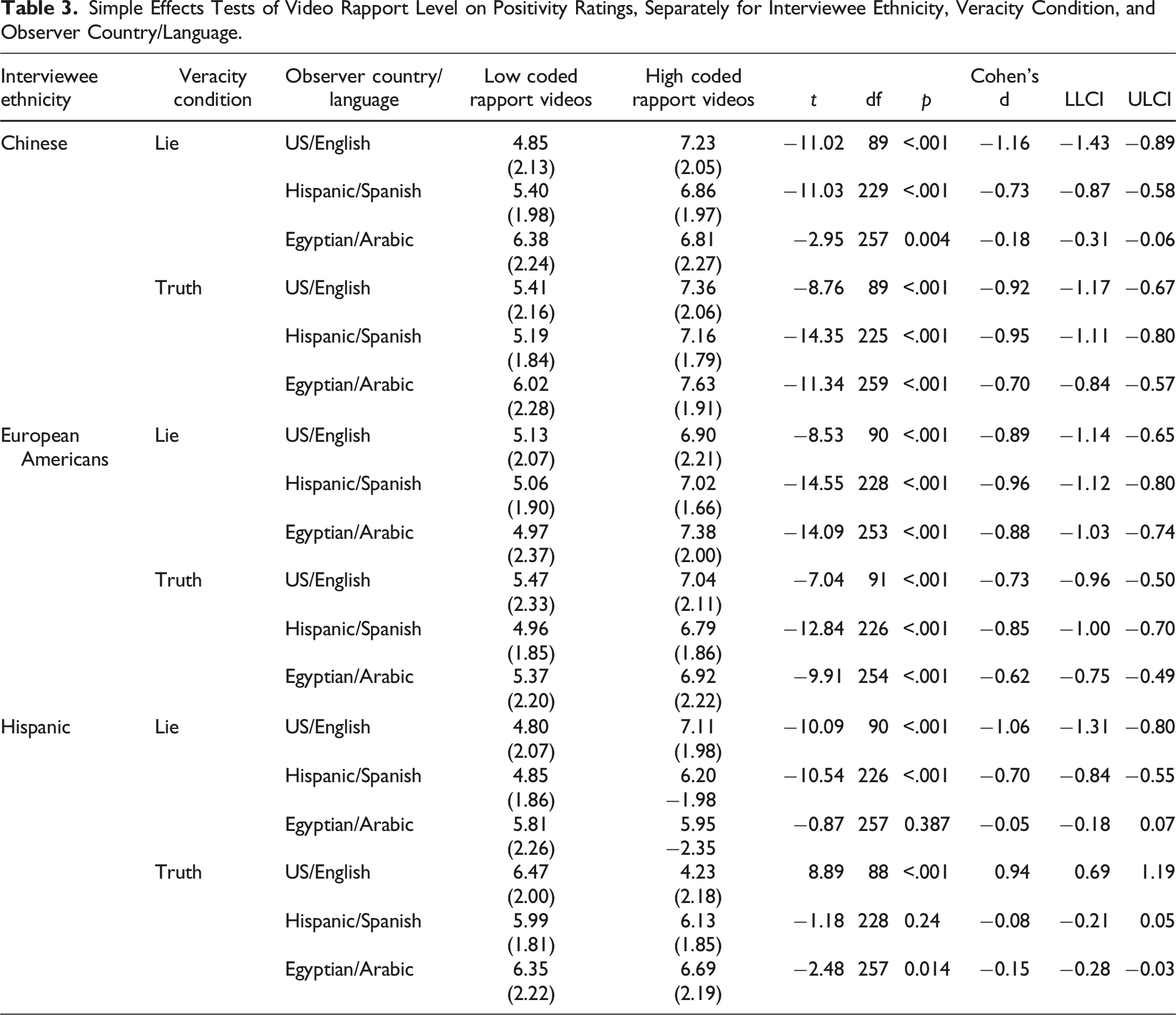
Simple Effects Tests of Video Rapport Level on Positivity Ratings, Separately for Interviewee Ethnicity, Veracity Condition, and Observer Country/Language.

Differences in Positivity ratings between high and low coded rapport videos.
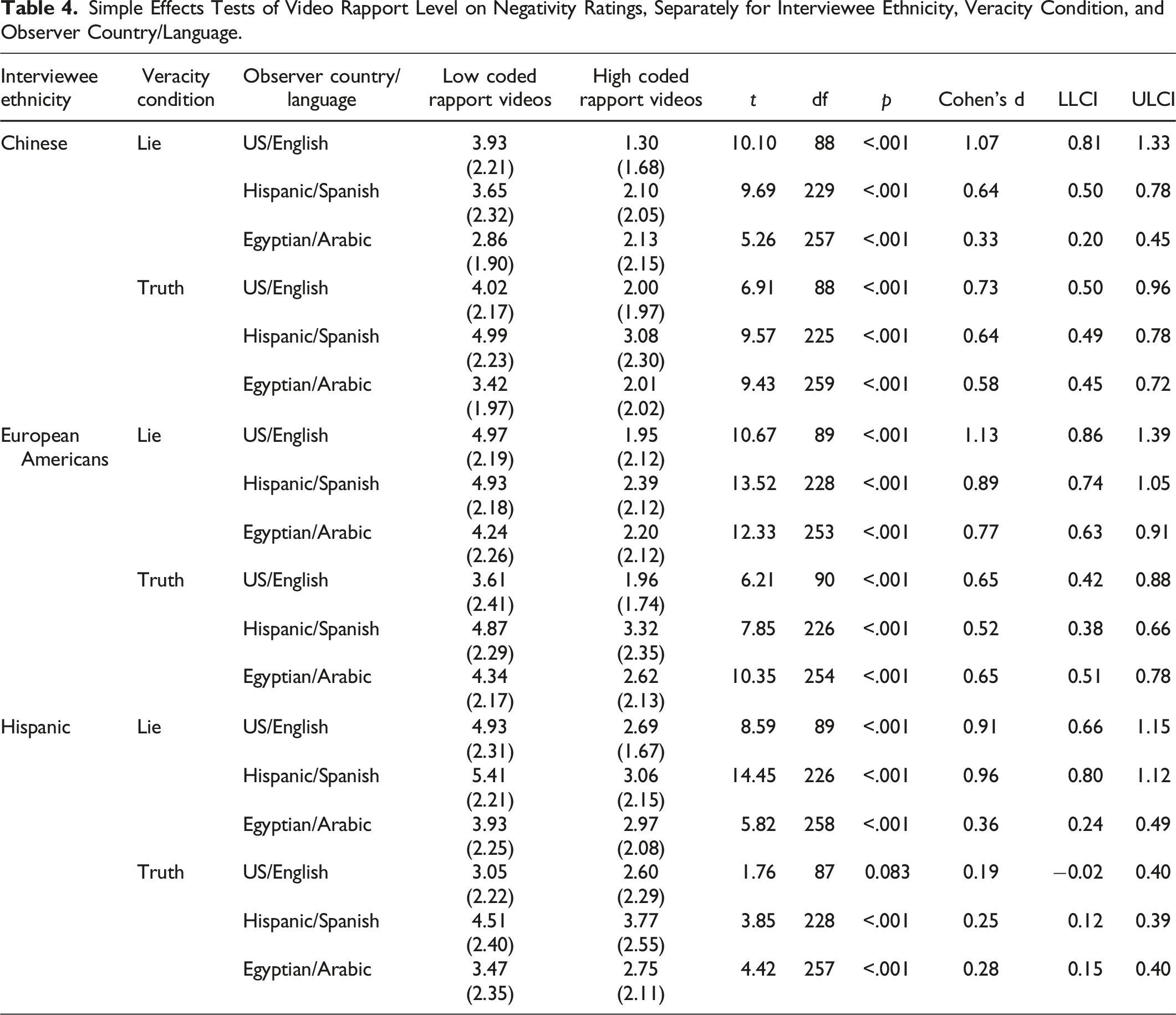
Simple Effects Tests of Video Rapport Level on Negativity Ratings, Separately for Interviewee Ethnicity, Veracity Condition, and Observer Country/Language.
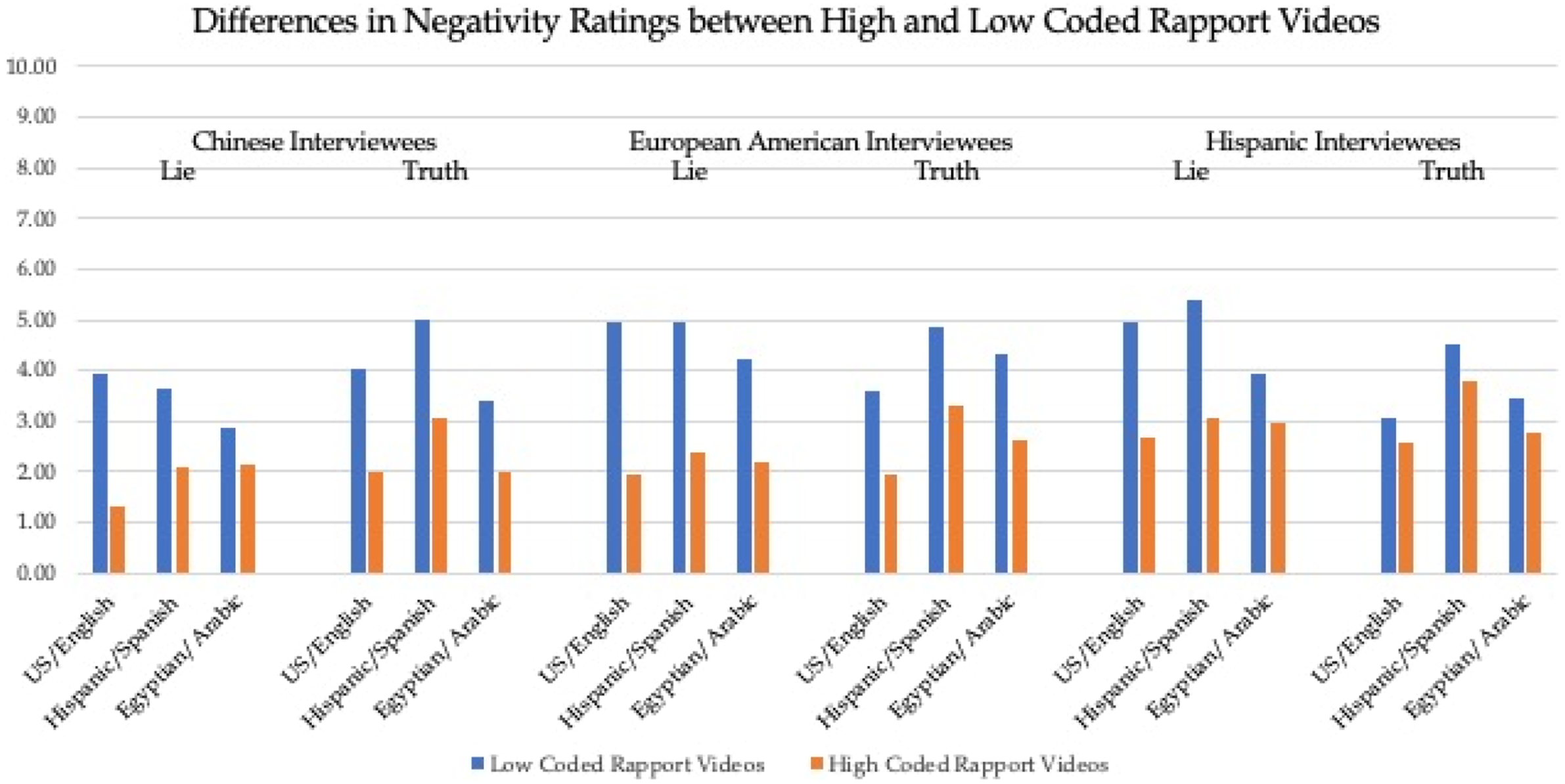
Differences in Negativity ratings between high and low coded rapport videos.
Post hoc Analyses
To examine if observer sex moderated any findings above, we examined sex effects in the two overall ANOVAs above. On Positivity, two interactions involving Sex and Video Rapport were significant: the Interviewee Ethnicity by Video Rapport Level by Sex, F (2, 1118) = 3.40, p = .034, η P 2 = .006; and the five-way, F (4, 1118) = 2.55, p = .038, η P 2 = .009. To follow-up, we computed the same simple effects of Video Rapport Level above separately by observer sex.
Male and female U.S./English observers showed the exact same findings on Positivity in Table 3: higher rapport videos were rated as higher Positivity with the exception of Hispanic interviewees' truthful videos, which produced the opposite finding. For Hispanic/Spanish observers also, the exact same pattern of findings was obtained as in Table 3: higher rapport videos were rated as higher in Positivity than the lower rapport videos by both male and female observers, with the sole exception of the Hispanic interviewees’ truthful videos, which produced non-significant results. Thus, observer sex did not moderate the main pattern of findings for U.S./English or Hispanic/Spanish observers.
For Egyptian/Arabic observers, some differences from the main findings were obtained on Positivity. Male observers rated three types of higher rapport videos (Chinese truth, European American truths and lies) as higher in Positivity, and there were no differences on Hispanic lie videos; these findings were the same as those in Table 3. But there were no differences on Chinese lie or Hispanic truth videos (means trended in the same direction as in Table 3). For female observers, the exact same pattern of findings as in Table 3 were obtained. Thus, Observer Sex moderated the pattern of findings for Egyptian/Arabic observers, although differences in statistical power due to the reduced sample size for Egyptian/Arabic males needs to be considered.
On Negativity, only the Veracity Condition by Sex interaction was significant, F (1, 558) = 7.50, p = .006, η P 2 = .013, but not any interaction involving Video Rapport Level, which was the main hypothesis. Thus, Observer Sex did not interact with rapport levels on Negativity and no further follow-up analyses were computed.
Finally, Bernieri and Gillis (1995) computed intraclass correlations (ICCs) to indicate that Americans and Greeks had similar within group consensus in their rapport ratings in their study. To gauge within group consensus in our study and to enable direct comparisons, we computed ICCs across the 11 ratings separately for each culture/language group (the same procedure as used in Bernieri & Gillis, 1995). Across all videos, within group consensus was highest among U.S./English, ICC = .88, 95% CI [.81, .92], then Hispanic/Spanish, ICC = .77, 95% CI [.68, .84], and then Egyptian/Arabic, ICC = .67, 95% CI [.53, .76]. (Similar findings were obtained when analyses were conducted separately by video clip.) CIs did not overlap between the U.S./English and Egyptian/Arabic groups, suggesting significant differences. Thus, unlike Bernieri and Gillis (1995), our findings indicated a cultural difference in within-group consensus among rapport ratings.
As an alternative method of comparing within-group rating consensus, we also calculated correlations between the mean ratings of each culture group for each of the 11 original ratings and for the Positivity and Negativity scale scores. The correlations were significant on 5/13 ratings between English and Arabic observers, on 11/13 between English and Spanish observers, and on 12/13 between Spanish and Arabic observers (see Table S2 in Supplemental Materials). We also computed ICCs for each rating across the 12 videos within each observer culture because observer culture differences in rapport judgments would be evidenced to the extent that the ICCs within each group were greater than the correlations of the consensus means comparing the pairs of cultural groups. In many cases they were and reflected the cultural differences reported in the ICCs immediately above and in the pattern of correlations.
Discussion
The current study extended an understanding of the nature of rapport perceptions across cultures, a topic of importance as discussed by many researchers in various contexts (i.e., Spencer-Oatey, 2005; Vallano & Schreiber Compo, 2015; Walsh & Bull, 2012). We explored whether different cultural backgrounds would impact perceptions of rapport in investigative contexts, and how observers who have no pre-informed knowledge about the interviews, interviewees, or interviewers perceived rapport through ratings of various items. Observers in three culture/language groups perceived rapport essentially on two dimensions – positivity and negativity – even though items assessed different theoretical conceptions of rapport and their components; and the ratings mostly corresponded with third-party codes of rapport of the same video clips previously obtained (as evidenced in the large correspondence in differences between the high- vs. low-coded rapport videos) that were also based on different theoretical conceptions.
Our findings suggested that despite previous conceptual frameworks of rapport positing such concepts as mutual attention, coordination, positivity, working alliance, or operational accord, observers across cultures essentially perceived rapport much more simply and applied these constructs comparably to examples of high and low rapport interactions (with a few exceptions, discussed below). There are several possible interpretations of these findings. On one hand, people may naturally perceive and understand rapport similarly to some extent regardless of cultural backgrounds, suggesting possible universal characteristics of “good” social interactions. Commonly shared needs for affiliation (Boyer, 2000; Buss, 2001) and the positive impact of social relations on health, well-being, and social survival (Spencer-Oatey, 2005) may facilitate a pancultural basis for meaningful social relations that may transcend culture and lend themselves to a simpler structure of rapport perceptions and interpretations of high and low rapport interactions, as evidenced here. On the other hand, our findings concerning the simpler structure of rapport ratings may have been an artifact of the methodology using a single rating or two to assess multiple components and conceptualizations of rapport, which would also then impact the differences between high and low rapport videos. Given such limited assessment of various potential components, expecting those components to emerge in EFAs may have difficult (although our findings would still suggest that positivity and negativity may be higher order factors). 5
The fact that observers perceived rapport as positivity and negativity suggested that rapport – the quality of an interaction that facilitates cooperation – may be elementally simpler in the minds of laypersons. A simpler understanding of rapport would align with previous findings demonstrating that there is not a one-to-one match between various behaviors and rapport components (Bernieri & Gillis, 1995). A simpler structure of observers’ rapport perceptions may contribute to understanding why different sources of rapport ratings often do not associate with each other (e.g., between interviewers and interviewees; Matsumoto & Hwang, 2021). Interactants’ rapport perceptions may be different from third-party coders or observers because of the interactants’ personal involvement in the interactions. Observers and third-party coders are not directly involved and observe interactions in their entirety, including both interactants, rather than from only in one or the other’s shoes (as coders of the videos in the previous study and the observers in the current study were instructed). 6 Thus, observer ratings and third-party coding cannot speak to the differential experiences of the interactants. That differences may exist among interactants, third-party coders, and observers do not negate the importance of rapport perceptions of the interactants; instead they point to the importance of considering different sources of such perceptions as somewhat independent of each other, albeit in an interdependent situation.
While the findings demonstrated strong cross-cultural similarities in the structure of rapport perceptions and their association with third party coding of the videos, there were also interesting cultural differences, essentially on the Hispanic interviewees’ truthful videos. Although those differences may have been aberrations given the overall consistency of the findings, the videos themselves may have contained some kind of unique characteristic that accentuated a cultural difference. That the cultural differences in the pattern of the findings occurred only on the videos of Hispanic interviewees is interesting. An ingroup bias in perceiving the interactions could not explain this differential pattern of findings as observers included U.S./English and Hispanic/Spanish observers; and, Arabic observers’ ratings generally corresponded to the rapport levels of the videos, regardless of interviewee ethnicity. Future studies should explore other potential characteristics of the videos, e.g., the match of the ethnicities of the interviewers and interviewees or the nature of the interaction that may accentuate cultural differences.
There were also cultural differences in within-group consensus in ratings across cultures, with Egyptian/Arabic observers having significantly less consensus than U.S./English or Hispanic/Spanish observers. Greater variability in ratings within the Egyptian/Arabic observers and fewer significant correlations with U.S. observers suggested more individual differences in rapport perceptions, which in turn may have several interpretations. Egyptian/Arabic observers may use different and more varied behavioral cues to identifying rapport compared to the other observers; or they may have different conceptions about rapport to begin with. The fact that the interviews were conducted in English may have contributed to these and other observed differences (although note that English and Spanish speaking observers had similar within-group consensus). Our data cannot speak to which interpretation may be correct and future studies should examine these potentially interesting cultural differences.
The findings may have practical implications. In many social situations, rapport is a core factor determining the development and maintenance of social bonds. In today’s world, social interactions can occur with anyone from any social or cultural background and at any place for various purposes. For example, rapport is critically important in therapeutic settings, and understanding perceptions of rapport across cultures may have implications for therapeutic work across cultures, as it has its own share of culturally unique aspects (Tanaka-Matsumi, 2019). In the investigative interviewing world, the current findings may provide a relatively simpler roadmap to establishing and maintaining rapport, much along the lines that Tickle-Degnan and Rosenthal (1990) posited years ago that positivity can play an important role, especially in the beginning of an interaction, at least involving interviews with naïve individuals.
The current study had limitations, the first concerning the nature of interactions examined, which was an investigative context. As mentioned in the introduction and throughout this discussion, investigative contexts may be a unique setting to study and understand rapport because interactants come with very different goals; interviewers have the job of building rapport and gaining cooperation whereas interviewees often do not share these goals; in fact, their goals may be antithetical to those of the interviewers. Interviewers and interviewees may have their perceptions influenced by the stakes involved as well as the associated cognitions and emotions that occur during the ebb and flow of the interaction. Thus, interviewers’ and interviewees’ rapport perceptions may be impacted by their subjective experiences, and findings from such contexts may not generalize to other contexts because they are not ecologically representative of the types of interactions that are normally associated with the construct of rapport or that were examined in seminal research reviewed earlier (e.g., Bernieri, 1988; Bernieri et al., 1988; Bernieri et al., 1994; Bernieri et al., 1996; Bernieri & Gillis, 1995). More recent research has demonstrated, however, that rapport is important in investigative contexts (e.g., Driskell et al., 2013; Duke et al., 2018; Hwang & Matsumoto, 2020; Vallano & Schreiber Compo, 2015) and future research will need to examine how the nature and function of rapport may differ in different interactions.
Another limitation was that the video stimuli used in the current study were all in English. Clearly observers in non-English speaking cultures may perceive the interactions differently than English-speaking observers because of differences in language comprehension. This limitation was mitigated somewhat by the fact that analyses were conducted within observer culture/language groups without direct comparisons between groups. Still, the correspondence between the language of the interactions and the observers was not controlled for and confounded any observed differences, such as in the within-group consensus analyses. Future studies should balance interaction language and observer language to replicate the findings reported here.
Although some post-hoc tests of sex produced significant results, they were compromised by large imbalances in sex ratios and low statistical power in some cells, especially in the Arabic group; however, as mentioned above, the isolated findings involving culture and sex may be meaningful in terms of identifying cultural variations in perceptions of rapport, and future studies designed and adequately powered to examine sex differences across cultures may provide further insights into this possibility.
In addition to commonly shared rapport components in the culture/language groups, there may be culturally specific factors underlying rapport, as suggested by the forced three-factor solutions. Therefore, future studies may examine what potential cultural elements of rapport can function more efficiently or differently in perceiving rapport. Also, the concept of rapport may be conceptualized differently depending on the purpose of the situation, and how it is assessed to achieve the goal of improving social interactions may matter. As Chartrand and Lakin (2013) pointed out, behavioral mimicry should be assessed in broader contexts and channels rather than relying on a specific type of behavioral movement in defining and understanding rapport. At the same time, examining more cultural similarities than what was observed in the current study is also useful in the future; Duke et al.’s (2018) measure of rapport perceptions, for instance, includes a cultural similarity scale that assesses the degree to which interviewers and interviewees share the same culture and can be useful in future studies in this regard.
The current study focused on rating rapport of the interaction rather than making judgments of specific cues or moments; a more extended and/or specific scope of rapport assessments may result in different findings as a result of the influence of other contextual factors. Such challenging, but necessary, exploration might be worthy to visit in future research. Lastly, based on suggestions by Bernieri and Gillis (1995), Tickle-Degnen and Rosenthal (1990) wrote that rapport is not a personality trait although an individual may be particularly adept at developing rapport. We believe that these remarks are crucial to keep in mind for future study, exploring a possible key to understanding fruitful aspects of rapport that have not yet been discovered or discussed.
Supplemental Material
Supplemental Material - Social Judgments of Rapport in Investigative Interviews Across Cultures
Supplemental Material for Social Judgments of Rapport in Investigative Interviews Across Cultures by Matthew Wilson, David Matsumoto, Angel Nicolas Avendano Vasquez, Jose Manuel Garcia Garcla, and Mai Helmy in Cross-Cultural Research
Footnotes
Acknowledgments
Statements of fact, opinion, and analysis in the paper are those of the authors and do not reflect the official policy or position of the Federal Bureau of Investigation or the U.S. Government.
Declaration of Conflicting Interests
The author(s) declared no potential conflicts of interest with respect to the research, authorship, and/or publication of this article.
Funding
The author(s) disclosed receipt of the following financial support for the research, authorship, and/or publication of this article: This work was funded by the High-Value Detainee Interrogation Group contract DJF-18-0017-PR-0006603
Data Sharing Statement
Raw data for analyses reported above will be kept for a minimum of 5 years, per guidelines established by the American Psychological Association, and are available to reasonable requests to the authors during this time.

Supplemental Material
Supplemental material for this article is available online.
Notes
Author Biographies
References
Supplementary Material
Please find the following supplemental material available below.
For Open Access articles published under a Creative Commons License, all supplemental material carries the same license as the article it is associated with.
For non-Open Access articles published, all supplemental material carries a non-exclusive license, and permission requests for re-use of supplemental material or any part of supplemental material shall be sent directly to the copyright owner as specified in the copyright notice associated with the article.
