



Abstract
Cultural learning is a key feature of culture and our humanity. Although studies exist on children’s learning in subsistence farmers and hunter-gatherers, comparable cross-cultural studies have not been conducted for pastoralists. The purpose of this paper is to identify and describe patterns of cultural learning in pastoralists and to compare these patterns to what we know about cultural learning in hunter-gatherers. The study utilizes 13 cultures coded as pastoralists in eHRAF World Cultures. The search located 198 texts in ethnographies with precise information on how pastoral children learn. Overall, we found that children acquired most pastoral skills and knowledge in early childhood, children were most likely to learn from parents (vertical transmission) and non-parental adults (oblique transmission), a relationship between age and specific modes of transmission did not exist, various forms of teaching were the most frequently mentioned processes of learning, and the frequency of teaching did not vary by the child’s age. When hunter-gatherer’s and pastoralist’s patterns of cultural learning were compared several similarities emerged: most accounts of learning occurred in early childhood, children were most likely to learn from parents and non-parental adults, and various forms of teaching were the most frequently mentioned processes of learning. Several differences in cultural learning between the two groups were identified: pastoralist ethnographers were less likely than hunter-gatherer ethnographers to mention learning from peers and more likely to mention learning via local enhancement and stimulus enhancement.
Introduction
Learning from others is key feature of culture and our humanity. Culture is acquired non-genetically in a variety of ways from others and shared among individuals within a group over time (Kashima & Gelfand, 2012; Richerson & Boyd, 2008). This processes of acquiring culture non-genetically from others is known as cultural or social learning (Hewlett, 2016; Hoppitt & Laland, 2013).
Cultural learning encompasses the process of acquiring cultural features such as social norms, social organization, as well as kinship, political, economic, medical, and religious systems. It is also a process of social reproduction through which different elements of culture (technology, knowledge, behaviors, language, and beliefs) are learned (Cavalli-Sforza & Feldman, 1981; Hewlett & Cavalli Sforza, 1986; Lancy et al., 2010). Although, culture, i.e. learning from others, is not limited to our species (see Hoppitt & Laland, 2013; Whiten, 2021), human cultural learning is unique in that it entails acquiring thousands of cultural variants over many areas of behavior, whereas in other animals it is typically limited to a few traits and often associated with finding food or mates’).
Anthropologists studying cultural learning use a variety of different approaches. Those who emphasize evolutionary approaches (Boyd et al., 2011; Boyd & Richerson, 1988; Cavalli-Sforza & Feldman, 1981; Kline, 2015; Mcelreath, 2004) examine cultural learning mechanisms that may or may not be adaptive or fitness enhancing and how cultural variants may persist or change over time. Cultural and psychological anthropologists (Barry et al., 1959; Bolton et al., 1976; Hewlett et al., 2011; Rogoff, 2003; Whiting and Whiting, 1975) tend to focus more on how the physical and social environment (e.g., local ecology or subsistence types) or foundational schema or cultural scripts impact cultural learning.
Many systematic studies of learning have been conducted with children in laboratory settings in “WEIRD” (Western, educated, industrial, rich, and democratic) societies with complex hierarchies, inequality, formal education, and capitalism (Abbott, 1992; Harkness et al., 2000; Harkness & Super, 2006; Henrich et al., 2010; Morelli et al., 1992; New & Richman, 1996; Super et al., 1996). Although some anthropologists have studied cultural transmission and acquisition in hunter-gatherer societies (Boyette & Hewlett, 2017; Garfield et al., 2016; Hewlett et al., 2011; Terashima & Hewlett, 2016), the majority of the classic systematic child-centered studies of cultural learning have been conducted with subsistence farming groups (Quinlan et al., 2016; Kline et al., 2013; Reyes Garcia et al., 2016; Rogoff, 2003; Lancy, 1996; LeVine et al., 1994; Whiting & Whiting, 1975; Spindler, 1974; Mead, 1930; Malinowski, 1929).
Although research in these cultures has provided important insights into how children learn outside of formal school settings, ethnographic descriptions of learning in pastoral groups are rare; no systematic comparative studies of child learning exist for pastoralists, and several features of pastoral life suggest that cultural learning may be somewhat different than hunter-gatherers or farmers, e.g., pronounced gender inequality and the need for updated information on the ecology (most pastoralists live in arid environments with high seasonal variability) (Glowacki & Molleman, 2017; Mcelreath, 2004; Bolton et al., 1976; Barry et al., 1959).
Thus, the primary aim of this paper is to identify and describe patterns of cultural learning in pastoralists and to compare these patterns to what we know about cultural learning in hunter-gatherers. Several cross-cultural studies have been conducted on hunter-gatherer social learning (Lew-Levy et al., 2021; Terashima & Hewlett, 2016), but comparable studies have not been conducted with pastoralists.
Cultural Learning: Modes and Processes
Cultural learning involves specific modes and processes. Modes of learning refers to the individuals from whom someone learns cultural beliefs, knowledge, or practices (Hewlett, 2016). Some of the modes of transmission include vertical (from parent-to-child), horizontal (from age-mates), oblique (from older non-parental adults), concerted (from a group that agrees on what to transmit to children), and prestige-biased (learning from individuals that are admired) (Boyd & Richerson, 2005; Cavalli-Sforza & Feldman, 1981; Garfield et al., 2016; Henrich, 2020; Hewlett et al., 2011).
Cross-cultural studies and ethnographies of diverse small-scale societies suggest that vertical transmission is frequent in relation to other modes of cultural transmission, i.e., oblique and horizontal (Garfield et al., 2016; Hewlett & Cavalli Sforza, 1986; Stieglitz et al., 2013). Some researchers have argued that modes of cultural learning vary by age. Mathematical models developed by Deffner and McElreath (2022) find that learning from older individuals is a good strategy when the environment is relatively stable and adaptive behavior is hard to acquire. McElearth (2004) suggested among the Usangu of East Africa parents are important in early cultural transmission whereas peer influence increases with age. Kline and colleagues (2013) point out that Fijian children start learning from parents and other members of the immediate family. As children get older, they start to compare what they have learned to the behavior of others. For instance, Garfield et al. (2016), found in their eHRAF World Cultures (eHRAF for short) study that vertical transmission is highly prevalent during infancy and early childhood but less common in middle childhood. Konner (2010), Reyes Garcia et al. (2016), and Harris (1995) also found that horizontal learning is most prevalent during middle childhood (7–12 years) when children spend most of their time playing with similar aged peers. The implication is that children begin learning vertically, while horizontal and oblique transmission become common in the late childhood and adolescence.
Concerted learning or consensus-based learning is where members of a group (often but not always older) formally (e.g., initiation) or informally (e.g., while sitting around campfire) agree upon which skills or norms should be transmitted and often transmit them together at the same time or over time. It is sometimes referred to as many-to-one transmission (Cavalli-Sforza & Feldman, 1981). Compared to hunter-gatherers, pastoralists are more likely to experience extended initiation ceremonies in their transition from childhood to adolescence or adolescence to adulthood (Gulliver, 1958; Schlegel & Barry, 1991). During this time, children may undergo intensive training from various community members. The training usually focuses on what the older community members agree upon to transmit. Another type of transmission is prestige-biased learning where individuals are attracted to learning from others in the community that have acquired prestige in any number of ways, e.g., political decisions, generous sharing, excellent hunter, or storyteller (Boyd & Richerson, 2005; Henrich & McElreath, 2003).
Processes of learning refers to the ways individuals learn from others. Both cross-cultural and field-based studies among hunter-gatherers indicate that teaching, emulation, imitation, observation, local enhancement, and collaborative learning are common processes of learning (Garfield et al., 2016; Hewlett, 2016; Hewlett et al., 2011). Kline et al. (2013) identified five learning processes: “hearing/listening, seeing/observing, doing/practice, imitating, and being taught” in their study of the farming community in a Fijian Village (2013: 360). Rogoff (2016b) found the process of learning occurs by participation or pitching-in and Tian (2019) indicates children learn by doing.
Although some scholars believe that teaching is rare in small-scale societies (Lancy, 1996; Lancy & Grove, 2010), current research questions this perspective (Boyette & Hewlett, 2017; Hewlett et al., 2011; Hewlett & Roulette, 2016; Kline et al., 2013; Quinlan et al., 2016). It is argued that teaching should be a relatively common feature of human cultural acquisition (Csibra & Gergely, 2009, 2011) due to the complexity of human cultures and that cultural transmission through teaching enhances high fidelity transmission and human’s ability to adapt rapidly and precisely to a changing environment (Boyd & Richerson, 1988; Kline et al., 2013; Tomasello et al., 1993). Although the need for learning from others declines with age (Deffner & McElreath, 2022; Levy, 1973), recent cross-cultural studies and ethnographic data shows that the importance of teaching increases with age of children in small-scale cultures. For instance, Boyette and Hewlett (2017) and Garfield, et al., (2016) argue that the importance of teaching increases with age in hunter-gatherer societies and that it is associated with learning more complex skills (e.g., elephant hunting, making baskets and cross-bows) or knowledge (ritual religious knowledge like witchcraft, sorcery).
Several anthropologists suggest that compared to other processes of cultural learning, observation and imitation are much more common in small-scale cultures (Gaskins & Paradise, 2010; Paradise & Rogoff, 2009; Rogoff et al., 1993). Observation and imitation is considered as a central process of cultural learning in small-scale societies and necessary to sustain a broad range of cultural features such as social norms, and social organization (Lancy et al., 2010). For further information on transmission modes and processes, one can refer to recent overviews in Hewlett (2016), Garfield et al. (2016) and Mesoudi (2011).
Cultural Contexts and Learning
Whiting and Whiting (1975) viewed culture as a provider of settings (physical and social settings) for child learning. Accordingly, the physical and social environment in which children are brought up patterns what children learn and how and from whom they learn. One aspect of the physical and social environment which shapes cultural learning is the subsistence system. In his concept of “becoming,” John Bock (2010) said that children acquire knowledge or skills that may not be of current use but will be important when they reach adulthood. Barry et al. (1959) also suggest that child training is in line with their future subsistence roles. However, there is a considerable variation about what skills children must learn in pastoralist, and foraging communities (MacDonald, 2010). For instance, among pastoralists men and their sons often take long trips to graze cattle or engage in warfare (limited access to learn from females during this time) whereas hunter-gatherers camps are relatively small and intimate therefore they have many people of both genders very close by to learn skills or knowledge.
Barry and colleagues (1959) indicate that herders put pressure on training their children to become obedient and responsible adults, and emphasis is put on enabling them to learn food accumulation. By contrast foragers emphasize self-reliance and communal autonomy, but do not encourage and often have social norms against accumulation. Thus, children brought up in different subsistence systems tend to develop these different qualities which enhance their survival.
Another factor that may influence cultural learning environments are what Shore (1996) calls foundational schemas and Descola et al. (2013) refers to as integrated schema. These are “ways of thinking and feeling that influence many domains of cultural life” (Hewlett et al., 2011:3). The foundational schemas are general ways of thinking that link a family of related cultural models (Shore, 1996: 53).
Hewlett’s (2016) study found that foundational schemas among Aka hunter-gatherers, i.e., egalitarianism, respect for autonomy, and giving/sharing, impacted many dimensions of infancy and early childhood, from frequency of breastfeeding to where children should sleep. In such cultures, children are relatively free to do what they want and are not punished for ignoring the requests from elders. However, pastoralists are characterized by social hierarchy based on age, sex, and strong clan organization (Edgerton, 1971; Legesse, 1973). All cultures have age grades, i.e., identifying stages of life, but pastoralists are much more inclined to have age sets, i.e., where a group of individuals of a particular age grade are named and pass through the stages together. The age mates come from clan members across a large area. Gender equality is relatively common (but enormous diversity) in hunter-gatherers, but gender hierarchy is particularly pronounced in pastoralists, in part due to regular warfare and male control of cattle that are important for female survival. One consequence of this pattern is that pastoralist fathers provide very little direct care to children whereas father involvement is generally much higher in hunter-gatherers (Marlowe, 2010). Consequently, pastoralists emphasize deference and respect towards both males and older individuals. Children are expected to obey the requests from their parents and other elders, on the expectation that these people know what is best for the child and therefore provide opportune guidance and instruction. Task assignments are also expected to be more frequent in pastoralist than in hunter-gatherer groups (Munroe & Gauvain, 2010).
Finally, pastoralists are much more likely to have strong clan organization than are hunter-gatherers. Clan organization means that individuals rely upon and regularly interact with clan members. Hunter-gatherers are known for their flexibility with whom they associate, i.e., they tend not to rely upon specific individuals outside of the household. For instance, hunter-gatherers are more likely to have multilocal post-marital residence patterns whereas pastoralists are more likely to be patrilocal (Marlowe, 2010). As these contexts impact cultural learning in pastoralists and hunter-gatherers differently, we carefully considered them in the predictions.
Predictions
Cultural Learning Among Pastoralists
Given our literature review about (1) the modes and processes of cultural transmission (see Cultural Learning: Modes and Processes) and (2) pastoralist life, we predict the following cultural learning patterns among pastoralists: • P1: It is difficult to hypothesize as to which mode of transmission will be most common in pastoralists because the age stratification might suggest more horizontal transmission (i.e., spending more time and learning from member of their age set), but the age stratification may also mean that parents and other adults (vertical and oblique) are likely to guide and direct child learning. Given the emphasis on vertical transmission in the existing literature on small-scale societies, we predict that vertical transmission will be the most common mode of learning. • P2: As suggested by the modes of transmission literature, we predict that the modes will vary by age; in early childhood, it will primarily be the vertical (parent-to-child) and then move to horizontal (slightly older peers, age-mates) in middle childhood, and then to oblique transmission (older non-parental adults) in adolescence. • P3: Given the age and gender stratification in pastoralist cultures, we predict that teaching will be a common process of cultural learning compared to other processes of learning. • P4: As with most small-scale societies, we predict that observation and imitation will be the most common process of child learning compared to other processes of cultural learning.
Comparing Hunter-Gatherer and Pastoral Cultures
Given our knowledge about the literature about modes and processes of transmission (Cultural Learning: Modes and Processes) and our understanding of contexts of pastoralist and hunter-gatherer subsistence (Cultural Contexts and Learning) we make the following predictions about differences and similarities in cultural learning among pastoralists and hunter-gatherers. • P5: Studies have consistently shown that both parents and non-parental adults are important transmitters of culture in small-scale societies and we therefore predict that vertical and oblique learning will be equally important modes of transmission in both pastoralists and hunter-gatherers. • P6: Since adolescent initiations are longer and more common in pastoralists, we predict that concerted transmission will be more common in pastoralists than in hunter-gatherers. • P7: The greater gender and age inequalities in pastoral life may also contribute to greater disparities in cultural knowledge and skills so that children may be more likely to be attracted to learn from these individuals. Consequently, we predict that prestige-bias will be more common in pastoralists than in hunter-gatherers. • P8: Observation and imitation processes are expected in both groups, but pastoralists have greater age hierarchy and directed learning from older individuals than hunter-gatherers and consequently we predict that observation and imitation will be more common among hunter-gatherers than among pastoralists and that teaching will be more common in pastoralists than in hunter-gatherers. • P9: Given the results from hunter-gatherer studies, we predict that teaching will increase with age in both hunter-gatherers and pastoralists. • P10: Finally, given the age stratification and foundational schema among pastoralists for deference and respect of elders, we predict stimulus enhancement, which is primarily task assignments from older adults, will be more common among pastoralists than among hunter-gatherers.
Methods
List of Cultures, Their Geographic Distribution and Coding Information.

The first author independently coded the texts and the second author independently coded a sample of 50% of the texts. Agreement was high, but some differences occurred in about 10% of cases and discussion easily resolved the few coding discrepancies to reach consensus.
Definition of Domains, Modes and Processes of Cultural Learning.

To test the predictions, we evaluated the frequency of modes and processes of transmission by the percentage of texts with specific modes and processes of transmission versus the other modes and processes of cultural transmission listed in Table 2. This paper is primarily descriptive in its nature, but we performed a few statistical analyses using chi-square to evaluate predictions about the differences between hunter-gatherer and pastoral children’s cultural learning.
The use of eHRAF and OCM codes offers methodological advantages: (1) It avoids researcher-introduced biases caused by nonsystematic sampling of cultures, i.e., it does not provide a complete or perfect sample of pastoralists, but it avoids suppressing evidence or selecting ethnographic cases that tend to favor one theoretical perspective over another, (2) the methods can be replicated, and (3) most analyzed ethnographic research took place before formal schools were in place. This last point is important because this study is interested in indigenous forms of cultural learning, e.g., before formal teachers could be observed or valued.
However, ethnographies in the eHRAF sample also had some limitations. (1) Few child-focused ethnographic studies of pastoralists exist (see Tian, 2019; 2017; Casimir, 2010 for exceptions) and this pattern was evident in the eHRAF sample of pastoralists. None of the eHRAF ethnographic studies were child-focused which may have limited the cultural learning topics covered by the ethnographer. (2) Most pastoralist ethnographers in eHRAF were male and this may have limited their opportunities to observe and talk with women. Descriptions tended to emphasize skills learned by boys (i.e., herding) whereas we know from the pastoralist ethnographic record that girls often take care of goats and sheep (see Tian, 2019: 83). About 90% of the cases of herding skills were about what boys learned. (4) Most ethnographers had extensive formal education which may have contributed to biases towards school learning, e.g., focus on adult-child learning and describing examples of teaching. Ethnographers seldom mentioned child-to-child learning when we now know it is common in some hunter-gatherer groups (Lew-Levy et al., 2020). Ethnographers frequently described various forms of teaching but seldom mentioned observation and imitation. Again, observational studies in hunter-gatherers and farmers indicate observation is the most common process of cultural learning (Boyette & Hewlett, 2017).
Results
The results are presented in three sections; the first section presents descriptive data, often in percentages, of the modes and processes of cultural learning in pastoral children. The second section reports the results of the predictions for pastoralists whereas third section examines the predicted differences between hunter-gatherers and pastoralists.
Descriptive Data on Pastoral Children’s Cultural Learning
The Frequency of Cultural Domains by Age.
One hundred ninety-eight texts were considered, but in 58 of them the ethnographers did not mention the age of the learner. As a result, we considered only texts with information on the domain and age of the learner.
Pastoralist ethnographies indicate that the largest portion of what pastoral children learn occurs in early childhood (48.6% of all items). Domains most likely to be transmitted in early childhood included herding skills and knowledge (64%), miscellaneous skills and knowledge (71%) and cultural values (47%) (See Table S1 in supplementary materials for more details). Herding skills included: grazing cattle, milking, moving reindeer-oxen, tending reindeer, handling tethered and draft animals, reindeer separation, watering and pasturing sheep and goat, caring and upkeeping livestock, playing reindeer, lassoing, and how to harness and drive reindeer (Garb, 1984; Gulliver, 1951; Itkonen et al., 1984; Watson, 1968). Miscellaneous skills and knowledge included: how to care for children, war and defense skills and knowledge, horse racing and riding, and music (Bolinder, 1957; Musil, 1928; Pelto, 1960; Spencer, 1988). Many miscellaneous skills were related to warfare and protection from cattle raiders and predators. The cultural values described by ethnographers included: respecting elders and guests, learning standard behavior (cultural norms), how to dress, politeness, moral principles, submission to orders, carrying messages, modesty, and etiquette (Itkonen et al., 1984; Garb, 1984; Watson, 1968; Gulliver, 1951). The ethnographic descriptions also indicated that tasks were frequently assigned in early childhood. Adults were more likely to direct and give tasks and teach children so that they acquire knowledge about good behavior in the community. For instance, tasks that were given in early childhood included rounding up cattle (Garb, 1984), watering and pasturing sheep and goats (Watson, 1968), carrying water and moving tethered reindeer (Ingold, 1976), handling of tethered and draft animals (Itkonen et al., 1984) and naming and looking after colts (Kurylev, 2011). Consequently, task assignment is a common way young child learn many skills in pastoralist cultures.
Modes of Transmission by Cultural Domain.
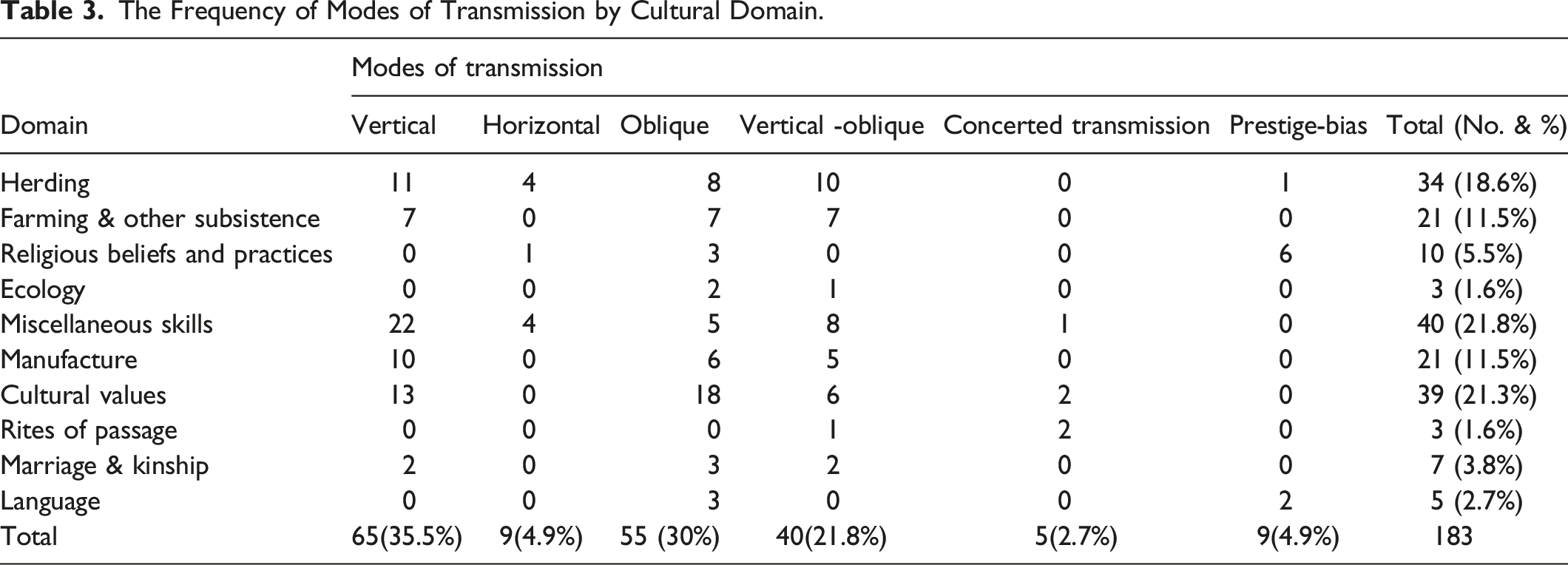
The Frequency of Modes of Transmission by Cultural Domain.
Modes of Learning by Age.
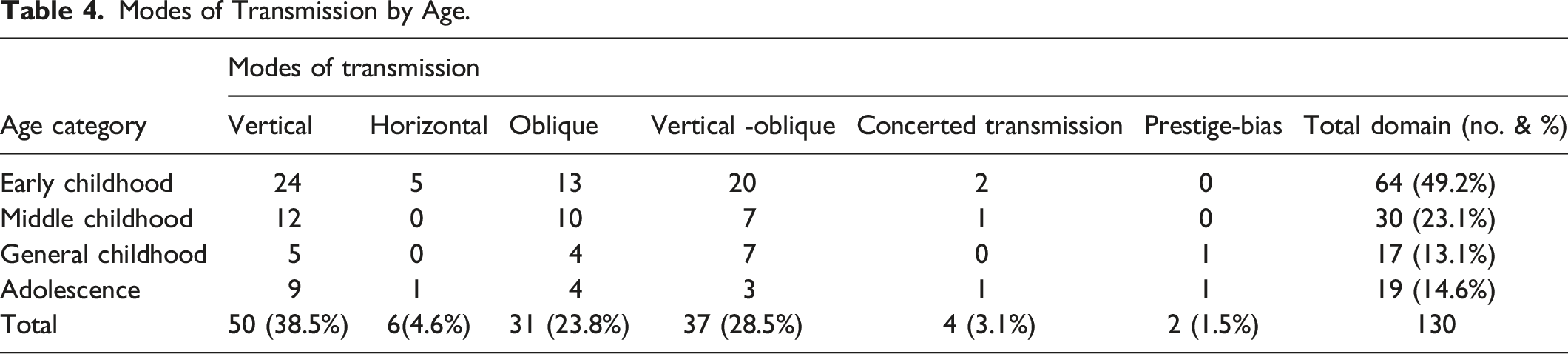
Modes of Transmission by Age.
Processes of Learning by Cultural Domain.
Processes of Social Learning by Domain.
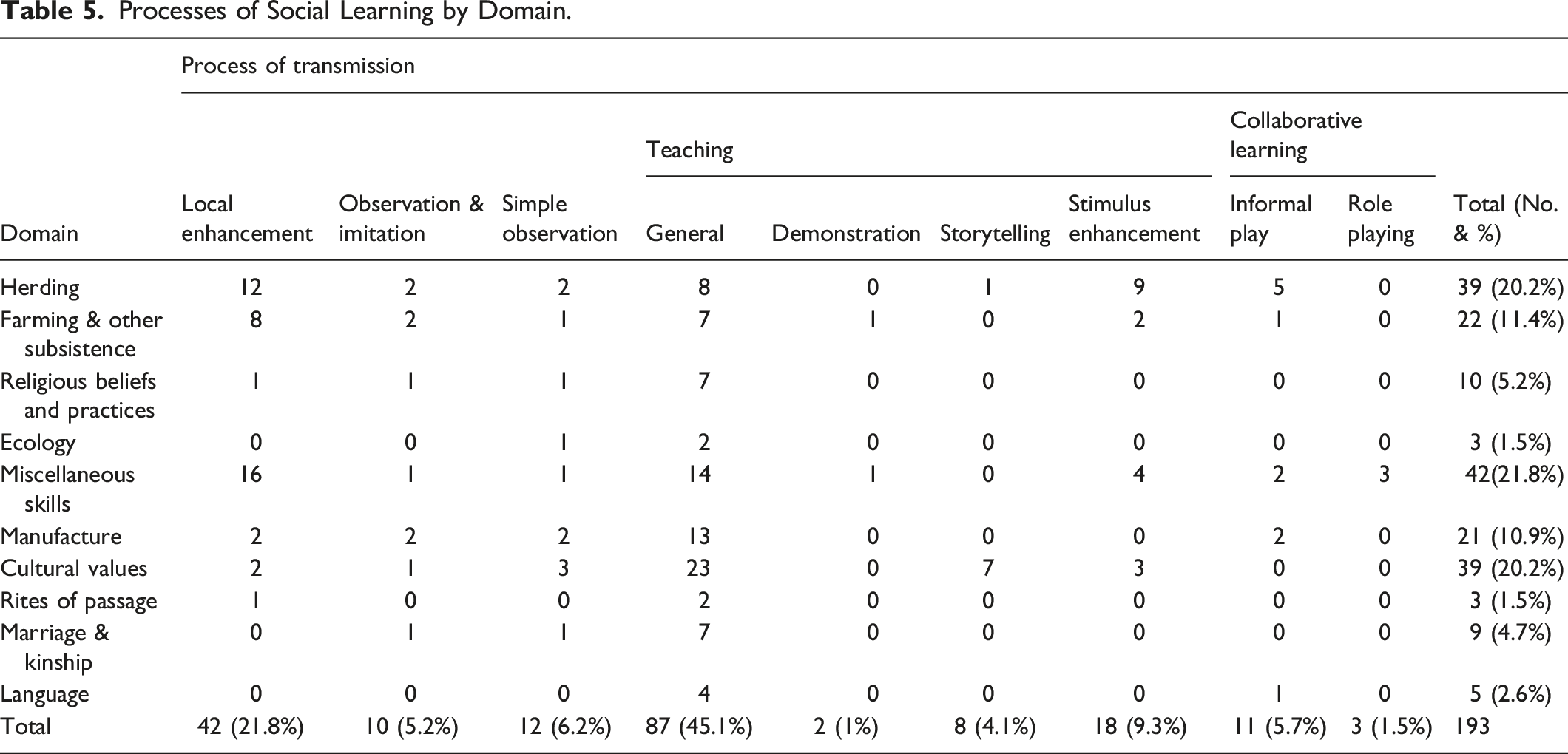
Table 5 also shows that a variety of teaching methods, i.e., demonstration, storytelling, and stimulus enhancement, accounted for 59.6% of all processes of learning. Local enhancement was the second most frequently mentioned process of learning (21.8%) compared to other cultural learning processes. The cultural domains often acquired through local enhancement were miscellaneous skills such as warfare and defense skills and knowledge, including defending cattle, horse riding and racing, (Benet, 1974; Pelto, 1960; Raswan, 1947) and herding skills and knowledge.
Processes of Learning by Age
The Processes of Social Learning by Age.
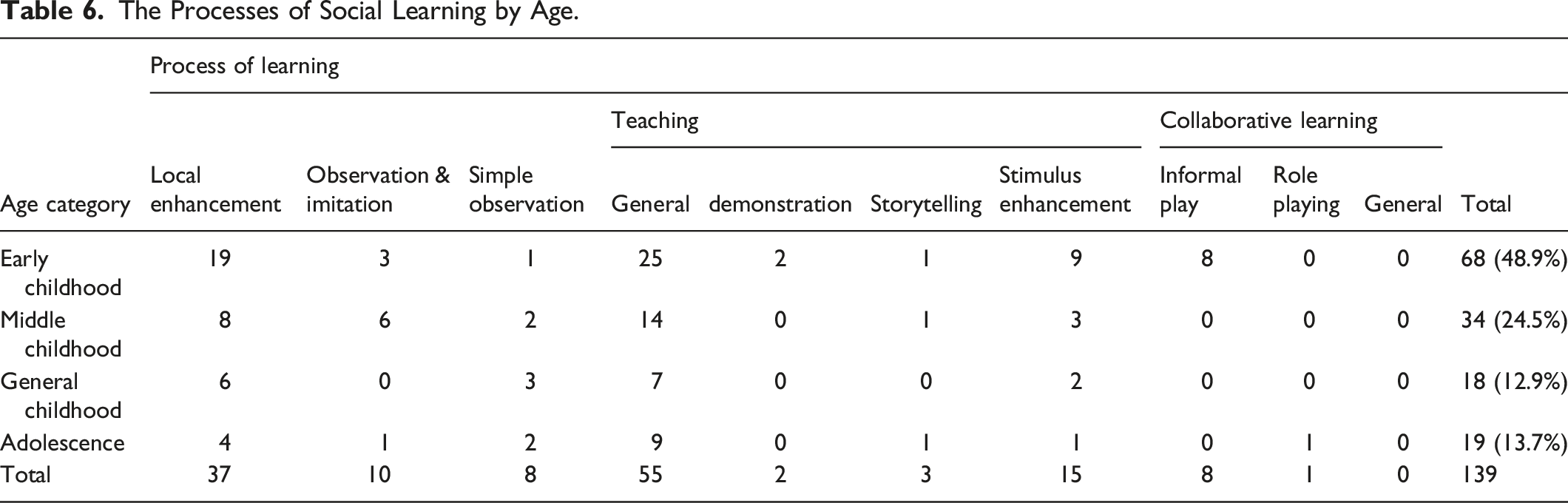
Two distinct patterns of processes of learning for pastoralists emerged in the tables above. First, teaching and local enhancement were the most common processes of learning across the age categories, but the importance of local enhancement decreased as the child’s age increased. Second, as the child’s age increased, the frequency of cultural learning (at least that reported by ethnographers) decreased. Ethnographers were most likely to describe cultural learning in early childhood.
Mode of Transmission by Processes of Cultural Learning
Twenty-one of the texts had no information either on modes or processes of cultural learning. Here we consider only the texts with information on both the modes and processes of learning. Few patterns emerged in the cross-tabulation. First, parents were particularly important for transmitting knowledge via local enhancement (56% of local enhancement cases). This makes sense as most learning occurs in early childhood and parents may take their young children out with them during herding and other subsistence activities. Second, teaching was common process of transmission for parents and non-parental adults (90% of cases of teaching). This was also not unexpected because various forms of teaching were the most common process of learning. (See Table S2 in supplementary materials for details).
Predictions Regarding Pastoralist Cultural Learning
Three of the four predictions regarding cultural learning in pastoralists were not supported. Only P3, regarding the importance of teaching for pastoralists was supported.
P1: The prediction that vertical transmission would be the most important form of learning for pastoralists was not supported. Instead vertical and oblique were the most common modes of transmission (see Table 3). The differences between vertical and oblique were not statistically significant. Both parents and non-parental adults were important transmitters of pastoral culture. Surprisingly, given the age stratification common to pastoralists, peers were seldom identified by ethnographers as important transmitters of cultural skills or knowledge (Table 4).
P2: The prediction that the modes of transmission would vary by age was not supported. Contrary to P2, the modes of transmission did not vary substantially by age as originally expected (see Table 4). Both vertical and oblique transmission were important in all age categories.
P3: The prediction that teaching would be a common process of cultural transmission compared to other processes of learning was supported. Table 5 shows that teaching was the process of cultural learning most frequently mentioned by pastoralist ethnographers. It was particularly common for cultural values, but it occurred across a wide range of domains. The data not only supported the prediction that teaching would be a common process of learning in pastoralists, but also indicated that it would be the most important learning process.
P4: The prediction that observation and imitation would be the most common process of pastoral cultural learning was not supported. Observation and imitation were seldom mentioned by ethnographers (only 5% of all cases) (see Table 5).
Pastoralist and Hunter-Gatherer Cultural Learning Predictions
Garfield et al. (2016) conducted a similar eHRAF cross-cultural study of cultural learning among hunter-gatherers. In this section, we utilize their data on hunter-gatherer to compare cultural learning data in the two modes of subsistence.
Modes of Transmission Among Pastoralists and Hunter-Gatherers.
Of the six predictions (P5-P10) comparing cultural learning in pastoralists and hunter-gatherers, two (P5 and P10) were supported, two (P8 and P9) were only partially supported whereas two (P6 and P7) were not supported.
P5: The prediction that vertical and oblique transmission would be the most common mode of transmission in both pastoralists and hunter-gatherers was supported. Figure 1 shows that children in both cultures frequently learn vertically from parents and obliquely from non-parental adults. This suggests that learning from older adults, be it vertical or oblique, is important in both groups. In order to more systematically evaluate possible differences between the two modes of subsistence, we took the 40 cases of vertical-oblique in pastoralists and added 40 more cases to both the vertical and oblique categories so that the data might be more comparable to the Garfield et al. (2016) hunter-gatherer study because it did not have a vertical-oblique category. Vertical-oblique transmission refers to a situation where the ethnographer indicated that children learn relatively equally from parents and non-parental adults. To make the groups comparable, we considered each reference to vertical-oblique transmission among pastoralists both in the vertical and the oblique categories, increasing the number of cases in these categories. Comparison of modes of transmission in pastoralists and hunter-gatherers.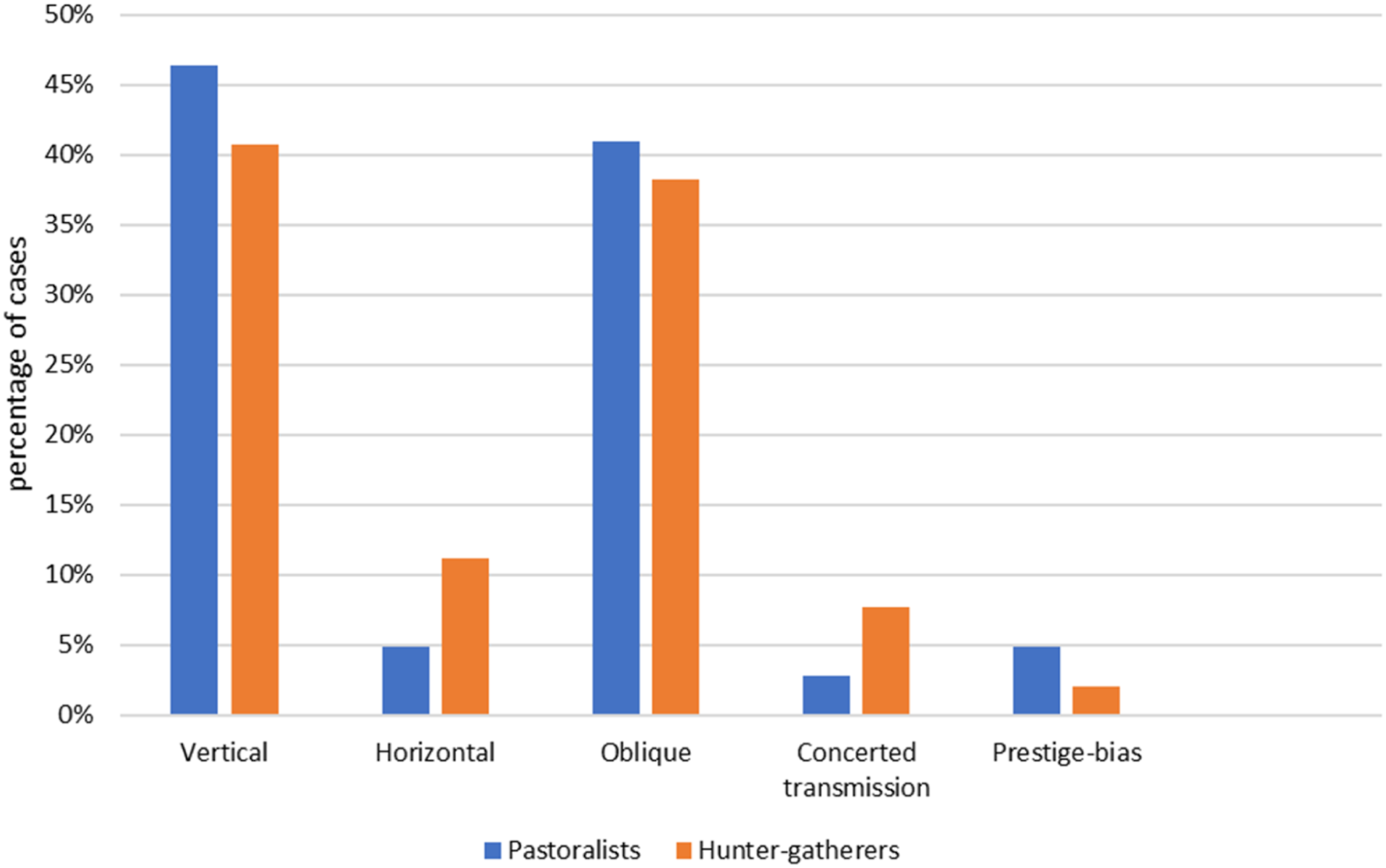
Modes of Social Learning Among Pastoralists and Hunter-Gatherers. The Hunter-Gatherer Data are Generated From Garfield et al., (2016) Page 26, Table 2.2.
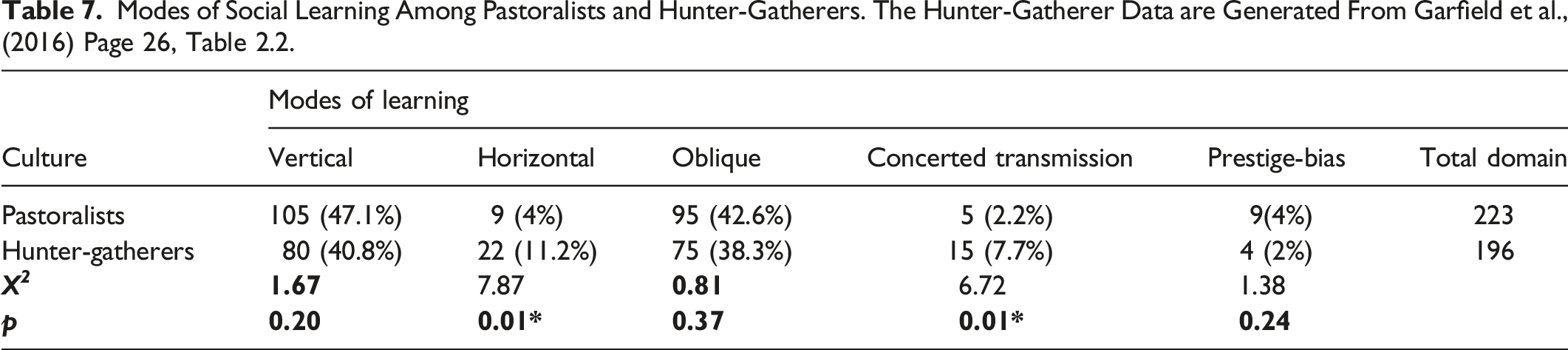
P6: The prediction that concerted transmission would be more common in pastoralists than in hunter-gatherers was not supported. Few cases of concerted learning were reported by ethnographers for both groups (Table 7 and Figure 1). In fact, statistical support for the opposite prediction emerged, i.e., hunter-gatherers had more concerted transmission than pastoralists. This may also be due to the high density living of hunter-gatherers, i.e., many adults and children are often only a few feet away from each other so that if a child does not share or hits another child, many individuals can simultaneously provide negative feedback (concerted transmission). The impact of concerted transmission in pastoralist adolescent initiation ceremonies is not evident in this study.
P7: The prediction that prestige-bias would be more common in pastoralists than in hunter-gatherers was not supported. Few cases of prestige-bias were reported by ethnographers for both groups (Table 3 and Figure 1). Pastoralists had slightly more cases (4% of all cases) than did hunter-gatherers (2% of all cases), but the differences were not statistically significant.
Process of Learning Among Pastoralists and Hunter-Gatherers.
P8: The prediction that observation and imitation would be more common among hunter-gatherers than in pastoralists and that teaching would be more common in pastoralists than in hunter-gatherers was partially supported. In order to compare processes of learning in the two groups we had to use processes that were identified in both studies. Consequently, we dropped the few cases of “simple observation” in the pastoralist study and the few cases of “individual learning” in the hunter-gatherer study because the categories did not exist in both studies.
Compared to other cultural learning processes, teaching was the most frequently mentioned process of learning in both pastoralists and hunter-gatherers (see Figure 2 and Table 8). The frequency of teaching mentioned by ethnographers for pastoralists and hunter-gatherers was 63.5% and 64.8% of the total cases respectively. In pastoralists, local enhancement ranked second with a frequency of 22.6% of the cases whereas observation and imitation ranked second for hunter-gatherers with 22.9% of cases. Thus, teaching and local enhancement were the main means of learning in pastoralists whereas teaching and observation and imitation were the main means of learning in hunter-gatherers. Comparison of process of learning in pastoralists and hunter-gatherers. Processes of Social Learning Among Pastoralists and Hunter-Gatherers. The Hunter-Gatherer Data are Generated From Garfield et al., (2016) Page 30 Table 2.6.
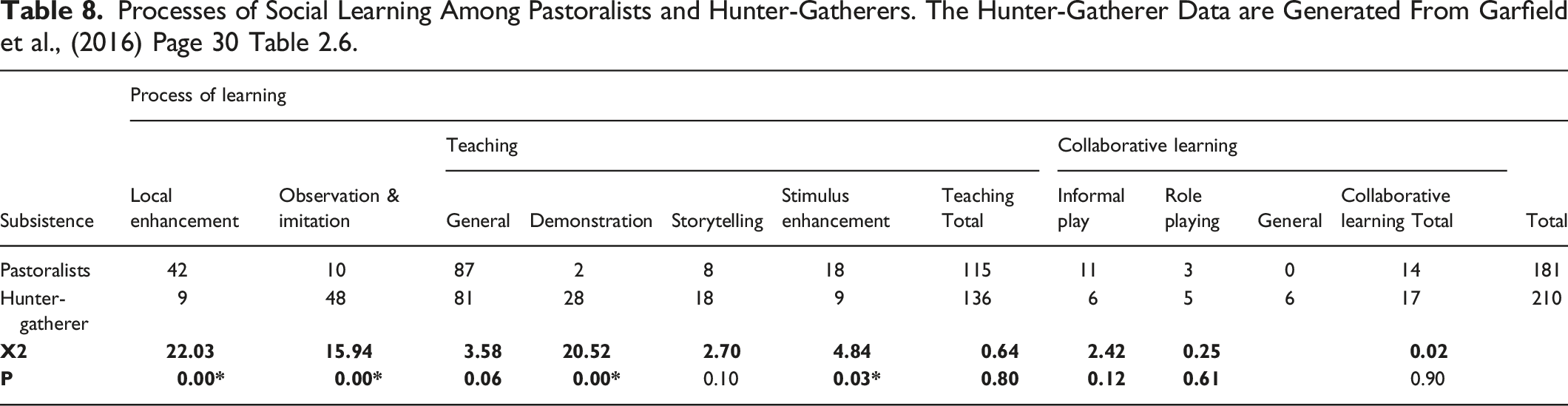
A chi-square test of the four primary processes of learning (local enhancement, observation and imitation, teaching (all types) and collaborative learning (all types) indicates that significant differences exist in the processes of transmission in the two groups (X 2 = 40.37, 3 df, p = .00), but most of the variability was a result of the differences in local enhancement and observation and imitation. Observation and imitation being much more common in hunter-gatherers (22.9% of cases) than pastoralists (5.6% of cases) and local enhancement being more common in pastoralists. The differences are statistically significant (Table 8). Thus, the data partially support the prediction that observation and imitation would be much more common in hunter-gatherers than in pastoralists and that teaching would be more common in pastoralists than in hunter-gatherers.
P9: The prediction that the importance of teaching would increase with age in both pastoralists and hunter-gatherers was partially supported. The data indicate that the importance of teaching increased with age in hunter-gatherers whereas it was similar across the age categories in pastoralists (see Figure 3). Teaching by age among pastoralists and hunter-gatherers.
P10: The prediction that stimulus enhancement (which is primarily task assignment) would be more frequent forms of teaching among pastoralists than in hunter-gatherers was supported. We have identified four types of teaching (teaching by demonstration, teaching by story-telling, teaching by stimulus enhancement and general teaching). Our data shows that teaching by stimulus enhancement was much more common in pastoralists than in hunter-gatherers (Figure 4 and Table 8 for statistical tests). The data also shows that teaching by demonstration was much more common in hunter-gatherers than in pastoralists. Comparison of types of teaching among pastoralists and hunter-gatherers.
Discussion
Although learning from others occurs throughout childhood and adolescence, the vast majority of pastoral cultural skills and knowledge were transmitted and at least partially learned in early childhood. Domains most likely to be transmitted during this period included herding skills and knowledge, miscellaneous skills and knowledge and cultural values. Similar to hunter-gatherers, pastoralists children acquire many of their cultural skills and knowledge from parents (vertically) and from non-parental adults (obliquely). Furthermore, in both subsistence groups teaching was a major process of learning across age groups. However, the importance of teaching appears to increase with age in hunter-gatherers whereas the data on pastoralists in this study did not find this pattern.
Modes of Transmission
A significant body of research argues for the association of age categories to specific modes of transmission (see Garfield et al., 2016; Reyes Garcia et al., 2016; Kline et al., 2013; Konner, 2010), e.g., vertical associated with early childhood, horizontal with middle childhood, and oblique with adolescence. The results from pastoral cultures, however, do not support these studies. Instead, we find no pattern for age and mode of transmission. Vertical and oblique were the primary modes of transmission across the different age groups (Table 4). For instance, in early childhood and middle childhood, about 85.3% of cultural transmission was vertical and oblique, and in adolescence, about 80% of cultural transmission was vertical and oblique. The finding supports the recent study by Lew-Levy et al. (2021) which found no relationship between age of learning and modes of transmission.
Surprisingly few texts mentioned learning from peers (horizontal) in pastoralists or hunter-gatherers. The frequency of horizontal transmission is only about 4.9% and 11.2% in pastoralists and hunter-gatherers respectively (see Figure 1 and Table 7). This result was unexpected given the body of anthropological literature that emphasizes the importance of similar aged children in cultural learning (see Harris, 1995; Lew-Levy et al., 2020; Moore, 2010; Zarger, 2010). Perhaps the pattern mentioned by some researchers may be linked to the methods that a researcher uses in their study. When a researcher uses interviews to understand from whom a child learns, parents and other adults may be identified as important (vertical and oblique) but if a researcher conducts observations at a specific age, children may be more likely to be identified as prime contributors (horizontal). Ethnographers in the eHRAF sample likely used interviews and informal, non-systematic observations. Another possible explanation is that none of the ethnographic studies of pastoralists in eHRAF happened to be a child-focused study. A general ethnographer with often more than 20 years in formal education system may not pay much attention to child-to-child learning.
Few cases of prestige-bias were mentioned by ethnographers in both subsistence systems. It was only slightly more common in pastoralists cultures (Figure 1 and Table 7). It is not clear if ethnographers were not attentive to this mode of transmission or whether prestige bias is infrequent in more egalitarian cultures.
Processes of Learning
As shown in Figure 2 and Table 8, teaching was the dominant process of learning in both pastoral and hunter-gatherer cultures. The variety of teaching methods (explanation, demonstration, stimulus enhancement and storytelling) accounted for 63.5% and 64.8% of learning mentioned in the ethnographies for pastoralists and hunter-gatherers respectively. It is worth noting that teaching seems to be particularly important for the transmission of cultural values in both groups.
Disagreement does exist as to whether the importance of teaching increases or decreases with age. Lew-Levy et al. (2021), Boyette & Hewlett (2017), and Garfield et al. (2016) argue it increases with age and is associated with learning more complex skills (e.g., elephant hunting, boating skills, traditional medicine) or knowledge (ritual knowledge) whereas Kline and colleagues (2013) argued that in small-scale societies, the importance of teaching declines in later life. The hunter-gatherers provide support for this pattern but as shown in Figure 3, the frequency of teaching in pastoralists is more or less similar as the child moves from early childhood (54.5%) to middle childhood (52.9%) and adolescence (55%).
Overall, the frequency of cultural learning, at least as measured by ethnographic reports, declines with age among pastoralists (Table 6). Among hunter-gatherers, ethnographic reports of cultural learning are also the highest in early childhood, drop in middle childhood, and then go up slightly in adolescence (Garfield et al., 2016).
We were surprised by how seldom ethnographers mentioned observation or observation and imitation because overviews of learning in small-scale cultures (Gaskins & Paradise, 2010; Paradise & Rogoff, 2009; Rogoff, 2003) and recent observational studies have indicated these processes are important process of learning (Boyette & Hewlett, 2017; Salali et al., 2019). This may be a result of ethnographers in the eHRAF sample referring to observation and imitation in a general way, but they were not utilized or coded in this study because they did not have specific information about learning a specific skill or knowledge and identify a mode or process of transmission. Several authors made statements such as “children learn many skills by observing and/or imitating others.” For instance, Bolinder mentioned that among the Goajiro of South America, “[e]ven in its earliest games the Indian baby imitates its parents’ occupations, thus amusing itself and learning at the same time (1957: 88).” Garb said that among the Abkhazians of Asia, “[a]t home, and in family gatherings the child learns traditional behavior by watching others (1984: 124).” These are general comments and could not be coded.
All ethnographers in this study mentioned the importance of participation in daily activities for cultural learning. This view is consistent with Rogoff (2016b)’s emphasis that learning occurs primarily by participation (learning by observing and pitching-in). However, “participation” as a process of learning (see Gaskins & Paradise, 2010) lacks precision as it may include teaching, observation and imitation, prestige-bias, and other processes. For instance, there might be learning by participation in adult activities when older individuals are present or interacting with the physical or social environment because other individuals expose the child to the setting or environment. Sometimes, children learn when others give them objects (i.e., stimulus enhancement, such as giving children herding sticks, knives) or assign them a task (e.g., collect firewood, watch small animals). In other instances, the child observes what others do and tries to replicate that activity or behavior. Thus, we suggest participation is more likely to be a context of learning rather than a process of learning.
In “Children from Undeserved Minority”, Rogoff (2016a) suggested collaborative learning as another important cultural learning process but again her approach is limited because it does not distinguish forms of collaboration. There are types of collaborative learning where skills or knowledge are acquired in informal play or miscellaneous games. Skills or knowledge are also acquired when children of similar age engage in role-playing (e.g., building a kraal, playing husband-wife). Sometimes children of similar ages work together to solve particular problems to acquire skills or knowledge. Rogoff’s definition pertains mainly to the last category of collaborative learning. Lumping these varieties together and considering them as a single process limits our understanding of the varieties of participation and collaboration in cultural learning.
Several limitations of the study were described in the methods section. Although this study is the most extensive study of pastoralist cultural learning conducted to date, it relies relatively on small sample size (N = 13 cultures) that was dominated by cases from three cultural groups (Goajiro, Saami and Abkhazians). However, the regional distribution of the data was balanced (see Table 1 for details).
In spite of these limitations, the study adds to our understanding of pastoralists cultural learning and its similarities and differences with hunter-gatherers. Furthermore, the paper along with several others (see Garfield et al., 2016; Hewlett et al., 2011; Mead, 1930) debunk Western notions that learning is limited to formal schools. Some researchers of cultural learning sometimes limit their definition of teaching to formal school-based instruction (see Lancy, 1996; Lancy & Grove, 2010) and argue that teaching is uncommon in small-scale societies. This paper shows that teaching is an important process of cultural learning among both pastoralists and hunter-gatherers. Other substantial contributions of the paper include: pastoralist children learn complex skills and knowledge early in life, children learn from both parents and non-parental adults, and that teaching is the important processes of cultural learning. Consistent with Rogoff (2016b), all of the ethnographies indicated that participation in daily activities is important for child learning.
Finally, pronounced cultural variation exists in child learning among pastoralists. Although it was not a focus of this paper, the ethnographies illustrate substantial variation, e.g., in some cultures, corporal punishment was described as a frequent form of teaching whereas in other pastoral groups ethnographers said it did not exist. Future research needs to examine the factors that help to explain the extensive variability, such as Stieglitz et al. (2013)’s task allocation study.
Supplemental Material
Supplemental Material - Cultural Learning Among Pastoralist Children
Supplemental Material for Cultural Learning Among Pastoralist Children by Temechegn Gutu Bira, and Barry Stephen Hewlett in Cross-Cultural Research
Footnotes
Acknowledgments
Numerous people and organizations contributed to this article. First, we would like to thank Zachary Garfield for reading a draft of the article and providing us with constructive comments and suggestions. Second, we would like to express our gratitude to Professor Jeannette Mageo, Arian Karimitar, Beatrice Caffe, Daniel McCloskey and Sykyler Paul for their useful comments and suggestions on early drafts of the paper. Finally, the first author would like to thank the College of Arts and Sciences and the Department of Anthropology at WSU for their financial assistance in the Summer of 2021 which provided the time to code the pastoralist data.
Declaration of Conflicting Interests
The author(s) declared no potential conflicts of interest with respect to the research, authorship, and/or publication of this article.
Funding
The author(s) received no financial support for the research, authorship, and/or publication of this article.

Supplemental Material
Supplemental material for this article is available online.
Author Biographies
References
Supplementary Material
Please find the following supplemental material available below.
For Open Access articles published under a Creative Commons License, all supplemental material carries the same license as the article it is associated with.
For non-Open Access articles published, all supplemental material carries a non-exclusive license, and permission requests for re-use of supplemental material or any part of supplemental material shall be sent directly to the copyright owner as specified in the copyright notice associated with the article.
