



Abstract
This paper integrates scaling theory with variation in systems of governance to help explain cross-cultural differences in the energy use of human polities. In both industrial and pre-industrial polities, systems of governance moderate the scaling of population and energy use. Polities with more inclusive governance systems display, on average, lower energy use per agent. However, as populations increase in size, the energy consumed by polities with more inclusive governance increases faster than among polities with less inclusive governance. These results support the hypothesis that more inclusive governance systems help generate a virtuous cycle of increasing trust, larger-scale cooperation, and more productive economies; however, a byproduct of this process is an expanding network–energy throughput tradeoff: Good governance empowers individuals and firms to connect and cooperate. At the same time, similar to Jevons’ classic efficiency paradox, scaling-up this empowerment requires a system, as a whole, to consume ever greater amounts of energy and materials from the earth’s ecosystems.
Decades of research indicates that human societies display many of the same ecological patterns as other animal species (e.g., Barsbai et al., 2021; Brown et al., 2014; Burger et al., 2012, 2017; Burnside et al., 2012; Cashdan, 2001; Freeman, 2012; Freeman & Anderies, 2015; Freeman et al., 2020; Hamilton et al., 2007, 2012; Tallavaara et al., 2018). Yet, one of the salient features of human societies is their diverse range of social norms, rules, and, technologies, often, coexisting in very similar ecosystems (e.g., Ullah et al., 2015). A central question emerges from this tension between the generality of ecological patterns among many species, including humans, and human specific variation in social norms, rules, etc.: Do differences in the rules and norms that structure societies induce differences in the basic patterns of human ecology? In this paper, we contribute to answering this question by assessing the relationship between governance systems–formal and informal rules and norms related to collective action and the control of within-group violence–and a robust pattern in human (and animal) ecology: The sub-linear scaling of population size and the use of energy (or space). Specifically, we devise a formal model to articulate a hypothesis for the effect of governance systems on population-energy scaling. The model helps illustrate a potential a trade-off between energy use and social network extent. Next, we use four data sets on the energy/territory use of industrial and pre-industrial polities to assess the the consistency of cross-cultural data with the model. Finally, we discuss the observed effects of governance systems on the energy use of human polities and raise questions for future research.
Population Size, Energy Use, and Governance Systems
Numerous studies document that human population size and the use of energy (or space) display a sub-linear relationship among hunter-gatherer, agricultural, and industrial societies (e.g., Hamilton et al., 2007, 2009, 2012, 2016, 2020; Brown et al., 2014; Burger et al., 2012; Burnside et al., 2012; DeLong & Burger, 2015; Freeman, 2016; Freeman & Anderies, 2015; Freeman et al., 2018). This sub-linear relationship parallels the long documented sub-linear scaling of body size and energy/space use among terrestrial mammals (e.g., Brown et al., 2004; Hamilton et al., 2007; Jetz et al., 2004; Lindstedt et al., 1986; McNab, 1963; Milton & May, 1976) and suggests that as group size increases, people use energy more efficiently (i.e., generate economies of scale). Given its ubiquity, along with others (Burnside et al., 2012; Hamilton et al., 2012), we consider the sub-linear scaling of population and energy use a basic ecological rule of energy use in human societies. Yet, the question remains whether this basic rule is modified in regular ways by the large differences in governance systems observed among human societies.
Here, by governance systems we mean the interlocking sets of formal and informal norms and rules that limit conflict and structure the scale and stability of collective action in social groups (North et al., 2009), and by norms and rules we mean the socially learned information shared between a group of peers and/or across generations, that shapes the opportunity costs of social interactions (e.g., North, 1990; Richerson & Boyd, 1998). Long-standing arguments in the social sciences posit that variation in how human groups construct their governance systems impacts, via a positive feedback process, the performance of human economies (e.g., Fukuyama, 2014; Hammel, 2005; Henrich, 2020; North et al., 2009; Putnam et al., 1993). If correct, then variation in governance systems should modify human behavior in ways that modify the basic scaling of population and energy use in human societies. To describe how and why, in this section we first define a basic continuum of governance systems among human societies. Next, we describe two qualitative arguments for how differences in governance might lead to differences in economic performance and, ultimately, the scaling of population and energy use of human societies.
First, governance systems vary along a continuum from exclusive, patron-client dominated networks, often structured along lines of blood kinship, to more inclusive (though not universally so) voluntary associations of kin and non-kin alike that allow/favor cooperation across many unrelated individuals (e.g., Blanton & Fargher, 2008; Fukuyama, 2014; Henrich, 2020; North et al., 2009; Putnam et al., 1993). Henrich and colleagues coin the concept of kinship intensity to describe this continuum (Henrich, 2020; Schulz et al., 2019a). More intensive kinship describes governance systems in which relatives form tight, reciprocal relationships that favor high in-group trust, collectivism, and cross-cousin marriages as patriarchs consolidate control over resources and mobilize defense against other such kin groups (Henrich, 2020; Murdock, 1967). For example, speaking of extreme cases, Hammel states “The politics of African, Near Eastern, and Central Asian segmentary societies may often be understood by the repeatedly cited [Bedouin] proverb: Myself [stands] against my brother, my brother and I [stand] against my cousin, my cousin and I [stand] against the stranger.” (Hammel, 2005, 11,954). More extensive kinship, conversely, describes a situation in which individuals increase the size of their social-networks via generalized norms that emphasize forming bonds outside of blood kin, leading to socialization pressures that emphasize more trust of strangers, reciprocity/reputation effects with non-kin, and voluntary associations (Henrich, 2020; Hill et al., 2014; Ostrom, 1998).
North and colleagues, working on modern states, as well as Blanton and colleagues studying pre-modern states, describe a similar continuum of governance systems (Blanton et al., 1996; Blanton & Fargher, 2008; North et al., 2009). In their terms, limited access states are very similar to intensive kinship systems. Limited access states describe polities in which elites and their clients control violence by establishing patron-client relationships based on norms of patriarchy, pay rents to motivate compliance, and provision public goods to a limited coalition (North et al., 2009). Inclusive states, conversely, describe polities in which elites share power across segments of society, relying on impersonal, voluntary associations and civic institutions to shape voluntary compliance in the limiting of violence and provision of public goods (North et al., 2009). Importantly, any governance system contains actors engaged in reinforcing tight-knit groups via patron-client strategies and actors engaged in strategies that increase the size and scope of social groups through voluntary clubs, rituals, and gifts that establish social bonds. Governance systems vary in the mix of strategies used and reinforced through norms and rules from more inclusive–well developed civic institutions that cross-cut many social groups–to less inclusive, more modular social groups (e.g., Blanton & Fargher, 2008; North et al., 2009; Putnam et al., 1993).
Second, multiple scholars argue that different governance systems give rise to different positive feedback processes that, in turn, create differences in the long-term economic performance of human societies (e.g., Fukuyama, 2014; Henrich, 2020; North et al., 2009; Putnam et al., 1993). In evolutionary psychology, Henrich argues that kinship intensity (the inclusiveness of governance) impacts psychological traits through socialization related to fairness, trust, and individualism. And, in turn, levels of trust, fairness, and individualism scale-up to structure and/or reinforce social networks by reducing the cost, to individuals, of forming cooperative networks beyond close kin. This process, Henrich argues, increases the economic productivity of a polity through mechanisms such as higher rates of information exchange and innovation in larger cooperative networks (Henrich, 2020). Similarly, in institutional economics and political science, Putnam et al. (1993) argue that participation in civic organizations creates norms of generalized reciprocity and networks of trusting (genetically) unrelated individuals. These norms of generalized reciprocity create social capital in Putnam’s terms and increase the ability of individuals to work in concert to solve the collective action problems associated with providing public goods and limiting violence at large scales. The more effective and large-scale provision of public goods, in turn, leads to increases in economic performance, which leads to more civic participation, and sustains high levels of social capital in a virtuous cycle. The ‘controller’ of the virtuous cycle, as with Henrich’s argument, is the effect of treating non-kin as kin to enable collective action and, thus, provide public goods at larger-scales.
The above arguments converge on a basic point: Norms and intuitions favoring trust and a low opportunity cost of cooperation beyond close are an essential component of a positive feedback process that leads to geographic differences in economic performance. Rules and norms that favor treating non-kin as kin decrease the cost to an individual of forming and joining extensive social networks. In turn, the presence of larger-scale networks increases the economic performance of a polity as a whole. If this argument has merit, then the proposed positive feedback process ‘controlled’ by the inclusiveness of governance systems should moderate the scaling of population size and energy use in human polities through an expanding network–energy use tradeoff. Specifically, inclusive governance systems that increase the ability of individuals to ‘wire-up’ should increase the energetic efficiency of polities at small scales (low populations). However, inclusive governance systems should lead to decreased efficiency at large scales, relative to polities with more exclusive governance systems, due to all of the ‘wires’ produced in the process of generating a higher level of economic productivity.
A Formal Model of Energy Use
To formalize and evaluate the expanding network-energy use tradeoff hypothesis, we combine the assumptions of scaling models proposed by human ecologists (e.g., Brown et al., 2014; Freeman & Anderies, 2015; Hamilton et al., 2007, 2012) and the IPAT (Impact = Population × Affluence × Technology) model proposed by environmental economists (e.g., Ehrlich & Holdren, 1971; Freeman et al., 2018; York et al., 2003) to describe the energy use of human polities. We build the model in three steps. First, we describe the metabolic expenditure of an average individual (metabolism for short); second, we multiply the metabolism of an average individual by the population size of a polity. In these first two steps, we explicitly account for the possibility that larger populations generate economies of scale in energy use as actors fill space to live and reproduce. Finally, we propose that the form of a governance system impacts how individuals interact in a population, modifying the scaling of population and energy use in human polities.
Individual metabolism
We assume that an average individual’s metabolic expense (energy/time), M, is a function of 3 variables: M = m(C, K, P). The variable C represents the complexity of physical infrastructure that individuals must contribute to building and maintaining to live and reproduce in a society; K represents the inclusiveness of rules and norms and social capital that impacts the energy necessary to form and maintain, on average, a social bond; and the dependence of M on population size, P, captures the fact that population size may interact with physical infrastructure and social networks in a non-linear way (e.g., sharing resources may create economies of scale in energy use). Typically, M is estimated in three ways in human populations. Basal metabolism is the expenditure of energy to sustain the basic somatic function of a biological organism at rest, and this quantity is only ever relevant in controlled lab settings. More relevant here are (1) the energy required to sustain basal metabolism and the activity of an organism to live and reproduce in real environments (‘field metabolism’); and (2) the entirety of the energy used to support well-being, including field metabolism and all other functions of a human population in a cultural context (extrasomatic metabolism).
We map an average individual’s energy use as field metabolism amplified by the physical infrastructure and social infrastructure used by a population to support their total, culturally defined, well-being (extrasomatic metabolism). To define M, thus, we start by assuming a constant field metabolic rate, m b (energy/person/time) required for somatic maintenance and reproduction that has evolved over the last two million years in the Homo lineage (Pontzer et al., 2012). Of course, this rate varies between individuals based on muscle mass and sex; however, Pontzer et al. (2016) find that even among very active adult populations, the total daily expenditure of energy is constrained by an upper boundary, that holds across cultures, of about 4000–5000 Kilocalories per day. The extrasomatic component of M, on the other hand, varies much more and depends on the complexity of built infrastructure (C), such as: Roads, bridges, canals, sewers, etc. that populations use and the energetics of forming and maintaining governance systems, social infrastructure (K), at a given population size (P). We assume that the effects of C, K, and P are multiplicative, such that m(C, K, P) = f C (C)f K (K)f P (P), and we define each of the functional forms below based on previous work and available data.
We assume that the metabolism of an average individual increases exponentially as the complexity, C of a polity’s physical infrastructure system increases (Figure 1(a)). Here, by complexity we mean the amount and diversity of built systems for managing ecosystem flows (e.g., canals) and transport costs (e.g., roads). For example, mobile hunter-gatherers use simple foot paths (often made by other animals) to decrease transportation costs. Very little energy expenditure goes into building and maintaining such foot paths. Industrial societies, conversely, purposely invest in roads, bridges, and railroads to decrease transportation costs. This investment in diverse transport architectures requires a lot of energy expenditure to procure large amounts of diverse materials, such as: cement, steel, and wire, and energy to maintain these structures in the face of constant decay. Thus, as a first approximation, we assume that the energy used by an average individual, holding population equal, grows exponentially as the complexity of a physical infrastructure system grows. We capture this by writing the average metabolism of an individual as Basic model relationships and hypotheses. A–The proposed effect of infrastructure complexity on the average energy used per individual per unit time. B–The proposed effect of inclusive governance (higher values = more inclusive) on the average energy used per individual per unit time to form a social connection. C–Holding infrastructure complexity equal, the proposed feedback effect of governance on the scaling of total energy consumed and population among polities with more inclusive versus exclusive governance, respectively.
For a given level of built infrastructure complexity, populations must form and maintain systems of governance (Crawford & Ostrom, 1995; North, 1990). To capture the effect of the inclusiveness of governance systems on metabolism, we note that individuals must pay a transaction cost (energy per person per unit time) to establish and maintain a social bond. This is because individuals must spend time talking, helping each other, or making and distributing gifts to establish trust and confidence in the functioning of a social group. In a classic ethnographic example, L. Bohannon learned that Tiv woman continually “create their society” through an endless cycle of gifts. Such activities built trust and signaled a commitment to help each other in farm labor and in the face of unpredictable events (Bohannan & Bohannan, 1968). More explicitly, Barí forager-horticulturalists produce crops beyond the needs of their local longhouse groups to host visitors for singing and gift exchange ceremonies (Beckerman & Lizarralde, 2013). The relationships formed during these visits form the basis of marriages and the ability of families to shift residence between longhouses. In short, forming relationships takes energy, and we believe that this much is intuitive. However, the shape of the curve that relates the energy expenditure of an average individual to the form of a governance system has not been the subject of much investigation (but see Hill et al., 2011).
Here, as a first cut, we describe the shape of the curve as f K (K) = m k e−αK, where K indicates the inclusiveness of governance in a population; m k defines the maximum transaction cost multiplier that sets the tolerance level of effort that strangers are willing expend to develop a social bond and work toward a joint goal; and α defines the rate of change in the average energetic cost of forming a bond as governance systems become more inclusive (Figure 1B). We constrain K and α to be strictly positive. This function recognizes that as governance becomes more inclusive, the marginal decrease in the energy necessary to form a social bond declines. Further, the function captures the assumption of Henrich’s and Putnam and colleague’s virtuous cycle arguments that the norms of a governance system, operating via trust and fairness (social capital), impact the distribution of the costs of forming social relationships for a typical individual.
Specifically, as the scale of trust and fairness increase in a polity (as one would expect in more inclusive governance systems), the distribution of pairwise energetic costs becomes unimodal and right skewed. Conversely, in a polity with highly restricted groups with high levels of trust based on patriarchy and patron-client norms (less inclusive of non-kin), the distribution of costs will resemble a bimodal distribution (one mode representing costs with kin, one with non-kin). Further, as norms become more exclusive of non-kin, the more distinct the bimodal distribution becomes, and the distance between peaks increases. We assume that as a distribution of such costs becomes more bimodal and the peaks more distinct, the more the mean energy expenditure of forming a social bond approaches the maximum tolerable wattage of m k . The bimodal distributions have a higher mean energetic cost because, we assume, that m k is very similar across human polities. At some allocation level, time (and energy) spent in forming social bonds must take time away from alternative activities essential for somatic maintenance. Systems with less inclusive institutions and, thus, social capital, will have more potential edges in a social network closer to this upper limit (m k ) than systems with more inclusive institutions, raising the mean energy expenditure of forming a social bond for a typical individual in such systems.
Given the effects of a system’s physical (C) and social (K) infrastructure, we can now model the potential effect of population size on the interaction of individuals and the average metabolism of an individual. Previous work suggests that individuals in a population interact in some way that allows them to more efficiently use energy as population increases in size–an economy of scale (Burnside et al., 2012; Freeman, 2016; Freeman & Anderies, 2015; Freeman et al., 2018; Hamilton et al., 2007, 2012, 2020). We capture the general scale effect of the interaction between individuals in a population by assuming that

Population Size and Energy Use
Given equation (1), we can now write the energy use of a human polity as

We can simplify the above equation by setting m
b
m
k
= M
B
, and β
s
= 1 − β2. This allows us to re-write equation (2) as

Moderating the Population–Energy Relationship
The expanding network–energy use hypothesis proposes that inclusive governance creates higher levels of social capital (treating strangers like kin). Higher social capital, in turn, leads to individuals who seek out connections by forming social groups, such as voluntary associations and, thus, an increased growth in the number of connections between actors as a polity’s population size increases. Similarly, less inclusive governance leads to more restricted networks with dense modules (kin groups) and minimal cross-cutting ties between modules. Such networks reinforce high in-group trust, low out-group trust, and, thus, less integration of a polity per unit increase in population (Henrich, 2020; Putnam et al., 1993). Following this line of reasoning, we propose that human networks face an energy tradeoff analogous to the one faced by physical brains. Wiring-up more neurons creates better and more easily re-wired maps of the world. However, a better ability to wire-up requires a faster increase in energy use as a brain grows in size, not just to feed more neurons, but to pay for all of the new connections (Schwarzlose, 2021). The same process should apply to polities with different governance systems. As human populations grow, polities with individuals who wire-up more effectively should be forced to use more energy than populations with individuals who form dense, modular social connections. As a consequence, energy use should increases more per unit increase in population among polities with more inclusive governance systems (i.e, β s exclusive < β s inclusive , Figure 1(c)).
Results
Evaluating the expanding network–energy use tradeoff hypothesis requires estimating the amount of energy consumed by a given polity over a given period of time t. This is directly possible among contemporary, industrial polities and, indirectly, via territory size, among pre-industrial polities. This indirect estimate of energy use follows from research demonstrating that the size of an animal’s territory estimates the energy that an individual needs to consume (e.g., Brown et al., 2004; Jetz et al., 2004; Lindstedt et al., 1986; McNab, 1963; Milton & May, 1976). On average, the larger an animal’s body size, the larger its territory, because big animals consume more energy than small animals (McNab, 1963). Applying such models to pre-industrial populations assumes that the size of a group’s territory reflects the area needed to consume energy by a population of size P at a given point in time (e.g., Hamilton et al., 2007, 2009, 2016, 2020; Freeman, 2016; Freeman & Anderies, 2015). Given these basic patterns of animal and human ecology, we can rewrite equation (3) in terms of territory size as


The area occupied by a polity results from the average metabolic expense of an individual multiplied by the production of energy in a set of ecosystems and population size.
INLA regression coefficient estimates, standard errors, and confidence intervals for GLMs in equations (6) and (7), reporting only the key variables (full models with basis coefficients reported in the Supplementary Material, Appendix 1).

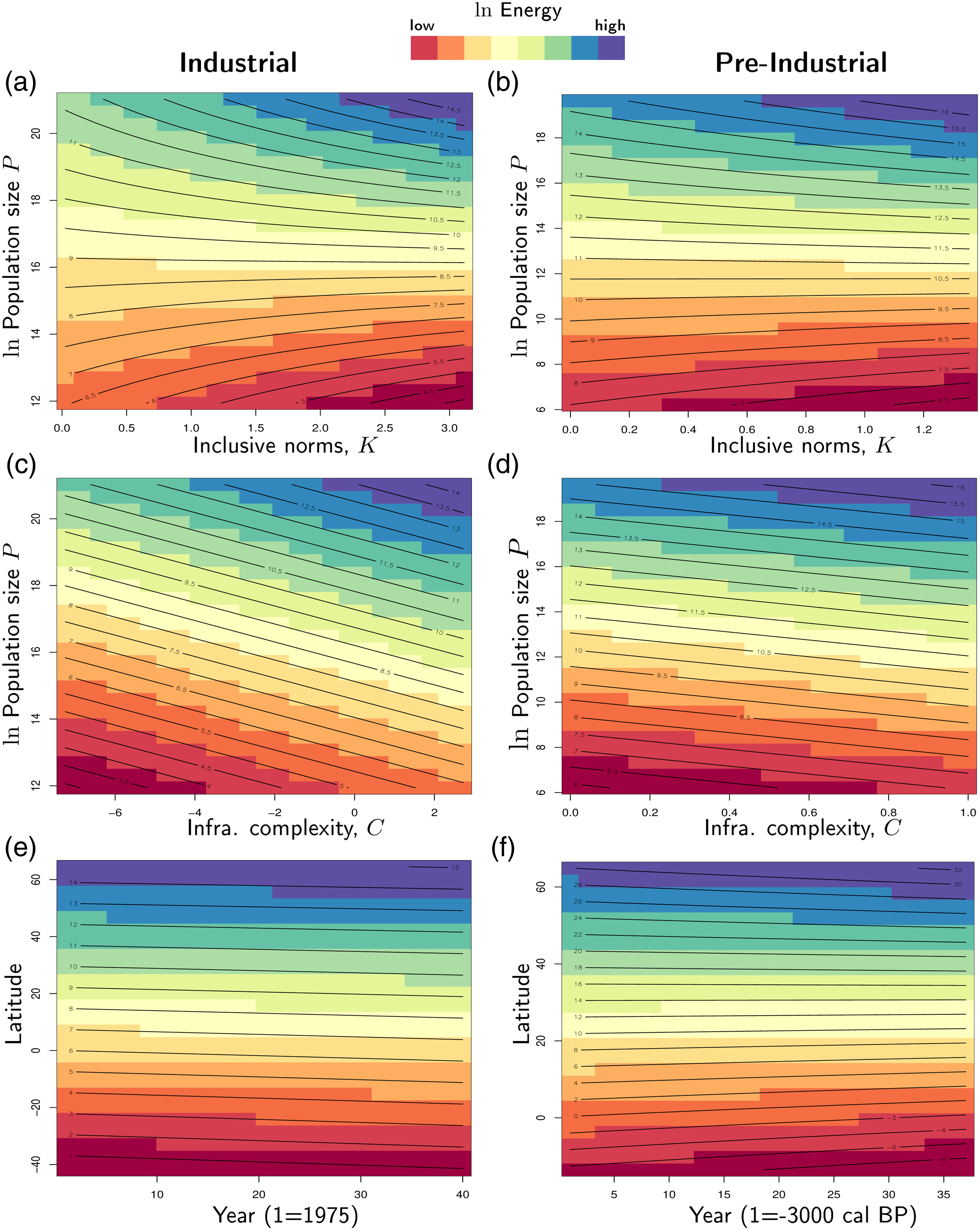
Marginal effect heat maps. Colored tiles represent energy use/territory size. In A and B, the highest energy use is observed among large populations with inclusive governance. In C and D, holding population size constant, energy use increases as infrastructure complexity increases. Industrial polities (E) in the S. Hemisphere tend to consume less energy than polities in the N. Hemisphere, and all polities increased energy consumption over 37 years. Pre-industrial polities (F) at high latitudes increased in size over the last 3000 years, and polities at tropical latitudes decreased in size.
Table 1 illustrates that the effect of inclusive governance systems (α) is negative among industrial and pre-industrial polities. This indicates that the average metabolic expense of forming social connections decreases among polities with more inclusive governance systems. As expected, both pre-industrial and industrial polities display a sub-linear scaling, as estimated by β s , of population and energy use. Similarly, the positive value of the interaction coefficient β sk indicates that as governance systems become more inclusive, the slope of the relationship between population and energy use increases.
Figure 2(a) and (b) visually illustrate how the interaction of governance system and population size impacts energy use in pre-industrial and industrial polities. One reads these heat maps by fixing their gaze at a particular natural log of population size and then tracking the change in colored tiles in a horizontal line from left to right. For example, viewing from left to right in Figure 2(a) along the y-intercept of ln p = 13 indicates that as the inclusiveness of governance systems increases, the use of energy declines. The same pattern holds in pre-industrial polities. Viewing from left to right in Figure 2(b) along the y-intercept of ln p = 7, as the inclusiveness of governance systems increases, the use of space declines. Conversely, at a high population size (e.g., ln p = 18), as the inclusiveness of governance increases, energy use increases. These patterns are consistent with the expanding network–energy use tradeoff hypothesis. More inclusive governance results in more energy efficient polities at small populations but less energy efficient polities at large populations.
Table 1 and Figure 2(c) and (d) also illustrates that the effect of physical infrastructure complexity (β1) is positive among both industrial and pre-industrial polities. As the infrastructure complexity of a polity increases, the amount of energy used by a fixed population grows exponentially. In addition, among pre-industrial polities, Table 1 indicates that territories become larger as polities occupy colder environments.
Finally, Figure 2(e) and (f) illustrate the interaction effects of latitude and the year of observation on energy use. Note, all controls on the space-time dependencies of errors are reported in the Supplementary Material, Appendix 1, Table S1. Here, we observe two patterns not accounted for by the expanding network–energy use hypothesis. (1) Among industrial polities, polities in the S. Hemisphere tend to consume less energy than polities in the N. Hemisphere, and all polities increased energy use over 37 years. This may reflect a history of development and colonization over space and the process of globalization making polities more interconnected and, thus, needing to pay for such connections with more energy expenditure over time (1975–2012). (2) Among pre-industrial polities, all else equal, polities in tropical locations have become smaller over the last 3000 years, and polities in colder locations have become larger. Again, this pattern may be driven by the historical circumstance that many European polities engaged in extensive colonization over the last 500 years, whereas polities in warmer settings did not.
Discussion
Decades of research indicates that human societies display many of the same ecological patterns as mammals and other species (e.g., Barsbai et al., 2021; Brown et al., 2014; Burger et al., 2012, 2017; Burnside et al., 2012; Cashdan, 2001; Freeman, 2012; Freeman & Anderies, 2015; Freeman et al., 2020; Hamilton et al., 2007, 2012; Tallavaara et al., 2018), such as a sub-linear relationship between population and energy/space use. Yet, human societies also display a wide range of governance systems that may modify basic patterns of human ecology. To address this possibility, we asked whether differences in governance systems impacts the level of energy use and moderates the scaling of population and energy use among industrial and pre-industrial polities. Our results indicate that polities with more inclusive governance systems display, on average, lower energy use per agent. However, as populations increase in size, the energy consumed by polities with more inclusive governance increases faster than among polities with less inclusive governance. Our results are consistent with the expanding network–energy use tradeoff hypothesis. More inclusive norms create incentives for psychological traits associated with more trust, fairness, and individualism, and, in turn, these traits lead to more extensive networks and greater economic productivity (Henrich, 2020; Putnam et al., 1993). This positive feedback process, although decreasing the energy expenditure of forming social relationships for an individual, must increase the energy expended by a polity as a whole to pay for all of the extra ‘wires’ generated when populations increase in size. Put simply, as the network is scaled up, the cost of maintaining network infrastructure begins to outweigh the benefits gained by improving collaborative and cooperative potential. These results raise important implications and challenges for future research.
Implications
1. All sustainability challenges require governance systems that align the priorities of actors with diverse preferences, experiences, and beliefs (Baggio et al., 2022). The institutions and norms of governance systems are a social infrastructure that, like physical infrastructure, require energy to build and maintain. Our results indicate that, similar to Jevons’ classic efficiency paradox, a sustainability paradox may emerge in human systems. More inclusive systems of governance decrease the energy necessary for diverse actors to form coalitions with aligned priorities; yet, as such coalitions enlarge, human systems must consume more energy and materials from the earth’s ecosystems to fund such inclusive systems of governance. As has been pointed out for decades, the natural resources on earth have limits (e.g., Brown et al., 2014; Catton, 1987; Ehrlich & Holdren, 1971). The positive feedback between inclusive governance, the provision of large-scale public goods, and economic performance (the growth paradigm) not only has built-in energetic costs (Brown et al., 2014), but a contradiction. To sustain the governance systems necessary to integrate diverse actors on a global scale, human populations will need to pump more extrametabolic energy into governance systems and economies, not less. Understanding this full accounting allows policy to focus not only on promoting inclusive norms, but also how we will maintain (at a cost) those norms over the long-term. On a darker note, our results indicate that large populations with exclusive systems of governance actually display more energetic efficiency than large populations with inclusive governance systems. This raises the possibility that, in resource constrained environments, cultural evolution will favor exclusive systems of governance over more inclusive, or in systems terms, cultural evolution may favor efficiency over power (Odum, 2007). This possibility has an insidious contradiction built into the political and economic realities that, while more energetically efficient, such exclusive systems do not align the priorities of diverse actors. Thus, cooperative agreements between actors, say to eliminate fossil fuel emissions, will be harder to enact. 2. Our comparison of data sets from industrial and pre-industrial societies implies that the same dynamics operate in both. This result needs further investigation across more data sets. Our analysis may be capturing a consistent effect of governance systems on the scaling of population and energy use. It is also possible that because the inclusiveness of governance systems was measured differently in the data sets, the consistency across data sets could be spurious. This is always a research challenge in comparative analyses. We have addressed this challenge here by using the positive correlation of multiple measures, argued on the basis of theory, to make operational the construct of the inclusiveness of a governance system (see Data and Methods). Another way to address this problem is through the replication of our study and results across many different data sets. Such studies would attempt to replicate the construct of the inclusiveness of governance systems using different variables. Our study warrants such future studies that attempt to replicate results across different data sets. This is important because our results contradict one of the fundamental assumptions of the modern global order: Modern polities and economies are qualitatively different from pre-modern polities (e.g., Fukuyama, 2014) and, thus, pre-modern polities are of little relevance to understanding contemporary societal challenges.
Challenges
Developing a full accounting of the energetic costs of governance systems requires more research into the relationship between individual energy expenditure and building and maintaining social relationships under different governance systems. There are two issues raised by our model and analysis that require more research and place our results into the context of these research needs. 1. We assume that more inclusive governance systems lower the mean Joules/minute necessary to form and maintain a social relationship. We also assume that an upper limit exists in all human societies in terms of how much energy per unit time an individual can tolerate investing in a social relationship. This makes sense if energy invested in getting food and forming a friendship, for example, are substitutes, but may make less sense if energy spent on such activities are complements. Evidence from time allocation studies of non-human primates suggests a non-linear, increasing relationship between time spent grooming (forming social bonds) and increases in group size (Dunbar, 1998, 2003). Dunbar argues that this indicates that non-human primates must give-up foraging efficiency as they live in larger groups due to the time costs, and, by inference, energy expenditure, necessary for social bonding (Dunbar, 2011). Our assumption follows this line of reasoning, though an important issue is how much humans can integrate social and food getting activities more so than other primates, thus creating complementary energy expenditure activities. 2. We assume that governance systems impact the distribution of individual energetic costs to form social relationships in a population, and that these costs are a non-negligible component of an average individual’s energy budget. All social interactions require a time expense. No one shows up at a Parent Teacher Association meeting and begins proposing policy. The first meeting is all about introductions and establishing familiarity. Like grooming among non-human primates, this takes time, and, thus, energy. The process occurs in trade between small-scale societies as groups and individuals invest in dinners, dances, and ceremonial gifts to establish fictive kin bonds that form the basis of more sustained, mundane trade and cooperation (e.g., Beckerman & Lizarralde, 2013; Graeber, 2012; Hill et al., 2014; Wiessner, 1998). In our model, we hypothesize that in societies with more inclusive governance systems people spend less time in these “getting to know you” activities, on average, because trust is more easily established among non-kin. This idea is empirically testable through empirical or experimental time-allocation studies. One could observe voluntary, anonymous groups in societies with inclusive versus less inclusive governance systems and expect that in more inclusive societies, it takes groups less time to begin working together on a joint task than in less inclusive societies. Further, one could compare the energy expenditure of individuals who form many social bonds and those who do not, controlling for governance system and body mass, to potentially infer whether the expense on building social bonds is non-negligible as we contend.
Data and Methods
We construct four data sets (available at Freeman et al. (2022)) that describe energy/territory use, population size, and data on variation in the inclusiveness of governance systems among industrial and pre-industrial societies. First, we collected energy consumption data for contemporary countries from the International Energy Agency’s estimates of total energy consumption (IEA, 2016) in 146 countries from 1975 to 2012 or 1990 to 2012, depending on the country. We combine these energy consumption estimates with population estimates for each country from the World Bank from the years 1975–2012 (TWB, 2016). The energy consumption data are self reported by each of the countries in the data set, which is a potential source of measurement error. We joined the population and energy consumption data with estimates of economic complexity collected from Hausmann et al. (2014). They measure economic complexity using an index that captures the diversity and ubiquity of products in an economy (Hausmann et al., 2014). The larger the number of products and the more distinct, we assume the more built-up and diverse the physical infrastructure of a polity. This assumes that the index of economic complexity positively and linearly relates to the complexity of a polity’s physical infrastructure system.
Finally, we combined the data above with data on country level psychological traits and kinship intensity published by Schulz et al. (2019b). We use the inverse of their kinship intensity variable (KII) to estimate the inclusiveness of governance systems. Schulz et al. (2019c) calculated kinship intensity as a between country metric developed from data published in the Ethnographic Atlas. They did this by first estimating the kinship intensity of ethno-lingustic groups within countries and then constructed a population weighted kinship intensity estimate at the country level. The index estimates how closely kin groups exclusively cooperate and social norms favor in-group cooperation and control over resources. In short, high kinship intensity means an exclusive governance system focused on local group patronage and building in-group trust. Schulz et al. used the association of five variables from the Ethnographic Atlas to construct these estimates: Cross-cousin marriage preference, polygamy, co-residence of extended families, lineage organization, and community organization (Schulz et al., 2019c).
More intensive kinship norms (less inclusive governance systems) are indicated by the association of greater preference for cross-cousin marriage (keeping marriages within a clan or lineage), larger, co-resident extended families, well defined lineages, and residence of lineages or clans together in settlements segregated from other lineages or clans (see Supplemental Materials, Appendix 1, Part I for more details). Simply, the presence or higher values for all of these variables signal less inclusive governance systems composed of competing kin groups rather than more inclusive systems in which social groups cross-cut kinship boundaries. That is, groups with intense kinship lack organizations, rituals, and norms that promote individuals from distinct clan or lineage groups to seek out and form relationships with each other.
For instance, Henrich describes the classic ethnographich example of the Sepik village of Illahita in New Guinea. In this village, Tambaran Gods were adopted and rituals created that forced young men from different kin groups to endure and perform joint ceremonies (Henrich, 2020). Thus, the rituals and norms of treatment created bonds that cross-cut local patrilines and formed the basis of Illahita’s much larger population size than neighboring villages where the gods and rituals were not recognized (Henrich, 2020). Importantly, the kinship intensity construct correlates with other variables thought to measure the inclusiveness of governance systems and social capital. Specifically, more intensive kinship negatively correlates with survey measures of out-group trust, blood donations in countries, and positively with unpaid parking tickets at the United Nations (Henrich, 2020, P. 207, 213, 215). In our analysis, we use the inverse of the KII estimates such that larger values indicate more inclusive governance systems. We also added a fixed constant to every estimate to eliminate negative values for ease of interpretation.
Second, we use a previously published dataset called Shiny Seshat (Miranda & Freeman, 2020) that reports the territory size, population size, and estimates of the treatment of non-kin as kin among pre-industrial polities. This is a cleaned and imputed version of the Seshat World 30 sample used in multiple publications to investigate the components of social complexity and the effect of religious practices on increases in social complexity (e.g., Turchin et al., 2018). Shiny Seshat is temporally resolved, corrects a variety of human errors, and uses a machine learning algorithm to impute missing values with a greater degree of fidelity than prior works (Miranda & Freeman, 2020). Shiny Seshat contains data on 1703 historic and prehistoric polity-centuries, where a polity-century refers to the estimated observation of the dependent variable (territory size) and independent variables in a given polity during a given century.
The dependent variable of territory size is a standard estimate for each polity in the world sample 30 and estimates the area within the political boundaries of a polity in a given century. This is clearly a difficult metric to code for prehistoric polities due to a variety of factors. The coders of Seshat simply attempted to make consistent estimates, and these decisions were independent of our research question. The main independent variables are Population Size, Infrastructure, Temperature, and the inclusiveness of the governance system. Population Size, again, is estimated for a given polity-century. Infrastructure is a ‘complexity characteristic’ created by Turchin and colleagues to estimate changes in social complexity over time in the world 30 sample (Turchin et al., 2018). The variable scales between 0 and 1 and estimates the presence of nine facets of infrastructure coded in Seshat: bridges, canals, ports, mines or quarries, roads, irrigation systems, markets, food storage sites, and drinking water supply systems. The presence of each facet contributes 1/9 to the metric; that is, 9/9 facets present is encoded as 1, 3/9 facets present is encoded as
Temperature is used to estimate the productivity of ecosystems occupied by a polity. This is a crude estimate, though, at a global scale, the productivity of terrestrial ecosystems associates with temperature because the productivity of an ecosystem partly depends upon the energy reaching the surface of the earth from the sun (Brown et al., 2004; Odum, 1997). As a first approach, we use PaleoView (Fordham et al., 2017) to estimate mean annual temperature in 100 year intervals for the natural geographic area of each polity identified in Seshat. PaleoView generates outputs from the TRaCE21ka experiment (Liu et al., 2009, 2014; Otto-Bliesner et al., 2014), a Community Climate System Model, version 3 (CCSM3), and a global coupled atmosphere-ocean-sea ice-land general circulation model (AOGCM) with 3.75° latitude-longitude resolution on land and sea and 3° resolution over the ocean. PaleoView re-grids the climate data to provide a 2.5 × 2.5° resolution on a global scale from 20,050 BC to AD 1989. PaleoView has the virtue, thus, of providing comparable paleoclimate estimates of temperature across natural geographic units. Such estimates of temperature may be augmented in the future by synthesizing paleoclimate and paleoecological records from each of Seshat’s natural geographic areas for incorporation with the data set.
Finally, we use three Shiny Seshat variables to estimate the inclusiveness of governance systems: “supernatural enforcement of fairness,” “human reciprocity,” and “supernatural enforcement of in-group loyalty.” These three variables track the norms and rules central to creating more inclusive governance systems. (1) The “supernatural enforcement of fairness” refers to religious beliefs in which spirits or gods punish individuals for not acting fairly. This corresponds to Henrich’s notion that more inclusive systems create incentives for individuals to treat others fairly and according to universal rather than situation specific standards. Indeed, intense kinship, as a proxy for less inclusive governance systems, negatively correlates with a propensity of individuals to judge others according to universal standards in contemporary countries (Henrich, 2020, p. 209). (2) “Human reciprocity” refers to beliefs that individuals should engage in generalized reciprocity outside of kin groups. This variable makes operational Putnam and colleague’s argument that voluntary associations depend upon norms of trust beyond close kin (Putnam et al., 1993) and Henrich’s description of the Tambaran gods in Illahita (see above). (3) The “supernatural enforcement of in-group loyalty” refers to the presence of beliefs, spirits, or gods who enforce treating non-kin as kin members. Inclusive governance systems depend upon such norms because these norms build out-group trust (Henrich, 2020).
Known values of the three above variables are coded as: 0 for absence known from direct evidence; 0.1 for absence inferred from indirect evidence; 1 for presence known from direct evidence; and 0.9 for presence inferred from indirect evidence. Missing values were statistically imputed to range from 0 to 1. The value between 0 and 1 is interpreted as a probability of a given variable’s presence. To assess the robustness of our results to imputed values, we replicated the analysis in three versions of Shiny Seshat (minimal, moderate, and full imputation; see Supplemental Materials, Appendix 1, Part II). We assume that the presence of the above three sets of norms support larger social networks by lowering the cost of interacting with non-kin. Thus, to estimate the inclusiveness of governance systems, we performed a principal component analysis of these three supernatural enforcement variables and used the first component of shared positive variance to create an Inclusiveness Index (Supplemental Materials, Appendix 1, Part II). Low values of the Inclusiveness Index indicate less belief in supernatural enforcement of fairness, trust, and loyalty beyond kin and higher values indicate belief systems that support larger, non-kin augmented networks. Again, we scaled this variable such that the lowest value = 0.
In order to fit our model to the above data, we use a general linear model and account for the effect of time, as well as control for spatial correlation among model errors using the FRK, spacetime, sp, gstat and INLA packages in R (R Development Core Team, 2008; Gräler et al., 2016; Pebesma, 2012; Pebesma & Bivand, 2005; Lindgren & Rue, 2015; Zammit-Mangion & Cressie, 2021). We assess our model by integrating the known co-variates (terms in Equations (6) and (7)) together with spatial basis functions (Cressie et al., 2022) and use a general linear model to assess the relationship between energy use, population, governance system, and infrastructure complexity among pre-industrial and contemporary industrial polities. (Note that for pre-industrial polities we use territory size (ln A) as an indirect estimate of energy consumption.) Specifically

In addition, given the complexity of the earth’s surface interacting with time, we also account for spatial and temporal autocorrelation via
Finally, the results presented in the main paper (Table 1 and Figure 2) were generated using INLA regression (discussed above). In addition to this analysis, we used two additional regression techniques useful to analyze data that are spatially an/or temporally correlated (reported in Supplementary Materials, Appendix 1). Multiple regression analyses have been suggested in the past and more recently by Wagenmakers et al. (2022) to evaluate the robustness of one’s results to changes in regression techniques. Thus, we followed this recommendation to check whether our results are simply a function of the technique used (especially the significance of coefficients). All three regression techniques, independently performed by the authors, result in similar effect sizes, signs of coefficients, and significance of the independent variables regressed on energy consumption (Supplementary Materials, Appendix 1).
Supplemental Material
Supplemental Material - Infrastructure and the Energy Use of Human Polities
Supplemental Material for Infrastructure and the Energy Use of Human Polities by Jacob Freeman, Jacopo A. Baggio, Lux Miranda, and John M. Anderies in Cross-Cultural Research.
Footnotes
Acknowledgments
We gratefully acknowledge the support of the National Science Foundation Grant SMA-1620457. Marcus Hamilton and an anonymous reviewer provided valuable criticisms on earlier drafts of the manuscript, and the criticisms greatly improved the final manuscript. JCF and LM undertook this study as part of PEOPLE 3000, a working group of the Past Global Changes (PAGES) project, which in turn has received support from the Swiss Academy of Sciences and the Chinese Academy of Sciences.
Author Contributions
Jacob Freeman and Jacopo Baggio designed the research; All authors contributed to the formal model; all authors analyzed the data; all authors wrote the paper.
Declaration of Conflicting Interests
The author(s) declared no potential conflicts of interest with respect to the research, authorship, and/or publication of this article.
Funding
The author(s) disclosed receipt of the following financial support for the research, authorship, and/or publication of this article: US National Science Foundation Grant SMA-1620457.

Informed Consent
All authors provide consent for publication.
Supplemental Material
Supplemental material for this article is available online.
Note
Author Biographies
References
Supplementary Material
Please find the following supplemental material available below.
For Open Access articles published under a Creative Commons License, all supplemental material carries the same license as the article it is associated with.
For non-Open Access articles published, all supplemental material carries a non-exclusive license, and permission requests for re-use of supplemental material or any part of supplemental material shall be sent directly to the copyright owner as specified in the copyright notice associated with the article.
