



Abstract
Mainstream attachment literature has chiefly employed WEIRD (Western, Educated, Industrialized, Rich and Democratic) samples, yet cross-cultural studies investigating attachment dynamics outside of Western world corroborated universality of the basic tenets of attachment theory and normativity of attachment security. Importantly, these studies revealed country-level differences in the prevalence of insecure attachment tendencies. Of note, this line of work bears the limitation of reducing culture to country and relying on the individualism versus collectivism dichotomy. The present study offers a novel examination of individual-level links between distinct cultural mindsets and distinct attachment orientations. We investigated two community samples (NTurkey = 368, NUSA = 350) from two diverse cultural contexts by employing an assorted battery of cultural value measures, including both overt and covert measures of cultural indicators. Results revealed distinct relationships between attachment anxiety and the interdependent mindset and attachment avoidance and the independent mindset in both cultural contexts. Findings are discussed in light of cultural implications.
Keywords
Introduction
Although research on attachment has predominantly employed WEIRD (i.e., Western, Educated, Industrialized, Rich, Democratic) samples, one of the most important points of debate in attachment research has always been how emotional bonds form and function within different cultural contexts. Empirical research on attachment theory (Bowlby, 1973, 1980, 1982) indeed initiated as a cross-cultural endeavor with Mary Ainsworth’s seminal field observations in Uganda, a non-Western society (Ainsworth, 1967). She was the first to acknowledge that the patterns of attachment behaviors may exhibit cultural variation (Ainsworth, 1967; Ainsworth & Marvin, 1995). Despite this initial stress on the role of cultural differences in the antecedents and consequences of attachment relationships, most of the attachment theorizing and research continued in Western contexts, with cross-cultural studies slowly blooming only years later. Perhaps reflecting this bias, the debate on how culture relates to attachment has been an intermittent one and the study of cross-cultural variation in attachment tendencies has been restricted to country-level analyses and mostly to the individualism-collectivism dichotomy. The present study addresses this issue and offers a unique investigation of distinct attachment patterns within cultural context by adopting a broader perspective and by exploring different cultural settings through several cultural indicators.
The Universality Versus Culture Specificity Debate in Attachment
Some scholars have criticized mainstream attachment research for being “culturally blind” and challenged the universality of the core hypotheses of the attachment theory (Rothbaum et al., 2000), whereas others have argued that the basic tenets of attachment theory have universal validity and cross-cultural differences exist only for the specifics of attachment behaviors (e.g., Grossmann et al., 2005; Mesman et al., 2016). Research corroborates the latter stance: For example, all typically developing children become attached to their caregivers, both parents and experts perceive attachment security and caregiving sensitivity in a similar manner, and children use their attachment figures as secure bases for exploration both within and across cultures (Emmen et al., 2012; Posada et al., 1995, 2013). Ethnographic studies also indicate that measures of maternal sensitivity devised in Western cultures can be significantly linked to cultural caregiving patterns of non-Western cultures, which in turn predict attachment security of children (Posada et al., 2004). As for adult attachment, reviews of studies employing the Adult Attachment Interview do not find any strong deviations in attachment representation patterns in non-European and non-English speaking countries (Bakermans-Kranenburg & van IJzendoorn, 2009; Hesse, 2016). Cross-cultural studies employing self-report measures of attachment also show that the majority of populations across the world exhibit secure attachment tendencies (Agishtein & Brumbaugh, 2013; Schmitt et al., 2004; van IJzendoorn & Bakermans-Kranenburg, 2010), lending further support to the universality of attachment.
The current state of the literature indicates that the main predictions of attachment theory hold cross-cultural validity and attachment security seems to be the universal norm. However, the unique effects of cultural practices on specific attachment behaviors are still recognized and recent intercultural studies have documented that the patterns of insecure attachment vary greatly across cultures: Whereas attachment anxiety (characterized by excessive worry about being rejected and abandoned, and clinginess to significant others) appears to be the relatively more common pattern in cultures that are typically marked by collectivism; attachment avoidance (characterized by discomfort with intimacy and closeness, and compulsive self-reliance) emerges to be relatively more prevalent in cultures that are predominantly characterized by individualism - in both early years (e.g., Sagi et al., 1991; van IJzendoorn & Kroonenberg, 1988) and adulthood (Agishtein & Brumbaugh, 2013; Schmitt et al., 2004; van IJzendoorn & Bakermans-Kranenburg, 2010). Despite this stark contrast, the adaptive value of different forms of insecure attachment in different cultural settings, and how and why these forms may be perpetuated by different cultures chiefly remain uncharted territory in attachment research.
Culture and Attachment Insecurity
The attachment behavioral system is an evolutionarily adaptive structure and different attachment patterns have unique adaptive value in different developmental contexts, so logic dictates that all attachment tendencies should be present in all cultures – which is the case. Nonetheless, since culture imposes specific living conditions, including child-rearing practices, it is also reasonable to expect variations in the distribution of these attachment tendencies across cultures. After all, as (Bowlby, 1982) puts it himself, the attachment bond is shaped by the intricate “long history of interpersonal relations within… the values and practices of her [the mother’s] culture” (p. 342). Mesman and colleagues (2016) cross-cultural analysis reflects the effects of these diverse sociocultural contexts in which attachment relationships develop and the fact that these different cultural niches impose different adaptive behavioral tendencies on the child to survive. These tendencies especially diverge in terms of insecure attachment orientations, as these are developed as strategies to make the best of suboptimal developmental environments. Consequently, we see marked cross-cultural differences not in secure but in insecure attachment patterns.
One theoretical framework that might aid in explaining why we see cross-cultural differences in attachment insecurity is Friedman and colleagues (2010) culture-fit hypothesis, which argues that the form of insecure attachment that is more common within a culture leads to less negative outcomes. Research testing this hypothesis shows that attachment avoidance, but not attachment anxiety, presents a greater risk factor for adverse outcomes, such as increased relationship conflict, less perceived relationship support and investment, and lower relationship satisfaction in collectivist cultures, as compared to individualist cultures (Friedman et al., 2010). In line with these findings, studies conducted with Turkish and Chinese samples reveal that attachment avoidance, but not attachment anxiety, negatively predicts several important outcome variables, such as maternal sensitivity (Selcuk et al., 2010), secure attachment to parents (Sümer & Kağıtçıbaşı, 2010), marital satisfaction (Harma & Sümer, 2016), friendship quality (Özen et al., 2011), and support from family and friends (Cheng & Kwan, 2008). Attachment avoidance seems to emerge as a specific risk factor in relational cultures that value interdependence and where attachment anxiety is more common. Conversely, attachment anxiety has been linked to negative outcomes, such as compulsive and intrusive caregiving (Kunce & Shaver, 1994) and more frequent relationship conflict and destructive engagement (Feeney & Karantzas, 2017) in samples from the United States, where attachment avoidance is more prevalent.
One cause for these different patterns of insecure attachment across cultures may lie in the sociohistorical factors shaping people’s independence versus interdependence orientations and how individuals view themselves vis-à-vis other people with whom they form close relationships. Markus and Kitayama’s (1991) independent/interdependent self-construal model argues that people construct their sense of self-based on how they regard their position with respect to others in their cultural environment. In another framework explaining how people view themselves and the world they live in, Bartholomew and Horowitz (1991) conceptualize attachment tendencies as manifestations of individuals’ evaluation of themselves as worthy of love and support or not (model of self), and other people as trustworthy, available, reliable, and caring or not (model of others). In collectivistic cultures where reliance on others’ viewpoints and approval and being part of a greater whole are widely emphasized, people tend to view themselves with respect to their relationships with others, which promotes an interdependent self-construal (Cross & Gore, 2012; Markus & Kitayama, 1991; Oyserman, 2011; Ting-Toomey & Chung, 2005; Triandis, 1989). The collectivistic (interdependent) cultural mindset might conceivably make it more likely that individuals have more pronounced models of others as compared to models of self, manifesting in attachment anxiety (Schmitt et al., 2004). Attachment anxiety, typified by a desire to merge with significant others, is indeed compatible with the intimate relational characteristics of an interdependent mindset. Defining oneself vis-à-vis others, relying on others for social cues, and being comfortable with having a relatively small personal space is very much in line with the tendency to want to become one with relationship partners. In contrast, in individualist cultures that foster an environment of individuality, uniqueness, well-defined interpersonal boundaries, and self-sufficiency, individuals tend to view themselves as disjoint agents acting freely from others and develop an independent self-construal (Cross & Gore, 2012; Markus & Kitayama, 1991; Oyserman, 2011; Ting-Toomey & Chung, 2005; Triandis, 1989). These mental representations of self may lead individuals to have more pronounced models of self as compared to models of others, manifesting in attachment avoidance (Schmitt et al., 2004). Indeed, attachment avoidance, characterized by a tendency to keep others at a distance and not rely on them, is more compatible with an independent mindset that values self-reliance and individuality. Defining oneself distinctly from others, not relying on others for help, and being comfortable with having a relatively large personal space is very much in line with the tendency to want to keep a distance from relationship partners.
Investigating these distinct relationships between different cultural mindsets and attachment tendencies is of importance not only to better understand why we see differences in the prevalence of attachment insecurity across cultures, but also to uncover potential exacerbated risks of having insecure attachment tendencies in different cultural contexts, based on lack of cultural fit (Friedman et al., 2010).
Overview of the Present Research
Although country-based variations in the prevalence of different types of attachment insecurity have been documented (e.g., Schmitt et al., 2004), to the best of our knowledge, no studies to date have investigated the direct links between attachment orientations and cultural orientations, and how insecure attachment can be differentially related to distinct cultural values chiefly remain as an uncharted territory in attachment research. In the present study, we employ multiple cultural indicators to empirically test the relationships between distinct insecure attachment tendencies and distinct cultural mindsets to fill this gap.
Even though different cultural contexts (i.e., individualist/independent vs. collectivist/interdependent) are typically associated with different countries (e.g., Western European/North American vs. Eastern Asian) (Hofstede, 2001), the grand notion of culture is much more complex. Research shows that culture is not restricted to a mere physical location but it reflects people’s mindsets - people do have the mental schemas for both independent and interdependent self-construals and are able to view themselves from distinct cultural perspectives, namely the individualistic ‘me’ self and the collectivistic ‘us’ self (e.g., Oyserman et al., 2002; Singelis, 1994). Moreover, multiculturalism makes both independent and interdependent self-construals readily accessible in mind (Cross & Gore, 2012).
Building on this, in the present study, unlike previous research looking at country-level differences and employing single measures (e.g., individualism vs. collectivism) to study cultural variability, we take a more diverse perspective and employ an individual-level analysis where we use several indicators of cultural values, including both overt and covert measures. We take these cultural indicators as an approximation of people’s cultural mindsets. Moreover, we apply these measures in two distinct contexts, namely Turkey and the United States, to increase the ecological validity of our results. Our overreaching expectation in the present study is to find systematic associations between the two fundamental attachment orientations and cultural indicators signaling distinct cultural mindsets.
Specifically, based on previous findings: 1. We expect that attachment anxiety in the Turkish sample will be more prevalent, whereas attachment avoidance will be more prevalent in the American sample. 2. Also, we predict that attachment anxiety will be positively related to measures signaling the interdependent cultural mindset, while it will be negatively related to measures signaling the independent cultural mindset. These patterns are expected to reverse for attachment avoidance. 3. Moreover, as we propose that insecure attachment is differentially compatible with culture, we expect the relationships between different types of insecure attachment and cultural mindsets to be distinct in the two cultural settings we explore:
We expect the link between attachment anxiety and the interdependent cultural mindset to be stronger in the Turkish sample because this cultural setting is predominantly collectivist (Hofstede, 2001). This collectivist cultural atmosphere, where dependence on others’ opinions and approval, being part of a greater whole is widely emphasized, and people tend to view themselves with respect to their relationships with others (Markus & Kitayama, 1991; Triandis, 1989), is likely to promote both an interdependent self-construal and lower model of self/higher model of others scores, signaling attachment anxiety (Bartholomew & Horowitz, 1991). Our expectation that the relationship between the predominant cultural mindset of interdependence will be more strongly related to the prevalent attachment insecurity type of anxiety in the Turkish setting is also in line with the cultural fit hypothesis (Friedman et al., 2010): Attachment anxiety, typified by a desire to be enmeshed with significant others, will be relatively more compatible with the intimate characteristics of a predominantly collectivist culture.
Conversely, we expect the link between attachment avoidance and the independent cultural mindset to be stronger in the American sample because this cultural setting is predominantly individualist (Hofstede, 2001). This individualist cultural atmosphere, which fosters an environment of independence and self-sufficiency, and where individuals view themselves as disjoint agents acting independently from others (Markus & Kitayama, 1991; Triandis, 1989), is likely to promote both an independent self-construal and higher model of self/lower model of others scores, signaling attachment avoidance (Bartholomew & Horowitz, 1991). Our expectation that the relationship between the predominant cultural mindset of independence will be more strongly related to the prevalent attachment insecurity type of avoidance in the American setting is also in line with the cultural fit hypothesis (Friedman et al., 2010): Attachment avoidance, characterized by a tendency to keep others at a distance and rely on oneself, will be relatively more adaptive in a predominantly individualist culture where materialistic values predominate.
Finally, we will also investigate potential non-linear relationships between attachment dimensions and cultural mindsets. We propose that, since neither extreme dependence nor interdependence is functional (regardless of culture), moderate levels of attachment anxiety and avoidance could be more prevalent and functional in collectivistic and individualistic contexts, respectively.
Method
Participants
The study was conducted online. The Turkish sample consisted of 368 adults (62% female) who were recruited via Facebook and participated in the study without compensation. For the American sample, 350 participants (42% female) were recruited through Amazon Mechanical Turk and paid $0.50 (see Supplemental Materials for details). The age range of these two community samples was 18–72 and 19–74 years, Turkish and American respectively (M = 37.47, SD = 12.38 and M = 38.86, SD = 12.60, respectively). Both samples reported relatively high levels of education (the Turkish sample: .00% primary school, .80% secondary school, 13.90% high school, 50.30% university, 35.10% masters/PhD; the American sample: .90% primary school, 2.00% secondary school, 39.40% high school, 43.10% university, 14.60% masters/PhD) and medium income (the Turkish sample: 7.90% low, 71.70% medium, 20.40% high; the American sample: 38.90% low, 58.90% medium, 2.30% high).
Materials and Procedure
Participants completed an online survey composed of the Experiences in Close Relationships Questionnaire (ECR) for measuring attachment orientations and a battery of cultural value measures. These indicators consisted of both overt measures of the independent and interdependent cultural mindsets (i.e., independence/interdependence values scale and individualism/collectivism scale), and more covert indicators of these cultural mindsets (i.e., harmony control scale, desirability of control scale, and circumplex scales of interpersonal values scale). Participants rated all items on 7-point Likert scales.
Experiences in Close Relationships Questionnaire (ECR)
Adult attachment orientations of participants were measured by the ECR Questionnaire (Brennan et al., 1998). ECR comprises of two 18-item subscales, one measuring attachment avoidance, reflecting an individual’s discomfort with closeness (e.g., “I prefer not to show others how I feel deep down”) and the other measuring attachment anxiety, reflecting an individual’s concern about abandonment (e.g., “I worry about being rejected or abandoned”). ECR has been adapted to Turkish by Sümer (2006). In the current samples, both subscales were found to be internally consistent (αAvoidance TR = .90, αAnxiety TR = .87, αAvoidance USA = .94, αAnxiety USA = .95).
Independence Versus Interdependence Values
To measure participants’ endorsement of independence versus interdependence values, which tap into a self-identity that emphasizes individual autonomy and distinction from others versus a self-identity that emphasizes relations with others and with social groups, respectively, the short version of Schwartz values survey (Schwartz & Boehnke, 2004) comprising of 18-items selected by Kam et al. (2012) was used. Participants rated the importance of these values (e.g., independence values: “freedom”, “self-respect”; interdependence values: “sense of belonging”, “family security”). The scale has been adapted to Turkish by Alper (2016). In the current samples, both subscales were found to be internally consistent (αIndependence TR = .70, αInterdependence TR = .78, αIndependence USA = .76, αInterdependence USA = .84).
Harmony Control Scale
The harmony control scale (Morling & Fiske, 1999) taps into an individual’s tendency to relinquish control to forces other than the self (e.g., a higher power, other people, or the social context) and assume a relational self-concept, so it was used as a covert measure of the interdependent mindset. The scale comprises of 21 items (e.g., “I accept the present because I know it’s the will of some higher power”). Alper (2016) adapted the scale to Turkish. In the current samples, the scale was found to be internally consistent (αTR = .79, α USA = .83).
Desirability of Control Scale
The desirability of control scale (Burger & Cooper, 1979) taps into an individual’s need to control the events in their lives, take autonomous action, and not rely on others or faith, so it was used as a covert measure of the independent mindset. The scale comprises of 20 items (e.g., “I prefer a job where I have a lot of control over what I do and when I do it”). The desirability control scale has been adapted to Turkish by Eğrigözlü (2002). In the current samples, the scale was found to be internally consistent (αTR = .80, α USA = .83).
Individualism-Collectivism Scale (INDCOL)
The individualism-collectivism scale (Singelis et al., 1995) consists of 40 items and it measures participants’ individualist versus collectivist orientations. 1 The individualism subscale taps into individuals’ need for independence and uniqueness and the extent to which individuals value competition, winning, and status (e.g., “One should live one’s life independently of others”). Conversely, the collectivism subscale measures the emphasis placed on group goals and equality (e.g., “The well-being of my co-workers is important to me”). The INDCOL has been adapted to Turkish by Wasti and Eser Erdil (2007). In the current samples both subscales were found to be internally consistent (αIndividualism TR = .77, αCollectivism TR = .81, αIndividualism USA = .83, αCollectivism USA = .89).
Circumplex Scales of Interpersonal Values (CSIV)
The circumplex scales of interpersonal values inventory (Locke, 2000) has eight 8-item subscales. For this study, only three subscales, namely agentic, communal, and agentic and communal, were adapted to Turkish by following translation and back translation procedures, and then administered to the sample. The factor analyses revealed that a two-factor solution best fits the data, so two subscales, namely agentic and communal, were used as variables. The total variance explained was 36.55% and 44.30% in the Turkish and American samples, respectively. Participants were asked to rate the extent to which the items were important to them in interpersonal situations (e.g., agentic: “I appear confident,” communal: “I feel connected to people”). As agentic values tap into an individual’s need to appear confident, correct, and in authority, and not let others boss them around, it can be considered as a covert measure of the independent mindset. In contrast, as communal values tap into an individual’s need to feel connected with and genuinely cared about and supported by others, it can be taken as a covert measure of the interdependent mindset. In the current samples, both subscales were found to be internally consistent (αAgentic TR = .72, αCommunal TR = .86, αAgentic USA = .84, αCommunal USA = .89).
Results
Supporting our first expectation that attachment anxiety in the Turkish sample will be more prevalent, whereas attachment avoidance will be more prevalent in the American sample, the American sample reported significantly higher attachment avoidance (M = 3.46) than the Turkish sample (M = 2.78) (F(1,716) = 70.46, p < .001, η p 2 = .090, 95% CI [.05,.13]) and the Turkish sample reported significantly higher attachment anxiety (M = 3.75) than the American sample (M = 3.52) (F(1,716) = 6.57, p = .011, η p 2 = .009, 95% CI [.00,.03]). Further supporting our first expectation, Turkish participants reported significantly higher levels of attachment anxiety (M = 3.75) than attachment avoidance (M = 2.78) (t(367) = 18.88, p < .001). No significant differences between attachment avoidance (M = 3.46) and anxiety (M = 3.52) were found in the American sample (t(349) = −1.01, p = .315, 95% CI [−1.06, −.86]).
Bivariate Correlation Analyses
In partial support of our second expectation, bivariate correlational analyses yielded several significant relationships between attachment orientations and cultural values in the predicted directions in both Turkish and American samples.
The Turkish Sample
Descriptive Statistics and Bivariate Correlations in the Turkish/American Samples, Respectively.
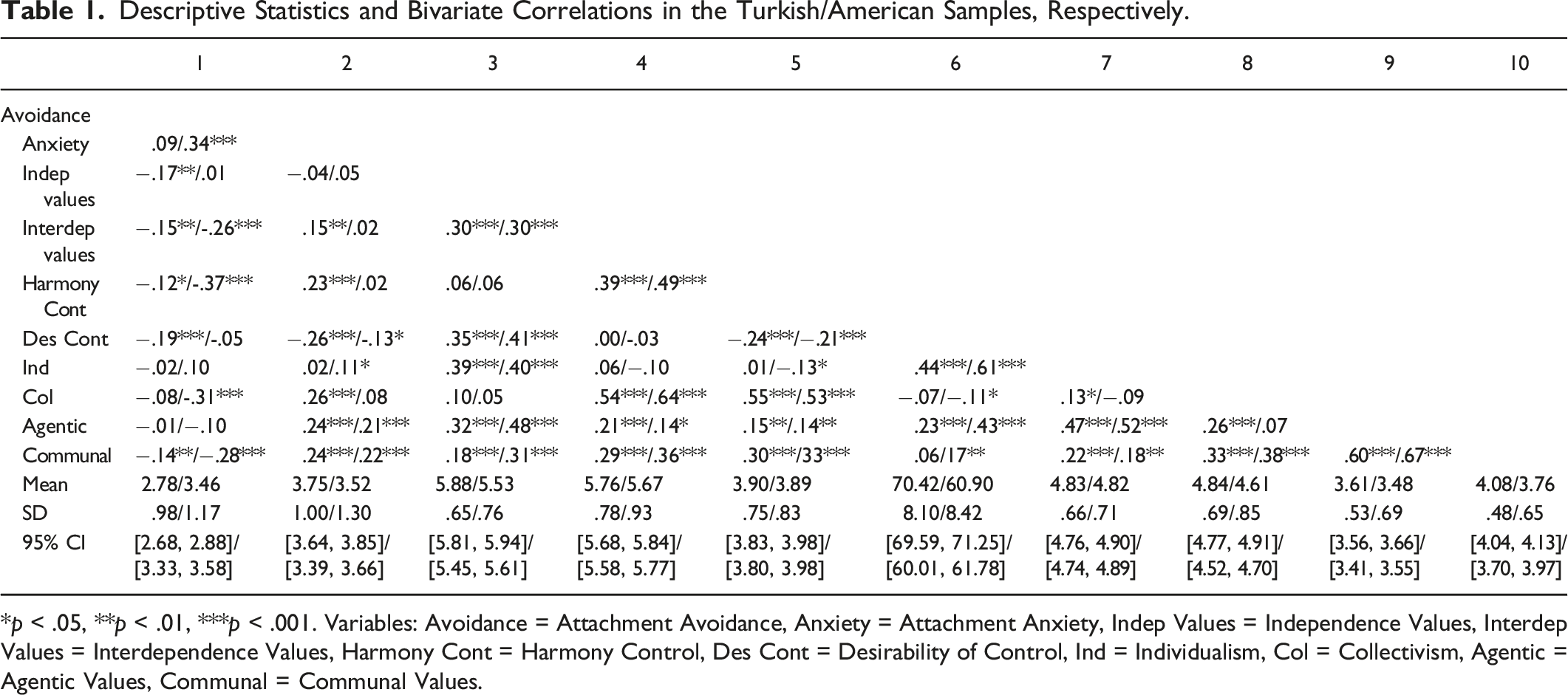
*p < .05, **p < .01, ***p < .001. Variables: Avoidance = Attachment Avoidance, Anxiety = Attachment Anxiety, Indep Values = Independence Values, Interdep Values = Interdependence Values, Harmony Cont = Harmony Control, Des Cont = Desirability of Control, Ind = Individualism, Col = Collectivism, Agentic = Agentic Values, Communal = Communal Values.
Contrary to expectations, attachment avoidance emerged as negatively related to independence values and desirability of control (r = −.17, p = .001 and r = −.19, p < .001, respectively). Also, we could not identify the expected positive relationships between attachment avoidance and individualism and agentic values.
The American Sample
In line with our second expectation, negative relationships between attachment avoidance and interdependence values, harmony control, collectivism, and communal values were also identified in the American sample (r = −.26 p < .001; r = −.37, p < .001; r = −.31, p < .001; and r = −.28, p < .001, respectively) (see Table 1). Further supporting our second expectation, positive relationships emerged between attachment anxiety and communal values (r = .22, p < .001). Similarly, a negative relationship was identified between attachment anxiety and desirability of control (r = −.13, p = .017).
Contrary to expectations, attachment anxiety was positively related to individualism and agentic values (r = .11, p < .048 and r = .21, p < .001; respectively). Also, we could not identify the expected positive relationships between attachment avoidance and independence values, desirability of control, individualism, and agentic values, and the positive relationships between attachment anxiety and interdependence values, harmony control, and collectivism.
Comparison Between the Samples
Lending support to our second expectation, negative relationships emerged between attachment avoidance and several measures of the interdependent mindset, specifically interdependence values, harmony control, and communal values in both samples. Similarly, there were negative relationships between attachment anxiety and desirability of control, a measure of the independent mindset, again in both samples. Further supporting our second expectation, positive relationships emerged between attachment anxiety and several measures of the interdependent mindset, specifically interdependence values, harmony control, and collectivism in the Turkish sample, and communal values in both samples. Contrary to expectations, however, attachment avoidance emerged as negatively related to independence values and desirability of control only in the Turkish sample and attachment anxiety was positively related to individualism and agentic values only in the American sample.
Finally, to investigate our third expectation, the correlation coefficients between attachment dimensions and cultural values from both samples were tested for statistically significant differences following the methods of Cohen and Cohen (1983). In partial support of our expectation, the negative correlation coefficients between attachment avoidance and several measures of interdependence, namely interdependence, harmony control, and communal values in the American sample (r = −.26, p < .001; r = −.37, p < .001; r = −.28, p < .001) were significantly larger than those in the Turkish sample (r = −.15, p = .004; r = −.12, p = .026; r = −.14, p = .010) (z = 1.53, p = .063; z = 3.57, p < .001; z = 1.96, p = .025).
Non-Linear Quadratic Regression Analyses
Non-linear Quadratic Regression Analyses for the Turkish/American Samples, Respectively.

*p < .05, **p < .01, ***p < .001. Variables: Sex: 1 = Female 2 = Male, Avoidance = Attachment Avoidance, Anxiety = Attachment Anxiety, Indep Values = Independence Values, Interdep Values = Interdependence Values, Harmony Cont = Harmony Control, Des Cont = Desirability of Control, Ind = Individualism, Col = Collectivism, Agentic = Agentic Values, Communal = Communal Values.
For the Turkish sample, the results revealed that in addition to the positive linear relationship between attachment anxiety and interdependence values, a significant non-linear relationship also existed (β = −.17, p = .001). In order to understand the nature of this quadratic relationship, a curve was plotted between the variables. As depicted in Figure 1, moderate levels of attachment anxiety emerged as related to higher levels of interdependence values, while low and high levels were related to lower levels of interdependence values. The quadratic relationship between attachment anxiety and interdependence values in the Turkish sample.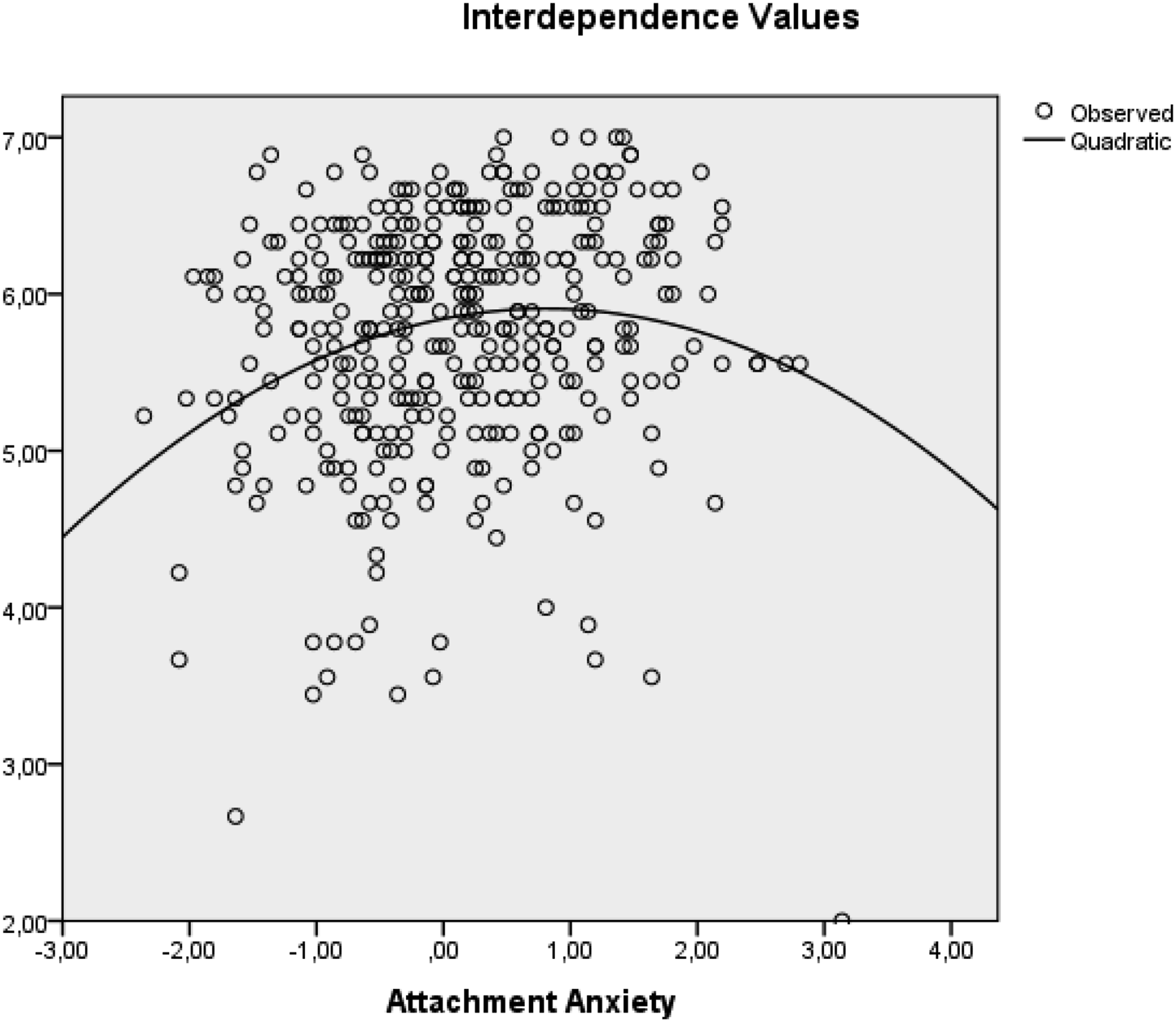
Harmony control was also positively predicted by attachment anxiety with a linear relationship in the expected direction, in addition to a significant quadratic relationship (β = −.12, p = .029). Similar to interdependence values, moderate levels of attachment anxiety emerged as related to higher levels of harmony control (see Figure 2). The quadratic relationship between attachment anxiety and harmony control in the Turkish sample.
While there was no significant linear relationship between attachment anxiety and individualism, a significant non-linear relationship emerged between these variables (β = .11, p = .041). The curve plotted between the two variables showed that only low and high levels of attachment anxiety were related to higher levels of individualism, while moderate levels of attachment anxiety were related to lower levels of individualism (see Figure 3). The quadratic relationship between attachment anxiety and individualism in the Turkish sample.
Collectivism, which was positively predicted by attachment anxiety in a linear relationship, also emerged to be associated with this variable in a non-linear relationship (β = −.15, p = .004). The plot of the quadratic relationship revealed that, as in the other measures of interdependence, moderate levels of attachment anxiety were related to higher levels of collectivism, while low and high levels of attachment anxiety were related to lower levels of collectivism (see Figure 4). The quadratic relationship between attachment anxiety and collectivism in the Turkish sample.
For the American sample, the non-linear quadratic regression analyses revealed that while there was no significant linear relationship between attachment avoidance and individualism, a significant non-linear relationship emerged between these variables (β = .13, p = .037). As depicted in Figure 5, only low and high levels of attachment avoidance were related to higher levels of individualism, while moderate levels of attachment avoidance were related to lower levels of individualism. The quadratic relationship between attachment avoidance and individualism in the American sample.
Discussion
Although the prevalence of attachment insecurity varies across countries (e.g., Schmitt et al., 2004), these analyses remain only at the country level, and its cultural concomitants have been left mostly unexamined except within the individualism versus collectivism dichotomy. The present study fills this gap by investigating how the two fundamental attachment orientations relate to distinct cultural mindsets from a broader perspective by employing several cultural value indicators in two diverse cultural settings. We will discuss the findings first by concentrating on the similarities and then the differences between the two samples.
Similarities Between the Turkish and American Samples
Lending partial support to our second expectation, several distinct relationships emerged between the two attachment orientations and cultural values in both samples. Specifically, in both the Turkish and the American settings, attachment avoidance correlated negatively with the interdependent mindset and attachment anxiety was positively related to the interdependent mindset, along with negative associations with several individualist values.
These results suggest that compulsive self-reliance in interpersonal relationships that typifies attachment avoidance also goes hand in hand with not endorsing communal values regarding cultural worldviews. Individuals who find proximity seeking in close relationships as a non-viable option, and consequently have to stand on their own to solve their problems, have been argued to be more likely to develop negative attitudes about containing others in their sense of self, not prefer to put the interest of the group above their own, and not enjoy small personal space (Sorensen & Oyserman, 2010). The significant negative relationship between attachment avoidance and the interdependent mindset lends the first empirical support to this idea. Arguably, this novel finding might also be valuable in understanding the potential adaptive value of attachment avoidance, especially in light of the recent findings showing that attachment avoidance predicts better performance in fields requiring self-reliance as compared to group work (Ein-Dor et al., 2012). The expected positive associations between attachment avoidance and measures of independence were not found. These results might be reconciled with the idea that avoidants are indeed counter-dependent more than being independent (see Bartholomew & Horowitz, 1991). Individuals high on attachment avoidance might value avoiding close contact with others even more so than they value independence. Future research could further investigate this distinction between avoiding intimacy and endorsing self-reliance.
The results also showed that people with a widespread fear of rejection or abandonment, typical of attachment anxiety, also feel the need to be more relational and value the group’s goals above their own. These results are in line with previous work that has also found positive associations between attachment anxiety and collectivism (e.g., Agishtein & Brumbaugh, 2013; Cheng & Kwan, 2008; You & Malley-Morrison, 2000), and extend and strengthen these findings in showing that this relationship holds for diverse measures of interdependence. These findings also make theoretical sense: Attachment anxiety, which entails dependence on others and a desire to be enmeshed with them, logically relates to interdependent values of inter-connectedness, seeing oneself as part of the group, and maintaining the harmony of the group (Sorensen & Oyserman, 2010).
Further supporting our second expectation, the results demonstrated that the said relationships between attachment avoidance and anxiety and the cultural worldviews are valid in two diverse cultural settings. Although different countries reflecting distinct values vary in their distribution of insecure attachment due to culturally divergent key factors in attachment formation, such as sensitive responding, accessibility, vocalization, soothing, and positive affect during the child-mother interaction within social and caretaking contexts (e.g., Leyendecker et al., 1997; Posada et al., 2002), the present findings offer the first hint of evidence suggesting that the latent relationships between attachment orientations and cultural mindsets of individuals may be universally valid.
This study also incorporated covert measures of cultural mindsets, such as harmony control, desirability of control, and agentic and communal values, to investigate the possible relationships between attachment orientations and cultural mindsets at a deeper level. The results obtained from these measures corroborated the other more frequently used overt measures of cultural values (i.e., individualism/collectivism and independence/interdependence). As expected, while harmony control and communal values were positively associated with attachment anxiety and negatively associated with attachment avoidance, desirability of control emerged as negatively related to attachment anxiety in both samples. These results are quite intuitive in the sense that relinquishing control to forces other than the self (e.g., a higher power, other people, or the social context), as measured by harmony control, can be very functional in an interdependent cultural setting, where belief in a higher power is very prevalent and uncertainty is a fact of life. Similarly, it is adaptive for individuals with high attachment anxiety to regulate their hypervigilance by endorsing culturally accepted interdependent values by adopting this harmony control mindset and cherishing the communal values endorsed by the majority. Consequently, they face less adverse consequences by fitting in the cultural atmosphere (i.e., being more compatible with the culture) (Friedman et al., 2010). However, in an individualist cultural context where each member of the society is expected to stand up for themselves and take control of their life without relying on other members of the society, it is relatively adaptive for individuals with high attachment avoidance to deactivate their need for affiliation and develop self-reliance. Instead of trying to depend on others who have been chronically unavailable, cultivating a dominant motivation for personal control over one’s life is more appropriate in such settings.
Differences Between the Turkish and American Samples
Supporting our first expectation and aligning with previous findings, which showed that attachment anxiety (avoidance) is more prevalent in cultures where collectivism (individualism) is widespread (e.g., Sagi et al., 1991; Schmitt et al., 2004; van IJzendoorn & Kroonenberg, 1988), the Turkish (American) sample of the present study reported significantly higher attachment anxiety (avoidance). Turkish participants also reported significantly higher levels of attachment anxiety than attachment avoidance, a phenomenon well documented in previous Turkish samples (see Sümer, 2014). These findings support our premise that insecure attachment tendencies should be studied through the lens of culture.
As for our second set of predictions, only in the American sample, individualism and agentic values, both of which measure the extent to which an individual wants to be better than others in competitive settings, emerged as positively related to attachment anxiety, which was contrary to what we expected. As a matter of fact, similar findings have been reported by Lee and Sawang (2016), where participants with high anxiety were revealed to be more likely to perceive intergroup competition in a project team setting and to be more willing to put more resources into outperforming competitors. These findings might suggest that individuals with high attachment anxiety may want to push themselves to be better than others to combat their chronic hypervigilance. The negative model of self that typifies anxious individuals might drive them to perform better than others to compensate for their feelings of not being worthy of love and support. The fact that this finding emerged as more prominent in the American setting, where such competitive acts are valued more, lends support to the compatibility argument of attachment insecurity. Individuals with high attachment anxiety may be trying to buffer the negative effects of their hypervigilance in an individualist culture that does not approve of dependence and clinginess by attempting to assert themselves by adopting agentic and competitive values, which are more acceptable. Although these are plausible arguments for interpreting this unexpected finding, further research is needed to construe the mechanisms of this relationship.
Another unexpected finding emerged only in the Turkish sample: Two individualism values, namely, independence and desirability of control, emerged as negatively related to attachment avoidance. Possibly, these individualist values, which are incompatible with a relational setting, are not endorsed by even members who have individual relational tendencies that favor these values. We were also unable to find the expected positive relationship between attachment avoidance and independence values, desirability of control, individualism, and agentic values in the American sample.
Our final expectation also received support, albeit partially. The negative relationship between attachment avoidance and the interdependent mindset emerged more strongly in the American sample than in the Turkish sample. This finding is important as it supports the idea that different types of attachment insecurity can be differentially compatible with different cultural orientations: The interdependent mindset is less compatible with attachment avoidance, and hence, it is more strongly evaded in a setting where this type of insecurity is less prevalent. It is also consistent with the cultural-fit hypothesis which argues that the less prevalent form of attachment insecurity is associated with more adverse outcomes (Friedman et al., 2010). Moreover, adapting to the local environment offers a major advantage in increasing survival fitness (e.g., Belsky et al., 1991; Chisholm, 1996) and adapting to local culture is also key for survival (Boyd & Richerson, 2005). Adherence to the prevailing attachment orientation-cultural value relationship in respective ecologies may be part of this strategy. Studies showing that the less prevalent form of attachment insecurity poses a specific risk in many domains in both collectivist and individualist cultures (e.g., Feeney & Karantzas, 2017; Kunce & Shaver, 1994; Rothbaum et al., 2000; Sümer & Kağıtçıbaşı, 2010) provide further evidence that incongruence with the cultural orientation which shapes close relationships is the less favorable strategy. Our results also suggest that individuals are less likely to endorse cultural values that go against the dominant attachment orientation-cultural mindset relationship of their environment.
In addition to these linear relationships between attachment orientations and cultural values, significant non-linear relationships also emerged between the variables. Several measures of the interdependent mindset, namely, interdependence values, harmony control, and collectivism, were associated with attachment anxiety in quadratic relationships in the Turkish sample, where moderate levels of attachment anxiety emerged as related to higher levels of these measures of the interdependent mindset and low and high levels of attachment anxiety were related to lower levels of these outcome variables. These results suggest that moderate construct levels are more representative as compared to extreme values. Even though high levels of a construct are usually regarded as more prototypical, indeed, moderate levels, centering around the mean values, are the actual prototypes and are more representative. Moreover, considering that these measures of the interdependent mindset are the prevalent norm in the relational Turkish culture, these findings lend support to the notion that insecure attachment is relatively functional - neither extreme dependence nor interdependence is functional. However, moderate levels of attachment insecurity can be associated with culturally adaptive values. These findings are very much in line with the psychological/emotional interdependence family model of Kağıtçıbaşı (2005), which argues that with increased urbanization and parental (especially maternal) education, the economic value of the child diminishes, as the psychological value of the child substantially increases. In this family model, which has been repeatedly shown to be valid for the Turkish culture, emotional interdependence and relatedness are still valued, given the collectivist cultural context; yet the child’s autonomy is also valued as there is no longer the need for material interdependence. In line with this model, the present results confirm that neither extreme dependence nor extreme independence, but moderate levels of a desire to be close to significant others, maybe more representative of the Turkish culture and more functional in it (see also Sümer & Kağıtçıbaşı, 2010).
A measure of the independent mindset, namely individualism, also emerged as significantly related to attachment anxiety in a quadratic relationship in the Turkish sample, where only low and high levels of attachment anxiety emerged as related to higher levels of individualism. In comparison, moderate levels of attachment anxiety emerged as related to lower levels of this outcome variable. It is plausible that the high and low levels of attachment anxiety may be related to high levels of individualism through different mechanisms. Low levels of attachment anxiety may be related to individualism due to the dismissing pattern, whereas high levels may be associated with individualism because extreme anxiety causes extreme concern with one self (e.g., Mikulincer et al., 2003), individuals who are extremely focused on themselves due to high anxiety may also logically score high on a measure of individualism. These findings are especially plausible for the Turkish sample, supporting the functionality argument of attachment insecurity in showing that only extreme values of attachment anxiety are related to a cultural construct incompatible with the cultural context in the relational Turkish sample. In contrast, individualism emerged as significantly related to attachment avoidance in a quadratic relationship in the American sample, where again only low and high levels of attachment avoidance emerged as related to higher levels of individualism, while moderate levels of attachment avoidance emerged as related to lower levels of this outcome variable. The fact that attachment avoidance, which is more prevalent in the American culture, emerged as related to individualism lends support to our third expectation.
Contributions and Implications of the Present Research
The present research extends the prevalent individualism versus collectivism dichotomy perspective in cross-cultural research and makes an important contribution to the literature by systematically investigating individual-level cultural mindsets by employing a battery of cultural value measures and showing for the first time that attachment and cultural orientations are differentially related to each other. Another contribution of the study is to reinforce these findings by utilizing multiple measures for collectivism and individualism, including covert cultural indicators (i.e., harmony control, desirability of control, and agentic and communal values), as complementary measures to the more traditional ones (i.e., independent vs. interdependent values and individualism vs. collectivism). The study is also fruitful in the sense that its results emerged in two distinct settings, namely Turkey and the United States. Employing community samples in both settings is another strength of the study.
The findings of the present research have important implications for how attachment orientations, particularly insecure attachment, are viewed from a cross-cultural standpoint. They provide preliminary evidence supporting the idea that insecure attachment unfolds in a culturally sensitive manner. Our findings suggest that individuals high on attachment anxiety (avoidance) would be better tolerated in interdependent (independent) settings, hence their contributions may be better utilized in these respective ecologies. Moreover, as the members possessing the attachment orientation that is incompatible with the cultural atmosphere can be tolerated to a lesser degree, this could pose a risk for them. These conjectures could help explain the repeated findings showing that attachment anxiety (avoidance) is more prevalent in collectivist (individualist) cultures.
Limitations of the Present Research and Suggestions for Future Studies
The contributions of the present research notwithstanding, the results should be approached with caution due to certain limitations. A major limitation of the study is its correlational nature. Although this study had results corroborating the links between attachment and cultural orientations, the causality between these constructs cannot be derived from the results. Further research is needed to investigate whether attachment tendencies are affected by the cultural mindset or whether attachment tendencies shape the cultural values individuals hold. Moreover, although the expected patterns emerged between cultural values and attachment dimensions overall, null findings and associations contrary to predictions were also identified. Future studies should incorporate other socio-ecological factors, such as relational mobility, in addition to these general cultural values to investigate the relationship between attachment dimensions and cultural values in more depth.
All in all, the cultural distinctiveness of insecure attachment is a fruitful avenue for future research, especially in light of its important implications for group formation and functioning. Distinct cultural contexts and mindsets should be incorporated into the study of attachment to achieve a more comprehensive picture of how humans relate to their significant others as a function of their distinct ecologies.
Supplemental Material
Supplemental Material - Cultural Correlates of Adult Attachment Dimensions: Comparing the US and Turkey
Supplemental Material for Cultural Correlates of Adult Attachment Dimensions: Comparing the US and Turkey by Ezgi Sakman and Nebi Sümer in Cross-Cultural Research
Footnotes
Author’s Note
This manuscript was generated from the doctoral dissertation of the first author.
Declaration of Conflicting Interests
The author(s) declared no potential conflicts of interest with respect to the research, authorship, and/or publication of this article.
Funding
The author(s) received no financial support for the research, authorship, and/or publication of this article.

Supplemental Material
Supplemental material for this article is available online.
Note
Author Biographies
Ezgi Sakman is a lecturer in the Department of Psychology at Bilkent University, Turkey. She received her Ph.D. in social psychology from Middle East Technical University, Turkey in 2016 and she conducted post-doctoral research in the Department of Psychology at Cornell University during 2018-2020. Her research focuses on the attachment system and its activation, adaptive functions of attachment insecurity in cultural context, and implicit predictors of relationship functioning.
Nebi Sümer is a professor of psychology at Sabancı University, Turkey. He received his PhD in social and personality psychology from Kansas State University in 1996. His research interests include attachment dynamics and parenting behaviors across the lifespan, transportation safety and driver behavior, effects of unemployment and job insecurity. He is a member of the Science Academy Association in Turkey.
References
Supplementary Material
Please find the following supplemental material available below.
For Open Access articles published under a Creative Commons License, all supplemental material carries the same license as the article it is associated with.
For non-Open Access articles published, all supplemental material carries a non-exclusive license, and permission requests for re-use of supplemental material or any part of supplemental material shall be sent directly to the copyright owner as specified in the copyright notice associated with the article.
