



Abstract
There is currently limited knowledge about the effects of introducing genetically modified (GM) crops into smallholder farming or about how biosafety requirements are interpreted and adopted by smallholders. A case study was conducted on introduction of GM (Bt) maize to South African smallholders. The results reveal low general awareness about agricultural technology among smallholders and an incompatibility between smallholder practices and biosafety requirements. The implications are low understanding of biosafety measures and low compliance. Therefore, essential prerequisites for the safe introduction of GM crops to smallholders are increased smallholder knowledge on modern plant varieties and improved agricultural advisory services that better match the smallholder context. In addition, information about GM crops and biosafety implementation must be modified to better suit smallholders.
Introduction
It has been suggested that use of genetically modified (GM) crops can raise yields, increase food security, and improve environmental sustainability in smallholder farming (see, for example, Borlaug, 2000; Wambugu, 1999). Others have argued that inherent uncertainties regarding future environmental and health effects should not be imposed on already vulnerable poor smallholders in the South (Altieri & Rosset, 1999; Russell, 2008; Scoones, 2002). To mitigate potential unintended adverse effects on human health and the environment, many countries have implemented biosafety regulations requiring both prerelease risk assessment of all GM crops and postrelease monitoring of any unanticipated adverse effects on human health and the environment. However, current GM crops and biosafety measures were developed to suit large-scale commercial farming, and there is still limited knowledge regarding experience with GM crops and adaptation to biosafety guidelines in smallholder faming (Assefa & Van den Berg, 2009; Kruger, Van Rensburg, & Van den Berg, 2012).
This article presents a case study of three villages in South Africa where genetically modified Bt maize was introduced to smallholders growing maize for subsistence. Bt maize provides resistance to certain insects, including the African maize stem borer (Busseola fusca) and the Chilo stem borer (Chilo partellus), which are important pests of maize in South Africa (Kfir, Overholt, Khan, & Polaszek, 2002). Use of Bt maize can reduce crop losses to these pests and potentially reduce the need for pesticides, benefits which could be of use to smallholders and large-scale farmers alike (Gouse, Piesse, Thirtle, & Poulton, 2009). However, Bt maize was initially developed for large-scale commercial farming and more information is needed on the effects of introducing Bt maize and associated biosafety measures into smallholder farming.
This study examined understanding of biosafety requirements associated with Bt maize in South Africa among smallholders, industry representatives, and retailers engaged in Bt maize introduction and compliance with these requirements. Specific attention was paid to examining local farm practices and local understanding of maize, as case study results showed that compatibility between new biosafety practices and local knowledge and practices is of key importance for smallholders’ understanding of, and compliance with, biosafety regulations. The results were used as the basis for some reflections regarding future challenges for the implementation of GM crops within a biosafety framework in smallholder farming, based on lessons learned from this case study.
Bt Maize and Biosafety Requirements
South Africa is a signatory to the Cartagena protocol on Biosafety and since 1997 has had its own biosafety law, GMO Act (15/1997; South African National Biodiversity Institute, 2011). There are certain biosafety conditions associated with approval of Bt maize (MON 810 event) in South Africa. In essence, the permit holder must (South African National Biodiversity Institute, 2011):
– keep detailed records of plant locations;
– monitor farmers’ compliance with regulations;
– develop an insect resistance management plan;
– monitor resistance management strategies;
– develop a surveillance plan for detecting resistance development; and
– educate growers to ensure their ability to meet the above requirements.
The GMO Act also authorizes inspectors in the South African Department of Agriculture, Fisheries and Forestry (DAFF) to ensure compliance with its requirements, to assess the effectiveness of risk management measures and to detect possible adverse effects. In addition, the South African National Biodiversity Institute (SANBI) is responsible under the National Environmental Management Biodiversity Act (NEMBA, no. 10 of 2004) for carrying out postcommercial release monitoring (South African National Biodiversity Institute, 2011).
To enable compliance with biosafety requirements, two new planting practices were introduced with Bt maize. The first is the establishment of a refuge planting where a proportion of each maize field is planted to a conventional non-GM hybrid, adjacent to the Bt maize planting. This refuge is often planted as border strip around Bt maize and serves the purpose of sustaining a pest population that is not subjected to selection pressure provided by the Bt protein. In this way, resistance build-up is delayed. The farmer commits to planting refugia in a technical agreement signed with the industry when buying seeds (Thomson, 2008). The second practice with which farmers certify their compliance is to only use the seeds for planting in a predesignated area (Thomson, 2008). This is intended to allow the industry to keep records of plant locations and monitor farmers’ compliance with terms imposed to fulfill biosafety regulations. It also ensures that purchased GM seed is not moved across international borders and that it is possible to carry out postcommercialization monitoring of adverse effects. In practice, this means that farmers cannot pass seeds on to others.
Smallholder Maize Farming and Agricultural Advisory Services
Agricultural research and advisory services in South Africa (Bembridge, 1991; De Wet, 1990; Hebinck, Fay, & Kondlo, 2011) and elsewhere (Chambers, Pacey, & Thrupp, 1989; Fitzgerald, 1993; Morris & Bellon, 2004) are commonly informed by large commercial farms. As a result, agricultural experts are generally much more knowledgeable about large-scale farming and advice is seldom adapted sufficiently to suit smallholders. However, as the effects of agricultural technology are largely context specific (Glenna, Jussaume, & Dawson, 2011; Schnurr, 2012; Snapp, Blackie, & Donovan, 2003; Tripp, 2001), both technology and advice have to be modified to fit the smallholder context. There are a number of features of smallholder maize farming that are of particular relevance when evaluating the local compatibility of Bt maize and current biosafety measures with smallholder farming.
In contrast to large-scale commercial farmers, smallholders commonly farm with minimal resources on land that is commonly much more diverse and less optimal for agriculture (Altieri, Funes-Monzote, & Petersen, 2011; Dawson, Murphy, & Jones, 2008). Smallholder farming environments are often pressured by multiple interacting stress factors, making it difficult for both farmers and specialists to single out the effect of one particular pest or to predict the outcome of interactions between stresses (Dawson et al., 2008). Adding to the ecological complexity that smallholders have to handle in general, maize farmers also have to deal with the effects of maize being a cross-pollinating species. In contrast to self-pollinating cereals like rice and wheat, which produce a highly homogenous crop, maize genetic material is exchanged when pollen flows among neighboring plants, which means that all plants in a field commonly differ from the preceding generation and from each other. This means that it is difficult for maize farmers to use local seed selection to ensure particular characteristics in the offspring, and it also becomes difficult to attribute specific traits to a particular maize variety in farmers’ fields (Smale & Jayne, 2003). Indeed, despite a very long tradition of local seed selection practices, traditional maize farmers in Mexico do not view seed selection as a primary means to achieve desired maize characteristics (Louette & Smale, 2000). However, despite the complexity of smallholder environments, research has shown that smallholders have detailed knowledge of their own environments and give highly relevant comments about the kind of characteristics they would like to have in maize (McCann, Dalton, & Mekuria, 2006; Mercer, Perales, & Wainwright, 2012).
The local maize varieties that smallholders have grown and taken seeds from for generations are often referred to as landraces. These are open pollinated varieties (OPV). There are also certified OPVs that can be bought on the seed market. OPVs are related, but genetically diverse, plant populations that can be bred to express certain traits but are not purified to the same extent as hybrids. In contrast to hybrids, OPV seed can be reused without major effects on yields (for further information visit IRRI Cereal Knowledge Bank: Maize [online] http://www.knowledgebank.irri.org/ckb/quality-seeds-maize/what-is-an-opv.html [accessed July 12, 2012]). During hybrid development, pollination is carefully controlled, resulting in genetically homogeneous varieties giving comparatively high yields. However, cross-pollination on being grown in farmers’ fields means that the effects of hybrid vigor are quickly lost in subsequent generations and maize hybrids should therefore be bought new every season to retain high yields (Fitzgerald, 1993). Smallholders commonly recycle seed for a variety of reasons including tradition, inability to pay for seeds, and because available varieties are not well suited to smallholder environments (Byerlee & Heisey, 1996). Information from 2005 suggests that 90% of South African smallholders plant OPVs or recycled seed from OPVs or hybrids (Gouse, Pray, Kirsten, & Schimmelpfennig, 2005).
Although use of hybrid seeds provides the potential for higher and more homogeneous yields, it also increases the dependency on the seed industry and expert agricultural advice for information on these seeds. As hybrids do not perform well when saved and replanted, adoption of hybrids means that farmers become increasingly dependent on market access to suitable seeds. In addition, different hybrid varieties are often visually very similar, making it difficult for farmers to distinguish between the different varieties without expert help (Fitzgerald, 1993). There are important parallels to be drawn to the current introduction of GM seed to smallholders. GM seed, like hybrids, should not be recycled. In addition, GM crops are often very similar to their conventional counterparts and their novel traits are generally not immediately obvious to farmers. It is therefore difficult for farmers to identify them without expert help (Tripp, 2001). Thus to ensure that smallholders can use GM crops to their benefit and comply with biosafety regulations, it is important that they are supplied with agricultural support adapted to local conditions.
Description of the Case Study and Method
The results presented here build on data from a case study of three adjacent villages (265 households) during a total of 5 months of field work in 2006, 2008, and 2009. The villages are located in what was formerly the Transkei homeland, in Eastern Cape Province, South Africa. The region is among the poorest in South Africa. Maize is planted for subsistence. It is often intercropped with beans and pumpkins in the field and with a range of vegetables in the home garden. The region has experienced a historical lack of agricultural advisory support. Despite the introduction of hybrid maize varieties during earlier agricultural policy interventions, most smallholders rely on locally saved and reproduced seed (locally referred to as “Xhosa maize”, IsiXhosa being the language spoken by the dominant ethnic group in the region) or buy improved OPVs of maize.
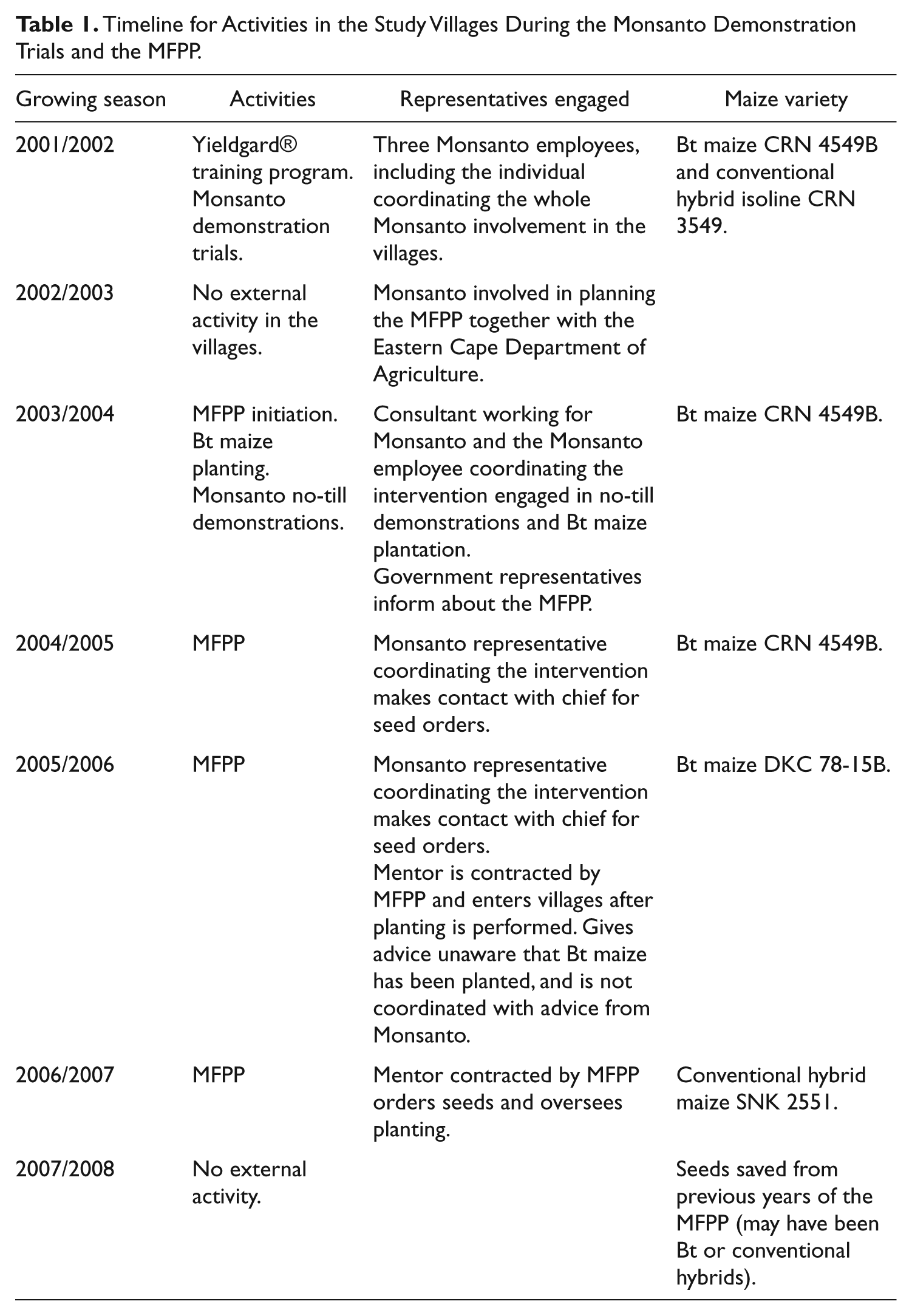
Bt maize was introduced to the study villages in 2001, when Monsanto had demonstration trials and provided a 2-day training course about Bt maize, the Yieldgard® training program. Interested smallholders were supplied with sample bags of Bt maize and the conventional hybrid isoline to plant and compare with each other and with local maize varieties. Chemical fertilizer was also provided. In 2003, the villages entered the Massive Food Production Program (MFPP), initiated by the Eastern Cape Department of Agriculture (ECDA). Villagers actively engaged in farming at that time and with fields that could be tilled mechanically were invited to participate. The MFPP left responsibility with local villagers to choose and order maize seeds and agrochemical inputs in negotiation with the private industry. The joint chief of the three villages, who was locally in charge of the seed orders, had established good contact with Monsanto during the previous demonstration trials. He pointed out that only Monsanto had demonstrated the performance of their seed in a local trial, so he chose to order Bt maize during the MFPP. Bt maize and chemical fertilizer were supplied free of charge during the demonstration trials and the subsequent MFPP. In the first 3 years of the MFPP, the three villages studied planted Bt maize from Monsanto (Table 1). In the third season, agricultural “mentors” were recruited in the MFPP. The mentor entered at the end of 2005, unaware of that the recently planted maize was Bt maize. During the fourth season the mentor was responsible for procuring seed and ordered conventional hybrid maize without informing the chief, who believed that Bt maize was planted in the fourth season too. The result was that smallholders were unaware that Bt maize was not planted during the last season. As the participating smallholders could not distinguish between the maize planted during the last season and Bt maize, the term “project maize” is collectively used here when discussing all new maize varieties introduced through the demonstration trials and the MFPP with smallholders.
Timeline for Activities in the Study Villages During the Monsanto Demonstration Trials and the MFPP.
The field work in the study villages was performed by the first author, who lived with a family in one of the villages and took part in daily activities. The aim of the field work was to examine a context-specific case of introduction of Bt maize to smallholder farmers. A combination of quantitative and qualitative methods was used to obtain overall data and an in-depth understanding of the issue. Triangulation of methods and sources allowed the cross-checking of tentative conclusions and revealed when more information was needed. All discussions were translated from English to IsiXhosa using local interpreters, who also served as key informants. Participant observation was a key tool used throughout the study to enrich understanding and cross-check verbal data.
All 265 households in the three villages were surveyed and informal talks and participant observation were performed in all villages. In total, 30% (77/265) of the smallholders in the three villages had first-hand experience of planting project maize during Monsanto demonstration trials and/or during the MFPP. The results presented in this article regarding smallholder understanding of Bt maize are thus based on information from these 77 households, obtained drawing on different methods as described in more detail below.
One of the three villages that had the highest participation rate in the MFPP and Monsanto demonstration trials was studied more intensively. In this village, 58 of 105 households had planted project maize during 1 or several years. All households in this village were subjected to a more detailed survey, including qualitative questions about village life and farming. A question of particular relevance to this article concerned local perceptions on the performance of project maize in the field. The question (posed to the respondents in IsiXhosa) was: “Do you see any differences between the Xhosa maize and the project maize when growing, for example a difference in how it is affected by weather, soil or insects?” Respondents were encouraged to give multiple answers. The responses were subjected to multiple response analysis using SPSS statistical software.
To gain a deeper understanding of key issues raised in the survey and during informal talks and participant observation, 11 households were selected for in-depth interviews from the 58 households with first-hand experience of project maize. Survey information about the age and sex of the de facto head of household, poverty level of the household (based on results from a participatory wealth ranking activity), and the varieties of maize currently planted in the garden and in the field were used when selecting these households. The aim was to include a variety of smallholders with first-hand experience of project maize.
A focus group discussion was performed in another of the three villages to cross-check information obtained in the surveys and interviews and to further examine smallholder understanding of local maize varieties and project maize. Eight smallholders selected by local key informants for their long experience of maize farming partook in the discussion, which focused around how to identify different local and purchased maize varieties, including project maize, and differences between the varieties regarding their performance in the field.
As shown in Table 1, a total of four Monsanto representatives were active in the study villages during the demonstration trials and the MFPP. Interviews were held with two of these: the individual who coordinated the whole intervention in the villages, from the demonstration trials and throughout the MFPP, and an individual contracted by Monsanto to advise smallholders on Monsanto products. Interviews were also held with two Monsanto employees who had worked with the introduction of Bt maize and other Monsanto products to other smallholders in the region at the time of the MFPP, but who had not been specifically involved in the study villages. Eight respondents involved in planning and implementation of the MFPP, ranging from the top level of administration of the MFPP at the ECDA to staff active at local level in the study villages, were also interviewed, as were six different shop assistants in the only two local agricultural supply stores selling Bt and Roundup Ready® maize.
Results and Analysis
Smallholder Identification of Bt Maize
In-depth interviews, informal talks, participant observation, and the focus group discussion on maize confirmed that villagers commonly did not have the tools to distinguish Bt maize from conventional hybrid maize. During the Monsanto demonstration trials in 2001, Bt maize and a conventional hybrid were supplied together for comparison. However, the common understanding was that one new maize variety had been planted and compared with the local maize. During the three years of the MFPP when Bt maize was planted, Monsanto distributed small packets of conventional hybrid seeds to be used for refugia plantings together with the Bt maize bags. These hybrid seeds were likewise not understood as being different from the Bt maize and many smallholders had given these packets to neighbors who wanted to try Bt maize. Furthermore, it was not generally known that Bt maize had been replaced by a conventional hybrid during the fourth year of the MFPP. On being probed on observed differences between the maize provided during the different years, smallholders commonly mentioned differing kernel size, ear size, or the color of the chemical coating as ways of distinguishing between the maize varieties provided. Further questioning about these differences revealed that these ways of distinguishing between varieties did not enable smallholders to identify the Bt maize. Rather, several sources confirmed that based on their ways of identifying Bt maize, smallholders believed that varieties had changed when they had not, or that they had bought/been given Bt maize when they had actually received a conventional hybrid or OPV maize.
The survey results showed that the stem borer resistance of Bt maize was almost completely unnoticed locally. The multiple response analysis (Table 2) showed that only 17% (10/58) of respondents mentioned that project maize was more disease/insect resistant (due to problems in distinguishing between damage by disease and damage by insects, type of resistance was not always specified). Specific analysis of these responses revealed that only 5% (3/58) of respondents mentioned that project maize was more insect resistant and a single respondent (1/58) said that it was specifically more resistant to stem borers. However, one respondent claimed that project maize had lower insect resistance. During the focus group discussion on maize, the participants argued that stem borer damage could not be limited by choosing a certain type of maize and that stem borers were a problem in rainy years, when they were a problem to all varieties alike, including project maize.
Results From Multiple Response Analysis of Survey Answers to the Question “Do You See Any Differences between the Xhosa Maize and the Project Maize When Growing, For Example a Difference in How It Is Affected by Weather, Soil, Or Insects?”.

The very low rate of recognition of stem borer resistance can be partly explained by the fact that smallholders thought that the hybrid maize and the Bt maize distributed were the same maize variety. It might also be argued that stem borer damage was not recognized since it was not a major problem in the area. The data did not allow us to determine whether this was actually the case; however, it can be noted that many smallholders highlighted stem borer damage as a problem in maize production, but still did not recognize the stem borer resistance in the Bt maize. The fact that many smallholders planted their maize late could also have influenced the possibility to recognize stem borer resistance, as late planting can lower the resistance to stem borers in Bt maize. It is also possible that the extremely low recognition of stem borer resistance illustrates a difficulty in distinguishing stem borer damage in the field. However, it also indicates that the information given about Bt maize imparting stem borer resistance had not been adequate.
As shown in Table 2, the most common feature reported for the project maize was that it had a shorter time to maturation than local varieties. This was highly appreciated, since many smallholders were forced to plant late due to waiting for draught animals/machinery or awaiting rains. However, the shorter maturation period is not specific to Bt maize but can be found in many hybrids and OPVs. In addition, 29% (17/58) of survey respondents reported having obtained increased yields with the project maize compared with their Xhosa maize (Table 2). However, in interviews with these respondents and in the focus group discussion on maize, it was commonly stressed that the simultaneous introduction of fertilizer and the project maize obstructed the possibility to compare the performance of the new maize with local landraces.
Smallholder Practices and Understanding of Refugia
The fact that the stem borer resistance of Bt maize was almost completely unrecognized, presumably, made it difficult to explain the concept of refugia. According to our interviews with Monsanto employees, the company had informed smallholders about refugia plantings and, as mentioned above, supplied small bags of conventional maize to be planted as refugia. However, interviews revealed that only the chief and one member of the MFPP village steering committee knew about refugia requirements (although the latter did not know about the stem borer resistance of Bt maize). Thus, there was no wider understanding in the villages of the purpose of the small bags supplied with Bt maize. One smallholder who had taken part in the Yieldgard® training program and had planted Bt maize during the demonstration year and the first 3 years of the MFPP claimed that the purpose of the small bags was to show smallholders what the seeds looked like, without having to open the whole 10 kg bag. Another smallholder who was considered locally as highly knowledgeable about farming and who had taken part in the Yieldgard® training program and all years of the MFPP was convinced that there had been no special instructions regarding the small bags, and that they were just a gift from the company to be planted at will. Other common responses were that the small bag was for planting in the garden. The perception of the small bag as a gift from the company was held by several smallholders.
Smallholder Practices and Understanding Regarding Saving and Sharing and Planting Seeds
Seeds were commonly shared between neighbors and friends. This was found to be especially important for the poorest households as a way to secure seed supply. People were not aware that they were not allowed to share Bt seeds and there was no indication that sharing of seeds had been reduced since the introduction of Bt maize. On the contrary, there were several cases where smallholders who had not been given seeds from the MFPP or Monsanto had received seeds from neighbors. One result of this was that many smallholders who planted Bt maize had not taken part in training and information meetings.
It was widely acknowledged that project maize seeds should not be reused. This is clearly manifested in the Xhosa term udlambhuqe, meaning “the maize that you eat until it is finished” (i.e., seeds are not saved for planting), which was widely used when referring to the project maize. However, it was not widely understood why the seeds should not be recycled and there were different ways to make sense of this. One smallholder who had taken part in the Yieldgard® training program and the MFPP argued that the Yieldgard® maize was only provided during the 1st year. Since Yieldgard® should only be planted once, she argued, they had switched to other varieties after the initial year of planting Yieldgard®. She took the fact that the bags of seed distributed after the initial demonstration trials contained a small bag of seeds as an indication that this seed was different from the initial Yieldgard® maize. This reconceptualization of the Bt maize again highlights the lack of connection made between the small bags and refugia planting. Another smallholder argued that the reason for not recycling the seeds was that they were too easily eaten by grain weevils in storage and therefore it was simply impossible to save them (Bt maize, like many hybrid varieties, is more sensitive to grain weevils and degrades more quickly in local storage conditions than local varieties). Many smallholders had also grasped that yield would decline if project maize seed was reused. Despite this, some smallholders had conducted small trials in their fields where they planted recycled project maize seeds repeatedly over some years to observe the results for themselves.
Many other smallholders did not reuse the new seeds and our data show that the concept of not saving seeds was extended to OPV seed, which unlike hybrid and GM maize seed can be reused. When people bought seeds in town they almost invariably bought OPV, the most commonly available and cheapest seeds in local shops. Despite this, several smallholders clearly believed that it was difficult to get hold of seeds that could be reused. We were unable to establish whether this widespread misconception was related to the introduction of Bt maize or whether it was the result of promotions of hybrid seeds in the past. Participant observation and interviews revealed that smallholders commonly could not differentiate between various OPVs and hybrid seeds bought in town. Thus, the widespread understanding that the new seeds should not be saved, in combination with unfamiliarity with hybrid seeds and lack of knowledge regarding the differences between Bt maize and other maize varieties, led people to believe that no purchased seed should be reused.
An additional feature of the project maize, according to smallholders, was that it should not be intercropped with other plants. Both MFPP staff and Monsanto promoted monocropping to rationalize mechanization and application of agrochemicals. Several smallholders mentioned that they had heard that a chemical would be applied to the maize and that the chemical would kill beans and pumpkins, which they commonly planted with maize. This indicates possible confusion between Roundup Ready® and Bt maize. In practice, no herbicide was supplied by Monsanto or the MFPP and many smallholders therefore returned to intercropping their maize.
Bt Maize Introduction to Smallholders According to Monsanto
As mentioned above, many smallholders falsely believed that Bt maize should not be intercropped. The representative at Monsanto who was responsible for coordinating the village intervention reported being aware of this misconception and attributed it to local confusion about different Monsanto products. Although only Bt maize had been distributed and planted, herbicide-resistant Roundup Ready® maize and Roundup® herbicide, as well as the herbicide atrazine, were promoted simultaneously in the study villages. These products exclude the possibility of intercropping. According to the Monsanto representative, the simultaneous promotion of these products was not a mistake made in these particular villages but that the company habitually promotes a range of their products at the same time when engaging with smallholders.
Although the idea of not reusing seeds was widely acknowledged locally, the Monsanto respondents insisted that the company did not prohibit smallholders from saving seeds, but that since Bt maize, like other hybrids, does not perform well when recycled, they simply advised that seeds should not be saved. The only statutory requirements that farmers must comply with, according to the Monsanto respondents, are planting refugia and not passing seeds on to others.
Large-scale commercial farmers in South Africa sign a technical agreement directly with Monsanto when buying their Bt maize, agreeing to plant refugia and not pass on seeds to a third party. Smallholders in the villages studied had not signed any such agreements. The chief in the study villages who had direct contact with Monsanto for seed orders was aware that such agreements should be signed, but he had not seen or signed an agreement. According to our Monsanto respondents, the established arrangement when smallholders want to buy GM seeds is that the responsibility for signing technical agreements and informing about biosafety requirements lies with local retailers. According to Monsanto, this is because it would be practically impossible for the company to sign agreements with every smallholder, due to their sheer numbers. The established procedure is that retailers selling seeds are trained by Monsanto and licensed to sell their GM seed. The retailers are then responsible for transmitting the information stated in the technical agreement to smallholders and making sure that the smallholders agree to the terms stated. Smallholders, like large-scale commercial farmers not following the regulations stated in the technical agreement, could in theory be prosecuted, according to our Monsanto interviews. However, even if retailers ensured that all buyers were informed about the terms in the technical agreement, smallholder compliance with the agreement would still be almost impossible to monitor, as it would be extremely difficult to establish in practice which specific smallholders had purchased and planted Bt maize.
According to Monsanto respondents, it was not easy to explain the logic behind refugia to smallholders. When asked why many smallholders thought that the small bag of seeds was a gift, Monsanto staff said that they commonly described the small bag as “a gift to the stalk borer” (stem borers are also commonly referred to as stalk borers). One Monsanto respondent commented on this, saying that when smallholders were told during demonstrations that the small bag was a gift to the stalk borer, a common response was, “Oh what? Do you want us to plant for the stalk borer!” As a result, smallholders did not want to comply with refugia plantings. However, that respondent also argued that it was not important at this stage of early Bt maize adoption that smallholders planted refugia, since neighboring fields planted with conventional maize served as natural refugia. There was also some confusion at Monsanto regarding the purpose of the refugia. The Monsanto coordinator in the study villages claimed that refugia were planted to provide a place for the stem borer to feed, just to ensure that they did not become extinct, since they did not want to disturb the ecosystem. Another respondent who had been engaged in smallholder training in the study villages stated that the dual purpose of the refugia was to show smallholders how effective the Bt maize was and also to make sure that the stem borers did not become extinct “because okay if you kill all the stalk borer maggots, you know, you don’t need Bt maize anymore.”
Understanding of GM Crops Among Local Retailers
Due to difficulties interpreting the information on seed bags in combination with the fact that many smallholders were not comfortable asking for advice in shops, some smallholders believed that they had bought Bt maize in local stores, whereas they had unknowingly bought OPV seeds. Several smallholders said that they had looked for seeds dyed with the same color as the Bt maize to ensure that they bought the right seed. In a couple of cases where this information could be cross-checked by looking at seed bags or getting information about where the seed was purchased and its cost, these seeds were confirmed to be OPV seed. Color is often used to indicate that seeds are treated with pesticides but there is no uniform standard for seed coloring and specific seed colors are not connected to specific GM traits, so OPV and hybrid seeds can be the same color as Bt maize seeds.
Information given in the local agricultural supply stores was also often insufficient. For example, one smallholder had asked specifically for Yieldgard® but despite this had unknowingly received OPV maize. The information given to customers in the agricultural supply stores was found to vary greatly depending on the sales assistant. Some staff could not tell the GM and non-GM varieties apart, whereas others could give detailed accounts of how the varieties differed. For example, when two sales assistants were asked what was special about Roundup Ready® maize, they were only able to say that it was “not the ordinary maize.” Although bags of Roundup Ready® maize seeds were available on display in the shop at the time, the sales assistants were unable to indicate which bags contained Roundup Ready® maize. When another sales assistant was asked for Yieldgard®, he provided a bag of unlabeled maize seeds, saying that perhaps the label had been torn off. He then provided another labeled bag stating (correctly) that this was Yieldgard® and claimed that it was the same variety as that in the unlabeled bag. He also pointed out (correctly) that the “B” stood for stem borer resistant (in South Africa, Bt and Roundup Ready® seeds are marked B and R, respectively, to make identification easier) and that stem borer is isishlava in IsiXhosa.
Interviews with local retailers selling GM maize seeds also revealed that not all shop assistants had taken part in Monsanto training days. Furthermore, not all of the Monsanto respondents who worked with smallholders in the region were aware that Bt maize was sold by these retailers, and no technical agreements were signed in either of the two stores when smallholders bought GM seeds.
Discussion
This case study showed that the current implementation of biosafety regulations in South Africa did not result in smallholder compliance. Smallholders had difficulties understanding and correctly applying biosafety measures, primarily because of the
– they could not identify Bt maize;
– they were not given sufficient and/or accurate information on Bt maize and associated biosafety measures;
– some of the biosafety measures were not fully compatible with smallholder practices.
Smallholders Cannot Identify Bt Maize
Smallholders were not aware that Bt maize is stem borer resistant. The dynamics of maize as a cross-pollinating species (Smale & Jayne, 2003), in combination with smallholder practices of recycling both local and purchased seed, mean that the local maize is a mix of locally used varieties. This makes it difficult to connect distinct maize varieties with subsequent performance of the maize in the field. Furthermore, a possible consequence of local practices and cross-pollination in maize is that other locally used varieties might have received stem borer resistance from the Bt maize. However, this study does not provide empirical evidence to show whether this was the case. Nevertheless, the environmental and social dynamics at work clearly make it difficult for smallholders to identify stem borers and stem borer damage and to connect certain varieties with particular features in the field. Consequently, it was also difficult for them to identify the stem borer resistance of the Bt maize. While there is some correlation between the amount of stem borer damage and the amount and timing of rains (Kfir et al., 2002), which was also recognized by the participants in the in the focus group discussion), stem borer pressure is unpredictable and often highly variable between seasons (Van Rensburg, Van Rensburg, Giliomee, & Walters, 1987). Furthermore, stem borers live fairly concealed lives as they fly at night and live inside stems, and the external symptoms of stem borer damage can resemble drought stress, for example. Thus it is not always easy to connect stem borers with the damage they cause (A. Berger, personal communication, March 22, 2011). According to an information leaflet given by Monsanto to South African farmers, Bt maize, despite its resistance, may also experience some stem borer damage if it is planted late and stem borer attacks coincide with flowering of the maize, during which it is more sensitive to stem borers. Smallholders frequently plant maize late because they have to await rains or allow draught cattle to improve their stamina after the dry winter season (Byerlee & Heisey, 1996; Waddington, Mudhara, Hlatshwayo, & Kunjeku, 1991). While late planting may thus reduce the effectiveness of Bt maize, it also makes it more difficult to distinguish from conventional hybrid maize. In addition, there are no clear visual features making it possible to distinguish Bt maize from other hybrid varieties.
Problems in the Transfer of Biosafety Information
Owing to the complexity of smallholder environments, as discussed above, it is important that smallholders are given sufficient agricultural advice so that they can understand and benefit from new crops and agricultural technology. However, this often fails to occur in practice. Tripp (2001) conducted a comprehensive review of research on the introduction of conventional crops and agricultural technologies to smallholders and concluded that the complexity of smallholder production environments combined with insufficient or inadequate advisory support frequently results in faulty or suboptimal applications of agricultural technology. Smallholders in the former homelands of South Africa, such as those presented in the present study, have historically been badly served by agricultural advisory services (Bembridge, 1991; De Wet, 1990; Hebinck et al., 2011). As a result, these smallholders often have extremely limited knowledge of modern seed varieties, for example. The limited local knowledge on modern maize varieties demonstrated in the present study clearly increases the challenge faced by the seed industry in transferring information on biosafety regulations. However, the results also showed that the industry was not prepared to take on this responsibility and thus failed to transfer information on biosafety. Key reasons for the failure of information delivery to villages were that
– some smallholders who planted Bt maize did not attend the information meetings;
– some industry representatives did not fully understand the purpose of the biosafety measures and also questioned their importance;
– the Bt maize was introduced simultaneously with other products and planting practices, such as monocropping, and this resulted in the local belief that the new maize could not be intercropped.
Although villages in the present case received biosafety information directly from Monsanto, in general the company delegated the responsibility for providing biosafety information and for keeping records on plant locations to company-trained local seed retailers. However, our case study showed that local retailers do not have sufficient competence to take on this task currently, as not all shop assistants had attended Monsanto training or could identify the GM seed in stock and provide the required information about it. While bags containing GM maize seeds have labels providing providing information about this, some sales assistants and most smallholders in this case study were found to be unable to interpret this information. In addition, the labels were sometimes missing. Furthermore, the local retailers interviewed did not keep any records regarding purchases of GM seed and were unaware that this was compulsory. The Monsanto respondents also pointed out that even if records had been kept by retailers, it would be impossible to know from the records the exact location of Bt maize plantings by smallholders. Therefore, the statutory requirement on keeping records of GM plant locations was not complied with in practice.
Showing strong similarities with the present case study, Stone (2004, 2007) reported that low compliance with biosafety measures among Indian Bt cotton farmers is based on lack of information on the seeds being planted and associated biosafety regulations. In that region, government-sponsored advisory services were virtually nonexistent and farmers relied on corporate seed promotions and retailers for information (Stone, 2007). However, retailers were commonly unable to provide sufficient information regarding new seeds and, while being responsible for informing farmers about biosafety requirements, they did so sometimes without sufficiently understanding the requirements themselves and commonly without explaining the underlying rationale. In addition, it was not uncommon for smallholders to receive seeds from other smallholders and thus they received no instructions (Stone, 2004).
Likewise, the training, implementation, and awareness of refugia plantings in the Makhathini flats in South Africa, often referred to as an example of successful GM crop introduction to smallholders, is reported to be very low (Bennett, Buthelezi, Ismael, & Morse, 2003). A case study by those authors revealed that only 50% of Bt cotton adopters in Makhathini had received training on the importance of planting refugia. Of those that received training, only 56% grew refugia and the majority (90%) of those who had been trained still did not understand the concept.
Studies on Bt maize in South Africa show that insufficient adoption of refugia occurs among both large-scale commercial farmers and smallholders (Assefa & Van den Berg, 2009; Kruger et al., 2012; Kruger, Van Rensburg, & Van den Berg 2009; Van Rensburg 2007). As a result, some stem borers (Busseola fusca) have now developed resistance to Bt maize (Kruger et al., 2012; Kruger, Van Rensburg, & Van den Berg, 2011; Van Rensburg, 2007). This naturally limits the future usefulness of the crop and requires new ways to control stem borer.
Other studies report a similar lack of local understanding of new features of GM crops and associated biosafety requirements. For example, in China, Bt cotton farmers continued to spray unnecessarily high levels of pesticides, indicating a lack of knowledge regarding the pest resistance of Bt cotton (Pemsl, Waibel, & Gutierrez, 2005). Some smallholder Bt cotton farmers in the Makhathini flats of South Africa reportedly reduced their levels of spraying against pests to which the Bt cotton did not provide resistance (Bennett, Ismael, Morse, & Shankar, 2004), indicating a similar lack of understanding of the pest resistance of Bt cotton. The similarities between our case and those cases presented on different GM crops and in different social and ecological contexts show that the results presented in this article are not case specific but are part of a larger trend.
Some Biosafety Measures are Incompatible With Smallholder Practices
Lastly, noncompliance with biosafety measures among smallholders is not necessarily solely due to lack of understanding but can also originate from incompatibilities between ensuring biosafety and the rationale of smallholder agriculture. One main incompatibility is the issue of saving and sharing seeds, which is an important way for smallholders to ensure seed supply and keep costs down. In South Africa, many modern varieties of maize, hybrids, GM, and also some OPV seed are protected by plant breeders rights, which prevent farmers from sharing seed with others (although they do allow farmers to reuse seed on their own farm (Collier, 2012; Collier & Moitui, 2009). This goes against smallholder practices and is frequently breached (often unknowingly) by smallholders. Unlike hybrids and OPV seed, GM seed is also protected by patents that ban seed saving on farm (Collier & Moitui, 2009), meaning that farmers could be prosecuted for patent infringement if they save seed. Although Monsanto has not enforced its right to sue smallholders for saving GM seeds in South Africa, it has done so in other countries (Collier & Moitui, 2009). Apart from plant variety protection and patent restrictions, which are not discussed further in this article, restrictions on sharing and saving seeds are also central in complying with biosafety regulations. If seeds are shared with neighbors or saved from previous harvests, there will be no filed documentation in the form of technical agreements (which should be signed by all smallholders when buying GM seeds but are not at present) to assist in monitoring and potential tracing and removal of GM crops in the event of unanticipated environmental or health effects. Compliance with current biosafety regulations thus means that farmers must abandon their practices of sharing and recycling seeds.
Concluding Remarks
What Can Be Done to Ensure Biosafety in Smallholder Farming?
First of all, this case study provides support for the argument that South African smallholders must be served by more widespread and more appropriate government agricultural advisory services. In fact, this demand can be extended to many smallholders in the rural South. It is clear from the results presented here that low awareness among smallholders of modern seeds in general makes it difficult to transfer information on biosafety. Smallholders also need this general knowledge to make informed choices about the seeds they choose to plant. Smallholders must be able to understand the information on seed bags and receive help in selecting suitable seeds and information about regulations relating to different types of seed.
Second, information transfer must be tailored so that the necessary information reaches smallholders and is understood by them. One way to ensure that information reaches every smallholder is to ensure that everyone purchasing GM seed signs the technology agreement and that the information is transferred at the point of sale. However, such a system can never prevent, for example, the owner’s brother taking care of the shop sometimes and selling GM seed without informing customers of the biosafety regulations. Likewise, it can never be ensured that those purchasing the seed are the growers. The most effective way of ensuring that smallholders have information on biosafety would thus probably be to raise their general awareness about modern seed, including GM crops and biosafety.
It is common practice for biosafety information to be provided mainly by the industry. However, the seed industry will also always want to market its own products, which our results indicate may be an obstruction to information transfer. While we do not suggest that the industry should not supply information on biosafety, it is essential that smallholders also have access to state-supported agricultural advisory services and that their general awareness of modern seeds is raised. This would enable smallholders to better judge the information they are given from the industry. In addition, information on GM crops and biosafety should be included in government agricultural advice.
A key reason for placing so much emphasis here on raising the general awareness about modern seeds, GM crops, and biosafety is that our results indicate that it is impossible to ensure that every smallholder planting GM seed receives appropriate biosafety information with the seed. Similarly, it is unrealistic to believe that records will be kept of all smallholders planting GM crops, a problem also recognized by the industry. However, current biosafety legislation in South Africa demands that such records are kept. This clear incompatibility between the legislation and what is possible to achieve in practice regarding the monitoring of smallholder GM plantations demands a revision of policy. One option would be to lower biosafety standards and drop the demand for being able to trace and remove GM crops once released. Alternatively, if tracing and removing GM crops once released is considered necessary for ensuring a sufficient level of protection against potential future risks, GM crops should perhaps not be planted in regions unable to guarantee compliance.
Footnotes
Acknowledgements
We are grateful for the help of our local assistants and interpreters in South Africa—Nomahlubi Mnukwa, Thoebelani Fuzile, and Phumzile Mkwahla—and to the Swedish undergraduate students, Anna Nilsson and Hanna Karlsson, for assisting us in data collection and processing. We are equally grateful to the Pali family for hosting us during repeated visits in the villages and to all our interviewees, without whom this research would have been impossible. We would like to thank four anonymous reviewers for valuable comments. We would also like to thank Mary McAfee for help with language editing.
Declaration of Conflicting Interests
The authors declared no potential conflicts of interest with respect to the research, authorship, and/or publication of this article.
Funding
The authors disclosed receipt of the following financial support for the research, authorship, and/or publication of this article: This research was funded by the Swedish International Development Cooperation Agency, Sida (grant number SWE-2005-270). The research school on Natural Resource Management and Livelihoods at the Swedish University of Agricultural Sciences provided a travel grant to support the joint writing process for the article.