




Abstract
In context of the 1992 UN Framework Convention on Climate Change, developing countries are asked to contribute to greenhouse gas control objectives by proposing so-called Nationally Appropriate Mitigation Actions (NAMAs). Although the concept provides developing countries with complete flexibility to design NAMAs, a majority of proposals seek international support. This article improves our understanding of the matching of NAMA design and international support by exploring (mis-) alignment between support providers' and NAMA developers' prioritization for NAMAs. The article assesses survey responses from support providers in light of records of NAMAs. We conclude that there is a mismatch between support providers' primary emphasis on systems for measuring emissions reductions and the lack of such provisions in existing NAMA proposals. Furthermore, sector preferences may create structural biases in NAMA support.
Keywords
Climate change poses a formidable challenge for 21st century world politics. Societies need to transform at a scale unprecedented since the 19th century industrial revolution. Supporting developing countries to contribute to global transformation is central to this task. Without substantial contributions by developing countries, the globally agreed goals cannot be met (see IPCCC, 2014). This growing understanding of the climate change problem underlines the significance of international support mechanisms in the design of global response measures. The mobilization of resources for climate action is a decisive factor for progress toward a low carbon and climate resilient society.
In 2007, policy makers in international climate negotiations agreed that so-called Nationally Appropriate Mitigation Actions (NAMAs) by developing countries would contribute to the global effort to reach the objective of the UN Framework Convention on Climate Change (UNFCCC): to prevent dangerous anthropogenic interference with the climate system (United Nations, 1992; UNFCCC, 2008). Although many aspects of NAMAs remain unclear, it is agreed that NAMAs should be unilaterally or internationally supported (Clémençon, 2008). Even though unilateral NAMAs are a reality in many emerging economies, the scale at which NAMAs will contribute to the global mitigation effort primarily hinges on the level of international support provided (Coetzee & Winkler, 2014). At the same time, developing countries have full flexibility to design proposals that seek support based on national development priorities (Tyler, Boyd, Coetzee, Gunfaus, & Winkler, 2013).
At the political level, developed and developing countries prioritize NAMA objectives very differently. This raises questions as to whether this is also the case on the operational level, that is, whether the priorities of support providers and NAMA developers are aligned. If not, the matching of NAMA design and support may be complicated.
Although there is no clear definition of NAMAs under the UNFCCC, action on the ground is accelerating. The number of NAMA proposals is increasing steadily, and support is gradually being made available (NAMA-Facility, 2014; Röser et al., 2014). Drawing on this growing body of evidence, it is now possible to consider whether and how the design of actual NAMA proposals by developing countries matches the preferences of support providers in developed countries, and vice versa. This article aims to improve our knowledge of precisely this issue, that is, the matching of NAMA support and design. To address this aim, the following question is explored: To what degree are the preferences for NAMAs among NAMA support providers and developers aligned?
The analysis is a first attempt to compare priorities that can inform further studies of matching design and support of NAMAs. It addressed three themes: (a) objectives of NAMAs (including support providers' eligibility criteria), (b) intervention types and contributions toward transformational change, and (c) prioritization among sectors, time frames, and types of NAMAs.
The article starts by briefly introducing previous research on NAMAs and key research gaps, followed by a section on definitions and the method used in this article. The next section presents results of the analysis of NAMA practice and of the extent to which NAMA design and support are aligned. Finally, the article discusses the results and concludes that there is a mismatch between support providers' primary emphasis on systems for measuring emissions reductions and the lack of such provisions in existing NAMA proposals. Furthermore, sector preferences may create structural biases in NAMA support that may disfavor African countries.
Some implications for the NAMA policy framework at the international level are discussed too. To the extent that NAMA practice can inform the international negotiations, NAMAs could (a) be pursued in sectors not covered by international support mechanisms for forest management, (b) focus on policies and programmes rather than projects and strategies/plans, (c) reserve projects for countries with low capabilities, and (d) allow Low Emission Development Strategies (LEDS) to pick up strategy/plan NAMAs or treat them under the Intended Nationally Determined Contributions (INDC) discussion. For the period beyond 2020, NAMAs could be building blocks for INDCs, but its potential role in the future climate regime is still unclear.
Literature
The UNFCCC, adopted in 1992, encourages developing countries to voluntarily propose mitigation actions and acknowledges that the effective implementation of these actions depends on financial and technological support from developed countries (United Nations, 1992: Art. 12 and 4.7). The establishment of the concept of NAMAs, in Bali in 2007, builds on these elements of the Convention.
Paragraph 1(b) (ii) of the Bali Action Plan (UNFCCC, 2008) introduced NAMAs but defined them very broadly (van Asselt, Berseus, Gupta, & Haug, 2010). This leaves a lot of room for interpretation: Research initiatives on NAMAs for instance have discussed very broad sets of definitional and design options (Sharma & Desgain, 2013; Sterk, 2010; Torres, Winkler, Tyler, Coetzee, & Boyd, 2012). A key issue has been to define what exactly should be considered nationally appropriate and opinions in this regard vary widely (Linnér & Pahuja, 2012; McMahon, Moncel, & Stasio, 2010).
Since Bali, several UNFCCC decisions have resulted in an emerging reporting structure for NAMAs. These include the establishment of developing countries' biennial update reports to their national communications (UNFCCC, 2011: §60c). The biennial update reports should include a national greenhouse gas inventory report, a description of mitigation actions, their impacts and the methodologies used for estimating the impact, and support received (UNFCCC, 2012a: decision 2/CP.17). The scope of the update reports therefore encompasses NAMAs.
The update reports are subject to a process of international consultation and analysis by a team of technical experts who review whether the reports follow the internationally established guidelines. In discussion with representatives from the reporting government, the experts also identify capacity-building needs for future reporting. The international consultation and analysis further aim to facilitate the sharing of information among parties through regular UNFCCC workshops (UNFCCC, 2012a: §§56-64; UNFCCC, 2014a: decision 20/CP.19).
A UNFCCC NAMA-Registry has also been established with three objectives: to enable recognizing domestically supported NAMAs as a contribution to the UNFCCC, record NAMAs seeking international support, and facilitate the matching of NAMA-proposals with support (see UNFCCC, 2011, decision 1/CP.16, and the following discussion). Whereas reporting is a requirement, submitting NAMAs to the Registry is completely voluntary and should not be viewed as a tool for measuring, reporting, or verifying NAMAs.
Conference of the Parties 16 (COP16), 2010, also encourages developing countries to make LEDS (UNFCCC, 2011: §65). The COP has not further specified LEDS, but the process of developing LEDS usually involves setting economy- or sector-wide and long-term mitigation goals as well as describing short- and mid-term actions to achieve the goals (Clapp, Briner, & Karousakis, 2010). The concept of NAMAs fits well with being inscribed as actions to implement LEDS.
Finally, NAMAs were specified by COP16 as actions aimed at achieving a deviation in emissions relative to “‘business as usual’ emissions in 2020” (UNFCCC, 2011: §48). It is therefore a central mechanism for increasing developing countries pre-2020 ambitions.
The current negotiations focus on achieving a new treaty due to be concluded by COP21 in Paris in 2015. It is centered on so-called INDCs to internationally defined policy goals (UNFCCC, 2015a). The anticipated new agreement should come into effect and be implemented from 2020. The role of NAMAs under a new agreement remains uncertain. However, as the most prominent and currently one of few international support instruments available, NAMAs have a potential role to play also for formulating measures to implement INDCs in the post-2020 regime.
Research on NAMAs is still conceptual in nature, with very few examples of implementation to draw on and different ways to approach NAMAs. For instance, some studies take the voluntary actions announced by developing countries after COP15, 2009, as their analytical starting point (Fukuda & Tamura, 2010; Sterk, 2010). Other studies examine the supporting framework available at the domestic level and country-specific policy design and institutional arrangements for NAMA implementation (Höhne et al., 2008; Tyler et al., 2013; Tyler, Boyd, Coetzee, & Winkler, 2014). The decisions of the COP that underlies NAMAs have also been thoroughly presented and analyzed (see Sharma & Desgain, 2013).
One topic that has already received some attention is that of NAMA support, focusing on what is eligible to be considered as support, how to link funding to specific actions, as well as the role of the private sector including in relation to carbon markets (Buchner et al., 2014; Clapp, Ellis, Benn, & Corfee-Morlot, 2012; Sterk, Luhmann, & Mersmann, 2011).
The UNFCCC puts the onus of raising support for NAMAs on developed countries listed in Annex II (A2) of the Convention (United Nations, 1992: Art. 4). However, there are differences between countries' conceptions on what can be considered climate finance, what its purpose is, how much is needed, including whether the pledged USD 100 billion annually from 2020 onward are adequate, how climate finance can be raised, and how climate finance should be deployed (Buchner et al., 2014; Clapp et al., 2012; Morel & Delbosc, 2012; Sterk, 2010; Watson, Nakhooda, & Caravani, 2012; Zenawi & Stoltenberg, 2010). Clarity is also lacking regarding how much climate finance already has been made available to developing countries (Buchner et al., 2014; Clapp et al., 2012; Röser et al., 2014). Developed countries advocate flexibility in raising finance, whereas developing countries demand new, additional, and predictable sources of climate finance.
This means that neither support for nor implementation of NAMAs is well defined. Nevertheless, the number of NAMAs proposed has increased rapidly over the last years. The exact amount of proposals remains unclear, as information is dispersed among several information sources, yet they amount to well above 100 NAMAs. Support, explicitly targeting NAMAs is also increasingly being put forward (van Tilburg et al., 2014). This means that both NAMA designers and support providers have started to consider how to define NAMAs. In absence of any clear international guidance of what NAMAs are, the scope for interpreting NAMAs is very broad, begging the question to what degree the preferences for NAMAs among NAMA support providers and developers align. Although several studies focus on NAMA design as well as climate finance, the literature lacks any comprehensive study on the matching of design and support of NAMAs. This article contributes to the closure of this research gap.
One foreseen benefit of NAMAs, when they were defined in 2007, was their potential to encompass nation- or sector-wide activities. In contrast, it has been acknowledged that the Clean Development Mechanism (CDM), for all its merits, has failed to spur broad transformational change (Linnér & Pahuja, 2012). Transformational change—required to meet the internationally agreed climate objectives—typically requires a broader scope than the project level, involves a wider spectrum of sectors than just the energy sector, and requires longer time frames.
The three focus areas of this article, specified in the introduction, are intended to address the research gap on matching design and support of NAMAs, that is: (a) objectives of NAMAs (including support providers' eligibility criteria); (b) intervention types and contributions toward transformational change; and (c) prioritization among sectors, time frames, and types of NAMAs. Within these themes, the article explores where preferences for NAMAs align, where key challenges for matching design and support can be expected, and whether NAMA practice can inform the international negotiations.
Data and Method
Three data sources have been used to compare how support providers and NAMA designers prioritize NAMA issues: (a) the official UNFCCC NAMA Registry, (b) an open-access wiki intended to compile information on all NAMAs seeking international support, the NAMA database, and (c) a survey of support providers' preferences (see Figure 1).
Geographical coverage of the analysis.
The NAMA Registry
The NAMA Registry was established by the 16th COP to the UNFCCC in 2010, “to record nationally appropriate mitigation actions seeking international support and to facilitate matching of finance, technology and capacity-building support for these actions” (UNFCCC, 2011: 1/CP.16, §53) as well as to “recognize nationally appropriate mitigation actions of developing countries” (§58). Based on further guidance by the COP, an operational platform was launched in the fall of 2013 (see UNFCCC, 2012a, 2/CP.17; 2013a, 16/CP.18).
Not all NAMAs seek international support: Support can also come entirely from national sources in developing countries, that is, be unilateral (Linnér & Pahuja, 2012). In practice, nearly all internationally supported NAMAs have a unilateral support component as well, so it can be difficult to distinguish between unilaterally and internationally supported NAMAs. When considering NAMAs in the context of the Registry, this article focuses solely on NAMAs requesting some level and form of international support.
The analysis of NAMAs listed in the Registry is based on the list and categorization of these provided by the UNEP DTU Partnership's January 2014 NAMA Pipeline (www.namapipeline.org). The Pipeline lists 41 NAMAs seeking support for either preparation (13) or implementation (28). Detailed information on these NAMA proposals has been accessed directly through the NAMA Registry. Twenty-two of these NAMAs originate from Serbia and Jordan alone, as are explored in detail in the analysis. The Registry is therefore somewhat skewed toward these countries' preferences regarding NAMAs, underscoring the need for complementary sources of information on NAMAs for the present analysis. Furthermore, limiting the definition of NAMAs to initiatives submitted to the Registry is also problematic, as this definition would include only a fraction of intended and ongoing mitigation actions in developing countries (Garibaldi et al., 2013), and only a subset of all initiatives explicitly labeled NAMAs. Few of the support providers surveyed for this study actually support NAMAs entered in the Registry.
To capture broader NAMA developments, a fourth definition is added here: A NAMA is a proposal for an intended or ongoing mitigation action that is explicitly labeled a NAMA. This often seems to be the practical reality of how a mitigation action becomes known as a NAMA among support providers and designers alike. To capture these NAMAs, this article uses the NAMA database maintained by Ecofys as a source (www.nama-database.org).
The NAMA Database
The NAMA database (www.nama-database.org) is an open-access wiki intended to compile information on all NAMAs seeking international support for which public information is available and that are clearly linked to a government entity. The database distinguishes NAMA concepts and proposals and NAMAs in implementation. NAMA concepts and proposals must include a mitigation objective, have a clear proponent and set of activities across a defined timeline, as well as specify cost estimates, support needs, mitigation, and co-benefit impacts. NAMAs in implementation must have already received some support for implementation. In addition, the database also includes information on NAMA feasibility studies. These describe potential NAMAs that do not have official government backing and that were typically undertaken for research purposes by development organizations or other bodies (Röser et al., 2014).
Registry NAMAs for preparation or implementation support are all included in the NAMA database, which also includes many NAMAs not filed in the Registry. The inclusion of feasibility studies broadens the scope still further, indicating where NAMAs may emerge in the future, although many feasibility studies do not lead to actual NAMA development. This article draws on the January 2014 version of the database, containing 127 individual entries comprising both NAMA proposals and feasibility studies from 33 countries.
A challenge when maintaining an accurate record of actual NAMA development in the database is the lack of publicly available information. In contrast, the Registry may suffer from its official nature and countries' reluctance to provide information under an official UNFCCC umbrella. However, the Registry and the database are the most systematized sources of information on NAMAs and hence are the best sources for empirical analysis.
Survey of Support Providers' Prioritizations
To capture support providers' NAMA preferences, an online survey was conducted from September to October 2013 reaching out to 71 experts assumed to be involved in NAMA support activities. The experts were associated with organizations based in UNFCCC A2 countries (see Figure 1), that is, developed countries with a special responsibility to support developing countries in implementing their commitments under the UNFCCC (UN, 1992: Art. 4, §3).
The survey's response rate of 37% is within the average of other online surveys (Fan & Yan, 2010). As a consequence of a statistically small overall population, the sample is relatively small compared with those of standard online surveys. The small population, in turn, results from the fact that NAMA support is a recent phenomenon that has yet to concern many people. The small data sample also makes each response relatively significant to the overall result. On the positive side, online surveys are not reported to produce sampling biases or distort the quality of responses compared with paper surveys (Hayslett & Wildemuth, 2004). The close proximity between the statistical population and the data sample adds to the representativeness of the data on support providers more generally.
The experts to whom the questionnaire was directed were selected for their assumed competence in the matter of NAMA support. In their self-assessments, 85% of the respondents said that they had a very good or good understanding of NAMA issues. Of the organizations for which the respondents worked, 93% had already provided support for NAMAs, 58% for NAMA readiness (15 respondents from 12 supporting institutions), and 35% for NAMA implementation (nine respondents from five supporting institutions); 4% of these organizations were planning to provide such support. Altogether, 19 organizations were represented, ranging from government agencies and departments engaged in direct bilateral NAMA activities to multilateral development banks and organizations.
The survey was designed based on five semistructured pilot interviews with support providers conducted in September 2013. To facilitate comparative analysis, the survey also drew on the literature on NAMAs and support for mitigation actions as well as being aligned with available data on contemporary NAMA development. The questionnaire probes support providers' opinions on the themes outlined in the Literature section earlier, that is, (a) objectives of NAMAs; (b) intervention types and transformational change; and (c) sectors, time frames, and types of NAMAs). So-called Likert-type response options are used, which are commonly deployed in social science and health research to measure opinions on issues in the form of levels of agreement/disagreement with sets of statements (Bowling, 1997; Rattray & Jones, 2007). The complete dataset (anonymized) and the online survey, reproduced as a pdf for paper distribution, are available at www.internationalnegotiationssurvey.se/about-us/about-ins/survey-questionnaires.
Results
Objectives of NAMAs: Emission Reductions and Sustainable Development
As highlighted earlier, emission reductions from NAMAs should be placed in the context of sustainable development (SD). Support providers were asked to indicate the importance attached to various aspects of a NAMA proposal when providing support to NAMAs (Figure 2).
Support providers' prioritization among eligibility criteria for providing support. Source. Nationally Appropriate Mitigation Action survey of support providers (n = 26).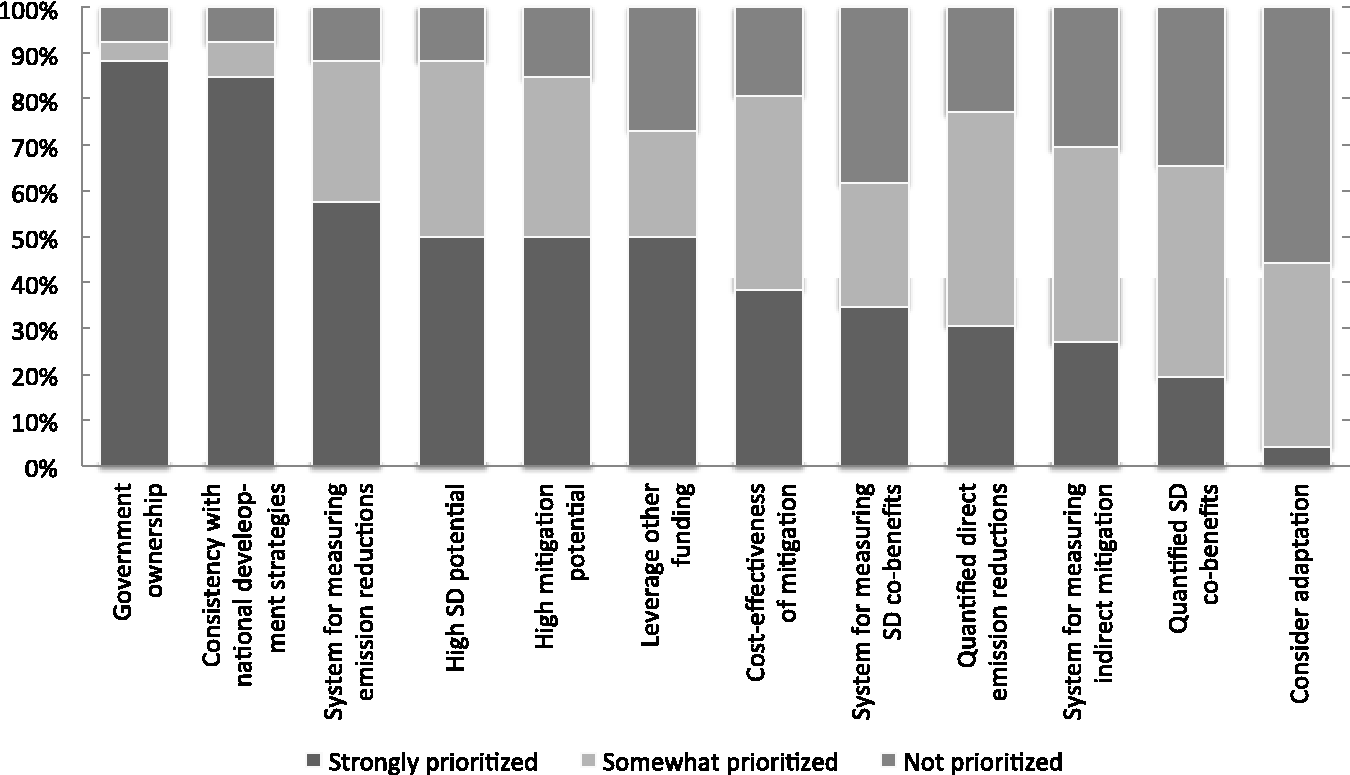
Government ownership and consistency with national development plans are imperative for the respondents. The significance of these criteria for the long-term effectiveness of support is also widely established in development cooperation, explaining the high priority attached to these criteria among support providers (Booth, 2012).
The third most important criterion is that the NAMA should incorporate a system for measuring emission reductions ex post. NAMA proposals also should demonstrate high emission reduction potential and a high potential for contributing to SD. The relative weight attached to the ex ante quantification of and need for measuring contributions to SD, however, is relatively low.
A minority of NAMAs in the database includes ex ante estimates of direct emission reductions as a means to demonstrate high mitigation potential (Figure 3). Of these, only 26% (i.e., 10 proposals) also indicate that the NAMA includes or intends to develop measuring, reporting, and verifying (MRV) indicators relating to achieved emission reductions.
Nationally Appropriate Mitigation Action proposals' specification of estimated emission reductions and indication of a measuring, reporting, and verifying system. Source: Nationally Appropriate Mitigation Action Database (n = 127).
The NAMA Registry displays a similar pattern. Ten of 41 submissions specify that the NAMA should include or develop MRV indicators for emission reductions. Six of these also make ex ante estimates of emission reductions. At the same time, 21 specify that the NAMA should consider or develop MRV indicators for SD. This pattern should be understood in light of the fact that 28 NAMAs in the Registry are seeking support for implementation, indicating that they should be fairly far advanced, whereas 13 are seeking support for preparation.
Prioritization Between Sectors, Time frames, and Types of NAMAs
Sector focus
The surveyed support providers generally do not want to prioritize particular sectors for NAMAs. Many respondents comment that this is because proposals for support are selected based on their mitigation potential rather than their sectoral focus (Figure 4).
Sector focus: Support providers' preferences and Nationally Appropriate Mitigation Action proposals. Note. NAMA = Nationally Appropriate Mitigation Action; UNFCCC = UN Framework Convention on Climate Change.
Among the surveyed support providers' preferences, the forestry and agriculture sectors stand out, as they have lower priority than other sectors. NAMA developers mirror these preferences, offering very few proposals in either the forestry or agriculture sectors to date (Figure 4). However, it should be noted that African countries have emphasized agriculture as a key sector for NAMAs (UNFCCC, 2013b, p. 4). In relation to forestry, developing countries' information submissions to the UNFCCC Secretariat regarding NAMAs indicate overlaps between NAMAs and REDD + projects. Ten of 55 countries that have submitted such information foresee undertaking NAMAs in the forestry sector through REDD+. Most of these are African countries (UNFCCC, 2013b).
Types of NAMAs
The surveyed support providers prioritize actions with high mitigation impacts, also indicating that sector-wide NAMAs as well as policies and programmes are much more likely to attract funding than project NAMAs due to the former's potential to achieve transformational change.
Among support providers, policies/programmes rank higher than project NAMAs (Figure 5), although these are not mutually exclusive. Currently, of all NAMAs being proposed and classified as project, policy/programme, or strategy/plan NAMAs in the NAMA database (n = 98), only 26.5% are project NAMAs. Most of these are also registered in the UNFCCC Registry; 73.5% of all classified NAMAs in the database are in the sphere of policies/programmes or strategies/plans (see Figure 5), meaning that NAMA proposals in the database align quite well with support providers' preferences. The UNFCCC Registry displays a different pattern, with a strong presence of project NAMAs. As shown in Figure 4, in both the Registry and database, the energy sector is overrepresented by a large proportion of energy NAMAs constituting projects. This situation should be seen in light of (a) the preferences for NAMA time frames and (b) the large number of Registry NAMAs from a small number of countries.
Comparison of preferences for types of Nationally Appropriate Mitigation Actions. Note. NAMA = Nationally Appropriate Mitigation Action; UNFCCC = UN Framework Convention on Climate Change.
Time frames of NAMAs
Support providers do not want to be locked into projects that they have to support for long periods (>10 years). As stated by one respondent: “Support cannot be institutional, too long term.” The respondents would like to see international support ending in five or fewer years (Figure 6). This is not to say that support providers, per se, favor short-term (<5 years) projects with direct impacts on emission reductions; international support is expected to help leverage private or domestic public support, thereby ensuring long-term sustainability. Providing a clear strategy for long-term finance, involving private or domestic support, in a NAMA proposal is a key to attracting funding (see Figure 2).
Comparison of preferences for Nationally Appropriate Mitigation Action time frames. Note. NAMA = Nationally Appropriate Mitigation Action; UNFCCC = UN Framework Convention on Climate Change.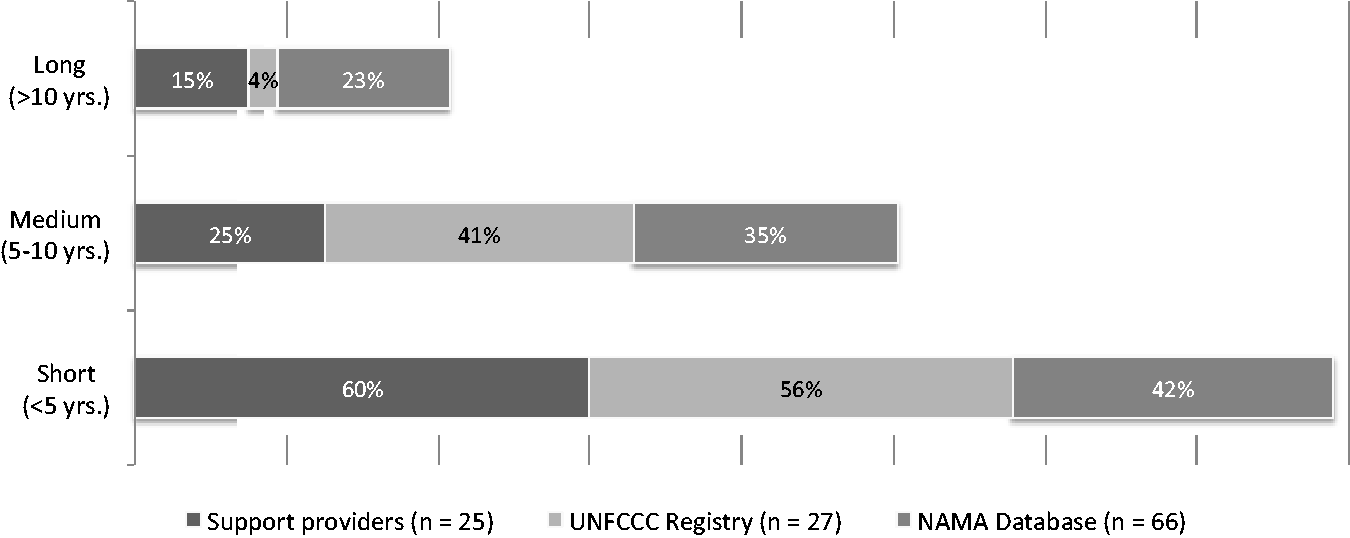
In relation to time frames, the design of NAMAs in the UNFCCC Registry mirrors support providers' preferences very well. Of the NAMA proposals specifying a time frame (68%), most estimate completion is less than 5 years. When also considering types of NAMAs and sector distribution, the picture that emerges is one of a UNFCCC Registry that is biased toward short-term project NAMAs in the energy sector. One of three categorized NAMAs in the Registry (n = 27) seeking international support is a project NAMA in the energy sector. All but one of these are seeking support over a short time, with one not specifying the support period.
So far, more NAMAs with shorter time frames have found their way into the Registry, whereas longer term NAMAs are more common outside the Registry, as reflected in the NAMA database. If we exclude the NAMAs registered in the UNFCCC Registry from the database, this pattern becomes very obvious: Of these NAMAs, which also specify time frames (n = 37), 29.7% are short term, 35.1% medium term, and 35.1% long term; the same proportions for the Registry NAMAs are 55.6%, 40.7%, and 3.7%, respectively (see Figure 6).
These numbers must be seen in light of the fact that of all project NAMAs in the Registry (n = 14), 79% belong to just two countries, that is, Jordan and Serbia. In addition, all short-term project NAMAs in the energy sector (one third of all project NAMAs in the Registry) belong to either Serbia or Jordan. This indicates that the Registry has been operational for only a relatively short time and that short-term project NAMAs in the energy sector are relatively quick to prepare.
Policy intervention types
The open definition of NAMAs also allows great flexibility regarding the type of interventions that may be supported. In theory, support can be provided to any activities with the ultimate aim of achieving “nationally appropriate mitigation actions.” However, Figure 7 reports that the intervention types ranking highest are “other financial incentive schemes” followed by “regulation and standards” as well as “capacity building and institutional readiness.” This also reflects the current policy landscape, where financial incentives are the most common policy instruments.
1
Support providers' prioritization of policy instruments/activities for Nationally Appropriate Mitigation Actions (n = 26).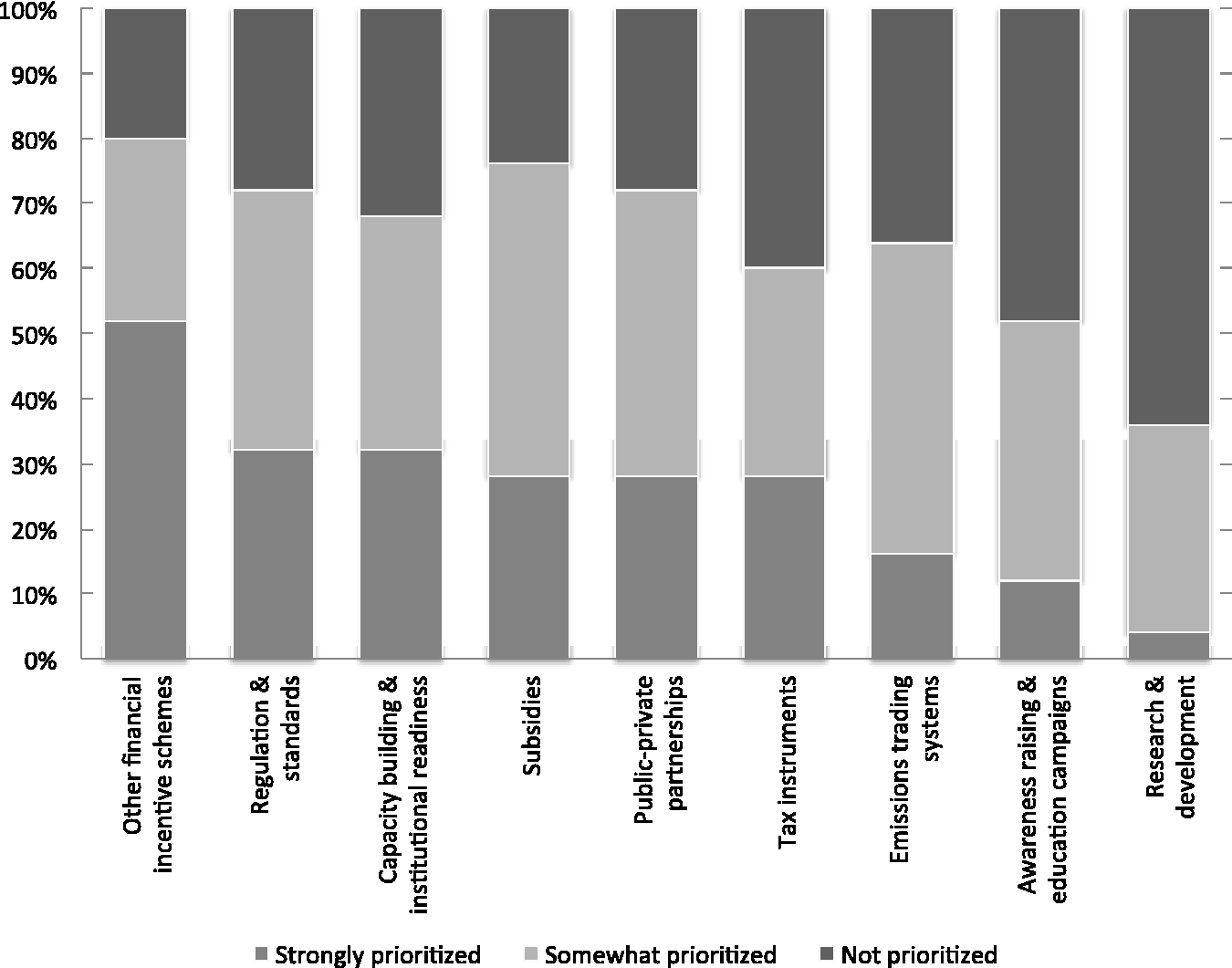
The two intervention types with the lowest priority are “awareness raising and education campaigns” and “research and development.” The low prioritization of these two types, however, does not reflect the current policy landscape, which clearly emphasizes their importance for successful mitigation. 2
Discussion
Objectives of NAMAs: Emission Reductions and Sustainable Development
Support providers' and NAMA developers' prioritization of NAMA objectives mirrors the understanding of the CDM objectives among developed and developing countries, that is, from the perspective of the industrialized countries, the CDM provides a means to engage developing countries in the control of GHG emissions, while from the perspective of the developing countries, the CDM provides an avenue for the financing of “sustainable development.” (Aldy & Stavins, 2012, p. 15)
The suggested mismatch between support providers' and NAMA developers' preferences regarding NAMAs may pose a challenge for turning NAMAs into an effective instrument. When asked to prioritize various NAMA objectives, support providers clearly singled out mitigation as the highest priority, mirrored in the preferences reported in Figure 2. The starting point for many NAMA developers is instead SD co-benefits; this does not exclude mitigation benefits, however, they may be seen as secondary. Mitigation is simply not relevant in the eyes of many developing country stakeholders and is difficult to sell politically (Tyler et al., 2013).
Measuring, Reporting, and Verifying Impacts of NAMAs
Most of the surveyed support providers also acknowledge that an MRV system for the impacts of NAMAs adds complexity and some associated transaction costs to a NAMA. However, they do not view the added complexity as overly costly and competing with mitigation for funding. On the contrary, MRV is seen as ensuring the effectiveness of a NAMA and providing a mechanism that supports donors' strategic decision making. When other objectives such as economic development have a higher priority than emission reductions in designing a NAMA, which is the reality in most developing countries, the complexity and additional transaction costs associated with emission reduction MRV are much more difficult to ignore. In the absence of long-term support to sustain an MRV system, the expectations of such a system have to match those of MRV systems of domestically supported NAMAs, unless countries or private actors agree to support additional MRV requirements in the longer term. Conversely, one could argue that developing countries might be more willing to develop emission-related monitoring systems in return for additional funding, a statement that is supported by the large number of CDM projects that have been developed despite their very stringent monitoring requirements.
As NAMAs are still a relatively recent concept for practitioners working on mitigation actions in developing countries, it is difficult to draw firm conclusions from this pattern. It cannot be concluded that NAMA developers are reluctant to include information on systems for MRV of emission reductions, but it can be noted that they have so far not done so to any great extent. This could be the case partly because funders have not yet required such information or partly because very few projects have received funds for implementation. In any case, measuring direct emission reductions can be a rather technical undertaking that requires capacity building in developing countries (Hinostroza et al., 2012), which may also to some extent explain the lack of MRV information on emissions.
Further reconciliation between NAMA objectives may be needed to facilitate the matching of NAMA design and support. In this context, finding an acceptable compromise between the various views of whether, and possibly how, emission reductions should be measured constitutes a potential challenge. However, it is too early to provide a more definitive answer. The monitoring frameworks of existing climate funds, however, provide some interesting hints. Funds often require monitoring of direct emission reductions for selected types of projects. Under the Global Environmental Fund, for example, projects with the objective to increase the share of renewables are required to monitor their greenhouse gas (GHG) reductions, whereas projects with the objective of supporting enabling activities are not (Global Environment Facility [GEF], 2013). Similar observations can be made of the monitoring systems for bilateral funds. The German International Climate Initiative allows certain projects to measure contributions to capacity building and institutional or policy development using proxies for emission reductions (International Climate Initiative, 2012). With respect to NAMAs, the NAMA Facility and the Green Climate Fund (GCF) are still setting up their monitoring frameworks, and it remains to be seen whether and for what type of mitigation actions they will require direct emission monitoring. The flexibility of monitoring approaches of existing climate change-related funds already at least allows some flexibility to accommodate the various needs of governments.
Prioritization Between Sectors, Time frames, and Types of NAMAs
Sector focus: high priorities for energy supply, buildings, industry, transport, and waste
In contrast to the one-sided pattern for sector distribution in CDM, which has overwhelmingly focused on the energy supply sector (71% of all projects, see Watts, Albornoz, & Watson, 2015), NAMA support providers acknowledge the need to also focus on energy demand sectors such as transport, industry, and buildings. The fact that NAMA proposals still overemphasize the energy supply sector (see Figure 4) may be partially explained by the current phase in NAMA development, that is, a time of transition from CDM to NAMAs utilizing all the know-how and capacity gained from the CDM and partially because energy supply for most countries is the key emission driver which can also be relatively easily addressed through government policy. While the demand for CDM has collapsed (see UNFCCC, 2015b), some short-term projects in the energy sector that were originally being intended for CDM have now been redesigned as NAMAs. The NAMA database, however, indicates that NAMAs are increasingly being put forward also in other sectors. In general, the preference among support providers to prioritize a broad range of sectors over any particular sector therefore seems to align with the trend among NAMA developers.
Sector focus: low priorities for the forestry and agriculture
Two sectors are exempted from this trend: The surveyed support providers do not prioritize the forestry and agriculture sectors. On an aggregated level, few NAMAs are proposed in these sectors. Yet, it should be noted that the African group—the largest UN regional group with 54 African member countries—strongly emphasized agriculture and agroforestry as key focus for NAMAs on the African continent (UNFCCC, 2013b).
Many of the support providers comment that they think of forest-related actions as better dealt with through specialized methodologies developed under UNFCCC agenda items on reducing emission from deforestation and forest degradation in developing countries, and the role of conservation, sustainable management of forests and enhancement of forest carbon stocks in developing countries (REDD+). The risk of reducing the relative share of African countries' access to support for mitigation, if NAMA support does not focus on forestry, is therefore potentially at least somewhat eased by these countries' ability to access support through REDD+. For agriculture, no such alternative support instrument is being developed.
Risk of leakage is one factor that may complicate forestry as well as agriculture NAMAs from the perspective of support providers, given that they strongly emphasize achieving and measuring emission reductions (Henders & Ostwald, 2012). It should be noted that several interesting agriculture NAMA developments, for example, in coffee production (e.g., Costa Rica) and agricultural waste-to-energy processing (e.g., Peru), do not suffer from leakage problems. Strong preferences among support providers for supporting NAMAs in sectors other than forestry and agriculture, therefore, do not necessarily exclude the successful matching of a forestry/agriculture NAMA. In addition, the GCF intends to support both NAMAs and REDD + projects, among other climate-related actions (UNFCCC, 2012b), and the GEF explicitly includes NAMAs as eligible for funding under its sixth period of replenishment of resources, July 2014 to June 2018 (GEF, 2014). There is, however, a latent risk that mismatches between support providers' and African NAMA developers' preferences for NAMAs will produce a structural bias that erodes African countries' relative access to NAMA support.
Types of NAMAs
NAMAs, ideally, should be aligned with national development strategies or plans. LEDS can serve that purpose, that is, be designed as an instrument to coordinate and prioritize different mitigation actions. Both support providers and NAMAs contained in the NAMA database prioritize policies and programmes for NAMAs. Alignment of preferences concerning types of NAMAs therefore seems fairly high and can be aligned with national development strategies or plans. The Registry, however, mainly includes project NAMAs, particularly in the energy supply sector.
The resemblance of project NAMAs in the Registry to CDM projects suggests that stronger consideration be given to whether project NAMAs, in the international policy framework, should be distinguished from other NAMAs.
In the interest of more efficient and streamlined NAMA development, project NAMAs may benefit from a defined subcategory of NAMAs that explicitly draws on already-established methodologies. As NAMAs do not generate credits, less stringent versions of the CDM methodologies (e.g., without the additionality requirement; Hinostroza et al., 2012), or other established monitoring methodologies such as the GHG protocol or the IPCC guidelines, 3 can be used, with lower associated transaction costs. Project NAMAs in the energy sector could especially benefit from established know-how and institutional capacity generated under the CDM, where considerable experience has been amassed (see Figure 4). Some countries are also attempting to implement NAMAs through the CDM (UNFCCC, 2013b). This can create problems of double counting of emission reductions in both developed countries, through CERs, and in developing countries, through their reported mitigation actions. It emphasizes the need for clarification of the relation of CDM and NAMAs in the international policy framework.
Time frames and transformational change
Conquering climate change requires substantial changes to our ways of living. Such transformational changes have historically proved to take a long time (Geels, 2002). The current situation has been described as a “carbon lock-in” (Unruh, 2000) into fossil fuel-based energy systems. Overcoming such lock-in will require a combination of technical but also institutional changes. This need to go beyond incremental change and the need to build capacities require investment to be made into more long-term endeavors such as research and development or capacity building, all of which will likely yield limited emission reductions in the short term.
As reported earlier, both support providers and NAMA developers primarily focus on short time periods for NAMAs (<5 years). The fact that support providers do not want to institutionalize their support does not mean that they are opposed to their support having long-term effects. The problem when it comes to spurring transformational change is that combining short-term funding with the measurement of emission reductions, as desired by support providers, will limit the kinds of NAMAs that can be expected. Spurring transformational change, on the contrary, often requires long time frames and investments in actions that have a high potential for indirect emission reductions such as research and development, awareness raising, and institutional design and capacity building. For such actions, it is often difficult to measure direct emission reductions in the short time frame.
This leads to a potential gap between the transformational change intentions of NAMAs and the emerging practice, particularly as reflected in the NAMA Registry. The NAMA database is much more balanced, indicating that we may witness an increase in NAMAs with longer time frames in the near future that may also find their way into the Registry. Striking a balance between MRV requirements and long-term transformation can become a key challenge for the development of effective NAMAs.
Policy intervention types and transformational change
The existing literature on innovation systems emphasizes the systemic nature of technological change favoring low-carbon development (Hekkert, Suurs, Negro, Kuhlmann, & Smits, 2007) and calls for systemic instruments that address all parts of an innovation system instead of focusing solely on certain aspects, such as financial elements (Smith, 2000). The danger of systemic failure (Wieczorek & Hekkert, 2012) implies that even though some (e.g., financial) instruments are in place for a particular mitigation option, other barriers might hinder or lessen the success of these policies.
As already mentioned, NAMAs are in an early stage of development, and very limited evidence indicates what types of proposals will actually be supported. Focusing too exclusively on financial instruments, as implied by the respondents, might not lead to the desired emission reduction if such instruments are not part of a comprehensive policy package. If NAMAs emphasize providing financial incentives, support providers should also, during their implementation, ensure that other barriers, such as the lack of awareness or research and development, are addressed by other means.
Can the International Community Learn From NAMA Practice?
In this context, it is imperative to recall the limitations of the information on NAMAs provided in the NAMA Registry and database, which do not capture the whole spectrum of NAMA activities. For example, a recent informal survey by the UNFCCC Secretariat identified approximately 150 NAMAs (Fridahl, 2014, observation notes). Clearly, not all of these are in the Registry or the database. Greater transparency and willingness on the part of NAMA developers to share their proposals would increase the opportunities to shorten a long learning curve. A first step to increase transparency would be to create greater incentives for publishing this information in the Registry (van Tilburg et al., 2014).
That said, the information we have on practical experience with NAMAs suggests that clearer divisions between several of the instruments and concepts that arise from the UNFCCC negotiations could generate efficiency gains by removing problems with duplication of work on methodologies (see Streck, 2012). NAMAs could target sectors not covered by REDD+, and as such, the two concepts could be kept distinct. For forestry and agriculture cross-sectoral activities, which are relatively common, a NAMA component could be added to a REDD+ activity or vice versa. At a minimum, REDD+ should be understood as a specific type of NAMA with separate flows of support and particular methodologies. Such a scheme is also reflected in the GCF, which presents REDD+ and NAMAs as parallel mitigation mechanisms in developing countries (UNFCCC, 2013b).
A final observation on lessons for the international from NAMA practice relates to a clearer differentiation of various related concepts. Strategy/plan NAMAs are not highly prioritized by support providers or NAMA developers. In fact, this NAMA type is hardly seen in practice. As pointed out earlier, project NAMAs may also become relatively fewer in the future, their function being picked up by other finance mechanisms or being more clearly distinguished from that of policy and programme NAMAs. In light of the very strong requirement among support providers that NAMAs should be aligned with national development strategies, it could be advisable to avoid strategy/plan NAMAs and instead focus on policy/programme NAMAs located in the context of LEDS. In 2010, the UNFCCC agreed to encourage developing country parties to develop LEDS (UNFCCC, 2011: §65). LEDS are frameworks under which NAMAs should ideally be placed, so the two concepts are very complementary. This is not to suggest that LEDS should be a precondition for NAMAs: As acknowledged by Lötken, Dransfeld and Wehner (2013), NAMAs are conceivable without LEDS. However, as this article demonstrates, NAMAs become much more attractive in the eyes of support providers if they are constructively aligned with LEDS.
As an outcome of COP19 in Warsaw, countries were invited to “initiate or intensify domestic preparations for their intended nationally determined contributions [INDCs]” (UNFCCC, 2014a, p. 4). This equally applies to developed and developing countries and could therefore lead to overlaps with NAMAs. The Cancún Agreement (UNFCCC, 2011: 1/CP.16) calls for NAMAs to seek a deviation in emissions relative to what would otherwise be business as usual emissions by 2020. However, several of the NAMAs studied here span periods beyond 2020. In combination with the momentum gained on NAMAs, this indicates that the life span of NAMAs stretches beyond 2020.
As INDCs are a very new concept that at the time of writing this article (i.e., after COP20 in Lima in 2014) has not been defined further at the international level, it remains to be seen how countries and the international community interpret the role of NAMAs in relation to INDCs. The COP20 outcome did not reach conclusion on the scope or information requirements for INDCs, to be submitted during the first quarter of 2015 (UNFCCC, 2014b). Furthermore, as only one country has submitted an INDC at the time of writing (Switzerland), any discussion on how different countries define the overlaps between NAMAs and INDCs would be speculative. Drawing on the overlap of NAMAs with other concepts described earlier, one can only conclude that in moving forward, both concepts should be defined carefully to ensure that they mutually support each other.
Finally, NAMAs that have the form of GHG intensity reduction targets or deviation from projected business as usual emissions (see UNFCCC, 2013b) could indeed be redefined as INDCs for the period beyond 2020, allowing for a clear distinction from policy- or programme-based NAMAs as a way to implement INDCs.
Conclusions
To date, knowledge and experience of the extent to which NAMA design and support are aligned is limited. The emergence of a substantial number of NAMA proposals as well as international support explicitly targeting NAMAs now enables a preliminary attempt to consider such matching. However, a lack of transparency and poor information access impede a more authoritative assessment. This study provides a first indication of potential (mis-) alignments in support providers' and NAMA developers' preferences for NAMAs. The discussed consequences of these (mis-) alignments may or may not materialize in the matching of design and support of NAMAs in the future. Yet, they do indicate areas where special considerations may become necessary to make NAMAs more effective in contributing to the objectives of the UNFCCC.
In the eyes of the support providers surveyed here, a NAMA should ideally have government backing and be aligned with national development strategies. It should furthermore display great potential for emission reductions and SD and incorporate a system for monitoring emission reductions. Given the loose international definition of NAMAs, such preferences might lead support providers' to drive NAMA development in ways undesirable to host countries. Such an influence of support providers on the design of NAMAs would at least turn the notion of national appropriateness upside down. Mismatches between NAMA proposals and support providers' preferences noted in the data sample analyzed here may give rise to distrust. If support providers can cherry pick NAMAs for support, we may see an emerging structural bias. Our research indicates that individual funders seek to support actions across all sectors, with the potential exception of the agriculture and forestry sectors. Currently, few agriculture and forestry NAMAs are put forward globally speaking, yet countries on the African continent propose most mitigation action in precisely these sectors. The lack of interest in forestry can be compensated for by support to REDD + activities, but mitigation actions in the agriculture sector may become underfinanced indicating that a support pattern that disfavors African countries may emerge. If such a structural bias emerges, it will show similarities with the structural bias of the CDM (De Lopez, Tin, Iyadomi, Santos, & McIntosh, 2009; UNFCCC, 2015b).
The operating entities under the UNFCCC's financial mechanism could be guided by the UNFCCC's COP to find niches in this landscape. The GCF and the GEF could play a key role by supporting NAMAs that other support channels potentially will avoid. In particular, NAMAs with great potential for transformational change, which often require long-term support and may sometimes not achieve short-term emissions reductions that can be monitored, run a high risk of being underfunded. Such NAMAs with high short-term risk but also high long-term potential could fall outside the scope of support providers' preferences but may prove hugely significant for reaching the Conventions' long-term objective. Also, special funding windows for actions that have particularly high SD co-benefits, which is often the case in, for example, the agriculture sector, could be prioritized by the GCF to offset potential biases in NAMA support identified in this article.
This article demonstrates that, to the extent that NAMA practice can inform the international negotiations, NAMAs could (a) be pursued in sectors not covered by REDD+, (b) focus mainly on policies and programmes, (c) reserve projects for countries with low capabilities, drawing on a less strict application of CDM methodology that utilizes the extensive know-how amassed since the early 2000 while avoiding the complications involved in the generation of credits, and (d) allow LEDS to pick up strategy/plan NAMAs or treat them under the INDCs discussion. For the period beyond 2020, policy, programme, and project NAMAs can continue to play an important role to advance mitigation but need to be carefully designed to reinforce INDCs. Policy makers should provide clarity on their distinct roles beyond 2020.
These four suggestions would reflect similarities between support providers' and NAMA developers' preferences for NAMAs. Developing LEDS would also allow NAMAs to be placed in the context of national development strategies, which, according to support providers, are by far the strongest eligibility criterion for supporting a NAMA.
Further research on the matching of design and support of NAMAs, drawing from a growing body of evidence, is necessary to provide more authoritative assessments and corroborate the indicative findings of this study. This study can only provide a departure point for deepening the knowledge of potential (mis-) alignments in support providers' and NAMA developers' preferences for NAMAs.