




Abstract
The article documents the case of South Africa’s struggle to reconcile racially based poverty, a legacy of apartheid, and attempts to conserve the country’s unique and important biodiversity. We present an analysis of KwaDapha, a small village in the iSimangaliso Wetland Park in northern KwaZulu-Natal, a protected area and UNESCO World Heritage Site, in terms of the capability approach. Despite South Africa’s strong human rights orientation, we show that the freedom, or agency, of local users and inhabitants to achieve doings and beings according to their own values and norms, is constrained by state-led conservation management at KwaDapha. We suggest that the intellectual cause of this failure might lie in the conflation of two distinct concepts: human rights and the capability approach, in the iSimangaliso Wetland Park’s predominantly market-based operationalization of sustainable development.
The article documents the case of South Africa’s struggle to reconcile racially based poverty, a legacy of apartheid, and attempts to conserve the country’s unique and important biodiversity. We present an analysis of KwaDapha, a small village in the iSimangaliso Wetland Park (IWP) in northern KwaZulu-Natal, a protected area and UNESCO World Heritage Site, in terms of the capability approach.
There is a long history of conflicts between efforts to maintain biodiversity through protected areas, and those to reduce poverty (Adams et al., 2004; Brockington, Igoe, & Schmidt-Soltau, 2006; Büscher, Sullivan, Neves, Igoe, & Brockington, 2012). Protected areas, conventionally understood as those areas with a minimal human presence and a limited history of alteration (Miller, Minteer, & Malan, 2011) can lead to the foreclosure of future land-use options, with potentially significant economic opportunity costs, and substantial negative effects on local people (Adams et al., 2004). This is particularly problematic in a country such as South Africa, shaped by structural poverty from past racial inequalities, mounting environmental challenges, and the declining contribution of agriculture to the livelihood strategies of most rural people.
Yet, the IWP strives to be a new model for protected area development and management, with a market-based and state-led policy framework that aims to deliver “Benefits beyond Boundaries” (iSimangaliso Wetland Park Authority [IWPA], 2008, p. 11)—promoting the view that protected areas can provide a synergy between conservation and sustainable development. This approach to conservation emphasizes the role of protected areas in broader (and combined) conservation and development agendas and efforts. Accordingly, the IWPA—a national government authority—has been careful to combine its effort at environmental conservation with improving the conditions of the people who have traditionally inhabited the park.
Nevertheless, since the proclamation of the IWP in 2000, there have been conflicts over conservation space between local people and the IWPA—at various locations and at various times. People at KwaDapha complain that the IWPA has developed its own plans for the area, in isolation of their voices. Conflicts over fencing have led to local people ignoring rules for access, cutting fences, and even burning down gates—illustrating local concerns with delimited access to natural resources inside the park (Buchanan, 2011; Hansen, Ramasar, & Buchanan, 2014). At KwaDapha and elsewhere in the Coastal Forest Reserve section of the IWP, people engaged in unauthorized tourism development have been faced with both civil and criminal court action taken by the IWPA (Hansen, 2014). Looking into these conflicts, we explore the outcomes of market-based (but state-led) integrated conservation and development, in terms of the capability approach.
There is an impetus, on the national level, for the redress of apartheid-era injustices—and the Bill of Rights of the Constitution of South Africa (Republic of South Africa [RSA], 1996) has a strong human rights foundation, including both first-generation traditional political and civil and second-generation social and cultural rights. Yet, despite South Africa’s strong human rights orientation, we show that the capabilities of local users and inhabitants to achieve doings and beings according to their own values and norms are constrained by conservation management at KwaDapha. Although the ruling African National Congress government has been very much aware of the imperative of improving the conditions of the most vulnerable sections of the population, the capability approach does not feature explicitly in South Africa’s recent National Development Plan (RSA, 2012). But if, as Martha Nussbaum and others propose, there is a bridge between human rights and the capability approach (Nussbaum, 2011; Vizard, 2005)—then surely if the IWPA supports human rights, capabilities should be supported too. We suggest that the intellectual cause of this failure might lie in the conflation of two distinct concepts: human rights and the capability approach, in the IWP’s predominantly market-based operationalization of sustainable development.
In the next section, we provide an overview of the debate over the relationship between human rights and the capability approach. This is followed by our theoretical framing and concepts: human development and the capability approach—and the application of the capability approach in our analysis and integrated conservation and development. This is followed by an overview of the case, and fieldwork and methods. We then present our findings, according to our application of the capability approach. This is followed by our discussion and conclusions.
Human Rights and the Capability Approach: A Scholarly Bridge?
The human development research agenda has deepened and expanded human rights discourse in the disciplines of ethics and economics. The central argument is that certain human rights can be seen as entitlements to certain capabilities. Both Sen and Nussbaum have addressed the relationship between human rights and the capability approach (Nussbaum, 2011; Sen, 2004, 2005). Nussbaum (2011) has argued that capabilities can supplement the language of rights in clarifying the basic concept of human rights, by emphasizing the material and social aspects of all rights and the need for government action to protect and secure all rights. Human rights can also supplement the language of capabilities, by making clear that the idea of capabilities is not an optional entitlement but an urgent demand that should not be ignored nor compromised in pursuit of other objectives, such as the expansion of aggregate wealth. Nussbaum (2011) stresses that the idea of rights has the capacity to mobilize political action, as human rights have gained support and endorsement the world over.
But Sen is very clear that neither capability approach nor human rights should be wholly subsumed within the other, and while it is clear that there are certain human rights that cannot be expressed in terms of capabilities, for example, process rights such as the right to a fair trial, the converse situation is not so clear. For Sen, human rights ought not to be “incarcerated” in legislation and the juridical process but also pursued through other means, for example, monitoring, agitation, and public recognition (Sen, 2004), a kind of social movement. In fact, he argues against a rights-based approach to development centering on legislation (Sen, 2012). This echoes what famous human rights scholar and critic David Kennedy sees as a failing in human rights: That when justice is seen as a relationship to the state rather than a condition in society, our attention is distracted from background norms, and economic conditions that often do far more damage (Kennedy, 2012).
The protection of human rights in South Africa stands upon the Bill of Rights in the Constitution 1 (RSA, 1996). The Bill of Rights contains all categories of human rights that are ordinarily included in most international human rights instruments—including first-generation traditional civil and political rights, as well as second- and third-generation social, economic, and cultural rights (Mubangizi, 2014). Social, economic, and cultural rights include the right to a clean environment, education, health care, housing, and social security (van der Bank & van der Bank, 2014). Although the realization of socioeconomic rights largely depends on state ability and willingness (Sarkin, 1999)—it being the state’s only to take reasonable legislative and other measures to progressively realize such rights (van der Bank & van der Bank, 2014), the South African Constitutional Court has upheld claims for the violation of socioeconomic rights in a series of landmark judgements (see Mubangizi, 2014; van der Bank & van der Bank, 2014; Vizard, 2005). These establish that resource constraints do not relieve the government of the obligation to fulfil socioeconomic rights by taking positive measures to eliminate or reduce the large areas of severe deprivation that afflict South Africa. But the court has also sought to delimit the nature and scope of the duties that flow from this obligation, reasoning that the State’s responsibilities under these articles can be discharged through the adoption of policies and programmes that aim at the achievement of human rights over time, rather than their immediate or complete fulfillment (Vizard, 2005). The violation of obligations of this type involves the absence and inadequacy of policies and programmes, rather than the nonfulfilment per se (Sen, 1982, 2000).
Importantly, South Africa has adopted the notion of ecologically sustainable development, not only as a human right entrenched in its Constitution but also as one of its major policy objectives 3 (Hattingh & Attfield, 2002). There are major practical, conceptual, and ethical stumbling blocks to implementing the policy goal of ecologically sustainable development, especially apparent conflicts with other pressing needs, such as the alleviation of poverty (van der Bank & van der Bank, 2014). But ecologically sustainable development is arguably a necessary policy objective in South Africa, if in that ideal is included notions of moving away from “development” that is destructive of life-sustaining ecological systems, as well as contributing to social justice, both intra- and intergenerational (van der Bank & van der Bank, 2014).
Human Development and the Capability Approach
Human development is a theoretical approach in development studies, which follows Amartya Sen’s earlier writings on poverty and famine, where he questions the common practice of economists (and developmentalists) to take monetary income as an indicator of development (Faran, 2010). Instead, he proposes human “functionings,” as opposed to fulfilling basic needs, as the foundational basis of a “good” life 2 (Sen, 1999, p. 75). Functionings are the various things a person may value doing or being. These include such factors as having good health, having enough food to eat, being able to participate in the political process, and having an education (Cruddas & Rutherford, 2009). Capabilities are a combination of functionings, which can be achieved by individuals. The approach provides a way to address socioeconomic development, which is based on the idea that social arrangements should aim to expand people’s capabilities: their freedom to promote or achieve valuable beings and doings (Alkire, 2005a, 2005b). We find Sen’s approach to the expansion of human capabilities both theoretically rigorous and practically operational, when dealing with socioeconomic development measures and the problem of poverty. Moreover, Sen’s approach has the merit of being expandable to embrace the environmental aspect of sustainable development, without losing sight of the human dimension.
The National Development Plan (released in 2012) aims for development that systematically includes the socially and economically excluded, where people are active champions of their own development, and where government works effectively to develop people’s capabilities to lead the lives that they desire (RSA, 2012). Although not directly citing the work of Amartya Sen or his associate Martha Nussbaum, the plan seems to have drawn strongly from Sen in its definitions of development that focus on creating the conditions, opportunities, and capabilities that enable people to lead the lives that they desire (RSA, 2012). The fourth of six pillars that are proposed to eliminate poverty and reduce inequality addresses the need to build the capabilities of both people and the country (Manuel, 2013). For people, capabilities can include adequate nutrition or a functioning transport system to get to a place of work; a college certificate to boost the chances of getting a job or work experience (Manuel, 2013). For the country, capabilities can cover what broadband speed we would require; energy needed to power a growing economy; port capacity to support a diversified economy; or a water supply that meets the needs of households, industry, and agriculture (Manuel, 2013). The plan envisages that building capabilities is a long-term endeavor, stretching over the next decade and beyond (RSA, 2012).
Application of the Capability Approach in Our Analysis
The capability approach argues that people should have the relevant primary assets and instrumental freedoms to achieve their capabilities. We assess primary assets in terms of human assets (health and education), natural assets (entitlements to land and access to resources), and physical assets (access to infrastructure). We assess instrumental freedoms in terms of political freedom (representation and consultation), economic opportunities, and protective security (state-funded grants and job creation). Our application of the capability approach in evaluating integrated conservation and development in the IWP is adapted from Chung (2010; Figure 1).
Application of the capability approach in our analysis.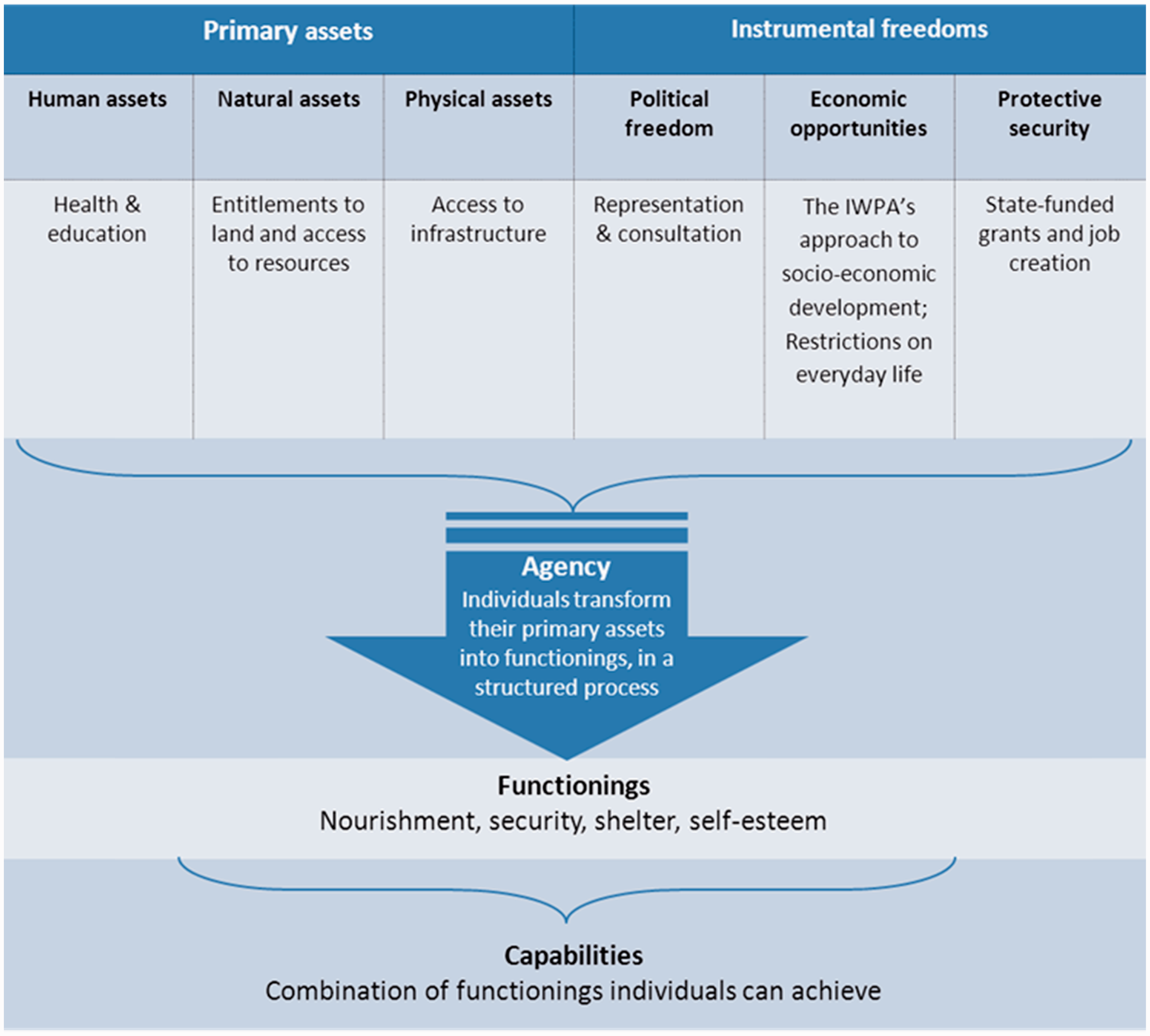
Integrated Conservation and Development
The conservation of nature and economic development, as traditionally imagined, are in tension. Proponents of integrated conservation and development offer a variety of approaches, and it is understandably controversial as to whether and how conservation for development can be regulated and achieved (Igoe & Brockington, 2007). It is this tension between conservation and economic development that is at the heart of the concept of sustainable development (World Commission on Environment and Development [WCED], 1987). Sustainable development has been characterized as consisting of three equally important pillars: the ecological, the social, and the economic (Harris, Timothy, Kevin, & Neva, 2001). According to this elaboration, development is sustainable only if it achieves sustainability in these three areas. However, no approach in sustainable development can claim to have found the recipe for a path that equally satisfies the requirements of the ecosystem and the economic system. Different approaches in sustainable development can accordingly be viewed as different ways of handling this tension, and approaches span a spectrum of critique toward economic growth pundits (Faran, 2010; Hopwood, Mellor, & O’Brien, 2005). Some are highly critical and, for example, promote degrowth in the economy to preserve the natural environment. Other attitudes are uncritical, assuming that, as the economy develops, it reaches a point where it starts to become more efficient in terms of pollution control, to the point that it eventually no longer damages the environment or that the damage is manageable, for example, through reinvestment (Hopwood et al., 2005).
The debate has since moved on from naïve attempts at achieving the utmost in terms of both conservation and development, to discussing the complex trade-offs involved in negotiating between different conservation, poverty alleviation, and other development goals, as well as the ethical orientation of conservation within sustainable development (Adams et al., 2004; Minteer & Miller, 2011). Recently, state-led institutions in South Africa have engaged in efforts to integrate conservation and sustainable development in the context of “free” markets (Büscher & Dressler, 2012). Neoliberal conservation (market-based) efforts are often conceptually geared at the ecological modernization paradigm, which is based on the theory that economic growth can be reconciled with ecological conservation, ideally bringing about so-called win–win situations (Adams et al., 2004; WCED, 1987). The integrated management plan (IMP) for the IWP cites the Thonga Beach Lodge and Mabibi community campsite as prime examples of the development of nature-based tourism partnerships between the private sector and local communities (IWPA, 2008).
Poverty alleviation is a central component of the social aspect of sustainable development. Indeed, the understanding of what can or does improve the material conditions of the worst-off has been a central motivating factor for “development,” a theoretical project in the social sciences that emerged in its own right after the Second World War (Greig, Hulme, & Turner, 2007). As a normative program of practice, in national and international relations, all brands of development take improvement of the lot of the poor, or the alleviation of poverty, as central (Greig et al., 2007). Nevertheless, approaches to how just to improve the lot of the poor vary as much as economic theory itself. Theories and approaches include “trickle-down liberalism” to Marxian “dependency theory” and all and sundry between and beyond.
The Case: The IWP
The IWP in northern KwaZulu-Natal was listed as South Africa’s first UNESCO World Heritage Site in December 1999 and proclaimed under the World Heritage Convention Act (RSA, 2000) in 2000. The IWP effectively consolidated 16 different parcels of previously fragmented land—a patchwork of former proclamations (the earliest going back to 1895), state-owned land, commercial forests, and former military sites—to create an integrated park (Department of Environmental Affairs and Tourism [DEAT], 2009; IWPA, 2008).
The IWP covers more than 330,000 hectares, stretching for 220 kilometers along the Indian Ocean from Kosi Bay, just below the Mozambican border in the north, to Maphelane south of the St Lucia estuary (DEAT, 2009). It encompasses one third of the KwaZulu-Natal coastline and 9% of the entire coastline of South Africa (DEAT, 2009). Its eastern boundary is the Indian Ocean, and its western boundary is irregular, incorporating the entire Kosi, Sibaya, and St Lucia lake systems, as well as the uMkhuze Game Reserve (Figure 2).
Geographical location of the iSimangaliso Wetland Park.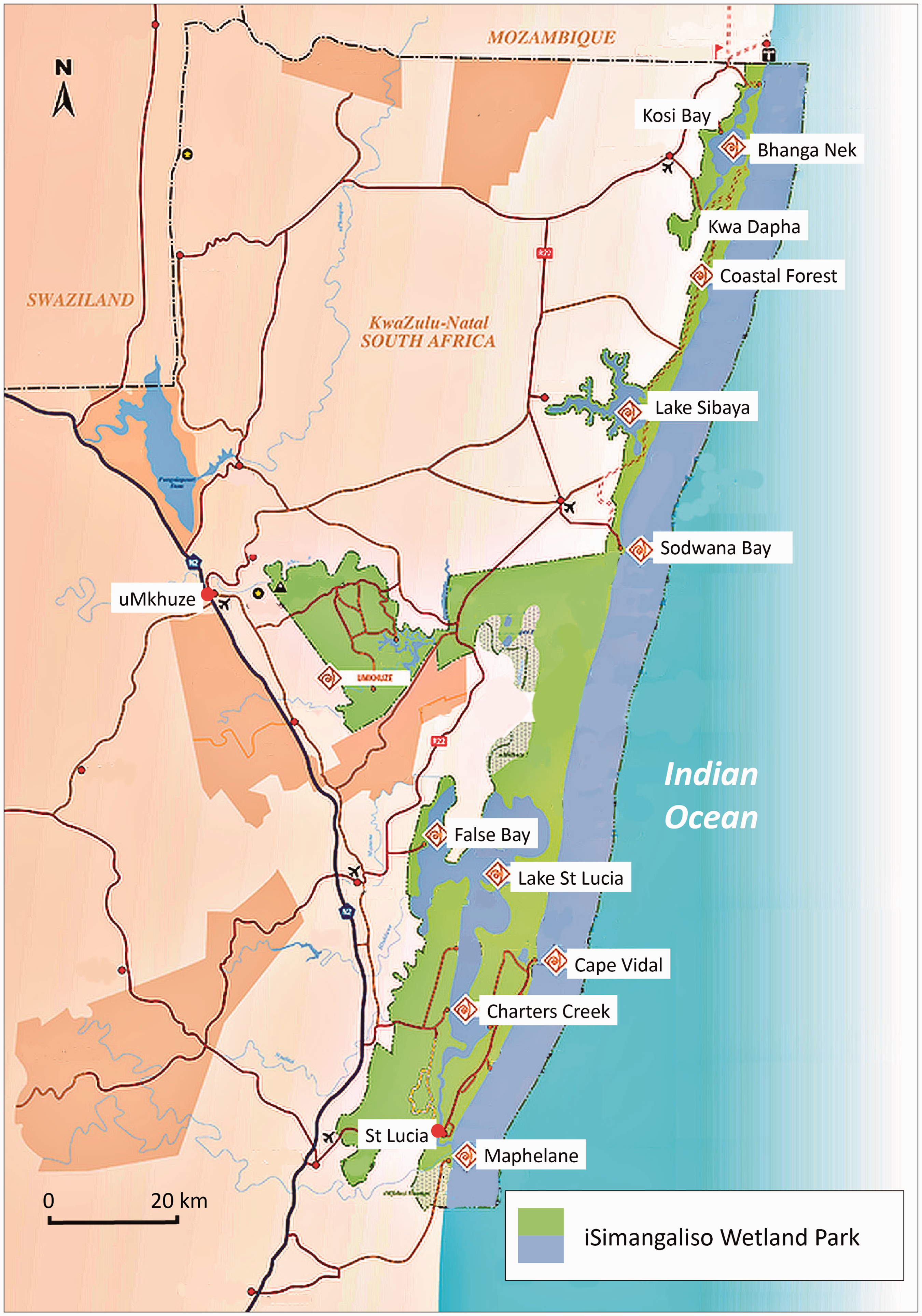
The IWPA was set up to manage the IWP on behalf of the state, also in 2000 (RSA, 2000). The IWPA is a development agency with a conservation mandate (IWPA, 2008). The major objective of the IWPA is to ensure that the development of the IWP is based on ecotourism as the primary land-use option, integrating both the conservation of World Heritage and local socioeconomic development. The authority takes into account the socioeconomic development needs of communities residing within and adjacent to the IWP (IWPA, 2008). The IWPA reports directly to the national Department of Environmental Affairs, from which it receives its core funding (DEAT, 2009). It has a board of nine members, who represent business, traditional councils, land claimants, as well as national, provincial, and local government (DEAT, 2009).
Conservation management in the IWP is based upon the IMP (IWPA, 2008)—a 5-year management plan developed under the World Heritage Convention Act (RSA, 1999), along with the National Environmental Management: Protected Areas Act (RSA, 2003). The plan strives to integrate conservation, tourism development, and the local economic development of communities in and adjacent to the park, primarily through equity partnerships between the private sector and mandatory community partners (IWPA, 2008). An example is the Thonga Beach Lodge and Mabibi community campsite, initiated in 2002. These have been cited as prime examples of the development of nature-based tourism partnerships between the private sector and local communities (Sunde & Isaacs, 2008). Implementing the plan is supposed to deliver “Benefits beyond Boundaries”; promoting the view that protected areas can provide a synergy between conservation and sustainable development, through private ecotourism development (IWPA, 2008, p. 11). This approach emphasizes the role of protected areas in broader conservation and development agendas (Hansen, 2013).
However, the IMP for the park explicitly recognizes that conservation objectives are foremost, the balance of locally beneficial economic development secondary. Or, in other words, there is an emphasis on development for conservation (IWPA, 2008, emphasis added).
As a result of historical forced relocations for conservation, the entire park has been subject to competing land claims, with a total of 14 claims (IWPA, 2010). Three of these were settled in 1998 and 2002, six in 2007, and five remain to be settled in 2013 (IWPA, 2010). In the case of successful land claims, land title has been transferred to claimant communities, with limited user rights under comanagement agreements (IWPA, 2008; Nustad, 2011). The comanagement process includes representatives of IWPA and the land claims committee, usually made up of tribal authority members in a given community. Where claims are still to be settled, the IWPA remain the overall managers on behalf of the state (IWPA, 2008). We follow many authors in acknowledging that the relationship between land reform/rights and that conservation is a complicated one (Fay, 2010; Kepe, Lewison, Ramasra, & Butt, 2011; Nustad, 2011; Sundnes, 2013).
Human rights are mentioned in the constitution of South Africa but not in IWP policy documents; therefore, it could be said that in fact they are confined to national legislation.
Fieldwork and Methods
Local-level research was conducted in KwaDapha, a so-called ‘tribal authority’ area, at Bhanga Nek, Kosi Bay. The area, located within the Coastal Forest Reserve Section of the IWP, comprises four lakes linked by a network of channels. Bhanga Nek lies between the third and biggest lake, kuNhlange, on the west, and the Indian Ocean on the east.
The Kosi Bay Nature Reserve was formally proclaimed in 1987 by the provincial conservation authority, the KwaZulu Bureau of Natural Resources (Kyle, 1995). The migration of local people attracted by the infrastructure in KwaNgwanse since the 1970s, accelerated when rumours of the establishment of nature conservation parks in the area were heard in the early 1980s (Mthethwa, 2002). Those who stayed resisted forced removals as a result of the proclamation of the reserve (Guyot, 2005) but lived under several restrictions from the KwaZulu Bureau of Natural Resources (Mthethwa, 2002). For instance, local people who owned fields around the banks of kuNhlange were not allowed to plough anymore (Mthethwa, 2002).
Since mid-2011, the KwaDapha community has fallen within the uMhlabuyalingana Local Municipality, one of the economically poorest in the country (uMhlabuyalingana Local Municipality, 2011/2012). The community is under the leadership of iNkosi Mabhuda Tembe of the Tembe Tribal Authority, represented by a local iNduna. The area is registered under the Coastal Forest Reserve land claim, which is still to be settled (IWPA, 2010).
The findings and analysis are based on field research undertaken in the IWP in 2011 and 2012. The work relies on qualitatively constructed fieldwork methods, conducted in parallel with a close reading of literature and theory. The early stages of the field study, in 2011, initiated our search for theory, whereas later field visits in 2012, continued to inform, shape, and test the emerging analysis. As such, the study is based on a qualitative approach, where we seek to understand and explain the reasons for and the dynamics, and implications of, the phenomenon under study (Flick, 2009): neoliberal conservation in South Africa assessed (using the capability approach).
From January 2011 to September 2012, we visited the IWP six times. We engaged with communities residing both in and adjacent to the IWP. I also interacted with local tribal authorities and the IWPA at Dredger Harbour, in the town of St Lucia. All interviews, dialogues, and focus group meetings were conducted in confidentiality, and the names of the respondents are withheld by mutual agreement.
We conducted six structured interviews with officials from the IWPA, consisting of standardized open-ended questions, which focused on the governance framework of the IWP. Certain questions were planned to guide the interviews, which were nevertheless designed for openness and flexibility according to the nature of the interviewee and the context of the interview. Each interview lasted between 1 and 2 hours.
During our visits to KwaDapha, we conducted interviews in the form of ongoing dialogues with several key people who were purposively sampled based on my research focus: struggles over conservation space. We asked questions on clusters of issues, rather than predetermined and set questions, and allowed people to point to their own experience of struggle and the impact of conservation management on their everyday lives. One person from KwaDapha proposed that further research be conducted in the community, owing to the constraints imposed on local people as a result of the IWPA’s management practices at KwaDapha. Other people with whom we engaged in repeated dialogue, over many visits to the area, included local people who had been prosecuted for instituting illegal developments in the IWP.
In September and October of 2011, we conducted structured interviews with 24 of the 49 households in KwaDapha. This was to develop a deeper contextual understanding of sociospatial, socioeconomic, and socioecological dynamics. We asked questions on sources of income, livelihood strategies, desires and aspirations, and relationships with nonhuman nature. We also gathered/constructed perceptual data on community relations with the IWPA and concerning changes in local livelihood subjectivities since the proclamation of the IWP in 2000. The households were chosen randomly, based on their willingness to participate. The duration of each interview was 30 to 60 minutes, depending on how much conversation each question incited. The interview script was open-ended to allow further discussion on issues considered important by the respondents. In this way, the questionnaire was qualitative in style.
In connection with the structured interviews, we engaged in “narrative walks” (Jerneck & Olsson, 2013b), guided either by the interviewees or by the research assistant. As an integrated method, this served several purposes: It captured social and ecological conditions of the landscape; it related spatial to temporal aspects of changes in the landscape and livelihoods; and it balanced an asymmetry between the interviewer and interviewee, by making the respondent a locality-specific “knower” of the environment (Jerneck & Olsson, 2013a). These structured interviews and narrative walks also helped me to get to know the people of KwaDapha on a more intimate level.
Last, two focus group meetings were conducted with local people from KwaDapha in September 2012. One of the focus group meetings was attended by men and the other exclusively by women, to avoid a potential gender gap in the discussions. This was a good way to get people talking, in a forum where they were not apprehensive of any individual consequences of being an “informant” (particularly in comparison with the household interviews). The meetings were held with the assistance of an interpreter, who had previously informed community members of the meeting. On the respective days of the meetings, we drove together from household to household at KwaDapha, to collect the participants and transport them to the Kosi Bay Beach Camp. The focus group meetings happened later in the research process, and a relationship of trust with many community members had been established by then, leading to frank and open discussions in the focus group meetings.
Findings
First, in terms of natural assets, the evaluation of the IWPA’s balance sheet is not impressive: Land entitlement at KwaDapha is unsettled and insecure. The Bhanga Nek area is registered under the Coastal Forest Reserve land claim, which is still to be settled. Access to natural resources is curtailed through conservation management. The physical infrastructure in KwaDapha has remained poor. The road from KwaDapha to the nearest town, KwaNgwanase remains a poorly maintained track, traversable only by off-road vehicle, or by foot. Basic municipal services, such as electricity, clean water, and sanitation, are absent.
With regard to instrumental freedoms, political freedoms are questionable, with tribal authorities (mainly men) being the main communicators with the state. Although on the whole the IWP seems to have maintained a good track record with regard to social opportunities, economic opportunities are severely constrained at KwaDapha when conservation objectives are prioritized, to ensure that World Heritage values are not compromised. This means that where the economic activities of local actors are in conflict with conservation, these actors are heavily penalized. Thus, we find that the freedom, or agency, of local users and inhabitants to achieve doings and beings according to their own values and norms (or in other words, to combine different natural assets and instrumental freedoms [political freedom and economic opportunities] to achieve their capabilities) is constrained by state-led conservation management at KwaDapha.
Primary Assets
Human assets: health and education
The IWPA has done fairly well at KwaDapha in terms of education. There is a new primary school, built in consultation with the authority and the Provincial Department of Education after 1999. Nevertheless, secondary school attendees must still commute to KwaNgwanase, often spending school weeks in boarding. There is also the (expensive) option of a daily taxi, operated by a member of the community, at a rate of R80 for a return trip (≈US$ 8.00).
There is no primary health-care facility at KwaDapha, and community members must travel to KwaNgwanase to visit clinics and hospitals.
Natural assets: entitlements to land and access to resources
As for natural assets (entitlement to land and resources), the IWPA’s balance sheet is not impressive: Land entitlement at KwaDapha is unsettled and insecure. The Bhanga Nek area is registered under the Coastal Forest Reserve land claim, which is still to be settled (IWPA, 2010). The land claim process has been characterized by continuing contestations and shifting tribal affiliations (Mthethwa, 2010). Although under the management of the IWPA, land is held in trust by the iNgonyama Trust, a Zulu tribal trust (uMhlabuyalingana Local Municipality, 2011/2012). Title deeds are absent, as the land is communal. Permission to reside in KwaDapha is given by the iNduna.
In terms of access to natural resources, our research in KwaDapha showed that negative perceptions of the IWPA are widespread, because of imposed limits. For example, one interviewee stated that “after iSimangaliso came in 1999 they put sanctions on us. Life was better before. Now there are sanctions even in the lake. People can’t renovate their houses, can’t fish on the lake” (interview, September 6, 2012).
Another respondent at KwaDapha said that community members have been stopped from renovating the locally constructed Methodist church in KwaDapha (interview, September 6, 2012).
Physical assets: access to infrastructure
The physical infrastructure in KwaDapha has remained poor. The road from KwaDapha to the nearest town, KwaNgwanase, remains a poorly maintained track, traversable only by off-road vehicle, or by foot. Basic municipal services, such as electricity, clean water, and sanitation, are absent. There are private solar or petrol/diesel generators in a few households. Water is obtained from wells or pumped from kuNhlange.
Instrumental Freedoms
Political freedom: representation and consultation
Although, theoretically, on a larger national scale, the inhabitants of park enjoy full political rights, thanks to postapartheid regime, at the local-level representation is problematic. The community is under the leadership of the Tribal Authority, 5 and local community engagement with the IWPA occurs mainly through Tribal Council meetings. Participation through tribal leaders may exclude some in the community and favor those close to the tribal leaders. iNkosi Mabhuda Tembe is on the board of the Wetland Park Authority, but there are questions in the community as to his legitimacy. One person from KwaDapha, referring to the perceived ease with which private tourism ventures are able to gain contracts to develop within the park, argued that “the iNkosi is a problem, he’s not acting as a people’s king. Now he’s for whites who have money.”
Beyond this, anecdotal evidence suggests that there is very little engagement with the Park Authority at the local level, especially with women. Many of the women I spoke to said that they did not know anyone from the authority (including the development facilitation manager for the area).
Men usually did know various officials, 6 including the park’s chief executive officer Andrew Zaloumis, who had stayed in the area in the 1980s. Nevertheless, three letters sent to the authority offices in St Lucia asking for a meeting to discuss available socioeconomic development opportunities for people at KwaDapha, within the legal framework, remained unanswered in mid-2014. Local people also expressed the perception that they have no voice in future plans for the Kosi Bay area. A community-based development committee had submitted an application to the IWPA to develop a diving lodge, in partnership with an external investor. However, they had not received a reply since submitting their application in 2009. They believed that this was because the IWPA had other plans for the area. One community member stated that “we do have our own plans, but our plans do not matter so much because they [the IWPA] have their own plans.”
Economic opportunities
We find economic opportunities severely constrained through conservation management at KwaDapha. The approach to ecotourism in the Park is one where private investors are encouraged to develop tourism infrastructure. The IMP aims to achieve this through the private sector as the primary actor, with equity partnerships between the private sector and mandatory community partners (IWPA, 2008). The Thonga Beach Lodge and the Mabibi Campsite, initiated in 2002 by the authority, are often cited as benchmarks for the development of private sector/community partnerships in ecotourism (Sunde & Isaacs, 2008).
7
But at KwaDapha, there has been no facilitation between the local community and the private sector. In a men’s focus group meeting (September 6, 2012), the following was argued: We want the government to intervene to build big lodges for people to have jobs at KwaDapha. People won’t then have a problem with permits or sanctions. … We have submitted an application to develop a 4-star diving lodge where the community tented camp currently is and to upgrade the Kosi Bay Beach Camp. Then iSimangaliso will find it easier to work with communities. If iSimangaliso doesn’t stop development, they will find it easier to work with the community.
Protective security: state-funded grants and job creation
We find social protection policies in the IWP to be strong, mainly through state-funded grants but also by job creation. We look at two main components of social protection: noncontributory social assistance programs addressing poverty and vulnerability and labor market and employment policies, whether “passive” or “active” (Barrientos, Moller, Saboia, Lloyd-Sherlock, & Mase, 2013).
We often found noncontributory social assistance programmes to be a main source of income at KwaDapha, both state pensions (R200 per month in 2013, ≈US$135) and Child Support Grants (R260 per month in 2013, ≈US$29)—collected on a monthly basis in KwaNgwananse.
With regard to labor market and employment policies, at KwaDapha, some people are employed in the CoastCare and turtle monitoring programs.
Discussion
An essentially neoliberal approach to development that we see on the ground in the IWP, where conservation partnerships are characterized by market-based instruments (such as so-called ‘equity partnerships’), has been the reason for limited advances in capabilities for people at KwaDapha. The normative discourse of ecologically sustainable development, based on market-based “win–win” implementation mechanisms, have been invoked in support of a project that has led to a decrease of local people’s entitlement to land and access to resources, poor physical infrastructure, questionable political freedoms, and limited economic opportunities. This is in spite of a constitution that enshrines first- and second-generation human rights. This global/local tension takes a particularly sharp form in South Africa, where inequalities based on race are connected with space (and place), and there continue to be deep spatial, economic, and political consequences of segregation and apartheid (de Satgé, 2013).
There is a host of literature critical of the path of economic development in the postapartheid South Africa (Johnson, 2009; Moore, 2001; Narsiah, 2002; Peet, 2002). The gist of the argument is that the neoliberal notion that market is the most efficient mechanism for providing for people’s welfare dooms this development path to failure in meeting the needs of the deprived majority of the people. In line with such understanding, although the IWPA’s plan of conservation attempts to address and include the human dimension of sustainable development, it relies on the operation of market in its concrete measures. We feel obliged to identify the concrete mechanisms, which, in the case of IWPA’s plan, justify the reliance on the operations of market for the improvement of the lot of the vulnerable inhabitants of the park. It seems to us that the identification of human rights with the capability approach has to be singled out as the intellectual cause of the failure of market to advance the capabilities of people living inside the park.
We see two possibilities for why development augmented by human rights has failed to guarantee capability expansion. On one hand, it could be that the approach to human rights was not in line with Sen’s approach to the relationship and thus ought to be expanded as we have suggested earlier. Whether this is practicable within a liberal ethical framework and the discourse of human rights is a moot question; it is also possible that the human rights regime is destined to suffer co-option by the utilitarian ethics of the market. Therefore, it may be Sen’s articulation itself that is flawed or, at least, destined to perversion in the market. In the end, regardless of which is correct, our recommendation is the same, that is, that development projects aim more directly for capabilities.
Conclusion
The contradiction between human rights, thus deployed, and capability approach appears to us to lie in the fact that legislated human rights alone cannot fulfil the development of human freedom. In other words, the legislative measures that aim to secure ecologically sustainable development for all are difficult to reconcile with people being the “champions of their own development.” The difference comes down to the question of universality. Human rights are seen as absolutely universal, “natural rights” that when articulated in law are subject to quantification, or minimum standards. This is perhaps their greatest strength, but it also means that they are open to pursuit instrumentally, which opens the door for neoliberalism.
On the other hand stands Sen’s understanding of universality. His approach recommends that the formulation of capabilities appropriate to a certain context must arise out of a process of public reasoning (Sen, 2004). Universality is guaranteed by exposure to “the eyes of the rest of mankind” in the transparent evaluation of this process. Therefore, if the goal is the expansion of capabilities, rather than guaranteeing finite entitlements, Sen’s approach of public reasoning and transparent evaluation procedures must be used to augment the approach of universal human rights that have become enshrined in law. To make the human rights approach work in terms of Sen’s approach, the securing of “ecologically sustainable development and use of natural resources while promoting justifiable economic and social development” would have to involve a public reasoning in terms of what this means in the context of the local people the IWP and the IWPA and be subject to evaluation procedures that render them legitimate.
Footnotes
Acknowledgements
The authors thank everyone who reviewed earlier versions of this article and who shared ideas and comments for improvement. Their gratitude also goes to the many people in South Africa who were willing to dedicate time for focus group meetings and dialogues. They gratefully acknowledge the support of the LUCID Research School for inspiring discussions, and they are of course alone responsible for any shortcomings.
Declaration of Conflicting Interests
The authors declared no potential conflicts of interest with respect to the research, authorship, and/or publication of this article.
Funding
The authors disclosed receipt of the following financial support for the research, authorship, and/or publication of this article: Linnaeus Grant: Lund University Centre of Excellence for Integration of Social and Natural Dimensions of Sustainability (LUCID) is a Linnaeus programme sponsored by The Swedish Research Council Formas for the period 2008–2018. LUCID is coordinated by the Centre for Sustainability Studies at Lund University (LUCSUS). Linnaeus Grants are awarded to exceptionally strong scholarly environments with the aim of enhancing support for research of the highest quality that can compete internationally. Furthermore, it aims to encourage universities to prioritize certain research fields, to allocate funding to them and promote structural changes in order to support new collaborations across scientific fields.