




Abstract
Many cities in the global South suffer from vast inadequacies and deficiencies in their solid waste management. In the city of Kisumu in Kenya, waste management is fragmented and insufficient with most household waste remaining uncollected. Solid waste enters and leaves public space through an intricate web of connected, mostly informal, actions. This article scrutinizes waste management of informal settlements, based on the case of Kisumu, to identify weak links in waste management chains and find neighborhood responses to bridge these gaps. Systems theory and action net theory support our analysis to understand the actions, actors, and processes associated with waste and its management. We use qualitative data from fieldwork and hands on engagement in waste management in Kisumu. Our main conclusion is that new waste initiatives should build on existing waste management practices already being performed within informal settlements by waste scavengers, waste pickers, waste entrepreneurs, and community-based organizations.
Keywords
This article examines solid household waste flows in informal settlements, informed by the case of Kisumu, Kenya. The aim is to identify the weak links of such systems that turn them ineffective in localities where the needs for improved services are the most pressing. Kisumu is a city of more than 500,000 inhabitants located at the shores of Lake Victoria (Figure 1). It has a large, unplanned peri-urban fringe where more than 50% of the population lives in informal settlements (County Government of Kisumu, 2015). Here, the greater part of the waste remains uncollected. Existing by-laws, policies, and programs have commendable ambitions but have not yet delivered the needed impact due to weak technical and financial capacity and poor implementation. As the population growth rate is estimated at 1.86% (County Government of Kisumu, 2015), the current problems will likely escalate if innovative measures are not taken.
The central areas of Kisumu (including the Central Business District, CBD) constitute the formal part of the city with some service delivery, such as electricity, water, and sewage. The formal city is surrounded by a fringe of informal settlements—Nyalenda, Manyatta, Obunga, and more—with extremely poor service delivery. The city’s open waste dump Kachok is located well inside the city next to a major shopping mall.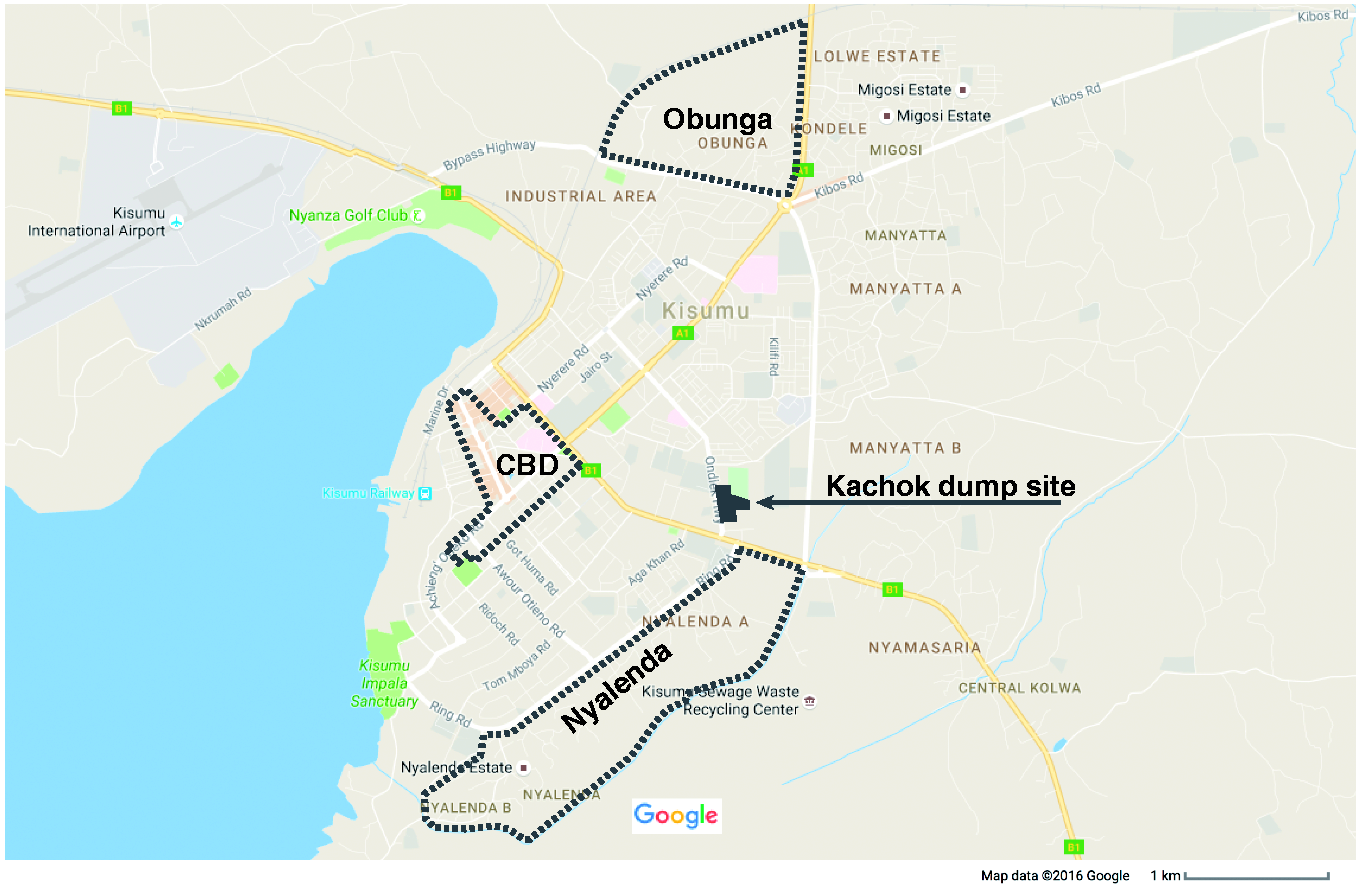
The waste situation in Kisumu is not unique. Informal settlements in the global South typically face severe environmental and health consequences from ineffective household waste management. Communities end up depending on individual waste pickers, recycling groups, community-based organizations (CBOs), waste microentrepreneurs, or cooperatives for cleaning, collection, and recycling services (Gutberlet, 2012; McBean, del Rosso, & Rovers, 2005; Medina, 2000; Zapata Campos & Zapata, 2014). Beyond their crucial contribution to strengthen the weak formal waste collection services (Ezeah, Fazakerley & Roberts, 2013), collaborative community-based initiatives and social microenterprises in waste management are also important livelihood activities in many cities in the global South (CWG & GIZ, 2011; Velis et al., 2012; Wilson, Araba, Chinwah, & Cheeseman, 2009).
In Latin America, successful examples for coproduction in waste management have been described for cities in Brazil (e.g., Araraquara, Aracaju, Arujá, Assis, Biritiba-Mirim, Londrina, Ourinhos or São José do Rio Preto, see Besen, 2006; Gutberlet, 2008, 2015b), Colombia (e.g., Bogota, see Terraza & Sturzenegger, 2010), Argentina (e.g., Matanzas in Buenos Aires, see Carenzo, 2014), and Nicaragua (e.g., Managua, see Zapata Campos & Zapata, 2013, 2014). In the city of Rio de Janeiro in Brazil, it is estimated that informal waste pickers contribute twice as much to recovering materials, than the official waste management system (da Silva Carvalho, Pinguelli Rosa, Bufoni, & Basto Oliveira, 2012). Examples of nonconventional participatory waste management initiatives have been studied also in India, where CHINTAN (2009) and Routh (2014) extensively described the informal sector contribution to waste management by waste pickers organized in a trade union in Pune.
The African examples are less frequent in the literature even if research from African cities also exposes different experiences with waste pickers or waste collectors providing waste management services (Ahmed & Ali, 2004; Gutberlet et al., 2016; Nzeadibe, 2013). In Cairo, it is estimated that waste pickers collect two thirds of all waste in the city (Fahmi & Sutton, 2015). Youth groups and child waste pickers are particularly active in the provision of these environmental services in many global South cities, such as in Nigeria (Adama, 2014) and Kenya (Thieme, 2015).
However, waste management systems are seldom described and analyzed from the perspective of how informality, in real life, interacts (or not) with formal waste management systems. Even if the potential of informal and community-based actors is increasingly acknowledged, few governments include such recycling in their policies, and even less governments actively implement what their policies prescribe (Gutberlet, 2015a; Zapata & Zapata Campos, 2015). This is unfortunate since the functioning of collaborative arrangements require support for storage, equipment, promotion of the collection services (Tirado-Soto & Zamberlan, 2013), and the evacuation of the collected solid waste from transfer points or recycling centers. A shift in waste management policy to include local actors also requires changes in the wider institutional environment, such as strengthening of local governments, building capacities of municipal officers, and establishing collaborative arrangements between local actors (Joshi & Moore, 2004; Yates & Gutberlet, 2011a; Zapata Campos & Zapata, 2013).
As described earlier, the literature suggests that community groups, cooperatives, and microentrepreneurs can play significant roles in service delivery to the urban poor (Gutberlet et al., 2016). However, there is a gap in the literature explaining waste management in informal settlements in Kenya to understand whether collaborative arrangements, for example, as described for Latin America can be part of addressing critical waste management challenges also in sub-Saharan Africa. Informed by the case of Kisumu, this article aims to examine weak links of the waste management chain, and to discuss how different types of neighborhood responses can be part of bridging these gaps. It applies a qualitative empirical research approach supported by systems thinking (Meadows, 2009) and action net theory (Czarniawska, 2004) to explain the complexity of the social, ecological, economic, and political elements, actions, actors, and processes associated with waste.
The article starts by situating the theoretical framework applied to this research and then presents the methods applied to collect and analyze the data. Next, the waste situation in Kisumu is outlined followed by a presentation of our findings in the form of a system or action net of the many actions coproducing the waste management chain, with some significant subsystems or subsets of actions. We continue by pointing out the most critical waste interfaces (or weak links between actions) and discuss nascent waste initiatives that aim to bridge such system deficiencies. The conclusion summarize the most important lessons learned from the Kisumu case.
Theory
This research combines systems thinking with action net theory. It is embedded in the wide field of systems thinking and applies system dynamics, which takes an interest in how one system element relates to another through reinforcing or reversing relationships. By system we mean “a set of things—people, cells, molecules, or whatever—interconnected in such a way that they produce their own pattern of behavior over time” (Meadows, 2009, p. 2). Here, positive feedback loops are of particular interest, as they reinforce any direction of change; such causal loops can be “vicious cycles” or “virtuous circles” (Meadows, 2009, p. 187). System dynamics is used to identify root causes of malfunctions in the waste system, potential leverage points for changes in waste practices to remedy such malfunctions, and forces that may resist change of the system and maintain status quo (Harich, 2010). An important aspect of understanding change resistance is to have a critical perspective on what is considered to be inside and outside the boundaries of the waste systems, and by whom (Ulrich, 2000). Ideally, such a pluralist approach (Stephens, 2012) will provide a basis for necessary systemic intervention practices.
System dynamics has proved useful to study waste management (Freeman, Yearworth, & Cherruault, 2013), urban household waste (Mashayekhi, 1993), and waste behavior (Babader, Ren, Jones, & Wang, 2016). For developing country contexts, system dynamics has been used to analyze waste policy (Bala, 2012; Sudhir, Srinivasan, & Muraleedharan, 1997) and to assess the potential of waste recovery through small-scale composting and informal recycling (Kum, Sharp, & Harnpornchai, 2005). Furthermore, system dynamics has been combined with actor-network theory to study the transitions of infrastructural systems (Chiong Meza & Dijkema, 2008), but not specifically applied to local waste management systems.
Action net theory (Czarniawska, 2004) draws from a combination of new institutional theory in organization studies (Powell & DiMaggio, 1991) and actor-network theory (Latour, 2005). Our understanding builds on the notion of “action as a movement or an event, to which an intention can be attributed by relating the event to the social order in which it takes place” (Czarniawska, 2004, p. 782). A “net” is seen as “a collection of holes tied together with a string” (Barnes, 1984, p. 38, here from Czarniawska, 2013), emphasizing the connections between actions as the most important ingredient, since unconnected knots hardly constitute a net. Action net theorists acknowledge time as an ever-changing element, which identifies action nets as temporary. This theory focuses on the “knotting” or the “connecting” as essential action in all organizing; be it around waste management, recycling or any other issue that requires organizing in society.
Place, a core concept in human geography is about understanding people’s meanings attributed to specific locations from a historic, cultural, and geographic perspective, recognizing specific place-based characteristics and the power relations manifested in place. Action net theory recognizes that place is relational and, through people’s actions and constant processes of transformation, becomes redefined. The focus on events unites the views of the researcher with the perceptions of the actors in the field. The intention is not only to understand particular events but also to comprehend how events are related.
The action net approach is useful for understanding networks and systems that are not yet stabilized or established (Lindberg & Czarniawska, 2006). In cities with large informal settlements, as is the case in most of Africa and also in our study site, Kisumu, waste management takes on a precarious format, with regular collection happening mostly in the formal city, while the informal city remains seriously affected by environmental health problems.
Action net theory has previously been used to examine urban waste management systems (Zapata Campos & Zapata, 2013, 2014), and waste prevention action nets (Corvellec & Czarniawska, 2015) based on seeing urban management as “a set of actions accomplished within a seamless web of inter-organizational networks, wherein city authorities constitute just one point of entry” (Czarniawska, 2010, p. 420). The notion of translation as discussed by Bruno Latour (1986) is central, helping us understand how words get translated into objects, images, or actions, and conversely, objects and actions get translated into words. Collective actions are thus seen as connected to one another through translations, as they are “the mechanism whereby connecting is achieved” (Lindberg & Czarniawska, 2006, p. 10). For waste action nets, translation would signify, for example, the process whereby collective actions of informal waste practices and the formal waste management system are interconnected. In this way, the action net concept helps us understand analytically how connections between actions—often loosely coupled—eventually create actors at a given time and place. For example, it is the action of waste picking that makes a waste picker, not the other way around.
The concept of action nets is founded on the idea that in each time and place it is possible to speak of an ‘institutional order,’ a set (not a system) of institutions (not necessarily coherent) prevalent right then and there. Such institutions shape organizing inasmuch as they dictate which actions, conventionally, should be tied together. (Czarniawska, 2004, p. 780)
Methods
A transdisciplinary research team was composed for complementary expertise, consisting of a waste entrepreneur, a public official, and a mix of researchers from engineering, sociology, public administration, geography, spatial planning, agriculture, and architecture.
The mapping of the waste system was based on document studies, field observations, semistructured interviews (27 interviewees), focus groups (four groups of waste scavengers,1 waste pickers, and residents with more than 40 participants), stakeholder workshops (with more than 70 waste professionals and waste entrepreneurs, policy makers, and residents), scholarly workshops (with Kenyan, Brazilian, and Swedish researchers), as well as hands on engagement on site through cleanup exercises in the informal settlements of Obunga and Nyalenda (Figure 1). The research team’s observations and the individual situatedness of each researcher add novel readings of the situation, allowing for diverse interpretations and meanings to emerge. The team interacted as participatory observers during preparatory meetings and cleanup activities in Obunga, facilitating additional learning opportunities for the team.
Interviews and workshops cover a wide range of stakeholders, such as residents, waste scavengers, waste pickers, waste entrepreneurs, recyclers, CBOs, nongovernmental organizations (NGOs), public officials from ward, city, county and state levels, researchers, UN-Habitat officers, development aid actors, and a former mayor of Kisumu. The results represent the integrated understanding the research team has gained by applying this qualitative research approach. All interviews, focus groups, and workshops were recorded for detailed analysis and substantiation of the findings. The usefulness of audio recording for research purposes was explained to all participants. They were asked for their consent and were informed about the possibility to refrain from taking part in the research at any point.
The collected data were transcribed, systematized, and analyzed by applying a combination of the two theoretical lenses: systems thinking and action net theory. Supported by this combined theoretical approach to understand the waste systems or nets, the many actions and their interconnections, organizing waste management in informal settlements, were mapped. From these actions, a large variety of involved actors (human and nonhuman) were identified. An overall diagram schematically representing the whole system or net of waste actions was developed, divided into a number of subsystems or subsets, based on type of actions and actors involved (Figure 2). From this larger diagram, we identified those waste interfaces that constitute weak links in the waste system or actions. Finally, system dynamics was applied to these interfaces to better understand potential solutions to improve the performance of the waste system (Figures 3–7).
System or net of all actions and flows related to solid waste in Kisumu’s informal settlements. The system or net is color-coded (see web version of this article) into seven distinct bundles or sets of actions. Numbered interfaces represent shortcomings and nascent waste initiatives examined in the discussion chapter. Causal loop diagram over how to achieve sorting at source, depicting the current situation to the left, and a potential future situation to the right.

Household Solid Waste Management in Kisumu
Communities in informal settlements in Kisumu suffer from very poor housing conditions and frail service delivery, such as waste collection. Currently, waste is mainly collected by the city in the central business district and the main markets (Onyango & Kibwage, 2008; Figure 1). Most of the solid household waste generated in the informal settlements remains uncollected and is left along main roads or in alleyways and empty lots, leading to appalling conditions not only in poor neighborhoods but also in the city in general (County Government of Kisumu, 2015).
The inhabitants of Kisumu produce somewhere between 200 and 450 tonnes of household solid waste per day, of which two thirds is organic material (County Government of Kisumu, 2015; Nodalis Conseil, 2009; Onyango & Kibwage, 2008). Previous studies (Onyango & Kibwage, 2008) have shown that, of the small amount of waste transported to the Kachok dumpsite, the city collected 20%, private waste entrepreneurs 27%, and industry (through self-collection) 53%. The study also noted that private entrepreneurs were more efficient and more environmentally sound than public operators, and that CBOs serviced low-income areas not accessed by either the city or private entrepreneurs. Uncollected household waste in low-income areas was mainly left in open pits (59%), burnt (23%), or scattered along roadsides (10%; Onyango & Kibwage, 2008).
In 2008, the Kisumu Integrated Solid Waste Management Project (KISWAMP) was initiated. KISWAMP was funded by the Swedish Development Agency (Sida), administered by the UN-Habitat, and implemented by the city of Kisumu in collaboration with local waste actors through the Project Implementation Unit. Other agencies, such as the International Labour Organization, provided technical and institutional support. KISWAMP opted for an integrated approach, with the promotion and inclusion of the informal sector in parallel with improvements of formal waste management. On the policy level, a key output of KISWAMP was the Kisumu Integrated Solid Waste Management Strategy 2010 to 2015, but when it comes to implementation, the impacts of KISWAMP appear minimal today. The program was only partially implemented and waste management in Kisumu continues to suffer from weak finances, feeble political and institutional support, and poor community attitudes (Frediani, Walker, & Butcher, 2013).
Even so, there have been various community-based initiatives for improving the waste situation in informal settlements, both with and without external funding. Often, these have been in the form of youth groups starting to clean up their neighborhoods for shorter periods. One of the positive impacts of KISWAMP has been the capacity building and strengthening of some of these groups and the support of their conversion into microenterprises. Currently, the County is developing a Kisumu Integrated Solid Waste Management Strategy 2015 to 2025 within the donor-funded Kisumu Urban Project (County Government of Kisumu, 2015), picking up many of the proposals of KISWAMP for a renewed implementation effort.
Results and Analysis: Household Waste Actions in the Informal Settlements of Kisumu
This chapter outlines the waste management system typical for many informal settlements in Kisumu. It starts with the larger picture and then zooms in on particular subsystems or sets of actions.
The Multitude of Actions Shaping Solid Household Waste Management
The gathering and analysis of the empirical data were guided by a questioning of any preconceived boundaries around the household waste system. All types of actions related to waste management were considered that resulted in a complex system diagram of waste actions (see Figure 2).
From an action-net perspective, it is these actions, with their connections (or translations), that produce the current waste system in Kisumu’s informal settlements. Through the waste actions, we observe how the system involves the households themselves as primary waste generators and subsequently a series of actors active in a loosely knitted but complex net at increasing perceived distances from everyday waste actions of households, for example: (a) shopkeepers, wind and water, absent waste containers, waste scavengers, waste pickers, and carts men, as well as chicken, goats, pigs, and cows; (b) waste entrepreneurs, neighborhood associations, CBOs/NGOs, city and private truck drivers, and the city’s staff at the Kachok waste dump; (c) recycling entrepreneurs or middlemen, and city/county administration; and (d) national authorities or ministries, national or global buyers of recyclables, aid donor agencies and projects, and transnational waste corporates.
The system diagram (Figure 2) can be divided into seven distinct bundles or sets of actions based on which actors are involved:
Waste generation of shops, markets, and households (gray) Everyday actions of households and in their near surroundings (red) Entrepreneurial actions of waste scavengers (green) Entrepreneurial actions of waste pickers or carts men and waste entrepreneurs (purple) Community actions by CBOs, NGOs, and neighborhood associations (brown) Actions by the city’s Environment Department at transfer points, along main roads, and at the dumpsite (yellow) Commercial actions by recycling entrepreneurs, middlemen, and national buyers of recyclables (blue)
In the following, we elaborate on each one of those subsystems or sets of actions.
Waste generation of shops, markets, and households
Household waste is primarily generated in informal settlements by discarding packaging from daily consumption and by organic waste from preparing and consuming food (gray color in Figure 2). As many live on a day-to-day basis, daily purchases of small amounts of foodstuffs result in comparably larger amounts of packaging. Due to lack of proper sanitation, feces is also disposed in plastic bags through so-called flying toilets.
Since material needs are pressing, reuse and reselling is common, and very few useful objects end up as waste. However, there are no initiatives from national or local governments to reduce the generation of waste, and the households do not perceive waste generation in itself as problematic. In particular, polyethylene bags from daily shopping contribute significantly to waste generation. Initiatives in emerging waste policies aim at reducing the use of plastic bags (County Government of Kisumu, 2015).
Everyday actions of households and in near surroundings
Part of the waste gets sorted at the source. In some households, kitchen waste is collected for composting to improve the soil of home gardens and a few households sort out organic waste to be picked up by local entrepreneurs. There are chicken, goats, pigs, and even cows that feed on scattered organic waste, thereby processing it into meat, eggs, and manure. Additionally, some households sort valuable materials, such as metals and plastic containers for reuse or resale. There is also a refund system in place for large brand soda glass bottles, such as Stoney Tangawizi, Coca Cola, and Fanta.
Since there is no common household waste collection in Kisumu, unsorted and residual sorted waste is removed from the homes through a variety of actions (red color in Figure 2). More affluent households may engage waste pickers to collect their waste, which is then accumulated at collection points within the settlement for transport to the waste dump by these waste entrepreneurs. A second option is for the household member to clandestinely dispose their waste at these collection points, without having paid the proper fee to the waste pickers for waste removal. A consequence of these actions is that waste pickers abandon the collection points, which then turn into local dumping grounds. A third option is to dispose of waste along main roads, typically during night time since a substantial fine is given if caught by public officials. Fourth, during the KISWAMP program skip containers were deployed at strategic waste transfer points around the city. Although the skips are long gone, these sites are still seen as legal disposal sites, but there are no signs indicating their locations. Nonetheless, if you know “where the skips used to be” (quote from public official) you may possibly dispose your waste there without being fined. A fifth alternative is to dig a pit within your compound and place your waste there and burn it when the heap becomes too big. There are also a number of common but less considerate ways of getting rid of your waste. You may simply throw it in neighboring alleyways and vacant lots or into drainage ditches.
Organic waste left at collection and transfer points, or dumped in pits, alleyways, vacant lots, and drainage ditches, is further processed by domestic animals feeding on the waste. Strong winds may remove remaining waste (typically polyethylene bags), often leaving it scattered in trees, bushes, and fences. Waste ending up in the drainage is at times flushed away by heavy rains, eventually out into Lake Victoria. However, a more typical consequence is a clogged drainage system resulting in inundations that flood the neighborhood with waste and sewage infested water.
Entrepreneurial actions of waste scavengers
From the perspective of individual households, the diverse actions to waste disposal appear rational. From a systems perspective, the result is an extremely complex waste chain, where source separation is minimal and conditions for waste management and waste recycling are hazardous. It is in this urban waste landscape that the most informal recyclers, the scavengers, harvest their “wealth” from what has been discarded by others, even by the very poor (green color in Figure 2). From early morning, one group of scavengers searches the neighborhoods for whatever has some value to carry on their backs until having enough to survive another day. Another group of scavengers work at the city dump going through the refuse collected by trucks and carts.
The scavengers experience hazardous working conditions, ranging from beatings (when seen as potential thieves), dog bites, infections, and stepping on glass or syringes to being cheated by buyers of recyclables once the day’s findings are to be sold. This is unfortunate since the scavengers play an important role for retrieving recyclables from all types of waste heaps and thus for making the existing malfunctioning waste system more efficient when it comes to resource recovery.
Entrepreneurial actions of waste pickers, carts men, and waste entrepreneurs
Some households engage waste picker entrepreneurs to collect their unsorted waste on a regular basis (purple color in Figure 2). The households typically receive a large polyethylene bag, which is collected at the door once a week by teams of waste pickers using hand-driven carts. Usually, poor access prohibits the use of larger trucks, so the waste is amassed at collection points to be loaded onto trucks for transport to the city waste dump. Often, this includes removing illegally dumped waste. It is important for the entrepreneurs to maintain a good public impression of their work, which means they cannot afford to leave any waste behind. Transportation is both carried out by private trucks and by city/county trucks at a fee.
Some entrepreneurs also collect sorted organic waste for composting, and there are itinerant buyers collecting sorted recyclables directly from households, typically focusing on a single group of materials, such as metals or glass bottles. The waste pickers or carts men are also allowed to sort out any valuable material from the waste they collect to sell and increase their income. There is some collaboration between waste scavengers and waste picker entrepreneurs, where recyclables are bought from the scavengers and where scavengers are recruited to become waste pickers due to their local knowledge of households and local waste actions. When shifting from scavenger to waste picker, working conditions and security appear to improve significantly. There is also cooperation among the waste picking companies, where they trade customers to make their collection rounds more efficient or to strengthen their position vis-à-vis the local government.
The entrepreneurs are constantly active in the neighborhoods to recruit more customers and expand their business. An interesting aspect of their customer relations is that tariffs are differentiated by household income. The entrepreneurs also contribute with cleaning up illegal dumping, the argument being that the cleaner a neighborhood becomes, the easier it is to recruit more customers, as reducing environmental impact is a strong selling argument. Moreover, many of the waste picking companies have evolved from community-based youth groups and have a strong local anchorage and sense of responsibility.
Community actions by CBOs, NGOs, and neighborhood associations
There are two main types of community actions: cleanups and processing of recyclables into sellable products (brown color in Figure 2). Cleanups are collaborative activities carried out to improve the environmental conditions in a neighborhood. At times and in some areas, they are regularly repeated once or twice a month and run by the ward, neighborhood association, or by CBOs/NGOs. Cleanups are also supported by waste picker entrepreneurs, as they are seen as a way to recruit new customers and because of their history as CBOs. However, in most cases, clean ups are less regular and the participation of the inhabitants is quite meager if not boosted through political campaigns, serving of refreshments, distribution of T-shirts, or similar rewards. In poorer neighborhoods, cleanups are the main, and sometimes the only, existing waste management initiative, and are totally insufficient for addressing the appalling environmental and health conditions.
The processing of recyclable material into sellable items is largely based on handicraft, where design and utility plays an important role for the marketability of the products. Polyethylene and VCR tapes are weaved into handbags, paper is turned into necklaces, beer caps into earrings, and so forth. Some of these products are well manufactured, and there is a potential for export but further product development would be beneficial. However, recycled plastic is also used as raw material for small-scale production of new products.
Actions by the city’s Environment Department at transfer points, along main roads and at the dumpsite
The City and County are involved in waste management primarily through the operation of a few skip containers, one skip loader, three tractors and two 15 tons tipper trucks (County Government of Kisumu, 2015), as well as the operation of the city’s dumpsite (yellow color in Figure 2). Both the old bylaws (Republic of Kenya, 2008) and the upcoming Solid Waste Management Act 2015 state that the producers of waste—including households—are fully responsible for managing their waste. However, they also recognize that the city should provide cleaning services of the general housing estates. The division of responsibilities between the households and the city/county is thus vague, especially when it comes to the urban poor.
Through KISWAMP, skip containers were deployed around the city to collect waste from both households and markets. For different reasons, there are now just a few remaining containers, primarily used for the main markets. Households are left without service. The consequence is that waste is accumulating along main roads and at the locations “where the skips used to be,” to be removed by the city/county trucks, however, both randomly and scarcely. The city/county does also, on request, collect waste from neighborhood cleanup activities.
The dumpsite is an open area in town, located near a large supermarket and a three-star hotel. The waste is not compacted, since the machinery is out of operation, and thus remains uncovered. The unclear interface between households, the city/county, and other actors turns unloading of waste into a negotiation over fees, where sometimes some actors choose to get rid of the waste elsewhere. Waste scavengers are active on the waste heaps trying to salvage anything of value, without cognisance of the hazardous waste, including hospital waste, mixed into the waste. There are no measures to control leakage to surface or groundwater, and there are grave environmental impacts on the city.
Commercial actions by recycling entrepreneurs, middlemen, and national buyers of recyclables
At the next level of recycling, management takes on a more industrialized character (blue color in Figure 2), even if the capacity for upgrading recycled material on an industrialized basis is limited in Kisumu, given the capital cost, skills, and maintenance of equipment. As households, scavengers, waste pickers, and waste-picker entrepreneurs bring in sorted waste, most of this material is shredded or compacted for transport to Nairobi or elsewhere. For example, a middleman specialized in plastic recycling sells the recycled materials to a Chinese company based in Nairobi. Another example is the sale of glass bottles to national buyers in Nairobi by waste entrepreneurs providing household waste collection services in informal settlements. However, a local waste entrepreneur, Bamato, makes plastic fencing poles and utensils from plastic waste, thus avoiding the transport of plastic waste to Nairobi as long as its facilities are operational. These fencing poles are strong and durable compared with locally available wooden ones.
Discussion: Weak Waste Interfaces and Nascent Waste Initiatives
By following the waste flows from the shops and markets via households and the various entrepreneurs and agencies involved, seven critical waste interfaces were identified that thwart the functioning of the waste system by weakening or obstructing necessary connections between waste actions (see numbered interfaces in Figure 2). It is in these interfaces where, following action net theory, actions are translated (Lindberg & Czarniawska, 2006) with different implications for residents, waste pickers, authorities, and the urban environment. Therefore, these points in the waste management action net carry significant potential for bridging existing system deficiencies.
Interface 1: Reduction of Waste
As a primary ambition is to prevent and reduce waste (United Nations Development Program, 2013), there are opportunities for significant improvement in the current waste system. The amount of packaging involved in buying daily commodities can be reduced, mainly the thin polyethylene bags now representing a serious environmental threat, by banning these and by encouraging the use of reusable bags as has been done in other parts of the world, such as Uganda, Tanzania, and Rwanda. Moreover, as living conditions of the urban poor hopefully will improve, there is a risk of a complete breakdown of the waste management system if consumption patterns from the North are further mimicked. Instead, Kisumu needs to leapfrog into consumption decoupled from waste generation. Many urban policies around the world now aim at zero waste involving CBOs, small-scale waste entrepreneurs, and informal recyclers in the material collection, separation, commercialization, and transformation (Bartl, 2013; Zaman & Lehmann, 2011, 2013). Still, as most national and municipal policies around the world frame waste as a commodity (Zapata, 2013), there are two competing logics at play: zero waste versus waste as a commodity. As reduction policies affect the economic interests of those involved formally and informally in waste recycling (Zapata Campos & Hall, 2013), such interests resist systematic change (Harich, 2010) toward zero waste.
Nevertheless, at the local level, sensitization of households to reduce their generation of waste may impact also on shopkeepers and markets to reduce packaging material, thus turning the vicious cycle (Meadows, 2009) of waste generation into a virtuous reinforcing loop of waste reduction. In a longer time perspective, sensitized households would also affect national and local policy, in this way creating another virtuous circle. Furthermore, the lack of resources in low-income households hinders the purchase of utilities with higher quality and longer life span, thus rapidly turning new items into waste. Here, reinforcing local, and often lost, abilities for repair and maintenance in the informal settlements would contribute to waste minimization. Similarly, other characteristics typical of life in many informal settlements, such as long distances from household to work and lack of proper equipment in households for cooking or preserving food, are also reasons behind the production of package waste and food waste.
Interface 2: Sorting at Source
Working conditions for waste scavengers and pickers are often atrocious when dealing with unsorted household waste. With source separation at the household level, working conditions would improve significantly and the value and volume of the recyclables would increase. Since 60% of all household waste is organic, it is essential to collect this fraction free from contaminating material. Strategies to achieve sorting at source need to be assessed carefully, since this appears to be quite a challenge in a context where having a proper waste collection system is still a conundrum. Opportunities may lie in providing suitable containers, reducing fees or improving services for sorted waste, and in sharing of the benefits between households, waste entrepreneurs, and the city/county (see Figure 3).
Sharing of benefits from separation at source may have a negative effect on the economy of the waste picker company. However, such initiatives should be beneficial on the longer term due to improved conditions for the carts men as well as higher value of recyclables, thus leading to another virtuous circle. Furthermore, waste entrepreneurs could become educators, informing the households about source separation. The literature describes many positive effects of door-to-door collection of sorted household waste but also draws the attention to the difficulties in implementing such services through cooperatives or CBOs (Gutberlet, 2013; Yates & Gutberlet, 2011a, 2011b).
Interface 3: Improvement of Local Waste Practices
Today, most waste is simply dumped locally, resulting in neighborhoods infested with waste of all sorts, entangled into all aspects of daily life. Cleanup activities temporarily improve the situation, but the short-term benefits are meager. It even seems as if cleanup exercises may reinforce negative waste practice by eventually removing waste from where it is thrown (see Figure 4). However, as cleanups appear to be appreciated they can be used strategically, persistently, and long term to change the attitudes, options, and actions linked to waste. Similarly, waste entrepreneurs, functioning as environmental stewards, can educate residents, change attitudes with respect to the local environment and create greater community cohesion, as has been reported from Brazil (Gutberlet, 2012, 2013), Nicaragua (Zapata Campos & Zapata, 2013), Argentina (Alvarez & Carenzo, 2012), and other countries (Martin, 2010). As sensitization of the households take effect, the need for, and role of, cleanup activities decreases. It is then vital that waste entrepreneurs can keep up sensitization to maintain and reinforce improvements in waste practices.
Causal loop diagram over how to improve of local waste practices.
Interface 4: Roles of Waste Entrepreneurs
An effective waste management will not be achieved just by placing the responsibility on the generators of waste, since the current situation is reinforcing a negative spiral of environmental degradation (see Figure 5). The important roles waste scavengers and entrepreneurs play in developing and running improved waste services should, therefore, be recognized (Onyango & Kibwage, 2008). In particular, the waste scavengers need to be acknowledged for their indispensable contribution and their working conditions need to be improved significantly on the short term, with the long-term goal to reform the waste system into a more dignified trade for all involved. This includes a number of measures such as revision of regulations and bylaws to recognize the role of waste pickers and scavengers in the waste management chain, issuance of permits at proper rates and procedures, minimization of risks (e.g., sorting at source), improvement of health schemes, provision of proper working environments and tools, promotion of education and awareness, and, not least, to pay them for the provided environmental service of diverting materials from the municipal dumpsite (Gutberlet, 2015a). The diversion of recyclables from landfills has been estimated to save approximately 20% of the municipal waste management costs in cities of the global South (Wilson, Velis, & Cheeseman, 2006). The compound effect of such measures on local environmental degradation, as well as on waste flows to the dumpsite could be significant and exponential, especially if combined with waste workers acting as sensitization officers (see Figure 5).
Causal loop diagram over the how the various waste actors may be supported to become key actors.
Interface 5: Responsibilities of the City/County
Since more than 50% of Kisumu’s population is poor (Nodalis Conseil, 2009), the city/county need to reconsider who is responsible for collecting the household waste from the urban poor and how such collection can be financed. Currently, confusion is profuse among residents, and in 2008, 70% did not understand why the municipality did not come and collect the household waste (Onyango & Kibwage, 2008). Unclear responsibilities and poor performance of the formal waste system reinforce negative waste habits, with dumping of unsorted waste all over the city (see Figure 6). We can learn from Managua, where, with the support of UN-Habitat, waste transfer points were established at the edges of informal settlements. This initiative significantly improved waste collection and reduced illegal waste dumping, with consequent savings for the municipality (Zapata Campos & Zapata, 2014). In Kisumu, a consistent system needs to be established with collection points (at neighborhood level) and transfer points (at ward level) as clear sites where the city/county takes on the responsibility for the waste (see Figure 6). If successful, such a system of virtuous feedback loops would result in significant improvement of local environmental conditions, as well as alleviate the pressure on the dumpsite through increased separation of recyclables, in particular organic matter (Kum et al., 2005). However, as household waste would be managed in a more controlled way, the livelihood opportunities for the scavengers would dwindle. This group should thus be made part of the new waste system.
Causal loop diagram over the shifting role of the city/county. Causal loop diagram over market deficiencies and the potential role of waste cooperatives and improved regulations.
Weak institutional frameworks and weak fiscal economy require that such a system become coproduced by involved waste actors. However, such coproduction of waste services between residents, waste entrepreneurs, and the city/county necessitates a strengthening of local governments, building the capacity of public officers, and establishing collaborative arrangements between involved actors (Gutberlet, 2015a). Otherwise, there is a high risk that local governments remain suspicious about the role waste entrepreneurs can play or that they simply do not fulfil signed agreements (Furedy, 1992; Joshi & Moore, 2004; Yates & Gutberlet, 2011a; Zapata Campos & Zapata, 2013). Governmental arrangements for the coproduction of waste services thus call for regular, long-term relationships with network and partnership arrangements that are integrated in the local governance structures (Joshi & Moore, 2004).
Interface 6: Transparent Tariffs and Procedures
The unclear role and responsibilities of the city/county result in, or open up for, nontransparent and confusing tariffs and rules for unloading waste at the waste dump. This unpredictability is both intimidating and counterproductive for improving the waste system. The nontransparent system needs to be replaced by a transparent and fair system of tariffs and fees connected to prompt and enduring service provision. In addition to reduced illegal dumping of waste around the city, such a system would increase the likelihood of succeeding with widened city/county responsibilities as outlined earlier. Moreover, the situation of the scavengers currently working at the dumpsite would improve if less exposed to arbitrary conditions. This finding is in line with other studies of waste management in settings with weak governance (i.e., Furedy, 1992; Zapata Campos & Zapata, 2013), where administrative fragmentation and lack of clear ideas of how to organize waste management have been observed to counteract any stabilization of arrangements between informal collectors and authorities.
Interface 7: Market Deficiencies for Recyclables
People at the bottom of the recycling system—scavengers, waste pickers, and carts men—are exposed to fluctuating prices and sometimes deceiving practices due to their need to sell their “wealth” for day-to-day survival. If you have carried your load on your back all day, you cannot walk additional kilometers to find a better price. This leads to a vicious cycle of vulnerability and poverty (see Figure 7). Associations or cooperatives for scavenger and waste pickers should be promoted as entry points for democratic and commercial organization so that they are able to mobilize in support of their collective interests. By doing so, their role as key waste actors can be strengthened to the benefit of both themselves and the wider community.
In Kisumu, there are already informal networks in place between waste entrepreneurs to improve the efficiency of fee collection and waste collection routes and to negotiate more favorable prices for recyclables. Such initiatives should be strengthened further and be formalized. Experiences from a network of recycling cooperatives in São Paulo have proven benefits in terms commercialization, access to microcredits, capacity building, and so forth (Gutberlet, 2015b). Such collaboration should also include safe storage of the “wealth” to provide stronger bargaining positions toward buyers. On the medium- to long-term policies and other regulatory tools should be developed that benefit actors involved in resource recovery, meaning that even businesses reusing recyclable material should be benefited. Such measures promote zero waste and reduce waste-related greenhouse gas emissions.
Conclusion
This article has uncovered weak links in the solid household waste management chain in informal settlements in Kisumu and discusses whether neighborhood responses can bridge these frailties. By applying a combined systems thinking and action net theory approach, we succeeded in depicting a complex, multilevel, and highly networked system of waste actions, involving a multiplicity of actions and actors at different levels: global, state, county, city, ward, informal settlements, microenterprises, households, individuals, animals and artifacts. Shifting the attention toward the weak interfaces of the waste chain made it possible to identify and propose, from a governance perspective, which actions should be better connected, redirected, or disconnected to produce better outcomes for the environment, the residents, the entrepreneurs, and the authorities. However, since we utilized a simplified systems approach to develop this representation of the waste chain, the interconnections and feedback loops between actions, actors, and levels are likely to be even more complex in the real waste chain and would benefit from further analysis.
We also set out to explore whether experiences with collective waste management in Latin America are relevant for addressing critical waste management challenges in sub-Saharan Africa. In Nicaragua, turning carts men, who used to be a source of pollution, into formal waste pickers with the support of formal waste transfer points constituted a positive linking of formal and informal waste actions. In Brazil, waste collectors in the informal sector, supported to form recycling cooperatives, are now coproducing selective waste collection and recycling in several municipalities. Their higher level of organization through cooperative networks has enabled them to make their voice heard in policy design for improved working conditions and more fair remuneration of the services they provide. Based on what we have learnt from Kisumu, such experiences seem to be highly relevant also for the sub-Saharan context. In Kisumu, a good starting point for the resuscitation of KISWAMP into the new Integrated Solid Waste Management Strategy would be to not only build on the existing coproduced waste collection practices by scavengers, waste pickers, entrepreneurs, and CBOs emerging within informal settlements but also to strengthen the link between formal and informal waste management practices. Drawing on Latin American experiences, a main issue will be to strengthen organizational capacity and access to resources and funding among these waste actors. Additionally, source separation practices should be supported strongly to improve working conditions and economic return for waste microactors. Finally, the skip containers should not only be returned to where they used to be, but these sites should also be critically assessed and, when suitable, be developed into a network of well-maintained collection and transfer points, servicing both communities and waste entrepreneurs.
Footnotes
Acknowledgments
The authors are grateful to all local stakeholders and officials who were supporting the field studies with their invaluable insights and valuable time, especially the local communities in the Nyalenda and Obunga informal settlements, and in particular waste entrepreneurs Silas Otieno, Dickens H. Ochieng, and Elvis Omondi. Nicholas Odhiambo and John Omolo were part of the team carrying out the field studies.
Declaration of Conflicting Interests
The authors declared no potential conflicts of interest with respect to the research, authorship, and/or publication of this article.
Funding
The authors disclosed receipt of the following financial support for the research, authorship, and/or publication of this article: This work was supported by the Swedish Research Council under Swedish Research Links grant number 348–2013-6689 and by the Swedish International Centre for Local Democracy.