



Abstract
We assessed the effectiveness of Nepalese Community Forestry Program (CFP) in increasing local perceptions of equity in benefit sharing. Our aim is to inform emerging forest policy that aims to mitigate climate change, promote biodiversity conservation, and address poverty and livelihood needs. We collected data from 1,300 households from nationally representative samples of 65 CFP communities and 65 non-CFP communities. By using a robust method of covariates matching, we demonstrate the unique and positive effect of the CFP on perception of equity in benefit sharing at national level and among poor, Dalits, indigenous and women-headed households and in the hills (except Terai). Our results suggest the need to continue the current benefit-sharing practices in CFP except in the Terai, where such practices need to be reviewed. However, caution should be taken in implementing emerging carbon-focused forestry so that it does not alter the CFP management sufficiently to conflict with equity goals and upend the generally positive effects on equity.
Many governments in tropical countries have been promoting decentralized forestry to involve forest-dependent communities and households in the conservation and management of local forests. A key aspect of decentralized forestry is that it devolves all or part of forest management rights from governments to local or even household levels (Charnley & Poe, 2007; Larson & Soto, 2008), and there is a growing consensus that decentralized forestry has the potential to reconcile sometimes-conflicting goals of social justice, equity, and environmental sustainability (Gauld, 2000). Concerns over equity have influenced many social movements related to human rights, global trade, and climate change (Gross, 2007), and in recent years, equity has been one of the central concerns regarding forest management (Adhikari & Di Falco, 2009). Indeed, it is increasingly considered to be a legitimate basis for judging the effectiveness of forest commons management (e.g., Li, 1996), affecting not only the motivation of community members but also credibility, acceptability, and socioenvironmental outcomes (McDermott, 2009).
The concept of equity is based on human needs related to survival, self-concept, and dignity through which people evaluate their social standing in a society (Mapel, 1989). Equity reflects the existence of social justice that includes contextual, procedural, and distributional dimensions, where context refers to the capacity of actors to participate and capture benefits, procedures focus on decision-making processes, and distribution considers how costs, benefits, and risks are shared (McDermott, Mahanty, & Schreckenberg, 2013). In the context of natural resource management, equity reflects a situation of fairness in which everyone has just and equal opportunities to participate in decision-making processes and access the resources required to achieve full potential (Mahanty, Fox, Nurse, Stephen, & McLees, 2006). A core determinant of equity, fairness is expected in day-to-day interactions (Gross, 2007) and in general requires value judgments in a particular context (Schreckenberg & Luttrell, 2009). Perspectives on fairness therefore vary across cultures, time, and space.
Equity and fairness are likely to be especially important for decentralized and incentive-based forest management. An important example of incentive-based approach to forest management is Reducing Emissions from Deforestation and Forest Degradation, Conservation and Enhancement of Carbon and Sustainable Management of Forest (REDD+), which is an international climate change initiative that provides financial resources to low-income countries in exchange for verifiable reductions in forest-based emissions (Wunder, 2008). While both decentralized forestry and REDD+ have the potential for poverty reduction and support for forest-dependent communities (Eliasch, 2008; Luintel, Ojha, Rana, Subedi, & Dhungana, 2009; World Bank, 2004), their incentives may differentially benefit individuals and groups and thereby create different perceptions of equity in benefit sharing.
Equity has so far been assessed either by using tangible benefits or by using perception of communities receiving benefits. Equity as measured by tangible benefits has been discussed in some previous research, which showed the strong relationship between private endowment and appropriation of benefits from the structured forms of collective action (e.g., Adhikari, 2005; Beck & Ghosh, 2000; Naidu, 2011; Sunam & McCarthy, 2010). Such findings indicate that the tangible benefit approach in understanding equity might not be adequate, particularly where the inequality in asset is an inherent problem. Another stream of literature argues that communities’ perceptions of fairness substantially impact their participation in conservation programs (Lind & Tyler, 1988; Vatn, 2010). The success of many conservation programs, including decentralized forestry and REDD+, is contingent on developing positive attitudes of local communities (Adams & Hulme, 2001; Struhsaker, Struhsaker, & Siex, 2005). Using local perceptions in assessing equity in benefit sharing is methodically easier and widely acceptable in complementing existing knowledge. Perceived lack of fairness in benefit sharing undermines the effectiveness of conservation programs even if they deliver tangible benefits (Kanfer, Sawyer, Earley, & Lind, 1987) and can lead to environmental degradation (Boyce, 1994). Therefore, it is important to understand the perception of equity in benefit sharing so as to address the issue of inequity and foster positive local attitudes.
Advocates pitch decentralized forestry as an effective approach to increase access to forest ecosystem services like fuelwood, fodder, and water quality that improves rural well-being (Beck & Nesmith, 2001; Rights and Resources Initiative, 2014). However, studies have shown both positive and negative results of decentralized forestry on equity, which has led to important debates. If devolution fosters fair and inclusive processes, equity may be enhanced by decentralization (McDermott & Schreckenberg, 2009). Persha and Anderson (2014) and Luintel (2006), for example, argued that equity has been enhanced by decentralized forestry primarily due to external support and the involvement of civil society organizations, and such supports are common in legally recognized community forest user groups (CFUGs) in Nepal (World Bank, 2001). Agrawal and Ostrom (2001), however, argued that decentralized forestry may not promote equity, and Adhikari (2005), Agarwal (2001), Iversen et al. (2006), and Thoms (2008) demonstrated that decentralized forestry in South Asia can be associated with unequal access. As a result, the gap between rich and poor forest users may be widening and involvement of poor and marginalized communities may be decreasing (Lamichhane & Parajuli, 2014). Mahanty, Guernier, and Yasmi (2009) and others (e.g., Bista, 1991; Hobley, 2007) argued that inequity in benefit sharing is common due to differential power, assets, and capacities of forest-managing community members.
Despite this active debate, robust empirical evaluation of the effect of decentralized forestry on equity in benefit sharing is limited. This knowledge gap reduces the credibility and legitimacy of decentralized forestry and may constrain the effective implementation of emerging forest management programs, such as REDD+ (Arsel & Buscher, 2012; Fairhead, Leach, & Scoones, 2012; McAfee, 2012). Researchers, policy makers, and practitioners have therefore highlighted the need for empirical assessment and greater understanding of equity to reduce the potential for social conflicts and environmental degradation (e.g., Boyce, Narain, & Stanton, 2007; Patel et al., 2013; Poudel, Thwaites, Race, & Dahal, 2015; Smith & McDonough, 2001).
In this article, we empirically examine whether and to what degree the Nepalese community forestry program (CFP), which is a formal forest decentralization program, increases perception of equity in benefit sharing, including among marginalized social groups, such as Dalit 1 groups, indigenous peoples, 2 and women-headed households, and different geographic regions (i.e., hill 3 and Terai 4 ). We use cross-sectional data collected in 2013 from nationally representative random samples of community forest (CF) and matched non-CF (NCF) communities. The Nepalese CFP offers a unique opportunity to examine the effects of decentralized forestry on equity; it has more than 40 years of history of managing approximately 1.8 million hectares and includes approximately 42% of the population with a wide range of socioeconomic backgrounds. The program legally recognizes approximately 19,000 CFUGs as autonomous public bodies that can acquire, possess, transfer, and manage property (Ministry of Law and Justice [MoLJ], 1993).
The most important challenge in such research is to identify an appropriate counterfactual, which allows the identification of the effect on equity in the absence of the program. We follow a quasi-experimental, matching method—a method that mimics randomized experiments. By using only matched samples, we estimate the average treatment effect on the treated (i.e., the average perception of household on equity in benefit sharing [ATTe]). As national-level estimates may mask a great deal of variation in the effectiveness of the CFP in different social groups and geographic regions, we also estimate the ATTe by social group and geographic region. Finally, we use sensitivity analysis to estimate whether and to what extent our ATTe can be affected by hidden bias caused by unobserved confounders.
We find strong equity-enhancing effects of the CFP virtually across the board. Whether we compare equity in CFs and NCFs in the overall sample, among the poor, Dalit, indigenous people, women-headed households, and in the hills, we can reject that the CFP has no positive effect on equity. Our results and methods are potentially applicable to a variety of countries that are practicing decentralized forestry and potentially provide critical insights for policy makers and planners.
Research Methods: Site, Design, and Analytical Model
The data presented are part of an ongoing multidisciplinary research project funded by the World Bank and jointly implemented by Portland State University and ForestAction Nepal. The primary aim of the project is to assess potential synergies and tradeoffs between the Nepal CFP and REDD+.
Sampling Methods, Sample Sites, and Data Collection
We randomly select 65 CFUGs from a nationally representative sample of 137 CFUGs used to conduct a CFP impact study during 2010 to 2012 (Ministry of Forest and Soil Conservation [MoFSC], 2013). We then selected 65 NCFs in such a way that they are proximate and similar to CFs based on a variety of characteristics (e.g., ethnic group, agro-ecological zones, use of forests by local communities, and forest characteristics). Such NCFs are close, but not next, to CFs to avoid being used simultaneously by the same people. The selected CFs and NCFs are distributed in the tropical, subtropical, and temperate climatic zones in 42 of Nepal’s 75 districts (Figure 1). The CFUGs in our sample have 5 to 40 years of experience in formal forest conservation and by law in principle are expected to show fairness in their benefit-sharing rules. We randomly sample 10 households from each of our 130 forest user groups to be surveyed and conduct or use impact evaluation survey results from leaders of all user groups.
Distribution of sample plots.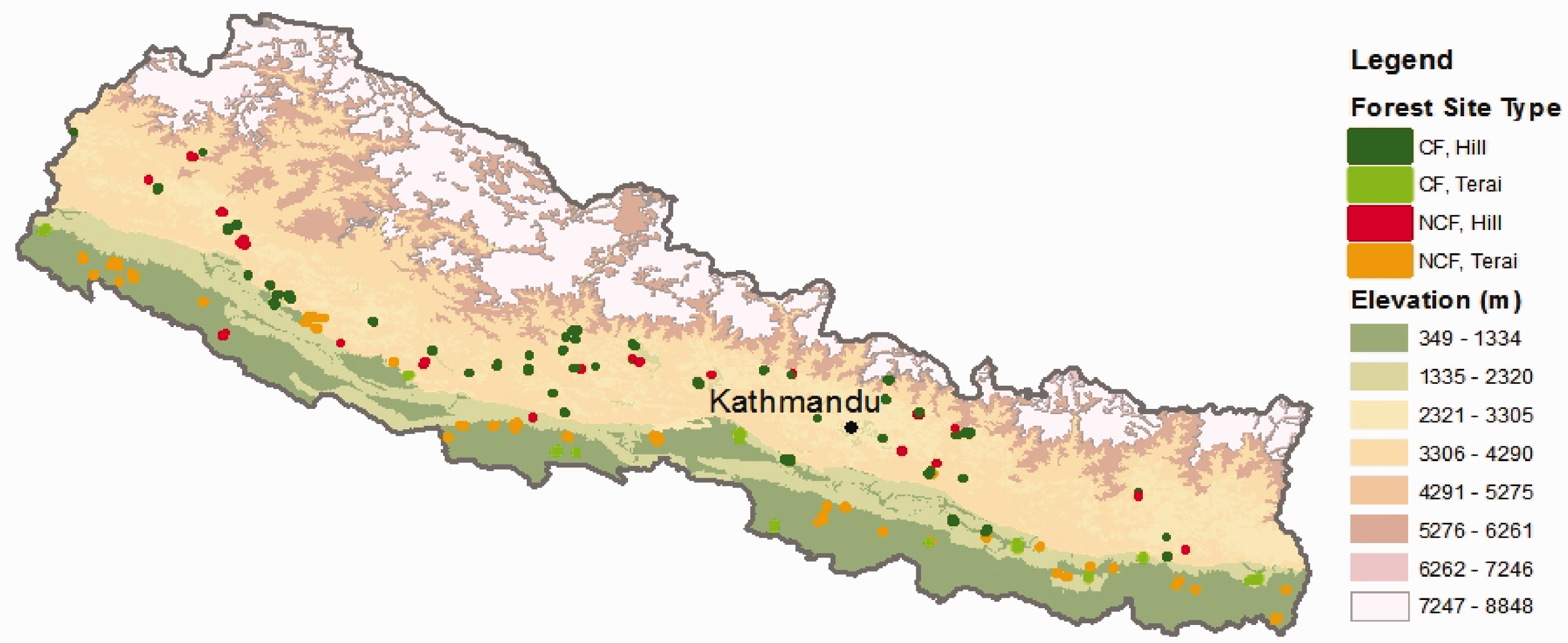
We developed and pretested a questionnaire in two CFUGs before conducting the survey and then recruited a team of 25 Nepalese field researchers having undergraduate degrees in forestry (12) and graduate degrees in social science (13). This team was trained to conduct forest user group surveys, forest inventories, and household surveys. Data were collected between March and May 2013.
Variable Selection and Measurement
Treatment and control variable
The treatment variable is participation in a formal CFP. Local communities and the Nepalese government opt into CF status, and therefore, the observational data are nonrandom. NCFs are the control variable and are formally owned by the Nepalese government, which also has management responsibilities. NCF communities may protect and use forest resources, particularly nontimber forest products, but often NCFs are effectively open access.
Outcome variable: the equity index
Household members may use a variety of criteria, indicators, and standards to view equity. Perceptions of fairness in benefit-sharing processes and outcomes therefore help create a picture of equity, and it is for this reason that our outcome variables come directly from survey responses by households who are and are not part of the CFP. Also of keen importance is that household categories, such as the poor, women-headed, Dalit, and indigenous, are defined at the household level. In Nepal, it is typical that household heads speak on behalf of families, and it is for this reason that surveys are conducted with self-identified household heads or their designees.
On the basis of the survey responses, we construct an equity index, which is a composite measure of equity in benefit sharing and summarizes different aspects of equity. Such an index is intended to capture most of the underlying ethics and assumptions of forest governance and management in relation to benefit sharing. Despite the risk of misinterpretation and misapplication, the single number index helps us summarize different dimensions of equity in a simple way, order equity, understand the average of household responses, assess how symmetric this measure is around the mean by applying various statistical tests, and compare and communicate the equity situation (Organisation for the Economic Co-operation and Development [OECD], 2008). Such construction of index is not uncommon in the field of forest commons study (e.g., Agrawal & Chhatre, 2005; Andersson & Agrawal, 2011; Beyene, Bluffstone, & Mekonnen, 2013).
Indicators Used to Create the Equity Index and Their Measurement Units.
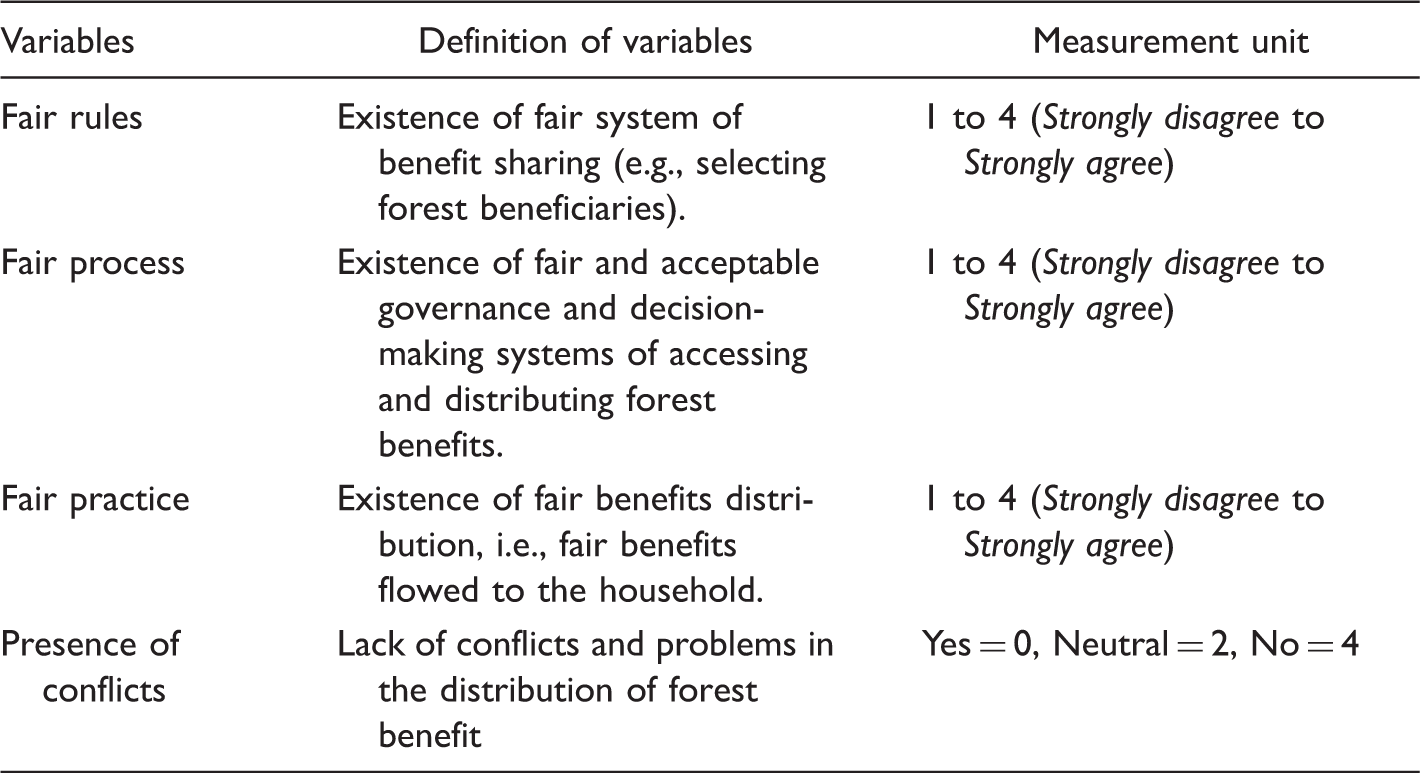
Note. As these four variables, at times, looks overlapping or it is difficult to delineate their boundaries, the authors were careful, while translating questions in Nepali language. As two of four authors’ native language is Nepali and they have worked in Nepalese community forestry for more 10 years, we overcame this challenge by carefully utilizing our knowledge, getting suggestions from ForestAction Nepal and pretesting questionnaires.
We identify the weights of these variables using principal component analysis (PCA) 5 and standardize the variables to have zero means and unit variance. Diagnostic checks of the data showed that all variables were correlated or internally consistent with the principal components (Cronbach’s alpha = .71; 95% CI[0.66, 0.75]); sampling adequacy scored as middling to meritorious (Kaiser–Meyer–Olkin Measure = 0.64–0.85); and the variables have different variances (Bartlett test of sphericity = 211.14, df = 3, p value ≤ 2.2e-16). The assumptions for using PCA were therefore met.
Eigenvalues of the Reduced Correlation Matrix, Factor Pattern, and Weight Factor.

Note. Numbers in bold face denote a dominating indicator (factor loading ≥.5 or ≤−.5).
aFactor scores: square the significant loading factor (>.5) and multiply by the proportion of explained variance.
bVariable weights: Factor scores scaled to 1.
Component 1 accounts for 40% of the total variance and received moderately negative loadings from process (−0.50) and conflict (−0.66). Component 2 explains 27% of the variance and received moderately negative loadings from conflict (−0.75). Component 3 accounts for 19% of total variance and largely depended on the actual practice of benefit distribution (0.92). Component 4 accounts for 14% of the variance and received positive leadings from rules (0.71) and negative leadings from existence of conflicts (−0.71).
Descriptive Statistics of Equity Index and the Variables Used to Construct Index.
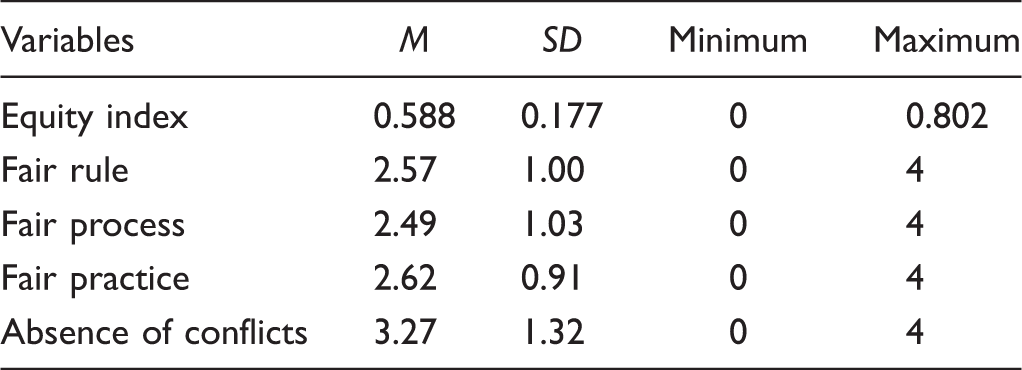
Confounding variables
Because communities choose to participate in the CFP, there are a number of potential confounders that may affect treatment status and cause bias in ATTe estimates (Heinrich, Maffioli, & Vázquez, 2010). We therefore use data from NCF plots to develop a counterfactual control group combined with matching, an ex post identification technique, to identify what would have happened to equity in benefit sharing in the absence of the CFP (Pattanayak, 2009). Of critical importance is that we control for confounders in the matching process, which helps minimize bias by identifying the best matches between CF and NCF households.
On the basis of the literature, focus group discussions with 10 different forest-managing communities and one consultation meeting with experts in Kathmandu in 2012, we identify 14 observable forest or topographical characteristics and communities confounders that could affect whether forests (and the households who use them) are part of the CFP. As far as possible, we tried to include all observable variables that determined whether a forest was part of the CFP or not, including relevant biophysical and socioeconomic confounders; by adjusting for these observables, we attempt to reduce any bias that potential confounders might cause.
Potential Confounders and Their Relationships With CFP Assignment (GLMM Probit Model) by Region and Household Type.
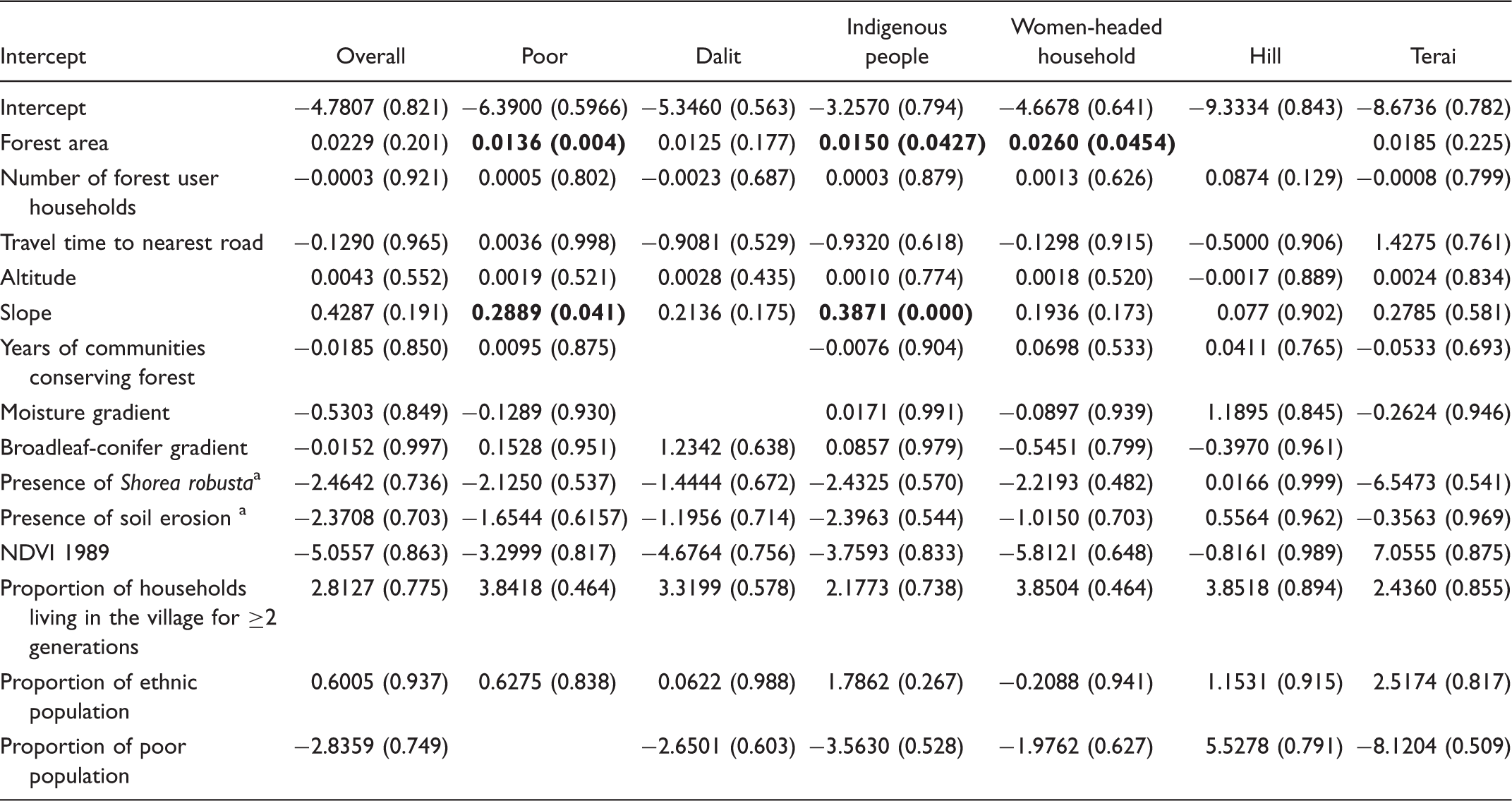
Note. N = 1,300. CPF = Community Forestry Program. CFP status is dependent variable. p values are in parentheses and statistically significant estimates (p ≤ .05) are in bold. A blank space indicates that a confounder is not used in the model to achieve matching in the particular forest category.
aThe presence of erosion and Shorea robusta could be functions of CFP status. As they are primarily determined by ecological characteristics and are likely important determinants of whether forests are assigned to CFP, we use them in the GLMM probit model used to estimate propensity scores.
If treatments were randomly assigned, coefficients should be zero or statistically insignificant. As shown in Table 4, very few variables have coefficients that are significantly different from zero, which suggests that CFP assignment evaluated at the household level was largely random. The two exceptions are forest area and average forest slope, which in three and two models had a statistically significant effect on the log odd ratio of a forest being selected into the CFP. 6 For example, the log odds ratio that a poor household was part of a CF increased by 0.0136 for each additional hectare of forest. The log odds ratio also increased for indigenous households by 0.015 with each additional hectare and for women-headed households by 0.026. This is reasonable, as local communities prefer larger forests, which provide more forest products; households in communities with larger forests are therefore more likely to opt into the CFP, and the Nepalese government has a policy of handing over forests according to communities’ willingness to manage (MoLJ, 1995). Finally, these three generally disadvantaged groups are likely to have access to smaller forests if they are members of CFs made up of similar households. The marginal value of organizing to gain access to larger forests is therefore likely higher than for other groups.
Second, in two models, average forest slope had a significant positive effect on the log odds ratio that households are part of CFs. Among poor households, the log odds of selection increase by 0.29 for each additional degree of slope, and the equivalent effect is 0.39 for indigenous households. As is well known, the Nepalese government especially promoted the CFP in the hills and has largely retained forests in the Terai.
According to our data, most of the potential confounders are not significantly related to CFP assignment. However, these confounders were important decision criteria during the initial years of the CFP, and we therefore keep them in our analytical models.
Specification of Analytical Models
Addressing confounding through matching
Because our study is observational, the principal problem in the estimation of ATTe is identifying counterfactuals and dealing with confounders induced by selection bias. Selection bias arises when a forest (and the households that use it) is nonrandomly assigned to the CFP. Adjusting for these confounders is important to avoid biased ATTe estimates and make matched households as close as possible to randomly assigned. Matched CF and NCF households in principle allow unbiased estimates of ATTe (Ho, Imai, King, & Stuart, 2007; Imbens, 2004; Rosenbaum & Rubin, 1983; Sekhon, 2011).
We use a two-step nonparametric matching method to identify counterfactuals and estimate ATTe. There is a lack of consensus on exactly how matching ought to be done, how to measure the success of the matching procedure, and whether matching estimators are sufficiently robust to misspecification (Heckman, Ichimura, Smith, & Todd, 1998), but it is generally agreed that appropriate matching asymptotically balances observed confounders and reduces or eliminates bias (Rosenbaum & Rubin, 1983).
As presented in Table 4, we control for 10 to 14 observed confounders 7 that are believed to affect the assignment into CFP and equity in benefit sharing. We then feed the estimated propensity scores from the GLMM model into the matching model. We find almost all variances (>99%) of random effects are attributable to community- or forest-level effects.
We use ≤0.25 standardized mean difference (SMD) as a cutoff point for matching adjustment, which is a common numerical balance diagnostic criterion, to check whether matching is satisfactory and acceptable (Rubin, 2001). The SMD expresses the standardized bias is similar to an effect size relative to the variability observed and is estimated by dividing the difference in mean outcomes between CF and NCF households by standard deviations of outcomes across CF households. Reducing SMD minimizes overt bias in ATTe estimates due to measured covariates (Imai, King, & Stuart, 2008; Rubin & Thomas, 1996).
We match CF and NCF households based on observed confounders using the MatchIt package of R 3.2.2 (Ho et al., 2007). We use matching with replacement, which allows each NCF household to be matched with ≥1 CF household, as it produces the highest degree of balance and lowest conditional bias (Abadie & Imbens, 2006; Dehejia & Wahba, 1999). In addition, to better optimize matches, we use genetic matching, a multivariate matching method that optimizes the balance between CF and NCF households by automating the process of finding good matches using an evolutionary search algorithm (Diamond & Sekhon, 2013). This is a generalization of propensity score and Mahalanobis distance matching (Rosenbaum & Rubin, 1985), which maximizes balance using p values. The Mahalanobis metric is considered a useful tool for determining similarities between treatment and control observations even when there are several, correlated confounders (Mahalanobis, 1936; Rubin, 1980).
Genetic matching most effectively balanced the maximum number of confounders while keeping the SMD below the acceptable limit. The postmatching SMD for confounders is less than 0.25 standard deviations for virtually all variables and the average SMD across all covariates are 0.11, 0.16, 0.14, 0.14, 0.12, 0.09, and 0.15 for the whole sample and poor, Dalit, indigenous and women-headed households, and households in the hills and Terai, respectively.
It was not possible to bring the SMD down to ≤0.25 for travel time to the nearest road-head in poor and women-headed households and presence of Shorea robusta (a high value tree found in the Terai region) in the Terai, while keeping as many covariates as possible in the matching models. However, we keep those confounders in the matching models, as they contribute positively to overall balance. A total of 20% to 63% of NCF households are matched with CF households in the full sample and across different social and geographic categories. The average ratios of matched NCF to CF households range from 1:2.43 to 1:4.69.
Comparing equity
The ATTe is estimated on the basis of the average difference in the equity index between matched CF and NCF households. As tests of average differences rely on their distributions, we check whether the distributions are normal using graphical plots (e.g., histograms and qq plots) and the Shapiro–Wilk test. We find that differences are not normally distributed and therefore using t tests is not appropriate. We therefore use a pairwise Wilcoxon signed-rank sum test to identify the (median) ATTe, by deducting NCF values from CF values. We compare perceptions of equity for the overall sample, in poor, Dalit, indigenous, and women-headed households, and within hill and Terai regions.
Sensitivity analysis
The legitimacy of matching is based on the assumption that assignment to CFP is ignorable when all the confounding covariates are included (Thoemmes & Kim, 2011). Matching methods are therefore not robust to bias arising from unobserved confounders that simultaneously affect assignment to CFP and equity outcomes. We properly measured and included all identifiable and measurable confounders in our model. However, we cannot rule out the possibility of unidentified confounders. Therefore, we carried out sensitivity analysis to help understand the robustness of our findings, as unfortunately testing for the existence of unobservable confounders is impossible.
Following the sensitivity analysis approach proposed by Rosenbaum (2002, Chapter 4) and using the sensitivitymv package in R 1.3, we explore how robust are ATTe estimates in view of the potential effects of unobserved confounders. We quantify the degree to which a key model assumption, that CFP assignment is effectively random conditional on the matches, must be violated in order for results to be reversed. In other words, we estimate how strong the effects of unobserved confounders would have to be to change the probability of assignment to CFP and significantly change ATTe estimates.
As is standard practice, we use a sensitivity parameter, gamma (Γ) that shows critical levels of hidden bias as a measure of difference in the odds of CFP assignment for two forests with the same observed confounders but that diverge on unobserved confounders. A higher Γ implies that the estimated ATTe results are more robust to potential selection bias, while a low Γ implies that even a mild selection bias could make the estimate insignificant (Γ = 1 indicates no hidden bias or fully random assignment). We determine the smallest value of Γ that will change the p value of the true ATTe to a nonsignificant level (>0.05). When the p value exceeds 0.05, the Γ value indicates the CF to NCF odds ratio at which ATTe estimates are sensitive to hidden bias. Since the sensitivity analysis for statistically insignificant ATTe estimates is not meaningful, we only compute critical levels for the significant CFP effects (Hujer, Caliendo, & Thomsen, 2004).
Effect of the CFP on Equity in Benefit Sharing
Average Effect of the CFP on Equity at Household Level and the Results of Sensitivity Analysis by Social Group and Geographic Region.

Note. CF = community forest; NCF = noncommunity forest; SMD = standardized mean difference; ATTe = average treatment effect on the treated; CPF = Community Forestry Program. Column 1 is the social and geographic categories of households. Columns 2 and 3 contain the number of CF/NCF plots and average SMD of confounders before and after matching in different social and geographic categories. Columns 4 and 5 present the mean equity of CF and NCF, respectively. Columns 6 to 9 depict the ATTe, lower and upper confidence levels of ATTe, and p values, respectively. The last two columns provide information about the sensitivities of estimated ATTe to the unobserved confounders. For sensitivity estimation, trimming was carried out at 2.5 times the median of the absolute matched difference, which is analogous to a trimmed mean that trims 5% outliers from each tail. We computed the critical level of hidden bias only for the significant CFP effects at a 5% level of significance.
The estimated ATTe nationally (i.e., the full sample) is 0.0937 (p ≤ .00), which is about 15.1% of the sample median of 0.621. This means that households that are part of CFs perceive 15% more equity than the average household in the sample. The ATTe is very similar for poor households (0.0921) but is a bit lower for hill (0.0794, p ≤ .00) and Dalit (0.0505, p ≤ .02) households but substantially higher for indigenous households (0.1391, p ≤ .00) or 22.4% of the median. Although point estimates are positive, as the ATTe estimates for households in the Terai (p ≤ .27) and marginally for women-headed households (p ≤ .062), are not significantly different from zero at the 5% significance level, we cannot reject that there is no effect of CF status on equity. 8 We also find that ATTe estimates overlap within a 95% confidence interval in the full sample, hill, poor, Dalit, and indigenous household samples, and therefore, we cannot reject that the estimated effects are statistically similar.
The higher the CF to NCF odds ratio (i.e., critical level of bias) and the narrower the confidence interval of ATTe, the more precise and less sensitive to unobserved confounders are our ATTe estimates. The sensitivity analysis suggests that these results can be nullified by the influence of unobserved confounders if the odds ratio of CFs to NCFs is changed by 2.01, 1.74, 1.91, 1.14, and 2.61 in the overall sample, hill, poor, Dalit, and indigenous households, respectively. As estimates are generally substantially above 1.0 (i.e., at which full randomization could flip the results), these results are very robust to unobservables for all household types except perhaps Dalit households.
Discussion
Our analysis contributes to the emerging literature on the impact of formal forest decentralization on equity (e.g., Adhikari & Lovett, 2006; Luintel, 2006; Naidu, 2009; Thoms, 2008). By using nationally representative samples from formal CFUGs and government forest NCFs, and by utilizing robust analytical methods that reduce bias, we demonstrate the positive effect of CFP on perception of equity in benefit sharing.
At the national level and among marginalized social groups, such as the poor, Dalit, indigenous, and (at slightly above the 5% significance level cutoff) women-headed households, as well as households in the hills, our results clearly demonstrate that the CFP has a positive effect on household head perceptions of equity in benefit sharing. Our results show some variations in ATTe across social and geographical groups, which likely reflect household perceptions about the implementation of locally generated benefit-sharing mechanisms in CFUGs. As per the legal requirement, each CFUG makes locally suitable provisions for benefit sharing, including provisioning for special benefits to the poor and marginalized groups (MoFSC, 2008; MoLJ, 1993, 1995).
Our ATTe estimates are in line with a recent study by Khanal Chhetri, Asante, and Yoshimoto (2016), who demonstrate, taking a Gini decomposition approach in five CFUGs, that CFs have an equalizing effect on household income distribution in the Nepalese hills. Significant positive ATTe reflects the contribution of the CFP in institutionalizing rules and practices of benefit sharing in an equitable way as provided for in the Community Forestry Directives (MoFSC, 2008).
The CFUGs receive support from a range of state and nonstate actors (World Bank, 2001) that likely help reduce elite capture and promote more equitable benefit sharing (Luintel, 2006; Persha & Anderson, 2014). Formal forest decentralization delegates certain rights to CFUGs, resulting in formal opportunities to participate in forestry activities, thereby potentially increasing ownership in decision making (Adhikari, Kingi, & Ganesh, 2014; Ribot & Peluso, 2003). Households participating in forestry are more likely to benefit from forest resources because of better access to information and ability to voice concerns (Agrawal & Gupta, 2005). We add to this literature in that we also find that CFP results in more equitable access to forest resources, as perceived by the local communities.
Community and household surveys carried out as part of this research indicate that 80% of NCFs have written rules and >60% of households engage in forest management. Utilizing both traditional and scientific knowledge on forest ecosystem and sociocultural practices, local communities might have implemented locally appropriate forest management plans that increased forest productivity. As documented by Naidu (2011) for the western Himalayas, increased forest productivity generally increases the ability of communities to access higher quantities of products from forests. Formally registered CFUGs regulate extraction and distribution of forest products (Meynen & Dornboos, 2005) and perhaps better control free riding, reduce unauthorized extractions, and, we find, establish equitable benefit-sharing systems.
The insignificant ATTe for Terai households indicates a lack of dedicated institutional rules and practices by communities and supporting agencies, including government forest agencies, civil society organizations, and donor funded projects, to enhance equity. The Nepalese government is known to have placed a low priority on community forestry in the Terai (e.g., Bhattarai, 2006; MoFSC, 2000; World Bank, 2001), resulting in poor institutional and procedural support for equitable benefit-sharing practices. Terai CFUGs often sell forest products to increase their CFUG funds, which they generally spend on community development activities rather than fulfilling the forest product needs of households (Lamichhane & Parajuli, 2014). Elite domination in Terai CF decision-making processes might have also inhibited equity.
Our differential ATTe estimates across social and geographic categories demonstrates the importance of evaluating the effect of forest decentralization at disaggregated levels. Our results show smaller effects than the national-level average for poor, Dalit, indigenous, women-headed, and Terai households and higher effects for hill households. While the positive ATTe estimates indicate the need to continue existing CFP practices, the neutral effect of CFP in the Terai suggests equity benefits from reviewing community practices. These estimates suggest the need for flexible and social group and area-specific policies for promoting equitable benefit sharing. More targeted policies might be able to address the deficiencies for the groups and areas that have perceived lesser benefits thus far.
These results point to the need for further research exploring why CFP is effective in promoting equity in different social groups and hills, but not in the Terai, how communities interpret and implement benefit-sharing provisions under the CFP, and what capacity building would be useful to ensure and strengthen equitable benefit sharing. Such research would contribute to amending the current CFP in such a way that improve intended biodiversity and carbon outcomes associated with the Convention on Biodiversity and REDD+ and offer lessons for other forest decentralization efforts.
Our research is one of the first to rigorously examine the equity effects of a formal CFP. Estimating ATTe is challenging with observational data, but a randomized control trial is likely to be infeasible in most circumstances and matching based on a large number of potential confounders increases our confidence in the results. As there are several matching algorithms, each with pros and cons, there is always room for questions related to the quality of the matching method. The use of SMD as a criterion to check the acceptability of the match balance and the existence of a few cases where we could not achieve balance while including all potentially confounding variables could also potentially be critiqued.
Despite careful use of sensitivity analysis, the possibility of spurious correlation cannot be completely ruled out. Unobservable confounders affecting the probability of assignment to the CFP may include the existence of strong leaders and communities’ intrinsic motivations. Although we include the key ecological variables and, of special importance, the pre-CFP 1989 forest-level NDVI in our model of CFP assignment, it is impossible to include all biological (e.g., life form, species, growth rate, wood density, and stage of life cycle) and ecological (e.g., successional stage, species composition, and disturbance regime) factors.
Conclusion
With the commencement of formalized and incentive-based forest management, including decentralized forestry and REDD+, equity has become recognized as one of the critical outcomes. It has been crucial in motivating forest-managing communities and for gaining support for effective CF management. Using cross-sectional data and robust analytical methods for estimating ATTe, we demonstrate the positive effect of the Nepalese CFP on perception of equity in benefit sharing in all circumstances except the Terai, which shows no effect. Our results suggest the need to review benefit-sharing practices in the Terai and continue or strengthen such practices at the national level and across marginalized households and in the hills.
Our findings suggest that the CFP could potentially support equity goals as Nepal implements REDD+. REDD+ brings unconventional benefits to forest-managing communities, but it will also impose restrictions on harvesting forest products (e.g., timber, fuelwood) that are important parts of local livelihoods and call on communities to invest in better forest management. In such cases, if the actual or perceived net benefits to households are negative, it is possible that the currently beneficial equity effects of the CFP could be reversed. Caution in implementing carbon-focused policies is therefore warranted because it is possible that such incentives could alter CFP management sufficiently to conflict with equity goals and upend the generally positive effects on equity of the Nepal CFP.
Footnotes
Acknowledgments
The authors acknowledge the critical support of Michael Toman in the design stage of this research project, ForestAction Nepal in the collection of field data, and Alec Kretchun for the preparation of research site map. Finally, we gratefully acknowledge review comments of Jeremy Spoon, Max Nielsen-Pincus, Veronica Dujon, and three anonymous reviewers at different stages of this article development.
Declaration of Conflicting Interest
The authors declared no potential conflicts of interest with respect to the research, authorship, and/or publication of this article.
Funding
The authors disclosed receipt of the following financial support for the research, authorship, and/or publication of this article: The authors would like to acknowledge the financial support of The World Bank Group (7161880 and 7176679) to carry out the research.