



Abstract
One of the key puzzles of authoritarian environmentalism is its dubious effectiveness due to fragmented interests among different political and market actors, which are often found undermining centrally crafted environmental regulations and targets. China recently launched a series of institutional reforms to fix its notorious local implementation gaps on environmental policies. By setting up a stringent central inspection system and holding frequent inquiry meetings with local government leaders, Beijing aims to reconfigure central–local power relations on environmental governance. We argue that these institutional reforms are essentially transforming environmental governance in China into a highly politicized task by enforcing party disciplines rather than legal frameworks. The aim is to rein environmental officers and hold local political leaders accountable. These reforms may significantly reduce local protectionism, yet such highly politicized approach based on coercive party rules and disciplines bears the risk of weakening the role of legal enforcement and can breed discontent among local officers. Consequently, how these new reforms can achieve a desirable central–local relation for addressing China’s environmental crisis in the long run is far from certain.
After decades of unprecedented economic growth and industrialization, China has not only become the second-largest economy in the world but also created a full-scale environmental crisis within its territory. The air, water, and soil pollution have all reached critical levels, and various forms of natural resources have been either overused or irreversibly damaged (State Council, 2016). The severe environmental problems threaten its environmental sustainability and social stability, as there is a rising dissatisfaction among Chinese people to the deteriorating environment quality and related harms to their health (Steinhardt & Wu, 2016; Xie, 2012), and mass protests on environmental crisis are surging in the past two decades (Van Rooij, 2010). Consequently, Chinese central government in the past decade has exhibited an increasing determination and ambition to tackle various environmental problems in the country, announcing stringent measures, targets, and regulations. Yet, implementing of these regulations at local level was known by both scholars and practitioners as highly challenging in Chinese governance context (Eaton & Kostka, 2014; Economy, 2010; Mertha, 2009).
Beijing obviously acknowledged this problem and initiated a new round of institutional reforms since Xi Jinping came into power in 2012. Beijing has even altered the highest political discourse by redefining the so-called primary social conflict (Zhuyao Maodun, 主要矛盾) in China as “the gap between people’s growing demand for a better life and unbalanced or insufficient development” (People’s Daily, 2017). This is a crucial revision of the previous political doctrine since the beginning of marketization reforms in the early 1980s, which emphasized “the gaps between people’s growing material and cultural demands and backward productivity” (Chinese Communist Party [CCP], 1981) as the biggest challenge for China. Such change is widely believed as a paradigm shift from a developmentalist approach focusing merely on economic growth to a more comprehensive strategy with environmental and ecological sustainability as one of the key priorities for the CCP (The New York Times, 2018; Xinhua News, 2018).
Besides changing political discourse, to tackle the specific problem of inefficient local implementation of environmental regulations, a series of policy and institutional experiments were introduced. The establishment of a new Ministry of Ecology and Environment (MEE) in 2018 can be viewed as the apex of this round of reforms, which attracts growing academic attention (Kostka & Zhang, 2018) to timely open up the discussion regarding the changing central–local environmental relations. In this article, we aim to engage the debate by arguing that unlike previous reforms, the recent attempt to reconfigure local environmental governance in China is essentially a process of accentuating CCP’s control over local political leaders and environmental officers by reinforcing party disciplines and strengthening vertical commanding chains as a fix of existing impasse of authoritarian environmental governance.
We focus on two particular administrative innovations emerged from the reforms, namely, central environmental inspection systems (huanbao ducha, or 环保督察) and formal environmental inquiry meetings (huanbao yuetan, or 环保约谈) as our case studies. These two instruments are primarily designed to reshape existing central–local relations with distinctive features of politicizing environmental governance via unsettling party disciplines, public tip-offs, and media exposures. Our investigation is based on both secondary policy document analysis and primary research conducted between 2016 and 2018, with local government officers at grassroots (city or county) level as our primary participants for interviews and informal discussions. We collected more than 15 hours of interview recordings from both Shandong and Hubei Provinces based on our access. These localities are believed to be representative of the whole country regarding their level of economic development, severity of environmental pollutions, and increasingly standardized procedures for inspections and inquiry meetings since 2015.
The rest of the article is divided into four sections. The next section presents a review of literature on authoritarian environmentalism and its relevance to the analysis of recent institutional reforms in China. This is followed by a section that presents the empirical analysis of the institutional arrangement of central inspections and inquiry meetings, to understand the process, achievements, and limitations, with the context of the establishment of a more powerful environmental ministry (MEE) in 2018. In the penultimate section, the key findings on mixed outcomes and uncertain prospects of authoritarian environmental governance in China are discussed, and in the final section, some conclusions are drawn.
Authoritarian Environmental Governance Revisited
Authoritarian environmentalism or environmental authoritarianism are two often interchangeable terms to conceptualize a highly centralized environmental governance system often led by a handful of elite bureaucratic agencies, often at central level, to design and promote environmental policies (Beeson, 2010; Gilley, 2012). Such centrally state-controlled or state-led system is notably lacking participation from other substate or nonstate actors in the policy processes yet appear to be more effective in delivering policy outputs without lengthy political debates or strong lobbying from various interest groups. The adoption of authoritarian environmental governance is highly path dependent so that East Asian countries are found more likely to follow this approach, due to their historical tradition of a state-led model for their economic catching up under the banner of developmental states (Amsden, 1992; Johnson, 1982). Compared with nudging or market-based policies, authoritarian governance model prefers using mandatory policy instruments by setting up stringent top-down plans, targets, and penalty systems for localities or organizations to follow or comply, often known as a “command and control” system (Schreifels et al., 2012).
There is hardly any dispute that China is an exemplary case for authoritarian environmental governance (Beeson, 2010; Wang & Jiang, 2020), yet the effect of this authoritarian approach is often questioned due to the magnitude of environmental crisis observed in China in the past decades, which indicate notable malfunction or inefficiency of this state-led model. Among the studies on Chinese environmental governance, the dominant view is that local states’ reluctance in fully complying or sincerely implementing centrally crafted environmental targets or regulations is the major factor to explain its governance failure (Eaton & Kostka, 2014; Kostka & Hobbs, 2013; Lo, 2015; Van Rooij, 2006, and many more). Implementing mandatory environmental policies has to reside primarily within local government, as central regulators lack sufficient capacity to oversee numerous polluting activities across the country, as a typical principal-agent problem plagued by asymmetry information. Local officers are therefore crucial for monitoring and checking polluting industries via charges, penalties, or shutting down of polluting activities. As these measures are essentially negative economic incentives, their implementation is often politically challenging due to these polluters’ contribution to the local economy and close links with local bureaucratic elites (Wank, 1996). As a result, local states’ protectionist behavior emerged as a crucial factor responsible for the unsatisfactory policy outcome.
This problem has long been noted among researchers, often framed as “fragmentation” of interests or preferences among central and local bureaucrats working for various government agencies (Mertha, 2009). The state-led or the “command and control” model of policy process is therefore believed as less ineffective than expected in addressing the environmental crises in China (Mol & Carter, 2006; Tang et al., 2016; Van Rooij, 2006). However, there are notably different explanations among scholars regarding the deep-rooted causes for such prevailing fragmentation. One group of literature highlights the problems at local level, namely, that local environmental officers are less powerful and capable to punish polluting industries, particularly when the polluters are vital for local economy and hence protected by local corporatist party or government leader (Kostka, 2013; Wang et al., 2008). In addition, these local environmental officers also have no or limited authority over large state-owned enterprises, which are often headquartered in Beijing (and hence more politically influential) but with polluting facilities across the country (Eaton & Kostka, 2017; Lorentzen et al., 2013).
Others believe the fragmentation problem is at least partially originated from the central or provincial level (Zhan et al., 2014), particularly due to contradictory and incoherent policies from various government agencies in Beijing and provincial headquarters, which demand localities to simultaneously pursuing various policy goals including facilitating economic development, maintaining social stability, and enforcing environmental sustainability (Zhu & Chertow, 2019). The problem of Chinese policy process, therefore, is not a lack of regulation but too many (Breslin, 2007). Some regulations and targets are intentionally designed with ambiguity (Kostka & Nahm, 2017) to avoid direct bureaucratic confrontation among different agencies at high levels, leaving local political leaders with significant autonomy to decide what to be implemented sincerely or emblematically. Therefore, the challenge is not actually a classic principal–agent problem as we see it (Edin, 2003), but there are often multiple principals giving orders to the same agent. As a result, environmental performance is often understandably compromised among these agents as there is a perverse incentive structure within CCP’s promotion system that fails to reward those who faithfully execute the environmental regulation (Li et al., 2019; Ran, 2013; Tang et al., 2018).
Consequently, the Chinese command and control system is essentially “commanding without control” because many environmental policies, plans, or targets cannot be achieved eventually (Kostka, 2016). However, little is agreed on how to improve the situation both at central and local level, as the problems are deeply intertwined in China’s highly complex bureaucratic system. Any attempt of reforms would certainly require a fundamental reconfiguration of the central–local relations, which is long haunted as one for the biggest political challenges in governing China (Chung, 2016; Lieberthal, 1995; Zheng, 2007). Throughout past few decades, China’s central–local relations on regulatory enforcement can be characterized by repeated alterations between centralization and localization (Chung, 2016; Huang, 1996). This is mainly because centralization or toughening of central supervision on local regulators often leads to doctrinarism that suffocates local creativity in advancing marketization reforms. Yet, the relaxation of central control and delegation of power to the local states often leads to anarchic situations when local officers abuse regulatory power for rent-seeking and irresponsible decisions. Consequently, in many issue areas, the authoritarian governance model shifts cyclically between power centralism and power delegation (Huang, 1996; Zheng, 2007). Local implementation can be such a significant obstacle that there has been a widespread saying among Chinese public that “central orders do not actually go beyond Zhongnanhai 1 (or 政令不出中南海)” (The Economist, 2016).
However, as Beijing finally decided to tackle these difficult problems embedded in its authoritarian environmental governance, a new round of institutional reforms was introduced since 2014 with two notable underpinning policy goals. First, as Beijing began to realize that local political leaders are often the biggest obstacle to implement environmental policies, new measures are experimented to hold their negligence or protectionist behaviors accountable. Central inspections as a conventional party discipline instrument mainly designed for anticorruption campaigns (Gong, 2008; Yong, 2012) have now been applied to environmental sector. Second, new reforms aim to liberalize city- or county-level environmental officers from the influence of local protectionist leaders or bureaucratic system, mainly by upgrading their status as operational arms of central or provincial environmental agencies. We argue that such institutional reforms are essentially a process of politicizing China’s environmental governance with tighter party rules and controls, aiming to create an augmented authoritarian system as the fix of lacking “accountability and control” of local states. In addition, the new reforms and measures seem to address the problem of lacking transparency or civil society participation commonly noted in authoritarian environmental model (Kostka & Mol, 2013) by encouraging participation of local citizen to reveal polluting activities and expose noncompliant local leaders for the public shaming and criticism.
The empirical analysis of these institutional reforms on Chinese environmental governance aims to address an unsolved puzzle regarding the challenge of the accountability of authoritarian environmentalism. We argue that fragmentation, defined as variant preferences or conflicting interest, always exist in all political systems, and hence, it is not a unique phenomenon to China or authoritarian states. The key question is rather who should be held accountable among highly fragmented and complex regulatory system when environmental targets are not met. In another word, it is the lack of accountability, rather than fragmentation, per se, that leads to ineffective environmental governance (Rodrik, 2014). Therefore, instead of questioning if central inspections and inquiry meetings help address the fragmentation problem, we ask in what ways these new institutional reforms are shaping the accountability of the environmental governance in China.
Central Inspections Plus Inquiry Meetings: New Tools to Rein the Local Officers?
Policy experiments and innovations, particularly originated in a bottom-up fashion, are noted as the powerhouse for China’s fast economic development in the past few decades (Ang, 2016; Heilmann, 2008, 2010). This is mainly because once the ideological barriers to developing a market-based economy were cleared away by the top party leaders in the early 1980s, the enthusiasm among local officers to become economically wealthier sparked off tremendous creativity to overcome various institutional gaps and barriers in developing a local market economy (Ang, 2016). In such case, the central state only needs to set out general guidelines and boundaries, whereas local officers will figure out creative implementing pathways. Yet, it is generally noted that such strong incentives for local policy innovations are absent in promoting environmental sustainability as there are no immediate political or economic benefits, such as promotion or rent-seeking opportunities, for local political leaders when addressing environmental externalities. In addition, many environmental problems, such as water and air pollutions are interjudiciary (Eaton & Kostka, 2018), so that the measures taken in a given locality may largely benefit the neighboring localities. As a result, institutional reforms can only be initiated in a top-down manner (dingceng sheji, 顶层设计), among which a central environmental inspection system and environmental inquiry meetings have emerged as the key instruments.
Central Environmental Inspection System
Prior to this round of institutional reforms, the weak position of the Ministry of Environmental Protection (MEP) and environmental offices in both local and central political systems is mainly due to the overlap of the so-called horizontal and vertical regulatory systems (or tiao/kuai, 条块). MEP does not have regulatory authority over local political leaders (government or CCP heads). They also lack direct supervisory power over local polluting enterprises, which are normally under local regulatory purview. They even lack direct authority over local MEP offices, as the fiscal budget and the appointment of these officers are all decided by local leaders. Therefore, MEP has de facto no disciplinary control of local officers’ misconduct and negligence on environmental protection regulations (see Figure 1). To change this scenario, several regulations and policies have been introduced since 2015 (see Table 1), with the introduction of central environmental inspection systems as a crucial experiment to strengthen the power of MEP and to fill this notable accountability gap.
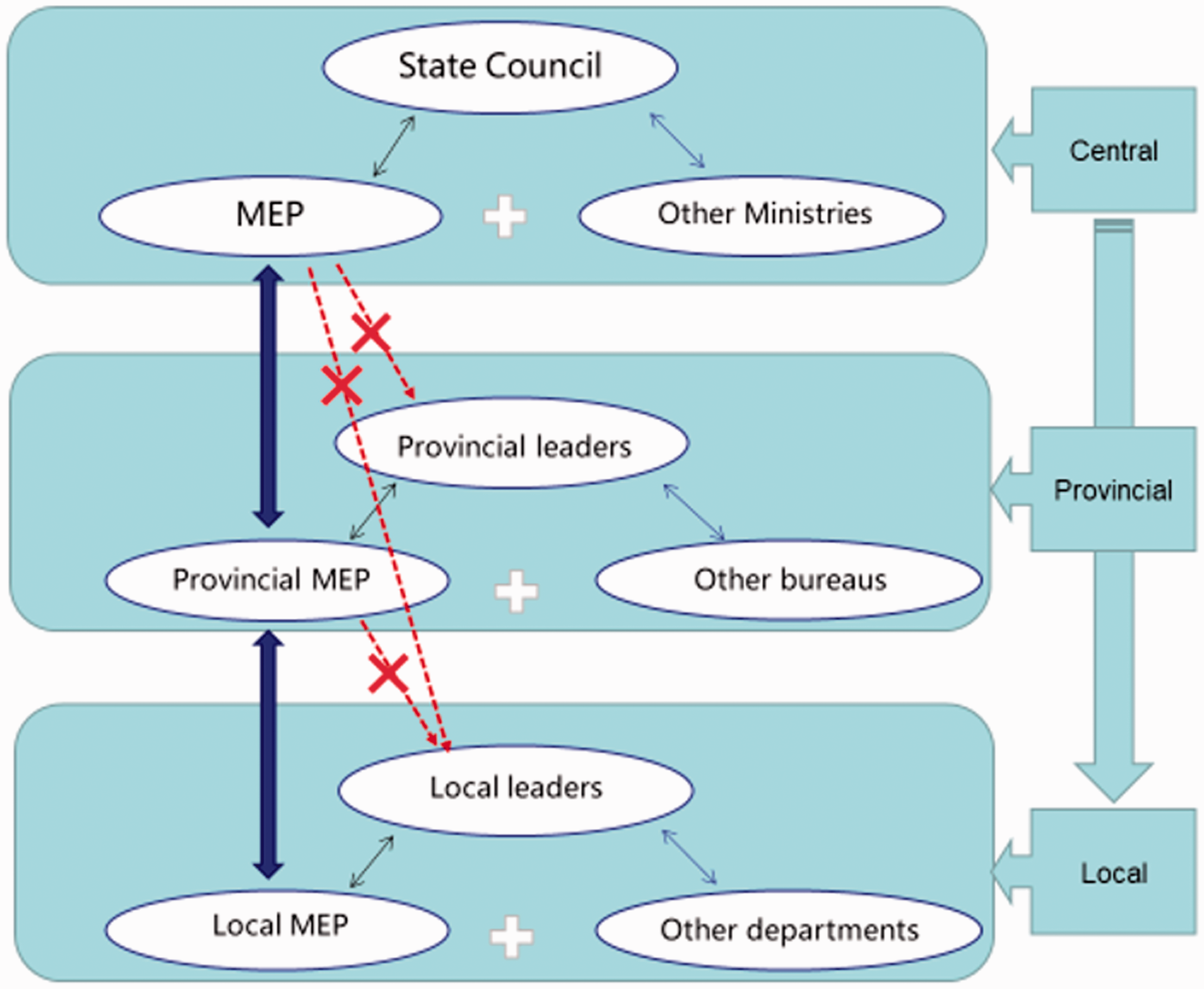
Vertical and Horizontal Regulatory System (tiao/kuai) Before Institutional Reforms.
Policy Developments to Strengthen the Role of Central Environmental Governance.
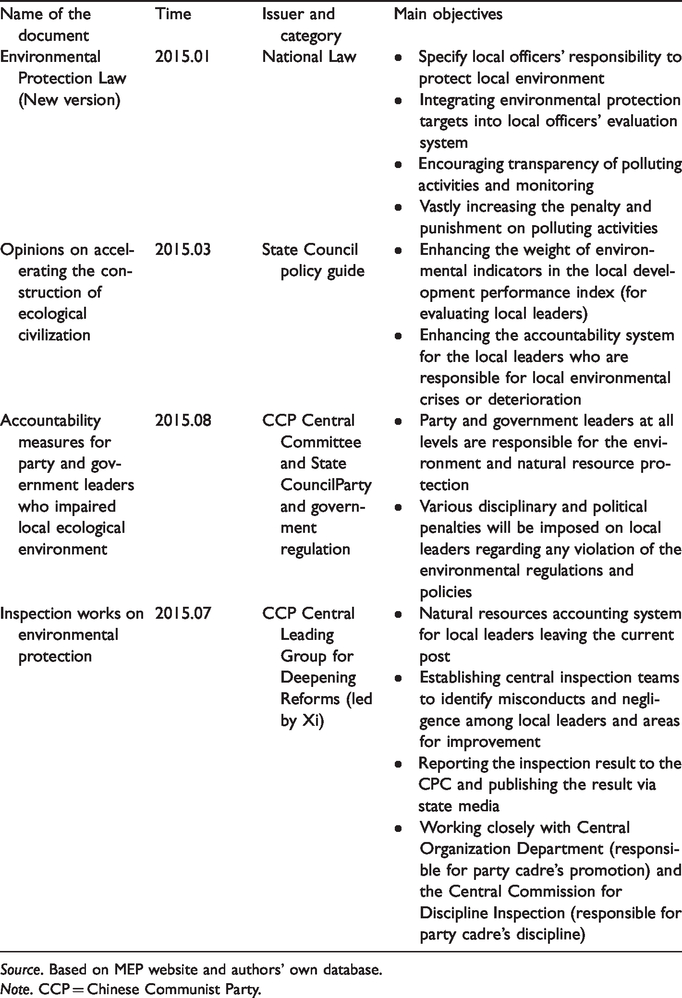
Source. Based on MEP website and authors’ own database.
Note. CCP = Chinese Communist Party.
Based on these new regulations, existing six regional inspection centers under MEP were upgraded as formal inspection bureaus to assume the responsibilities of inspecting local works in East, North, South, South West, North West, and North East regions of China. Since the inception of the system, all localities received at least one round of central inspections and several rounds of provincial inspections. Interviews reveal that central inspection team often comprises 20 to 30 inspectors and is led by minister-level MEP officers from Beijing.
The inspection work often lasts about one month, first at provincial level and then at city or even county level. Procedures of inspection include three stages. First, prior to the formal inspection, some inspectors are sent to conduct a field investigation without notifying local government. Information and evidence of local environmental problems are gathered in advance before the inspection is formally launched. Second, once the inspection team arrives at the locality, interviews with the local government leaders and various officers will be conducted, whereas telephone and email contacts of the central inspection team will be open to the public to welcome disclosure of local environmental problems. All the public complaints will be transferred to the local leaders with a request of urgent respond. The results will then be published through local media. The inspections often comprise both provincial-level and city- (or even county-) level investigation. 2
For those most significant pollution sources that are well known by the local residents but protected by the local leaders, the effect of inspection from higher officials is immediate and straightforward. Inspections are always treated by local leaders with paramount attention, as anyone who failed to resolve the problems revealed during the inspection would be held accountable immediately. Many long-plagued issues have been resolved so quickly. For example, the relocation of our highly polluting chemical factories had been delayed for so many years. Yet once central inspection teams raised this issue, all of them moved into the industrial parks almost instantly. —Interview from a city-level environmental officer
The aim of inspection: Holding local leaders accountable
The newly established inspection system is a highly politicized process with the aide from two most powerful CCP organs, known as the Organization Department and the Central Commission for Discipline Inspection, who send their officers to join different inspection teams. 3 Any local leaders with misconduct or negligence on environmental protection may face immediate demotion or removal, plus possible corruption investigation as commonly associated with protectionist behaviors. The final inspection report will also be reviewed by these two CCP organizations if any further staffing change or anticorruption investigations are needed as following up measures. Such arrangement gives clear signals to the local leaders that they would be held accountable and their political career will be affected for not meeting environmental regulation and targets. For the local leaders, clear messages regarding promotion and accountability are usually highly valued, and our field investigation illustrates notable attitude changes among local leaders in prioritizing environmental protection among other issues.
The central inspection system is not an entirely new experiment, as previously MEP had been dispatching small inspection teams occasionally since 2007, mainly to press local environmental officers to achieve pollution control targets set out at central level (Mol, 2009). Such target-driven inspections often led to temporary closure of polluting industrial activities, yet its transitory effects and the lack of consistency are obvious. The newly institutionalized central inspection system, however, shifts the inspection focus from the polluting enterprises to the highest ranking party and government leaders (dangzheng yiba shou, 党政一把手) and makes these local leaders, rather than polluting enterprises, accountable for environmental problems. It is clear to us that the main job of central and provincial environmental officers now is to supervise local political leaders and managing local environmental officers, whereas city level environmental officers’ main job is to supervise and monitor polluting enterprises. —Interview with a provincial environmental officer
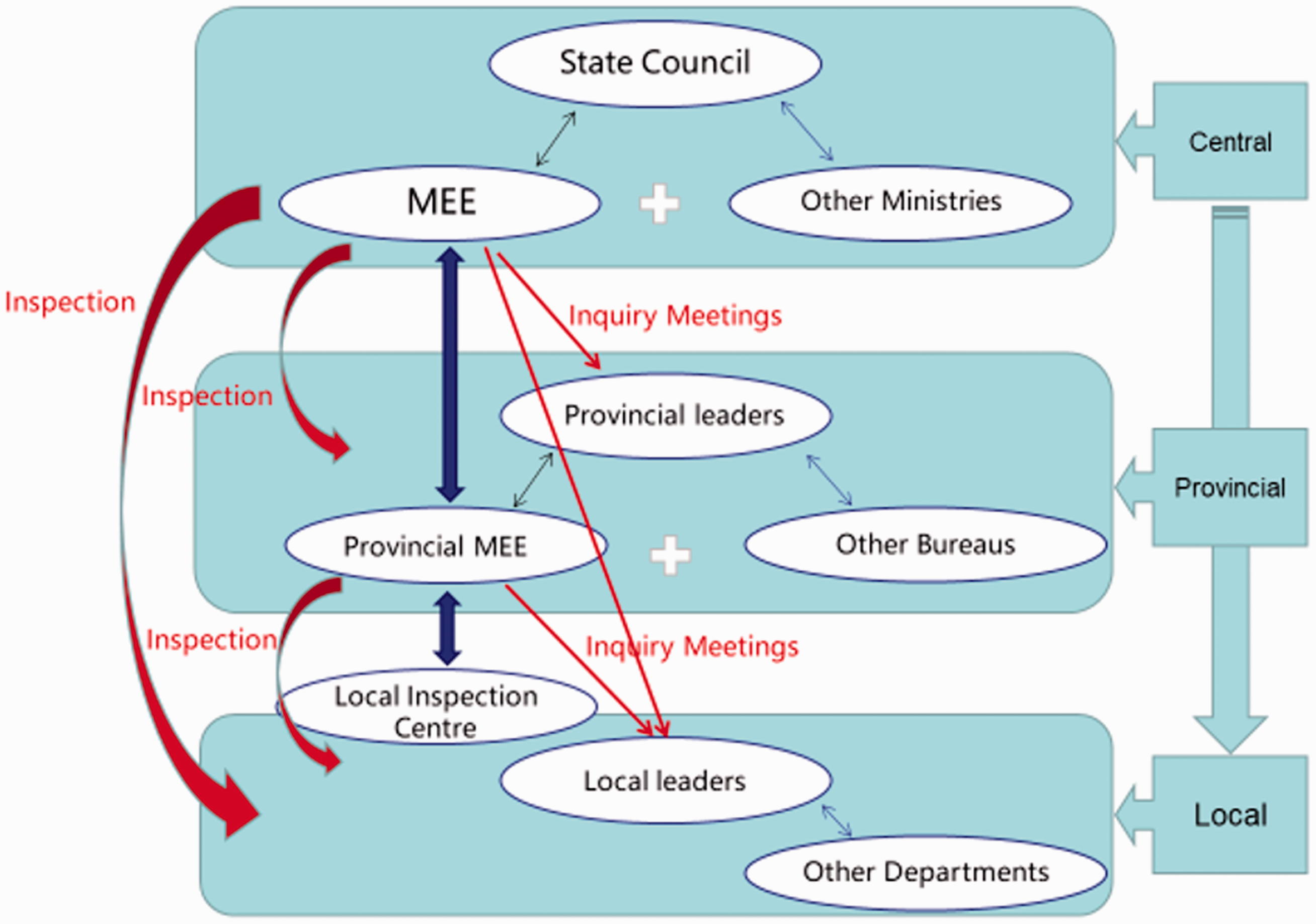
Vertical and Horizontal Regulatory System (tiao/kuai) After Institutional Reforms.
Throughout my career there were so many times that once we decided to penalize a polluting activity, a senior officer would appear or ring us to ask (demand) withdraw our decisions. Now such intervention is rare as these government leaders will be held accountable for protecting these polluting enterprises. They would no longer be willing to shelter these polluting enterprises by risking their own political positions.
—Interview with a county MEP officer
Process of inspection: A total populist approach
Traditionally, a typical challenge for authoritarian regimes is the asymmetric information between local and central officers. Central officers have to rely on local offices to provide pollution data and information for making various long-term and midterm plans and policy decisions, yet the data are often found incomplete or falsified to either cover up or exaggerate local environmental problems (Andrews, 2008; Ghanem & Zhang, 2014). As a result, policy targets based on inaccurate information became either too conservative or unrealistic. In addressing this problem, current central inspection teams adopted a “total grassroots approach” that relies on local residents’ complaints or tip-offs as the major method to collect real information on environmental problems. These complaints are often in the form of emails, phone calls, and direct visits. Since the establishment of the inspection system, the number of complaints and the percentage of resolved cases appear to be the most important criteria for evaluating local environmental performance. “Everything else needs to be set aside to make sure those complaints transferred from the inspection team are dealt with utmost priority. This is a massive pressure on our workload” (interview with a local environmental officer in Shandong).
Such an approach changed the priority of local environmental offices that was traditionally mainly driven by meeting various pollution reduction targets. The change toward a grassroots approach also shows central government’s concern regarding the growing petitions and protests in the past decades regarding various environmental concerns across the country. Not only is the scale and frequency of these protests growing, but so are people’s innovative ways to organize these protests (Steinhardt & Wu, 2016). Therefore, one of the key tasks for the central inspection teams is to identify the major grievances among local residents and prevent these concerns from being escalated into mass incidents, petition visits, or street protests. These inspections consequently contributed to local social stability by harnessing local government heads to deal with residents’ complaints in a more serious manner. Besides grassroot tip-off, another source of information is from independent field investigations of the pollution sites without previous notification or unaccompanied by the local officers. Such arrangement aims to avoid collusion between polluting industries and local officers in advance. Many patrols are intentionally scheduled during the late evenings because that is when many polluting facilities are operating at full scale, under the pressure of increasing surveillance in the daytime.
Limitation of inspections: Lack of focus, coordination, and trust
Effective policy implementation requires integrating central demand, local agency, and public participation (Ahlers & Schubert, 2015). The central inspection system is largely implemented in a coercive manner that involves little negotiation and bargaining process between central inspectors and local government officers. In addition, collecting firsthand pollution information through local residents’ revelations of the problems or inspectors’ primary investigations indeed help to reduce the information asymmetry problem in the principal–agent dilemma. Yet, such total populist approach also bears the risk of having a too diversified agenda for local environmental protections. Some local environmental officers believe that not all the complaints deserve utmost attention. “I am sometimes confused of which tasks are more important, addressing big problem or meeting small demands from the people” (interview with a city environmental officer).
Therefore, the current criteria that emphasize the number of residents’ complaint being solved, or quantity of officers being investigated or prosecuted, as the major achievements of these politicized and grassroot-based instrument can be misleading.
4
In addition, it is increasingly clear that local environmental officers are overwhelmed by the intense inspections from higher authority. Central inspection, provincial inspections, specific inspections on water, air, soil and wastes … Endless inspections year round. It took 2 to 3 months for us to prepare and deal with each inspection. We have 40 people and there is no capacity to deal with requests from inspection teams. Our normal works are severely interrupted. Some counties now recruit people from polluting enterprises to write inspection reports, which obviously have conflict of interests and may lead to collusion. —Interview with a county environmental officer
Central Inquiry Meetings
The central inspection system is by nature a preventive measure to identify minor negligence or dereliction in implementing environmental regulations and safeguarding local environmental quality. However, if serious environmental problems indeed occur, central or provincial officers can apply another innovative administrative measure, known as environmental inquiry meetings. These inquiry meetings were previously experimented at various local MEP bureaus, mainly to press local polluting enterprises in compliance with environmental regulations. Since 2014, such local experiments were institutionalized and legitimized at the central level with formal rules and procedures (MEP, 2014). The central inquiry meetings, however, are not targeting local enterprises but local government and party heads, who are summoned to meet with MEP officers in Beijing or provincial centers. The inquiry meetings are organized if the following problems are noted by MEP: failure to meet central environmental regulations, standards, or targets; serious and health-threatening pollution incidents; mass protest on environmental issues; damage of ecological resources or biodiversity; forging environmental data; and violating environmental law or its enforcement (MEP, 2014). In theory, substantial errors on nearly any aspect of environmental protection can trigger these inquiry meetings.
Most of the meetings will be chaired with a top central or provincial officer. During the meetings, official statements regarding the nature and severity and formal requests for specific actions will be announced. Local leaders are then expected to express their commitment to solve the problem timely, often accompanied with an open letter of apology and self-criticism (ziwo piping, 自我批评). The content of these inquiry meetings will then be documented and archived for future review and inspections, and the details of the meeting will be released for media coverage. At the time of writing, local leaders from 84 localities have been summoned to these inquiry meetings since 2015 (see Figure 3), among which local government heads from Hebei, Shanxi, and Henan Provinces are the most common attendees of these meetings (see Figure 4), and the high level of outdoor ambient air pollution appears to be the most common cause to induce these meetings.
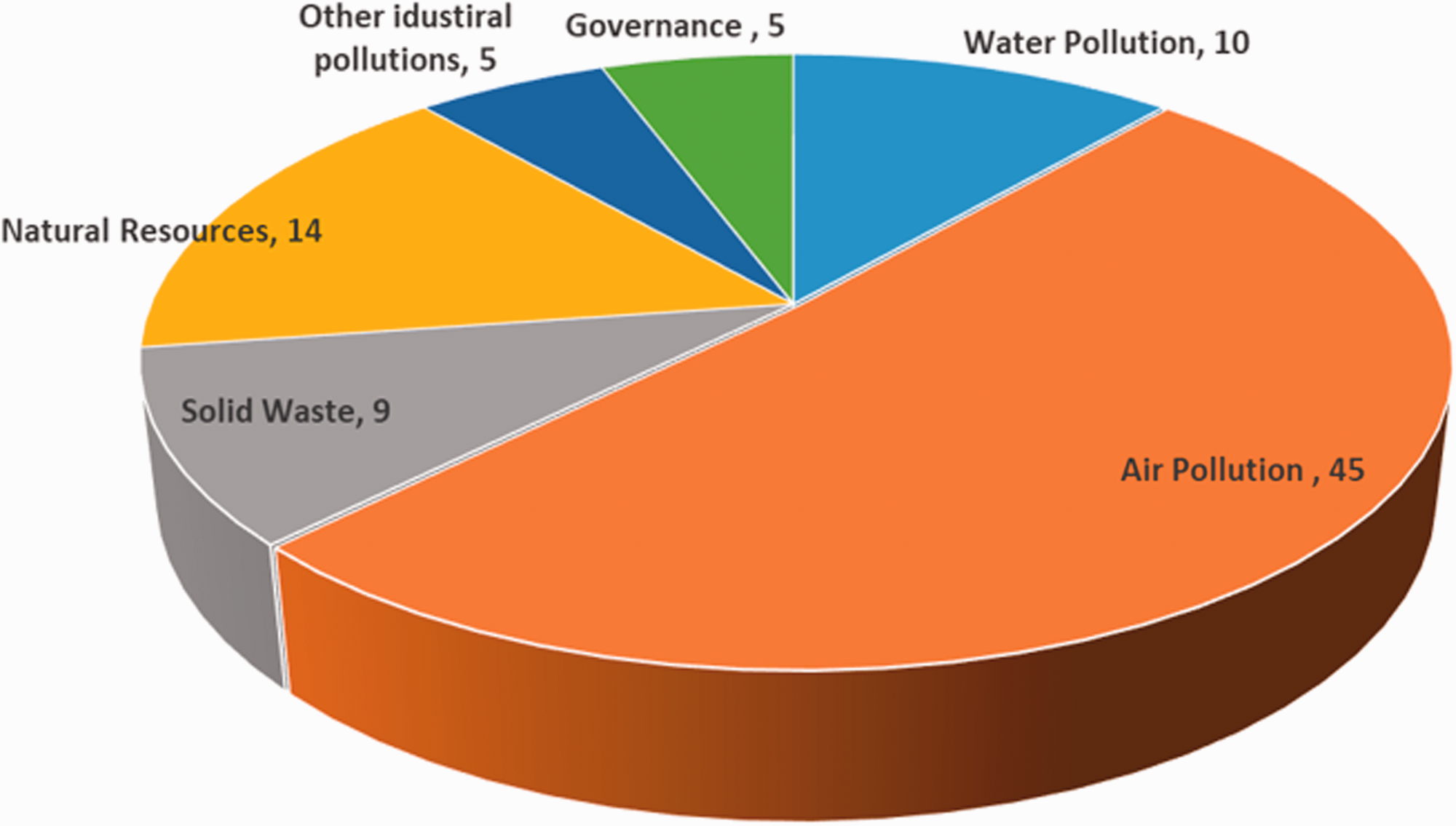
Number of Inquiry Meetings by Various Issues by 2018.
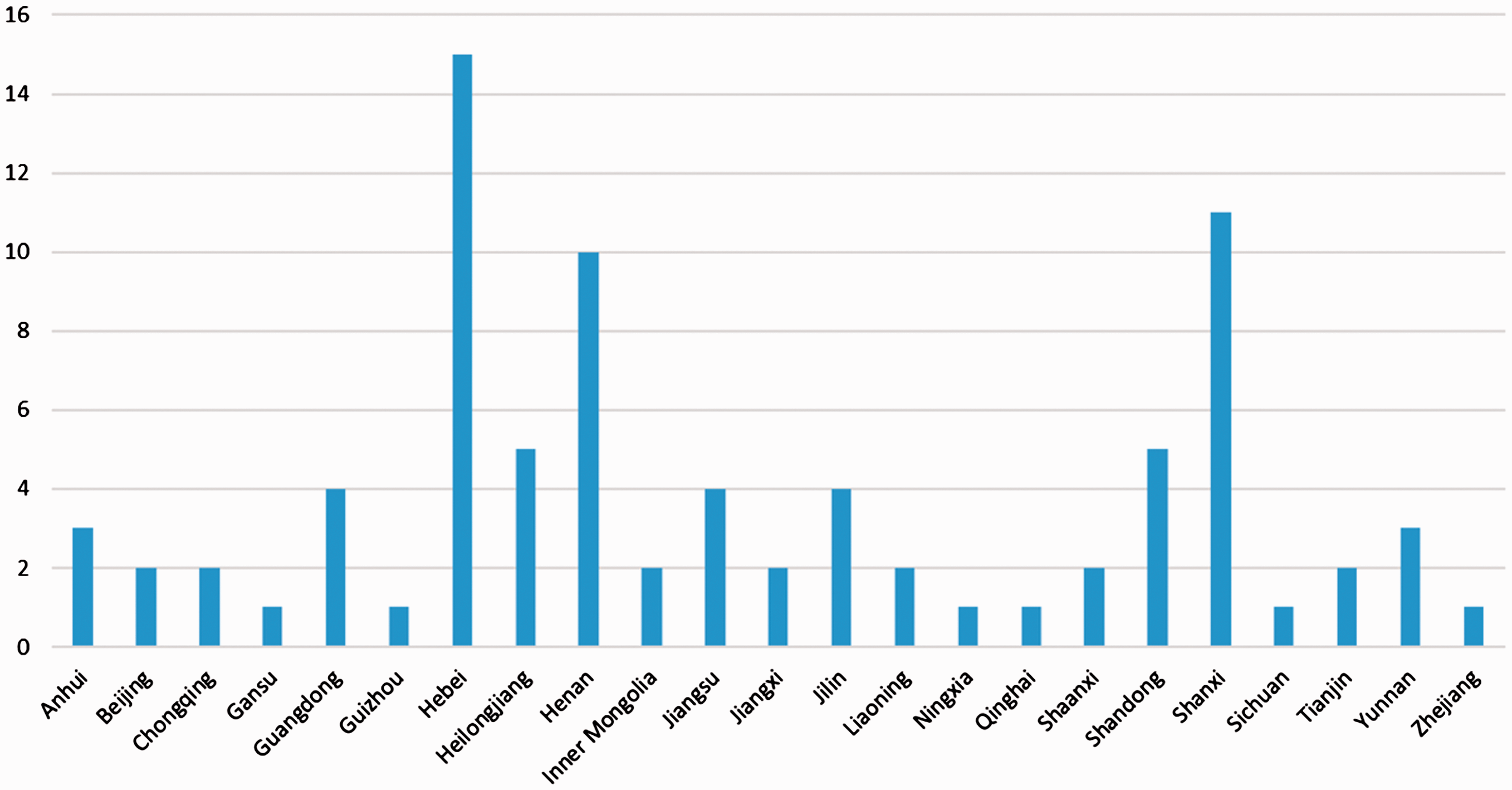
Inquiry Meetings (by provinces) Between 2016 and 2018.
The aim of the inquiry meeting: Establishing the commanding chain
On the surface, inquiry meetings are only informal discussions between central MEP officers and local government heads over specific environment problem, which can hardly be labelled as an innovation. Yet in reality, such institutionalized arrangement has a profound impact in terms of restructuring the influence chain among central, provincial, and local bureaucrats (see Figure 2). At the outset, it aims to further enhance the power of central or provincial MEP officers on the vertical chain over local political leaders on the horizontal cluster. As explained in previous sections, MEP in Beijing or different provincial capitals had limited communication channels and influence over local political leaders before these reforms, who are de facto the commanders of local bureaucratic clusters that possess full administrative power over various issues with environmental protection only part of their duties. Therefore, for any environmental problem emerging at the local level, central or provincial MEP officers can only urge its local MEP branches tortuously to solve the problem because there is no direct commanding links with the government heads. In the political hierarchy, most province leaders have the same ranking with the central or provincial MEP directors so that it is nearly impossible to establish any direct command chain between these two groups of officers. The inquiry meetings are therefore designed to set up a clear commanding route so that central MEP officers can overpass the various hurdles within the complex political system to give direct orders to local political leaders.
The inquiry meetings also help MEP officers in Beijing to challenge city- or even county-level leaders directly, without going through provincial governments. Such cross-level arrangement is unusual in China’s strictly hierarchical system, where central officers are found more often to delegate their power to the provincial officers to manage city- or county-level issues. As a result, the presence of high-ranking MEP officers in these inquiry meetings put further pressure on the city or county leaders to address the problems in a more serious manner. Previously, long command chains through levels of administrative hierarchies were not only inefficient but also gave lower level officers the impression that local environmental problems can be obscured from central surveillance. The inquiry meetings prove that these local problems are indeed visible from Beijing (partially thanks to the central inspection system elaborated in the previous section), which consequently urges lower level officers to strengthen their enforcement. Our city ranked the “bottom three” in the province in terms of air quality in 2018. The mayor was warned (by officers in Beijing) to improve it in the first quarter of 2019. We did not make it, so the inquiry meeting soon followed. During that meeting, our mayor and vice mayor (responsible for environmental protection) both attended and vowed to lift the city out of the bottom rank in air pollution index within 12 months, or they both would be held accountable with party discipline and even demoted. As a result, for the rest of 2019 mitigating air pollution has become the central task of our city … we tried every method and spent tremendous amount in the budget, and finally achieved this targets. —Interview with the director of local environmental bureau
Addressing the deep-rooted causes of local protectionism
Like central inspections, these inquiry meetings are designed to target mainly the top government officials (mayors or party secretaries). Central or provincial MEP officers are no longer addressing a specific pollutant or polluter, but interrogating deep-rooted governance problems at the local level. Local government heads often have strong autonomy and influence in governing local enterprises since the marketization reforms in the 1980s, a phenomenon referred to as the local state corporatism (Oi, 1992). Particularly after the taxation reforms in 1994, local governments’ fiscal incomes are heavily dependent on local enterprises’ sales tax and value-added tax rather than central government’s budgetary allocation. Consequently, local enterprises that are generating most tax revenues are therefore protected by a corporatist state-enterprise relationship. To disrupt such bond is believed as the prerequisite to alter the behavior of polluting enterprises, and the inquiry meetings are therefore designed to urge local political leaders to change their protective attitude, which may have tremendous impact on previously protected enterprises too. Previously the biggest tax paying enterprises are really difficult to touch. They seldom cooperate with our environmental officers. Now they all realise that it is serious issue, and they can no longer evade the regulations and have to make serious effort to clean up their pollutions. —Interview with a county environmental officer Since 2017, the deception on environmental data or sabotaging monitoring equipment are much rare compare to the previous years. The cost of doing particularly for large enterprises as such behaviors are written in the criminal law. Yet, for small enterprises remote monitoring is still very challenging. —Interview with a provincial environmental officer Many environmental issues are beyond our own authority. For example, dealing with environmental damages of illegal mining require support from Land and Resource Bureau, whereas shutting down polluting factories require approval from Market Regulation office. These are powerful agencies that previously do not respond to our request for help. After the inquiry meeting, the mayor now replaced the deputy mayor as the commander for environmental protection, so all other agencies are mobilised to address environmental issues. —Interview with a city environmental officer
Transparency with Chinese characteristics
Enhancing transparency has long been written in MEP’s policies (MEP, 2008). It is believed that local states are the least trusted sources to disclose environmental information due to their protectionist attitude toward polluting enterprises (He et al., 2014). The inquiry meetings are designed to address this acute problem by revealing the content of these meetings via media coverage and MEP’s official website. Media reporters are invited to attend and audit some meetings and then broadcast their interview with the local leaders after the meetings. This “shame and name” strategy is not rare in other countries (Mol, 2009), but in China, it is seldom used upon government officials. It hence created widespread pressure for those who were summoned to attend inquiry meetings and then interviewed in front of the national television.
However, there are concerns that the impacts of media exposure would eventually decrease once these inquiry meetings became a common practice (Procurational Daily, 2017). As the number of local government heads involved in these meetings is increasing, the pressure on individual leader is somehow diminished. The public attention to these meetings is also waning due to the pervasiveness of these incidents. In addition, due to the heavy workload of MEP, recent inquiry meetings are often organized as group meetings with several local leaders being inquired simultaneously (People’s Daily, 2018). Although the group meetings allow different localities to learn from each other’s lessons over specific issue, the pressure on individual officers is significantly reduced as the problems are deemed as prevalence across various localities.
The inquiry meetings are essentially straightforward admonition that involves little negotiation or bargaining between the central environmental officers and local political leaders. These meetings also reflect a trend of China’s environmental governance in recent years, which is characterized by mixed features of tightening central surveillance and enhancing policy transparency, as in the past decade the public have been provided with more information but are given less voice (Zhang et al., 2016). The central inquiry meetings disclosed some information to the public, but the supervisory powers of these local political leaders are still in the hands of the central government. Residents are normally obscured to the follow-up measures after these meetings, and they do not have any meaningful impacts on decision making to rein the inquired politicians or polluting industries.
Discussion: Toward a New Central–Local Power Relation?
In March 2018, the State Council announced the plan to establish a new MEE based on the previous MEP and the other five government departments. The enhanced MEE will absorb other regulatory functions such as climate change from other ministries and become the most powerful central custodian administration on environment and ecological resources in the history of China’s environmental governance. 5 MEE also intends to take back the control over local environmental offices from the local government heads. Since 2016, piloting experiments were launched to strengthen provincial control over city- or county-level environmental offices by controlling these offices’ fiscal budget and staff promotion. Under newly established MEE, previous local MEP offices are given a new title of Environmental Inspection Centre or Enforcement Administration (see Figure 2) to act as operational arms of regional or provincial inspection bureaus of MEE. 6 These upgraded inspection bureaus at city and county levels are designed to supervising polluting enterprises, monitoring environmental qualities, and enforcing environmental regulations. 7 The central inspections and inquiry meetings mentioned in previous sections are hence formally institutionalized and strengthened with local environmental officers gradually being separated from local bureaucratic cluster.
However, such efforts created highly divided opinions among local environmental officers. Some are pleased to see their augmented status and autonomy as one interviewee describe local environmental officers now as people possess “real power” (shiquan or 实权) with superiority of over other local government departments. However, others expressed concerns regarding their future career prospects within the local political system. In China, local government officers can usually be transferred and promoted among various government departments. Yet, such career path is now severed for environmental officers who are stripped off the local officialdom to work as mere agents of central or provincial MEE. In their (Environmental Inspection Centre) first round of recruitment, nobody is willing to apply. Provincial leaders had to come to our county office to encourage everyone to apply for their posts. Working for the superior (provincial) government is not appealing because our families and networks are here. —Interview with a county environmental officer
From the institutional experiments such as central inspections and inquiry meetings, to a newly establishing MEE and its local apparatus, the focus of China’s recent reforms on environmental governance has been regaining the control over local governments leaders and environmental officers (Chen & Lees, 2018). The core purpose is to hold local leaders accountable for their notorious local protectionism on polluting entities and integrate local environmental officers into the vertical command chain. Consequently, the whole central–local governance system is gradually reshaped so that central and provincial MEE offices do have stronger control on both local leaders and environmental officers. The ultimate purpose of the ongoing reforms seems to create centralized, independent, and professional inspection and monitor teams for pollution control and natural resource management across the country. It shows that Beijing has gradually given up the direct surveillance of polluting enterprises and prefer pulling the strings indirectly, yet more stringently, via local governments via party disciplines and populist tip-offs, and media exposures.
However, the current approach seems to be relying purely on “sticks” instead of “carrots,” with all firepower particularly on the local government leaders, who are usually not the experts on governing environmental problems and tend to apply immediate (inappropriate) fix due to mounting pressure from Beijing.The inspections and inquiry meetings are implemented in a rather coercive style with party disciplinary penalties as the ultimate weapon, which created an instant and enormous impact on the effectiveness of local environmental performance (Li et al., 2020). Previous studies illustrated the absence of positive incentives to encourage local government officials to enforce environmental policies, particularly related to their career progression, economic benefits, or moral or symbolic attainments (Ran, 2013), which are still absent at least from our field research. There are some rewards for the top performing cities or counties, including cash and title such as a green city or green GDP. But these are rather symbolic, most of the localities are driven by the pressure of accountability concerns rather than these rewards. —Interview with a county environmental officer Our director (as head of Environmental Inspection Centre) has just resigned after taking the job less than a year. He admitted that the pressure is too big. No matter how hard you try, no matter what you have achieved, one mistake, one tip-off, or one sudden environmental incident can ruin all your previous work. —Interview with a city environmental officer
In the past decades, Chinese government introduces several public participation and deliberation channels, such as public hearing meetings and online policy feedback window, with mixed results (Enserink & Koppenjan, 2007; He & Thøgersen, 2010; He & Warren, 2011; Johnson, 2010; Zhang, 2013). But none of these instruments is applied during the design and implementation on inspections and inquiry meeting system. The policy process is more like an internal disciplinary procedure within CCP and government officers, which is only partially transparent to the outsiders. The enclosed nature of these institutional arrangements is likely to reduce people’s high expectation on these new reforms.
Last, the highly politicized environmental governance can further limit the role or formal legal framework in governing China environmental crisis. In my heart, I wish that eventually we don’t have to use these political interventions to get our job done. We have comprehensive set of environmental laws, but many clauses are vague and not practical (接地气), so it is difficult to enforce them on the ground … These inspections and inquiry meetings can be written in the law regarding when to use and how to use them, reducing randomness and uncertainty. —Interview with a city environmental officer
Conclusion: Fixing Authoritarian Environmentalism
Accountability is Achilles, heel of authoritarian environmental governance as policy implementation is constantly jeopardized by frontline environmental officers and local government leaders who are supposed to protect local environment. Although fragmented interest is prevalence and unavoidable in most political systems, the key challenge is how to hold polluting and protectionist behaviors accountable and to avoid a situation that so many policy outputs are produced to provide so little meaningful outcome (Ahlers & Shen, 2018; Gilley, 2012). Chinese central government in the past few years tackled this fundamental challenge by reshaping its existing central–local decision-making chains in the environmental governance sector via new institutions such as inspections and inquiry meetings, which presents a rather mixed outcome. On one hand, party discipline is used to hold protectionist local government leaders accountable, accompanied by a populist approach to reduce asymmetric information between principal and agent. The newly created environmental ministry in Beijing is also found to regain control over local environmental offices from local bureaucratic system. On the other hand, trust between central, provincial, and local officers is significantly undermined under this intensified cat-and-mouse game. Party disciplines can be far less predictable and sometimes counterproductive compared with rule-based legal systems.
Two particular concerns arise, which may deserve further investigation. First, as local leaders are held accountable and forced to compete with each other on environmental performance, interlocality cooperation is likely to become more difficult. Yet many environmental problems are cross-boundary and require coordinated regional efforts. The second uncertainty is associated with the fact that current round of institutional reforms is based on Chinese top leader’s strong determination for addressing environmental crisis. However, the persistence of such strong commitment is hard to predict, particularly due to the drastically changing economic outlook. Although Chinese state media and central officers keep reassuring the public that tougher environmental policies will persist (Sina News, 2019), many suspect the strings will be eventually relaxed if economic situations worsen particularly due to the impacts of the COVID-19 pandemic. Even before the epidemic outbreak in December 2019, the year-on-year target for air pollution reduction has been slashed back to only 3% by MEE, comparing with 15% for the previous year (Financial Times, 2018). The institutional reforms based on the goodwill of top leaders tend to be momentary and instable compared with rule-based system.
Footnotes
Acknowledgments
Many thanks to Hubert Schmitz for his comments on an earlier draft of this manuscript. We would like to thank Ruby Utting for the excellent research assistance. We also very much appreciate the constructive feedback from five anonymous reviewers and the editor, who contributed significant improvements to the manuscript.
Declaration of Conflicting Interests
The authors declared no potential conflicts of interest with respect to the research, authorship, and/or publication of this article.
Funding
The authors received no financial support for the research, authorship, and/or publication of this article.
