




Abstract
For several decades, national environmental framework laws have come into existence to define its citizens’ environmental rights and duties, as well as express how the government will manage and protect the environment. However, previous research has not considered how a nation’s highest form of law promising environmental protection and management conveys its role or supports relevant parties. To fill this gap, we do a narrative analysis to see what themes emerged in 44 national environmental framework laws across the world. The main themes are (1) Rights and responsibilities of citizens and corporations, (2) Rights of the natural environment, (3) Environmental knowledge, (4) Governing the natural environment, and (5) External influences. Overall, we argue that the narratives we observed in the national environmental framework laws helps shape and reify the existing human domination of the natural environment for our own benefit and survival under the guise of protection.
Keywords
Introduction
Beginning in the 1970s, increased global attention to environmental issues, largely resulting from globalization, led to the proliferation of environmental laws (Yang & Percival, 2009). In the last few decades, researchers have documented how the social contract between the citizen and the state across the world has been amended to include environmental citizenship—including the development of national environmental laws. Environmental citizenship, or the set of environmental rights and duties nations bestow upon their citizens through their laws, is expanding in countries across the world (McDonald & McCormack, 2021; Yazykova & Bruch, 2018). Previous research in the world society tradition shows that nations tended to develop national environmental framework laws in a top-down manner (Frank et al., 2000). In this explanation, global norms, generally perpetuated by and for the benefit of powerful global actors in affluent nations including the United Nations and international nongovernmental organizations, dictated the nation-state as the responsible body for environmental protection (Frank et al., 2000; Shorette et al., 2017). Of many avenues of influence, international environmental conventions and treaties helped communicate global environmental expectations, such as asserting norms of a nation’s interest in protecting the environment, as well as establishing material changes, including environmental ministries and environmental impact assessments (Haas & Sundgren, 1993; Meyer et al., 1997).
These global environmental norms have been reinterpreted and codified into national law across the majority of nations in the world over a relatively short period of time (Frank et al., 2000). Though this history presupposes the uniformity of national environmental laws, it does not necessitate the seriousness of a nation’s commitment to protecting the environment, nor does it imply standardization of environmental protection. In fact, several scholars have read and coded constitutions, other general national laws, and some environmental laws exploring the extent of environmental law expansion and find it improves the lives of citizens and helps protect natural environments (Barry, 2006; Boyd, 2012; Lewis, 2018). Still, other researchers argue such rights will not lead to changes for humans or the environment, especially if they do not challenge the existing social structures that tend to privilege the economy over individuals and natural environments (Gonzelez, 2015; Mwanga, 2022; Wellman, 2018).
While previous research hypothesized a specific frame these national laws follow, no research has tried to identify shared narratives among national environmental laws with regard to the law’s historical and national context in the larger global environmental rights regime. Thus, this research is important in helping to identify these, often abstract, global environmental norms in general, and the ways they are reinterpreted at the national level with respect to the national values, norms, level of wealth, colonial heritage, governance structure, natural disasters experienced, and time period, as well as many other factors shape the way in which the law is written, decided upon, and interpreted.
We expand this previous research by considering how national environmental framework laws codify environmental citizenship and natural environments. Diverging from previous research, such as Li et al. (2021) who focused on morality in a small sample of environmental laws, we analyze all laws in ecolex.org, the largest depository of environmental laws, that are basic or framework environmental protection laws. We established these criteria in an effort to analyze the general narratives in national environmental laws in terms of how they codify environmental citizenship and natural environments. Building on previous research in environmental citizenship, in our sample of 44 national environmental framework laws, we examine if and how this citizenship contrasts with the stated rights and duties of the economy, markets, and corporations broadly. Specifically, we conduct a narrative content analysis, using analytic methods to identify and interpret the “stories” in 44 national environmental framework laws across the world (Loseke, 2012). Generally converging with ideas from the world society tradition, we find five main themes: (1) Rights and responsibilities of citizens and corporations, (2) Rights of natural environments, (3) Environmental knowledge, (4) Governing natural environments, and (5) External influences, which support an overarching narrative that privileges that economy and its beneficiaries over individuals while justifying the exploitation of natural environments. We argue that these narratives help shape and reify the existing human domination of natural environments for human benefit and survival. The laws’ stated purpose of environmental protection and management packages environmental exploitation as not only excusable or justifiable but as an act of service.
Before exploring the themes that emerged from the laws and the narratives they support, we review theory concerning the juxtaposition of humans and natural environments, as well as literature analyzing this divide in other mediums. After that, we describe our sample of 44 laws, sampling procedure, and how we organized our coding structure to minimize author bias. We conclude by commenting on the overall isomorphism of the laws and provide several avenues for future research.
The Nature/Culture “Divide”
Within environmental sociology and global political economy, several researchers identify the tendency of societal narratives to privilege economy and its beneficiaries over individuals and natural environments. These insights include “ecological metabolic rift” (Clark et al., 2019; Foster, 1999; Marx, 1976; Moore, 2000), the “culture of capitalism” (Foster et al., 2011), “Anthropocene” versus “Capitalocene” (Malm, 2015; McBrian, 2016), “organized hypocrisy” (Sommer et al., 2017; Weaver, 2008), “green neoliberalism” (Bakker, 2010; Devine & Baca, 2020; Wissenburg, 2013), the “social construction of nature” (Durkheim, 1984; Gerber, 1997; Murphy, 1994), the “treadmill of production” (Besek & McGee, 2014; Gould et al., 2004); “human exceptionalism paradigm” and “new environmental paradigm” (Dunlap & Van Liere, 1978; Srinivasan & Kasturirangan, 2016), and many others.
Regarding the connections between society and nature, Norgaard (2018) calls for an inclusion of not only the sociological imagination but also an ecological imagination to see the relationships between human actions and their impacts on the Earth. By combining the two, we can begin examining the relationships within society that comprise “our environmentally damaging social structure” (171). The distinction between ecological and sociological imaginations mirrors not only the strict division between natural and social sciences as disciplines but also the Western bifurcation of nature and culture as separate domains. Erasing these divisions could flesh out relationships between natural environments and social life, and their impacts on one another. Utilizing the sociological imagination within an ecological context allows recognizing the role social structures create and perpetuate environmental issues.
Taken together, the aforementioned theories create critical conversations concerning the “nature/culture” divide (Altvater, 2016; Moore, 2016) and operate under the assumption that natural environments are only phenomenologically separate from human beings. The multidimensional process of this division involves defining “environment” as separate from daily human life and thus involves the mutual social construction of humanity and the environment as overlapping, yet diametrically opposed (Bauman, 1991; Smith, 2015). An alternative view, the new ecological paradigm posits that social life is necessarily intertwined with, shapes, and is shaped by, the environment (Dunlap & Van Liere, 1978). The environment is treated “as a social, or at best spatial, variable-devoid of any physical substance” (Michelson & Michelson, 1976, p. 13). By giving this ethereal meaning to “the environment,” it has proven difficult to build an argument for the importance of a sociological understanding between the environment and social.
The nature/culture divide began as a conversation among anthropologists concerning tensions between human and environmental realms (Bauer & Ellis, 2018; Greenwood & Stini, 1977). This quickly expanded to considerations of if these two spheres were distinct entities or inextricably intertwined (Bowring, 2015; Fox & Alldred, 2020; Mortenson, 2011). However, several critical scholars understand the nature/culture divide to be a façade manufactured to exploit an area’s resources. In this line of reasoning, nature/culture divide narratives can be part of ideology that helps further alienate humanity from their environments (Adorno & Horkheimer, 1944; Bauer & Ellis, 2018). Therefore, the question is not are these spheres different or how do they overlap, but rather, how did we create this divide, who benefits from it, and what existing social structures perpetuate and reify it.
The Culture of Capitalism
Accordingly, the current hierarchical/stratified relationship between humans and the environment justifies environmental exploitation and destruction, which is accompanied by a set of social practices, norms, values, and patterns of behavior. This process is driven by ideology from the culture of capitalism (Robbins, 2005). The culture of capitalism is the set of practices that naturalizes and essentializes socially constructed rules allowing the economic system of capitalism to flourish and seldom be questioned (Boström, 2020; Cutler, 2005).
Several scholars have focused on identifying artifacts of the “othering” process by which humans become “us” and natural environments become “them.” Documenting these processes uncovers layers of ideology that influence our social construction of the environment, providing insights into what language, metaphors, themes, and other social content goes unquestioned. This process of recognition helps render the norms surrounding humans’ relationship to the environment visible, so that we can acknowledge how these norms and values influence our relationship with the environment and what power structures benefit from these patterns.
Zerubavel’s (1996) islands of meaning describe the way that those in control of language ultimately control the “lumping and splitting” process, informing what is alike and different, ultimately influencing our actions. Categories inform dominant narratives along with their characters and moral evaluations, and how to interpret them (Holden et al., 2021). The bifurcation of culture and nature is one such dominant narrative, recognizing them as entirely separate domains. The ideology of the human exceptionalism paradigm supports this narrative (Dunlap & Van Liere, 1978). Ultimately, the narratives surrounding the nature/culture dichotomy allow for the continuation of environmental degradation as a requirement of the treadmill of capitalism.
For example, Doherty (2015) explains how TV weather broadcasts express a narrative of humans as dominant over natural environments through their rationalized/scientific attempts to measure weather and communicate how to adapt to or control the weather through umbrellas and coats. Doherty (2015) goes on to explain how weather is dramatized and demonized through the way it is discussed—creating a sense of the need to overcome the weather. This narrative presents the environment as dangerous, justifying environmental exploitation. This “us versus them” mentality can also be expressed in other mediums such as disease control and pest and wildlife management. For example, Besek and McGee (2014) find that economic development contributes to the establishment of invasive species and suggests that as nations focus more on economic concerns, they further alienate themselves from natural environments by demonizing some species despite the small annoyances such labeled species “commit” and despite the role of economic activities in the introduction of these species in a region.
Additionally, Gunster (2004) discusses vehicle advertisements as dominating nature and using “pristine images of a hyper-pure nature to motivate the use of a product that consumes excessive amounts of natural resources and emits high levels of pollutants” (1). Beyond the vehicle itself, these advertisements sell more abstract, desirable ideas of freedom, individualism, domination, consumption, and superiority. Distant and immediately traversable spaces create a gap in our understanding of the environmental consequences of our behavior; these technologies allow people to transcend time and space, embedded in the ideas of freedom, power, and consumption (Gould & Lewis, 2009). Through these narratives, consumers fall into a type of “technological somnambulism,” or the tendency to accept the use and spread of new technologies without question and without concern for natural resources (Capek, 2009).
Alongside this work, researchers have documented how representations of “the environment” in the media, law, and other areas have implications on how we treat, manage, or protect natural environments. Many argue the need to examine the values, ethics, attitudes, and behaviors that underpin our world’s environmental damage (Stuart et al., 2022). Thus, values that promote environmental protection, refute individual economic interests and economic growth, and focus on the needs of people (Holden et al., 2021) are central to adapting to and mitigating climate change (O’Neill & Gibbs, 2016). Furthermore, the distribution of responsibilities, rights, and mutual obligations between nations for environmental protection is essential to deal with these environmental issues equitably (Yazykova & Bruch, 2018).
While the formation and motivation of the nature/culture divide is complex, it is important to continue to recognize it in society and document it through empirical evidence. While media representations, quantitative evaluations, and survey research are commonly used to test the theory of the nature/culture divide, no research to our knowledge considers how national environmental protection and management framework laws may express the orientation of humans to natural environments. While these laws have been studied in other ways, most notably as explained above to document the expansion of environmental citizenship across nations (Barry, 2006; Boyd, 2012; Lewis, 2018; Yazykova & Bruch, 2018), they have not, to our knowledge, been analyzed in terms of narratives, how their narrator (the nation) represents the characters: environment, citizens, and economy, and the duties and responsibilities of these characters (Loseke, 2012).
Environmental Narratives and Power
Guided by Moore’s (2016) “Green Thought,” we are interested in how humans and human organizations fit within the larger web of life, rather than humanity’s separation from nature. Because states exist upon the surface of the earth, they are inherently environmental entities. For capital to use nature, the state seizes parts of the surface of the earth and controls it. The territorialization of the modern state delivers nature in various ways through place-based property regimes (Parenti, 2016). States define the use value of environmental processes and materials, which are then enforced by infrastructure, extraction, and interaction. The integration of sustainability policies requires governments to place a stronger emphasis on ecological concerns in economic governance (Moore, 2016).
The bifurcation of people and nature under the human exceptionalism paradigm relates to Said’s (1978) discussion of imaginative geography in the way that imaginative geographies are nothing more than representations of places that reflect the beliefs of those in power about those places. The ways in which we interpret and interact with the environment are created by those in power. Imaginative geography influences how we act toward certain places. This is what allows for the degradation of environmental resources because under the human exceptionalism paradigm, people are superior to the natural world despite how much they rely on it for their survival.
Nations are central to the regulatory process that conditions the operation, manipulation, and deployment of political, social, and economic power (Levi-Faur, 2017). Via globalization, capitalism is an international geopolitical system that regulates interactions among countries. Economies that paradoxically require infinite growth from finite resources are stuck on the treadmill of production, which requires environmental degradation in pursuit of economic growth and development “where their well-being is not improved by economic growth, yet the impacts of this pursuit of growth cause massive, unsustainable environmental damages” (Curran, 2017, p. 28). Societies driven by economic expansion are in an endless conflict with nature (Gunderson & Fyock, 2022; Schnaiberg, 1980). Here, the ends justify the means; profit and success outweigh environmental degradation (Porter, 2010). Environmental degradation is an essential part of the success of capitalism as an economic system (Clark et al., 2018; Stuart et al., 2022). For decades, this notion has been accepted and supported within the growth paradigm (Fisher & Jorgenson, 2019). For example, there are widespread narratives that actions taken to combat climate change will be bad for business and the economy, thus scaring people into continuing their support for the status quo for fear of their financial security (O’Neill & Gibbs, 2016; Schofer & Granados, 2006).
Fisher and Jorgenson (2019) apply theories of ecological modernization, world society, and reflexive modernization as “optimistic perspectives” to merge environmental protection and economic growth. In terms of ecological modernization, Barbosa (2009) notes that “transformation of state environmental policy is central in this institutional development” and “while the stewardship of the process would start in government, it would be transferred to the market” (39). The “‘re-enchantment of the world,’ in which there are endlessly new opportunities to consume” (Capek, 2009, p. 18), can be used to revisit the way we understand the treadmill of capitalism. Not only are there new opportunities to consume, but also opportunities for the creation of new technologies through ecological modernization that places emphasis on reforming or modernizing the current system rather than radically changing it. The ideology of this ecological paradigm allows for the understanding of social life and nature as intertwined and related and is perhaps the “switch” on the horizon, or a reflection of Beck’s “reflexive modernization,” that involves people and institutions reevaluating beliefs and practices in light of new information (Barbosa, 2009, p. 40). The former theories are built upon a world society theory in which various actors, including the state, market, and non-governmental organizations (NGOs) focus on the role of international institutional structures in shaping social change and environmental conditions (Fisher & Jorgenson, 2019).
While these theories of environmentalism are important, few researchers have focused on the presence of such narratives in national laws, which should be better analyzed to uncover how they characterize the protection and management of the environment. Laws provide a large amount of information on what nations value (Nurse & Grant, 2020). Laws are like a contract to the citizen, they say what governments will do, and what they expect of their people, and therefore may offer great material for narrative analysis (Franzosi, 1998; Riessman, 1993).
Analyzing laws will reveal what governments think about the environment society relations (Nurse & Grant, 2020). National laws are one of the highest forms of de facto judgment and can have cascading effects for the entire population (Bourdieu, 1973). Ultimately, these documents are an ideal way to see if and how we “other” the environment and may provide justifications for its destruction. Building on this work, we collect a sample of 44 national laws on environmental protection and management and analyzed them for major themes and values. The next section details our choice of focusing on national laws, how we collected our sample, and how we coded the documents.
Data and Methods
Country, law, and year the law was established or revised.
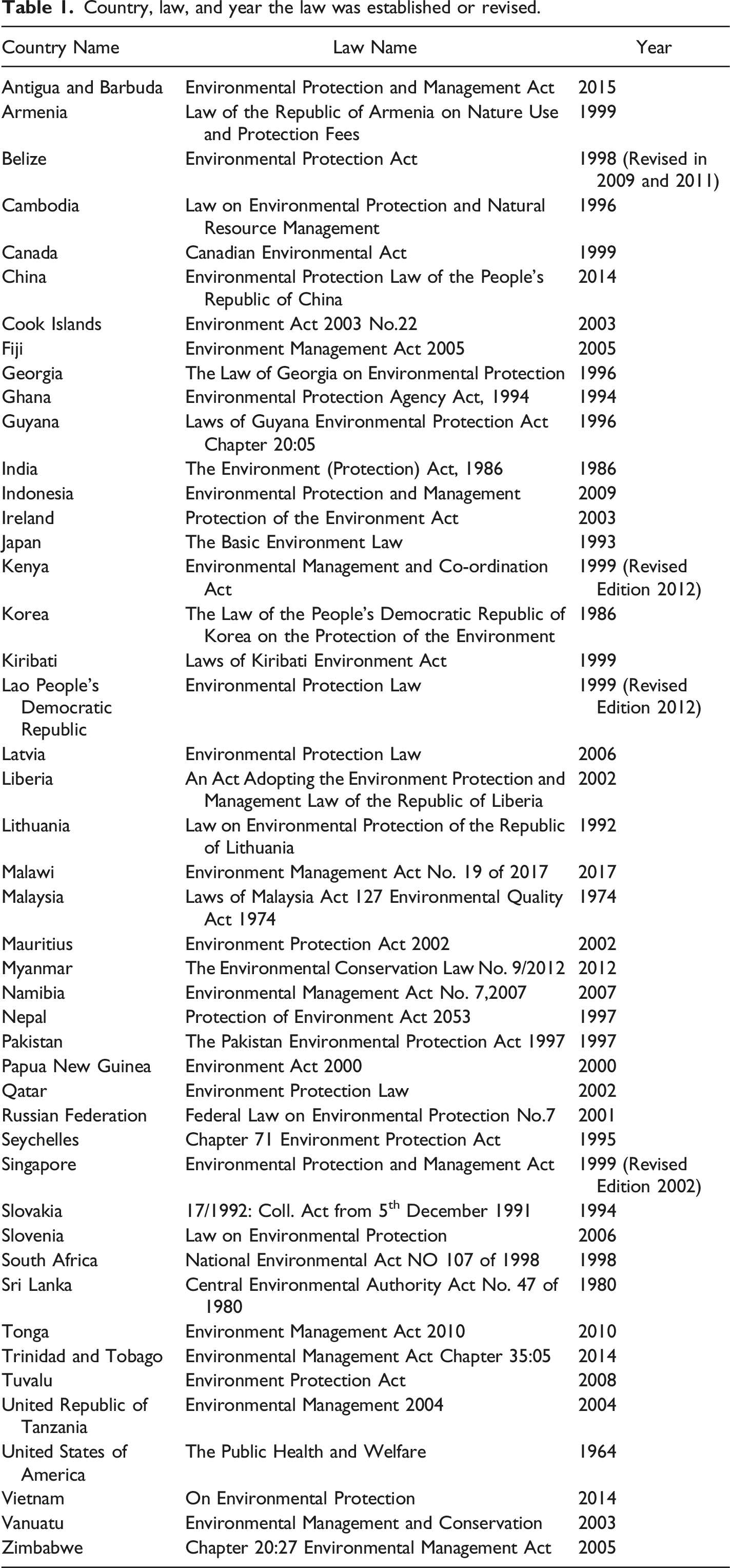
Table 2: Analysis Questions.

Five themes emerged: (1) Rights and responsibilities of citizens and corporations, (2) Rights of natural environments, (3) Environmental knowledge, (4) Governing natural environments, and (5) External influences. Following initial coding, the five themes were defined and refined. Next, all documents were reread and coded for the presence of each theme, and, if present, to what extent and how was it characterized. We gathered quotes from each document reflecting the themes. All quotes from the laws collected are available upon request.
Findings
All five themes were present to some extent in every law. Below, we review the guiding question for each theme and describe the scope of its inclusion in the laws. The themes below are not mutually exclusive and do not reflect the entirety of the laws. Instead, the themes are overlapping parts of an overarching narrative in the data privileging the economy and its beneficiaries over individuals and natural environments.
Rights and Responsibilities of Citizens and Corporations
Each country’s law outlines the roles and responsibilities of citizens and corporations toward the environment. While some countries are more general, others provide specific regulations holding citizens and corporations accountable to specific standards. For example, Pakistan’s Law: “Subject to the provisions of this Act and the rules and regulations made thereunder, no person shall operate a motor vehicle from which air pollutants or noise are being emitted in an amount, concentration or level which is in excess of the 66 [Punjab] Environmental Quality Standards.” An example of general standards is Tanzania’s Law: “Every person living in Tanzania shall have a stake and a duty to safeguard and enhance the environment and to inform the relevant authority of any activity and phenomenon that may affect the environment significantly.”
The language used to determine the roles and responsibilities of actors is a crucial element in understanding the positionality of states in environmental preservation and management (Altvater, 2016; Moore, 2016). Two aspects of the language indicate leniency toward corporations over individuals. First, despite the vast difference in the use of environmental resources and their impact by individuals versus corporations, there is indifference in the language used toward these groups. Second, where the roles and responsibilities of individuals and corporations are addressed separately, the laws use stricter language for implications of harming the environment by individuals and more relaxed language for corporations.
In addressing the roles of individuals in caring for and protecting the environment, the laws generally use stricter language to define responsibilities and limits. For example, in the US Law: “Federal agencies shall also encourage State and local agencies to adopt similar procedures for informing the public concerning their activities affecting the quality of the environment” (5219). The US emphasizes the role of the public in maintaining and improving the quality of the environment. On the other hand, the language used to connect corporations and the government on environmental matters is more mediatory. For instance, the US Law addresses the corporations more subtly by stating that the government must: “Identify and examine problems of the effects on the environment of industrial practices and the needs of industry for improvements in the quality of the environment, and recommend solutions to those problems” and “Provide liaison among members of the business and industrial community on environmental quality matters” (5220). The difference in the language used to address the two sets of actors suggests that the government can exercise more power over the citizens than on the corporations, even though corporations’ activities pose a more significant threat to the environment (Bryant & Bailey, 1997; Shandra et al., 2009). Though industries and companies pose significantly more threats, states tend to define stricter rules and duties for citizens in preserving the environment than corporations. Subsequently, it is easier for corporations to blanket their environmentally hazardous practices under periodic corporate social responsibility events. Such events allow for the continuation of what Figueroa and Mills (2008) characterize as the role of corporations in exaggerating the environmental socio-economic divide and racism—a form of discrimination in which corporations with political agency offer marginal compensation in low-income communities where they dump hazard.
The role of language in overlooking corporations and their harmful activities toward the environment is further noted in Malaysia’s Law stating: “No person shall, unless licensed, discharge environmentally hazardous substances, pollutants or wastes into the Malaysian waters in contravention of the acceptable conditions specified under section 21” (26). By using the word “person,” the law limits its decree to individuals and undermines the environmental impact of industrial and corporate activities. Moreover, the language and requirements mentioned subtly favor corporations as corporations have the means and justifications of obtaining a license. 1 Some states indicate in their laws that “person” entails any individual or group body including corporations, some states do not, leaving their laws exclusionary. We find just six states—Pakistan, Tanzania, U.S., China, Malaysia, and Mauritius—declare this inclusiveness.
Nonetheless, some states recognize the intertwining role of individuals and the economy and attempt to address the environmental needs inclusively and pluralistically. For example, Zimbabwe aims to “secure ecologically sustainable management and use of natural resources while promoting justifiable economic and social development” (44). 2 While the language used in these laws can be commended for being inclusive, they can also be critiqued for framing the roles and responsibilities of individuals and corporations around economic development.
States often hold actors accountable by setting neutral and fair accountability laws. For example, Vietnam’s Law states: “Any organization, family household or individual, who causes environmental pollution, emergencies, and degradation, is responsible to find remedial solutions, pay damages and assumes other responsibilities as stipulated by laws” (4). 3 Most commonly, the responsibility and accountability for preserving and managing the environment fall upon the owner of the property. This often reflects vagueness in environmental laws, making it difficult to assign concrete responsibility to the different actors in play. Vanuatu’s law states: “The landowners, or the management committee formed by the landowners or Director for the purpose, are responsible for the development and implementation of any conservation, protection or management plan established for a registered Community Conservation Area” (15). However, one challenge here is if the land is leased, neither party assumes the due responsibility of being considerate toward the environment. Holding an entity accountable becomes even more challenging when a transnational corporation is involved, as they exercise capital power over the government and can evade national laws.
Rights of Natural Environments
This theme concerns the rights that natural environments have and how they are discussed. In the laws, the environment is generally described as a resource to be utilized for human benefit and preserved for future generations rather than for its other values or its own sustenance. There is an emphasis on “fiscal responsibility” and “mitigation.” A status quo, “business as usual,” stance is taken on issues concerning environmental pollution. Rights of the environment are mainly observed in two overlapping themes: protection by the people for the people and protection in the form of conservation, preservation, and restoration.
The rights of the environment in the laws often seem to be overshadowed by the economic needs of the people. The economic needs of the people and corporations are directly or indirectly merged with the protection and rights of the environment. For example, Japan’s Law: “the State shall appropriately conduct surveys and research on the effectiveness of implementing such measures with regard to prevention of interference with environmental conservation and on the effects of such measures on Japanese economy” (5). Again, language plays a critical role in defining the relationship between humans and the environment. The language used in environmental laws remains anthropocentric and not ecocentric, making it difficult to address issues of climate change and environmental degradation. There is little recognition of the existence of the environment and its components before the advent of humans, their societies, and economies. Also, little attention is paid to the crucial role of the environment in sustaining the well-being and survival of the planet. We also find in some laws a blunt and inconsiderate reliance on the environment without recognition of the relationship between the planet and natural environments. 4
Overall, the primary rights of the environment, including its protection from exploitation and mistreatment, unimpeded from economic factors is sparsely mentioned. An example of such unrestricted protection was only found in Ireland: “environmental protection includes- (a) the prevention, limitation, elimination, abatement or reduction of environmental pollution, and (b) the preservation of the quality of the environment as a whole.” (11). In most laws, protection has an anthropocentric purpose; rarely does an entity design laws for the environment that prioritizes the environment over human needs and desires. Even when for aesthetic purpose, it serves for human recreation. 5
There is a lack of reciprocity in terms of what is extracted from the environment and what is returned to the environment. This imbalance between the rights of the people in their use of the environment and the rights of the environment is particularly evident in how the laws tend to make provisions for how its citizens can use the environment and less on how to care for it. Thus, this framing tends to reinforce a paternalistic outlook toward the environment, emphasizing the assumption that the environment exists solely for mankind’s benefit. Some common rights of the environment indicated in the laws include right to be free from degradation, right from excessive utilization, and right to recovery or restoration. Like Ireland’s efforts, Guyana “enacted environmental protection legislation, passed environmentally-related acts and laws, and embraced sustainable development goals” (Lakhan et al., 2000). We observed this progressive effort in our review of their law that puts in place rules to “restore natural environments by (i) rescuing and restoring all plants, animals and other organisms; (ii) cleaning up, removing or neutralizing the contaminant; (iii) restoring the air, land and water to the condition they were in before the discharge” (43).
It is rare in our study for states to recognize the rights of the environment and attempt to prioritize or balance its needs with those of their citizenry. These laws are not solely centered on human benefits but advocate for a reciprocal relationship between communities and their environment. Guyana’s and Ireland’s Laws attempt to balance the two. They recognize the consequences of overexploiting natural environments, or “the ‘avoidance’ principle: it is preferable to avoid environmental damage as it can be impossible or more expensive to repair rather than prevent damage” (Guyana, 21). An even more ideal example is Indonesia’s Law recognizing the negative impact of human activities on natural environments and recommending a holistic approach: “Since the rising global warming has caused climate change thus worsening the environmental quality, environmental protection and management are needed” (1). The law further identifies: “Environmental preservation shall be done through efforts: (a). conservation of natural resources; (b). reservation of natural resources; and/or c. conservation of atmosphere function. (16).”
The language used in Indonesia’s Law addresses the nature–culture divide that we find common in other laws. Our impression of Indonesia’s Environmental Law as comparatively more progressive supports literature that identifies Indonesian environmental laws as being both inclusive and specific, where the laws strengthen elements of environmental laws of other nations but customized them for Indonesia’s ecological and political-economic conditions (Bedner, 2008), making the laws sustainable.
Generally, governing bodies such as states or intergovernmental organization pass and create environmental laws. 6 In the case of natural environments, both the state and the people play an active role and are expected to grant rights to the environment and act accordingly. While the governing body sets the law, the people exercise it. However, as stated above, these acts of preservation and restoration of the environment are anthropocentric: For example, Korea’s Law defines the role of the state in environmental issues: “The State shall always show concern for protecting and managing the environment so as to provide the people with a healthy environment and hygienic work conditions… Protecting the environment is noble work to provide the popular masses with an environment for leading an independent and creative life.” 7
States tend to assume responsibilities related to protocols such as: Japan’s Law “The purpose of this law is to comprehensively and systematically promote policies for environmental conservation to ensure healthy and cultured living for both the present and future generations of the nation as well as to contribute to the welfare of mankind” (1) as a way of granting environment rights. As higher echelon actors, states exercise power and assume greater responsibility toward natural environments, part of which incudes passing laws, developing projects, creating policies, and disseminating information. 8
Another established environmental right is the need to study the environment. For the purposes of best utilization, state laws recognize the need to study natural environments. Ghana’s Law: “to promote studies, research, surveys and analyses for the improvement and protection of the environment and the maintenance of sound ecological systems in the Republic; ” (3). We further explore this right as our next theme.
Environmental Knowledge
With the increasing need for sustainable environments, states in collaboration with scholarly communities and NGOs justify the need to build and expand our knowledge about sustainability, focusing on causes of environmental degradation and preservation. Few laws focus on incorporating different types of knowledge when concerning the environment. A notable exception is Canada’s Law, stating it will “apply knowledge, including traditional aboriginal knowledge, science and technology, to identify and resolve environmental problems” (21).
Other nations tend to only mention the importance of environmental knowledge upon the depletion of the environment. As the US Law indicates: As concern with the condition of our physical environment has intensified, it has become increasingly clear that we need to know more about the total environment—land, water and air. It also has become increasingly clear that only by reorganizing our Federal efforts can we develop that knowledge, and effectively ensure the protection, development and enhancement of the total environment itself (5214).
The common purpose of collecting environmental knowledge reflected across most laws is to benefit people and the economy by learning the extents to which environmental resources can be extracted without causing depletion. For example, South Africa’s Law states: “Community wellbeing and empowerment must be promoted through environmental education, the raising of environmental awareness, the sharing of knowledge and experience and other appropriate means” (11). Similarly, Malawi’s Law: “promoting scientific research, technological development and training relating to the protection and management of the environment or the conservation and sustainable utilization of natural resources” (13).
Knowledge for the economy and national development is a recurring narrative, echoing the culture of capitalism. An example is Kenya’s Law stating: “The national environment action plan shall - (d) recommend methods for building national awareness through environmental education on the importance of sustainable use of the environment and natural resources for national development” (33). 9
While the laws generally point to and encourage numerous ways of generating environmental knowledge, the most common strategy tends to be the appointment of experts to conduct research. There exist both state-appointed environmental committees and non-state environmental actors, such as specialized NGOs. In both cases, the governing authority tries to appoint experts in the field, though does not detail what constitutes experts. Cook Island’s Law defines the procedure in environmental research: “The Minister shall not appoint any person to an Island Environment Authority unless the Minister is of the opinion that the person has suitable knowledge or experience relating to the protection, conservation, and management of the environment” (52). Additionally, Cook Island’s Law encourages the, Voluntary registration of environmental organisations - (1) Any private or community organisation or association in the Cook Islands which purports to have expertise in environmental matters or which offers advice to any persons on such matters or purports to represent the interests of any persons in relation to such matters, may, at its discretion, register the Service for the purposes of this Act (45).
This quote describes that when the state laws become incomprehensible for the people, non-state organizations become the bridge by assuming the responsibility of raising awareness. However, states retain the right to determine and recognize the expertise of bodies and individuals invested in creating knowledge about the environment. Therefore, the state ultimately validates and legitimizes environmental knowledge.
We also observe a recurring emphasis on scientific research. States emphasize the importance of and support research and technological progression on environmental knowledge. China’s Law demonstrates this: The state supports scientific and technological research, development and application of environmental protection, encourages the development of environmental protection industry, facilitates the environmental protection information technologies and improves the scientific and technological level of environmental protection science (2).
10
States tend to advocate for the use of “rationalized metrics” for their evaluations including environmental impact assessments rather than reliance on community/indigenous/citizen input and knowledge. US law states “(e) Promote the development and use of indices and monitoring systems (1) to assess environmental conditions and trends, (2) to predict the environmental impact of proposed public and private actions, and (3) to determine the effectiveness of programs for protecting and enhancing environmental quality” (5219). Moreover, Pakistan’s Law defines environmental data as “‘environmental impact assessment’ [which] means an environmental study comprising collection of data, prediction of qualitative and quantitative impacts, comparison of alternatives, evaluation of preventive, mitigatory and compensatory measures, formulation of environmental management and training plans and monitoring arrangements, and framing of recommendations and such other components as may be prescribed.” 11
Current environmental laws tend to disregard indigenous knowledge systems (Oguamanam, 2016). For ages, indigenous populations of various regions possessed natural resources and held valuable knowledge concerning environments they lived in (Artelle et al., 2018). However, the enlightenment period and colonial and imperial expansion of European kingdoms imposed Western ideologies globally (Carey & Festa, 2009). One impact of such ideologies is the limitation of the rights of indigenous populations in their use of natural resources (Bocking, 2011). The modern state system restricted access of indigenous groups to their natural environments and undermined environmental knowledges they held (Maragia, 2005). Although some states attempt to uphold some indigenous rights and value their knowledge, most nations have taken possession of indigenous knowledges and resources. This is reflected in the way state laws refer to and discuss indigenous knowledge. For example, in Antigua and Barbuda’s Law: “It is noted under this Act that the Government of Antigua and Barbuda together with the civil society exercises sovereign rights over the biological resources existing in the country and recognises that it is the duty of the state and its citizens to regulate the access to biological resources as well as related use of community knowledge and technologies.
12
The Government also recognises the need to promote and support the traditional and indigenous technologies that are important in the conservation and sustainable use of biological resources and to complement them by modern technologies so as to ensure the implementation of the relevant provisions of the Convention on Biological Diversity.”
Another is Canada’s Law: “Whereas the Government of Canada recognizes the integral role of science, as well as the role of traditional aboriginal knowledge, in the process of making decisions relating to the protection of the environment and human health and that environmental or health risks and social, economic and technical matters are to be considered in that process” (20). Both state and non-state governing bodies assume the responsibility of disseminating environmental knowledge. The dissemination of environmental knowledge to the public occurs in various ways. In Antigua and Barbuda, the state assumes the role of informing the public on environmental issues by: [gathering, analysing, publishing and disseminating] environmental data and information, including but not limited to preparing State of the Environment reports and such periodic or other reports that the Government is required to produce including reports required under any multilateral environmental agreement to which Antigua and Barbuda is a party (21).
13
However, few states recognize the need to incorporate the views and opinions of their populace in defining and implementing environmental laws. Consequently, states take a top-down approach where information from citizens is rarely considered in environmental laws. We find that ecological impact assessments and specified/rationalized governing directions are valued while collective community or indigenous knowledges as well as public suggestions and for environmental decision-making (i.e., environmental democracy) are scarcely mentioned.
Not all states value and practice environmental democracy and those that do limit participation through bureaucratic means. The US attempts to promote environmental democracy: “utilize a systematic, interdisciplinary approach which will ensure the integrated use of the natural and social sciences and the environmental design arts in planning and in decision-making which may have an impact on man’s environment” (5241). Also, Belize mentions the need to include public views in laws: “The Department may make its own environmental impact assessment and synthesise the views of the public and interested bodies” (27). This law also begins to point to our next theme concerning who governs the environment, from departments to committees. As is the case with the Belize Law, many nations describe, although vaguely, different parties to manage environmental activities.
Governing Natural Environments
Governance of environments is rooted in designing and following best practices for protection and management (Duit, 2016). States create laws outlining best practices that align with their respective national interests/needs including but not limited to sustainability, economic, and cultural (Frank et al., 2000). These laws combine national interests and international standards. As reflected in Tanzania’s Law: “In determining whether or not to issue a license, permit or other authorization to discharge contaminant… the Council or any other person empowered to make the decision shall seek to ensure that the prescribed best practicable option is adopted.”
Vietnam’s Law states: “Dumping and discharge of wastes on the marine zones and islands must be based on the specific features and attributes of wastes and must be permitted by the competent regulatory agencies” and “Preventive and remedial measures against marine and island environmental pollution must comply with International Agreements on sea and islands to which the Socialist Republic of Vietnam is a signatory” (19). Common is the allowance of dumping waste if it is within what is permitted by the nations’ agencies. While it’s necessary to factor in these activities, they are often vague and economic and anthropocentric. These distinctions also suggest that these regulations are internal and bureaucratized in a way that may be exclusionary to the public.
We find that environmental governance is nearly exclusive to those in the government, and they specify committees and lines of communication to carry out these processes. The centrality of the government in environmental law is also reflected in the domination of government in the appointment of individuals on environmental leadership and decision-making roles. The most common position is a state or central environment minister whose powers include but are not limited to “any direction, order, notice issued under, or any requirement imposed by, any other enactment, or part of any other enactment which the Minister may, by regulations, declare, to be an environmental law” [Mauritius’s Law] (2).
Some states establish laws that promote environmental democracy. But within the hierarchy of this democracy, the state’s position remains a priority followed by the voices of the people and other civil bodies. For example, South Africa’s law states: the law should ensure that organs of state maintain the principles guiding the exercise of functions affecting the environment; that the law should establish procedures and institutions to facilitate and promote co-operative government and intergovernmental relations; that the law should establish procedures and institutions to facilitate and promote public participation in environmental governance; that the law should be enforced by the State and that the law should facilitate the enforcement of environmental laws by civil society (2).
We find little evidence a nation’s political system factors into their environmental governance. Previous research suggests that more authoritarian states would universally declare environmental proceedings while democratic ones are likely to mention specific ways in which citizens are involved in the governing process (Hochstetler, 2012; Pál & Perez, 2021). An example of an authoritarian state’s law is Zimbabwe’s Law: “Any regulations, rules, by-laws, notices, orders or awards which, immediately before the fixed date, were in force under the repealed Act shall remain in force as if they had been made or granted under this Act.” Similarly, China’s Law states: The State shall establish and improve the environmental monitoring system. The competent departments of environmental protection administration under the State Council shall formulate monitoring standards, and shall, in conjunction with relevant departments, organize a monitoring network, unify the planning of national environmental quality monitoring stations (posts), set up information sharing system for monitoring data, and strengthen the management of environmental monitoring (4).
In both examples, states and their agencies take complete control without any mention of collective governance. While some authoritarian states seem to universally declare environmental proceedings, others tend toward democracy. For example, though authoritarian, Belize’s law recommends to “consult with any other Government department or agency, non-governmental organisation, or any person interested in the quality of the environment or the control or abatement of environmental pollution” (18). South Africa, a constitutional republic, adopts similar language. 14
Contrary to expectations, some authoritarian states emphasize compliance with international standards and agreements. For example, Vietnam’s Law emphasizes ratified international agreements: “Preventive and remedial measures against marine and island environmental pollution must comply with International Agreements on sea and islands to which the Socialist Republic of Vietnam is a signatory” (19). 15
Contrary to previous research, authoritarian nations seem to express more holistic views of the environment compared to more democratic states, suggesting that the commodification of and alienation from the environment is stronger in more democratic nations.
External Influences
Laws are also influenced by external factors such as international organizations and agreements. Per previous research, states are likely to adopt standards set by international organizations to portray a positive national image at the global level(Frank et al., 2007). Conforming to international standards also impacts funding that states receive (Frank et al., 2000). Regional and international organizations that nations participate in often influence their environmental laws (Shorette, 2021). Some laws broadly declare their compliance with such conventions, such as Kiribati’s Law: “to comply with and give effect to regional and international conventions and obligations relating to the environment” (6). Canada’s Law also recognizes the need to meet the standards of its international agreements: “Canada must be able to fulfil its international obligations in respect of the environment” (20). Others convey their abidance in more detail, explicitly stating the objective of the alliance with foreign entities. For example, Malawi’s Law states: “promoting co-operation with foreign governments and international or regional organizations in the protection of the environment and the conservation and sustainable utilization of natural resources” (12).
Through international agreements and conventions, states acknowledge the environments they share with other nations and the need to cooperate internationally to ensure the sustainability of these resources. This is reflected in Malawi’s Law to “promote international and regional co-operation in the protection and management of the environment and the conservation and sustainable utilization of natural resources shared between Malawi and other countries” (18). International cooperation among states is also observed in the form of fostering joint responsibility. Latvia’s Law indicates that, If environmental harm affects or is likely to affect the territory of another state, the State Environmental Service… shall provide the competent institution of the other state with information regarding the nature, amount, and distribution of the environmental harm, the performed and necessary emergency or remedial measures (16).
16
Another component of external acknowledgment includes fair treatment and accountability. Korea’s Law, for example: “In cases where foreign ships or foreigners have polluted the air or water in our territory or our economic waters...authorized organs concerned shall detain them and ensure that they compensate for the loss, or fine them.” Hence, regional and international conventions and treaties serve as frameworks for states making laws concerning the environment.
Beyond formal treaties and conventions is informal knowledge sharing for the purpose of best practices. For example, Laos’ Law: “The State promotes overseas, regional, and international cooperation regarding environmental protection and rehabilitation through sharing of lessons learnt, information, science, technology, technical assistance, participation and implementation of international treaties and agreements, which Lao PDR is the state member of” (11). 17
However, these cooperations remain anthropocentric, focusing on effective ways to utilize the environment for the benefit of citizens. Japan’s Law encourages international collaboration to preserve the environment to improve the health and welfare of its citizens and mankind in general: “To assist conservation of the environment in developing regions and the environmental features being recognized of its international value, which contribute to both the welfare of mankind and the healthy and cultured living of the Japanese people” (7).
While referring to external influences, we observe that international laws and conventions dominate the authority and sovereignty of states. State laws are often drafted to comply with international laws and standards. For example, “The power of the [state’s] department include… [the power] to implement treaties and conventions on environmental and resource management to which Fiji is a party” (Fiji 10). 18 This highlights the impact of geopolitics on national sovereignty in relation to the environment. Often, international laws and agreements are West-centric and ignore the local knowledge and social reality that shape the use of the environment in other nations. Consequently, western standards and perspectives dominate in the global effort to preserve the environment.
External funding is another factor that exerts influence on states. Most nations receive funding in the form of aid from specialized environmental conventions and organizations. Cambodia’s Law makes provisions for the use of national foreign contributions toward the conservation of the environment. 19 Likewise, Armenia’s Law mentions the intended use of foreign aid in accordance with international agreements. 20 To attract more foreign assistance in their efforts to conserve the environments, states are likely to sign on to international treaties, conventions, and agreements, formalizing their commitments by drafting environmental laws conforming to international standards.
Discussion and Conclusion
We began this article by noting that, for several decades, national environmental framework laws have come into existence to define its citizens’ environmental rights and duties, as well as express how the government will manage and protect the environment. Given the heterogenous emergence of environmental laws as documented by world society research, and the current global, political, economic, and social domination of the capitalist system, many researchers question if such shifts in state protections will translate into individual or environmental benefits or become yet another layer of environmental and human exploitation masked as an act of service. However, previous research has not considered how a nation’s highest form of law promising environmental protection and management conveys its role or supports relevant parties.
We conducted a narrative analysis to identify themes in 44 national environmental framework laws across the world. Our five themes are (1) Rights and responsibilities of citizens and corporations, (2) Rights of natural environments, (3) Environmental knowledge, (4) Governing natural environments, and (5) External influences. These themes demonstrate that the onus of responsibility for the environment is on individuals or vaguely on groups. Converging with previous research, though larger companies/organizations have the largest negative environmental impacts, the laws overall do not reflect this (Hormio, 2017; Zahar, 2021). The laws tend to be capital and anthropocentric, environmental protection for people’s benefit, development, and economic gain rather than protecting the environment for the environment’s sake. This is also in line with previous studies (Mandal, 2021; O’Riordan, 2002).
Moreover, governance is bolstered by rationalized empirical or ‘objective’ science, which tends to simplify the complexities of environmental protection and management. Building on previous research, laws framing of knowledge as an academic or scientific process puts less weight on local knowledges that are not dominant or hegemonic, which supports why laborers, minority, and indigenous knowledges are rarely legitimized as relevant to the nations’ planned practices of environmental protection and management (Wilson & Cavender, 2005; Corburn, 2003; Mathews, 2008). Similarly, the governing process was often highly internal, seldom transparent, or democratized, with few exceptions. Building on previous research, such processes can have detrimental impacts on the environment (Turnhout & Van der Zouwen, 2010; Tang & Tang, 2004).
Like previous research, we also find that international laws and conventions supersede the authority and sovereignty of states (Frank et al., 2000; Hironaka, 2014). The laws’ stated conformity to international standards is especially interesting given previous research suggesting that environmental improvements within nations likely follow international events rather than local ones (Hironaka, 2014). For example, global events such as the UN Conference on Environment and Development in 1992 or the UN Conference on the Human Environment in 1972 have spurred nations to establish environmental ministries (Frank et al., 2007), pro-environmental policies (Hironaka, 2014), and international and domestic NGOs. Thus, researchers have argued that environmental governance tends to form due to global influences rather than domestic needs or interests (Frank et al., 2007).
Framework laws form the backbone of legislation for governments, where rights and responsibilities are laid out, leaving specific policies to other laws. The existence of environmental framework laws within a nation indicates the intention to direct the relationship between society and the environment. Prior to 1970, no framework convention laws existed for the environment broadly defined. Numerous framework laws existed for water, forest, mining, and agricultural management, but these explicitly governed resources to be extracted. In 1970, the US passed the first environmental framework law. The UN conferences in 1972 and 1992 and various international environmental conventions are followed by the establishment of framework laws around the world. Given the timing and the similarity in themes and language used in the sample, it seems extremely likely that the establishment of environmental citizenship through these laws has been a process of global norm diffusion and international influence.
We find convergence in themes across the laws from politically, regionally, environmentally, economically, and otherwise distinct contexts, supporting previous research that environmental governance at the national level is informed by global values and norms. This is further supported given the consistent mentions of external influences and cross-national collaborations throughout the laws. Overall, the themes generally support culture of capitalism narratives, filtering conversations concerning environmental and human rights through the economy and development. Thus, we corroborate the research finding evidence that capitalism and its culture is global, and that it has implications for all nations which are communicated through national laws.
However, a drawback of this study is that it cannot comment on environmental framework laws beyond the 44 country sample, and thus, its findings and implications may not hold for other nations. Moreover, we have only analyzed framework laws, which may overlook information relevant to the scope of this study. Thus, future research should aim to expand our sample as well as code different types of laws, even those beyond the environment to continue to get a sense of how the nation characterizes its role, as well as the role of citizens and groups.
Footnotes
Declaration of conflicting interests
The authors declared no potential conflicts of interest with respect to the research, authorship, and/or publication of this article.
Funding
The authors received no financial support for the research, authorship, and/or publication of this article.

Notes
Author Biographies
My name is