




Abstract
Inclusive tourism is a key part of an increasingly sustainable tourism development and harmony society. However, the degree, characteristics, and shortcomings of regional inclusive tourism development remain understudied. To holistically understand and describe the development of inclusive tourism in China, we develop an assessment model for inclusive tourism development from three dimensions: tourism stakeholders, economic inclusion, and tourism resources and environments. The spatial pattern and characteristics of China’s provincial inclusive tourism development is measured and classified. Furthermore, we conduct an in-depth discussion combined with specific indicators and propose the targeted suggestions. This study provides a basis for optimizing policies and practices of inclusive tourism in China. In addition, this study also contributes to the global body of knowledge surrounding inclusive tourism and provides the referee value for other countries.
Introduction
The tourism industry plays an important role in sustainable development and economic growth around the world. However, the tourism industry is also controversial because of its inequality and exclusivity. Some scholars believe tourism is an industry for the rich class, excluding marginalized groups and only providing entertaining places and opportunities for the middle and upper classes (Jamal & Camargo, 2014). In addition, tourism has also been criticized for causing environmental problems, cultural desecration, negative social effects, and economic inequality (Bianchi & de Man, 2021). Some scholars have proposed the idea and development model of inclusive tourism to address those challenges (Biddulph & Scheyvens, 2018; Gillovic et al., 2018; Scheyvens & Biddulph, 2018).
Inclusive tourism aims to expand the range of people benefiting from tourism activities, promote the development of marginal tourism areas, and facilitate economic integration (Biddulph & Scheyvens, 2018). Inclusive tourism emphasizes humanistic care, incorporates marginalized groups (such as poor, ethnic minorities, women, and children), pursues fair and just development opportunities, and ensures all participants can share the benefits (Gillovic et al., 2018). Inclusive tourism believes all groups can actively participate in tourism development and contribute by creating their own opportunities (Nguyen, 2022). The tourism industry can only be sustainable if tourism become more inclusive. By introducing inclusiveness into the tourism industry, expanding the channels of consumption, production, and profit sharing of tourist attractions, and creating new places of tourism interaction and experience, marginalized groups (i.e., those living in extreme poverty, ethnic minorities, those with disabilities, women, and children) have equal opportunities to participate in tourism activities and gain benefits (Hall, 2019). Inclusive tourism emphasizes the importance of broad and equal participation by various groups. At the same time, inclusive tourism is important to address inequality, break the segregation of groups, reduce the wealth gap between participants, and achieve social equity development (Jamal & Camargo, 2014).
As the largest emerging economics experienced decades of rapid growth, China’s economy has made remarkable achievements, but is now facing economic structure transformation and industry upgrading. In this context, China’s government has paid great attention to tourism development and has positioned tourism as a strategic pillar industry of the national economy (Li, Liu, and Qiu 2020). On the one hand, the government hopes to promote economic transformation and upgrading by integrating tourism with transportation, culture, real estate, ecology, and rural development by virtue of feature of highly industry relevance for tourism. According to the 2019 China Tourism Development Report, the tourism industry contributed 9.94 trillion Yuan to China’s GDP, accounting for 11.04% of China’s total GDP, and contributed 79.91 million jobs, ranking first in the world. On the other hand, tourism industry is facing the transition to sustainable development, including more inclusive, more ecological, and more resilient (Chen et al., 2020). The tourism industry’s shift from rapid growth to sustainable development in China must make efforts surrounding China’s society, economy, environment, and governance (Shen et al., 2019). For example, from the interest balance perspective, attention should be paid to protecting participants’ rights, providing opportunities for various groups, and creating a harmonious and inclusive tourism environment. In addition, vulnerable groups have always been easily ignored in tourism activities (Buzinde & Caterina-Knorr, 2022). With the development of inclusive tourism, the barriers between tourism regions and groups are gradually broken down and minority groups begin to benefit from tourism development. Therefore, the inclusive tourism is central to the sustainable tourism development and high-quality development. However, the assessment of situation and characterization for the territory-based inclusive tourism development has received little attention.
This study aims to holistically understand the situation, characteristics, and trends of regional inclusive tourism based on the case of China by building an assessment model. The contribution of this study is twofold. On the one hand, this study builds an assessment model to quantitatively evaluate the inclusive tourism development in China. This study address the gap of existing inclusive tourism research that focuses mainly on theory and qualitative analysis. On the other hand, this study uses China as a case country from which to draw conclusions using the cross-section data of 2019. It presents the country’s first snapshot of inclusive tourism and enables policy-makers to identify shortcomings for improving policy decisions. This study has important significance for China to develop inclusive tourism, promote sustainable tourism development, reduce the gap between the rich and poor, protect the rights of marginalized groups, and promote public participation in tourism.
The rest of the article is organized as follows. The next section illustrates the theoretical background of our research, followed by a section on our research design and data. After providing descriptive analyses for results in the fourth section, we conduct an in-depth discussion combined with the inclusive tourism theory and China’s practice in the penultimate section. The last section concludes the article.
Literature Review
Inclusive tourism stems from the idea of inclusive growth, which refers to the growth of participation in equal opportunities, focusing not only on creating development opportunities, but also on making these opportunities available to all people on an equal basis (Bianchi & de Man, 2021). Inclusive growth is a value-oriented approach that no longer seeks GDP growth, but enables people to live a happy life with dignity (Wu & Chang, 2023). Inclusive tourism is also closely linked to inclusive urbanization, which highlights a significant shift from the earlier model of city-centered urbanization to urban and rural integrated and equitable development (Zhu & Tian, 2017). In addition, inclusive urbanization argues that rural peasants have not obtained the benefits derived from urbanization equally despite rural peasants and migrants bearing huge social costs during the transition (C. Y. Liu, Hu, & Jeong, 2020). These experiences and perspectives also have important implications for inclusive tourism. In the traditional world, many people are excluded from tourism development due to their gender, ethnicity, age, disability, or poverty. Inclusive tourism aims to enable those people to participate in tourism development and share the benefits (Bakker et al., 2020).
Inclusive tourism is a common challenge and agenda facing countries around the world due to increasing global inequality and sustainable development requirements (Bianchi & de Man, 2021). Inclusive tourism has various definitions from different perspectives. Inclusive tourism is defined as the application of inclusive growth in tourism development; stakeholders participate in tourism equally, fairly share the comprehensive benefits brought by tourism development, and promote the harmonious development of the regional economy and society (Biddulph, 2018). Inclusive tourism can be understood as transformative tourism where marginalized groups engage in ethical tourism production or consumption and share its benefits (Scheyvens & Biddulph, 2018). Inclusive tourism can also be seen as a new operational type of tourism, emphasizing that tourism can increase employment opportunities for the poor, increase the productive employment jobs in tourism-related industries, promote the equitable allocation of tourism development achievements, narrow the gap between the rich and poor, and achieve the purpose of promoting equitable social development (Fennell & Garrod, 2022). Inclusive tourism is also a concept of strategic tourism planning and development, and inclusive tourism breaks down group segregation, addresses inequality, and promotes marginalized groups to participate in the production or consumption of tourism and share the benefits (Zapata Campos et al., 2018). Nyanjom et al. (2018) proposed that inclusive tourism is an ideal of equal participation and inclusion of all beings in tourism. Their empirical research based on the cooperation of barrier-free tourism stakeholders shows that inclusive tourism is the goal of barrier-free tourism. Commonalities among inclusive tourism definitions include the emphasis on equal opportunities, benefit sharing, multi-participants, and fairness and justice.
Inclusive tourism pays more attention to the equitable distribution of benefits, which involves relationships between stakeholders, including governments, enterprises, consumers, residents, and marginalized groups (Len, 2018). The government plays the role of leader and organizer in tourism development and governance, guiding and driving other stakeholders to promote fairness and equality in tourism (Bærenholdt & Meged, 2023). The key to inclusive tourism is that the government enhances the ability of marginalized groups to participate in tourism development through institutional empowerment and enhances the endogenous driving force of tourism development (Fennell & Garrod, 2021). Policy intervention is the government’s critical instrument and the government uses policies to ensure opportunities are equitable and participants can share the benefits (Osinubi et al., 2021). Biddulph (2018) proposed that sustainable social benefits in inclusive tourism depend on the commercial success of enterprises.
China’s inclusive tourism is currently applied mostly in poverty-stricken areas such as rural and mountainous areas and minority communities. Inclusive tourism development paths in minority communities mainly include government-led equal-development opportunities, benefit-sharing institutions, residents' discourse rights, and civic organizations and advocates for tourists to participate in the construction of tourism communities and include tourism environment developments (H.-M. Liu et al., 2016). There are four ways to promote inclusive tourism development in ancient Chinese towns: enhance government legitimacy and public policy identity, improve the cultural tourism industry chain and promote industrial integration, pay more attention to people’s livelihood and improve the level of local human capital, and establish a mechanism for coordinating interests (Tan & Yan, 2015). The path of inclusive tourism development in mountainous and minority areas includes strengthening regional tourism cooperation, creating distinct tourism brands, improving tourism infrastructure and public services, improving residents’ well-being, increasing employment opportunities, inheriting the national culture, deepening the integration of traditional culture and modern society, building a cohabitation mechanism of protection and development, and protecting the ecological environment (Wang & Zheng, 2012).
From the literature review above, we can draw a conclusion that the existing researches have conducted a large number of studies on the theoretical system and development models of inclusive tourism, forming a solid global knowledge body. However, little attention is paid in current studies on the assessment of inclusive tourism development in a specific country or region around the world. In addition, the studies that are now available lack a quantitative methodology and focus more on qualitative research, which includes case studies and theoretical analysis. The purpose of this paper is to try to address this research gap.
Research Design
Building an Assessment Model for Inclusive Tourism Development
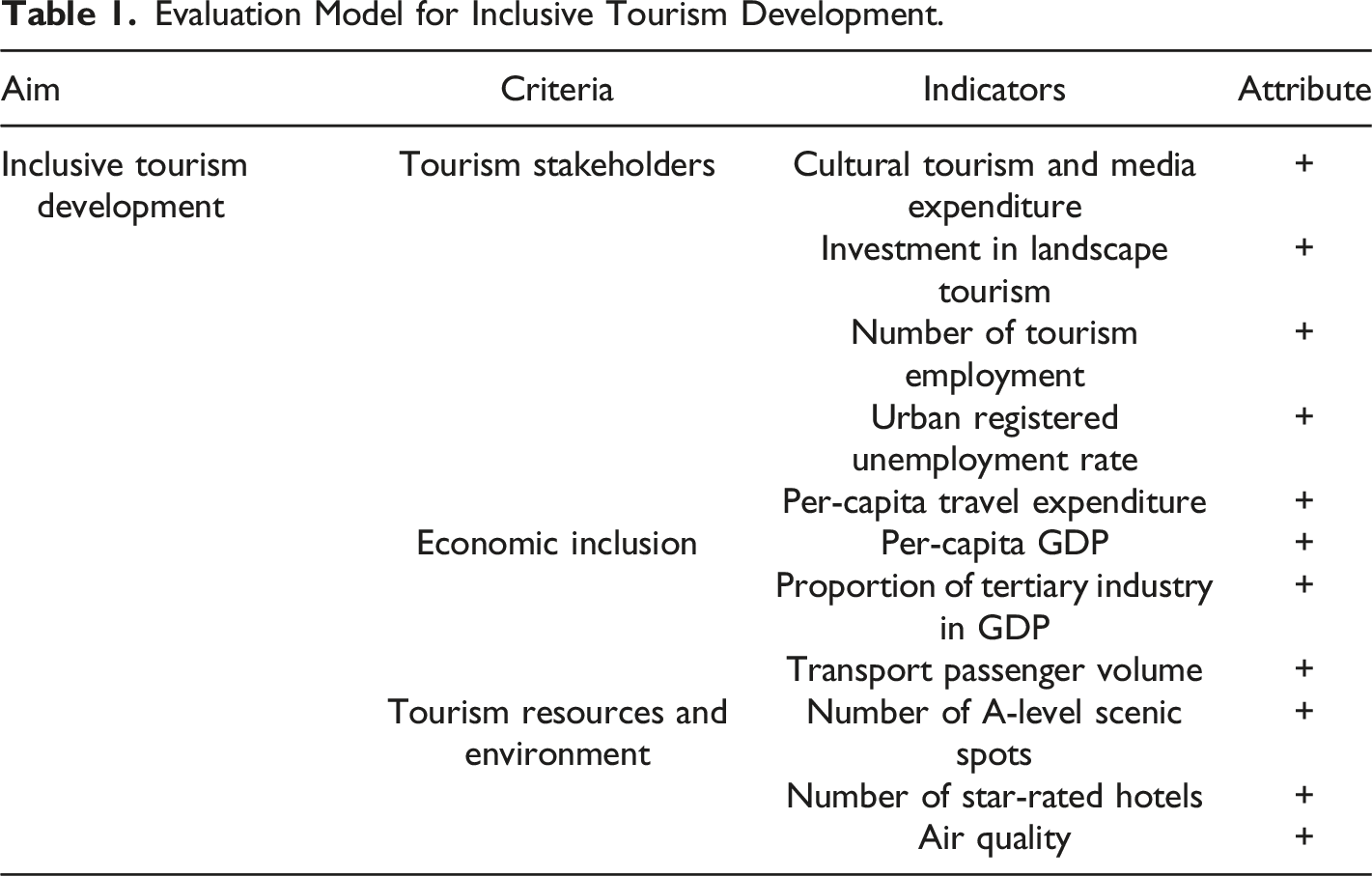
Inclusive growth is a value-oriented approach that no longer seeks to increase economic quantity, but is committed to enabling people to live a life of dignity and happiness (Jeyacheya & Hampton, 2020). Compared to the sustainable tourism development, inclusive tourism emphasizes equal opportunities for tourism participants, highlights equity and justice, and eliminates persistent poverty (Bianchi & de Man, 2021). The construction of the assessment model should reflect the connotation, characteristics, and major function of inclusive tourism, and also consider the availability and operability of data. The selection of indicators are the foundation and core of the assessment model, and we follow the principles of comprehensiveness, scientific, representativeness, and data availability. Therefore, we evaluate inclusive tourism from the dimension of tourism stakeholders, economic inclusion, and tourism resources and environments based on the characteristics of fairness of tourism subject participation, effectiveness of tourism economic development, and sharing of tourism development achievements (Figure 1). Stakeholders in inclusive tourism involve the government, labor force, and enterprises (Vrontis et al., 2021). The government plays a leading role in inclusive tourism development, mainly through the formulation of policies to guide inclusive tourism development, as well as fiscal investment in inclusive tourism. Therefore, indicators of cultural tourism and media expenditure, and investment in landscape tourism, are used to measure the government’s role. The investment in landscape tourism in this study refers to the investment in fixed assets of landscaping, including the capital investment in the construction, maintenance, and management of urban landscaping. Tourism enterprises are important subjects of inclusive tourism and have strong employment-absorbing capacities, which help reduce the unemployment rate and promote economic growth. Therefore, tourism employment numbers are used as an indicator. It is an inevitable requirement of inclusive tourism for laborers to obtain employment opportunities through tourism to achieve survival and development of individuals and families. At the same time, a stable occupation can improve people’s happiness. Therefore, the urban registered unemployment rate is used as an indicator. Tourists' spending supports the development of local tourism, and the development of tourism can support more participants, so per-capita travel expenditure is adopted as an indicator. Evaluation framework design.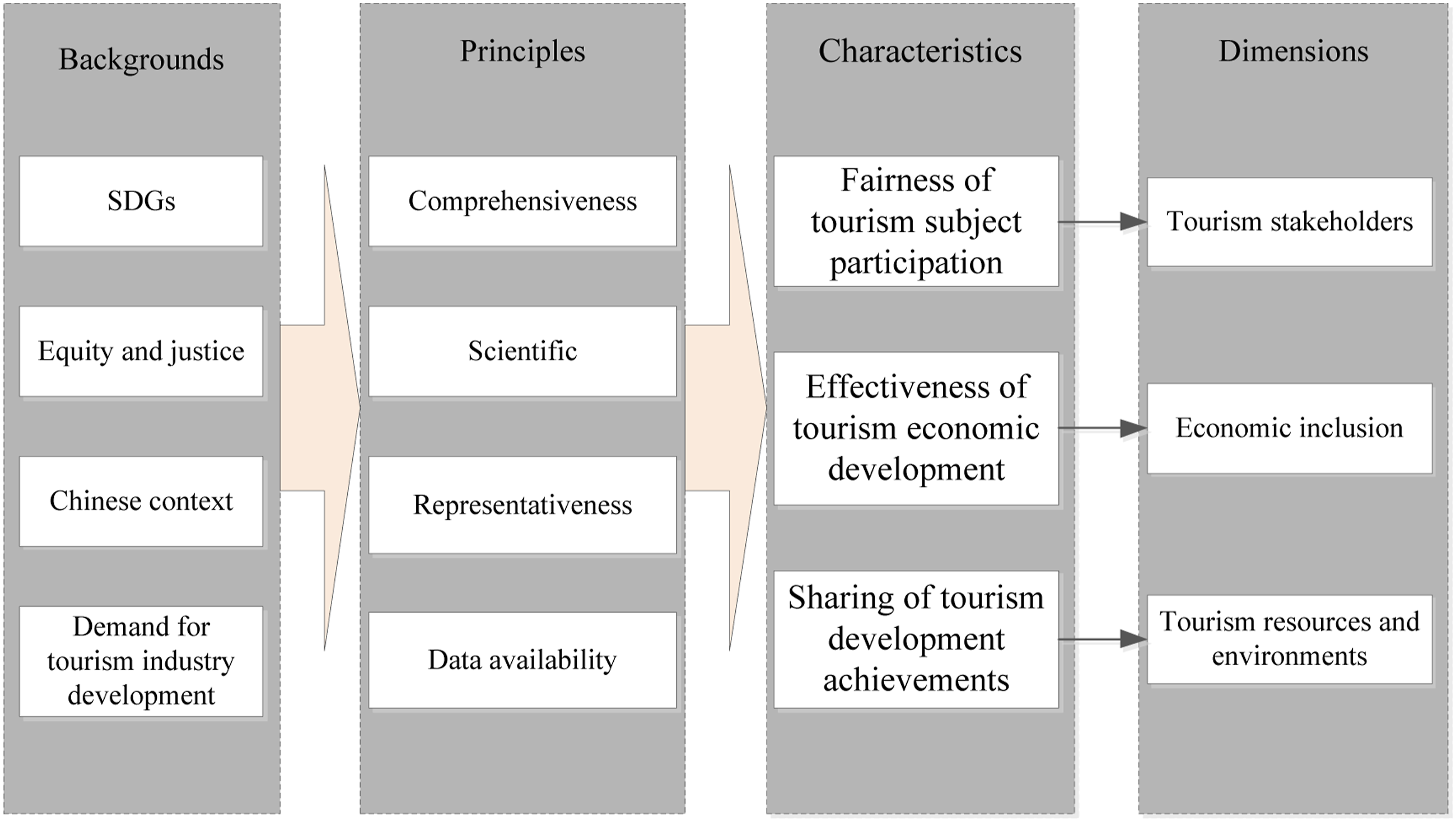
As an important component of inclusive tourism, economic inclusion involves whether economic growth increases people’s well-being (Pavkovic et al., 2017). We evaluate the economic inclusion of tourism using indicators, which include per-capita GDP, the proportion of tertiary industry in GDP, and transport passenger volume. Tourism resources and environments are the foundation of inclusive tourism development (Mandić, 2019). Appropriately using tourism resources is key to developing regional tourism. The demand for comfortable environments is increasing due to people’s improved living standards. We adopt indicators including the number of A-level scenic spots, number of star-rated hotels, and air quality (measured by the number of days that air quality reaches the standard) to reflect the tourism resources and environments in inclusive tourism development.
Evaluation Model for Inclusive Tourism Development.
There are three main methods to calculate the weight of indicators: subjective weight method, objective weight method, and combined weight method (Shehzad et al., 2019). We decided to adopt the entropy method of objective weighting to eliminate the human-induced uncertainty. We calculated the data and finally generated the indicator weight value by collecting the mathematical relationship between the original data. Information entropy is a measure of information disorder and randomness in an information system (Deng et al., 2020). Entropy can be used to judge the degree of dispersion of an indicator. It is generally believed that the greater the information entropy value, the greater the data disorder, the less information provided, and the smaller the weight (Cheng, Tang, et al., 2022; Song & Yuan, 2021). The smaller the entropy value, the smaller the data disorder, and the more information provided, the greater the weight (Li, Liu, & Qiu, 2020). Therefore, the entropy method has widely applied in the academic community (Cai et al., 2021; Cheng, Zhao, et al., 2023; Zhao et al., 2021). The weight in this study can be calculated according to the entropy value. The main steps are as follows.
First, m regions and n indicators were selected and formed the original data matrix X =
Second, standardize the data.
Positive indicator calculation method:
Negative indicator calculation method:
Third, calculate the indicator’s weight.
The weight of the j indicator of the i sample:
Entropy of the j indicator
Calculate the entropy redundancy:
Fourth, calculate the indicator’s weight:
Fifth, compute the single indicator score:
Finally, calculate the comprehensive score of the i city:
The development degree of regional inclusive tourism is measured through the above calculation steps. The higher the comprehensive score, the higher the level of regional inclusive tourism development. The lower the comprehensive score, the lower the level of inclusive tourism development.
Data Sources
Descriptive Statistic of Variables.
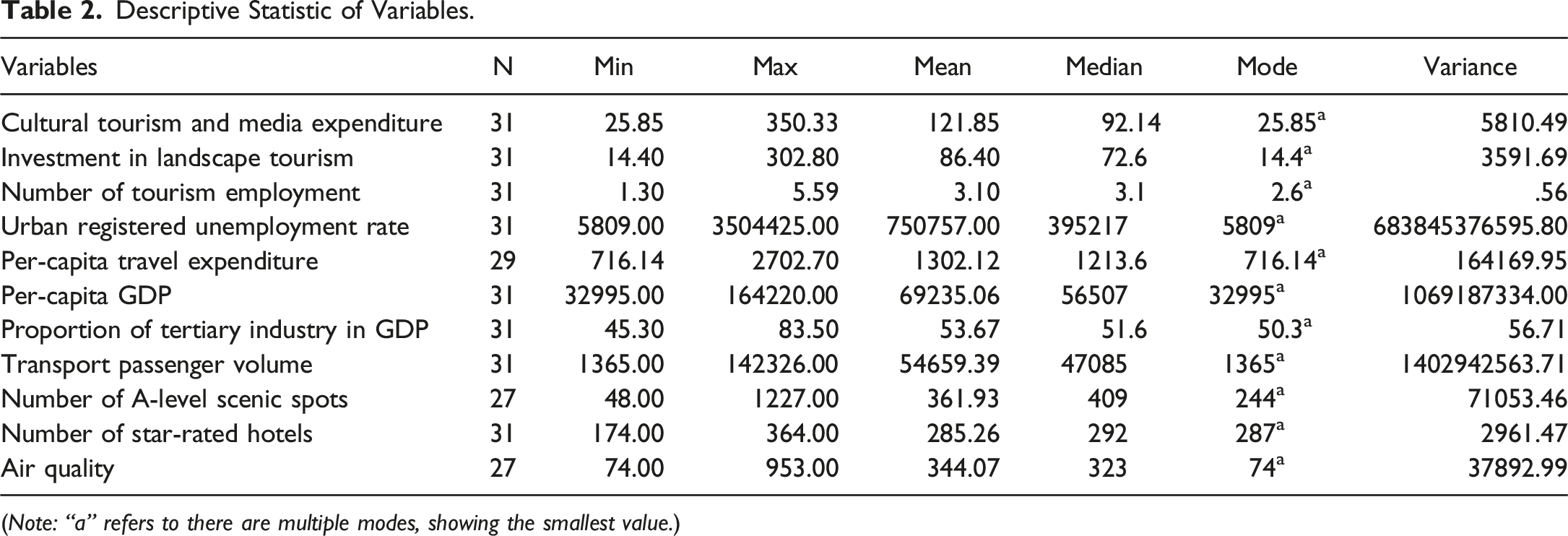
(Note: “a” refers to there are multiple modes, showing the smallest value.)
Results
Weight of Indicator for Evaluation Model.
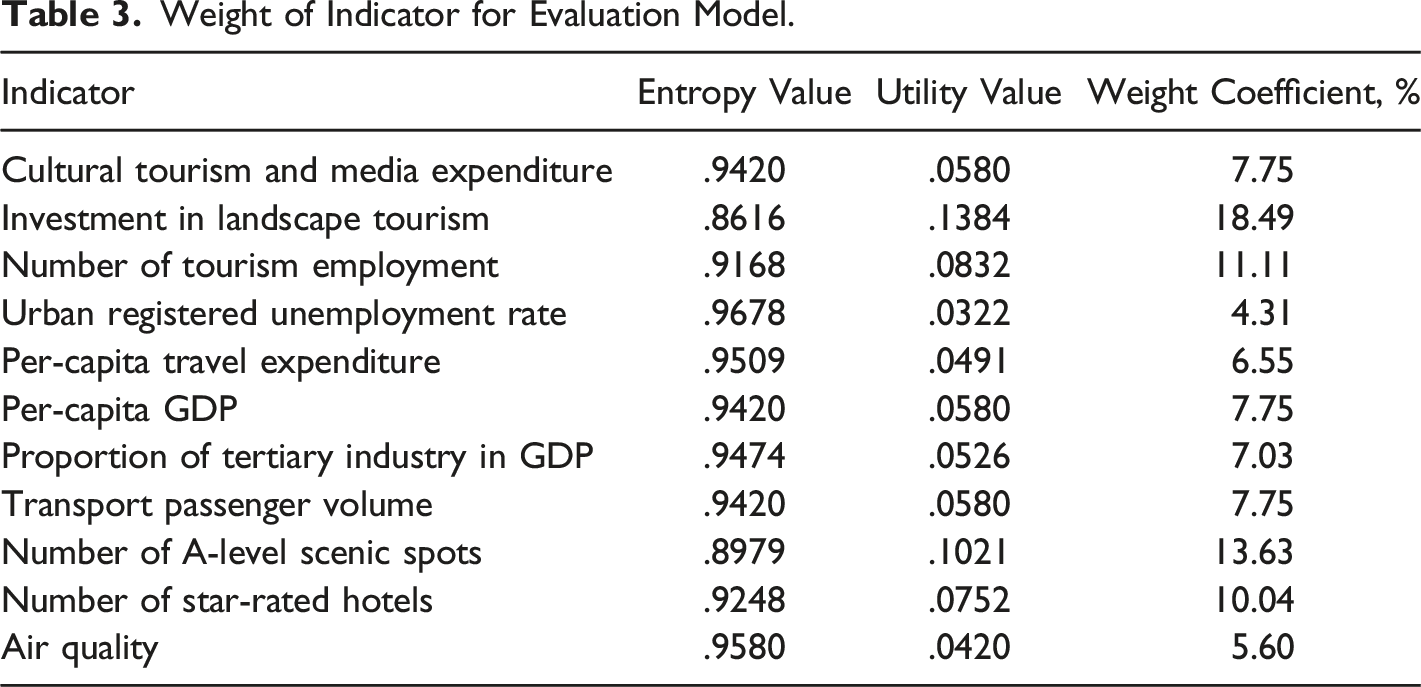
We can see clearly that the most significant indicator is the investment in landscape tourism with a weight of 18.49%, and the lowest indicator weight of urban registered unemployment rate is only 4.31%. The number of A-level scenic spots (13.63%), tourist employment (11.11%), and star-rated hotels (10.04%) is also significant. Cultural tourism and media expenditure, per-capita GDP, and transport passenger volume accounted for the same proportion at 7.75%, whereas air quality accounted for the lower weight at 5.6%.
Comprehensive Score and Rank of Provinces in China.

Based on the calculation, The 31 provinces in China were divided into four categories (Figure 2), including highly inclusive tourism development areas (comprehensive score above .4), moderate inclusive tourism development areas (comprehensive score from .3 to .4), low inclusive tourism development areas (comprehensive score from .2 to .3), and non-inclusive tourism development areas (overall score below .2). Five provinces belong to highly inclusive tourism development regions, namely, Beijing, Jiangsu, Shandong, Guangdong, and Henan. Nine provinces are moderately inclusive tourism development regions, namely, Shaanxi, Guizhou, Sichuan, Guangxi, Jiangxi, Fujian, Anhui, Zhejiang, and Shanghai. Thirteen provinces belong to low-inclusive tourism development areas, namely, Tianjin, Hebei, Shanxi, Heilongjiang, Jilin, Liaoning, Hubei, Hunan, Hainan, Chongqing, Yunnan, Gansu, and Xinjiang. Four provinces are non-inclusive tourism development areas, namely, Inner Mongolia, Tibet, Qinghai, and Ningxia. Spatial pattern of inclusive tourism development in China. (Note: this map is based on the standard map GS (2002) 310 of the Ministry of Natural Resources of China).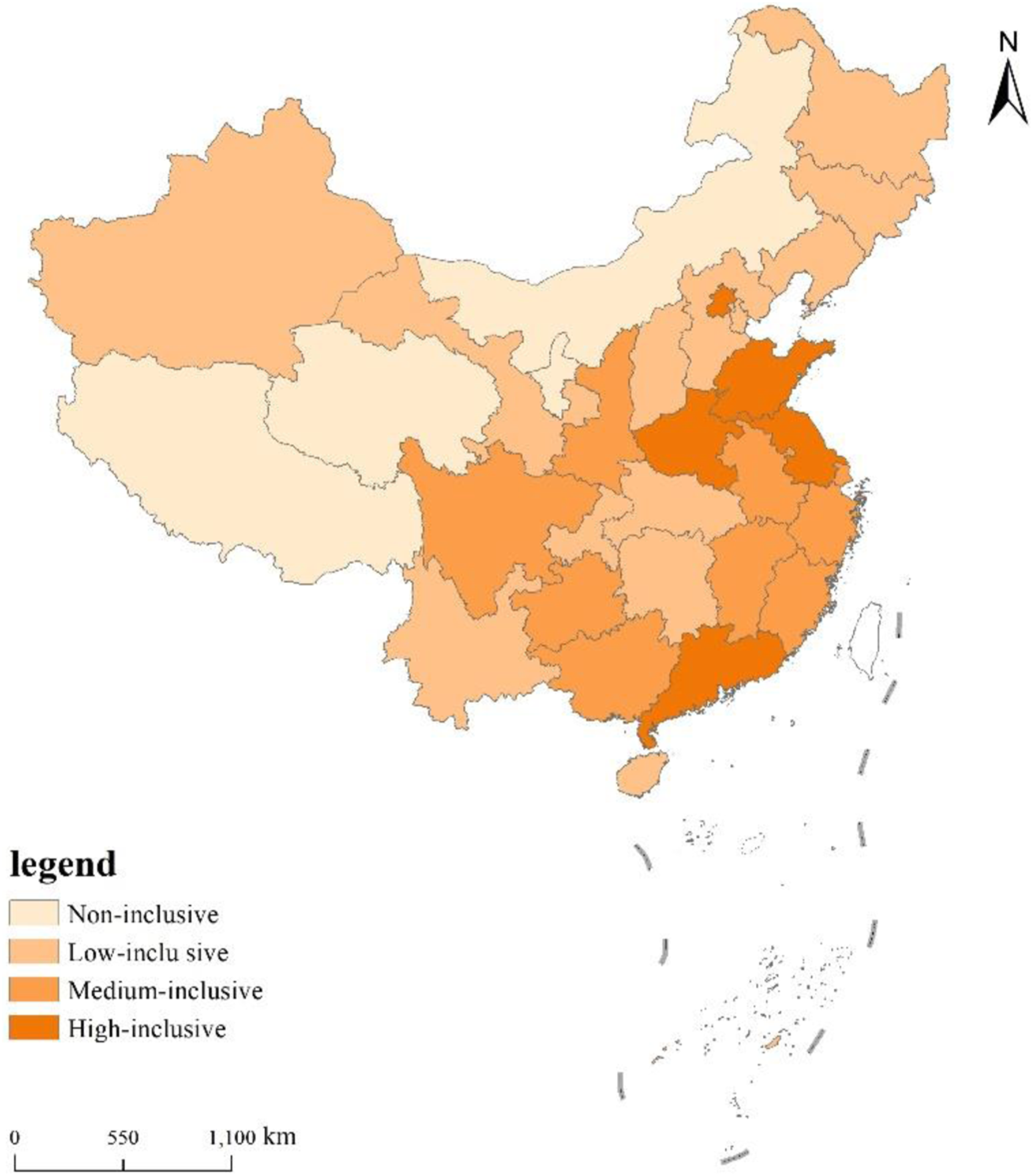
Discussion
Over the past decades, the tourism industry has become a strategic pillar industry for national economic and social development in China and many other countries. Tourism is also facing a sustainable transformation, especially in Global South. In addition, global tourism development faces many challenges, such as the impact of the COVID-19 pandemic and extreme weather events caused by climate change. It is urgent to lead the benign development of tourism through industrial updating and model innovation. Inclusive tourism is a potentially important direction (Buzinde & Caterina-Knorr, 2022). Both Chinese scholars and the government have realized the importance of this issue and have made great explorations in both theory and practice, such as all-for-one tourism and poverty alleviation by the tourism industry (i.e., China-type pro poor tourism) (Feng, 2017; Zhao, 2020). This study constructs an assessment model to quantitative evaluate the inclusive tourism development in China, and have a more comprehensive and in-depth understanding of China’s inclusive tourism development. Compared to existing theories and case studies of inclusive tourism (Gillovic & McIntosh, 2020; Scheyvens & Biddulph, 2018; Streimikiene et al., 2021), this study makes some new findings through quantitative evaluation.
Overall, China’s inclusive tourism development is in its initial stage and develops slowly, which is consistent with previous research conclusions (Y. Liu & Tu, 2015; Zhang & Wang, 2016). However, this study innovatively evaluates and discusses the level and differences of inclusive tourism development in various provinces of China from the perspective of regional heterogeneity. Most provinces are belonging to moderate- and low-inclusive tourism development areas. From the perspective of the spatial pattern of inclusive tourism development in China’s provinces, there are significant spatial differences in inclusive tourism development. Spatial distribution of inclusive tourism development is high in the south and east and low in the north and west. Highly inclusive tourism-developed areas are concentrated in eastern and southern China, whereas central and western China develops inclusive tourism relatively slowly, which is also consistent with China’s economic development pattern.
In addition, the development of inclusive tourism is also closely related to the tourism industry. For example, Beijing, Jiangsu, Shandong, Guangdong, and Henan are developed in tourism, with perfect tourism infrastructure, flourishing tourism enterprises, various active group participation in tourism activities, and rapid development of the tourism industry, promoting inclusive tourism development. Inner Mongolia, Tibet, and Ningxia are rich in tourism resources, but the overall level of tourism development is low, leading to the under-development of inclusive tourism. There is a high overlap between minority areas, poverty-stricken areas, and tourism resources-rich areas in China, and the development of tourism in minority areas is closely linked to the reduction of poverty. The Chinese government has always taken the tourism industry as an important approach to poverty alleviation, exploring to create economic growth and reduce poverty for minority areas by developing tourism.
Score and Rank of Provinces From the Criteria Level.
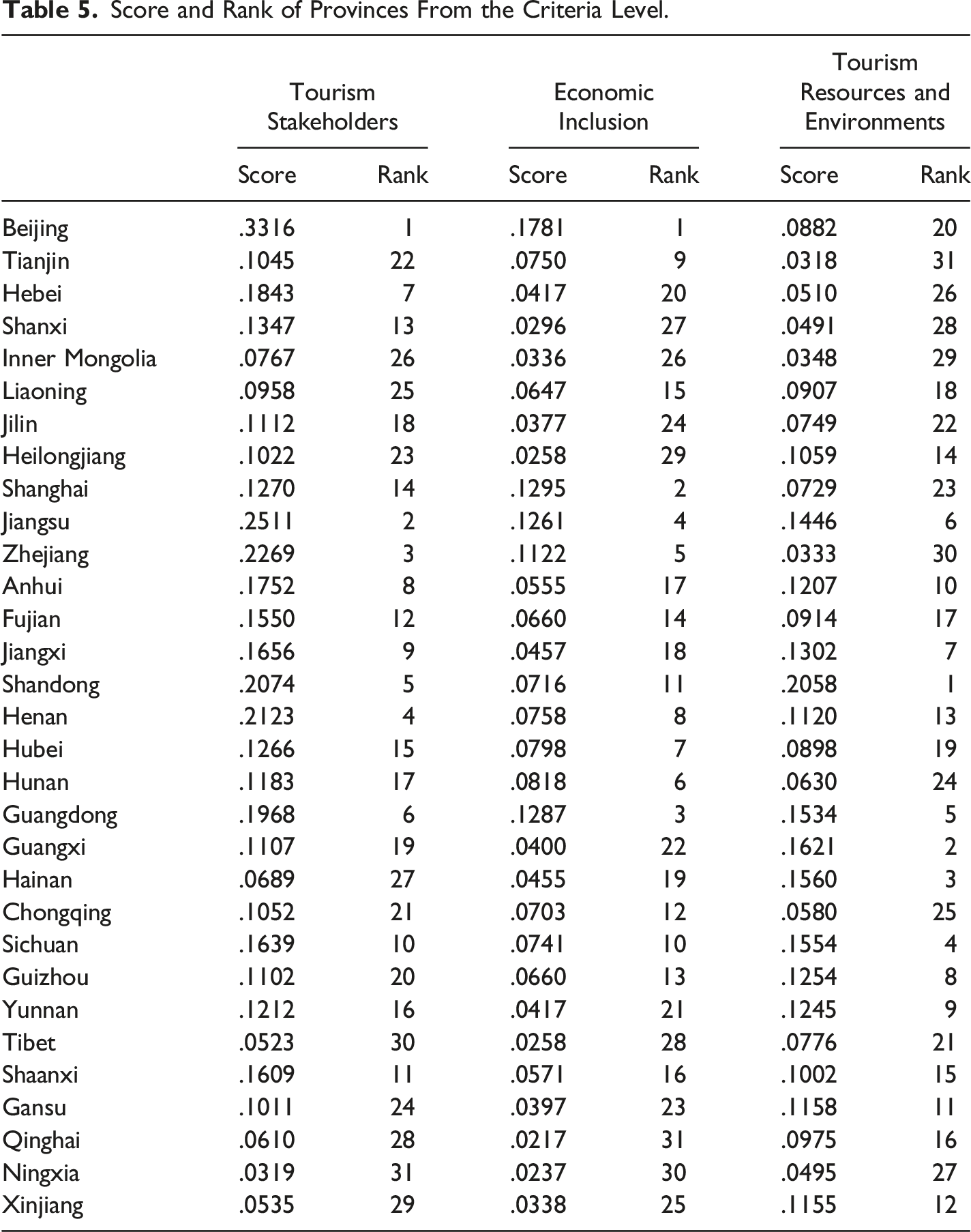
Tourism stakeholders have the greatest impact on the development of inclusive tourism. In particular, government support is closely related to the development of inclusive tourism. Among the indicators of this dimension, investment in landscape tourism has the most significant influence. This indicates the government is the key driving force for promoting inclusive tourism development. First, the government takes advantage of various instruments include planning, preferential policies, financial support, and talent introduction to develop tourism resources and promotes tourism economic growth and provides more employment opportunities to local residents (Buzinde & Caterina-Knorr, 2022; Bærenholdt & Meged, 2023). Second, the government effectively coordinates the distribution of benefits between stakeholders, such as enterprises and residents, so all groups can share the benefits of tourism development (Nyanjom et al., 2018). Third, the government actively provides a stable development environment for inclusive tourism, including providing good infrastructure and public services, which create a good sense of experience for the people (C. Liu, Hu, & Jeong, 2020). In addition, the government formulates a combination of long- and short-term policy tools according to different periods and objectives to solve problems related to tourism development, combined with the market mechanism effect, and ensure the tourism market’s harmony and stability (Jeyacheya & Hampton, 2020).
As the critical stakeholders, tourism enterprises, including catering, accommodation, and travel agencies, play an important role in regional inclusive tourism development. Tourism enterprises are an important way to increase employment and promote inclusive tourism. Tourism enterprises must not only provide higher-quality services, but they must also pay attention to improve the happiness of internal employees and establish a good and sustainable partnership with residents (Hall, 2019). Special attention is paid to the proportion of women in tourism employment. Inclusive tourism requires tourism enterprises increase the accessibility of women (Nguyen, 2022). Tourism must not only allow professionals to find suitable positions, but also benefit the general population, especially for disadvantaged groups, to have equal opportunities to obtain the right to individual development and improve social happiness (Gillovic & McIntosh, 2020). In addition, attention should be paid to flexible employment channels in the tourism, such as the current popularity of live-streaming and vlogs.
The impact of tourism resources and environments on inclusive tourism development is second only to that of tourism stakeholders, and high-quality tourism resources bring great advantages to regional tourism development (Hall, 2019; Yfantidou & Matarazzo, 2017). The content of tourism resources continues to expand with the transformation development of tourism (Lonardi et al., 2020). From the initial human and natural landscapes, tourism resources now include all the resources that can attract people to visit, consume, and enjoy (Rahman et al., 2022). Distinct attractions, including cultural and natural, are the core foundation of tourism development and important resources for the shift toward inclusive tourism. Tourism investments can replace tourism resources to a certain extent, and large-scale investments can promote tourism development (Alam & Paramati, 2017). The weight of the number of A-level scenic spots and star-level hotels show that investment-driven resources are rapidly becoming an important resource for regional inclusive tourism development. High-quality and complete tourism infrastructure and services play a critical role in the current tourism industry and inclusive tourism. Currently, the air quality level of most cities in China is similar, and the impact of air quality on inclusive tourism development is not significant.
The weight of the three specific indicators of economic inclusion is not high, indicating that China’s tourism economic inclusion is in an initial development stage. However, there are significant regional differences in tourism inclusion. Developed provinces such as Beijing, Guangdong, and Shandong have strong economic power and large investments in tourism projects. On the contrary, Tibet, Ningxia, Qinghai, and other underdeveloped provinces have weak economic power and tourism investments. The government’s financial support plays an important role in developing inclusive tourism (Wu & Chang, 2023). Even if there are good supporting policies, the lack of fiscal funds will lead to the lag of inclusive tourism development. Transportation has a positive external driving influence on inclusive tourism development. Traffic development helps improve the accessibility of tourism form large-scale tourism flows and promotes the rapid development of local tourism (Dinu, 2018).
Conclusion
As a pillar industry of the national economy, tourism is also facing the challenge of transforming to sustainable and inclusive development around the world. Inclusive tourism meets the goal and requirement of sustainable development, promotes the tourism industry to become more inclusive, equitable, and efficient with fairness and justice, and facilitates everyone to share the benefits of tourism development. However, the existing research of inclusive tourism focuses on the theoretical and qualitative analysis, and little attention is paid to quantitative assessment of regional inclusive tourism development. To address this gap, this study takes China as a typical case and constructs an assessment model to quantitatively evaluate the development characteristics and spatial pattern of inclusive tourism in China. This study aims to answer the following questions: how far has China’s inclusive tourism development come? What are the characteristics of inclusive tourism in China? What are the shortcomings?
More specific, this study constructs an assessment model for inclusive tourism development from three dimensions, including tourism stakeholders, economic inclusion, and tourism resources and environments, and 11 specific indicators. Based on the model, China’s provincial inclusive tourism development is evaluated and ranked according to the comprehensive score calculated. According to the evaluation results, it is divided into four types, namely, highly inclusive tourism development areas, moderately inclusive tourism development areas, low inclusive tourism development areas, and non-inclusive tourism development areas. In addition, combined with the assessment results, the characteristics and shortcomings of China’s inclusive tourism development are analyzed.
This study helps holistically understand China’s development of inclusive tourism and provides a basis for optimizing policies and practices of inclusive tourism. In addition, this study also contributes to the global body of knowledge surrounding inclusive tourism and provides the referee value for inclusive tourism development in other countries. However, there are some limitations in this study owing to the restriction of the method, data, and spatial scale. For example, prefecture- and county-level assessments can be conducted under the precondition of data availability. We can also conduct a cross-country comparative study. The research method can also be diversified, such as trying to conduct an econometric analysis in future research. In addition, the linkage between of the inclusive tourism and carbon emission is a possible future research direction for further advancement in the context of carbon neutrality and emission peak in China.
Footnotes
Declaration of Conflicting Interests
The author(s) declared no potential conflicts of interest with respect to the research, authorship, and/or publication of this article.
Funding
The author(s) disclosed receipt of the following financial support for the research, authorship, and/or publication of this article: The research is sponsored by the Major Program of Philosophy and Social Science of Chinese Ministry of Education (No.21JZD034), the Guizhou Provincial Major Scientific and Technological Program (No. [2023]113), and the National Natural Science Foundation of China (No. 42271185).
