



Abstract
Amid population growth and a shift from extensive to intensive shrimp farming, there may be a future reduction in extensive shrimp farming and mangrove forest areas. Understanding the correlation between land accumulation, economic efficiency, and potential losses is crucial. This study interviewed 311 black tiger shrimp farmers in the Mekong Delta, using one-step stochastic frontier analysis to estimate efficiency and investigate these correlations. Findings indicate an average economic efficiency of 82%, suggesting an 18% reduction in observed total costs. Economic losses, estimated at 82–465 USD/ha, were primarily seen in households with land areas below 2 ha. A positive correlation between land accumulation and economic efficiency suggests that maintaining a minimum pond area of 2 ha enhances income and mitigates losses. The study highlights the need for policies supporting land consolidation among shrimp farmers to achieve optimal pond sizes, reducing losses, and improving profitability, while promoting sustainable practices to balance shrimp farming with mangrove conservation.
Keywords
Introduction
Despite abundant previous findings concerning the impact of land accumulation on agricultural production, encompassing general agricultural practices and specific rice production, there remains a shortage of studies focused on extensive shrimp farming models. This gap is particularly pronounced in light of decreasing extensive shrimp farming areas, partially replaced by the intensive shrimp farming model (Lu et al., 2018). Consequently, this shift has resulted in a reduction in mangrove forest area and has impacted the financial efficiency of the extensive shrimp farming model (Irwin et al., 2007; King et al., 1982; Niroula et al., 2005). Furthermore, given the ongoing model transition and the challenges posed by population growth, it becomes imperative to delve into the understanding of the relationship between land accumulation and economic efficiency and losses within the extensive shrimp farming model.
Data from Lu et al. (2018) reveal a significant shift in global shrimp farming practices. In 2010, extensive shrimp farming dominated, comprising roughly 70% of global production, while intensive farming lagged behind at about 30%. However, by 2020, there was a noteworthy transition, with intensive shrimp farming claiming a larger share of approximately 60%, while extensive farming decreased to around 40%. This shift is attributed to factors such as increased productivity, better disease control measures, and enhanced efficiency in land and resource utilization (Lu et al., 2018). According to Schuur et al. (2022), the transition from extensive to intensive shrimp farming in the Mekong Delta (MD) presents several advantages. These include enhanced shrimp production, increased income, and a reduction in land and water usage. However, this conversion entails a redistribution of land towards intensive shrimp farming, thereby limiting available space for extensive shrimp farming. This situation prompts inquiry into how economies of scale in extensive shrimp farming might be affected.
The manifestation of land fragmentation in Vietnam has become increasingly apparent, driven by persistent pressures from population growth, leading to a reduction in the availability of arable land (Vu et al., 2017). As the population of Vietnam has grown, the per-person arable land has decreased by 26%, declining from 0.095 ha in 1985 to 0.075 ha in 2016 (Group, 2016). The total area of agricultural land, excluding forestry land, exceeds 10 million hectares, encompassing around 70 million parcels and nearly 14 million farm households. On average, each household possesses 5 parcels of agricultural land, with an average area per parcel of 0.14 ha. Notably, over 80% of farmers own areas smaller than 1 ha (To et al., 2019). Nevertheless, empirical evidence suggests that the total factor productivity in Vietnam falls behind that of numerous Asian peer countries (Kompas et al., 2012; World Bank, 2016). Despite the agricultural sector maintaining a relatively robust annual growth rate (around 3%), this growth has experienced a secular decline since 2008 (Liu et al., 2020; Mai, 2018). The fragmentation or non-contiguity of plots utilized by small-scale farmers plays a substantial role in this productivity decline (Tu, Kopp, et al., 2021).
Vietnam plays a crucial role in global agriculture and food security, as more than 60% of its population depends on agriculture and fisheries. As one of the leading exporters of agricultural products and shrimp, Vietnam contributes significantly to meeting global food demands. In 2022, fishery production reached 8423 thousand tons, showing a 1.8% annual increase. Shrimp farming, covering 736.5 thousand hectares, yielded 1014 thousand tons, underscoring its importance in Vietnam’s agricultural landscape (GSO, 2021; MARD, 2023).
The MD stands as a significant hub for aquaculture, with a particular emphasis on brackish water shrimp (GSO, 2021). In 2022, the brackish water shrimp farming area was estimated to cover approximately 697.32 thousand hectares, making up 93% of the country’s total shrimp farming area. Of which, the cultivated area for black tiger shrimp in the MD is approximately 603 thousand hectares, and the cultivated area for white leg shrimp is around 93 thousand hectares. Despite the recent introduction of white leg shrimp cultivation, estimated at about 4477 ha in 2008, it has surged to 93 thousand hectares by 2022, representing a growth of over 20.77 times (VASEP, 2022). Black tiger shrimp is predominantly cultivated in the MD by 330,000 smallholder farmer households (Quyen et al., 2020). Quyen et al. (2020) also reported that 94.4% of shrimp farms in the MD were dedicated to the extensive production of black tiger shrimp. Extensive shrimp farming in the MD is appealing due to its low initial investment costs, minimal maintenance, and low risks, making it suitable for rural households (MARD, 2019, 2023; Phuong et al., 2014). However, this method faces challenges such as (1) low productivity, (2) adverse effects of climate change on production, (3) prolonged cultivation, and (4) limited adoption of new technologies (Long et al., 2010; Phuong et al., 2014; Son et al., 2014).
Therefore, this current study aims to explore the relationship between land accumulation and economic efficiency and then estimate the losses using the one-step stochastic frontier analysis model and multiple regression. The paper is structured as follows: first, the introduction provides an overview of the research; next, the literature review delves into existing studies on related topics; the subsequent section outlines the research methodology employed in this study; following this, the results and discussion section presents the findings and their interpretation; finally, the conclusion and recommendations section summarizes the key findings and offers suggestions for future research.
Literature Review
Extensive Black Tiger Shrimp Farming and Measurement of Economic Efficiency
As stated by Phuong et al. (2014), extensive black tiger shrimp farming relies heavily on natural feed within the pond. This method involves low stocking density, minimal control, and requires no significant technological advancements or substantial investments. Typically, the yield from this farming remains below 500 kg/ha/year, with a shrimp stocking density averaging around 4–6 shrimp/m2. In sum, extensive shrimp farming, characterized by low input use and reliance on natural tidal exchange for pond water, has been a traditional practice in the MD, contributing significantly to both local livelihoods and export revenues (Le et al., 2022). Studies by Funge-Smith et al. (1998) and Phuong et al. (2014) highlight the socio-economic importance of this farming method, noting its relatively low environmental impact compared to more intensive practices. However, these studies also discussed that the shift towards intensive farming methods, driven by higher productivity and profitability, poses risks to the sustainability of extensive systems. Quyen et al. (2020) and Schuur et al. (2022) points out that extensive shrimp farming in the MD is often practiced on small landholdings, which limits economic efficiency and resilience to market fluctuations. According to Boyd et al. (2022), Ecuador, one of the five leading exporting countries of farmed shrimp, has an average pond size of 6.59 ha and an average farm size of 140 ha. This average size is significantly larger than the average land area of extensive shrimp farming households in the Mekong Delta, which typically range from 2 to 4 ha.
Farrel (1957) was a pioneering author who introduced the concept of overall efficiency in the realm of economics. Economic efficiency is widely regarded as the combination of technical efficiency and allocative efficiency, which refers to the capacity to produce a certain level of output at minimum cost (Farrel, 1957; Schmidt and Knox Lovell, 1979; Kopp, 1981). According to Kumbhakar et al. (2003) and Coelli et al. (2005), economic efficiency can be estimated in three distinct ways: cost-oriented, revenue-oriented, and profit-oriented. In this study, the term cost efficiency, synonymous with economic efficiency, refers to the ability to produce a predetermined output level at the lowest cost relative to input prices (Farrel, 1957; Battese, 1992; Reinhard et al., 1999; Reinhard et al., 2000; Tu, Trang, & Yabe, 2021). Measuring the economic efficiency index involves two primary approaches: stochastic frontier analysis (SFA) or data envelopment analysis (DEA). The SFA was initially developed by Aigner et al. (1977) and Meeusen et al. (1977). The SFA approach, based on econometrics and parametrics, facilitates the differentiation of noise effects from the stochastic frontier. Conversely, the DEA approach, a non-parametric technique grounded in mathematical programming, does not discern noise effects, potentially resulting in either overestimation or underestimation of efficiency.
The assessment of economic efficiency has been widely applied across various agricultural production activities, serving as a tool to evaluate the effectiveness of specific farming methods. Numerous studies have measured economic efficiency using the profit function approach (Hong et al., 2015; Thong et al., 2011, 2015; Tien et al., 2014), while others have opted for the cost function method (Ferrier et al., 1990; Rosko, 2001; Tu et al., 2015, 2021c; Worthington, 2000). Within agricultural production, minimizing costs is considered a more practical approach to efficiency measurement, as these costs are within the control of farmers (Trang, 2020).
In recent times, experts in econometrics have suggested adopting the one-step estimation model as a more favorable alternative to the traditional two-step estimation approach for assessing economic efficiency. Instead of estimating economic efficiency and then conducting regression on the factors influencing economic efficiency, a one-step estimation approach will simultaneously estimate efficiency while exploring the factors impacting efficiency. This recommendation stems from the one-step approach’s capacity to alleviate the issue of estimation bias (Caudill et al., 1993; Coelli et al., 2005; Greene, 2005; Wang et al., 2002).
The existing literature highlights significant gaps that prompt this study. Firstly, there’s a lack of research specifically investigating economic efficiency within extensive shrimp farming, despite its thorough examination in various agricultural production contexts. Lastly, although the one-step estimation model is recommended to assess economic efficiency, its application in estimating economic efficiency in extensive shrimp farming remains limited. Particularly, studies examining the relationship between land accumulation or shrimp pond size and economic efficiency and then estimating economic losses are lacking. Thus, this study endeavors to address these gaps by concentrating on estimating economic efficiency in extensive shrimp farming. Employing a one-step SFA approach, it considers variables like land accumulation or shrimp pond size as independent factors affecting economic inefficiency effects.
Land Fragmentation
Globally, agricultural land fragmentation is influenced by various institutional factors, including collectivization (Di Falco et al., 2010), inheritance laws (Yucer et al., 2016), land market transaction costs (Lu et al., 2018), personal valuation of land ownership (King et al., 1982), and urban development (Irwin et al., 2007). The prevailing notion is that land fragmentation negatively impacts agricultural productivity and growth (Niroula et al., 2005; Tu, Kopp, et al., 2021), leading to the inclusion of land consolidation policies in many national economic and agricultural development strategies.
Studies on land fragmentation’s impact on agricultural performance have yielded varying interpretations. While some researchers see it as limiting productivity and scale benefits (Karouzis, 1977; Niroula et al., 2005; Rahman et al., 2009), others propose the opposite (Goland, 1993; Hartvigsen, 2014). The perception of fragmentation as a risk mitigation strategy, providing diverse crop portfolios and access conditions, may contribute to increased biodiversity and economic value of the landscape (Thenail et al., 2004, 2009).
Land fragmentation in the MD results from multiple factors, including the Land Law of 2013, which limits agricultural land allocation to 3 ha per household, rooted in socialist ideologies to prevent landlessness. The size of land allocations, determined by household size, exacerbates issues related to inheritance practices (Ravallion et al., 2006). Farmers accumulating multiple plots, inheritance practices, and intricate land transfer policies are factors contributing to fragmentation (Ravallion et al., 2006). Recently, many extensive shrimp farmers have started converting parts of their land to intensive shrimp farming, leading to reduced pond sizes for extensive shrimp farming. This shift may affect economic efficiency since extensive shrimp farming relies on natural feed. This shift is occurring across most provinces in the MD region. Hence, it is crucial to assess the correlation between land accumulation or shrimp pond size and economic efficiency in extensive shrimp farming to provide policymakers with valuable insights for long-term development planning.
Methodology
Data Collection
Total Black Tiger Shrimp Farming in the Mekong Delta.

Source: MARD (2019, 2023). The bold numbers are simply the total or sum by year.
Extensive shrimp farming associated with black tiger shrimp farming in the MD is primarily concentrated in Bac Lieu, Kien Giang, and Ca Mau. Among these, Ca Mau stands out as the largest producer of black tiger shrimp and extensive farming, boasting a total area of 272.9 thousand hectares in 2022, followed by Bac Lieu with 124.4 thousand hectares and Kien Giang with 139.4 thousand hectares. These three provinces collectively contribute to over 88.94% of the total black tiger shrimp farming area in the MD region. Consequently, these provinces were chosen as the study sites. At each province, the study identified two districts with the most substantial extensive shrimp farming areas. Subsequently, each selected district will select one commune to carry out a survey of shrimp farmers.
In 2022, the study conducted face-to-face interviews with extensive black tiger shrimp farmers identified through randomized lists provided by local authorities in each commune. As each household may be involved in farming across multiple ponds, the study concentrated on gathering data from the largest pond, given its pivotal role and substantial impact on the household’s livelihood. This selection method ensures a more comprehensive recording or storage of information, consequently enhancing the reliability of the data. Data was collected during interviews at shrimp farmers’ houses, averaging 35–40 minutes and centered on the preceding crop season. The study concentrated on three sets of data: (1) socio-economic profiles, (2) technical aspects of shrimp farming, and (3) details concerning the inputs and outputs of the extensive shrimp model. Accessing shrimp farming households posed challenges, so local facilitators, particularly village leaders, assisted in making connections and introducing the research team to each household. This is also a primary reason for the sample size disparity among the study areas. Specifically, Ca Mau has 84 observations compared to Kien Giang and Bac Lieu with 114 observations each. Additionally, logistical challenges and varying levels of accessibility in different regions contributed to the unbalanced sample sizes. Finally, a total of 311 black tiger and extensive shrimp farmers were interviewed. For each province and the specific locations of the selected provinces, please refer to Figure 1. Map of Mekong Delta and the study sites. Note. The study sites are highlighted in color, while the coastal provinces are striped. The numbers in parentheses represent the observations for each province.
Data Analysis
The study employed the SFA approach proposed by Aigner et al. (1977) and Meeusen et al. (1977) to assess the economic efficiency (EE) of extensive black tiger shrimp farming. This analysis employed the translog cost function within a one-step estimation method. The methodology and specific case studies utilizing the translog variable cost in one-step estimation can be referenced in Coelli et al. (2005) and Tu, Trang, and Yabe (2021).
According to Reinhard et al. (1999), Reinhard et al. (2000), Kumbhakar et al. (2003), Coelli et al. (2005), Tu (2017), Tu et al. (2018), Tu, Trang, et al. (2021), and Tu, Trang, and Yabe (2021), typical input variables used to measure efficiency in agricultural production encompass fertilizers, pesticides, labor, capital, feed, and fuel. In the realm of shrimp farming, commonly employed inputs include feed, postlarvae, labor, fuel, chemicals, and other associated costs (Au, 2009; Den et al., 2007; Nguyen et al., 2014; Tu et al., 2021b, 2021c). In this study, output is quantified as the quantity of shrimp harvested per hectare per crop (measured in kg/ha/crop). The independent variables used in the model to estimate economic efficiency through the one-step method fall into two groups: (1) input prices (Wi), other fixed costs (Z 1 ), and output (Y); (2) factors affecting ui.
Variables Used in the Measurement of Economic Efficiency.

Note. A negative effect of the variable hi on economic inefficiencies signifies a positive impact of this variable on economic efficiency.
Data were estimated based on surveys conducted with a sample size of n = 311 households.
The empirical translog cost frontier in one-step SFA is presented by the following formula: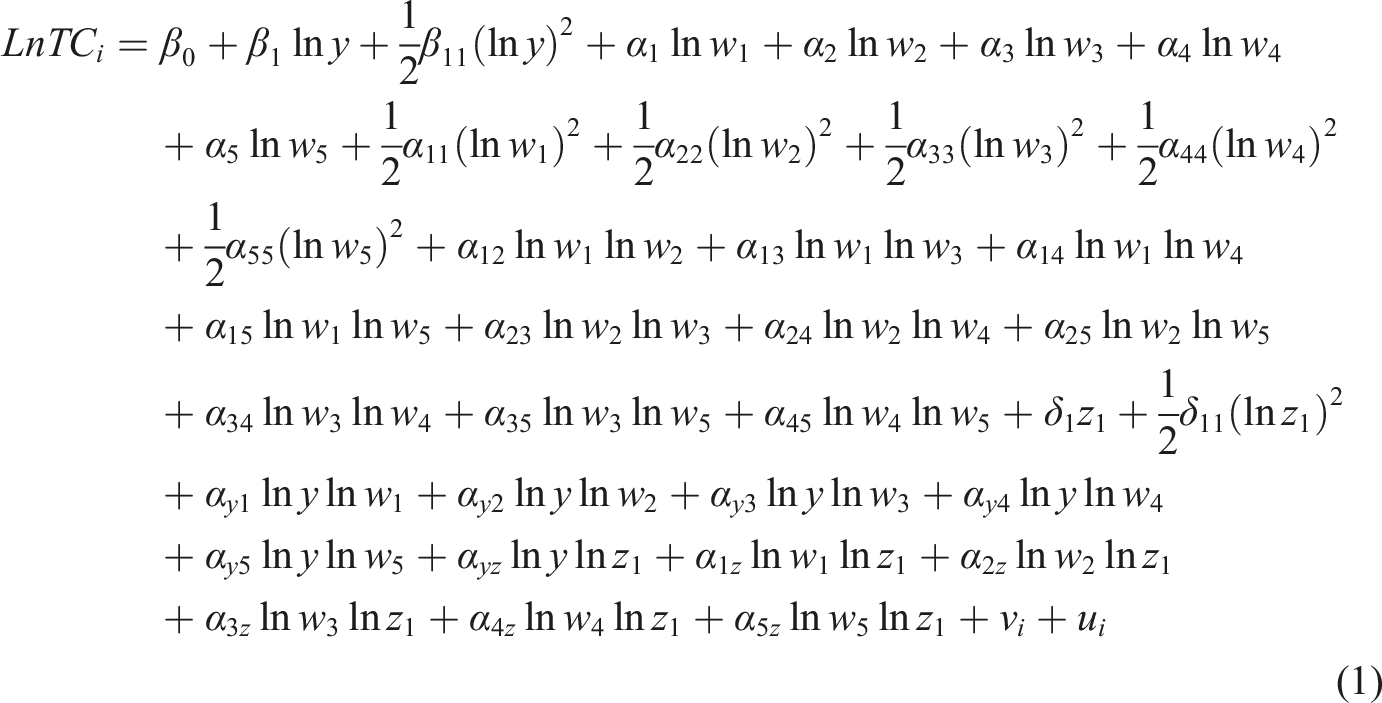

The study utilizes the following formula (3) to compute economic losses incurred by shrimp farmers due to inefficient use of inputs.
Results and Discussions
Socio-Economic Characteristics of the Respondents
Socio-Economic Characteristics of the Respondents.

Source: Own estimates; data is available upon request from the authors.
Financial Performance of Extensive Black Tiger Shrimp
Financial Performance of Extensive Black Tiger Shrimp.

Note. 1 USD = 24.038 VND.
Source: Own estimates, data is available upon request from the authors.
Land Accumulation in Extensive Shrimp Farming
Distribution of Shrimp Farming Land in the Study Site.

Source: Own estimates; data is available upon request from the authors.
To provide insights into land accumulation patterns among extensive black tiger shrimp farmers in the study area, the Lorenz curve has been employed. The results in Figure 2 indicate that approximately 50% of shrimp farmers own only about 20% of the total land area, while around 18% of farmers with larger land holdings possess up to 50% of the remaining land area. This situation highlights the existence of many small-scale extensive shrimp farmers who may not fully leverage the economies of scale, alongside a portion of approximately 18% of farmers practicing extensive shrimp farming on larger land areas. The findings of this study are consistent with the research conducted by Tu, Kopp, et al. (2021) and further confirm the occurrence of land accumulation in agricultural production in the MD. Land accumulation based on Lorenz curve. Source: Own estimates; data is available upon request from the authors.
To gain deeper insights into land accumulation in extensive shrimp farming across the study sites, Lorenz curves were constructed for each province. The findings in Figure 3 reveal that the concentration of extensive shrimp farming land in Kien Giang province surpasses that in the other two provinces in the study sites. More precisely, around 17% of farmers with larger shrimp farming areas in Kien Giang account for approximately 50% of the total shrimp farming land in the study sites, while this percentage exceeds 26% in Bac Lieu and Ca Mau provinces. Land accumulation based on Lorenz curve by study sites. Source: Own estimates; data is available upon request from the authors.
The findings reveal that while the total shrimp farming land area of households is substantial, shrimp households may operate multiple ponds that are dispersed. Consequently, the analysis proceeds to conduct a regression on the relationship between the number of ponds and the total area of extensive black tiger shrimp farming in the study sites. The findings are presented in Figure 4. Relationship between number of ponds and shrimp landholding. Source: Own estimates; data is available upon request from the authors.
The findings depicted in Figure 4 reveal a positive correlation between the number of shrimp farming ponds and the total area of extensive black tiger shrimp farming in the study sites. This implies that many farmers could accumulate shrimp land by decreasing the number of ponds, aiming to create larger-scale pond systems and capitalize on economies of scale. This result contrasts with the previous studies of Ravallion et al. (2006) and Tu, Kopp, et al. (2021) about rice production in the MD, where farmers can acquire numerous rice land parcels but face challenges in effectively consolidating them. In rice farming, fragmentation of land into smaller, non-contiguous parcels makes it difficult to improve efficiencies, as it can lead to higher transportation costs and inefficiencies in machinery use. The ability to consolidate shrimp ponds into larger, contiguous areas allows shrimp farmers to overcome these barriers. However, due to the incomplete planning of shrimp farming areas, controlling water intake and discharge during the extensive shrimp farming process is difficult and poses many risks. Consequently, many financially capable households often switch to intensive farming models on their extensive farming land. Meanwhile, smaller households face significant challenges in accumulating land and transitioning to intensive farming models due to financial barriers, legal constraints on land ownership, and limitations in technical management capabilities.
Impact of Land Accumulation on Economic Efficiency
Determining the Best Fit Model
LR Tests for Determining the Specification of Cost Frontier.

Source: Own estimates; data is available upon request from the authors.
As presented in the data analysis section, there are two approaches to investigate the impact of land accumulation on economic efficiency: (1) employing the two-step estimation approach, where economic efficiency is estimated from the cost function and subsequently regressed with the variable land accumulation and other control variables, and (2) employing the one-step estimation approach, wherein economic efficiency and its relationship with land accumulation are simultaneously estimated. Thus, the study proceeded to compare the two-step SFA with the one-step SFA to determine the best fit with the observed data. According to the LR test results presented in Table 6, the one-step SFA was found to be a better fit for the data.
Estimating the Translog Cost Frontier
Estimates of Variable Cost Frontier by Using One-step SFA.

Source: Own estimates; data is available upon request from the authors.
Based on the estimated parameters presented in Table 7, there are three variables significantly associated with economic efficiency: experience, land accumulation (or pond size), and the number of ponds. Experience and land accumulation show positive correlations with economic efficiency, indicating that experienced farmers and larger pond areas are linked to higher efficiency in extensive black tiger shrimp farming. This finding underscores the crucial role of land accumulation or pond size, serving as a natural feed supply for shrimp, reducing the need for additional feed (Burford et al., 2020; Focken et al., 1998). The findings of this current study are consistent with previous studies in agricultural production (Karouzis, 1977; Rahman et al., 2009; Tu, Kopp, et al., 2021). Although previous studies have suggested an optimal area for extensive shrimp farming models to be 1–2 ha (Hai et al., 2009), the current study shows that many farmers still operate on a small scale and have the potential to improve economic efficiency. Therefore, policies encouraging land accumulation are necessary to leverage economies of scale. Furthermore, the positive correlation with experience can be attributed to the nature of extensive farming, which requires less technical intervention, making experienced farmers more adept at decision-making. This finding is in line with the previous study of Tung (2010). Conversely, the number of ponds is negatively associated with efficiency, which is consistent with the previous finding of Tu, Trang, and Yabe (2021). This counterintuitive result suggests that managing multiple ponds may pose challenges for farmers, potentially affecting their overall efficiency.
Estimating the Economic Efficiency and Losses
Economic Efficiency of Shrimp Farmers by Study Sites.

Source: Own estimates; data is available upon request from the authors.
The findings presented in Table 8 reveal that the average economic efficiency among black tiger shrimp farmers is approximately 82%. This implies that farmers could potentially reduce 18% of total production costs without compromising the output level. The findings of this study align with Tu’s previous research using the one-step SFA approach (Tu, Trang, & Yabe, 2021); nevertheless, they are considerably higher than the estimates derived from the material balance principle approach (Trang et al., 2023). Interestingly, the study highlights that farmers in Kien Giang exhibit the highest economic efficiency among the study sites. According to the ANOVA test results (χ2 = 40.19), the economic efficiency of shrimp farmers in Kien Giang is significantly higher than that of farmers in Ca Mau and Bac Lieu. As mentioned, the land accumulation situation in Kien Giang is more prominent than in the other two provinces. The results of this study once again affirm that large-scale extensive shrimp farming will have a positive impact on economic efficiency. It’s noteworthy that despite being the largest producer of black tiger shrimp in the MD, Ca Mau has the lowest economic efficiency among the provinces studied. Table 8 also reveals that, on average, shrimp farmers in Kien Giang could reduce about 11% of the total observed cost. In comparison, the corresponding figures for Ca Mau and Bac Lieu are 19% and 25%, respectively. The study further illustrates significant variations in efficiency scores among shrimp farmers in all study sites, ranging from 34% to 99%.
Shifting our focus to estimating economic losses arising from cost inefficiency, the results depicted in Figure 5 indicate that these losses are most pronounced in Ca Mau, amounting to 11.4 million VND/ha (equivalent to 465 USD/ha). While the scope of this current study does not fully elucidate the economic inefficiency of shrimp farmers in Ca Mau province, discussions with agricultural authorities at a provincial level suggest that this inefficiency may stem from shrimp farmers predominantly relying on experience and being less open to adopting new scientific and technical knowledge. Moreover, the widespread availability of low-quality shrimp seedlings sold by numerous companies at discounted prices, combined with shrimp farmers’ inclination to purchase these seedlings for intensive farming, results in high rates of loss. Additionally, recent erratic changes in temperature and weather have had a significant impact on shrimp farming activities in the province. Bac Lieu follows with economic losses of 5.04 million VND/ha (equivalent to 205 USD/ha). Conversely, shrimp farmers in Kien Giang experience the lowest economic losses, totaling only 2.03 million VND/ha (equivalent to 82 USD/ha). Kien Giang province also exhibits low investment costs for extensive shrimp farming models, primarily applying the rotated rice—shrimp farming system. This finding partially indicates the effectiveness and risk mitigation of this model in agricultural economic development. However, there are likely multiple factors contributing to variations in the efficiency of extensive shrimp farming models among provinces, highlighting the need for additional in-depth studies. Economic losses of extensive tiger shrimp farming. Source: Own estimates; data is available upon request from the authors. Note. The exchange rate is 1 USD = 24.516 VND.
To gain a clearer understanding of the relationship between economic losses and land accumulation, Figure 6 illustrates their connection. Relationship between land accumulation and economic losses. Source: Own estimates; data is available upon request from the authors.
Economic Losses by Different Pond Sizes Unit: 1000 VND.

Source: Own estimates; data is available upon request from the authors.
The findings presented in Table 9 indicate that the average economic losses are highest in the pond size range of 0.1–1.0 ha, and an increase of 1000 m2 significantly contributes to reducing these losses. Specifically, the losses for accumulating from 0.1 ha to 0.2 ha shrimp pond size decrease from 47.3 million VND to 24.4 million VND (equivalent to 1930.4 USD to 997.8 USD). The average losses within this range are 14.5 million VND. Similarly, the economic losses for shrimp pond areas between 1 and 2 ha gradually decrease as the pond area increases by 0.1 ha. However, as the area becomes larger, the rate of loss reduction decreases and becomes negligible for areas around 2–3 ha. This finding is also in line with previous studies of Karouzis (1977) and King et al. (1982). This result underscores the need for careful consideration when transitioning from extensive shrimp farming to intensive methods. While such a shift has the potential to reduce land usage and facilitate the utilization of remaining land for mangrove forest conservation or environmentally friendly practices, addressing the livelihood concerns of rural households with limited financial resources presents a significant challenge. This renders the conversion process highly complex and intricate to resolve (King et al., 1982). Additionally, extensive shrimp farmers should consider expanding pond areas by consolidating and exchanging land parcels. Given the current fragmentation and small-scale nature of shrimp farming, along with incomplete infrastructure, pond accumulation is necessary. However, redesigning ponds and managing water will be challenging. Farmers with areas below 2 ha should focus on accumulating pond area to reduce economic losses, while those with larger operations may find accumulation optional.
In conclusion, farmers with small-scaled farming planning to transition from extensive to partial intensive shrimp farming are not encouraged. Farmers with larger areas may consider the transition, ensuring that the remaining extensive shrimp farming land is optimized, preferably exceeding 2 ha.
Conclusions
In conclusion, this study examined the relationship between land accumulation and economic efficiency among extensive shrimp farmers in the Mekong Delta using the one-step stochastic frontier analysis model and multiple regression. Findings indicate that the one-step stochastic cost frontier best fits the observed data, with an average economic efficiency of 82%, suggesting an 18% potential cost reduction without output loss. Experience in shrimp farming and pond size positively influence economic efficiency. Sharing farming experiences and consolidating shrimp ponds could enhance efficiency. Economic losses, estimated at 82–465 USD/ha, are highest in Ca Mau, followed by Bac Lieu, with Kien Giang having the lowest losses. Small-scale farmers with land areas below 2 ha face higher economic losses, highlighting the need for land accumulation. Large-scale farmers should maintain a minimum of 2 ha for extensive shrimp farming. The findings highlight the urgent need for policies supporting land consolidation among shrimp farmers to achieve optimal pond sizes, thereby reducing economic losses and improving profitability. Additionally, promoting sustainable practices that balance shrimp farming with mangrove conservation is essential for long-term environmental and economic sustainability. By fostering an environment that supports both economic efficiency and environmental stewardship, policymakers can help secure the livelihoods of shrimp farmers while preserving critical mangrove ecosystems.
The study’s limitations include its focus on economic efficiency for cost minimization. Future research should explore market factors as farming areas decrease and assess the long-term impacts of land accumulation on environmental sustainability and social factors within shrimp farming communities. Investigating disparities in the efficiency of extensive shrimp farming across provinces, considering natural, technical, and socio-economic factors, is also essential.
Footnotes
Acknowledgments
We thank the local staff and shrimp farmers in Ca Mau, Bac Lieu, and Kien Giang provinces for their invaluable support in completing our surveys.
Declaration of Conflicting Interests
The author(s) declared no potential conflicts of interest with respect to the research, authorship, and/or publication of this article.
Funding
The author(s) disclosed receipt of the following financial support for the research, authorship, and/or publication of this article: This research is funded by Vietnam National Foundation for Science and Technology Development (NAFOSTED) under the grant number 502.01-2021.09.

Appendix
Socio-Economic Characteristics of the Respondents by Province. Variables Used in the Measurement of Economic Efficiency by Province. Note. The units used are the same as those in Table 4. Land Holding by Provinces.
No.
Indicators
Ca Mau
Bac Lieu
Kien Giang
Mean
SD
Mean
SD
Mean
SD
1
Gender
0.93
0.23
0.90
0.29
0.87
0.32
2
Family size
4.73
1.30
4.93
1.80
4.05
1.37
3
Shrimp laborer
1.90
0.84
1.72
0.87
1.65
0.78
4
Experience
15.04
4.14
15.76
6.06
13.80
6.24
5
Number of crops
1.61
0.89
1.88
1.31
3.04
2.65
6
Land accumulation
1.70
1.09
2.01
1.75
5.74
5.73
7
Number of ponds
1.83
1.85
1.50
0.88
1.71
1.21

No.
Indicator
Ca Mau
Bac Lieu
Kien Giang
Mean
SD
Mean
SD
Mean
SD
1
Input
1.1
Postlarvae
100,481
62,637
89,452
67,918
74,919
60,659
1.2
Feed
371
809
76
275
61
390
1.3
Fuel cost
2,444,448
1,471,456
2,042,587
1,578,677
1,482,161
949,348
1.4
Medicine cost
2,853,312
4,026,396
2,195,482
3,357,113
2,464,997
3,037,175
1.5
Labor
66
47
54
21
41
25
1.6
Other cost
3,636,964
2,215,804
2,049,994
1,735,500
3,176,628
2,117,242
2
Input price
2.1
Price of PL
54
30
58
28
44
40
2.2
Price of feed
32,511
7,443
28,862
13,394
36,866
23,432
2.3
Price of labor
176,349
26,100
190,438
19,660
185,815
27,681
3
Total cost
34
32
21
14
15
9
4
Output
461
450
373
445
234
145
5
Selling price
202
35
214
44
201
31
6
Total revenue
91
86
81
10
47
30
7
Net profit
56
63
60
95
32
32

Indicator
Ca Mau
Bac Lieu
Kien Giang
Frequency
Percentage(%)
Frequency
Percentage(%)
Frequency
Percentage(%)
≤0.5 ha
6
7.2
8
7.0
1
0.9
0.5–1.0 ha
31
37.3
26
22.8
5
4.4
1.0–1.5 ha
7
8.4
24
21.1
3
2.6
1.5–2.0 ha
15
18.1
21
18.4
15
13.2
2.0–2.5 ha
4
4.8
6
5.3
2
1.8
2.5–3.0 ha
9
10.8
16
14.0
26
22.8
3.0–3.5 ha
7
8.4
3
2.6
1
0.9
>3.5 ha
4
4.8
10
8.8
61
53.5
Total
83
100
114
100
114
100