



Abstract
Is the medicalization of poverty a rational and humane response to an intractable problem, or just the latest in a long series of ineffective and costly attempts to address the problem? Considerable ink has been spilled on the dispute, with each side marshalling heart-rending anecdotes to help make their case — along with the obligatory statistics and regression analyses. Rather than add more verbiage to that dispute, this article sketches out a framework for understanding the phenomenon of medicalization, along with a description of the demand-side and supply-side factors that have brought us to this pass.
“Every great cause begins as a movement, becomes a business, and eventually degenerates into a racket.”
Introduction
Some people view the medicalization of poverty as a rational and humane (if not particularly cost-effective) response to an intractable problem. Others view the medicalization of poverty as just the latest in a long series of ineffective and costly attempts to address an intractable problem. Considerable ink has been spilled on the dispute, with each side marshalling heart-rending anecdotes to help make their case — along with the obligatory statistics and regression analyses. These efforts have been quite persuasive among those who already agree with one side or the other, but otherwise have had little impact. Motivated reasoning and (political) tribal loyalties being what they are, continued trench warfare on the subject seems the most likely outcome.
Rather than add more verbiage to that dispute, this Article sketches out a framework for understanding the phenomenon of medicalization, along with a description of the demand-side and supply-side factors that have brought us to this pass. My logic for this approach is straightforward. We already spend a lot of money on healthcare — far more than people would choose to spend voluntarily, were they presented with the bill at the start of each year and forced to come up with it on the spot. In a forthcoming co-authored book, I explore how we find ourselves in that situation. 1 But, medicalizing poverty will aggravate our healthcare spending problem — which arose because of misaligned incentives, including the fact that everyone perceives they are spending someone else's money. How and why did that happen? Because our collective strategy for the financing and delivery of health-care started out as a movement — but it turned into a business and then a racket. If we don't want the medicalization of poverty to follow the same trajectory, it makes sense to think hard about the problem before proceeding.
Rather than add more verbiage to that dispute, this Article sketches out a framework for understanding the phenomenon of medicalization, along with a description of the demand-side and supply-side factors that have brought us to this pass. My logic for this approach is straightforward. We already spend a lot of money on healthcare — far more than people would choose to spend voluntarily, were they presented with the bill at the start of each year and forced to come up with it on the spot. I explore how we find ourselves in that situation.
I. A (Brief) Typology of Medicalization
There is no shortage of writing about medicalization — much of it dating back to the 1970s. Sociologists viewed medicalization as a form of (undesirable) social control. Feminists objected to medicalization that treated normal human processes (i.e., birth) as instances requiring the intervention of medical personnel. Marxists argued that capitalist systems used medicalization to obscure the reality that many diseases were the result of social inequality and poverty. More recently, critics have focused their fire on pharmaceutical companies, arguing that the development and marketing of treatments for such “diseases” as premenstrual dysphoric disorder, erectile dysfunction, and attention deficit hyperactivity disorder reflects the same process of treating behavior that is well within the range of normal human condition as pathological.
It will surprise no one who is familiar with my work that I approach these issues from a quite different perspective. First, I divide the world into problems that are and are not currently medicalized. Then, I add a temporal dimension, assessing whether the problems were previously medicalized. We end up with a simple model, readily conceptualized as a four-part box. Table 1 presents the model, along with illustrative examples for each of the four possible outcomes.
A Model of Medicalization in Four Simple Boxes

Box (1) is composed of things that have always been medicalized. No one thinks it unusual or surprising that broken bones are a medical (or sometimes surgical) problem that will generally not get better on their own. Such problems are appropriately medicalized. My example is quite deliberately chosen; when one of my former colleagues explained to me that illness was socially constructed, I offered to break his arm across the table, and asked him whether he thought he would stick to his position while we were on our way to the Emergency Room. Stated differently, the decision to medicalize what everyone agrees are medical problems raises no real difficulties, even among the most hyper-sensitive of bioethicists.
Box (2) is composed of things that at one point in time were not medicalized — but now they are. Leprosy was long thought to be an indication of spiritual corruption. 2 The response was to forcibly remove lepers from society — or if that was not feasible, to force them to wear distinctive garb and ring bells to warn others of their presence. 3 Now that leprosy has been recognized as a treatable disease, no one is pressing for the return of bell-ringing — let alone leper colonies. And to my knowledge, no one believes that we should de-medicalize problems like leprosy that are only in Box (2) because of the state of medical knowledge at the time — meaning they should have always been in Box (1).
Box (3) is the mirror image of Box (2). It is composed of things that were once viewed as medical problems — but are no longer treated as such. The classic example is homosexuality, which in 1973 was removed by the American Psychiatric Association from the list of psychiatric diagnoses in the second edition of the Diagnostic and Statistical Manual (DSM-2). Other examples would include female hysteria and “masturbatory insanity.” 4 As with Box (2), there is no apparent sentiment to re-medicalize things that are not, in fact, medical conditions.
Finally, Box (4) is composed of things that have never been treated as medical problems. Although there has been some recent interest in treating homelessness as a medical condition, the larger market for housing has remained un-medicalized — and there is no indication that is likely to change anytime soon. 5
The debate over the medicalization of poverty focuses on a number of matters that are currently in Box (4) — but there is disagreement over whether they belong there or in Box (2). There is also a more muted debate — mostly among academics and other professional scolds — over whether some matters that are currently in Box (2) actually belong in Box (4). 6 Plus, there is a parallel and more serious dispute about whether we should continue medicalizing aging, given how poorly that has worked out. 7 Conversely, the overwhelming majority of matters that currently occupy Boxes (1) and (3) raise no concerns.
The demand-side for the medicalization of poverty appears to be mostly composed of self-declared do-gooders — who want to improve their community and the well-being of those who live in it. Having failed to eradicate poverty after decades of their preferred approach (a combination of social programs and sizeable transfer payments), these do-gooders have come up with a new strategy, and rebooted their rhetoric. Instead of “justice-talk,” the argument is now framed in terms of providing effective medical treatments at a lower cost — piggy-backing off the moral authority of the healthcare system, and our collective desire to get more bang for our healthcare buck.
Table 1 makes it clear that much less is at stake in many of the debates over medicalization than might first appear. But, Table 1 also makes it clear that the real question is how we should go about deciding whether any given matter belongs in Box (2) and Box (4). Once again, a range of decision rules are available, including: Ad hoc judgments, based on whether the issue “feels” more like a Box (2) or Box (4) problem; Analysis of the utility, efficacy, and/or cost-effectiveness of classifying a matter into Box (2) or Box (4); Other explicit or implicit standards or rules for defining the boundary between Box (2) and Box (4) — including the desire to subsidize people affected by the issue (since that is far more likely to happen if a problem is classified into Box (2) than Box (4)). Arguments from sentiment (i.e., “you can't allow this person to suffer at the hands of the impersonal marketplace”).
Unfortunately, it is far from self-evident how we should choose a decision rule for sorting out these disputes. Indeed, for any given dispute, the choice among these decision rules seems likely to depend on how “hard” or “easy” the classification issue is perceived to be, along with the size and intensity of the coalition pushing for reclassification, and the degree of push-back from those who disagree. Plus, motivated reasoning is likely to loom large, along with complaints about insensitivity, a lack of compassion, and hypocrisy.
The more fundamental difficulty is that reasonable people will have different preferences for how much medicalization is appropriate — and under what circumstances. Those differences will quite predictably cash out into different decision rules when it comes time to select one — particularly if advocates are able to switch their decision rule depending on the particulars of the issue under consideration.
Worse still, there is sufficient play in the joints that even people who agree on a single decision rule can still come to opposite conclusions on the appropriateness of medicalization. The result is that much of what will pass for debate in this policy space is actually people who are talking past one another — each convinced that they are virtuous, and their opponents are either stupid or evil — or both.
II. Medicalization: Demand- and Supply-Side Perspectives, and Some Complications
Given the analysis in Part I, it strikes me as a fool's errand to try and persuade readers that any given decision rule is a silver bullet for resolving any and all disputes about medicalization. Instead, Part II explores the demand-side and supply-side of the medicalization of poverty and identifies several complications.
The demand-side for the medicalization of poverty appears to be mostly composed of self-declared dogooders — who want to improve their community and the well-being of those who live in it. Having failed to eradicate poverty after decades of their preferred approach (a combination of social programs and sizeable transfer payments), these do-gooders have come up with a new strategy, and rebooted their rhetoric. Instead of “justice-talk,” the argument is now framed in terms of providing effective medical treatments at a lower cost — piggy-backing off the moral authority of the healthcare system, and our collective desire to get more bang for our healthcare buck.
What about the supply-side? Some (but by no means all) healthcare providers appear to be enthusiastic about the medicalization of poverty. Their reasons for doing so appear to include some combination of the desire to expand the portfolio of remedies to solve a persistent and frustrating social problem that routinely ends up on their doorstep; the desire to tap a new revenue source; and the desire to distract attention from operational problems (regarding quality of care, cost-effectiveness, and customer service) with their core business.
But, there are complications. For starters, it is far from clear that everyone is on board with the medicalization of poverty. Based on the comments of several participants at the Medicalization of Poverty conference, some (perhaps many) providers resist the medicalization of what they view as non-medical problems. Indeed, they seem to believe that they have their hands full already, and it will not end well if people look to the healthcare system to solve (what they believe to be) non-medical problems.
Unsurprisingly, many (perhaps most) payers appear to be unenthusiastic about footing the bill for what they believe to be non-medical problems — and they are unpersuaded by the argument that doing so will save them money in the long run. Physicians report considerable frustration at dealing with insurer pre-approvals for what are clearly medical treatments. Just imagine the fights that will ensue over the coverage of newly medicalized social problems.
What about the general public, whose money is being spent? Although there is considerable sympathy for the poor and less fortunate, polling suggests that a clear majority of the population believes that people should be “responsible for their own well-being and they have an obligation to take care of themselves.” 8 Only 5% of those surveyed believe that past efforts to fight poverty have had a “big impact.” 9 In fairness, other polls suggest that a majority of Americans believe that structural factors (i.e., low pay, inadequate healthcare and education, and high fixed costs relative to income) are more important than personal irresponsibility in explaining poverty. 10 Regardless, these findings suggest that it is a reach to believe that there is fertile soil in which to plant a new (and expensive) war on poverty. It is not an accident that the Obama Administration chose to announce a “moonshot” to deal with cancer — not poverty. 11
More pragmatically, even if the medicalization strategy works initially, unless we do something about the amount of money that we spend on healthcare, we will eventually run out of (other people's) money. Since choices will have to be made, we may end up with a return to the days of letting healthcare providers decide who are the “deserving poor.” As Professor Charles Rosenberg observed: At the Massachusetts General Hospital, the resident physician had to report individually on the moral worth of applicants for wooden legs. He recommended one boy, the son of a widow, for he “had looked up his record and we find that he is a good little boy.” A laborer was approved because he had “a family to support and has never had aid from town or city.”
12
Is this particular version of “déjà vu all over again” really where we want the medicalization of poverty to end up?
III. Conclusions
So where does that leave us? First, it is important to note that the coalition supporting the medicalization of poverty did not arise by accident. Instead, it closely resembles previous coalitions of “Bootleggers and Baptists” — including the one that brought us Obamacare.
13
As Professor Bruce Yandle has noted, such coalitions are pervasive, because they work: Durable social regulation evolves when it is demanded by both of two distinctly different groups. “Baptists” point to the moral high ground and give vital and vocal endorsement of laudable public benefits promised by a desired regulation. Baptists flourish when their moral message forms a visible foundation for political action. “Bootleggers” are much less visible but no less vital. Bootleggers, who expect to profit from the very regulatory restrictions desired by Baptists, grease the political machinery with some of their expected proceeds. They are simply in it for the money.
14
Maybe people should think about that dynamic, the next time that Baptists start advocating for their latest bright idea.
Second, there is considerable inefficiency associated with running the provision of in-kind transfers to the poor through the healthcare system. If we want to help the poor, why don't we just cut out the middle-man, and give them the necessary funds directly? Doing so will make the poor better off, and avoid the inefficiencies associated with in-kind benefits.
The invariant response is to argue that Congress and state legislatures won't adequately fund a non-medical approach to poverty — so it is necessary for elites to covertly solve that problem by medicalizing poverty. In Overcharged, we explain the basic problem with such arguments:
Obamacare supporters object that Congress and state legislatures won't provide sufficient funds to take care of the problem of pre-existing conditions if we force it to be funded in a transparent on-budget way. That may or may not be true. But consider what it means that Obamacare supporters believe it to be true. If Congress and state legislatures won't provide the level of funding they want, it means that voters don't want what Obamacare supporters want. Obamacare supporters know it, and they therefore prefer to use (in Jonathan Gruber's words) a “lack of transparency” to deceive voters about what Obamacare really does. If Obamacare supporters believe the only way they can get what they want is to lie to their fellow citizens about what they are doing and why, that is a more damning indictment of their position than anything we can say about it.
15
Leaving that issue aside, the real problem is that our healthcare system is so expensive that it has exceeded our budget for compassion. Given that reality, we should be careful about medicalizing more things — at least until we restrain healthcare spending. Anyone who believes that this state of affairs indicates a lack of compassion or generosity does not understand the realities of the situation. Americans are incredibly compassionate and generous — so much so that they have spent decades funding a healthcare system at a price point that would have long since broken any other country in the history of mankind.
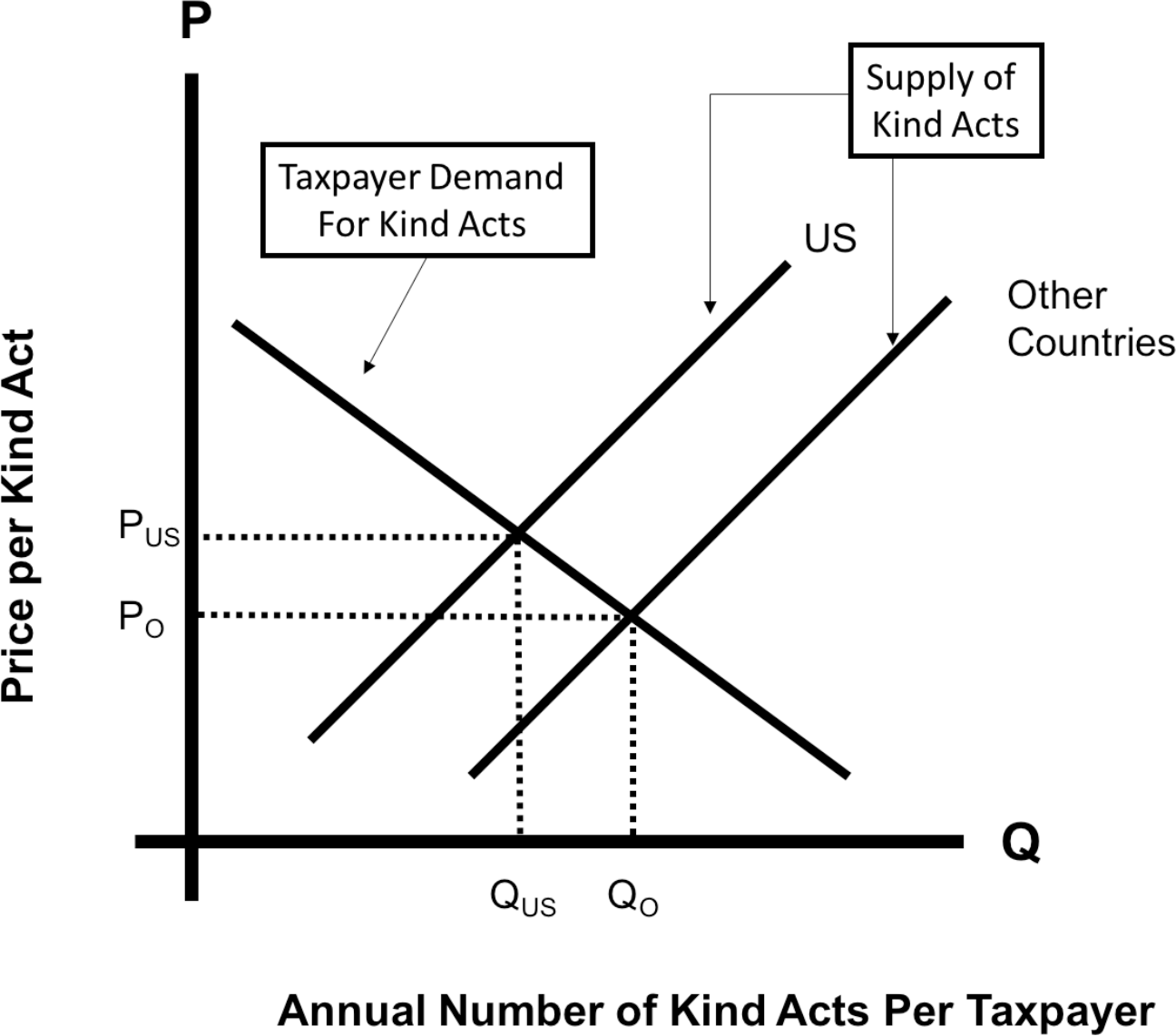
If our healthcare system were cheaper, we could afford to do much more for many more people. But, until we fix the price/cost problem, the supply of kind acts toward the poor will predictably fall short of what it could be. For those who prefer this insight in the form of a figure, I offer a simplified version of the graph that Professor Uwe Reinhardt, who died the month after our conference on the Medicalization of Poverty, included in his 1989 Christmas Card.
The Economics of Kind Acts
As the figure indicates, Professor Reinhardt is comparing the annual number of “kind acts per taxpayer” — with separate supply lines for the U.S. and for all other countries. Even if taxpayers in both sets of countries have the same demand for kind acts, the higher prices for the delivery of those acts in the U.S. means that fewer of them will be provided (i.e., QUS < QO).
How should we go about fixing this problem? We should start by recognizing that it is price/cost (and not access) that drives the dysfunctions of the American healthcare system. Indeed, the Baptists' well-intentioned efforts to broaden access have mostly enriched the Bootleggers — and poured gasoline on the price/cost fire. Those who want more detail on how to fix these problems should read Part II of Overcharged.
Second, even those who are skeptical of my analysis should embrace federalism as a robust solution to this (and other) problems. If California wants to medicalize poverty, and Texas doesn't, as long as each is spending their own money, why is that anyone else's business? In the words of a famous advice columnist, everyone should just “MYOB.” I leave for another day the question of how we should structure Medicaid funding in a world where we want to encourage the states, as laboratories of democracy, to pursue their own visions of how best to deal with the problem of poverty.
Footnotes
The author has no conflicts to disclose.