



Abstract
The Multidimensional Personality Questionnaire (MPQ) assesses a range of personality characteristics pertaining to affective and interpersonal style, behavioral restraint versus disinhibition, and capacity for sensory and imaginal engagement. Its 11 lower order trait scales map onto 3 higher order factors that reflect temperament dimensions. Its content and measurement properties have made the MPQ useful for elucidating constructs relevant to normal and abnormal behavior and investigating their neurobiological underpinnings. However, a barrier to its use in certain populations is the reading difficulty of some MPQ items. We describe efforts to develop a simplified-wording form, the MPQ-SF, composed of items readable at or below the seventh grade level (with most below sixth grade). Simplified-wording items demonstrated high convergence with original-wording items, and resulting trait scales showed adequate internal consistencies and appropriate higher order structure. The availability of a simplified version expands the potential utility of the MPQ to a wider range of samples.
Keywords
A key element of the process of construct validation entails evaluating how new measures of interest relate to previously validated indices of hypothesized constructs (Cronbach & Meehl, 1955). Omnibus inventories of personality are valuable for construct validation work, because they provide multiple anchors against which new measures can be compared and evaluated. One notable inventory of this type is the Multidimensional Personality Questionnaire (MPQ; Tellegen, 1995/2003, 2011a), which provides for a comprehensive assessment of personality at two distinct levels, one involving finer grained measurement of specific lower order traits and the other broader measurement of higher order factors posited to reflect dimensions of temperament. The MPQ has proven useful as a framework for elucidating constructs relevant to normal and abnormal behavior and for clarifying relations among constructs in these domains. However, an obstacle to its use in some populations is the difficulty of some MPQ items in terms of reading level. For example, research on youthful or educationally disadvantaged populations (e.g., underprivileged adults, incarcerated offenders) would benefit from a simplified-wording version. In this article, we provide a brief overview of the MPQ and some of the ways in which it has been used in construct validation research and then describe our efforts to develop a simplified-wording form of the MPQ suitable for use in diverse participant samples.
MPQ Model of Personality: Descriptive Summary
The MPQ was developed using an iterative approach to test construction in which target constructs and scales were progressively refined across multiple rounds of data collection and analysis (for details, see Tellegen & Waller, 2008). The goal was to create a set of unidimensional self-report scales, each indexing a distinctive trait construct, which together would provide for a comprehensive assessment of normal personality. The current full-length version of the MPQ (MPQ-276; Tellegen, 1995/2003, 2011a) comprises 276 items. A 155-item brief form (MPQ-BF; Patrick, Curtin, & Tellegen, 2002; Tellegen, 2002, 2011b) was also developed to facilitate research.
The MPQ contains 11 primary (first-order) trait scales that operate as indicators or facets of three orthogonal higher order factors: Positive Emotionality (PEM), Negative Emotionality (NEM), and Constraint (CON). These higher order factors have been interpreted as broad dimensions of temperament (Clark & Watson, 1999; Tellegen, 1985). PEM and NEM reflect variations in the propensity to experience positive and negative affect, respectively, across events and situations. Each is associated with a primary trait scale that indexes general mood disposition: Well-being (reflecting tendencies to be happy, fun-loving, and optimistic) in the case of PEM and Stress Reaction (reflecting tendencies to be nervous, sensitive, and worried) in the case of NEM. In addition, each is associated with other primary trait scales that index behavioral expressions of positive and negative emotionality in the interpersonal domain—that is, agency (Achievement, Social Potency) and affiliation (Social Closeness) as components of PEM 1 and antagonism (Aggression) and estrangement (Alienation) as components of NEM. The CON factor of the MPQ is marked by three primary trait scales that measure tendencies toward high versus low behavioral restraint: Control (planfulness vs. impulsivity), Harm Avoidance (intolerance vs. tolerance of danger), and Traditionalism (conventionality vs. nonconformity). A final MPQ scale, Absorption, indexes variations in openness to and capacity for self-involving engagement in a wide range of perceptual and imaginative experiences. This scale loads modestly on both PEM and NEM, and although identified as a primary trait, attains the substantive breadth of a higher order trait in its own right. In addition, the MPQ includes three validity scales—two for detecting lack of consistency (semantic coherence) in responding (Variable Response Inconsistency [VRIN], True Response Inconsistency [TRIN]) and one for assessing socially desirable responding (Unlikely Virtues).
Several publications (e.g., Church, 1994; Markon, Krueger, & Watson, 2005; Tellegen & Waller, 2008) have reported linkages of primary and higher order MPQ constructs to structural models of other established personality inventories, including the California Psychological Inventory (Gough & Bradley, 1996), Eysenck Personality Questionnaire (Eysenck & Eysenck, 1975), NEO Personality Inventory (NEO-PI; Costa & McCrae, 1985), Temperament Character Inventory, Cloninger, Svrakic, & Przybeck, 1993), Big Five Inventory (John, Donahue, & Kentle, 1991), Dimensional Assessment of Personality Pathology (Livesley & Jackson, 2006), and Schedule for Nonadaptive and Adaptive Personality (Clark, 1993). The findings demonstrate meaningful relations between MPQ constructs and measures and broad factors of other omnibus inventories and highlight how these comparisons across inventories can help clarify which aspects of personality each measures.
MPQ constructs and measures have also been found useful for clarifying clinical constructs. For example, with regard to internalizing psychopathology, Tellegen (1985) proposed that anxiety and depression overlap, both being associated with generalized negative affect (or “demoralization”; Tellegen et al., 2003; Tellegen et al., 2006) but differ in that depression is also characterized by a specific deficiency in positive affect (subsequently relabeled “positive activation” by Watson, Wiese, Vaidya, & Tellegen, 1999). This idea served as part of the foundation for Clark and Watson’s (1991) tripartite model of depression (see also Joiner, Catanzaro, & Laurent, 1996; Mineka, Watson, & Clark, 1998). A sizable body of research also exists on relations between impulse control (“externalizing”) disorders and MPQ personality traits (e.g., Krueger, 1999; Krueger, Caspi, Moffitt, Silva, & McGee, 1996). Like internalizing disorders, externalizing disorders show positive relations with traits in the domain of NEM (but more with Alienation and Aggression than Stress Reaction), while additionally exhibiting negative relations with traits in the domain of CON. Consistent with the literature on MPQ correlates of anxiety/mood and impulse-related disorders, Miller, Greif, and Smith (2003) demonstrated that MPQ profile data can be used to distinguish internalizing from externalizing forms of posttraumatic stress disorder.
With regard to personality pathology, one condition that has been studied extensively using the MPQ is psychopathy. The MPQ primary and higher order factors have been helpful in elucidating constructs underlying correlated but distinguishable affective interpersonal and antisocial deviance factors of Hare’s (1991) Psychopathy Checklist–Revised, in both male (e.g., Hall, Benning, & Patrick, 2004; Verona, Patrick, & Joiner, 2001) and female (Kennealy, Hicks, & Patrick, 2007) prisoner samples. Other research with nonincarcerated samples has used the MPQ to investigate analogous (cf. Poythress et al., 2010) “Fearless-Dominance” and “Impulsive-Antisocial” factors of psychopathy indexed by the Psychopathic Personality Inventory (PPI; Lilienfeld & Andrews, 1996), the latter of which relates closely to the externalizing domain of psychopathology (Benning, Patrick, Blonigen, Hicks, & Iacono, 2005; Blonigen et al., 2010; Blonigen, Hicks, Krueger, Patrick, & Iacono, 2005). Studies have also shown the MPQ to be of use for clarifying the mediating role of personality traits in relations between diagnostic constructs and specific problem behaviors (e.g., relations between Psychopathy Checklist–Revised psychopathy and suicidal behavior; Verona et al., 2001; Verona, Hicks, & Patrick, 2005).
Also of interest are analyses reported by Patrick et al. (2002) for the MPQ-BF, the 155-item counterpart of the current simplified form. The MPQ-BF scales accounted for sizable portions of the variance in various other self-report measures developed to index anxiousness, fearfulness, sociability, empathic concern, narcissism, impulsivity, sensation seeking, socialization, and imagery ability. The correlational patterns indicated that the MPQ-BF scales yielded informative summaries of the constructs underlying each of these measures.
Creation of a Simplified-Wording Form of the MPQ: Rationale and Development Strategy
Findings such as the foregoing highlight the usefulness of the MPQ measurement model as a framework for investigating personality processes in assorted contexts and across differing levels of analysis. However, the MPQ contains a number of items that are complex in terms of word difficulty, phrasing, or overall length, imposing a limitation on using the MPQ with youthful or educationally disadvantaged samples. The current work was undertaken to develop a simplified-wording version of the MPQ appropriate for use with adolescents or other individuals with less than secondary-level reading ability.
Readability has not been a widely discussed topic in the personality assessment literature, and normal personality inventories typically do not provide elaborated guidelines for reading level requirements. However, there are important reasons to consider this issue in the domain of personality assessment. In his theoretic discussion of score validity, Messick (1995) noted that high reading comprehension requirements can result in what he termed “construct-irrelevant difficulty,” leading to inaccurate scores for weaker readers. In particular, suboptimal readability poses challenges for clinical researchers who are interested in studying populations in which lower reading levels are common, such as educationally disadvantaged groups (e.g., low-income, incarcerated, or youth samples). With these considerations in mind, Schinka and Borum (1994) used the Flesch–Kincaid grade level formula to evaluate the text difficulty of some of the more commonly used personality inventories, including the California Psychological Inventory, the 16 Personality Factor Questionnaire, and the revised NEO Personality Inventory (NEO-PI-R). They reported that whereas overall reading levels of these instruments fell in the fifth- to sixth-grade level range, analysis of text difficulty for individual scales revealed average levels as high as eighth grade. This work illustrates how considering only average readability across items can be misleading, in particular for longer inventories. Subsequent to this, Costa and McCrae (1997) highlighted the need for a simplified version of their widely used NEO-PI-R because of the high difficulty of some items, leading to development of the NEO-PI-3 (McCrae, Costa, & Martin, 2005). Thus, issues of readability have begun to be addressed with some of the more common normal personality instruments.
The MPQ was developed without consideration of reading level. The average reading level for the 276 items of the full MPQ (MPQ-276; Tellegen, 2011a), per the Flesch–Kincaid grade level index of readability, is sixth grade. However, 97 of its items (35%) have reading levels above the sixth grade, with 54 of these (20%) above the eighth grade. The MPQ-BF (Patrick et al., 2002), which served as the referent for development of the simplified wording form, consists of 155 items taken verbatim from the MPQ-276. Approximately 40% of these 155 items fall above the sixth grade readability level, with 24% exceeding eighth grade level. In contrast, studies examining the readability of educational materials in primary care settings have shown that average reading levels of adult participants in these settings fall in the seventh- to eighth-grade level (e.g., Davis et al., 1994), a figure that matches with reports of the National Center for Education Statistics (NCES, 2007). Average reading levels of adolescents at 6th- to 12th-grade levels in school are at the 7th-grade level (Davis et al., 2006). The implication is that existing versions of the MPQ may be inadequate for use with educationally disadvantaged youth and adults who read at levels lower than the average American. For example, a representative sample of prison inmates in 2003 showed lower average literacy than adults living in households, sometimes even with the same level of educational attainment, and almost 40% had not completed high school (vs. 16% of nonincarcerated Americans; NCES, 2007).
With these considerations in mind, we sought to develop a simplified-wording form of the MPQ (MPQ-SF) consisting, to the extent possible, of items at or below the sixth-grade level to provide for assessment of personality in weaker reading samples. In developing the MPQ-SF, we sought to balance considerations of protocol length, content coverage, and fidelity of measurement. Specifically, we sought to establish an item set that is (a) worded to be optimally comprehensible and (b) appreciably briefer than the full MPQ, while (c) faithfully capturing first-order constructs associated with the MPQ primary trait scales (as evidenced by strong empirical relations with full original-wording scales), and (d) providing coverage of distinct content subdomains represented in each full primary trait scale. In conjunction with these objectives, we also sought, at the higher order factor level, to preserve the established three-factor structure of the original MPQ (Patrick et al., 2002; Tellegen & Waller, 2008), with primary trait scales loading in expected ways on broad factors of PEM, NEM, and CON.
As with the development of the MPQ-BF, accommodating these various aims required us to balance a number of different criteria in selecting items for the brief simplified-wording scales. The current article describes the criteria and selection procedures that we used and the properties of the final item set from the standpoint of the foregoing aims. We also present data evaluating predictive relations of the simplified-wording scales with criterion measures consisting of (a) scores on the NEO Big Five personality dimensions; (b) scores on the Fearless Dominance factor of PPI psychopathy, computed from relevant subscales of the PPI (Social Potency, Stress Immunity, Fearlessness); and (c) scores on an inventory of externalizing proneness, a construct with strong ties to the antisocial deviance factor of psychopathy (Blonigen et al., 2010; Patrick, Hicks, Krueger, & Lang, 2005).
Method
Overview
The starting point for the development of the simplified-wording MPQ was the 155-item brief form of the inventory (MPQ-BF; Patrick et al., 2002; Tellegen, 2002, 2011b), which includes 12 items per primary trait scale, along with items composing the MPQ Unlikely Virtues scale (n = 14) and subsets of paired items from the MPQ VRIN and TRIN scales (21/39 and 16/28 pairs, respectively) used for detecting response inconsistency. The MPQ-BF rather than the full-length MPQ-276 served as the starting point in the interest of protocol conciseness. However, in certain instances where the brief form items could not be effectively simplified, other items from the full MPQ were used as replacements. In general, psychometric objectives that guided development of the MPQ-BF were also observed in developing the simplified-wording form. Specifically, we sought to maximize empirical relations of the simplified primary trait scales with their original scale counterparts while maintaining substantive coverage of each primary trait domain by including items from distinct content clusters identified in prior work (Tellegen & Waller, 2008). In addition, across the primary trait scales, we sought to retain sufficient representation of semantically linked item pairs for inclusion in the two main MPQ validity scales (VRIN, TRIN) to permit identification of invalid protocols.
Item Development
Items were assessed for readability using the Flesch–Kincaid grade level index, 2 and in addition, the Lexile reading level index. 3 The Lexile index was used together with the better known Flesch–Kincaid index so as to take word familiarity (i.e., frequency of usage) into account along with word complexity (number of syllables) and sentence length. MPQ-BF items with readability scores at or below the sixth-grade level on both indices were incorporated in original form, and those above sixth-grade level on either index were reworded to this simpler level or, if not amenable to simplification, replaced with alternative items from the MPQ-276. Thus, candidate items for the simplified MPQ administered to participants in the initial development round consisted of 59 simple-original items (i.e., 45 items from the MPQ-BF and 14 replacement items from the MPQ-276 worded in original form), along with 101 reworded items (i.e., 86 items from the MPQ-BF and 15 replacement items from the MPQ-276 for which wordings were simplified to sixth-grade level). In conjunction with these 160 candidate items, all remaining standard-wording items from the MPQ-276 (supplementary-original items; n = 116) were administered to provide for a larger pool of original-wording items against which to evaluate the 101 reworded candidate items; some of these supplementary items were administered in simplified form (i.e., reworded to be more readable) as well as in original form, to serve as replacements if needed for candidate items.
Participant Samples
Initial development sample (N = 421)
A questionnaire containing the 160 candidate items along with the 116supplementary-original items was administered to 421 undergraduate students at the University of Minnesota (UMN; n = 222) and at Kent State University (KSU; n = 199). This initial development sample consisted of 142 men and 279 women, of whom 84% were Caucasian
Cross-validation sample (N = 554)
Items retained on the basis of analyses of data from the development sample were administered, along with a small number of replacement items (see below), to a psychometric cross-validation sample of 554 undergraduates from UMN. This sample consisted of 187 men and 367 women, of whom 86.1 % were Caucasian.
Questionnaire protocols from the cross-validation round that contained >25% of missing items for any of the primary trait or validity scales (n = 16) were excluded from the analyses. No protocols from the development round met this criterion for exclusion. For questionnaires with fewer missing items than this in either round, scores were prorated for scales that included missing items.
Criterion Measures
We evaluated the validity of the simplified-wording form of the MPQ in relation to two sets of criterion variables. One consisted of scores on the NEO–Five Factor Inventory (NEO-FFI; Costa & McCrae, 1992), an abbreviated version of the NEO Personality Inventory (NEO-PI; Costa & McCrae, 1985, 1992) that yields broad (domain-level) scores on the Big Five dimensions of personality. The NEO-FFI was administered to the portion of the development sample recruited and tested at KSU; data for this inventory were available for 198 of the 199 KSU participants. Within this sample, we examined relations of NEO-FFI domain scores with scores on MPQ trait scales composed of items contained in the final simplified-wording MPQ—that is, incorporating item substitutions made based on analyses of the 160 candidate items administered to development sample participants (see next section). Since these item substitutions were made independently of the NEO-FFI data, we considered it appropriate to report correlations with NEO domain scores in this sample as evidence for the validity of the final MPQ-SF trait scales.
The other criterion variables consisted of scores on two psychopathy-related measures collected from participants in the UMN cross-validation sample (N = 554) for whom scores on the final version of the simplified-wording MPQ were available. One of these was the affective-interpersonal factor of psychopathy indexed by the PPI (Fearless Dominance, or PPI-FD; Benning et al., 2005; Benning, Patrick, Hicks, Blonigen, & Krueger, 2003), computed using a subset of items (n = 12) from the PPI Social Potency, Stress Immunity, and Fearlessness subscales administered to this sample; the 12 items were selected specifically to provide for efficient, effective estimation of scores on PPI-FD. As evidence of this, in a separate UMN sample (N = 763) administered the full PPI, PPI-FD scores based on this 12-item subset (computed as the sum of standardized item-score means for each subscale) correlated .87 with PPI-FD scores based on the full subscales. The second psychopathy-related measure consisted of scores on a representative subset of items (n = 41) from the Externalizing Spectrum Inventory (ESI; Krueger, Markon, Patrick, Benning, & Kramer, 2007), an inventory designed to index general externalizing proneness, a construct closely related to the antisocial deviance component of psychopathy (Blonigen et al., 2010; Patrick et al., 2005). Within the development sample for the ESI (N = 1,787), scores on this 41-item subset correlated very highly (.92) with scores on the full inventory.
Results
Development Sample Analyses and Decisions
In the data for the overall UMN/KSU development sample (N = 421), scores for individual reworded items within each primary trait scale were correlated with aggregate scores representing the sum of all original-wording items for that trait scale (i.e., simple-original + supplementary-original items) to evaluate the extent to which reworded items tapped the same underlying constructs as original-wording items. Median item–total rs for constituent items were moderate (.37 or higher) for all primary trait scales except Traditionalism, for which item–aggregate correlations were lower (median = .26) in comparison to other scales. However, this did not appear to be due to alterations in the meanings of the reworded items specifically, as the magnitudes of corrected item–total correlations for original-wording Traditionalism items within the development sample (median = .25) were comparable to those for reworded items (median = .26). To further evaluate the resemblance between reworded and original items, correlations between aggregate scores formed by summing reworded items and separately summing original-wording items (original + supplementary-original) within each primary trait scale were also computed. For all 11 trait scales, reworded item–aggregate scores showed strong correlations with their original item–aggregate counterparts (median r = .74; range = .60-.81).
Although reworded candidate items compared well as a whole with original-wording items, seven reworded items were dropped from the candidate item set because of weak correlations with corresponding aggregate original-wording scores, or unpredicted cross-correlations with other original-wording scales; two simple-original items were also dropped because of weak performance. To compensate for these deletions, four of the available supplementary items with better observed psychometric properties were added as replacement items (two in reworded form) to primary trait scales. Nine candidate trait scale items that exhibited good psychometric properties but appeared redundant in content coverage were excluded from membership in primary trait scales but retained as VRIN or TRIN scale items. In addition, two other supplementary items were added at this point (one in reworded form) to further increase the number of VRIN/TRIN item pairs.
To summarize, results of item analyses indicated that the reworded items as a whole strongly reflected the content of the original MPQ primary trait items. Nonetheless, analyses of data from the development sample led to the exclusion of 9 candidate items because of low item–total correlations with their home scales and/or high cross-loadings on other trait scales, leaving 151 items. These 151 items included 128 content items retained as primary trait scale items, 9 other content items retained to increase available item pairs for the VRIN and TRIN scales, and the 14 items comprising the Unlikely Virtues scale. To compensate for deleted items, four supplementary items were added to primary trait scales as replacements, resulting in 12 items in each of these 11 scales (i.e., 12 × 11 = 132 trait scale items total), and two supplementary items were added as validity-scale-only items. Thus, the final version of the MPQ simplified-wording form (MPQ-SF) administered to the independent cross-validation sample (N = 554 UMN undergraduates) consisted of 157 items. Of these, 96 were reworded from original form to be simpler.
Final MPQ-SF: Item Composition and Readability
Final items retained for inclusion in the primary trait scales of the MPQ-SF are listed (according to MPQ-276 item numberings) in Table 1. 4 Each primary trait scale consists of 12 items that enter into the tabulation of scale scores. In addition, the MPQ-SF contains 9 other trait scale items that were retained to increase the number of TRIN item pairs and 2 other trait scale items included to increase the number of VRIN item pairs, along with 14 Unlikely Virtues items, for a total of 157 items. As shown in Table 1, 78 of the 132 items used in computing trait scale scores, 8 of the 9 VRIN/TRIN-only items, and 10 of the 14 Unlikely Virtues items were reworded from original form to be simpler. Examples of items that were reworded to improve readability are
Final Simplified-Wording Multidimensional Personality Questionnaire Item Set: Item Numbers, Listed by Primary Trait Scale.

Note. Item numbers correspond to those for the 276-item version of the Multidimensional Personality Questionnaire (MPQ-276; Tellegen, 1995/2003, 2011a). Italicized items are those that were retained to increase the number of Variable Response Inconsistency and True Response Inconsistency item pairs.
Absorption scale: “I can wander off into my thoughts so completely while doing a routine task that I actually forget what I am doing and a few minutes later find that I have finished it.” reworded to “Sometimes I get so lost in thought that I forget what I’m doing.”
Well-being scale: “It is easy for me to become enthusiastic about things I’m doing” reworded to “I enjoy most things I do.”*
Table 2 shows numberings for the items of the MPQ-SF, grouped by content area, along with corresponding MPQ-276 item numberings. All content areas of the MPQ-276 are represented in the MPQ-SF, with the exception of the “Condemns selfishness” content area of Traditionalism—which is represented by only two items in the MPQ-276, neither of which performed well enough in current analyses to retain.
Final Simplified-Wording Multidimensional Personality Questionnaire (MPQ-SF) Item Set: Item Numbers Listed by Content Area of Primary Trait Scales, With Corresponding Item Numbers for the Full-Length MPQ-276.
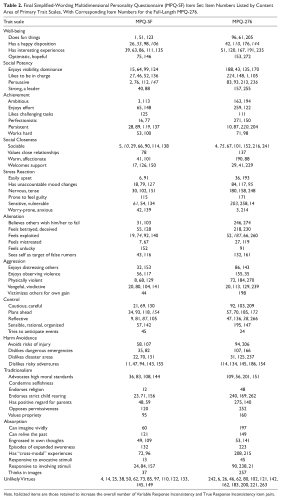
Note. Italicized items are those retained to increase the overall number of Variable Response Inconsistency and True Response Inconsistency item pairs.
Readability statistics for final MPQ-SF item set
Flesch–Kincaid and Lexile readability statistics for items composing the final 12-item MPQ-SF trait scales are presented in Table 3, along with readability statistics for items composing the final MPQ-SF validity scales (Unlikely Virtues, VRIN, TRIN). Of the 132 items included in the final trait scales of the MPQ-SF, 106 are readable at the sixth-grade level or below according to both indices, 20 are readable at the sixth grade on one index but not the other (with only 4 of these showing readabilities above seventh grade on the other index [max = 10.3 Flesch–Kincaid]), 4 are readable at seventh grade on both, and 2 are readable at seventh grade on one index and at eighth to ninth grade on the other. In sum, the trait scale items of the MPQ-SF include 106 with readabilities at or below sixth grade on both indices, 20 with readabilities at or below sixth grade on one index or the other, and 6 with readabilities at or below seventh grade on one index or the other, or both. Of the 25 items used exclusively as validity scale items (i.e., 14 Unlikely Virtues items + 11 supplemental VRIN/TRIN items), 21 are readable at 6th grade or below according to both indices, 2 are readable at 6th grade on one index and at 7th grade on the other, and 2 are readable at sixth grade on one index and below 10th grade (i.e., 7.4, and 9.7, specifically) on the other.
Final MPQ-SF Item Set: Item Readability Statistics for Each Primary Trait and Validity Scale.

Note. MPQ-SF = Simplified-Wording Multidimensional Personality Questionnaire; VRIN = Variable Response Inconsistency; TRIN = True Response Inconsistency. The VRIN and TRIN scales contain some items from the primary trait scales along with some additional items not used in the primary trait scales. Flesch–Kincaid scores for the two VRIN items not used as primary trait scale items were 3.7 and 4.8; corresponding Lexile scores were 413.5 and 599.4. Readability statistics for the nine TRIN items not used as primary trait scale items were as follows: Flesch–Kincaid index—M = 4.7, SD = 2.2, range = 2.3-9.7; Lexile index—M = 444.4, SD = 2.0, range = 149.3-840.0.
Cross-Validation Sample Findings
Descriptive statistics and reliabilities for final MPQ-SF trait scales
Table 4 presents descriptive statistics (Ms, SDs) from the UMN cross-validation sample (N = 554) for all final MPQ-SF trait scales, along with internal consistency (alpha, α) coefficients for the final 12-item trait scales. Values of alpha were .65 or higher for all primary trait scales, with most exceeding .75. It should be noted that within sets of items comprising each of the final trait scales, alpha coefficients for reworded and simple-original subsets (accounting for differences in number of items using the Spearman–Brown Prophecy formula; Brown, 1910; Spearman, 1910) were in all cases comparable.
Final MPQ-SF Item Set: Descriptive Statistics (M, SD) for Primary Trait and Validity Scales, and Internal Consistencies (α) for Primary Trait Scales, in Undergraduate Cross-Validation Sample (N = 554).
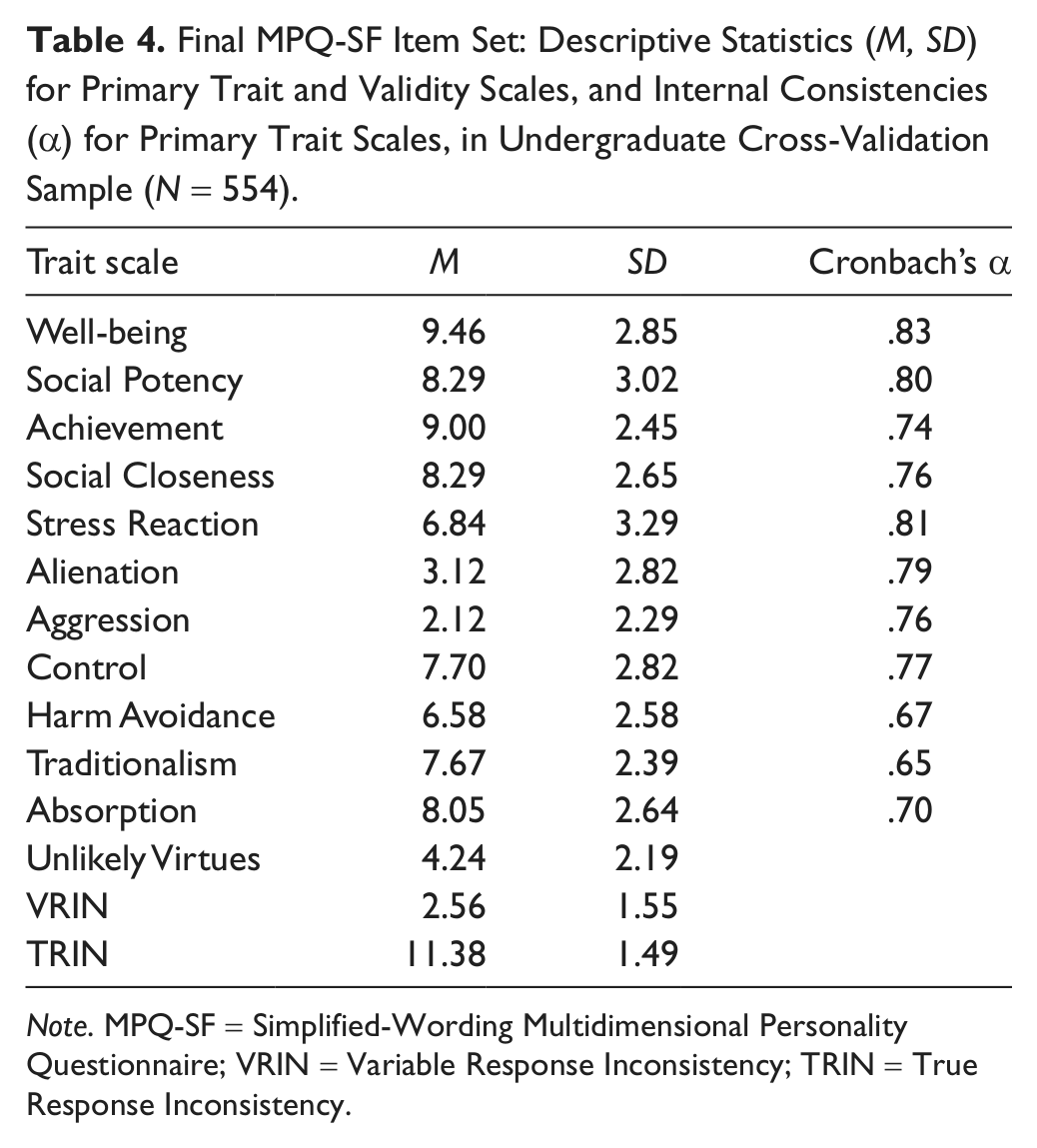
Note. MPQ-SF = Simplified-Wording Multidimensional Personality Questionnaire; VRIN = Variable Response Inconsistency; TRIN = True Response Inconsistency.
Higher order structure of the final MPQ-SF
The higher order structure of the primary trait scales was examined in the cross-validation sample using exploratory principal axis factor analysis; the analysis focused on 10 of the 11 trait scales, excluding Absorption, because of prior work showing lack of convergence of this scale with any specific factor (Patrick et al., 2002; Tellegen & Waller, 2008). Exploratory rather than confirmatory factor analysis was used for reasons of consistency/comparability with prior published work and because concerns have been raised in the literature that confirmatory factor analysis may be overly conservative for evaluating the fit of structural models of personality test data (Church & Burke, 1994; Hopwood & Donnellan, 2010; McCrae, Zonderman, Costa, Bond, & Paunonen, 1996). Also in the interests of consistency/comparability, the number of factors extracted (three) and the approach used to derive the factors (including rotation method) mirrored prior published work on MPQ scale structure (Patrick et al., 2002; Tellegen & Waller, 2008). Specifically, after first extracting four orthogonal components using varimax rotation, we then derived the broad factor of Positive Emotionality (PEM) as the intermediate vector between the two factors corresponding to Agentic PEM and Communal PEM. 5 These results are depicted in Table 5. All primary trait scales loaded most strongly on their predicted factors, with the exception of Aggression, which loaded somewhat more highly on CON than on Negative Emotionality (NEM). 6
Loadings of MPQ-SF Primary Trait Scales on Three Factors Derived From Exploratory Principal-Axis Factor Analysis for the Cross-Validation Sample (N = 554), Using All Scales Except Absorption.
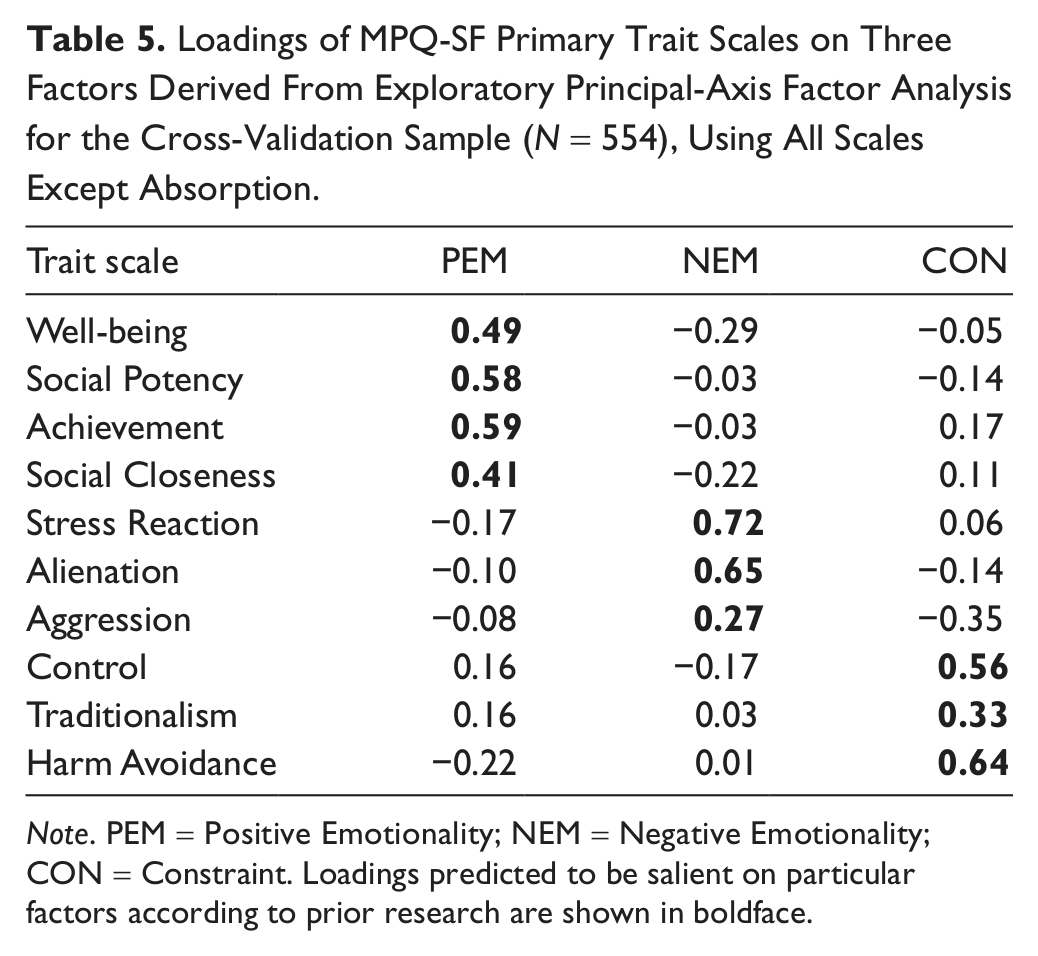
Note. PEM = Positive Emotionality; NEM = Negative Emotionality; CON = Constraint. Loadings predicted to be salient on particular factors according to prior research are shown in boldface.
Concurrent Validity of MPQ-SF Trait Scales
The left side of Table 6 presents, for the KSU portion of the initial development sample (n = 198), correlations between trait scale scores based on items of the final MPQ-SF and scores on the Big Five domains of personality assessed using the NEO-FFI. For comparison, the right side of Table 6 depicts correlations between trait scale scores for the 155-item standard-wording MPQ-BF (Patrick et al., 2002) and domain scores of the Big Five Inventory (Benet-Martinez & John, 1998; John et al., 1991); data in this case are from the Eugene–Springfield Community Sample (N = 550; Goldberg, 2005; Goldberg et al., 2006). Despite differences in approaches used to assess the Big Five domains, patterns of relations of MPQ trait scales with particular domains are quite similar across the two samples. For example, in both samples Neuroticism (N) is associated most strongly with MPQ Stress Reaction and secondarily with MPQ Well-being (–) and Alienation, whereas Extraversion (E) shows moderate positive correlations with Social Closeness, Social Potency, and Well-being in the MPQ domain of PEM, and low to modest associations with all other MPQ traits.
Correlations (rs) Between MPQ-SF Trait Scales and Big Five Domain Scores in KSU Portion of Development Sample (N = 198) Compared With rs for MPQ-BF From ESC Sample (N = 550; Goldberg, 2005).
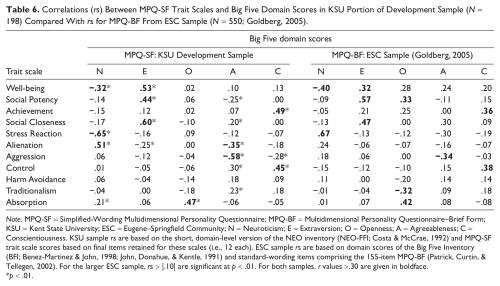
Note. MPQ-SF = Simplified-Wording Multidimensional Personality Questionnaire; MPQ-BF = Multidimensional Personality Questionnaire–Brief Form; KSU = Kent State University; ESC = Eugene–Springfield Community; N = Neuroticism; E = Extraversion; O = Openness; A = Agreeableness; C = Conscientiousness. KSU sample rs are based on the short, domain-level version of the NEO inventory (NEO-FFI; Costa & McCrae, 1992) and MPQ-SF trait scale scores based on final items retained for these scales (i.e., 12 each). ESC sample rs are based on domain scores of the Big Five Inventory (BFI; Benez-Martinez & John, 1998; John, Donahue, & Kentle, 1991) and standard-wording items comprising the 155-item MPQ-BF (Patrick, Curtin, & Tellegen, 2002). For the larger ESC sample, rs > |.10| are significant at p < .01. For both samples, r values >.30 are given in boldface.
p < .01.
Table 7 depicts correlations for the final 157-item MPQ-SF and the standard-wording MPQ-BF with scores on the Fearless Dominance factor of the PPI (PPI-FD) and scores on a 41-item version of Krueger et al.’s (2007) ESI in two different UMN undergraduate samples. Again, patterns of relations for MPQ trait scales with each criterion variable are highly similar across the two versions of the MPQ. In each case, MPQ traits of Harm Avoidance (–), Social Potency, Stress Reaction (–), and Well-being are robustly predictive of scores on PPI-FD, whereas MPQ traits of Aggression, Control (–), and Alienation, and to a somewhat lesser degree Traditionalism (–) and Harm Avoidance (–), are predictive of scores on the 41-item ESI. In the original report on the factor structure of the PPI, Benning et al. (2003) reported a multiple R of .70 for prediction of scores on PPI-FD from the 11 primary trait scales of the standard-wording MPQ. Parallel regression models were run for the two data sets depicted in Table 7. Multiple Rs for prediction of PPI-FD scores from trait scales of the MPQ-SF and the MPQ-BF in these models were .72 and .74, respectively, with strong correspondence in the configuration of beta weights for trait scales across the two models, as evidenced by a very high (.96) coefficient of congruence (Gorsuch, 1983; Watkins, 2002) between the two. Regression models were also run predicting scores on the 41-item ESI from scores on the 11 MPQ trait scales. Multiple Rs for prediction of ESI scores from trait scales of the MPQ-SF and the MPQ-BF in these models were .73 and .72, respectively, with the coefficient of congruence between the beta weights for one model compared with the other again very high (.96).
Correlations (rs) Between Final MPQ-SF Primary Trait Scales and Psychopathy-Related Criterion Measures in Cross-Validation Sample (N = 554) compared With rs for MPQ-BF in an Independent Undergraduate Sample (N = 743).

Note. MPQ-SF = Simplified-Wording Multidimensional Personality Questionnaire; MPQ-BF = Multidimensional Personality Questionnaire–Brief Form; PPI-FD = item-based index of the Fearless Dominance factor of the Psychopathic Personality Inventory (Lilienfeld & Andrews, 1996); ESI = 41-item version of the Externalizing Spectrum Inventory (Krueger, Markon, Patrick, Benning, & Kramer, 2007). For both samples, r values >.30 are given in boldface.
p < .01.
Discussion
The aim of the present work was to develop a simplified-wording form of the MPQ, the MPQ-SF, effective in capturing primary traits and higher order factors indexed by the standard MPQ. The final 157-item MPQ-SF includes 132 items used in the scoring of the primary trait scales (12 per scale), some of which are also used as inconsistency scale items, along with 25 other items used exclusively as validity scale items—that is, 14 Unlikely Virtues items plus 11 supplemental VRIN/TRIN scale items. (As a whole, the MPQ-SF item set provides representation of 20/39 VRIN item pairs and 17/28 TRIN item pairs.) Of the items comprising the primary trait scales, 54 were retained in original form and 78 were reworded to improve their readability to approximately the targeted (sixth grade) level; of the validity scale items, 7 were retained in original form and 18 were reworded to improve their readability.
The fidelity of reworded primary scale items as indices of intended constructs was demonstrated by their generally robust relations with aggregate scores for original-wording items in the initial development round of the project. The small subset of individual items that functioned at suboptimal levels in this initial round were replaced in the subsequent cross-validation round. In general, observed internal consistency (alpha) coefficients for the final 12-item primary scales in the cross-validation sample were respectable and commensurate with those for the 12-item primary scales of the MPQ-BF. The one notable exception was the Traditionalism scale, which evidenced lower item–total correlations and internal consistency compared to the others. A possible explanation for this could be changes in the functioning of items that were simplified. However, the fact that alpha coefficients for reworded items in this scale were comparable to those for simple-original items (αs = .70 and .64, respectively) after equating for subscale length (using Spearman–Brown) argues against this. Furthermore, as discussed below, this scale demonstrated expected correlations with psychopathy-related criterion measures in the form of PPI-FD and ESI scores, comparable in magnitude to those for its standard-wording MPQ-BF counterpart. This points to sample characteristics as an alternative explanation for the weaker internal consistency of this scale. For example, the fact that current participants consisted of college students rather than individuals from the general community might be a factor, since college students as a group are expected to be lower in Traditionalism. Further research will be needed to evaluate the impact of sample characteristics on this and other scales of the MPQ.
A further major aim of the present work was to preserve the higher order factor structure of the full MPQ and to maintain expected loadings of the primary trait scales on the PEM, NEM, and CON factors (cf. Tellegen & Waller, 2008). For the most part, this goal was also effectively realized. A factor analysis of the MPQ-SF trait scales in the cross-validation sample yielded three higher order factors readily identifiable as PEM, NEM, and CON, with scales generally exhibiting their strongest loadings on the appropriate higher order factor. The only departure from expectation was the Aggression scale, which loaded somewhat more strongly on the CON factor than on the NEM factor. Notably, prior structural analyses of the MPQ trait scales have demonstrated a moderate secondary loading of Aggression on CON (Patrick et al., 2002; Tellegen & Waller, 2008). The fact that Aggression loaded less than expected on NEM in the current factor solution could reflect variables such as sample composition (e.g., higher proportion of women vs. men than in prior work) and analytic approach (use of factor analysis, rather than principal components analysis [cf. Patrick et al., 2002]).
The current work also provides initial evidence for the concurrent validity of the MPQ-SF in a young-adult (undergraduate) sample. Patterns of correlations for trait scales of the MPQ-SF with broad domains of the Big Five as indexed by the NEO inventory paralleled those for the trait scales of the MPQ-BF. This finding is noteworthy because the Big Five model is prominent in the field and thus serves as an informative referent for other models of personality. Furthermore, in line with prior published work (e.g., Benning et al., 2003; Benning et al., 2005; Blonigen et al., 2005), the MPQ-SF trait scales proved effective for estimating scores on two distinctive components of the psychopathy construct—the affective-interpersonal component as indexed by PPI-FD, and the impulsive-antisocial component as indexed by scores on the ESI. The prediction afforded by the MPQ-SF scales matched that provided by the standard-wording MPQ-BF scales, and the two sets of scales were weighted similarly in regression models that used one or the other set to predict scores on the two psychopathy variables. This pattern of results supports the utility of this “downward extension” (cf. Salekin, 2006) of the MPQ for operationalizing clinically relevant constructs as configurations of basic personality traits (for other examples of this kind, see Bornovalova, Hicks, Patrick, Iacono, & McGue, 2011; DiLalla, 1989).
An important limitation of the current study is that it focuses on properties and correlates of the MPQ-SF in participants with stronger reading ability (i.e., college students) as opposed to lower reading ability. As an initial step, the current study involved an evaluation of the psychometric properties of the MPQ-SF in college students to establish consistency of measurement with the standard-wording form. We considered it important to first establish that the content of the simplified items and factor structure of the simplified scales remained consistent with those of the standard-wording form, and this could only be evaluated through use of a common sample of the type the standard MPQ was developed for use with (i.e., adults possessing good reading ability). Further work is needed to evaluate the effectiveness of the MPQ-SF with younger or educationally disadvantaged samples. We have begun to address this issue through follow-up work focusing on the psychometric properties and correlates of the MPQ-SF in treatment-referred adolescents, including youthful offenders (M age = 14 years); findings from this work (Javdani, Finy, & Verona, 2012) demonstrate scale reliabilities and factor structure in this younger clinical sample similar to what we report for college participants in the current report.
Additional empirical studies of special populations for which the MPQ-SF was specifically designed—including older children and adolescents in community settings such as schools, and educationally disadvantaged adults—are needed to determine which form of the MPQ is optimal for use with specific populations. In particular, studies should be undertaken comparing the utility of the standard- and simplified-wording versions of the MPQ in populations for which the MPQ has previously been used, including incarcerated adults, to investigate more generally the extent to which readability affects personality assessments, a topic that has received limited attention to date in the personality literature. This latter goal is another reason why a simplified-wording form will be a useful tool in future research. More important, work of this kind will set the stage for MPQ-based research on dispositional aspects of emotion, cognition, and behavior, and contributions of personality to psychological vulnerability and resilience, in youthful, underprivileged, or specialized clinical samples. The availability of a downward extension of the MPQ, which organizes primary traits around broad temperament dimensions, will also be valuable for developmental studies aimed at clarifying the stability and structure of personality from earlier to later points in the life span.
Footnotes
Acknowledgements
We are grateful to Sarah Patrick and Emily Reichman for their suggestions on rewording of items and to Marianna Gasperi for her assistance with collection and initial processing of data.
Authors’ Note
For each version of the Multidimensional Personality Questionnaire (MPQ-276, MPQ-BF, MPQ-SF), a research kit containing test booklet, descriptive statistics, and scoring program (Tellegen, 2011a, 2011b, 2011c; Tellegen, Patrick, Verona, & Kaemmer, 2011) is available for research purposes from the University of Minnesota Press ( ).
).
Declaration of Conflicting Interests
The MPQ-SF will be provided by the University of Minnesota Press to researchers from among the MPQ suite of instruments at a nominal cost to defray administrative expenses, producing modest sales revenue to the Press, of which Beverly Kaemmer is the Associate Director/Test Division Manager.
Funding
The authors disclosed receipt of the following financial support for the research, authorship, and/or publication of this article:
This work was supported by Grants MH65137, MH072850, and MH089727 from the National Institute of Mental Health.
Notes
*
Items are excerpted from the Multidimensional Personality Questionnaire™ (MPQ™), test booklet. Copyright © 1995, 2003 by Auke Tellegen and the Multidimensional Personality Questionnaire Simplified Form™ (MPQ-SF™), test booklet. Copyright © 1995, 2003, 2011 by Auke Tellegen. Used by permission of the University of Minnesota Press. All rights reserved.