



Abstract
The present study is the first to investigate the Personality Assessment Screener, a brief self-report measure of risk for emotional and behavioral dysfunction, in relation to the informant report version of this instrument, the Personality Assessment Screener–Other. Among a sample of undergraduate roommate dyads (N = 174), self-report and informant report total scores on the Personality Assessment Screener/Personality Assessment Screener–Other moderately converged (r = 0.45), with generally greater agreement between perspectives observed for externalizing behaviors compared with internalizing distress. In addition, selves tended to report more psychological difficulties relative to informant ratings (d = 0.45) with an average absolute discrepancy between sources of 6.31 (SD = 4.96) out of a possible range of 66. Discrepancies between self-report and informant report were significantly associated with characteristics of the dyadic relationship (e.g., length of acquaintanceship) as well as the severity of self-reported psychological difficulties and positive impression management.
Keywords
The Personality Assessment Screener (PAS; Morey, 1997) is a 22-item self-report questionnaire designed to detect individual risk for a broad array of emotional and behavioral problems. In addition to providing an index of global psychological impairment, the PAS identifies specific domains of dysfunction that may warrant further targeted assessment. The brevity of the PAS can be particularly useful in mental health settings where time constraints prevent general administration of comprehensive testing and necessitate informed decisions about whether to expend resources on additional evaluation. To this end, the items on the PAS were extracted from the parent instrument, the Personality Assessment Inventory (PAI; Morey, 1991) to assess 10 independent problem domains, identified in factor analyses of the PAI item pool, that in combination optimally discriminate between persons with and without psychological difficulties. Although relatively few studies have examined the performance of the PAS, extant research suggests that the measure effectively screens for the presence of schizophrenia (Christensen, Girard, Benjamin, & Vidailhet, 2006), mood disorders, personality disorders, and substance use disorders (Porcerelli, Kurtz, Cogan, Markova, & Mickens, 2012). The PAS exhibits further utility in predicting a history of childhood abuse and ongoing intimate partner violence among urban women (Porcerelli, Hurrell, Cogan, Jeffries, & Markova, 2015) and dissociative symptoms (McLeod, Byrne, & Aitken, 2004), depression, and suicidality among inmates (Harrison & Rogers, 2007).
An informant report version of this instrument, the Personality Assessment Screener–Other (PAS-O; Morey, 2005), is also available for use in corroborating and supplementing self-report ratings, which may contain important omissions for a variety of reasons (Achenbach, Krukowski, Dumenci, & Ivanova, 2005; see Podsakoff, MacKenzie, Lee, & Podsakoff, 2003, for review). However, no known studies have yet examined the properties and utility of the PAS-O in screening for psychopathology. Moreover, no research exists concerning the relation between self and informant versions of this instrument, including whether perspectives converge and diverge from one another in predictable ways. Given the relative ease with which the PAS-O can be administered to knowledgeable others, incorporation of this outside perspective when making triage decisions and conceptualizing patients’ sources of dysfunction may prove to be a cost-effective means of improving decision making.
Self-report measures ostensibly permit access to privileged information concerning unrevealed thoughts, emotions, and motivations. Even so, there are coinciding disadvantages to the self-report approach that can contribute to incomplete or inaccurate descriptions of functioning. Notably, self-report measures are vulnerable to socially desirable responding and exaggeration of symptom severity, tendencies that may result from intentional attempts at deception or limitations in self-awareness. The potential for response distortion seems especially problematic in assessing psychopathology, as unrealistic self-appraisal represents a core feature of numerous disorders, such as depression (Swallow & Kuiper, 1988), anorexia nervosa (Vandereycken, 2006), and narcissistic personality disorder (John & Robins, 1994). Moreover, persons with psychopathology may have difficulty appreciating the consequences of problematic emotional and behavioral patterns as they are experienced by close others (Carlson & Oltmanns, 2015; Clifton, Turkheimer, & Oltmanns, 2004).
In recent years, researchers have increasingly encouraged use of informant reports as a cost-effective means of improving the reliability and validity of psychological assessment in adult populations (Ganellen, 2007; Klonsky, Oltmanns, & Turkheimer, 2002; Miller & Lynam, 2015; Vazire, 2006). With opportunities to observe an individual across multiple naturalistic contexts, knowledgeable informants are capable of reporting unique and relatively unbiased information that selves are unable or unwilling to disclose. Indeed, although informant responses do replicate aspects of self-report in a corroborating manner, empirical examinations of agreement between sources demonstrate there is also significant room for complementary information. For example, self-reports and informant reports of Big Five personality traits only moderately converge (mean rs = 0.46-0.62; Connolly, Kavanagh, & Viswesvaran, 2007), whereas convergence between self-ratings and informant ratings of personality disorder criteria appears to be “modest at best” (median r = 0.36; Klonsky et al., 2002, p. 303). Together with evidence of similarly modest correlations between self-ratings and informant ratings of adult psychopathology, including internalizing (mean r = 0.43) and externalizing (mean r = 0.44) disorders (Achenbach et al., 2005), these findings indicate the common presence of meaningful discrepancies within pairs of respondents. The relative attenuation of correlations when examining maladaptive versus normal-range attributes further suggests that discrepancies could, in part, be driven by characteristics of psychopathology (e.g., disturbances in self-awareness), although this notion has not been supported in some samples (Miller, Jones, & Lynam, 2011; Ready & Clark, 2002).
Vazire (2010) proposed a more general explanation for discrepancies between self and informant insights that emphasizes the observability and evaluativeness of measured traits. Because individuals have access to their own covert cognitions and emotions, self-report is predicted to provide relatively more valid information concerning internalizing traits and disorders (e.g., neuroticism, anxiety). Conversely, Vazire suggests that informant report should provide relatively more valid information concerning externalizing traits and disorders (e.g., antagonism, narcissism) that others can easily observe or infer from behaviors. These outwardly conspicuous qualities also tend to have a larger evaluative component (i.e., as desirable or undesirable), which is thought to further motivate biased reporting from selves compared with ostensibly more disinterested informants.
The PAS and PAS-O provide an opportunity to test the hypothesized arrangement of self–other correspondence, as the measures assess for both internalizing experiences of distress (e.g., negative affectivity, suicidality, social detachment) and outwardly expressed psychological difficulties (e.g., impulsivity, substance use, anger management). This content could also facilitate greater understanding of how internalizing and externalizing dysfunction may be experienced differently from the perspectives of the self and others. For example, two items on the PAS/PAS-O are indicative of alienation, or disturbances in attachment relationships, which is symptomatically associated with externalizing features, such as acting out, anger, and distrust. Examining the discriminant validity of domains across perspectives could uncover systematic differences in how selves and informants interpret particular problems, with more private states (e.g., tension, interpersonal discomfort) perhaps being perceived by others as overtly alienating (e.g., unfriendly or hostile).
In recent research, the notion that selves and informants are attuned to different aspects of personality and psychological difficulties has been supported by the hypothesized patterns of knowledge (Carlson, Vazire, & Oltmanns, 2013; Vazire, 2010; Vazire & Carlson, 2011). Additionally, the discrepancies between self-ratings and informant ratings can partially result from a tendency for selves to report more dysfunction than do informants, as has been observed for reports of internalizing and externalizing problems among adolescents (Rescorla et al., 2013), cognitive deficits among adults (Rabin et al., 2012), and alcohol consumption among adolescent and adult family members (Engels, Van Der Vorst, Deković, & Meeus, 2007). This assertion is qualified, however, by studies using epidemiological samples in which selves reported fewer pathological features than informants with respect to personality disorder criteria (Busch, Balsis, Morey, & Oltmanns, 2015; Cooper, Balsis, & Oltmanns, 2012). Even so, for other types of psychological difficulties, such as alcohol use among college students, self-ratings and informant ratings demonstrate no mean difference (Borsari & Muellerleile, 2009), although they are not necessarily redundant. It is worth noting that the utility of informant report has been demonstrated by findings of incremental validity over self-report and/or interview-based ratings in predicting numerous outcomes, including social behavior and psychological distress among psychiatric inpatients (Ready, Watson, & Clark, 2002), prior episodes of major depression (Galione & Oltmanns, 2013), alcohol consumption (Whitford et al., 2009) and intimate partner violence (Jones & Miller, 2012) among community members, and antisocial behavior among undergraduates (Kelley, Edens, Mowle, & Sörman, 2015).
It is apparent that both the self-description put forth by an individual and the perceptions of close others are important components to weigh in case conceptualization. However, there is currently limited research comparing self and informant responses on screening measures of psychopathology generally, with no research to this point on the PAS/PAS-O specifically. An absence of nomothetic data to contextualize self–informant disagreement creates uncertainties for practitioners when attempting to interpret and integrate differing accounts of symptomatology. Accordingly, the present study seeks to examine self and informant convergence on the PAS/PAS-O in a sample of undergraduate roommates, and describe the distribution of discrepancies observed between perspectives. We further investigate the role of dysfunction severity and positive impression management (PIM) in moderating self–informant discrepancies, as these features have the potential to impede accurate self-appraisal. Finally, we also examine the extent to which relationship qualities (e.g., length of acquaintanceship) moderate self–informant convergence on the PAS/PAS-O based on previous research suggesting that aspects of interpersonal relationships influence interrater agreement on measures of personality (Biesanz, West, & Millevoi, 2007; Connelly & Ones, 2010).
Method
Sample
Participants included 174 undergraduate students (87 dyads) recruited from the psychology subject pool at a large university in the Southwestern United States. Recruited participants brought a current same-sex roommate (with whom they were not romantically involved) to the in-person study session. Most participants were female (64.4%) and Caucasian (59.8%; Hispanic, 22.4%; Asian American, 9.2%; African American, 3.4%; Other, 4.6%). The mean age was 19.1 years (SD = 2.8). The median length of cohabitation reported by roommates was 0.3 years (M = 1.0, SD = 2.9) with a median acquaintanceship of 1.3 years (M = 3.7, SD = 5.1). The majority of participants chose to live with their current roommate (63.2%), as opposed to living with an assigned roommate. Five participants were excluded from data analysis for failure to follow instructions, resulting in a final sample of 82 dyads.
Measures
The PAS (Morey, 1997) is a 22-item self-report questionnaire that screens for multiple domains of emotional and behavioral problems. The content dimensions assessed by the PAS characterize approximately 40% of the variance underlying items of the parent instrument, the PAI (Morey, 1991), and are enumerated as 10 discrete elements: Negative Affect, Acting Out, Health Problems, Psychotic Features, Social Withdrawal, Hostile Control, Suicidal Thinking, Alienation, Alcohol Problem, and Anger Control; each of these elements are assessed with two or three items on the PAS. These items were selected from the parent instrument to be optimally informative for distinguishing between persons experiencing emotional/behavioral dysfunction and those manifesting no psychological difficulties. Responses are provided on a 4-point Likert-type scale (false, not at all true to very true).
Raw scores are converted into probability estimates (P), which indicate the likelihood of observing significant psychopathology or dysfunction (>70T) if the respondent were to complete the full-length parent instrument, based on the results of logistic regression in a combined sample of community members and persons under psychological care. In addition, total raw scores can be expressed as categories of risk for psychological difficulties as follows: Low (≤12), Normal (13-15), Mild (16-18), Moderate (19-23), Marked (24-44), or Extreme (≥45). The Moderate to Extreme categories correspond to P-scores ≥48, or a generally greater than chance probability that more extensive assessment would uncover significantly problematic areas. For decision-making concerning follow-up, use of this dividing point (i.e., a raw score of 19) is recommended and yields 84.7% sensitivity and 78.7% specificity in predicting clinically significant elevations on the PAI. The PAS has demonstrated convergent and discriminant validity, including associations with measures of personal distress (e.g., anxiety, anger), severe mental illness (e.g., psychosis, paranoia), substance use, and personality disorder (Morey, 1997; Porcerelli et al., 2012). In the present sample, internal consistency was expectedly modest (α = .67) given the combined breadth and brevity of the measure.
The PAS-O (Morey, 2005) is the informant report version of the PAS and corresponds to the self-report measure in terms of structure, scoring, and content, with the exception of using third person pronouns. In the present study, pronoun stems (i.e., he, she) were changed to “my roommate.” The PAS-O demonstrated internal consistency (α = .76) comparable to that of the self-report version.
Participants also completed the Positive Impression Management (PIM) validity scale of the PAI, which consists of nine items measuring tendencies toward defensive responding (in this sample, α = .71). In addition, information concerning the roommate relationship was collected, including length of acquaintanceship, length of cohabitation, and whether participants chose or were assigned to their current roommate. Participants further provided ratings on (a) how well they knew their current roommate and (b) how likely they were to continue cohabitating with their current roommate if circumstances allowed. These two items were rated on a 6-point Likert-type scale (1 = not at all; 6 = extremely).
Procedure
During informed consent procedures, roommate pairs were assured that their responses were confidential and would not be shared with each other. In separate rooms, each dyad member completed both the PAS and the PAS-O as part of a larger study on self-reports and informant reports. Self-report and informant report versions of the measure were presented in a counterbalanced manner. Items from the PIM scale were evenly interspersed throughout the PAS and the PAS-O, as they are on the parent PAI instrument, and self and other perspectives were thus counterbalanced for this measure as well. Last, information concerning demographics and the roommate relationship was collected. Participants enrolled in the psychology subject pool were compensated with course credit.
Results
Self and Informant Agreement
We first examined the similarity of roommates’ self-ratings on the PAS and determined that dyad members’ scores were sufficiently independent from one another to analyze self–roommate agreement using reciprocal ratings, ICC (1, 1) = 0.01, p = ns (see Kenny, 1995). On the total scores, self-reports (PAS) and informant reports (PAS-O) of emotional and behavioral functioning moderately converged, r = 0.45, p < .01; however, the mean difference between total scores provided by each perspective (Table 1) suggested a tendency for selves to report more psychological difficulties relative to informant ratings, t(320) = 4.00, p < .01, d = 0.45. Self-ratings and informant ratings further evinced small to moderate agreement on 6 of 10 subscales (Table 1), with roommates generally sharing greater knowledge related to externalizing behaviors (e.g., Acting Out, Alcohol Problem) compared with internalizing dysfunction (e.g., Negative Affect, Suicidal Thinking).
Descriptive Statistics and Self–Informant Agreement on the PAS/PAS-O.
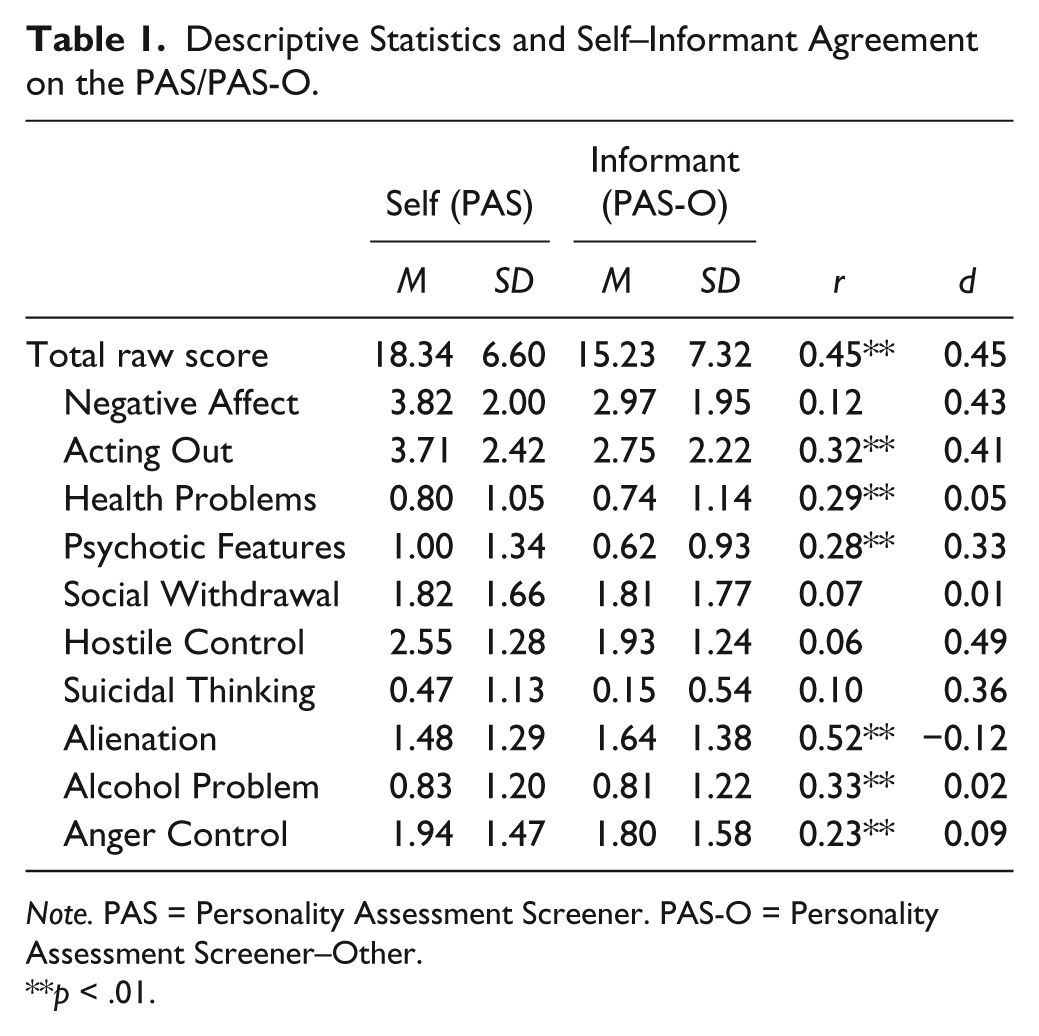
Note. PAS = Personality Assessment Screener. PAS-O = Personality Assessment Screener–Other.
p < .01.
Regarding discriminant validity from a multitrait–multimethod framework, the means of heterotrait correlations within and across measures ranged from −0.02 to 0.19, with the greatest overlap observed for Negative Affect and Anger Control. 1 In fact, certain internalizing elements (i.e., Negative Affect, Social Withdrawal, Hostile Control, and Suicidal Thinking) demonstrated greater associations with numerous other affective, externalizing, and/or interpersonal problems than with the corresponding subscale from the alternative perspective. For example, PAS Negative Affect was positively associated with PAS-O Anger Control (r = 0.20, p = .01). Furthermore, PAS Social Withdrawal related positively to PAS-O Alienation (r = 0.18, p < .05) and Anger Control (r = 0.15, p = .07). For the majority of remaining elements, no or only one other heterotrait correlation exceeded the magnitude of monotrait self–informant convergence.
Because the PAS is intended for use as a screening device, we also examined agreement dichotomously as to whether or not further assessment would be warranted given the probability of identifying significant psychopathology with continued evaluation (Low, Normal, Mild, P < 48 vs. Moderate, Marked, Extreme, P ≥ 48). For self-report, 50.6% of total scores exceeded this cut score such that follow-up would be recommended, whereas only 27.8% of informant-report total scores were categorized as significant elevations. There was fair agreement (κ = .25) resulting from dichotomous decisions about risk using data from the two raters. Using this dividing point, informant ratings demonstrated 72.7% sensitivity and 57.9% specificity in predicting whether self-report indicated the need for further assessment of psychological difficulties.
We next examined the configural similarity of PAS and PAS-O ratings using the Q correlation. The Q correlation assesses the extent to which self-ratings and informant ratings agree concerning the relative presence, or rank order, of attributes within a single individual. The resulting correlation coefficient reflects the degree of correspondence in the shape of the two personality profiles, with higher values indicating greater agreement. Roommates demonstrated a wide range of Q correlations (−.32-.96), though on average self-ratings and informant ratings exhibited moderately strong convergence (mean Q correlation = 0.57, 95% confidence interval [0.45, 0.66], SD = 0.29). 2
Discrepancy Analyses
The raw discrepancies between self and informant total scores ranged from −20 to 28 (M = 3.18, SD = 7.38) out of a possible range of −66 to 66, with each extreme indicating complete disagreement. The absolute discrepancies ranged from 0 to 28 (M = 6.31, SD = 4.96) out of a possible range of 0 to 66. In any particular dyad, two sources of variability may contribute to absolute discrepancies in ratings. First, the status of a respondent as providing self-report or informant report contributes to differences in ratings, as selves reported more psychological difficulties compared with informant ratings by approximately three points, on average. The remaining variability results from aspects unique to each dyad. Given the wide standard deviation of raw discrepancies, which notes that many informants provided overestimates of self-reported dysfunction, factors beyond perspective may better account for the magnitude, and perhaps direction, of discrepancies. To illustrate, when self-reports are adjusted by subtracting from each the 3.18 average group difference attributable to perspective, results demonstrate only a modest reduction in the average absolute discrepancy (M = 5.82, SD = 4.51). Accordingly, other possible sources of disagreement require identification and examination.
Correlates of Self–Informant Discrepancies
To examine potential moderators of agreement, we investigated associations between self and informant discrepancies and features of the roommate relationship (Table 2). The length of cohabitation was not significantly correlated with either raw or absolute discrepancy; however, the length of acquaintanceship was significantly and negatively associated with absolute discrepancy, r = −0.18, p < .05. In addition, both perceived knowledge about and willingness to continue cohabitating with roommates correlated negatively with rating discrepancies (rs = −0.16 to −0.25, ps < .05). Roommates who had chosen to live together demonstrated marginally less absolute discrepancies (M = 5.71, SD = 4.22) relative to those assigned to be roommates (M = 7.26, SD = 5.94), t(155) = 1.91, p = .06, d = 0.31.
Correlates of Raw and Absolute Self–Informant Discrepancies.
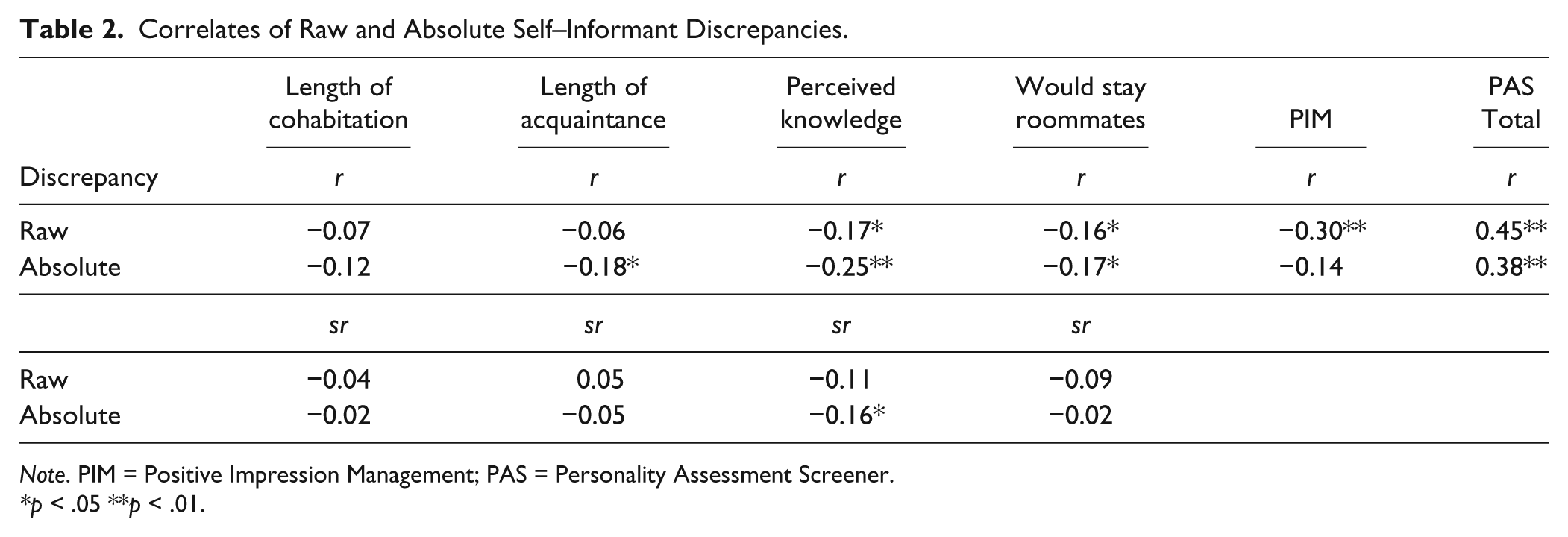
Note. PIM = Positive Impression Management; PAS = Personality Assessment Screener.
p < .05 **p < .01.
Because relationship variables generally demonstrated significant correlations with one another, 3 we employed multiple regression to examine the unique association of each with raw and absolute rating discrepancies. The resulting semipartial correlations are reported in Table 2. Taking into account shared variance among aspects of the dyadic relationship, only a negative relationship between perceived knowledge about the roommate and absolute discrepancy remained significant (r = −0.16, p < .05).
We further analyzed the role of PIM in discrepancies between PAS and PAS-O ratings. As self-reported PIM increased, the deviation between perspectives shifted direction; whereas more candid participants overreported psychopathology compared with informant ratings, highly defensive participants tended to endorse fewer problems compared with informant ratings (r = −0.30, p < .01; Table 2). Last, results revealed that the severity of self-reported psychological difficulties (PAS Total) was strongly correlated with raw (r = 0.45, p < .01) and absolute (r = 0.38, p < .01) discrepancies. To illustrate these findings, we split our sample into participants with a Low to Mild total score (≤18, n = 78) and those with a Moderate to Extreme elevation (>18, n = 80) and examined the mean ratio of self to informant ratings in each group, which controls for the general observation that discrepancies between scores increase as scale values increase (e.g., 10:5 and 18:9 vary in absolute difference but are equivalent as ratios). In comparison with participants reporting few difficulties, participants indicating greater problems with psychological functioning displayed larger discrepancies with informant ratings on average (M = 1.29, SD = 0.81; M = 1.69, SD = 1.32), t(156) = −2.27, p = .03, d = 0.36.
Discussion
The present study examined the convergence and divergence of self-ratings and informant ratings of psychological difficulties on the PAS/PAS-O. Consistent with previous findings on shared knowledge of psychopathology (Achenbach et al., 2005), selves and informants moderately agreed on the extent of emotional and behavioral dysregulation. However, selves tended to describe themselves as having more problems when compared with informant ratings. Although this finding conflicts with some prior results regarding features of personality disorders (e.g., Busch et al., 2015), it is consistent with previous studies examining other forms of psychopathology that have observed a similar propensity for informants to provide relatively more favorable ratings (e.g., Rescorla et al., 2013).
The poor agreement between roommates regarding internalizing difficulties may reveal one source of systematic discrepancy between perspectives. As predicted by emergent research on self–other knowledge asymmetries (e.g., Vazire, 2010), self-report demonstrated endorsement of symptoms concerning heightened negative affect, need for control, and suicidal thinking that was not reflected in informant ratings. In addition, self-reports and informant reports of social withdrawal did not converge, despite comparable mean ratings. Drawing from previous research, the absence of agreement on this domain may be because subjective detachment and discomfort in relationships is experienced differently from the perspective of others (e.g., as cold or hostile; Clifton et al., 2004). Indeed, our results revealed that self-reported Social Withdrawal tended to be more associated with informant-reported Alienation and Anger Control, both of which capture elements of an irritable and unfriendly temperament. It may similarly be the case that disruptions in interpersonal relatedness, which can be associated with a variety of difficulties (e.g., trauma, paranoia, apathy) are expressed, as opposed to simply perceived, as hostility or suspiciousness. With respect to externalizing dysfunction, self-reports and informant reports generally evinced moderate correlations, as suggested by prior theory and research (Vazire, 2010). Informants appeared particularly knowledgeable about self-perceptions of alienation, which may be inferred from observable failures in interpersonal relationships and associated with other more public aspects of functioning, such as acting out, psychotic features, and poor anger control.
The moderate average convergence and mean differences observed between roommate ratings are qualified by considerable variability in PAS/PAS-O agreement at the dyadic level. With respect to total scores, our results suggest that out of the 66 possible points on the instrument scale, the majority of self and informant reports (i.e., 68%) will exhibit an absolute difference ranging between 1 and 11 points, which in turn can result in appreciably different estimated categories of risk for emotional or behavioral problems. In the present sample, these differences manifested as both underestimates and overestimates of self-reported dysfunction. Moreover, the extent to which selves and informants agreed regarding the configuration, or relative salience, of particular emotional/behavioral difficulties spanned a noteworthy range. Clearly, some roommates held very different impressions from the target, whereas others produced nearly indistinguishable profiles of dysfunction.
Beyond considering the typical magnitude of disagreement between perspectives, interpretation of self-reports and informant reports may benefit from identifying factors that drive these inconsistencies between sources. Our findings suggest that discrepancies between selves and informants on the PAS/PAS-O are reduced when informants have known the target individual for a relatively longer amount of time and when informants hold favorable attitudes toward the target, such that they would be willing to continue living together. The moderating nature of these variables is consistent with past research demonstrating that increased intimacy strengthens self–informant agreement, in part because intimate informants increasingly interpret observations in ways that align with the target’s own inferences and self-perceptions (Connelly & Ones, 2010). Our results also suggest that informants have a degree of insight into their ability to accurately describe another individual. Those viewing themselves as knowledgeable informants, perhaps due to the intimacy of lengthy cohabitation and/or friendship, provided ratings that converged more with self-reports, whereas greater discrepancies were observed among those doubting their ability to provide evidence-based ratings.
Additionally, we found that targets who appeared to engage in positive impression management tended to disclose fewer psychological difficulties relative to informants, such that discrepancies were observed in the opposite direction of the overall trend toward self-pathologizing. Consequently, informant reports may be particularly valuable resources in situations where individuals have the tendency (potentially resulting from either external or internal factors) to present themselves favorably. Last, more severe self-reported disturbances in emotional/behavioral functioning coincided with greater discrepancies between perspectives, observed as a relatively greater mean ratio of self to informant total scores. The extent of disagreement at the upper end of the continuum of dysfunction may be due to concealment of serious distress from others, or perhaps reflects exaggerations of personal deficiencies and environmental stressors that are fueled by negative affect and distorted awareness. In such situations with multiple hypotheses, identifying the exact source of self–informant discrepancies may best be accomplished by viewing associated variables (e.g., intimacy, severity, perceived knowledge) in combination with one another.
Based on the findings of our study, practitioners can normatively expect reports from informants to deviate from self-report in some way. In clinical settings, including primary care and mental health services, the usefulness of disagreement for case conceptualization and targeted follow-up assessment will depend on whether the unique information provided by an outside perspective reflects valid observations, as opposed to assumptions, guesses, or overly favorable impressions. To maximize the probability that informants are knowledgeable about aspects of targets’ functioning, practitioners should encourage selection of informants with whom targets share an intimate relationship. This may be indicated by having known one another for a significant amount of time and by having a desire for closeness, such as continued cohabitation. Most nominated informants are willing to provide assistance to others by completing questionnaires (Achenbach, 2006), and most also appear willing to provide a valid indication of their qualifications. Allowing informants to confidentially disclose how well they know the target in terms of the assessed qualities is a simple addition to the evaluation process that could greatly aid interpretation of differences in personality ratings.
The present study provides an important first step in conducting research on the convergence and divergence of the PAS and PAS-O in screening for psychopathology, but is not without limitations. First, although approximately half of our undergraduate sample presented with at least moderate risk of some form of emotional/behavioral dysfunction, replication is needed in psychiatric, community, and primary care samples where certain traits and behaviors may be more prevalent (e.g., suicidality, substance use). In primary care settings, patients are not necessarily seeking evaluation for psychological concerns, but nonetheless may give indications through self-report that they are experiencing emotional/behavioral difficulties warranting follow-up or referral (e.g., history of trauma, intimate partner violence; Porcerelli et al., 2015). The utility of informant perspectives in further identifying these individuals outside strictly mental health contexts presents an interesting avenue for future research. Among psychiatric samples, in particular, the discrepancy between self- and informant ratings might be expected to be greater given its positive relation with risk severity in the present findings. In addition, our study required roommates to serve as informants and guaranteed confidentiality of responses, whereas real-world settings generally allow individuals to select an informant from among friends, family members, or romantic partners and do not necessarily restrict them from viewing collateral materials. The nature of the informant relationship, the motivations for choosing a particular person as an informant, and whether informants are assured confidentiality of ratings may each have important implications for correspondence between reports. Relatedly, no contingencies were associated with participants’ responses, and different findings may emerge in situations where targets are motivated to obscure or exaggerate psychological dysfunction (e.g., access to medications, employment eligibility evaluations).
The brevity of the PAS and PAS-O element scores, while advantageous for rapid screening, may constrain the correlations observed between raters, and as such replication of our findings will be important. It should also be recognized that the PAS includes only two or three items per element, and length and breadth of assessment may be an important moderating factor in comparing our findings to the broader literature on self–informant convergence. Last, we note that future research should assess and compare the predictive validity of each perspective in relation to relevant correlates (e.g., clinician diagnoses following comprehensive assessment), as the current study cannot speak to which source provides the most “correct” portrayal of reality. For example, regarding our finding that subjective reports of social detachment tended to be more associated with informant perceptions of interpersonal alienation and poor anger management, further investigation using objective recordings of behavior could shed light on the interpretation of this discrepancy and the relative importance of each in predicting interpersonal behavior. Identifying both when and how the PAS-O provides unique and valid information represents a much needed advancement in meeting the challenge of integrating multiple perspectives of psychological functioning into a coherent whole.
Footnotes
Declaration of Conflicting Interests
The author(s) declared the following potential conflicts of interest with respect to the research, authorship, and/or publication of this article: Dr. Morey is the author of the Personality Assessment Screener and receives royalties from the sale of the test.
Funding
The author(s) received no financial support for the research, authorship, and/or publication of this article.