




Abstract
A vast majority of psychological science focuses on snapshots of individuals. Clinical outcome studies may integrate multiple snapshots, typically with yearly intervals. However, there is much to learn about psychological processes as they unfold over real time, including minutes, days, weeks, and months. This special issue contains several articles that make significant advances in real-time assessment of psychological processes using state-of-the-art measurement. This is a brief summary of the specific innovations of this special issue. The summary includes suggestions for applying these measurement innovations to the study of functional dynamics that lead to clinically and socially significant events. Several examples provide ways in which a dynamical analysis of function may be revealing. Most important, the assessment of dynamic mechanisms underlying the amplification of psychopathology seems especially useful for tailoring clinical interventions to meet clients’ specific needs.
Keywords
Introduction
Overview
This special issue called for innovative assessments of dynamic psychological assessments (Wright & Hopwood, 2016). These 10 articles jump-start innovation in three key areas of research on dynamical psychological processes. The first area of innovation advances the idiographic approach to studying dynamic linkages across human affective states over time (see Beltz, Wright, Sprague, & Molenaar, 2016; Bringmann et al., 2016). From a transactional framework, a strong developmental theory should empower prediction at both individual and group levels (Sameroff, 1981). The measurement and quantitative tools that allow for the analysis of individual dynamics are critical to a transactional perspective on development. The articles in this issue also advance dynamic psychological research through the creative use of technology. The automation of coding interpersonal interaction solves several barriers to the use of direct observation (see Girard & Cohn, 2016), including the expense of training coders and coder drift (Reid, 1970). Moreover, the use of technology to collect ambulatory assessments (Carpenter, Wycoff, & Trull, 2016) opens up exciting possibilities for sampling detailed time-sensitive indicators of key events related to changes in clinical status and clients’ health (Matthews et al., 2016).
Several articles pave the way with novel quantitative strategies to analyze dynamic assessment data, including advances in time series (Hamaker, Grasman, & Kamphuis, 2016), intensive data on dyads (Gates & Liu, 2016), the analysis of networks of emotional states for individuals over time (Bringmann et al., 2016), and a new quantitative framework for integrating idiographic and nomothetic behavioral processes (Beltz et al., 2016). It is impressive that the authors apply these innovative assessment and quantitative strategies to clinically significant populations such as borderline personality disorder (Wright et al., 2016) and bipolar disorder (Hamaker et al., 2016). Indeed, by integrating these measurement strategies for dynamic behaviors as along with advanced analytic strategies, we are moving toward a capability of personalized interventions in response to the dynamic needs of individuals (see Fisher & Boswell, 2016).
The Analysis of Function
For the past 80 years, the analysis of dynamic behavior has progressed sporadically, beginning with an analysis of children’s “quarrels” on the playground (Dawe, 1934). However, dynamic data such as these did not emerge as a clinical tool until the 1960s. Initially the collection of dynamic data was pragmatic, for example, daily observation ratings by psychiatric nurses were applied to study patient progress in the context of residential treatment for severe mental health problems (Bunney & Hamburg, 1963). Soon the collection of dynamic data on human interaction was theoretically driven. Objective counts of behavior became the sine qua non of the behavioral revolution inspired by operant theory (Skinner, 1945). Volumes of studies appeared on process measures and clinical observations with nearly every defined human psychopathological disorder (Goldfried & Pomeranz, 1968).
Despite the inspiration of reinforcement theory to the design of interventions and behavioral assessment, a long-standing neglect has persisted in the actual measurement and analysis of the function of interaction dynamics. That is, what is the net outcome of an interaction: Is a painful discussion avoided, sympathy elicited, a conflict suppressed, or reinforcement provided? I suspect there are two methodological reasons for collective inattention to functional dynamics.
In experimental settings with pigeons, finding a reinforcement effect on choice behavior was straightforward (Skinner, 1945). In a controlled laboratory setting, one can experimentally manipulate a reinforcement schedule associated with pecking at a green versus a red light, with the ensuing change in pigeon’s preferences for one light over another, a reinforcement effect is established. How does one establish reinforcement in a stream of behavior represented in a parent–child interaction, where experimentally manipulating reinforcement is more challenging?
Patterson applied reinforcement theory to children’s aggressive behavior, beginning with the hypothesis that children inadvertently received reinforcement for their aggressive responses, which led to increases, and if left unabated, clinical significance. This program of research reveals the methodological challenges of studying function in ongoing interactions between two or more individuals over time. The efforts are of value, however, if one is interested in the study and prediction of behavior change (Patterson, 2016). The first step is defining exemplars of aggression that occur frequently enough that patterns of evoking antecedents and resulting consequences can be systematically studied. Direct observation coding systems were developed that were reliable, generalizable, and that discriminated between children referred for aggressive behavior compared to nonclinical controls (Jones, Reid, & Patterson, 1975). After identifying specific aversive behaviors, application of a Bayesian approach empirically determined the functional dynamics of these interactions involving children’s aversive behavior (e.g., shout, whine, hit, etc.). Such an approach led to the conclusion that positive reinforcement did not maintain aversive events among children. In fact, often families with aggressive children were relatively lean on reinforcing events. It turned out that aversive behavior in children functioned to reduce conflict in families of the kind often involving a parent making an unwanted demand for behavior change in the child (e.g., pick up the toys). The child’s aversive behavior leads to the parent withdrawing the demand, thereby leading to the child effectively “winning” the exchange. In these examples, the aggressive child wins in the short run but loses in the long run. Aggressive behavior is one of the major disruptors of normative development, leading to a cascade of potential outcomes such as school failure, peer rejection, and eventually self-organizing into groups with other youth inclined toward antisocial behavior. The peer dynamics in these deviant peer clusters is the most robust predictor of adolescent escalation to more serious forms of problem behavior and substance use (see Dishion, 2016).
As it turned out, one could measure negative reinforcement, and an aversive event could be reliably anticipated on a set of antecedent events from family members, referred to as stimulus control (see Patterson & Cobb, 1973). A careful analysis of real-world social interaction led to the conclusion that negative reinforcement (not positive reinforcement) was a driving mechanism for family aggression. Negative reinforcement of a target child’s aversive behavior by parents as well as siblings became the cornerstone of coercion theory (see Patterson, 1982; Patterson, Reid, & Dishion, 1992). Coercion theory contributed to the development of several evidence-based treatments for child and adolescent problem behavior that emphasized changing parenting (see Weisz & Kazdin, 2010). It is worth noting, however, that few of the studies that link an evidence-based intervention with children’s problem behavior actually document a change in the function of the problem behavior in real time. A notable exception is the intervention outcome research by Forgatch and colleagues (see Forgatch & Domenech Rodriguez, 2016), in which linkages are established between the fidelity of the parenting intervention to reductions in coercive parenting, to improvements in children’s behavior.
Inattention to the measurement of functional dynamics is likely due a combination of measurement and quantitative challenges. Every relationship has its own unique set of aversive events, shared meanings, and learning history. Therefore, one needs to carefully define behaviors of interest that occur frequently and that are part of the process of the psychopathology of interest. If behaviors being studied occur too rarely, it is impossible to study the functional dynamics without a long observation period, which can be unrealistic and unwieldy. For example, in the study of aggression, if we use “hit” as the definition of aggression, it occurs rarely, and there are statistical limitations to studying the functional dynamics of a behavior that occurs so rarely (Bakeman & Quera, 1995). Thus, we need measurement tools (e.g., Girard & Cohn, 2016) that are able to increase the base rate of clinically relevant phenomena to a level at which the function can be identified.
The linking of interaction patterns and daily events to longer term ebb and flow of psychopathology is a multilevel problem. Not until recently do we have the computing power and statistical framework to test these multilevel models. Stoolmiller (2016) provides an overview of the use of multilevel survival models, where the duration of interactive events are linked to longer term changes in antisocial behavior. This special issue adds the quantitative innovations that enable the analysis of function in psychopathology. Thus, there is a need for linking idiographic relationship dynamics with a conceptual theory with clearly defined nomothetic constructs (see Beltz et al., 2016; Hopwood, Zimmerman, Pincus, & Krueger, 2015). These investigators provide a quantitative framework and pragmatic examples of linking the idiographic interaction patterns that occur over seconds (micro social exchanges) and macro change that occurs on a longer time scale (weeks, months, years).
Despite the pull of evolutionary theory in nearly all aspects of psychology (see Dishion, 2016; Hinde, 1991; Kenrick et al., 2009; Krebs, 2008; Neuberg, Kenrick, & Schaller, 2011; Schmitt & Pilcher, 2004), our theoretical models generally lack a statement of functional dynamics. This is strange, given that natural selection would have it that much of human behavior is selected based on the consequences generated (Biglan, 2003). In part, this oversight is largely due to a growing disinterest in the pragmatics of the behavior sciences. Refreshingly, the majority of the articles in this special issue address clinically relevant and pragmatic problems (see Hopwood et al., 2016). All the programs of research represented in this special issue are poised to integrate the study of functional dynamics.
Based on the articles in this special issue, I hypothesize that negative reinforcement describes a common underlying function that likely amplifies the major forms of psychopathology that involve problem behavior and emotion distress (see Figure 1). An emerging body of research supports this hypothesis. In an innovative theoretical reformulation of psychopathology, Beach et al. (2007) reconsidered disorders with respect to patterns of interpersonal relationships. If we expand the concept of conflict to include any interpersonal experience that elicits distress, including criticism, disagreement, unspoken tension, invalidation, and rejection, then it is easy to see that many forms of psychopathology are embedded within interpersonal conflict. As shown in Figure 1, interpersonal distress can precipitate symptoms such as depression, anxiousness, or even self-destructive behaviors. If the function of the symptom is to reduce the interpersonal conflict, then it will be more likely to occur in the future. It is assumed that these negative reinforcement dynamics are largely outside of the awareness of the participants. The hopefulness that comes for this kind of person-oriented process research is that working with families and close relationships is helpful for reducing a wide range of human suffering, not only children’s aggression.

Negative reinforcement dynamic function (Patterson, 1982).
I would hypothesize that when symptoms function to temporarily reduce the experience of interpersonal conflict, demands, and/or pain, the symptoms increase over time. Figure 2 summarizes research that supports the potential role of negative reinforcement in the amplification of various forms of psychopathology. For example, in adolescent romantic relationships, the female’s effort to “upregulate” during conflict discussions predicts her increases in depression 3 years later, controlling for earlier levels (Ha, Dishion, et al., 2014). This finding suggests anxious attempts to avoid the inevitable conflicts in romantic relationships is likely to lead to unsolved problems, break up, and later depression. Marital relationships, on the other hand, may inadvertently shape depression in one of the partners, if expressions of depression and hopelessness serve to reduce the partner’s aggressive approach to resolving conflicts (Hops, Biglan et al., 1990).
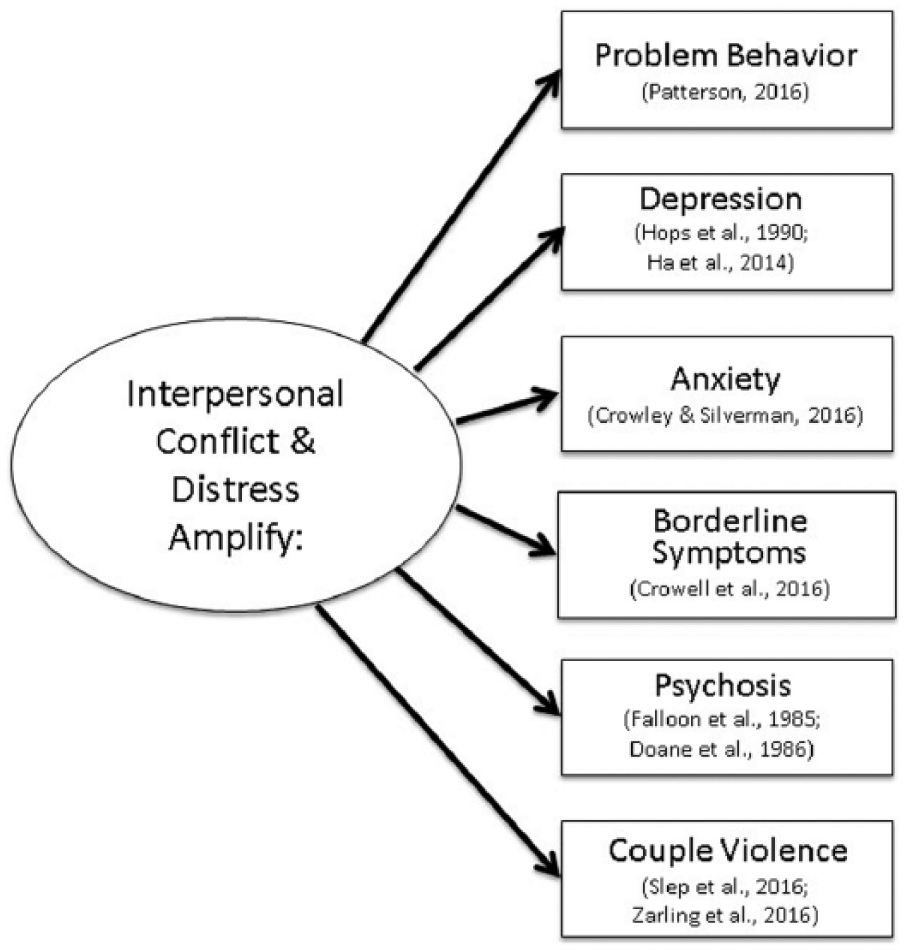
Distress and negative reinforcement as an amplifying mechanism.
Children’s anxiety may become worse when parents tend to intervene at the first sign of distress. In this way parent involvement may at times enable children’s anxiety, but in this sense, both the child and parent are negatively reinforced for these intrusive interventions in the face of anxiety (Crowley & Silverman, 2016). The work on parasuicidal behavior among females with a borderline diagnosis clearly links that gesture and the enabling response from the social environment with reduced emotional distress (Crowell, Yaptangco, & Turner, 2016). Classic intervention studies by Falloon et al. (1985) suggest that interventions supporting family management practices reduce rehospitalization of young adults with diagnosed psychoses. Reductions in family conflict mediated these changes (Doane et al., 1986). It is conceivable that many of the prodromal signs of a psychotic break intensify in the context of negative affect, tension, and conflict in families. Finally, and most clearly, although many couples experience conflict, for some, such conflicts escalate to violence and/or divorce (Kim, Shortt, Tiberio, & Capaldi, 2016; Zarling, Orengo-Aguayo, & Lawrence, 2016). Helping couples deescalate in the face of coercion is likely to improve the satisfaction, safety, as well as the emotional well-being of both partners in the relationship (Slep, Heyman, & Lorber, 2016).
Future Directions
This special issue suggests that, theoretically and methodologically, we are in a better position to study the function of psychological processes within the social environment. Several tools reflected in the innovative research represented in this special issue are immediately applicable. The use of mobile technology in general is becoming an excellent tool for the study of interpersonal dynamics. For example, Ehrenreich and Underwood (2016) demonstrate the study of texting among adolescents in real time from a functional perspective, showing that approval to deviance promoting texts actually amplified problem behavior over time. In addition, ambulatory assessments included in this volume specifically enable the study of ebb and flow of physiological, objectively observed (speech sample), and reported conflict and interpersonal tension.
However, to advance the analysis of function, one needs data on an individual interaction within an interpersonal context (e.g., Hopwood et al., 2015). Therefore, the need for a dynamic measurement of relationships is prerequisite. Second, there is a need to go from the idiographic to the nomothetic theoretically, by using the quantitative frameworks described in this special issue. For various reasons, psychopathology does not fit well within the Diagnostic and Statistical Manual of Mental Disorders categories, and comorbidity is the rule rather than the exception. It is likely that the science described in this special issue is a more promising approach to the development of taxonomies that might lend themselves to the design of more effective and personalized treatments that integrate biology and psychology.
Footnotes
Author’s Note
The opinions expressed are solely those of the author and not necessarily those of the funding sources.
Declaration of Conflicting Interests
The author(s) declared no potential conflicts of interest with respect to the research, authorship, and/or publication of this article.
Funding
The author(s) disclosed receipt of the following financial support for the research, authorship, and/or publication of this article: This special issue resulted, in part, from a National Science Foundation (BCS-1444761) supported workshop. The National Institute of Drug Abuse (Grant Numbers 5R01DA007031 and 1R01DA036832) and the National Institute of Alcohol Abuse and Alcoholism (5R01AA022071-03) supported the author’s effort on this project.