



Abstract
Self-transcendence is thought to increase well-being and is implicitly promoted in contextual cognitive behavioral therapies (CCBTs). This study conceptualizes, develops, and validates the first comprehensive CCBT-informed self-transcendence questionnaire. Using a CCBT-informed theory, we propose four self-transcendence facets: distancing oneself from mental content, distinguishing an observer of mental experience that is separate from the content of experience, experiencing innate connectedness with other beings, and noticing the constantly changing nature of experience. We measured these facets with items from existing relevant questionnaires and novel, expert-informed items. Exploratory factor analyses and bifactor exploratory structural equation models supported the first three of these facets. Those factors evidenced convergent validity with decentering, defusion, experiential avoidance, and mindfulness, and criterion and incremental validity in predicting psychological well-being. Our findings support a CCBT-informed model of self-transcendence, introduce the first instrument to comprehensively measure the self-transcendence facets we identified, indicate links with well-being, and suggest future intervention targets.
Keywords
Psychologists have long posited a human capacity to experience an “awareness of awareness,” a sense of self that is distinct from the content of present mental experience, has a quality of ever-presence despite changing mental content, and a quality of innate connection to other beings (e.g., Deikman, 1982; James, 1890; J. L. Villatte et al., 2012; Yaden et al., 2017). Contact with this sense of self has been noted to come in two varieties: (a) momentous, meaningful, rare occasions, which have been referred to as “mystical” (James, 1902/2002) or “self-transcendent” (e.g., Yaden, Eichstaedt, et al., 2016) experiences; and (b) a lasting personality quality of sensed innate connection to oneself and others that promotes human flourishing (Cloninger, 2006; Erikson, 1963; Frankl, 1966; Garcia-Romeu, 2010; Maslow, 1971). We refer to the latter as “trait self-transcendence,” and it is the focus of the following studies.
We introduce a new perspective on trait self-transcendence from the lens of cognitive behavior therapy, and specifically from contextual cognitive behavioral therapies (CCBTs; Hayes, Villatte, et al., 2011) that notably include Acceptance and Commitment Therapy (ACT; Hayes, Strosahl, et al., 2011), Mindfulness-Based Cognitive Therapy (MBCT; Segal et al., 2013), and Dialectical Behavior Therapy (DBT; Linehan, 1993). CCBTs are a widely researched and disseminated set of psychological interventions with overlapping core intervention techniques, including mindfulness, acceptance, decentering, defusion, and pursuing valued life activities.
Why propose and test a new conceptualization of trait self-transcendence, and why from the lens of CCBT? First, there is a philosophical alignment between historical approaches to self-transcendence and recently developed CCBTs in increasing human well-being. Religious and secular practices have been developed over the past millenia to improve overall human well-being in part by increasing self-transcendence (Yaden, Le Nguyen, et al., 2016). Aligning with those practices, CCBTs are evidence-based psychological interventions that aim to improve life meaning and satisfaction, increase flexibility in responding to thoughts, feelings, and sensations, and reduce symptoms of psychological disorders. Given this broad focus, CCBTs target aspects of self-transcendence (described below) as one way to increase flexibility in responding to internal experience and to promote sense of meaning. Next, CCBTs are based on empirically derived and robustly tested models of cognition and behavior (Hayes, Villatte, et al., 2011; Linehan, 1993; Segal et al., 2013). Therefore, a CCBT-informed theory of trait self-transcendence can draw on well-established, widely accepted psychological principles, and can be fluently integrated into models of typical and atypical behavioral repetoires. Third, CCBTs incorporate themes from many of the previous psychological approaches to self-transcendence, including life span development (Coyne et al., 2011), idiographic approaches and individual differences (Hayes et al., 2019), and transition to aging and death (McBee, 2014) 1 . Thus, a CCBT-informed model may be useful in unifying previous, relatively siloed approaches to self-transcendence. Finally, CCBT research programs span a broad array of populations and psychosocial concerns (Hayes, Villatte, et al., 2011) and have committed to examining mechanistic psychological processes that lead to improved well-being (Hayes & Hofmann, 2017). Therefore, a CCBT-based model of self-transcendence is likely to provide ample opportunities for future testing and development of a model of trait self-transcendence.
Among the CCBTs, ACT is specifically based on a model of language and perspective taking that provides a basic learning theory foundation for conceptualizing self-transcendence (M. Villatte et al., 2016). This model is called relational frame theory (RFT; Hughes & Barnes-Holmes, 2016). Given the potential advantages of developing a self-transcendence theory from this lens, three of the four proposed facets of self-transcendence are generated from basic RFT principles, and all are consistent with CCBTs generally, as described below.
Distancing and Observing Self
According to RFT, when we reflect on our own experience, we typically have thoughts in the present environment (here-and-now), and the content of the thoughts refers to other times and places (there-and-then, future or past). Clinically, problems can arise when there-and-then content becomes enmeshed in the here-and-now, such as recalling a traumatic memory (the content of which is there-then) and suddenly finding oneself reliving it (here-now), complete with distressing thoughts and somatic symptoms (M. Villatte et al., 2016). Mindfulness techniques often involve observing the here-and-now just as it is. Self-transcendence, on the other hand, involves an act of observing that is distinct from the content of thoughts, emotions, and sensations, and that shifts content to there-and-then. Two phenomena are involved here: first, the ability to distance the observer from the observed content (henceforth, distancing); and second, experiencing the observer as a stable, ever-present entity (observing self; c.f. Deikman, 1982).
Both of these processes appear in intervention techniques common to many CCBTs. For example, the distancing process is inherent in a common CCBT exercise wherein practitioners are invited to notice when thoughts arise and, rather than engage in their content, just mentally label them “thoughts” (Segal et al., 2013). Likewise, the observing self process is inherent in ACT exercises wherein the practitioner is invited to notice that some unchanging aspect of themself has witnessed all moments in their past, is witnessing the present moment, and will continue to do so as long as they are alive (Hayes, Strosahl, et al., 2011). To synthesize across CCBTs, we note that what we are calling distancing is akin to the processes of “defusion” in ACT (Hayes, Strosahl, et al., 2011) and “decentering” in MBCT (Segal et al., 2013). The current notion of observing self aligns with the concept of “Wise Mind” in DBT (Koerner, 2012) and what is called observing self or “self-as-context” in ACT (Hayes, Strosahl, et al., 2011).
Importantly, ACT posits that there is a phenomenological quality of the observing self as persistent and safe, no matter what seemingly threatening thoughts, emotions, or sensations may arise in consciousness (Stewart et al., 2012). For example, an ACT clinician might draw their client’s attention to the experience of noticing a distressing emotion like shame or fear when it arises, and then to the experience of the observer remaining constant even as the emotion and its associated thoughts and physical sensations change in content or intensity (M. Villatte et al., 2016). Through such exercises, the client may learn that feeling distress is not dangerous, and they will continue to exist and observe their experience steadily no matter how distressed they may feel. Intuitively sensing the safety and permanence of the observing self may help individuals tolerate aversive stimuli, such as facing feared contexts in exposure therapy, and more broadly supports personal growth and well-being (Hayes, Villatte, et al., 2011; Robins, 2002).
Intertranscendence
An additional facet of self-transcendence suggested by CCBTs is a sense of innate connection to other beings (intertranscendence). The RFT model predicts that, as individuals gain awareness of the observing self that is the unchanging place from which all of their experiences are perceived, they also necessarily gain awareness of that same persisting, stable self that belongs to other beings and entities (J. L. Villatte et al., 2012). Mindfulness practices in many CCBTs are thought to simultaneously engender a sense of connection with self and sense of connection with other people, beings, and ultimately the world, based on the view that connection to self cannot take place without connection to others (Kabat-Zinn, 1990). The lovingkindness for self and others practice (e.g., silently offering well-wishes to people who elicit affection, neutral responses, and aversion) that is based in Buddhist lovingkindness practice and integrated in various forms within some CCBTs, is an example of a technique intended to promote intertranscendence (Hofmann et al., 2011). Indeed, a subset of CCBTs that incorporate self-compassion capitalize on a sense of innate connection for therapeutic gain: for many who have compassion for others but are harsh toward themselves, self-compassion can be cultivated by noticing the innate interconnection between self and others, and the common shared experience of struggling and failing as a natural part of the human experience (Neff, 2003). Likewise, Radically Open DBT, an adaptation of DBT, aims to increase clients’ sense of innate connectedness to others as a primary intervention target (Hempel et al., 2018).
Nonpermanence
We conceptualized one additional facet of self-transcendence not explicitly predicted by RFT, but consistent with theories from other CCBTs: a sense that the external world and internal experiences are constantly changing (nonpermanence). Nonpermanence, like mindfulness, is rooted in Eastern religious philosophy (Goldstein & Kornfield, 1987) and has been introduced into CCBTs to some degree (e.g., DBT; Koerner, 2012). According to the model of behavior change in DBT (Koerner, 2012; Linehan, 1993), and perhaps mindfulness-based interventions more generally (Shapiro et al., 2006), awareness of nonpermanence encourages tolerance of aversive experiences. Though nonpermanence is typically not explicitly targeted in CCBTs, common instructions in mindfulness exercises across CCBTs like “watching sensations come and go” invite practitioners to experience nonpermanence directly.
Existing CCBT-Based Instruments to Measure Self-transcendence
Three existing ACT-based questionnaires have been developed to examine self-as-context and related processes: the Reno Inventory of Self-Perspective (RISP; Jeffcoat, 2015), the Self-Experiences Questionnaire (SEQ; Yu et al., 2016), and the Self As Context Scale (SACS; Gird, 2013; Zettle et al., 2018), and other instruments intended to measure the six core processes in ACT (Francis et al., 2016; Rolffs et al., 2018) include small sets of items to measure self-as-context. None of these scales measure all of the facets of self-transcendence that we have proposed as part of a CCBT-informed conceptualization, though each may measure part or parts of it. Moreover, the three measures intended to tap self-as-context have had limited use to date, especially outside the context of ACT-based research. By contrast, non-ACT-based measures of decentering such as the Experiences Questionnaire (EQ; Fresco et al., 2007) have been very widely used, but even as recent measurement research has highlighted the multidimensionality of that construct (Hanley et al., 2020), we believe that existing decentering measures still capture mostly or only the distancing aspect of self-transcendence described above.
Towards A Comprehensive Measure of Trait Self-Transcendence Informed By CCBTs
Though there are several measures that may capture aspects of self-transcendence relevant to CCBT, we are unaware of one specific, comprehensive measure that does so. Intertranscendence is notably missing from existing instruments, despite its theoretical link to perspective-taking and observing self, and despite its presence in CCBTs. Moreover, the ACT-based measures that most closely align with our conceptualization have been validated in a limited number of samples and used in a limited number of studies. Thus, the present studies aimed to make both theoretical and empirical contributions: to test the CCBT-informed model of self-transcendence, and to develop a corresponding, comprehensive instrument. In Study 1, we generated novel items and pilot tested a combination of novel items and items from the RISP, SEQ, and SACS intended to tap all four putative facets of self-transcendence. In Studies 2 and 3, we refined that combined set of items and conducted factor analyses to test the proposed multidimensional model of self-transcendence and identify key items to operationalize it. Finally, in Study 4, we assessed the reliability, convergent, criterion, and incremental validity of the novel self-transcendence measure.
Study 1
In Study 1, we aimed to generate a set of self-report items, comprised both of items from existing scales and novel items tapping content not captured by existing scales, to measure the theorized facets of self-transcendence. First, we generated a set of novel items and edited them based on feedback from expert reviewers (Study 1a). Next, we administered the items to community adults to examine whether they were suitable for testing the hypothesized factor structure, and, if suitable, to test that factor structure with exploratory factor analysis (EFA; Study 1b).
Study 1a
Method
Participants
Given the theoretical basis of this research in RFT/ACT, we recruited RFT/ACT researchers and clinicians (N = 7) by email to review the novel items. They reported between 10 and 30 years of ACT experience (M = 17.29, SD = 7.54). They were not compensated.
Materials
We generated novel items to measure the four theorized facets of self-transcendence. The items were constructed with the intention that a respondent would indicate their degree of agreement with each item on a Likert-type scale (1 = completely disagree, 2 = moderately disagree, 3 = somewhat disagree, 4 = neither agree nor disagree, 5 = somewhat agree, 6 = moderately agree, 7 = strongly agree). Prior to soliciting expert review, we refined the items to increase their clarity by soliciting initial feedback from graduate, postbaccalaureate, and undergraduate members of an ACT-focused research group (N = 12).
Procedures
Item content reviewers reviewed the novel items on a Qualtrics survey site. Reviewers read a brief description of the constructs we were intending to measure, then read each item and rated its fit with the construct on a Likert-type scale (1 = very poor, 2 = poor, 3 = fair, 4 = good, 5 = very good). Finally, they provided open-ended qualitative feedback on the items.
Analyses
We computed the Aiken’s V statistic for each item, with V ≥ .75 indicating acceptability of an item (Aiken, 1985). As our goal at this early stage was to retain all items that could prove useful for the final scale, we examined items for potential inclusion in the pilot testing if they were close to, but did not achieve, the cutoff for acceptibility. We also planned to add, remove, and edit items based on qualitative feedback from reviewers prior to administering the pool of items to a pilot sample (see Study 1b Materials section).
Results
Forty-four of the 58 items had Aiken’s V ≥ .75. Item content reviewers indicated via qualitative feedback that the items would be improved by simplifying and shortening items, removing negatively worded items, and adding additional observing self items to more fully capture the facets of connection across separate parts of the self.
Study 1b
Method
Participants
For this and the samples recruited for Study 2, we aimed to recruit approximately 300 participants, a size indicated in the literature as adequate for EFA in the context of novel instrument development (see review in DeVellis, 2017). We recruited community adults using Prolific (www.prolific.ac), an online research platform akin to Amazon Mechanical Turk. For this study and the following studies, the inclusion criteria for community adults were as follows: be at least 18 years old, live in the United States, speak English natively (since the items are linguistically complex), and have had at least 95% of previous work accepted on the site. A total of 477 individuals opened the survey link, of whom 86 did not complete the survey, 16 completed the study faster than the cutoff for content reliability 2 (13 minutes), eight provided nonsensical responses to free-text queries, and two provided the identical response to all Likert items in the questionnaire, indicating inattentiveness. Participants who completed the study in a content-valid manner (N = 361; see demographics in Table 1) were compensated $3.25 for their time (median = 31 minutes).
Demographic Variable Counts (Percentages) of Study Participants.

Note. Except where noted otherwise, counts of participants in each demographic group are shown in columns without parentheses, and percentage of participants in each group in parentheses. CA = community adults; UG = undergraduates.
Materials
To construct the set of items to be administered in Study 1b, we examined the set of 44 items deemed content-valid from Study 1a. We also included an item with nearly acceptable content validity (V = .71) that we believed had variation in wording not captured by the other retained items. We applied content reviewers’ suggestions for improving the items by eliminating or modifying negatively worded items, simplifying and shortening items, and adding additional items intended to probe dimensions of the observing self not probed by our initial items (e.g., “I’m aware of a bigger part of me that contains all the roles I play in life”; M. Villatte et al., 2016). This process yielded 48 novel items that we administered in Study 1b.
Procedures
Participants chose to complete this study on Prolific, and then opened a link to the study website on Qualtrics. After consenting, participants read and responded to all items on the novel questionnaire, as well as the RISP, SACS, SEQ, and four other self-report questionnaires used for other studies. The questionnaires were presented in random order. As an attention check in this and all following samples, participants were asked to report their current U.S. state of residence and the beginning and end of the study, and were removed from the data set prior to analysis if their responses did not match.
Analyses
We examined aggregate descriptive statistics and distributions for each item using quantile–quantile (Q-Q) plots and histograms to ascertain overall item performance and suitability for factor analysis. Given that items’ skewness could complicate the interpretation of factor analytic results (Sellbom & Tellegen, 2019), we planned to conduct factor analyses only if responses to most of the items were normally distributed.
Results and Discussion
Community adult participants’ Likert responses indicated strong agreement with the items: 9 out of 48 items had a modal response of 6 (moderately agree) and 18 had a modal response of 7 (strongly agree). Visual inspection of Q-Q plots and histograms indicated that almost all the items had unimodal, negatively skewed distributions, which could lead to misleading results in analyses of interitem correlations (Clark & Watson, 1995). Thus, we planned to edit the items to elicit more normally distributed response profiles by anchoring them to a never true–always true scale, and then to test those modified items, as described in Study 2.
Study 2
Method
Participants
Community adults
We again recruited community adults using Prolific, but excluded individuals who reported being current students since we planned to recruit a separate undergraduate sample (see below). Other inclusion/exclusion criteria were retained from Study 1. However, 393 individuals opened the survey link, of whom 20 who did not complete the questionnaires, 15 completed the study faster than the cutoff for content reliability (8 minutes), three did not consent, three provided content-invalid responses to open-ended questions indicating inattention, three completed the study twice, and one failed the attention check. Thus, our final sample had 348 participants (see demographics in Table 1), each compensated $2.60 for their time (median = 18 minutes).
Undergraduates
Undergraduates were recruited from the introductory psychology course participant pool at a large public university in the Mountain West region of the United States. Inclusion/exclusion criteria were that participants must have been at least 18 years old, and self-identify as native English speakers. Of 344 eligible undergraduates who opened the study website, 34 participants completed questionnaires under the cutoff for content reliability (13 minutes), five did not consent, five failed the attention check, and two did not complete the questionnaires, yielding 298 participants with analyzable data (Table 1). Here and in Study 3, undergraduate participants were compensated with course credit.
Materials
Amended novel items
To address the agreement bias elicited by the novel items from Study 1, we rewrote the novel self-transcendence items to map onto a Likert-type scale indicating the frequency with which items accurately described the responder (1 = never true, 2 = very rarely true; 3 = seldom true; 4 = sometimes true; 5 = often true; 6 = almost always true; 7 = always true). We also made edits to simplify item wording, removed two items whose content we believed was already captured in another item, and added one item tapping an additional sense of distancing that was missing from the existing items, resulting in a pool of 47 novel items.
Existing measures
We administered the SEQ, SACS, and RISP. We used an 11-item version of the SACS (Gird, 2013) because the 10-item version (Zettle et al., 2018) had not yet been published at time of data collection. Additionally, as the SACS was initially developed to be used with scale anchors indicating agreement rather than frequency of applicability, we adapted SACS item wordings as necessary so that they made sense with frequency anchors.
Procedures
Participants entered the study website via Prolific or the undergraduate research participation website. After consenting, participants completed (in random order) the novel items, the SACS, RISP, SEQ, and other measures of related constructs (described in Study 3).
Analyses
We first combined the SACS, SEQ, RISP, and novel item responses into pooled data sets (one data set per sample) and assessed suitability for EFA. We established EFA suitability by examining the novel items’ response distributions for skewness using skewness statistics, histograms, and Q-Q plots, and we assessed for collinearity by examining the interitem correlation matrix (Child, 2006; Clark & Watson, 1995; DeVellis, 2017). In order to eliminate redundant items prior to subjecting the data to EFA, we identified all item pairs in which the interitem correlation was r > |.65| in one or both sample, and planned to eliminate the more linguistically complicated item in each pair from both samples unless we determined the face content of the two items was not clearly redundant.
To determine the number of factors to extract in EFA, we used parallel analysis (Ruscio & Roche, 2012) and scree plot examination (Costello & Osborne, 2005), testing all possible interpretations of each analysis (c.f. Ruscio & Roche, 2012). We also tested for Kaiser–Meyer–Olkin (KMO) statistic >.90, indicating suitability for EFA (Dziuban & Shirkey, 1974). We then conducted EFAs with principal axis factoring and Promax rotation in R (R Core Team, 2018) using the “psych” package (Revelle, 2018). Following Gamez et al. (2011) but using a slightly higher cutoff, we considered an item as having loaded onto a factor if an item loaded ≥ |.4| onto one factor and < |.4| on all other factors (c.f. Baer et al., 2006).
Results and Discussion
Item Suitability for EFA
Histogram and Q-Q plot inspection indicated that the items were approximately normally distributed, and items had medians between 3.5 and 5 and modes of 4 or 5, indicating that concerns regarding skewed response profiles of the Study 1 items were adequately addressed.
In a pooled data sets of participants’ responses to existing scales and the novel items, there were 81 item pairs in the community adult and 30 item pairs in the undergraduate sample with rs > |.65|. We eliminated 16 items in pairs with clearly redundant content but did keep both items in some pairs wherein face content appeared to differ. For example, we kept both of the following items, “I see a connection between who I was in the past and who I am today” and “It seems like part of me is always the same, no matter where I am” because the first probed sameness across time and the second probed sameness across place. Having eliminated 16 items, we reduced the number of item pairs with rs > |.65| to 15 in the community adult sample and three in the undergraduate sample. KMO was >.90 for the 65 item set in both samples.
Factor Analyses
Parallel analysis and scree plot (Figures S1a and S1b, available in the online supplemental material) inspection each indicated a four-factor solution for community adults and undergraduates with the set of 65 items. An EFA with four factors explained 48% of the variance in the community adult sample and 41% of the variance in the undergraduate data, and eigenvalues were greater than two for all factors. The factors that emerged were consistent with distancing, intertranscendence, observing self, and a fourth factor comprised only of RISP items tapping a sense of entanglement with emotions and negative self-judgment (henceforth entanglement; see factor loadings in the online supplemental material Table S1). Correlations between the first three factors were between rs = .53 and .66 in community adults, and .40 and .55 in undergraduates, whereas correlations of the first three factors with the fourth factor were between rs = −.15 and .13 in community adults, and rs = −.55 and −.16 in undergraduates. Nonpermanence did not emerge as a factor in either sample.
As the entanglement factor did not conceptually fit with the present theoretical model (or other existing models in the literature) of self-transcendence, we removed the seven RISP items, and then reexamined the data set of the remaining 58 items with EFA (KMOs > .90). In the community adult sample, parallel analysis results and scree plotting (Figure S1c, available in the online supplemental material) appeared to support three factors and possibly a fourth factor, which had an eigenvalue only slightly above the simulated value in the parallel analysis. In the undergraduate sample, parallel analysis and scree plot inspection (Figure S1d, available in the online supplemental material) clearly indicated three factors. Given these results, we conducted both three- and four-factor EFAs. For the three-factor solution (community adult sample variance explained = 46%; undergraduate sample variance explained = 39%; all eigenvalues >2 in both samples; community adult factor correlations rs = .56-.66, undergraduate rs = .39-.57), one factor tapped distancing, another factor tapped observing self, and the third was composed of intertranscendence items and items intended to capture nonpermanence and distancing. In the four-factor models (community adult sample variance explained = 49%; undergraduate sample variance explained = 41%; all eigenvalues >1 in both samples; community adult factor correlations rs = .51-.68 undergraduate rs = .32-.58), we found that items designed to capture distancing split over two factors, and in undergraduates, a heterogeneous factor emerged tapping intertranscendence, nonpermanence, and distancing.
Given its greater parsimony and the more clearly defined and reliable factors, as indicated by higher eigenvalues, we determined that the three-factor model provided a better fit than the four-factor model. However, in both samples, two items intended to tap nonpermanence were among the top eight highest loading items on the intertranscendence factor. We were unable to conceptualize how these two items fit thematically with the other intertranscendence items. We thus recomputed EFAs with those items omitted, and obtained results very similar to those described above for the same models with the 58-item data set.
To obtain a final set of items for further testing in Study 3, we inspected the loadings of items onto each factor on the 56-item, three-factor model across the two samples (Supplemental Table S2, available in the online supplemental material). Following Baer et al. (2006), we intended to identify eight items per factor to retain for further analyses, a number intended to balance internal reliability with nonredundancy of items (Clark & Watson, 1995). To identify the eight most representative items for each factor across both samples, we ranked items from highest to lowest loading for each factor separately for each sample, and we retained the eight items that ranked highest in both samples. We found that one item intended to capture distancing that had unexpectedly loaded onto the intertranscendence factor did not load above |.4| in the undergraduate sample, and dropped this item from the final set; thus, the final intertranscendence factor contained only seven items. EFAs with the final set of 23 items in both samples supported the same three-factor model.
Study 3
To further assess the stability of the factor structure observed in Study 2, we administered the 23 top-loading items from Study 2 to new samples of community adults and undergraduates. As self-transcendence has been linked to contemplative practices including mindfulness meditation, we also administered these items to a sample of experienced lay Buddhist meditators, with the intention of assessing whether the same factor structure would hold for this population given their extensive meditation training. We assessed for evidence of the hypothesized factor structure using bifactor exploratory structural equation modeling (B-ESEM; Morin et al., 2016). Since, to our knowledge, no guidelines for sample size are available for B-ESEM in instrument development, we recruited samples with Ns between 200 and 250, similar to confirmatory samples used in the development of related measures (e.g., Baer et al., 2006; Fresco et al., 2007).
Method
Participants
Community adults
We recruited community adults from Prolific using the same inclusion and exclusion criteria from Study 1. Of 229 participants who opened the study website, nine completed the study faster than the cutoff for content reliability (10 minutes), three did not complete the entire questionnaire, two declined to consent, and two failed the attention check. Participants who completed the survey in a valid manner (N = 213; Table 1) were paid $2.60.
Undergraduates
Undergraduates were recruited from the introductory psychology course participant pool at the same university as in Study 2, using the same exclusion criteria. Of 247 eligible undergraduates who opened the study website, ten completed the questionnaires faster than the cutoff for content reliability (11.50 minutes), five declined to participate, and five failed the attention check. Thus, we analyzed data from 227 participants (Table 1).
Meditators
To obtain a sample of Buddhist meditators, we contacted U.S.-based Insight/Vipassana Buddhist communities and requested that they each send a short study recruitment message on their email listserv describing the research and a link to the website where community members could consent and participate. Vipassana (also called Insight) meditation is a form of Buddhist practice derived from the Southeast Asian Theravada tradition (Goldstein & Kornfield, 1987) that has been widely adopted by practitioners in the United States and has been influential in the development of mindfulness-based clinical interventions. Of the 313 individuals who opened the link to the study website, 52 consented but did not complete the self-transcendence items, one declined to consent, and one failed the attention check; thus, we had 259 participants with analyzable data (Table 1). These participants were not compensated.
Participants’ mean reported length of a typical formal meditation session was 27.92 (SD = 11.97) minutes, and 84.55% of participants reported meditating at least three times per week, (40.15% daily). Notably, approximately half (47.49%) of participants reported that they only practiced Vipassana/Insight Buddhism, 20.08% reported practicing multiple forms of Buddhism, 14.67% reported practicing only some other form of Buddhism, and 13.90% reported not practicing Buddhism. Thus, though we recruited from Vipassana groups, we obtained a heterogeneous sample of (largely) Buddhist meditators.
Materials and Procedures
Participants completed the 23 novel self-transcendence items, questionnaires about demographics and personal meditation practice, and measures to assess convergent and incremental validity (see Study 4). Since we could compensate undergraduates with course credits, we administered more instruments to undergraduates than the other samples.
Statistical Analyses
We used B-ESEM with target rotation to examine whether the three-factor structure obtained in Study 2 adequately fit the 23-item data set in each novel sample, assess for bifactor structure, and determine if any additional items needed to be added or dropped. The following analyses were conducted in Mplus Version 7.4 (Muthén & Muthén, 1998-2012; see syntax in the online supplemental materials). ESEMs, with or without a bifactor, accommodate cross-loadings that are expected to emerge in self-report questionnaires. In a B-ESEM, the bifactor captures variance among items attributable to a global construct (e.g., self-transcendence) and specific factors explain additional shared variance among subsets of the items (e.g., distancing, observing self, and intertranscendence). Thus, the B-ESEM approach is appropriate for the current purpose of assessing a multidimensional construct with self-report items (Morin et al., 2016). Where applicable, we computed equivalent models and examined local fit statistics to determine which of the equivalent models allowed for the most readily interpretable solution. For models with admissible solutions, we assessed global model fit with widely used indices (Hu & Bentler, 1999; Marsh et al., 2004): χ2 (good fit indicated by p > .05, though this standard is virtually never met in models of psychological assessments; Sellbom & Tellegen, 2019), root mean square error of approximation (RMSEA; excellent ≤ .06, acceptable ≤ .08), comparative fit index and Tucker–Lewis indices (CFI/TLI; excellent ≥ .95, acceptable ≥ .90), and standardized root mean square residual (SRMR; acceptable ≤.08).
We then evaluated measurement invariance of the model with the most readily interpretable solution across the three samples, to examine whether and how model results may be compared across populations. Following Marsh et al. (2009), we estimated a series of models with increasing constraints on parameter variation between samples: a configural invariance model with only the overall factor structure held constant between groups, a metric invariance model wherein factor loadings were held constant, a scalar invariance model wherein factor loadings and item intercepts were held constant, and a residual invariance model, wherein factor loadings, item intercepts, and item uniquenesses were held constant. Establishing scalar invariance would indicate that these samples’ factor means may be justifiably compared, and residual invariance would indicate that the samples’ measurement error is similar.
Using guidelines proposed by Chen (2007), metric invariance would be rejected if there was decrement from fit of the configural model of ≤ −.010 in CFI, supplemented by a change of ≥.015 in RMSEA or an SRMR change of ≥.030 in the metric model. Scalar and residual invariance would be rejected if there was decrement from fit of ≤ −.010 in CFI, supplemented by a change of ≥.015 in RMSEA or a change of ≥.010 in SRMR between the metric and scalar models, or scalar and residual models, respectively.
Results and Discussion
Identifying the Correct Number of Factors
We first specified a B-ESEM with three specific factors, one each for distancing, intertranscendence, and observing self, with no correlations between items (Figure 1a; undergraduate χ2(167) = 399.667, community adult = 449.232, meditator = 354.858, ps < .001). The model matrix was nonpositive definite for undergraduates, with a Heywood case for one observing self item that had negative variance. In the model estimates for all three samples, we observed problems with observing self items loading weakly to the observing self factor. In the community adult sample only, the distancing items also loaded weakly or nonsignificantly to the distancing factor. To determine if the cause of local model misfit might be due to misfit of one or a few items, we inspected residual correlation matrices and modification indices, and determined that specifying correlations between two intertranscendence items sharing the conceptual quality of connection to nonhuman beings, and two observing self items sharing a methodological similarity of the wording “sense of myself,” and dropping one intertranscendence and one distancing item, would provide improved fit (Figure 1b; undergraduate χ2(130) = 250.969, community adult = 269.936, meditator = 188.376, ps < .01). Even with these modifications, however, we observed empirically unidentified factors in the undergraduate and meditator samples, and the residual covariance matrix was nonpositive definite for meditators, suggesting that the distancing or observing self specific factors could be eliminated.
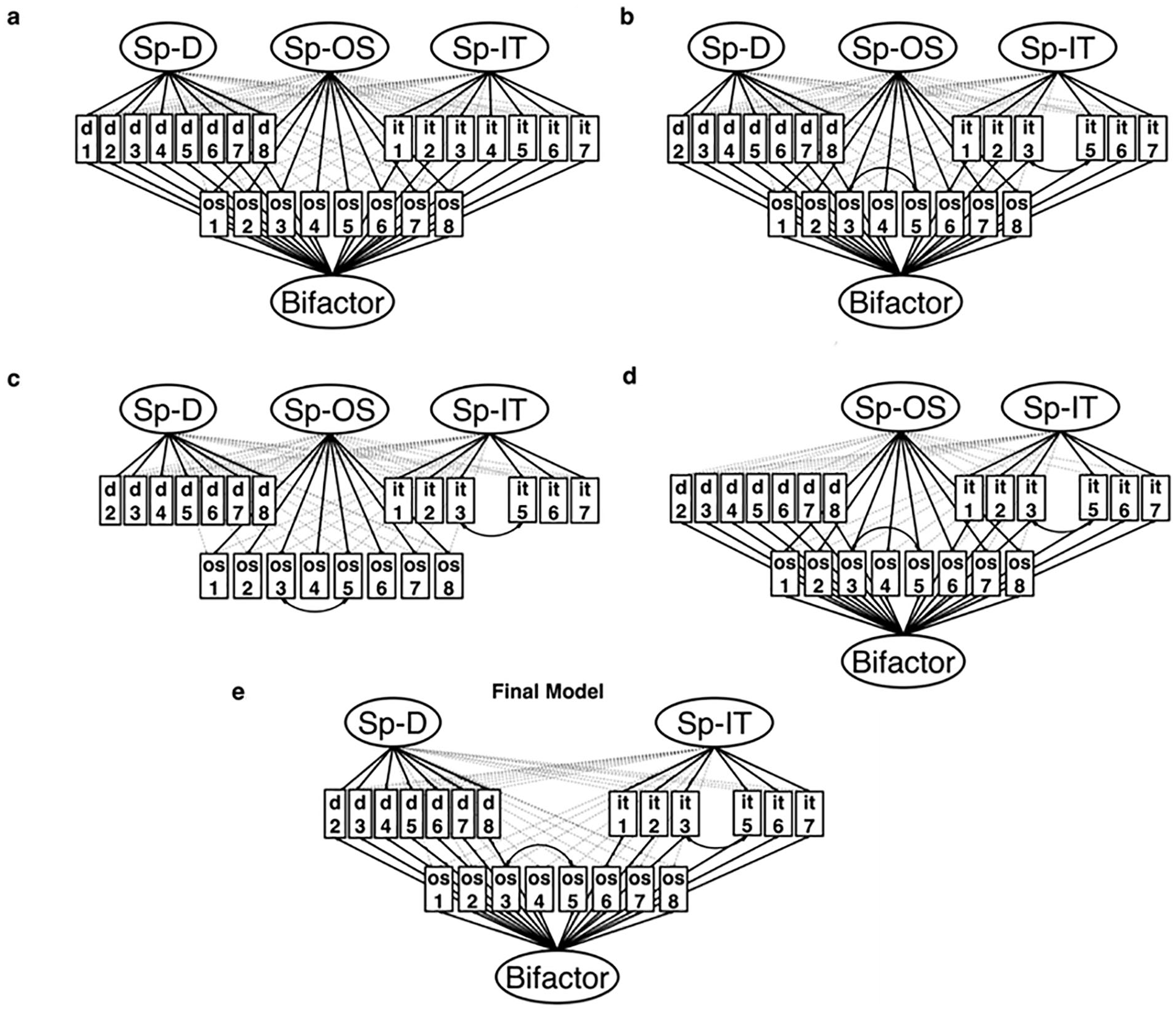
Bifactor exploratory structural equation models evaluated in Study 3.
Comparing Equivalent Models
Having seen that four factors were not supported by the data, we next evaluated a series of models with only three factors (Figures 1c to 1e). We first estimated a model wherein the bifactor was omitted (Figure 1c). Additionally, since our initial models indicated that either the observing self or distancing specific factor was potentially causing identification issues, we specified models eliminating the distancing (Figure 1d) or observing self (Figure 1e) specific factor. All of the following models had the same number of parameters and thus had identical global fit, which was acceptable or excellent in all three samples except TLI in undergraduates and community adults, and significant χ2s as expected (Table 2). Given these models had identical global fit, we selected a final model based on which model yielded the most readily interpretable local fit, as indicated by the presence of specific factors with strong loadings for targeted items and few cross-loadings (defined as Β > |.20|), and a bifactor with significant loadings from all or nearly all of the items. When examining the model eliminating the distancing specific factor (Figure 1d), we examined whether the observing self specific factor had sufficient loadings from putative observing self items to warrant retaining that specific factor. Likewise, for the model eliminating the observing self factor (Figure 1e), we examined whether the distancing factor had sufficient loadings from putative distancing items.
Global Fit of Study 3 Models.
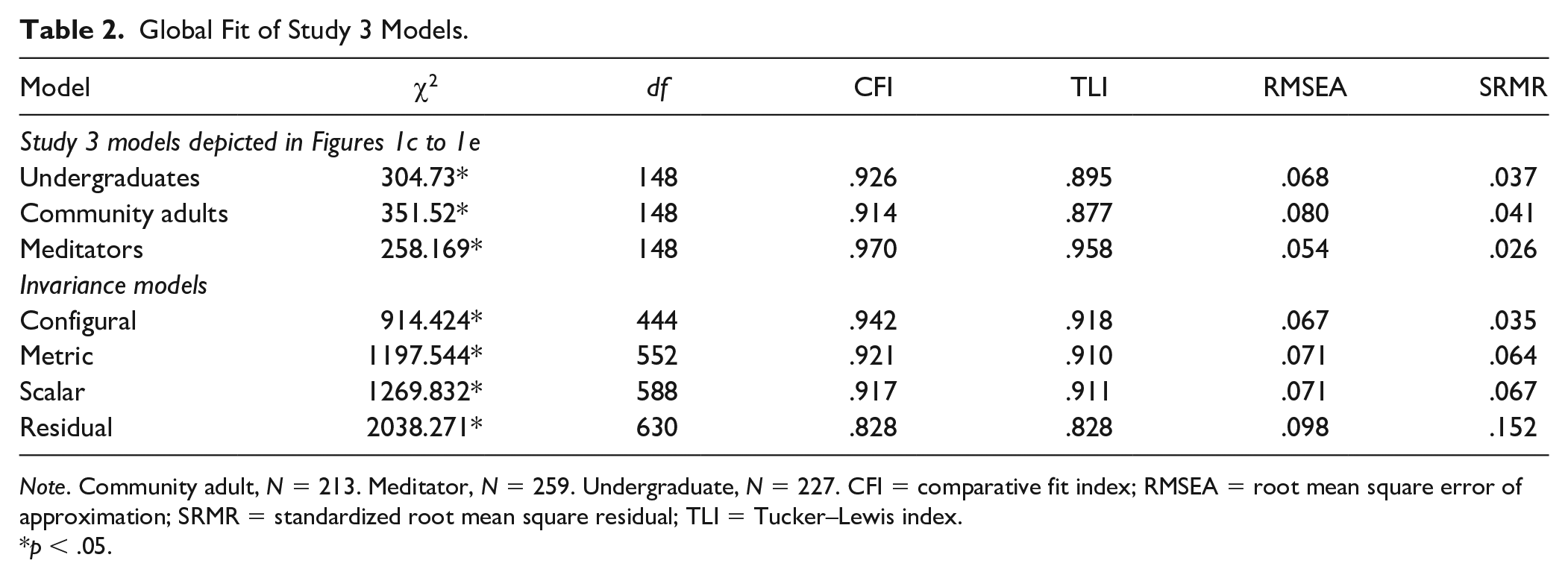
Note. Community adult, N = 213. Meditator, N = 259. Undergraduate, N = 227. CFI = comparative fit index; RMSEA = root mean square error of approximation; SRMR = standardized root mean square residual; TLI = Tucker–Lewis index.
p < .05.
Correlated factors ESEM (omitting bifactor)
We first evaluated a three-factor ESEM for observing self, distancing, and intertranscendence (Figure 1c). There were numerous cross-loading items in the undergraduate and community adult samples of intertranscendence and distancing items onto the observing self factor, in essence forming a partial bifactor. Thus, a three-factor ESEM was ruled out.
Model omitting distancing specific factor
To explore which specific factor might be extraneous, we estimated a model that omitted the specific factor for distancing (Figure 1d). In that model, loadings of items to the intertranscendence factor and bifactor were as expected, with the exception of one item that failed to load significantly to the bifactor (see abridged item loadings for these models in Table 3 and full loadings tables in Supplemental Tables S3-4, available in the online supplemental material). There were five items that cross-loaded in one or more of the samples. Mean standardized loadings of observing self items to the observing self specific factor were .27 for undergraduates, .39 for community adults, and .56 for meditators.

Note. Community adult, N = 213. Meditator, N = 259. Undergraduate, N = 227. All loadings significant at p < .05 except as noted. In Model 1d, Observing self items load only to the bifactor (no observing self specific factor is specified in the model; see Figure 1), and in Model 1e, Distancing items load only to the bifactor (no distancing specific factor is specified in the model). Thus, loadings listed in italics denote loadings of items to the bifactor, and nonitalicized loadings indicate loadings of items to the specific factor listed in the table subheader. Loadings > |.20| of each item to all factors are shown listed in Supplemental Tables S1-2 (available in the online supplemental material). D = Distancing; IT = intertranscendence; OS = observing self; SE = standard error; NS = nonsignificant.
NS loading at p < .05.
Model omitting observing self specific factor (final model)
In a model, wherein we eliminated the observing self factor instead of the distancing factor (Figure 1e), loadings of items to the intertranscendence specific factor and to the bifactor were again as expected. Four items cross-loaded with Β > |.20| in at least one sample. Mean standardized loadings of all putative distancing items to the distancing specific factor were .36 for undergraduates, .44 for community adults, and .56 for meditators.
Though there is no objective rule of what strength of loadings are acceptable or how many cross-loadings are acceptable, a more readily interpretable model should have better defined specific factors (i.e., items expected to load to a specific factor load strongly to that factor) and fewer cross-loadings. Across the three samples, the B-ESEM excluding the observing self factor (Figure 1e) was preferable based on these criteria among the models in Figures 1c to 1e.
Though the observing self specific factor was ultimately dropped from the final model, the interpretation of the retained distancing and intertranscendence factors remains the same as in a more typical bifactor model, wherein all items load to a specific factor (Morin et al., 2020). This finding could indicate that observing self items mostly tap the broader construct of self-transcendence, such that additional variance in responses to those items is not left over to form a specific factor. From a theoretical standpoint, one could further argue that this finding supports the notion that observing self forms the “core feature” of self-transcendence, with distancing and intertranscendence as less central (but still related) facets. Yet in the present study, the model dropping the distancing-specific factor (Figure 1d), while retaining its items on the bifactor, also yielded a reasonable (though slightly less readily interpretable) fit. Thus, a definitive claim that any of observing self, distancing, or intertranscendence is the core of self-transcendence is not justifiable as yet. What is established here is that there appear to be three unique subsets of items aligning with the model of self-transcendence that we have proposed.
Measurement Invariance
The configural invariance model derived from Figure 1e had acceptable fit (Table 2); thus, there was evidence that the same overall factor structure applied reasonably in all three groups. Metric invariance (ΔCFI = −.021, but ΔRMSEA = .004, and ΔSRMR = .029) and scalar invariance (ΔCFI = −.004, ΔRMSEA = .000, and ΔSRMR = .003) were supported, but residual invariance was not (ΔCFI = −.089, ΔRMSEA = .027 and ΔSRMR = .085). These results indicate that latent factor means may be compared between the sampled populations using the Questionnaire on Self-Transcendence (QUEST), though measurement error may vary by population.
Study 4
With the general factor structure of self-transcendence established across five samples in Studies 2 and 3, we sought to determine whether subscales versus a total sum score of the self-transcendence scale were more appropriate for use in analyses, and to establish the reliability and validity of the novel instrument’s three subscales and total score scale derived from Study 3. We titled the novel instrument QUEST; a printable handout of the instrument and scoring instructions is provided in the online supplemental materials.
Method
Participants and Procedures
Data from the three Study 3 samples were used in the following analyses. We collected two-week follow-up data from a majority of Study 3 undergraduate participants (N = 196).
Materials
The existing measures used to assess the novel measure’s validity are listed below. Our hypotheses about associations between self-transcendence and other variables of interest were the same across populations. As described in Study 3 above, each sample completed a different set of questionnaires. Means, standard deviations, McDonald’s ω coefficient of reliability for all administered measures, and correlations between all measures, are in Supplemental Tables S5-7, available in the online supplemental material.
QUEST subscales
Critical to dissemination of a multidimensional assessment tool is guidance on whether to analyze subscale scores. Given that the final model we obtained from Study 3 clearly supported specific factors for intertranscendence and distancing, we first sought to establish whether subscale scores, computed by summing the responses to the items from each specific factor, could be used to capture those specific factors. Using Haberman’s (2008) test, we observed in all three Study 3 samples that the QUEST distancing and intertranscendence subscale scores were more accurate predictors of true subscale scores, as compared with the total 21-item sum scale scores. Thus, use of subscales for intertranscendence and distancing is justified. To assess whether we should also analyze a subscale comprised just of the observing self items, since those items loaded only to the bifactor, we examined typical indicators of whether a shortened scale can be used in place of a total scale (Goetz et al., 2013): whether Cronbach’s α remains acceptable (i.e., ≥.80) with just the shortened scale, and whether the shortened scale has similar associations with theoretically related measures as the total scale. Given noted concerns regarding α (McNeish, 2018), we also examined whether McDonald’s ω values were similar for the observing self scale. The shortened observing self scale retained acceptable α (range .84-.91) and ω (range .86-.91), and had similar associations to the total scale with most of the convergent and criterion-related measures (see Table 4). Given these findings, we believed that use of the eight-item observing self subscale was justified. We examined associations between factors by computing Pearson’s r correlations among the subscales. We also examined the performance of a total score computed from responses to the 21 items, and correlations between all subscales and the total scale scores.
QUEST Interfactor, Convergent Validity, and Criterion Validity Pearson’s rs.
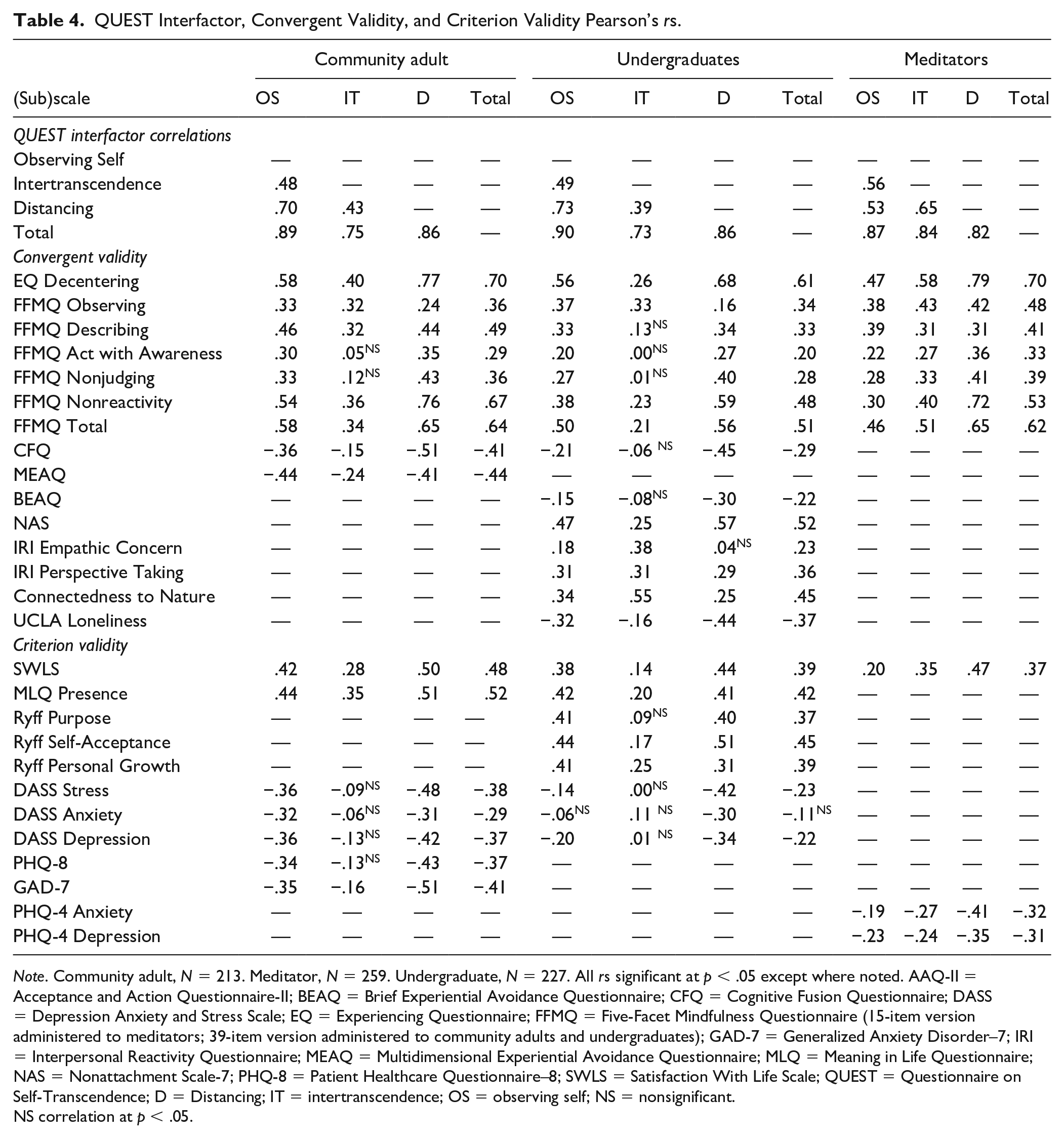
Note. Community adult, N = 213. Meditator, N = 259. Undergraduate, N = 227. All rs significant at p < .05 except where noted. AAQ-II = Acceptance and Action Questionnaire-II; BEAQ = Brief Experiential Avoidance Questionnaire; CFQ = Cognitive Fusion Questionnaire; DASS = Depression Anxiety and Stress Scale; EQ = Experiencing Questionnaire; FFMQ = Five-Facet Mindfulness Questionnaire (15-item version administered to meditators; 39-item version administered to community adults and undergraduates); GAD-7 = Generalized Anxiety Disorder–7; IRI = Interpersonal Reactivity Questionnaire; MEAQ = Multidimensional Experiential Avoidance Questionnaire; MLQ = Meaning in Life Questionnaire; NAS = Nonattachment Scale-7; PHQ-8 = Patient Healthcare Questionnaire–8; SWLS = Satisfaction With Life Scale; QUEST = Questionnaire on Self-Transcendence; D = Distancing; IT = intertranscendence; OS = observing self; NS = nonsignificant.
NS correlation at p < .05.
Convergent validity measures
We predicted that self-transcendence would correlate positively with measures of processes associated with Buddhist contemplative practice, including decentering, mindfulness, and nonattachment. Therefore, we administered the EQ—Decentering Subscale (Fresco et al., 2007) and the Five-Facet Mindfulness Questionnaire (FFMQ; Baer et al., 2006; Baer et al., 2012) in all three samples. For the FFMQ, we examined all individual subscale scores as well as total scale scores. Meditators completed the 15-item FFMQ version and the other samples completed the 39-item version. We also administered the Nonattachment Scale–7 (NAS; Sahdra et al., 2016) to undergraduates.
As the present model of self-transcendence was based on therapies that promote flexibility and acceptance with regard to difficult thoughts and emotions, we hypothesized that increased self-transcendence would be associated with less rigid reliance on thoughts and self-evaluations in guiding behavior (cognitive fusion) and decreased avoidance of negative internal experiences (experiential avoidance). To test these hypotheses, we administered the Cognitive Fusion Questionnaire (CFQ; Gillanders et al., 2014) to undergraduates and community adults, the Multidimensional Experiential Avoidance Questionnaire (MEAQ; Gámez et al., 2011) to community adults, and the Brief Experiential Avoidance Questionnaire (BEAQ; Gámez et al., 2014) to undergraduates. We examined MEAQ and BEAQ total scores only.
We additionally predicted that the intertranscendence subscale would be positively associated with connectedness to other beings (human and nonhuman). To assess this hypothesis, we administered the Interpersonal Reactivity Index Empathic Concern and Perspective Taking Subscales (Davis, 1983), the UCLA Loneliness Scale Version 3 (Russell, 1996), and the Connectedness to Nature Scale (Mayer & Frantz, 2004) to undergraduates.
Criterion-related and incremental validity measures
As discussed above, sensing innate connection to oneself and others has been linked to well-being. To test this hypothesis, we administered the Satisfaction With Life Scale (SWLS; Diener et al., 1985) to all three samples, the Meaning in Life Questionnaire Presence of Meaning subscale (Steger et al., 2006) to community adults and undergraduates, and the Ryff Psychological Well-being Purpose, Self-Acceptance, and Personal Growth subscales (Abbott et al., 2006), to undergraduates.
As decreased decentering and increased cognitive fusion are associated with increased psychopathology, and because those processes may mediate treatment effects (Arch et al., 2012; van der Velden et al., 2015), we also sought to test whether self-transcendence is negatively correlated with anxiety and depression symptoms. Thus, we administered the Depression Anxiety and Stress Scale 21-item version (DASS; Antony et al., 1998) to undergraduates and community adults, the Patient Healthcare Questionnaire–8 (PHQ-8; Kroenke, Strine, et al., 2009) and Generalized Anxiety Disorder–7 (GAD-7; Spitzer et al., 2006) to community adults, and the Patient Healthcare Questionnaire–4 (PHQ-4; Kroenke, Spitzer, et al., 2009) to meditators.
Statistical Analyses
We examined internal reliability using McDonald’s ω for each of the subscales. We assessed two-week test–retest reliability (Watson, 2004) via correlations between undergraduates’ baseline and follow-up scores on each self-transcendence subscale and the total scale, computing the test–retest statistics for the EQ and CFQ as benchmarks. To examine between-subscale correlations, we computed Pearson’s r correlations between the self-transcendence subscales. We assessed convergent and criterion-related validity with Pearson’s r correlations between the self-transcendence scale and its subscales, and the measures described above. Following Cohen (1988), we designated rs > |.1|, |.3|, and |.5| as small, moderate, and large, respectively.
To assess incremental validity, we examined whether self-transcendence subscales accounted for unique variance in well-being and psychopathology symptoms even after accounting for defusion and decentering, two constructs theoretically related to self-transcendence that have been widely examined. Following Haynes and Lench (2003), we first examined the zero-order correlations of all variables. We planned to assess incremental validity for each criterion variable using all the self-transcendence subscales that demonstrated a significant association with that criterion variable. We conducted linear regressions wherein each well-being and psychopathology variable was independently regressed on decentering (EQ) and cognitive avoidance (CFQ; or decentering only in meditators as the CFQ was not administered in that sample) in a “Step 1” model, and self-transcendence subscales in a “Step 2” model. We tested incremental validity of self-transcendence subscales with F tests of the Step 1 versus Step 2 models.
Results and Discussion
Reliability
Internal reliability
Omega values for the subscales and total scale ranged from .78 to .91, and were comparable with the related existing measures’ reliability (Supplemental Tables S5-7, available in the online supplemental material).
Test–retest reliability
Undergraduates’ test–retest rs for the observing self, distancing, and intertranscendence subscales, and the total scale were .63, .67, .72, and .68, respectively. For the EQ and CFQ, test–retest rs were .81 and .72. It may thus be that the latent construct of observing self has greater variability over short timespans than the other measured constructs. Given that this is preliminary finding from one undergraduate sample, further study of temporal stability in additional samples is needed to examine whether observing self indeed is reasonably stable, as would be expected based on our trait-based conceptualization.
QUEST Subscale and Subscale-Total Scale Correlations
Below, all correlations were significant at p < .05 except as noted. Table 4 lists correlations between QUEST subscales and the total scale with all other measures. Correlations between observing self and distancing were large in all samples and correlations between distancing and intertranscendence were large in meditators and moderate in undergraduates and community adults. Observing self and intertranscendence correlations were approximately r = .5 in all three samples. We observed large correlations between the total scale and subscales.
Validity Analyses
Convergent validity
QUEST subscales and the total scale correlated positively with decentering measured with the EQ, mindfulness as measured by FFMQ total scores, and nonattachment measured with the NAS (Table 4). In undergraduates, intertranscendence scores had large correlations with Connectedness to Nature Scale scores, moderate correlations with interpersonal, and small negative correlations with the UCLA Loneliness scale. CFQ scores were moderately negatively correlated with observing self, had low or nonsignificant negative correlations with intertranscendence, and moderate to large negative correlations with distancing. Similar patterns were observed with experiential avoidance as measured by the BEAQ (undergraduates) and MEAQ (community adults) total scores. The general pattern of results support our hypotheses regarding convergent validity.
Criterion validity
There were low to moderate correlations between SWLS and the QUEST subscales (Table 4). A similar pattern emerged with sense of life purpose (Meaning in Life Questionnaire). In undergraduates, scores on the Ryff Scales of Psychological Well-being were moderately correlated with observing self, had insignificant or low correlations with intertranscendence, and moderate to high correlations with distancing. Correlations of anxiety and depression symptoms with distancing were moderate, whereas correlations with observing self were low to moderate, with one nonsignificant correlation (undergraduate DASS anxiety r = −.06, p = .37) and correlations with intertranscendence were significant for meditators only. The hypothesized positive correlations between QUEST subscales and well-being outcomes were thus supported, whereas evidence supporting the predicted negative correlations between QUEST subscales and depression and anxiety was mixed. That meditators, but not other samples, showed significant negative associations between intertranscendence and depression and anxiety may be due either to true differences between populations in how intertranscendence relates to mental health, or could also be due to differences in how depression and anxiety were measured in meditators (PHQ-4) versus the other samples (DASS).
Incremental validity
In cases where there were significant correlations between QUEST subscales and criterion variables, we entered those subscales into incremental validity analyses (see Supplemental Tables S8-10, available in the online supplemental material). Self-transcendence subscale scores provided little or no incremental benefit (ΔR2s < .02, ps > .01) in modeling depression and anxiety symptoms. By contrast, self-transcendence subscales did provide significant incremental benefit in modeling well-being outcomes in all but one analysis (ΔR2s .02 – .09). There were also notable differences between samples in which individual subscales evidenced incremental validity: in undergraduates, only observing self incrementally predicted well-being outcomes, in community adults, only intertranscendence, and in meditators, only distancing. These findings align with the historical perspective that self-transcendence is associated with general well-being, and highlight the importance of further study on population differences with regard to self-transcendence.
General Discussion
We have proposed a CCBT-informed theory of trait self-transcendence and developed and psychometrically evaluated a self-report measure of self-transcendence based on that theory. To develop this measure, we combined items from existing ACT and RFT-informed scales of constructs linked to self-transcendence and developed new items, which were reviewed for content validity by experts in ACT (Study 1a), piloted with a community adult sample (Study 1b), and revised based on the pilot sample feedback. In the subsequent studies, EFAs (Study 2) and B-ESEMs (Study 3) indicated that distancing, observing self, and intertranscendence comprise three distinct factors of self-transcendence. Overall, our hypotheses about the factor structure of self-transcendence were largely but not completely supported. The final B-ESEM model indicated that observing self items are best captured by the general self-transcendence factor. QUEST subscales were correlated in expected directions with psychological well-being outcomes and evidenced incremental validity in predicting those outcomes. Associations with depression and anxiety symptoms, however, were lower or nonsignificant for observing self and intertranscendence.
Though CCBTs (and some contemplative and religious traditions) imply a connection between distancing, observing self, and intertranscendence, the present studies are the first to our knowledge to attempt to formally test a theory of self-transcendence composed of these elements. Our results call attention in the context of clinical psychological science to the importance of considering (and measuring) multiple aspects of self-transcendence. The present research furthermore provides the first self-report questionnaire, validated in three samples, to enable efficient measurement of the self-transcendence facets. We believe that the observing self and intertranscendence subscales represent potentially important new contributions to the CCBT measurement toolkit. For example, the SEQ has been used in limited ways to examine mechanisms of change in ACT, though the focus of its development and subsequent research has been on chronic pain patient populations (Yu et al., 2017). Previous measures do not measure intertranscendence despite its theoretical relation and importance. The availability of our measure enables process or mechanism-focused research with a measure validated in broader, nonmedical populations and which explicitly measure both observing self and intertranscendence.
The failure of the nonpermanence factor to emerge could indicate that nonpermanence may indeed not represent a facet of trait self-transcendence. Or, because the ACT/RFT experts who reviewed the initial items may have not been familiar with nonpermanence, we may have failed to include items that would have enabled detection of a nonpermanence subfactor.
We also did not anticipate that the most readily interpretable model for our data would be one in which the observing self specific factor was omitted (Figure 1e). Further research is needed to replicate this factor structure, and compare it with plausible alternatives.
Study Strengths and Weaknesses
A key strength of this study was its grounding in well-established behavioral science and evidence-based clinical practice, and close methodological adherence to published recommendations for questionnaire development (DeVellis, 2017). This included use of existing scales where feasible, content validation and revision of novel items, factor analytic techniques best suited to model multidimensional assessment instruments (Morin et al., 2016), and thorough assessment of construct validity using measures of a variety of theoretically related constructs (Clark & Watson, 1995). Another strength is the inclusion of five samples of participants spanning three populations, including a highly experienced lay sample of meditators.
Weaknesses in the study design highlight important future directions. First, the current CCBT-informed conceptualization of self-transcendence does not easily map onto alternative conceptualizations of self-transcendence described above. But importantly, the present, clinically informed conceptualization of self-transcendence is more easily related to CCBTs and thus may have greater clinical utility at present. Future studies should integrate our CCBT-informed model with models of self-transcendent experiences that may occur in clinical settings and potentially promote trait self-transcendence. The present studies also relied exclusively on self-report via questionnaires, which we deemed appropriate as a first step in measuring a nuanced, subjective trait, but which introduces potential respondent bias. Some behavioral measures (e.g., Hadash et al., 2016) are potentially adaptable to measure self-transcendence and warrant further examination. Finally, addressing our largely cross-sectional design, it will be critical to test whether the three-factor structure of self-transcendence and its relationships with well-being variables endure over longer timespans. Further characterizing the temporal reliability of the QUEST subscales will be an important precursor to such research.
Conclusions
Self-transcendence is a process implicitly targeted in CCBTs, but to date it has not been comprehensively measured in that context. In this research, we have tested a CCBT-informed model of self-transcendence, positing four facets: distancing, observing self, intertranscendence, and nonpermanence. The findings supported the first three of these, and we created and validated a novel scale to measure them. We found that self-transcendence facets were related to well-being and provided predictive utility in psychological well-being outcomes over-and-above existing related measures. The proposed theoretical model and novel questionnaire thus enables empirical testing of if, when, and how self-transcendence may change in the context of psychological interventions and beyond.
Supplemental Material
sj-docx-1-asm-10.1177_1073191120980061 – Supplemental material for The Questionnaire on Self-Transcendence (QUEST): A Measure of Trait Self-Transcendence Informed by Contextual Cognitive Behavioral Therapies
Supplemental material, sj-docx-1-asm-10.1177_1073191120980061 for The Questionnaire on Self-Transcendence (QUEST): A Measure of Trait Self-Transcendence Informed by Contextual Cognitive Behavioral Therapies by Joel N. Fishbein, Ruth A. Baer, Joshua Correll and Joanna J. Arch in Assessment
Supplemental Material
sj-docx-2-asm-10.1177_1073191120980061 – Supplemental material for The Questionnaire on Self-Transcendence (QUEST): A Measure of Trait Self-Transcendence Informed by Contextual Cognitive Behavioral Therapies
Supplemental material, sj-docx-2-asm-10.1177_1073191120980061 for The Questionnaire on Self-Transcendence (QUEST): A Measure of Trait Self-Transcendence Informed by Contextual Cognitive Behavioral Therapies by Joel N. Fishbein, Ruth A. Baer, Joshua Correll and Joanna J. Arch in Assessment
Supplemental Material
sj-docx-3-asm-10.1177_1073191120980061 – Supplemental material for The Questionnaire on Self-Transcendence (QUEST): A Measure of Trait Self-Transcendence Informed by Contextual Cognitive Behavioral Therapies
Supplemental material, sj-docx-3-asm-10.1177_1073191120980061 for The Questionnaire on Self-Transcendence (QUEST): A Measure of Trait Self-Transcendence Informed by Contextual Cognitive Behavioral Therapies by Joel N. Fishbein, Ruth A. Baer, Joshua Correll and Joanna J. Arch in Assessment
Supplemental Material
sj-rtf-4-asm-10.1177_1073191120980061 – Supplemental material for The Questionnaire on Self-Transcendence (QUEST): A Measure of Trait Self-Transcendence Informed by Contextual Cognitive Behavioral Therapies
Supplemental material, sj-rtf-4-asm-10.1177_1073191120980061 for The Questionnaire on Self-Transcendence (QUEST): A Measure of Trait Self-Transcendence Informed by Contextual Cognitive Behavioral Therapies by Joel N. Fishbein, Ruth A. Baer, Joshua Correll and Joanna J. Arch in Assessment
Footnotes
Acknowledgements
We thank the following individuals for their insightful comments and suggestions in conducting these studies: members of J.J.A.’s research group, Sona Dimidjian, Matthieu Villatte, Steven Reise, Alexandre Morin, István Tóth-Király, and Naomi Friedman.
Declaration of Conflicting Interests
The author(s) declared the follwing potential conflicts of interest with respect to the research, authorship, and/or publication of this article: J.J.A. discloses funding from the National Institutes of Health and the National Comprehensive Cancer Network/AstraZeneca.
Funding
The author(s) received no financial support for the research, authorship, and/or publication of this article.

Supplemental Material
Supplemental material for this article is available online.
Notes
References
Supplementary Material
Please find the following supplemental material available below.
For Open Access articles published under a Creative Commons License, all supplemental material carries the same license as the article it is associated with.
For non-Open Access articles published, all supplemental material carries a non-exclusive license, and permission requests for re-use of supplemental material or any part of supplemental material shall be sent directly to the copyright owner as specified in the copyright notice associated with the article.
