




Abstract
Adolescence is a crucial period for the development of personality and its dysfunctions. In this regard, it is essential to evaluate the nature and degree of maladaptive personality functioning. However, measures currently available present some limitations, mainly being adaptations from adult’s tailored instruments and length. Moreover, no instrument considers the crucial dimensions related to body development and sexuality. This contribution presents data on the Adolescent Personality Structure Questionnaire (APS-Q) development, a self-report measure to capture core aspects of personality functioning in adolescence while being agile and reliable. On two large samples of adolescents (total N = 1,664), we investigated the psychometric properties of the APS-Q. We explored its factor structure and construct and incremental validity in the first sample, testing specific associations with existing measures of severity of personality pathology, maladaptive personality traits, and psychological distress. In the second sample, we confirmed its factor structure, assessing gender and age invariance. Overall, our findings support the APS-Q’s validity as a reliable and useful measure to assess personality functioning. Moreover, the APS-Q highlighted developmentally vital dimensions such as self-functioning (encompassing mental and bodily changes and considering the dimension of sexuality), interpersonal functioning (discriminating the dimensions of family and peers), and emotion regulation.
Keywords
Adolescence is a crucial period for developing and consolidating personality (Blos, 1968; Erikson, 1959; O. F. Kernberg, 1978), encompassing significant changes in body and neurophysiological development (Casey et al., 2008; Spear, 2000). Adolescents face psychological transformations in the perception of themselves, of family members and peers, as well as of emerging romantic and sexual relationships (P. F. Kernberg et al., 2000). Also, they begin to articulate their goals and interests related to school and future aspirations (Becht et al., 2016). These psychological and behavioral aspects converge into personality formation as integrated and stable over time (Kroger, 2007; Lis et al., 2007). However, during this phase, severe perturbations other than typical developmental crises can lead to maladaptive outcomes such as anxiety disorders, mood disorders, schizophrenia, substance abuse, nonsuicidal self-injurious behaviors (Benzi et al., 2018; Di Pierro et al., 2012; Powers & Casey, 2015). Moreover, an increasing number of studies showed that adolescence’s dysfunctional personality is a significant precursor of personality pathology in adulthood (Westen & Shedler, 2000; Zanarini et al., 2011).
Recent years witnessed the emerging importance of identifying a multifactorial and dimensional understanding of personality disorders (PDs; Benzi et al., 2020; De Fruyt & De Clercq, 2014; Ensink et al., 2015; Sharp, 2019). The alternative model for PDs (AMPD) formulated in Section III of the Diagnostic and Statistical Manual of Mental Disorders–Fifth edition (DSM-5; American Psychiatric Association [APA], 2013) suggests a pivotal approach to this problem focusing on a dimensional model that accounts for the severity of impairment in personality functioning, rather than on the presence/absence of criteria, as in the DSM-5 official classification (Section II). Research previously underlined the limitations of a merely descriptive focus on PDs and the need for dimensional developmental models that consider the core aspects of these disorders’ early stages (Cicchetti & Crick, 2009; Hutsebaut et al., 2013). Overall, the DSM-5 allows diagnosing adult-like PDs in adolescence from a categorical standpoint. However, this option has raised conflicting opinions related to the questionable construct and predictive validity. More, clinicians are reluctant to diagnose PDs in adolescence as they are supposed to be transitory and might foster stigmatizing effects (e.g., Bondurant et al., 2004; Miller et al., 2008). Undeniably, during this developmental period, assessing the nature and degree of personality pathology is essential (Paris, 2003; Chanen et al., 2017).
Maladaptive Personality Functioning in Adolescence
One approach that for long time fostered a dimensional perspective regarding personality is the object relations theory (O. F. Kernberg, 1984). Indeed, during this neurological period, when the emotional brain has not fully developed cognitive controls, it posits that adolescence’ significant tasks include identity formation, quality of relationships, and affect regulation (Casey et al., 2008; Ensink et al., 2015). Notably, among psychodynamic dimensional models, the object relations approach has been demonstrated to be in line with the AMPD on adults’ samples (Di Pierro et al., 2020; Hörz et al., 2009; Preti et al., 2018), encompassing self and interpersonal related aspects of personality pathology.
The consolidation of identity comprises a multifaceted construct that, in adolescence, encompasses natural fluctuations in the integration of the sense of self, the perception of bodily changes, sexuality as well as the presence of investments and goals (Fontana et al., 2020; Lind et al., 2019; Locati et al., 2019; P. F. Kernberg et al., 2000). From an object relations perspective, identity involves the capacity to maintain a representation of the self that is stable and consistent over time, as well as to experience and to be aware of one’s inner states (i.e., emotional, cognitive, and behavioral; Benzi & Madeddu, 2017; O. F. Kernberg, 1998a; Sharp, 2020). Also, identity is associated with bodily development acceptance, and empirical studies show that physical dissatisfaction relates to low self-esteem, eating disorders, and poor psychosocial functioning in adolescence (e.g., Davison & McCabe, 2006; Stice & Whitenton, 2002; Tiggemann, 2005). Moreover, the psychic integration of physical changes is linked to how adolescents can fully experience their first sexual and romantic experiences (Collins, 2003; Moore & Rosenthal, 2007). Finally, the presence and stability of investments and goals is also a fundamental building block of identity formation, as it allows teenagers to experiment with their dispositions and interests over time (Becht et al., 2016; O. F. Kernberg, 1998a; Klimstra et al., 2010).
Interpersonal relationships are another relevant aspect of personality functioning in adolescence. In this sense, a significant contribution derives from attachment theory, which underlined developmental pathways for the emergence of personality pathology and other mental disorders (De Carli et al., 2016; De Carli et al., 2018; Lyons-Ruth et al., 2013). The quality of interpersonal relationships in this developmental phase encompasses both the family environment and significant peers. As shown by previous findings (McGue et al., 2005; Reitz et al., 2014), the quality of relations with parents and friends is a protective factor from maladaptive outcomes such as emotional and behavioral problems. Moreover, according to a psychodynamic framework, the quality of relations is related to the adolescent’s internal representations of significant others (P. F. Kernberg et al., 2000). Indeed, according to the object relations theory, a primary task of adolescence is the separation-individuation process, which allows adolescents to cultivate and experiment themselves in meaningful relationships outside of the familiar environment (e.g., Blos, 1967; Sugimura et al., 2018).
Finally, the ability to regulate emotions is another essential dimension of personality functioning in adolescence. The styles of affect regulation result from the mutual interactions between neurobiological and temperamental features and the quality of caregiving experienced with the attachment figure (Fonagy et al., 2004). Research has shown that a lack of the ability to regulate affective states is related to pathological outcomes and behavioral problems during adolescence (Di Pierro et al., 2014; Garnefski & Kraaij, 2006). In this sense, the defensive tendency to act out negative emotional states can result in aggression that manifests itself along a continuum of severity and can be directed toward oneself and others (O. F. Kernberg, 1994, 1998a).
Assessment of Personality Pathology in Adolescence With Self-Report Measures
In recent years, different tools for the assessment of personality pathology in adolescence have been created. Such measures focus on the DSM classification of PDs, on pathological variants of personality traits, or on (mal)adaptive dimensions of personality functioning (Table 1).
Instruments Investigating Maladaptive Personality Traits/Functioning in Adolescence.
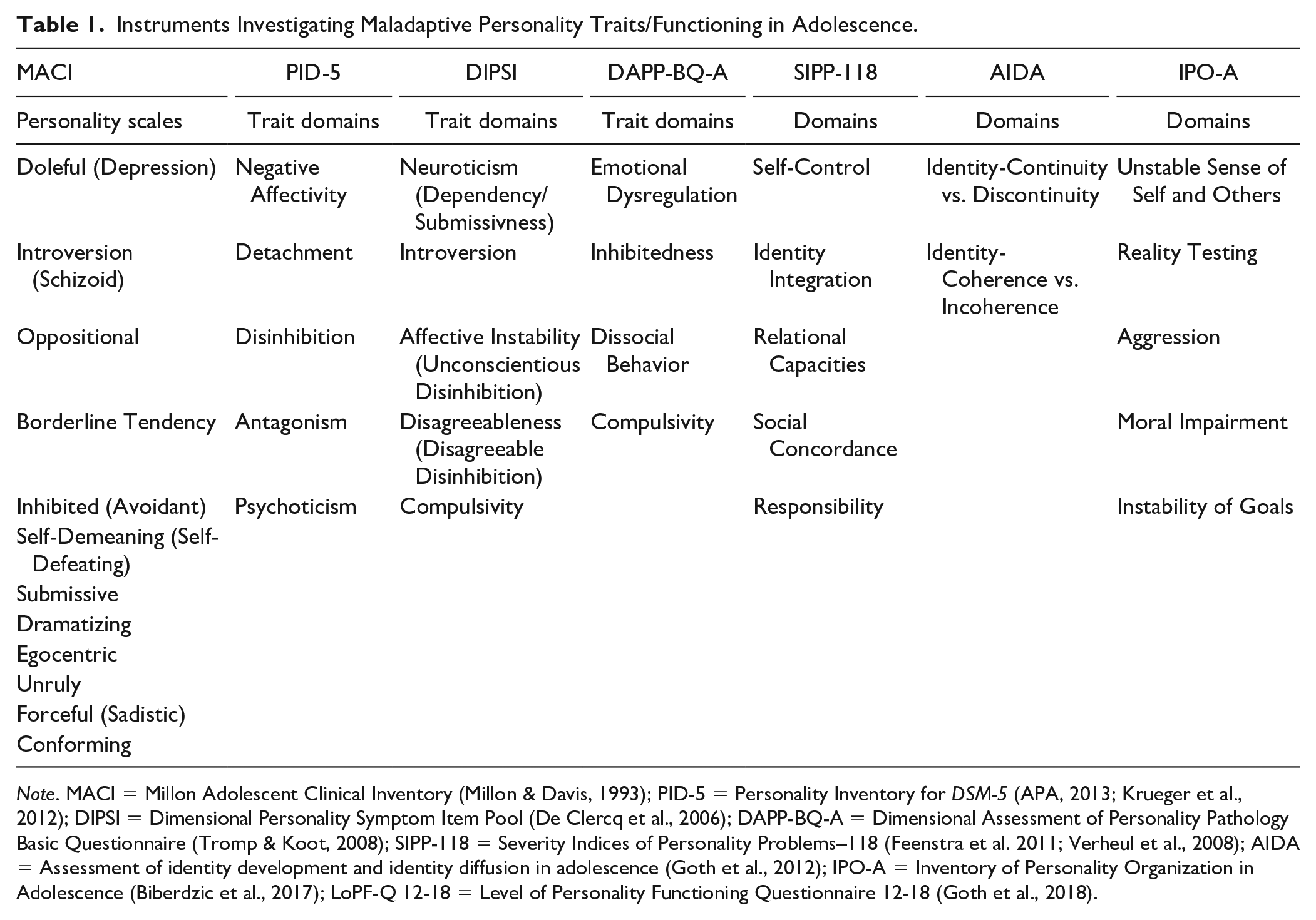
Note. MACI = Millon Adolescent Clinical Inventory (Millon & Davis, 1993); PID-5 = Personality Inventory for DSM-5 (APA, 2013; Krueger et al., 2012); DIPSI = Dimensional Personality Symptom Item Pool (De Clercq et al., 2006); DAPP-BQ-A = Dimensional Assessment of Personality Pathology Basic Questionnaire (Tromp & Koot, 2008); SIPP-118 = Severity Indices of Personality Problems–118 (Feenstra et al. 2011; Verheul et al., 2008); AIDA = Assessment of identity development and identity diffusion in adolescence (Goth et al., 2012); IPO-A = Inventory of Personality Organization in Adolescence (Biberdzic et al., 2017); LoPF-Q 12-18 = Level of Personality Functioning Questionnaire 12-18 (Goth et al., 2018).
As maladaptive traits account for the description of personality pathology, the general degree of adaptation (personality functioning) ought to be considered as a core component of healthy/pathological personality (Benzi et al., 2019; Keeley et al., 2014; Sharp, 2020).
According to a dimensional approach focused on (mal)adaptive personality functioning, Feenstra et al. (2011) adapted the Severity Indices of Personality Problems–118 (SIPP-118; 118 items) to the adolescent population. The SIPP-118 investigates the severity of personality functioning, measuring five domains: Identity integration, Self-Control, Social Concordance, Relational Capacities, and Responsibility. In 2012, Goth et al. developed the assessment of identity development and identity diffusion in adolescence (AIDA; 58 items) that explored the construct of Identity according to Kernberg’s theoretical framework. Also, Biberdzic et al. (2017) explored the psychometric properties of the Inventory of Personality Organization in Adolescence (IPO-A; 42 items), adapted from the adult version of the instrument (IPO; Lenzenweger et al., 2001). The IPO-A dimensions investigate crucial areas of personality pathology in adolescence, according to Kernberg’s model (O. F. Kernberg, 1986; P. F. Kernberg et al., 2000; Preti et al., 2012): the presence of an unstable sense of self and others, instability of goals, aggression, moral impairment, instability of goals, and reality testing. More recently, Goth et al. (2018) developed the Level of Personality Functioning Questionnaire 12-18 (LoPF-Q 12-18; 96 items) inspired by the AMPD, thus exploring the crucial areas of identity, self-direction, empathy, and intimacy.
The major shortcoming of these self-report instruments is that they result from the adaptation of the adult version of the same instruments. This aspect is significant regarding adopting an age-appropriate vocabulary and highlighting core components of maladaptive personality functioning that are peculiar to this developmental phase (e.g., SIPP-118; AIDA; LoPF-Q 12-18). Indeed, aspects related to identity in adolescence include the sense of self and the perception of bodily changes and sexuality that are not as relevant for adults. Similarly, the quality of interpersonal relationships in adolescence includes relationships with both the parents and peers. Furthermore, as adolescents are often averse to prolonged psychological assessments, the instrument’s length ought to be considered a weakness (e.g., SIPP-118; IPO-A; LoPF-Q 12-18).
Given these shortcomings, we developed a new self-report measure to assess pathological personality functioning in adolescence, the Adolescent Personality Structure Questionnaire (APS-Q), based on the Interview of Personality Organization Processes in Adolescence (IPOP-A; Ammaniti et al., 2012; Fontana et al., 2020). The IPOP-A is a semistructured interview based on the object relations approach to personality pathology created specifically for evaluating personality functioning in adolescence (P. F. Kernberg et al., 2000). The IPOP-A measures some critical domains of pathological functioning in adolescence and young adulthood (from 13 to 21 years): identity formation, quality of object relations, and affect regulation.
We aimed for it to be tailored, reliable, and agile to easily highlight personality dimensions and foster adolescents’ compliance.
The Present Research
This contribution presents data on the development of the APS-Q.
In Study 1, we developed a pilot set of items and checked for their clarity and comprehensibility. According to the IPOP-A, we aimed for it to acknowledge features related to the self (identity) and interpersonal (object relations) dimensions and affect regulation. Also, we aimed at choosing a set of items into a range from 30 to 50, if warranted by the principal component analysis (PCA; Laher, 2010), from the initial set of items. Then, we explored the factor structure of the APS-Q considering criteria of coherency and internal validity of its dimensions and stability across different subsample (factor congruence). Also, we tested the APS-Q stability over a short period (test–retest validity). Finally, we investigated the construct validity of the APS-Q. We hypothesized the APS-Q scales to be significantly related to other measures of severity of personality pathology, maladaptive personality traits, and psychological distress (convergent validity) and to provide unique and additional information (discriminant and incremental validity).
In Study 2, we explored the goodness of the factorial structure of the APS-Q. Then, we tested the gender and age invariance of the APS-Q scales. Gender and age invariance deals with the psychometric equivalence of a construct across males and females and across different ages, showing that a construct has the same meaning to those groups (Putnick & Bornstein, 2016). Widaman and Reise (1997) recommend that measurement invariance testing be articulated in four steps: (1) configural, that is, equivalence of the pattern of free and fixed elements across groups; (2) metric, that is, equivalence of factor loadings across groups; (3) scalar, that is, equivalence of item intercepts or thresholds; and (4) residual, that is, equivalence of items’ residuals or unique variances. These steps should be sequentially tested, with consideration of model fit and change in model fit through the steps (Cheung & Rensvold, 2002; Svetina et al., 2020).
Method
We report how we determined our sample size, all data exclusions, all manipulations, and all measures in the studies.
Participants
Study 1 involved 848 participants, including 543 females (64.03%) and 305 males (35.96%) with an overall mean age of 16.37 (SD = 1.77; range = 13-19) that completed the set of items of the APS-Q. A subsample of 562 participants including 351 females (62.45%) and 211 males (37.54%) with an overall mean age of 16.24 (SD = 1.69; range = 13-19) also completed measures of personality functioning, maladaptive personality traits, and psychological distress to investigate convergent and discriminant validity. Of this subsample, 451 participants (%), including 276 females (61.19%) and 175 males (38.80%) with an overall mean age of 16.15 (SD = 1.68; range = 13-19), recompiled the APS-Q set of items after 1 month to assess test–retest reliability.
Study 2 involved 816 participants, paired on gender with an overall mean age of 15.87 (SD = 1.38; range = 13-19) that completed the set of items of the shortened and final version of the APS-Q. For the assessment of age invariance, the total sample was divided into three subsamples referring to different adolescent’s phases: early (range = 13-14; n = 161), middle (range = 15-16; n = 388), and late adolescence (range = 17-19; n = 267).
Participants from both studies were recruited from middle and secondary schools in Italy. The assessment was performed after receiving authorization from both parents of underage students and older students themselves. To ensure their anonymity, students received a unique reference code and completed self-report questionnaires via a private web link. The institutional review board approved all materials and procedures (prot. n. 207/2014).
Measures
Study 1: Development of the APS-Q Set of Items
To identify the core aspects of adolescent personality functioning, we followed the structure of the IPOP-A interview (Ammaniti et al., 2012; Fontana et al., 2020). The pool of 176 items was composed in Italian, evaluated, and discussed by a consensus group of five experts with a clinical and research background of at least 10 years on the structural model of personality pathology (O. F. Kernberg, 2016) and PDs.
According to the IPOP-A interview, items of the APS-Q covered the three main domains of identity, quality of object relations, and affect regulation.
Considering identity, we included the following areas of inquiry: self-description features, mentalizing capacities, self-esteem, acceptance of body development, coherence in time of self-image. Also, we added items related to the presence and stability of investments (efficiency, objectives and ambitions, satisfaction) and the presence of risky behaviors. To investigate object relations, we included items related to the representation of significant others outside and within the family (i.e., characteristics, mentalizing capacities, stability, romantic investment, sexuality, fights and discussions, and secrets). Regarding affect regulation, we considered the presence of anger and attacks toward the self and others, the presence of guilt and shame, as well as feelings of anxiety and boredom.
As a first step, the pool of 176 items was administered to a group of teenagers (n = 10) to evaluate their clarity and intelligibility qualitatively. We eliminated items that teenagers assessed as not easily understandable (e.g., “Even if we do not tell each other, I always know what my role is in the group of friends”), too general (e.g., “Outside of my family, the people I look up to are only the best”), or addressing more than one aspect (e.g., “If I would make a fool out of myself with my friends because of a lie that I told, I think I would die from shame”). Also, to facilitate the adolescent on focusing on his most significant person inside and outside the family, we discarded items that were specifically referred to mother/father (e.g., “I feel that my mother/father would be ready to support me if I needed to”). With the same purpose, we discarded items referring in a too general way to friends (e.g., “My friends know that if they disappoint me, they will lose my friendship forever”). Rather, the questionnaire asked the adolescent to think of a significant other within or outside the family (“With whom of your family members do you have the strongest relationship?” and “Who is the most important person for you outside of your family?”) before rating the items related to the specific dimensions (i.e., relationship with family and relationship with friends).
Following the procedure described above, we identified the final set of 112 items of the APS-Q that was administered to the whole sample of the study. For each item, the questionnaire asked participants to rate their level of agreement on a 5-point scale (1 = never true to 5 = always true).
Severity Indices of Personality Problems–118 (Verheul et al., 2008)
The SIPP-118 is a dimensional measure of 5 core components of (mal)adaptive personality functioning (Self-Control, Identity Integration, Relational Capacities, Responsibility and Social Concordance). The self-report questionnaire consists of 118 items related to the past 3 months and measured on a 4-point Likert-type scale (1 = I fully agree to 4 = I fully disagree). High scores indicate better adaptive functioning, whereas low scores represent more maladaptive personality functioning. Reliability and validity of adolescents’ samples have proven to be satisfactory (Feenstra et al., 2011). All the scales showed good internal consistency coefficients, with α values ranging from .86 (Responsibility) to .91 (Self-Control).
Personality Inventory for DSM-5 (PID-5; APA, 2013; Krueger et al. 2012)
The PID-5 is a 220-item questionnaire that measures maladaptive personality traits as proposed in the AMPD of DSM-5. Responses are rated on a 4-point Likert-type scale (0 = very false or often false to 3 = very true or often true). The higher the scores, the higher the severity of pathological traits. The PID-5 measures five higher order traits domains: Internalizing Traits (Negative Affectivity and Detachment), Externalizing Traits (Antagonism and Disinhibition), and Psychoticism. The DSM-5 provides both an adult and child (11-17 years) version of the questionnaire (Somma et al., 2017). The five trait domains showed good internal consistency coefficients, with α values ranging from .89 (Disinhibition) to .94 (Psychoticism).
Symptom Check List-90–Revised (SCL-90-R; Derogatis, 1994)
The SCL-90-R is a self-report measure that assesses psychological and physical symptoms during the last week on a 5-point scale, ranging from no symptoms to many symptoms. The psychometric properties of the questionnaire have been investigated in several studies and resulted satisfactory both in clinical and control populations (Prunas et al., 2012). For the present study, we used the global severity index (GSI), corresponding to the average score of all the items, as a measure of psychological distress. The GSI scale showed a good internal consistency (α = .97).
Study 2: Final Version of the APS-Q
The final version of the APS-Q is a self-report measure consisting of 35 items that assesses personality structure in adolescence according to seven dimensions: sense of self, self-acceptance, sexuality, investments and goals, relationship with family, relationship with friends, and aggression. For each item, the questionnaire asks participants to rate their level of agreement on a 5-point scale (1 = never true to 5 = always true). All the scales showed good internal consistency coefficients, with α value for the total score = .83 and α values for the individual scales ranging from .63 (relationship with friends) to .85 (self-acceptance).
Statistical Analyses
Study 1
Statistical analyses were conducted using R code (R Core Team, 2017). Using the R package psych, we performed parallel analysis (PA; O’Connor, 2000) to determine the most appropriate number of factors to retain. PA simulates random data sets with the same numbers of observations and variables as the original one. Then, it uses the random data sets to compute eigenvalues from its correlation matrix. The maximum number of factors to retain is obtained confronting these eigenvalues with those from the original data (the initial data values must be higher than the PA values). Taking into account PA results, we conducted PCA (Laher, 2010; available in the R package psych) evaluating several factor structures. Moreover, we performed PCA on different subsamples to assess the factor solution and to compute Tucker-Phi for factor loadings congruence (Lorenzo-Seva & Ten Berge, 2006; available in the R package psych). We considered Phi values higher than .85 as displaying fair similarity and higher than .95 as displaying equivalence between the compared factors. We investigated internal consistency (R package DescTools) and explored concurrent and discriminant validity, as well as test–rested reliability, computing Pearson correlations (available in the R package stats). Also, hierarchical regression analysis was conducted to assess the incremental validity of the APS-Q (Hunsley & Meyer, 2003; R package stats).
Study 2
Since the APS-Q items were categorically ordered and nonnormally distributed a confirmatory factor analysis based on the polychoric correlation matrix with a robust weighted least squares mean and variance adjusted estimator was used (Hoyle, 2012; Li, 2016). This procedure avoided to parcel items, using all the manifest indicators to estimate the model (Bandalos, 2008). The overall fit of the model was evaluated adopting a multifaceted approach to fit assessment. Therefore, complementary goodness of fit indexes were taken into account (Hoyle, 2012): (1) Chi-square significance (if Chi-square is not significant, it means that model reached a perfect fit with the observed data); (2) comparative fit index (CFI); values ≥.95 indicate a good fit, values ≥.90 indicate an adequate fit; (3) root mean square error of approximation (RMSEA); values .05 or .08 indicate a good fit, such as the nonstatistical significance of its associated 90% confidence interval (CI); (4) Tucker–Lewis index or nonnormed fit index (TLI or NNFI); values ≥.95 indicate a good fit, values ≥.90 indicate an adequate fit.
After identifying the best fitting model of APS-Q, we tested the following gender and age invariance models: (1) a configural invariance model with invariant factor loading pattern; (2) a metric invariance model with invariant factor loadings, and (3) a scalar invariance model with invariant factor loadings and intercepts; (4) a residual factorial invariance model with invariant indicator residual variances. To identify the best fitting model, we relied on the difference chi-square test between nested models using the DIFFTEST procedure (Muthén & Muthén, 1998-2015). In addition, we also followed Cheung and Rensvold’s (2002) ΔCFI < .01 criterion to compare nested models because it is the criterion most often used in the empirical literature (Putnick & Bornstein, 2016). Statistical analyses were conducted using Mplus version 8.3.
Results
Study 1
Selection of Factor Solution
Before running the PCA, we tested the Kaiser–Meyer–Olkin coefficient to verify the sampling adequacy for the analysis KMO = .86, which is well above the acceptable limit of .5 (Dziuban & Shirkey, 1974). Bartlett’s test of sphericity indicated that correlations between items were sufficiently large for running a PCA (<ι>χ2</ι> [6216] = 26145.127, p < .001). PA suggested a maximum of 14 components (Table 2), whereas the scree test allowed us to identify three main jumps in the eigenvalues (between the 4th and the 5th, the 6th and the 7th, and the 7th and the 8th) corresponding to a four-, six-, and seven-factor solutions.
Parallel Analysis: Principal Components and Random Normal Data Generation.

Note. Tested factor solutions are in bold.
We conducted PCA on the 112 items with oblique rotation (Promax). We chose an oblique rotation given the presence of correlations >.30 among the factors in most solutions. Then, we discarded items according to their loadings (<.30) and considered loadings >.30 on different factors.
To individuate the best factor solution, we adopted a two-step approach. First, as the PA suggested, we evaluated the 14 components solution. We discarded it because of the insufficient number of items (<3) per component and the unclear interpretability of some of the factors. Second, we focused on the solutions suggested from the scree-test sequentially. Thus, we evaluated the four, six, and seven components solutions. We discarded the first two because they excluded dimensions that we aimed to measure (e.g., the four components solution excluded items associated with the stability of investments and to relationships with friends; the six components solution excluded items related to the stability of investments). Finally, we evaluated a seven components structure, which resulted more coherent from a statistical point of view, displaying a sufficient number of items per component. Also, the seven components solution resulted more interpretable from a theoretical point of view. Such solution identified aspects related to self-description features and mentalizing capacities, acceptance of body development, being at ease with sexual impulses, representation of the significant other outside the family, representation of the other within the family, anger and attack toward the self and others, and satisfaction about and stability of investments.
Factor Structure and Internal Consistency
To obtain an agile and coherent measure based on the seven components structure, we adopted a multistep approach. First, discarding items with low loadings (<.30), we reduced the initial set of 112 to 86 items. Second, we discarded items with large secondary loadings (<.30 on more than one factor), resulting in a set of 77 items. After this first round, we rerun a PCA on the remaining items with seven components for the second round of selection aimed at identifying a final set of 30 to 50 items. After having verified that the seven component solution was still overall adequate, we first eliminated 17 items that were less clear markers of the construct (e.g., “When I perceive a negative emotion, I behave in a way that I cannot explain to myself” under the sense of self dimension). Then, we discarded 14 items that were redundant (e.g., we maintained “If I think about it, every day I am like a different person” and deleted “Even if I’ve changed, I’m always the same person”). Finally, we reduced further by eliminating 12 items displaying low loadings (<.30) or secondary loadings (<.30 on more than one factor). All in all, we aimed at keeping items with high loadings (>.50). However, we decided to keep one item with slightly lower loadings as it was considered theoretically relevant (i.e., “Nobody, other than my family, is really important to me, not even . . . ” = .45). The final version of the APS-Q thus consists of 35 items.
The factors that resulted after rotation (Table 3) were interpreted as follows. Self-acceptance (Factor 1) is composed of six items that encompass acceptance of physical development and presence of shame. Sense of self (Factor 2) includes seven items on description and stability of the self-image and ability to mentalize internal states and behaviors. Aggression (Factor 3) comprises five items on the tendency to acting-out (toward self or others) or to lose control when emotions are overwhelming. Relationship with family (Factor 4) includes five items on the quality of the relations inside the familiar context. Sexuality (Factor 5) has four items exploring how/whether adolescents are comfortable with their sexual desires/impulses. Relationship with friends (Factor 6) is composed of four items on the quality of the relations with the most significant friend. Finally, investments and goals (Factor 7) includes four items on presence and stability of goals and investments in school or work.
Factor Structure of the APS-Q (Total Sample, n = 848; Promax Rotation).
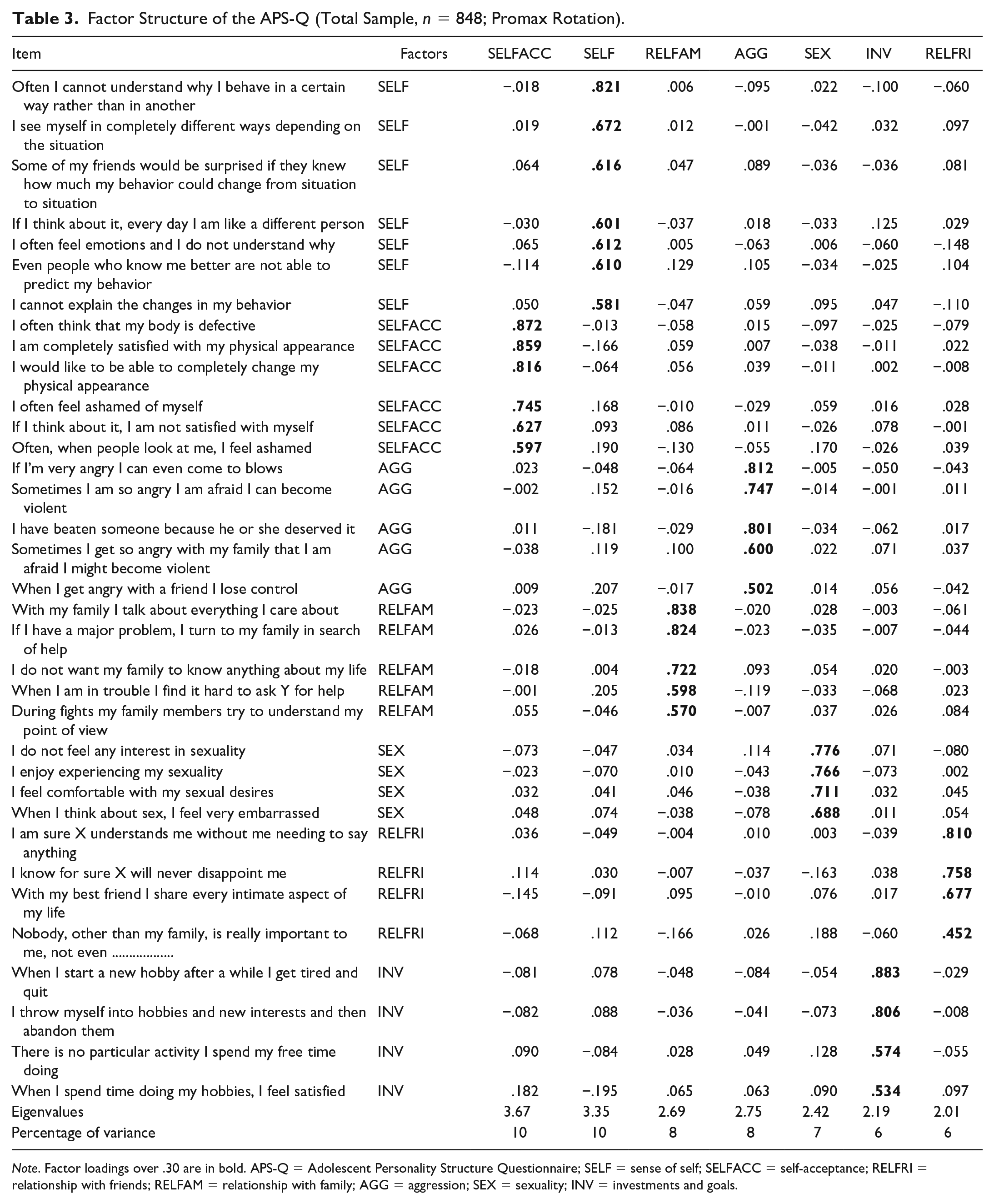
Note. Factor loadings over .30 are in bold. APS-Q = Adolescent Personality Structure Questionnaire; SELF = sense of self; SELFACC = self-acceptance; RELFRI = relationship with friends; RELFAM = relationship with family; AGG = aggression; SEX = sexuality; INV = investments and goals.
Intercorrelations between factors are reported in Table 4. Generally, intercorrelations between factors were low (r ≤ .30). Only the sense of self dimension was associated (r ≥ .30) with the self-acceptance and aggression dimensions.
Intercorrelations Between APS-Q Factors (n = 848).
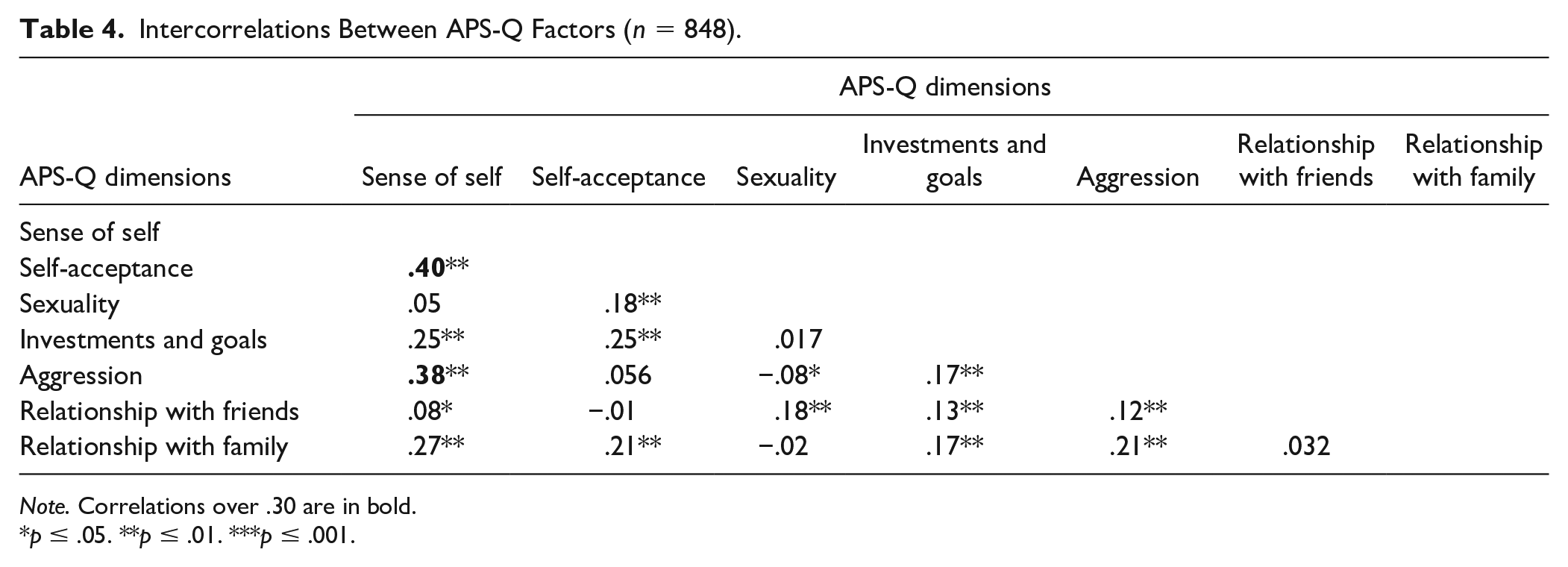
Note. Correlations over .30 are in bold.
p ≤ .05. **p ≤ .01. ***p ≤ .001.
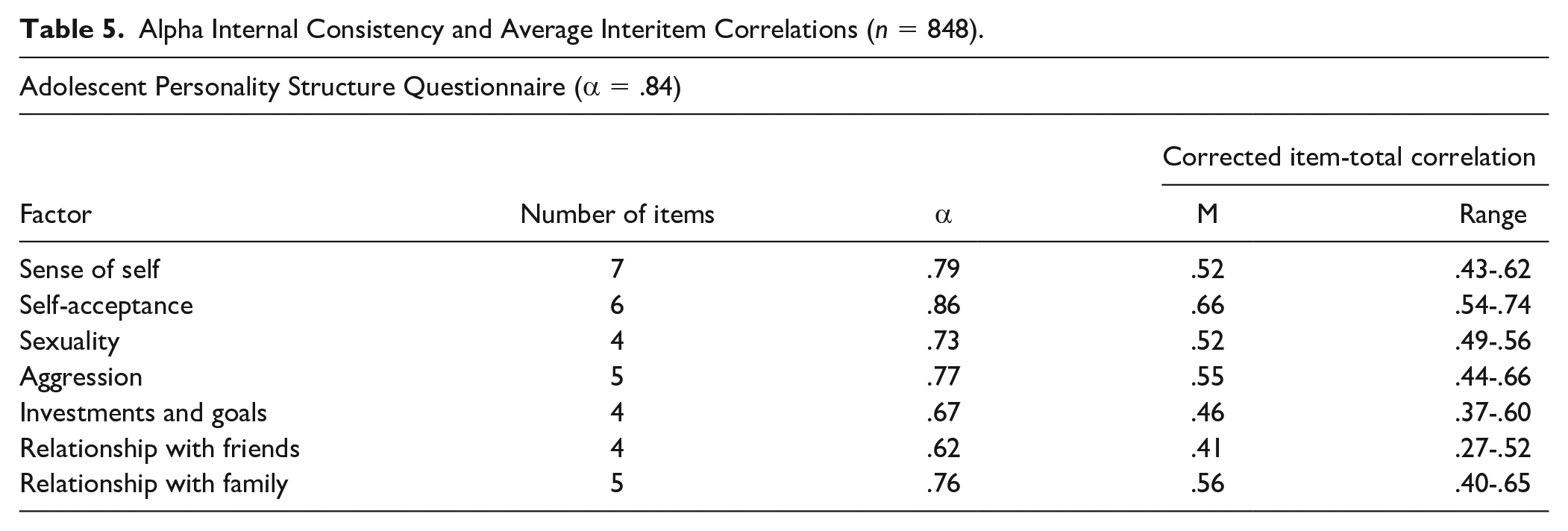
Cronbach’s alpha values for internal consistency and average interitem correlations for the seven dimensions are reported in Table 5. Overall, all the APS-Q dimensions showed good internal consistency.
Alpha Internal Consistency and Average Interitem Correlations (n = 848).
Stability of the Factor Solution
To test the stability of the factor solution obtained, we considered two random subsamples (about 50% of the overall sample each): R1 (n = 422), including 271 females (64.21%) and 151 males (35.78%) with an overall mean age of 16.40 years (SD = 1.76; range = 13-19) and R2 (n = 426), including 272 females (63.84%) and 154 males (36.15%) with an overall mean age of 16.34 years (SD = 1.77; range = 13-19). Results showed that the same factor structure was replicated in both subsamples. We tested Tucker Phi coefficients for factor congruence. Values for all dimensions started from .94, therefore displaying a substantial equivalence between factors (Table 6).
Factor Congruence Between Random 1 (n = 422) and Random 2 (n = 451) Subsamples.
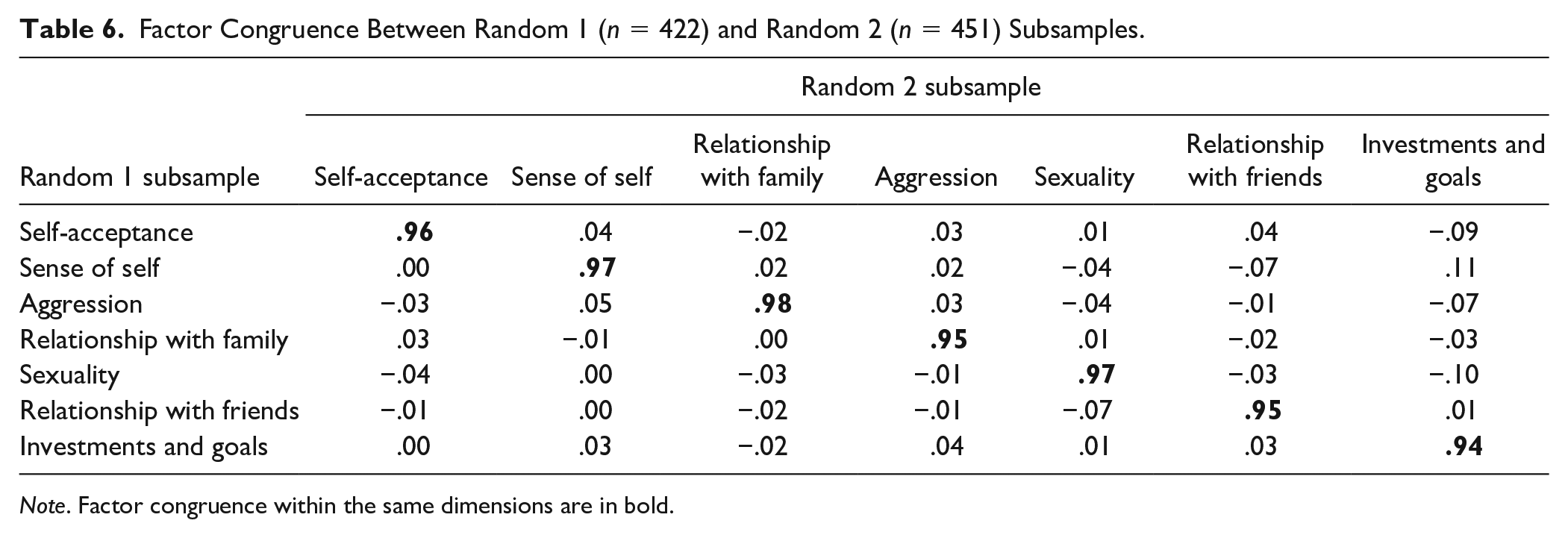
Note. Factor congruence within the same dimensions are in bold.
Additionally, we tested the stability of the factor structure in a subsample of 451 participants, including 276 females (61, 19%) and 175 males (38, 8%) with an overall mean age of 16.15 years (SD = 1.68; range = 13-19) that filled in the questionnaire again after 1 month. Still the factorial structure was confirmed with values for all dimensions ranging from .94 to .97, therefore displaying a substantial equivalence between factors.
Test–Retest Reliability
Test–retest reliability was explored over a 1-month period in the subsample of 461 participants previously described. We found high correlations for every dimension of the APS-Q (ranging from .68 to .87), showing substantial reliability over this period of time (Table 7).
Pearson Correlation Coefficients Between Retest (T0 and T1) Measurements (1 month; n = 451).
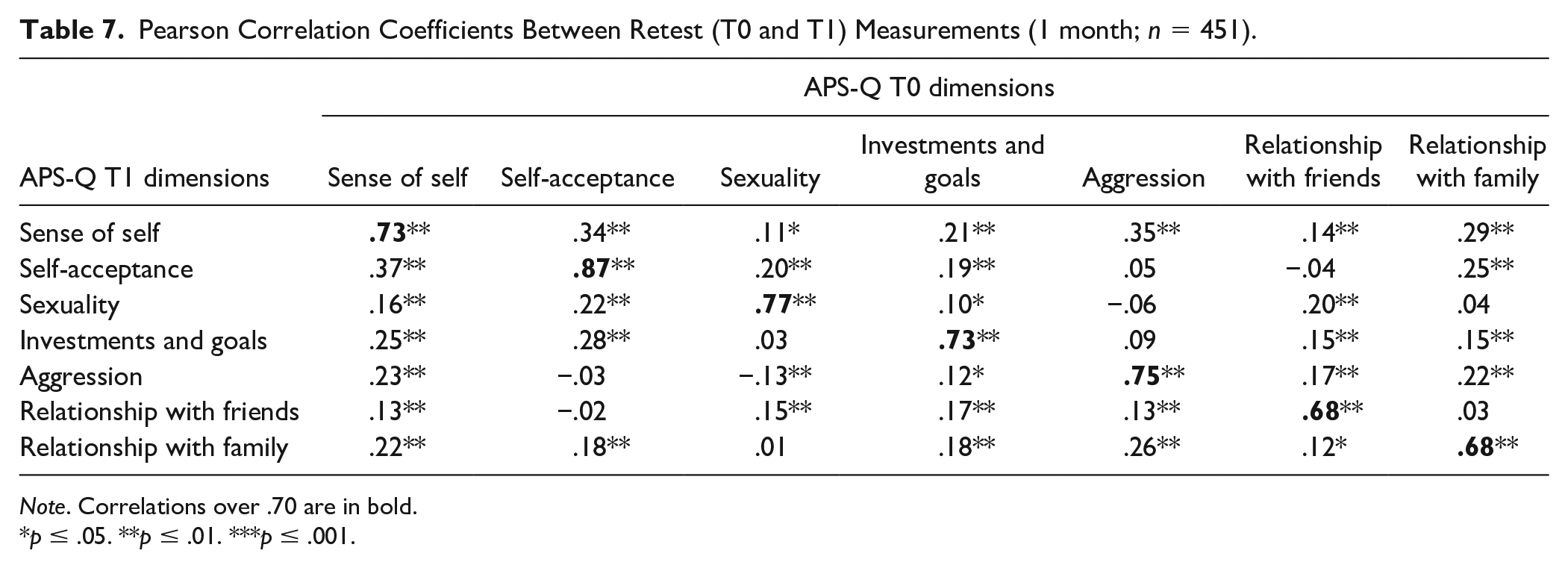
Note. Correlations over .70 are in bold.
p ≤ .05. **p ≤ .01. ***p ≤ .001.
Convergent and Discriminant Validity
As our questionnaire aims to measure pathological personality functioning, we tested the associations between the APS-Q dimensions and the SIPP-118 domains to explore convergent validity (Table 8). The APS-Q dimension of sense of self, showed strong correlations with the correspondent SIPP-118 domains of Self-Control and Identity Integration. Similarly, the APS-Q self-acceptance dimension showed a strong association with the SIPP-118 Identity Integration domain and a moderate association with the SIPP-118 Self-Control domain. The APS-Q sexuality dimension showed a weakly significant relationship with the primary domains of the SIPP-118. The APS-Q Investments and goals dimension was significantly associated with the SIPP-118 domains of Identity Integration and Responsibility. The APS-Q aggression dimension was strongly related to the SIPP-118 Self-Control and Social Concordance domains.
Pearson Correlation Coefficients Between APS-Q Dimensions and SIPP-118 Domains (n = 562).
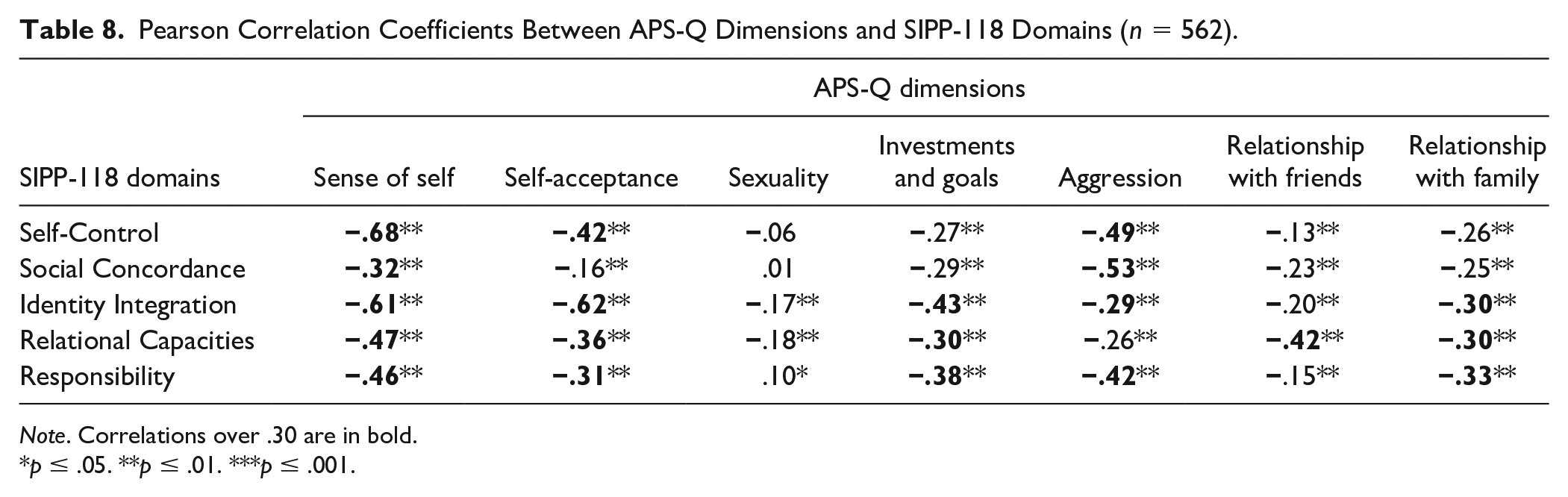
Note. Correlations over .30 are in bold.
p ≤ .05. **p ≤ .01. ***p ≤ .001.
Both the APS-Q dimensions investigating quality of relations (relationship with friends and relationship with family) were associated with the SIPP-118 Relational Capacities domain.
To explore the relationship with DSM-5 maladaptive personality traits, we tested the associations between the APS-Q dimensions and the PID-5 traits (Table 9). Strong and moderate correlations were found between the APS-Q sense of self dimension and internalizing traits (Negative Affectivity and Detachment), and with Disinhibition and Psychoticism. Also, self-acceptance was significantly related to internalizing traits. Furthermore, correlations between Aggression and externalizing traits (Antagonism and Disinhibition) were found. Finally, both APS-Q dimensions associated with the quality of relationships (relationship with friends and relationship with family) were associated with Detachment.
Pearson Correlation Coefficients Between APS-Q Dimensions and PID-5 Domains (n = 562).
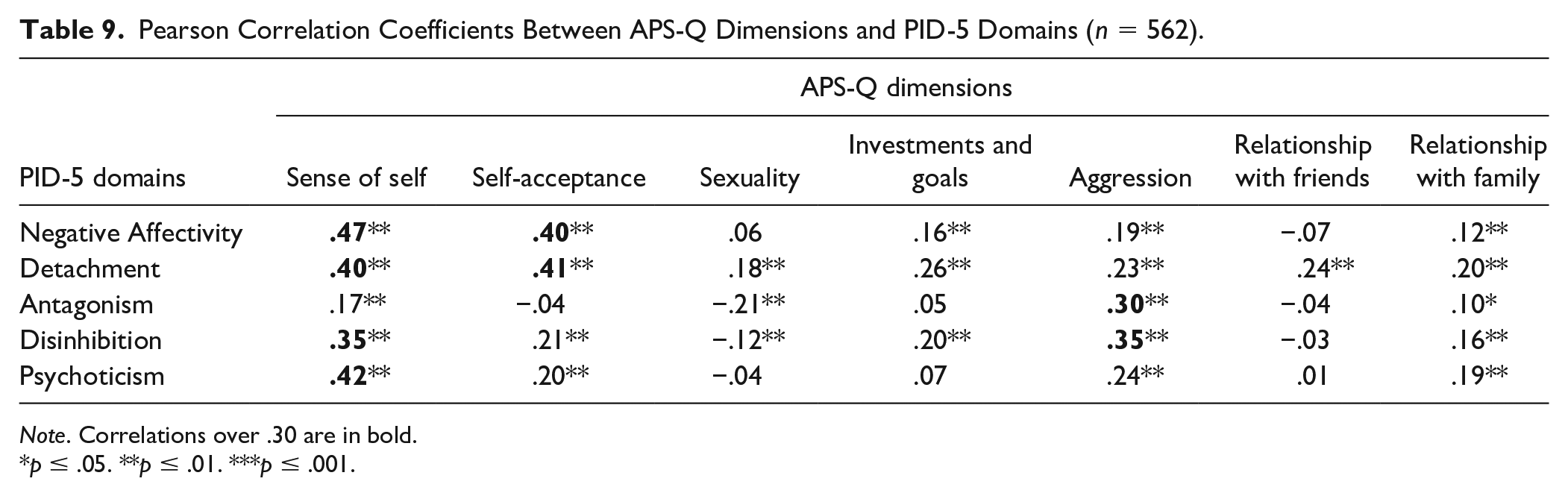
Note. Correlations over .30 are in bold.
p ≤ .05. **p ≤ .01. ***p ≤ .001.
Positive correlations were found between the APS-Q self-related dimensions and the GSI (sense of self, r = .47, p < .001 and self-acceptance, r = .42, p < .001), as well as between the all the other personality dimensions except the sexuality dimension.
Incremental Validity Over the SIPP-118
To further explore the APS-Q ability to predict maladaptive personality traits over a similar measure of personality functioning such as the SIPP-118, we conducted multiple hierarchical regressions: all changes in R2 were significant through the models (see details in the online supplementary material).
First model, in Step 1, SIPP-118 dimensions accounted for 32% of variance in predicting Negative Affectivity and in Step 2, the APS-Q dimensions accounted for an additional 6% of the variance (Social Concordance domain not being significant predictors in second step and sexuality, relationship with family, aggression and investments and goals not being significant predictors for the APS-Q).
Second model, in Step 1, SIPP-118 dimensions accounted for 48% of variance in predicting Detachment (Self-Control, Social Concordance not being significant predictors in both steps; Responsibility not being significant in Step 2) and in Step 2, the APS-Q dimensions accounted for an additional 2% of the variance (only sexuality and relationship with friends being significant predictors for the APS-Q).
Third model, in Step 1, SIPP-118 dimensions accounted for 14% of variance in predicting Antagonism (Responsibility not being significant predictors in both steps and Self-Control in Step 2) and in Step 2, the APS-Q dimensions accounted for an additional 7% of the variance (only sexuality, relationship with friends and aggression being significant predictors for the APS-Q).
Fourth model, in Step 1, SIPP-118 dimensions accounted for 24% of variance in predicting Disinhibition (only Self-Control and Responsibility being significant predictors in both steps) and in Step 2, the APS-Q dimensions accounted for an additional 4% of the variance (only sexuality and relationship with friends being significant predictors for the APS-Q).
Fifth model, in Step 1, SIPP-118 dimensions accounted for 17% of variance in predicting Psychoticism (only Self-Control and Relational Capacities being significant in Step 1, only Identity Integration in Step 2) and in Step 2, the APS-Q dimensions accounted for an additional 6% of the variance (only sense of self, sexuality and investments and goals being significant predictors for the APS-Q).
Study 2
Model Fit Indexes
The fit indices of the seven-factor model showed a close to adequate fitting model, χ(degrees of freedom [df]) = 2031.832 (539), p < .00001; χ/df = 3.77; RMSEA = .058, 90% CI [.056, .061]; CFI = .90; TLI = .89. Modification indexes were examined and evidenced that specific error terms should be allowed to correlate in order to improve model fit. Thus, residuals between I5 (“I often feel emotions and I do not understand why” ) and I6 (“Often I cannot understand why I behave in a certain way rather than in another”), I25 (“If I’m very angry I can even come to blows”) and I26 (“I happened to beat someone because he/she deserved it”), and I14 (“When I start a new hobby after a while I get tired and quit”) and I15 (“I throw myself into hobbies and new interests and then abandon them”) were allowed to correlate. Furthermore, latent factors like sexuality and investments and goals were considered as uncorrelated, as aggression with self-acceptance and sexuality with relationship with family. The final model (Figure 1) evidenced adequate fitting, χ(df) = 1725.578 (539), p < .00001; χ/df = 3.20; RMSEA = .052, 90% CI [.049, .055]; CFI = .92; TLI = .91. Standardized loadings ranged from .33 (Item 33) to .93 (Item 24) with an average standardized loading of .68 across all items.
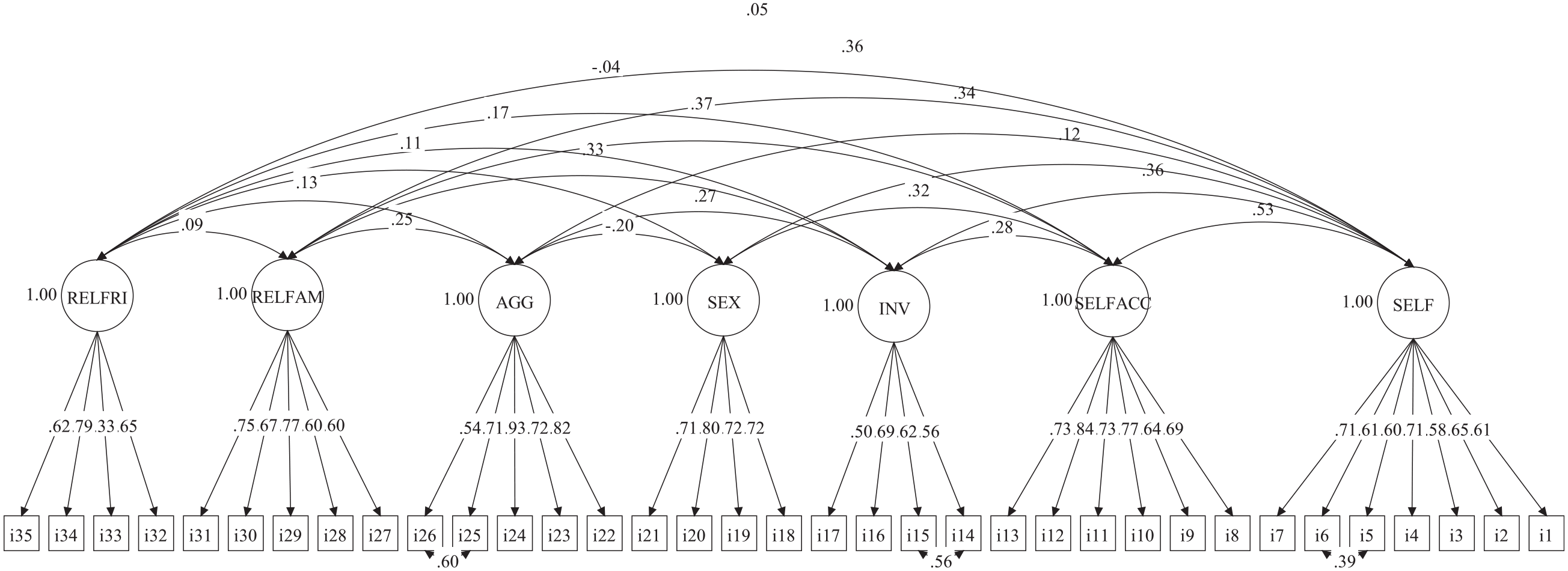
Final model of the APS-Q (n = 816).
Gender Invariance
Invariance testing results across gender are presented in Table 10. The baseline model showed an acceptable fit, supporting configural invariance. In the next step, equality constraints were imposed on all factor loadings to examine metric invariance. The resulting model also achieved an acceptable fit, after freeing parameters I13 “Often, when people look at me, I feel ashamed” and I23 “When I get angry with a friend I lose control” for gender groups. When comparing configural and metric models, the change in the chi-square difference test was not statistically significant. In addition, the absolute difference in CFI was less than 0.01. Thus, we concluded that partial metric invariance across genders is supported. The fact that partial metric invariance held indicates that the items were related to the latent factor equivalently across groups. The except is for I13 and I23 respectively, which were less related to the dimension of self-acceptance and aggression in female. Next, equality constraints were imposed on all thresholds to test scalar invariance. This model did not achieve an acceptable fit.
Gender Invariance Results of the Seven-Factor Model of the APS-Q Across Females (n = 408) and Males (n = 408).
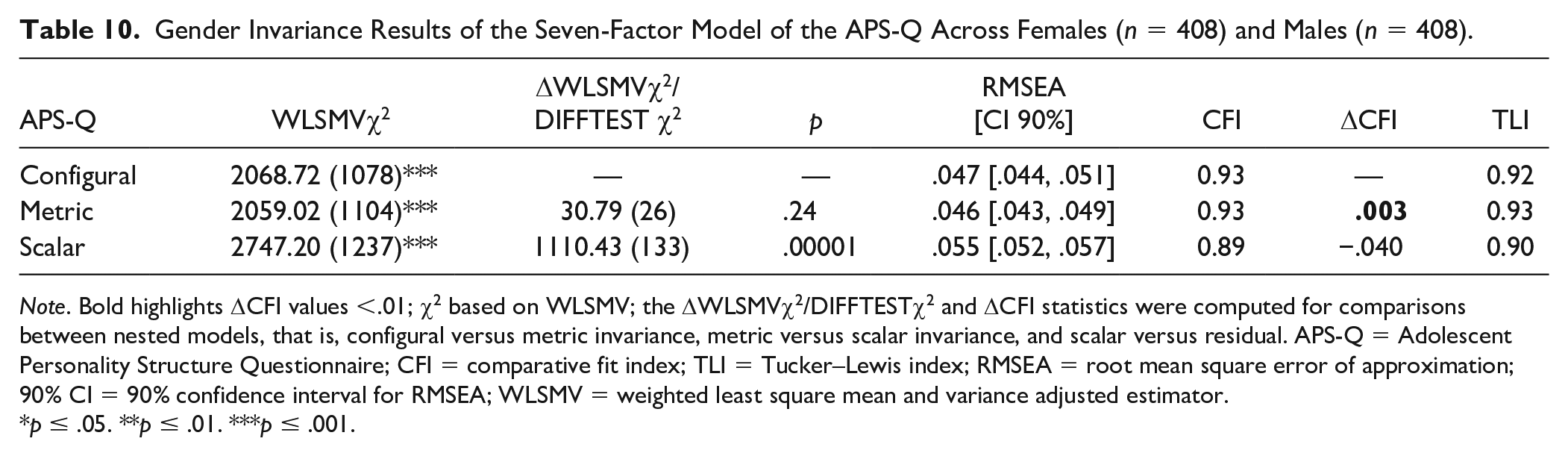
Note. Bold highlights ΔCFI values <.01; χ2 based on WLSMV; the ΔWLSMVχ2/DIFFTESTχ2 and ΔCFI statistics were computed for comparisons between nested models, that is, configural versus metric invariance, metric versus scalar invariance, and scalar versus residual. APS-Q = Adolescent Personality Structure Questionnaire; CFI = comparative fit index; TLI = Tucker–Lewis index; RMSEA = root mean square error of approximation; 90% CI = 90% confidence interval for RMSEA; WLSMV = weighted least square mean and variance adjusted estimator.
p ≤ .05. **p ≤ .01. ***p ≤ .001.
Age Invariance
Invariance testing results across age are presented in Table 11. The baseline model showed an acceptable fit, supporting configural invariance. Thus, equality constraints were imposed on all factor loadings to examine metric invariance. Comparing configural and metric models, the change in the chi-square difference test was not statistically significant. Moreover, the absolute difference in CFI was less than 0.01. Thus, we concluded that metric invariance across different adolescent’s phases is supported. Metric invariance indicates that the items were related to the latent factor equivalently across groups. Equality of the unstandardized item thresholds across groups was then examined in a scalar invariance model. All factor loadings and all item thresholds were constrained equal across groups; all residual variances were still constrained to be equal to 1 across groups. The full scalar invariance model fit significantly worse than the metric invariance model, DIFFTEST (266) = 342.11, p < .001. Modification indices suggested that I2 (“Some of my friends would be surprised if they knew how much my behavior could change from situation to situation”), I3 (“Even people who know me better are not able to predict my behavior”), I7 (“If I think about it, every day I am like a different person”), and I18 (“When I think about sex, I feel very embarrassed”) were the largest source of the misfit. After freeing I2, I3, I7, and I18’s thresholds, the partial scalar invariance model did not fit significantly worse than the metric invariance model. Moreover, the absolute difference in CFI was less than 0.01. The fact that partial scalar invariance (i.e., “strong invariance”) held indicates that all the APS-Q items except I2, I3, I7, and I18 have the same expected response at the same absolute level of the trait, that is the observed differences in the proportion of responses in each category for those items was due to factor mean differences only. Equality of the unstandardized residual variances across groups was then examined in a residual invariance model. The full residual invariance model fit significantly worse than the partial scalar invariance model, DIFFTEST (70) = 95.31, p < .02. Modification indices suggested that the residual variance for I28 (“During fights my family members try to understand my point of view”) was the source of misfit and should be freed. After doing so, the partial residual invariance (i.e., “strict invariance”) model held, indicating that the amount of item variance not accounted for by the factor was the same across groups in all the items, except for I28.
Age Invariance Results of the Seven-Factor Model of the APS-Q Across Early (n = 161), Middle (n = 388), and Late Adolescents (n = 267).

Note. Bold highlights ΔCFI values <.01; χ2 based on WLSMV; the ΔWLSMVχ2/DIFFTEST χ2 and ΔCFI statistics were computed for comparisons between nested models, that is, configural versus metric invariance, metric versus scalar invariance, and scalar versus residual. APS-Q = Adolescent Personality Structure Questionnaire; CFI = comparative fit index; TLI = Tucker–Lewis index; RMSEA = root mean square error of approximation; 90% CI = 90% confidence interval for RMSEA; WLSMV = weighted least square mean and variance adjusted estimator.
p ≤ .05. **p ≤ .01. ***p ≤ .001.
Discussions
This contribution presents data on the development of the APS-Q, a self-report aimed at capturing the core features of personality functioning in adolescence. Coherently with the structural model for personality pathology (O. F. Kernberg, 1978; P. F. Kernberg et al., 2000) and similarly to the IPOP-A (Ammaniti et al., 2012; Fontana et al., 2020), the APS-Q captures seven core dimensions of personality functioning theoretically related to identity integration, quality of object relations and affect regulation. Furthermore, coherently with Criterion A of the AMPD (APA, 2013), the APS-Q considers self and interpersonal related aspects of maladaptive personality functioning.
Empirical literature stresses that identity is a particularly complex and multifaceted construct in adolescence, and it must be considered both from a more intrapsychic point of view (Benzi & Madeddu, 2017; O. F. Kernberg, 2016) as according to its psychosocial characteristics (Kroger, 2007; Meeus, 2011). Thus, the APS-Q dimensions are in line with previous research highlighting the facets of identity integration in adolescence as related to the coherence and stability of self-image (sense of self dimension; P. F. Kernberg et al., 2000; Preti et al. 2015) and also as accounting developmental changes related to the body and the presence of shame (self-acceptance dimension; Ammaniti et al., 2012; Finkenauer et al., 2002). Also, being at ease with sexual impulses and desires (sexuality dimension) is crucial to the overall well-being of the individual during this developmental phase (Moore & Rosenthal, 2007; O. F. Kernberg, 1998b). Finally, the APS-Q encompasses the stability and presence of investments and goals (investments and goals dimension), connected to the development of a healthy and integrated sense of self (Becht et al., 2016).
The APS-Q is also the first self-report instrument assessing both qualities of the relationship with significant figures within the family context (relationship with family dimension) and outside of it (relationship with friends dimension). According to an object relations model of personality pathology, the quality of relations and internal representations of relations are essential aspects as they define the adolescent’s capacity of genuine, enduring, and intimate relationships (e.g., P. F. Kernberg et al., 2000). Last, the aggression dimension, which investigates the tendency to acting-out (toward self or others) or to lose control when emotions are overwhelming, acknowledges the need for considering the aspects related to affect regulation (e.g., Garnefski & Kraaij, 2006; O. F. Kernberg, 1994, 1998a).
Overall, the APS-Q structure is coherent with recent literature suggesting that self and interpersonal aspects are core features of personality pathology (e.g., APA, 2013; Morey et al., 2011; Sharp & Wall, 2017). Indeed, we found dimensions that explore both self-related facets of personality, such as identity (sense of self, self-acceptance, sexuality) and self-directedness (investments and goals), and interpersonal-related aspects of personality, such as intimacy and empathy (relationship dimensions).
The APS-Q showed good psychometric properties. In Study 1, we proved the stability and coherence of the factor structure of the APS-Q, and demonstrated its ability to provide stable profiles of personality functioning over a short time. Furthermore, the APS-Q showed good construct validity. The majority of the APS-Q dimensions were significantly related to all the SIPP-118 dimensions, supporting the validity of the constructs that the APS-Q measures. In other words, an impairment in personality functioning measured with the APS-Q corresponded to an impairment in corresponding dimensions in the SIPP-118. Also, as we expected, the sexuality dimension, which is not included in the SIPP-118, was barely related to any of the latter.
Second, as the AMPD suggests (e.g., Bender et al., 2011, Morey et al., 2011), we expected an impairment in the dimensions of the APS-Q related to maladaptive personality traits as well as provide unique information (discriminant validity). As far as our knowledge, the AMPD in adolescence has not been studied consistently, but the literature suggests a relationship between the level of impairment in personality functioning and maladaptive traits as independent yet mutually related facets of personality (De Clercq et al., 2014; Somma et al., 2017). Accordingly, we found that the sense of self and self-acceptance dimensions were related to internalizing maladaptive personality traits of Negative Affectivity and Detachment. In other words, features related to intrapsychic facets of self have a significant association with maladaptive traits that account for emotional lability, anxiety, separation insecurity (Negative Affectivity), withdrawal, anhedonia, and intimacy avoidance (Detachment). Similarly, the aggression dimension was related to maladaptive personality externalizing traits of Antagonism and Disinhibition. Thus, the tendency to act out overwhelming emotional states is positively linked to traits describing manipulativeness, deceitfulness, grandiosity features (Antagonism), irresponsibility, impulsivity, and distractibility features (Disinhibition). Moreover, impairments in the APS-Q interpersonal dimensions of personality were meaningfully related to traits of withdrawal, anhedonia, and intimacy avoidance (Detachment).
In line with previous research (e.g., Widiger, 2011), we also found that impairments in the sense of self, self-acceptance, and aggression dimensions were related to the general psychological distress. The higher the impairment in the self-related facets of personality, the higher the presence of psyshopathological symptoms.
Finally, the exploration of incremental validity over the SIPP-118 in predicting maladaptive personality traits, showed interesting results. First, the dimension of sexuality gathered additional information in predicting all maladaptive traits but negative affect. This is a further confirmation of the importance of exploring this dimension in personality development in adolescence. More, the dimension of relationship with friends gathered additional information over (and with, considering Antagonism) the dimension of Social Concordance in predicting all maladaptive personality traits. These results are a significant stimulus in explaining the advantage of investigating the quality of interpersonal relationships in adolescence by differentiating relationships with family members and peers, which, certainly from a clinical point of view, represent two distinct universes at this stage of development. Third, the dimension of sense of self provided additional information in explaining Psychoticism traits over the SIPP-118 Identity domains, highlighting the importance of this dimension to capture fluctuations in the individual’s sense of self/identity, another crucial aspect to capture during adolescence that is not necessarily pathological but opens up to the importance of considering subthreshold measurements.
Finally, in Study 2, we confirmed the factorial structure of the APS-Q evidencing its stability over gender and age groups. The seven-factor structure obtained in Study 1 was tested in with acceptable fit indexes, after allowing items similar in wording to correlate. Results outlined are consistent with the theoretical model (P. F. Kernberg et al., 2000). Furthermore, the majority of APS-Q items were related to the latent factor equivalently across males and females, highlighting partial metric invariance. Moreover, with the exception of some items, the APS-Q showed partial scalar and residual invariance across different age groups (i.e., early, middle, and late adolescents), demonstrating that the differences in the proportion of responses in each category and the amount of item variance not accounted for by the factor were the same across groups.
Limitations of the Present Research
Overall, the present contribution shows that the APS-Q is a promising instrument assessing pathological personality functioning in adolescence. However, the APS-Q needs further studies confirming its factor structure and investigating its construct validity. For instance, it would be crucial to explore the factor stability of the APS-Q on clinical samples (i.e., adolescents with PDs), computing a confirmatory factor analysis (Brown, 2014).
Also, as the APS-Q aims to detect personality functioning impairment levels, it would be relevant to administer the questionnaire to different clinical populations of adolescents to highlight pathological cutoffs. Future studies could also use the IPOP-A semistructured interview to test the convergent validity of the APS-Q further. Finally, it would be essential to investigate whether the APS-Q can capture specific features of pathological personality functioning that are related to specific PDs (Ensink et al., 2015; Normandin et al., 2015; O. F. Kernberg, 1998a).
In conclusion, our findings provide data supporting the APS-Q’s validity as a reliable and useful instrument to investigate personality functioning in adolescence. The APS-Q is in line with the promising dimensional approach to personality assessment that considers self and interpersonal features as core aspects of personality pathology (e.g., Morey et al., 2011; Sharp & Wall, 2017). Also, the APS-Q, differently from other available instruments, was developed without the need to adapt it from adult assessment tools, but directly according to a developmental model for personality functioning in adolescence (Ammaniti et al., 2015; P. F. Kernberg et al., 2000) which permits to capture those features that are distinctive in personality functioning during this developmental phase (i.e., discriminating between the quality of relationship with family and with friends; considering the dimension of sexuality; exploring the self dimension both through the perception of the mental and bodily changes). Finally, it is a relatively brief instrument (35 items) that allows identifying areas of impairment in personality functioning quickly, and this is particularly important when working with adolescents, that are often initially reluctant to lengthy psychological assessments.
Supplemental Material
sj-pdf-1-asm-10.1177_1073191120988157 – Supplemental material for Assessment of Personality Functioning in Adolescence: Development of the Adolescent Personality Structure Questionnaire
Supplemental material, sj-pdf-1-asm-10.1177_1073191120988157 for Assessment of Personality Functioning in Adolescence: Development of the Adolescent Personality Structure Questionnaire by Ilaria M. A. Benzi, Andrea Fontana, Rossella Di Pierro, Marco Perugini, Pietro Cipresso, Fabio Madeddu, John F. Clarkin and Emanuele Preti in Assessment
Footnotes
Authors’ Note
The data that support the findings of this study and all statistical models syntaxes are available from the corresponding author on request. Translations of the APS-Q into other languages are also available on request for research and clinical purposes.
Declaration of Conflicting Interests
The author(s) declared no potential conflicts of interest with respect to the research, authorship, and/or publication of this article.
Funding
The author(s) received no financial support for the research, authorship, and/or publication of this article.

Supplemental Material
Supplemental material for this article is available online.
References
Supplementary Material
Please find the following supplemental material available below.
For Open Access articles published under a Creative Commons License, all supplemental material carries the same license as the article it is associated with.
For non-Open Access articles published, all supplemental material carries a non-exclusive license, and permission requests for re-use of supplemental material or any part of supplemental material shall be sent directly to the copyright owner as specified in the copyright notice associated with the article.
