



Abstract
Structural models of personality traits, particularly the five-factor model (FFM), continue to inform ongoing debates regarding what personality attributes and trait domains are central to psychopathy. A growing body of literature has linked the constructs of the triarchic model of psychopathy (boldness, meanness, disinhibition) to the FFM. Recently, researchers developed both item and regression-based measures of the triarchic model of psychopathy using the NEO Personality Inventory–Revised—a popular measure of the FFM. The current study examines the correlates of these two FFM-derived operationalizations of the triarchic model using data from the Collaborative Longitudinal Personality Disorders Study. The two approaches had strong convergent validity coefficients and similar patterns of criterion-related validity coefficients. Meanness related to greater personality pathology characterized by exploitation of others and poor attachment, whereas disinhibition related to indicators of greater negative affect and poor behavioral constraint. Boldness related to reduced negative affect and greater narcissistic personality traits. Although the item and regression-based approaches showed similar patterns of associations with criterion-variables, the item-based approach has some practical and psychometric advantages over the regression-based approach given strong correlations between the meanness and disinhibition scores from the regression approach.
The triarchic model (Patrick et al., 2009) proposes that three broad constructs capture the personality traits associated with psychopathy—boldness, meanness, and disinhibition. 1 A growing body of research has pointed to connections between the triarchic traits and models of normal personality traits such as the five-factor model (FFM; e.g., Brislin et al., 2015; Poy et al., 2014). Although the Triarchic Psychopathy Measure (TriPM; Patrick, 2010) is likely the most widely used measure in triarchic psychopathy research, psychologists have created various ad hoc measures of triarchic attributes from existing inventories that measure normal and psychopathic traits (e.g., Brislin et al., 2015; Drislane et al., 2015; Hall et al., 2014; Ruchensky et al., 2018). The goal of the current study, using a large clinical data set, was to further evaluate the psychometric properties of two recently created measures of the triarchic traits derived from the popular NEO Personality Inventory–Revised (NEO-PI-R; Costa & McCrae, 1992) designed to measure the FFM: the item-based approach of Drislane et al. (2018) and the regression-based approach of Dotterer et al. (2017).
Since publication of the triarchic model (Patrick et al., 2009), a large body of work has evaluated the correlates of triarchic traits (see Lilienfeld et al., 2016 and Sleep et al., 2019 for meta-analytic findings). For example, boldness relates negatively to internalizing psychopathology, whereas disinhibition relates positively to internalizing and externalizing psychopathology (Latzman et al., 2019). Research has also linked the triarchic constructs to emerging models of personality pathology, such as the Diagnostic and Statistical Manual of Mental Disorders (5th edition; DSM-5) alternative model for personality disorders (American Psychiatric Association, 2013). Strickland et al. (2013) found meanness was well-represented among lower order facets of Antagonism (Callousness, Manipulativeness, Deceitfulness), whereas boldness was well-represented across facets reflecting low anxiety (reverse Anxiousness), social dominance (reverse Submissiveness; Attention Seeking), and high sensation seeking (Risk Taking). Disinhibition was best captured by facets reflecting poor impulse control (Impulsivity), difficulties following through on obligations (Irresponsibility), and poor anger management (Hostility; Strickland et al., 2013). Laboratory-based studies have also linked greater triarchic traits to weakened response to punishment (boldness; Ribes-Guardiola et al., 2020), decreased pain sensitivity (meanness; Brislin et al., 2016), and increased risk-taking (boldness; Snowden et al., 2017).
Other work has mapped the triarchic traits to the FFM (Donnellan & Burt, 2016; Miller et al., 2001; Poy et al., 2014; Stanley et al., 2013). To date, studies consistently find that boldness correlates negatively with neuroticism and positively with extraversion, meanness correlates negatively with agreeableness, and disinhibition correlates negatively with conscientiousness and positively with neuroticism (Donnellan & Burt, 2016; Poy et al., 2014; Stanley et al., 2013). These empirical findings converge with expert-generated personality profiles that characterize the personality traits of the “prototypical psychopath” using the lower order dimensions and facets of the FFM (Lynam & Widiger, 2007; Miller et al., 2001).
Operationalizing Triarchic Psychopathy From the NEO-PI-R
Drislane et al. (2018) developed triarchic scales from the NEO-PI-R items through conceptual analysis and psychometric evaluation. First, items were identified for inclusion in triarchic scales based on a consensus-rating approach, where five clinical psychology graduate students rated each of the items for how well they reflected each of the triarchic constructs based on descriptions of the triarchic traits used in prior work (Hall et al., 2014). Items rated as strongly representative of boldness, meanness, or disinhibition were retained for preliminary scales. Items were then removed if they correlated poorly with other candidate items or increased correlations with nontarget scales. Additional items were then included if they exhibited moderate consensus across raters, improved internal consistency, and did not increase the correlation between target and nontarget triarchic scales. The final triarchic scales based on NEO-PI-R items showed strong convergent validity with the TriPM scales (rs = .66-.79) and correlated with indicators of antisocial behavior and substance use in theoretically expected ways. Thus, there is promising initial evidence for the validity of the Drislane et al. (2018) scales. Such results make sense given the overlap between certain FFM traits and psychopathic attributes (Lynam et al., 2018).
Dotterer et al. (2017) took an alternative approach and used NEO facet scores to create estimates for each triarchic dimension using a scoring algorithm based on regression weights from a previous article that administered the TriPM and the NEO-PI-R to a sample of undergraduates (Poy et al., 2014). Prior researchers have leveraged a regression-based approach to estimate psychopathy scores from broadband personality measures with promising results (e.g., Benning et al., 2005). Of note, regression equations were created separately for men and women given that Poy et al. (2014) reported separate regression models for women and men. In other words, the scoring algorithms differ for women and men. Dotterer et al. (2017) found that NEO-triarchic estimates correlated in expected ways with measures of impulse control, substance use, and internalizing symptomatology (e.g., greater boldness related to less anxiety) but were highly intercorrelated (|r’s| = .47-.93). This pattern of results suggests promising evidence of criterion-related validity but may raise concerns about the discriminant validity of the NEO-triarchic estimates.
The ability of researchers to reconfigure existing measures of normal personality traits to measure psychopathic personality attributes has theoretical and practical implications. The successful creation of triarchic scales from normal range trait measures suggests that psychopathic traits transcend any particular structural model of personality (Patrick & Drislane, 2015). Furthermore, the ability to use existing personality measures to study the triarchic traits allows researchers to capitalize on existing data sets, such as the Collaborative Longitudinal Personality disorders Study (CLPS; Gunderson et al., 2000; McGlashan et al., 2000; Witt et al., 2010), to examine the correlates of psychopathic traits. This is especially useful because many existing large-scale data sets contain a rich set of theoretically and practically important variables that would be difficult and time consuming to recreate using a dedicated measure of the triarchic model such as the TriPM.
Current Study
The goal of the current study is to evaluate the psychometric properties of the recently developed NEO-triarchic scales (Drislane et al., 2018) and the NEO-triarchic estimates (Dotterer et al., 2017) using the CLPS data set—a longitudinal study of personality and personality disorders (Gunderson et al., 2000; McGlashan et al., 2000). The CLPS data set includes measures of pathological personality traits (e.g., Negative Temperament, Disinhibition), symptoms of personality disorders (e.g., Narcissistic Personality Disorder) and psychopathology (substance use disorder and depression). Prior work with the CLPS data set has provided evidence for NEO-based measures of fearless dominance and impulsive antisociality (Witt et al., 2010), traits that were emphasized in theoretical work that served as the precursor to the triarchic model (Patrick et al., 2009).
In light of past research (Latzman et al., 2019; Lilienfeld et al., 2016) and theorizing (Patrick et al., 2009; Patrick & Drislane, 2015), we expect boldness will relate to greater positive affectivity, lower negative affectivity, and lower levels of personality pathology characterized by low agency (e.g., DSM-IV Dependent Personality Disorder; American Psychiatric Association, 1994). We expect that meanness will relate most strongly to interpersonal components of negativity affect and externalizing personality pathology, such as antisocial and narcissistic disorders. We predict disinhibition will relate to greater negativity affect, and personality pathology, as well as lower impulse control. Given our large sample size and the large number of analyses, we focus our interpretations on effect sizes greater than or equal to .10 (Cohen, 1988) and with p values < .01. This approach should balance concerns over inflated Type I errors with our interest in the estimation of the strength of observed associations. Finally, given ongoing debates regarding the latent structure of triarchic measures (Patrick et al., 2021; Roy et al., 2021), we examined the structure of the NEO-triarchic scales using exploratory structural equation modeling (ESEM).
Method
The current study uses the same data set described in Witt et al. (2010), a study that examined NEO-derived scales of fearless dominance and impulsive antisociality. The description below draws on the Method section in that article and has only been updated for brevity and with information regarding scoring the NEO-triarchic scales (Drislane et al., 2018) and NEO-triarchic estimates (Dotterer et al., 2017). Neither of the approaches for using the NEO PI-R to study the triarchic constructs were available when Witt et al. (2010) conducted their investigation.
Participants
Participants were 733 baseline patients recruited from multiple clinical sites for the CLPS project (see Gunderson et al., 2000, for study procedures and McGlashan et al., 2000, for comorbidity patterns). Participants were either seeking treatment or had recently received treatment from psychological service providers. Participants were selected if they met criteria for a personality disorder (N = 629; 87%) or major depression without a personality disorder. Specifically, researchers recruited personality disorder patients who met diagnostic criteria for schizotypal personality disorder, borderline personality disorder, avoidant personality disorder, and obsessive–compulsive personality disorder. These disorders were selected based on factor analytic work suggesting between a three or four factor structure of Axis II criteria (e.g., Kass et al., 1985). Participants were interviewed by trained raters and completed multiple self-report measures at baseline and follow-up assessments. The mean age of participants at baseline was 32.50 (SD = 8.11; range = 18-45). Women represented 64% (N = 467) of the sample; 69% (N = 506) of participants were White, 15% (N = 108) Black, and 13% (N = 94) Hispanic (25 participants reported some other ethnic group membership). The sample size was dictated by the nature of the existing CLPS project.
Psychopathy Measures Derived From the NEO Personality Inventory
The NEO-PI-R (Costa & McCrae, 1992) is a 240-item self-report measure designed to measure the trait facets and domains of the FFM. Baseline internal consistency estimates for the five NEO domains (neuroticism, extraversion, openness to experience, agreeableness, and conscientiousness) in this sample ranged from .87 to .92 (Morey et al., 2002). Responses to the NEO-PI-R were used to calculate scores for the Drislane et al. (2018) NEO-triarchic scales (23 items for the boldness scale; 21 items for the meanness scale, and 15 items for the disinhibition scale) and the Dotterer et al. (2017) NEO-triarchic estimates using different regression equations for men and women.
Criterion-Related Measures
Schedule for Nonadaptive and Adaptive Personality
The Schedule for Nonadaptive and Adaptive Personality (SNAP; Clark, 1993) is a 375-item self-report questionnaire designed to assess personality traits in both the higher order/temperamental (negative temperament, positive temperament, and disinhibition; median internal consistency = 0.89; Morey et al., 2003) and lower order/abnormal range (mistrust, manipulativeness, aggression, self-harm, eccentric perceptions, dependency, exhibitionism, entitlement, detachment, impulsivity, propriety, and workaholism; median internal consistency = .84; Morey et al., 2003).
Psychopathology
The Structured clinical interview for DSM-IV axis I (SCID-I; First et al., 1996) is a structured interview assessing DSM-IV Axis I disorders. Baseline depression and substance use disorder were used as dependent variables in this study.
Diagnostic Interview for DSM-IV Personality Disorders
The Diagnostic Interview for DSM-IV Personality Disorders (Zanarini et al., 1996) is a semistructured interview that assesses PD criteria, which must be present over at least the previous 2 years and characteristic of the person to count toward the diagnosis. Adequate interrater reliability was found for all disorders diagnosed five times or more in a baseline subsample (Zanarini et al., 2000).
Data Analytic Plan
We conducted zero-order correlations and multiple regression analyses to examine the convergent and discriminant validity of the NEO-triarchic scales and NEO-triarchic estimates. For regression analyses, triarchic variables were entered simultaneously as statistical predictors. With respect to the internal structure of the NEO-triarchic scales, we conducted ESEM with target rotation and a GEOMIN rotation to examine whether the scales conform to the proposed triarchic structure. 2 We used robust weighted least squares as the estimator approach. This approach of allowing cross-loadings is preferable to traditional confirmatory factor analysis (CFA) with a simple structure given long-standing concerns that personality measures do not cleanly fit onto proposed structural models (Hopwood & Donnellan, 2010). This issue is of particular concern for scales extracted from existing measures of personality models because these scales are composed of items across facets of higher order domains and thus represent “blends” of narrow personality facets. These analyses were conducted using Mplus version 8.0. We considered items as loading onto a scale at ≥ |.30|.
Results
Descriptive Data and Evidence for Convergent Validity
The NEO-triarchic scales demonstrated adequate reliability for boldness (α = .85; ω t = .85; ω h = .84), meanness (α = .83; ω t = .82; ω h = .81), and disinhibition (α = .81; ω t = .83; ω h = .82). 3 Descriptive statistics and correlations for the NEO-triarchic scales and NEO-triarchic estimates are reported in Table 1. 4 The NEO-triarchic scales were intercorrelated (max |r| = .39 for meanness and disinhibition) and the NEO-triarchic estimates were also significantly intercorrelated for men and women (max |r| = .88 for meanness and disinhibition for women). The NEO-triarchic scales and NEO-triarchic estimates showed strong convergent validity for boldness (Men: r = .89; Women: r = .86), meanness (Men: r = .70; Women: r = .71), and disinhibition (Men: r = .90; Women: r = .87).
Descriptive Statistics and Intercorrelations.

Note. All correlations were statistically significant at p < .01.
Associations With the SNAP Scales
Table 2 reports associations between the NEO-triarchic scales and the SNAP scales at baseline. Both zero-order correlations and regression weights are reported. NEO-boldness was inversely related to negative temperament and strongly related to positive temperament. In contrast, NEO-disinhibition was positively related to negative temperament and inversely related to positive temperament. This divergent pattern of associations was also present within the lower order traits, such as self-harm. Additionally, NEO-disinhibition appeared to be more strongly related to the lower order negative temperament traits than the positive temperament traits. In contrast, NEO-boldness related strongly to features of positive temperament, such as exhibitionism and entitlement, and the self-harm and dependency traits of negative temperament. NEO-meanness was most strongly related to antagonistic components of negative temperament (manipulativeness, aggression) as well as the entitlement and detachment components of positive temperament. The higher-order SNAP trait, disinhibition, related positively to NEO-disinhibition and NEO-meanness. The NEO-triarchic scales were typically unrelated to specific disinhibition components, although NEO-disinhibition was strongly related to impulsivity.
Associations Between NEO-Triarchic Scales and Abnormal Personality, Psychopathology, and Personality Disorders.
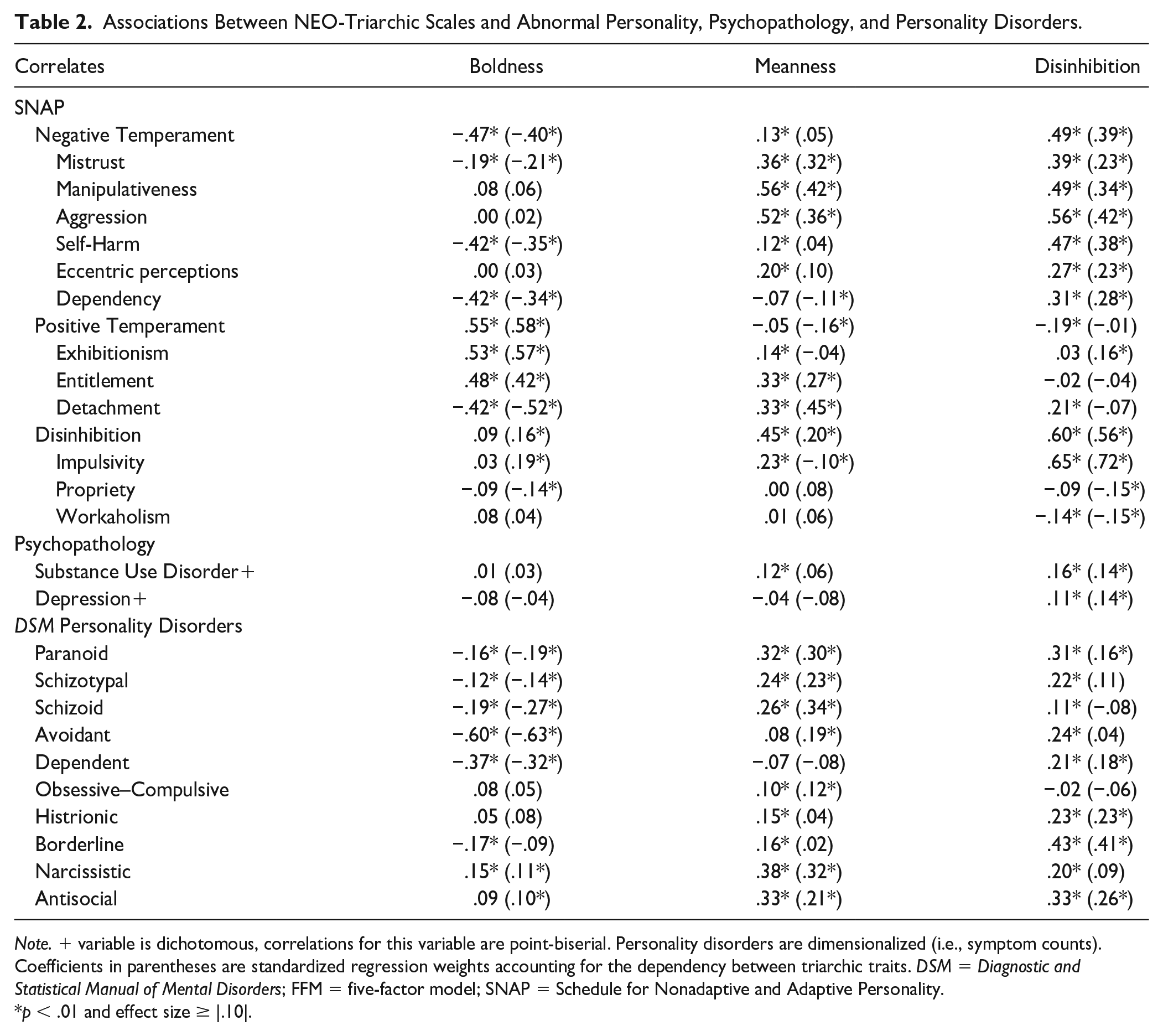
Note. + variable is dichotomous, correlations for this variable are point-biserial. Personality disorders are dimensionalized (i.e., symptom counts). Coefficients in parentheses are standardized regression weights accounting for the dependency between triarchic traits. DSM = Diagnostic and Statistical Manual of Mental Disorders; FFM = five-factor model; SNAP = Schedule for Nonadaptive and Adaptive Personality.
p < .01 and effect size ≥ |.10|.
Table 3 reports zero-order correlations between the NEO-triarchic estimates and SNAP scores at baseline, whereas Table 4 reports regression weights. Greater boldness related to lower negative temperament and higher positive temperament. Disinhibition was significantly related to SNAP negative temperament, positive temperament, and disinhibition. Meanness was moderately related to the SNAP higher order traits for men and women. Similar patterns for the NEO-triarchic estimates emerged for the SNAP lower order traits. The regression weights for the NEO-triarchic estimates are somewhat difficult to interpret given the strong correlations between the meanness and disinhibition scales. Thus, we focused our attention on the correlations.
Zero-Order Associations Between NEO-Triarchic Estimates and Abnormal Personality, Psychopathology, and Personality Disorders.

Note: + variable is dichotomous, correlations for this variable are point-biserial. Personality disorders are dimensionalized (i.e., symptom counts). DSM = Diagnostic and Statistical Manual of Mental Disorders; SNAP = Schedule for Nonadaptive and Adaptive Personality.
p < .01 and effect size ≥ |.10|.
Regressions Between NEO-Triarchic Estimates and Abnormal Personality, Psychopathology, and Personality Disorders.

Note: + variable is dichotomous. Personality disorders are dimensionalized (i.e., symptom counts). Values reported are standardized beta coefficients (β). DSM = Diagnostic and Statistical Manual of Mental Disorders; SNAP = Schedule for Nonadaptive and Adaptive Personality.
p < .01 and effect size ≥ |.10|.
Associations With Psychopathology
The CLPS data set included SCID scores of depression and substance use disorder. NEO-disinhibition was linked to greater substance use and depressive symptoms, but NEO-boldness and NEO-meanness were not uniquely related within regression analyses (Table 2). Patterns of associations were somewhat different for the NEO-triarchic estimates. Boldness was negatively related to depressive symptoms across men and women, whereas disinhibition was positively related to substance use.
Triarchic Traits and DSM-IV Personality Disorder Symptoms
Table 2 shows how NEO-triarchic scales were associated with DSM personality disorder symptoms as assessed by semi-structured interview. Overall, NEO-boldness was negatively related to personality disorder symptoms, particularly avoidant and dependent personality pathology. NEO-boldness was also modestly associated with narcissistic symptoms and this relation persisted in regression analyses. In contrast to NEO-boldness, NEO-meanness and NEO-disinhibition were typically positively associated with personality disorder symptoms, such as antisocial personality disorder. These associations for the NEO-triarchic estimates are shown in Table 3. Boldness was negatively associated with most symptoms (e.g., antisocial, avoidant) across men and women. Meanness was associated with personality pathology characterized by poor attachment (e.g., schizoid) and violation of social norms (e.g., antisocial) across men and women. Disinhibition also related to most disorders, particularly borderline symptoms.
Comparing Patterns of Associations
Double-entry intraclass correlation coefficients (see Furr, 2010) were computed to compare the profile similarity of the NEO-triarchic scales with the NEO triarchic-estimates. 5 intraclass correlation coefficients suggested strong convergence for boldness (Men: .95; Women: .92) and disinhibition (Men: .96; Women: .95) and more moderate convergence for meanness (Men: .60; Women: .68).
ESEM of NEO-Triarchic Scales
We subjected the 69 items selected for the NEO-triarchic scales to ESEM analyses and focused on the solution with three latent factors. This model had the following fit statistics: χ2(2142) = 6853.23, p < .001; root mean square error of approximation = .06; comparative fit index = .74; weighted root mean square residual = 1.95. Although most items had their largest loading on their target factor (58/69; see Table 5), 11 did not and many items cross-loaded on multiple factors. Specifically, 21 of 23 items on the boldness scales had their largest loading onto the boldness factor, 19 of 25 meanness items had their largest loadings on the meanness factors, and 18 of 21 disinhibition items had their largest loadings on the disinhibition factor. Because some of the items did not sufficiently load onto the target factor, we examined the association between the original NEO-triarchic scales and an abbreviated version. We retained items that loaded ≥ |.30| onto the target factor and eliminated items that loaded ≥ |.30| onto any nontarget factor. The abbreviated versions correlated highly with their original triarchic scale (boldness: r = .97, meanness: r = .91, disinhibition: r = .93) indicating substantial overlap.
Pattern Coefficients From ESEM of the NEO-Triarchic Scales.

Note: Loadings ≥ |.30| are in bold. Bold = boldness; Mean = meanness; Dis = disinhibition.
Discussion
We evaluated the psychometric properties of two different ways to estimate scores for the triarchic traits of boldness, meanness, and disinhibition using NEO data from a large, clinical patient sample. Altogether, the results suggested that both the NEO-triarchic scales and NEO triarchic estimates were promising ways to measure the constructs of boldness, meanness, and disinhibition from the perspective of strong convergent validity coefficients and similar patterns of criterion-related validity evidence when considering zero-order correlations. In general, meanness related to pathological personality dimensions characterized by poor attachment and egocentricity, whereas disinhibition related to indicators of low emotional and behavioral constraint. Boldness was typically associated with positive temperament scales such as exhibitionism, and negatively related to personality pathology characterized by distress and interpersonal dysfunction. However, boldness also correlated positively with narcissism, which is associated with a domineering, cold, and vindictive interpersonal style (Wilson et al., 2017). The observed correlations for the triarchic traits were consistent with prior theory (Patrick & Drislane, 2015; Patrick et al., 2009) and empirical work (Drislane et al., 2014; Donnellan & Burt, 2016; van Dongen et al., 2017). 6
A factor analysis of the NEO-triarchic scales raised concerns about the structural integrity of the Drislane et al. (2018) item set. In particular, a number of items did not have their highest loadings on their primary factor and many had substantial cross-loadings. These findings diverge from similar ESEM approaches supporting the tripartite structure of the TriPM (see Patrick et al., 2021). To be fair, the process used to select items in Drislane et al. (2018) did not emphasize a clean three factor solution. One explanation is that items selected for triarchic scales originally belonged to different NEO domains and facets and this may generate a complicated factor structure for this collection of items. Regardless, the original and “abbreviated” version of these scales were highly redundant, which alleviates concerns that the structural results may diminish convergent and discriminant validity.
The current results also highlight some concerns with the NEO-triarchic estimates from the perspective of discriminant validity, given the strong correlations between the meanness and disinhibition scales for both scoring algorithms. Prior findings using the TriPM have found that boldness is sometimes modestly associated with higher meanness (r = .20) and lower disinhibition (r = −.11; Ruchensky & Donnellan, 2017) in undergraduate samples. In comparison, meanness and disinhibition are positively associated in college (e.g., r = .49; Ruchensky & Donnellan, 2017) and offender (e.g., r = .36; Stanley et al., 2013) samples. The correlation between meanness and disinhibition for the NEO-estimates is closer to 1.0 than we believe is ideal. Likewise, such high correlations make the interpretation of regression coefficients difficult when estimates for all three domains are in the same model as seen in Table 4. Thus, we tentatively conclude that the NEO-triarchic scales have a slight overall edge when item-level data from the NEO-PI-R are available to researchers.
In addition, the NEO-triarchic scales are simple to compute when item-level data are available and involve the same ingredients for both women and men. This is often a prerequisite for considering gender differences in traits as the NEO-triarchic estimates use different algorithms for men and women thereby rending gender comparisons invalid. Along these lines, evidence from the CLPS data set suggests that reliance on gender-specific norms can weaken validity of personality measures (Samuel et al., 2010). Overall, results within the current data set support the convergent validity of the NEO-triarchic estimates, but a few limitations point to certain advantages of the NEO-triarchic scales when researchers want to use NEO-PI-R data to study triarchic constructs.
Limitations and Future Directions
Although there are several strengths to this study, some limitations are worth noting. For instance, we did not have other ways to measure the triarchic traits for comparison with the NEO-triarchic scales. Future work should use multiple scales to allow for integration of triarchic findings across instruments, especially using clinical and forensic samples, and incorporate multiple sources of assessment into the methodology. Triarchic psychopathy research, including this current study, is limited by a strong reliance on findings using self-report scales. Beyond these limitations, the current study suggests that information from the NEO can be used to provide estimates of the triarchic constructs when using a clinical sample. In some ways, the successful extraction of triarchic psychopathy from the NEO is unsurprising given substantive research pointing toward the congruence between the FFM and triarchic constructs (Hyatt et al., 2020). Results were consistent with prior empirical work that helps elaborate the nomological network of triarchic psychopathy, such as diverging patterns of associations across scales. Although the regression-based approach (Dotterer et al., 2017) had promising evidence of convergent validity with the NEO-scales, practical limitations in the gender-based scoring and concerns about the substantial intercorrelations among NEO-triarchic estimates suggest that the item-based approach (Drislane et al., 2018) might have some practical advantages. Regardless of which approach researchers ultimately select, we hope that the current study further encourages researchers to revisit existing data sets with the NEO PI-R to further expand the field’s understanding of the triarchic constructs.
Supplemental Material
sj-pdf-1-asm-10.1177_10731911211006186 – Supplemental material for A Comparison of Two Five-Factor Model Operationalizations of the Triarchic Model of Psychopathy in a Clinical Sample
Supplemental material, sj-pdf-1-asm-10.1177_10731911211006186 for A Comparison of Two Five-Factor Model Operationalizations of the Triarchic Model of Psychopathy in a Clinical Sample by Jared R. Ruchensky, M. Brent Donnellan, Christopher J. Hopwood, John F. Edens, Andrew E. Skodol and Leslie C. Morey in Assessment
Footnotes
Declaration of Conflicting Interests
The author(s) declared no potential conflicts of interest with respect to the research, authorship, and/or publication of this article.
Funding
The author(s) disclosed receipt of the following financial support for the research, authorship, and/or publication of this article: This work was supported by the National Institute of Mental Health under Grants R01 MH 50837, R01 MH 50838, R01 MH 50839, R01 MH 50840, R01 MH 50850.

Notes
References
Supplementary Material
Please find the following supplemental material available below.
For Open Access articles published under a Creative Commons License, all supplemental material carries the same license as the article it is associated with.
For non-Open Access articles published, all supplemental material carries a non-exclusive license, and permission requests for re-use of supplemental material or any part of supplemental material shall be sent directly to the copyright owner as specified in the copyright notice associated with the article.
