



Abstract
The Category Switching Test (CaST) is a verbal fluency test with active semantic category switching. This study aimed to explore the association between CaST performance and brain amyloid-β (Aβ) burden in patients with mild cognitive impairment (MCI) and the neurofunctional mechanisms. A total of 112 participants with MCI underwent Florbetapir positron emission tomography, resting-state functional magnetic resonance imaging, and a neuropsychological test battery. The high Aβ burden group had worse CaST performance than the low-burden group. CaST score and left middle temporal gyrus fractional amplitude of low-frequency fluctuations (fALFF) related inversely to the global Florbetapir standardized uptake value rate. Functional connectivity between the left middle temporal gyrus and frontal lobe decreased widely and correlated with CaST score in the high Aβ burden group. Thus, CaST score and left middle temporal gyrus fALFF were valuable in discriminating high Aβ burden. CaST might be useful in screening for MCI with high Aβ burden.
Keywords
MCI is considered by many to be a predementia state with an increased risk of progressive cognitive decline (Langa & Levine, 2014). Amyloid-β is an essential biomarker of MCI caused by Alzheimer’s disease (AD) (Petersen et al., 2021). Patients with a high Aβ burden are more likely to progress to AD (Vermunt et al., 2019). Therefore, in the MCI stage, it is of great interest to find a neuropsychological tool that is sensitive to brain Aβ burden.
The verbal fluency test, as a quick measure of cognitive-linguistic ability, can assess both language function and higher-level cognitive processes, which rely on lexical knowledge and executive function (Cermak et al., 2021). Phonemic and semantic verbal fluency are significantly impaired in patients with frontal lobe injuries, and the deficiency in semantic verbal fluency is more obvious than one in phonemic verbal fluency in patients who have sustained temporal lobe injuries (Henry & Crawford, 2004). In patients with AD, semantic verbal fluency is mainly related to temporal lobe cortex lesions (Henry et al., 2004). Research also reported that semantic verbal fluency is related to both the temporal and frontal lobes in mild AD patients (Jones et al., 2019).
According to some researchers, the conventional verbal fluency test is not sensitive enough to identify Aβ deposition in nondementia elderly persons (Vonk et al., 2020). In contrast, individuals with higher levels of Aβ are more sensitive to semantic interference (Loewenstein et al., 2016). The performance on Semantic Interference and Learning (LASSI-L) is associated with their brain Aβ burden and the cortex thickness of the temporal and frontal lobes (Curiel et al., 2018; Loewenstein et al., 2018). A study using multiple neuropsychological tests (NPTs) showed that verbal learning and executive functions are both important components of a cognitive composite predicting brain Aβ deposition (Kim et al., 2022). Therefore, we hypothesized that the verbal fluency test enhanced by the executive task would be more sensitive to Aβ pathology and neuropathological changes in Aβ-susceptible areas.
Switching performance in the verbal fluency test is more sensitive to changes in executive function (C. L. H. Chen et al., 2013; Costa et al., 2014) and is considered a valuable approach for evaluating cognitive flexibility (de Paula et al., 2015; Narme et al., 2019). In verbal fluency studies, switching ability is generally used as an evaluation approach for executive function. In MCI and AD patients, verbal fluency switching features a strong correlation with the performance of executive function and the deterioration rate of global cognition (Pakhomov et al., 2012). Verbal fluency switching ability, measured by semantic clusters, is associated with the dementia risk in older females; this association is independent of verbal fluency performance itself and memory function (Pakhomov & Hemmy, 2014). Deficits in verbal fluency switching are based on certain neuropathological changes. A study using automated computerized cluster analysis reported the relation between verbal fluency switching deficits and the temporal and frontal cortex lesions (Meier et al., 2022).
The fALFF is a resting-state functional MRI (
Overall, deficits in executive function, evaluated by semantic switching, may be related to brain Aβ deposition and specific neurological function changes. However, current research in this field is still preliminary. First, most relevant studies have focused on structural changes. Functional neuroimaging studies have shown that the functional connectivity (FC) of the temporal and frontal lobes plays a vital role in semantic control (Davey et al., 2016). However, the correlation between semantic-based executive function and the temporal-frontal functional connections remains unclear. Second, the switching style used by researchers in verbal fluency tests usually requires participants to switch between phonemes and semantics (Costa et al., 2014). For example, participants were instructed to say successively alternating words beginning with a specific letter and words belonging to a specific category. In our previous studies, we utilized a verbal fluency test that required participants to actively switch between two semantic concepts (Shuai et al., 2015). This assessment is referred to as the CaST. We considered this as an assessment of complex cognitive abilities relying on semantic-based executive functions and assumed that it is sensitive to Aβ pathology and neurological function alterations in the MCI stage.
Method
Participants
Participants with MCI were recruited from local communities through advertising between March 2019 and October 2021. Criteria for participants included (a) were a native Chinese speaker; (b) had no history including stroke, craniocerebral injury, brain tumor, anxiety, or depression, systemic diseases with brain function affection; (c) had no severe hearing-visual impairment, (d) could complete the NPT; and (e) complete the examinations of craniocerebral positron emission tomography (PET) and magnetic resonance imaging (MRI).
The actuarial neuropsychological method, which uses six neuropsychological measures to evaluate the three cognitive domains, was used to define MCI. The six neuropsychological measures were as follows: two indicators (long–delay-free recall and recognition) of the Auditory Verbal Learning Test (AVLT) (Zhao et al., 2015) for episodic memory; Animal Fluency Test (AFT) (Zhao, Guo, & Hong, 2013) and Boston Naming Test (BNT) (Knesevich et al., 1986) for language function; and Shape Trail Test (STT)-A and STT-B for speed/attention/executive function (Zhao, Guo, Li, et al., 2013). Neuropsychological impairment cutoff was defined as a score >1 standard deviation (SD) below the corrected normative mean. The cutoff of AVLT was set separately according to age ranges; the cutoff of AFT and BNT was set separately according to education level; the cutoff of STT was set separately according to age range and education level (Huang et al., 2020). Participants who generate the norm were recruited from a memory clinic and the local community. The overall number of participants was 1,459, Chinese speakers, all without dementia, with more than 5 years of education, aged 50 to 80 years, Clinical Dementia Rating (CDR) score ≤0.5, Hamilton depression rating scale (17 items) score ≤12, and Mini-Mental State Examination (MMSE) score >24 (Huang et al., 2020). Note that we used the STT instead of the Trail Making Test for cultural fairness.
The inclusion criteria for MCI participants were as follows: (a) MMSE (Katzman et al., 1988) score >24; (b) had an impaired score on both measures within at least one cognitive domain or had one impaired score in each of the three cognitive domains (Bondi et al., 2014); (c) had no more than one changed items on the Activities of Daily Living (ADL) (P. Chen et al., 1995) scale; and (d) did not reach dementia’s criteria of the National Institute of Aging and Alzheimer’s Association.
Neuropsychological Test
All the participants underwent NPTs as summarized below. For general cognitive function, these comprised MMSE, Montreal Cognitive Assessment Basic (MoCA-B) (Huang et al., 2018), Addenbrookes Cognitive Examination III (ACE-III) (Pan et al., 2022); daily living ability: ADL, Everyday Cognition (ECog) (Farias et al., 2008); memory function: AVLT and Brief Visuospatial Memory Test-Revised (BVMT) (Benedict et al., 1996); language function: AFT, Fruit Verbal Fluency (FFT), and BNT; executive function: Stroop Color-Word Interference Test (SCWIT) (K. Chen et al., 2019), STT-A, STT-B, and Digit Symbol Test (DST) (Benson et al., 2010).
Semantic-based executive function was assessed using CaST, a fluency test using a category-switching task in a manner similar to Verbal Fluency-Category Fluency in the Delis-Kaplan Executive Function System (D-KEFS) (Delis et al., 2001). The participants were asked to orally generate examples in the order of alternating animals and fruits within 60 seconds, such as dog, apple, horse, orange, mouse, and banana. Trained examiners could decide whether the word pairs were correct and record the number of correct responses as the total score. Higher scores represented better function. The CaST scale was developed in 2010 and published in 2015 (Shuai et al., 2015). To avoid semantic interference caused by AFT and FFT to CaST, participants returned to the neuropsychology room 2 weeks after completing the screening test battery to receive the first CaST test in person. Participants were given a second CaST test at a 2-week interval after the first CaST test to perform test–retest reliability analysis. No other semantic-related tests will be performed on the date of the CaST test.
Neuroimaging Acquisition and Processing
Florbetapir (F18-AV45) PET
All participants underwent an AV45 PET scan (Biography 64 PET/CT, Siemens, Erlangen, Germany) 50 minutes after the intravenous administration of 7.4 MBq/kg of F18-AV45. To avoid potential bias for NPT assessors caused by AV45 PET findings, PET scans were performed after the NPT for all participants. Reconstruction of the PET data was performed using an ordered subset expectation-maximization algorithm with weighted attenuation. PET images were preprocessed using Statistical Parametric Mapping 12 (SPM12, http://fil.ion.ucl.ac.uk/spm/) in MATLAB 2013b (MathWorks Inc.). Participants’ AV45 PET images were registered with their corresponding T1-MRI images. T1-MRI images were then segmented into gray matter, white matter, and cerebrospinal fluid tissue probability maps. The transformation parameters derived from the segmentation were used to spatially warped PET images into the Montreal Neurological Institute (MNI) space. To increase the signal-to-noise ratio of PET images, an isotropic Gaussian kernel of 8 mm was used to smooth the images. The global cortical standardized uptake value ratio (SUVR) was obtained by using the whole cerebellum as the reference region.
The participants with MCI were divided into high Aβ burden and low Aβ burden groups according to the SUVR of AV45 PET using a cutoff point of 1.17 (Grothe et al., 2017).
Resting-State Functional MRI
rs-fMRI scanning was conducted on a 3.0 Tesla scanner (SIEMENS MAGNETOM Prisma 3.0 T, Siemens, Erlangen, Germany) using an echo-planar imaging sequence. Throughout the scanning, participants were instructed to maintain a relaxed state with their eyes closed and move little. The scan parameters were as follows: repetition time/echo time, 800/37 ms; flip angle, 52°; matrix size, 104 × 104; field of view, 208 × 208 mm; number of slices, 72; slice thickness, 2 mm; and voxel size, 2 × 2 × 2 mm. It took 404 s to obtain images at 488 time points for each participant.
The rs-fMRI data were processed using SPM12 and RESTplus toolkits (http://restfmri.net). The first 30 time points were discarded for magnetization equilibrium and participant adaptation. For each participant, the images were realigned to the first volume to correct head movement (head motion criteria were <3 mm and 3°). Spatial normalization was subsequently performed using 3-mm isotropic voxels in the standard MNI space. We regressed out the white matter signal, cerebrospinal fluid signal, and Friston-24 motion parameters and performed smoothing by the full wave at half the maximum of 6 mm. Finally, the images were bandpass-filtered (0.01–0.08 Hz) and linearly detrended. Each voxel’s fALFF value was calculated and z-standardized.
An independent t-test was performed to identify the regions that showed significant differences in fALFF between the two groups using RESTplus toolkits. Multiple comparison correction was employed using Gaussian random field (GRF) theory with voxel wise p < .001 and cluster wise p < .05.
Statistics
The study was exploratory; therefore, no formal sample size calculations were performed. Statistical power and sensitivity of the main results were calculated using G*Power (G*Power 3.1, The G*Power Team, Belgium) (Faul et al., 2007). Data were analyzed using SPSS 26 (SPSS, Inc., Chicago, IL, USA). In the statistical analyses, the factors considered as potential confounders were sex, age, and education years. Therefore, these demographic factors were compared between the two groups. For demographic and NPT data, categorical variables are presented as percentages. Categorical data were analyzed using the chi-square test. Quantitative data with normal distribution were presented as mean ± SD, and analysis of differences was performed using the t-test. Data that did not conform to a normal distribution were represented by medians and quartiles, and analysis of differences was performed using the Mann–Whitney test. For the CaST, test–retest reliability was evaluated by Pearson’s correlation coefficient between the first and second tests. Correlation analyses were performed using Pearson correlation. Logistic regression analysis was performed to identify the variables that have a discrimination capacity for high Aβ burden. Analyses of receiver operating characteristics (ROC) and area under the ROC curve (AUC) values were used to evaluate discrimination capability. The optimal cutoff value was determined by the Youden index (Youden index = specificity + sensitivity − 1).
Ethical Approval
The study was performed in accordance with the principles of the Helsinki Declaration. The Ethics Committee of Shanghai Jiao Tong University Affiliated Sixth People’s Hospital reviewed and approved this study (approval number 2019-041). All participants provided written informed consent to participate in the study.
Results
A total of 112 participants were included (age: 65.70 ± 7.05 years; male, 41). Fifty-nine participants (52.7%) were allocated to the low Aβ burden group (age: 66.05 ± 7.07 years; male, 23), and 53 (47.3%) participants were allocated to the high Aβ burden group (age: 65.30 ± 7.08 years; male, 18).
Demographics and NPT
Demographic data between the groups did not differ significantly (age, years of education, and sex) (Table 1). The two groups had similar performance in MMSE, MoCA-B, ACE III, ADL, ECog, AVLT (immediate recall, short delay-free recall, long delay-free recall, long delay cued recall, and recognition), BVMT (immediate recall, short delay-free recall, long delay-free recall, and recognition), BNT, AFT, FFT, SCWIT (accuracy and time), STT-A, STT-B, and DST (sequence and reverse) (Table 1). The high Aβ burden group had a significantly worse performance in the CaST than the low Aβ burden group (12.26 ± 3.43 vs. 16.32 ± 5.59, p < .001, statistical test power = 0.996, effect size = 0.875) (Table 1).
Demographic and NPTs

Note. MMSE = Mini-Mental State Examination; MoCA-B = Montreal Cognitive Assessment Basic; ACE-III = Addenbrookes Cognitive Examination III; ADL = Activities of Daily Living Scale; ECog = Everyday Cognition; AVLT = Auditory Verbal Learning Test; BVMT = Brief Visuospatial Memory Test-Revised; BNT = Boston Naming Test; AFT = Animal Fluency Test; FFT = Fruit Fluency Test; SCWIT = Stroop Color-Word Interference Test; STT = Shape Trail Test; DST = Digit Symbol Test; CaST = Category Switching Test.
Mann–Whitney test.
p < .001.
Psychometric Properties of CaST
The test–retest reliability of CaST was 0.982 (p < .001). The correlation coefficients between CaST and MOCA-B, ACE III, AVLT long delay cued recall, BVMT immediate recall, BVMT short delay recall, BVMT long delay recall, BVMT recognition, FFT, SCWIT time cost, STT-A time cost, and STT-B time cost were 0.242, 0.219, 0.187, 0.285, 0.290, 0.304, 0.211, 0.247, −0.204, −0.197, and −0.242, respectively (p < .05). The correlation coefficient between CaST and AFT was .325 (p < .001) (Table 2). Ceiling and floor effects had not been detected.
Correlations Between CaST and Conventional NPTs in the Overall Cohort

Note. CaST = Category Switching Test; MMSE = Mini-Mental State Examination; MoCA-B = Montreal Cognitive Assessment Basic; ACE-III = Addenbrookes Cognitive Examination III; ADL = Activities of Daily Living Scale; ECog = Everyday Cognition; AVLT = Auditory Verbal Learning Test; BVMT = Brief Visuospatial Memory Test-Revised; BNT = Boston Naming Test; AFT = Animal Fluency Test; FFT = Fruit Fluency Test; SCWIT = Stroop Color-Word Interference Test; STT = Shape Trail Test; DST = Digit Symbol Test.
p < .05. **p < .001.
Difference of fALFF Between Groups
Compared with the low Aβ burden group, the high Aβ burden group showed a significantly lower fALFF in the left middle temporal gyrus (MTG.L, volume: 56 voxels). The peak MNI coordinates were −48, −72, and 15 (peak t value: 6.01. GRF-multiple comparison corrected, voxel wise p < .001, cluster wise p < .05, cluster size: 24 voxels) (Figure 1).
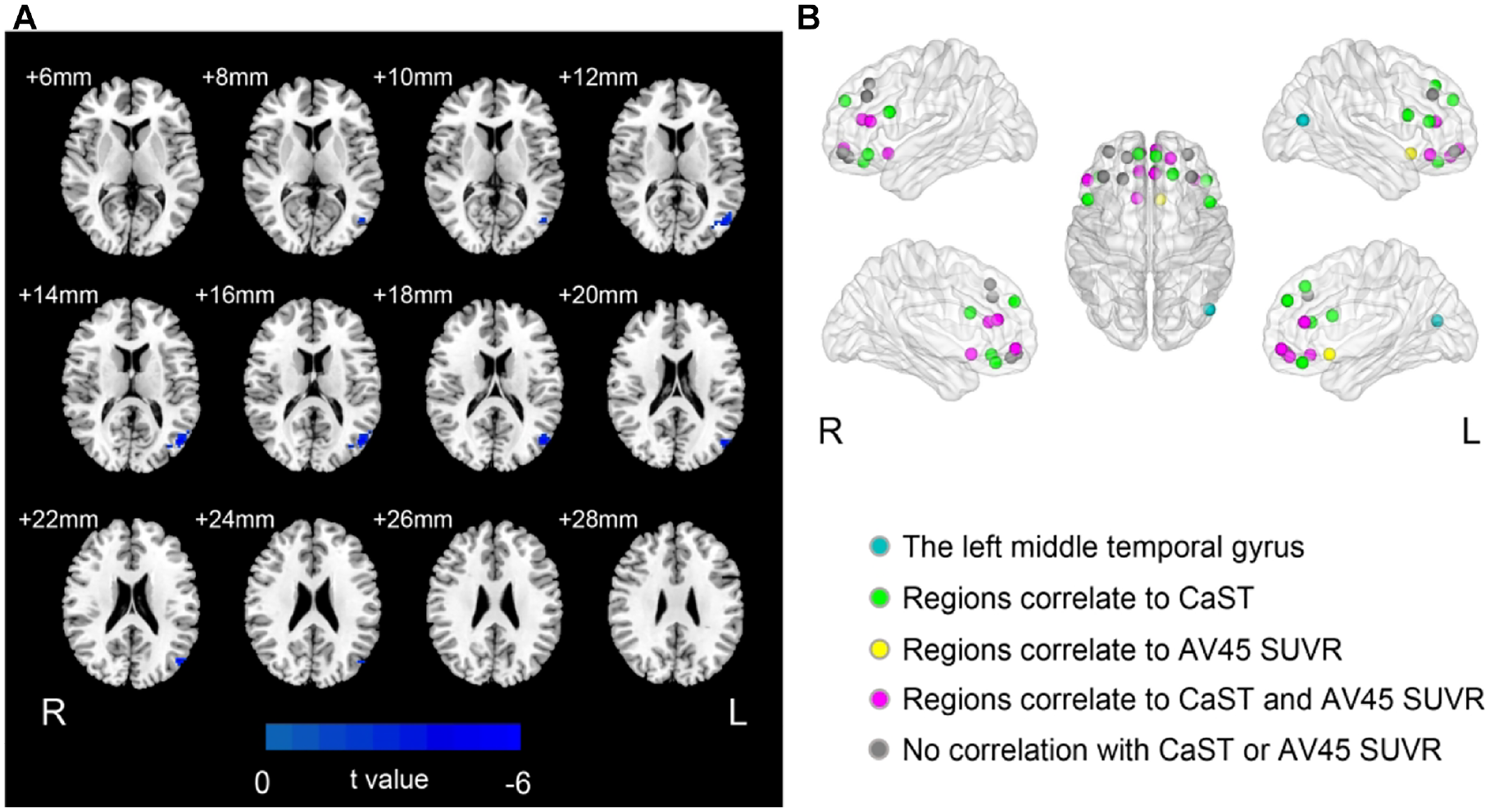
Local Function and Temporal-Frontal FC Changes. (A) Compared with the Low Aβ Burden Group, the High Aβ Burden Group Has a Lower fALFF in the Left Middle Temporal Gyrus (MTG.L). (B) FCs Between Nodes in the Frontal Lobe and MTG.L.
Correlation of CaST, AV45 SUVR, and MTG.L FALFF
In the overall cohort, CaST performance was inversely related to global AV45 SUVR (r = −0.439, p < .001, statistical test power = 0.999) and directly related to MTG.L fALFF (r = 0.225, p = .017, statistical test power = 0.679). The MTG.L fALFF was inversely related to the global AV45 SUVR (r = −0.351, p < .001, statistical test power = 0.975). (Table 3, Figure 2).
Temporal-Frontal FC Changes and Correlation of Aβ and CaST

Note. FC = functional connectivity; CaST = Category Switching Test; SUVR = standardized uptake value ratio; MTG.L = the left middle temporal gyrus; L = left; fALFF = fractional amplitude of low-frequency fluctuation; SFGdor = superior frontal gyrus, dorsolateral; ORBsup = superior frontal gyrus, orbital part; MFG = middle frontal gyrus; ORBmid = middle frontal gyrus, orbital part; IFGoperc = inferior frontal gyrus, opercular part; IFGtriang = inferior frontal gyrus, triangular part; ORBinf = inferior frontal gyrus, orbital part; OLF = olfactory cortex; SFGmed = superior frontal gyrus, medial; R = right; ORBsupmed = superior frontal gyrus, medial orbital; REC = gyrus rectus; ACG = anterior cingulate and paracingulate gyri.
p < .05. **p < .001.

Correlations and Aβ Burden Discrimination Capabilities of CaST and MTG.L fALFF. (A) CaST Score and MTG.L fALFF Are Inversely Related to the AV45 SUVR. The CaST Score is Directly Related to the MTG.L fALFF. (B) Discrimination Capability of CaST and MTG.L for High Aβ Burden.
Functional Connectivity of MTG.L With the Frontal Lobe
To further explore the temporal-frontal FC changes, the FC of the MTG.L with each node of the frontal lobe was calculated. The FC was analyzed using a region-of-interest (ROI)-to-ROI approach. The cluster with a significant difference in fALFF between groups was selected as the seed ROI (MTG.L). In the frontal lobe, target ROIs were defined according to the Automated Anatomic Labelling atlas as spheres with a radius of 12 mm, centered on the peak MNI coordinates of each frontal lobe region (Bai et al., 2011; Tzourio-Mazoyer et al., 2002; Wang et al., 2007) (Table 3).
In the high Aβ burden group, 11 out of 24 nodes (45.8%) in the frontal lobe had decreased FCs with MTG.L. In the overall cohort, a correlation analysis of FCs with the AV45 SUVR and CaST performance was conducted. Nine out of 24 nodes (37.5%) had FCs inversely related to AV45 SUVR. Seventeen out of 24 nodes (70.8%) had FCs that were directly related to CaST. FCs of 8 out of 24 nodes (33.3%) had both inverse relationships with AV45 SUVR and direct relationships with CaST performance (Table 3, Figure 1).
Discrimination Capability for High Aβ Burden
Logistic regression was performed to evaluate the discrimination capability for high Aβ burden. Initially, univariate regression was performed including sex, age, education years, conventional NPT, CaST, and MTG.L fALFF. It was found that factors such as sex, age, years of education, and conventional NPT could not discriminate high Aβ burdens (p > .05). The decrease in CaST and MTG.L fALFF both suggested a higher risk of high Aβ burden (OR = 0.810, p < .001; OR = 0.413, p < .001) (Table 4).
Variables Screening for Discriminating High Aβ Burden

Note. OR = odds ratio; CI = confidence interval; MMSE = Mini-Mental State Examination; MoCA-B = Montreal Cognitive Assessment Basic; ACE-III = Addenbrookes Cognitive Examination III; ADL = Activity of Daily Living Scale; ECog = Everyday Cognition; AVLT = Auditory Verbal Learning Test; BVMT = Brief Visuospatial Memory Test-Revised; BNT = Boston Naming Test; AFT = Animal Fluency Test; FFT = Fruit Fluency Test; SCWIT = Stroop Color-Word Interference Test; STT = Shape Trail Test; DST = Digit Symbol Test; CaST = Category Switching Test; MTG.L = the left middle temporal gyrus; fALFF = fractional amplitude of low-frequency fluctuation.
p < .05. **p < .001.
Next, analysis with bivariate regression using CaST and MTG.L fALFF was performed. The collinearity analysis of CaST and MTG.L fALFF demonstrated that these two variables had no collinearity (Tolerance: 0.988; variance inflation factor: 1.01). Then, logistic regression confirmed that these two variables remained independently associated with high Aβ burden risk (CaST: OR = 0.816, p = .001). MTG.L fALFF: OR = 0.423, p < .001). (Table 4).
CaST, MTG.L fALFF, and their combination had different discrimination capacities for high brain Aβ burden. With a cutoff of 15 for CaST, the AUC was 0.726 (0.633–0.819), sensitivity was 88.7%, specificity was 52.5%, positive predictive value (PPV) was 62.7%, and negative predictive value (NPV) was 83.8%. With a cutoff of 1.20 for MTG.L fALFF, the AUC was 0.814 (0.735–0.892), sensitivity was 66.0%, specificity was 86.4%, PPV was 81.4%, and NPV was 73.9%. When using the combination of CaST and MTG.L fALFF, AUC was 0.864 (0.797–0.930), and sensitivity, specificity, PPV, and NPV were 74.6%, 86.8%, 72.3%, and 87.2%, respectively (Table 5, Figure 2).
Discrimination Capability for High Aβ Burden

Note. AUC = area under the receiver operating characteristic curve; CI = confidence interval; PPV = positive predictive value; NPV = negative predictive value; AIC = Akaike information criterion; CaST = Category Switching Test; MTG.L = left middle temporal gyrus; fALFF = fractional amplitude of low-frequency fluctuation; Combination = CaST combined with MTG.L.
The cutoff values were determined by the Youden index.
Discussion
This study investigated the relationship between CaST performance and brain Aβ burden in MCI patients and its neurofunctional mechanisms. We found that individuals with high Aβ burden and MCI had worse CaST performance, which indicated the existence of semantic-based executive dysfunction. The rs-fMRI analysis revealed that worse CaST performance was associated with lower local function in the MTG.L and a widespread decrease in FC between the MTG.L and frontal lobe. Furthermore, in the overall cohort, the CaST performance, local function in the MTG.L, and temporal-frontal connectivity were all related to Aβ burden. CaST performance and local function in MTG.L both exhibited remarkable capability for discriminating high brain Aβ burden in patients with MCI.
Our findings suggest that the sensitivity of CaST to Aβ can give some indication as to whether individuals with MCI are suffering from a heavier Aβ burden. According to the National Institute on Aging and Alzheimer’s Association (NIA-AA) study framework (Jack et al., 2018), Aβ deposition in the brain is an important pathological marker of AD. Individuals with higher levels of Aβ deposition in the brain have a significantly higher risk of developing dementia (Donohue et al., 2017; Lopez et al., 2018). Therefore, detecting Aβ burden is helpful to clarify the pathological diagnosis of the participants and to help determine the possible clinical outcome, thus helping them to receive timely and necessary interventions. Current detection of Aβ pathology relies on PET scans or cerebrospinal fluid examinations. We hope that a brief Aβ-sensitive neuropsychological testing tool, such as the CaST, will help health care providers reduce unnecessary testing or help determine who needs further testing.
The two groups with different Aβ burdens demonstrated similar general cognitive function. No indicator could offer a significant difference between the groups in the conventional NPT of memory, language, and executive domains. In contrast, significantly worse CaST performance was found in the high Aβ burden group. The category-switching ability of verbal fluency has been proven to be more sensitive in distinguishing between dementia and MCI with different etiology (Zhao, Guo, & Hong, 2013). In the verbal fluency test that required the participants to switch between two semantic categories consciously, their cognitive flexibility could be evaluated more precisely (Anderson et al., 2017; Iudicello et al., 2008). The present study further found the high sensitivity of the CaST for Aβ burden in patients with MCI. The high sensitivity of CaST to Aβ deposition may be related to its inherent active semantic interference (Loewenstein et al., 2016, 2018).
Worse CaST performance in patients with high Aβ burden might reflect an impaired semantic-based executive function. A longitudinal study in healthy elderly individuals without cognitive impairment showed that in the early stages of Aβ deposition, there was a faster decline in executive function. In contrast, in the advanced deposition stages, there was a faster decline across multiple cognitive domains (Levin et al., 2021). The possible mechanism is that the clinical effects of amyloid pathophysiology may occur before those of intraneuronal neurofibrillary pathology in the hippocampus; the pathological damage of Aβ on the cortex leads to executive dysfunction prior to memory impairment (Harrington et al., 2013). In those with normal cognition, brain Aβ burden can better predict future impairment of executive function than memory function (Ackley et al., 2021). In patients with Aβ positive, brain Aβ is weakly associated with memory but strongly associated with executive function and language function (Tiepolt et al., 2019). In older patients with MCI, executive function impairment is associated with amyloid deposition in the brain (Lauretani et al., 2020).
rs-fMRI analysis showed a lower fALFF in the MTG.L in the high Aβ burden group. Previous studies have shown that Aβ deposition leads to abnormal function in this region, possibly mediated by tau (Adams et al., 2021). It is noteworthy that the fALFF of MTG.L is positively correlated with CaST performance, suggesting that weakened local functional activity in this region might affect semantic-based executive function. The posterior MTG plays an important role in semantic cognition and is functionally correlated with some regions of the frontal lobe (Davey et al., 2016). Language dysfunction with executive control deficits is correlated with two systems: language network damage in the inferior frontal and middle temporal gyri and executive control deficits in the dorsolateral prefrontal cortex and intraparietal sulcus (Meier et al., 2022).
The connection between the frontal lobe and posterior cortex, such as the temporal lobe, is important for executive function and related to the ability to switch rules (Buss & Spencer, 2018). Therefore, it is necessary to evaluate the possible changes in FC between the MTG.L and frontal lobe.
Furthermore, FC analysis revealed that the MTG.L had decreased connectivity with many frontal lobe regions. Most of these impaired functional connections were directly related to the AV45 SUVR and inversely related to the CaST performance. This result suggests the potential relationships among Aβ deposition, temporal-frontal FC, and semantic-based executive dysfunction. Some semantic deficits involving verbal fluency are attributable to executive dysfunction and are also associated with the connection between the frontal and temporal lobes, which are the main components of the semantic network (Sumner et al., 2018). In cognitively intact older adults, Aβ is associated with the declining local function of the temporal and frontal lobes (Reinartz et al., 2021) and the disconnection between mesial temporal and other brain regions (Mueller & Weiner, 2017). In our study, some impaired FCs between the frontal and temporal lobes were associated with CaST, but not AV45 SUVR, suggesting that these impaired FCs may involve other mechanisms, such as tau (Tideman et al., 2022) or neuroinflammation (Passamonti et al., 2019).
We detected the discrimination ability of the CaST for a high Aβ burden. CaST has a relatively higher sensitivity and NPV, hence being a suitable choice for screening purposes. Note that the recommended cutoff value provides limited specificity and brings a relatively low PPV. In a typical MCI population (approximately 50% Aβ positive) (Schreiber et al., 2015), the participants who performed poorly on CaST were close to 40% virtually without Aβ elevation. Therefore, we suggest combining other methods, such as fALFF used in this study, to improve prediction specificity. However, the final Aβ pathology diagnosis depends on biological marker testing (e.g., PET or cerebrospinal fluid). CaST is a simple tool that requires considerably less expense and a shorter time compared with the other methods. Therefore, we recommend the use of CaST in the cognitive assessment of MCI to help clinicians initially evaluate a patient’s brain Aβ burden.
The combination of CaST with MTG could further increase the discrimination ability. However, the practicability of MTG.L fALFF as a screening approach is limited because the fALFF values we used were extracted from the region where the statistical difference was located. For future research, an appropriate complex cognitive function assessment combined with neurofunctional indicators may be a promising direction for identifying brain Aβ burden.
Our study showed that CaST has high test–retest reliability. It may be related to the following factors. The CaST is scored based on the number of correct responses by the participant and has a high degree of objectivity. Our study required participants to undergo many examinations, including multiple imaging tests, NPTs, and two additional visits to the neuropsychological room for CaST testing; participants who completed the entire course had perfect compliance. Each NPT participant underwent was administered in the same quiet, specialized testing environment. Furthermore, there is likely some practice effect because the retested CaST was the fourth semantic-related fluency test that participants received.
There are some limitations applied in the present study that need to be considered and addressed in the future. First, the sample size may not be large enough to detect the correlations among semantic-based executive dysfunction, Aβ burden, and neurofunctional changes in different Aβ burden groups. Second, it remained unclear whether the decreased FCs not related to Aβ deposition were caused by tau. Third, CaST had not been applied in similar studies, leaving its effect unverified in the external cohort. Finally, there were no follow-up studies to investigate the dynamic correlations between Aβ, local functions, FC, and semantic execution functions.
In addition, the impact of the cultural background of the study site (Shanghai, China) on semantic fluency test performance needs to be taken into account. As the Chinese zodiac covers 12 animals, the participants were able to enumerate a larger number of animals. The participants could also list a larger number of fruit types due to the test location’s geographical (seaport city), economic, and dietary habits. Therefore, the results obtained in this study need to be interpreted with caution when using CaST in other regions and ethnic groups with different cultural and language backgrounds.
In conclusion, our study focused on the utility of the CaST in patients with MCI as an Aβ-sensitive assessment tool. CaST can be used to detect the semantic-based executive dysfunction in individuals with high Aβ burden. This semantic-based executive dysfunction might be based on brain Aβ deposition and is associated with decreased local function of the left temporal lobe and impaired temporal-frontal lobe FC.
Footnotes
Acknowledgements
The authors are grateful to Jiehua Zhu, Yanlu Huang, Yifan Wang, Xiangqing Xie, and Yun Yang for their help with NPTs.
Author Contributions
Liang Cui: methodology, investigation, formal analysis, visualization, writing – original draft. Zhen Zhang: investigation, data curation, formal analysis. Yihan Guo: writing, review, and editing. Yuehua Li: investigation, supervision. Fang Xie: investigation, supervision. Qihao Guo: conceptualization, funding acquisition, resources, supervision, writing, review, and editing. All authors reviewed the article. Liang Cui and Zhen Zhang contributed equally to this work.
Declaration of Conflicting Interests
The author(s) declared no potential conflicts of interest with respect to the research, authorship, and/or publication of this article.
Funding
The author(s) disclosed receipt of the following financial support for the research, authorship, and/or publication of this article: This study was funded by the National Natural Science Foundation of China (Grant 82171198), Shanghai Municipal Science and Technology Major Project (Grant 2018SHZDZX01), Guangdong Provincial Key S&T Program (grant no. 2018B030336001), and Shanghai Municipal Health Commission (Grant 202140042).
Availability of Supporting Data
The datasets used and analyzed during this study are available from the corresponding author upon reasonable request.
