



Abstract
Many students who experience difficulty with mathematics may also require behavioral support. We suggest educators create an appropriate scope and sequence for mathematics intervention by focusing on the critical mathematics content. Educators can then design the intervention with a common session structure. Finally, educators can embed and intensify supports for a student by increasing the dosage, focusing on the alignment of the intervention, and attending to transfer.
Keywords
Jesse and Morgan are grade-level colleagues who talk almost daily about the successes and challenges of teaching mathematics. Jesse is an experienced general education teacher whose content-area training is a strength when teaching complex mathematical concepts. Morgan is an experienced special education teacher whose expertise in intervention and intensification complements Jesse’s pedagogical and content knowledge. While they do not co-teach, they regularly collaborate to support eighth-grade students who are experiencing difficulty in mathematics.
One day after school, Morgan stops by Jesse’s room to brainstorm. Morgan will be working with a few students from Jesse’s class and wants to know if the intervention materials are mathematically appropriate. Morgan also wants to use behavioral strategies to help students with engagement and on-task behavior.
Hey! I just heard that I’ll be pulling a few students from your class to work with during intervention block.
That’s so great. They’ll really benefit from the extra support.
I wanted to pick your brain because there aren’t a lot of packaged mathematics interventions, in general, but especially for secondary students. I want to make sure I’m targeting the right foundational skills and linking it with the grade-level content you’re covering in class. And I know that the students I’ll be pulling struggle with being engaged and staying on task, so I want to find strategies that address the content and the behavior.
The conversation between these two educators likely happens frequently at middle schools, but what is unique is the collaboration they obviously share. The purpose of this article is to help educators design high-quality intensive mathematics interventions for students experiencing difficulty in mathematics and behavior. Why is this important? Well, students who experience mathematics difficulty often demonstrate behavioral challenges (Reid et al., 2004). For example, research indicates that 30% to 50% of students who have a learning disability also have attention-deficit/hyperactivity disorder (DuPaul & Volpe, 2009). Students experiencing mathematics difficulty also uniquely struggle with internalizing behaviors, such as mathematics anxiety (Wu et al., 2014).
Students with or at risk for emotional and behavioral disorders (EBD) represent a subgroup of students who experience difficulty in mathematics despite the use of research- or evidence-based practices (Mulcahy & Krezmien, 2009). Not only do students with or at risk for EBD struggle academically, they also exhibit unique and challenging behaviors. These challenging behaviors may hinder students’ abilities to access and benefit from previously established mathematics interventions (Lane et al., 2008). While students with challenging behaviors demonstrate underachievement in all academic subjects, students with severe challenging behaviors (e.g., EBD) experience the most difficulty with spelling and mathematics (Reid et al., 2004). As an example, students with high rates of externalizing behaviors did not perform as well as their peers after participation in an evidence-based mathematics intervention (Benz & Powell, 2021). This establishes the need to provide strategies to deliver and intensify interventions for students with challenging behaviors.
While educators have access to many fully designed reading interventions, fewer fully developed mathematics interventions exist. For example, on the National Center on Intensive Intervention’s (NCII, 2020) Tools Chart, the site lists 30 reading interventions but only 15 mathematics interventions, reflecting the lack of available mathematics interventions with a solid evidence base that have been submitted for expert review. The burden, therefore, falls on educators to create and adjust mathematics interventions to meet both the academic and behavioral needs of students.
To address educators’ needs to develop high-quality mathematics interventions that incorporate behavioral supports for students with challenging behaviors (e.g., EBD), we highlight several key recommendations that can be implemented at both the elementary and secondary levels:
Create an appropriate scope and sequence for mathematics intervention;
Use a common session structure; and
Embed and intensify supports for students experiencing mathematics and behavioral difficulty.
In the following sections, we explore each of these recommendations. We include a rationale for the recommendation, then provide examples and suggestions for how to integrate behavioral supports within the recommendations. We anticipate educators could use these recommendations when designing and delivering targeted (Tier 2) or intensive (Tier 3) mathematics intervention.
Create an Appropriate Scope and Sequence
To design a strong mathematics intervention, we recommend educators identify an appropriate scope and sequence. We define scope and sequence as the mathematics content that will be taught during mathematics intervention. If a student is experiencing mathematics difficulty and requires supplemental mathematics support beyond the general education classroom, the scope and sequence for mathematics intervention will be different from the grade-level scope and sequence of the district’s mathematics curriculum. Research indicates instructional materials for use during intervention should build upon the student’s foundational mathematics knowledge and focus on critical mathematics content essential for long-term success with mathematics (Stevens et al., 2018). Therefore, the scope and sequence for mathematics intervention may focus on reviewing foundational content that is below or at grade level as well as practicing grade-level mathematics content.
Table 1 shows several mathematics content suggestions for mathematics intervention. These recommendations are generalized and focused on whole- and rational-number understanding, which are foundational for success with algebra, a gatekeeper to higher level mathematics for many students (Eddy et al., 2015). In kindergarten through Grade 5, interventions should focus on the conceptual understanding of whole numbers as well as procedures to work with whole numbers. For students in Grades 4 through 8, interventions should continue to build knowledge of whole numbers as well as focus on rational numbers (Gersten et al., 2008; National Council of Teachers of Mathematics, 2006).
Whole- and Rational-Number Intervention Content by Grade Band.
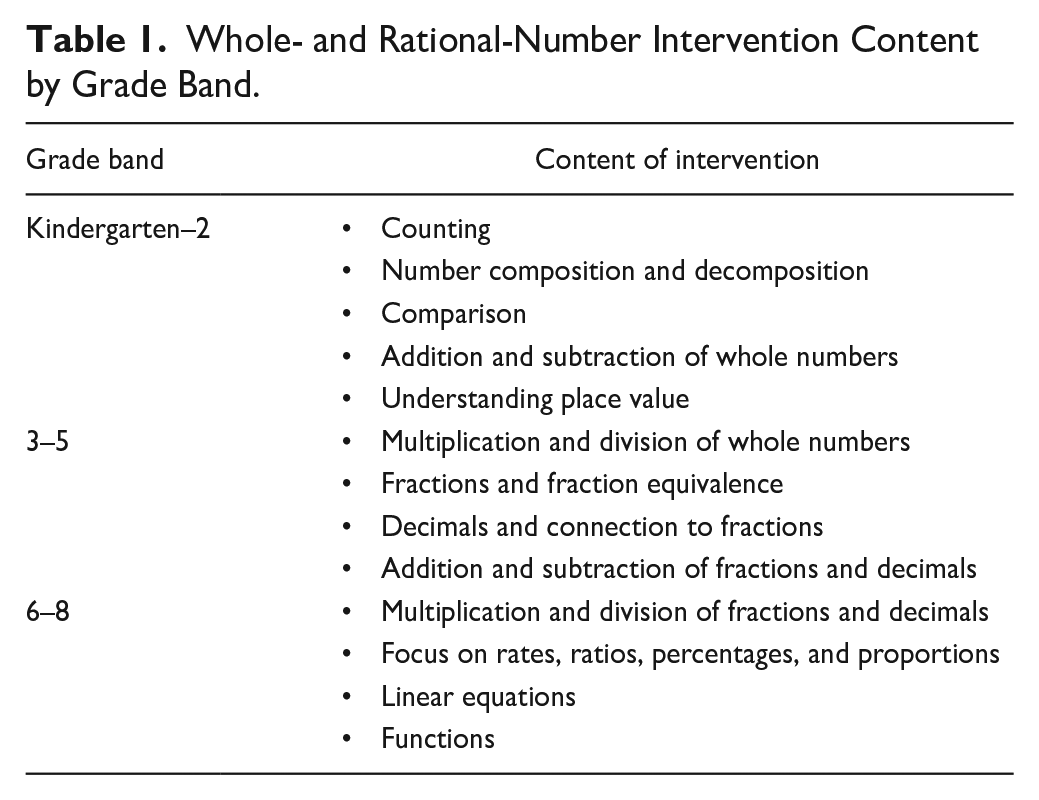
To identify content and create an appropriate scope and sequence, an educator can review all formal and informal data sources (see Table 2 for ideas) to understand the mathematics strengths and weaknesses of the student (or group of students). An educator can also review vertical alignment documents related to mathematics standards that show the critical mathematics content a student needs to learn in each grade level (National Council of Teachers of Mathematics, 2006). We refer many educators to the focus documents from Achieve the Core (https://achievethecore.org/category/774/mathematics-focus-by-grade-level). Then, keeping in mind a focus on critical mathematics content, the educator can determine which mathematics content to include in intervention based on student areas of difficulty. This content can be sequenced from easier content to more difficult content (i.e., the scope and sequence).
Formal and Informal Data Sources.

Using the Scope and Sequence: Behavioral Supports
As an educator starts implementing a mathematics intervention based on an appropriate scope and sequence, it is important to understand that higher teaching quality contributes to higher student engagement and motivation (Leon et al., 2017). It is also necessary to understand which behavioral supports can be blended into the mathematics intervention to supplement high-quality instruction. For example, if a student has difficulty paying attention to the lesson, the educator could employ the use of a self-regulation strategy such as a checklist (e.g., Am I: on task, taking notes, and asking questions when I don’t understand?). At regular intervals, a device (e.g., MotivAider®) or the educator could prompt the student to fill out the checklist. This strategy helps students to monitor their own engagement and can be tied to a preferred reinforcer (e.g., a 10-min break, time to talk with a friend, or fewer problems to complete) for either a set percentage of intervals on task or for simply completing the checklist. A MotivAider® is also an effective intervention for a student who has difficulty starting a problem, monitoring pace during a problem, or completing a problem.
Providing behavior-specific praise, immediate instructional feedback, or different instructional choices are also behavioral strategies that could be used to increase a student’s motivation during the mathematics intervention. For example, students are often more motivated and engaged in a lesson if they are allowed to choose what order tasks are completed (e.g., “Do you want to do the measurement activity or the fraction activity first?”). Regardless of the behavioral strategy that is chosen, the key element to determining which behavioral strategy to employ relies on the reason—or function—of the student’s behavior (Ennis et al., 2018; Korinek & deFur, 2016; Lane, Menzies, Ennis, Oakes, Royer, & Lane, 2018; Oakes et al., 2018; Scott & Landrum, 2020). We discuss function and associated function-based intervention in more detail later.
Morgan develops an intervention scope and sequence that addresses foundational mathematics concepts and skills for each student. While the needed skills vary by student, both teachers note that all students need fraction and decimal work, so they decide to begin there. As the intervention group starts meeting, Morgan notices a few students who seem reluctant to participate or are simply disengaged. Knowing that Jesse has worked with these students in the general education classroom, Morgan reaches out and talks with Jesse about embedding breaks within the mathematics intervention or providing more opportunities to respond.
The intervention is going really well, but a few off-task behaviors have popped up. Like yesterday, during individual review, a few students had their heads down or were looking at their phones.
That’s tough. Maybe you could take a break right before that activity?
That’s a really good idea. Or maybe I should increase the opportunities to respond during individual review. That might prevent students from feeling disengaged.
Use a Common Session Structure
After developing the scope and sequence, an educator needs to determine what will occur in each mathematics intervention session. We call this the common session structure. These are the activities that will occur during each intervention session. We recommend that an educator create a common intervention session structure to help the student anticipate the lesson content and the educator effectively plan the intervention. For example, Powell et al. (2021) structured each intervention session to include (a) math fact warm-up, (b) focus on solving equations, (c) word-problem instruction, (d) word-problem sorting practice, and (e) individual review. Bryant et al. (2016) used a common session structure of (a) warm-up, (b) preview, (c), modeled practice, (d) guided practice, and (e) daily check. A common session structure should have a warm-up, explicit modeling and practice on a mathematics skill, and a review. While the use of a consistent session structure is critical, the structure can vary depending on the educator and student needs. When designing and using a lesson structure, we provide the following content recommendations.
Fluency
First, interventions at all grade levels should devote several minutes in each session to building fluent retrieval of mathematics facts (Fuchs, Bucka, et al., 2021; Riccomini et al., 2017). For students in the early elementary grades, this can include a focus on addition (e.g., 3 + 6 or 7 + 9) and subtraction (e.g., 4 – 1 or 12 – 5) facts. In the later elementary grades, the focus on fluency can involve multiplication (e.g., 3 × 4 or 8 × 6) and division (e.g., 6 ÷ 2 or 56 ÷ 8). Many students in middle and high school may still require fluency practice with facts.
As students demonstrate fact fluency, educators can continue to devote several minutes in each intervention session to building fluency beyond the mathematics facts. For example, educators may want to practice whole-number computation to help a student develop accuracy and greater efficiency (i.e., fluency) with solving such problems. Educators may want to practice fluency with determining common denominators among fractions or determining an equivalent decimal when presented with a fraction. Students could use fluency practice on addition, subtraction, multiplication, and division with integers. Educators may also want to practice fluency with solving one- or two-step linear equations with a variable. Fluency involves less reliance on working memory (Justicia-Galiano et al., 2017), so these activities might be embedded within each intervention routine. Because fluency activities are of short duration and easily adapted into a game or competition, such activities tend to be engaging for students who may display off-task behaviors.
Explicit Instruction
Second, instruction within intervention must be explicit and systematic (Doabler et al., 2015; Hughes et al., 2017). Figure 1 provides an overview of explicit instruction. All mathematics instruction can be delivered using the components of explicit instruction (Jitendra et al., 2018; Morgan et al., 2015).
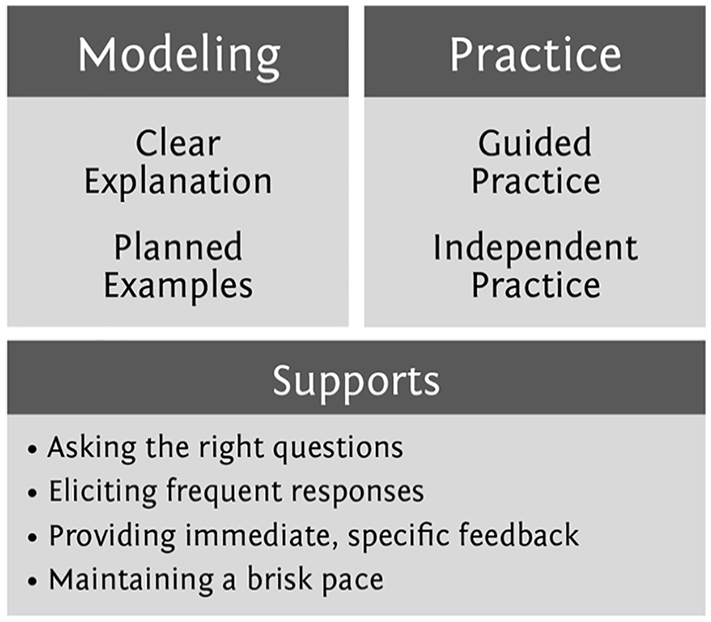
Explicit instruction overview.
With explicit instruction, the educator starts a session by stating the goal of the session and the relevance of this mathematics to real life. Then, the educator demonstrates, often using think-alouds, how to solve a specific type of problem. After this modeling, the educator and student can practice problems together with the student transitioning to solving problems independently. Practice promotes learning mathematics, so a student should be afforded many practice opportunities for a specific mathematics skill.
During the modeling from the educator and extensive practice opportunities, educators can employ supports for student learning. These supports can help students with challenging behaviors participate in the mathematics lesson at a deeper level. Supports include the following:
Asking students a mix of low-level questions (e.g., “What is 5 times 4?”) and high-level questions (e.g., “Why do I have to regroup?”). Low-level questions allow for educators to check foundational knowledge and help build student confidence. High-level questions help educators understand what types of misconceptions students might have.
Asking students to respond frequently. When delivering interventions, our typical suggestion is that a student responds at least every 30 to 60 s in some way (e.g., answers a question, gives thumbs up, writes a problem, uses a manipulative, talks to a peer). Frequent responses help students stay on task.
Providing affirmative and corrective feedback. Educators can provide mathematics- and behavior-specific affirmative feedback, such as “Using your word-problem steps helped you focus on the problem!” When a student makes a mistake, educators can provide corrective feedback situated in a positive manner, such as “Let’s look at the hundreds column. Tell me how you subtracted the numbers.”
Be planned and organized with all materials ready for use. Educators should have materials easily accessible for the lesson and all virtual materials pulled up and ready to go so time is not wasted trying to get organized during an intervention session. In addition, a quick pace during intervention delivery assists with student engagement.
Visual Representations
Third, when providing mathematics instruction, an educator can use visual representations to help a student understand different mathematics concepts and procedures (Fuchs, Bucka, et al., 2021). Students must be explicitly taught how to use the visual representation as well as provided sufficient opportunities to practice successfully using it (Peltier & Vannest, 2018). There are a wide variety of visual representations: hands-on manipulatives, virtual manipulatives, drawings, or graphic organizers. Even if providing mathematics instruction in virtual environments, continual use of visual representations through the use of virtual manipulatives can help students understand the concepts and procedures of mathematics (Bouck et al., 2020).
An educator can select a visual representation that will help a student understand the mathematics at a deeper level. For example, if a student needs help comparing fractions, the educator may want to use fraction tiles or fraction number lines to visually show the magnitude of different fractions. An educator should consider whether some visuals may be distracting to students with challenging behaviors. For example, Base-10 blocks or algebra tiles include lots of small pieces that can be used to represent mathematical concepts as well as build things or make patterns. They can also be easily thrown across the room or eaten. Depending upon an individual student’s behavioral challenges, educators may want to avoid certain hands-on tools. Similarly, some students may become distracted by virtual manipulatives, especially if they can easily access the internet from their phone or computer or if the virtual manipulative is displayed on a webpage with many advertisements. Therefore, careful selection of virtual manipulatives is a must.
Word-Problem Solving
Fourth, and because all students demonstrate their mathematics competency through solving word problems (Powell et al., in press), it is necessary for a common session structure to include instruction on setting up and solving word problems (Cook et al., 2020; Jitendra et al., 2015; Peltier & Vannest, 2017). With word-problem instruction, an educator can provide a student with an attack strategy to help the student work through the problem. Figure 2 shows the commonly used attack strategy of Understand, Plan, Solve, and Check, but there are many other attack strategies that an educator can use. For example, Montague et al. (2014) used Read, Paraphrase, Visualize, Hypothesize, Estimate, Compute, and Check, with a focus on helping students improve self-regulation as they solved different word problems.
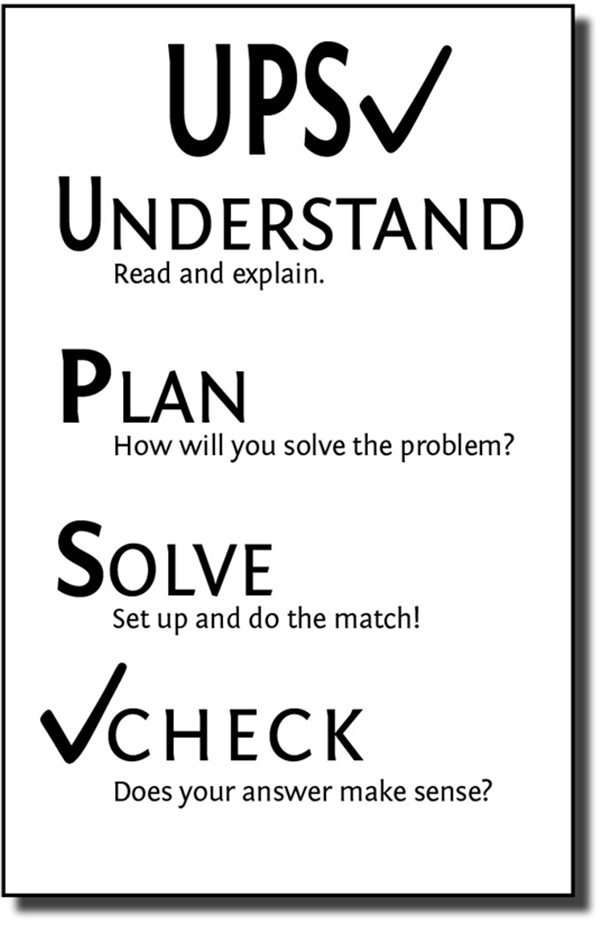
Word-problem attack strategy.
In combination with an attack strategy, an educator can teach a student to recognize the various structures (i.e., schemas) of word problems (Powell & Fuchs, 2018). There are six word-problem structures that a student regularly solves across kindergarten through Grade 8: total, difference, change, equal groups, comparison, and ratios or proportions. The total, change, and difference structures begin to appear in kindergarten and continue with a student throughout their schooling. With the total structure, a student puts amounts together for a total. With the change structure, a student has an amount that increases or decreases. With the difference structure, a student compares two amounts for a difference. The equal groups and comparison structures appear around Grade 3 and continue with wide use through middle school. With the equal groups structure, a student has groups with an equal amount in each group. With the comparison structure, a student has a set multiplied a number of times. With the ratios or proportions schema, a student explores the relationships among quantities. This structure typically appears around Grade 6.
When a student can recognize the structure of a word problem, they can use strategies (e.g., drawings, graphic organizers, equations) previously used to solve similar problems of the same structure. Having a specific strategy at the ready reduces anxiety and builds success for students who experience mathematics difficulty. Similar to visual representations, any word-problem attack strategy and a focus on the word-problem schemas need to be explicitly modeled and practiced. Explicit instruction about word-problem solving is essential.
Using a Common Session Structure: Behavioral Supports
A common session structure can help a student understand the regular routine and flow of their mathematics intervention session, which allows for planning, organization, and self-regulation. In terms of planning, a common session structure helps a student to know what they are going to do during every session (e.g., “first I start with a mathematics-vocabulary warm-up, then the educator models, then we do two problems together, and finally I do two problems on my own”). A common session structure helps a student keep their materials (e.g., “I need to get out my mathematics glossary at the beginning of each session”) and themselves organized (e.g., “I will work for 25 min in this intervention session before going to lunch”). In terms of self-regulation, a student can understand the expectations for behavior with a common session structure. When helpful, an educator could also use a self-regulation checklist of each session’s activities to help the student track their progress through each session. The common session structure ensures everyone—the educator and all students in the intervention—knows what to expect from the beginning until the end of the intervention session. A common session structure also makes it easier for an educator to plan the intervention.
In addition to the common session structure, a student who experiences difficulty with mathematics and behavior will benefit from regular rates of planned reinforcement during intervention. For example, in our prior research on word-problem solving (Powell et al., 2021), we effectively used a token-based reward system and goal-driven tasks to increase student attention and promote motivation. Students received gold coins throughout the intervention lesson for following the intervention rules (e.g., listening to the interventionist, staying in their seat, and working hard). At the end of the lesson, students counted the number of gold coins they earned and recorded the number on their treasure map. When students earned enough coins to reach the treasure chest on their map, they received a tangible reinforcer (i.e., toy, pencil, candy). Therefore, in addition to using a common session structure, it is essential to integrate planned behavioral components in your intervention lessons to support students that demonstrate mathematics difficulty.
Morgan implements this new session structure. This session common session structure starts with a fluency game. Then, Morgan uses explicit instruction and multiple representations to help students understand the length, area, and set models of fractions. Morgan concludes each session by applying fraction knowledge to developing skill with word-problem solving and doing an individual review. Within each session, Morgan also includes increased behavioral supports during the individual review time and during transitions between activities.
Intensify Mathematics Intervention
For approximately 3% to 5% of the student population, more intensive intervention (e.g., Tier 3 or specially designed instruction) beyond targeted or Tier 2 intervention may be required. An educator determines the need to intensify supports when a student demonstrates inadequate progress toward meeting mathematics goals (Powell & Stecker, 2014). The process of intensification does not occur for every student receiving mathematics intervention. It is reserved for only those students who (a) demonstrate below grade-level academic achievement, such that they require intensive intervention; (b) demonstrate an inadequate response to a Tier 2 intervention, delivered with fidelity, as evidenced by progress-monitoring data; or (c) have a disability and receive specially designed instruction.
The taxonomy of intervention intensity (Fuchs et al., 2017) provides educators with a framework for making an intervention more intensive for a student. The full taxonomy includes seven dimensions (intensiveintervention.org): strength, dosage, alignment, attention to transfer, comprehensiveness, behavioral support, and individualization. We focus on three dimensions (i.e., dosage, alignment, and attention to transfer) to intensify supports within mathematics intervention.
Dosage
Dosage refers to the number of opportunities a student has to respond and receive feedback from the educator. Students with intensive intervention needs often require 10 to 30 times more practice opportunities than their general education peers (Gersten et al., 2008). Therefore, an educator may choose to increase the length of the intervention session or offer more sessions during a week to ensure that students have more opportunities to receive feedback.
For example, if a student is currently receiving mathematics intervention two times a week for 30 min per session, the educator may consider an additional intervention session to intensify the intervention (3 times a week for 30 min each session). An educator could also increase the number of minutes of mathematics intervention from 30 to 40 min. Remember, adding extra time or intervention sessions really means that you are adding extra opportunities for your student to practice and acquire foundational skills which is essential for the learning of mathematics. Be creative in how you increase dosage—for example, an extra session could be added as the student has breakfast in the classroom in the morning or with the media specialist during study hall.
Alignment
Alignment refers to how well the intervention matches the targeted academic skill of the student and incorporates grade-appropriate standards. For example, a student who has difficulty with understanding the concept of place value and whole numbers may not necessarily immediately benefit from a fraction intervention. Therefore, it is imperative for an educator to use data including diagnostic assessments to determine whether the student’s strengths and weaknesses can be addressed by the content of the intervention. As an educator, you may revisit the dimension of alignment if you notice that the student is not making expected growth with a mathematics intervention implemented with high levels of fidelity.
Addressing alignment may involve revising the scope and sequence for a student and making adaptations to how the mathematics content is taught within intervention. An educator may want to consider several different adaptations to the mathematics content:
Ensure a student understands how visual representations connect to the abstract form of mathematics (i.e., numbers, symbols, words). Flores et al. (2016) had students use hands-on tools that connected to diagrams to solve word problems with numbers and symbols.
Teach students different ways to solve similar problems (e.g., using partial products or arrays for multidigit multiplication).
Break down complex problems into smaller, more manageable steps. Create self-monitoring checklists for complex problems. For example, Ennis and Losinski (2019) taught students to use the FILMS process mnemonic when adding and subtracting fractions with unlike denominators: Find the denominators, Identify the multiples, Locate the least common multiple, Multiply to make new fractions, and Solve the problem.
Explicitly teach mathematics vocabulary and create word walls or glossaries for a student to use as a resource. As emphasized by Petersen-Brown et al. (2019), provide many opportunities for students to practice mathematics-vocabulary terms with student-friendly definitions.
Engage the student in more discourse about mathematics to understand misconceptions and errors.
Use worked examples solved correctly and incorrectly, or engage students in discussion about how they could use the strategies from worked examples.
Attention to Transfer
Attention to transfer refers to whether the intervention is explicitly designed to help students make connections between the skills taught in intervention and skills learned in other contexts. Many students transfer one mathematics skill to another without much explanation from the educator. Some students, however, require explicit instruction on transfer and how knowledge with one mathematics skill can be used to solve a similar, but more difficult, problem (Fuchs et al., 2002).
For example, a student should understand how their addition skill of knowing 9 + 6 = 15 can transfer to subtraction 15 – 6 = 9 and 15 – 9 = 6. As another example, a student needs to understand that if you regroup in the tens place for the problem 74 – 29, the same regrouping strategy works for 722 – 368 or 7,340 – 3,985. Furthermore, a student might learn how to use knowledge related to addition of 2 + 7 = 9 and how that relates to 2/12 + 7/12 = 9/12. In each of these examples, an educator must provide explicit modeling on how existing mathematics knowledge can be used to solve more difficult or novel-looking mathematics problems.
Behavioral Supports
The taxonomy of intervention intensity (Fuchs et al., 2017) also includes a component for behavioral support. We previously discussed how to embed behavioral supports when building interventions. However, some students require even more intensive and individualized support for behavior. In these cases, an educator often conducts a functional behavior assessment (FBA) to determine the function of the student’s behavior. The findings from these data can be integrated into the intervention lesson by tailoring the reinforcer to the student’s function or increasing the amount of reinforcement a student receives during the intervention lesson, for example. There are several functions of behavior. These include seeking attention from an adult or peer; having access to a tangible, escaping or avoiding something; and behaving to appease a sensory condition (Beavers et al., 2013). Some students may not be motivated to reach their behavioral goals by receiving a tangible reinforcer (e.g., prize or candy) or receiving attention from their educator. A way to intensify the intervention could be to tailor the reinforcement to the student’s functional preference.
Equally as important to understanding the function of the behavior is understanding the amount of the reinforcer you provide. When students struggle with motivation or behavior, higher rates of reinforcement can be used initially. In our earlier example, a token economy was used to motivate students. After a student received a specific number of coins, the student could exchange those coins for a prize. For a student that is reinforced by access to tangibles (e.g., prizes), the educator could award coins more frequently to ensure the student receives their preferred reinforcer more frequently. As the student’s motivation or behavior improves, the reinforcer can be offered less frequently. While a token economy has been found to be effective for student behavior, there are several other research- or evidence-based interventions for behavior, including check-in/check-out interventions and group-based contingencies (Swoszowski, 2013). For more suggestions, visit the NCII behavioral interventions tools chart at intensiveintervention.org.
Jesse notices that one student, Pat, still is not learning as expected. Pat is also demonstrating off-task behaviors, like getting out of their seat and having off-topic conversations. Jesse questions if Pat needs a different intervention, and Morgan suggests the intervention for Pat needs to be intensified based on data collected during intervention and team-based decision making that followed an FBA. After 6 weeks, the colleagues meet to talk about Pat’s progress. Pat is doing well with behavior but may benefit from intensified supports in mathematics.
So . . . how’s Pat doing?
Behaviorally, really well. When I increased the number of opportunities for making authentic choices, Pat responded really positively. And actually, so did other students in the group!
That’s awesome. How about the math?
Pat’s made some progress, for sure. But there are still some moments where I’m not sure the concept is clear. Pat can follow procedures, but I want to know there is real understanding.
I see that too in my classroom. Let’s look at some data and see if there are other intensifications we could make to boost Pat’s academic performance!
Summary
As described in this article, many students who experience difficulty with mathematics require intervention. Within mathematics intervention, some students may also need behavioral support (Benz & Powell, 2021). It can be easy to create mathematics intervention to support the mathematics learning and behavior of students. As shown in Figure 3, consider focusing on the following, each of which has research demonstrating efficacy in either mathematics or behavior.
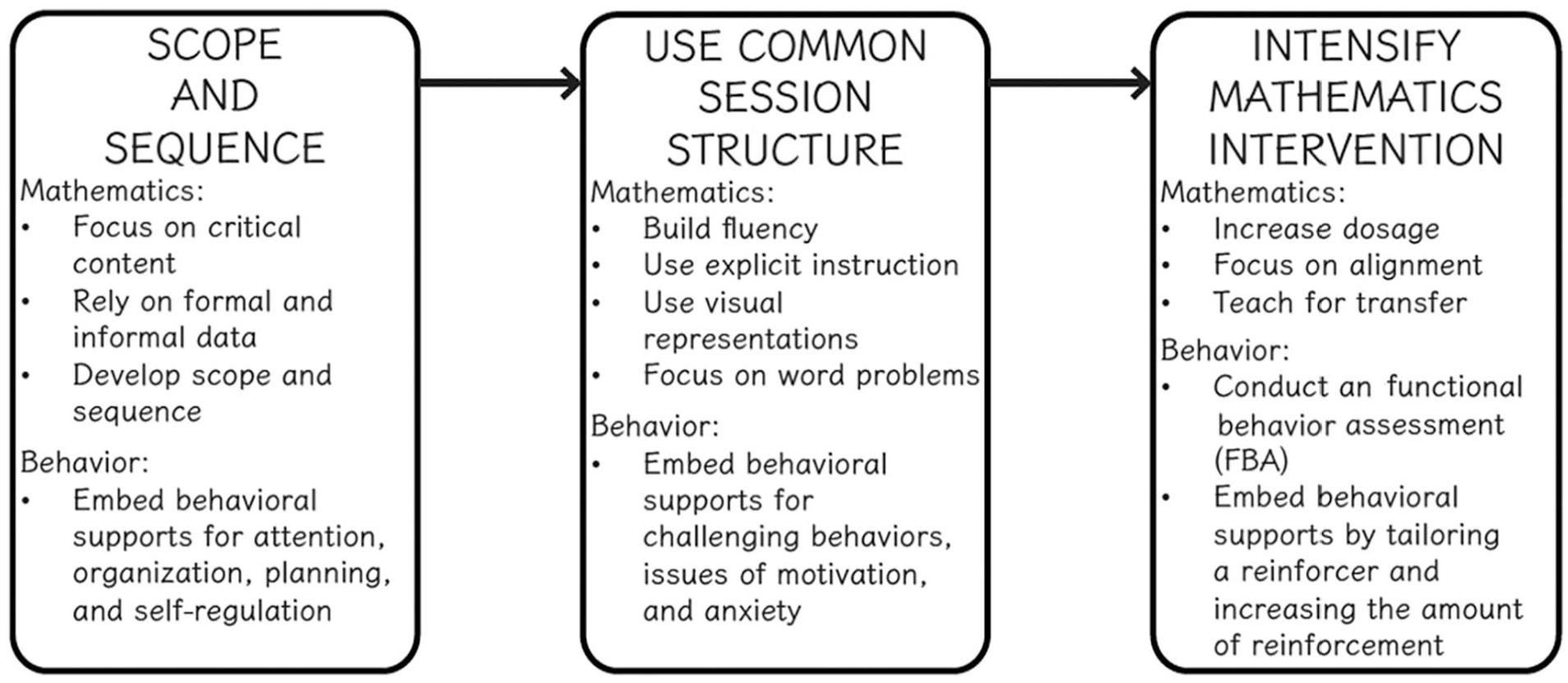
Mathematics intervention tips for educators.
First, develop an appropriate scope and sequence for the mathematics content you will teach during your intervention. Rely on formal and formal data sources to understand student strengths and weaknesses (Schumacher et al., 2017), then develop a scope and sequence focused on critical mathematics content. Embed appropriate behavioral support to help a student maintain attention, get organized, plan accordingly, and regulate themselves (Alter, 2012; Fuchs, Seethaler, et al., 2021; Peltier & Vannest, 2016). Ideas for low-intensity behavioral support include providing behavior-specific praise, using precorrection, using active supervision, giving a student instructional choice, and providing instructional feedback (Lane, Menzies, Ennis, & Oakes, 2018).
Next, use a common session structure that allows a student to understand the flow of each intervention session. This common session structure should include fluency-building activities (Fuchs et al., 2014). An educator should use explicit instruction and visual representations to help students learn how to solve mathematics problems (Doabler et al., 2019). The common session structure should also feature a focus on how to set up and solve word problems (Powell et al., 2021). Embed appropriate behavioral support, such as daily report cards (Vannest et al., 2011) or check-in/check-out interventions (Kern & Wehby, 2014), when a student exhibits challenging behaviors.
Behavioral support may also be important when a student exhibits anxiety. With regard to mathematics anxiety, it can affect mathematics performance and vice versa (Gunderson et al., 2018). This demonstrates the essential role of mathematics intervention for improving mathematics performance and lessening mathematics anxiety (Carey et al., 2016).
Finally, intensify the mathematics intervention when a student demonstrates inadequate progress toward meeting mathematics goals. Intensification may involve increasing the dosage, focusing on alignment, and teaching for transfer (Fuchs et al., 2017). Figure 4 provides additional resources for identifying, using, and intensifying mathematics interventions. In addition to the mathematics intervention, an educator may need to revise the student’s behavior intervention plan and embed appropriate behavioral supports (Kern & Wehby, 2014). This could involve tailoring a reinforcer or increasing the amount of reinforcement (Morano et al., 2021).
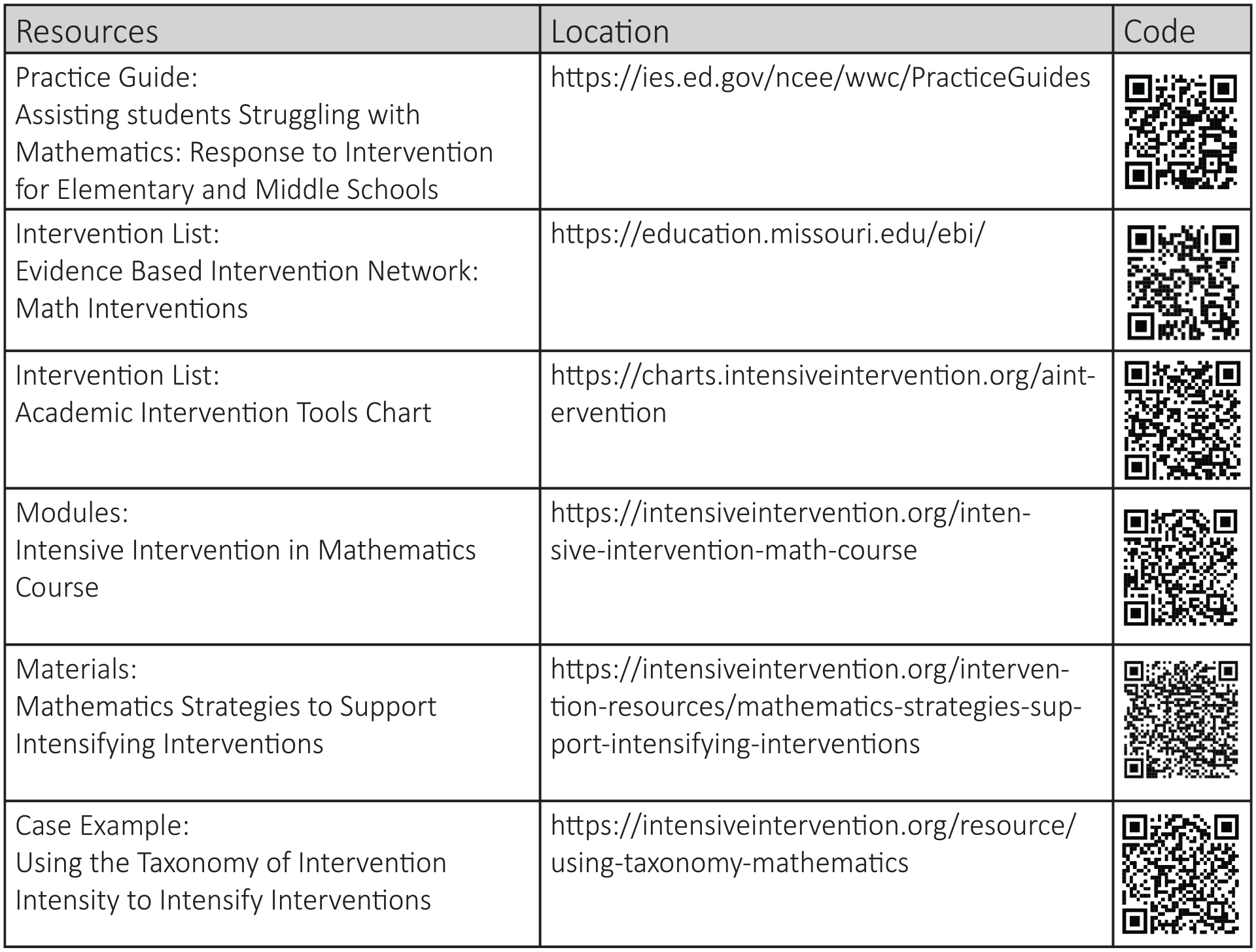
Mathematics intervention resources.
Similar to Jesse and Morgan, you probably know a student who experiences difficulty with mathematics and who also requires behavioral support. Because of the limited number of fully designed mathematics interventions, we realize you will have to create and adjust your mathematics intervention to meet the academic and behavioral needs of your students. As you engage in this work, create an appropriate scope and sequence for mathematics intervention, use a common session structure, and embed and intensify supports. Remembering these recommendations will help you with the design and delivery of mathematics intervention.
Footnotes
Declaration of Conflicting Interests
The author(s) declared no potential conflicts of interest with respect to the research, authorship, and/or publication of this article.
Funding
The author(s) received no financial support for the research, authorship, and/or publication of this article.
