




Abstract
Goal setting is a research-informed intervention that has demonstrated improved behavioral outcomes for students with emotional and behavioral disorders. However, not all students will respond to goal-setting interventions delivered in a standard format, requiring planning, implementation, and ongoing evaluation of more intensive goal-setting formats. This article describes how teachers can implement goal-setting interventions in their classrooms and provides a systematic framework for teachers to use individualized data to intensify goal-setting interventions.
Korey is labeled with emotional and behavioral disorders (EBD) and has a difficult time maintaining academic engagement during Mrs. Lynn’s English class. As an eighth-grade student, Korey is expected to participate in whole class, small group, and individual instructional activities that include reading and writing essays during class. However, Korey often spends much of the class period displaying disruptive behaviors, such as talking to his peers, using his phone, and walking around the class. Additionally, when Korey does start working, he yells across the room for help instead of raising his hand and then stops working. Korey’s behavior is not only disruptive to his learning; it also disrupts his peers in Mrs. Lynn’s English class. Therefore, Mrs. Lynn sends Korey to the office or to speak with an administrator when he is disturbing the classroom environment. Mrs. Lynn has a discussion with Korey about his behavior, and he acknowledges that his behavior is disruptive and he wants to improve it in order to be successful in her class. Together, Mrs. Lynn and Korey decide that they would use a goal-setting intervention to assist him incrementally improve his compliant behavior.
Goal setting has an evidence base of improving student behavior since the 1980s and both teachers and students have rated goal setting as a socially valid intervention to improve outcomes for students labeled with EBD (e.g., Mazzotti et al., 2013). Characteristics of students labeled with EBD can vary widely. However, some common characteristics include poor social skills acquisition, disruptive behavior, aggression, and academic performance deficits. These characteristics contribute to many students with EBD not being able to meet the expectations for academic and social-emotional-behavioral success in school settings (Lane et al., 2008).
This population of students can benefit from evidence-based interventions that address a wide range of outcomes. Research has found that students labeled with EBD can improve outcomes through empirically supported, data-driven interventions that can be individualized to address the complex and diverse academic and social-emotional-behavioral needs of students labeled with EBD (Maggin et al., 2016). One framework that can help address all of these diverse needs is goal-setting.
Definition of Goal-Setting
Broadly speaking, goal-setting falls under the umbrella of self-determination and self-management as part of a metacognitive process that allows students labeled with EBD to manage and regulate their behavior (Estrapala & Reed, 2019). As the name implies, the intervention involves teachers and students setting goals to improve an academic or behavioral outcome and works by setting a goal that is above the student’s typical performance, so that the student can progress toward improving a targeted outcome (e.g., appropriate behavior, academic engagement; Bruhn, McDaniel, et al., 2016; Epton et al., 2017). Goal-setting interventions can be tailored to fit within existing classroom management practices and can be intensified for a wide range of behaviors emitted by students with EBD and their accompanying functions. Therefore, goal-setting interventions can look very different depending on contextual factors such as school resources, existing classroom management practices, or the topographies of behaviors displayed by the student. However, at its core, goal-setting typically involves setting a goal and then regular data-based monitoring to track the student’s progress toward achieving the established target (Hirsch et al., 2013).
Evidence Base of Goal Setting to Improve Behavioral Outcomes
Although researchers and teachers have traditionally used goal-setting interventions to improve academic engagement and life skills (Bruhn, Vogelgesang et al., 2016), recent research has indicated that goal setting is being used more frequently to decrease disruptive behaviors. Specifically, Bruhn and colleagues (2016) found in their review of studies with 1,359 participants that the most common disability label was EBD, and that the intervention was used to address a wide range of behaviors, including social skills development, work completion, on-task behavior, and classroom preparation. Bruhn and colleagues (2016) described a number of positive takeaways. One, they found that all of the studies, some of which included multiple components, reported positive outcomes. Second, they indicated that students were more likely to attain their goal when they were involved in setting the goals. Third, Bruhn and colleagues (2016) found that a majority of participants rated goal setting as socially valid.
Research on goal-setting interventions also indicates that teachers can efficiently and effectively incorporate goal-setting interventions into existing behavior management strategies (Epton et al., 2017). To determine if goal-setting interventions were delivered as stand-alone interventions or incorporated into other classroom management strategies, Bruhn, Vogelgesang et al. (2016) analyzed the 40 studies to examine intervention components and found that the delivery of the goal-setting interventions varied widely across studies and goal setting was often only one component of a multi-component behavioral management strategy. The most common interventions that goal setting was paired with included variations of Check-in/Check-out (55%), self-management (17.5%), social problem-solving (17.5%), and focused goal setting (10%).
When teachers use goal setting as a component of a Check-in/Check-out intervention, they typically use a daily behavior report card to track the student’s goal. In this format, teachers meet with the students at the beginning of each day to discuss the goals and then again at the end of the day to review the data and determine if the student achieved their goals. Teachers who incorporate goal setting as a component within a self-management framework typically had their students monitor and track their behavior and academic engagement and sometimes included contingent reinforcement. A contingent reinforcement is when students receive a preferred item or activity contingent on achieving their goal (Maggin et al., 2017). When goal setting is a component within a social problem-solving intervention, the goals are typically related to social interactions, including positive behavior in social interactions. Teachers using goal setting as a social problem-solving intervention typically have the students meet in a small group led by support staff (e.g., social worker, school psychologist) to discuss, practice, and set realistic goals related to positive social interactions. When teachers implement focused goal-setting interventions, the students typically select goals based on their baseline data and progress monitor frequently (e.g., each class). The authors of the studies included in the Bruhn and colleagues (2016) review indicated positive outcomes related to various behavioral and academic measures across all types of goal-setting interventions. However, the efficacy of the goal-setting intervention could likely be a result of other aspects, such as including the student in their goal setting, thus increasing their metacognitive process.
Goal-setting interventions can be incorporated into a multi-component intervention strategy and intensified to meet the needs of students who display the most severe and persistent needs. With the increased use of tiered systems of support, educators are searching for strategies to use their limited resources to intensify their existing interventions to provide intensive supports (Braun et al., 2019). Goal setting is an example of an intervention that can work within existing practices, such as the creation and ongoing evaluation of annual individualized education program (IEP) goals. It can also be used as a stand-alone intervention to target shorter time frames, such as days or weeks (Lloyd et al., 2019). Furthermore, goal-setting interventions can be systematically intensified through a data-based individualization framework to meet student-specific needs. However, for the data to be valid, it is critical that an intervention is delivered with fidelity.
Implementing Goal-Setting Interventions
Goal-setting interventions can be adapted to meet the contextual needs of classrooms and students, but there are core components that are commonly included in goal-setting interventions, whether they are delivered as part of a multi-component intervention strategy, or as a stand-alone intervention. Following a multi-step implementation process allows teachers and students to improve behavior by monitoring student-specific behaviors.
Bruhn et al. (2017) describe a format to systematically deliver goal-setting interventions which can be used as a resource with this article to guide delivery in classroom settings. Implementing goal-setting interventions in a systematic multi-step process with fidelity provides more assurance that the outcome data are related to the intervention, which then allows for the interventions to be intensified. Without delivering the intervention with fidelity, it is difficult to ascertain if the goal-setting intervention is actually having an effect. The core components, which expands upon formats described by Bruhn et al. (2017) and Estrapala and Reed (2019), include (a) identifying and defining the targeted behavior, (b) establishing a behavior monitoring plan, (c) collecting baseline data, (d) goal setting, (e) progress monitoring, and (f) deciding to fade, maintain, or intensify the intervention. Teachers should use a fidelity checklist that a teacher can use to monitor their delivery (see Figure 1).
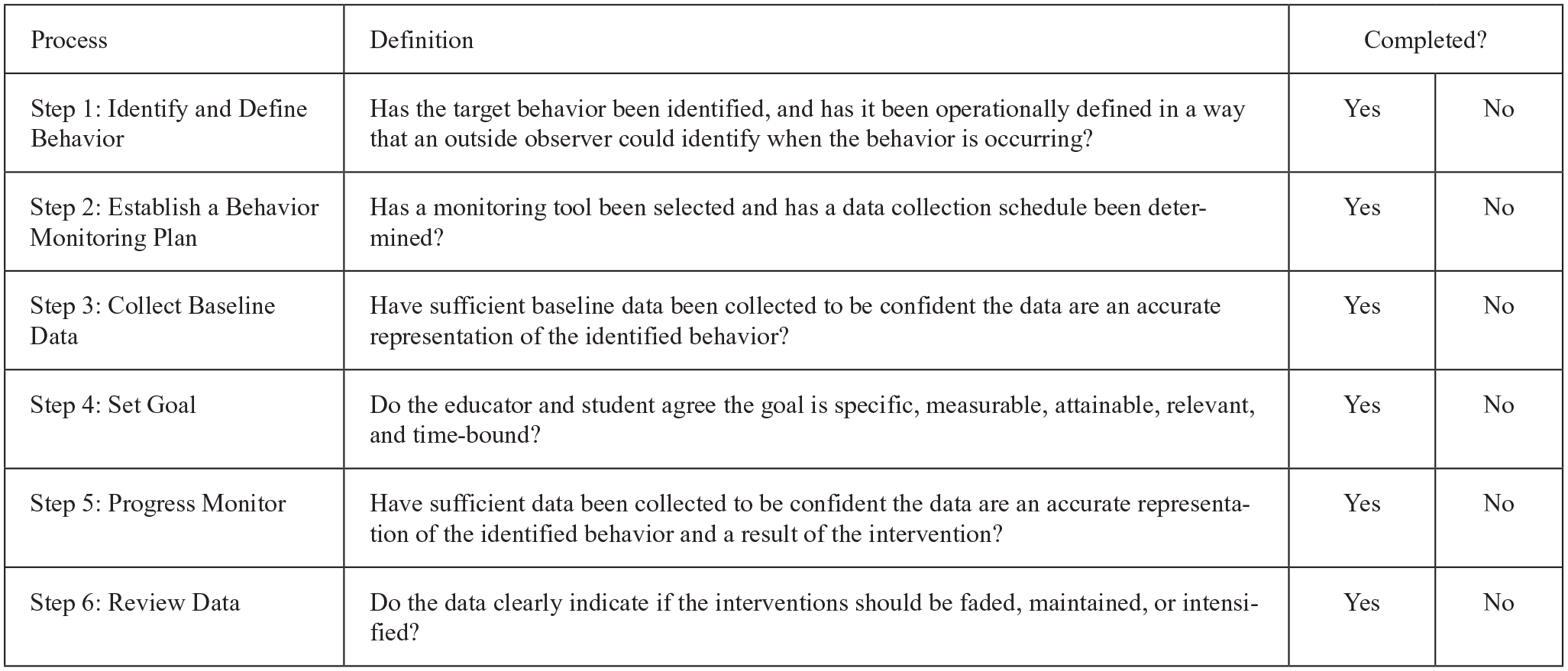
Goal-setting implementation fidelity checklist.
When working with a student who displays several disruptive behaviors, teachers should first target the behavior that is most disruptive and then move on to other behaviors. Next, teachers should then establish a behavior monitoring plan for baseline that is realistic and will not disrupt the regular flow of their classroom, which can include having the student collect their own data, or using a classroom aide. Then, after using the goal-setting intervention, the teacher and student should review the data with the student. If the intervention is successful, they should keep implementing it in the same format until the teacher and student agree the intervention could be faded (e.g., less frequent data collection, less frequent meetings to review data).
If a student is not responding to the goal-setting intervention, there are several strategies that can be used to incrementally modify the intensity of the intervention. Examples include increasing data collection and changing the goal. When this occurs, a school’s behavioral management team should meet to review data and make decisions on intensifying the intervention. Behavioral management teams can vary from school to school, but they typically include educators from various disciplines (e.g., special education teacher, general education teacher, administrator, school psychologist, social worker) that work as team to use their collective strengths to guide the delivery of research- or evidence-based interventions. Korey and Mrs. Lynn are fictional examples which are used to demonstrate how teachers can implement and intensify goal-setting interventions for students with EBD.
Step 1: Identify and Define Behavior
Before beginning a goal-setting intervention, it is essential to identify and operationally define the target behavior. If a student displays several behaviors, it is recommended that teachers first identify the behavior that is the most disruptive, and then work on defining the disruptive behavior. The definition of the target behavior should be as specific as possible and describe how the behavior looks, with examples and nonexamples created to further clarify the description. Every teacher should be able to read the definition and identify when the student is displaying the behavior, regardless of their previous knowledge of the student or class.
Mrs. Lynn and Korey meet to discuss his disruptive behavior and how it has a negative impact on him and his peers’ abilities to be academically engaged in class. After speaking about his disruptive behavior and the different types of behavior he typically displays in class, Mrs. Lynn and Korey decide that talking to Korey’s peers is the most disruptive and should be targeted for improvement. They then discuss what it looks and sounds like when he is talking to his peers during different classroom activities and discussed what it would look and sound like if he is displaying compliant behavior by being academically engaged instead of talking. Mrs. Lynn also provides Korey with examples and non-examples of what it looks and sounds like when Korey is compliant with the classroom expectation. They define compliant behavior as when Korey is working on his assigned task while not talking to his peers, or when he is appropriately speaking with his peers about academic work during small-group sessions. Non-examples of the behavior include Korey talking to a peer while the teacher is providing classwide instruction, Korey talking to a peer when he is supposed to be working quietly, or Korey talking to his peers about something that is not academically related during small-group work.
Step 2: Establish a Behavior Monitoring Plan
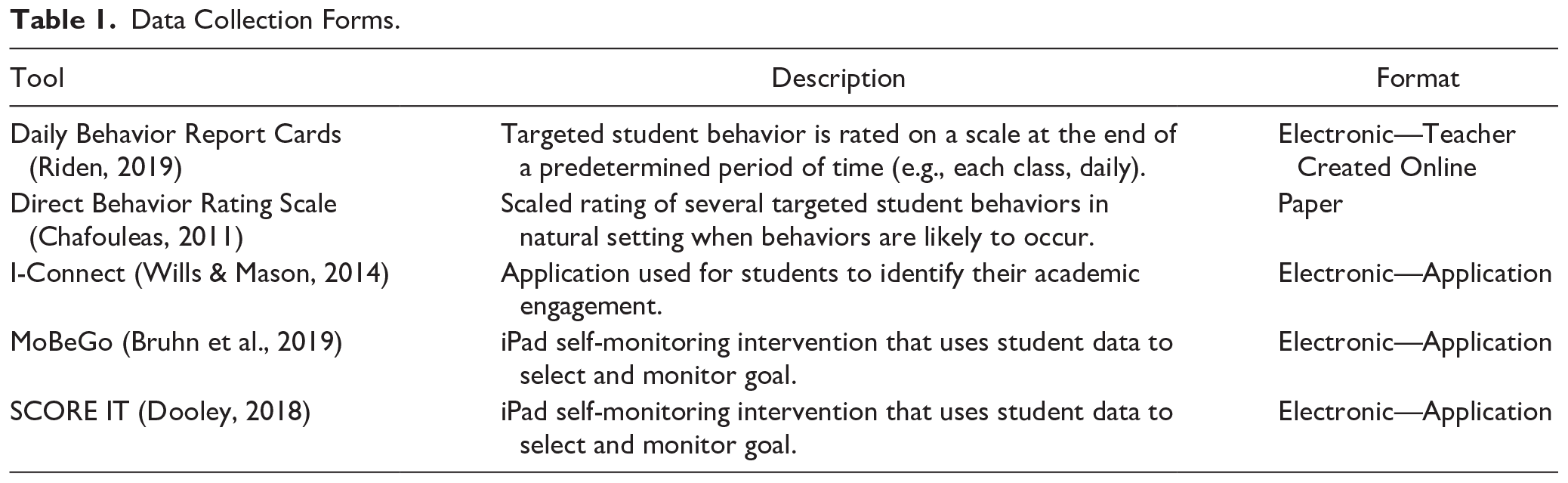
To determine if a goal-setting intervention is effective or not, accurate data need to be collected on the frequency the targeted behavior is occurring. To do this, the teacher and student need to establish a data collection plan that is feasible in their learning environment and will not disrupt the learning environment. The data collection can involve student only, teacher only, or teacher and student both collecting data. There are several important issues that need to be addressed in this step. First, the teacher needs to determine what type of monitoring system can be used to collect data in the class without disturbing the learning environment. There are both paper and pencil and electronic formats (e.g., direct behavior rating scale; Chafouleas et al., 2013) that can be used, depending on school resources (see Table 1). Second, the teacher and student need to determine how often they want to review the data with the student. Students with mildly disruptive behavior may only need to meet with their teachers weekly if they are meeting their goal, while students with more severe and persistent needs may need to review their data each class period. Finally, the teacher and student should decide how long they want to keep the goal-setting intervention in place before deciding to fade, maintain, or intensify the intervention. This decision should be based on input from both the teacher and student and may include other school personnel if necessary.
Data Collection Forms.
After deciding to set a goal of increasing the amount of time that Korey is appropriately engaged in academic work, Mrs. Lynn and Korey decide to use a paper and pencil form to regularly record his behavior in 10-minute intervals. Mrs. Lynn and Korey record his behavior every 10 minutes. Each rating consists of a 0-4 scale, with 0 representing 0% compliant academic engagement, and 4 representing 100% compliant academic engagement. The teacher and Korey decide that they will meet to review his appropriate academic engagement data every three days.
Step 3: Collect Baseline Data
Before a teacher and student can set a goal, they must first determine how often the targeted behavior is occurring. To determine the frequency of the behavior, data need to be collected using the same forms and time intervals that will be used throughout the goal-setting intervention. In addition, baseline data should be collected for several days so that the teacher and student can be confident that the data are accurate reflections of the need for a goal-setting intervention and not skewed by a class period where the student displayed uncharacteristic behavior. Without accurate baseline data, it is difficult to know if the student’s behavior is improving and diminishes the integrity of the intervention. Therefore, the teacher and student should not begin the intervention until they agree the baseline data are accurate.
Mrs. Lynn and Korey decide they should monitor the amount of time Korey is displaying appropriate academic engagement. Ms. Lynn uses the data collection form and process that she identified in the previous step and meets with Korey on Friday to review the data. The data show that Korey was appropriately engaged during academic portions of the class 60% of the time. Mrs. Lynn and Korey both agree that he displayed behaviors that were typical, and the data were accurate.
Step 4: Set Goal
After collecting baseline data to determine the frequency of a disruptive behavior, it is time to select the goal. The first process in this step is to review the baseline data with the student and determine a realistic goal that the teacher and student can agree upon. It is important the teacher and student discuss what is realistic and acknowledge that they will not completely eliminate the problem behavior right away. Including the student in selecting the goal improves their motivation and allows them to feel invested in the process. Once a goal has been agreed upon, the goal should be positively stated and identify a replacement behavior, such as raising hand to ask for help. For instance, instead of saying Korey will stop talking to his peer, the goal could say that Korey will silently engage in his classwork. Finally, the goal should be specific, measurable, attainable, relevant, and time-bound (SMART; van Geel et al., 2016). Setting a SMART goal allows for teachers and students to know exactly what behavior needs to be changed, how it will be measured, and when they will meet again to assess progress.
After collecting baseline data for a week, Mrs. Lynn and Korey meet to set a SMART goal. Mrs. Lynn guides the conversation by moving through each part of a SMART goal. They both review the data and select a realistic goal that they agree Korey could meet, which was a 10% improvement, and make sure it was measurable by using the same definition of academic engagement as the baseline phase. They then discuss the goal to review what would need to happen (i.e., behaviors that need to occur to make reach the goal) to make the goal attainable, and how the goal would help reduce the relevant inappropriate behavior (i.e., reduce non-examples of academic engagement). Lastly, they both decide that Korey could achieve his goal within a month. Korey’s SMART goal was written as follows: Within one month, Korey will be academically engaged in classwork 70% of the time.
Step 5: Progress Monitoring
After establishing a goal and making sure the student knows the expectations, it is time to begin monitoring the student’s behavior. During this step, the teacher and student should continue following the data collection plan established in Step 2. Unless the goal-setting intervention causes the desired behavior to get worse, progress monitoring should continue at the interval established in Step 2, and the goal monitoring frequency (e.g., every 3 days) should continue for the period of time (e.g., 1 month) established in the SMART goal.
During this step, Mrs. Lynn and Kore continued to collect data in the same fashion and at the same intervals as she did while collecting baseline data. Mrs. Lynn and Korey meet every three days to review his data and compare his outcomes to his goal of increasing the amount of time he was quietly academically engaged by 10%. After a month of using the goal-setting intervention, Mrs. Lynn and Korey meet to review his progress towards meeting his goal and discuss if they want to continue using the intervention in the same format, increase the intensity, or reduce the intensity of the intervention.
Step 6: Review Data to Fade, Maintain, or Intensify
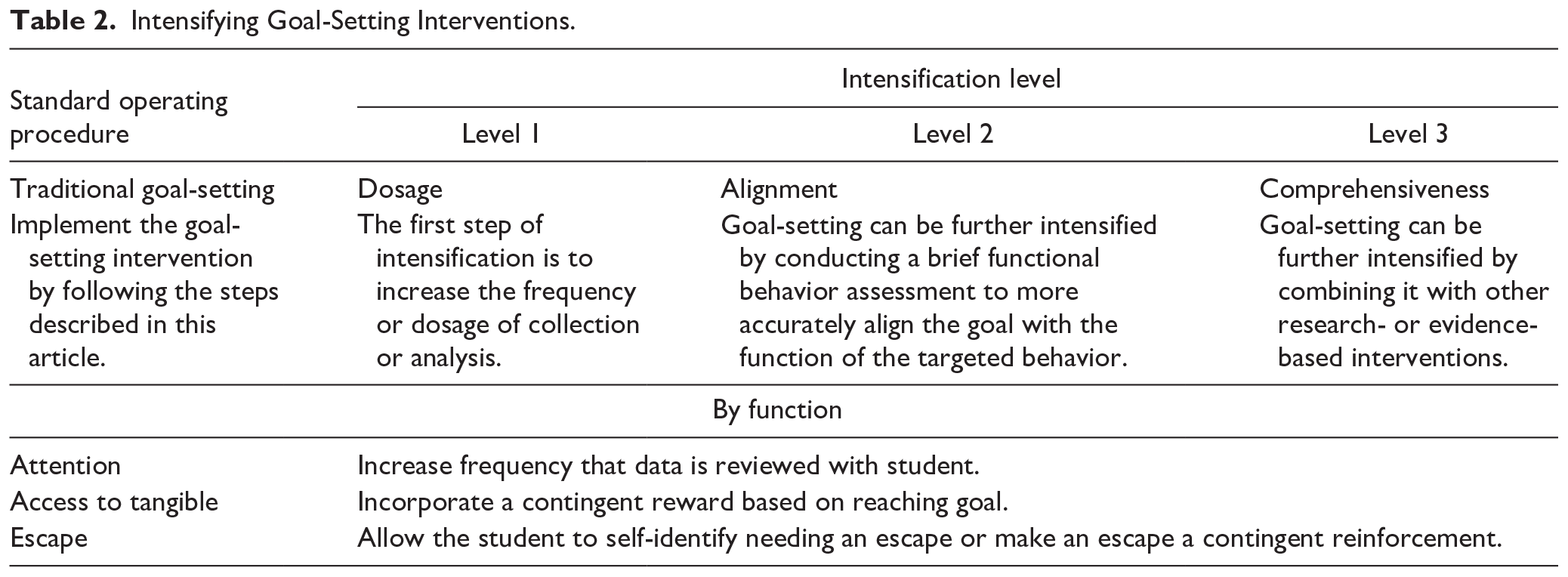
After the goal-setting intervention has been in place for enough time to ensure an accurate estimate of the student’s typical behavior as described in Step 2, a meeting should occur with the student and teacher to determine if the goal-setting intervention is associated with improvements in the desired behavior. The criteria for effectiveness should depend on the level of student behavior in baseline, and the realistic goal previously determined. However, smaller improvements are often important and can have a positive impact on the student’s ability to participate in class. If the intervention is determined to be effective, and the team agrees the student is meeting his goals, they can decide to continue the goal-setting intervention in the same format or reduce the intensity by reviewing or collecting the data less frequently. Another option when a student reaches their goal consistently is to continue to increase the goal (e.g., engaged 70% of the time to 75% of the time). However, if the student is not displaying improved behavior, the teacher and student may agree to increase the intensity of the intervention. The teacher, student, and other relevant personal (e.g., school social worker, school psychologist, administrator) should meet to consider components of the goal-setting intervention that they can intensify to meet the needs of the student. Similar to other interventions, goal-setting can be intensified in a format that allows for increasing intensity at each level (see Table 2).
Intensifying Goal-Setting Interventions.
Mrs. Lynn and Korey review their month of data and although Korey’s behavior has improved, and he was talking to his peers less often, he still only quietly engages in his work an average of 64% of the time. The data indicate that Korey would start class well but frequently revert to disrupting as the class progressed. Therefore, Mrs. Lynn, Korey, and the school’s behavioral management team meet to discuss ways they could intensify the goal-setting intervention to help Korey achieve his goal.
Intensifying Goal-Setting Interventions
Students labeled with EBD will not always respond to a goal-setting intervention delivered in its standard format and can benefit from intensifying the existing intervention (Maggin et al., 2016). When non-responset occurs, teachers should analyze the student’s progress monitoring data. With the increased use of tiered systems of support, such as positive behavioral interventions and supports (PBIS), educators may be best served by searching for strategies to provide intensive interventions that do not unduly increase their workload and do not require a prepackaged multi-component intervention.
Depending on resources, student need, and a teacher’s existing classroom management practices, there are numerous ways that teachers can intensify goal-setting interventions with minimal disruption to the classroom routine. When deciding how to intensify the intervention, teachers should begin by first using the least intense option available and then continue to intensify the intervention to meet the student’s needs (McDaniel et al., 2015). By applying a systematic intensification process and progress monitoring after each adjustment, teachers, and students can determine which intensification component best supports student growth with minimal disturbance to the classroom learning environment.
The National Center for Intensive Interventions (NCII; National Center on Intensive Interventions, 2018) provides tool charts that rate and list resources to collect and analyze data to intensify interventions. Data monitoring tools should be selected based on the behavior being monitored and the contextual needs of the school. There are numerous resources that educators can use (see Table 1) to fit their specific needs, and teachers are increasingly using free online resources (e.g., Google Docs) to create their own digital progress monitoring forms (e.g., Riden et al., 2019).
An intervention intensification framework should be individualized and fit within a school’s existing contextual variables. There is not a prescribed intensification process that must be followed. However, Fuchs and colleagues (2017) developed a taxonomy of intensification process based upon research that uses data-based individualization to intensify evidence-based interventions. Their intensification framework builds upon research focused on components of academic intensification that can be implemented by teachers in a classroom, and includes seven intensification components: (a) strength, (b) dosage, (c) alignment, (d) attention to transfer, (e) comprehensiveness, (f) behavioral support, and individualization, which they expand upon. The behavioral component that they identify can be broad for students labeled with EBD and can include its own intensification process using the same framework.
When using this framework, teachers do not need to incorporate each component. Instead, they should include ones that are feasible for their setting and align with student needs. In addition, behavioral interventions should be intensified in a systematic process that relies on student-specific data and input from the student and behavioral team (Kern & Wehby, 2014; Wehby & Kern, 2014), which is expanded upon below (see Table 2). Using a data-driven framework allows for all students to receive behavioral interventions that match the intensity of their specific needs. Using student-specific data provides teachers with the opportunity to address each students’ specific needs through an intensification framework. For example, due to the diverse and unique characteristics of students labeled with EBD, there is a need to provide individualized goal-setting strategies that can be intensified to meet their unique academic and social-emotional-behavioral needs in a systematic framework. One of the most commonly used methods in this framework involves adjusting the dosage of the intervention.
Level 1: Dosage
A low-intensity strategy for intensifying goal-setting interventions is to increase the dosage. Dosage refers to the size or amount of the intervention presented to students. This can be completed in any number of ways. In some scenarios, the intervention can be intensified by providing it for an extended time during class or across class activities. In other scenarios, the student may benefit from receiving the intervention for a shorter, more focused period of time. Another way that teachers can increase dosage is by reviewing the goal-setting data more frequently, such as at the end of each class instead of once every 3 days. Teachers and students should discuss which method best matches the present needs of the student and which can be done with the least disturbance to the learning environment. Increasing the dosage by reviewing data more frequently allows the student to potentially experience the metacognitive process of reflecting on what may have caused the behavior. The more frequent reviews of the data also provide additional opportunities to disrupt a behavior by having the student stop what they are doing to record what is happening.
The behavioral management team and Korey discuss his data and determine that since he was less compliant at the end of class than the beginning, they would increase the frequency that he rates his compliant behavior toward the end of the class period. Mrs. Lynn and Korey talk about how their class typically operates and decide that collecting data on the goal in five-minute intervals in the second half of the period would not be too disruptive. They both agree that 70% compliant behavior is still an achievable goal and meet every three days to review the goal and discuss Korey’s behavior. The team and Korey agree to meet again in three weeks to review the data and determine if any additional modifications will be required.
Level 2: Alignment
When students do not respond to goal-setting interventions delivered with increased dosage, teachers can further intensify the intervention and address the student’s full set of behavioral skill deficits by focusing on meaningful, age-appropriate goals that are aligned to the function of the student’s behavior. The function of a behavior is the purpose the behavior serves the student. For example, a student may display a disruptive behavior to seek attention, obtain a tangible object or activity (i.e., access to a location or object), or to escape challenging work. By determining the function of a behavior, teachers can align interventions with the underlying reason for the behavior.
If a student is displaying a disruptive behavior to seek attention, the intervention can be intensified by providing opportunities for positive teacher or peer feedback at regular intervals that do not coincide with the attention-seeking behavior. Students who display access to tangible objects may benefit from allowing access to preferred items contingent on reaching their goal. Likewise, if a student displays a behavior to escape a setting or task, the intervention can be intensified by only allowing the student to escape if the student reaches a particular goal. If teacher needs to intensify by improving alignment, they can conduct a functional assessment screening tool (FAST; Iwata et al., 2013), or a similar assessment, to determine why the student is displaying the behavior. After conducting a FAST, the teacher and student can discuss why they think the behavior is occurring and then develop a goal that addresses the cause of the behavior at the antecedent level before the behavior occurs.
Korey and the behavioral management team meet after three weeks to review his compliant behavior. The data indicate that on average, Korey was compliant 68% of the time. The team and Korey acknowledge that his compliant behavior continues to improve, but all agree that he could reach his goal of 70%. The team conducts a brief functional behavior assessment and determine that the most likely function Korey talking to his peers is to escape classwork. Korey agrees that he does not like to try assignments that he thinks are difficult. Mrs. Lynn meets with Korey and teaches him how to raise his hand and appropriately ask for help before giving up on a task and talking to his peers. She also teaches Korey how to use his textbook and class notes to search for help. They both agrees to keep the other components of the goal-setting intervention the same and meet again in three weeks to determine if Korey has made progress towards meeting his goal.
Level 3: Comprehensiveness
Students labeled with EBD who display the most severe and persistent behaviors may require more than a goal-setting intervention as a stand-alone behavioral management strategy. When this happens, a school’s behavioral management team, including the teacher and student, should meet to discuss methods of providing more comprehensive services. Providing more comprehensive services involves embedding additional research- or evidence-based interventions. There are several additional research- or evidence-based interventions that incorporate characteristics of goal-setting interventions that teachers can use in their classroom (see Table 3). For example, goal-setting interventions can be intensified by having students graph their goal daily to provide a visual indication of their progress or including a Check-in/Check-out component at the beginning and end of each class. Another component that can be incorporated is a contingent reinforcement. A contingent reinforcement is when a teacher offers a reinforcement that students would find desirable (e.g., extra free time, access to a recourse), but receiving the reinforcement is contingent upon the student achieving their goal. Teachers could also intensify the intervention using a daily behavior report card that is sent home to parents each day to provide additional positive attention and increased communication (Riden et al., 2019).
Interventions Incorporating Goal-Setting.
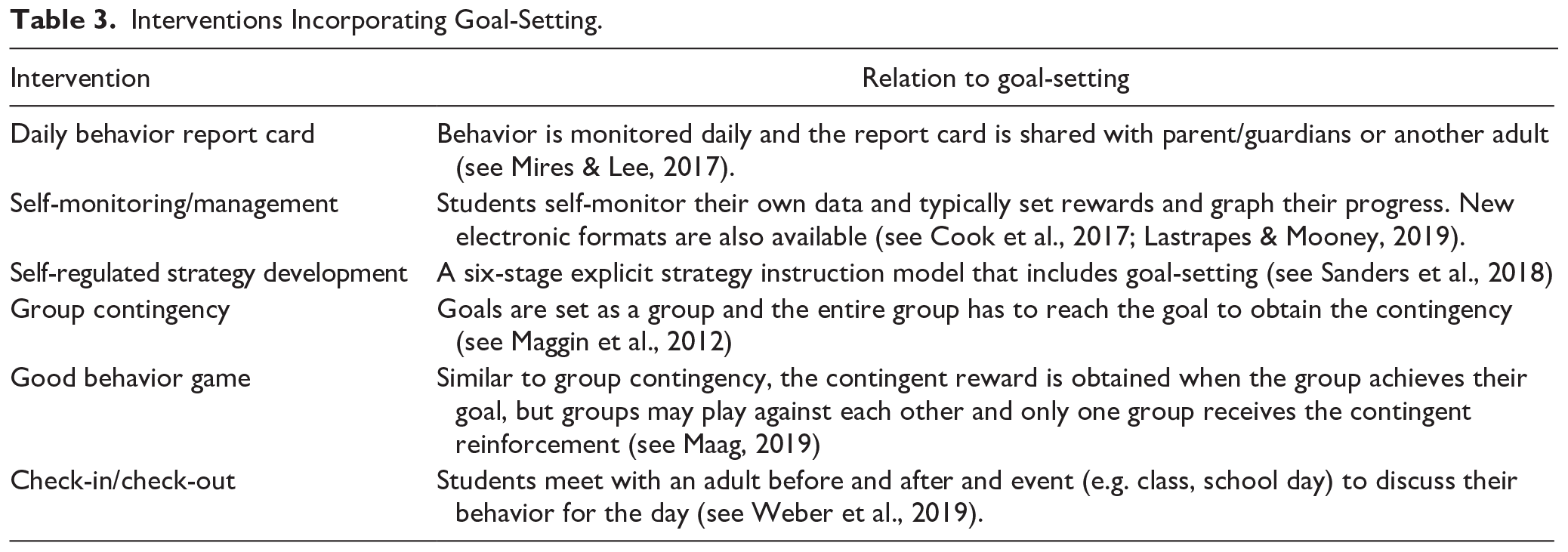
If a student continues to display the same disruptive behaviors, teachers can use other research- or evidence-based behavioral interventions that incorporate goal-setting. Sanders and colleagues (2021) describe how goal-setting is a component in self-regulated strategy development interventions, which have helped students improve their academic and behavioral outcomes. Regardless of which comprehensive intensification process chosen, the team and student should continue to meet regularly and discuss the intervention as part of an iterative process.
Korey and the behavioral management team meet after three weeks to review Korey’s data and they are all pleased to see that he was reaching his goal 74% of the time. They decide to continue to deliver the intervention and progress monitor. Unfortunately, as the school year progresses and Korey begins to think about his transition to high school, his compliant behavior regresses, and he is no longer reaching his goal. The team meets with Korey to discuss his behavior and decides to use a daily behavior report card to incorporate his parents into the intervention so that they can provide additional supports as he transitions on to the next academic setting.
Conclusion
Students with EBD are likely to display actions that negatively impact their behavioral and academic outcomes (Lane et al., 2008) and teachers often cite managing classroom behaviors as one of the most significant challenges they face in the classroom (Wehby & Kern, 2014). Goal setting is an intervention with a growing evidence base for improving behavioral outcomes in classrooms, and it can be implemented as a stand-alone intervention or incorporated into existing classroom behavior management strategies. As demonstrated with the fictional example of Mrs. Lynn and Korey, goal-setting interventions can be delivered in a classroom setting, incorporated into existing practice, and intensified to meet the individual needs of students with EBD. Goal-setting interventions should be intensified in a systematic format that allows teachers and students to monitor their progress monitor toward a predetermined goal and incrementally increase the intensity of the intervention without unduly increasing workload. Goal-setting interventions can be intensified by increasing dosage, increasing alignment through the collection of functional data, or delivering the goals setting intervention as part of a multi-component intervention. The students’ progress should regularly be monitored as part of an iterative process that continually allows for intensification to meet a student’s changing needs.
Footnotes
Declaration of Conflicting Interests
The author(s) declared no potential conflicts of interest with respect to the research, authorship, and/or publication of this article.
Funding
The author(s) received no financial support for the research, authorship, and/or publication of this article.