




Abstract
There is a growing concern among teachers and parents regarding how best to teach children with emotional and behavioral disorders (EBD) in a remote learning format. Students with EBD may have specific needs that present as unique and challenging for teachers to address and when engaging in remote learning. We will discuss research-informed, adapted virtual methods, including strategies to make students feel comfortable socially and academically.
In households across the country, students are learning in environments that look vastly different than ever before. Although educational technologies (e.g., computer-based instruction) were common in classrooms prior to 2020, restrictions surrounding the COVID-19 pandemic forced teachers to rely almost exclusively on virtual instruction tools. With the widespread stay-at-home order, most K–12 students started receiving instruction online either synchronously (i.e., live lecture) or asynchronously (i.e., recorded lecture). Without access to the school building, some students were no longer able to reliably obtain educational materials, discounted or free meals, specialized services (e.g., special education, mental health services), or a rich social environment (Koehler & Farmer, 2020). With the absence of essential components and resources, parents were finding themselves trying to provide these same experiences in the home (Noonoo, 2020).
With the shift to remote learning following the COVID-19 guidelines, K–12 students started having less physical and overall interaction with their teachers. Given the unprecedented change in instructional delivery, there was no research base for the decisions educators were making. Rather, educators were having to make research-informed decisions. Even with an online school setting, students have had to adjust to new learning schedules. For example, in Illinois, following school closures, students in kindergarten received between 2 and 3 hr of instruction a day only 4 days per week (Illinois State Board of Education, 2020). This is compared with traditional hours of 6 hr a day of instruction, 5 days a week. Older students were spending even less time with their teachers, as educators filled in the instructional minutes with asynchronous instruction and independent work (Noonoo, 2020). Academic hardships (i.e., students not benefiting from remote instruction), financial struggles, job loss, healthcare concerns, and an impaired overall well-being (e.g., unstable mental health) plagued families across the United States (Cohen & Heinz, 2020). Schedule juggling made meeting online academic demands difficult for some, which contributed to widespread absence and truancy issues.
The experience educators and families have gained from engaging in a year plus of eLearning can be readily applied to future instances of eLearning. Best practices for delivering instruction online can be applied to students who receive instruction in hospital settings or home-bound instruction. In addition, this new way of instruction may benefit students who are incarcerated, students who require summer school, and rural populations who otherwise would not receive quality instruction due to their geographic distance from qualified educators. The following two suggestions address specific areas teachers can pay particular attention to when preparing to teach learners with emotional and behavioral disorders: (a) how teachers should adjust the structure of the classroom learning environment by including a behavior management system, response cards, reinforcement systems, and meaningful breaks; and (b) how teachers can promote social development by incorporating social interactions remotely through family–school relationship solutions and metacognitive social solutions.
Students With Emotional and Behavioral Disorders
The circumstances of at-home learning made meeting the unique needs of the over seven million students with disabilities in the United States (National Center for Education Statistics, 2020) incredibly challenging for teachers. Emotional Disturbance (hereafter referred to as emotional and behavioral disorders or EBD) is a disorder that is identified when there is an inability to learn that cannot be explained by any definitive intellectual, sensory, or health factors. This diagnostic criterion implies an unexplained element to this disability. Thus, the needs of students with EBD are particularly unique when compared with students with other disabilities (Individuals with Disabilities Education Improvement Act [IDEA], 2004).
The documented incidence rates of EBD among school-age children are low (i.e., 5% of students receiving services under IDEA during the 2020–2021 school year). However, given the vague and subjective definition of EBD (Hanchon & Allen, 2018), prevalence of students with EBD varies widely, between 1.65% and 17% (Office of Special Education Programs [OSEP], 2018). The criticized diagnostic criterion of EBD also relies on the severity of externalized behaviors and level of disruption to their academic instruction, as such a large percentage of students with EBD may not consistently receive the necessary services they need to be successful. In addition, data indicate that teachers are not well prepared to meet the needs of students with EBD (Zolkoski, 2019).
This is particularly concerning because students with EBD tend to have a more difficult time regulating their emotions and maintaining peer and teacher relationships both in and out of the classroom when compared with their peers without disabilities (Henry, 2020). Although about half of students with EBD spend most of their school day (i.e., more than 80%) in a general education classroom, they have the lowest grades and the highest dropout rates of any disability group (Lloyd et al., 2018). Students with EBD also have a lower 12th grade graduating rate (60%) compared with other disability categories (73%) (OSEP, 2018may). Unless teachers get to know their students as well as educate themselves about the signs, triggers, and behaviors of a student with EBD, they will be unable to advocate for them sufficiently and may not be able to provide them with the necessary resources and services.
Classroom Structure and Environment
The online learning environment looks nothing like the physical space the teachers and students are used to. However, just like in school buildings, the classroom teacher needs to arrange the eLearning environment in such a way that ensures the most advantageous and intentionally structured space with the least number of distractions for students with EBD (Lamport et al., 2012). No matter the learning format, programming for students must meet the identified needs and be evaluated to determine whether measurable goals set out in the collective Individualized Education Programs (IEPs) are being met. Although teachers are subject to what their district provides for them, teachers may consider using a very structured, all-in-one platform such as Miro (miro.com), Wakelet (wakelet.com), or Notion (www.notion.so). Marsh et al. (2019) found that a large majority of students with EBD in Grades K–12 did not contribute as much to the class and were not considered as much a part of the group as their general education peers were in terms of involvement and inclusion in class activities. This concern is exacerbated when students feel isolated in their homes, with just a computer screen to interact with.
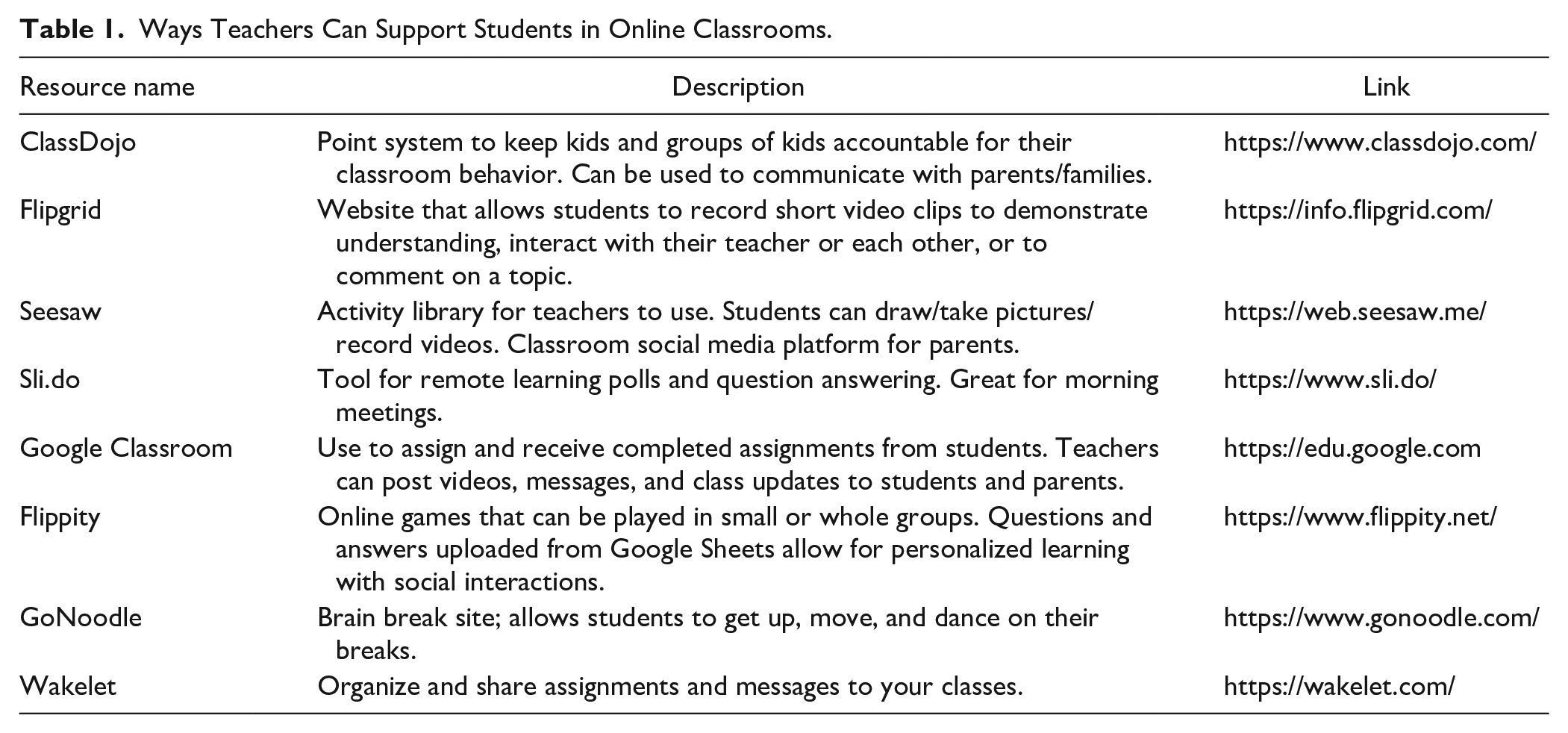
Educators must find a way to form a positive relationship and use that relationship with students to maintain involvement in the virtual classroom. For example, teachers can use a video interaction site like Flipgrid (info.flipgrid.com) to promote student-to-student interaction in a safe and fun way. Students can post videos with various filters to share their ideas, respond to teacher prompts, or connect with their peers. Teachers need to use best practices and make research-informed decisions for their students with EBD in an eLearning platform. More importantly, they need to understand who their students are, what they enjoy, and how they function. By creating an environment and taking the steps that encourage these relationships, a student with EBD can be successful in any general education classroom. Table 1 outlines various ways in which teachers can support students within their online classroom.
Ways Teachers Can Support Students in Online Classrooms.
Learning Environment
A concern for both families at home and teachers in schools is ensuring each student has a learning environment that will be distraction free and provide a safe and quiet atmosphere where students can focus and attend to instruction. Given the constraints when learning online, teachers need to make intentional efforts to loop parents in as much as possible. Seesaw (eb.seesaw.me) is a social media-like platform teachers can use to share with families what their children are learning, what activities they are completing, and what is going on during the instructional day. Online tools like this provide opportunities to mitigate the difficulties some families experience when creating a supportive learning environment for their child and also promote a more productive and focused day (Lloyd et al., 2018).
Communicating daily expectations to students and family members might be easiest to incorporate into online platforms like the stream function within Google Classroom. This functions like Facebook and includes announcements and upcoming assignments. It is the first thing students see when they log in. Within this stream, the teacher can outline what elements of the day align with individual student goals (e.g., collaboration, independent work). Even with a well-planned day and clear expectations delivered to students, the at-home physical learning environment can make it difficult for students to concentrate or use the self-regulating strategies they have been taught in the classroom setting. These self-regulation strategies help them identify and de-escalate activities and events during the school day that trigger them. Effectively using de-escalation strategies helps students address triggers sooner (Lee, 2018). The following suggestions were designed to help teachers enhance the teaching with the virtual classroom for students, adapting best-practices classroom strategies to address the obstacles that come with remote learning.
Behavior management plan
Teachers should implement a consistent and explicit behavior management plan
Students with EBD may associate certain class activities (e.g., math, specific reading lessons) or times of the day with negative emotions and lash out inappropriately due to a lack of ability to express their emotions (Lamport et al., 2012). When provided with clear expectations, there may be fewer challenges when completing a task (Zolkoski, 2019). Desired behaviors exhibited by students should be explicitly praised and undesirable behaviors should be addressed directly (Lamport).
Response cards
Another successful strategy that has shown to be helpful in the remote learning classroom among students with disabilities is the use of response cards (Didion et al., 2020). During in-person learning, response cards take form by way of a physical piece of colored paper, shapes, or cards with short phrases on them such as “yes,” “no,” and “question” that allow students to respond without disrupting the flow of the class (see Figure 1). In a virtual environment, response cards may look different (e.g., students using the chat box to comment) but still function to either answer a question or get the teacher’s attention without the need for unmuting the microphone. This attention-grabbing strategy promotes active student response. It may increase student achievement and also hold the student accountable for their learning while helping them feel that they truly belong in that classroom.
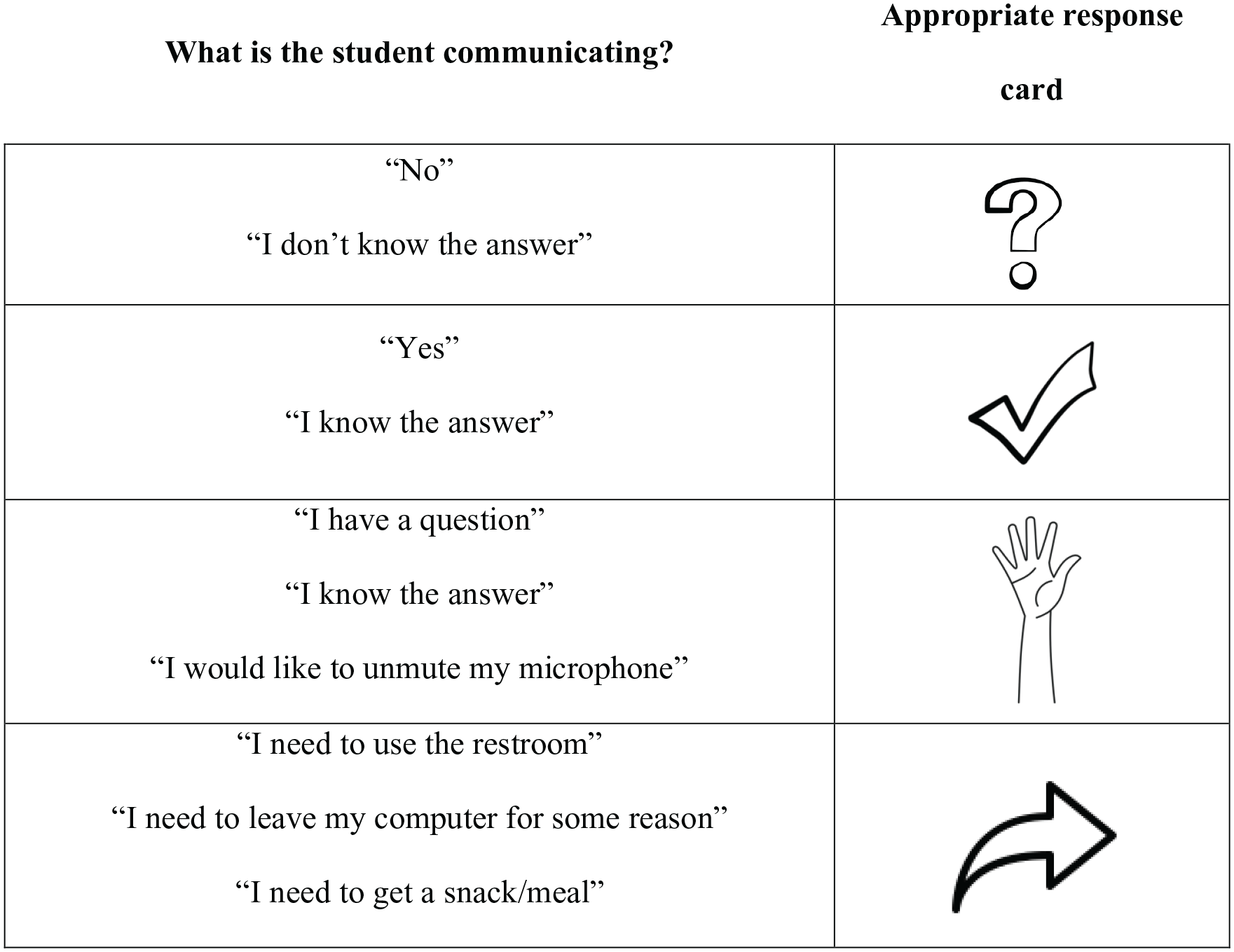
Student response card options.
One way of incorporating digital response cards in the eLearning classroom would be to use a Google Slide extension, Pear Deck (www.peardeck.com/googleslides), which transforms simple multiple-choice options on a slide or moveable or clickable options for each student. Teachers can use Pear Deck throughout their lectures to check for understanding or to touch base with students to see how they are feeling. Teachers can also use polling features within most online platforms (e.g., Zoom, Google Classroom) or traditional paper response cards when trying to get a quick check for understanding or to make sure students are still engaged in the lesson.
At the start of each unit, students should be directed to gather materials around their homes to make these cards if that is their preference. For example, before a math lesson, students can make cards such as, “+,” “−,” “<,” “>,” or “=.” Teachers should then model the use of the cards to their students by showing a problem on the screen followed by her camera in the corner with her holding up the appropriate card. Teachers may also consider modeling non-examples such as holding up the card while opening her microphone and saying, “It’s greater than!” The drawback to response cards is the possibility that students will watch each other and respond based on what their peers have answered. Because of this, teachers should always assess learning before moving onto the next concept with high-tech response card options such as interactive websites (e.g., iClicker), games (e.g., Kahoot!, Flippity), or online surveys (e.g., Google Forms) (Riden et al., 2020). These options are great when promoting student participation but take prior planning, set up, monitoring, and may come with a cost.
Reinforcement systems
Another adjustment teachers can make within their remote learning classroom includes implementing a consistent positive reinforcement plan. Using reward systems and strategies such as token reinforcement, antecedent interventions, and antecedent-based interventions can be very successful when managing the behaviors of students with EBD (Greer et al., 2014). In a remote learning environment, this plan may include students earning time to share something around them like a family member or pet. Teachers may also give students points to be accumulated and exchanged later for rewards, time with the teacher, or prizes the parents can provide. Teachers may consider using ClassDojo (www.classdojo.com), which is an online platform where teachers track student’s behavior and progress associated with a number of desired behaviors such as working independently, contributing something meaningful to the class, or following the rules that they set for themselves. The point system can be shared with parents to allow for continuous communication about the child’s daily progress.
Teachers may also try using Gamably (app.gamably.com), which is a behavior tracking game that is continuously running in the classroom. Points can be earned based on homework completion, grades on tests, or other classroom behaviors. These points can be synced to Google sheets so that students can see how many points they have, what level they are on, and so forth. Teachers can individualize this app for students who need a side goal so they can earn more points for individual efforts. It is important for teachers to develop a strong relationship between student’s behaviors and rewards so that students can make the connection clearly in their virtual classroom and their everyday life.
Meaningful breaks
In a remote learning environment, students with EBD require breaks throughout the course of a school day (Garwood & Ampuja, 2019). These breaks may be different for each student based on their specific needs and might include time with a favorite toy or a walk with an adult to chat about their day (Mason & Shriner, 2008). It is sometimes difficult to maintain a student’s attention on a screen for multiple hours at a time. As such, students need to be made aware of when they will receive a break and what activities they are permitted during breaks, and should also be permitted to take extra breaks if they feel necessary while still getting all activities done that need to be completed (Mason & Shriner). Teachers should incorporate brain breaks within the scheduled activities to alleviate the need for students to request to step away during instruction. Depending on the grade level of the students, teachers may use GoNoodle (www.gonoodle.com), which is a collection of full-body games and activities that might involve jumping, clapping, and running around the room.
If students require breaks in addition to those scheduled by the teacher, the student will need a method of communication to relay this information without disrupting the class or bringing inappropriate attention to themselves. This might include clicking the “raise my hand” button, holding up a certain color response card, or sending the teacher a direct, private message. To provide breaks for students that support their social-emotional health as well as their academic productivity, teachers should work with the family to identify an area close by for breaks where the student can take their focus away from academic demands (Mason & Shriner, 2008). Establishing this space may improve a student’s motivation to learn more after having time to refresh (Marsh et al., 2019). It is important for teachers to check in at least weekly with the family members who support the student during remote learning to determine whether anything needs to be revised, including breaks in general and the student’s space.
Promoting Social Development
Students with EBD may need an environment that nurtures their self-esteem to further encourage their social development (Lamport et al., 2012). However, students with EBD may develop a negative self-concept when engaging in social interactions (Garwood & Ampuja, 2019). This in-combo with the differences in how a student with EBD learns compared with their general education peers may lead to a deficit in social skills, especially when interacting with a person or environment for the first time (Cumming, 2013). Students may learn best in a social environment that emphasizes inclusion and collaboration with their general education peers (Garwood & Ampjua). This may look like something as simple as putting students into breakout groups in their Zoom call. Socialization can also be guided by having groups of four to six students engage in a Quizlet Live (https://quizlet.com/live) review game to go over instructional material. Social interactions and relationships are critical for the academic achievement of students, as well as for their personal development, mental health, and well-being (Lamport).
Remote Learning: Social Concerns and Connections
Social concerns that come along with remote learning may result in impaired relationships with peers and lacking connections with teachers in a manner that may not have been an issue during face-to-face learning (Marsh et al., 2019). If a student with EBD is not being held accountable for their actions (e.g., misbehaving), the student may experience feelings of isolation (Henry, 2020) that may result in the student lacking a sense of belonging among their peers (see Figure 2). In addition to social isolation, students must also learn how to first acknowledge and later on regulate one’s emotions (Marsh et al., 2019). Websites and resources such as Collaborative for Academic, Social, and Emotional Learning (CASEL, https://casel.org/) can help students accomplish this. CASEL can provide teachers with strategies to help students build techniques for both recognition and self-management of different emotions and reactions they may experience in the online environment. Students with EBD may have already begun this journey of self-discovery and progression and may struggle to adapt those strategies and methods to an online environment. Some students may have just started to recognize and understand their emotions and behaviors and may not know how to accomplish any sort of regulation during the school day (Gable et al., 2012).
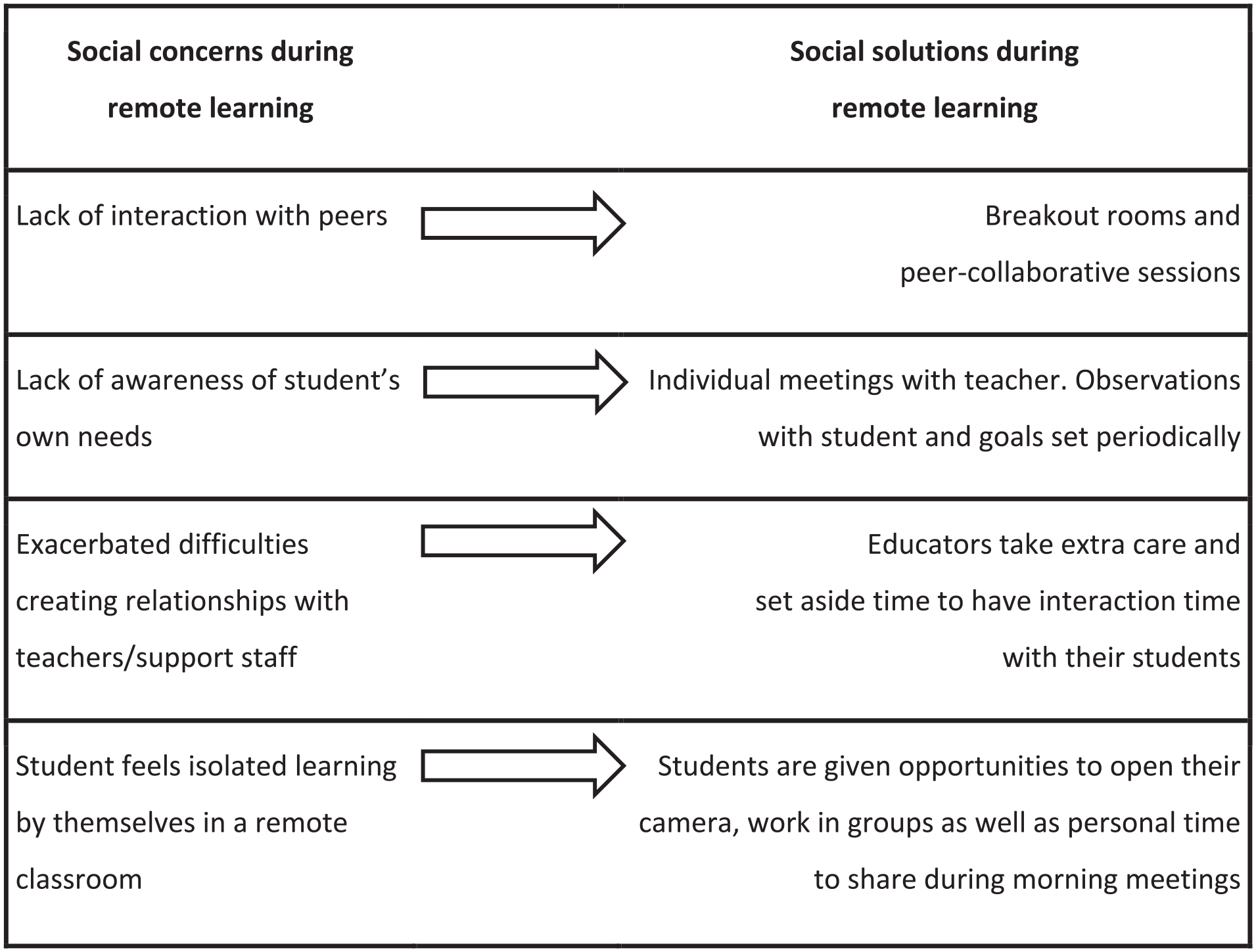
Proposed solutions to common social challenges.
Marsh et al. (2019) discuss how students with EBD have a tendency to have a much more difficult time when creating and sustaining relationships with teachers than their peers. Students with EBD are at an increased risk for becoming disconnected from school staff due to the struggles of maintenance and formation of these critical relationships. This is likely to increase if teachers are not adequately prepared with the necessary strategies, information, and materials to form these relationships. Tips for teachers here may include things such as assigned check-ins with the student in a small writing assignment they complete at the beginning of the day and turn in on Google Classroom or Seesaw.
Incorporating Social Interactions Remotely
To combat the social struggles among students with EBD that come along with remote learning, it is critical that teachers use strategies that incorporate social interaction throughout the school day. Students get stimulation from social environments, and as such, they need to be collaborating with peers and working together during assigned activities or projects as well as in between structured work activities (Gable et al., 2012). Teachers should promote a socially inclusive environment by assigning heterogeneous groups in order to promote students with and without disabilities working together (Garwood & Ampuja, 2019). These groups can be established virtually by placing students in breakout sessions or by assigning students group work during an offline assignment. These types of activities can provide a sense of belonging and community among students while developing critical interpersonal relationships (see Figure 2) (Lamport et al., 2012).
There are several online tools that teachers can use to promote collaboration and socialization among students in the virtual classroom. Quizlet Live (quizlet.com/features/live) is a great team approach activity that gamifies learning. Like Kahoot!, students team up to answer questions the teacher prepares for them. The students work together to answer the questions within their learning platform (e.g., Google Classroom). This healthy competition builds community while encouraging peer to peer interactions. Flippity (www.flippity.net) is another collaborative tool that teachers can use by building online games that can be played in small or whole groups. Questions and answers are then uploaded from Google Sheets, which allows for personalized learning with social interactions.
Family–school relationship solutions
A critical piece when educating and collaborating with students with EBD in a remote learning format is communication. Constant and concise communication is a component of learning virtually that benefits the student, families, and the teacher (Garbe et al., 2020). Teachers should start by setting expectations for the student and their family regarding what the year will look like along with how classes will proceed (Garbe et al.). Then, teachers should create an online schedule that teachers update daily where students have access to due dates, assignments, and homework. Teachers can pick a schedule from premade Google Slide templates from Slides Carnival (www.slidescarnival.com) or SlidesMania (slidesmania.com) and edit to match their own personal preferences. Then, they can share this live link with students and families so expectations are clear to everyone. Teachers may also consider hosting a classroom social media platform (e.g., Twitter) where they can post updates for parents, reminders, and any other key information they need to know (e.g., due dates).
Daily check-ins at drop off or pick up are a thing of the past, and as such, teachers have had to develop new strategies to connect with parents about individual students with EBD in a virtual way. One option might be communicating with parents through a shared Google Doc (www.google.com/docs). Keeping lines open for communication between teachers and parents of students with EBD is particularly important and helpful in times of anxiety and uncertainty such as during a pandemic (Tremmel et al., 2020). It is equally important that special educators and service providers (e.g., speech-language pathologists) make a concerted effort to communicate and stay on track with the family (Tremmel). It is imperative to the student’s learning and overall well-being that the teacher be kept up to date on all information and be aware and attentive to all documentations and meetings that the student and family take part in with any special educator and/or special services professional (Tremmel). Plans of what needs to be discussed such as academic progress reports, social updates, and general check-ins with family well-being and functionality are all positive components of the meetings.
Metacognitive social solutions
Teachers need to consider the social-emotional needs of their students with EBD. Social emotional learning (SEL) is the process of developing self-control, self-awareness, and interpersonal skills, specifically for students in a classroom (Mason & Shriner, 2008). Although there are dedicated curriculums to help teachers address and promote SEL, there are simple ways in which teachers can use SEL strategies during the virtual school day. Teachers may include self-made virtual check-in through Google Survey or with teacher-made self-monitoring Google checklists. However, districts may opt to purchase a dedicated curriculum designed to support students socially and emotionally through direct and explicit methods of instruction such as Second Step (Committee for Children, 2011).
These curricula may include strategies such as modeling for partners a conflict-resolution activity or something as basic as asking all of the students to share how they feel each morning (see Figure 3). This can be incorporated within Slido (www.sli.do), which is an online polling and Q&A app that allows the students to see each other’s responses in real time. Answers can be displayed as a word cloud or in a graph. For example, the teacher may ask, “Describe in one word how you are feeling today.” Students can feel connected to each other when they see common words pop up on the screen such as “anxious” or “overwhelmed.”
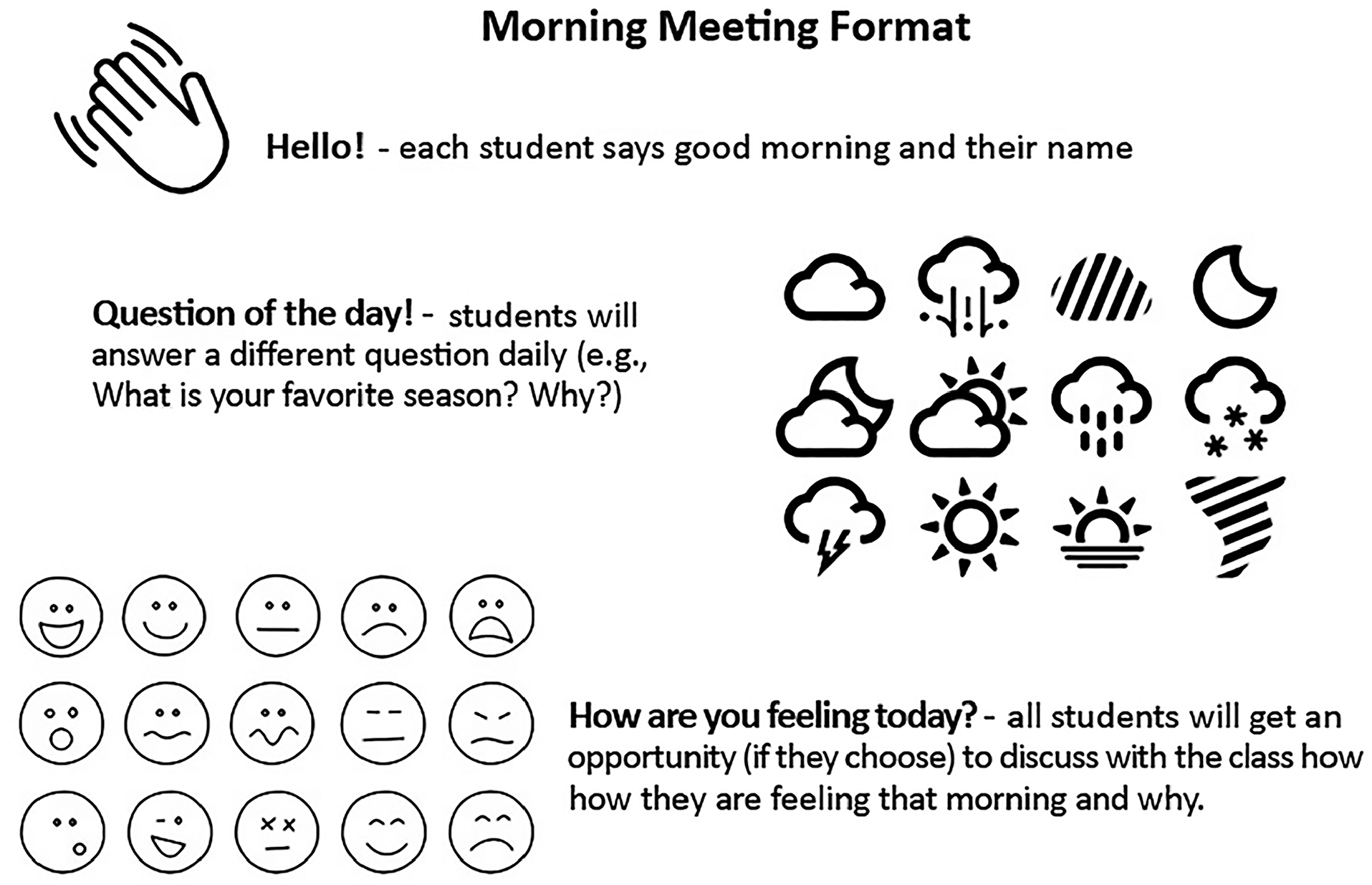
Morning meeting option.
Domitrovich et al. (2016) found that when teachers used an SEL approach in their classroom, students with EBD reported having higher levels of self-awareness of their own behavior, social and emotional skills, and personal achievement. Using different types of collaborative and individual SEL lessons has been shown to strengthen learning processes, emotional processing skills, and social relationship skills that are needed to assist a student in learning how to self-regulate (Smith et al., 2018).
In SEL lessons, students learn to identify feelings and emotions, how to recognize when one feeling is being felt, and how to accept/process such things (Smith et al., 2018). Then, once students have been taught emotional regulation, they are often introduced to problem-solving strategies. It is imperative that while they are learning how to problem solve in uncomfortable situations, they are simultaneously working on controlling their emotional and trigger responses. It is also imperative, particularly during remote learning, that teachers provide SEL lessons that incorporate mindfulness and stress-reducing strategies for students of all ages (Raschdorf et al., 2020). This can be incorporated while having discussions about current events and emotions connected to them or when practicing deep breathing Students with EBD may need additional guidance from an instructor in order to benefit from these strategies.
Conclusion
Students with EBD who are learning through a remote format may have to work to overcome hardships related to their disability as well as the structure struggles that come with attending school online. With the use of best practice teaching strategies, through research-informed decision making, with use of online resources, and through getting to know students as individuals and learners, teachers can strike a balance online that allows students to create, find, and implement strategies that work best for their students with EBD. Teachers must be creative when finding reliable strategies that combat social deficits by forming positive student–teacher relationships and cultivating an environment that promotes student–student relationships in an intentional way. Although there is very little research dedicated to measuring methods used to support students with EBD through eLearning, teachers need to seek out strategies that are aligned with proven learning strategies for students with EBD. Teachers should be aware of all the tools available to assist them in creating effective eLearning environments for students with EBD.
Footnotes
Declaration of Conflicting Interests
The author(s) declared no potential conflicts of interest with respect to the research, authorship, and/or publication of this article.
Funding
The author(s) received no financial support for the research, authorship, and/or publication of this article.
