



Abstract
Motivational interviewing (MI) is an established, research-based intervention that focuses on building intrinsic motivation to promote lasting, healthy changes in a variety of situations. In school settings, MI has been used to improve student motivation, attendance, punctuality, confidence in schoolwork, and self-determination as well as increase student academic grades. Students who exhibit challenging behaviors in schools often feel ambivalent toward change, and teachers often have a difficult time motivating them toward positive and prosocial behaviors and actions. This article describes the framework of MI and gives specific descriptions of how middle school teachers and other school personnel can use MI to help their students who are experiencing challenging behaviors due to lack of motivation increase their likelihood of school success.
Mr. Ali and Mrs. Gonzalez are middle school teachers. Mr. Ali is an eighth-grade teacher in an inclusion classroom and Mrs. Gonzalez is a self-contained special education teacher for middle school students with emotional and behavioral disorders (EBD). Both teachers work with Jimmy, an eighth-grade student who can be oppositional and defiant at times. Jimmy often arrives to class late, refuses to work, and verbally challenges both teachers. In Mr. Ali’s class, Maya has also had a difficult time staying on task during class. Maya was doing reasonably well at the beginning of the year, but she now often seems to be daydreaming during class time, rarely responds in class discussions, and has turned in her assignments less frequently over time. In Mrs. Gonzalez’s classroom, sixth-grade Angel has had multiple bouts of physical aggression that no interventions seem to help reduce. He has been in fights with other students, been known to lose his temper quickly, and often shouts at other students. Mr. Ali and Mrs. Gonzalez feel tired and stressed. They have tried talking with each student, using positive reinforcement techniques, and setting boundaries. Still, the behaviors persist. They want something that will increase engagement and decrease behavior problems in their classrooms.
Many students experience ambivalence. On one hand, they want to make positive changes, but on the other hand, they have reasons for staying the same. A student may desire to get better grades or into fewer fights, yet they cannot seem to find the time for homework or help but get angry at their teachers. More simply put, students often want to change but lack the motivation. Motivational interviewing (MI) was created to allow students to work through the ambivalence they experience. Motivational interviewing is a “collaborative conversation style that generates supportive pathways for an individual to harness their own desire for change” (Miller & Rollnick, 2013, p. 29). The purpose of this article is to describe MI, a research-based approach to improving behavior and learning.
Through MI, teachers can use conversation to support students in thinking through their own reasons and strategies for change. MI works to increase intrinsic motivation and uses open-ended questioning, accurate empathy, and engagement to change behaviors that might have previously led to feelings of ambivalence or resistance (Miller & Rollnick, 2013). This framework has substantial evidence to support its use in a variety of cultural contexts and backgrounds, as well as with students of all ages who are at risk of dropping out or may have disabilities (Oh & Lee, 2016; Ratanavivan & Ricard, 2018). Motivational interviewing can help students with severe, persistent challenges who display behaviors such as aggression, oppositional defiance, work refusal, chronic tardiness, or off-task behaviors by giving teachers a new way to approach these behaviors that support student autonomy and elicit student thoughts and feelings about change.
Practitioners should note that the examples illustrated throughout this article address middle school students. This intervention has been examined with Grades 3 through 12 (see Snape & Atkinson, 2016). Adaptations for the use of MI with younger students are still being researched. This article aims to equip practitioners with the necessary tools to implement MI by understanding MI’s evidence, spirit, and method and seeing practical examples depicting how MI could be used with various challenging behaviors in school settings.
What Exactly Is Motivational Interviewing?
MI is an intentional conversation method used to bring about change by strengthening one’s internal motivation and increasing one’s commitment to change (Miller & Rollnick, 2013). As a brief counseling approach for behavioral change, the spirit and methods of MI are used in a milieu of settings, from counselors and healthcare professionals to teachers and administrators in schools (Miller & Rollnick, 1991, 2002, 2013). The goals of MI, across all settings, are to bring about lasting change through conversations that allow individuals to talk themselves into change. MI aims to shift the focus away from blame, arguments, and ambivalence and toward autonomous decisions geared at growth through collaboration, acceptance, compassion, and evocation (Miller & Rollnick, 2013).
There are students at every school who struggle with motivation. Teachers often find themselves implementing sticker charts, level systems, and rewards to increase motivation, but rarely do these have sustaining effects for students (Robinson et al., 2006). Alternatively, teachers may try correcting, placing responsibility, or punishing students. Yet, these effects can be minimal (Bambara et al., 2021). MI focuses on the struggle students seem to consistently face: ambivalence. As noted earlier, in this context, part of the student exhibiting ambivalence wants to change, while another part of the student seems to want to keep things the way they are.
Teachers regularly experience student ambivalence. A high school student is failing and says she will turn in her work but never does. A middle school student says he will be on time for class the next day but is tardy. An elementary student says she wants to stop blurting out in class but finds herself doing it again and again. Rather than telling the student what is right, MI focuses on eliciting change talk from the person experiencing ambivalence to increase motivation and inspire action.
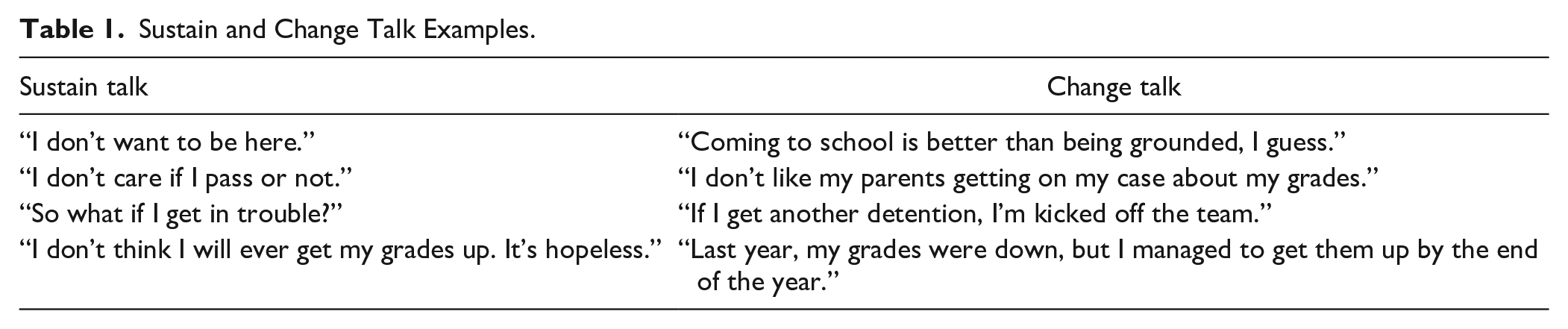
Users of MI are trained to look for two specific types of “talk” in these collaborative conversations: sustain talk and change talk. Sustain talk focuses on the reasons for things to stay the same, such as reasons to keep fighting with others, continue skipping school, or not turn in homework. Sustain talk gives reasons to remain the same, even if someone knows it is not best for them. Change talk, on the contrary, shares reasons to change, including things students do not like about their current situation. MI focuses on softening sustain talk and cultivating change talk, as studies suggest the more a person talks about changing, the more likely they are to make the change they want (see Table 1; Miller & Rollnick, 2013).
Sustain and Change Talk Examples.
What’s the Evidence Base for Using MI With Students?
Multiple studies have examined the effect MI has had on adults and children. It has been effective in improving measured behaviors for those who smoke, drink, gamble, use illegal substances, have eating disorders, and struggle to exercise (Lundahl et al., 2010). Outside of school settings, MI has been particularly effective in decreasing drug and alcohol abuse and reducing aggression. A study conducted by Clair-Michaud et al. (2015) randomly assigned 189 incarcerated adolescents to either two MI or relaxation therapy sessions. Their study found participants in the MI group had significantly less aggression at post-assessment than those who received relaxation therapy.
Although more limited, MI research has also been conducted in school settings on its effectiveness with students. In a randomized controlled trial conducted by Strait et al. (2012) and replicated by Terry et al. (2013), researchers found just one 45-min session of MI had significant improvements on in-class participation, academic behavior, and math grades. A literature review examined the evidence supporting MI in educational settings and found eight high-quality studies (Snape & Atkinson, 2016). The findings demonstrated significant improvements in school-based motivation, attendance, punctuality, confidence in schoolwork, and self-determination, as well as higher math, science, and history grades. Evidence indicates MI shows promise to be used by teachers and administrators (Snape & Atkinson, 2016).
Regarding students with challenging behaviors, a study conducted in 2018 examined the effects of MI in a disciplinary alternative education program. This study included 15 students in Grades 3 through 5 who had been removed from their regular campuses due to noncompliance, bullying, possession of weapons or substances, violent behaviors, and assault. Each student participated in six individual MI sessions in this study, demonstrating moderate effectiveness overall (Ratanavivan & Ricard, 2018). Research has also been conducted examining students with intellectual disabilities experiencing challenging behavior. Frielink and Embregts (2013) discuss modifications that can be made to MI for students in this population. Understanding the specific needs of students is imperative, and adaptations for students with comorbid EBD and intellectual disabilities, autism, and attention-deficit/hyperactivity disorder are found in Table 2.
Motivational Interviewing Adaptations for Students With Comorbid Disabilities.

Source. Adapted from Frielink & Embregts (2013).
Note. ADHD = attention-deficit/hyperactivity disorder.
MI has been used globally, and this conversation style’s impact on students of many cultural backgrounds has been investigated. Within the United States, studies have shown MI tends to be more effective with racial minorities than with White students (Hettema et al., 2005; Oh & Lee, 2016). Researchers have suggested this could be due to racial minorities in the United States being less likely to utilize mental health services and more likely to feel misunderstood by practitioners (Oh & Lee, 2016). As MI focuses on the goals and opinions of the individual, it may give more agency to students of color, making the intervention more effective. Specific cultural adaptations of MI have been tested and shown to be effective for populations such as Latinx (see Añez et al., 2008; Interian et al., 2010) and American Indians (see Dickerson et al., 2015; Venner et al., 2007). Overall, findings for using MI in schools with challenging behaviors are positive and support its use for students with disabilities from various cultural backgrounds.
The Spirit of MI
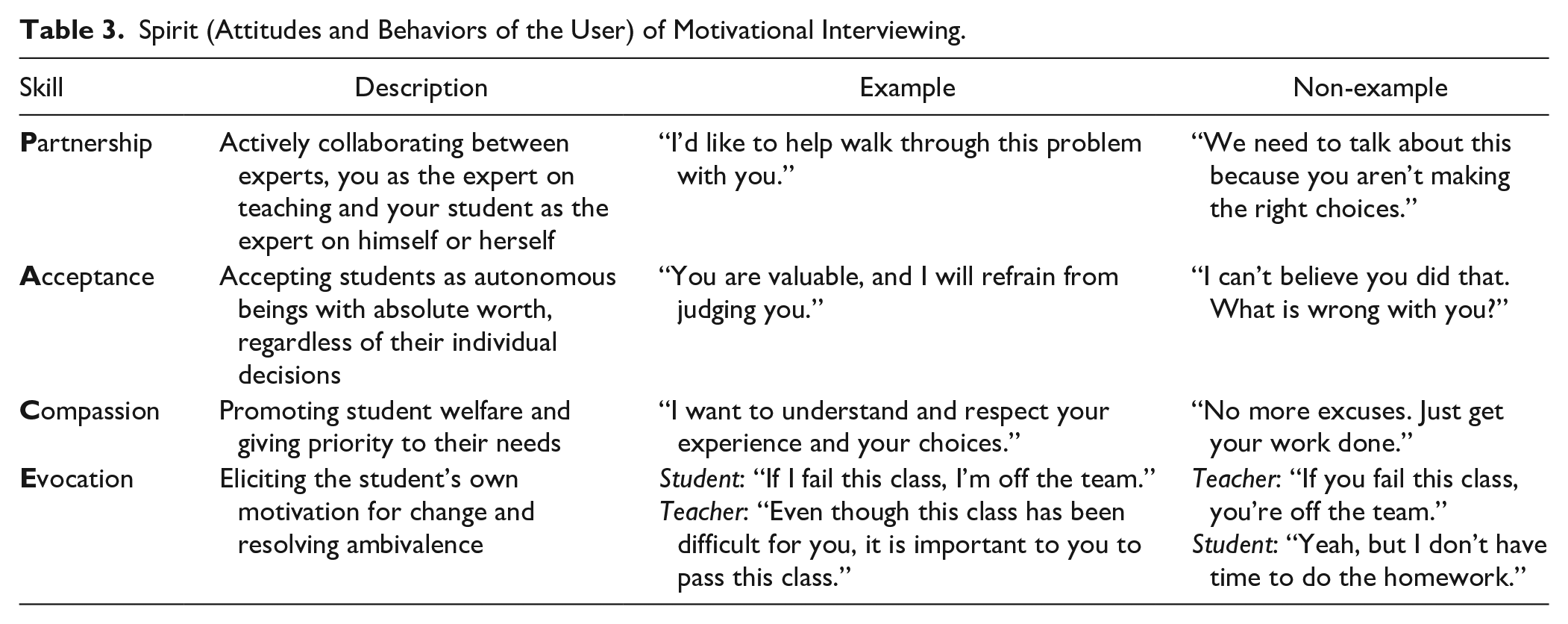
While the techniques in MI are significant, multiple studies and meta-analyses demonstrate that simply knowing the right words to say is not enough to bring meaningful, lasting change (Burke et al., 2003; Lundahl et al., 2010; Snape & Atkinson, 2016). Meta-analyses have also demonstrated that even when MI interventions are manualized, well-controlled, and closely supervised, there can be a large amount of variability based on the interventionist (Burke et al., 2003; Miller et al., 2003). These skills are referred to as the spirit of MI. The spirit of MI consists of the attitudes and behaviors of the user toward the student. A belief of MI is that students need to feel accepted, appreciated, and important to want to make changes. The spirit of MI consists of partnership, acceptance, compassion, and evocation, otherwise known as PACE (see Table 3; Miller & Rollnick, 2013). These characteristics focus on the relationship one may have with their students and pay careful attention to students’ change talk statements (Rollnick et al., 2016).
Spirit (Attitudes and Behaviors of the User) of Motivational Interviewing.
Partnership
In MI, partnership means both the teacher and the student serve as the expert. The teacher serves as the expert on the material being taught, and the student is an expert about themselves. Students have different levels of trust they are willing to give, so this will come quickly for some students and take longer for others. Forming a partnership with students allows the student to feel trusted and respected. Therefore, they are more likely to develop ideas for how they might want to change their actions to better their educational experience.
Acceptance
If students feel accepted as human beings, they are more likely to change. A fundamental way to accept students in the classroom is by supporting their autonomy. Students have the right to make decisions for themselves. While teachers do want what is best for their students, it is not the teacher who decides their actions. Acceptance does not mean affirming every decision a student makes but instead accepting they are their own person, who makes their own choices, and likely has reasons for the choices they have made.
Compassion
Compassion focuses on an “active commitment to meet a student’s needs” (Rollnick et al., 2016, p. 24). Compassion in this sense is to give priority to the needs of the student that is being helped. Compassion has proven to be a critical component to seeing lasting change in clients’ behaviors (Miller & Rollnick, 2013).
Evocation
The last characteristic, evocation, focuses on a student’s words and draws out their own perspective about change. Evoking involves listening carefully to students to hear their own reasons they want to change. It is considered the opposite of telling students what to do. From the point of view of MI, students often know what they should do. It is motivation they lack. They may feel ambivalent toward the change they should make. Given this context, then, telling students what they should do may often lead to resistance. A common refrain in the classroom might be, “I know I should have done my homework last night, but . . .” The student here is showing ambivalence. Changing the refrain and instead of reflecting compassion can evoke the student toward their own change. Many teachers are naturally compassionate, accepting, and treat their students as partners. When these occur, evoking starts the change process by concentrating on their change talk.
The Method of MI
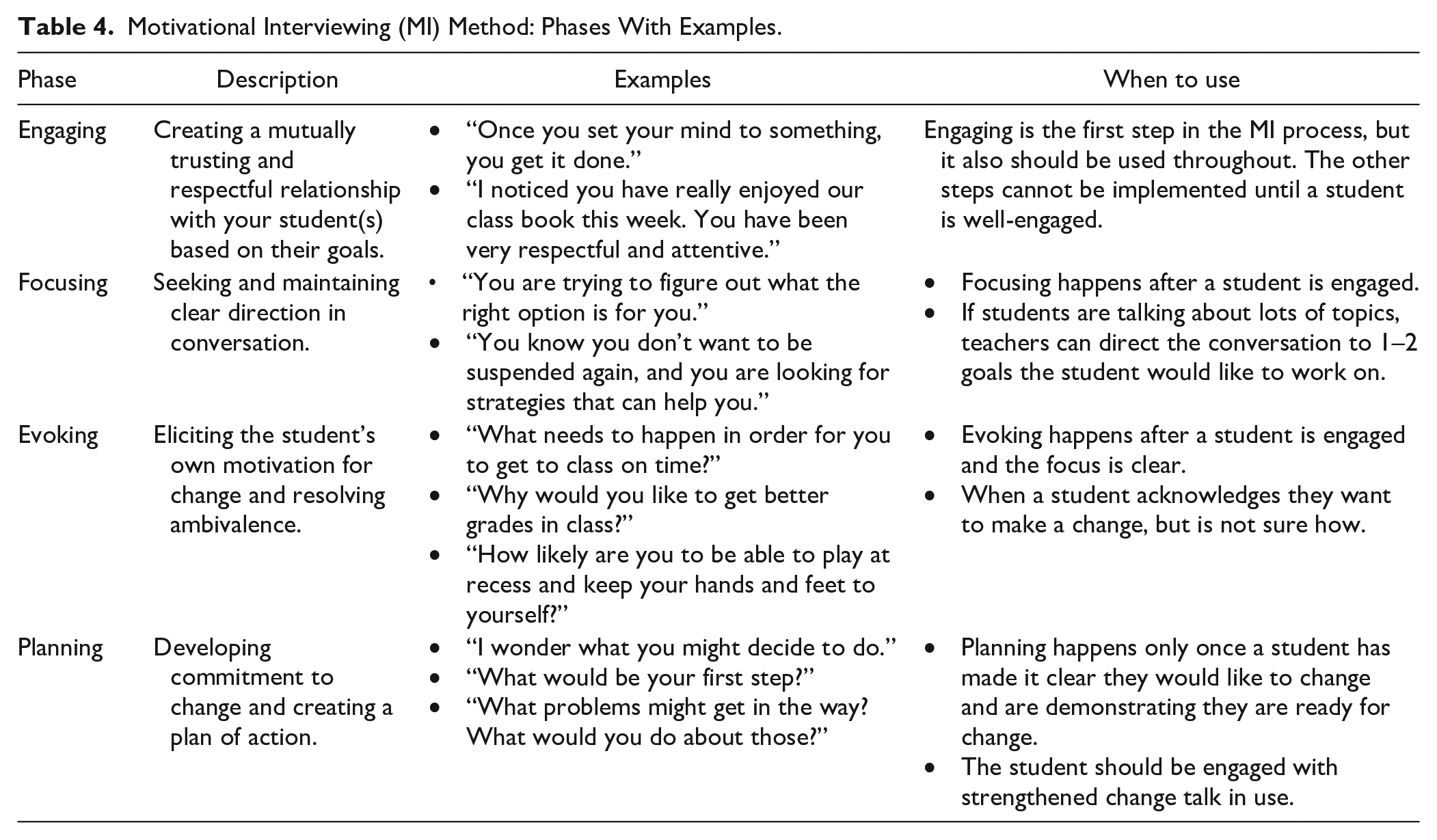
Just as they have four characteristics encompassing the spirit of MI, Miller and Rollnick (2013) have also developed four phases, or techniques, that tend to occur that lead to lasting change (see Table 4). This entire process can be accomplished in as little as 5-min conversations. The amount of time varies for each person and each circumstance, but the phase order tends to remain consistent. The phases are engaging, focusing, evoking, and planning.
Motivational Interviewing (MI) Method: Phases With Examples.
Phase 1: Engaging
Engaging involves establishing a connection with the student. This phase may take no time for some students, as they may already feel connected and supported. For other students, this may look like reaching out to them individually to show that you understand, or want to understand, their experiences. Engagement is the first phase of the process but is essential to occur throughout the conversation continuously.
Phase 2: Focusing
The process of engagement leads to focusing. Focusing directs attention to the purpose of the conversation and decides where the conversation should go. Sometimes this is very clear, such as a student failing a subject test, being tardy, or getting into a fight. Other times, it may be less obvious what the problem at hand is and may take some clarification to pick a specific area to focus.
Phase 3: Evoking
Once the purpose and direction are clear, the third phase is evoking. Evoking is the heart of MI and focuses on eliciting the student’s ideas of what changes they would like to make and how to make those changes possible. A trap that teachers can experience here is called the righting reflex. It can seem easy and efficient to tell a student what they need to change, but in the context of MI that action dismisses their agency and focuses the conversation then on what we think they should do, which seldom brings change. Instead, evoking change talk through reflecting what a student is saying (“You’re not sure how, but you know you want to change”) and asking open-ended questions (“How might you solve this challenging problem you are facing?”) can help foster change talk and ideas they are willing to try.
Phase 4: Planning
The last phase, planning, is the process of putting the change talk into action. Again, in the context of MI, the righting reflex is unlikely to lead to positive results and may increase the likelihood resistance from the student you are trying to help. Instead, it is imperative to have students plan for what they believe they can do to change during the planning phase. Planning involves active listening and affirming when you hear change talk. Planning also involves taking a realistic look at the situation, which can be done by asking a rating scale question around how likely they are to implement the discussed plan or discussing any barriers that might get in the way (see Figure 2). During the planning phase, a teacher wants to reinforce any commitment language they might hear (“You have come up with a plan and you are determined to do it”).
Tips for Implementation
To use MI effectively, implementers use four foundational skills to put the spirit and method into practice. These core skills are commonly referred to as OARS, an acronym for asking
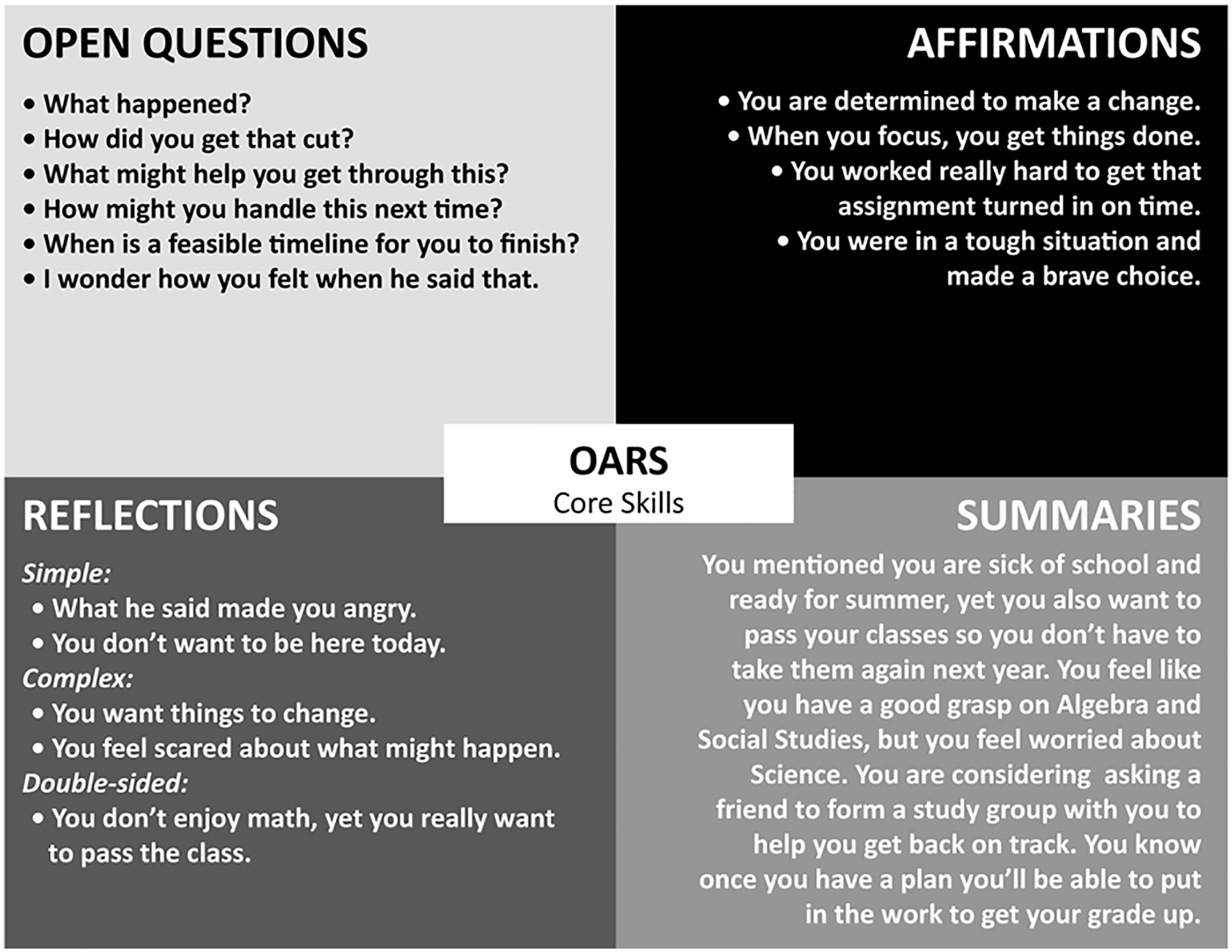
Core skills of motivational interviewing.
Open Questions
Open questions have the potential to leave conversations ripe for responses. Closed questions have a restricted number of answers, such as “yes” or “no.” Although there is certainly reason to use closed questions with students, open questions allow room for exploration of thoughts and feelings and give space for teachers to understand their perspectives. Open questions are only one piece of the puzzle and should not be the only technique used to guide a conversation about change. An example of an open question is the following: “How did you respond in that situation?” An example of a closed question is the following: “Did you lose your homework again?”
Affirming
Affirming a student means pointing out their strengths, efforts, and achievements. To affirm a student is not to add your judgment on what you think about them but rather to shed light on something already in the student. The difference can seem like a confusing nuance, but rather than saying, “Great job, I think you did awesome,” affirmations are “you” centered, such as, “You are looking for a friend who is honest because that is what you are.” The affirmation does not suggest anything about your thoughts, but instead takes stock of their personal values. The difference is significant because adding a judgment (“I am really proud of you”) takes the focus away from their strengths and instead focuses on your opinion. An example of an affirmation is the following: “You worked hard and are proud of your accomplishment. You are dedicated to the team.” An example of a positive judgment is the following: “I think you did a great job.”
Reflecting
Reflections involve repeating back what a student said or what a student might have been trying to say. Reflections are used as a part of active listening and helping others feel understood. There are three types of reflections often used in MI: simple reflections, complex reflections, and double-sided reflections. A simple reflection addresses what the person says or means, such as the following: “You did not like what he said to you.” A complex reflection addresses the feeling underneath what the student might be saying. If a student says, “I hate being at school,” then a complex reflection in response might be, “You feel hurt by this place, and you want things to change.” A double-sided reflection notes the ambivalence a student is experiencing and strategically orders the components to evoke change talk. If a student says, “I know I need to get my grades up, but I don’t think I can,” then a double-sided reflection response could be, “You are unsure how to do it, but you feel motivated to do better in school.” Double-sided reflections lead the conversation to discuss their motivation to get their grades up (change talk).
Summarizing
Summarizing involves bringing together the whole of the conversation into a brief paragraph. Summaries help focus the discussion on its significant pieces as well as help the student feel heard and understood. In addition, summaries can help change the direction of the conversation if it begins to result in tangents or unrelated information. Typically, we want to include any change talk heard in summaries and allow the student to include anything they find important that was not already reviewed. An example of a summary would be the following:
I am going to summarize what I’ve heard you say to make sure I understand, and then we can discuss where to go from here. How does that sound? You shared with me why your grades have been slipping, and you have had a more difficult time turning in assignments. Then you shared how difficult it has been for you but that you really want to improve and find a time to get your homework done. You have seen yourself excel in class in the past, and you want to get back on track. Is there anything I missed?
MI skills can be used in any conversation. They focus on active listening and responding to help others feel heard and understood to build trust and form a foundation for evoking change talk. Together, understanding the spirit and method of MI along with OARS can lead to change in students by having conversations full of empathy that give the student space to see their reasons for change and find ways to put them into action. The spirit and method of MI align well with the principles of positive behavioral interventions and supports. For students in Tier 1, teachers can increase student engagement and school motivation by forming a partnership, respecting student autonomy, and affirming students. In Tier 2, teachers can employ MI skills using a check-in/check-out system by allowing students to set goals and find their own strategies to reach their goals. MI can be incorporated as a Tier 3 intervention in having intentional, daily conversations with students that are not punitive or judgmental. Instead, teachers can consistently affirm students to highlight what they are doing well and cultivate change talk for their personal growth.
What MI Actually Looks Like With Students
Knowing the components of MI is helpful, but it can feel daunting to know how to put all the pieces together to benefit your students. In this section, specific examples will demonstrate how the spirit, method, and core skills work together to support behavior change for students who may experience ongoing behavioral challenges. In the first example, Mrs. Gonzalez demonstrates how to have a conversation geared toward change using the principles of MI. The second demonstration uses a specific tool called the readiness ruler (see Figure 2) to have students evaluate how ready they are to make a particular change. In the third example, Mr. Ali uses a decisional balance with Maya to increase her classroom engagement (see Figure 3).

Readiness ruler.
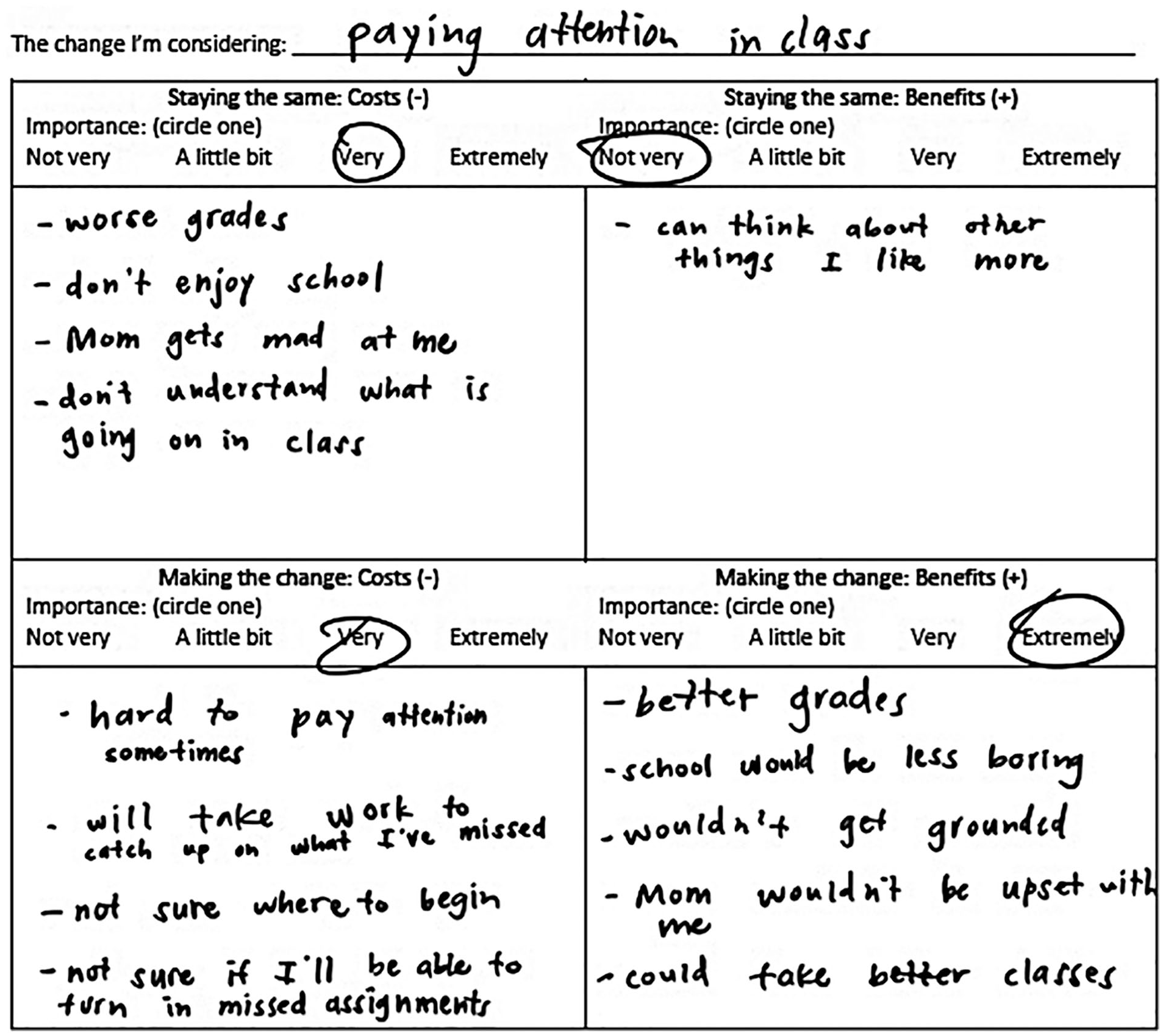
Decisional balance for Maya.
Compliance
In the vignette at the beginning of the article, we were introduced to Jimmy, an eighth-grade student who spends part of his day in the general education classroom and part in a classroom for students with EBD. Both of his teachers have been experiencing difficulties with Jimmy talking back, refusing to work, challenging their authority, and coming late to class. When each teacher has tried to address these problems in the past, it only frustrates Jimmy and often results in him refusing to engage for the rest of the class period.
Mrs. Gonzalez decides to take a different approach today and instead tries to implement some of the MI strategies addressed in this article. She begins with an affirmation, because although Jimmy came into class 5 min late today, he has been working for the entire time he has been in class. She begins by saying, “You are already finished with problem one. Here is an example of how hard you work.” Even though she was annoyed he was late, getting stuck on what Jimmy did wrong misses her opportunity to notice what he is doing right. Instead, the affirmation is designed to allow Jimmy to think about his hard work and increase his motivation to continue the trajectory.
To further address the issue of Jimmy’s compliance, Mrs. Gonzalez could engage in conversation to build rapport and deepen their partnership. Next, Mrs. Gonzalez could ask Jimmy for a future meeting to discuss his tardies and create a plan to arrive in class in a timelier manner. Mrs. Gonzalez knows Jimmy can struggle with following directions, so respecting his autonomy and ability to make choices on his own will be crucial. In following up with Jimmy, Mrs. Gonzalez is sure to remind herself that the decisions Jimmy makes are his own and affect himself most of all. Although Mrs. Gonzalez wants to see Jimmy excel in class like she knows he can, she remembers it is ultimately his choice to show up to class on time or not. To start the conversation, she reflects on his positive behaviors.
Yesterday, in class, you worked hard throughout the entire class period. I noticed you were a few minutes late and missed some critical instruction at the beginning. I wonder what caused you to be late. [Reflection]
Yeah, I had to go to my locker and the bathroom, and then I saw my friend in the hall, and he wanted to ask me something. I didn’t have time to get all that done before the bell rang.
You had too many things to get done during the passing period. [Reflection]
Yeah, I didn’t want to be late, but the passing periods are too short. [Sustain talk]
I wonder why it is that you don’t like being late to class. [Reflection]
Well, if I get any more tardies, I am going to get another detention. And my mom is gonna be so mad at me if that happens. [Change talk]
You don’t want to get in any more trouble. [Reflection]
No, she won’t let me hang with my friends over the weekend if I do. [Change talk]
You know you’ve had some tardies in the past, but you are determined to make a change, so you don’t get any more this year. [Reflection, eliciting change talk]
Yeah, it’s just the passing periods are too short. I wasn’t trying to be late yesterday; I just ran out of time. [Sustain talk]
You are trying hard to be on time. What do you think could help make that happen? [Reflection, open question]
Well, I guess I could bring my books for both science and math with me. That way, I don’t have to stop at my locker between classes.
Does that seem like a plan that will help you? [Open question]
Yeah, I don’t think it would be such a big deal to carry two books. My locker is way out of the way, so it would save me a lot of time not to stop between classes.
You have made a plan, and when you want to do something, you do it. [Affirmation]
Yeah, I think this will really help.
Mrs. Gonzalez also wants to address the non compliant behaviors she has noticed. She decides to bring this up as well.
Wonderful. I know you have also received a couple of write-ups this year for talking back to teachers. How has your mom taken that? [Open question]
Oh, that’s even worse than the tardies. Sometimes I talk back to her at home, and it makes her really mad.
You don’t like it when your mom is upset with you. [Reflection]
No, she ends up taking away my things. Like Xbox. Or time with friends. [Change talk]
You value the time you get playing video games and with your friends. You don’t want that taken away. [Simple reflection]
Definitely not. It’s so boring when I can’t do those things. But also, sometimes it’s hard not to talk back. Adults can be really annoying. [Change and sustain talk]
On one hand, some people can frustrate you, and so it’s easy to be mean to them, but on the other, you don’t like losing the things you like to do. [Double-sided reflection]
Yeah, I don’t. And I know it’s disrespectful to talk back. I just can’t help it sometimes.
I wonder what you think could help. [Simple reflection]
I’m not sure. It feels out of my control.
You feel at a loss for how, but you know you want to make a change. [Double-sided reflection]
Yeah, I do. I guess I could try not to get so angry. Like, it bugs me when my teachers are on my case about stuff, but I know it’s because they want me to do well. [Change talk]
Even though it has frustrated you in the past, you think the adults in your life want you to succeed. [Complex reflection]
Yeah, I guess I should probably be nicer to them. They are just trying to help me out. [Change talk]
So, the next time you want to talk back to your teacher or mom, it sounds like you want to instead think of how they are trying to help you. [Focusing, summary]
Yeah, then I won’t get so mad at them.
You have come up with another solution to a problem. Would you mind if I summarized our conversation from today? [Simple reflection, asking permission]
Sure.
First, we talked about tardies. You shared that though the passing periods feel short, you want to make it to class on time. You plan to skip going to your locker between your math and science classes to save time. Then we discussed some other times you’ve gotten in trouble for talking back to teachers. You don’t want to get in any more trouble at school or home, and you thought about how your teachers were just trying to make sure you do well. Even though it feels hard at times, you’d like to think about how your teachers try to help you when they give you instructions. You want to finish your year out strong and show yourself and others just how great a job you can do. Did I miss anything? [Summary]
No, I think that pretty much covers it.
Of course, not every conversation will look exactly like this. The key is to notice any change talk a student might be using and allow their reasons for change to drive the conversation. Understanding Jimmy’s autonomy and ability to solve his own problems will enable him to come up with solutions. He is also more likely to stick with those solutions as they were his ideas. Having this conversation does not mean Jimmy will never talk back or be tardy again but gives him room to try and a conversation to return to later if needed.
Reducing Aggression
Students with and without EBD can have difficulty managing aggression. In the vignette, we were also introduced to Angel, a sixth-grade student in a self-contained classroom for students with EBDs. Angel has had multiple instances of physical aggression that have occurred both in and outside the classroom. His teacher Mrs. Gonzalez has noticed he can become frustrated very quickly and often shouts at her and other students in the classroom. For Angel, MI could be used to prevent future outbursts of anger and intervene when these behaviors occur. As Mrs. Gonzalez is already aware this is a problem for Angel, she decided to meet with him when he was calm to discuss what school has been like from his perspective and anything he may like to change as a preventive measure. With Angel, Mrs. Gonzalez decides to use a readiness ruler to test whether Angel is ready to change (see Figure 2). The readiness ruler is a way to test the confidence or readiness of a student to self-examine the likelihood of making the change being discussed.
In Mrs. Gonzalez’s conversation with Angel, he shares that he does not like getting in fights, but it feels like he cannot help it sometimes. Angel also shared that it has been helpful in the past when he takes deep breaths right when he notices he is getting upset. Angel said he knows things that can make him angry may not need to be a big deal, and he does not think it is worth it to act on that anger and get in trouble as frequently as he has been. When Mrs. Gonzalez started hearing more change talk, she decided to use the readiness ruler to see how ready he was to change (see Figure 2).
How likely do you feel like you are on a scale of 1 to 10 to make this change the next time you feel agitated? [Closed question]
I don’t know . . . maybe a 5?
I wonder why you chose a five and not a three? [Eliciting change talk]
Well, it’s something I want to do, and I think I can. It just might take some practice. [Change talk]
You feel confident you can take charge of your emotions once you get used to it. [Complex reflection]
Yeah, I really think I can do it. [Change talk]
Mrs. Gonzalez starts by asking Angel where he thinks he is on the scale. If Angel had said zero or one, Mrs. Gonzalez would have known he still needs more time to think about it and will need to hear more change talk before broaching the idea again. Angel answered right in the middle, indicating he still feels ambivalent but believes he might meet his goal. Mrs. Gonzalez responded with a critical question to evoke more change talk. That is, she asked why not a lower number. Her question gives Angel the space to talk about his confidence rather than his uncertainty, further increasing Angel’s belief that he can make the change he desires.
Increasing On-Task Behavior
Some students seem disinterested and disengaged during class time. They are not necessarily doing anything disruptive, but they rarely participate in class. That was the case with Maya in Mr. Ali’s class. She participated at the beginning of the year, but now it seems like she hardly ever knows what is going on and has turned in fewer assignments.
After briefly talking with Maya, Mr. Ali noticed she was feeling ambivalent. It appeared she wanted to change and do better in class but could not find the motivation. Mr. Ali decided to use a decisional balance to help Maya process her ambivalence, as seen in Figure 3. The decisional balance is part of the evoking process: Maya knows she wants to change but is not quite sure what holds her back. After completing the balance, Mr. Ali and Maya discussed it together. Mr. Ali noticed it seemed important to Maya to improve her grades, have a good relationship with her mom, and enjoy her time at school. When bringing this up to Maya, she talked about how she wanted to go to a good college and believed focusing in class would help her accomplish her goal. Maya also reported that she is worried she may not catch up due to missing too much class time. Mr. Ali suggested she could still turn in her missing assignments with a late penalty, which relieved her. When asked how else she might catch up, Maya offered to work with a friend to go over notes from class after school. Maya said the pros of paying more attention outweighed the cons and stated she felt determined to start paying more attention in class.
Common Challenges When Implementing MI
There are two common challenges for those who use MI: avoiding traps and recognizing when students are not ready to change. Regarding traps, some are easy to fall into when working with a student to improve their motivation toward school success. It is easy when students seem very resistant to change for teachers to miss the change talk and reinforce their sustain talk. Some change talk may be cleverly disguised, but picking up on the little hints can significantly affect behavior. If a student says, “My mom keeps getting on my case about my bad grades,” they are using change talk. Take the window of opportunity that is given to promote change in students. Any time a student denotes they do not like something about their situation, take that as an opportunity to hear more about the changes they might want to make.
Another trap that is easy to fall into is using judgment instead of praise. Judgment can be positive or negative and can feel particularly difficult to avoid with a student who may have many areas they could improve. Rather than pointing out the things you think they need to change, it is critical for you to notice what they are already doing in affirming a student or using behavior-specific praise. When telling a student what they should be doing, it is often met with why they are doing it. The goal of MI is to elicit reasons for change and get them instead to argue for those changes they would like to make. Affirming a student is an excellent way for students to notice positive changes they would like to make for themselves without putting yourself into the equation. It is less about a student earning your approval and more about finding their motivation to make a change.
The third trap is blame. It can be easy to focus attention on wanting students to accept responsibility for their actions immediately. Blame does not allow a partnership to form, can break down trust, and can lead directly to resistance, such as “I didn’t do it!” or “It was him!” Rather than focusing on who is to blame, MI lends itself to a restorative approach using reflections to understand a student’s perspective, allow the student to feel accepted not for their actions but for their being, and in turn, start thinking about changes to which they can commit.
Perhaps the most common trap motivational interviewers fall prey to is the righting reflex. The righting reflex is the inclination to fix a problem for the student, to tell them what you would do in the situation. It is easy to do, as it is efficient, but rarely does it land well with a student. Instead, focus on having the student come up with their solutions for change, discuss the feasibility of the solution, and let the student guide the change. A student is much more likely to listen to their own advice than to someone else’s.
Regarding student readiness for change, it needs to be understood that there is no magic to this intervention. MI focuses on building a trusting partnership with your students (the spirit) and then finding ways to home in on the changes they want to make (the method). Teachers should be mindful that while this approach has proven effective with many individuals, not all students will be ready to change in the ways the teacher might desire. Motivation can wax and wane with time. The key is to build a trusting partnership that respects the student’s autonomy and allows them to make changes for themselves. If students are not quite ready to make changes or flat out say they do not want to, using the MI skills of partnership and acceptance is crucial. The goal of MI is not to manipulate or force youth into making the changes we want for them. Rather, it is about empowering students to feel successful in their own lives with their own decisions. We cannot coerce students to make decisions they are not ready to make. If a student seems like they want to change but the student has not implemented the changes, the evidence for MI does suggest the more change talk a student engages in, the more likely they will make the changes they have set for themselves (Ratanavivan & Ricard, 2018). Therefore, using any opportunity to cultivate change talk and soften sustain talk is crucial.
Conclusion
Many students want to change in positive ways but do not always know how. MI is an empathic conversation practice that can help promote lasting change in students experiencing ambivalence. The spirit and method of MI can be used in tandem to work with students experiencing challenging behaviors to honor their autonomy and foster change talk. Evidence has shown that MI has effectively changed various undesirable behaviors, from smoking and drinking to school suspensions and tardies. In schools, MI has been particularly effective for students with solid reasons for change but could not carry out the changes they would like to make (Ratanavivan & Ricard, 2018). Incorporating MI practices into daily conversations with students from kindergarten through 12th grade can lead to lasting changes that benefit students by giving them the space to process their doubts and strengthen their motivation. For more information on MI, consider reviewing the resources found in Table 5.
Motivational Interviewing Resources.

Footnotes
Declaration of Conflicting Interests
The author(s) declared no potential conflicts of interest with respect to the research, authorship, and/or publication of this article.
Funding
The author(s) received no financial support for the research, authorship, and/or publication of this article.
