




Abstract
Timeout has been used extensively within schools to address inappropriate behavior in children. In practice, timeout is not a single strategy; rather, it is a compilation of related practices. Some forms of timeout are research-based practices for modifying student behavior. However, others lack research support and frequently are misused, hindering academic performance and risking harm to children. This article reviews the different types of timeout and shares best practices to help teachers use timeout successfully.
Ms. Abernathy is in her second year of teaching a self-contained classroom at Chambers Elementary School. One of her fifth-grade students named Juan consistently interrupts her math class by calling out to the point that she places him in timeout outside her classroom nearly every morning. At the end of the school day, the vice-principal, Mr. Walters, drops by her class and tells her that he sees Juan on a regular basis outside her classroom just goofing off. Mr. Walters stresses the importance of Ms. Abernathy keeping her students in the classroom, especially given they are functioning far below their peers academically. Ms. Abernathy states that she is extremely frustrated with Juan and that the timeouts do not appear to be reducing his inappropriate behavior. Mr. Walters suggests she meet with the special education coordinator to find a better way to keep Juan engaged in math class and out of the hallway.
A recent study on teacher retention found special educators who taught students with emotional and behavioral disorders (EBD) experienced the highest turnover rate among all categories of teachers (Gilmour & Wehby, 2020). While there are many reasons for teacher turnover (e.g., workload and years of experience), educators have reported that increased student behavior challenges have negatively impacted their job performance and contributed to teacher turnover. Nearly half of teachers surveyed (41%) claimed that student misbehavior has interfered with their teaching (Brunsting et al., 2014).
Unfortunately, challenging behaviors are relatively common among students with disabilities. This is especially true for those children who display externalizing behaviors, which is typical among students with EBD who are verified as having autism, emotional disturbance, or attention-deficit/hyperactivity disorder (ADHD). Cognitive processing deficits that affect the judgment of many students with disabilities contribute to the behavioral challenges (Kestner et al., 2019). These students typically display inappropriate behaviors due to difficulties with impulsivity control, reasoning ability, and social skills (Kestner et al., 2019). Complicating matters further, many of these students have difficulty interpreting others’ behaviors, processing information, and determining the consequences of their actions (Kestner et al., 2019).
One research-based set of behavioral strategies that has been demonstrated effective in reducing a variety of maladaptive behaviors across educational placement settings is timeout (Ryan, Sanders, & Katsiyannis, 2007). Timeout is a very popular set of behavior reduction techniques that has demonstrated efficacy in reducing problem behaviors and has been embraced by both teachers and parents (Jensen et al., 2018; Slocum et al., 2019). In fact, surveys have indicated that pediatricians have recommended timeout to parents as a treatment for childhood aggression more than any other intervention (Scholer et al., 2006). A recent systematic review of nonviolent discipline options for teachers and caregivers reported that timeout yielded moderate to strong effects for reducing disruptive and physically aggressive behavior among children with EBD and ADHD (Quail & Ward, 2022).
In spite of its popularity, however, we believe that many teachers and parents who use it are unfamiliar with the underlying behavioral concepts that are required to make timeout work. The term timeout is an abbreviation for “timeout from positive or social reinforcement.” From a behaviorist perspective, timeout is a class of behavior reduction procedures or form of punishment in which students who display an inappropriate behavior are prevented from receiving positive social reinforcement (Alberto et al., 2020). In practice, timeout is not a single strategy but rather a compilation of related practices designed to reduce inappropriate behavior. Timeout has also been used to allow children space and time to self-reflect, mull over decisions, learn about feelings awareness, and self-control (Wolf et al., 2006).
Types of Timeout
Timeouts are commonly grouped into three categories: inclusion (non-exclusionary), exclusion, and seclusion. In the next section, we describe each in detail.
Inclusion Timeout
Inclusion is considered the least restrictive form of timeout. Instead of removing a student from the classroom environment, the procedure calls for removing the reinforcer. For example, the student displaying inappropriate behavior can be seated away from peers from whom they are receiving attention. Teachers should create designated spaces within their classrooms that are not reinforcing and free from posters, toys, and pleasant items that can distract or seem engaging for a student (Benoit & Mayer, 1975). When placed in inclusion timeout, the student should still be able to observe classroom instruction but be denied the opportunity to participate or receive reinforcement from peers or the teacher (Ryan, Sanders, & Katsiyannis, 2007). Common types of inclusion timeout include planned ignoring, contingent observation, timeout ribbon, and withdrawal of materials. These types of non-exclusionary timeouts should be implemented first when dealing with a problem behavior that disrupts a student’s learning. Referring back to Juan in the vignette, utilizing one of these inclusionary timeout options would keep him in the classroom and increase the likelihood that he accesses the learning environment and makes academic progress toward his Individualized Education Program (IEP) goals.
Planned ignoring
Planned ignoring is a simple but effective timeout strategy for dealing with inappropriate behaviors by systematically withdrawing social attention from a student for a specified time following a particular undesirable behavior (Knoster et al., 2003). For instance, when using planned ignoring for a child who interrupts, the teacher would not pay attention to the student following a verbal interruption. Before implementing planned ignoring, it is crucial to understand that the maladaptive behavior targeted for reduction (e.g., calling out) will likely temporarily increase in frequency before diminishing. This increased rate of behavior is called an “extinction burst.” However, once the student realizes the targeted behavior is no longer being reinforced (e.g., gaining the teacher’s attention), the occurrence of the behavior will likely reduce and ultimately disappear. For this to occur, the teacher must consistently ignore the inappropriate behavior despite the presence of the extinction burst (e.g., increased rate of calling out), which can be very challenging to tolerate depending upon the behavior (Hall & Hall, 1998).
Planned ignoring is efficacious in assisting students with the development of self-regulation skills. The student can independently determine both appropriate and inappropriate behaviors based on the teacher’s attention for each behavior (Hester et al., 2009). While the implementation sounds simple, ignoring an extinction burst (e.g., yelling) within the confines of the classroom can be difficult for many teachers. In addition, this procedure is effective only if the adult attention provided during the “time in” period is perceived to be reinforcing to the student, and if other sources of positive reinforcement (e.g., attention from peers) can be controlled (Kerr & Nelson, 1989). Planned ignoring should NOT be used as a response to any type of student self-harm or physical aggression because of the risk of an extinction burst.
Contingent observation
Contingent observation is a slightly more restrictive form of inclusion timeout which calls for removing the student (contingent upon displaying inappropriate behavior) from the instructional environment to another location within the classroom for a predetermined period. While in timeout, the student can still observe the classroom instruction but cannot participate in the class activities (Ryan, Sanders, & Katsiyannis, 2007). With the child away from the group, it is hoped that they will observe the other students receiving positive reinforcement for demonstrating appropriate behavior by the teacher and imitate the proper behavior upon returning to the group (Mahoney, 2014). Placing the student in the periphery of the activity or lesson to observe the other students can be a very effective form of contingent observation. The advantage of contingent observation is that the student remains in the academic environment and is still being supervised by the teacher. In addition, the student continues to observe other students’ appropriate behavior and the lesson itself (Harris, 1985).
Timeout ribbon
The timeout ribbon is typically used in early childhood settings and has been shown to be an effective form of inclusion timeout (Harris, 1985). It is a variation of contingent observation in which students wear an object (e.g., ribbon) around their neck or wrist while exhibiting positive behaviors, indicating that they can participate in classroom activities and receive teacher-dispensed reinforcement. However, once a student displays maladaptive behavior, the ribbon is removed for a specified period, along with attention from the teacher and their peers for a specified amount of time (Salend & Gordon, 1987). A review of six research studies investigating the efficacy of the timeout ribbon reported marked decreases in inappropriate and disruptive behaviors ranging from inappropriate vocalizations to out-of-seat behaviors (Kostewicz, 2010). Four primary advantages to using the timeout ribbon procedure are (a) the teacher does not have to remove a student from instruction; (b) when in timeout, students can observe other students behaving appropriately; (c) the teacher and other adults in a classroom can see who is eligible for reinforcement; and (d) the ribbon signals students when reinforcement is available and when they are in timeout (Ryan, Sanders, & Katsiyannis, 2007).
Withdrawal of materials
Withdrawal of materials is another form of inclusion timeout commonly used in early childhood settings. This entails removing reinforcing materials from a student whenever a child displays an inappropriate behavior for either a specified period or until the child calms down. For example, if a student throws a crayon at a peer during class, the teacher would remove all the student’s crayons for a predetermined time (e.g., 5 min). This specific withdrawal of materials creates a meaningful discrepancy between the time-in and time-out environment, which helps make the intervention more effective. When looking at timeout as a continuum, inclusion timeouts such as the withdrawal of materials are less intrusive procedures than exclusion timeout.
As with all other forms of timeout, it is important for the withdrawal of materials to be paired with the removal of attention from both the teacher and other students in the class (Wolery et al., 1988). According to Knoster et al. (2003), when these types of timeout are consistently incorporated into a teacher’s classroom management plan, it does not require a formal explanation of the timeout procedure to the student. A simple statement such as, “You will get the crayons back once you calm down,” will likely be sufficient.
Exclusion Timeout
A second and more restrictive form of timeout is called exclusion. When implementing exclusion timeout, the student is immediately removed from the learning environment for some time period and not permitted to observe the class activity (Wolery et al., 1988). Typical forms of exclusion timeout include placing the student in a seat in the corner of the room, out in the hallway, or in some other location (e.g., principal’s office). We caution that placing a student outside of the educational environment has significant drawbacks. First, missing academic instruction risks students falling further behind academically. In addition, if students are placed outside of the classroom, they may not be consistently supervised by an adult. Hence, a preferred alternative to placing students in the hallway unsupervised or down at the principal’s office is to place challenging students in an interclass timeout whenever they are not responsive to a less restrictive form of inclusion timeout.
During an interclass timeout, a disruptive student is removed from the classroom and sent to a partnering teacher’s classroom for some period (O’Handley et al., 2019). Upon arrival in the classroom, the student is directed to a predetermined seat, which provides them an opportunity to calm down. During a natural break in instruction, the teacher provides the student with a debriefing form (see Figure 1) to help them identify what happened and how they could have better handled the situation.
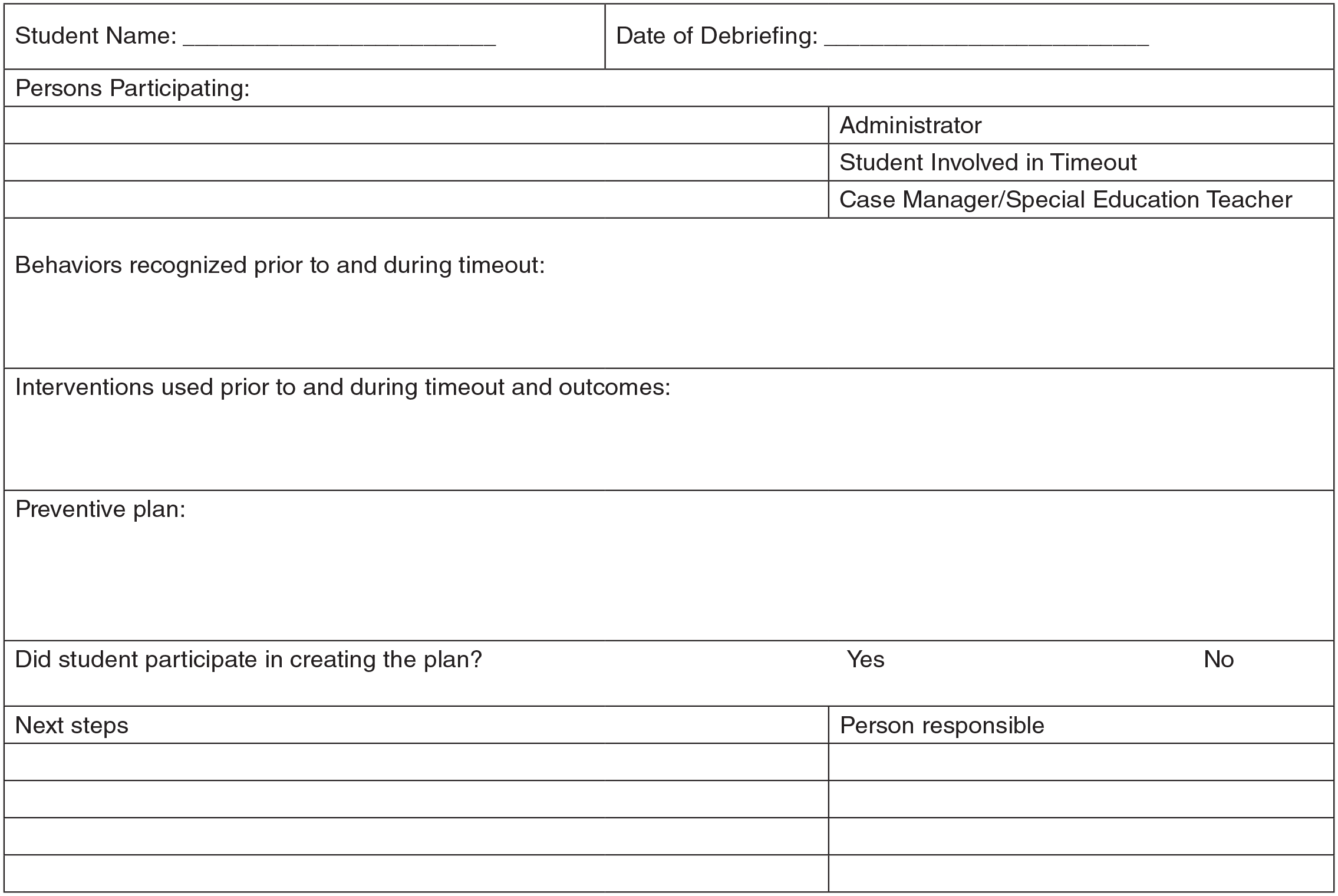
Timeout Debriefing Form.
Nelson and Carr (1996) recommended that the debriefing form address the following with the student: (a) What was the problem? (b) Where, when, and why did the problem occur? (c) What will the student do next time instead of this behavior? (d) What will the student do when the student finishes completing this form? (e) Does the student need to discuss this problem further with someone? Once the student completes the debriefing form and displays compliant behavior, they return to their assigned classroom. During the interim, they are still in a supervised academic environment, with a teacher whom they are not experiencing an emotional conflict.
Seclusion Timeout
Seclusion is the most restrictive form of timeout and entails involuntary confinement of a student who is placed alone in a room or area. This form of timeout prohibits the student from leaving the room for an allotted amount of time. Seclusion aims to prevent out-of-control or dangerous students from harming themselves or others and has a long history of being used for students with EBD and autism (Zirkel, 2020). Seclusion rooms have been called a variety of names including cool down, isolation, and scream rooms.
Seclusion continues to be a controversial practice. There is a paucity of research supporting its use in modifying student behavior. One research study concluded that when students are put in seclusion, they have shown little to no immediate decrease in maladaptive behaviors and only a slight decline in unsafe behaviors (Connolly, 2017). Another concern expressed is that the threat of being placed in seclusion timeout risks escalating student aggression further, potentially resulting in implementation of more intrusive interventions such as the use of restraint or involvement of a school resource officer (Connolly, 2017; Ryan, Peterson, Teetreault, & van der Hagen, 2007).
Due to the challenges and controversies surrounding seclusion, it is not a recommended practice for public school settings. The Council for Children with Behavioral Disorders (Freeman et al., 2023) recommends IDEA be amended to prohibit seclusion, and if used, policies should be in place regarding its use (e.g., procedures, documentation, parental notification) to ensure it is only used when a student’s actions pose an immediate danger to themselves or others. Policies should also ensure that (a) all staff who use seclusion are trained in conflict prevention, (b) the procedure is never used as a form of punishment, (c) the seclusion environment is safe (e.g., reasonable size, ventilated, continuously monitored, inspected by fire inspectors), and (d) the procedure is not being used repetitively, given this is seen as a failure of educational programming (Council for Children with Behavioral Disorders, 2009).
Common Challenges With Timeout
When implemented properly, timeout has proven to be effective in reducing a wide range of maladaptive behaviors and increasing appropriate behaviors (Foreman et al., 2020; Ryan, Sanders, & Katsiyannis, 2007). However, many teachers are unaware of the underlying behavioral concepts that make timeout an effective behavioral intervention. When misused, these strategies risk exacerbating student behavior, hindering academic performance, and potentially harming children (Ryan, Peterson & Rozalski, 2007). Hence, several precautions should be considered when implementing these procedures, including the risk for overuse, loss of academic instructional time, threat of litigation, lack of supervision negatively affecting student safety, escalation of behavior, and emotional trauma.
Overuse of Timeout Procedures
Teachers should not overuse timeout procedures. When a student causes a disturbance, it may serve as a means of escaping an unpleasant task or activity. As a result, when a teacher places a student in timeout for escape-related reasons, s/he may inadvertently be reinforcing the maladaptive behavior by enabling the student to avoid an unpleasant task or activity. Similarly, teachers may also be inadvertently reinforced when using exclusion and seclusion timeouts since the problem behavior is removed from the classroom, enabling them to continue with their lesson or activity undisturbed. This simultaneous reinforcement of both student and teacher alike can result in timeout being used repetitively despite it being ineffective in reducing problem behavior.
An investigation into the use of seclusion in one special day school found that even well-trained staff in behavior management and de-escalation continued to use this procedure excessively (up to 66 times) with challenging students despite its inability to reduce maladaptive behavior (Ryan, Peterson, Tetreault, & van der Hagen, 2007). This is why one of the most critical steps for implementing timeout effectively is data collection. Collecting data on a student’s misbehavior can inform the teacher if an intervention is being effective, how frequently it is used, and help identify the antecedent or what happens immediately before the problem behavior is displayed.
Loss of Academic Instructional Time
Students with EBD struggle in school, perhaps more than students with any other disability, which has led to dismal academic outcomes (Wagner et al., 2006). On average, students with EBD perform 1.2 to 2 grade levels behind their peers while in elementary school and experience 3.5-grade-level deficits by high school (Ryan et al., 2008). Researchers have demonstrated that students with disabilities who are removed from the classroom due to disciplinary issues have lower academic performance in reading and math than their peers with disabilities who are not removed from school (Allman & Slate, 2011, 2013). Given these significant academic deficits and the adverse influence exclusionary discipline practices have on student achievement, timeout should only be used when less intrusive interventions such as redirection, distraction, and warnings have proven unsuccessful.
Threat of Litigation
Many advocates have argued that seclusion is unethical, allowing for environments that have led to student injuries, fatalities, and disproportionate use for students with disabilities and minorities (U.S. Department of Education, Office for Civil Rights, 2018). There is also consternation regarding the lack of research and comprehensive standards regarding its use. Currently, 39 states have laws that provide meaningful protections against the use of seclusion for children with disabilities (Butler, 2019). Schools that implement seclusion should ensure they comply with all state and district policies or guidelines. Policies should specify room requirements that define size requirements (e.g., 6′w × 8′l × 8′h feet), tamper-resistant lighting, ventilation and temperature, and continuous monitoring procedures (e.g., plexiglass window or video). It is also recommended that teachers receive approval from the school district before implementing seclusion and seek parental consent.
Behavior Escalation
The National Center for Education Statistics (NCES, 2014) reported that nearly half (43%) of schools reported inadequate levels of teacher training in behavior management (NCES, 2014). This is disconcerting, given the increased number of children displaying challenging behaviors. Moreover, researchers have estimated that 15% or more of all students have a mental health disorder severe enough to impair functioning (Brown et al., 2008; Kauffman & Landrum, 2018). When dealing with challenging behaviors, it is vital that teachers focus on prevention and de-escalation strategies.
Research indicates that preventive approaches can effectively reduce dangerous behaviors (Bullock & Gable, 2000; Miller et al., 2005). Unfortunately, educators who are not trained in prevention and de-escalation techniques risk exacerbating student behavior (Colvin, 2004; Couvillon et al., 2019). In addition, research has shown that the threat or use of seclusion often escalates student behavior. A recent report found that when students were placed in isolation, there was an escalation in students’ verbal and physical aggression and self-injurious behaviors (Connolly, 2017).
Emotional Trauma
Finally, many parent and advocacy groups have suggested that students subjected to harsh disciplinary interventions like seclusion are at increased risk of long-term trauma and possibly post-traumatic stress disorder (Bak et al., 2012; Steinert et al., 2007). Students with EBD often have a history of childhood traumas including physical abuse, sexual abuse, neglect, and domestic violence (Dye, 2018). Because of these histories, there is great concern that the more restrictive forms of timeout can result in students with EBD being further traumatized due to feelings of anxiety, helplessness, and fear. A survey of parents and guardians of children who experienced seclusion timeout reported that 92% of the students experienced emotional trauma from the intervention (Westling et al., 2010). Children with a history of trauma often have challenges with self-regulation, learning, memory, social relationships, physical health, cortisol regulation, and sleep (Design et al., 2018).
What to Do Prior to Choosing Timeout
As teachers and educators consider using timeout procedures to address challenging behaviors with students with EBD, two important points can be considered. First, teachers should provide their students with a rationale for the use of timeout. Second, strategies should be taught for students to practice in order to handle the classroom environment when a classmate is placed in timeout. Below are four practical steps to consider before the implementation of timeout in the classroom. These steps can be utilized in most but not all situations and settings (Payne et al., 2005).
Step 1: Identify the Student
When identifying a student with EBD for which timeout strategies might be helpful, answers to the following questions are important: (a) Is there a student in class whose behavior impedes instruction and the learning of their classmates? and (b) Is this student constantly displaying this behavior? These behaviors may look different for each student.
Step 2: Identify the Target Behavior
It is crucial to identify which behavior needs modification the most. Teachers want to ensure that they do not add unnecessary stress by addressing the wrong behavior. Is the behavior indeed a continual issue or a one-time occurrence? In addition, strategies that should precede timeout include redirection, distraction, and warnings.
Step 3: Choose the Reinforcer
The teacher should already be familiar with what motivates their students. This is when the importance of a personal relationship with a potential target student with EBD will count the most. To help with buy-in, consult with the student when determining which reinforcer will work best for the behavior. Teachers can also create a menu of backup reinforcers for students to select a reward. Consider surveying students to gather information on their preferred reinforcers and ensure that the positive reinforcer chosen will not lead to a second negative behavior, such as yelling out or self-stimulation.
Step 4: Determine How to Deliver the Reinforcer
A conversation should occur with the student to determine where, when, and how the reinforcer will be delivered. Together, the teacher and student can choose when to implement positive reinforcement. However, the teacher should ensure the student is calm enough to participate in this discussion. This will assist the student in deciding which goal they will work toward, and whether the support is tangible or an activity. This step allows for an increased level of student buy-in.
What to Do While Implementing Timeout
Payne et al. (2005) offer three additional steps for teachers to follow when implementing timeout procedures.
Step 5: Deliver the Reinforcer
When the student displays the desired target behavior, the teacher must immediately provide the student’s chosen reinforcer. This step must be consistent when following the plan as explained to the student (Gallagher, 2000). It is the teacher’s responsibility to stick to the program. When students see the benefits of demonstrating positive behavior, they are more likely to repeat the behavior. This is a great example of behavior-specific praise which is itself an evidence-based practice (Ennis et al., 2018).
Step 6: Collect Data to Monitor Effectiveness
This step does not have to be complicated. The teacher observes the student to see if they are displaying the desired behavior (Walker et al., 2004). Documenting student progress helps the teacher provide instruction and guidance. Data collection and subsequent data-based decisions allow for adjustments on behalf of the teacher and student. Furthermore, with the student aware of the teacher’s expectations, they can be taught to self-monitor their behavior and aid the teacher in tracking their progress.
Step 7: Evaluate the Intervention
This step helps teachers determine whether the plan put in place was successful or not. If the student’s behavior does not improve, the teacher should return to step 1 and begin again. If the plan has minimal progress, the teacher should not give up. Even minimal growth is an improvement (Payne et al., 2005). If there is a significant increase in positive behavior, the teacher should begin to fade the reinforcement or increase the target goal to extend positive outcomes. Fading can help the plan elements move from tangible to activity reinforcers (Payne et al., 2005). Even with the strategic use of preferred items, positive reinforcements, and data collection, avoiding timeout is not always an option, especially regarding aggressive behaviors. The following section will share items to consider when the implementation of timeout is necessary in your classroom.
Other Considerations for Implementing Timeout
Timeout can be an effective behavioral response to students’ challenging behaviors when appropriately implemented. However, teachers should remember that every student is unique and there is not a one-size-fits-all approach to timeout. The following recommendations are provided to help you use timeout procedures more effectively in the classroom.
Ensure the Classroom (Time-in) Environment is Reinforcing
Perhaps the most essential ingredient for a timeout to work effectively is that the time-in environment must have reinforcing qualities. The timeout environment must be less reinforcing than the regular classroom environment (Kostewicz, 2010). Timeout will not be effective if a student is not receiving reinforcement within the classroom environment. Instead, you may likely see increased levels of misbehavior so the student can be placed in timeout to escape an unpleasant task or activity.
Researchers have long suggested that teachers who use high levels of positive reinforcement have fewer behavior problems (Sugai & Horner, 2002). Educators should strive to build strong relationships with their students. Taking time to get to know about your students’ hobbies, interests, families, and strengths will build rapport and support the social emotional learning competencies of your students (Mahoney et al., 2021). Other strategies that can help teachers create a more positive and reinforcing learning environment include implementing positive reinforcement, having a high ratio of educator praise statements to reprimands (e.g., 5 to 1 ratio), and providing increased levels of behavior-specific praise (Mahoney et al., 2021).
Document the Use of Timeout
Teachers should consistently and explicitly document the use of any timeout procedure that is implemented in their classroom. Documentation can help identify the underlying causes or triggers of a maladaptive behavior and the frequency in which students are being placed in timeout. It can also help determine the efficacy of an intervention in reducing maladaptive behavior (Couvillon et al., 2019). Thorough anecdotal notes and documentation should include the (a) antecedent or event that occurs directly before the timeout, (b) strategies that were implemented preceding the timeout, (c) the location of timeout, (d) interactions that took place during implementation of the timeout, and (d) length of time the student was placed in timeout. Patterns and trends can be seen in accurate and thorough documentation. For example, if the teacher notes the student consistently misbehaves first thing in the morning upon arrival at school, they might implement a strategy of a preferred activity to begin the student’s day.
Limit the Length of Timeouts
The use of any timeout should be limited to a specified time to ensure it is not implemented for excessive periods of time. It has been recommended that the maximum time while in timeout should be no longer than 5 min. Results in one study compared four different timeout durations (1, 5, 10, and 20 min) for 20 students with EBD to see which was most effective (McGuffin, 1991). Researchers found that extended amounts of time were not beneficial and that a duration of 5 min was the most effective (McGuffin, 1991). To help monitor this, teachers should set a digital timer that indicates when the timeout is over. For an example of a questionnaire that can be used to assist in implementation (see Figure 2).
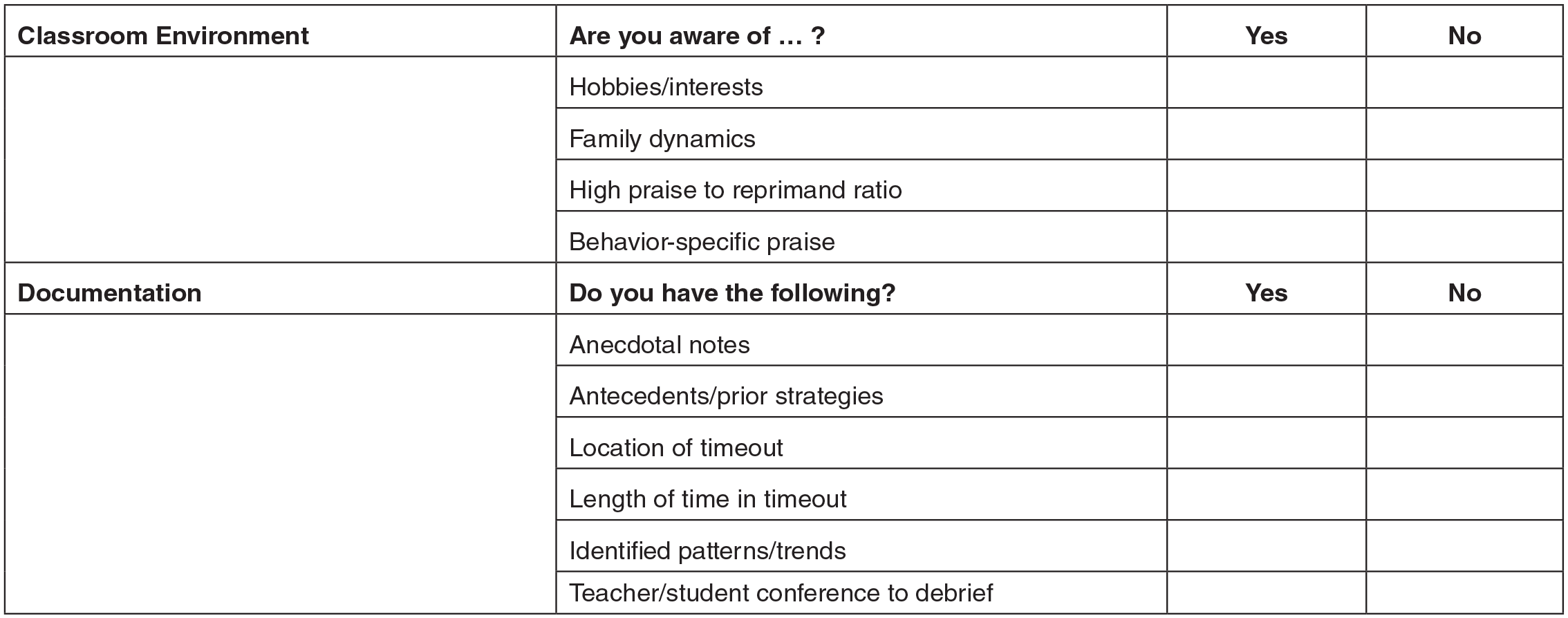
Questionnaire for Implementing Timeout.
Steps for Implementing an Effective Timeout
As we conclude this article and having described types of timeout procedures, benefits, cautions, and considerations of implementation, the following is a brief listing of the steps that can facilitate effective implementation of a timeout.
Pre-teach to the class the classroom behavioral expectations and the procedures of timeout that will be implemented should the behavioral expectations not be met.
When a problem/target behavior occurs, calmly warn the student about their (nonaggressive) behavior and that this behavior is not acceptable. Inform them that timeout will be implemented should it continue.
If the behavior occurs again, calmly lead your student to the timeout area.
Have them sit, calmly get down on their level, and explain why they are receiving a timeout.
Continue to stay calm while you make the student aware of how long the timeout will last, either through a visual timer or clock that they understand.
Continue work with the other students as the student completes the timeout.
When the timer sounds, offer the student verbal praise for sitting, and release them to continue with their day.
Do not hold a grudge. The timeout or the behavior should not be mentioned again. Be sure to implement the positive reinforcements listed above to avoid the behaviors.
If an aggressive behavior has occurred, go directly to Step 3 in this sequence and lead them to timeout.
After each timeout, teachers should create notes, particularly about the antecedent and the environment. Consider making changes to support students and discourage negative behaviors. Teachers should be sure to constantly reflect on the process. Figure 1 is an example of a debriefing form that could be used for reflection.
Conclusion
Although timeout is frequently used in schools, it has become a controversial procedure due to a lack of understanding of its underlying behavioral principles, overuse, and ethical concerns (Slocum et al., 2019). When using the procedure, be sure to create a warm and engaging classroom environment to promote appropriate student responses. When identified challenging behaviors occur, follow the specific procedures outlined in this article to increase effectiveness and limit the ethical concerns. Document the implementation results and review those results to increase the likelihood of successful implementation.
After meeting with the special education coordinator Ms. Abernathy decides to implement a hierarchical approach for using timeout in her classroom. First, she will implement an inclusion timeout for 5 min and then place the student in an interclass timeout if the student does not respond. Since learning that timeout will only be effective when the “time-in” environment is reinforcing, she decides to implement a checklist to help reinforce Juan. Ms. Abernathy elects to focus on reducing Juan’s calling out behavior during math class. Since she knows Juan loves drawing, she decides to meet with him to develop a behavior contract that entails him earning up to 10 min of drawing time before lunch if he does not call out during math class. Ms. Carlson collects data on the number of timeouts that Juan receives over the next week and quickly recognizes that his calling out in class has reduced drastically. Juan is now spending significantly more time in math class than in the hallway, which prompts some kind words to Ms. Abernathy from the principal during their next interaction.
Footnotes
Declaration of Conflicting Interests
The author(s) declared no potential conflicts of interest with respect to the research, authorship, and/or publication of this article.
Funding
The author(s) received no financial support for the research, authorship, and/or publication of this article.