




Abstract
This article discusses the use of behavior-specific praise (BSP), an effective technique for promoting prosocial behavior and managing classrooms. It addresses the criticism that BSP may reduce students’ intrinsic motivation and offers directions on how to use BSP to provide students, especially those with challenging behaviors, with useful feedback that encourages them to engage productively in school activities.
The teachers at Fernwood Elementary School use proactive strategies to encourage students’ prosocial behaviors and decrease challenging behavior. At their monthly staff meeting, the principal or a teacher introduces a new technique, and the teachers discuss it before deciding whether they should try implementing it across all classrooms. This week they began discussing behavior-specific praise. Some teachers objected to the strategy, saying it gives students a false sense of achievement and that complimenting students is not part of the learning process.
It is not unusual for teachers to be wary of behavior-specific praise (BSP). However, BSP is somewhat of a misnomer and may discourage education practitioners from understanding its effectiveness. Behavior-specific praise is an easy-to-use technique for enhancing prosocial behavior by acknowledging students’ academic, social, and behavioral efforts (Musti-Rao & Haydon, 2011). For example, when a teacher asks her students to prepare for a math lesson, she might say, “Thank you, Paul, for getting out your math book right away,” when she sees he has responded.
Yet, some teachers view praise as superfluous and even counterproductive, while others report using praise conflicts with professional development they have received in behavior management (Shernoff et al., 2020). In this article, we review the benefits of BSP and best practices for using it. We discuss the misconception that BSP may diminish intrinsic motivation and the philosophical tension around strategies grounded in applied behavior analysis (ABA), which can be barriers to using BSP. We finish with illustrations of how to use BSP with students in different grade levels and how it can be implemented both individually and whole class.
Brief Overview of BSP
Behavior-specific praise was first noted in the education literature over 60 years ago and has most recently been used as an effective tool for positive behavior support and an initial alternative to reactive practices such as reprimands (Ennis et al., 2018, 2020). Behavior-specific praise is a praise statement given when a student demonstrates a desired behavior. It is more intentional than simply paying a compliment and is used to reinforce prosocial behaviors a teacher wants to promote. A better description would be behavior-specific feedback.
The effectiveness of BSP in shaping behavior is premised on theory from ABA. It assumes when a person receives motivating feedback about a behavior, they will likely increase their use of that behavior (Pierce & Cheney, 2017). In ABA terms, a teacher offers praise contingent on an appropriate action or response, and the praise is tailored to the situation and student. For example, if a student has trouble completing a task but clearly applies themselves, the teacher might say, “Arlene, I see you focused on your assignment.” This is different from general praise, which might sound like, “Nice work, Arlene.”
With BSP, Arlene knows exactly what her teacher took note of and can tell by the teacher’s attention and tone that Arlene’s effort on the assignment is appreciated even though she may not have completed the task. As a result, Arlene is more likely to apply this type of effort to future assignments. Admittedly, BSP will not work overnight, and using it successfully depends on the consistent and appropriate application of the strategy (Floress et al., 2018; Musti-Rao & Haydon, 2011; Zentall & Morris, 2010).
Behavior-specific praise is successful because it is a positive approach to elicit desired behavior rather than a reactive or even punitive approach to remedy problem behavior after the fact. With the advent of positive behavioral interventions and support (PBIS) frameworks, there is wider recognition that reprimands, timeouts, exclusionary practices, and punitive measures do not cultivate prosocial behavior (Downs et al., 2019; Gerlinger et al., 2021; Horner & Sugai, 2015; Lane et al., 2020). In fact, overreliance on reactive measures reduces a teacher’s ability to manage classroom behavior and can contribute to a negative classroom environment (Mitchell & Bradshaw, 2013; Sugai & Horner, 2006).
Proactive measures can take more time to become fluent with, but in the end, they pay larger dividends in terms of establishing a warm classroom climate as well as reducing problem behavior. A single proactive strategy alone will not mitigate all problems. Still, BSP is a powerful tool to use in concert with other proactive strategies, such as opportunities to respond (Menzies et al., 2016) and instructional choice (Lane et al., 2015). Behavior-specific praise has been studied for its efficacy and demonstrated positive results with a wide variety of students and settings (see Ennis et al., 2020 for a comprehensive review of the literature on BSP; Royer et al., 2018). The What Works Clearinghouse currently ranks the use of reinforcement as having strong evidence for reducing behavior problems and supporting a positive classroom environment (Epstein et al., 2008).
Intrinsic Motivation
Ryan and Deci (2000) described intrinsic motivation as “the doing of an activity for its inherent satisfactions rather than for some separable consequence” (p. 56). They explained how intrinsic motivation is enhanced by autonomy and competence, but noted how school environments are often structured in ways that neglect these aspects of development (Ryan & Deci, 2020). This is unfortunate because not only are these areas directly related to achievement, but as Ryan and Deci (2020) emphasized, they are critical in promoting students’ psychological wellbeing. This is especially true for students with learning disabilities (Dev, 1997; Zisimopoulos & Galanaki, 2009) and behavioral disorders (Sutherland & Singh, 2004) as they are less likely to feel their efforts make a difference in their academic success, thus contributing to a lack of intrinsic motivation.
A common criticism of school environments is the overreliance on control and external motivators, such as praise, rather than promoting students’ sense of autonomy. However, despite its name, BSP can be used to foster autonomy and recognize students’ attempts to acquire skills and knowledge. Reeve and Jang (2006) identified several teacher behaviors that promote student autonomy including praise as informational feedback and offering encouragement. Behavior-specific praise is designed to directly address these areas (Conroy et al., 2009; Stormont & Reinke, 2009). Offering feedback and encouragement is critical when working with students with disabilities because they frequently receive less constructive teacher feedback as well as more negative feedback than students without disabilities (Sprouls et al., 2015).
Other research has debated possible negative effects on students’ achievement and behavior when praise is used too often, specifically examining whether it decreases students’ motivation to try more challenging tasks (Dweck, 2016; Henderlong & Lepper, 2002). Seminal studies by Mueller and Dweck (1998) and Dweck (2016) demonstrated that when students were praised for their intelligence after successfully completing a task (e.g., “You did good! You are so smart!”), it had a negative impact on their achievement. Students were subsequently more likely to choose an easier task to show they were smart rather than engage in a challenging task at which they might not succeed.
Yet, the type of praise made a difference in task choice. When students were praised for their hard work and effort (e.g., “You worked so hard!”) instead of their intelligence, they were more likely to choose challenging tasks and increase their learning. This finding indicates the way children are praised can increase prosocial behaviors (Bayat, 2011). Mueller and Dweck’s (1998) study also determined that students who were praised for their efforts had a more positive sense of their capabilities and achievement. Therefore, the “how-to” in using praise is essential. When used correctly, praise can help students understand the value of effort and persevere with challenging tasks.
Beliefs About Teaching and Learning and the Use of BSP
Teachers’ philosophical orientation and personal beliefs about teaching are instrumental in determining the types of instructional strategies they will use (Kennedy, 2016; Spillane et al., 2002). In addition to misperceptions about the effect of BSP on intrinsic motivation, PBIS strategies are sometimes rejected by teachers because they believe them to be antithetical to educational philosophies such as humanism or constructivism. Terms like contingency and reinforcement may remind teachers of Skinner’s theories of operant conditioning. Although the field of PBIS relies on some basic ABA principles, its emphasis is on proactive strategies to help students learn prosocial behaviors and abandon maladaptive behaviors that impede their academic and social success in school (Trump et al., 2018).
Behavior-specific praise can be added to a teacher’s repertoire of effective strategies without changing one’s philosophical orientation. The Montessori method is one example of a progressive curriculum using verbal feedback like BSP. Its philosophy is based on child-guided learning and inquiry to build self-determination and self-control to foster intrinsic motivation (Montessori, 1995). Minimal adult interference encourages children to learn through an internal drive and not in response to extrinsic rewards or motivations (Lillard, 2018, 2021).
While the Montessori method may seem at odds with a strategy like BSP, it aligns with the Montessori view about using the power of encouragement. Verbal encouragement focused on a student’s work process and effort, qualities a student can control, is used to offer feedback in Montessori classrooms. Teachers are cautioned not to interrupt with praise when students are fully immersed in their work and do not need feedback to remain engaged. Interrupting could interfere with learning rather than reinforce it (Montessori, 1995). Table 1 provides examples of BSP focused on observation and encouragement in contrast to praise offered for innate characteristics or praise that is too general.
Examples of Specific and General Types of Praise.
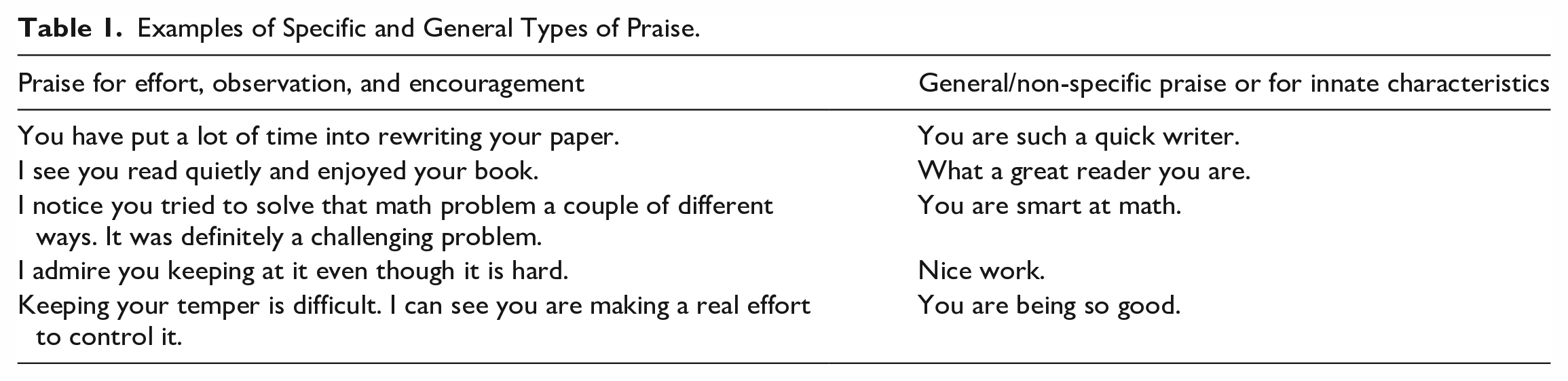
Having a better understanding of the goal of BSP and how to use it correctly can help educators add to their repertoire of powerful strategies without feeling it conflicts with their teaching philosophy. Using BSP to acknowledge process and effort is key to promoting student autonomy and ensuring it does not diminish intrinsic motivation.
BSP and Students With Behavioral Challenges
Behavior-specific praise is a powerful strategy to use with students who have or are at risk for disabilities, particularly those with challenging behavior (Dufrene et al., 2014; Stormont et al., 2007; Sutherland et al., 2000). Schools and teachers have moved rapidly in the last decade to adopt instructive and proactive strategies with the realization undesirable behavior can be changed rather than seeing it as an act to be punished (Lane et al., 2015). There is increased awareness that a punitive approach to school discipline can have counterproductive results and may harm student–teacher relationships. Students who lack trust in school personnel are less willing to modify their behavior and more apt to have contentious relationships with them (Pham et al., 2022).
At-risk students and those with disabilities often have difficulty with self-regulation skills and a poor self-concept about their academic abilities. Some students with behavioral challenges tend to misinterpret others’ intentions and assume a negative attribution (Ogundele, 2018), leaving them less able to navigate social interactions with their teachers and peers. Unfortunately, students with behavior issues also receive higher rates of reprimand and less positive feedback compared with other students, which discourages their engagement in school (Drake & Nelson, 2021). Behavior-specific praise ameliorates these challenges by building rapport, mitigating learned helplessness, providing explicit feedback, and shaping behavior.
Building Rapport
Establishing rapport with students is critical in developing a secure and supportive relationship (Maldonado-Carreño & Votruba-Drzal, 2011; Sabol & Pianta, 2012). Students who trust their teacher or other school personnel show increased engagement and fewer behavioral challenges. Because BSP is an interaction based on giving attention in a positive way, it builds rapport.
Mitigating Learned Helplessness
This phenomenon occurs when an individual will not attempt tasks or does so at a level inconsistent with what they can achieve due to repeated past failures (Sutherland & Singh, 2004). Students with behavioral challenges are particularly at risk for learned helplessness as they frequently have a history of poor academic performance. In addition, if teachers do not provide reinforcement when students do respond correctly or offer scaffolded opportunities to learn prosocial behavior, it creates an environment where students do not recognize the relation between their actions and subsequent events, making it even less likely they will acquire prosocial behaviors. Behavior-specific praise offers feedback that helps a student understand how to respond.
Providing Explicit Feedback
Students who have difficulty interpreting implied meaning do better with explicit feedback. When feedback is ambiguous, students may not be able to draw a direct connection between the behavior and the reinforcing praise. Behavior-specific praise is designed to be explicit so students can easily identify the prosocial behavior their teacher is praising (Stormont & Reinke, 2009).
Shaping Behavior
Shaping is a powerful technique for teaching prosocial behavior. When a student cannot perform a desired behavior fluently, a teacher can provide feedback and encouragement for approximations close to the target behavior (Pierce & Cheney, 2017). Behavior-specific praise is an effective tool for shaping because it can offer feedback on some aspects of what the student did correctly, even if they were unable to perform the entire task or behavior exactly as desired. This is more motivating to students than being told what they did wrong (Drake & Nelson, 2021). Lack of any positive feedback can lead to learned helplessness and damage rapport.
How to Use BSP
While BSP can be used informally, an intentional approach will lead to stronger results (Shernoff et al., 2020). Thinking in advance about the types of praise to use will make it easier to deliver it strategically on an individual or whole-class level. Behavior-specific praise aligns well with tiered models of positive behavior support as it can be used as either a Tier 1 approach for all students or tailored to provide intensive feedback as a Tier 2 intervention.
The following steps are recommended for using BSP and are taken from the work of Lane et al. (2015), who offer detailed and comprehensive information on several proactive strategies for maximizing student engagement (Figure 1).
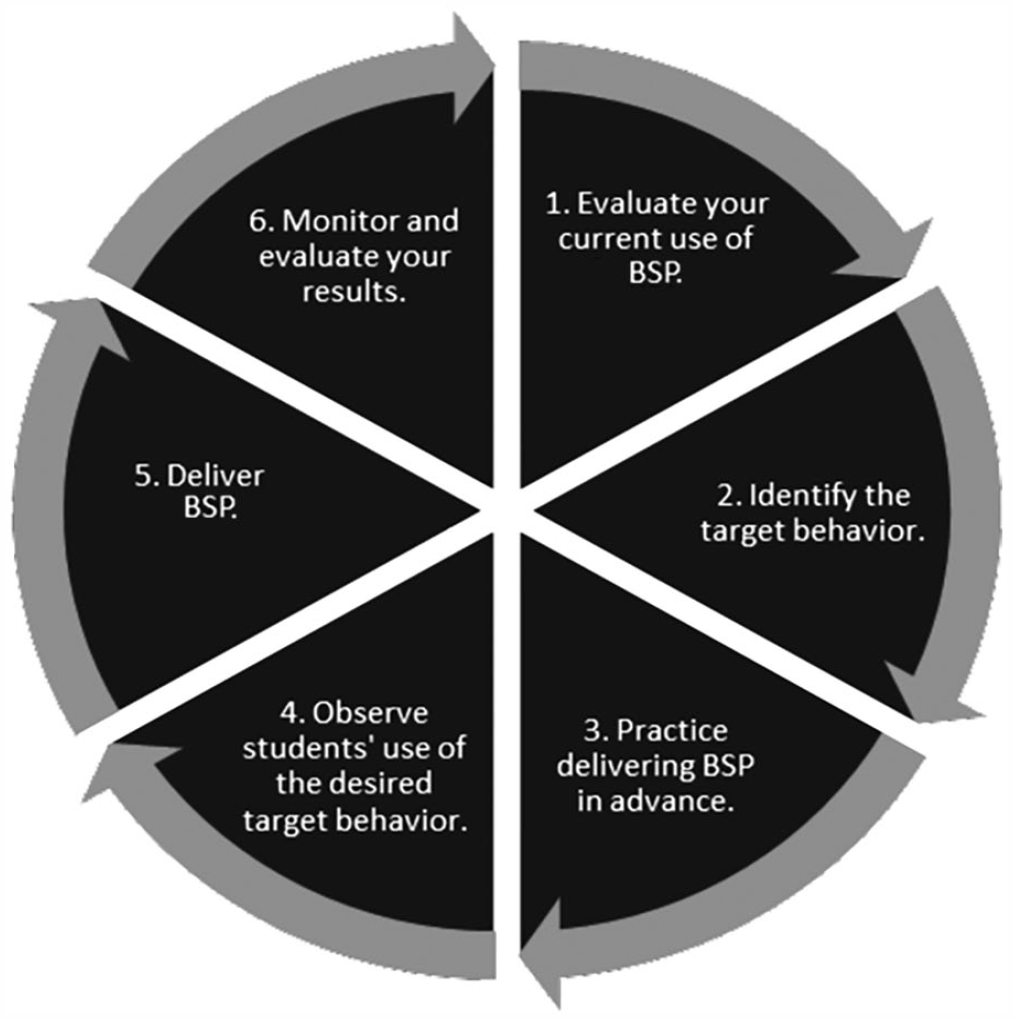
Recommended steps for using behavior-specific praise (BSP; Lane et al., 2015).
Step 1: Evaluate Your Current Use of BSP
Are you already using BSP? Is it frequent, strategic, and used both whole-class and with individual students who would benefit from encouragement? Are you praising students’ innate characteristics (e.g., “You are so smart!”) rather than their effort or process (e.g., “I see you enjoy working on your project”)? Are you using general praise (e.g., “Nice work”) instead of specific praise (“You put a lot of effort into completing your assignment!”)? Perhaps, you notice student behavior during particular routines or a time of day that could be improved with BSP and can plan to use it then.
Mr. Gonzales, a third-grade teacher of students with behavioral and learning disabilities, noticed he was reprimanding students frequently during transitions to lunch and then again at the end of the day. He decided to reteach his expectations for these procedures and use BSP with students who followed the directions rather than reprimand those who did not. In particular, he resolved to be more proactive with his student Steven who was high energy and lacked impulse control.
Step 2: Identify the Target Behavior
Behavior-specific praise can be used to promote prosocial behavior in a variety of domains. In addition to academic work or task completion, a teacher can focus on students’ social interactions during recess or class discussion. Classroom or schoolwide expectations can also be targeted for BSP. For example, a common schoolwide expectation is Be Kind. Reinforcing students when they demonstrate kindness is quick and easy: “I noticed you were kind to Jacob when you asked him if he wanted to play.” Behavior-specific praise can also be employed to mitigate problem behaviors with individual students by frequently providing BSP when they use appropriate behavior or when you can see they are attempting skills they have difficulty using with ease.
A common occurrence is a student who quickly escalates to anger when upset. When a student like this remains calm, even if it is not a particularly volatile moment, a teacher could say, “I see you are remaining calm.” A BSP statement can be a simple observation delivered with feeling. A teacher’s attention is usually highly motivating for students, so communicating that the teacher values the student’s action can be quite effective. (Students with social–emotional difficulties like being quick to anger will also need support in learning to identify and control their feelings and emotions, but BSP can be one of many strategies used with this type of challenge.) The praise statement must be specific enough so the student is aware of the behavior you are targeting.
Mr. Gonzales reviewed lunch time procedures with his class and made sure he had Steven’s attention as he went over them. He reminded students that when he gave the signal to clean up, they were expected to return materials, such as markers and paper to the shelves and put their books and notebooks inside their desks. Then, when desks were cleared off and everyone was seated and quiet, he would ask them to line up at the doorway and proceed to the cafeteria. Mr. Gonzales also reminded students of the schoolwide expectation, Be Kind, and noted how one way to be kind was not to bother other students as they were preparing to go to lunch.
Step 3: Practice in Advance
Once you have identified the target behavior and decided when and where you want to use or refine your use of BSP, you can script praise statements in advance. This avoids praising innate characteristics and highlights effort and process instead. Grade-level examples of praise, acknowledgment, and feedback are provided in Tables 2 to 4.
Examples of Behavior-Specific Praise for Social-Emotional Skills.

Mr. Gonzales scripted a few praise statements he was sure he would have an opportunity to use when students transitioned to lunch. He knew several students would immediately put away their materials and he would probably be able to say, “I see Jessica and Maricela have quickly put away their markers and books.” He knew Steven would put away his materials but would be less likely to return to his desk, so he prepared the statement, “Steven, I notice you have already put away your materials. I can tell you are eager to get to lunch.”
Mr. Gonzales planned to quickly acknowledge any seated student to help cue Steven to the next step. A good bet was Diego, who was usually eager to line up, so Mr. Gonzales was ready to say, “Thanks, Diego, I see you are patiently sitting at your desk so we can all line up.” Mr. Gonzales thought using proximity with Steven would be another cue to help him through the transition, so he decided to be nearby Steven’s desk when he gave students the signal to get ready for lunch.
Step 4: Observe Students’ Use of Desired Target Behavior
Now that you are set to go with praise statements, observe students for the targeted behavior. It is simpler to begin by focusing on the specific transition, routine, time of day, or task where you want to facilitate behavior change. As BSP becomes a more natural response, it will be easier to deliver it spontaneously. Decide whether you will use whole-class BSP, individual BSP, or a combination of the two. You should also look for approximations of the behavior you want to see. If a student is trying or has partially demonstrated the target behavior, it is acceptable to praise that attempt and shape their behavior to closer approximations of what you want to see.
Sure enough, during the transition to lunch Mr. Gonzales saw several opportunities to use the statements he had prepared. He was glad he had thought about possible scenarios in advance because he would not have been as likely to acknowledge students who were getting ready. It also helped Mr. Gonzales refrain from using reprimands because it was just as easy to recognize the students who were on task as to scold those who were not.
Step 5: Deliver BSP
As students engage in the task, deliver the praise. It is important to do so immediately after seeing the desired target behavior because students will understand more clearly the praise is a response to the behavior. It also encourages students to continue being on task. Many teachers find that when they praise a student, the good behavior “spreads” as other students hope to be acknowledged for their efforts. When delivering BSP to individual students, be sure to say the student’s name and make eye contact. This way you can be sure the student is aware of your feedback. Behavior-specific praise helps teachers increase their ratio of positive feedback to students, an essential element in establishing a warm classroom climate.
It turned out the mix of whole-class and targeted BSP was especially helpful. As he had planned, Mr. Gonzales was able to immediately praise Jessica and Maricela, and because most students responded appropriately to his signal to clean up, he added, “Thank you everyone for getting ready for lunch by cleaning up so quietly and quickly and returning to your desks.” Steven, too, put away his materials and benefited from Mr. Gonzales’s immediate feedback. In addition, Mr. Gonzales cued Steven to the next step: “You are on task with turning in your paper, but don’t forget to return to your desk and sit quietly until I ask you to line up.” Once Steven sat down, Mr. Gonzales made eye contact with Steven and gave him a nod and a smile so Steven would know his efforts were recognized.
Step 6: Monitor and Evaluate Your Results
A strategy is only as good as its results, so it is worthwhile to determine whether it is effective for you and your students. You can do so either formally or informally by taking a baseline of how many behavior infractions occur before using BSP and then again after using the strategy consistently. If you do not see a difference in student performance, review your efforts to ensure you used the strategy correctly and implemented it with integrity.
Using BSP with intentionality during the transition to lunch helped Mr. Gonzales get back on track with his usual proactive approach to classroom management and reduced his use of reprimands. He felt it was worth the time to remind students of expectations, anticipate possible problems, and prepare BSP statements because emphasizing what students were doing correctly made him feel better than admonishing those who were off task, and it proved more effective overall.
Examples of BSP
The following are examples of BSP statements that can be used at various grade levels. Some illustrations demonstrate whole-class and individual BSP. Others describe BSP for social, academic, and behavioral domains.
Early Childhood Example for Social-Emotional Skills
Ms. Sotelo is an early childhood education teacher in a full-day Montessori preschool program. She has a class of 20 students and one teaching assistant. Many of her students are from culturally and linguistically diverse backgrounds and are dual language learners. She structures learning time so students can explore and engage in activities they are interested in. Students work at their own pace at different activities, so Ms. Sotelo engages individually with students playing in small groups and those who are by themselves. Many of her students are working on recognizing and regulating their emotions and taking turns in activities with their classmates. Ms. Sotelo uses BSP to encourage positive social–emotional skills (see Table 2).
Elementary School Example for Transition and Unstructured Activities
Ms. Clemons is a relatively new third-grade teacher at a school where over 90% of the students qualify for free or reduced-price lunch. Her 29 students are high energy, and Ms. Clemons is always looking for ways to implement positive behavior support strategies to save time and effort in the long run. Experience has taught her that constantly correcting her students reduces her ability to connect with them, makes her feel ineffective, and is frustrating for everyone.
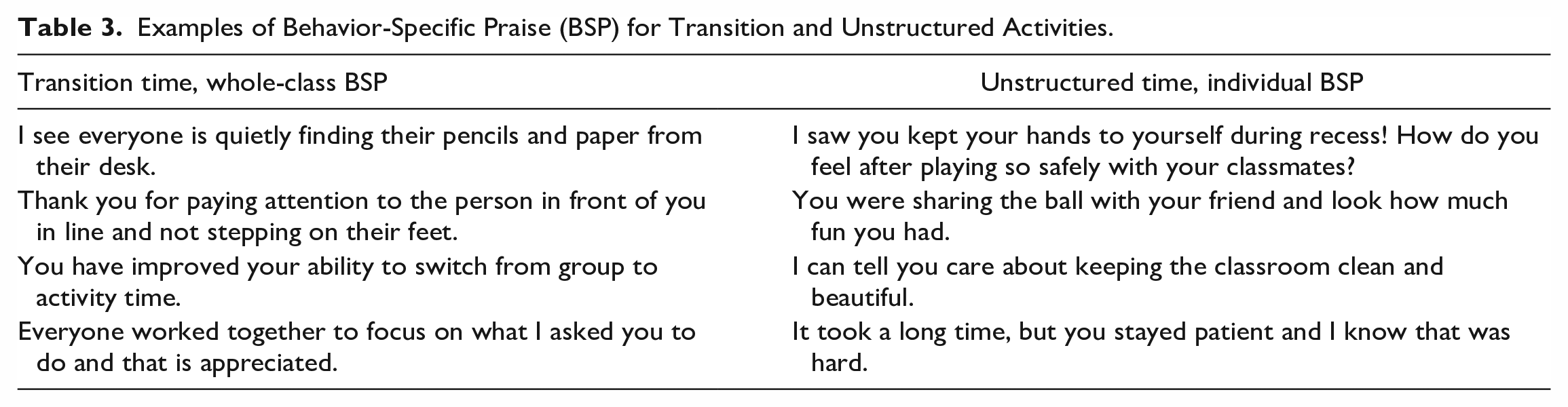
She knows transition times such as switching activities and walking in line as well as unstructured times like cleaning up and recess are prime opportunities to offer extra support and encouragement because they are the events most prone to disorder and challenging student behavior. Ms. Clemons devotes a great deal of time practicing routines and procedures with her students and individualizes instruction for one student who has an Individualized Education Program with goals for behavior. This is when her BSP statements have a powerful impact. Her students exude self-assurance when she smiles and delivers statements during transition and unstructured times (see Table 3). Behavior-specific praise also increases her rapport with her student with behavior challenges.
Examples of Behavior-Specific Praise (BSP) for Transition and Unstructured Activities.
High School Example for Social and Academic Skills
Ms. Flores is a seasoned ninth-grade language arts teacher who has taught for nearly 20 years. She has more than 175 students, so interacting with them individually every day is not possible. However, Ms. Flores prides herself on her ability to connect with her students. She knows how much it means when she has kind and encouraging words for them. She firmly believes in being genuine, especially when offering feedback her students will find useful. Although her designated subject is language arts, Ms. Flores also does what she can to address students’ social-emotional learning. High school can be confusing and stressful for many students, and Ms. Flores pays close attention to how students interact in her classroom.
Given the constraint of having so many students and meeting with each group for only 50 minutes, Ms. Flores concentrates on offering whole-class BSP and focuses on a few students who require extra support. She thinks through the topic she is covering for the day and comes up with several BSP statements she will offer as feedback when appropriate. For example, she knows she will see students help one another find their materials, locate the right book or page, and interact with one another, so these are all fruitful areas for BSP.
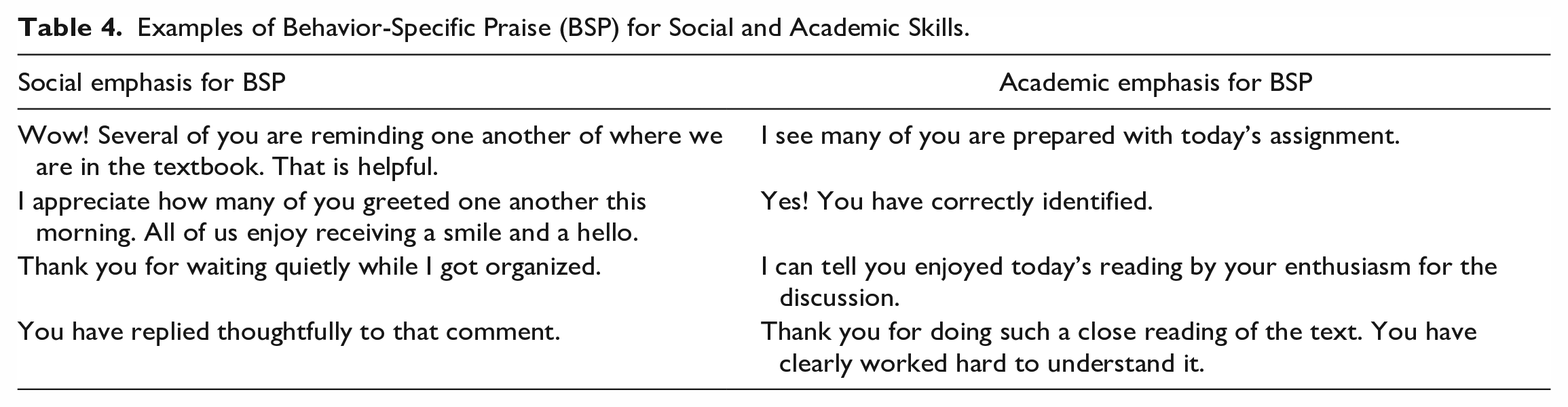
Having taught for so many years, she can anticipate the topics students will grasp easily or those they will struggle with, so she develops BSP around those areas. Ms. Flores also consults with the special educator to offer individualized BSP to students with disabilities who attend her classes. After so many years, using BSP comes naturally and is no longer as difficult as it was in the beginning and requires little advance planning on her part (see Table 4).
Examples of Behavior-Specific Praise (BSP) for Social and Academic Skills.
Each of these teachers does their best to be proactive and realizes when they are, fewer redirects or reminders are needed. The BSP also serves as a cue to students who are not demonstrating the appropriate behaviors while encouraging the behaviors a teacher wants to see. This creates a warmer environment than when the emphasis is on what students are doing wrong. Reprimands and negative comments take their toll on students and teachers alike (Hamre & Pianta, 2001; Hosan & Hoglund, 2017). Behavior-specific praise is a way to consciously work on emphasizing the positive.
Conclusion
Teachers are right to be concerned that BSP could reduce students’ motivation. Praise that is overblown, insincere, or focused on students’ innate characteristics does not offer useful feedback. However, it is simple and effective to use BSP as a tool to acknowledge student effort and provide meaningful information and encouragement. Fine-tuning BSP will encourage prosocial behavior without reducing intrinsic motivation.
The principal at Fernwood Elementary provided a professional learning session for the teachers on using BSP. After hearing more about the strategy, teachers were willing to try it. As one teacher said, “The more I learn about the impact and importance of consistently acknowledging and giving feedback on desired behaviors, the more I see how necessary it is for positive classroom management.”
Footnotes
Appendix
Declaration of Conflicting Interests
The author(s) declared no potential conflicts of interest with respect to the research, authorship, and/or publication of this article.
Funding
The author(s) received no financial support for the research, authorship, and/or publication of this article.
