




Abstract
Paying attention during academic instruction plays a significant role in learning. Students with off-task behaviors are less likely to obtain desired learning outcomes. Technology-based self-monitoring is one of the strategies designed to address this issue. This article introduces technology-based self-monitoring (TBSM) for elementary educators of students with and without emotional and behavioral disorders. Specifically, we describe the development of self-monitoring technologies, present suggestions for designing effective TBSM interventions, and discuss I-Connect as an example to illustrate how TBSM interventions work.
Student engagement in learning, or on-task behavior, is critical for improving academic outcomes (Blicha & Belfiore, 2013). In contrast, off-task behavior interferes with learning, may disrupt the learning of others, and is a common challenge for both students and educators across settings (Godwin et al., 2013; Scott & Burt, 2018). High levels of off-task behavior are associated with low levels of academic achievement, which may negatively impact students beyond their Grades K–12 experience (Nelson et al., 2004). Specifically, the more time students engage in off-task behavior, the less time they work on assigned tasks and the harder it is for them to focus on educators’ instruction during classes. For educators, the more time students engage in off-task behavior, the more time educators must spend addressing off-task behavior rather than delivering academic instruction (Gage et al., 2018).
Off-task behavior may have an even more detrimental impact on students with or at risk for emotional and behavioral disorders (EBD). Compared with typically developing students, students with EBD are more likely to have lower levels of on-task behavior performance and task completion (Hunter et al., 2017). Therefore, it is critical to identify effective strategies to support all students, including students with or at risk for EBD, to engage in learning and increase on-task behavior. In this article, we (a) introduce technology-based self-monitoring (TBSM) as an efficient approach to increase students’ on-task behavior, (b) provide guidance for designing effective TBSM interventions, and (c) illustrate how educators may use a specific TBSM application (I-Connect; Wills & Mason, 2014) to improve on-task behavior with a student in their classroom.
Technology-Based Self-Monitoring
Self-management is a research-based approach to promote students’ on-task behavior (Rosenbloom, 2017). With self-management, individuals use strategies to change their own behavior (Cooper et al., 2020). One simple yet effective self-management approach is self-monitoring—that is, observing and recording one’s own behavior. Specifically, Bruhn and Wills (2018) defined self-monitoring as a metacognitive process that includes a specific target behavior (e.g., on-task behavior) and a method (e.g., self-monitoring behavior) to observe and record the occurrence of the target behavior.
Traditional Self-Monitoring Approaches in Schools
To support a student with self-monitoring, educators (a) explicitly teach the student how to recognize a target behavior (e.g., on-task behavior); (b) arrange external prompts to cue the student to periodically self-monitor the occurrence of the target behavior; and (c) provide the student with a self-recording system to record whether the student is engaged in the target behavior (e.g., on-task behavior) or not (Bruhn & Wills, 2018; Cooper et al., 2020). In many self-monitoring interventions, a student periodically receives external cues, self-monitors whether they are on task, and then records monitoring outcomes (Bruhn & Wills, 2018). Historically, educators and students have used traditional, or low-tech (e.g., paper and pencil), approaches for self-monitoring. For example, adults and students may develop a checklist that breaks a complex task into multiple steps, and students give themselves a check when they complete each step.
Since the 1970s, researchers have augmented paper-and-pencil approaches with technology, including audiotape recorders, MotivAiders, timers, and cell phones as self-monitoring devices to remind students to check whether or not they were paying attention to assigned tasks. Most of these early technology-supported interventions engaged electronic devices to emit external prompts (e.g., beeps) but still used paper-and-pencil methods to self-record. That is, technology components did not directly improve “intervention efficiency and effectiveness” and did not promote “data collection, storage, and analysis” (Bruhn & Wills, 2018, p. 54).
TBSM Approaches in Schools
As technology has become more prevalent in personal, professional, and educational environments, TBSM approaches have emerged, evolved, and been implemented to support students in schools. Bruhn et al. (2017) defined TBSM as using “mobile technology to deliver prompts and track self-recorded behavior” (Bruhn et al., 2017, p. 120). Initial TBSM approaches emerged in 2008 and primarily focused on prompting and/or recording (Gulchak, 2008). In recent years, TBSM tools have evolved to include more comprehensive functions to help students become more focused during a task. The comprehensive functions include automated prompting, response recording, data graphing, and results sharing.
Automated Prompting
Technology-based self-monitoring automatically reminds students to stay on task using fixed or variable intervals. Automated prompting comes directly from the same device the student is recording on rather than from an additional source (e.g., adult, audiotape) so that the adult and the student no longer need to pre-record audio prompts. The prompts can be visual, audio, and vibrating cues. For example, a recent TBSM application named I-Connect can simultaneously send both an individualized visual sentence (e.g., “Are you on task?”) and an audio prompt (e.g., chime sound, beep sound).
Response Recording
The selected device collects students’ responses (e.g., students press buttons on the screen) when students receive a prompt. The recording system is embedded in the device so that the adult and the student do not need to spend time designing and drawing self-recording charts.
Data Graphing
The TBSM tool generates user-friendly visual graphs or summaries of the data. Users can manipulate and immediately export various types of charts based on their preference. In paper-and-pencil self-monitoring, alternatively, users must spend time on data entry or hand drawing.
Results Sharing
The TBSM tool allows users to access the data from different locations and share the data with other stakeholders, such as educators and parents. This sharing process is more convenient, flexible, and quicker than paper-and-pencil self-monitoring. For example, after a student uses I-Connect to self-monitor their homework performance, the student and the parent can access the results within the application and export the results report as a PDF file. They can share the PDF file between stakeholders, such as using email or a flash drive. As a more convenient option, the student and the parent also can connect their family I-Connect account with a teacher’s account (using the “add a stakeholder” function) so that the teacher can directly access the results from a teacher’s device.
Table 1 includes a list of some traditional self-monitoring interventions with external prompts and some existing TBSM practices. In the functions column, we indicated with a checkmark the functions of automated prompting, response recording, results sharing, and data graphing supported by each device.
Examples of Traditional Self-Monitoring With Technology Support and TBSM.
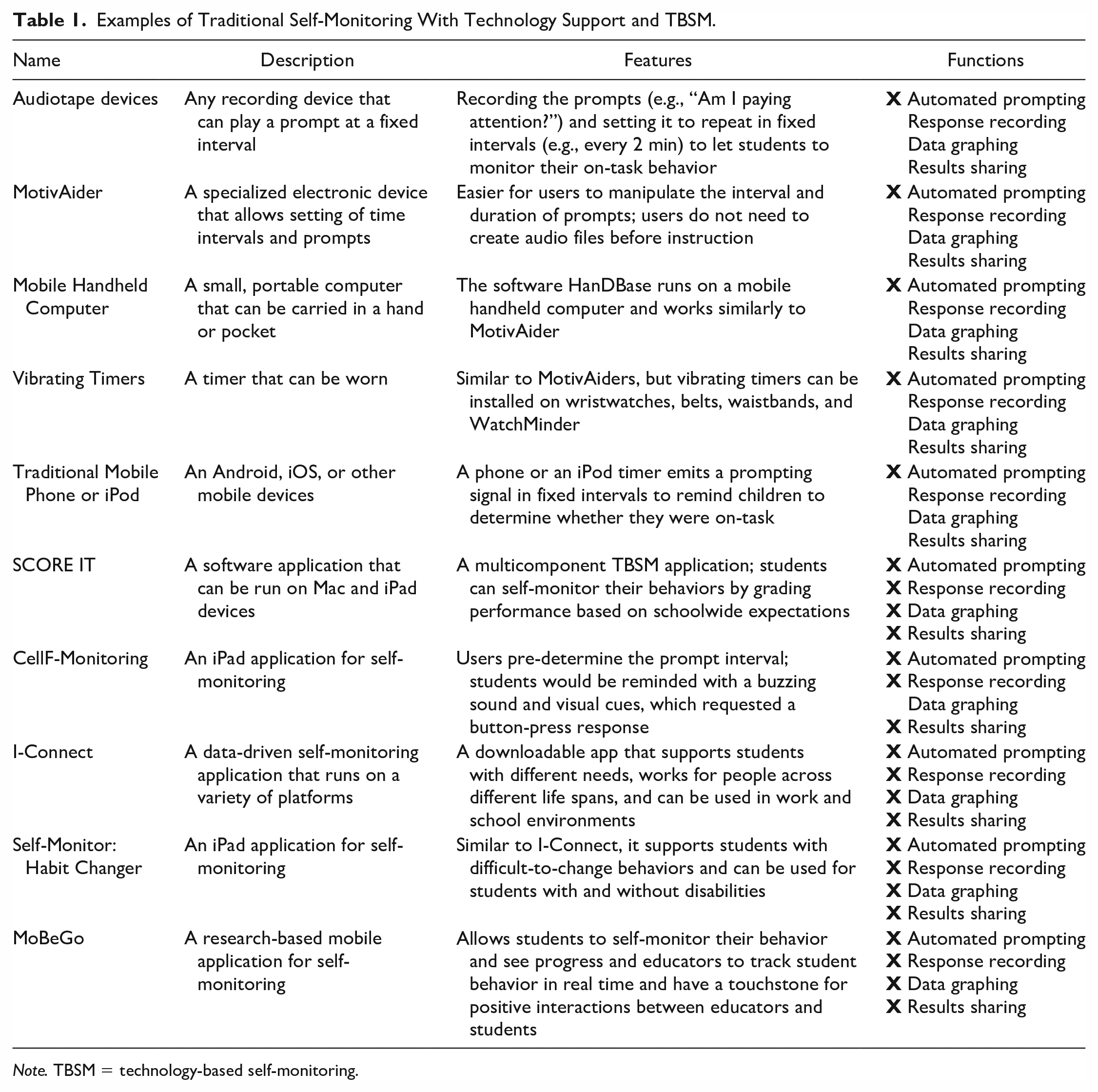
Note. TBSM = technology-based self-monitoring.
Evidence Supporting TBSM in Schools
Empirical studies have demonstrated the effects of TBSM on improving students’ behavior outcomes across educational settings. Technology-based self-monitoring is associated with increasing on-task behavior and decreasing off-task or other undesired behaviors (Bruhn et al., 2020; Clemons et al., 2016; Crawley et al., 2006; Rosenbloom et al., 2016). For example, Rosenbloom et al. (2016) provided a TBSM intervention (I-Connect; Wills & Mason, 2014) to an elementary student with autism in a general education classroom. The mobile device with the I-Connect application was placed on the desk, and I-Connect prompted the student at 30-sec intervals. The prompts were a flashing screen and a visual cue, “Are you on task?” The student determined whether he was on-task, and then responded to the prompt by pressing the “Yes” or “No” button on the device screen. The intervention led to an immediate increase in on-task behavior and an immediate decrease in off-task behavior (Rosenbloom et al., 2016). The average level of on-task behavior increased from 22.45% (before intervention) to 83.1% (during intervention). The social validity results indicated that both the student participant and the educator had positive perceptions of the TBSM intervention.
Bruhn et al. (2016) investigated the effects a multicomponent self-monitoring application named SCORE IT on students’ classroom behavior. The intervention combined student self-monitoring with teacher mediation and feedback and contingent reinforcement. Two middle school students with disabilities identified behavior expectations (e.g., be respectful, be responsible, be ready) and inputed them into SCORE IT. After each instructional session, the students rated their respectful, responsible, and ready behavior on SCORE IT’s 4-point scale system. After the delivery of the intervention, both students had improved academic engagement and decreased disruptive behavior. The results demonstrated a functional relation between the SCORE IT and students’ improved behavior for both participants. The students also indicated positive perceptions of the intervention. Other studies demonstrating positive effects on students’ behavior performance include Beckman et al. (2019), Clemons et al. (2016), Crutchfield et al. (2015), Romans et al. (2020), Schardt et al. (2019), and Vogelgesang et al. (2016).
Advantages of TBSM Interventions
Technology-based self-monitoring interventions have advantages over traditional paper-and-pencil self-monitoring or other adult-centered interventions. First, TBSM tools or applications are user-friendly. Researchers have suggested that TBSM tools are “portable,” “easy to use,” “socially acceptable,” and “students are motivated to use them” (Bauer & Ulrich, 2002; Hunter et al., 2017, p. 68). Second, TBSM approaches are efficient, requiring less effort from adults than other approaches to support student behavior. Rather than drawing a checklist or spreadsheet, educators and students can set up prompting intervals by clicking buttons on an electronic device. The technology system can collect data and transfer the data to graphs and result reports (e.g., percentage of on- and off-task intervals). Researchers have demonstrated that using handheld computers for self-monitoring can save up to 81% of the time required for capturing and reporting data (Fletcher et al., 2003; Gulchak, 2008).
Third, some recent TBSM applications can track and share data between students, educators, and parents, facilitating school–home communication and collaborative data-based decisions (Wills & Mason, 2014). Fourth, given the prevalence of smart devices at school and home, TBSM can work privately without drawing attention to a student. Fifth, one TBSM application can support numerous target behaviors and be used across different settings. Finally, research suggests that TBSM can work for a broad range of students (e.g., various ages, grades, support needs; Cooper et al., 2020).
Designing Effective TBSM Interventions
To maximize the benefits of TBSM, researchers have explored external intervention components implemented by parents and educators. Students directly used a TBSM application and adults (e.g., parents, educators) provided external support to boost the effects of the intervention. Based on this research, we suggest educators (a) explicitly teach students to use TBSM, (b) promote self-monitoring accuracy, (c) use data to guide adjustments to TBSM, and (d) consider combining TBSM with other external supports to increase effectiveness of TBSM interventions.
Explicitly Teach Students to Use TBSM
To set students up for successful use of TBSM, educators should explicitly teach a student to use TBSM before expecting them to use it. Explicit instruction typically includes an operational definition of the target behavior—a general description followed by specific examples and non-examples, a detailed introduction to the TBSM device with step-by-step instructions for how to use it, and opportunities for students to practice with feedback. Furthermore, educators may work with students to set up goal levels, behavioral expectations, and contingent reinforcement systems. We provide a detailed example of explicit instruction on TBSM in the final section of this article.
Promote Self-Monitoring Accuracy
Once a student begins TBSM and before using student-recorded data to guide decisions, it is important to promote self-monitoring accuracy. Although research suggests that accurate self-monitoring is not necessary for behavior change (Cooper et al., 2020), accuracy is important when data will guide decisions about TBSM and other supports (next sections). As discussed, recent TBSM applications incorporate data collection systems. The system prompts the student to self-record by pressing a button on the device screen. Initially, an educator may record data alongside a student. That is, every time the TBSM application prompts a student to record, an educator may write down whether the student is engaging in the target behavior (e.g., on task). Then, the educator can compare their data with student-recorded data collected by the TBSM application, and they can calculate percentage of agreement—an indicator of self-monitoring accuracy. Low agreement between an educator and student may indicate that additional training is required for the student and/or the educator.
Use Data to Guide Adjustments to TBSM
Technology-based self-monitoring tools also can facilitate data collection, storage, summarizing, and reporting. Some recent applications (e.g., I-Connect) allow users to access data summaries instantly. This level of access to usable data makes data-based decision-making more efficient and immediate. That is, in collaboration with students and families, educators can use data to guide decisions about whether to maintain, fade, or adjust TBSM.
Regarding maintenance, if a student is in the initial weeks of TBSM and their target behavior is improving, the educators may decide to maintain the current level of support. For fading, if the TBSM data indicate the student is consistently engaging in a desired level of target behavior (e.g., high level of on-task behavior) for a meaningful period of time (e.g., 2–3 weeks), an educator may consider fading the intervention by gradually decreasing the frequency or duration of TBSM use and until the student is successful with existing classroom support. Regarding adjustments, if TBSM data indicate a student is not making progress, an educator may adjust the intervention by changing how often the TBSM tool prompts the student, retraining (e.g., reviewing off-task and on-task definitions and examples), and considering more external support (next section). We provide additional examples of each of these data-based decisions in the third section of this article, which presents an example of using I-Connect.
Consider Combining TBSM With Other External Supports
Although one advantage of self-monitoring is students supporting their own behavior, external support may still play a significant role, especially when data indicate that a student may benefit from external support (Bruhn et al., 2016, 2022; Bruhn & Wills, 2018; Cooper et al., 2020). For example, in collaboration with a student and their family, educators may:
Help the student set or adjust a goal for their target behavior (e.g., level of on-task behavior);
Provide specific feedback (praise and correction);
Provide graphic feedback (e.g., help student graph data if TBSM application does not graph);
Choose preferred rewards contingent on meeting goal or desired level of behavior;
Develop a behavior contract;
Design and implement a token economy system;
Establish a clean and quiet environment;
Preview expectations before self-monitoring;
Review completed tasks after self-monitoring; and/or
Implement other similar external supports.
A TBSM Example: I-Connect
To illustrate how TBSM works, we share an example of how to design, implement, and monitor a TBSM intervention. Although we use I-Connect as the TBSM tool in this example, readers may generalize many of the steps to other TBSM applications. I-Connect is a data-driven self-monitoring application available on iOS and Android devices. This application provides audio and visual prompts in pre-set fixed or variable schedules based on user preferences and records users’ responses and summarizes and graphs data. Users can easily share the data or export the results reports with other stakeholders (e.g., educators, parents). I-Connect can successfully work for a wide range of populations, including typically developing students, students at risk of problem behavior, and students with different types of disabilities (Juniper Gardens Children’s Project, n.d.). Researchers have investigated the effects of I-Connect across multiple settings, such as home, school, community, and workplace (Clemons et al., 2016; Crutchfield et al., 2015; Romans et al., 2020; Rosenbloom et al., 2016; Wills et al., 2019; Wills & Mason, 2014).
In this example, an educator was concerned that one of their students had a low level of on-task behavior, especially during writing activities. The educator decided to implement I-Connect to help the student improve their level of on-task behavior and increase their engagement in writing in class. She followed a few simple steps: (a) prepare and establish baseline levels of target behavior; (b) explicitly teach student to use TBSM; (c) implement TBSM; and (d) progress monitor and use data to guide decisions.
Step 1: Prepare and Establish Baseline Levels of Target Behavior
The educator downloaded the I-Connect application to a classroom mobile device (e.g., tablet) and registered a free administrator account on the I-Connect website (https://iconnect.ku.edu). The educator logged into the new administrator account and created a student account.
To establish the student’s baseline (pre-intervention) level of target behavior (e.g., on-task), the educator designed a straightforward observation procedure. The educator decided take data during a daily 30-minute writing activity—where the student needs self-monitoring to help himself stay on task. During that 30-minute activity, the educator used momentary time sampling to collect data. Specifically, the educator set a timer for 3 minutes and reset immediately after it beeped. Then, the educator noted on a simple data sheet whether the student was on- or off-task at that ending moment of each 3-minute interval. The educator then graphed the percent of moments the student was on-task (e.g., if the student was on-task four of the 10 moments, the educator would add a data point at 40% for that observation). The educator continued to observe during the same 30-min activity for 3 to 5 days to establish the students’ baseline level of on-task behavior. On average, the educator found the student was on-task during 60% of observed moments during baseline observations. The educator also wrote down specific examples of the student’s on- and off-task behaviors, which the educator would incorporate into training.
Step 2: Explicitly Teach Student to Use TBSM
The educator explicitly taught the student how to use TBSM to support their on-task behavior. First, the training session started with an operational definition of on-task behavior. The operation definition included a general description of on- and off-task behavior, examples of on-task behavior, and non-examples of on-task behavior (i.e., off-task behaviors). The examples and non-examples were the individualized on- and off-task examples collected from the direct observations (Step 1). The educator chose an example (e.g., eating snacks during writing activity time, playing with a pencil) and asked the student to recognize whether it was on-task or off-task. Second, the educator explicitly taught what self-monitoring was and how to use I-Connect, including how to start the application to self-monitor and check the self-monitoring results at the end of a writing session. Third, the educator and the student worked together to set up I-Connect parameters, including locations (e.g., school, work, community, home), tasks (e.g., math, writing, music, homework, community chores), preferred prompting intervals (e.g., variable interval, fixed interval), desired mean interval (e.g., prompting every 3 min), and percentage goal for the target behavior.
The student placed the device with I-Connect on his desk. The student chose a preferred visual prompt (e.g., “Are you on task?”) and an audio prompt (e.g., chime sound). The educator and the child selected an initial fixed interval length of 3 min, similar to how the educator collected baseline data. Fourth, the educator and student made a plan for the student to earn a brief break on their iPad (using school appropriate apps) at the end of each writing activity when the student met their goal for on-task behavior. Because the student displayed on-task behavior during 60% of moments during baseline, the educator and the student set 75% as an initial on-task goal level. Fifth, the educator and the student had a practice session before the official I-Connect self-monitoring. A practice session allowed the educator and the student to confirm they were familiar with the technology and able to use I-Connect smoothly.
Step 3: Implement TBSM
In the beginning, the educator made sure the students’ workspace was clean, quiet, and free of distraction. The educator and the student reviewed the goal level and the reward. Next, the student started the I-Connect application and worked on assigned writing tasks. I-Connect prompted the student to stay on task. After every 3 min, I-Connect emitted a chime sound and showed a visual cue “Are you on task?” At the same time, the device screen showed a YES button and a NO button. The student determined whether they were on task and then responded to I-Connect by pressing the button. If the student did not press a button within 5 sec, the visual prompt would disappear, and I-Connect would recognize it as no response. This prompting and recording process continued until the student completed the assigned task and stopped the self-monitoring session (approximately 30 min). I-Connect automatically saved students’ response data, and users could immediately access the self-monitoring results.
Step 4: Progress Monitor and Use Data to Guide Decisions
During the self-monitoring intervention, the educator reviewed student self-monitoring data daily and periodically (e.g., one session a week) observed and collected their own data, using the same observation routines as the baseline observations (e.g., record if the student was on-task at the end of each 3-min interval) to note the student’s level of on-task behavior during TBSM. Because the educator’s data and the student’s I-Connect data used the same interval (e.g., 3-min interval) and the same recording system (e.g., record at the end of each 3-min interval), these data were comparable.
The educator then compared educator and student collected data for agreement and evaluated if the student increased their on-task behavior compared with the baseline. If the agreement was at or above 80%, then the educator would provide specific oral praise. If the agreement was below 80%, then the educator and the student would review the operational definitions of the on- and off-task behaviors. In this example, the student and the educator collected data had 100% agreement.
Both indicated that the student’s on-task behavior improved only slightly in the first week of TBSM (from an average of 60%–65% of moments) and the student was not meeting their goal several days a week. Based on these data, the educator decided to adjust the TBSM intervention. First, the educator and the student reviewed the definition and goal for on-task behavior. Second, they decided to decrease the interval length, so that, the student received prompts and recorded on-/off-task behavior every 2 min, on average, using a variable interval schedule. Using a variable interval, each interval would be unpredictably more or less than 2 min, rather than exactly every 2 min. Third, they planned to further check the learning environment to ensure it was free of distractions.
With these simple adjustments, the student met their goal (>75% of moments on all 5 days in the following week). The educator and student decided to increase their goal in the following week (to 80% of moments on task). After the student consistently maintained high levels of on-task behavior (>80% of moments) for 2 to 3 weeks, they decided to systematically fade TBSM support (e.g., increase interval length, decrease the number of breaks earned each week) until the student was benefiting from classroom support and no longer using TBSM by the end of the quarter.
Conclusion
Technology-based self-monitoring can be an effective tool to improve on-task behavior. This article introduced TBSM and provided simple steps educators can follow to implement TBSM for one or more student(s) in their classrooms. Educators can consider each student’s individual needs to set appropriate monitoring intervals, goals, and potential rewards. Educators also can consider external support, such as supplemental reinforcement strategies, to further improve outcomes. As illustrated in the example, data-driven interventions such as I-Connect provide opportunities for tailoring an intervention to ensure its effectiveness and provide maximum benefit to the students involved.
Footnotes
Declaration of Conflicting Interests
The author(s) declared no potential conflicts of interest with respect to the research, authorship, and/or publication of this article.
Funding
The author(s) received no financial support for the research, authorship, and/or publication of this article.
