




Abstract
Students with emotional and behavioral disorders (EBD) can exhibit severely challenging behaviors that lead to events of crisis in an inclusive classroom. This article provides practitioners with an overview of the cycle of dysregulation experienced by some students with EBD. The article includes descriptions of stages in the dysregulation cycle, observable behaviors of students “in” the various stages, and step-by-step directions for teachers and other education professionals aiming to guide students successfully through each cycle stage and prevent further crisis.
Ms. Ramirez, a second-year teacher, begins the class period by telling students they will be working on their essay, worth a large portion of their grade. Dennis, a fifth-grade student with autism spectrum disorder (ASD), begins to feel anxious about the essay. He knows he struggles with writing and language in general, and that this essay could substantially affect his grade. He begins to sweat. According to Dennis’s functional behavior assessment, he most often attempts to elope when presented with tasks that he feels are above his writing ability level and can become dysregulated when his behavior support needs are not addressed.
To address this, his behavior intervention plan outlines interventions, such as allowing him to take a break and restructuring long writing tasks into smaller, more manageable tasks. Feeling a rush of embarrassment, he tries to leave the room, but Ms. Ramirez calls him out when he crosses the room. Believing she must stand her ground, Ms. Ramirez threatens to write Dennis up if he leaves the room and breaks the rules. Dennis continues to spiral knowing that, if he gets written up, he will be grounded and not be able to see his friends regardless of how well he does on the essay. Dennis starts pushing desks, some with students still in them. Ms. Ramirez hits the office button on her desk phone, requesting the crisis response team come to her room. Dennis continually screams and bangs his head on the desk nearest to him.
When the crisis response team arrives, Ms. Lambert, his special education teacher and favorite person in the building, begins talking to him to figure out what happened. After several minutes, Dennis begins to realize it is Ms. Lambert talking to him. He stops trying to bang his head and stops screaming but still cannot speak. Ms. Ramirez decides she needs a better system in place so that all her students are supported and successful in her class.
Students with emotional and behavioral disorders (EBD) can exhibit challenging behaviors. For example, behaviors of individuals with ASD may range from mild such as disruptive or stereotypic self-stimulatory flapping to severe such as self-harm or aggression (Oliver & Richards, 2015). For individuals with EBD, behaviors may range from mild such as socially withdrawing or short attention spans to severe such as aggression and self-harm (Division for Emotional and Behavioral Health, 2020). These aggressive behaviors often escalate from mild to severe within a cycle of “rage” (Myles, 2003) or “dysregulation” (Faupel et al., 2017). For the purposes of promoting inclusion and reduction of bias, we refer to this cycle as “dysregulation.” Previously, this cycle was expounded upon within the mental health field (Dix & Page, 2008). Faupel and colleagues (2017) and Colvin and Scott (2015) have extended this work to explain patterns of behavioral escalation for students with ASD and EBD within inclusive classroom settings. As this application to the classroom is relatively recent, this article provides teachers with strategies to understand and address this cycle of dysregulation.
Specifically, although teachers may have knowledge of a variety of behavior management strategies, they may choose ineffective or more restrictive strategies, which could escalate the student’s behavior (e.g., providing attention to challenging behavior rather than appropriate behavior; Zirpoli, 2008). These behaviors often more greatly affect the amount of time the student is present in the general education classroom compared with minor challenging behavior (e.g., off-task behavior) due to the disruption to the classroom and threat of harm to self or others (Dunlap et al., 2010).
To best serve students with EBD who exhibit challenging behaviors in inclusive environments, educators must be knowledgeable about the behaviors associated with each stage of the cycle of dysregulation and implement appropriate interventions to help the student regulate their behaviors (Faupel et al., 2017). Classroom applications of interventions of challenging behavior of students with EBD, when considered within the context of the cycle of dysregulation, are limited. In this article, we appeal to inclusive general education teachers and school-based behavioral teams by presenting observable behaviors within each stage of the cycle of dysregulation and recommended teacher behaviors for each stage. We also provide a hypothetical scenario to demonstrate how teachers and school personnel might navigate the cycle of dysregulation.
The Cycle of Dysregulation
The cycle of dysregulation consists of rumbling, dysregulation, and recovery. In the rumbling stage, students become generally discontent, agitated, or frustrated (Konstrantareas & Stewart, 2006; Myles & Aspy, 2016; Northrup et al., 2021; see Figure 1). They may exhibit minor behaviors, like tapping their foot, fingers, or objects; lowering their voice; changing facial expressions (e.g., go from smiling to grimacing); or tensing their muscles (e.g., intensely grip a pencil). They might also exhibit more visible behaviors, like emotionally withdrawing from an activity or individual (e.g., slouching in their chair, blankly staring, not acknowledging being called on); threatening other students or teachers; physically disturbing other students (e.g., pushing students, pulling hair, nagging others); leaving the classroom (e.g., requesting a bathroom break, abruptly walking out without asking permission); or attempting to engage in a power struggle with other students or the teacher (e.g., telling a teacher they are not going to do an assignment; von der Embse, 2011).
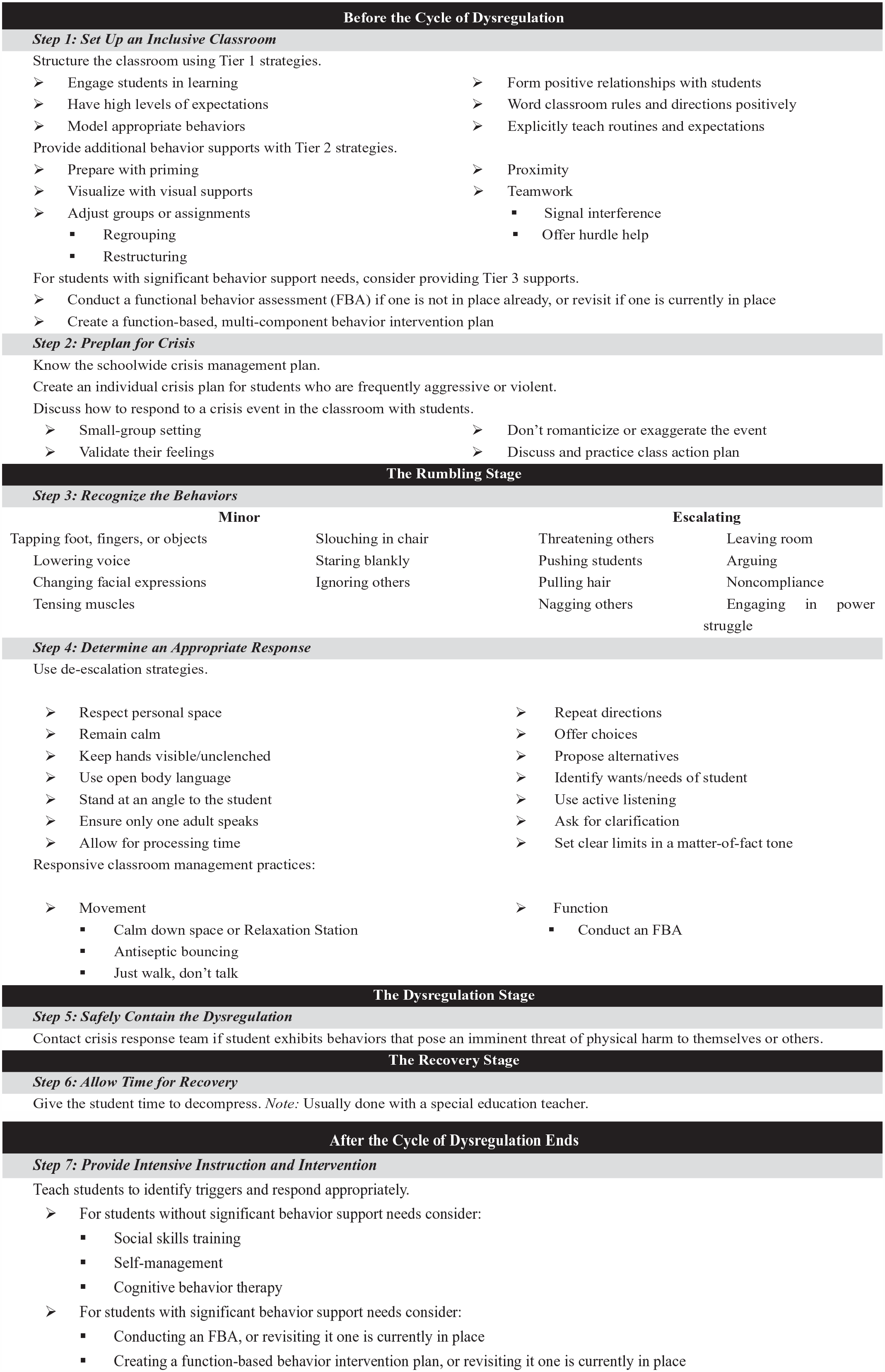
Summary of steps to navigating the cycle of dysregulation.
If an adult fails to stop the behavior in the rumbling stage, the student will often escalate to the dysregulation stage (Conner et al., 2021; Faupel et al., 2017). In this stage, the student is no longer thinking clearly and will be impulsive, emotional, and often explosive (Northrup et al., 2021; Richmond et al., 2012). Behaviors exhibited during this stage can be internal or external (Achenbach, 2011). Internal behaviors include self-harm (i.e., hitting or biting self); isolating from a group; not speaking; feeling worthless or fearful; sobbing; and suicidal thoughts or actions. External behaviors include screaming, yelling, cursing, hitting, biting, kicking, destroying objects, fighting, attacking others, threatening others, and running away (Myles & Aspy, 2016). Once this stage begins, the cycle usually has to run its course (Myles, 2003). Fewer events of severe challenging or crisis behaviors are often exhibited as students age (Greenlee et al., 2021; Konstrantareas & Stewart, 2006), which could be due to increased coping skills or general maturity (Ryan et al., 2008). However, adolescent and young adults still experience events of dysregulation.
Following the dysregulation stage is the recovery stage (Schaff et al., 2015). In this stage, the student may experience a variety of feelings, exhibit remorse for their behavior, and not fully remember what happened during the previous stage (Faupel et al., 2017). Students may be broody (e.g., deep in thought, reflective), withdrawn (e.g., staring, not responding when called), exhausted (e.g., laying their head on their desk, sleeping, physically exhausted or panting), or in denial that the behavior occurred (Achenbach, 2011).
Steps to Navigating the Cycle of Dysregulation
As illustrated in the hypothetical scenario, Dennis’s behavior progresses to the point that it is potentially dangerous to himself and others. There are several important steps practitioners can take to more safely and effectively navigate the cycle of dysregulation, including (a) setting up an inclusive classroom, (b) preplanning for crisis, (c) recognizing behaviors, (d) determining an appropriate response, (e) safely containing the dysregulation stage, (f) allowing time for recovery, and (g) providing intensive instruction and intervention after recovery (Ke et al., 2018; Myles & Aspy, 2016; Schaff et al., 2015; Sorter et al., 2022). Figure 1 provides a summary of steps to navigating the cycle of dysregulation. In the remainder of the article, we discuss the cycle’s elements and offer readers suggestions for successful educator navigation.
Before the Cycle of Dysregulation Begins
Step 1: Set up an inclusive classroom
First, structure your classrooms using preventive strategies and interventions (i.e., Tier 1 strategies) for classroom and behavior management. This includes structuring activities to encourage high levels of student engagement (e.g., collaborative learning groups, Think-Pair-Share, equity sticks); maintaining high levels of expectations (e.g., believe in students, hold them accountable for assignments and behavior expectations); strong levels of teacher–student rapport (e.g., calling students by name, embracing diversity, creating and enforcing classroom community norms, small group work); modeling positive behaviors; and incorporating special interests in activities (e.g., favorite animals, sports, and culture; Johnson et al., 2021). Wording classroom rules and directions concisely and positively can increase positive student behaviors (e.g., use “walk” instead of “don’t run,” Mundschenk et al., 2011). Also, consider explicitly teaching classroom routines and expectations through modeling and guided practice (Mitchell et al., 2017). Embedding these Tier 1 supports provides a foundation for proactively addressing challenging behaviors that can trigger the cycle of dysregulation in students with EBD (Reinke et al., 2018).
Classroom management practices to reduce challenging behaviors have been found to be effective regardless of students’ age, gender, or verbal ability (Lory et al., 2020). Furthermore, classroom management practices with strong effects can result in reduced mild and severe challenging behaviors in inclusive settings, likely limiting the frequency of a student’s behavior escalating within the cycle of dysregulation (Lory et al., 2020). Incorporating student preferences and interests, as well as peer models, can be particularly effective components of classroom management (Lory et al., 2020). Be sure to receive training to effectively implement practices to reduce challenging behaviors in the general education classroom.
There are several preventive classroom management practices that can help students keep behaviors from escalating. Understanding the student, their personality, and demeanor when choosing a classroom management strategy or intervention package is vital, as students will react differently to interventions (Lory et al., 2020). Table 1 provides a summary of classroom management practices you can implement to reduce challenging behavior. In the following subsections, we describe effective preventive classroom management strategies that have been demonstrated to be especially effective with students who experience behavioral dysregulation and require a unique set of Tier 1 supports in place (Reinke et al., 2018; Sinclair et al., 2021).
Summary of Classroom Management Practices to Reduce Challenging Behavior.
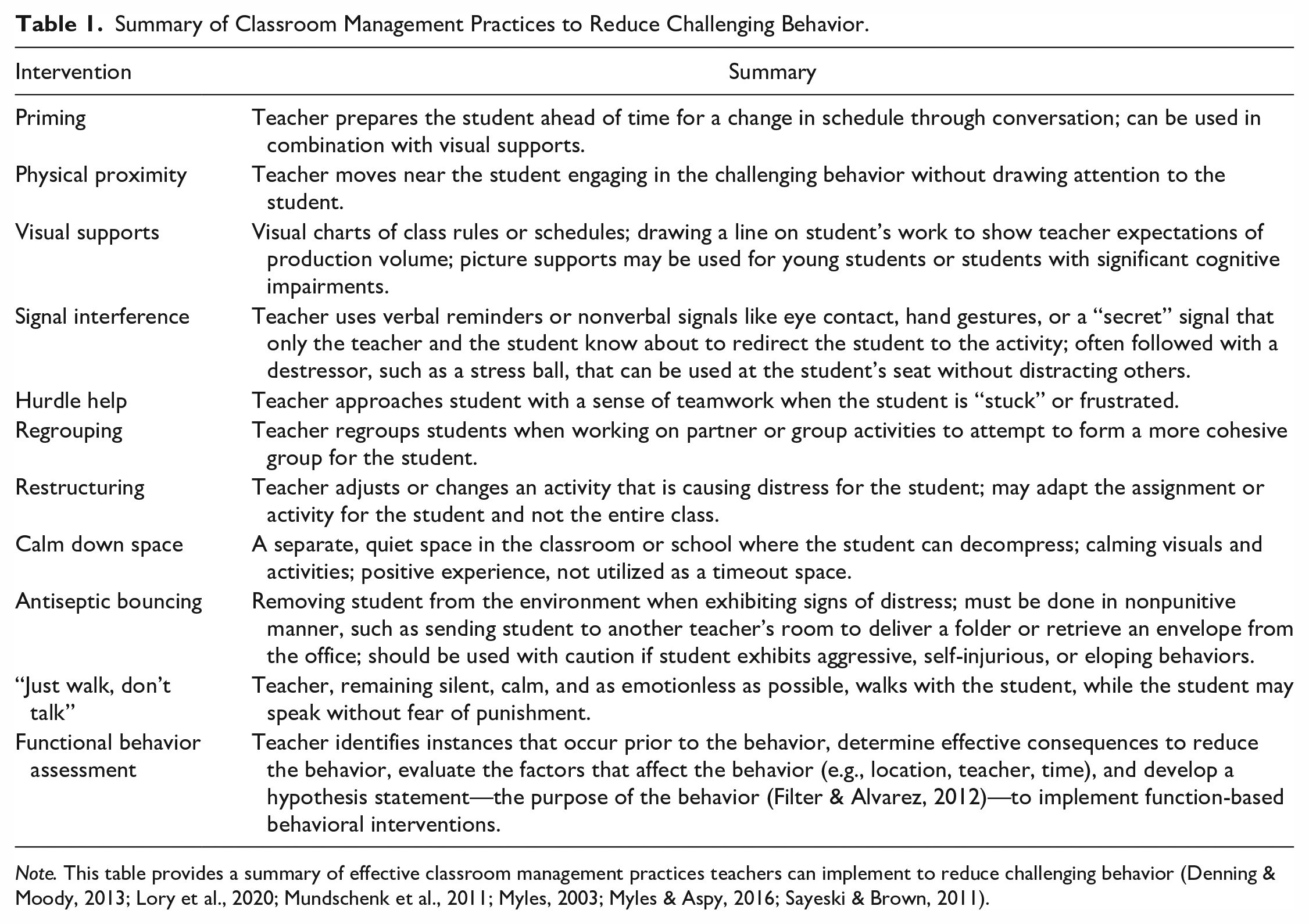
Note. This table provides a summary of effective classroom management practices teachers can implement to reduce challenging behavior (Denning & Moody, 2013; Lory et al., 2020; Mundschenk et al., 2011; Myles, 2003; Myles & Aspy, 2016; Sayeski & Brown, 2011).
Priming
Students with EBD may require support to prepare for schedule changes or when new tasks are introduced. Priming can be a helpful strategy. When using priming, prepare the student ahead of time for a change in schedule or assignment expectations through conversation (Denning & Moody, 2013). In these conversations prior to the change, explain the change and how their normal routine will be different. Make sure to include as many details as possible to ease the transition. For example, if there is an assembly happening during class time, offer answers to relevant questions like the following: Will they check in with their teacher and attend as a class? Will there be an announcement over the intercom that instructs students to go to the auditorium? Will they sit together as a class or have free choice of seating? If you do not have all the details, tell the student and let them know who will be there to support them with the change. This strategy can be used in combination with other strategies like visual supports, explained in a later section.
Proximity
When engaging in challenging behavior, some students with EBD may simply need to know that a teacher is nearby. Physical proximity provides students with this notion and can reduce challenging behaviors in a variety of settings (e.g., classroom, lunchroom). This strategy only requires moving near the student engaging in the challenging behavior without drawing attention to them (Burden, 2020). For minor disruptions (e.g., pencil tapping), slowly walk down both rows of desks without saying anything to the disruptive student. If the behavior persists, provide extended physical proximity by checking in with the student beside them. A teacher’s presence will often redirect the student to the task at hand.
Visualize
For students who require additional structure to classroom schedules and routines, visual supports can be helpful. Visual supports provide an aid, or cue, for students to see the expectation (Lory et al., 2020). Visual supports can range considerably, from a chart of rules or schedules to a line drawn on student’s work to show teacher expectations to pictures of expectations or vocabulary (Mundschenk et al., 2011). For a student struggling with task completion, for example, draw a star by the line the student is expected to complete before circulating back to the student. Picture supports may be used for young students or students with significant cognitive impairments (Denning & Moody, 2013). In the case that a student’s therapist might be absent, you can consider using a picture of the therapist and someone who is sick to help explain why the therapist is not at school. Visual supports provide a visual cue and scaffolded supports for students with EBD.
Signal interference
It is important for students with EBD to feel a sense of teamwork with their teachers. Signal interference is a strategy that can build rapport with students while maintaining high levels of expectations. Signal interference occurs when verbal reminders or nonverbal signals (e.g., eye contact, hand gestures, or a “secret” signal that only the teacher and the student know about) are used to redirect the student to the activity (Myles & Aspy, 2016). “Secret” signals should be reserved for students who exhibit frequent minor behaviors and should be established ahead of time with the student. Form this signal with the student in a private conversation, away from other students.
Ground rules for using the signal, such as keeping the signal a secret and only using when necessary, should also be put in place during this conversation. A student who requires breaks may have a “secret” signal, like placing an eraser on the corner of their desk, to show that they are taking a break from the assignment. If the behavior escalates, this intervention can be followed with a destressor that can be used at the student’s seat without distracting others, such as a stress ball (Sayeski & Brown, 2011).
Hurdle help
If signal interference is not successful at reducing behaviors, hurdle help is a promising next step. Hurdle help is another rapport-building strategy. When using hurdle help, approach the student with a sense of teamwork toward tackling the assignment (Burden, 2020). For instance, approach the student by acknowledging that they seem puzzled and offer help in the area they are struggling in. Assist the student in completing the challenge by using scaffolding and supports. From there, offer praise and specific feedback to the student and encourage them to complete the next set of problems independently. Approaching the situation with an attitude of teamwork can often de-escalate the student and redirect them to the task at hand.
Adjust
Sometimes students require adjustments to assignments or groups to reduce frustration levels. If a student seems to be frustrated due to group members, try regrouping (Burden, 2020). Change the members of a group when working on partner or group activities to form a more cohesive group for the student in distress. If a student continues to escalate, try restructuring, or changing the activity that is causing distress for the student (Denning & Moody, 2013). Adjustment-oriented interventions can reduce student challenging behavior in classroom activities and assignments or with workload expectations. Adjustments include allowing the student to choose a partner, complete work independently, or complete an assignment or assessment using an alternative method for demonstrating knowledge. For example, you could allow a student to make an instructional video to teach a skill to others instead of completing a worksheet with 40 problems.
Ms. Ramirez began thinking about the Tier 1 supports she had in place in her classroom. She realized that although she had already implemented several effective strategies, like having high levels of expectations of all her students and consistently enforcing routines, she had not implemented many additional strategies with demonstrated positive effects, including having her classroom rules posted. After consulting with the special education teacher, she decides to make several changes, including posting her classroom rules with visual supports. She also plans for other supports she can put in place to keep behaviors from escalating. She makes a note to prepare Dennis for change using priming and visual supports when appropriate. She decides to use extended physical proximity to control minor behaviors and create a secret signal to use when he becomes frustrated. She will approach tasks he sees as challenges using hurdle help, adjust by regrouping partners and group members, and restructuring assignments and assessments.
Step 2: Preplan for crisis
For students who exhibit aggressive and violent behaviors, it is important that practitioners preplan for events of dysregulation (Richmond et al., 2012). It is recommended that schools have a schoolwide crisis management plan and crisis response team, as well as an individual student crisis plan for students who exhibit aggressive and violent behaviors more frequently (McIntosh & Av-Gay, 2007). Practitioners and the crisis response team should receive training in de-escalation and crisis interventions. They should also practice the crisis management plan regularly (Adamson & Peacock, 2007). Classwide discussions should also be provided to students so they are aware of how to respond if a crisis were to occur in the classroom (Schonfeld & Newgass, 2003).
These discussions are best done in small groups where questions can be asked and steps clarified (Center for Mental Health in Schools at UCLA, 2008). Encourage students to express their thoughts and validate their feelings. Keep them from glamorizing, exaggerating, or idealizing the event (Center for Mental Health in Schools at UCLA, 2008). Discuss the class action plan, practice this plan as a group, and offer students who might need additional emotional support and the chance to discuss events with a school counselor (Schonfeld & Newgass, 2003).
Ms. Ramirez had never been in the middle of a crisis event before. She was glad that her school already had a crisis response team in place. She made sure to discuss with team members areas she could plan for in the future. The crisis response team shared the schoolwide crisis response plan with her and discussed ways she could have attempted to de-escalate the most recent situation. Ms. Lambert also reviewed Dennis’s behavior plan and role-played the situation with Ms. Ramirez to provide her an opportunity to practice the strategies discussed.
Crisis response team members suggested she explain to her students how they should react in crisis situations. When Dennis was out of the classroom helping her with an errand, she explained to the class that Dennis did not act out to hurt her or anyone else intentionally, only that he had a very difficult time controlling his emotions during that time. She explained if the event happened again, she would give a signal for the class to relocate to the neighboring teacher’s room.
The Rumbling Stage
Step 3: Recognize the behaviors
Students with EBD can exhibit a range of behaviors. As the severity or number of behaviors increase, a challenging student may have a harder time accepting intervening strategies and regulating their behavior. That makes it imperative that we intervene as early as possible when minor behaviors are exhibited (Myles & Aspy, 2016). Be aware of these behaviors to determine an appropriate response. Figure 1 provides an overview of student behaviors that may be exhibited.
To familiarize yourself with recognizing behaviors, reflect on an instance of challenging behavior. Think of the minor behaviors the student exhibited prior to escalating. It would also be helpful to take the first and last 5 min of class to observe student behaviors, comparing them with the behaviors provided in Figure 1. Practicing observing behaviors in a nonthreatening environment may assist in recognizing the behaviors in an escalating environment.
Ms. Ramirez begins to think about the events leading up to Dennis pushing desks around the room, what she previously thought was the start of the crisis event. After debriefing with the special education teacher, Ms. Ramirez recognizes several minor behaviors that led up to his dysregulation, like tapping his foot quickly and trying to leave the classroom. She makes a point to make a list of minor behaviors the special education teacher mentioned so that she can proactively notice those behaviors in the future and keeps the teacher checklist for navigating the cycle of dysregulation near her desk for future reference (see Figure 1).
Step 4: Determine an appropriate response
Next, implement de-escalation strategies to reduce challenging behavior when a student begins to show minor challenging behaviors (Lory et al., 2020). It is vital that adults intervene without becoming part of the student’s struggle when minor behaviors are exhibited to keep the student from escalating (Faupel et al., 2017). The following behaviors have a potential to escalate a student’s behavior to a crisis: ignoring the student; raising your voice; verbally assuming the cause of the behavior; bringing up unrelated incidents; using sarcasm; using threatening or tense body language; arguing with the student; attacking the student’s character; confronting the student in front of the class; bribing or rewarding challenging behavior; and not asking for help (Spaulding, 2005).
Utilize strategies that de-escalate behaviors to keep students from escalating to dysregulation (Richmond et al., 2012). De-escalation strategies include the following: respecting personal space; remaining calm; keeping hands visible and unclenched; using open body language; standing at an angle to the student; allowing for processing time; repeating directions; offering choices; proposing alternatives; identifying the student’s wants and needs; using active listening (e.g., giving full attention to the student, showing verbal and nonverbal signs of listening); asking for clarification (e.g., asking a question in a different way); and setting clear limits in a matter-of-fact tone (e.g., emotionless tone with no anger or surprise; Richmond et al., 2012). Understand that these strategies are meant to diffuse the situation and help the student return to a regulated state, not teach students to identify their triggers or self-regulate their own behavior (Myles & Aspy, 2016). Some of the classroom management strategies described earlier, such as signal interference or hurdle help, would be appropriate at this time as well. However, if a student’s behavior is continuing to escalate, practitioners may need to implement more intensive, responsive practices to help the student return to a regulated state.
Movement
Students with EBD can get restless or need time to decompress when frustrated. De-escalation strategies that incorporate movement can meet those needs. A calm down space or Relaxation Station (i.e., a separate, quiet space in the classroom or school where the student can decompress) can be one option to provide to students (Maich et al., 2019). Calm down spaces often have visual supports of emotional regulation strategies, books, or other relaxing activities for students to engage in while decompressing. This strategy should be done in a positive manner and never utilized as a timeout (Maich et al., 2019).
Antiseptic bouncing is another movement strategy that can be implemented if the student is continuing to escalate after attempting to regulate behavior in the calm down space. Antiseptic bouncing happens by removing the student in a nonpunitive fashion from the environment when exhibiting signs of distress (e.g., sending the student to another teacher’s room to deliver a folder or retrieve an envelope from the office), but it should be used with caution if the student exhibits aggressive, self-injurious, or eloping behaviors (Mundschenk et al., 2011).
If the student could be a flight risk, “just walk, don’t talk” would be a more appropriate intervention for movement (Myles & Aspy, 2016). In this strategy, walk with the student, remaining silent, calm, and as emotionless as possible, while the student may speak without fear of punishment (Myles, 2003). De-escalation strategies that require movement can assist students in regulating challenging behavior when less intensive supports are not effective.
Function
Every behavior an individual engages in serves a purpose. If you are unsure of reasons behind a student’s behaviors, conducting a functional behavior assessment (FBA) can assist in determining the most appropriate and effective interventions (McIntosh & Av-Gay, 2007). An FBA can identify instances that occur prior to the behavior, determine effective consequences to reduce the behavior, evaluate the factors that affect the behavior (e.g., location, teacher, time), and develop a hypothesis statement—the purpose of the behavior (Filter & Alvarez, 2012). Furthermore, data from the FBA can be used to pick behavioral interventions aligned to the purpose of the student’s behavior.
Overall, interventions chosen based on the FBA are more effective than alternative intervention approaches (Newcomer & Lewis, 2004). Conducting an FBA and choosing appropriate behavioral interventions based on data can reduce events of dysregulation. It is likely that students with disabilities who have behavior support needs have function-based interventions outlined in their individualized education program (IEP). It is recommended practitioners review and implement these practices if they are provided in the IEP.
Students with significant cognitive impairments may be unable to identify triggers of dysregulation. In this case, interventions such as cognitive behavior therapy (CBT) are not the most effective intervention to reduce instances of dysregulation. Instead, conduct an FBA (Watson & Steege, 2003) and create a function-based, multicomponent behavior intervention plan to teach the student an appropriate replacement behavior (Westing, 2015). Using a multicomponent behavior intervention plan, we can alter the events that occur before the student exhibits challenging behavior (e.g., letting the student work in another location), teach replacement behaviors, such as functional communication, and modify consequences to the behavior (e.g., reinforcing positive behaviors instead of negative behaviors; Westing, 2015).
Consult with a special education teacher prior to attempting to conduct an FBA or create a behavior intervention plan, as they have more intensive training in these areas. For students with disabilities who exhibit challenging behavior over time, like Dennis, it is likely the team already has this in place. However, if one is not in place, it is recommended that the team consider conducting an FBA and creating a behavior intervention plan aligned to the students’ needs. If one is in place, it is vital to make sure that all staff are aware of the plan and are implementing it with fidelity. The team should consider reevaluating the function of behavior and function-based interventions in place if fidelity is met and the student continues to struggle (Westing, 2015).
Ms. Ramirez realizes that she could have provided additional supports to Dennis, such as de-escalation strategies. She decides in advance that she will use the hierarchy of strategies suggested in navigating the cycle of dysregulation. She will also be proactive by creating a calm down space in the classroom and forming a system with colleagues to implement antiseptic bouncing. She makes a note to reach out to Ms. Lambert for assistance with determining the function of Dennis’ behavior.
The Dysregulation Stage
If responsive classroom management practices are ineffective and the student’s behavior continues to escalate, it is likely the student will enter a state of dysregulation. At this point, the safety of the student and those around the student is of critical importance (Richmond et al., 2012). If the child is exhibiting externalizing behaviors that pose a threat of imminent harm to themselves or others, adults are now in crisis response mode, and the school’s crisis response team should be contacted (U.S. Department of Education, 2012). This is not a time to provide teacher-led interventions. Rather, it is a time to ensure the safety of all involved (Couvillon et al., 2010). Crisis response teams are provided with specific training, often through crisis intervention programs, to implement crisis intervention procedures (i.e., de-escalation, removal, physical restraint) safely. The team will determine the appropriate course of action and be responsible for containing the dysregulation stage of the cycle (Schonfeld & Newgass, 2003). It is also recommended that teachers document events of aggressive and violent behavior and report crisis events (Couvillon et al., 2010).
The team discusses what they will do if Dennis’ behavior escalates in the future. In addition to noticing minor behaviors and using less intrusive interventions, Ms. Ramirez will call for Ms. Lambert prior to Dennis escalating to the point of dysregulation, in the hopes Ms. Lambert will de-escalate the situation prior to the need for the crisis response team to intervene. She reviews plans with the crisis response team so that she may be prepared in the event of dysregulation in the future.
The Recovery Stage
After events of dysregulation, it is vital that students who have exhibited significant problem behaviors during an incident be allowed time to decompress. If they are not provided with appropriate recovery time, they may become triggered and regress to dysregulation (Myles & Aspy, 2016). When recovering from events of dysregulation, students should be in a private location outside of the general education classroom. To decompress, students should be allowed to choose a safe, preferred activity. This may look different for each student. For example, one student may choose to sleep while another student may choose to draw.
Nonetheless, students in this stage are often not in a mental space where interventions would be effectively received (Richmond et al., 2012). Thus, it is important that you and/or your colleagues provide appropriate supervision from a distance without interrupting or startling the student while they recover. To determine if the student is ready to resume their daily routine, give them a highly motivating, preferred, easily accomplished task (e.g., having a quick chat with a preferred adult, walking to a preferred location; Lory et al., 2020) and evaluate their response. Offering such a task can serve as a way to help the student resume a sense of normalcy prior to attempting to provide intervention or services to address the behavior.
If Dennis is in another crisis event in the future, the team agrees that he will be allowed time to recover in Ms. Lambert’s room. She will provide time to decompress by allowing Dennis to choose a preferred activity (e.g., drawing, napping) while also setting points in time to check on Dennis and gauge his recovery. To determine if Dennis has returned to a regulated state, she will ask if he would like to spend time in the school garden, his favorite place to be.
After the Cycle of Dysregulation Ends
Students must learn to identify situations that trigger their anxiety, stress, and overstimulation to self-regulate their behaviors when these feelings are experienced. This instruction should be provided when students are in a regulated state (i.e., calm and receptive of others). When students have fully recovered from events of dysregulation, intensive interventions can be implemented to provide instruction to address their behaviors. There are several intervention programs (e.g., social skills training, Lane et al., 2005; self-management, Thompson, 2014) that can help teach students these skills and strategies to self-regulate their behavior.
In addition, group counseling using CBT (Sukhodolsky & Scahill, 2012) and CBT with embedded social skills training have been effective at reducing challenging behaviors (Saliha et al., 2021). Effective programs utilize components such as social stories, video modeling, social problem-solving, scripting activities, pivotal response training, self-monitoring, priming and prompting, role-play scenarios, one-on-one teaching, game play, group work and conversations, feedback, and homework (Ke et al., 2018). These intervention programs should be selected when considering the needs and abilities of the student and implemented at a time when the student is in a teachable state, not within the cycle of dysregulation (Stahmer et al., 2011).
The team decides that Dennis will receive additional social skills training, focusing on identifying his triggers and role-playing how to better handle the situation if his behaviors escalate to crisis level in the future. The team believes this intervention should be provided in the school garden to ensure Dennis has returned to a regulated, teachable state and has fully recovered from the cycle of dysregulation, prior to implementing the intervention.
Conclusion
Students with EBD may exhibit a variety of challenging behaviors that ultimately affect the amount of time spent in the general education classroom (Stoutjesdijk et al., 2012). If teachers are not knowledgeable about how to intervene, behaviors could escalate to dysregulation (Mundschenk et al., 2011). This article provides teachers with an explicit guide of steps to take to successfully navigate the rumbling, dysregulation, and recovery stages of the cycle of dysregulation. Furthermore, it provides recommendations for preventive measures to the cycle of dysregulation, like setting up an inclusive classroom and preplanning for crisis, as well as recommendations for explicit instruction and intervention that can be implemented after the student has completed the cycle of dysregulation.
So, after reading this article, reflect on your classroom and students. Is your classroom set up to be an inclusive environment? Do you have a student like Dennis who exhibits challenging, sometimes crisis, behaviors? Do you have a plan of action if a crisis were to occur in your room? Do you provide support and instruction for your student(s) after the recovery stage? If your answer to any of these is no, we encourage you to create a plan to address the gap. Creating a comprehensive plan by addressing each of the steps discussed in this guide will increase the likelihood that you successfully navigate the cycle of dysregulation and support the well-being of yourself and your students.
Footnotes
Declaration of Conflicting Interests
The author(s) declared no potential conflicts of interest with respect to the research, authorship, and/or publication of this article.
Funding
The author(s) received no financial support for the research, authorship, and/or publication of this article.
