




Abstract
Students with emotional and behavioral disorders (EBD) often struggle to apply self-determination skills. Teaching self-determination skills within the context of writing allows students to amplify their voice and communicate with others. This article describes how writing instruction and lessons on self-determination skills may be combined to improve the trajectory of students with EBD using the self-regulated strategy development (SRSD) instructional approach. Special considerations for implementing SRSD with self-determination for students in restrictive education settings are discussed.
Keywords
Students with and at risk for emotional and behavioral disorders (EBD) in restrictive education settings (e.g., self-contained settings, residential treatment facilities, juvenile justice facilities) often present with comorbid academic and behavioral challenges (Ennis et al., 2018). Frequently these students have entered what is known as the failure cycle (Sanders et al., 2018; Scott et al., 2001) where academic and behavioral deficits are intertwined and progressively, negatively impact student performance and outcomes.
A student may enter the failure cycle due to behavioral excesses or deficits (e.g., noncompliance, off-task behaviors, aggression) or low academic skills. The cycle begins when the student is removed from the classroom due to inappropriate behavior(s). Removal leads to a loss of academic instruction, impacting academic performance and contributing to the development of splintered skill sets. These outcomes can influence future inappropriate behaviors in the classroom, perpetuating the cycle (Sanders et al., 2018; Scott et al., 2001). By the time these students reach middle and high school, this cycle can lead to significant loss of academic instructional time. In addition, these behavioral excesses and deficits splintered academic skill sets can lead to further challenges in other developmental domains (e.g., social-emotional, transition) and be compounded by a student’s difficulty regulating their behavior (e.g., self-monitor work completion or time on-task) and/or managing their emotions (e.g., anger or frustration and coping strategy usage; Ennis et al., 2018).
Researchers continue to show that students with or at risk for EBD display deficits across academic tasks (e.g., reading, writing, spelling, math; Ennis et al., 2018) and increasing levels of disruptive or challenging behavior (Black et al., 2021; Ennis et al., 2018), which can lead to marginalized postsecondary outcomes for these students (Griller Clark et al., 2016). Given these students’ frequency of challenging behaviors during instruction as well as significant academic deficits, it is imperative to provide students with or at risk for EBD with appropriate and individualized research- or evidence-based academic instruction to promote positive school and lifelong outcomes (Tankersley et al., 2022). One specific academic skill that students with and at risk for EBD often struggle with is writing (Gage et al., 2014).
Writing Needs of Students With and At Risk for EBD
Students with or at risk for EBD experience significant challenges with writing (Gage et al., 2014). Writing is a complex academic skill that involves multiple steps including planning, organizing, drafting, writing, and revising, and students with EBD often produce written products that are shorter, lacking in detail and developed vocabulary, and misaligned with the prompt when compared to typically developing peers (Cuenca-Carlino et al., 2019; Ennis & Jolivette, 2014). In addition, students with and at risk for EBD may struggle with self-regulatory behaviors that support writing such as setting writing goals (e.g., “My goal is to remember to have an ending for my essays”; Pitzel et al., in press) self-monitoring written products (e.g., spelling, grammar; Sanders, Rollins, et al., 2021).
Writing is a critical skill for students with and at risk for EBD to attain proficiency as it is a way to demonstrate understanding within a school setting. It also may be used to communicate thoughts and ideas and as a tool to self-advocate for specific wants and needs (Ennis et al., 2014). This is especially important when students reach middle and high school, where the expectation that they can communicate their thoughts and opinions is well established (Harris & McKeown, 2022).
Students with and at risk for EBD may struggle with appropriately and effectively communicating their ideas through writing (e.g., self-advocating for wants or needs; Pitzel et al., 2022). This struggle may lead to low self-efficacy and motivation toward writing tasks (Cuenca-Carlino et al., 2016). One way to support students in developing their skills to communicate their ideas through writing (e.g., planning, organizing, writing) is to concurrently integrate self-determination skill instruction into writing instruction (Cuenca-Carlino et al., 2016; Pitzel et al., in press). Self-determination skills include goal setting, self-monitoring, and self-advocacy.
Self-Determination Skills
Self-determination refers to an individual’s ability to have full control of their life (Wehmeyer, 2005). Self-determination includes a combination of skills to help a person feel more empowered, autonomous, and satisfied with their quality of life (Wehmeyer, 2014). Integrating self-determination instruction with writing instruction support can improve writing outcomes (e.g., Cuenca-Carlino et al., 2016; Pitzel et al., in press). However, there is also an established connection between strong self-determination skills and overall student outcomes (Shogren et al., 2015).
Moreover, as students reach adolescence, teaching self-determination supports their growing desire for independence and autonomy, while teaching them skills necessary for postsecondary success. Conversely, a lack of self-determination skills may negatively impact the behavior of students with and at risk for EBD in the classroom, as these skills are used to support positive, prosocial behaviors (e.g., advocating appropriately, self-regulating behaviors). Thus, an integrated approach to teaching writing and self-determination to this population has the potential to positively impact both academic and behavioral outcomes while interrupting the failure cycle (Sanders et al., 2018; Scott et al., 2001).
Recently, researchers have started to integrate self-determination skill instruction into the writing process for students with and at risk for EBD in restrictive education settings. A particular emphasis has been placed on teaching seven self-determination skills: Decision-making, a person’s ability to make choices about their life (Pitzel et al., in press); goal setting, developing realistic and meaningful goals that a person hopes to achieve (Wehmeyer, 2014); self-awareness, an individual knowing their own strengths and needs (Sanders, Jolivette, et al., 2021); problem-solving, analyzing a situation and coming up with a possible solution (Cuenca-Carlino & Mustian, 2013); self-advocacy, a person stating their wants, needs, or beliefs in a positive manner (Pitzel et al., in press); self-monitoring, a person evaluating their progress and how they are doing (Cuenca-Carlino & Mustian, 2013); and self-efficacy, an individual assessing their ability and confidence at a skill or task (Cuenca-Carlino et al., 2016).
These skills have been shown to improve the writing performance outcomes and self-determined behavior of students with or at risk for EBD (e.g., Cuenca-Carlino & Mustian, 2013; Pitzel et al., 2022, in press; Sanders et al., 2022). One vehicle for teaching writing with integrated self-determination skills is through the self-regulated strategy development instructional approach.
Self-Regulated Strategy Development
Self-regulated strategy development (SRSD) is an evidence-based instructional approach designed to address the writing needs of students with or at risk for EBD using embedded self-regulation skills (Harris et al., 2008; What Works Clearinghouse, 2017). The SRSD instructional approach contains six recursive stages that are taught until student mastery of the strategy (e.g., independent usage) is achieved. These stages include develop background knowledge, discuss it, model it, memorize it, support it, and demonstrate independent performance (see Table 1 for definitions). The stages are recursive and multiple stages are represented within each of the lessons (see Harris et al., 2008 for complete lessons and corresponding resources). Students are taught a selected mnemonic through a series of lessons covering the six stages for approximately 2 to 4 weeks. Lessons are typically delivered 3 times a week for 30 to 40 min in individual, small, group, or whole class formats (Ennis & Jolivette, 2014; See Table 2 for resources related to SRSD).
Self-Regulated Strategy Development (SRSD) Stages With Self-Determination Examples.
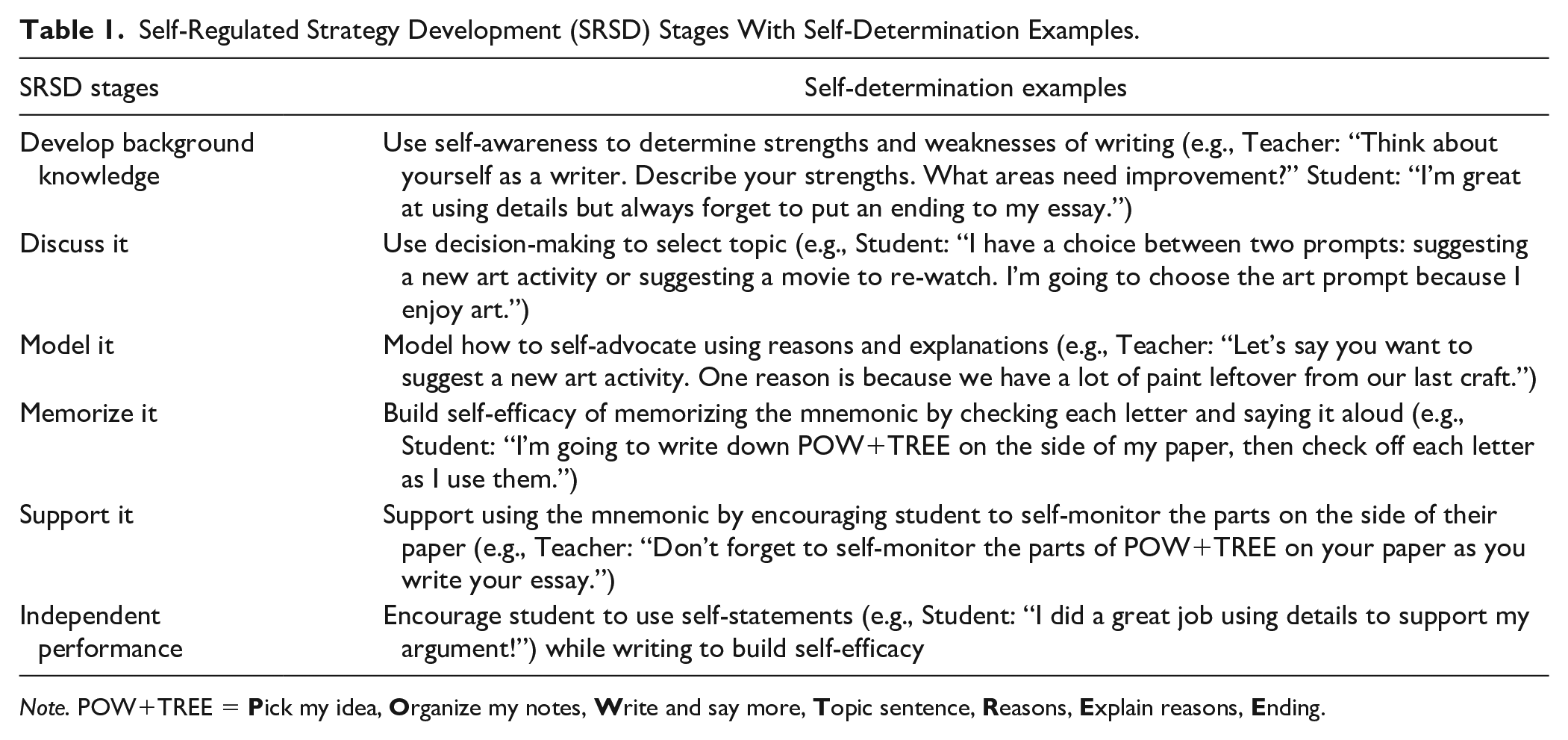
Note. POW+TREE =
Additional Self-Regulated Strategy Development (SRSD) Resources.
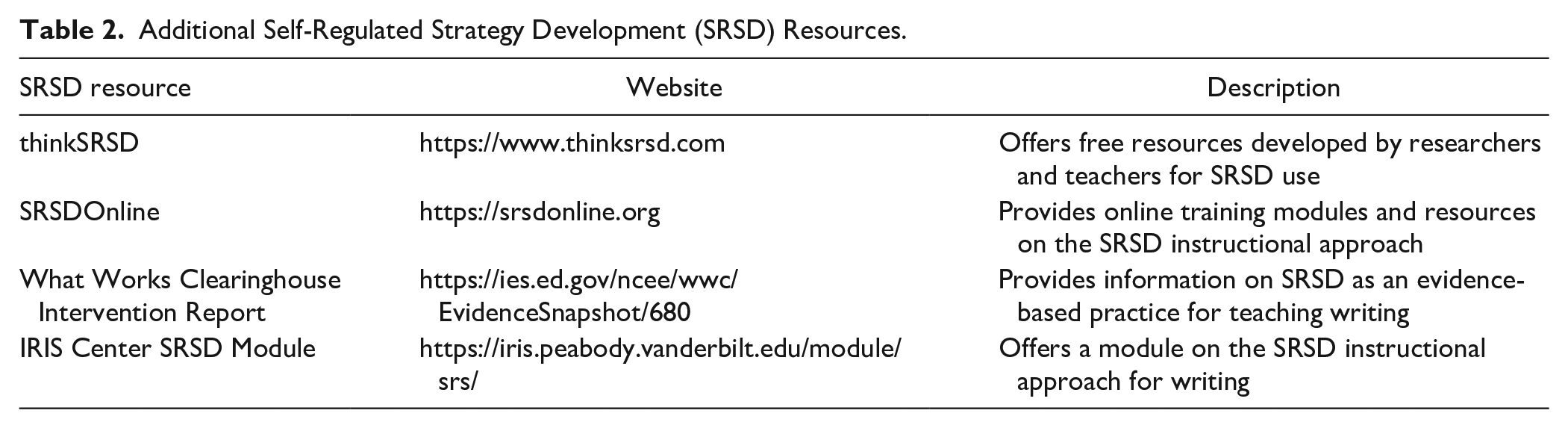
Recent efforts have been made to teach students with or at risk for EBD writing with integrated self-determination skills using the SRSD instructional approach. Specifically, researchers have used SRSD to teach the POW+TREE (
Integrating Self-Determination Skills Within Writing Instruction
Writing instruction, specifically the SRSD framework, is particularly well-suited for integrating self-determination skills, as there are many authentic opportunities for students to practice using their self-determination skills. In restrictive settings, there are some unique student contextual variables (i.e., specific factors that apply to this student population) that should be kept in mind as they may negatively impact a teacher’s ability to implement the intervention with fidelity and, thus, impact the intervention’s effectiveness.
When implementing writing SRSD with self-determination skills, teachers should consider the effects of the following contextual variables: (a) histories of trauma (e.g., abuse, neglect, familial discord), (b) disabilities or other health-related issues, (c) transient nature of population, and (d) student behaviors while in the school or facility (Jolivette, 2016). The following section offers key elements that are contextually specific to integrating self-determination skills within restrictive education settings to help teachers support writing skills growth, the development of self-determination skills, and the ability for students to share their voice within each stage of the SRSD instructional approach.
Ms. Jones is choosing SRSD to help improve the writing and self-determination skills of the students in her self-contained classroom. In particular, she is excited to see how the lessons support 12-year-old Jake. Jake has many strong opinions, finds writing challenging, and struggles to share his voice in socially appropriate ways. When given writing assignments, Jake struggles to organize his thoughts and does not always explain his reasons. Plus, Jake frequently struggles to verbalize his opinions. Often when asked why he needs or wants something, he replies, “Just because!” To help Jake, Ms. Jones chooses SRSD with self-determination to teach persuasive writing.
Develop Background Knowledge
In this stage, the teacher defines self-determination and gauges student understanding of the concept. For instance, the teacher might ask students if they have ever heard of self-determination and then discuss the meaning of its key components (decision-making, goal setting, self-awareness, problem-solving, self-advocacy, self-monitoring, self-efficacy). The teacher also might ask students for examples of when they have used self-determination skills in their daily lives at the school or facility (e.g., “Think of a time when you had to make a decision”).
During this stage, the teacher should be careful to avoid any discussions or conversations that may be triggering to students who have experienced histories of trauma (e.g., low self-efficacy due to familial discord) and may want to focus the examples on their life in the school or facility. If the student is unsure or needs additional support, the teacher may provide examples of how others used their self-determination skills in the school or facility by saying: I saw two of your peers get into an argument over which game they should play outside. One used problem-solving to figure out how they could come to an agreement. They decided to play basketball because it was quicker given the amount of time they had to play.
This may be particularly beneficial for students with or at risk for EBD who often struggle with recognizing and engaging in self-determination skills such as decision making and problem solving (Cuenca-Carlino & Mustian, 2013) during regular daily activities. By reviewing examples of self-determination (from the student or teacher), the teacher can assess a student’s current understanding of such skills as well as which skills might need more development and instruction.
Next, the teacher discusses the writing genre of choice (e.g., persuasive, informational) and gauges student understanding. The teacher may say, “What does it mean to persuade someone?” or “Have you ever heard of the word persuade?” This allows the teacher to assess the student’s knowledge of the genre and how much support will be needed throughout each stage of strategy instruction. For students with or at risk for EBD and/or other cognitive issues (e.g., processing difficulties), the teacher can provide them with a visual card of the word “persuade” and a synonym on the back such as “convince.” If the student is still unsure, the teacher may scaffold student understanding by linking the genre to their everyday lives.
For example, the teacher may say, “To persuade someone means to get that person to agree with you.” At this point, the teacher should connect the genre to self-determination—specifically self-advocacy—and be mindful of student contextual variables during their discussion (e.g., student struggles to request wants and needs in a positive and appropriate way). If a student wanted to invite a guest speaker to come talk to the class, the teacher may say, “Let’s say you wanted to have a softball player come speak to the class from a local community college.” You may say, “I want a softball player as a guest speaker because I play softball at my neighborhood school and I want to play in college.” Such examples can assist students who are struggling to connect the writing genre with self-determination skills.
The teacher may further develop the student’s background knowledge by having them connect self-advocacy and the writing genre to their own life, including when they leave the school or facility. If a student lived with their grandparents the teacher can say, “Let’s say you wanted a new car. You can use self-advocacy to persuade your grandparents to agree with you.” You may say, “I need a car to be able to drive to myself to soccer practice and drop my brother off at school when you and grandpa are at work.” Together, the student and the teacher can brainstorm a list of ways the student has needed to self-advocate for themselves and persuade others to agree with them. Because students may have past histories of negatively persuading others (e.g., through bullying or aggression), the teacher should make sure to keep such conversations and examples appropriate and prosocial. Inside the school or facility students might self-advocate for which assignment they would like to start first. The teacher should model for students how to self-advocate for the assignment they want using appropriate and positive sentence stems (e.g., “I would like to start this assignment first because this assignment is important to me.”). Doing so will allow the student to gain a better understanding of how the two connect and relate, which will set the stage for learning the mnemonic selected in later lessons.
Ms. Jones asks Jake if he has ever heard of the word self-determination before. Jake says yes. He thinks it has to do with life and decision making. Ms. Jones asks Jake to think of a time where he had to use decision making in his life. Jake says he had to decide on which elective class he wanted to take last year at his neighborhood school. Ms. Jones builds on Jake’s background knowledge and starts discussing the other self-determination skills.
Discuss It
During this stage, the teacher introduces the writing mnemonic (e.g., POW+TREE; Cuenca-Carlino & Mustian, 2013; Ennis et al., 2013) and discusses how writing can be used to self-advocate for things the student may want or need for both inside and outside of school. The teacher then reviews the different parts of the mnemonic and what they stand for. For example, “The
As the teacher discusses the writing mnemonic, they should begin describing how the steps of the mnemonic link to the self-determination skills while keeping student contextual variables in mind (e.g., transient nature of population—may not have experience using self-determination skills in other settings due to lack of choice or student voice in opportunities). The teacher may say, “I can use problem solving to
If the student is struggling to see the connection, especially those with other cognitive issues (e.g., processing difficulties), the teacher may provide additional examples using other parts of the mnemonic or choosing another self-determination skill (e.g., “The prompt is asking me to write about my favorite holiday. I really like Thanksgiving and Valentine’s Day. Let me use decision making to decide on which idea I want to write about in the
Finally, the teacher will discuss setting goals with the mnemonic: “My goal is to have at least three reasons and three explanations to meet the requirements of TREE.” The teacher can assist students with or at risk for EBD who often struggle with setting academic goals (Sanders, Rollins, et al., 2021) by practicing self-awareness. Specifically, the teacher can support the student by creating a list of “Glows” and “Grows” that they would like to work on as they learn and master the mnemonic. A glow might include: “I do a great job using some reasons and explanations in my essay.” A grow might include: “I need to make sure I have at least three reasons and three explanations in my essay.”
As the teacher works with students, behavioral contextual variables should be kept in mind. For example, if a student begins to display negative academic self-talk, the teacher might teach and encourage student goal setting. The teacher may say, Let’s see the grows and glows you wrote down. It looks like you do a great job of adding reasons and explanations! I know that can be hard for people to do. Now, it looks like you want to make sure you have at least three of each. Let’s set a goal to include at least three reasons with explanations the next time you write. You can keep track of your reasons and explanations using tally marks like this [teacher demonstrates using tally marks on a sheet of paper]. This can help you self-monitor your progress towards meeting your goal!
Identifying a student’s strengths and setting goals for improvement can serve as an effective way to assist those with or at risk for EBD who may express low self-efficacy in their writing abilities (Pitzel et al., in press).
Ms. Jones discusses how to use goal setting while writing essays. Before modeling how to write a persuasive essay, Ms. Jones tells Jake that she often forgets to include an ending in her essays. Ms. Jones says she can write down a goal to help her get better at this. The goal might be, “Include an ending sentence in my persuasive essays.” She asks Jake what his goals are for improving his writing skills. After some thought, Jake decides he wants to set a goal to include at least three reasons to support his opinion in each of his essays.
Model It
In this stage, the teacher models how to use the mnemonic graphic organizer(s) to self-advocate for wants and needs. For example, on the TREE graphic organizer the teacher may say, I am trying to persuade someone to let me help clean the classroom. I can self-advocate for myself through the
The teacher then models filling out the graphic organizer by writing down these reasons and explanations for the student to see. When considering student contextual variables, this is especially useful for those who may have other disabilities or cognitive difficulties that might impact instruction. In turn, the student can conceptualize how to think through developing reasons and explanations (with a focus on self-advocacy), then transfer those ideas onto the graphic organizer.
During this stage, the teacher also models how to self-monitor the parts of the mnemonic (e.g., POW+TREE). Often, students with or at risk for EBD find it difficult to self-monitor their behavior, thoughts, and actions during academic instruction (Sanders, Rollins, et al., 2021). This may be further amplified for those who have experienced histories of trauma—a common contextual variable—which can impact the brain’s development and ability to control emotions (Black et al., 2021). Providing students with a way to track their progress as they write (e.g., tally marks, check marks) can assist them during the writing process.
One way to self-monitor the mnemonic parts is by writing the letters on the side of the essay paper and checking them off as the student writes. The teacher can model this process as they write a sample essay (e.g., teacher checks off parts of the POW+TREE mnemonic during the
Also, during this stage the teacher demonstrates how to create and use positive self-statements (e.g., “I’ve got this!”) to build student self-efficacy in writing. Self-statements are often referred to as the small voice inside of our head that helps us keep going when we are faced with obstacles or challenges (Pitzel et al., in press; Sanders, Rollins, et al., 2021). Typically, students with or at risk for EBD will verbally express low motivation and apprehension toward writing (Sanders, Rollins, et al., 2021) leading to observable, verbal negative self-talk (e.g., “I’m not good at this” or “I can’t do anything right”). Creating a list of positive self-statements is an effective low-intensity behavior strategy that can help students maintain engagement in their writing and build self-confidence in their abilities.
To model positive self-statements, the teacher can describe a scenario, keeping student contextual variables in mind (e.g., student displays aggressive and defiant behaviors during writing activities due to low motivation and apprehension toward writing). For example, the teacher might say One time I was writing an essay about space. Space isn’t my favorite topic. I really struggled with sitting down to complete my essay for class. As I was writing, I would say to myself, “I can do this!” or “Keep going! You’re almost done,” which helped me make it through the rest of my essay.
The teacher can then write these positive self-statements on a sticky note to refer to as she continues teaching the mnemonic and also have students add their own self-statements throughout the learning process. For students with other cognitive issues (e.g., processing difficulties), the teacher can have them create picture cards demonstrating positive self-statements (e.g., a thumb-up symbol) to provide individualized supports.
Finally, the teacher models the use of choice making during strategy instruction which has been identified as an evidence-based practice for students with or at risk for EBD (Landrum & Tankersley, 2013). The teacher can do this by modeling how to choose between two essay topic prompts while also demonstrating how to use decision making throughout this process (Sanders et al., 2022). The teacher can say, I have a choice between two prompt topics. One is about suggesting a new holiday activity and the other is about suggesting a new snack item. I need to use my decision-making skills to select the prompt. I think I have more to say about which snack item I would like to suggest, so I will choose that one.
As a result, the student may see how to use decision-making skills to choose the most appropriate prompt based on their needs and build self-efficacy and confidence about writing on a topic they enjoy.
Ms. Jones reminds Jake that she struggles to end her essays. Ms. Jones says that she can use self-monitoring to help her remember to include an ending before she is done. Ms. Jones writes out the mnemonic POW+TREE on the side of her paper and checks off each letter as she models how to write a persuasive essay. Ms. Jones gets to the last letter in TREE and remembers that she needs an ending. She writes out her ending, then checks off the “
Memorize It
Within this stage, the student practices verbally stating the mnemonic to build their self-efficacy of the strategy and promote student voice—an aspect that is often lacking for students with or at risk for EBD in restrictive education settings. To assist students with memorizing the mnemonic, particularly those with additional disabilities or other health-related issues (e.g., poor fine/gross motor skills), the teacher can write down the parts (e.g., POW+TREE), then point to each letter and have the student verbally state the word and meaning aloud. For example, the teacher might point to the “O” in POW and the student might respond by saying, “
To further promote student voice, the teacher can offer a choice to write down the mnemonic on their own and check off the parts as they say them aloud. This can empower students and build their confidence with using the mnemonic on their own. Doing so can be particularly beneficial for students experiencing behavioral challenges (e.g., anger and frustration contextual variables) during instruction due to lack of motivation or apprehension toward writing.
Ms. Jones writes out the POW+TREE mnemonic on a sheet of paper. Ms. Jones points to each letter of the mnemonic and prompts Jake to verbally say the word aloud. The two of them do this each time they meet for lessons to help Jake memorize the mnemonic and build his self-efficacy while using it. Sometimes, Ms. Jones has Jake describe how he is using self-determination skills while he is writing and sometimes she has him describe how he completes each of the POW+TREE steps. This allows Ms. Jones to test Jake’s ability not only to remember the steps and skills but also how to apply them to his writing. Jake says he feels more confident in his abilities to use the mnemonic as he writes since he has memorized all the parts.
Support It
In this stage, the primary role of the teacher is to provide support with mastering the mnemonic and self-determination use. This stage can be difficult for students with or at risk for EBD and those with contextual variables related to past histories of trauma who may struggle with self-regulating their emotions or behavior when support is being faded and when writing tasks become difficult (Sanders, Rollins, et al., 2021). To assist students while keeping contextual variables in mind (e.g., difficulty self-regulating due to challenging behaviors), the teacher can remind them to write the mnemonic on the side of their paper to help them self-monitor and check off the parts being used as they write. This serves as an effective way to prompt those who may be struggling with monitoring the parts of the mnemonic due to contextual variables.
Teachers can also support students by emphasizing the self-determination skill problem solving. For instance, if a student gets stuck with their writing, teachers can support students in identifying how to identify the problem and generate possible solutions (e.g., look up a word and ask for help). Another way that the teacher can assist students is by reminding them to use positive self-statements as they write to help build their self-efficacy. For instance, the teacher can say, I know that writing becomes challenging during the
Providing this reminder to students with or at risk for EBD is especially beneficial given that they often fall into academic dysregulation during challenging tasks (e.g., writing an essay; Pitzel et al., in press) which may result in negative self-talk or defiant behaviors (e.g., verbal refusal to complete work)—common contextual variables associated with this population. Such self-statements will also be beneficial for transient populations of students (another contextual variable) due to ease of implementation and use across settings.
Ms. Jones and Jake are working together on an essay prompt that asks students to explain to their teachers why they should be able to complete their writing with a computer. While planning out his essay on the graphic organizer, Jake becomes frustrated because he cannot think of one more reason and explanation. He tells Ms. Jones that he does not want to write anymore and gives up. Ms. Jones reminds Jake to look back at some of the positive self-statements he created during the previous lessons to help him keep going and develop his self-efficacy. Jake looks at his self-statement sheet and reads one aloud (e.g., “You’re almost there! You can do this!”). Jake looks back at his graphic organizer and thinks of one more reason and explanation to add. Afterwards, Ms. Jones and Jake reflect on how he was able to self-advocate his needs through his writing.
Independent Performance
During this stage, the teacher monitors the student’s ability to complete the essay writing process on their own using the selected mnemonic and self-determination skills. For example, the teacher might monitor the student’s ability to self-advocate for their wants or needs during the
Due to the unique nature of this population, contextual variables must be kept in mind. For example, it will be particularly important to monitor for students with or at risk for EBD and other disabilities (e.g., learning disability) given they tend to struggle with setting personal goals and self-advocating for themselves independently (Pitzel et al., in press; Sanders, Rollins, et al., 2021). If the teacher notices that the student is struggling during this stage or any parts of the essay writing process, they should go back and revisit the previous SRSD stages until mastery is achieved (e.g., student struggling with goal setting and self-advocating for needs due to a learning disability—teacher goes back to the “Discuss It” stage and reviews how to self-advocate for themselves by setting appropriate and realistic goals given the student’s contextual variables). This will ensure the student has successfully mastered the strategy instruction.
Jake is writing a persuasive essay. As Jake fills out his graphic organizer, Ms. Jones monitors his ability to self-monitor as he completes the brainstorming, planning, and writing processes, as well as the way he is self-advocating for himself through his reasons and explanations. Ms. Jones can tell that Jake is confident in his abilities to not only write an organized, detailed response but also self-advocate for things he wants or needs. Jake’s reasons were clear and stated in a positive way (“I want to take art as an elective because I’m interested in learning about painting portraits”). She also can tell his self-efficacy related to writing has grown. He is much more confident throughout the writing process. Ms. Jones notices that Jake also is doing a better job verbally explaining what he needs during the day. She is pleased with not only his improvements in writing but also his increased and effective use of the self-determination skills they emphasized throughout the lessons.
Additional Considerations
Special considerations should be kept in mind as teachers implement SRSD with self-determination with students in restrictive education settings. The following section offers four considerations for this vulnerable and unique population of students.
Application Across Genres
Teachers working with students with or at risk for EBD can implement SRSD with self-determination across different writing genres. Being taught to write across genres is important for students to master Common Core State Standards (U.S. Department of Education, 2017). There are various mnemonics that have been used to teach writing skills for different genres. For example, the STOP and DARE mnemonic (
For example, in The prompt is asking me to choose whether I would like to stay inside or go outside to P.E. Let me use some problem solving to determine which side I should take. First, it’s starting to get warmer outside so some people may want to participate in outdoor activities. Second, we can do more activities outside than inside. I think I have more to say about going outside for P.E. I’m going to decide to write about that one.
Table 3 includes more examples of how to integrate self-determination into the STOP and DARE mnemonic.
Examples of STOP and DARE With Self-Determination.
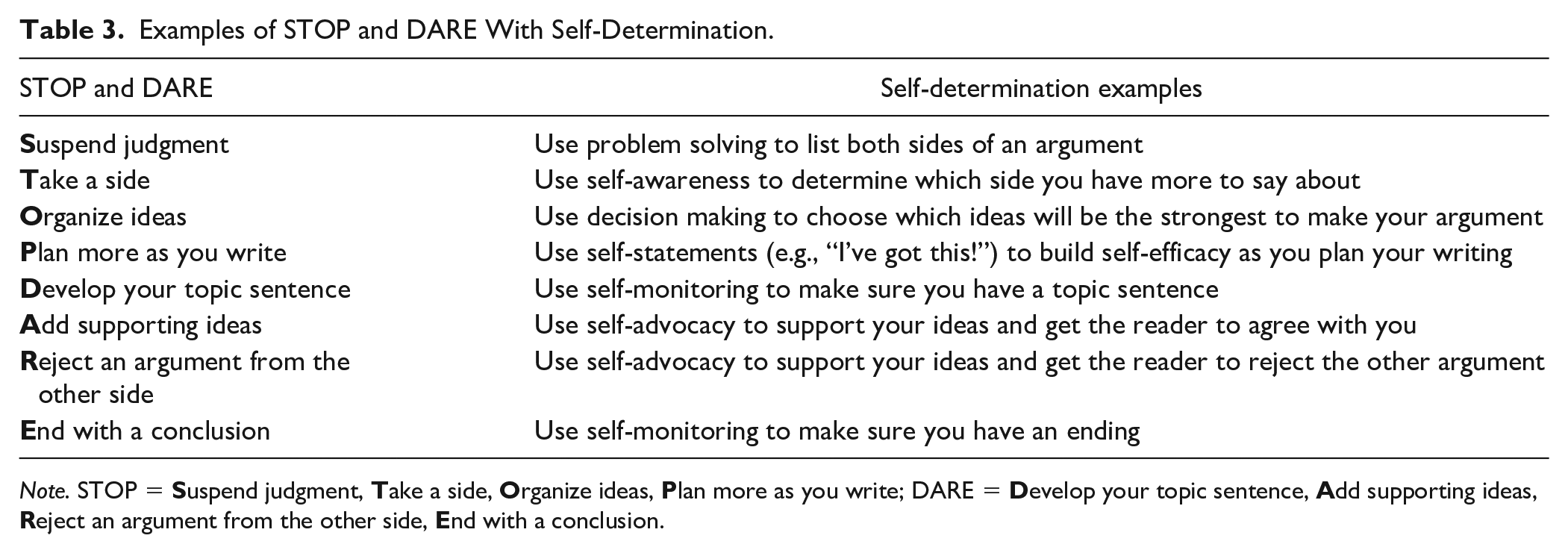
Note. STOP =
Another genre where teachers can incorporate SRSD with self-determination is informational writing. For instance, TWA (
Examples of TWA + PLANS With Self-Determination.
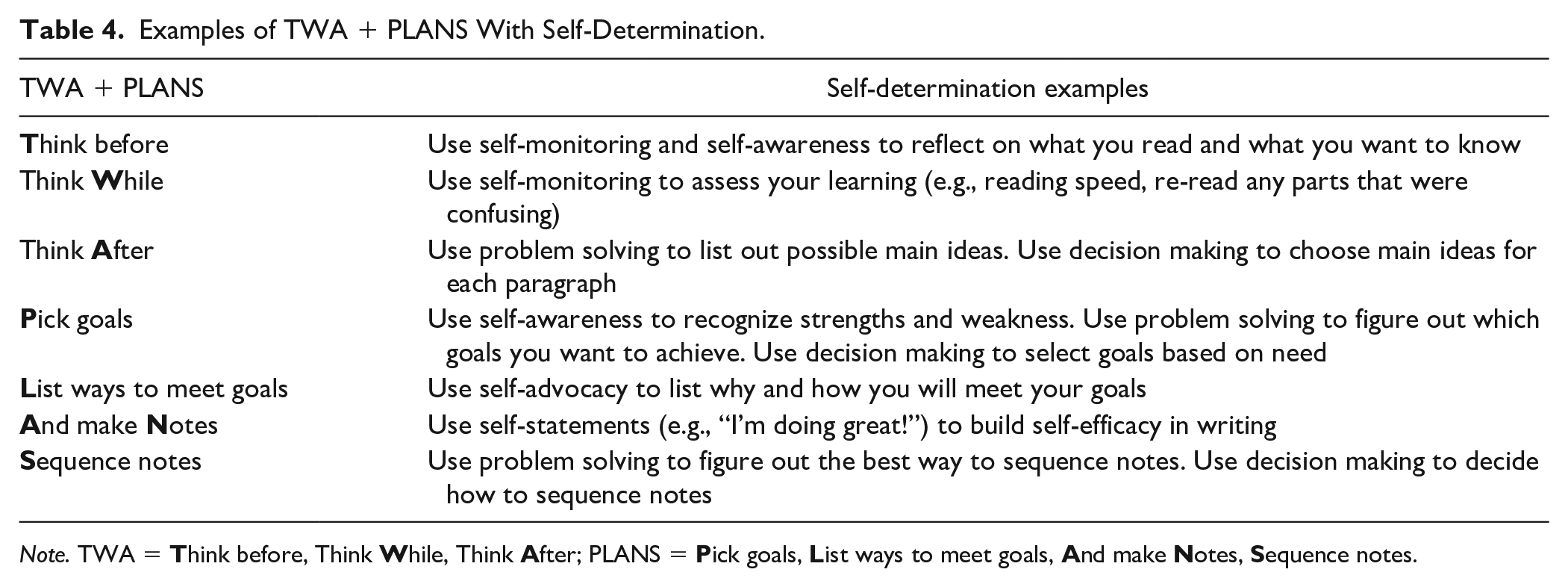
Note. TWA =
Trauma-Informed Approaches
Often, students with or at risk for EBD in restrictive education settings have experienced significant histories of trauma that may have a negative impact on their overall development (e.g., academic, social-emotional; Pitzel et al., 2022). Trauma has been connected to low self-esteem, low self-worth, poor decision making, and a lack of ability to respond to stressful situations (Black et al., 2021). Utilizing trauma-informed approaches can be critical in setting up students with or at risk for EBD in restrictive settings for success upon release.
There are several ways that teachers can implement trauma-informed approaches to meet the writing and self-determination needs of students with or at risk for EBD. One way to do this is by creating self-advocacy-focused writing prompts that are trauma sensitive. To do this, teachers can give students an interest survey or inventory to get a better sense of things they like, want, or need (e.g., future career, favorite games). Teachers can then use this information to create their own self-advocacy-focused writing prompts. After creating the writing prompts, teachers can review them for potential triggers as well as have other people in the school or facility (e.g., special education teacher, social worker, colleagues) look at them to ensure they meet the needs of their students (e.g., minimize number of prompts, reword prompts for possible triggers).
Furthermore, the teacher can adapt lesson plans to make them trauma sensitive. For instance, the teacher can provide choice within the lessons, giving students voice in the process (Sanders, Jolivette, et al., 2021). There are a number of ways to incorporate choice including: (a) where (e.g., at a table, at the desk); (b) within, or the materials used for the task (e.g., pencil, pen); (c) between/among, or choices within the writing task (e.g., which writing prompt to answer today); or (d) future (e.g., what to do when the task is complete; Jolivette et al., 2002). In addition, the teacher can change or update any words in the lessons to prevent students from being triggered. The teacher can do this by having people in their school (e.g., special education teacher, social worker, colleagues) review the sample essays and lessons, then provide feedback or suggestions on how to make them more appropriate (e.g., prompt topics, words or phrases in lessons) based on individual student need.
Culturally Responsive Practices
Considering a student’s background and culture is important when implementing SRSD with self-determination to improve the writing outcomes of students with or at risk for EBD (Jozwik & Cuenca-Carlino, 2020). Students with or at risk for EBD come from diverse ethnic backgrounds and such backgrounds (e.g., Latino) may put them at greater risk for poor life outcomes (e.g., social, emotional, behavioral) due to linguistic and cultural barriers (U.S. Department of Education, 2022). Designing instructional practices that incorporate the student’s culture and language can make this population feel more welcome and accepted within the school or facility (Black et al., 2021).
One way to ensure that the individual needs of students are being met is by completing a “Get to Know You” survey during the intake assessment and screening process to learn more about their culture. Requests can be made for information on the student’s culture and/or traditions. Such information can then be used to make connections to student culture during lessons. For example, the teacher can create writing prompts that provide students with the opportunity to self-advocate for themselves in their culture (e.g., You want to suggest a new snack item from your culture. Choose the snack item you would like to suggest for the class to enjoy together. Think about who your reader[s] might be. Be your own self-advocate—write a response to convince the reader to agree with you.).
Providing this opportunity promotes student voice and empowerment, which are key aspects that are often lacking or non-existent for this population of students. Lessons can also be designed with student culture in mind. The teacher can do this by creating sample self-advocacy essays that relate to the student’s culture. For instance, a sample essay could be based on the following prompt: You want to play a game that is part of your culture’s tradition during P.E. Choose the game that you would like to play. Think about who your reader(s) might be. Be your own self-advocate. Write a response to convince the reader to agree with you.
A final way the teacher can consider a student’s culture is through goal setting. This can be done by having the student set goals in both English and their own native language to build self-efficacy during instructional activities (e.g., handwritten, verbal; Black et al., 2021). As a result, students may feel more connected to their goals which can impact their writing performance and self-determination outcomes.
Student Voice
Providing students with or at risk for EBD with opportunities to amplify their voice can assist them with becoming more self-determined. Amplifying one’s voice is a recommended best practice according to the positive youth development model (Tuell et al., 2017). Using writing to promote student voice and develop self-determination is one promising approach (Cuenca-Carlino & Mustian, 2013; Pitzel et al., in press). Teachers working with this population can empower students by providing them with opportunities to have a say in their instruction (Black et al., 2021). For example, the teacher can offer students a choice in prompt topics, then have them use decision making to choose the prompt they would like to write about (e.g., Student: “I have a choice between writing an essay about suggesting a new lunch menu item or requesting a new item for the classroom reward center. I’m going to choose a new item for the classroom reward center because I would like to see us have more options”).
The teacher also can have students set personal goals based on their current and individual needs by encouraging them to consider how they feel, then determine what would be a reasonable goal for the day. Creating realistic and reasonable goals are important for students with or at risk for EBD who may enter the writing session with history effects or events that happened prior to instruction (e.g., poor sleep, altercation with another student or staff member). For instance, if a student came into class and did not sleep well the night before, the teacher can work with the student to help them come up with a realistic goal based on their current state or mood. The teacher could say, “I know you are tired. Let’s think of a reasonable writing goal for today that you feel like you can achieve based on your past essays.” Not only will this allow students to reflect on their own writing, but it also will allow them to self-monitor their behavior and emotions—a key contextual variable that is unique to this population. By taking these considerations into account, teachers working with students with or at risk for EBD in restrictive education settings can promote positive writing and self-determination outcomes.
Final Thoughts
Writing and self-determination are both important for students with and at risk for EBD receiving education services in restrictive settings. Not only does integrating the two improve writing outcomes, but it also further develops existing self-determination skills and empowers students to use their voice to self-advocate for things they want or need. By combining instruction on these skills, teachers can support student success in school and beyond.
Footnotes
Declaration of Conflicting Interests
The author(s) declared no potential conflicts of interest with respect to the research, authorship, and/or publication of this article.
Funding
The author(s) received no financial support for the research, authorship, and/or publication of this article.
