



Abstract
Check-in/check-out (CICO) is an evidence-based practice for addressing the behavioral needs of students with and without disabilities from kindergarten through the 12th grade. The CICO intervention is easily adapted to address other areas of need, beyond behavior, including academics and social integration, making CICO appealing for all school grade levels and differing student needs. Recently, transition skills have been targeted and integrated into CICO for adolescents with disabilities. Building from the transition-focused applications of CICO, adaptations and intensifications specific to high school students with emotional and behavioral disorders related to transition-readiness skills of self-monitoring, social skills, and vocational training are provided.
Keywords
The Individuals with Disabilities Education Improvement Act (IDEIA, 2004) mandates transition services must begin by age 16 for students with disabilities. Thus, secondary special education teachers should begin teaching transition-readiness skills and providing transition services when students enter the ninth grade (Strnadova & Cumming, 2016). Students with emotional and behavioral disorders (EBD) benefit from these individualized transition services and skills related to their strengths and needs as well as future goals (Yeager et al., 2020).
Transition skills and services have shown to improve student outcomes in accessing a higher quality of life, obtaining gainful employment, and feeling more socially accepted (e.g., Murray et al., 2021). Transition services help to prepare students with transition-readiness skills needed for improved postschool outcomes related to their postsecondary education, employment, independent living, and community integration. Transition-readiness skills are critical for students with EBD whether they are transitioning into postsecondary education or the workforce. Transition-readiness skills include self-determination, interpersonal skills, career readiness and vocational training, and social skills.
Given the individualized focus and approach to transition-readiness skills, students with EBD are allowed to take a more active role in their learning and school outcomes while meeting their desires to be more autonomous and independent with increased participation in their own educational decision-making (e.g., Bundock & Horner, 2021; Cooper & Pruitt, 2005). One evidence-based strategy, check-in/check-out (CICO), is individually flexible, has been used to promote transition-readiness skills, and allows students with EBD to have more self-governance in their learning and future postsecondary school pursuits (Hawken et al., 2021).
Check-In/Check-Out
The CICO intervention is an evidence-based practice used to improve the behaviors of students with EBD across settings (Maggin et al., 2015; Mitchell et al., 2017). Those settings include elementary (e.g., Kladis et al., 2020), middle (e.g., McDaniel & Bruhn, 2016), and high schools (e.g., Toms et al., 2018), residential treatment facility schools (e.g., Hackney, 2023; Melius et al., 2015), and community-based settings (e.g., Hester & Swoszowski, 2022). The CICO intervention has been effective in improving behaviors of students with EBD such as (a) off-task (Swoszowski, Jolivette, & Fredrick, 2013), (b) on-task (Hackney, 2023), (c) classroom disruptions (Swoszowski, McDaniel, et al., 2013), (d) office referrals (Hawken et al., 2021), and (e) inappropriate peer interactions (Smith et al., 2015). The practice utilizes a facilitator/mentor to lead the intervention and provide guidance to the student. The CICO process consists of five steps:
a check-in conversation with a facilitator,
regular and frequent feedback throughout the day,
a check-out conversation with a facilitator,
a home component for family to review and sign, and
the signed form returned to their facilitator the next morning (e.g., Swoszowski et al., 2011). Each step is described in more detail below.
Check-In Conversation
Check-in occurs at the beginning of the school day or before a designated period. Check-in sessions typically last 3 to 5 min and involve the student meeting one-on-one with the facilitator. These meetings can occur in small group or whole class arrangements (Hawken et al., 2021). During this time, the facilitator and student(s) review the previous day’s feedback from the daily progress report (DPR; point card) and review goals and expectations for the day. The facilitator reminds the student(s) about how to complete the DPR sheet throughout the day and check out at the end of the day. The CICO expectations are positively stated and phrased in terms of what the student should be doing (e.g., staying on-task, asking for help when needed) per their behavioral goals. A given student then takes the DPR to each class to track their behavior with teacher assessments and as a continuous reminder of their goals and behavioral expectations.
Regular Feedback
After each class period or after a designated amount of time, a given student receives numerical and verbal/written feedback on their DPR from their teacher or other staff member related to their behavioral performance per the student’s goals. This feedback occurs throughout the day to allow the student to reflect on their behavior(s) and goals as well as receive immediate feedback on their behavioral performance.
Check-Out Conversation
At the end of the day or designated time, a student meets with the facilitator one-on-one to review their daily performance (e.g., across the school day or during the designated time periods), identify any issues that arose, and set behavioral goal(s) for the next day (e.g., what percentage of points to earn). If the student did not meet their DPR goal for the day, the facilitator reviews the behavioral expectations and teacher feedback and helps the student problem-solve what they could do better the following day. Check-out conversations typically last 3 to 10 min (Hawken et al., 2021). At the end of the check-out conversation, the facilitator reminds the student to take their DPR home for a family member or guardian to review and sign. The student is to bring the signed form to the next day’s check-in conversation.
Home Component
Each day the student brings their DPR home to let a family member or guardian review and sign it. This allows for ongoing school-to-home communication and opportunities for the family to have input into the behavioral performance of their child and provide reinforcement and encouragement to their child for positive school behavior, behavioral goal attainment, and behavioral growth.
Return to School
The following morning, the student brings their DPR back to school and gives it to their facilitator at the beginning of the check-in conversation. The facilitator reviews the DPR for a family member or guardian signature. If a signature is missing, the student is reminded to bring the sheet back signed. The five CICO steps are then repeated with ongoing progress monitoring.
Adaptability of CICO for Students With EBD
The CICO intervention can easily be adapted to meet the unique needs of students with EBD. Majeika et al. (2020) reviewed 45 articles that made adaptations to CICO. Those adaptations included changes in the check-in or check-out sessions (e.g., use of a peer mentor), modifications of the facilitator feedback or home component, and the addition of more components to CICO, such as transition-readiness skills. The CICO intervention has been adapted specifically to better meet the needs of students with EBD, especially for those with severe EBD served in residential treatment facilities. For example, Hackney (2023) integrated trauma-informed approaches into both the check-in and check-out conversations to address the known trauma experiences of students with EBD.
Given a high percentage of students with EBD have experienced trauma, incorporating trauma-informed approaches can allow for a more supportive environment (Yeager, 2021) and may increase the effectiveness of CICO (Hackney, 2023). Also, Melius and colleagues (2015) included peers as the CICO facilitators for students with EBD; Ennis and colleagues (2012) integrated function-based logic; and Swoszowski, McDaniel, et al. (2013) intensified CICO by adding a second check-in during the middle of the school day to account for student dysregulation across the school day. Each of these adaptations and intensifications resulted in additional improvements in the outcomes of students with EBD.
Incorporating Transition-Readiness Skills Into CICO for Students With EBD
In addition to the adaptations and intensifications of CICO for students with EBD, several studies have adapted CICO by embedding transition-related skills for students with other disabilities and/or challenging behaviors. Areas of focus have involved targeting self-determination, particularly self-advocacy, self-monitoring, and goal setting (e.g., within self-monitoring, Miller et al., 2015), social skills instruction, including intentional instruction on skills such as getting along with others and following directions (e.g., Collins et al., 2016; Dart et al., 2015; Ross & Sabey, 2015), and vocational training, specifically job training and career exploration (e.g., Boden et al., 2018; Hester & Swoszowski, 2022).
Skills related to self-determination, social skills instruction, and vocational training are areas in which students with EBD need more explicit and individualized instruction to better prepare them for the transition from school to postschool outcomes (Davis & Cumming, 2019a, b). Building upon these prior adaptations and intensifications, we offer additional suggestions for practitioner use specific to the transition-readiness skill areas of self-determination, social skills instruction, and vocational training. Once implemented and student mastered, these skills can assist students with EBD in achieving higher quality of life outcomes upon graduation (Davis & Cumming, 2019b).
Self-Monitoring
Adapting CICO to include targeted self-determination skills, like self-monitoring, enhances the effectiveness of the intervention for students with EBD in transition (Andrews et al., 2017). Self-monitoring allows students to track and regulate their own behaviors. This can be accomplished through self-observations and self-recording the occurrence of a particular behavior which has been proven effective in improving the behaviors of students with EBD. This technique requires students to actively discern whether a behavior has occurred in real time (Lee et al., 2009). Self-monitoring research has indicated improvements in self-regulation skills and behavior, motivation and independence, and organizational skills, confidence, and goal attainment for students with EBD (Estrapala & Reed, 2020; Lee et al., 2008, 2009; Miller et al., 2015). Self-monitoring is a generalizable life skill that can have a lasting impact on quality-of-life outcomes and has been identified as an essential transition-related skill (Wehmeyer, 2005).
Practitioners may consider several ways to embed self-monitoring techniques into the CICO process when targeting transition-readiness skills. For instance, students with EBD could be taught to self-monitor their own behavior after each class period using the DPR sheet alongside teacher feedback. This could be implemented by providing additional space to the DPR sheet to allow the student to rate themselves after each class period. The classroom teacher could provide their own rating on the same sheet, with each taking a turn discussing the rating being given (see Figure 1 as an example of a DPR with self-monitoring). In this case, if the ratings vary between the two, each can engage in a brief discussion of their rating until a consensus is achieved. Such a discussion could also occur with the facilitator during the daily check-out conversation.
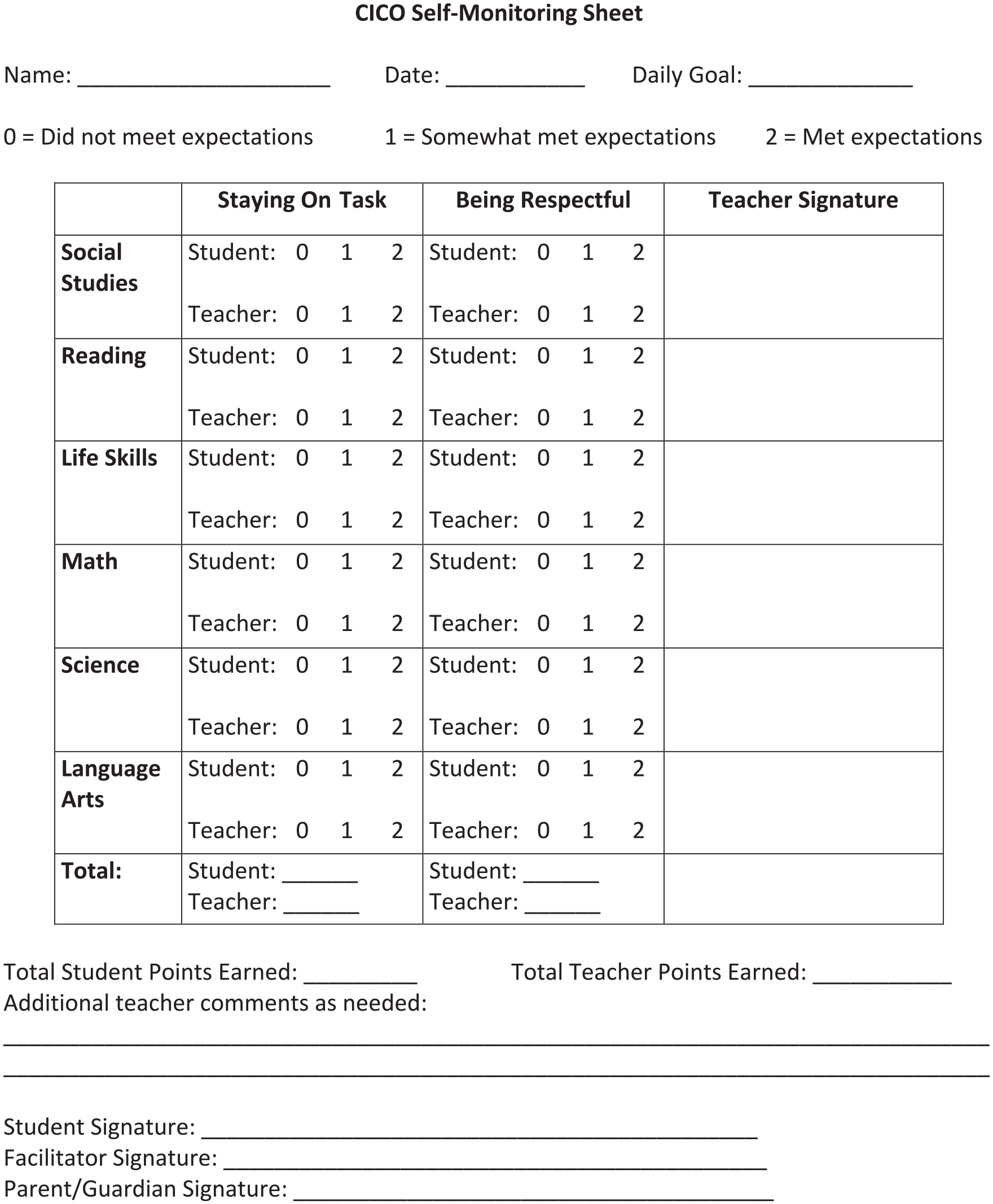
Maria’s Self-Monitoring Check-In/Check-Out (CICO) Sheet.
The teacher ratings could be gradually faded to allow for more student autonomy. For example, fading of teacher rating for the first class period may occur, then the teacher for the second class period, and so forth, until the student is self-monitoring all class periods. Other students may have the class periods in which they are receiving the highest ratings faded first. In either case, the student will need to be explicitly taught how to self-monitor their behavior, including how to use the DPR sheet, examples and nonexamples of the behavioral expectations to be monitored, and how to sum the ratings to determine whether the behavioral goal was met. Miller et al. (2015) found that allowing students with EBD to self-monitor their behavior during CICO increased their academic engagement and reduced disruptive behaviors. Allowing the student to self-monitor can facilitate student ownership of their learning (Miller et al., 2015) which is an important transition-readiness skill. Taking charge of their learning while monitoring and reflecting on their own behavior(s) is a large part of demonstrating self-determination.
Mrs. Laura is an inclusion teacher at Liberty High School. On her roster is Maria, a 15-year-old with EBD. Maria has been struggling to remain on task during classes. She will often doodle on a piece of paper or put her head down during class. When Mrs. Laura or another teacher corrects Maria by asking her if she is paying attention, Maria gets upset and always states that she is paying attention. Mrs. Laura reached out to her school’s schoolwide positive behavioral interventions and supports (PBIS) team members for ideas for an intervention to help Maria pay closer attention in class. Members of the PBIS team suggested using CICO adapted with student self-monitoring to address Maria’s quest for more independence and strengthen the transition supports being taught.
Mrs. Laura met with Maria and explained how CICO would be implemented. She noted that Maria would meet with the same CICO facilitator of her choice each morning to review her goals for the day using a DPR. Mrs. Laura explained that Maria would be working on staying on task during class and being respectful. After each class period, Maria would receive written feedback on her DPR from the classroom teacher and a brief verbal explanation of the ratings. Maria would also be responsible for rating her own behavior after each class prior to debriefing with her teachers. If there were disagreements in Maria’s rating and the teachers rating, they would briefly discuss this and come to consensus before Maria went to the next class.
At the end of the day, Maria would check out with the facilitator to discuss her performance. The facilitator and Maria would discuss the scores she gave herself during each class period compared with her teachers. Maria also would be responsible for taking the DPR home and gaining her mother’s signature before returning the DPR the next day to the facilitator. If Maria reached her DPR daily goals for the week, she would receive a reinforcement of her choice. Mrs. Laura asked Maria who she would want to be her facilitator and what reinforcement she would like. Mrs. Laura gave her ideas for both. Maria picked her science teacher, Mrs. Tiffany, as her facilitator and wanted to work toward being allowed to be on her cell phone during lunch on Fridays. Mrs. Laura agreed with both suggestions and said she would ask Mrs. Tiffany if she would agree to serve as the facilitator.
Maria’s adapted CICO included the following components:
Check-in conversation
Maria checked in with her teacher, Mrs. Tiffany, before first period to review her daily behavioral expectations (i.e., staying on task and being respectful) with a reminder to be honest when self-scoring her behavior after each class period. On the DPR, Maria could receive a total of 24 points each day (i.e., 2 points per target behavior over six classes). Mrs. Tiffany and Maria agreed her DPR goal for the week would be to earn at least 75 points to have access to her phone during lunch on Friday, with the classroom teacher’s scores determining goal attainment with a long-term goal of Maria’s scores becoming the determinant.
Receiving feedback
After each class period, Maria rated herself on her DPR and handed it to her teacher to also give her a rating. If the ratings varied, Maria and the classroom teacher discussed why they disagreed on the scores allowing for transparent discussion on strengths and areas for improvement, self-reflection, and problem-solving.
Check-out conversation
Maria met with Mrs. Tiffany each afternoon to review her DPR. One day, Maria had two class periods where she rated herself higher than her teacher. Maria discussed what she thought she did well but admitted that she did lay her head on the desk for a few minutes in both class periods. Mrs. Tiffany and Maria discussed why she chose to do that and what she could have done instead. Mrs. Tiffany praised Maria for being honest about her behaviors and for being open to other ways she could behave the next day. Mrs. Tiffany reminded Maria to take her DPR home for her mom to review and sign.
Home component
Maria took her DPR home to her mom. Her mom looked it over and they discussed how Maria performed. Maria admitted to putting her head down for a few minutes in two of her classes. Her mom said she was proud of Maria for being honest and working so hard to pay attention in class.
Return to school
Maria returned her signed DPR to Mrs. Tiffany the next day. Mrs. Tiffany looked it over, and as she was getting a new DPR, she said, “Great job, Maria, of being respectful and on task yesterday! Let’s have another great day today.” Then, they engaged in the check-in conversation.
Self-monitoring could be intensified or faded to meet a student’s individualized needs. When teachers like Mrs. Tiffany are considering adaptations to intensify the CICO intervention, the following should be considered: (a) strength, (b) dosage, (c) alignment, (d) attention to transfer, (e) comprehensiveness, (f) behavioral support, and (g) individualization of the intervention (Fuchs et al., 2017). In addition, self-monitoring could also be easily implemented once a student shows consistent progress (e.g., exceeding DPR goals). For example, Maria could begin to set her own goals more independently or her DPR could slowly be faded to include just check-out sessions each afternoon. Students with EBD could benefit from self-monitoring by having the opportunity for more independence in tracking their behavior(s) and learning to self-reflect on whether the behavior(s) occurred.
Social Skills
Social skills are learned behaviors that allow people to behave and communicate effectively with others in our lives. Students who experience difficulties in displaying appropriate social skills are at risk of school dropout, delinquency, and internalizing behavior problems such as anxiety and depression (Toms et al., 2018). The social skills of students with EBD are significantly lower compared with their peers with and without disabilities, thus placing them at higher risk for negative postschool outcomes (Crews et al., 2007; Novak et al., 2020) and difficulties in engaging with transition-readiness skills (Yeager et al., 2020). Students with EBD may require explicit instruction related to social skills, including (a) establishing peer relationships, (b) receiving constructive criticism/feedback, (c) engaging in problem-solving, (d) self-management of transition skills, and (e) asking for help when needed (Collins et al., 2016; Kumm et al., 2021). Providing social skills instruction has been shown to improve transition-related outcomes, including making friends and becoming gainfully employed (Kumm et al., 2021).
Social skills instruction can be incorporated into CICO by setting clear expectations (i.e., operationally defined behavioral expectations and realistic yet challenging goals) while implementing lessons on targeted social skills taught by the CICO facilitator (Melius et al., 2015; Ross & Sabey, 2015) as part of the check-in and/or check-out conversations. These conversations serve as unique opportunities to provide one-on-one lessons to students with EBD who may need additional social skills instruction as part of their transitional supports. During these conversations, the facilitator may role-play specific workplace/career readiness social skills scenarios and provide examples and nonexamples related to, or that support, the behavioral expectations and goals of the student’s DPR. Social skills instruction does not need to be time-consuming or intrusive but naturally integrated into the daily conversations.
When teaching social skills as part of CICO, teachers may find that students with EBD respond better to a peer CICO facilitator instead of an adult CICO facilitator (Collins et al., 2016; Melius et al., 2015). High school students with EBD often prefer to rely more on peer influence than adult influence and are typically highly motivated by peers (Hawken et al., 2021). Peer facilitators have been shown to be effective in improving the social and behavioral outcomes of students with disabilities during CICO (Collins et al., 2016; Dart et al., 2015). Melius et al. (2015) used a peer-led CICO intervention with two students with EBD. The facilitators were student mentors who met one-on-one with their mentee each morning and afternoon to discuss the mentee’s performance in meeting the PBIS behavioral expectations. Melius et al. (2015) found that peer-led CICO improved the mentees’ behavior and promoted more appropriate social interactions with peers and staff.
Just like an adult CICO facilitator, a peer CICO facilitator would need to be explicitly trained and responsible in meeting with the student at least twice daily for the check-in and check-out conversations, along with teaching, modeling, and reinforcing the appropriate social skills behaviors of focus. During these conversations, an adult should still be present, but the peer facilitator would lead the conversations and instruction.
Mr. Taylor is a high school special education teacher at Lee Roads High School. Mr. Taylor enjoys having his students learn new transition skills each week by implementing group activities such as learning about various careers and investigating postsecondary educational opportunities. These group activities require students to talk to one another and work together to problem-solve. Mr. Taylor notices that one of his students—Jack—struggles to talk to any of his classmates or group partners during group activities and does not take turns listening and talking. This is hurting Jack’s participation grade, learning, and his peer relationships.
Jack is an 11th grader and receives services for EBD. Mr. Taylor decides to implement CICO with an adapted social skills instruction focus. Mr. Taylor also thinks it would be helpful for Jack to have a responsible classmate serve as the facilitator of CICO to promote more opportunities for social interaction and gain confidence in his abilities. Jack’s targeted behaviors include starting conversations with peers, interacting appropriately with peers (e.g., working on group activities, sharing materials), and listening while others are talking.
Figure 2 is an example of the CICO sheet that Mr. Taylor made for Jack and his peer facilitator to use. Mr. Taylor met with Jack to explain CICO and the goals he would like Jack to work on. Mr. Taylor asked Jack who he would like to serve as his peer facilitator. Mr. Taylor described that a good peer facilitator is someone that Jack feels comfortable talking with one-on-one about his goals. Jack named Marcus because Marcus goes out of his way to speak to Jack every day. Mr. Taylor agreed that Marcus would be a perfect peer mentor because Marcus is very responsible, has strong social skills, and would enjoy helping a fellow classmate. Jack also picked Mr. Taylor to serve as the teacher to help co-facilitate.

Jack’s Social Skills Check-In/Check-Out Daily Progress Report Sheet.
Last, Mr. Taylor discussed some possible reinforcements Jack could work toward. Jack chose to receive time in the gym playing basketball after school with Marcus on Fridays as a reinforcement for meeting his DPR goals for the week. Mr. Taylor also met with Marcus to discuss if he was willing to meet with Jack in the mornings and afternoons. Marcus agreed and seemed excited to get to know Jack better. Mr. Taylor decided the two young men would meet in his classroom at the beginning and end of the school day. Mr. Taylor provided Marcus with one-on-one training that discussed his roles, expectations, confidentiality, and the steps to CICO. Marcus was given a checklist of the CICO steps, examples of questions, and talking points to discuss with Jack.
Check-in conversation
Jack and Marcus met in Mr. Taylor’s room each morning before classes began. Marcus started by discussing the previous day’s DPR sheet and reminded Jack that he was working on starting conversations with peers, interacting appropriately with peers, and listening to peers. Marcus and Jack reviewed the DPR goal for the day with help from Mr. Taylor. They decided Jack would try to earn half of his points (i.e., 10 in each class) for the day. Marcus and Jack talked about what he could do to reach his points such as saying hello to a classmate, answering a question during a group activity, and looking at and nodding his head while a peer talked. Before the end of the conversation, Marcus provided encouragement, stating, “I know it can be awkward to talk to people in class and listen to others, but I know you can do it!”
Receiving feedback
Jack went to his various transition activities (e.g., vocational training, career exploration, math/budgeting, and independent living) and handed his DPR sheet to each teacher at the end of each activity. During career exploration, he said hello to one of his peers and asked how their weekend was. During functional math/budgeting, he also said hello to one of his peers but struggled to talk during the group activity where he was working with his peers on a budgeting sheet.
Check-out conversation
Jack checked out with Marcus and Mr. Taylor at the end of the school day. Marcus and Jack talked about how Jack’s day went. Marcus started by asking Jack what he did well on and what he could have been improved. Jack stated, “I said hello to a peer during each transition activity, but I still didn’t talk during the group activity during math/budgeting.” Marcus complimented Jack on starting conversations with his peers and said that he knew Jack would speak up tomorrow during group activities. Marcus said he was proud of Jack for talking more to others during the transition activities. They all signed his DPR form and Jack took it home for his dad to sign.
Home component
Jack and his dad discussed how the day went. His dad knew he had been struggling to make friends and how much Marcus had already had an impact on his son’s overall confidence. He told Jack he was proud of him and that he would like him to try to speak up more tomorrow. Jack agreed.
Return to school
Jack and Marcus met in Mr. Taylor’s room the next day. Mr. Taylor collected the signed DPR form and complimented Jack for bringing it back. Marcus and Jack reviewed the previous day’s progress, reviewed expectations, and got a new DPR sheet out for the day.
As Jack becomes more familiar with CICO, the intervention could be intensified or faded. Jack’s reinforcer could be determined by the amount of DPR points he secures. For instance, if he secures the maximum number of DPR points, he might enjoy playing basketball for two afternoons. Marcus’s involvement could also be faded to only check out with Jack in the afternoons. The CICO can easily be adapted to meet the social skills needs of students with EBD by making small changes to the intervention as a student becomes more independent or needs more assistance in obtaining their DPR goals.
Vocational Training
Students with EBD are less likely to be employed full-time upon graduation compared with their peers with other disabilities (Newman et al., 2009). Students with EBD could benefit from more meaningful and hands-on vocational training experiences prior to graduation. Vocational training is a primary transition skill that provides students with hands-on instruction in a job-related area either in school or in the community and provides students with systematic ways to improve their job skill sets (Boden et al., 2018).
Students with EBD who receive vocational training in high school have higher quality-of-life outcomes, are more likely to obtain an employed position, and have greater independence upon graduation (Almalky, 2020; Voermans et al., 2021). During vocational training, students with EBD are working on (a) specific job-related tasks; (b) appropriate interactions with co-workers, customers, and supervisors; (c) appropriate worksite behaviors; (d) application of problem-solving skills; and (e) how to receive constructive feedback from others (e.g., teachers, job coaches, job supervisors) on ways to improve their job skills and overall performance.
The CICO intervention can be used to assist students with EBD in vocational training by providing them with additional support in each of the above areas. Using CICO during vocational training has increased student work performance via improvements in staying on task, meeting work-related goals, and displaying more appropriate work behaviors (Boden et al., 2018; Hester & Swoszowski, 2022). For example, Hester and Swoszowski (2022) used CICO in a community-based vocational training site with three young adults (ages 18–20) with intellectual disabilities in a transition program. The facilitator was the on-site supervisor who was responsible for implementing the check-in and check-out conversations and providing meaningful work-related feedback throughout their shift.
Hester and Swoszowski (2022) found that CICO assisted the students in receiving regular feedback on the following: job performance, ways to improve job skills, more open and frequent communication between the student and the supervisor, and more natural on-the-job supports (e.g., supports that peers without disabilities would receive). Using CICO in vocational training with the on-site supervisor as the facilitator allows students with EBD more opportunities for positive outcomes and interactions with adults (Davis & Cumming, 2019a; Hester & Swoszowski, 2022).
The CICO intervention can be implemented in several ways to meet the individual needs of students with EBD in vocational training settings. If the vocational training is taking place in the school setting, the classroom teacher could serve as the facilitator. However, if training is taking place in the community, we encourage having the vocational training site supervisor serve as the facilitator (Hester et al., 2024) to allow for a more natural experience by providing continuous on-the-job support that is not intrusive (Boden et al., 2018; Hester & Swoszowski, 2022). The home component also could be modified to reflect a more natural work experience for adolescents.
For example, instead of taking the CICO DPR home and having a parent or guardian sign it, the sheet could be given to the classroom teacher upon return to school from the vocational training site. This would allow the classroom teacher to give his or her input, reinforce positive work behaviors, and know how the student performed at work (see Figure 3 for an example). Such insight also allows the classroom teacher the opportunity to reteach work skills identified by the supervisor for needing improvement or behaviors in which the student did not receive the highest of ratings. This adaptation also could be used in gainful employment positions and slowly faded over time for students engaged in transition activities.

Vocational Training Check-In/Check-Out Sheet.
Mrs. Johnson is a transition teacher for five students with EBD at Sumner High School. This semester her students are participating in off-campus internships at a local food bank. One of her students, Kristen, struggles to complete her off-campus work tasks in a timely manner. Moreover, the quality of her work performance is inconsistent. Kristen also becomes shy and does not speak to her supervisors or co-workers at the food bank when they try to talk to her.
Mrs. Johnson notices that Kristen relies on her job coach, Mr. Fred, for interacting with her immediate supervisor, Mrs. Pam. Mrs. Johnson wants Kristen to gain confidence in speaking directly to her supervisor and co-workers while at work and target more consistent work performance. Mrs. Johnson decides to implement adapted CICO as a way for Kristen to receive regular feedback during her vocational training internship to address these goals.
Mrs. Johnson asks the food bank supervisor, Mrs. Pam, if she would be interested in being Kristen’s CICO facilitator. Mrs. Pam agrees, and Mrs. Johnson provides (a) one-on-one training to go over the CICO process, (b) examples and nonexamples of the check-in and check-out conversations, (c) discussion on the transition-related skills to improve, and (d) direction on how to complete the CICO DPR. Mrs. Johnson also trains Kristen and Mr. Fred on the procedures of CICO. Mr. Fred would still be working with Kristen at the food bank but would help facilitate the CICO sessions by prompting Kristen when it was time to engage in the check-in or check-out conversation and provide feedback during the middle of the work shift.
Check-in conversation
When Kristen arrives at the food bank, she is prompted by Mr. Fred to engage in the check-in conversation with her supervisor. Kristen finds Mrs. Pam, who had a new CICO DPR for the day’s work shift. Mrs. Pam reviews the tasks Kristen needed to complete during that work shift. She states, “I really need help with breaking down the boxes for recycling and packing 30 bags of canned food.” Mrs. Pam writes these two tasks at the top of the DPR and asks Kristen if she has any questions. Mrs. Pam also reviews Kristen’s two goals—confidence in talking with co-workers/supervisors and consistent work performance.
Receiving feedback
Mr. Fred looks over Kristen’s DPR about halfway through the work shift as a CICO intensification. Kristen spent the first half of work breaking down the boxes as instructed. Mr. Fred notes that Kristen was a little distracted by her friend, who was working in the same area. The two girls were talking about their weekends, and this was slowing Kristen’s work and contributing to her inconsistent work performance. Mr. Fred states, “Kristen, I like how you are breaking down the boxes and placing them in neat piles. Please make sure to stay on task and limit talking so that your performance can remain high, and you have time to bag the canned goods before we leave.” Kristen agrees and continues working.
Check-out conversation
Kristen had completed breaking down boxes and was halfway through bagging the canned goods when Mr. Fred instructs Kristen that it is time to engage in the check-out conversation with her supervisor. Kristen finds Mrs. Pam and gives her the DPR. Mrs. Pam reviews the sheet and notices that Kristen had checked the task of breaking down the boxes. Mrs. Pam says, “Thank you so much for your help today with breaking down the boxes. That was a huge thing we needed to complete. Did you finish boxing up the canned goods?” Kristen says, “No, I got to 15 bags.” Mrs. Pam states, “Ok. No problem. I appreciate you working on that. I would like you to finish the next 15 bags tomorrow. Remember how we are working on performance accuracy so we need to stay focused so we can finish our tasks on time.” Kristen states that she understands. Mrs. Pam asks, “Do you think a good goal for tomorrow would be staying focused on our job tasks?” Kristen agrees. Mrs. Pam writes down that goal on the DPR for the next work shift: “Kristen will work on staying focused on assigned job tasks and maintain performance accuracy.” Mrs. Pam and Kristen sign the bottom of the DPR. Mrs. Pam states, “Thank you again for your help today and I will see you tomorrow.”
Adapted home component
Kristen returns to the classroom and hands Mrs. Johnson her DPR from work. Mrs. Johnson reviews the sheet and asks Kristen how work had gone. Kristen states that she did not complete her work because she got distracted talking but that the work she did accomplish was accurate. Mrs. Johnson praises Kristen for her work accuracy. They discuss the importance of work and that we can always talk to our friends during breaks or when work is over. Kristen says she understands. Mrs. Johnson signs the DPR and hands it back to Kristen.
Return to work
Kristen returns to her internship the next day and hands Mrs. Pam her DPR from the day before. Mrs. Pam reviews it and says, “Great! Thank you. Your work accuracy is top notch. Remember that our goal for today is to stay focused on your job tasks. Are you ready to get started?” Kristen says yes and Mrs. Pam writes her work tasks for the day at the top of a new DPR.
The CICO intervention can be intensified or faded for Kristen based on her performance and her unique needs. For example, Kristen could self-monitor her own behavior by collecting data such as tally marks for each conversation she initiates. This would also encourage self-determination skills by self-monitoring and reflecting on her work behaviors. Kristen may also need more prompts or reminders of her DPR goals. Therefore, an additional check-in session could be added to the middle of the work shift. If Kristen is becoming more independent at work, CICO could be faded to the beginning of the work week and the end of the work week.
Considerations
Whenever adapting or intensifying an evidence-based intervention like CICO that is applied to student transition-readiness skills, it is important to keep several considerations in mind. Such considerations may increase the likelihood that the adapted and/or intensified CICO intervention will be implemented with fidelity while improving the overall transition-readiness skills of students with EBD as they use their new skills and generalize skills to new settings.
Identifying a Facilitator
The facilitator plays a key role in CICO as they lead the check-in and check-out conversations. That is because they have sustained and predictable time with the student throughout CICO implementation and can become a trusted adult in the student’s life. Such consistency and predictability are important for students with EBD, especially for those who have prior trauma experiences. Identifying a CICO facilitator is critical. First, the facilitator should be someone who will serve as a positive role-model for the student and someone the student respects. Selection of the facilitator is an opportunity to increase youth self-determination by involving youth voice in the selection process as this aligns with trauma-informed practices.
In the first vignette, Mrs. Laura was already instilling self-determination when she asked Maria to pick who she wanted to be her facilitator. The opportunity to choose the facilitator assists with increasing buy-in from the student, especially students with EBD who often are not asked to provide input. Second, the facilitator needs to have a flexible schedule and be able to meet with the student regularly. For instance, if an employment supervisor is the facilitator, the supervisor needs to be present during most work shifts to give consistent feedback during check-in and check-out conversations (Hester et al., 2024; Hester & Swoszowski, 2022).
Third, the facilitator must be willing to participate and feel comfortable providing feedback. This may require some buy-in from the facilitator or additional training on how to provide meaningful feedback to the student. Additional training was demonstrated with Mrs. Pam, a work supervisor who served as a facilitator for Kristen at the job site in the second vignette, and Marcus, a peer facilitator in the third vignette.
Fading
As with any intervention, student performance should be monitored to determine the effects of CICO on the targeted behavior or skill. If the student is excelling (e.g., exceeding DPR goals), the facilitator may want to fade CICO over time. Fading refers to decreasing the level of assistance given during the intervention (Miller et al., 2015). Fading promotes student independence needed during transition, which is essential as students with EBD assume the leadership role for their postsecondary school lives.
For example, the CICO facilitator could modify the daily check-in and check-out conversation schedule to just a check-in or check-out conversation or to several times a week. For example, in the second vignette, this type of fading could be the next step for Kristen. Once she is consistently staying on task while at work with high work performance and meeting/exceeding her DPR goals, Mrs. Johnson may start to fade the intervention by having Kirsten only check in and out with her supervisor, Mrs. Pam, at the beginning and end of the work week. The transition strategies discussed in this article are not isolated processes. They can be embedded into one another. For example, CICO with social skills can be faded by incorporating self-monitoring techniques (Majeika et al., 2020).
Selecting Reinforcements
The CICO intervention is most effective when the student receives structured, age-appropriate, and meaningful reinforcement for engaging in positive behavioral expectations and/or meeting their daily and weekly goals (Hawken et al., 2021). For high school students with EBD working on their transition skills, special consideration may need to take place for selecting reinforcements. Reinforcements could use a currency system (e.g., learning money-related skills) that allows the student to “cash out” on certain privileges or items (e.g., a pass to skip the lunch line or a homework pass; Bundock & Horner, 2021). Also, for many high school students with EBD, motivation may be accessing peer interactions. For instance, in the third vignette, Jack chose to spend time with Marcus by playing basketball in the gym. This is an age-appropriate goal reinforcement and relates to Jack’s target social skill behavioral goals.
Conclusion
The CICO intervention is a flexible, evidence-based intervention that can be adapted and intensified to address transition-readiness skills for students with EBD. The CICO intervention applied in transition-readiness skill acquisition, fluency, and generalization is critical to improving and increasing skills to promote school and postsecondary school outcomes. Such outcomes can lead to improved student outcomes in accessing a higher quality of life, obtaining gainful employment, and feeling more socially accepted (e.g., Murray et al., 2021). Incorporating transition-readiness skills (i.e., self-determination, social skills instruction, and vocational training) into the CICO intervention can be one way to foster and promote independence for students with EBD. Table 1 displays additional resources for practitioners who are interested in learning more about CICO.
Additional Check-In/Check-Out (CICO) Resources.

Footnotes
Declaration of Conflicting Interests
The author(s) declared no potential conflicts of interest with respect to the research, authorship, and/or publication of this article.
Funding
The author(s) received no financial support for the research, authorship, and/or publication of this article.
