




Abstract
The study explored environmental communication strategies within the Okavango Delta, northwest Botswana. A survey instrument was administered to 120 respondents, randomly sampled across four villages. The findings show that respondents obtain environmental conservation information from diverse source organizations. Agencies use a multimix approach that utilizes different channels of communication, such as mass media and group channels. Statistically significant associations were found among the radio audience by education and among the television audience by age, education, and gender; and no statistically significance association was found between the kgotla group channel and the three demographic variables. Findings suggest that the interventions have promoted proenvironmental behaviors and attitudes among the respondents. Implications for environmental communication practice and directions for future research are discussed.
Public understanding and active participation in solutions to global environmental problems are critical for sustainable development. Even so, there are concerns that public participation and interest in dealing with the environmental challenges are not sufficient. The status quo is blamed on scientists’ failure to effectively communicate science to nonscientific audiences (Groffman et al., 2010; Heong & Escalada, 2005), thereby leaving the public with little or no understanding of the recurring environmental challenges and potential search for local solutions. Environmental and natural resources management information is largely informed by scientific research studies, often written in scientific language not easily understood by nonexpert stakeholders. The complexity of the language used to report findings and recommendations alienates nontechnical audiences from showing interest in finding solutions to the recurring environmental concerns.
For the public to gainfully use information from scientists, there is a need for scientists to communicate effectively beyond their peers. Several scholars have lamented the communication breakdown between academia and nonexpert stakeholders and blamed the ever-increasing environmental challenges and passive stakeholders on inadequate knowledge transfer by the scientists (e.g., Greco, 2005; Groffman et al., 2010; Rhoads, Wilson, Urban, & Herricks, 1999; Wagenet et al., 2005; Whitmer et al., 2010). The state of affairs necessitates that the institutions, mainly academia, demonstrate social responsibility by ensuring that the results of environmental research studies are effectively communicated to all stakeholders. This will generate dialogue and create an informed and environmentally responsible citizenry.
The Okavango Research Institute (ORI) has generated substantial information on environmental research in the Okavango region since its establishment in 1994. However, the research findings emanating from the multidisciplinary research institute have not yet made a meaningful impact on stakeholders, at both the local and national levels (Brown & Russo, 2002). This is happening against the backdrop of research studies from ORI, along with other initiatives focused on the Okavango Delta, reporting a general decline in natural resources and environmental quality (Ellery & McCarthy, 1998; Kgathi et al., 2006; Mbaiwa, 2002). While the reasons for the decline are partly due to natural environmental changes, anthropogenic activities also play a significant role. A consultancy report revealed that research findings were not being used in policy and management decision making or being translated into positive behavioral changes (Brown & Russo, 2002). Reasons advanced were that the research findings were inaccessible and ineffectively communicated to stakeholders.
This scenario dictated that the ORI to develop communication interventions that will facilitate information diffusion and knowledge translation of its environmental research findings and ultimately promote proenvironmental behaviors. While environmental communication interventions in Botswana have mainly adopted the use of group channels for information dissemination, such as the tribal kgotla 1 and workshop, it is imperative that the ORI communication intervention strategies be guided by theory and research for maximal impact. Little scholarly research has been conducted in Botswana on environmental communication, making it necessary therefore for the ORI to initiate study to inform its future communication interventions. It is necessary for the ORI to examine the environmental communication interventions already in place within the Okavango Delta and how these could be effectively employed and/or improved in realizing the ORI social responsibility of environmental research communication. The purpose of the study is therefore to explore ongoing environmental communication interventions in the Okavango Delta, in terms of media and channels use patterns, with a view to informing and guiding the development of the institute’s research communication strategy.
Theoretical Background
To understand environmental communications in the Okavango Delta, the study was guided by the diffusion of innovations theory. The focus of the theory is on the communication processes by which new ideas or products are diffused and adopted within the society. According to Rogers (2003), “diffusion is a special type of communication in which the messages are about new ideas” (p. 6), in this case preventive innovations. The main elements of the diffusion of the innovation process are the following: (a) an innovation, (b) communication channels, (c) time, and (d) the social system—the context (Rogers, 2003). The diffusion theory conceptualizes a five-staged process that innovations go through after introduction within a social system. The five-staged process encompasses (a) awareness, (b) interest, (c) evaluation, (d) trial, and (e) adoption.
The theory highlights two kinds of innovations: incremental and preventive (Rogers, 2003). Preventive innovations, such as environmental conservation and protection, are complex; their outcomes are also uncertain, and the desired results occur mostly in the distant future. These new ideas can be adopted to avoid possible occurrence of some unwanted future events. The greatest challenge is that the benefits are often not immediate and tangible. The theory further highlights five factors that determine the speed at which innovations are adopted by members of a social system. These are the following: (a) perception of an innovation, (b) type of innovation decision, (c) communication channels, (d) characteristics of the social system, and (e) promotion strategies. In turn, the way innovations are perceived is a product of five elements: relative advantage, compatibility, complexity, trialability, and observability. Among these, relative advantage is deemed the main challenge for preventive innovations. Preventive innovations pose a great communication challenge because they are low in relative advantage (Rogers, 2002). However, several suggestions are offered on how the relative advantage of preventive innovations may be improved to speed up the adoption rate. These include changing the perceived attributes of the innovations, introduction of incentive policies, government mandates, and regulatory frameworks (Rogers, 2003).
Environmental Communication
Environmental communication literature reveals that a lot has been done in the area of environmental risk communication associated with toxic and hazardous substances from landfills, industrial and agricultural technologies, pollution, environmental public health and safety, and the medical health practice (Baker, 1990; Bordenave, 1976; Bradbury, 1994; Rogers, 2002; Weterings & Van Eijndhoven, 1989). Other studies focused on effective communication strategies that contribute to favorable attitudes and a better understanding of ecological phenomenon by policy makers, local communities, and the general public (Chess & Purcell, 1999; Schiller et al., 2001; Zimmerman, Akerelrea, Smith, & O’Keefe, 2006). These studies provided insights on the utility of group channels such as public meetings, workshops, and mass media and demonstrated how the approaches were influenced by the demographic profiles of the recipients. Most of these studies in science/environmental communication were conducted primarily in developed countries. For example, studies by Chess and Purcell (1999); Decker, Lassoie, Goff, and Parish (1988); and Tucker and Napier (2002) were conducted in the United States, while studies by Burgess, Harrison, and Filius (1998) and Konijnendijk (2000) focused on European cities such as Berlin (Germany), Copenhagen (Denmark), Rome (Italy), Nottingham (United Kingdom), and Eindhoven (the Netherlands). Studies may thereby be limited in guiding interventions within cultures in the developing countries (Greco, 2005; Lee, 2008), such as rural Africa. Greco (2005) contended that different cultures and countries need appropriate communication structures for efficient information diffusion. Noting the potential effect of cultural environment on communication intervention, a review by Chess and Purcell (1999) excluded studies conducted outside North America indicating that the cultural differences there may flaw the results on the meta-analysis.
Environmental issues, such as natural resources degradation, are major concerns in developing countries (Pe Benito Claudio, 1988). Loss of a natural resource base in rural Africa is often accompanied by negative socioeconomic impacts because the resources are the mainstay for rural livelihoods and economies. Effectively communicating risks associated with degradation of biodiversity resources therefore becomes imperative. In Botswana, relatively little scholarly work on environmental communication and education has been done. Mutshewa (1999) studied the use of mass media in disseminating environmental information among environmental organizations in Botswana. While the study found that environmental organizations preferred using the group channel (kgotla) and institutional mass media in disseminating environmental information, other scholars have questioned the utility and reliance on the kgotla (e.g., Letsididi, 2001; Magole, 2003; Monametsi, 2007; Robinson, 1998; Siphambe, 2003; Thakadu, 2005). They argue that it does not promote maximal participation and representation because it has historically marginalized minority groups in the decision-making process. On the other hand, other studies from elsewhere have demonstrated the utility of using group channels, such as public meetings, in communicating environmental information (Chess & Purcell, 1999; Decker et al., 1988; Gundry & Heberlein, 1984; Tucker & Napier, 2002).
The studies already noted were mainly concentrated within sociocultural contexts different from Botswana, while Mutshewa’s (1999) focused on environmental communication flows from the source agencies only. The focus of this applied study is therefore to explore and establish environmental communication interventions, in the context of the Okavango Delta, Botswana, from the perspectives of the local communities—the recipients. The study’s contribution is threefold; it extends the scholarly literature on (a) environmental communications by providing empirical evidence in a different setting, (b) diffusion of environmental conservation innovations with respect to biodiversity resources (natural resources), and (c) specific stakeholder groups, local communities, whose livelihoods directly depend on the biodiversity resources. The study also provides the ORI with empirical basis to inform and guide its social responsibility initiatives of communicating environmental information to nonscientist stakeholders in an attempt to promote proenvironmental behaviors and knowledge translation.
The specific objectives of the exploratory study were to (a) identify the sources, channels, and channel use patterns in the Okavango Delta for communicating environmental information; (b) examine the perceived utility and relevance of the communication strategies on the recipients; and (c) examine kgotla and workshop preference among community members based on perceived utility and relevance.
Method
Study Setting
The study was conducted in the villages of Sankuyo, Khwai, Boro, and Xaxaba within the Ngamiland district, northwestern Botswana (Figure 1). The population of the four villages ranges from 78 to 395 inhabitants (Central Statistics Office, 2002). The Ngamiland district is known for its rich biodiversity, and it houses the wetland of international importance, the Okavango Delta. The Delta and its immediate environs are home to multiethnic groups and are a vital source of livelihood. As a result of its rich biodiversity, the Delta has attracted several stakeholders and interest groups. These groups compete with each other for resource use, making the resources vulnerable to overexploitation. The Delta stakeholders, mainly local communities, were the focus of this exploratory study.
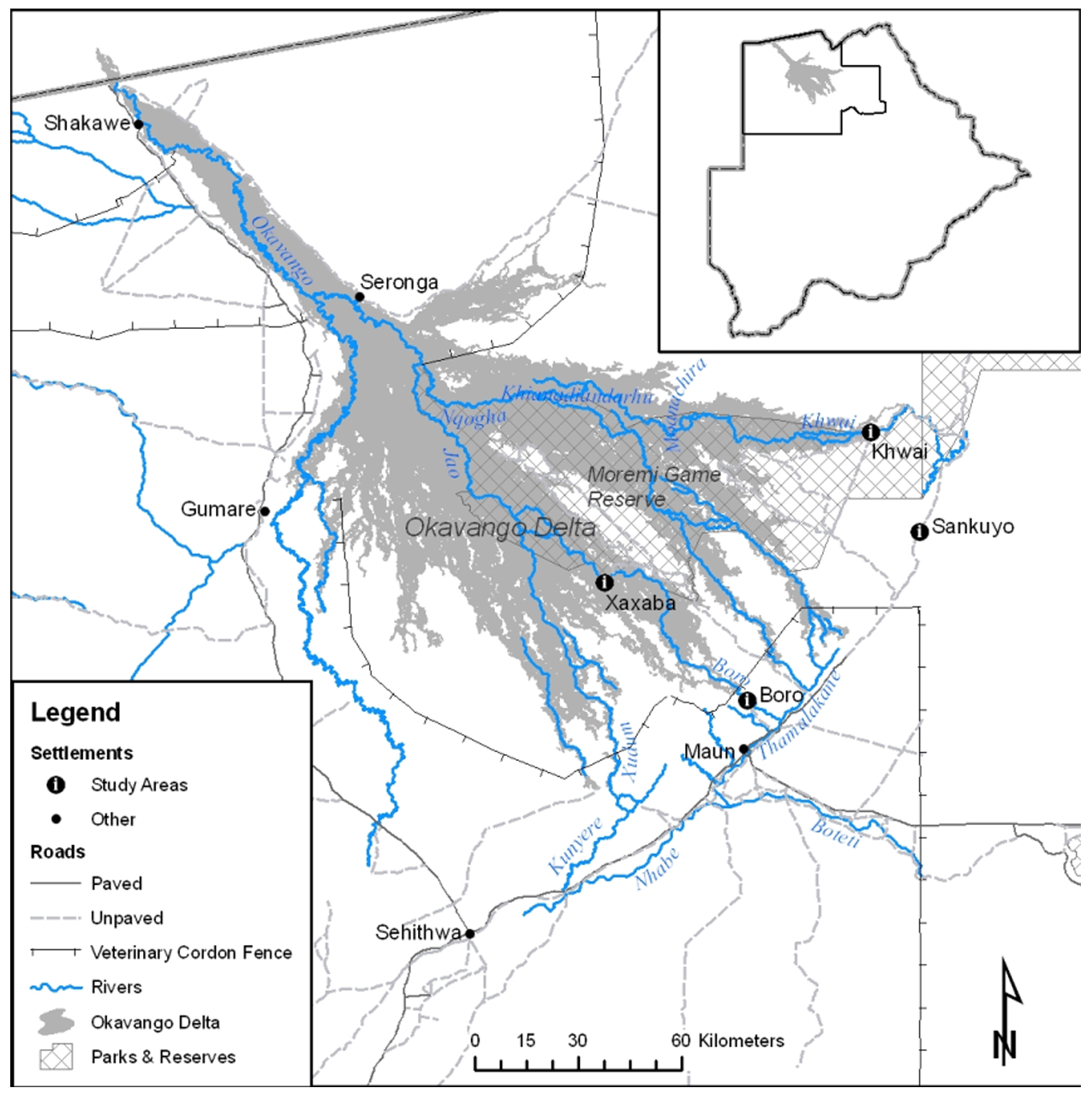
Map of the study area and sites
Sampling
The study followed a three-staged sampling approach. First, four villages were purposively selected from all villages/settlements within the Okavango Delta. Selection was based on location in respect to the Okavango Delta and relative to the main town center of Maun (Figure 1). Second, 30 respondents were randomly sampled from each village. Third, the sample was allocated proportionally among education categories within villages based on an updated list of 2001 housing and population census data for each village.
Data Collection, Instrumentation, and Procedure
Primary data were collected through directly administered semistructured questionnaires, coupled with participant observation. Participant observation helped validate the responses of the respondents through direct observation of behavior and practice in the field (Ary, Jacobs, Sorensen, & Razavier, 2006). The survey instrument was designed to structure the interview process around the domains of environmental communication, strategies, and associated behavioral impacts. Eleven sets of nested, closed, and open-ended questions were developed to target the sources, channels, and recipients’ measure of perceived effectiveness.
Some questions tapped the understanding and opinions of the respondents on the messages communicated, specifically, whether or not the environmental communication efforts had translated into demonstrated behavioral changes and their perceived utility and relevance. In the context of this study, the term “perceived utility” was based on self-reported outcome measures of the impacts of such interventions as (a) an increase in the recipients’ knowledge of Okavango Delta environmental issues; (b) a change in the recipients’ attitudes; and (c) a change in the recipients’ behavior. The questionnaire also solicited respondents’ demographic information.
Data Analysis
Data were compiled and analyzed using SPSS Version 13. Percentages and proportions were calculated and chi-square tests applied to test for significance. The variables levels with expected counts below the expected minimum cell size required for chi square analysis were collapsed into smaller levels to facilitate analysis. Fisher exact test was used in analysis of data with smaller counts. Final collapsed levels for education and age were defined as follows: (a) education: low—primary and lower, high—secondary and higher; and (b) age: young adult: 18 to 29 years; adult: 30 years and above. Chi-square tests showing statistically significant variables from the bivariate distribution were further examined to determine the odds ratio. Prior to this, the predictor variables were examined for multicollinearity using logistic regression. Since the study was exploratory, significance level values between .05 and .10 were considered significant and indicative of trends warranting further investigation.
Qualitative data from the open-ended questions and participant observation were analyzed thematically. Themes were identified from responses to open-ended questions. All the responses to specific open-ended questions were collated, and repetitions, metaphors, and analogies were identified as themes and subthemes. Concepts, phrases, and ideas occurring frequently from the responses and unique statements to the responses indicated emerging themes (Ryan & Bernard, 2003). Conclusions were drawn on the basis of emerging themes that formed patterns and clusters.
Results
Demographic Characteristics
A total of 120 respondents from the four villages were interviewed. In all, 51% of the respondents were male, and 49% were female. Table 1 summarizes the respondents’ demographic information. Nearly half of the respondents (48%) had no formal education, indicating low levels of literacy in the study area. The literacy rate in the study areas reflects the district’s levels, which are generally lower—43% illiteracy rates (Bendsen, 2003). The modal age group is 18 to 29 years.
Summary of Demographic Profile of Respondents (N = 120)
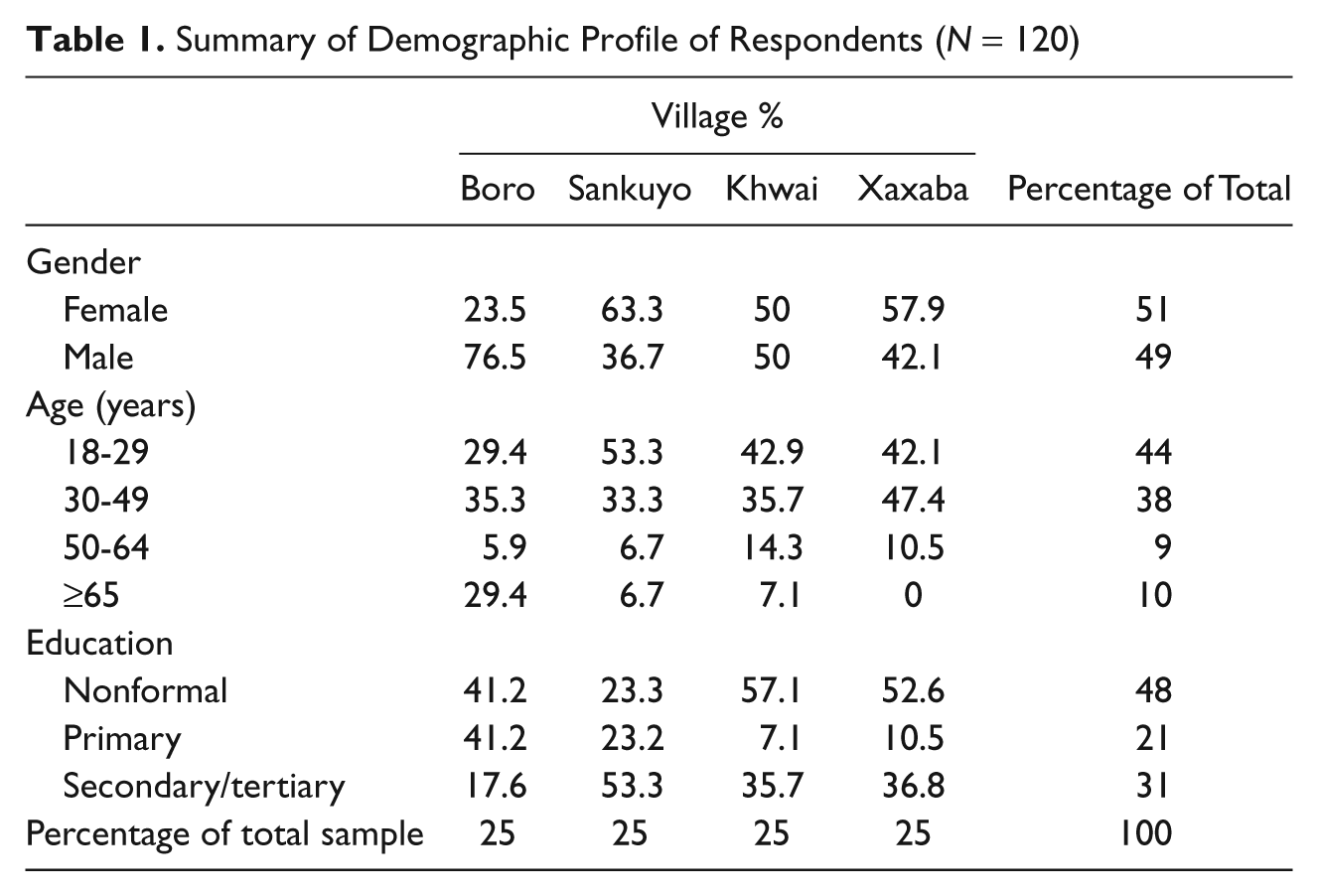
The demographic profile of the four villages studied differed in gender, education, and age. For example, the Boro sample was predominantly male (76.5%) and had more seniors and fewer educated respondents when compared with the other three villages. A number of possibilities may explain the discrepancy. Boro village is nearest to Maun (a major town area in the district) when compared with others. Vicinity to the urban center may have encouraged the migration of the young and better educated residents to the town. This may be so because the young people tend to be highly mobile when compared with older ones. They move mainly when there are no economic opportunities to keep them in rural areas. There are no educational facilities in Boro, Xaxaba, and Khwai, which further compounds literacy factor in the three villages. The presence of an education facility (primary school) in the village, as is the case for Sankuyo, facilitates residents to attend school conveniently and thereby offers them opportunities to progress beyond the primary level. This explains why the Sankuyo sample had the majority of the respondents (53.3%) in the secondary/tertiary category. Lack of educational facilities may explain why there are more seniors in Boro, as most of the young people may prefer living in town where there are better opportunities and educational facilities.
The dominance of males in the Boro sample (Table 1) may be explained by the mainstay economic activity enterprise within the village: mokoro (traditional canoe) poling. Boro village is a center for mokoro enterprise, attracting international tourists who pay a token fee for the mokoro poling services offered by the residents into the Okavango Delta. The mokoro poling enterprise is traditionally regarded as a male domain and hence induces more males than females to remain in the village. The differences in the demographic profiles among the four study villages demonstrate how social infrastructure, residential proximity to urban centers, age and mobility, and economic enterprise may affect the village demographics.
In terms of ethnicity, the sample was predominantly Bayei (65.8%), followed by BaSarwa (27.5%), with the remaining ethnic groups less represented. The predominance of the Bayei in the sample is not surprising. The study was conducted in villages along the fringes of the Delta and inside, which are traditional territories of the Bayei. Bayei people are mostly found along the watercourses as their livelihoods are intimately associated with the wetland resources.
Information Sources
Respondents were asked to identify the source institutions responsible for disseminating environmental conservation within their communities, as well as the generic themes and goals of the communication interventions. Among all government institutions, the Department of Wildlife and National Parks (DWNP) ranked highest, with about 83% of the respondents indicating that they had attended meetings and campaigns conducted by the DWNP. The Agricultural Resources Board (ARB) accounted for about 33% of the respondents, while other government institutions ranged between 1% and 18% (Figure 2). Only two nongovernmental organizations (NGOs) were identified by 2.5% of the respondents. The overall theme of the messages communicated by the sources was conservation of natural resources, mainly in the Okavango Delta. Specifically, the respondents indicated the following themes: water, wildlife, fish, forest and veldt products conservation, and environmental health. Qualitative responses revealed that the communication goals of the source agencies were mainly to stimulate awareness, information transfer, and dialogue.

Environmental information source institutions
Source organizations classified under “others,” identified by 23% of the respondents (Figure 2), included African Wildlife Foundation, Botswana Community-Based Organizations Network, the community-based natural resources management (CBNRM) trusts, environmental/wildlife clubs, researchers, tour operators, and training institutes. The respondents indicated that the source organizations mostly use Setswana, a language preferred and spoken by almost all (96.7%) the respondents.
Cross-tabulations of villages by source organizations showed that the DWNP continued as the agency with the highest proportion of respondents identifying it across all villages. The percentage ranged from over 70% to 100% in all four villages. ARB was identified by a range of 30% to 37% of respondents in all four villages. For other organizations, the percentage of village respondents differed among each, with the overall prominence much lower. The level of visibility for the respective organizations, demonstrated by the number of respondents identifying an organization, differed among villages. For instance, the Department of Water Affairs had the highest number of respondents (23%) from Xaxaba. In Sankuyo, 7% to 20% of the respondents identified source organizations such as Department of Tourism (DoT), Okavango Delta Management Plan, and Tawana Land Board, which were the highest figures reported among the four villages. In Boro, 10% of the respondents identified the Department of Forestry (DoF), while 43% identified Environmental Health in Khwai.
Channels of Communication
Respondents were asked to identify channels through which they acquire environmental information. The various channels of communications identified by the respondents are shown in Table 2. Channels included mass media, group channels, and interpersonal communication channels. Among all the channels identified, only radio and kgotla accounted for more than 50% of the respondents.
Communication Channels Used by Respondents
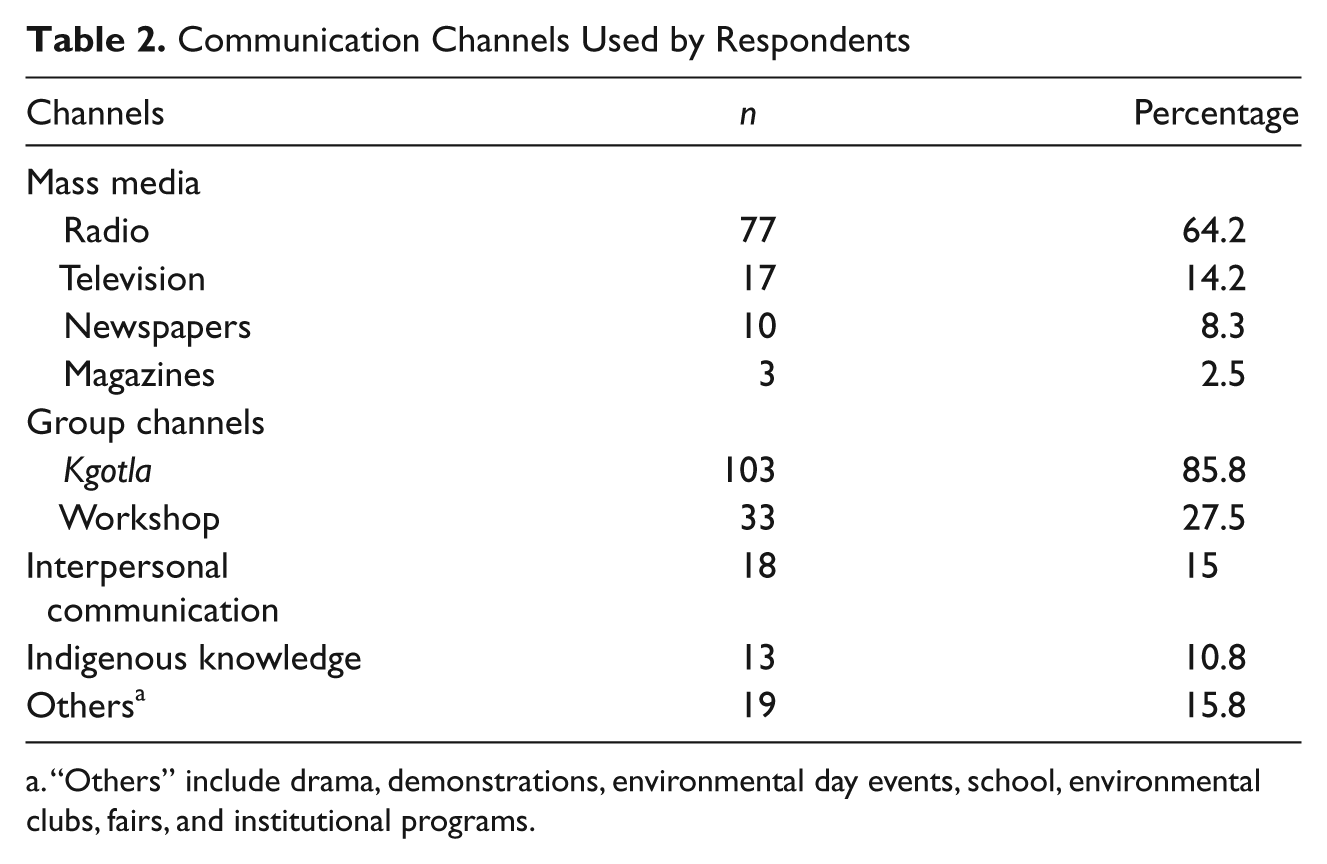
“Others” include drama, demonstrations, environmental day events, school, environmental clubs, fairs, and institutional programs.
The respondents who said they used radio to acquire environmental information were asked to name the specific programs they usually listened to. The programs indicated by the respondents were all state institutional radio programs. These were Makgabisa-naga (DWNP), Bojanala (DoT), Tikwa-tikwe (DEA), Tshomarelo (ARB), and other ad hoc programs. The DWNP radio program, the lead source organization identified by respondents, had an audience of about 40%, followed by the DoT program with 31%.
Approaches in Communication: Group Channels
Respondents indicated that the kgotla and workshop were common group fora used by source organizations to disseminate environmental information: 85.8% obtained environmental information through the kgotla, while 27.5% received this information from workshops (Table 2). Respondents who attended both the kgotla and the workshop were asked to compare the effectiveness of the two fora. In all, 55% (n = 36) of those who attended both indicated that the workshop was efficient. The results were examined for significance difference using the exact binomial significance test, which revealed no significant difference in the proportion of respondents who said either method was effective (p = .62). With the available data, it can be concluded that equal numbers of people would consider either method effective.
The source organizations used other approaches, such as drama, demonstrations, exchange visits, and institutional-sponsored programs such as the CBNRM programs. These were classified as “others” in Table 2.
Perceived Utility of Environmental Communication Interventions
When the respondents were asked about the applicability, relevance and benefit, practical use of information, and behavioral impacts of the messages communicated by the source agencies, more than 90% of the respondents affirmed that the information was worthwhile in all these aspects. Specifically, 91.2% (n = 104) said that they had benefited from the messages the source organizations disseminated and that they were implementing them (90.5%). They also reported that the messages had translated into positive behavioral changes and attitudes toward natural resources (91.3%) such as wild animals. Participant observations revealed that the villagers coexisted peacefully with wild animals. Warthogs could be spotted in the respondents’ yards during interviews, and kudus could be seen roaming the village. Some respondents attested to the presence of the wild animals within their community as an indication of their conservation mindedness.
Media/Channel Usage by Gender, Age, and Education
Chi-square significance tests were conducted to examine the association between audiovisual media and group channels usage by gender, age, and education among the respondents. Analysis for radio use by the three demographic variables revealed that only education showed a significant association—χ2(1) = 3.21, p < .10, effect size = 0.17—while gender and age were not statistically significant (Table 3). Cross-tabulations revealed that 77% of high education level respondents used the radio as a source of information compared with 60% with a low education level category. This indicated that educational level influences the use of radio, while age and gender did not. The odds for low education level respondents using the radio as a source channel is 0.79, while for high education level respondents, the odds are 1.73. The Fisher’s exact test was also conducted for television use and nonuse by the respondents. The test showed a significant moderate association between television audience by age and education and a small association effect by gender (Table 3), indicating that age and education plays a role in television audience.
Summary of Chi-Square Test of Association Between Audiovisual Media Usage and Gender, Education, and Age
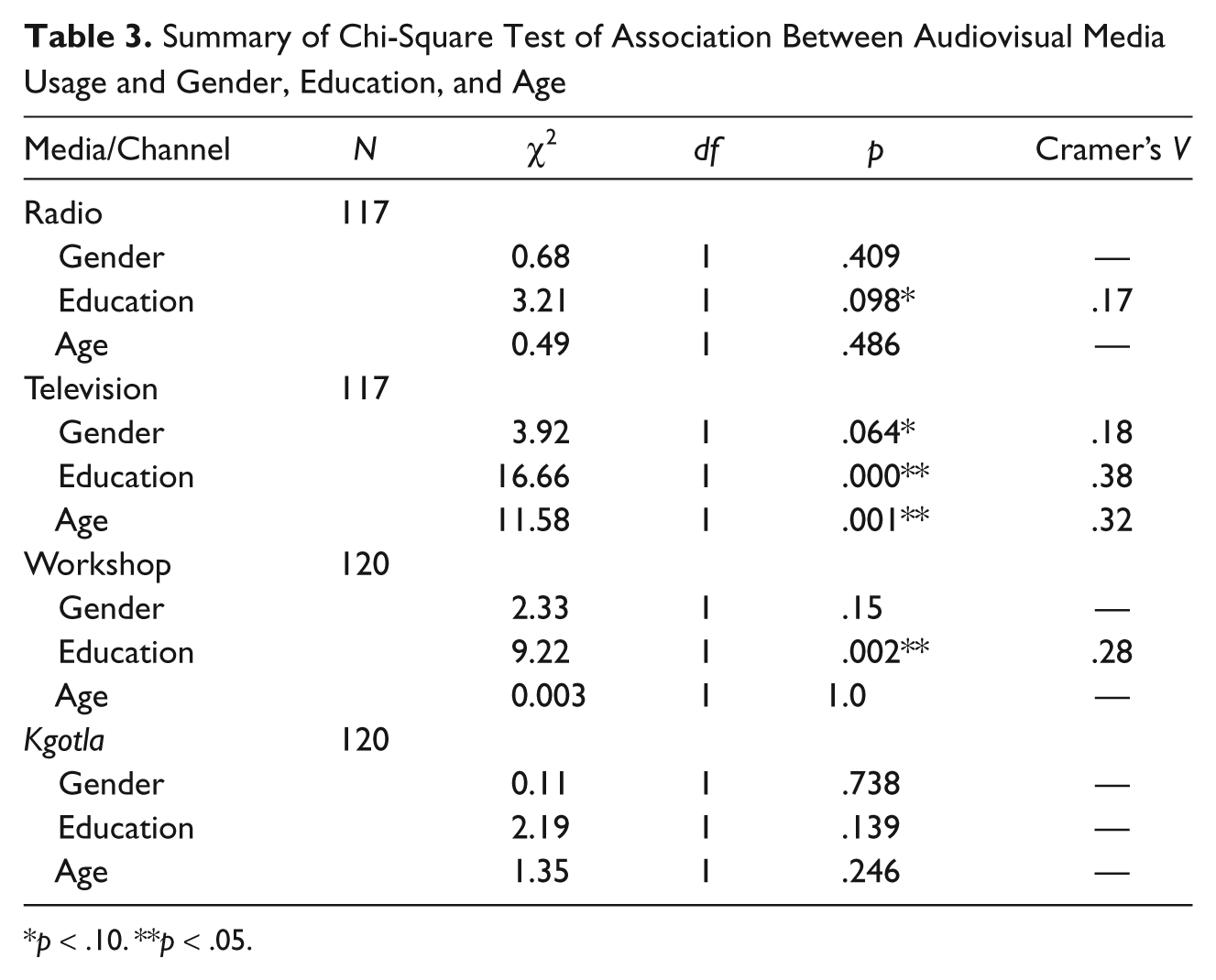
p < .10. **p < .05.
Cross-tabulations on television users by age, education, and gender revealed that most young adults (about 27%) used television compared with 5% of adults, and 33% of the high educational level respondents used television compared with 5% of the low educational level respondents. This indicates that the young adults within the high education category use television as a channel for environmental information more than the 30+ years adults group and the less educated. With regard to gender, more males (22%) used television than females (9%).
Analysis of the workshop as a means of getting environmental information also revealed insignificant association between gender and age (Table 3). However, there was a statistically significant association between workshop and education: χ2(1, N = 120) = 9.22, p = .002. The Cramer’s V statistic value of 0.28 indicates a moderate effect. Few respondents (18.7%) in the lower educational category indicated that they attended the workshop where they received information on environment, while over half (55%) in the high education category did attend and received information through this group channel. It can therefore be concluded that educational level significantly influences workshop attendance within these communities. The odds ratio indicates that the respondents with lower education were 3.5 times unlikely to attend and receive information on environment through workshops than those more educated.
For the kgotla as a forum for receiving environmental information, there was no significant association found between the kgotla attendance by gender, age, and education (Table 3). This indicates that the three demographic variables of interest do not play any role in the use of kgotla as a channel by the respondents. Respondents generally receive environmental information through the kgotla group channels irrespective of gender, age, and education. Generally, Table 3 shows that education plays a role in all the media/channel audience except when it come to the kgotla.
Discussion
This study explored the environmental communication strategies and interventions within the Okavango Delta communities and their perceived utility from the perspective of the recipients.
Information Sources
The respondents identified a wide range of environmental information source organizations, which included eight government agencies and three nongovernmental organizations, together with community-based organizations, wildlife clubs, researchers, and training institutes. Source institutions such as the DWNP were identified in high proportions throughout the study villages, and others varied across the study area. The prominence of DWNP within the study area was not surprising because all the villages in the study area are situated either in a wildlife management area or in its immediate vicinity. Wildlife management areas are areas where the primary form of land use is wildlife management, and hence the DWNP frequently visits these areas for monitoring. The DWNP also leads the facilitation of CBNRM projects within the study area. This may be the reason why the majority of the respondents could easily identify with the DWNP. Some of the organizations identified by the respondents are similar to those found by Mutshewa (1999). The availability of multiple source organizations shows that respondents use a multimix of agencies to obtain information, a finding consistent with literature (Tucker & Napier, 2002).
Having identified source organizations, further follow-up research needs to be conducted on the source organizations. Understanding environmental communication in the Okavango Delta from the perspective of the current source institutions may facilitate discovery of potential areas of partnerships in communication interventions. Moreover, the source organizations are part of the stakeholders targeted by the ORI to be reached with findings of research initiatives. Source organizations are critical in that they influence policy and management decisions that have direct impact on the Okavango Delta.
Channels
Findings indicated that respondents relied on multiple channels, such as print and audiovisual media, interpersonal communication, and experiential interaction with the environment, in addition to campaigns by source organizations. These channels are indicative of the information flow identified by Pillmann (2000). Findings also showed that certain groups were more inclined to use certain channels more than others, which is consistent with previous research (Israel & Wilson, 2006). This is so because the social system is heterogeneous in key demographic characteristics, such as age and education. While it is recommended that further research be conducted to understand the relationship between some of the social system demographic characteristics, the communication channels, and the sources used, the findings of the current study can inform practice. The study has shown that young, educated adults use television as a source channel for environmental information. To widen the television audience beyond the current base, there is a need for the environmental television programs to be broadcast in the local Setswana language also, a language preferred and known by the majority of the residents. At present, the programs reach the young, who are more educated, thereby excluding the majority of rural residents who do not understand English, more so because they are also illiterate. The use of diverse channels by sources, which has the potential to reach more community members, is a good practice that ensures broad-based impacts.
Approaches
The strategies used by source organizations included the use of group channels, such as kgotla meetings and workshops. The findings of the current study did not support the previous research (Decker et al., 1988) that workshops would be more preferred than traditional public meetings. The results indicated that people have equal preference for both the kgotla and the workshops when it comes to perceived effectiveness. The benefits of workshops compared with other traditional public meetings have been discussed in literature (e.g., Chess & Purcell, 1999; Decker et al., 1988; Israel & Wilson, 2006). Generally, workshops are regarded as more useful because they allow more time for dialogue and follow-ups and are intensive.
Though the findings show that the respondents show equal preference for the kgotla and the workshop, the results need to be interpreted with caution. First, preference for the kgotla may be based on cultural intimacy, credibility, and perceived legitimacy of the place and institution and not necessarily on effectiveness. The kgotla is highly regarded as a customary credible place for communicating and consulting on any public matter in Botswana. Literature has pointed out that values and beliefs found in cultures can influence respondents’ view of a communication approach (Rogers, 2003). This may explain why Mutshewa (1999) discovered that while most environmental organizations’ professionals said they preferred the kgotla as a forum for disseminating information, they also identified poor attendance of the same as the main obstacle. It may be that the organizations preferred the kgotla forum based only on legitimacy, the same influence that may be at play within the Delta communities. Second, there may have been social desirability bias on the part of the respondents, whereby they informed the researchers of only what they believed the researchers needed to hear, which did not necessarily reflect their personal position. Third, the highly educated class may prefer a better medium of instruction and dialogue, such as the workshop, but the social system and the cultural norms that surround them may dictate that they claim preference for the kgotla system as an equally important forum for dialogue and communication. These are possibilities that call for dedicated research studies to fully understand the role that gender, age, and education may play in showing preference for a system of communication and the factors contributing to a choice of a favored approach.
The group channels were diversified, giving them the potential to reach different sectors of the community. The use of diverse group channels has potential to facilitate broad-based impacts, as each may influence different segments of the community differently. For instance, in Khwai, the young adults expressed the indelible effects the edutainment (drama) had on them. The qualitative responses showed that most young people in Khwai recommended future interventions to use edutainment. Respondents also identified radio programs they listened to, which were solely media broadcasts from government agencies. This indicates that access by private media to rural areas was limited. While radio programs were diversified, they all featured broadcasts with the overall theme of environmental conservation.
The use of radio, television, and workshop for sourcing environmental information was more prevalent among the highly educated people than the low educational level group. The use of television was also found to be influenced by gender and age. The young and highly educated adults were more likely to use television as a channel to get environmental information than their counterparts. This is partly so because most environmental conservation–related programs broadcasted on television are in English and are thereby understood better by those with higher education. This group happens to fall mostly in the young adults category. The implications of these findings are that the use of television as a channel to broadcast environmental programs will influence mostly young adults, who understand English. Measures that could be considered by source agencies to expand television audience beyond the existing listenership include broadcasting environment-related programs in the local language, which is understood by most people.
The results showed that males used television more than females for environmental information. This may be so because most males work as guides in tourist camps and lodges and therefore watch wildlife videos, films, and nature programs at the workplace. Again, the nature of their work as tour guides demands that they have a good knowledge of natural ecological phenomenon and biodiversity of the Okavango Delta.
However, another factor that may be at play in the study area may be ownership and reception of the audiovisual technologies (radio and television) among the rural communities. Future research should consider examining ownership of these communication technology assets by the respondents. Lack of electricity and reception networks in rural areas may limit ownership of radios and television sets and hence may constrain interventions relying on these channels. The Ngamiland district development plan has alluded to poor radio and television reception in remote areas (North West District Council, 2009).
Use of the kgotla for obtaining environmental information was not associated with gender, age, and education. This result contradicts the previous assertions made in literature regarding kgotla attendance by women, youth, and the less educated among the Botswana society (e.g., Letsididi, 2001; Robinson, 1998; Siphambe, 2003). However, considering the increasing awareness on civil rights and political activism in Botswana, the current results may not be surprising. Moreover, the current study was conducted in smaller villages engaged in CBNRM activities, and it may be that the reliance on the kgotla as an information source is more prevalent in them than in other big villages and centers elsewhere. The CBNRM program may also be a contributing factor to kgotla activism by community members within these villages. Future research should explore the effect of village size on kgotla attendance by gender, age, and education using villages of different sizes. The research should also explore whether the presence of programs such as the CBNRM does promote kgotla attendance by the three demographic variables. However, the finding that; the kgotla is a frequently used group channel within the study villages suggests that the channel may be considered a culturally legitimate channel, and hence there is a need for communicators to tap on the channel to propagate environmental information for broad-based reach and impact.
The results indicate that the interventions have been effective in positively affecting both the respondents’ behaviors and attitudes. While preventive innovations are regarded as a challenge in the innovation diffusion process, the results indicate that in the study area it has been a success. This success may have been achieved over time, although this was not examined in the current study. The diffusion theory notes the importance of time in the innovation diffusion process. Rogers (2003) indicated that the way innovations are perceived by recipients explains the different pace of adoption. In view of the five characteristics of innovations that define the speed of the adoption process, the following can be deduced from the study:
Relative advantage: It was easier for respondents to adopt conservation innovations because most indicated that the messages were applicable to their livelihoods. Respondents regarded adopting conservation behaviors as being advantageous as it contributed to sustaining the natural resource base, which is directly linked to their day-to-day survival. One of the respondents said, “There is just no how I can think of tomorrow without conserving my resources.” This expressed the respondents’ perception that natural resources conservation was part of their day-to-day consideration, as it was the basis of their living.
Compatibility: The idea and practice of conservation were compatible with the respondents’ traditions, customs, practices, and values. Many did not regard it as an innovation as such, but the way it was packaged by the institutions made it appear as an innovation. In their own words, conservation was their “lifestyle,” demonstrated through their long coexistence with wild animals. Most elderly respondents could relate experiences that demonstrated their conservation mindedness and how they have orally and experientially passed the tradition to their children. The young adults also indicated that they acquired conservation habits from their parents and through experiential learning.
Complexity: Conservation, as an innovation to these communities, was not a foreign concept in the language of the respondents. This simplified the social marketing of the conservation innovation. The cost-benefit analysis of changing old behaviors for new ones was made easier as communities were able to conceptualize the implications of either scenario. This is in line with the social exchange theory, which postulates that as long as the benefits of performing a new behavior outweigh the costs of maintaining an old one, people will change their behaviors by adopting newer and less costly practices or innovations (Zafirovski, 2005). Some respondents noted that their attitudes toward conservation have changed as they realized the importance of natural resources, mainly wildlife, which they previously perceived as a liability when they destroyed their crops and property. They attributed their change of attitudes to the introduction of CBNRM program in their villages.
Trialability: All four villages chosen for the study area were participants in the government-initiated, CBNRM program. The programs were initiated with a view to demonstrating the values and benefits of conservation to the rural communities, who reside in resource rich areas. This was achieved by transferring in part the management responsibility, decision-making processes, and user benefits to the local communities (Thakadu, Mangadi, Bernard, & Mbaiwa, 2005). To date, the projects have yielded positive benefits to the communities, according to the respondents. This made the trialability of the conservation innovation seem less doubtful to the communities. Qualitative responses indicated that community conservation initiatives were helpful and contributed to livelihoods.
Observability: The history of community conservation initiatives in the Okavango Delta has shown that as communities and individuals benefit from the initiatives, more and more communities wanted to be part of the program. This was so due to the tangible benefits (e.g., employment opportunities, provision of game meat) realized by the local communities from the innovation. The respondents attested that the innovations had contributed to behavioral and attitude changes toward conservation. Some of the communication approaches noted by the respondents were in the form of exchange visits and demonstration projects, which tend to enhance observability. The implication for this finding is that source organizations’ communication interventions should demonstrate relevance and applicability to the people’s livelihoods in order to yield meaningful and desired impacts. Communication interventions that inform people only about the risks—without providing requisite alternatives—may not necessarily bring expected positive results.
Drawing from the diffusion theory (Rogers, 2002), it can be deduced that CBNRM in the study area had greater relative advantage, compatibility, trialability, and observability and was simple, making its adoption and consequently adoption of environmental conservation innovations rapid and successful. The innovations have also gone through the five stages of awareness, interest, evaluation, trial, and adoption.
Rogers (2003) pointed out that policy and regulatory frameworks may contribute to widespread adoption of preventive innovations. This has been the case within the study area because government introduced policies that facilitated communities to benefit directly from natural resources management, through CBNRM projects. The program enabled Delta communities and others to derive direct and tangible benefits, which contributed to favorable attitudes, behavior, and adoption of environmental conservation innovations.
However, the same policy instrument that guides CBNRM implementation, adopted in 2007 (Government of Botswana, Ministry of Environment, Wildlife and Tourism, 2007), has the potential to negate the positive impacts of the CBNRM program and, consequently, the communication effects realized to date. Through the policy, community trusts are expected to retain only 35% of revenue from community projects and give up 65% to the central treasury so as to fund environmental projects nationally. The prepolicy practice was that community-based organizations retained all the funds realized through CBNRM projects and invested them in meaningful community projects. Though this policy provision was vehemently opposed by the local communities, the policy was ultimately approved by Parliament. Implementation of the policy is yet to start as it awaits development of implementation guidelines.
Other reasons for the success of the interventions are that the organizations used a multimix of channels, approaches, and strategies to supplement the primary means for maximizing the impact. The use of diverse channels by source organizations facilitated smooth passage of the conservation innovations through the five stages of awareness, interest, evaluation, trial, and adoption. Literature has shown that different channels and approaches of communication influence these stages differently, with mass media ideal during the first stage, as it stimulates awareness (Rogers, 2003). Passage through other stages could be enhanced through interpersonal means of communication.
Recommendations for Practice and Research
The applied exploratory research study was initiated to guide the ORI in developing an environmental communication strategy for the Delta area. The study provided insights on environmental communication in the Okavango Delta. The results suggest that when communicating environmental information, strategies should use a multimix approach that utilizes diverse channels and media for maximal and broad-based impact. The kgotla as a group channel is used by all the categories of individuals within the society, as reflected in this study. This presents an ideal opportunity for source agencies to continue to use the kgotla platform during information dissemination interventions. The source agencies should also consider widening the television audience base by broadcasting environmental conservation programs in the local language. It is also suggested that sources of preventive innovations should adopt a participatory communication approach, with a development component. This will provide opportunities for alternatives and local solutions to the environmental dilemmas. However, interpretation of the findings should be made bearing in mind the following study limitations: (a) the sample size for the study was small, (b) the results are only applicable to the local communities’ stakeholder groups only, and (c) while the researchers guarded against social desirability bias, its potential effect may not be ruled out completely. While acknowledging these limitations, the findings can be used to establish a foundation for future research in this area. As such, suggestions coming from the study are warranted. It is necessary therefore for future research to focus on the following:
Communities outside wildlife management areas and CBNRM project beneficiaries. The current study demonstrated that communicating preventative innovations has been successful in CBNRM project areas, represented by the four sample study areas. It appears that CBNRM played a decisive role in the formation of favorable attitudes among the recipients and adoption of conservation innovations and hence the need to examine dynamics that may be at play within non-CBNRM communities.
Further exploration of the relationship between group channels, such as the kgotla and workshop, by psychographic and demographic characteristics of the social system, using a larger sample. Future studies should also examine the effect of village size on kgotla attendance.
Exploration of environmental communication from the perspective of the source organizations and other stakeholders, such as tour operators, guides, and other institutions. These are among the stakeholders targeted by the ORI and their practices may inform ORI strategy.
Incorporation of participatory observation techniques to facilitate probing and validation of behavioral practices reported.
In conclusion, it is necessary to undertake studies such as this one periodically to appreciate audience communication behavior and patterns, as Israel and Wilson (2006) noted. Effective dialogue and efficient communication of environmental information demand that practitioners understand the different structural, historic, and cultural realities at play within target societies to inform interventions (Greco, 2005). This becomes imperative in this era when there is public outcry that scientists fail to effectively disseminate their findings to nonscience audiences. Response to the public outcry will entail understanding and appreciating the interventions in place to diffuse and translate environmental knowledge into practice and policy. Furthermore, understanding available interventions may encourage emerging institutions willing to shoulder social responsibility to consider forging links with existing sources with a view to pooling resources, expertise, and/or sharing best practices for maximal impact. The impact of the CBNRM projects, a development project, also becomes food for thought for academia to consider embracing participatory communication, where stakeholders take the lead in identifying their local environmental problems and finding local solutions for the same. This may call for academia to ensure that funding sourced for research initiatives has a strong development component intervention.
Footnotes
Acknowledgements
We would like to express special thanks to the three anonymous reviewers for their insightful comments and constructive suggestions on earlier version of this article. Special appreciation to Ms. Angelinah Mokowe for proof reading the article and editorial services.
Declaration of Conflicting Interests
The authors declared no potential conflicts of interest with respect to the research, authorship, and/or publication of this article.
Funding
The authors disclosed receipt of the following financial support for the research, authorship, and/or publication of this article: This research was supported through a grant from the Office of Research and Development, University of Botswana, Grant Allocation R199.