




Abstract
This article describes the LRS lens, a methodology designed to consider technical controversies with reference to a critical realist conceptualization of technology and meaning production. The application of the lens is demonstrated in a qualitative analysis of the biofuel controversy in the United Kingdom. The analysis organizes participants’ positions in terms of the technologies they refer to, their names, and their judgments. They organize biofuels’ variability in different ways, developing the vocabulary to identify and refer to relevant subgroups. The domination of one approach could have a significant impact on technical development.
Sometimes it matters what a thing is, what name it has, and how people judge its properties.
Winner’s assertion about technical things, names, and judgments holds a particular relevance for disagreements. As we shall see, it also resonates with the conceptualization of technology and meaning production used here to develop a methodological lens for studying a controversy around biofuel technology in the United Kingdom. Participants in the controversy use names to communicate judgments of things. By using these features to organize and analyze communications about biofuels, we may learn a great deal about how actors’ positions are mobilized within the debate and consider potential implications for the development of the technology.
Biofuels are liquid fuels made from nonfossilized biological material that can be blended with petrol or diesel for use in existing motor engines. Many different materials are used as feedstocks for biofuel production, and further options are presented in processing, blending, delivering, and consuming the finished product. Infrastructural scales vary from off-grid systems, where biofuels are produced and consumed locally, to cross-continental systems integrated with other supply chains. Furthermore, the technology is undergoing fairly rapid development with significant research activity promising an even greater array of feedstocks, processing methods, and applications for the fuel.
The technology to use biological feedstocks as motor fuel has been available for as long as fossil fuels, although biofuels have spent much of the period since the industrial revolution in relative obscurity. Around a decade ago, biofuels enjoyed something of a resurgence with regulatory and market incentives for their development in Europe and the United Kingdom. The European Union’s Biofuels Directive (European Parliament, 2003) obliged European suppliers to blend biofuels into the mainstream fuel mix. The then British government implemented this policy in the United Kingdom through the Renewable Transport Fuel Obligation (Secretary of State, 2007), framed by a threefold justification of diversifying the energy supply, stimulating rural economies, and reducing carbon emissions (Darling, 2006; Department for Environment, Food and Rural Affairs, 2008; Department for Transport, 2006a, 2006b). These promises were contested and, ultimately, overshadowed by concerns about the negative impacts that some biofuels may have on climate change, poverty, and social justice. Various amendments to European and domestic policies have responded to the emerging controversy, although significant disagreement remains and the controversy has persisted (Boucher, 2012).
Disagreements in this biofuel controversy are manifest as conflicting representations of the technology communicated publicly by various actors. Biofuels are a heterogeneous technology so, while these communications sometimes pertain to biofuels generally, they often refer to or represent specific biofuels, for example, those of a particular feedstock, origin, or standard. There are loci of consensus on the benefits (or costs) of specific biofuels that could potentially be identified and developed (or restricted) separately from the main group without contention. This, however, would require the construction and maintenance of a system for organizing biofuels’ variability, drawing boundaries around relevant subgroups, and developing consensus on how these subgroups are identified. The analysis here revealed significant flexibility in how this can be achieved. The current project examines these features of the biofuel controversy in the United Kingdom, drawing on insights from critical realist conceptualizations of technology and meaning production.
The following section, Critical Realism, Technology, and the Mechanics of Meaning, presents a discussion of the theoretical perspective on technology and meaning production that informed the development of the methodology. The methodology itself is described in the subsequent section, The LRS Lens, and applied in the penultimate section, Analyzing Disagreements in the Biofuel Controversy. Finally, discussions of the possibilities, limitations, and implications of the research are presented as Concluding Remarks.
Critical Realism, Technology, and the Mechanics of Meaning
Periods of controversy and disagreement are a popular research topic for a number for reasons. They may disrupt established understandings and allow others to emerge and stabilize, making them moments of potential change. Social structures and processes may be more visible at this time, and hidden motives and interests may be revealed, making them more amenable to study. For example, a European Commission report (2006) released during the controversy revealed that the central motive for biofuel development was not environmental or developmental but to reduce European dependence on oil (Boucher, 2012). The added social and political relevance of contentious topics makes them an attractive topic (e.g., Roberts et al., 2012), and they often correspond with heightened communicative activity, providing ample resources for empirical studies.
Appropriate methodologies must be designed for the study of a controversy. This is not only to define how data are collected (e.g., document analysis, interviews, participant observation) but also how they are organized and analyzed. The suitability of a methodology for studying a technical controversy will depend on the details: whether the debate is live or historic, whether the participants can be accessed, the specifics of the technology, its level of development, public salience, and other features. It will also depend on the aims of the research, perhaps to test a specific theory or hypothesis (e.g., Grimm, 2009) or to consider future development prospects (e.g., Rip, 1986). Whether explicit or implicit, intentional or incidental, methodologies always reflect a wider perspective on what technologies and controversies are and how they are related. As such, methodologies should be designed to be commensurate with the specification of the data and also with a coherent and well-justified theoretical perspective. For example, a positivist method within a deficit model of disagreement would examine participants’ positions against privileged scientific accounts of the truth, explaining disagreement and its resolution with reference to correspondence with this truth. Success and consensus would be considered in terms of “good science” or “good technology.” From this perspective, one party to a disagreement must be “righter” than the others, and this would affect how the empirical material is organized and analyzed, likely with reference to a dominant scientific perspective. Such an understanding would also affect how analyses and results are mobilized, since it follows that the preferred resolution of the controversy would involve the dominance of the “best” understanding. The point here is that empirical material is inevitably analyzed from a perspective, and this significantly affects the analysis and its results. For this reason, we refer to an approach to organizing and analyzing empirical material from a given theoretical perspective as a methodological lens, highlighting that it is to examine by particular means and from a particular position. A good lens should provide an explicit, coherent, and justifiable link between theory and practice, and its use should deliver both theoretical and empirical insights.
The deficit approach described above amounts to little more than a straw man in contemporary literature and has been widely discredited. Prior to a constructivist turn in the literature, the role of meaningful structures and processes was only resorted to when considering why technologies failed or raised contention. Bloor (1976) criticized this imbalance, demanding that success and failure and consensus and disagreement are considered symmetrically, that is, with the same analytical foci and techniques. Of course, for the reasons discussed above, disagreements and controversies are still given heightened attention in the literature. The key point is that, now, the truth of a participant’s communications is more often considered as an attribute achieved discursively than as a property based on an inherent correspondence with an objective reality. This is not to reject ontological realism but to prioritize an epistemological relativism (Bloor, 1999). The literature increasingly diverts analytical attention to the meaningful structures and processes that can explain how and why technologies develop in the ways they do. Various methodologies have been articulated to support this kind of analysis, each drawing on different sets of assumptions about technology, society, and communications. For example, a method developed in the social construction of technology literature (see Pinch & Bijker, 1984) considers disagreements about technologies as a result of a technology’s interpretive flexibility, reduced through (reversible) mechanisms of closure around a dominant framing of the technology (e.g. Watkins, 2011). Venturini recently articulated methodological guidelines for observing (2010) and describing (2011) scientific and technological controversies with reference to actor-network theory. Classically, methods within the boundary objects literature (see Star & Griesemer, 1989) would be designed to consider how a technology may enable effective communication across diverse communities of actors, although it can also be used to inform methodologies to consider how communication, innovation, and agreement are inhibited, leading to contention (Fox, 2011).
Boucher (2011) identified a critical realist account as potentially useful for considering controversies such as that surrounding biofuels. As a broad position, critical realism has developed steadily since the 1970s (Archer, Bhaskar, Collier, Lawson, & Norrie, 1998; Bhaskar, 1975). Often positioned somewhat between positivist and constructivist approaches to social science, critical realism combines ontological realism with epistemological relativism, highlighting the role of constructive social processes operating within a deeply stratified realist ontology, conceptualized in terms of three nested domains. Following Bhaskar (1975), the empirical (or the subjective/semiotic; see Hartwig, 2007c) includes the observation and meaning of phenomena. This can be understood as the reality of experience itself. It is part of a deeper domain of the actual, which includes all phenomena that actually occur, including but not limited to the experience of other phenomena. This in turn is part of the broadest domain of the real, which includes anything with some causal power, regardless of whether it is exercised in causing phenomena or whether any such phenomena are experienced. Simply put, reality includes the mechanisms that generate phenomena, the phenomena themselves, and also the experience of these phenomena.
Critical realism also asserts a distinction between an intransitive dimension of being and an epistemic or transitive dimension of knowledge about being. Transitive knowledge is produced through referential detachment from an intransitive object. As an emerging social reality, this transitive reference is distinct from its intransitive referent (Al-Amoudi & Wilmott, 2011). The transitive dimension depends on social structures and relations, such as language, concepts, and practices. Yet its relationship with the intransitive dimension is not dichotomous. Just as the domain of empirical reality is part of the domain of actual reality, the transitive dimension is contained within the intransitive dimension; it is a nonexhaustive part of it. As a transitive object emerges through meaningful engagement with the referent, it becomes part of the wider intransitive dimension. This knowledge becomes part of being and, as such, can subsequently be referentially detached as the intransitive referent of new knowledge: knowledge about knowledge about being (Hartwig, 2007b).
Critical realism has been used to reconsider the foundational assumptions of various disciplines, notably organization studies (Ackroyd & Fleetwood, 2004) and economics (Lawson, 2003). In the current project, two relatively underdeveloped contributions to critical realist theory are of particular relevance: first, its account of technology and, second, its account of meaningful processes—semiotics. These form the basis of the methodological lens, and the remainder of this section describes each in greater detail.
Lawson (2008, 2010) provided an account of technology from a critical realist perspective in which technologies are conceptualized as artifacts that depend on social processes and collective engagement as well as their physical form for their continued existence. Such artifacts cannot be reduced to materials or meanings alone (Fleetwood, 2005). Lawson also defined technical activities as those that “harness the intrinsic powers of material artefacts in order to extend human capabilities” (p. 59). In his transformational model of technical activity, Lawson sketched a mutually conditioning relationship between technical artifacts and technical activities, conceptualizing technical activities as conditioned by a preexisting technical structure that depends on these technical activities for its continued transformation and reproduction. As such, technical artifacts are both the condition for and outcome of technical activities. However, an artifact may be a technology because humans harness its physical powers to extend their capabilities, but it may be controversial through other kinds of harnessing. The activities typically encountered in controversy, such as poster campaigns and public debates, do not fit Lawson’s definition of technical activities; they are discursive and harness symbolic or functional powers, and they would not be said to extend human capabilities. Yet they have an important role in the construction of what the technical artifact is. These discursive activities are also constrained by the technologies to which they refer. Even though these activities are not sufficient to maintain the artifact’s status as technology (this depends on those activities Lawson described), the controversy and the technology are certainly in a mutually conditioning relationship, which will be revisited in the context of biofuels.
The reconciliation of a realist account of being with a relativist account of knowledge presents a methodological challenge for all critical realist scholarship. The hiatus within technologies—as irreducibly social and material—presents a further challenge here, particularly as they are manifest seamlessly in the empirical domain as technical artifacts. The broader critical realist literature provides some conceptual resources to support this kind of reconciliation (e.g., Carter & New, 2004; Danermark, Ekstrom, Jakobsen, & Karlsson, 2002) as well as precedents from other disciplines (e.g., Bhaskar & Danermark, 2006) but, while Lawson’s (2008) conceptualization was intended to be “useful for those engaged with technology” (p. 48), it has not been significantly developed or empirically applied. The current project responds to this gap in the development of a methodological tool for empirical analysis that is explicitly aligned with a critical realist understanding of technology.
Recalling Winner’s (1993) opening quote, technical artifacts or things are constructed, reproduced, and transformed through the ways they are named and judged by actors. This meaningful engagement with technical artifacts through naming and judging is particularly important here because it is constitutive of the reproduction and transformation of technical artifacts. This process is captured to some extent in the emergence of transitive reality and its passing over to the intransitive dimension, as discussed above. Semiotics, the study of meaningful processes, attempts to conceptualize this process in greater detail, and its insights contribute to the development of our methodological lens.
The Saussurean tradition of semiotics articulates a dyadic schema of meaning itself (signified) and its representation (signifier). This conceptualization articulates an arbitrary relationship between the signifier and signified and no relationship between the pair and their object (de Saussure, 1965). A Peircian tradition differs in a number of ways, most notably in its triadic schema, which also includes an object. While Peirce’s interpretant is roughly equivalent to the signified, its direct relationship with the object introduces significant conceptual differences; it may be an effect of it or a reaction to it. Similarly, his representamen roughly equates to the signifier but, again due to its relationship with the object, is not an arbitrary social convention. Rather, it can have a relationship with the object, for example, a physical likeness or geographic proximity (Nellhaus, 1998). Unlike de Saussure’s schema, Peirce’s includes what Winner (1993) called things (objects), as well as their names (representamens) and judgments (interpretants). The distinction between them is fluid, so, for example, an interpretant may also stand as a referent in other semiotic processes.
Bhaskar (1993) has discussed semiotics from a critical realist perspective only very briefly (pp. 222-224). Without mentioning the Peircian or Saussurean traditions directly, he emphasized the importance of including the object of reference. Given the prominent role critical realism affords to meaningful engagement with objects, it is both unfortunate and surprising that more attention has not been given to the subject (Fairclough, Jessop, & Sayer, 2002). Following the conventional Saussurean terminology, Bhaskar asserted a signifier-signified pairing, accompanied by a referent akin to Peirce’s object. These terms are historically loaded, subject to wide interpretation, and can be misleading if used without precise definition. Following Nellhaus (1998), Bhaskar’s terminology is particularly problematic because his concept of the signifier and signified are more closely aligned with Peirce’s representamen and interpretant. Peirce’s understanding of semiotic processes can also be used to capture the critical realist understanding of how meaning emerges in the transitive dimension as a referential detachment from a preexisting object. Since the transitive is contained within the intransitive, this meaning can be subject to further referential detachment. So, returning to our concern here, meanings emerge and at once become part of the fixtures of reality, perhaps reproducing or transforming some feature of what the technology is. Embodied within a technical artifact, these meanings may gain heightened durability and power (see also Feenberg, 2002; Pfaffenberger, 1992). It is through these semiotic processes that technologies are constructed; they are literally the unfolding of technical reality.
The triadic schema positions the distinction between things, names, and judgments as the nexus of the construction, reproduction, and transformation of technology. The current project uses this abstract account of meaning production as the basis for a novel methodological lens for the analysis of empirical material.
The LRS Lens
The features of the methodological lens are defined with a specific terminology. Bhaskar’s (1993) term referent is considered acceptable and is defined here as any independent, preexisting, intransitive chunk of reality to which a meaning may refer. This captures the technical artifact to which actors refer as they engage in disagreement. As an artifact, this referent was constructed through previous semiotic processes, including technical activities. For that which represents, in preference to de Saussure’s (1965) signified or Peirce’s representamen, we adopt the term locution, which captures that it is about expression itself, differentiated from its meaning and referent. Locutions are context sensitive, and a single locution may have various meanings and referents. It also alludes to the critical realist account, as Bhaskar (1993) described the transmission of “locutionary force” (p. 222). The locution is usually a name, although it may also be an image or other representative form. Finally, we must capture judgments of the technology. These are particularly important in disagreements but fit within a broader concept of meaning that must also capture experiences, interpretations, and understandings of technologies. In place of de Saussure’s signified or Peirce’s interpretant, we adopt the term sense because it captures the experience itself, apart from its referent and its locution. It is also associated with causal reasoning, “the sense of a course of action,” which is crucial in a critical realist account of semiotics (Fairclough et al., 2002)
The role of the analytical lens is to support the consideration of disagreements in terms of the technologies referred to, the senses associated with them, and the locutions used to represent them. By organizing and analyzing communications in terms of these features, so defined, analysis is undertaken from an explicitly critical realist perspective on meaningful engagement with technology. For example, analyses using the LRS lens reproduce the assumption of the referent as a technical artifact; the causal power of meaningful engagement with the referent; the assertion of a deeply structured ontology of causal powers, actual phenomena, and experience; the unfolding of technical reality in the transitive dimension and its containment within the intransitive dimension; the mutually conditioning and transformative relationship between (technical) structure and (technical/discursive) activity. The schema is presented in Figure 1 and is henceforth described as the LRS lens in a deliberate nod to SLR (single-lens reflex) cameras, highlighting that what is observed is necessarily interpreted by the analyst, from a perspective, and through a lens. During analysis, empirical material is interpreted and organized to describe actors’ positions in terms of these three features. The locution captures how the communicator refers to the technology and may directly reflect the empirical material in the form of a name or image used. The referent and sense are identified through analysis and interpretation of a range of empirical data.

The LRS lens.
The apparent simplicity of the lens should not mask its ontological, epistemological, and methodological challenges. Each vertex has an internal relationship with the others, so part of what each is is defined by its relationship with the others. On one level, this presents an ontological challenge—because the locutions and senses associated with a technical referent are existential features of technology itself. The referent must always be considered as a dynamic artifact, dependent on both meaning and material, never reduced to either one alone, continually being transformatively reproduced through meaningful engagement. On another level, this internal relationship also presents an epistemological challenge because LRS analyses do not directly present the locutions, referents, and senses but, rather, the analyst’s interpretation of them. The analysis itself is also a semiotic process: the construction of new locutions to describe the analyst’s sense of the referent, which, in this case, is the empirical material (treated as a proxy for the actors’ actual positions). This presents a methodological challenge in providing fair interpretations of the actors’ referents and senses.
The analyst should not be discouraged; after all, this challenge applies to literally all empirical activities. The first precaution is to recognize the inevitability of these challenges during all stages of research design and implementation. In critical realist terminology, it is a question of reconciling epistemological relativism and ontological realism. The analyst must manage the hiatus between the intransitive and the transitive, referent and reference, being and knowledge. In this capacity, critical realism asserts judgmental rationality: that all knowledge is possible within a wider assumption of epistemological relativism. As such, knowledge is constructed, inherently fallible, developmental, and dependent on context and perspective (Hartwig, 2007a). This applies to the participants’ claims about the technology and also to the analyst’s claims about the controversy. The analyst should be driven to heightened reflexivity and the adoption of increasingly robust methodological practices.
Interpreting empirical material is a delicate process, and the analyst must strive to capture the actors’ positions as fairly as possible. “Meta-discourse,” when participants engage the controversy directly, for example, by rejecting claims raised by others, can be particularly revealing. Analyses should be illustrated with referenced quotes, allowing the reader to revisit the material and consider the communicator’s position for themselves. If possible, participants in the controversy should be engaged in dialogue to discuss the analysis. This can provide some degree of validation of the analysis and also may augment it by allowing actors to elaborate on the reasoning for or specifics of their positions. Informal interviews are suitable, but given sufficient resources and access, a fully participative approach could allow actors to describe their own positions through the LRS lens.
Analyses will also benefit from familiarity with the relevant scientific and engineering literatures. This is because some actors’ positions may rely on specialist knowledge, and the proper identification of referents, locutions, and senses, which are often quite specific, will require a detailed understanding of the state of the art. The analyst must be comfortable with this material while maintaining a critical, reflexive distance from it. Any scientists and engineers participating in a controversy should be analyzed in the same way as any other actor.
Analyzing Disagreements in the Biofuel Controversy
The purpose of this section is to demonstrate the application of the analytical lens while also contributing to understandings of the biofuel controversy in the United Kingdom through two empirical studies. The first is the observation of a live panel debate, presented to identify and illustrate two characterizations of disagreement found in the biofuel controversy. The second presents selected results of a broad empirical study of the broader controversy to demonstrate how analyses may proceed with the LRS lens.
Two Characterizations of Disagreements in a Live Panel Debate
Considering actors’ positions on biofuels in terms of these locutions, referents, and senses can support the analysis of disagreements in the biofuel controversy. Disagreements about technologies are manifest as conflicting senses of the same referent being communicated with some degree of antagonism. Here, we consider how this manifestation of disagreement might actually be characterized in two different ways. The first characterization, as might be expected, involves different senses of the same referent, for example, a debate about the quality of apples. The second is more interesting, involving different referents and senses that share a locution. For example, a disagreement about fruit where both interlocutors use the same locution ‘fruit’ as one refers to apples and the other to oranges. On a surface analysis it may appear as though their different senses have the same referent: a classic disagreement, although they actually have discrete referents. These disagreements can falsely amplify the apparent divergence between actors’ judgments, because their sense of each specific referent each may not be dissonant. As we shall see, this kind of disagreement may also reveal a greater flexibility in how heterogeneous groups of referents, such as fruit or biofuel, can be organized and relevant subgroups of it can be identified.
This section presents a discussion of both characterizations of disagreement and their implications with reference to a live panel debate, “Biofuels: Earth Saving or Climate Changing,” hosted by the University of Manchester on November 21, 2007. The debate featured representatives of two central participants in the controversy: the National Farmers Union (NFU) and Biofuelwatch. We analyzed the debate as part of a broader empirical analysis of the biofuel controversy. The LRS lens was not fully developed at that stage, but we were already considering the variety of objects and meanings invoked by the word biofuels. During the debate, we took notes on the participants’ positions on specific biofuels and how they expressed themselves. We then undertook brief, approximately 10-minute interviews with each participant separately after the event, both to check that we had made accurate and fair interpretations of their positions and to ask for clarification on the referents and senses invoked during their presentations. For example, we asked the Biofuelwatch representative which specific biofuels they referred to when making an association with forced evictions.
The debate focused particularly on the environmental promises and concerns surrounding biofuel development in the United Kingdom, which Biofuelwatch opposed and the NFU supported. During the debate, the NFU representative reproduced many of the justifications that framed early biofuel development: providing benefits for the rural economy, the environment (particularly climate change), and energy security. The panelist from Biofuelwatch explicitly countered these benefits as myth, citing rainforest destruction, species endangerment, mass eviction, and bad labor practices. The arguments presented by each are broadly representative of the positions held by their organizations as documented by various campaign materials produced around the time of the debate (see Biofuelwatch, 2007; NFU, 2007a) and are considered typical of the debates that characterized the early stage of the controversy around that time.
On a surface reading, the NFU and Biofuelwatch presented conflicting senses of the same referent, biofuel technology, using the same locution, “biofuels.” This analysis is presented in the two triangles at the top of Figure 2, with the locution in the L vertex and interpretations of the referent and sense positioned in the R and S vertices. It is clear that the locutionary and referential vertices are congruent and the sensory vertices are dissonant. As such, this type of disagreement is characterized by a sensory dissonance: multiple dissonant senses of the same referent and locution. Such a surface reading, however, will not always suffice. Biofuels are heterogeneous, and the NFU representative’s positive sense of biofuels in general was seen to be an extension of his positive sense of domestically produced biofuels in particular. He actively opposed the imported biofuels criticized by the Biofuelwatch representative and questioned their environmental credibility. Similarly, the Biofuelwatch representative’s vehement opposition to biofuels in general was seen to be an extension of his position on imported biofuels in particular. His position on the small-scale domestic production and consumption to which the NFU representative referred was much more reserved, although still negative. On the production of biofuels from existing waste streams, the Biofuelwatch and NFU positions were closely aligned in support. Once again, each of these positions on specific biofuels can also be found in enduring relics of NFU and Biofuelwatch participation in the controversy around the time of the debate (see Biofuelwatch, 2008a; NFU, 2007b). On this reading, the positions of the Biofuelwatch and NFU representatives did not conflict as much as they appeared, either in the debate itself, which was heated, or in the analysis of positions presented at the top of Figure 2. Once the specific positions are organized with reference to the LRS lens, as presented at the bottom two triangles of Figure 2, it is clear that the disagreement is not characterized by dissonance across the sensory vertices but, rather, by referential dissonance, where different referents, associated with different senses, are referred to with the same locution. These disagreements are manifest in the same way as disagreements characterized by sensory dissonance. As such, they are described as falsely amplified, because their actual positions do not conflict to the extent that they appear. This is important because disagreements can occupy significant resources and affect development paths. The pressure of the controversy certainly led to slower biofuel development in the United Kingdom (Secretary of State, 2009). In this sense, biofuels act as an inhibitive boundary object (see Fox, 2011); the ways in which they are understood and represented present a barrier to their development.
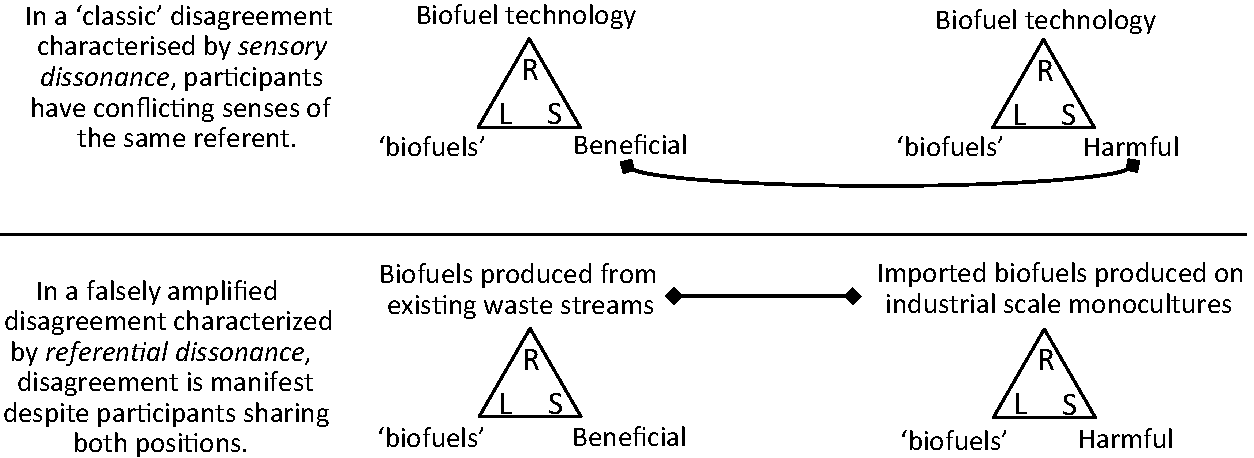
Modes of disagreement in the biofuel debate.
Now, consider the disagreement that would be manifest in this particular debate if, instead of referring to biofuels generally with one locution, “biofuels,” the technology was organized into three subgroups—those produced from imported feedstocks referred to with the locution “imported biofuels,” those produced from domestic feedstocks referred to with the locution “domestic biofuels,” and those produced from waste products referred to with the locution “waste biofuels.” Much of the disagreement would be resolved without any change in either actor’s judgment of specific technologies. Of course, any disagreement characterized by sensory dissonance would remain. The positions articulated in the debate would more accurately reflect the actors’ actual positions on the technology. If this could be achieved on a larger scale, a more sophisticated development trajectory could be implemented where specific biofuels that are roundly supported are promoted while others that are roundly opposed are restricted. Given the fluidity of locutions, referents, and senses, why has the technical parlance not developed and diversified to respond to this apparent inadequacy? Why have the actors not developed their vocabulary or referred to biofuels in more specific terms? The answer is that such a process is far from straightforward, and the stakes are high. As we shall see, while disagreements characterized by referential dissonance may falsely amplify the apparent interpretive flexibility of specific artifacts, they also reveal a broader flexibility in which dimensions of biofuels’ variability matter, how this variability can be organized, how boundaries can be constructed and maintained to identify subgroups of the technology, and how these subgroups can be named. The actors cannot proceed until this is achieved. The approach to this process is described here as locutionary work, and the domination of one approach could have a significant effect on a technology’s development. The Renewable Energy Directive (European Parliament, 2009) is an example of a robust approach to locutionary work: increasing regulatory support for biofuels that are produced from waste products and withdrawing it from those that did not offer significant emissions reductions (see Boucher, 2012). The following subsection presents examples of locutionary work identified in the controversy by analysis through the LRS lens.
Analyzing Locutionary Work in the Biofuel Controversy
We analyzed various actors’ locutionary work as part of a broad study of the biofuel controversy. The LRS lens was used to organize and analyze various actors’ participation in the controversy. This included primary data recorded during informal interviews and secondary data in the form of pamphlets, posters, video advertisements, presentations, newspaper articles, press releases, government papers, position statements, and other such materials. We attempted informal interviews with all actors to augment and validate the secondary data analysis, although some did not agree to participate. The analysis took place over several months, spanning from late 2008 to early 2009, once the conceptual framework and LRS lens were quite well developed. The focus of analysis was to draw out the locutions, referents, and senses of the actors’ communications as accurately and fairly as possible.
Actors are heterogeneous, comprising a number of individuals, and their positions are likely to emerge through internal negotiation, even if this is not reflected in their public-facing communications. The varied meaning productions and mobilizations within organizations can be analyzed to consider how actors come to decide on their position, a possibility considered later. In the current project, organizational positions articulated publicly and at a national U.K. scale are considered. The full analysis comprised a number of actors, including fuel suppliers, retailers, motor and agricultural industries, nongovernmental organizations, academics, regulatory groups, and government agencies. We organized the positions articulated by each actor into a number of triangular figures formatted as those in Figures 1 and 2. Due to limitations of space, we omit the triangles themselves and can only present a brief discussion of the analysis with reference to four actors that, while far from providing a microcosm, illustrates some of the breadth of the controversy in the United Kingdom and demonstrates how analyses may proceed with the LRS lens.
Biofuelwatch is a single-issue activist group that campaigns against biofuel development on environmental and social grounds. Leaflets and reports were collected online, at events where Biofuelwatch material was distributed, and in two telephone interviews that augmented the analysis and provided validation for its findings. Biofuelwatch’s sense of biofuels is very negative. It also deploys an alternative locution for “biofuels” in “agrofuels.” Definitions of these locutions’ referents are occasionally provided, but they do not always match, although they are clear that “most biofuels are agrofuels” (Biofuelwatch, 2008b) and the senses appear to be the same. Biofuelwatch prefers the locution “agrofuels” because the lexeme “bio-” is of life—it is intrinsically positive—so the use of the word biofuels is an immediate misrepresentation of the technology, and “agro-” is more accurate because it pertains specifically to agriculture. The internal relationship between the locutions and their senses is visible here. We would further suggest that the lexeme “agro-” has a colloquial connotation with aggression and may be an intrinsically negative lexeme that better corresponds with Biofuelwatch’s overall position on the technology. Its reluctant use of the dominant terminology of “bio-,” even incorporating it into the organization’s name, illustrates the mutually conditioning relationship between the broad terminology and its use. Biofuelwatch is constrained by the dominant parlance and each time it uses locutions like “biofuels,” it reproduces their dominance. The “agro-” example also illustrates the transformative potential of communications. Actors may attempt to transform the dominant terminology by exploiting their margins of flexibility; in this case extending the vocabulary to exploit the internal relationship between the locution “agro” and negative senses.
Identifying some biofuels as agrofuels also identifies an “othered” group of nonagrofuel biofuels. Depending on the definition of agrofuels, these may be biofuels from feedstocks that are not produced specifically for biofuel production or in large monocultures. Biofuelwatch supports these biofuels and refers to them with the locution “sustainable biofuels” (Biofuelwatch, 2008c) but highlights their insignificant scope: “not enough to reduce our carbon emissions by much” (Biofuelwatch, 2008c). This has a rhetorical function, because, by conceding that exceptional subgroups of biofuels are environmentally beneficial, Biofuelwatch can criticize their insignificant scope. To summarize Biofuelwatch locutionary work, it organizes biofuels’ internal variety by its social and environmental context—that is, the intentionality, scale, and intensity of feedstock production—and identifies subgroups with novel though somewhat ambiguously defined locutions.
Supergen is a research group composed largely, though not exclusively, of academic scientists and engineers. Its communications are not privileged in the analysis but treated as any other participant. Its motto of “advancing UK bioenergy” illustrates its broad support for biofuel development. Nine issues of its newsletter, British Bioenergy News, spanning from 2004 to 2009, were collected, interpreted, and organized through the LRS lens in the manner described above. In them, Supergen frequently uses the locution “biofuels” to refer to biofuels generally and with a beneficial sense. Interestingly, when it concedes biofuels’ occasionally harmful effects, it uses a specific locution in place of “biofuels”—for example, “the case of palm oil, where there is some concern” (Supergen bioenergy, 2006, p. 11). This has a similar rhetorical function to that of Biofuelwatch; using a more specific locution to refer to exceptional referents that it judged negatively, some concerns are accepted without contradicting their generally positive sense of biofuels. In summary, Supergen’s locutionary work organizes biofuels’ internal variety with reference to the raw materials that are used to produce them, identifying specific subgroups with locutions that are derived from the names of these feedstock.
Saab manufactures a range of specialist “biopower” cars, designed to run on biofuels. Its website for this range (http://www.saabbiopower.co.uk) hosts a wealth of indexed resources on biofuels, including an FAQ section and a substantial video library, which was analyzed through the LRS lens. Saab is positive about biofuels, principally on the basis of their technical performance and the traditional values embodied within biofuel production techniques: a natural progression from centuries of alcohol production. Saab’s locutionary work organizes biofuels’ internal variety with reference to the technology that is used to process feedstocks, using locutions such as “second-generation biofuels” to identify subgroups. The exceptional subgroups identified are associated with an even more positive sense than the technology in general, leaving any negative implications of biofuel development unrecognized.
The NFU lobbies on behalf of the domestic agricultural industry and is broadly supportive of biofuels. It has published some leaflets and position statements, and the analysis also benefitted from a telephone exchange with its press office. As discussed, it questions the environmental credibility of imported biofuels and emphasizes the existing standard of all domestic agriculture. While it presents its arguments as environmentally motivated, its organization of biofuels’ variety by feedstock production location is likely a reflection of its framing of the technology as an economic opportunity. It does use locutions other than “biofuels” to differentiate between specific subgroups of the broad technology, but these are not as well developed or consistent as those of many other participants in the controversy. For example, locutions for domestic biofuels include “biofuels from UK feedstocks” (NFU, 2009) and “UK-produced biofuels” (NFU, 2007c), and locutions for imported biofuels include “imported feedstock or biofuel” (NFU, 2007b) and “biofuels produced elsewhere in the world” (NFU, 2008). Nonetheless, its locutionary work is certainly discernible. Indeed, it is quite explicit:
The NFU has taken the opportunity of national Biofuels Day to draw a clear distinction between biofuels produced sustainably to what it calls “The British Model” that yield genuine greenhouse gas savings, and biofuels produced elsewhere in the world with fewer environmental safeguards. (NFU, 2008)
This kind of meta-discourse where actors address their own locutionary work directly, like Biofuelwatch’s discussion of “agrofuels,” reveals a great deal about their positions and validates the concept of locutionary work.
Each of these four actors adopt different approaches to organizing biofuels’ variability: Supergen by the feedstocks that are used, the NFU by the location of feedstock production, Biofuelwatch by the intentionality and intensiveness of feedstock production, and Saab by the technology used to process feedstocks into biofuels. This illustrates significant flexibility in the dimensions of the technology’s variability that matter. Other approaches are found in the wider analysis of the controversy. Anecdotally, science and engineering actors—such as Saab, Supergen, and Greenergy—tend to deploy locutionary work that organizes variety on the basis of feedstocks and processing technologies. Other more politically orientated actors—such as Biofuelwatch, the NFU, Greenpeace, and Friends of the Earth—tend to deploy locutionary work that organizes variety with reference to the context of feedstock production, such as its location, intentionality, scale, intensiveness, and other localized minutia. Various approaches to developing the vocabulary associated with the technology are also identified. Supergen uses the name of specific feedstocks, and Saab uses the name of specific processing technologies. These locutions explicitly reflect their approaches to organizing the variability of the technology. Biofuelwatch adopts more novel, symbolic names such as “agrofuels” that do not directly indicate the approach to organizing variability. The NFU example illustrates a third, less sophisticated formula for the locutions of exception referents: using strings of adjectives.
In some cases, the actors’ internal heterogeneity was more visible than in others. For example, the Biofuelwatch material was more internally varied than those of the NFU and Saab. The former is a small group of dedicated individuals with a relatively low resource base, whereas the latter two groups have clearly made use of media or public relations experts. Indeed, while our point of access during the live debate was a farming member of the NFU, our telephone interviews were with a desk-based press officer. The Supergen newsletters were explicitly multiauthored with their magazine format, yet demonstrated significant internal consistency, perhaps due to a degree of communicative professionalism among the authors and editorial team.
Locutionary work is more than a rhetorical device. Like Lawson’s technical activity, it is also constitutive of the transformative reproduction of the technical artifact, its forness, and its positioning within wider structures and relations. In locutionary work, we witness the unfolding of technical reality. The analysis here has demonstrated the flexibility that remains around the technology by illustrating the plurality of approaches to organizing its variety and the lack of a shared technical parlance. Yet it seems that environmental framings are gaining dominance in the United Kingdom. Domestic policy wording (e.g., Department for Transport, 2011) and public forums are increasingly framed in environmental terms alone, eliding issues such as energy security and rural development. The Renewable Energy Directive, also discussed earlier, is an indicator of the dominance of environmental discourse at a European level. By organizing biofuels’ heterogeneity with reference to variability across dimensions of environmental performance—specifically carbon emission reductions and waste recycling—it reproduced the framing of biofuels as a technology for the environment. Moreover, the activities governed by these regulations are likely to further reproduce biofuels’ status in the United Kingdom as a technology whose success is measured by the extent to which it supports environmental agendas. More sophisticated redistributions of regulatory support for biofuels in the United Kingdom are expected, likely in the form of a mandatory standard (see Renewable Fuels Agency, 2010). This formal approach to locutionary work would stabilize a very specific approach to identifying and labeling a specific subgroup of biofuels, all but guaranteeing its widespread reproduction. Most of the certification schemes under consideration would build on the dominant environmental framing, as they share a focus on environmental sustainability, eliding concerns for the domestic agricultural economy or technical performance (see Boucher, 2012). While the current approach, where suppliers report on their purely voluntary compliance with various schemes, is applauded for embracing different means of organizing biofuels’ variability, it does so with a limited vision of what the technology is for, passing over the opportunity to maintain a wider flexibility and debate that might internalize potentially broader benefits of the technology. Reducing biofuels’ variability to environmental performance in this way may lead to missed opportunities. Revisiting the justifications initially provided for biofuel development in the United Kingdom, and considering the potential of further technical developments, why not maintain a broad discursive arena, considering more dimensions of biofuels’ variability and holding the door ajar for a technology that may yet deliver value on many fronts?
Full closure around a particular framing of biofuel technology and its variability has not yet occurred, and some flexibility remains in the terminology. As debate is increasingly reduced to environmental issues, the opportunities to maintain this breadth of debate will be less frequent. As an environmentally structured approach to locutionary work stabilizes, it becomes more difficult for actors to mobilize arguments that rely on other approaches. For example, the NFU translates its preference for domestic biofuels from an economic consideration motivated by the protection of agricultural markets to an environmental consideration motivated by the sustainability credentials of British farming. Other forms of translation are more difficult to achieve. Some actors whose framing of the technology is not commensurate with the dominant approach may not be able to articulate their position in the language of the controversy.
Concluding Remarks
The LRS lens was designed to organize and analyze positions in a controversy with reference to a critical realist understanding of meaningful engagement with technologies as the unfolding of technical reality. Its methodological application was demonstrated in two empirical studies of the biofuel controversy in the United Kingdom. The first considered a debate about biofuels to show the difference between disagreements characterized by sensory dissonance and those characterized by referential dissonance. The latter are falsely amplified but reveal a greater interpretive flexibility in how to identify and name subgroups of biofuels, a process captured in the concept of locutionary work. The second empirical study considered the locutionary work of various participants in the biofuel controversy, leading to a discussion of the potential impact that the dominance of environmental framings could have on biofuel development.
The methodology and thus the empirical analysis and its results are explicitly linked to the theoretical framework. Without combining epistemological relativism with ontological realism and explicitly including a referent in the conceptualization of semiotic processes, it would not be possible to identify the difference between sensory dissonance and referential dissonance illustrated in Figure 2 or the process of locutionary work described in the previous section. This is because these concepts depend on and reproduce the assumptions of the critical realist perspective. Many conceptualizations of technology in society are, therefore, incompatible with the LRS lens, including the ontologically agnostic approach of the social construction of technology (see Bijker, 2010) and the deliberately flat ontology of actor-network theory (e.g., Hinchliffe, 1996). The position of epistemological relativism within a deep ontological realism is closer to that of the strong programme (see Bloor, 1999). The crucially dynamic conceptualization of the locution, referent, and sense is also reflected in the methodological lens. Studies that rely on a static conceptualization of the locution to trace the development of its associated meanings over time (e.g., Perren & Sapsed, 2010) are not equipped to capture the process of locutionary work. Where possible, studies should be undertaken while a controversy remains open, because it is difficult to capture dynamism and flexibility from a perspective of closure. As the history of the discursive arena is reconstructed ex post, peripheral, forgotten, and failed locutions may be excluded, rendering analysis incomplete and less capable of informing policy and other action.
As discussed, the empirical analysis was limited to public communications, with the support of some interviews. At least one major retailer (interview with senior employee, February 3, 2009) did not publicly communicate its use of biofuels in its fleet as a precaution against the unknown effect of public knowledge of its association with the controversial technology. Relying solely on relics of public communications as secondary data is limiting. For a full analysis, primary data should be collected through wide-ranging interviews at the appropriate scale, including any actor with an interest in how the technology develops, whether or not they communicate a position publicly.
The project was positioned at a national organizational scale, which was considered appropriate for its empirical aims. However, just as a broader international study would have a limited capacity to capture the heterogeneity of perspectives within national borders, our study has a limited capacity to capture the heterogeneity of perspectives within organizations. This would require multiple points of access to organizations, preferably as a participant-observer or ethnographer. Such analyses may be well suited to localized controversies, such as facility siting disputes, where there the reduced breadth of the empirical landscape may allow greater depth. This would require greater understanding of how individuals’ meanings are constrained and enabled by wider social structures (Marková, 2003; Raudsepp, 2005).
The LRS lens supports the analysis of technical controversies with reference to a contemporary realist account of semiotics and technology, drawing attention to meaningful social processes while retaining an explicitly realist ontology. As such, it provides a useful first step in the application of an embryonic critical realist conceptualization of technology and an important bridge, from theory to practice. Nonetheless, further theoretical, methodological and empirical research at various scales will be required to ascertain what critical realism can offer to the study of technology in society. The LRS lens could be deployed in long-term studies, tracing the development of locutions, senses, and referents over many years. Fertile empirical ground may be found in areas where the role of the referent is more visible. Technologies with broad umbrella terms that have significant referential heterogeneity or are used for a variety of purposes are likely to fit this category. Some classic examples from the literature include nanotechnology and genetic modification.
Footnotes
Acknowledgements
I would like to thank the writing club at Manchester Institute of Innovation Research and the editorial team at Science Communication for their encouragement and constructive comments on earlier drafts.
Declaration of Conflicting Interests
The author declared no potential conflicts of interest with respect to the research, authorship, and/or publication of this article.
Funding
The author received no financial support for the research, authorship, and/or publication of this article.