



Abstract
This study examines the influence of media messages about paranormal investigators on perceptions of how scientific and credible such investigators are, as well as on beliefs about paranormal phenomena such as ghosts and haunted houses. The analyses use experimental data to test the effects of three different versions of a news story about paranormal investigators: one version presenting them with “trappings of science” such as technology and jargon, another presenting them in terms of traditional supernaturalism, and yet another debunking them as unscientific. The analyses also test whether various forms of media use predict perceptions regarding paranormal investigators and phenomena.
Back off, man. I’m a scientist.
In 2004, the Sci-Fi Channel, a U.S. cable television channel, launched Ghost Hunters, a “reality” series about two paranormal investigators. The program’s website explains its premise:
Contact between humans and spirits from the afterlife is not as far-fetched as is it seems. As plumbers by day and ghost hunters by night, Jason Hawes, Grant Wilson, and their team have worked to track down the presence of paranormals across the country. As leaders of The Atlantic Paranormal Society (TAPS), both Jason and Grant have made it their life’s mission to help anyone with questions pertaining to paranormal phenomena and ghost hunting.
1
To pursue this mission, Hawes and Wilson use a variety of devices, including digital thermometers, infrared cameras, ion generators, EMF (electromagnetic field) detectors, and white noise generators. 2 In describing their investigations, they also use a variety of technical-sounding terms; for example, they discuss collecting “stationary recordings” in “hot spots” to search for “EVPs” (electronic voice phenomena). 3 The investigators sometimes debunk purported paranormal phenomena, but on the whole their show suggests that such phenomena are real and can be studied scientifically (Hawes, Wilson, & Friedman, 2007).
Ghost Hunters swiftly proved to be a rating success; by its third season, it regularly drew almost 3 million viewers (Stelter, 2009). In response to its popularity, the Sci-Fi Channel (renamed SyFy) created several spinoff shows. Other cable networks followed with their own paranormal-themed reality shows, including A&E’s Paranormal State, Biography’s Celebrity Ghost Stories, the Discovery Channel’s Ghost Lab, the Travel Channel’s Ghost Adventures and Ghost Stories, and Animal Planet’s The Haunted. Anecdotal accounts also suggest that Ghost Hunters helped inspire the formation of numerous other paranormal investigation teams across the country. For example, an October 31, 2007, Newark Star-Ledger article described the efforts of Garden State Paranormal Investigators, “One of roughly a dozen New Jersey groups dedicated to finding out what exactly went bump in the night” (Suleman, 2007, p. 13). Similarly, a June 20, 2010, Washington Post article detailed an investigation conducted by John Warfield, head of the D.C. Metro Area Ghost Watchers (Wilcox, 2010).
Like Hawes and Wilson, many of these investigators see—and present—themselves as scientific researchers. In contrast, skeptical observers have argued that paranormal investigations such as the ones presented on Ghost Hunters rely on pseudoscience. For example, the July 11, 2005, episode of BULLSHIT!, professional magician Penn Jillette’s cable television program on Showtime, revolved around the host’s claim that “calling ghost hunting scientific is an insult to real science.” Along the same lines, Radford (2010) argued in the Skeptical Inquirer that although Hawes and Wilson “have always claimed to use good scientific methods and investigative procedures . . . it quickly becomes clear to anyone with a background in science that the methods used are both illogical and unscientific” (p. 34).
With all of this in mind, the present study examines the influence of media messages about paranormal investigators on audience members’ perceptions of how scientific and credible such investigators are, as well as on their beliefs about paranormal phenomena such as ghosts and haunted houses. The topic is important in its own right given that many Americans believe in paranormal phenomena (Bader, Mencken, & Baker, 2010). 4 For example, a 2005 Gallup poll found that 37% of respondents believed that houses can be haunted and that 32% believed in ghosts (Lyons, 2005a). Similarly, 36% of the respondents in a 2011 Economist/YouGov poll said that they believed in ghosts (YouGov, 2011). 5 On a theoretical level, studying this topic provides a context for examining how media messages that use the “trappings of science” (Hornig, 1990, p. 18) to cloak an endeavor can serve to construct scientific authority—even when the pursuit in question lies outside the mainstream of science. Thus, the present research can speak to how people form perceptions regarding whether a range of other “fringe” fields of knowledge, from astrology (see Allum, 2011) to ufology (see Nisbet, 2006), are scientific and credible.
To develop a theoretical framework for addressing these issues, the following account synthesizes research on how media messages influence beliefs about the paranormal and research on how media messages construct scientific authority. The analyses use experimental data to test the effects of three different versions of a print news story about paranormal investigators: one version presenting them with the trappings of science, another presenting them in terms of traditional supernaturalism, and yet another presenting them with the trapping of science along with an argument debunking them as unscientific. The analyses also test whether various forms of media use predict perceptions regarding paranormal investigators and phenomena. The study concludes by considering the implications of the findings for our understanding of how media messages can influence perceptions of what is (or is not) scientific.
Media Messages and Perceptions of the Paranormal
A number of previous studies have found that media messages can shape beliefs about the paranormal. One body of evidence regarding such influence comes from a series of experiments conducted by Sparks and his colleagues. In their first study, the researchers manipulated exposure to an episode of a television series about paranormal investigations (Sparks, Hansen, & Shah, 1994). They found that exposure to the episode—which focused on astral projection—led participants to express greater belief in paranormal phenomena. On the other hand, exposure to a version that included a disclaimer reduced belief in such phenomena.
A pair of follow-up studies tested the effects of news stories on beliefs about unidentified flying objects, or UFOs (Sparks & Pellechia, 1997; Sparks, Pellechia, & Irvine, 1998). 6 The first study manipulated exposure to different versions of a print news story (Sparks & Pellechia, 1997). It found that exposure to a version that included a scientist affirming accounts of UFO abductions led participants to express greater belief in UFOs. In contrast, exposure to a version that included a scientist disconfirming accounts of such abductions failed to reduce beliefs in UFOs. The second study tested the effects produced by exposure to different versions of a television news story about UFOs (Sparks et al., 1998). This time, participants viewed either a one-sided version of the story that included no disconfirming testimony or a two-sided version that included disconfirming testimony from scientists. The researchers found that participants exposed to the former version expressed increased belief in UFOs, whereas those exposed to the latter version exhibited no change in beliefs.
Another line of research has focused more broadly on the relationships between various forms of media use and paranormal beliefs. An initial study drew on cultivation theory to argue that exposure to television programming might influence viewers’ beliefs about the paranormal (Sparks, Nelson, & Campbell, 1997). The classic version of this theory focuses on the power of the television system as a whole to cultivate viewers’ perceptions of reality (Shanahan & Morgan, 1999). Some subsequent accounts of cultivation, however, have highlighted the potential for particular genres of television programming to influence viewers’ perceptions (for an overview, see Morgan & Shanahan, 2010). Sparks and his colleagues examined how both overall television viewing and viewing of paranormal-themed programs were related to paranormal beliefs. They found no clear evidence that the former predicted beliefs in the paranormal, but they did find that the latter was positively related to belief in supernatural beings. A follow-up study produced similar findings (Sparks & Miller, 2001).
Both studies also examined whether the relationship between viewing paranormal television and paranormal beliefs depended on one’s prior experience with the paranormal. In doing so, they drew on cultivation theory’s concept of “resonance” (Gerbner, Gross, Morgan, & Signorielli, 1994)—that is, the notion that the effects of television messages should be stronger when they correspond with viewers’ real-life experiences. Here, the studies produced mixed results. The first one found that the positive relationship between paranormal television viewing and belief in the paranormal emerged only among those without prior self-reported experience with the paranormal (Sparks et al., 1997), whereas the second found that this relationship emerged only among those with previous paranormal experiences (Sparks & Miller, 2001).
As noted by Sparks and his colleagues (Sparks et al., 1997; Sparks & Miller, 2001), the classic version of cultivation theory says little about the mechanism(s) underlying cultivation effects. Subsequent studies, however, have identified cognitive accessibility as a psychological mechanism underlying such effects (e.g., Shrum, 2002). According to this perspective, members of the public rely on mental shortcuts to make sense of the world; as a result, they may attach particular weight to information “primed” through frequent and/or recent exposure to media messages. Looking at two paranormal topics (UFOs and psychics), Nisbet (2006) used priming theory to account for parallels between trends in print news media attention and public beliefs.
In sum, previous research suggests that (a) exposure to news stories about the paranormal can influence paranormal beliefs; (b) the effects of such exposure can depend on whether the story includes confirming or disconfirming statements from scientists; (c) television viewing—particularly viewing of paranormal-themed programs—can predict paranormal beliefs; and (d) relationships between television viewing and paranormal beliefs may vary depending on personal experience with the paranormal. Thus far, however, research has paid relatively little attention to the role of media messages in shaping perceptions regarding whether paranormal investigators are scientific and credible.
Media Messages and the Construction of Scientific Authority
In addressing this problem, the present study begins with the premise that scientific authority is a social construction and that the mass media help construct such authority. Most obviously, perhaps, science media work to construct scientific authority. For example, Hornig (1990, p. 17) found that the PBS documentary science series NOVA uses a variety of techniques (including shots of “blackboards covered with equations” and “offices lined with bookcases”) to establish the “special status” of scientists as “high priests who negotiate for us between their mysterious world and our more mundane one.” Thus, the “trappings of science define the scientist just as the close-ups of chemicals and complex equipment define the lab” (Hornig, 1990, p. 18). Similarly, Long and Steinke (1996) found that children’s educational science television programs frequently portray scientists as omniscient elites.
Other forms of media can also work to construct scientific authority. According to Kirby (2003), producers of fictional films often rely on science consultants to enhance the legitimacy of their own portrayals of science and scientists. For example, they ask such consultants to assist actors in mastering scientific jargon and to help give sets and props a scientific “look.” The resulting “naturalizing effect” may make it difficult for viewers to distinguish between fact and fiction (Kirby, 2003, p. 273) and lead them to accept plausible-sounding but inaccurate scientific conclusions (Barnett et al., 2006). Along the same lines, television dramas can construct scientific authority. As a case in point, CSI: Crime Scene Investigation uses both scientific terminology and technological imagery to enhance the credibility of its portrayals of forensic science (Ley, Jankowski, & Brewer, 2012). Such portrayals, in turn, may prime viewers to hold more positive perceptions of scientists and science in general (Pettey & Bracken, 2008) as well as more confidence in forensic tools such as DNA evidence (Brewer & Ley, 2010).
The present study builds on these findings by exploring how media messages construct the scientific authority of paranormal investigators (hereafter, PIs). Unlike (for example) the scientists portrayed on NOVA or CSI, PIs engage in a pursuit regarded by mainstream science as pseudoscientific. Nevertheless, media messages that prime broader faith in scientific authority by cloaking PIs with the trappings of science may enhance their legitimacy in the eyes of audience members. By the same logic, these messages may foster greater belief in phenomena such as ghosts and haunted houses. Thus, the following account tests the impact of a news report highlighting PIs’ use of scientific methods, tools, and jargon:
Hypothesis 1A: Compared with people not exposed to any news story about the paranormal, those exposed to a news story presenting PIs with the trappings of science will be more likely to see PIs as scientific, to see PIs as credible, and to believe in paranormal phenomena.
To test whether including the trappings of science in a media message exerts a unique impact, the study also contrasts responses to the aforementioned news report with responses to a news report presenting PIs in terms of historical supernatural approaches (e.g., the use of mediums to contact the spirits of the dead):
Hypothesis 1B: Compared with people exposed to a news story presenting PIs in terms of traditional supernaturalism, those exposed to a news story presenting PIs with the trappings of science will be more likely to see PIs as scientific, to see PIs as credible, and to believe in paranormal phenomena.
Furthermore, the following account tests whether the inclusion of a statement from a scientist debunking paranormal investigations as unscientific will weaken or neutralize the impact of a news story presenting PIs in scientific terms:
Hypothesis 1C: Compared with people exposed to a news story presenting PIs with the trapping of science, those exposed to a news story that does so but also includes a rebuttal from a scientist will be less likely to see PIs as scientific, to see PIs as credible, and to believe in paranormal phenomena.
Given Sparks et al.’s (1998) finding that the impact of a story about UFOs on belief in UFOs disappeared with the inclusion of disconfirming testimony from a credible scientific source, it seems reasonable to expect similar disconfirming testimony to undermine whatever scientific authority PIs derive from the trappings of science.
In testing these hypotheses, the following account focuses on exposure to different versions of a print news story. The central concern here is not the impact of a specific medium of communication but rather the impact exerted by the presence or absence of key elements—the “trappings of science” and the scientific rebuttal—within the message. At the same time, it is true that television may play an especially prominent role in disseminating messages about the paranormal and that much of the research discussed above focuses on television. Thus, the present study also tests two additional hypotheses revolving around potential relationships between television use and perceptions regarding both PIs and paranormal phenomena. The first of these follows from classic cultivation theory and its emphasis on total television viewing:
Hypothesis 2: Total television viewing will be positively related to seeing PIs as scientific, to seeing PIs as credible, and to believing in paranormal phenomena.
Two previous studies built on the premise that depictions of the paranormal are widespread across television in hypothesizing that total television viewing would predict belief in the paranormal (Sparks et al., 1997; Sparks & Miller, 2001). These studies failed to produce support for the hypothesis; it is worth noting, however, that they used small samples and that one study found a positive relationship that approached statistical significance (Sparks & Miller, 2001).
The final hypothesis revolves around the viewing of a specific television genre, paranormal reality television:
Hypothesis 3: Viewing of paranormal reality television will be positively related to seeing PIs as scientific, to seeing PIs as credible, and to believing in paranormal phenomena.
This hypothesis builds on findings that viewing paranormal-themed television can be positively related to belief in the paranormal (Sparks et al., 1997; Sparks & Miller, 2001).
Last, the present study poses a research question that addresses previous mixed findings regarding the role of personal experience in moderating relationships between media exposure and paranormal beliefs (Sparks et al., 1997; Sparks & Miller, 2001):
Research Question 1: Do any of the hypothesized relationships differ depending on one’s personal experience with the paranormal?
Method
The data for the study came from a posttest-only experiment conducted in April 2011. The method of recruiting participants followed an approach used by Kramer and Hess (2002) and Quick (2009). Students in a mass communication seminar at a public university in a midwestern U.S. city were each responsible for recruiting 20 participants (some recruited more). They were encouraged to recruit not only fellow students but also nonstudents. The resulting pool of participants (N = 520) was more diverse than a typical student sample. Of the participants, 53% were women and 47% were men. A majority (56%) were between 18 and 25 years of age, but 17% were 26 to 35 years old, 8% were 36 to 45 years old, 12% were 46 to 55 years old, and 6% were 55 years of age or older. In terms of race, 84% primarily self-identified as White, 10% as African American, and 2% as Asian American (the remainder indicated another race or did not answer). Almost half (46%) were currently attending college; of the rest, 8% had not attended college, 12% had attended college but had not completed a degree, 29% had completed a degree, and 4% had completed a graduate or professional degree. To be sure, the nature of the sample raises the issue of how generalizable the results will be—a point revisited in the conclusion.
Each participant was asked to read two print news stories. To misdirect participants’ attention from the true purpose of the study, the instructions accompanying the stories included a statement that participants would be asked “some questions about what [they] thought of the stories.” The first story addressed a topic unrelated to the present study and was included to help disguise the purpose of the study. For the second story, participants were randomly assigned to one of four conditions. Those in the control condition read a story on a topic unrelated to the paranormal (the cancelation of a soap opera). Those in the treatment conditions read one of three versions of a story about a paranormal investigator. The headline was the same for each version (“The haunted: The debate about whether ghosts exist will never be settled, but for paranormal investigator John Warfield, it’s all about the search for proof”) as were the first, second, fifth, and sixth paragraphs. In the scientific version of the story (see the appendix for all treatments), the third and fourth paragraphs highlighted the investigator’s “meticulous approach” as well as his technological devices and jargon. In the supernatural version, the third and fourth paragraphs described the investigator’s “strange experiences . . . as a child” and his “openness to nonscientific methods” such as communication with spirits through a medium. The scientific version with rebuttal was identical to the scientific version except for the inclusion of a seventh paragraph that noted the absence of “globally accepted guidelines” for paranormal investigations, compared them to “old-time medicine shows,” and quoted a professor as rejecting the notion of paranormal investigations as scientific (“Despite all the trappings, it isn’t science”). All stories were attributed to the Washington Post and were constructed from passages in real news stories. 7
Afterward, each participant completed a pen-and-paper questionnaire. This posttest began with another set of instructions intended to misdirect participants’ attention from the study’s purpose: “Before we ask you what you thought about the news stories you just read, we’d like to ask you some background questions.” Consistent with the instructions, the posttest included questions asking the respondents to rate each article on a variety of dimensions (e.g., how informative, entertaining, and biased it was). It also included questions about a range of other topics (some of them related to the topic of the first article).
Along with these distractor items, the posttest included items that assessed the dependent variables of interest. Two questions captured perceptions of PIs. The first asked, “How scientific do you think paranormal investigators or ghost hunters are?” The second asked respondents to rate “how credible” they thought “paranormal investigators or ghost hunters are.” Response options for both items included not at all (coded as 0), not very (1), somewhat (2), and very (3). Two additional items assessed beliefs regarding paranormal phenomena by asking respondents to indicate on a five-point scale (recoded to range from 0 for strongly disbelieve to 4 for strongly believe) how much they believed in “ghosts” and “that houses can be haunted.” Responses to these two items, which were strongly correlated with one another (r = .81; p < .01), were averaged to create an index.
The posttest also included items capturing key independent variables for the analyses. Total time spent watching television (M = 2.38; SD = 1.27) was measured through an item asking, “On the average day, about how many hours do you personally watch television?” Less than one hour was coded as 0, one hour as 1, two hours as 2, three hours as 3, and four or more hours as 4. Viewing of paranormal reality television (M = .80; SD = .97) was measured through an index constructed by averaging responses to two items (r = .53; p < .01): one asking participants how many times they had seen Ghost Hunters and another asking them how many times they had seen Paranormal State. Response options included never (coded as 0), 1 to 2 times (1), 3 to 5 times (2), 6 to 10 times (3), and more than 10 times (4).
Other questions captured variables included as controls in the analyses. Viewing of paranormal television dramas (as opposed to paranormal reality television programs) was captured through an index (M = 0.59; SD = 0.87; α = .63) constructed by averaging responses to three items asking participants how many times they had seen Medium, Ghost Whisperer, and Fringe (each of which was a then-recent or current prime-time television series; response options and coding were the same as for the paranormal reality television items). 8 Science television viewing (M = 2.02; SD = 1.24) was captured through an item asking, “How often do you . . . watch television channels about science such as the Discovery Channel?” Response options included never (coded as 0), less than once a week (1), once a week (2), a few times a week (3), or every day (4). In terms of background variables, the posttest included the aforementioned demographic measures as well as the following measure of personal experience with the paranormal (0 if no and 1 if yes; 74% and 26%, respectively): “Some people say that they have experienced things that fell outside of the realm of normal experience, such as encountering ghosts or seeing UFOs. Has anything like this ever happened to you?” 9
Results
A series of planned comparisons tested the effects of the treatments on perceptions of PIs and paranormal phenomena (see Table 1). 10 The first set of comparisons tested the effects of the scientific version of the story relative to the control condition. As expected (Hypothesis 1A), the participants who read the scientific version expressed greater belief that PIs are scientific (t = 3.93; p ≤ .01; d = .42; η2 = .04) and greater belief that PIs are credible (t = 2.32; p ≤ .05; d = .29; η2 = .02) than did those who read no story about the paranormal. On the other hand, belief in paranormal phenomena did not differ significantly across the two conditions (t = 1.63). Another set of tests compared the responses of participants who received the scientific version to the responses of those who received the supernatural version. Consistent with expectations (Hypothesis 1B), the former expressed greater belief that PIs are scientific (t = 3.65; p ≤ .01; d = .44; η2 = .05), greater belief that PIs are credible (t = 2.63; p ≤ .01; d = .33; η2 = .03), and greater belief in paranormal phenomena (t = 2.53; p ≤ .01; d = .32; η2 = .02) than did the latter. Yet another set of tests captured the impact of adding a rebuttal from a scientist at the end of the scientific version. As anticipated (Hypothesis 1C), participants who read the scientific version with a rebuttal were less likely than those who read the scientific version without a rebuttal to believe that PIs are scientific (t = 3.76; p ≤ .01; d = .45; η2 = .05) and credible (t = 3.74; p ≤ .01; d = .46; η2 = .05). Belief in the paranormal, however, did not differ significantly depending on the inclusion or exclusion of the rebuttal (t = 1.24). In terms of size, the effects that attained statistical significance fell in the range between small (d = .20) and moderate (d = .50); as such, they were comparable in magnitude to many other commonly studied media effects (see Perse, 2001).
Mean Beliefs About Paranormal Investigators and Phenomena, by Experimental Condition.
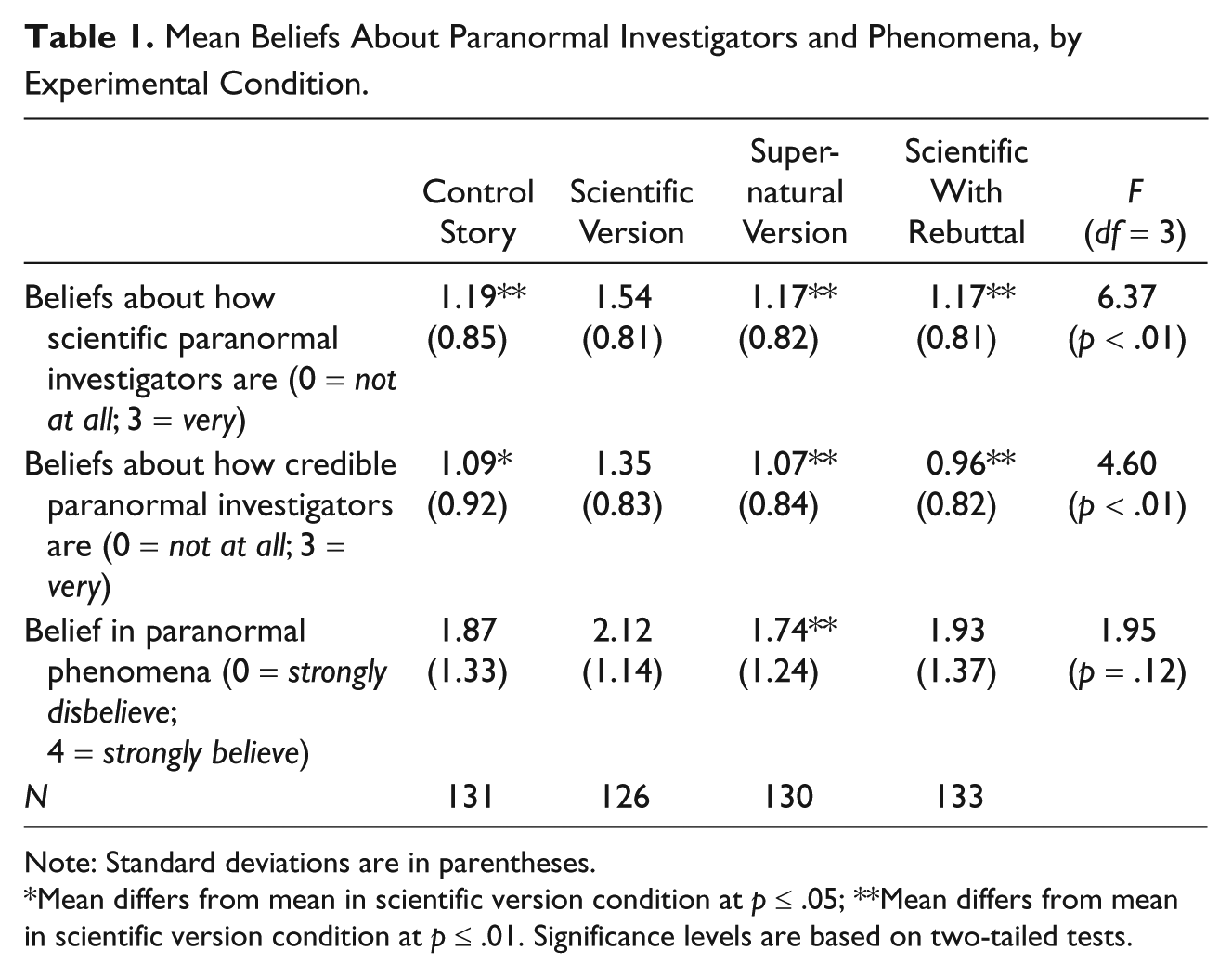
Note: Standard deviations are in parentheses.
Mean differs from mean in scientific version condition at p ≤ .05; **Mean differs from mean in scientific version condition at p ≤ .01. Significance levels are based on two-tailed tests.
Next, a series of regression analyses tested whether various forms of media use predicted beliefs about PIs and paranormal phenomena, as well as whether any of the hypothesized relationships varied with self-reported personal paranormal experience. For each dependent variable, the first block of independent variables included a set of controls for background factors identified by previous research as potential influences on paranormal beliefs: sex, age, attendance at religious services, and personal experience with the paranormal (Bader et al., 2010; Sparks et al., 1997; Sparks & Miller, 2001). 11 A second block of independent variables included the measures for total television viewing, paranormal reality television viewing, paranormal television drama viewing, and science television viewing, along with a set of dichotomous variables capturing the effects of the various conditions (given that all hypotheses regarding the treatments involved comparisons to the scientific version, this condition served as the baseline). A third block included a series of multiplicative terms capturing whether personal experience moderated the relationships between the media variables and the dependent variables.
Taken together, the background factors accounted for 11% of the variance in beliefs regarding how scientific PIs are, 15% of the variance in beliefs regarding how credible PIs are, and 27% of the variance in beliefs regarding paranormal phenomena (see Table 2). Compared with men, women were more likely to see PIs as scientific (β = .08; p ≤ .05), to see PIs as credible (β = .14; p ≤ .01), and to believe in paranormal phenomena (β = .17; p ≤ .01). Age was negatively related to believing in paranormal phenomena (β = −.10; p ≤ .01), while attendance at religious services was negatively related to seeing PIs as scientific (β = −.12; p ≤ .01) and to believing in paranormal phenomena (β = −.14; p ≤ .01). Not surprisingly, self-reported experience with the paranormal was positively related to believing in paranormal phenomena (β = .42; p ≤ .01).
Predicting Beliefs About Paranormal Investigators and Paranormal Phenomena.
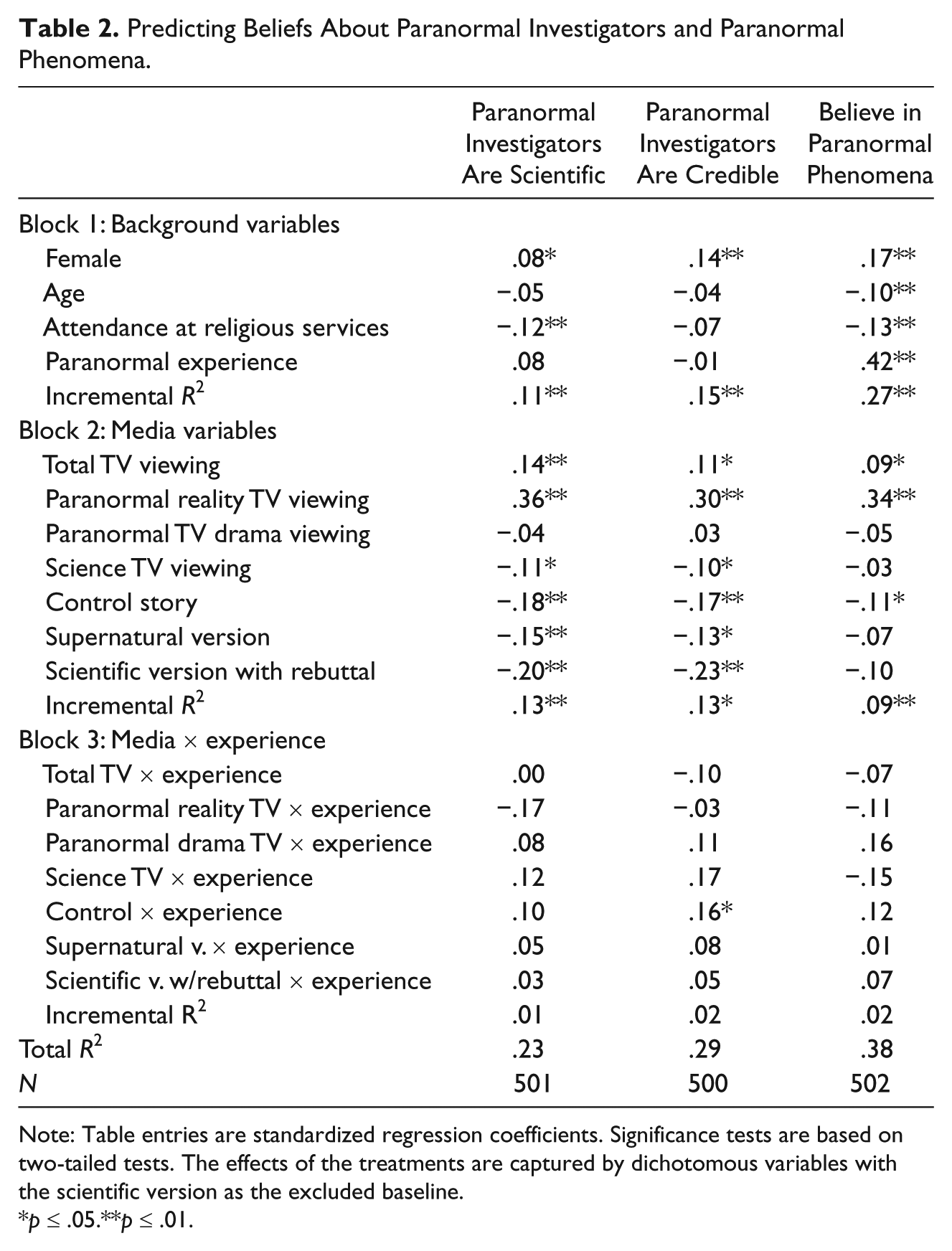
Note: Table entries are standardized regression coefficients. Significance tests are based on two-tailed tests. The effects of the treatments are captured by dichotomous variables with the scientific version as the excluded baseline.
p ≤ .05.**p ≤ .01.
All told, the media variables explained 13% of the variance in beliefs regarding how scientific PIs are, 13% of the variance in beliefs regarding how credible PIs are, and 9% of the variance in beliefs regarding paranormal phenomena. Total television viewing was positively related to seeing PIs as scientific (β = .14; p ≤ .01), seeing PIs as credible (β = .11; p ≤ .05), and believing in paranormal phenomena (β = .09; p ≤ .05). Thus, the results supported the classic cultivation hypothesis (Hypothesis 2). The hypothesis regarding paranormal reality television viewing received strong support (Hypothesis 3). Such viewing was positively related to seeing PIs as scientific (β = .36; p ≤ .01), seeing PIs as credible (β = .30; p ≤ .01), and believing in paranormal phenomena (β = .34; p ≤ .01); furthermore, the coefficient for this variable was relatively sizable in each case. In contrast, paranormal television drama viewing was not significantly related to any of the dependent variables. Science television viewing was negatively related to seeing PIs as scientific (β = −.11; p ≤ .05) and seeing PIs as credible (β = −.10; p ≤ .05); the relationship between science television viewing and believing in paranormal phenomena, however, fell short of statistical significance.
The results for the condition variables largely corroborated the previous findings regarding the effects of the treatments. Control participants, those who received the supernatural version, and those who received the scientific version with rebuttal were all less likely than participants who received the scientific version to see PIs as scientific (p ≤ .01 for each) and credible (p ≤ .05 for the comparison to the supernatural version; p ≤ .01 for the other comparisons). The findings regarding belief in paranormal phenomena, however, differed from the earlier analysis. Here, the negative effect of the supernatural version, relative to the scientific version, did not attain statistical significance. In contrast, the positive effect of the scientific version, relative to the control, on believing in paranormal phenomena attained statistical significance (p ≤ .05, as captured by the control coefficient). The negative effect of the scientific version with rebuttal, relative to the scientific version without a rebuttal, on believing in paranormal phenomena fell just short of statistical significance (p = .06).
The analyses yielded little evidence that the relationships between the media variables and the dependent variables differed depending on personal experience with the paranormal (Research Question 1). The third block of variables, which included the media variable × personal experience terms, explained 1% of the variance in beliefs regarding how scientific PIs are, 2% of the variance in beliefs regarding how credible PIs are, and 2% of the variance in beliefs regarding paranormal phenomena. Only one significant conditional relationship emerged: the impact of the scientific version, relative to the control, on seeing PIs as credible was weaker among participants reporting personal experience than among those reporting none (β = .16; p ≤ .05).
Conclusion
One key finding of this study is that media messages invoking the trappings of science can construct scientific authority even for pursuits regarded by mainstream science as pseudoscientific. Compared with control participants, those who read a story that presented paranormal investigators as using a rigorous approach, technical language, and technological devices were more likely to see such investigators as scientific and credible. Moreover, it was not the case that any message about paranormal investigators had the same effect. Control participants and those who read a story that presented paranormal investigators as using the tools of traditional supernaturalism held virtually identical perceptions (see Table 1), whereas both groups were less likely than participants who read the scientific version to see paranormal investigators as scientific and credible. The results here also corroborate previous findings that media messages can foster belief in the paranormal (Sparks et al., 1994; Sparks et al., 1998; Sparks & Pellechia, 1997). At the same time, the results indicate that a rebuttal from a scientific source can undermine the scientific authority bestowed on paranormal investigators by the trappings of science. Participants who read a version of the story that included such a rebuttal differed little from the control participants in their perceptions (again, see Table 1), whereas they were less likely than participants who read the same version without a rebuttal to see paranormal investigators as scientific and credible.
In addition to capturing the effects of specific messages on beliefs about paranormal investigators and phenomena, the results point to broader links between various forms of media use and such beliefs. Unlike previous studies, the present study found evidence of a classic cultivation effect: The more television participants watched, the more they tended to see paranormal investigators as scientific and credible and to believe in paranormal phenomena. This pattern could reflect a tendency on the part of television programming as whole to suggest that paranormal phenomena exist and can be studied scientifically (see Sparks et al., 1997; Sparks & Miller, 2001). The contrast to previous findings could stem from the present study’s larger sample size; alternatively (or additionally), it could reflect a shift over time in the prevalence and/or nature of messages about ghosts and ghost hunters across the television system. 12
Along with overall television viewing, paranormal reality television viewing predicted beliefs about paranormal investigators and phenomena. Specifically, higher levels of viewing paranormal reality television predicted greater belief that paranormal investigators are scientific and credible, as well as greater belief in paranormal phenomena. Interestingly, viewing of paranormal television dramas was not significantly related to beliefs about either paranormal investigators or paranormal phenomena. Thus, the findings for this form of television use stood in contrast to the strong positive relationships found for viewing of paranormal reality television. One possible explanation here is that paranormal reality television may do more than paranormal television dramas to emphasize the use of technical jargon, technological devices, and other trappings of science. Another potential explanation is that viewers may perceive the former as more realistic and/or credible than the latter; such perceptions of realism and credibility may be enhanced by the documentary style of paranormal reality television. Yet another potential explanation is that viewers of the two genres differ in their uses and gratifications (Perse, 2001) and, thus, bring different assumptions about realism and differing levels of willingness to suspend disbelief in the programs.
The findings provide scant basis for concluding that the relationships observed between the media variables and beliefs were stronger or weaker among those with personal experience regarding the paranormal. Thus, the present study does little to clarify the mixed findings from previous research on the role of “resonance” in this domain (Sparks et al., 1997; Sparks & Miller, 2001). It may be that personal experience simply does not play a consistent role in moderating the effects of media messages on beliefs regarding paranormal investigators and phenomena. Alternatively, the role of such experience may be too complex or subtle for the approaches used in the present study and previous studies to disentangle.
In considering the implications of the findings presented here, it is important to bear in mind several limitations of the research. One such limitation revolves around the use of cross-sectional analyses to examine the links between the various forms of television use and perceptions. This approach can identify relationships between variables but does not yield clear evidence of cause and effect. In the context at hand, it is possible that participants’ beliefs about paranormal investigators and phenomena influenced their television viewing habits. Though this does not seem particularly plausible in the case of overall television viewing, it is more plausible in the case of paranormal reality television viewing. Moreover, the cross-sectional analyses relied on self-reports of viewing behavior, the validity of which are contingent on the accuracy and honesty of participants’ assessments. 13 The experimental results, however, provide internally valid evidence that specific media messages can influence beliefs about paranormal investigators and phenomena. Thus, these results also provide a basis for arguing that broader forms of television use can do the same.
Another set of limitations revolves around the issue of external validity. Participants were selected through convenience sampling rather than probability sampling; as such, they were unrepresentative of the broader public, particularly in regard to education and age. Furthermore, the experimental portion of the study involved the use of only one medium (print news) and one set of treatments. 14 Thus, the findings are not necessarily generalizable. Having said this, some of the key results dovetail with previous experimental research (Sparks et al., 1994; Sparks et al., 1998; Sparks & Pellechia, 1997) or previous survey research based on small but randomly drawn samples (Sparks et al., 1997; Sparks & Miller, 2001). These include the finding that news stories about the paranormal can influence belief in paranormal phenomena and the finding that viewing of paranormal-themed television is positively related to belief in paranormal phenomena. In addition, previous research suggests that the effects of media messages on beliefs about the paranormal cut across media forms and communication modes (see Ramsey et al., 2011; Sparks et al., 1994; Sparks et al., 1997; Sparks et al., 1998; Sparks & Miller, 2001, Sparks & Pellechia, 1997). Thus, it is reasonable to speculate that the findings from the present research will apply beyond its specific context.
To the extent that the conclusions presented here are internally and externally valid, they may help explain how people form perceptions regarding not only paranormal investigations of ghosts and haunted houses but also a range of other “fringe” fields sometimes presented within media messages as scientific. As a case in point, they provide a basis for considering the potential effects of documentary television shows (such as Animal Planet’s Finding Bigfoot, launched in 2011) that cloak cryptozoology (i.e., the study of animals whose existence is not recognized by mainstream science) with the trappings of science. Working backward from perceptions to media effects, the results could also help explain why many people see astrology as scientific (see Allum, 2011; National Science Foundation, 2010).
In addition to applying the insights from the present study to other contexts, future studies could test extensions of its theoretical framework. For example, such research could explore the psychological processes underlying the relationships found here along with potential individual-level mediators (e.g., the cognitive accessibility of general beliefs about scientific authority) that could govern them. Likewise, studies could further examine the role of message characteristics (e.g., source credibility) and receiver characteristics (e.g., scientific knowledge or literacy) in moderating these relationships. Future research could also use open-ended measures to capture in greater depth how people think about paranormal investigators and media messages about the paranormal. Last, but not least, future research could test whether—and if so, how—media messages that associate the trappings of science with “fringe” fields influence broader perceptions of science and scientists. Such an analysis might shed light on an issue that concerns some members of the scientific community (e.g., Sagan, 1997), namely, whether messages of this sort can damage the credibility of science more generally.
Footnotes
Appendix
Declaration of Conflicting Interests
The author(s) declared no potential conflicts of interest with respect to the research, authorship, and/or publication of this article.
Funding
The author(s) received no financial support for the research, authorship, and/or publication of this article.