




Abstract
This study aims to contribute to our empirical understanding of the factors and processes that lead scientists to engage in public communication. Using a national sample, this study identifies key factors that contribute to scientists’ public communication activity, including a scientist’s status, communication autonomy, use of print and online media, intrinsic rewards, communication training, perceived behavioral controls, normative beliefs, and perceived level of medialization. In addition to these findings, this study aims to extend our understanding of the popularization process by injecting theoretical rationale, accounting for indirect pathways of influence, and proposing a baseline model that can be refined over time.
Keywords
Introduction
Pressing environmental challenges, medical advancements, scientific innovations, and emerging technologies all pose implications that increasingly affect the quality of our daily lives. Improved communication among the expert community, policy makers, media professionals, and the general public is essential if these issues are to be addressed most beneficially. One fundamental step to enhancing these lines of communication is through understanding what circumstances lead scientists to engage in public communication. Few empirical studies, however, have examined these circumstances. Using data from a survey conducted of U.S.-based biomedical scientists, this study seeks to refine and extend our current understanding of how and why scientists engage with the public. To meet this goal, this study synthesizes extant research and applies social scientific theories to construct and test a baseline model that identifies key factors and processes associated with scientists’ public communication activities—that is, public communication of science and technology (PCST).
Literature Review
Science and the Public
For more than 50 years, much attention has been devoted toward problematizing a troubling disconnect between science and society (e.g., Bensaude-Vincent, 2001). Indeed, evidence of the tenuous relationship between scientists and the mainstream public remains. Americans, for example, are relatively disengaged and ill informed when it comes to science (National Science Board, 2010; Pew Research Center for the People & the Press, 2008a). There also is continued evidence that the scientific culture still embodies inward tendencies that impede its public communication abilities. Recent research suggests that the scientific culture undervalues public communication (Neresini & Bucchi, 2011), continues to exhibit a deficit model perspective (Davies, 2008), and increasingly recognizes these public communication failures (Kohut, Keeter, Doherty, & Dimock, 2009).
And there are reasons to suspect that the science-public relationship may endure increased strain. Technoscientific innovation is central to addressing many of the greatest challenges facing global society, but many of these emerging innovations (e.g., synthetic biology, epigenetics) pose ontological, political, and religious implications that can complicate and intensify public responses to them (Priest, 2008). Concurrently, American mass media are undergoing major changes that threaten their traditional role as the primary sources of scientific information for the public (Mooney & Kirshenbaum, 2009; Pew Research Center for the People & the Press, 2008b). In short, at a time when society’s stake in science is growing, science itself is simultaneously becoming more difficult for the average citizen to monitor and comprehend.
A Growing Focus on Improving Scientists’ Public Communication
The scientific community is increasingly recognizing these trends, with scientific leaders calling on their colleagues to improve their communication skills and engage the public in more meaningful dialogues about the role science will play in meeting societal challenges (Cicerone, 2010; Ham, 2012; Reddy, 2009). This renewed attention raises numerous questions. How, for example, do scientists feel about engaging in public communication activities, and what, if any, tangible evidence exists to suggest that the scientific community is trying to improve its efforts to communicate with the public? Investigating these questions has often revealed a dim view of PCST, but recent surveys of scientists highlight improvements to the PCST process. For example, surveys suggest that scientists engage in public communication activities more often than is commonly assumed (Corrado, Pooni, & Hartfee, 2000; Jensen, Rouquier, Kreimer, & Croissant, 2008; Pearson, Pringle, & Thomas, 1997) and reveal positive shifts in scientists’ valuing of PCST (Martín-Sempere, Garzón-Garcia, & Rey-Rocha, 2008; Royal Society, 2006).
In addition to the trends evident in these survey results, concrete efforts to aid scientists in accomplishing public communication are increasing. Training programs designed to prepare scientists to engage in PCST are proliferating (Brown, Propst, & Woolley, 2004; Gold, 2001; Miller & Fahy, 2009; Peters, Brossard, et al., 2008b), pedagogical shifts are emphasizing communication training for student scientists (Craig, Lerner, & Poe, 2008; Crone et al., 2011; Reddy, 2009), and major scientific institutions now require PCST compenents in the research they fund (Meredith, 2010; Pearson, 2001).
Toward a Refined Understanding of PCST
Overall, these shifts represent apparent improvements when it comes to PCST. Despite these seemingly positive trends, however, there is still much to learn about the crux of the PCST issue: the factors and processes that lead scientists to interface with nonscientists. This lack of knowledge is due, in part, to a relative paucity of research. Only a handful of empirical studies have attempted to identify factors salient to scientists’ PCST perceptions and behaviors (e.g., Bauer & Jensen, 2011; Dunwoody, Brossard, & Dudo, 2009; Gascoigne & Metcalfe, 1997; Jacobson, Butterill, & Goering, 2004; Martín-Sempere et al., 2008; Pearson et al., 1997; Peters, Brossard, et al., 2008a; Poliakoff & Webb, 2007). These studies have made marked contributions to the literature of PCST and have laid a foundation for future research that uses increasingly sophisticated data, analytic procedures, and theoretical rigor. Building on this foundation, this study aims to extend and refine our understanding of how and why scientists engage with the public. Using social scientific theories, extant research regarding PCST, and survey data from a national sample of biomedical scientists, this study seeks to identify key factors associated with scientists engaging in public communication activities and to reveal processes that underlie these behaviors. A subgoal of this study is to consider the extent to which scientists’ use of mass media influences their likelihood to engage in PCST activities, a relationship not previously examined in existing literature.
The Public Communication of Science and Technology
Before delving into the thrust of the study, it is important to clarify what is meant by “PCST.” The concept of “public communication of science and technology” goes by many names, including “public understanding of science activity” (Pearson et al., 1997), “knowledge transfer activities” (Jacobson et al., 2004), “public engagement of science” (Bauer & Jensen, 2011), “science dissemination” (Torres-Albero, Fernández-Esquinas, Rey-Rocha, & Martín-Sempere, 2011), and “PCST” (Jensen et al., 2008), and is represented by an array of activities (e.g., doing interviews with journalists, giving public lectures). This study, which defines PCST as the “communication of science by scientists to people not involved with research in their field” (Pearson, 2001, p. 122), is concerned with the total overall amount of PCST activity in which scientists have recently engaged: that is, scientists’ self-reported PCST behavior. This intentionally broad definition of PCST, which is often advocated by science communication researchers (Bauer & Jensen, 2011; Jensen, 2011; Kreimer, Levin, & Jensen, 2011), is used because it allows for the creation of a model that is based on an inclusive operationalization of this process. The terms public communication of science and technology, PCST, and public communication are used interchangeably throughout this study.
Building a Model of Scientists’ Public Communication Activity: Specifying a Conceptual Framework and Identifying Key Predictors
Achieving this study’s goals requires identifying key variables that are likely to contribute to scientists’ PCST behavior and the relationships among these concepts. Reflecting extant PCST research, the survey developed for this study measured numerous factors previously associated—or likely to be associated—with scientists’ PCST behavior. Determining how to enter these factors into an initial PCST process model was then guided by an amalgam of conceptual and theoretical perspectives likely to be relevant within the PCST context. Specifically, the inclusion and placement of the factors in the model follow insights from the theory of planned behavior (ToPB; Ajzen, 1991), social cognitive theory (Bandura, 1986), cultivation theory (Morgan, Shanahan, & Signorielli, 2009), the accessibility principle (Shrum, 2009), and other theoretical approaches, which are detailed below. This holistic approach toward model construction was preferred as no existing theoretical model sufficiently captures the PCST process.
Model construction was also guided by the O-S-O-R perspective (Markus & Zajonc, 1985), which is commonly used as an organizational scheme in communication research because it enables process-oriented approaches toward understanding attitudinal and behavioral outcomes (e.g., Cho et al., 2009). The O-S-O-R perspective assumes that stimuli (e.g., the communication phenomena “S”) and two types of orientations influence responses. The first set of orientations (the first “O”) represents the structural and cultural characteristics that provide the context in which people use and process communication stimuli. The second set of orientations (the second “O”) potentially mediates or moderates the links between media and the response (the “R”), in this case scientists’ PCST activity. I use this perspective as a broad organizational tool through which to help logically map the PCST process. The remainder of this section discusses the predictor variables included in the model, each of which is grouped into one of the O-S-O-R perspective’s three levels of endogenous variables.
First-level orientations
Although comprehensively identifying the salient exogenous predictors of PCST behavior may be difficult, research suggests at least three predictors that should be controlled. First, research has continually unearthed evidence that scientists with higher status—typically defined by academic activities such as vigorous publication records—engage in PCST more frequently (Bauer & Jensen, 2011; Boltanski & Maldidier, 1970; Peters, Brossard, et al., 2008a) and that this relationship remains after controlling for the potential effects of scientists’ age. A scientists’ level of PCST activity might also be a reflection of organizational structure. For example, some research has shown that public scientists (e.g., scientists employed by academic institutions, government, etc.) are more likely to engage in mediated PCST than scientists who work in the private sector (Dunwoody, 1986). Though not previously tested, one possibility is that scientists who have (or perceive themselves to have) autonomy over their ability to decide when and how to do PCST are more likely to engage in public communication activities than those saddled with more rigid organizational constraints. Conversely, scientists who work for institutions that promote and oversee PCST may engage in more public communication activities than colleagues working at institutions without this oversight.
Gender may also play a role in determining PCST activity; however, research investigating the relationship is sparse. Traditionally, the majority of individuals working in science and engineering fields are male (National Science Board, 2010), making it reasonable to assume that male scientists have more opportunities to engage in PCST activities. However, while some research has found that male scientists are more likely to engage in public communication (Bentley & Kyvik, 2011; Kreimer et al., 2011), other recent research found that female scientists were more active in PCST activities (Jensen, 2011; Jensen et al., 2008), leaving the relationship between gender and PCST unclear.
Stimuli
Although scientists use popular media to monitor developments in science (Kiernan, 2003; Phillips, Kanter, Bednarczyk, & Tastad, 1991), we know little about the effects of scientists’ use of popular media, and we know even less about how scientists’ use of media might be linked with their perceptions and behaviors related to PCST. Two studies found no relationship between scientists’ use of popular media and PCST behavior (Dunwoody et al., 2009; Willems & Woudstra, 1993), but both of these studies looked for direct effects between scientists’ media use and PCST behaviors when it is likely that scientists’ use of popular media will have indirect effects through the various perceptions scientists’ hold relative to PCST (McQuail, 2005).
Survey results and theoretical orientations suggest numerous ways in which scientists’ use of popular media could influence their beliefs about PCST. On one hand, it is reasonable to expect negative effects as scientists typically evaluate popular media coverage of scientific issues critically (Bragg, 1998; Hartz & Chappell, 1997). This generalized negativity toward mediated coverage of science may be reflected in scientists’ PCST belief systems. It also seems reasonable to expect that scientists’ media use can contribute positively to their PCST beliefs by making them more familiar with the PCST process. This potential phenomenon, anchored in the theoretical orientation known as the “accessibility principal” (Shrum, 2009), implies that judgments are most likely to be formed by the information that most readily comes to mind (Higgins, 1996), which is often the information that is activated frequently (Higgins & King, 1981) and recently (Wyer & Srull, 1980). It is possible that scientists who use media more frequently are more likely to be exposed to the PCST process in action, perhaps making them more likely to have favorable orientations about PCST.
Use of different media may also have differential effects on outcomes related to PCST. For example, scientists who frequently read newspaper science sections and/or read popular science magazines repeatedly see comparatively higher caliber representations of scientists and scientific issues. Considering evidence that use of print media can have stronger learning effects than other media (Chaffee & Frank, 1996; Eveland & Scheufele, 2000), scientists’ frequent use of print media may contribute positively to their belief system about PCST, with this belief system possibly influencing their likelihood to partake in PCST. Internet use may have similar positive effects, as research has uncovered positive associations between Internet use and civic/political engagement (Bakker & de Vreese, 2011). Conversely, cultivation theory, which often finds a link between frequent television use and unfavorable perceptions of science (Dudo et al., 2011; Gerbner, 1987; Nisbet et al., 2002), implies that viewing television may have detrimental effects on scientists’ PCST belief systems.
Second-level orientations
Scientists may engage in PCST more often if they have more favorable personal attitudes toward this behavior. According to the ToPB, the more positive an individual’s attitude toward a particular behavior, the likelier he or she should be to (intend to) perform it (Armitage & Conner, 2001). What the ToPB labels “attitudes” are commonly called “intrinsic rewards” in PCST research and represent the internal rewards scientists derive (or anticipate deriving) from partaking in PCST activities. Intrinsic rewards that scientists commonly associate with engaging in PCST include personal self-growth (Pearson et al., 1997) and personal enjoyment (Corrado et al., 2000), and some research suggests that these positive attitudes are linked with scientists’ PCST activity (Martín-Sempere et al., 2008; Poliakoff & Webb, 2007).
Certain normative perceptions may influence the likelihood of scientists’ participation in PCST activities. The ToPB, for example, identifies norms—“the perceived social pressure to perform or not to perform the behavior” (Ajzen, 1991, p. 188)—as salient predictors of engaging in a behavior, demonstrating that if an individual perceives that peers endorse (or disapprove of) a particular behavior, he or she is more (or less) likely to adopt the behavior (Armitage & Conner, 2001). In PCST research these norms are commonly called “extrinsic rewards” and represent the external rewards—positive and negative—scientists’ associate with PCST. Research suggests that scientists perceive numerous external barriers (i.e., negative extrinsic rewards) to their ability to conduct PCST, including being mistreated by media (Crichton, 1999), being criticized by their peers (Dunwoody, 1986), and having their career advancement hampered (Gascoigne & Metcalfe, 1997; Jacobson et al., 2004). Research also shows that scientists commonly cite a lack of external support for PCST in terms of resources and managerial support (Kreimer et al., 2011; Martín-Sempere et al., 2008; Royal Society, 2006) as detrimental to their ability to participate in PCST. It seems likely that scientists who are more sensitive to these perceived barriers might partake in less PCST.
Research also suggests that scientists can derive numerous positive external benefits (i.e., positive extrinsic rewards) from engaging in PCST. Some of these benefits include gaining support for research funding (Corrado et al., 2000), increasing disciplinary visibility (Kreimer et al., 2011), recruiting future scientists (Gascoigne & Metcalfe, 1997), and enhancing their personal reputation both among their peers and among the public and acquaintances (Dunwoody, 1986). Hence, scientists who perceive higher positive extrinsic rewards from PCST may be more likely to engage in PCST activity. Additionally, appealing to scientists’ sense of duty has long been thought to increase their PCST (Bodmer, 1986), with scientists commonly reporting that one benefit of PCST is that it allows them to raise public interest, awareness, and/or appreciation of science (Bentley & Kyvik, 2011; Royal Society, 2006). A scientist who believes in this social function of PCST may be more likely to engage in PCST activities.
Another possible predictor of scientists’ likelihood to engage in PCST activities is their ability to communicate effectively. The ToPB has repeatedly demonstrated how this ability—what it labels “perceived behavioral control”—predicts both behavioral intentions and actual behaviors (Ajzen & Fishbein, 2005). Additionally, the concept of “self-efficacy” has long been demonstrated to be an important predictor of behavior. For example, Bandura’s (1986) research stemming from his social cognitive theory has demonstrated that people’s decisions to partake in certain behaviors “depends on whether or not they believe they will be efficacious in performing those actions” (Fiske & Taylor, 1991, p. 198). The increase in communication training resources available for scientists implies that scientific organizations believe that nurturing scientists’ communication skills will have positive influences on their PCST behaviors. Indeed, a handful of studies are revealing this effect (Corrado et al., 2000; Kreimer et al., 2011; Poliakoff & Webb, 2007). With these considerations in mind, there is a strong impetus to expect that scientists’ perception about whether they have the ability to partake in clear communication is associated with their PCST behaviors.
In addition to the second-level orientations described above—attitude, norms, and perceived behavioral control—the “medialization” concept is another possible predictor of scientists’ PCST behavior. Introduced by German sociologist Peter Weingart, the medialization of science refers to the phenomenon whereby science becomes “increasingly media-oriented” (Weingart, 1998, p. 872), “with the consequence that media criteria become relevant within science” (Peters, Heinrichs, Jung, Kallfass, & Petersen, 2008, p. 71). The central premise of the medialization hypothesis is that this consequence, which is thought to manifest as increasingly savvy science outreach and fundamental changes to scientific practice, occurs more frequently as the relationship between science and media evolves to resemble the increasingly open, intense relationship that exists between politics and media. Although anticipated media response is thought to influence how scientists present themselves and their work publicly (Goodell, 1977; Peters, Heinrichs, et al., 2008) and how scientific research is conducted (Peters, Brossard, et al., 2008b), the empirical effects of medialization on the PCST process have not been tested. I therefore provide this examination, from the premise that scientists who perceive more medialization in their profession may be more likely to engage in public communication.
Research Questions
While previous literature and theory provide compelling evidence to expect relationships between certain factors and the dependent variable, empirical evidence linking other factors to the dependent variable is scant. This scenario introduces an unavoidable element of exploration to this study, making it more appropriate to investigate inclusive research questions than to test a series of specific hypotheses. In fact, at this stage in the development of PCST research, the flexibility bestowed by investigating research questions seems essential to any attempt to derive a viable model of the PCST process. With these considerations in mind, the following research questions guide the analyses:
Research Question 1: Which of the aforementioned concepts contribute directly to a scientist’s level of PCST activity?
Research Question 2: Which of the aforementioned concepts contribute indirectly to a scientist’s level of PCST activity? Specifically:
Research Question 2a: In what ways is a scientist’s use of media linked with his or her level of PCST activity?
Research Question 2b: Which of scientists’ second-level orientations mediate relationships between other endogenous variables and a scientist’s level of PCST activity?
Method
National Survey
The data were collected via a mail survey of biomedical scientists—epidemiologists and stem cell researchers—who are based within the continental United States. Using the PubMed database, search strings were used to select journal articles in the two fields published between 2002 and 2004. After pulling the names of all authors and coauthors and eliminating researchers who had coauthored only one article during the time period (so as to purge the sample of individual’s with tangential connections to these research areas), specific addresses were sought for the remaining scientists. Simple random samples of U.S. researchers were then drawn from the two research arenas, providing a final sample of 1,254 U.S. scientists. An adapted version of Dillman’s (2007) tailored design method was used as the procedure for conducting a mail survey. Data collection took place between November 2005 and February 2006. A total of 363 scientists returned completed surveys, resulting in a response rate of 34.5%. Comparisons of responses of early to late responders to the questionnaire did not show any significant demographic or response differences.
Measures
Status
The measure of a scientist’s status is a combination of two variables: career level (junior, midcareer, senior) and number of career publications (a five-value variable that ranged from “fewer than 10” to “more than 100”). These two variables were summed (r = .67, p < .001, M = 6.04, SD = 1.97).
PCST autonomy
The measure of a scientist’s PCST autonomy comes from one categorical measure asking if they would need to seek approval from someone in their organization before talking to a journalist or if the decision would be their own. One dichotomous item was created where scientists who said they would have to seek approval or did not know were coded “0” and scientists who said it would be their own decision were coded “1” (49%; M = 0.49, SD = 0.50).
Gender
The measure of a scientist’s gender consists of one dichotomous variable, with female coded “0” and male coded “1” (65%).
Media use—four types
The generalized measure of scientists’ media use comes from two questions. The first question asks, “How often in a typical week do you read newspapers or news/public affairs magazines, listen to the radio, watch TV, or use the Internet?” and scientists’ attention to mediated science stories was measured with a comparable question focused on “science-related media coverage.” For both questions, respondents were asked to indicate the frequency of their weekly use (on a 4-point scale from 1 [less than once a week] to 4 [almost every day]). Four media use variables were constructed, each combining the general use and science media use for each channel: print (a combination of general and science-focused use of newspapers and magazines; Cronbach’s α = .67, M = 9.05, SD = 2.76), radio (r = .29, p < .001, M = 5.06, SD = 1.55), TV (r = .34, p < .001, M = 5.00, SD = 1.76), and Internet (r = .51, p < .001, M = 5.31, SD = 1.97).
Attitude
The measure of a scientist’s attitude comes from reactions (on a 5-point scale from 1 [dislike intensely] to 5 [enjoy very much]) to this question: “How much personally would you enjoy engaging in this activity?” Respondents were asked to rate their enjoyment of six possible activities (e.g., explaining your research and its results to the public, describing the possible practical uses of your research). Factor analysis indicates that all six of these items form one factor, hereafter labeled “attitude” (Cronbach’s α = .86, M = 21.47, SD = 4.96).
Norms—negative extrinsic rewards
The measure of perceived negative extrinsic rewards is derived from reactions (on a 4-point scale from 1 [not important] to 4 [very important]) to a question asking scientists to rate the importance of eight external barriers that increase reluctance to engage in PCST. Factor analysis indicates that four of the eight possible responses (e.g., critical reactions from peers, incompatibility with the scientific culture) form one factor hereafter labeled “negative extrinsic rewards” (Cronbach’s α = .74, M = 9.24, SD = 2.77).
Norms—positive extrinsic rewards
The measure of perceived positive extrinsic rewards is based on reactions (on a 4-point scale from 1 [not important] to 4 [very important]) to a question asking scientists to rate the personal importance of eight external rewards that make them feel more positive about PCST. Factor analysis indicates two separate factors. One factor, which represents scientists’ perception of PCST leading to enhanced reputations, is hereafter labeled “enhanced reputations” and is composed of two items: enhanced personal reputation among peers and the public (r = .73, p < .001, M = 4.87, SD = 1.64). The second factor, which represents scientists’ perception of PCST allowing them to influence public debates and knowledge, is hereafter labeled “public influence” and is composed of two items: influence on public debate and a better educated general public (r = .55, p < .001, M = 6.64, SD = 1.22).
Norms—welfare of society
Scientists were asked to rate the importance of six public communication activities (on a 5-point scale from 1 [totally unimportant] to 5 [critically important]) relative to the welfare of society (e.g., evaluating political decisions based on your professional expertise, discussing the social and ethical aspects of your research). Factor analysis indicates that all six of the items form one factor, hereafter labeled “welfare of society” (Cronbach’s α = .77, M = 22.03, SD = 3.86).
Communication training
A scientist’s level of communication training is represented by the sum of responses to two variables. Respondents were asked if they ever had formal training in communication skills. Respondents who answered “no” to this question were given a value of zero on the aggregate formal training variable. Respondents who answered “yes” to this question were then asked at what audience those skills were aimed (students, scientists, general public, mass media). Answers were summed for a final formal training variable ranging from 0 to 4 (M = 0.65, SD = 0.95).
Perceived behavioral control—communication self-efficacy
Scientists’ perceived communication skill is derived from their evaluations of “whether you personally would find it difficult or easy to” (on a 5-point scale from 1 [extremely difficult] to 5 [extremely easy]) engage in 14 different public communication skills. Factor analysis indicates that 6 of the 14 items (e.g., explain scientific facts in a way that lay people can understand, adjust to different kinds of lay audiences) form one factor, hereafter labeled “PCST skills” (Cronbach’s α = .83, M = 20.24, SD = 4.34).
Medialization
Scientists were presented with the stem, “Because of anticipated media publicity, scientists I know have . . .” and asked to check any of the six alternatives that apply (e.g., chosen or avoided particular research questions, chosen or avoided certain research methods). Respondents’ answers were summed for a medialization variable ranging from 0 to 6 (KR-20 [Kuder-Richardson coefficient of reliability–20] = .77, M = 1.64, SD = 1.82).
PCST activity
The dependent variable sums how many of 13 different PCST activities a scientist reported doing in the 3 years prior to the survey. These activities include direct engagement with the public and engagement via interactions with media and are derived from two survey questions. In one question, scientists were asked to indicate whether or not they participated in four separate types of “contact with the media in the past 3 years” (e.g., been interviewed by a journalist, been a guest on a TV or radio panel). In another question, scientists were asked to indicate whether or not they participated in nine separate types of “public communication activity in the past 3 years” (e.g., helped prepare a brochure for the public, gave a lecture for laypeople). Respondents’ answers were summed for a final PCST activity variable ranging from 0 to 13 (KR-20 = .80, M = 4.81, SD = 3.16).
Results
Analytical Procedures, Model Specification, and Model Modification
Structural equation modeling was used to address the research questions because this procedure provides a comprehensive decomposition of effects in a way that, unlike traditional path modeling, controls for possible measurement error and provides estimates of model fit (Kaplan, 2009). The structural component of the analysis was initiated by testing a conceptual model of relationships among the independent factors against the data using Mplus statistical software. As previously described, the specification of the conceptual model (see Figure 1) was guided by the O-S-O-R perspective, relevant theories, and extant PCST research. The variables status, PCST autonomy, and gender are included in the model but are treated as exogenous variables.

Conceptual model of scientists’ total PCST activity.
Given the somewhat exploratory nature of this study, a distinction is made between two types of freed parameters. The freed parameters appearing in boldface are those for which there is likely to be sufficient support given theory and/or previous research. As such, a decision was made at the outset of the modeling process that the parameters in boldface could not be modified post hoc. The other freed parameters (i.e., the parameters not in boldface), however, could be modified post hoc given that they are more exploratory. Making this distinction between the freed parameters placed constraints on how the original conceptual model could be modified, which allowed for striking a balance between deriving a theoretically driven model of scientists’ PCST behavior—the primary goal of this study—and following conservative procedures of model modification (see Kaplan, 2009).
Structural Model of Scientists’ Engagement in Public Communication
The conceptual model (Figure 1) does not fit the data well according to fit statistics that are commonly used to judge the veracity of structural models (likelihood ratio χ2 = 326.51, degrees of freedom = 49, p = .000; comparative fit index = .331, Tucker-Lewis index = .113, root mean square error of approximation [RMSEA] = .125). Despite this overall lackluster model fit, however, the parameters in boldface specified in the theoretical model were all significantly related to the dependent variable. A conventional model modification approach was then followed whereby parameters were freed when consistent with theory and extant research and based on the Lagrange multiplier statistics (Kaplan, 2009). A total of three parameters were freed in the model modification process, and all nonsignificant paths were dropped to increase interpretability.
The revised structural model (Figure 2) fits the data well (likelihood ratio χ2 = 22.9, degrees of freedom = 13, p = .043, comparative fit index = .97, Tucker-Lewis index = .94, RMSEA = .046). The cross-validation indices between the theoretical model and the revised model also suggest substantial improvement in model fit (conceptual model Akaike information criterion = 23569.089, Bayesian information criterion = 23670.344; revised model Akaike information criterion = 15802.795, Bayesian information criterion = 15869.00). The revised model accounts for 32.5% of the variance in scientists’ total PCST activity. Notably, the minor modifications enhanced the interpretability and fit of the model while remaining consistent with the theoretical rationales anchoring the study.
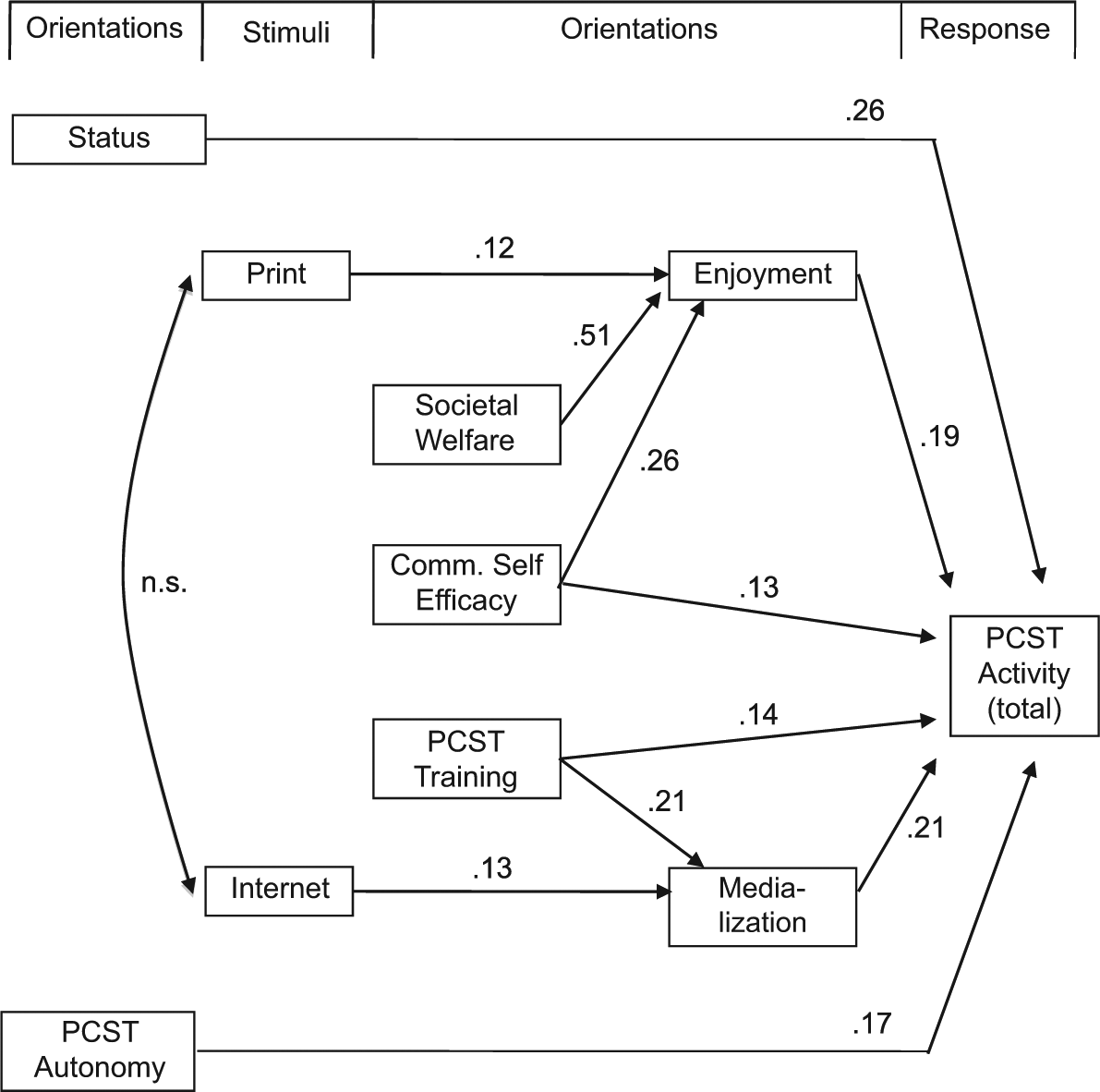
Structural model of scientists’ total PCST activity.
Direct effects
Two exogenous variables are significantly linked with the dependent variable. Scientists with higher levels of status (β = .26) and more organizational autonomy to communicate externally (β = .17) engage in a greater amount of PCST activity. A scientist’s gender, however, is not significantly related to his or her level of PCST activity. Four of the second-level orientations directly predict PCST activity. Scientists with more positive attitudes toward PCST (β = .19), higher perceived communication self-efficacy (β = .13), and more formal communication training (β = .14) are significantly more likely to engage in PCST activity. Additionally, scientists who perceive more medialization among their colleagues (β = .21) are more likely to engage in a greater amount of PCST activity. None of the normative endogenous concepts—scientists’ perceptions of negative extrinsic rewards, positive extrinsic rewards (“enhanced reputation” and “public influence”), and importance of PCST to society—are directly linked with the dependent variable. Furthermore, scientists’ media use across different channels does not directly contribute to their level of PCST activity.
Indirect effects
Although the normative concepts and media use variables do not have direct relationships with the dependent variable, some contribute to scientists’ level of PCST activity through other endogenous variables. In particular, scientists’ attitude toward PCST fully mediates numerous relationships. Scientists who perceive PCST as important to the welfare of society (β = .51) are more likely have positive attitudes toward PCST and, in turn, engage in PCST. Additionally, scientists who consume more print media are more likely to have positive attitudes toward PCST (β = .12) and, in turn, to engage in a greater amount of PCST. Beyond its direct effect, scientists’ level of communication self-efficacy also positively predicts their level of PCST activity through its positive relationship with attitude (β = .13, total effect = .18). The concept of medialization also functions as a mediator. Scientists who spend more time using the Internet tend to perceive more medialization (β = .13) and, consequently, engage in greater amounts of PCST activity. And beyond its direct effect, scientists with more formal training in communication are more likely to engage in a greater amount of PCST activity through its positive relationship with medialization (β = .14, total effect = .18).
Discussion
This study aims to contribute to our empirical understanding of the factors and processes that lead scientists to engage in public communication. Building on a foundation of existing research, this study identifies a group of key factors that contribute to scientists PCST activity, among them a scientist’s status, level of PCST autonomy, use of print and online media, attitude, level of communication training, perceived behavioral control, normative beliefs, and perceived level of medialization among colleagues. Beyond these specific findings and their implications, this study attempts to refine and extend our understanding of the PCST process by injecting much-needed theoretical rationale, using a conceptual approach that accounts for numerous pathways of influence, and proposing a baseline model that rests on representative data and sophisticated analytical procedures. The final model (Figure 2) fits the data well, achieves strong fit according to the RMSEA and cross-validation indices, and accounts for 32.5% of the variance in the dependent variable, scientists’ total amount PCST activity.
Limitations
Before elaborating on the results, I should call attention to the study’s potential limitations. Model misspecification is an inherent risk when conducting structural equation modeling. The final model, while relatively comprehensive, surely does not capture every salient predictor of scientists’ PCST activity. Some research, for example, suggests that regional differences (Bentley & Kyvik, 2011), scientific field (Kreimer et al., 2011), scientists’ workload (i.e., scientists’ time spent teaching, doing research, etc.; Jensen, 2011), and scientists’ level of introversion (Tsfati, Cohen, & Gunther, 2011) influence how often scientists engage in PCST. Considering other theoretical perspectives could also expand the final model. For example, rational choice theory could be used to legitimate the inclusion of additional antecedent variables that account for the influence of other external resources in the PCST process (e.g., the organizational resources available to support PCST).
There are also possible limitations that may stem from the sample. The most likely of these limitations is nonresponse bias, the possibility that the scientists who completed and returned the survey do not represent U.S. biomedical researchers as a whole. Sampling productive researchers, for example, may have led to an overestimation of PCST activity, a common scenario in studies of PCST (Bauer & Jensen, 2011). Another possibility is that sampling biomedical researchers has led to an overestimation of PCST activity due to the frequent newsworthiness of their work, yet other recent studies have found that biologists and chemists partake in PCST least, while social scientists and astrophysicists partake in PCST most (Bauer & Jensen, 2011). The response rate may also be a limiting factor. This study’s response rate may seem low (34.5%), but it is consistent with other surveys of U.S. scientists (e.g., Hartz & Chappell, 1997). Although these sampling issues are important to consider when generalizing from these data, the strengths of the study—the sampling and analytic procedure, connection to well-established theories, and consonance with existing PCST literature—outweigh these potential limitations.
Implications and Future Research
Consistent with previous PCST research, I find that scientists with higher levels of professional status engage in a greater amount of PCST activity. Although this association is likely to continue (Jensen, 2011), the proliferation of formal communication training in the university curriculums of student scientists (e.g., Crone et al., 2011) may normalize PCST as part of the process of “doing science.” Researchers should monitor the extent of this shift in years to come. The findings also suggest that scientists with greater autonomy to communicate with nonscientific audiences engage in a greater amount of PCST activity. This result poses questions for best practices when it comes to scientific institutions’ internal policies about PCST, suggesting that the trade-offs between providing a supportive internal framework for organizational PCST (e.g., a network of trained public information officers) and providing experts with freedom to engage in creative public engagement activities be carefully considered and researched.
The analysis fails to find a link between a scientist’s gender and his or her level of PCST activity. This result, however, is not surprising given the ambiguity that so often characterizes this factor’s connection to PCST. It is possible that gender’s contribution to PCST activity might be moderated by cultural considerations, but this possibility requires additional scrutiny.
A scientists’ attitude toward PCST plays a central role in the process leading to PCST behavior, a finding that is consistent with previous research (e.g., Poliakoff & Webb, 2007) and the ToPB. The results also suggest that a scientists’ personal attitude mediates numerous relationships between other factors and PCST behavior. This is a notable finding as it demonstrates the importance of exploring indirect relationships when trying to illuminate the PCST process. Indeed, it is only through examining indirect effects that the contributions of scientists’ normative beliefs to the PCST process are revealed. Together, this result and its theoretical rationale imply that PCST researchers take cues from communication researchers (e.g., Holbert & Stephenson, 2003) and explore indirect effects (e.g., mediation and moderation) when examining the PCST process.
The robust, positive relationship between scientists’ attitudes toward PCST and their PCST behavior also has applied implications. Amid the flurry of calls for more scientist-public interactions, scientists writ large are commonly charged with becoming better public communicators. Scientists, however, are trained to produce innovative research, not to be facile talking heads. It seems unreasonable to expect the majority of scientists to devote substantive effort toward PCST activities (Pearson, 2001). Instead, the results hint at more strategic approaches to enhance PCST efforts. For example, scientific institutions that are serious about improving public engagement may be best served by efforts to identify and support scientists who find (or might find) PCST pleasurable. This may seem intuitive, yet it can have substantial strategic relevance as it guides how scientific organizations develop policies and allocate resources relative to outreach.
It seems that scientists who have more perceived behavioral control in terms of self-identified communication efficacy feel empowered to engage in PCST. This finding dovetails with previous studies (e.g., Gascoigne & Metcalfe), the ToPB, and the concept of self-efficacy. Additionally, scientists with higher levels of formal communication training engage in more PCST. Communication training may be distinct from communication self-efficacy (e.g., a scientist may receive training but still feel like a lackluster communicator), but together these results pose a practical implication: Scientific organizations aiming to improve their PCST efforts should invest in enhancing their scientists’ abilities to communicate with nontechnical audiences. As previously discussed, these investments seem to be happening. The findings suggest that these shifts—and the tangible investments they may involve—are worthwhile.
This study also provides an initial empirical examination of the role medialization plays in the PCST process, finding that scientists who perceive greater medialization among their colleagues are more likely to engage in PCST. Beyond this direct effect, medialization mediates two other relationships with PCST activity. These findings complement the ToPB and are consistent with recent anecdotal predictions in PCST research that the medialization of science is likely to increase the public presence of science (Peters, Heinrichs, et al., 2008). PCST, it seems, is a natural by-product of working in a profession where more sophisticated media sensibilities (or perceived media sensibilities) are gaining purchase. This relationship poses potential benefits and detriments that require additional scrutiny. From a viewpoint focused on increasing PCST, the medialization results imply that bolstering scientists’ conceptual understanding of media’s connections to science may increase their level of PCST. Conversely, we must simultaneously consider how attempts to make scientists more media oriented might detract from the purity of scientific practice.
Extrinsic rewards do not seem to contribute to a scientists’ likelihood of engaging in PCST. This finding is somewhat surprising given the negative influence scientists so often attribute to external barriers to PCST, particularly the specific barriers modeled in this study (e.g., critical reactions from peers, supervisors, and the public). Scientists, for example, often bemoan the Carl Sagan effect, assuming that their public communication efforts will be punished by their colleagues and tarnish their career (Dean, 2009). Yet my analysis does not bear this out. One simple, but likely, possibility is optimistic bias; when asked to rate the personal importance of external barriers to PCST, perhaps the surveyed scientists underestimated the salience of these impediments, believing themselves to be less at risk of experiencing their negative influence (Weinstein & Klein, 1996). Regardless of the possible explanation, this result highlights a potential discrepancy between the anecdotal and empirical effects of negative extrinsic rewards on the public communication of science and begs for more research.
This study also provides one of the first examinations of the contributions scientists’ media use makes to their public communication behavior, finding that scientists’ media use has indirect effects on their PCST behaviors and that different channels have different effects. The accessibility principle (Shrum, 2009) and print media’s stronger learning effects (Chaffee & Frank, 1996; Eveland & Scheufele, 2000) may, in part, explain the positive association found between scientists’ use of print media and their PCST belief system. It also seems reasonable to expect that use of the Internet could have similar positive effects. The Internet provides a wide breadth of mediated science information where scientists can monitor science news and visit online forums that debate media treatment of scientific topics. This multifaceted experience may help explain why scientists who spend more time online tend to perceive a heightened awareness among colleagues of media’s connection to science. Future PCST research should examine how various online activities contribute to scientists’ PCST activity, modeled on studies showing how different types of online activities (e.g., reading news, using web-based services) are positively associated with political participation (Bakker & de Vreese, 2011).
Although the analysis fails to find any meaningful links between the time scientists spend listening to the radio and watching television and their level of PCST behavior, scientists who spend more time watching television are more likely to perceive PCST as posing negative extrinsic rewards (β = .12). This connection is consistent with cultivation theory, and suggests that future investigations of the PCST process dig further into the potential effects of scientists’ TV use.
The findings also highlight broader considerations about studying scientists’ public communication behavior. New media technologies raise a host of applied and normative questions about PCST as they are providing radically new communication modalities for scientists. The Internet, for example, empowers scientific institutions to engage in direct-to-consumer science. One notable illustration of direct-to-consumer science is the real-time public sharing of data from scientific conferences via social networking tools (Brumfiel, 2009). While this phenomenon makes scientific conferences more accessible, it also raises some significant questions about the future production and dissemination of scientific knowledge. New media technologies also have empowered scientists to expose their personalities to public audiences. Popular blogs (e.g., scienceblogs.com) provide a public platform for scientists to express their views on myriad topics in myriad ways, from tactful to scathing. These types of blogs make science and scientists more accessible to nonscientists—a seeming boon to PCST—but they also have the potential to damage public perceptions of science and scientists. This possibility highlights a novel area for PCST research: exploring how certain types of PCST may actually worsen divides between the scientific community and the public.
Footnotes
Acknowledgements
The author especially thanks Drs. Sharon Dunwoody, Dominique Brossard, and Hans Peter Peters.
Declaration of Conflicting Interests
The author(s) declared no potential conflicts of interest with respect to the research, authorship, and/or publication of this article.
Funding
The author(s) disclosed receipt of the following financial support for the research, authorship, and/or publication of this article: The data used in this study were gathered in the project “Integration of Scientific Expertise in Media-Based Public Discourses,” supported by a grant from the German Federal Ministry of Education and Research (BMBF), administered to Principal Investigator, Dr. Hans Peter Peters, Research Center Jülich, Germany. Any opinions, findings, and conclusions or recommendations expressed in this article are those of the author and do not necessarily reflect the views of the BMBF or the principle investigator.