



Abstract
Under what conditions does the perceived “unnaturalness” of a specific application of synthetic biology influence its public acceptability? Using data from a framing experiment embedded in a national survey of Canadian adults, we argue that this consideration leads to negative perceptions of the technology only when opponents of the application use rhetoric that refers to its unnaturalness and when characteristics of the application itself, such as the use of genetic material from “dissimilar” organisms, increase the perceived relevance of such arguments. Additionally, we find that individuals who view nature as sacred or spiritual are most responsive to unnaturalness framing.
Synthetic biology is an emerging field of biotechnology that applies engineering principles to biological systems (Chopra & Kamma, 2005; Endy, 2005; Royal Society of Chemistry, 2008), resulting in the creation of “artificial” organisms. Broadly speaking, research in this area can be categorized into “top-down” and “bottom-up” approaches (Presidential Commission for the Study of Bioethical Issues, 2010). In the “top-down” approach, biological features of existing organisms are rearranged to endow “platform” organisms like baker’s yeast or the E. coli bacterium with biological functions that they do not possess in their natural state, while the more ambitious “bottom-up” approach involves attempts to construct “living systems from raw materials, starting with nonliving components” (Presidential Commission for the Study of Bioethical Issues, 2010, p. 45). In this article, we explore how members of the public form opinions about what is likely to be a typical application of “top-down” synthetic biology: the use of a synthetic yeast to produce Stevia, a food sweetener.
To the extent that this type of “top-down” application involves the modification of an existing platform organism rather than the “creation” of entirely new forms of life, it can be thought of as an extension of existing forms of genetic engineering that simply involves a more extensive manipulation. For example, “top-down” synthetic biology might involve the engineering of an entire metabolic pathway into a platform organism’s genome rather than simply the addition of one or two genes. We therefore begin by using the existing literature on how members of the public perceive genetically modified (GM) foods to guide our expectations about public perceptions of “top-down” synthetic biology applications in the food domain, since we expect reactions to a sweetener-producing synthetic yeast to be qualitatively similar to people’s reactions to GM foods in general. Moreover, we believe that our findings speak both to how the public debate on synthetic biology is likely to develop and to why the controversy over GM foods has unfolded in the way it has.
A key finding in the literature on public perceptions of GM foods is that the acceptability of GM products varies widely based on their characteristics. While public acceptance of new biotechnologies differs based on the domain of application, with medical applications proving more popular than agricultural ones (Bauer, 2002; Frewer & Shepherd, 1995), the acceptability of GM applications in the agricultural domain itself depends to a large extent on the types of organisms used to create new products. Specifically, GM applications involving animals or transfers of human DNA (deoxyribonucleic acid) are perceived much more negatively than those that exclusively involve plants or microorganisms (Frewer, Howard, & Shepherd, 1997; Frewer & Shepherd, 1995; Knight, 2006). A major reason for this distinction appears to be an increased perception that GM animals are “unnatural” or were created by “tampering with nature” (Tenbült, Vries, Dreezens, & Martijn, 2005) as compared to perceptions of GM plants or microorganisms. Frewer et al. (1997), for example, find that a perception of “unnaturalness” is “an important determinant of underlying concern [about genetic engineering] and . . . is focused on applications involving animals and human genetic material” (p. 117). Indeed, this “unnaturalness” objection is a recurrent theme in focus group research (Coyle & Fairweather, 2005; Knight, 2009; Shaw, 2002) and media coverage (Hansen, 2006) on genetic biotechnologies.
In the context of food-related applications of genetic engineering, this “unnaturalness” concern is also reflected in the more specific “Frankenfoods” metaphor, which activates people’s schema of the Frankenstein monster, who was created by combining parts taken from more than one being and who ultimately turned on his creator (Coleman & Ritchie, 2011). 1 Generally speaking, then, we should expect concerns about unnaturalness (both for existing GM foods and for “top-down” applications of synthetic biology) to be most pronounced in the context of true “Frankenstein-like” organisms—that is, those that are created using parts from different beings. Specifically, in the context of synthetic biology, we would expect that organisms created by combining DNA from evolutionarily distant species and, in particular, the insertion of human genes into nonhuman genomes would be most likely to be perceived as involving the use of parts originating in “different” beings, and therefore most likely to be perceived as “unnatural.”
The existing evidence on this question is, however, mixed. On the one hand, previous research has shown that individuals object to transgenic products in large part because they perceive this type of gene transfer to be unnatural (Knight, 2009; Mielby, Sandoe, & Lassen, 2012; Shaw, 2002) and that cisgenic products (in which the imported gene[s] originate with a plant species or variety that is closely related to the host organism and which have been marketed as “natural” alternatives to transgenic crops) are perceived much more positively than their transgenic equivalents (Gaskell et al., 2010, 2011; Knight, 2009; Lusk & Rozan, 2006; Mielby et al., 2012). This concern about the “mixing” of animal and plant genomes, moreover, is reflected in the messaging strategies used by opponents of GM crops. The recent campaign by “Take the Flour Back” to try to end the open-air trial of GM wheat at Rothamsted Research, for example, featured a bread loaf in the shape of a cow as its principal logo, 2 which was a visual statement of the group’s concern about the source of the promoter gene used to construct the modified wheat.
On the other hand, differentiation in the public’s acceptance of cisgenic and transgenic crops varies depending on individuals’ levels of education and scientific knowledge (Mielby et al., 2012), which suggests that the degree to which evolutionary distance influences attitudes is likely to vary across contexts. Indeed, while Frewer and Shepherd (1995) find that GM applications that involve animals are more negatively perceived than those involving plants or microorganisms, they do not find evidence that GM applications using genetic material from “dissimilar” organisms (plants-animals or microorganisms-animals) are perceived differently than those using material from more “similar” organisms (microorganisms-plants). Overall, these mixed results suggest that while the evolutionary distance between donor and host organism can be a major determinant of public perceptions of a specific GM or “top-down” synthetic biology application, the extent to which it matters in any given context is determined by largely unknown factors.
In this article, we present two factors—(a) individual-level variation in the extent to which nature is perceived to be “sacred” and (b) the use of an “unnaturalness” argument by opponents of the technology—that help explain when evolutionary distance between a synthetic biology application’s donor and host organisms is likely to shape public attitudes towards that application, at least in the food domain. We use a framing experiment embedded in an original national survey of the Canadian public to explore this question. In particular, we test the extent to which an “unnaturalness” argument moderates the impact of the source of the added genes on the Canadian public’s views of a food sweetener produced using a synthetic strain of yeast. Overall, we find that evolutionary distance has little effect on attitudes when the “unnaturalness objection” is absent but a strong influence when it is. This effect, moreover, is strongest among those who espouse the principal value with which the unnaturalness objection resonates—namely, the belief that “Nature” is sacred and therefore inviolable.
Theoretical Framework
Our theoretical starting point for investigating the effect of the “unnaturalness objection” is the literature on framing effects. The concept of framing has a long history in social science, but the term remains rather ambiguous, given the wide variety of concepts that have been referred to by this name (see, e.g., Druckman, 2001, for a discussion of the variety of concepts and processes that have been discussed using this umbrella term). In communication studies, framing has been conceived of primarily as a general property of news coverage, as in the “issue responsibility” or “horse race” frames in political coverage (Iyengar, 1990), and as one of the three principal mechanisms that underpin media effects (Scheufele & Tewksbury, 2007). The specific theme that pervades a news article on biotechnology, for example, has been shown to influence public perceptions of areas like stem cell research, with a “Progress” frame leading to much more positive attitudes than a “Political Conflict” frame (Stewart, 2012; Stewart, Dickerson, & Hotchkiss, 2009).
In this article, however, we use a different conceptualization, in which frames are features of the rhetoric used by specific participants in a debate rather than a property of news coverage imposed on it by journalists and editors. We draw from the literature on persuasion and attitude change, which views frames as specific arguments in favour of or in opposition to a position that highlight specific considerations relating to the issue under discussion and de-emphasize others (what Druckman, 2001, refers to as “emphasis” framing). From this perspective, people’s attitudes can be thought of as “summary evaluations based on a weighted average of a sample of beliefs about the attitude object” (Nelson, Oxley, & Clawson, 1997, p. 225; see also Zaller, 1992; Zaller & Feldman, 1992). Frames (i.e., arguments) influence people’s attitudes by increasing the relative “weight” placed on some considerations, which is also referred to as a consideration’s “relevance” (van der Pligt & Eiser, 1984), “importance” (Anderson & Zalinski, 1991), or “applicability” (Price, Tewksbury, & Powers, 1997). That said, in a contested communications environment, this type of frame can be strategically deployed by interested parties through the media as part of what Scheufele (2000, p. 307) refers to as the “frame-setting” process, such that frames used by participants in a debate may eventually become news frames.
In the context of this article’s topic, then, we can think of the “unnaturalness objection” as an argument used by opponents of a synthetic biology application that is meant to encourage their audience to focus on the application’s relative “naturalness” as a key consideration rather than on other aspects of the technology (e.g., its potential benefits or, indeed, the specific risks it might pose). 3 The problem, of course, is that the concept of “naturalness” is an extremely ambiguous concept (Verhoog, 2003), so it is not immediately clear which specific considerations the unnaturalness objection is likely to emphasize. One of this article’s objectives, then, is to identify both the specific concepts activated by unnaturalness arguments and the conditions under which this activation is most likely to occur. While the meaning of “unnatural” is ambiguous, however, its valence is overwhelmingly negative, so we should expect an unnaturalness argument to reduce support for the application in question. This leads us to our first hypothesis:
Hypothesis 1: Support for a biotechnological application should be lower when it is objected to on the grounds of its “unnaturalness” than when that objection is not raised by opponents.
The literature on framing effects, however, suggests that the effect of this objection is likely to vary widely across individuals. Specifically, one way of conceptualizing the effects of rhetorical frames as we define them is that they resonate with specific underlying “values” held by the audience (Shen & Edwards, 2005), which are defined as attitudes that are “stable and enduring, and as such . . . may predispose people to take certain positions on social and political issues” (Shen & Edwards, 2005, p. 796). The unnaturalness objection clearly aims to tap into a general belief that being “natural” is good by definition, a value that arises from specific conceptions of nature. This type of worldview has been shown to influence support for both biotechnological (Peters, Lang, Sawicka, & Hallman, 2007) and nanotechnological (Vandermoere, Blanchemanche, Bieberstein, Marette, & Roosen, 2011) applications in the food domain and has featured heavily in media coverage of biotechnology (Hansen, 2006). Hansen, for example, identifies representations of Nature in which it is depicted as
Good, pure (“Paradise on Earth”) and nourishing/nurturing (“Mother Nature”), balanced and harmonious (nature is valorized as good per se, perhaps precisely because it is perceived as untouched by the interference and corruption of man) . . . (p. 814)
Similarly, Coyle (2005) describes “wise nature,” “traditional nature,” and “pure nature” images. A key point is that this type of conception of nature does not simply describe people’s general liking or positivity toward nature but, rather, reflects an idealization of “Nature” as a distinct entity possessing intrinsic value, with all that that entails about the appropriateness of manipulating it or threatening its integrity.
While this type of intrinsic valuation of nature can arise from a variety of belief systems, it is likely to be linked primarily to spiritual belief systems in which Nature is perceived to be a “sacred” entity that must not be “interfered” with. Pargament and Mahoney (2005) define sanctification as “a process through which aspects of life are perceived as having divine character and significance” (p. 183), following which people are, among other effects, motivated to protect what has been made sacred and, most importantly, “may suffer severe consequences when sanctified aspects of their lives are harmed or lost” (Pargament & Mahoney, 2005, p. 191). Indeed, they note that “[s]ome of the strongest words in the religious lexicon are assigned to violations of the sacred: abomination, desecration, pollution, profanation” (p. 191). In the context of this article, we believe that “unnatural” serves a similar purpose, indicating the desecration of a sacred “Nature,” and should therefore prompt negative responses from individuals who do ascribe sacred properties to nature.
A key element of Pargament and Mahoney’s (2005) theory, moreover, is that sanctification can be both “theistic” and “nontheistic.” In theistic sanctification, “an object can be perceived as a manifestation of one’s images, beliefs, or experience of God” (Pargament & Mahoney, 2005, p. 183) and is therefore likely to be tied to explicit religious beliefs. Qualitative studies, for example, have shown that objections to a given GM technology founded on its “unnaturalness” often go hand in hand with concerns that scientists are “playing God” (Shaw, 2002, p. 281); and belief in God, specifically, has been shown to be associated with European public preferences for the regulation of synthetic biology (Dragojlovic & Einsiedel, 2012). As Evensen, Hoban, and Woodrum (2000) argue, individuals who believe in the biblical story of Creation are more likely to have moral objections to plant and animal biotechnologies, presumably because they view the natural order as sacred and view “tampering with nature” as interference with God’s will. Indeed, while Verhoog (2003) views the “playing God” discourse as distinct from the “unnaturalness” argument against biotechnology, there are likely substantial overlaps between the two.
Nontheistic sanctification occurs when individuals “[invest] objects with qualities that are associated with the divine . . . [, such as] transcendence (e.g., holy, heavenly), ultimate value and purpose (e.g., blessed, inspiring), and boundlessness (e.g., everlasting, miraculous)” (Pargament & Mahoney, 2005, p. 185). As Pargament and Mahoney note, “[I]ndividuals could conceivably attribute sacred qualities such as these to significant objects though they may not espouse beliefs in a God or higher power” (p. 185). This certainly would seem to apply to conceptions of nature, since nonreligious forms of spirituality (at least in a Western context) often involve a personification of nature, such as “Mother Nature” (Hansen, 2006, p. 814), or the use of nature as a metaphor for the divine (what Bainbridge, 2003, refers to as “figurative religion”). This spiritual background is important because while large segments of Western populations value or feel positively about nature, it is individuals who value “nature” and/or the “natural order” intrinsically (Verhoog, 2003) rather than based on the possible benefits to be derived from nature who are the most likely to be offended by genetic manipulation. From their perspective, this type of technology aims to improve on or manipulate an entity (“Nature”) that they hold in high esteem and that must be respected (Myskja, 2006).
In short, then, we should expect the effect of the unnaturalness frame to be moderated by the following individual difference:
Hypothesis 2a: Individuals who believe that nature is sacred or has spiritual value should be more responsive to the unnaturalness objection than those who do not.
Moreover, to the extent that a greater evolutionary distance between the organisms used to create a GM product is a key indicator of the product’s relative “unnaturalness”—and the work on the differences in public perceptions of transgenic and cisgenic crops suggests that this is indeed the case (Mielby et al., 2012)— we should also expect the following:
Hypothesis 2b: Individuals who believe that nature is sacred or has spiritual value should be more sensitive to the evolutionary distance between the donor and host organisms used in a synthetic biology application.
The second theme in the framing effects literature points to another factor that is likely to influence the extent to which the unnaturalness objection is able to influence attitudes toward synthetic biology applications. As we note above, frames can be viewed as exerting an effect on attitudes primarily by influencing which considerations are perceived to be most “applicable” (Price et al., 1997) to the issue at hand. While this process has been described using different terms, such as the relevance (van der Pligt & Eiser, 1984) or importance (Anderson & Zalinski, 1991) of the consideration in question, the key point is that a frame that deals with a specific consideration increases the weight that is assigned to it in during the individual’s deliberation (Nelson, Clawson, & Oxley, 1997; Scheufele, 2000). Frames that deal with considerations that are judged by individuals to be obviously inapplicable, however, tend to be quite weak, either having no effect on attitudes or, in some circumstances, exerting a contrast effect in which attitudes move in the opposite direction to that suggested by the frame (Chong & Druckman, 2007).
In the context of the unnaturalness frame, this suggests that the unnaturalness objection would influence attitudes primarily by increasing the weight that individuals assign to a biotechnological application’s relative “naturalness” when evaluating the application, leading them to de-emphasize other attributes, such as the potential benefits. To the extent that evolutionary distance is a determinant of an application’s perceived unnaturalness, then, we should expect the effect of evolutionary distance on attitudes to be conditional on the extent to which unnaturalness is gauged to be an applicable consideration. In short, this leads us to our next hypothesis:
Hypothesis 3a: The effect of the evolutionary distance between the donor and host organisms used in a synthetic biology application on public perceptions of that application should be greater when an “unnaturalness” frame is used by opponents of the technology than when it is not.
That said, we would also expect the perceived applicability of an “unnaturalness” consideration to vary depending on the “objective” unnaturalness of the biotechnological application in question. Specifically, an unnaturalness-based objection to an application that is not in fact perceived to be particularly unnatural—if, say, it involves “similar” organisms like plants or microorganisms (Frewer & Shepherd, 1995)—is unlikely to be as effective as when dealing with an organism that “mixes” the DNA of evolutionarily distant species. This logic leads to our final hypothesis:
Hypothesis 3b: An “unnaturalness” frame should increase in effectiveness (leading to reduced acceptability of a synthetic biology application) as the evolutionary distance between donor and host organisms increases.
Research Design
To test these hypotheses, we conducted a hybrid online and mail-based survey that measured the Canadian public’s perceptions of synthetic biology in March 2012. The survey was fielded on a sample drawn from EKOS Research’s PROBIT panel, which is recruited using probability sampling. It was administered online to a sample of 1,001 respondents, while 200 respondents completed and returned an identical mail-in survey, yielding a total sample size of 1,201 respondents. In both cases, respondents were able to choose between an English version and a French version of the questionnaire.
The first part of the questionnaire included general political and other attitude and knowledge items. Respondents were then presented with a seven-sentence description of synthetic biology that defined the technology as “a new type of genetic biotechnology in which an organism’s DNA is redesigned to allow it to carry out completely new functions that are not currently found in nature” and noted the range of industries in which the technology might be applied. 4 They were then asked whether they agreed or disagreed with five statements about the risks and benefits of synthetic biology. These items were identical to the dependent variables used in the framing experiment, which are described in greater detail below, and were used to construct the pretreatment outcome measure used in the analysis. They were followed by a number of items probing respondents’ attitudes toward nature and progress and their religious beliefs. Finally, respondents participated in the framing experiment and answered a few demographic questions.
Experimental Design
The framing experiment featured a fictional news article of about 350 words in length that participants were told had been recently published in the Globe and Mail (Canada’s principal newspaper with national distribution) and that reported on a breakthrough in synthetic biology research. Specifically, it described a synthetic yeast that would be able to produce Stevia—an artificial sweetener—much more cost effectively than current methods. 5 In “reporting” on the research, the article quotes two experts: (a) Peter Thompson, who is described as a professor of health policy at the University of Toronto and who stresses the potential economic and health benefits of synthetic Stevia, and (b) Michael Flatley, an analyst at the Canadian Science Policy Institute, who expresses concern about the risks posed by the synthetic yeast. The results presented below consist of data from 6 of the 18 experimental conditions included in the experiment, comprising a subsample of 362 useable cases and yielding an average sample size of about 60 for each condition. The remaining 12 conditions featured alternative framing conditions and uses of synthetic biology that are not directly relevant to this article and are reported on elsewhere.
These six conditions were defined by two manipulations. First, participants were randomly assigned to receive either a version of the article that included an argument against the synthetic yeast based on its unnaturalness (in which Flatley says, “We’re tampering with nature and we just don’t know where it will lead”) or a version of the article in which Flatley does not use this specific argument in addition to his other risk-related arguments (but that was otherwise identical). Second, the genetic material used to modify the yeast was described as consisting of “plant,” “animal,” or “human” DNA, thus randomly varying the evolutionary distance of the donor and host organisms used to create Stevia-producing yeast. In the following discussion, we will refer to these three versions of the article as the plant-yeast, animal-yeast, and human-yeast applications. After reading the article, participants were asked to agree or disagree with the same five statements about synthetic biology that they had evaluated earlier in the survey (these related to benefits, risks, the balance of benefits and risks, government funding, and regulation), using a 7-point scale in which 1 = disagree strongly and 7 = agree strongly. Nonresponses and refusals were coded as missing. As described below, we only use responses to three of the statements (Benefits: “The benefits of synthetic biology are likely to be very large”; Balance: “On the whole, the benefits of synthetic biology will outweigh the risks”; and Funding: “The federal government should fund university research on synthetic biology”) in this analysis.
Dependent Variable
As our dependent variable, we created a single composite measure of respondents’ attitudes toward synthetic biology using three of the five posttreatment items, since multi-item measures of attitudes toward emerging technologies exhibit greater reliability and construct validity than global, single-item measures (Binder, Cacciatore, Scheufele, Shaw, & Corley, 2012). Specifically, the Benefits, Balance, and Funding items all loaded strongly onto a single factor in an exploratory factor analysis, so we averaged the scores for these three items, creating a single additive index—Positivity (DV)—to use as our dependent variable (Cronbach’s α = .76). This same index was calculated for the pretest items, yielding a pretreatment outcome variable, Positivity (Pretest) (Cronbach’s α = .71).
Independent Variables
We use two other measures collected before the experiment in this analysis. First, we use Synbio Awareness, an item that appeared immediately following the initial description of synthetic biology in which respondents were asked how much they had heard about the technology prior to taking the survey. Responses were coded from 1 (nothing at all) to 4 (a lot). Second, we use Nature Sacredness, a variable created from an item in which participants were asked whether they believed that nature is “sacred because it is created by God” (16% of respondents), “spiritual or sacred in itself” (36%), or “important but not spiritual or sacred” (46%). Nature Sacredness is a dummy variable in which 0 represents those who explicitly did not believe nature is sacred (the last response option) and 1 represents everyone else. This splits the sample roughly in half based on respondents’ conceptions of nature and allows us to test our second set of hypotheses. This same item (albeit coded differently) has been shown to relate consistently to proenvironmental behaviors (Tarakeshwar, Swank, Pargament, & Mahoney, 2001), and its use of explicitly divine and intrinsic rationales for ascribing a sacred status to nature captures both theistic and nontheistic forms of sanctification (Pargament & Mahoney, 2005).
Results
In order to test for the effect of the experimental manipulations, we estimate four ordinary least squares regression models in which Positivity (DV) is regressed on a set of dummy variables indicating the framing and donor organism conditions, interactions between the two experimental factors, and, in Models 3 and 4, an additional set of interactions between the experimental variables and Nature Sacredness. Estimates for these models are presented in Table 1. Models 1 and 3 are the baseline models, including only the experimental variables and, in Model 3, a potential moderator. Models 2 and 4, however, also control for Synbio Awareness and Positivity (Pretest). We include these pretreatment covariates in order to address a random imbalance in the treatment groups. As is shown in Table 2, there are no differences in a wide range of demographic and attitudinal variables between the experimental conditions, which suggests that the randomization of respondents was successful. For both Synbio Awareness and Positivity (Pretest), however, one group is significantly imbalanced, with unusually high awareness in the plant/control group and unusually high positivity in the plant/unnatural group. The effective randomization of other covariates and the fact that randomization was performed by computer software suggests that this imbalance is what Bowers (2011) refers to as “random imbalance” and not a failure of randomization. Adjusting for random covariate imbalance by controlling for imbalanced covariates in a multiple regression model can be an effective solution provided that “parallelism” (Cox & Reid, 2000, p. 29) and “common support” (Bowers, 2011) hold. Since this appears to be the case in our sample (based on visual inspection of the association between the covariates and the dependent variable in each condition), we use Models 3 and 4 to test the robustness of the main effects we observe in Models 1 and 2.
Effects of the Experimental Manipulations on Positive Perceptions of Synthetic Biology, Positivity (DV).
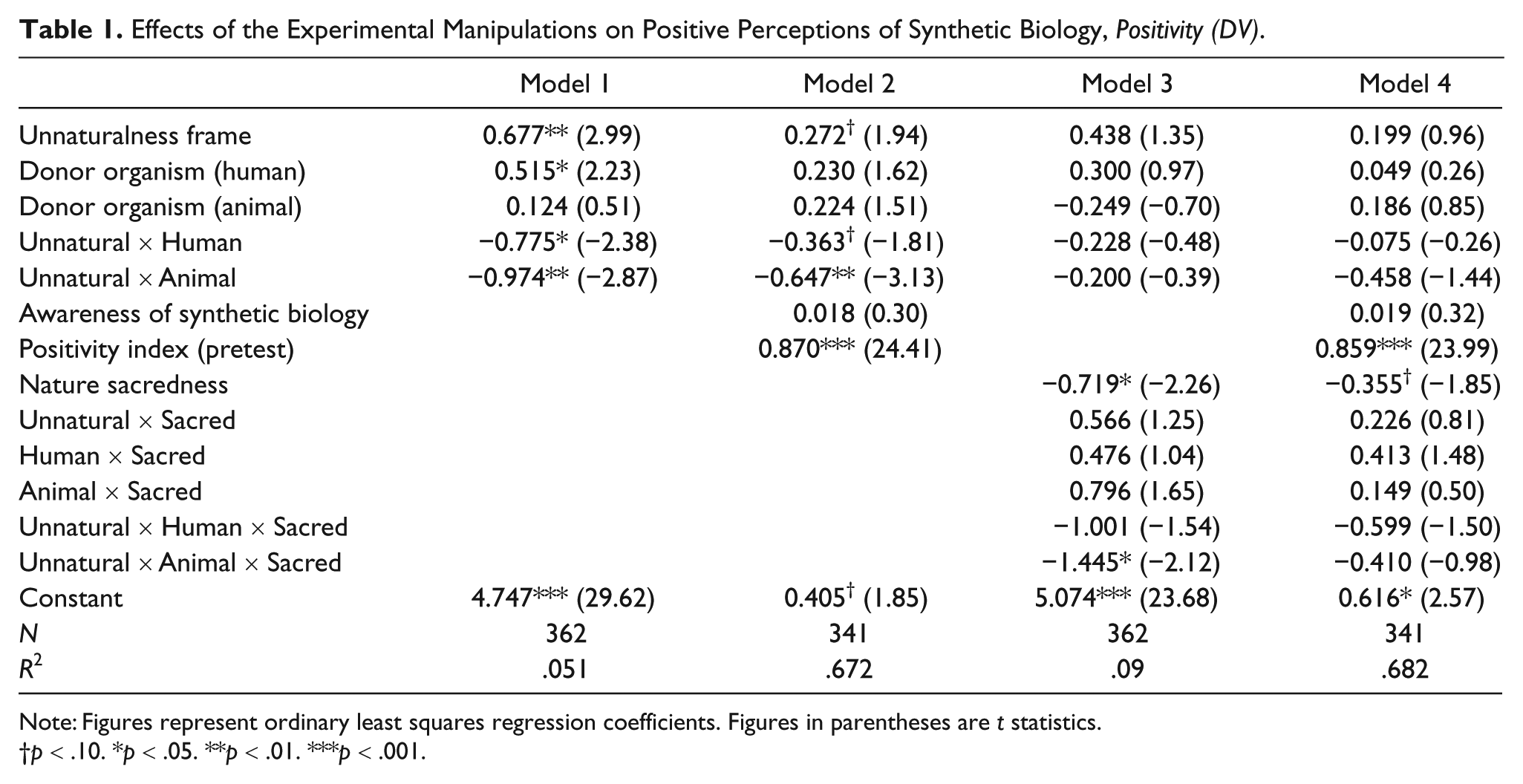
Note: Figures represent ordinary least squares regression coefficients. Figures in parentheses are t statistics.
p < .10. *p < .05. **p < .01. ***p < .001.
Mean Values of Dependent and Pretreatment Variables by Experimental Condition.
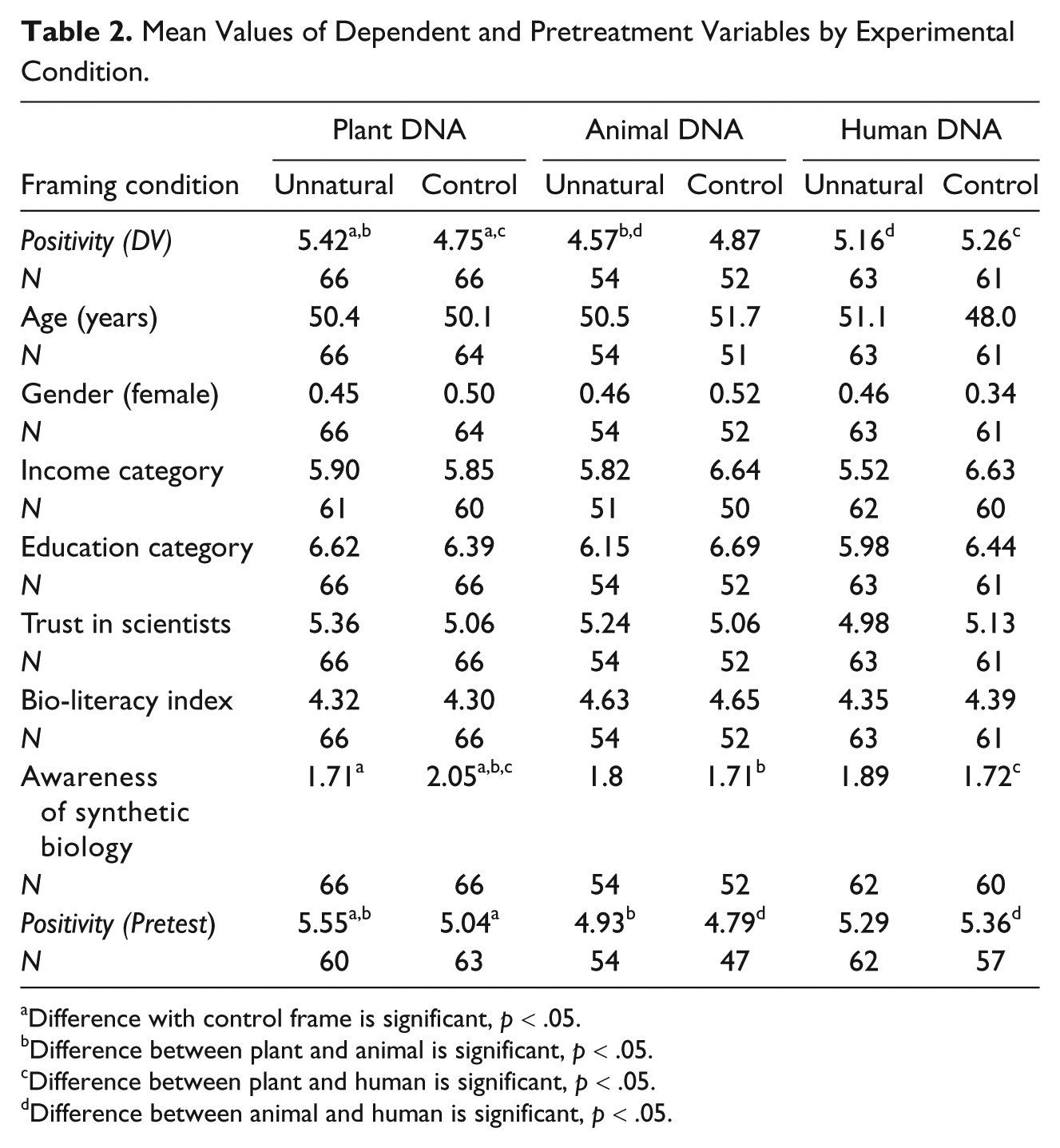
Difference with control frame is significant, p < .05.
Difference between plant and animal is significant, p < .05.
Difference between plant and human is significant, p < .05.
Difference between animal and human is significant, p < .05.
Because the significance of interaction effects in ordinary least squares regression can be difficult to determine directly from the significance of the coefficients for the individual component terms (Brambor, Clark, & Golder, 2006) and, moreover, to facilitate interpretation, we use the CLARIFY software package for Stata (King, Tomz, & Wittenberg, 2000; Tomz, Wittenberg, & King, 2001) to estimate the overall predicted effect of each experimental manipulation on Positivity (DV) in a number of contexts. We set control variables at their means in Models 2 and 4 and present these results graphically in Figures 1 to 4.
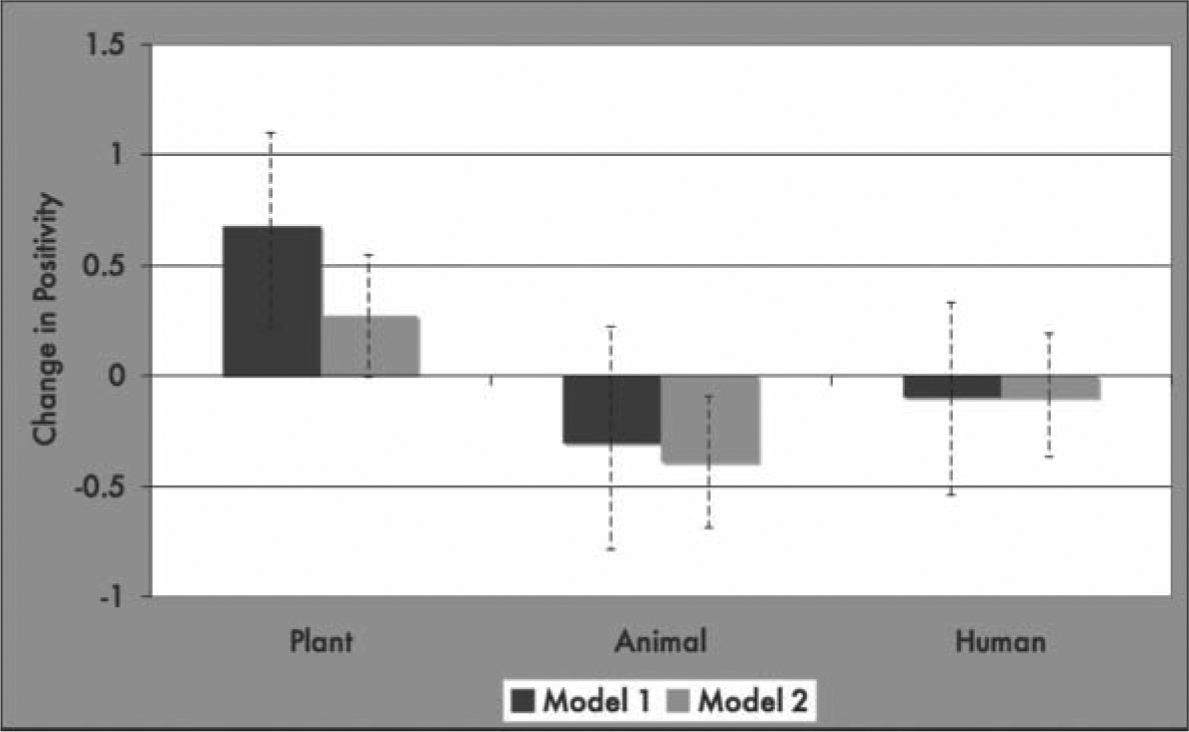
Predicted effects of the unnaturalness frame on positive attitudes toward synthetic biology, Positivity (DV), for the three types of genetic donor organism.
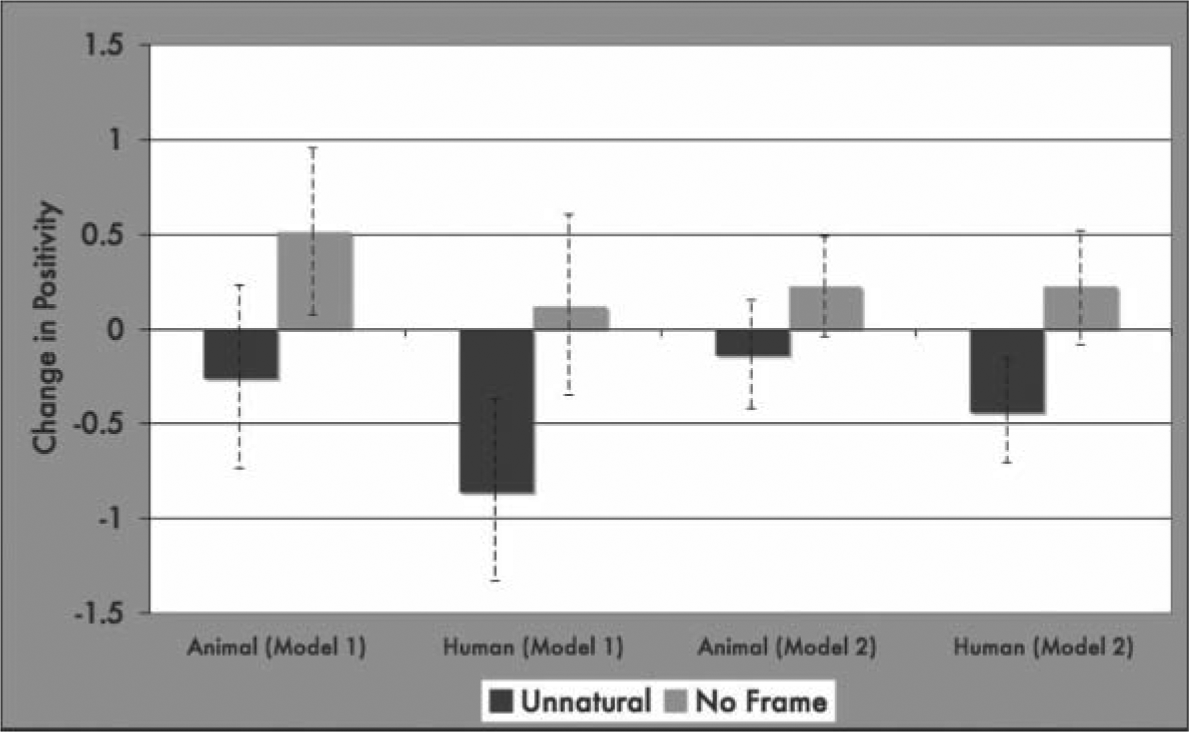
Predicted effects of evolutionary distance between platform and donor organisms (the plant donor condition is the baseline) on positive attitudes toward synthetic biology, Positivity (DV).
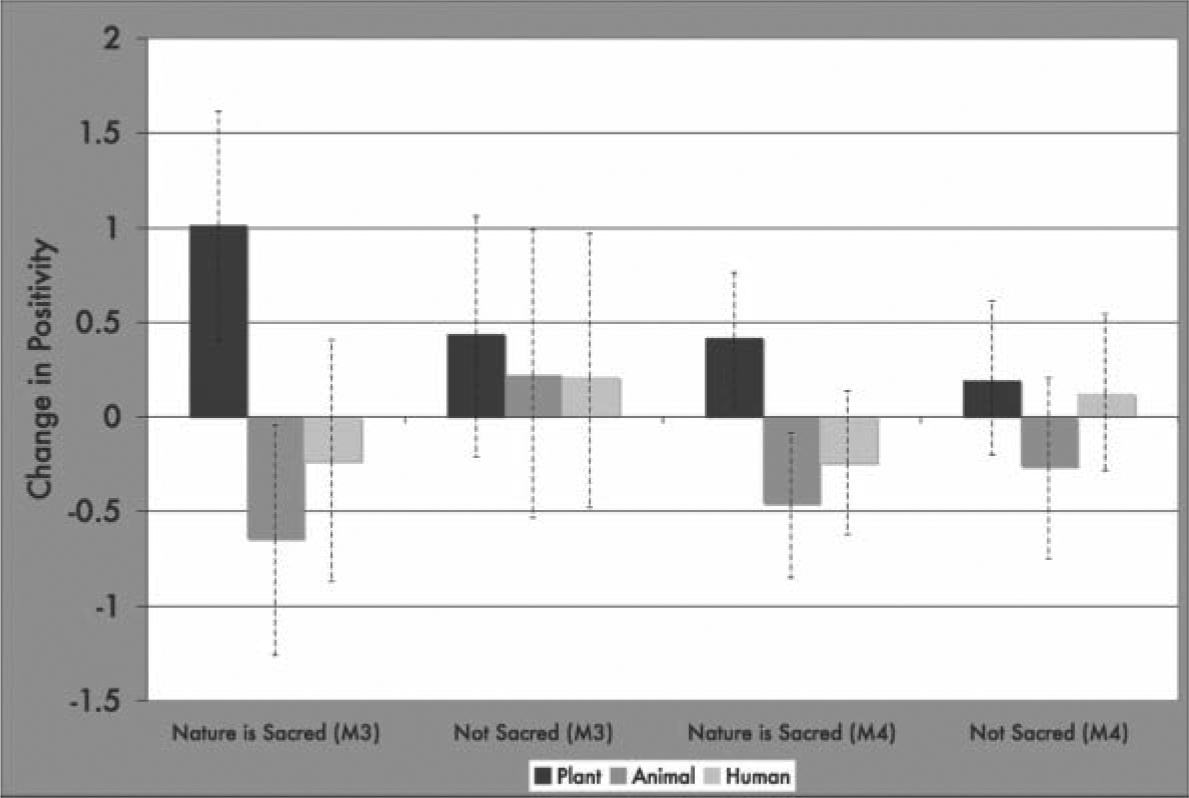
Predicted effects of the unnaturalness frame on positive attitudes toward synthetic biology, Positivity (DV), conditional on participants’ conception of nature, and separately for each type of genetic donor organism.
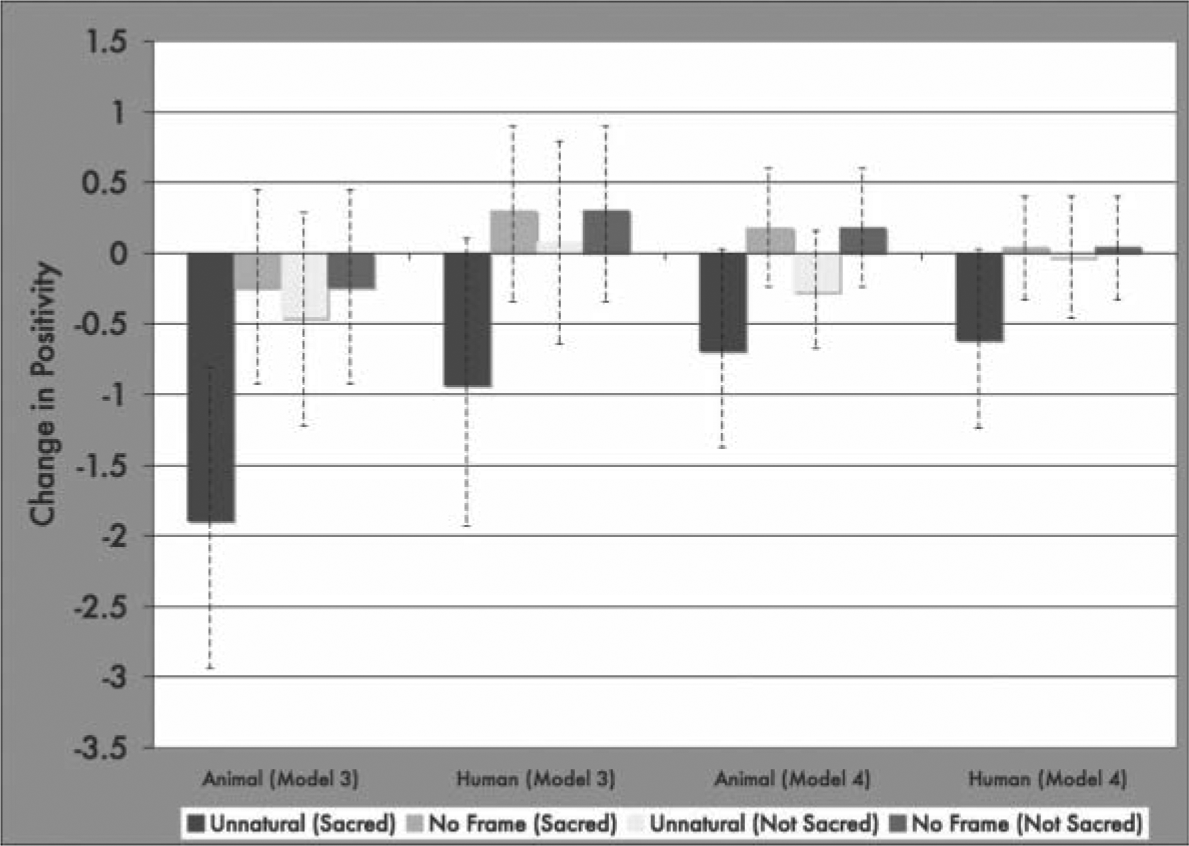
Predicted effects of evolutionary distance between platform and donor organisms on positive attitudes toward synthetic biology, Positivity (DV), conditional on participants’ conception of nature and on whether they were exposed to the unnaturalness frame.
Figure 1 shows the predicted effect of the unnaturalness frame (when compared to the “no frame” condition) for each type of donor organism, for the baseline model (Model 1) and for the adjusted model (Model 2). The first thing to note is that the unnaturalness frame appears to move attitudes in different directions depending on the type of donor organism, with negative predicted effects for the animal-yeast and human-yeast applications and positive effects for the plant-yeast application. While the effects for human donors are of small magnitude and are not statistically significant, the main effects for the other two donor organisms are more informative. For an animal donor, the unnaturalness frame appears to reduce Positivity (DV) by between 0.3 and 0.4 points (about 5% to 7% of the range of the variable), with the effect becoming statistically significant at a 0.05 level when the imbalanced covariates are controlled for in Model 2 (i.e., the 95% confidence interval for the estimated effect, indicated by the error bars, does not include 0). For a plant donor, however, the frame appears to significantly increase positive perceptions of synthetic biology by about 0.7 points (or about 11% of the range of the variable) in Model 1, though this predicted effect is substantially reduced and is rendered only marginally significant when Synbio Awareness and Positivity (Pretest) are controlled for.
Overall, these results support Hypothesis 1, since the unnaturalness frame does significantly reduce positive perceptions of synthetic biology in the animal-yeast application condition, but, as suggested by our other hypotheses, they also point to a contextual effect for this argument. Specifically, the objection actually had a positive effect for a yeast modified using plant genes, which is consistent with Hypothesis 3b and suggests that the unnaturalness objection will be more effective when the “objective” unnaturalness of a biotechnological application is greater—that is, when the evolutionary distance between host and donor organisms increases. Indeed, the result for the plant-yeast application, for which evolutionary distance is smaller than for the animal-yeast application, points to a possible contrast effect (Chong & Druckman, 2007) in which the frame actually backfired (presumably because it was perceived to be inapplicable to that context and therefore a weak argument against the technology).
Figure 2 presents the results from Models 1 and 2 from a different perspective, showing the predicted difference in positive perceptions of synthetic biology in the human-yeast and animal-yeast application conditions as compared to that in the plant-yeast condition. In other words, the figure shows the predicted effects of evolutionary distance on Positivity (DV) separately for the two framing conditions. Here, the pattern of effects is clearer. Specifically, when an unnaturalness frame is not used by opponents, participants appeared to feel equally or more positive about a yeast with animal or human genes than one with plant genes. Three of these four positive effects are of small magnitude and nonsignificant, however, and the only significant effect (for animal-yeast in Model 1) disappears in the adjusted model. In contrast, when opponents do use the unnaturalness frame, all the predicted effects are negative, and the effect for the human-yeast condition is statistically significant in both Models 1 and 2. Concretely, participants perceive the yeast with human genes more negatively than the yeast with plant genes by between 0.4 and 0.9 points, which represents between 7% and 15% of the range of the dependent variable.
Overall, this pattern of results strongly supports Hypothesis 3a, which suggests that the evolutionary distance between donor and host organisms of a biotechnological application (i.e., it’s “objective” unnaturalness) will only influence attitudes when it is “activated” by an unnaturalness objection. Combined with the results presented in Figure 1, then, we can conclude that the perceived “unnaturalness” of an application can indeed reduce its public acceptability but that this is only likely to happen when the actual features of the application make it appear more “unnatural” and when opponents of the application use arguments to increase the weight that individuals place on this consideration when evaluating the application in question. A natural follow-up question, then, is this: Which groups of individuals are most susceptible to this type of dynamic?
Models 3 and 4 explore this issue by interacting the experimental manipulations with our dichotomous measure of participants’ conceptions of nature (Nature Sacredness). Figures 3 and 4 use these estimates to present the same predicted probabilities as in Figures 1 and 2 but split separately according to people’s conceptions of nature. The results presented in Figure 3 strongly support Hypothesis 2a, which predicts that the unnaturalness objection should be most effective in moving attitudes among those who believe that Nature is sacred or spiritual, and provide further support for Hypotheses 1 and 3b. Specifically, among individuals who believed that nature is “important,” but not sacred or spiritual, the unnaturalness objection did not change their perceptions of synthetic biology in either the baseline (Model 3) or adjusted models (Model 4), regardless of the evolutionary distance between donor and host organisms. Among those who did believe that Nature is sacred or spiritual, however, we find that the unnaturalness objection significantly reduced participants’ positive perceptions of synthetic biology by between 0.45 and 0.65 points when the yeast in the article incorporated animal genes but increased positive perceptions by between 0.4 and 1.0 points when it incorporated plant genes. Both of these effects are statistically significant in both Models 3 and 4, though the magnitude of the contrast effect in the plant-yeast application is substantially reduced when the imbalanced covariates are controlled for. As in Figure 1, the unnaturalness frame does not appear to influence attitudes when the yeast incorporates human genes.
Overall, this provides robust support for the idea that those who believe that Nature is sacred or spiritual are most sensitive to both the unnaturalness objection and the evolutionary distance between donor and host organisms (since, unlike those who do not believe that nature is sacred, their responses to the unnaturalness frame distinguish between the plant-yeast application and the animal-yeast application contexts). This conclusion is further supported by Figure 4. Specifically, attitudes toward both the animal-yeast and the human-yeast applications appear to differ from perceptions of the plant-yeast application only among participants who believe that nature is sacred or spiritual and who are exposed to the unnaturalness objection. In this case, the more evolutionarily distant applications are perceived between 0.6 and 0.7 points more negatively than the plant-yeast application (Model 4), and while these effects are only marginally significant, they are substantially larger than the predicted effects in any of the other three contexts. Together with Figure 3, these findings strongly support Hypothesis 2b, which suggests that evolutionary distance will be a meaningful product attribute only among those who perceive nature to be sacred, as well as Hypothesis 3a, which predicts that this attribute is only likely to influence attitudes when it is activated by an unnaturalness objection.
Discussion and Conclusion
Taken as a whole, the results of this experiment provide strong support for the argument that the extent to which the perceived “unnaturalness” of a specific biotechnological application influences its public acceptability will depend on both the objective characteristics of the application itself and the communications context, which is characterized both by the arguments used by opponents of the application and by the values espoused by their audience. We find, specifically, that the unnaturalness objection does reduce positive perceptions of synthetic biology, but only among individuals who ascribe intrinsic value to nature (i.e., those who perceive “Nature” to be sacred or spiritual) and only when the evolutionary distance between the host and donor organisms is large. When this distance is smaller, as in the plant-yeast application, the unnaturalness argument appears to be judged to be inapplicable and not only is ineffective at reducing the acceptability of synthetic biology as a consequence but also actually appears to backfire, leading to increased positive perceptions of the technology.
Our findings contribute to the science communication literature in at least two ways. From a substantive perspective, they help us further understand the specific conditions under which a symbolically important characteristic of real-life synthetic biology applications—the evolutionary distance between the donor and host organisms—is likely to influence public perceptions of this technology. Moreover, the present study is, to our knowledge, the first to investigate the impact of the unnaturalness argument on biotechnology attitudes using an experimental research design. Previous public opinion work on this question has had difficulty inferring the marginal impact of unnaturalness perceptions on biotechnology attitudes because it has relied primarily on observational data and typically conceives of unnaturalness perceptions as a dependent variable. In contrast, approaching the question using a framing experiment allows us to, first, explore the question of unnaturalness directly as a feature of the communications environment, rather than as an underlying attitude, and, second, to make clear causal inferences about the effect of this objection on perceptions of a specific biotechnological application.
Taken together, these two sets of findings have mixed implications for advocates of “top-down” synthetic biology. On the one hand, the null effects for the unnaturalness objection in the plant-yeast condition suggest that many specific applications of the technology may prove to be relatively immune to attempts by critics to drum up controversy using generic values-related frames like the unnaturalness objection. Indeed, when the application in question is not “objectively” unnatural, advocates may be best served by ignoring this type of argument, since our results suggest that they can even backfire on critics who use them. On the other hand, our findings show that the unnaturalness objection can indeed have a substantive impact on public perceptions of synthetic biology applications in which the platform organism has been more substantially modified. In fact, given the relatively subtle manipulation used in our experiment, the small magnitude of the effects shown in our results may underestimate the power of the unnaturalness argument. Together, this suggests that advocates of synthetic biology should invest time in developing effective counterarguments to the unnaturalness objection. That said, we hasten to add that the unnaturalness consideration is only one of many influences on people’s attitudes toward synthetic biology, and we are not claiming that it is necessarily the most important. As shown in Table 1, Model 1, which included only the experimental manipulations, explained about 5% of the variance in attitudes toward synthetic biology. While this is a respectable figure for this type of general population experiment, it highlights that most of the variance in perceptions of synthetic biology is likely to be explained by other factors.
Finally, this article also contributes to the theoretical literature on framing effects in science communication. Specifically, our findings point to a relatively objective feature of the communications context (the evolutionary distance between host and donor organisms) that influences the perceived applicability of the unnaturalness argument to an audience’s evaluation of synthetic biology applications and moderates its effect on people’s attitudes. At the same time, we also find that the unnaturalness objection acts to “activate” this feature of the application in question when the evolutionary distance is large, which illustrates the power of frames to shape how “objective” features of a technology are perceived by the public. Taken together, these results point to the need for further research to identify the conditions under which advocates and opponents of new technologies are able to use rhetorical frames to shape how we perceive these technologies and when their messaging is likely to be ignored because it simply does not fit with the objective reality of the technology in question.
Footnotes
Declaration of Conflicting Interests
The author(s) declared no potential conflicts of interest with respect to the research, authorship, and/or publication of this article.
Funding
The author(s) disclosed receipt of the following financial support for the research, authorship, and/or publication of this article: This research was supported by PhytoMetaSyn, a Genome Canada-funded project for which Dr. Einsiedel serves as coprincipal investigator. The PhytoMetaSyn project is supported by Genome Canada and Genome Alberta.
Notes
Author Biographies
References
Supplementary Material
Please find the following supplemental material available below.
For Open Access articles published under a Creative Commons License, all supplemental material carries the same license as the article it is associated with.
For non-Open Access articles published, all supplemental material carries a non-exclusive license, and permission requests for re-use of supplemental material or any part of supplemental material shall be sent directly to the copyright owner as specified in the copyright notice associated with the article.
